UK’s nuclear obsessions kill off its net zero strategy

The new Roadmap reads like an outing to a massive nuclear sweet shop. On top of Hinkley Point C and Sizewell C, we’ll have one more big one. And then we’ll have lots of Small Modular Reactors, all over the country. And we’ll have a new fuel processing plant. And a new Geological Disposal Facility – at some much more distance point. And so on and on. 24 fantastical Gigawatts to be designed and delivered by 2050.
Jonathon Porritt, 18 Jan 24
After 14 years of Tory mismanagement, the UK finds itself bereft of an energy strategy.
This was finally confirmed in the release last week of the Government’s new Nuclear Roadmap. At one level, it’s just the same old, same old, the latest in a very long line of PR-driven, more or less fantastical wishlists for new nuclear in the UK. But at another, it’s a total revelation.
For years, a small group of dedicated academics and campaigners have suggested that the UK Government’s Nuclear Energy Strategy is being driven more by the UK’s continuing commitment to an “independent” nuclear weapons capability than by any authoritative energy analysis. For an equal number of years, this was aggressively rebutted by one Energy Minister after another, both Tory and Labour.
The new Nuclear Roadmap dramatically changes all that. It sets to one side any pretence that the links between our civil nuclear programme and our military defence needs were anything other than small-scale – and of no material strategic significance. With quite startling transparency and clarity, the Roadmap not only reveals the full extent of those links, but positively celebrates that co-dependency as a massive plus in our ambition to achieve a Net Zero economy by 2050.
“Startling” is actually an understatement. Such a comprehensive volte-face is rare in policy-making circles. Every effort is usually made by Ministers to obscure the scale (let along the significance) of any such screeching handbrake turns. That is so not the case with the new Roadmap.
Courtesy of the latest forensic work done by Professors Andy Stirling and Phil Johnstone at Sussex University (who have been absolutely at the forefront of seeking to bring these links into the public domain over many years – often with mighty little support from mainstream environmental organisations, let alone “independent” commentators), chapter and verse of this volte-face can be laid bare. Just three o examples from the Roadmap:
- “Not only does this Roadmap set a clear path for the growth of nuclear fission…it acknowledges the crucial importance of the nuclear industry to our national security, both in terms of energy supply and the defence nuclear enterprise.”
- “Government will proactively look for opportunities to align delivery of the civil and nuclear defence enterprises, whilst maintaining the highest standards of non-proliferation.”
- “To address the commonalities across the civil and defence supply chains, and the potential risk to our respective nuclear programmes due to competing demand for the supply chain, the Department of Energy Security and Net Zero (DESNZ) is working closely with the Ministry of Defence and the Defence Nuclear Sector.”
And there’s a whole lot more than that! As Andy Stirling has said: “Without any reflection on what this says about previous efforts to suppress discussion of this issue, the Government is now openly emphasising its significance.”
Indeed!
As usual, the UK’s ill-informed and unbelievably gullible mainstream media would appear to have missed the significance of this gobsmacking inflection point. So one can hardly expect them to have grasped its even more significant implications for UK energy strategy as a whole. In every single particular.
Let me briefly unpack some of those particulars:
- Nuclear
The new Roadmap reads like an outing to a massive nuclear sweet shop. On top of Hinkley Point C and Sizewell C, we’ll have one more big one. And then we’ll have lots of Small Modular Reactors, all over the country. And we’ll have a new fuel processing plant. And a new Geological Disposal Facility – at some much more distance point. And so on and on. 24 fantastical Gigawatts to be designed and delivered by 2050.
The reality couldn’t be more different:
- We will indeed end up with Hinkley Point C – at a staggering of cost of somewhere between £26 billion and £30 billion, with consumers paying twice as much for its electricity as they will for offshore wind. And it will almost certainly not come online until the end of the decade, 15 years on from the time it was meant to be up and running.
- We may possibly get Sizewell C, though the Government cannot currently guarantee the required level of investment. So a Final Investment Decision is unlikely before the next Election. At which point, Starmer may come to his senses and kill off this absurd white elephant.
- We will never get a third big reactor. The economics are literally impossible to justify.
- We are unlikely to get more than a couple of hugely expensive Small Modular Reactors, at some indeterminate point in the future, even with a new “flexible approach” to planning and financial inducements. Even that may prove to be an illusion. As Professor Steve Thomas has written: “Advocates of Small Nuclear Reactors claim they are cheaper and easier to build, safer, generate less waste, and will create many jobs compared to existing large reactor designs. These claims are unproven, misleading, or just plain wrong. Worldwide, no commercial design of SMR has even received a firm order yet.”
- And we may or may not get life extensions for the last five power stations in the “legacy fleet” – subject to regulatory approval, which may not be all that easy given extensive cracking in their reactor cores.
In short, the Roadmap is just a massive diversion from reality. Entailing incalculable opportunity costs. And putting at risk our entire Net Zero by 2050 strategy.

Ministers know all that. But they don’t really care. Our nuclear weapons programme (including upgrading Trident) will be protected as a consequence of this, via an unceasing flow of public money into the civil nuclear cul-de-sac, at a time when our defence budget is already massively overstretched. So who cares about the missing 24GW?
- Renewables
We’ll continue to see new investment into renewables here in the UK, despite (not because of) government policy, which has seriously messed up our offshore wind industry, maintained a de facto ban on onshore wind, couldn’t care less about solar, witters on vapidly about tidal without doing anything etc etc.
Meanwhile, on a global basis, renewables continue to boom. Here are a few facts – in contrast to over-excited sightings of nuclear unicorns:…………………………………………………………………………………………………………………………………………………………
Why don’t people see this?
Why don’t our mainstream media offer any serious critique of what’s going on here?
Why don’t our opposition parties rip to shreds this tissue of preposterous illusions?
The reasons for this almost complete silence can be traced back to successive governments’ grim intent to hang onto our so-called “independent nuclear deterrent”. At literally any costs…………………………………………………………………….more https://www.jonathonporritt.com/uks-nuclear-obsessions-kill-off-its-net-zero-strategy/
Zelensky Courts JPMorgan, Bank of America & Bridgewater CEOs At Davos, Urges More Money From West
Zero Hedge, BY TYLER DURDEN, WEDNESDAY, JAN 17, 2024
As expected, anything related to Ukraine presented at the World Economic Forum (WEF) in Davos has been focused on more weaponry and seeking more vows of integration among Western allies.
“Ukrainians need predictable financing throughout 2024 and beyond,” European Commission president Ursula von der Leyen told World Economic Forum participants. “They need a sufficient and sustained supply of weapons to defend Ukraine and regain its rightful territory.”
As for President Zelensky, in addressing world leaders at the forum he emphasized that the West needs to help Ukraine achieve air superiority if his forces are to have a chance to emerge victorious against Russia……………………………………

At the summit, US Secretary of State Antony Blinken promised that Washington will keep up its support for Ukraine, however while keeping things vague – following Biden’s proposed foreign defense budget request being reject by GOP members in Congress; and NATO chief Jens Stoltenberg suggested Ukraine is moving closer to entry into the alliance.
Stoltenberg acknowledged a “serious battlefield situation” but also said there is “cause for optimism” after nearly two years of fighting, and NATO’s constant support.
Below is a portion of the NATO press readout based on his panel speech:
………… Ukrainians are now firmly oriented to the West, aspiring for membership in NATO and the European Union. The Secretary General also stressed that “support for Ukraine is not charity; it’s an investment in our own security”.………
But realistically, the prospect of Ukraine gaining full NATO membership would be a process of years, and would likely trigger WW3 with Russia–so to some degree this is all empty posturing.
But here’s what’s happening at Davos which is arguably more important to Kiev at the moment:
Ukraine is seeking new ways to finance its rebuilding plans as vital aid from the West slows down. President Volodymyr Zelenskyy reportedly has plans to meet JP Morgan’s CEO at the World Economic Forum.
Ukraine’s President Zelenskyy is reportedly planning to meet JPMorgan CEO Jamie Dimon at the World Economic Forum in Davos to seek new ways of financing its rebuilding plans.
JP Morgan, the biggest US bank with almost half a trillion dollars of market capitalization, has already been advising Ukraine on financing reconstruction.
It’s as yet unclear if any firm promises were made or agreements struck at the Davos meeting which also included Bank of America’s Brian Moynihan, as well as Bridgewater’s Ray Dalio.
According to further details of who was in attendance via Fox Business: “Other meeting attendees included David Rubinstein of the private equity firm Carlyle Group; billionaire entrepreneur Michael Dell, the founder of Dell Technologies; Ray Dalio of Bridgewater Associates, the world’s largest hedge fund; Steve Schwarzman, the CEO of Blackstone, the world’s largest private equity fund; and Philipp Hildebrand, representing BlackRock, the world’s largest money manager.”
Additionally, “Dimon was accompanied by Mary Erdoes, who runs JPMorgan’s asset-management unit. The White House was represented by Penny Pritzker, of the super-wealthy Pritzker family and a major Democratic Party donor.” Pritzker has been appointed Biden administration’s special representative for Ukraine’s economic recovery. https://www.zerohedge.com/geopolitical/zelensky-courts-jpmorgan-bank-america-bridgewater-ceos-davos-urges-more-west
For Estonia the risks of going nuclear are high, and the plant not strictly necessary
ERR EE, Jevgeni Ossinovski, chair of the Social Democratic Party (SDE) parliamentary group, 20 Jan 24
Our worst-case scenario would be suspending Estonia’s sustainability efforts in anticipation of a nuclear power plant, Jevgeni Ossinovski (SDE) writes.
“….. nuclear power plants could be the preferable option in countries with high population density, high energy demand and limited land for renewable energy development.
A very different question is whether Estonia needs a nuclear power plant. We lack the skills, regulations, civil protection and monitoring systems, or even a waste disposal site, for building and operating a nuclear power plant. For all of these reasons, developing a nuclear facility carries significant risks and societal costs that would fall on future generations.
The report of the [Estonian] nuclear working group suggests that it is possible to build a nuclear power plant in Estonia, which is not surprising. Also, the report suggests ways to minimize some of the risks involved, but on several critical topics, such as the final disposal of nuclear waste, it provides little insight and merely states that a waste disposal solution will be eventually developed, which apparently does not yet exist.
Unfortunately, the report also fails to address the question, which is critical to Social Democrats: Is it unavoidable that Estonia needs a nuclear power plant, considering the long-term risks and consequences?
The board of the Social Democrats adopted the position that the answer to this question was “no” as early as 2021. There are other alternative approaches that could speed up the realization of our energy goals, and these are affordable, environmentally sustainable and reliable energy sources.
At the Social Democrats’ insistence, a goal of generating 100 percent of our electricity from renewable sources by 2030 has become law. The administration is aiming to establish the necessary regulatory structure to double renewable energy generation in the coming years.
This will give us a surplus of energy for over half the year, which we should aim to store for periods when there is no wind and little sun, or export. So we’ll be supported by fast-growing storage capacity (the soon-to-be-built Paldiski hydropump and battery storage), better consumption management and links to neighboring nations where we can also get electricity in cases of shortages for most of the remaining hours………………………………………………………………………………………..
The development of renewables, storage facilities, consumption management, and international trade will give us what we need: economical, climate-friendly and secure electricity under normal grid conditions, while we also have sufficient reserve capacity for extreme cases……………………………….
Our worst-case scenario would be suspending Estonia’s sustainability efforts in anticipation of a nuclear power plant. If the plant is not built in 10 years due to public opposition, a political decision, the immaturity of [small modular reactor] technology, or a lack of investment (all of which are real risks), we will be facing a sinkhole and the National Audit Office once again will have to admit that decision-makers shortchanged the Estonian people.
Should new circumstances emerge that indicate Estonia is incapable of achieving its energy policy goals without a nuclear power plant, we will be ready to reassess our position. So far, the nuclear energy working group failed to address this issue in its report. https://news.err.ee/1609227519/ossinovski-risks-of-going-nuclear-high-and-the-plant-not-strictly-necessary
The threat of catastrophe is assessed in Nuclear Armageddon: How Close Are We? — review
Ft.com, 19 Jan 24,
BBC documentary surveys experts in international security, diplomacy and military science to shed light on current reality
………………………………….. Nuclear Armageddon: How Close Are We?, a BBC documentary tied to the Doomsday Clock update, asks why the hands have ominously ticked to within 90 seconds of a catastrophic “midnight”, the shortest time recorded since the clock’s inception in 1947. The title strikes an alarmist tone but the show itself is built on the reporting of journalist and filmmaker Jane Corbin and insightful interviews with experts in international security, diplomacy and military science. They include a Nobel Prize winner and a physicist who has been given rare access to North Korea’s nuclear facilities……………………………………………….
Please use the sharing tools found via the share button at the top or side of articles. Copying articles to share with others is a breach of FT.comT&Cs and Copyright Policy. Email licensing@ft.com to buy additional rights. Subscribers may share up to 10 or 20 articles per month using the gift article service. More information can be found here.
https://www.ft.com/content/64d5c035-b1de-480a-95d6-06ce7b07b9ae
The documentary is balanced and informative yet it can only scratch the surface in a single hour. A longer runtime would have left room for a more thorough analysis of how the conflict in the Middle East could shape Iran’s uncertain nuclear future, and what the re-election of a man accused of keeping classified domestic documents in the bathroom of his private residence might mean for the US and the world. As Bronson notes at one point, all it takes are careless “accidents and misperceptions” to plunge us into midnight darkness. https://www.ft.com/content/64d5c035-b1de-480a-95d6-06ce7b07b9ae
North Korea says it tested underwater nuclear attack drone in response to rivals’ naval drills
By Associated Press Jan 19, 24, https://www.9news.com.au/national/north-korea-says-it-tested-underwater-nuclear-attack-drone-in-response-to-rivals-naval-drills/c2549630-f1b1-47f9-a510-0c1352a6ca97
North Korea vows to back Russia after meeting between leaders
North Korea said on Friday it had tested a purported underwater nuclear attack drone in response to a combined naval exercise between South Korea, the United States and Japan this week, as it continues to blame its rivals for raising tensions in the region.
The alleged drone test came days after North Korean leader Kim Jong Un declared he would scrap his country’s long-standing goal of a peaceful unification with South Korea and that his country would rewrite its constitution to define South Korea as its most hostile foreign adversary.
Tensions on the Korean Peninsula have risen to their highest point in years, with Kim accelerating his weapons testing activity and threatening nuclear conflict.
The United States and its Asian allies have responded by strengthening their combined military exercises, which Kim calls rehearsals for invasion.
North Korea’s alleged nuclear attack drone, which the North first tested last year, is among a broad range of weapon systems demonstrated in recent years as Kim expands his arsenal of nuclear-capable weapons.
South Korea’s military has insisted the North has exaggerated the capabilities of the drone, which is supposedly designed to carry out strikes on enemy vessels and ports.
The North’s military said it conducted the test in the country’s eastern waters in response to the US, South Korean and Japanese joint naval drill, which ended on Wednesday in waters south of Jeju island.
“Our army’s underwater nuke-based countering posture is being further rounded off and its various maritime and underwater responsive actions will continue to deter the hostile military maneuvers of the navies of the US and its allies,” the North’s Defence Ministry said in a statement.
“We strongly denounce the US and its followers for their reckless acts of seriously threatening the security of the DPRK from the outset of the year and sternly warn them of the catastrophic consequences to be entailed by them,” it said, using the initials of North Korea’s formal name, the Democratic People’s Republic of Korea.
The North in recent months has also tested various missile systems designed to target the United States and its Asian allies, and announced an escalatory nuclear doctrine that authorises the military to conduct preemptive nuclear strikes if the leadership in Pyongyang is under threat.
The North conducted its first ballistic missile test of 2024 on Sunday, which state media described as a new solid-fuel, intermediate-range missile tipped with a hypersonic warhead, likely intended to target US military bases in Guam and Japan.
At an emergency meeting of the UN Security Council on Thursday, South Korea called on the council “to break the silence” over North Korea’s escalating missile tests and threats. Two of the council’s permanent members, Russia and China, have blocked US-led efforts to increase sanctions on Pyongyang over its recent testing activity, underscoring a divide deepened over Russia’s war on Ukraine. South Korea is serving a two-year term on the council
It’s All About Me: Netanyahu Rejects Palestinian Statehood

January 20, 2024Written by: Dr Binoy Kampmark, https://theaimn.com/its-all-about-me-netanyahu-rejects-palestinian-statehood/
Israel has been given enormous license to control the security narrative in the Middle East for decades. This is not to say it is always in control of it – the attacks of October 7 by Hamas show that such control is rickety and bound, at stages, to come undone. What matters for Israeli security is that certain neighbours always understand that they are never to do certain things, lest they risk existential oblivion.
For instance, no Middle Eastern state will be permitted to acquire nuclear weapons on the Jewish State’s watch. Nuclear reactors and facilities will be struck, infected, or pulverised altogether (Osirak at Tuwaitha, Iraq; the Natanz site in Iran), with, or without knowledge, approval or participation of the United States.
This is a signature mark of Israeli foreign and defence policy: the nuclear option remains the greatest, single affirmation of sovereignty in international relations. To possess it, precisely because of its destructive and shielding potential, is to proclaim to the community of nation states that you have lethal insurance against invasion and regime change. Best, then, to make sure others do not possess it.
Israel, on the other hand, will be permitted to develop its own cataclysmic inventory of weapons, platforms, and doomsday options, all the while claiming strategic ambiguity about the whole matter. In that strangulating way, Israeli policy resembles the thornily disingenuous former US President Bill Clinton’s approach to taking drugs and oral sex: he did not inhale, and oral pleasuring by one by another is simply not sex.
The latest remarks from Israeli Prime Minister Benjamin Netanyahu on January 18 suggest that the license also extends to ensuring that Palestinians will never be permitted a sovereign homeland, that they will be, in a perverse biblical echo, kept in a form of bondage, downtrodden, oppressed and, given what happened on October 7 last year, suppressed. This is to ensure that, whatever the grievance, that they never err, never threaten, and never cause grief to the Israeli State. To that end, it is axiomatic that their political authorities are kept incipient, inchoate, corrupt and permanently on life support, the tolerated beggars and charity seekers of the Middle East.
At the press conference in question, held at the Kirya military base in Tel Aviv, Netanyahu claimed that, “Whoever is talking about the ‘day after Netanyahu’ is essentially talking about the establishment of the Palestinian state with the Palestinian Authority.” (How very like the Israeli PM to make it all about him.) The Israel-Palestinian conflict, he wanted to clarify, was “not about the absence of a state, a Palestinian state, but rather about the existence of a state, a Jewish state.”
With monumental gall, he complained that “All territory we evacuate, we get terror, terrible terror against us.” His examples, enumerated much like sins at a confessional, were instances where Israel, as an occupying force, had left or reduced their presence: Gaza, southern Lebanon, parts of Judea and Samaria (the West Bank). It followed that “any future arrangement, or in the absence of any future arrangement,” Israel would continue to maintain “security control” of all lands west of the Jordan River. “That is a vital condition.”
As such lands comprise Israeli territory, Gaza and the West Bank, Palestinian sovereignty can be assuredly ignored as a tenable outcome in Netanyahu’s policed paradise. He even went so far as to acknowledge that this “contradicts the idea of sovereignty” as far as the Palestinians are concerned. “What can you do? I tell this truth to our American friends.”
As to sceptical mutterings in the Israeli press about the country’s prospects of defeating Hamas decisively, Netanyahu was all foamy with indignation. “We will continue to fight at full strength until we achieve our goals: the return of all our hostages – and I say again, only military pressure will lead to their release; the elimination of Hamas; the certainty that Gaza will never again represent a threat to Israel. There won’t be any party that educates for terror, funds terror, sends terrorists against us.”
This hairbrained policy of ethno-religious lunacy masquerading as sane military strategy ensures that permanent war nourished by the poison of blood-rich hatred and revenge will continue unabated. In keeping such a powder keg stocked, there is always the risk that other powers and antagonists willing to have a say through bombs, rockets and drones will light it. Should this or that state be permitted to exist or come into being? The answer is bound to be convulsively violent.
It is of minor interest that officials in the United States found Netanyahu’s comments a touch off-putting. US Secretary of State Antony Blinken had, it is reported, dangled a proposal before the Israeli PM that would see Saudi Arabia normalise relations with Israel in exchange for an agreement to facilitate the pathway to Palestinian statehood. Netanyahu did not bite, insisting that he would not be a party to any agreement that would see the creation of a Palestinian state.
Blinken, if one is to rely on the veracity of the account, suggested that the removal of Hamas could never be achieved in purely military terms; a failure on the part of Israel’s leadership to recognise that fact would lead to a continuation of violence and history repeating itself.
In Washington, State Department spokesperson Matthew Miller stated in the daily press briefing that “Israel faces some very difficult choices in the months ahead.” The conflict in Gaza would eventually end; reconstruction would follow; agreement from various countries in the region to aid in that effort had been secured – all on the proviso that a “tangible path to the establishment of a Palestinian state” could be agreed upon.
For decades, administrations in Washington have fantasised about castles in the skies, the outlandish notion that Palestinians and Israelis might exist in cosy accord upon lands stolen and manured by brutal death. Washington, playing the Hegemonic Father, could then perch above the fray, gaze paternally upon the scrapping disputants, and suggest what was best for both. But the two-state solution was always encumbered and heavily conditioned to take place on Israeli terms, leaving all mediation and interventions by outsiders flitting gestures lacking substance.
Now, no one can claim otherwise that Palestinian statehood is anything other than spectral, fantastic, and doomed – at least under the current warring regime. Netanyahu’s own political survival, profanely linked to Israel’s own existence, depends on not just stifling pregnancies in Gaza but preventing the birth of a nationally recognised Palestinian state.
Work officially ‘started’ at Sizewell C Nuclear on Monday – but it was really only political theatre.

Ipswich Star, By Paul Geater 18 Jan 24
This week we had big fanfares and a major ceremony to “mark the start” of construction at Sizewell C.
But what did it all mean?
In one sense construction has already started. Land has been dug up, mature trees have been cut down, and one of the new entrances to the site is being cleared.
However, the Final Investment Decision (FID), the point at which the various parties are committed to building the station is still, apparently, several months away – so Monday’s ceremony really does look like nothing but a piece of political theatre.
What is clear, though, is that there is clear political will for this project to go ahead. The Government and the official opposition are both committed to it whatever the cost they may be exposed to.
I can understand that. I still don’t think it makes a great deal of economic sense – but given the uncertainties across the globe and the need to move to carbon zero energy I can see why they want to proceed with nuclear whatever the cost.
Personally I don’t have any concerns about the potential safety of the plant – while there are potential dangers with nuclear generation the experience over the last 60 years in this country suggests it can be operated safely.
And given that there are already two nuclear plants at Sizewell that need to be protected from the sea, it doesn’t seem unreasonable to put the new plant next to them so the protection can be shared.
I still have serious concerns with EDF and the government – who must be seen as equal partners in the project – over the way it is going to be built and the devastating impact it will have on local communities.
By adopting a “bull in a china shop” attitude towards its construction, EDF and the government are planning to cause substantial environmental damage to some of the most precious parts of the Heritage Coast that are closely linked in with Minsmere and Dunwich Heath……………………………………
Creating a new nature reserve two miles inland is great – but it can’t replace a massive area that’s directly linked to the coast.
But I fear that battle is lost now. With both the current government and the likely future government keen on the project, the best we can hope for is that some new habitats will make up for the lost treasures………………….
There’s also been a failure to really engage with local people. There have now been local community forums set up but they are being treated with suspicion by many. https://www.ipswichstar.co.uk/news/24054795.opinion-sizewell-c-still-doesnt-engage-residents/
No Palestinian state – Netanyahu
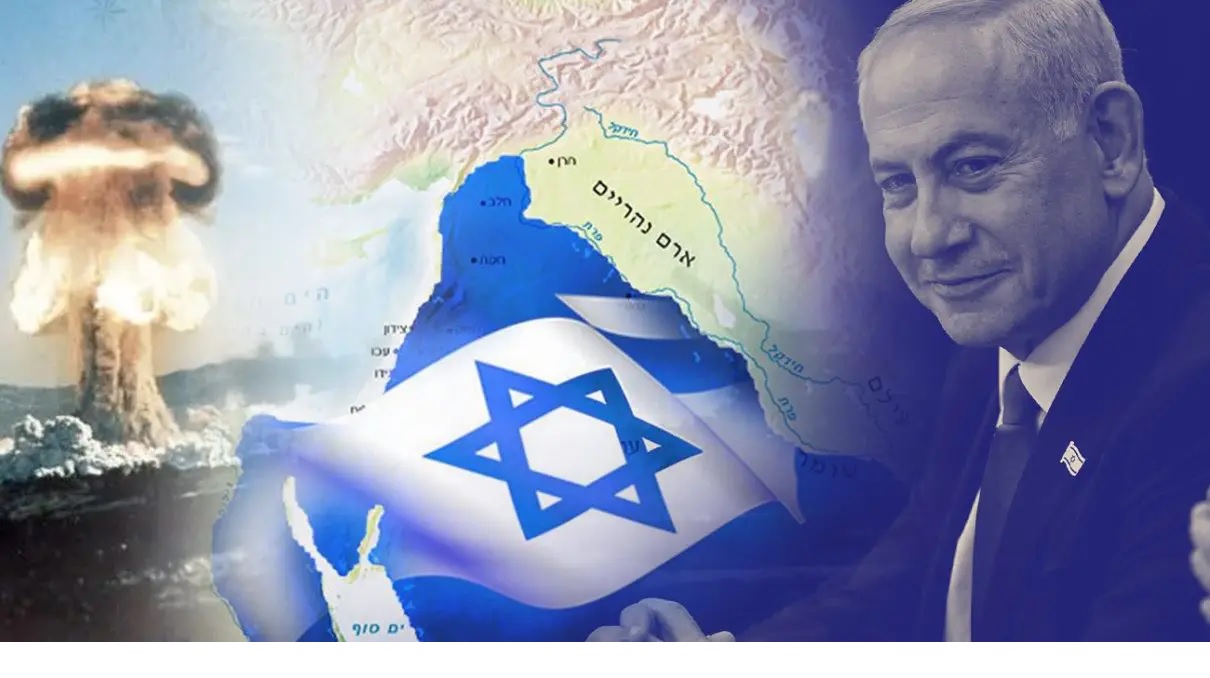
https://www.rt.com/news/590919-no-palestinian-state-netanyahu/ 19 Jan 24
The US and Israel have clashed over the future of post-war Gaza
Prime Minister Benjamin Netanyahu has declared that Israel “will not settle for anything short of an absolute victory,” rejecting calls from Washington to either wind down the hostilities in Gaza or support the creation of a Palestinian state.
The US pushed for the realization of the two-state solution earlier this week in Davos, with US Secretary of State Antony Blinken arguing that Israel’s path to “genuine security” lay with the formation of a Palestinian state.
The Israeli PM dismissed the idea on Thursday, asserting that “Israel must maintain security control over all the territory west of the Jordan River,” to ensure no “terror is leveled against” the Israeli people.
“We will not settle for anything short of an absolute victory… That collides with the idea of [Palestinian] sovereignty. What can we do?” Netanyahu said at a press briefing in Tel Aviv. “I have explained this truth to our American friends, and I put the brakes on the attempt to coerce us to a reality that would endanger the state of Israel.”
However, Washington believes there is no way to solve Israel and Gaza’s long- and short-term problems “without the establishment of a Palestinian state,” US State Department spokesperson Matthew Miller reiterated on Thursday.
During Blinken’s Middle East tour last week, the US delegation allegedly secured agreements with several Arab leaders to participate in rebuilding Gaza, provided that Israel moves forward with a two-state solution for Palestine.
“For the first time in its history, you see the countries in the region who are ready to step up and further integrate with Israel and provide real security assurances to Israel and the United States is ready to play its part too, but they all have to have a willing partner on the other side,” Miller continued, calling this a “historic opportunity” for Israel.
The IDF military operation in Gaza has drawn condemnation from the surrounding Arab states, as well as the wider international community, as the death toll among Palestinians nears 25,000 people, according to local officials.
The war has caused widespread destruction of civilian infrastructure in Gaza and displaced over 80% of the enclave’s 2.3 million residents since the fighting erupted on October 7. Hamas militants attacked Israel on that day, killing more than 1,100 people and taking over 200 hostages. According to Israeli sources, more than 130 people remain in captivity.
How Israel Bombed Al Jazeera Journalists & Blocked Rescue of Cameraman Samer Abudaqa Until He Died
Democracy Now. JANUARY 17, 2024
We hear from Democracy Now! correspondent Sharif Abdel Kouddous, whose recent article for The Intercept documents how Israel bombed two Al Jazeera journalists in mid-December while they were accompanying rescue workers, seriously injuring both. But while the network’s Gaza bureau chief Wael al-Dahdouh managed to get to an ambulance nearby, his cameraman Samer Abudaqa bled to death from his wounds as Israeli forces prevented medical workers from reaching him for about five hours, despite the desperate entreaties of many foreign journalists to save the life of their colleague. “The world should be outraged about this killing, about all the killings that are happening to Palestinian journalists in Gaza,” says Abdel Kouddous.1
Transcript……………………………………………………………………………………………………………………………….. more https://www.democracynow.org/2024/1/17/al_jazeera_journalists_attacked?fbclid=IwAR0VM-_M1vgnP6RCVfFxVIzRS3trLHqblVMRD65RPdKn25quH8Xb_ctGPIw
United Against Nuclear Iran: The Shadowy, Intelligence-Linked Group Driving the US Towards War With Iran
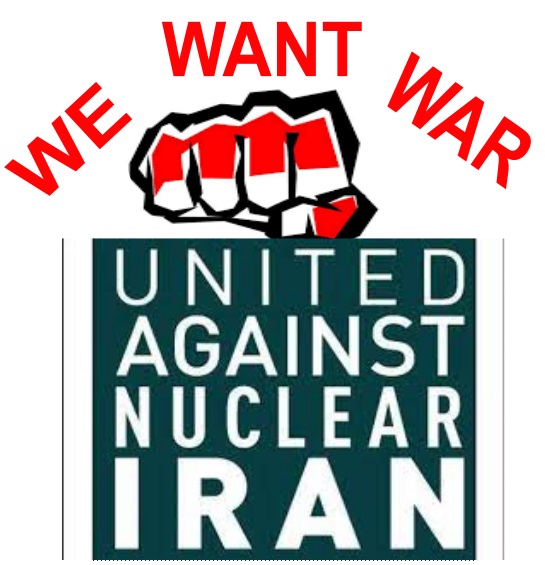
United Against Nuclear Iran, a secretive neoconservative organization with close links to the CIA and the Mossad, is trying to escalate the Israeli assault on Gaza into an Iraq-level U.S. Attack on Iran.
By Alan MacLeod / MintPress News
Most of the world has watched the Israeli assault on Gaza in horror. As tens of thousands have been killed and millions displaced, tens of millions of people around the world have poured onto the streets to demand an end to the violence. But a few select others have taken to the pages of our most influential media to demand an escalation of the violence and that the United States help Israel strike not just Palestine, Syria, and Lebanon but Iran as well.
“I might have once favored a cease-fire with Hamas, but not now,” wrote Bush-era diplomat Dennis Ross in The New York Times, explaining that “if Hamas is perceived as winning, it will validate the group’s ideology of rejection, give leverage and momentum to Iran and its collaborators and put [our] own governments on the defensive.”
In the wake of Hamas’ October 7 assault, arch-neoconservative official John Bolton was invited on CNN, where he claimed that what we witnessed was really an “Iranian attack on Israel using Hamas as a surrogate” and that the U.S. must immediately respond. When asked whether he had any evidence, given the implications of what he was saying, he shrugged and replied, “This is not a court of law.”
On December 28, Bolton doubled down on his hawkish stance, writing in the pages of Britain’s Daily Telegraph that “The West may now have no option but to attack Iran” – a position he has held for at least a decade.
Meanwhile, in an interview with Saudi state-funded broadcaster Iran International, senior Bush official Mark Wallace bellowed that, “This is Iran’s work. Iran will suffer at the hands of retribution and will suffer the consequences of supporting this terror group and its horrific attack on Israel.” Wallace continued:
No civilized country wants further conflict. But the Iranians are forcing the civilized world’s hand. And you will see a dramatic response soon as the United States, Israel, and our allies begin to position assets around the world in preparation.”
If there was any doubt as to what sort of “dramatic response” Wallace wanted to see, he added a message to Iran’s Islamic Revolutionary Guard Corps: “I look forward to seeing you hanged from the end of one of your own ropes.”
Iran was recently the victim of a deadly terrorist attack. As mourners commemorated the U.S. assassination of Qassem Soleimani, two bombs exploded, killing 91 and injuring hundreds more. In this context, it was understandable why Iranian officials pointed the finger at the U.S. and Israel.
WARMONGERS, INC
What these individuals all have in common is that they are board members of United Against Nuclear Iran (UANI), a shadowy but influential organization dedicated to pushing the West toward a military confrontation with the Islamic Republic.
Founded in 2008, the group is led by neoconservative hawks and has close ties to both U.S. and Israeli intelligence. It does not divulge where it receives its copious funding. However, it is known that right-wing Israeli-American billionaire Sheldon Adelson was a source. There is strong circumstantial evidence that Gulf dictatorships may also be bankrolling the group, although UANI has strongly denied this. In 2019, Iran designated UANI as a terrorist organization.
When asked by MintPress what he made of UANI’s recent statements, Eli Clifton, one of the few investigative journalists to have covered the group, said, “It’s very consistent with the positions and advocacy that the organization has taken since its inception.” Adding,
United Against Nuclear Iran does not miss an opportunity to try to bring the United States closer to a military conflict with Iran. And on the other side of the equation, they also have worked very hard to oppose efforts to de-escalate the U.S.-Iran relationship.”
UANI’s board is a who’s who of high state, military and intelligence officials from around the Western world. Among its more notable members include:………………………………………………………………………………………………………………………………….
In addition, notable former board members include ex-CIA Director R. James Woolsey; head of Mossad between 2002 and 2011, Meir Dagan; and one-time chief of British spy agency MI6, Sir Richard Dearlove.For 15 years, UANI has organized conferences, published reports, and lobbied politicians and governments, all with one goal: pushing a neoconservative line on Iran. “UANI are a force multiplier. They provide at least the veneer of an intellectual infrastructure for the Iran hawk movement. They did not invent being hawkish on Iran, but they sure made it a heck of a lot easier,” Ben Freeman, Director of the Democratizing Foreign Policy Program at the Quincy Institute, told MintPress.
CONFLICTS AND CONFLICTS OF INTEREST
For such a large, well-financed, and influential organization filled with senior officials, United Against Nuclear Iran keeps its funding sources very quiet. However, in 2015, Clifton was able to obtain a UANI donor list for the 2013 financial year. By far and away, the largest funders were billionaire New York-based investor Thomas Kaplan and multibillionaire Israeli-American casino mogul Sheldon Adelson……………………………………………………………………………………………………………..
PUTTING IRAN IN THE CROSSHAIRS
One of United Against Nuclear Iran’s primary activities, Iranian political commenter Ali Alizadeh told MintPress, is to create a worldwide “culture of fear and anxiety for investing in Iran.” The group attempts to persuade businesses to divest from the Islamic Republic and sign their certification pledge, which reads as follows:…………………………………………………………………………………………………………………………………………..
INTELLIGENCE CONNECTIONS
That UANI is headed by so many state, military and intelligence leaders begs the question: to what extent is this really a non-governmental organization? “That is one of the dirty secrets of think tanks: they are very often holding tanks for government officials,” Freeman said, adding:
The Trump folks all had to leave office when Biden won, so a lot of them ended up in think tanks for a while, four years, let’s say. And if Trump wins again, they will bounce back into government. And the same is true of Democratic administrations, too.”
he U.S. government also clearly has a longstanding policy of outsourcing much of its work to “private” groups in order to avoid further scrutiny. Many of the CIA’s most controversial activities, for example, have been farmed out to the National Endowment for Democracy (NED), a technically non-governmental organization funded entirely by Washington and staffed with ex-state officials. In recent years, the NED has funneled millions of dollars to protest leaders in Hong Kong, organized an attempted color revolution in Cuba, organized anti-government rock concerts in Venezuela, and propped up dozens of media organizations in Ukraine………………………………………………………………………………………….
UANI’s funders certainly also have extensive connections to Israel. Kaplan is the son-in-law of Israeli billionaire Leon Recanati and is said to be close with Prime Ministers Naftali Bennet and Yair Lapid. He has also employed a number of Israeli officials at his businesses. An example of this is Olivia Blechner, who, in 2007, left her role as the Director of Academic Affairs at the Israeli Consulate General in New York to become Executive Vice-President of Investor Relations and Research at Kaplan’s Electrum Group – a rather perplexing career move……………………………………………………………
A NETWORK OF REGIME CHANGE GROUPS
While United Against Nuclear Iran is already a notable enough organization, it is actually merely part of a large group of shadowy non-governmental groups working to cause unrest and, ultimately, regime change in Iran. These groups all share overlapping goals, funders and key individuals…………………………………………………………………………………………………………………………………………………
In short, then, there exists a network of American NGOs with the mission statements of helping Iran, opposing Iran, preserving Iran, and bombing Iran, all staffed by largely the same ex-U.S. government officials……………………………………………………………………………………………………..
A LESSON FROM HISTORY
The history of Iran has been intimately intertwined with the United States since at least 1953 when Washington orchestrated a successful coup against Prime Minister Mohammad Mosaddegh……………………………………………………………………………………………………………………………………….
The slaughter in Gaza has been horrifying enough. More than 22,000 people have been killed in the Israeli invasion, and a further 1.9 million displaced. Israel is also simultaneously bombing the West Bank, Syria and Lebanon. The U.S. is facilitating this, sending billions of dollars in weaponry, pledging iron-clad political support to Israel, silencing critics of its actions, and vetoing United Nations resolutions.
But United Against Nuclear Iran is eager to escalate the situation to a vastly greater level, urging Washington to attack a well-armed country of nearly 90 million people, erroneously claiming that Iran is behind every Hamas or Hezbollah action. ………………………………………………………………………
IF UANI gets its way, a conflict with Iran might spark a Third World War. And yet they are receiving virtually no pushback to their ultra-hawkish pronouncements, largely because they operate in the shadows and receive virtually no public scrutiny. It is, therefore, imperative for all those who value peace to quickly change that and expose the organization for what it is. https://scheerpost.com/2024/01/16/united-against-nuclear-iran-the-shadowy-intelligence-linked-group-driving-the-us-towards-war-with-iran/
The Times asks “Are big nuclear reactors really the right thing for the UK?

Nuclear minister Andrew Bowie had a case to hail it a “major
milestone”, with Julia Pyke, Sizewell’s joint managing director,
calling it a “significant moment” for the project and for UK “energy
security”.
Even so, there is still a long way to go. The project will
cost £30 billion-plus, with the PM yet to make a final investment
decision. Sizewell uses the same European pressurised reactor technology as
Hinkley: the Somerset nuke being built by France’s EDF and China’s CGN.
Who exactly will fund Sizewell? Alison Downes, of the Stop Sizewell C
campaign, is no neutral party. But she’s right to say the government is
“still months away” from securing finance, while keeping “secret”
the project’s “enormous cost”.
Bowie told the Financial Times he was
“very confident” of obtaining private finance, but the government is
now rowing back from the FT report that it’s “on track” to raise £20
billion. Even if it has changed the funding rubric to a “regulated asset
base” model that frontloads cost overruns on to consumer bills, investors
think that figure wildly optimistic. On a one third/two thirds split,
ministers need at least £10 billion of equity and £20 billion of debt.
But EDF wants no more than 19.9 per cent of Sizewell equity, while the UK
has booted off the Chinese. Ministers have reportedly lined up Abu Dhabi
funds for a chunk of the equity. But market talk is that the government is
still at least £5 billion short, while it also faces having to underwrite
all the debt — at least until it can syndicate some out once construction
hurdles are met.
Is this the best use of taxpayer’s money? And what’s
the risk private investors are given too generous terms? Yes, the wind
doesn’t blow or sun shine every day. So Britain will need baseload power
to offset intermittent renewables.
But, even if Sizewell C gets the
official go-ahead soon, it won’t be generating power until the late
2030s. A third station will be even further behind. Labour’s union
backers are typically pro-nuclear. But should Sir Keir Starmer come to
power, he must still tackle key questions. Are pricey mega nukes, largely
funded by the taxpayer and consumers, the right strategic bet for 2040? Or
do battery power, say, or modular nuclear reactors make more sense? The
government is yet to make a conclusive financial case for Sizewell C —
let alone any more.
Times 16th Jan 2024
https://www.thetimes.co.uk/article/sizing-up-sizewell-is-a-nuclear-option-fwpd2p53d
Biden administration finalizes a $1.1 billion aid package for California’s last nuclear power plant

LOS ANGELES (AP) — President Joe Biden’s administration on Wednesday finalized approval of $1.1 billion to help keep California’s last operating nuclear power plant running.
The funding is a financial pillar in the plan to keep the Diablo Canyon Power Plant producing electricity to at least 2030 — five years beyond its planned closing.
Terms of the aid package were not released by the Energy Department.
In 2016, plant operator Pacific Gas & Electric, environmental groups and plant worker unions reached an agreement to close the four-decade-old reactors by 2025. But the Legislature voided the deal in 2022 at the urging of Democratic Gov. Gavin Newsom, who said the power is needed to ward off blackouts as climate change stresses the energy system.
California is the birthplace of the modern environmental movement and for decades has had a fraught relationship with nuclear power. Environmentalists argued California has adequate power without the reactors and that their continued operation could hinder development of new sources of clean energy. They also warn that long-delayed testing on one of the reactors poses a safety risk that could result in an accident, a claim disputed by PG&E……………………… https://www.hindustantimes.com/world-news/biden-administration-finalizes-a-1-1-billion-aid-package-for-california-s-last-nuclear-power-plant-101705536723552.html
The Military-Industrial Complex Is the Winner (Not You)

The best route to preventing a future Chinese invasion of Taiwan would be to revive Washington’s “One China” policy that calls for China to commit itself to a peaceful resolution of Taiwan’s status and for the U.S. to forswear support for that island’s formal independence. In other words, diplomacy, rather than increasing the Pentagon budget to “win” such a war, would be the way to go.
SCHEERPOST, By William D. Hartung / TomDispatch, 17 Jan 24
2023 was a year marked by devastating conflicts from Russia’s ongoing invasion of Ukraine to Hamas’s horrific terror attacks on Israel, from that country’s indiscriminate mass slaughter in Gaza to a devastating civil war in Sudan. And there’s a distinct risk of even worse to come this year. Still, there was one clear winner in this avalanche of violence, suffering, and war: the U.S. military-industrial complex.
In December, President Biden signed a record authorization of $886 billion in “national defense” spending for 2024, including funds for the Pentagon proper and work on nuclear weapons at the Department of Energy. Add to that tens of billions of dollars more in likely emergency military aid for Ukraine and Israel, and such spending could well top $900 billion for the first time this year.
Meanwhile, the administration’s $100-billion-plus emergency military aid package that failed to pass Congress last month is likely to slip by in some form this year, while the House and Senate are almost guaranteed to add tens of billions more for “national defense” projects in specific states and districts, as happened in two of the last three years.
Of course, before the money actually starts flowing, Congress needs to pass an appropriations bill for Fiscal Year 2024, clearing the way for that money to be spent. As of this writing, the House and Senate had indeed agreed to a tentative deal to sign onto the $886 billion that was authorized in December. A trillion-dollar version of such funding could be just around the corner. (If past practice is any guide, more than half of that sum could go directly to corporations, large and small.)
A trillion dollars is a hard figure to process. In the 1960s, when the federal budget was a fraction of what it is now, Republican Senator Everett Dirksen allegedly said, “A billion here, a billion there, and pretty soon you’re talking real money.” Whether he did or not, that quote neatly captures how congressional attitudes toward federal spending have changed. After all, today, a billion dollars is less than a rounding error at the Pentagon. The department’s budget is now hundreds of billions of dollars more than at the height of the Vietnam War and over twice what it was when President Eisenhower warned of the “unwarranted influence” wielded by what he called “the military-industrial complex.”
To offer just a few comparisons: annual spending on the costly, dysfunctional F-35 combat aircraft alone is greater than the entire budget of the Centers for Disease Control and Prevention. In 2020, Lockheed Martin’s contracts with the Pentagon were worth more than the budgets of the State Department and the Agency for International Development combined, and its arms-related revenues continue to rival the government’s entire investment in diplomacy. One $13 billion aircraft carrier costs more than the annual budget of the Environmental Protection Agency. Overall, more than half of the discretionary budget Congress approves every year — basically everything the federal government spends other than on mandatory programs like Medicare and Social Security — goes to the Pentagon.
It would, I suppose, be one thing if such huge expenditures were truly needed to protect the country or make the world a safer place. However, they have more to do with pork-barrel politics and a misguided “cover the globe” military strategy than a careful consideration of what might be needed for actual “defense.”
Congressional Follies
The road to an $886-billion military budget authorization began early last year with a debt-ceiling deal negotiated by President Biden and then-House Speaker Kevin McCarthy. That rolled back domestic spending levels, while preserving the administration’s proposal for the Pentagon intact. McCarthy, since ousted as speaker, had been pressed by members of the right-wing “Freedom Caucus” and their fellow travelers for just such spending cuts. (He had little choice but to agree, since that group proved to be his margin of victory in a speaker’s race that ran to 15 ballots.)……………………………………………………………………………………
Threat Inflation and the “Arsenal of Democracy”
Perhaps you won’t be surprised to learn that the strategic rationales put forward for the flood of new Pentagon outlays don’t faintly hold up to scrutiny. First and foremost in the Pentagon’s argument for virtually unlimited access to the Treasury is the alleged military threat posed by China. But as Dan Grazier of the Project on Government Oversight has pointed out, that country’s military strategy is “inherently defensive”:
“[T]he investments being made [by China] are not suited for foreign adventurism but are instead designed to use relatively low-cost weapons to defend against massively expensive American weapons. The nation’s primary military strategy is to keep foreign powers, and especially the United States, as far away from its shores as possible in a policy the Chinese government calls ‘active defense.’”
The greatest point of potential conflict between the U.S. and China is, of course, Taiwan. But a war over that island would come at a staggering cost for all concerned and might even escalate into a nuclear confrontation. A series of war games conducted by the Center for Strategic and International Studies (CSIS) found that, while the United States could indeed “win” a war defending Taiwan from a Chinese amphibious assault, it would be a Pyrrhic victory. “The United States and its allies lost dozens of ships, hundreds of aircraft, and tens of thousands of servicemembers,” it reported. “Taiwan saw its economy devastated. Further, the high losses damaged the U.S. global position for many years.” And a nuclear confrontation between China and the United States, which CSIS didn’t include in its assessment, would be a first-class catastrophe of almost unimaginable proportions.
The best route to preventing a future Chinese invasion of Taiwan would be to revive Washington’s “One China” policy that calls for China to commit itself to a peaceful resolution of Taiwan’s status and for the U.S. to forswear support for that island’s formal independence. In other words, diplomacy, rather than increasing the Pentagon budget to “win” such a war, would be the way to go.
The second major driver of higher Pentagon budgets is allegedly the strain on this country’s arms manufacturing base caused by supplying tens of billions of dollars of weaponry to Ukraine, including artillery shells and missiles that are running short in American stockpiles. The answer, according to the Pentagon and the arms industry, is to further supersize this country’s already humongous military-industrial complex to produce enough weaponry to supply Ukraine (and now Israel, too), while acquiring sufficient weapons systems for a future war with China.
There are two problems with such arguments. First, supplying Ukraine doesn’t justify a permanent expansion of the U.S. arms industry. In fact, such aid to Kyiv needs to be accompanied by a now-missing diplomatic strategy designed to head off an even longer, ever more grinding war.
Second, the kinds of weapons needed for a war with China would, for the most part, be different from those relevant to a land war in Ukraine, so weaponry sent to Ukraine would have little relevance to readiness for a potential war with China (which Washington should, in any case, be working to prevent, not preparing for).
The Disastrous Costs of a Militarized Foreign Policy
Before investing ever more tax dollars in building an ever-expanding garrison state, the military strategy of the United States in the current global environment should be seriously debated. Just buying ever more bombs, missiles, drones, and next-generation artificial intelligence-driven weaponry is not, in fact, a strategy, though it is a boon to the military-industrial complex and an invitation to a destabilizing new arms race.
Unfortunately, neither Congress nor the Biden administration seems inclined to seriously consider an approach that would emphasize investing in diplomatic and economic tools over force or the threat of force. …………………………………………………………………………………………………………………
A serious national conversation is needed on what a genuine defense strategy would look like, rather than one based on fantasies of global military dominance. Otherwise, the overly militarized approach to foreign and economic policy that has become the essence of Washington budget-making could be extended endlessly and disastrously into the future, something this country literally can’t afford to let happen.
https://scheerpost.com/2024/01/17/the-military-industrial-complex-is-the-winner-not-you/
When Yemen Does It It’s Terrorism, When The US Does It It’s “The Rules-Based Order”
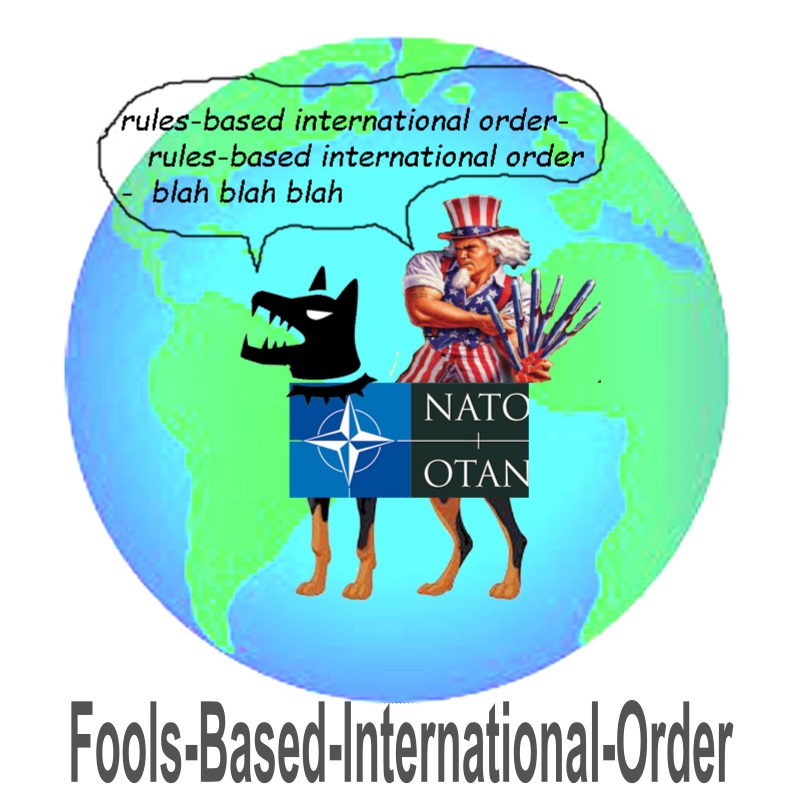
That’s right kids: when Yemen sets up a blockade to try and stop an active genocide, that’s terrorism, but when the US empire imposes a blockade to secure its geostrategic interests in the middle east, why that’s just the rules-based international order in action.
What this shows us is that the “rules-based international order” the US and its allies claim to uphold is not based on rules at all; it’s based on power, which is the ability to control and impose your will on other people. The “rules” apply only to the enemies of the empire because they are not rules at all: they are narratives used to justify efforts to bend the global population to its will.
CAITLIN JOHNSTONE, JAN 18, 2024
The Biden administration has officially re-designated Ansarallah — the dominant force in Yemen also known as the Houthis — as a Specially Designated Global Terrorist entity.
The White House claims the designation is an appropriate response to the group’s attacks on US military vessels and commercial ships in the Red Sea and the Gulf of Aden, saying those attacks “fit the textbook definition of terrorism.” Ansarallah claims its actions “adhere to the provisions of Article 1 of the Convention on the Prevention and Punishment of the Crime of Genocide,” since it is only enforcing a blockade geared toward ceasing the ongoing Israeli destruction of Gaza.
One of the most heinous acts committed by the Trump administration was its designation of Ansarallah as a Foreign Terrorist Organization (FTO) and as Specially Designated Global Terrorists (SDGT), both of which imposed sanctions that critics warned would plunge Yemen’s aid-dependent population into even greater levels of starvation than they were already experiencing by restricting the aid that would be allowed in. One of the Biden administration’s only decent foreign policy decisions has been the reversal of that sadistic move, and now that reversal is being partially rolled back, though thankfully only with the SDGT listing and not the more deadly and consequential FTO designation.
In a new article for Antiwar about this latest development, Dave Decamp explains that as much as the Biden White House goes to great lengths insisting that it’s going to issue exemptions to ensure that its sanctions don’t harm the already struggling Yemeni people, “history has shown that sanctions scare away international companies and banks from doing business with the targeted nations or entities and cause shortages of medicine, food, and other basic goods.” DeCamp also notes that US and British airstrikes on Yemen have already forced some aid groups to suspend services to the country.
So the US empire is going to be imposing sanctions on a nation that’s still trying to recover from the devastation caused by the US-backed Saudi blockade that contributed to hundreds of thousands of deaths between 2015 and 2022. All in response to the de facto government of that very same country imposing its own blockade with the goal of preventing a genocide.
That’s right kids: when Yemen sets up a blockade to try and stop an active genocide, that’s terrorism, but when the US empire imposes a blockade to secure its geostrategic interests in the middle east, why that’s just the rules-based international order in action…………………………………..
What this shows us is that the “rules-based international order” the US and its allies claim to uphold is not based on rules at all; it’s based on power, which is the ability to control and impose your will on other people. The “rules” apply only to the enemies of the empire because they are not rules at all: they are narratives used to justify efforts to bend the global population to its will……… https://www.caitlinjohnst.one/p/when-yemen-does-it-its-terrorism?utm_source=post-email-title&publication_id=82124&post_id=140790707&utm_campaign=email-post-title&isFreemail=true&r=1ise1&utm_medium=email
 | |||
| |||
Sizewell C opponents warn Suffolk nuclear plant ‘could be the new HS2’.
Sizewell C opponents warn Suffolk nuclear plant ‘could be the new HS2’.
Campaigners fighting a new nuclear power station on the Suffolk coast say
they fear a shortfall in finance for the project could mean it becomes
another HS2. Their comments came amid a landmark moment for the building of
Sizewell C as a Development Consent Order was triggered, meaning
construction can begin. Andrew Bowie, the minister for nuclear and
renewables, was at the construction site to herald what he claimed was a
significant point in the development. The new power plant, which could
create 10,000 jobs, was given the go-ahead in November – but campaigners
opposed to it say they will not give up.
ITV 15th Jan 2024
https://www.itv.com/news/anglia/2024-01-15/coastal-nuclear-plant-could-be-new-hs2-warn-campaigners
lear plant ‘could be the new HS2’.
1 This Month
23-25 October – on Zoom – World BEYOND War’s annual global conferenc


Shut down the radiation-damaged Heysham nuclear reactors now
To see nuclear-related stories in greater depth and intensity – go to https://nuclearinformation.wordpress.com

Say No to NASA’s Reckless Nuclear Reactor on the Moon
Say No to NASA’s Reckless Nuclear Reactor on the Moon
-
Archives
- October 2026 (180)
- September 2026 (339)
- August 2026 (330)
- July 2026 (355)
- June 2026 (287)
- May 2026 (306)
- April 2026 (356)
- March 2026 (251)
- February 2026 (267)
- January 2026 (308)
- December 2025 (358)
- November 2025 (359)
-
Categories
- 1
- 1 NUCLEAR ISSUES
- business and costs
- climate change
- culture and arts
- ENERGY
- environment
- health
- history
- indigenous issues
- Legal
- marketing of nuclear
- media
- opposition to nuclear
- PERSONAL STORIES
- politics
- politics international
- Religion and ethics
- safety
- secrets,lies and civil liberties
- spinbuster
- technology
- Uranium
- wastes
- weapons and war
- Women
- 2 WORLD
- ACTION
- AFRICA
- Atrocities
- AUSTRALIA
- Christina's notes
- Christina's themes
- culture and arts
- Events
- Fuk 2022
- Fuk 2023
- Fukushima 2017
- Fukushima 2018
- fukushima 2019
- Fukushima 2020
- Fukushima 2021
- general
- global warming
- Humour (God we need it)
- Nuclear
- RARE EARTHS
- Reference
- resources – print
- Resources -audiovicual
- Weekly Newsletter
- World
- World Nuclear
- YouTube
-
RSS
Entries RSS
Comments RSS

