UK Government’s nuclear power plans a roadmap to a dead-end – CND

“The debate and investment into trying to develop new nuclear energy projects divert funds and political motivation away from further developing truly renewable energy sources, which is the real solution.”
Sara Medi Jones, Campaign for Nuclear Disarmament (CND), assesses the government’s latest nuclear power announcement m https://labouroutlook.org/2024/01/23/governments-nuclear-power-plans-a-roadmap-to-a-dead-end-cnd/
It’s only mid-January and we have already had two major nuclear power announcements in 2024. A long-awaited “roadmap” of nuclear power expansion was unveiled earlier this month, with the government promising to accelerate new nuclear projects. And this week we’ve just heard that construction of the Sizewell C nuclear station in Suffolk should be a step closer.
But the problem is – nuclear is a dead-end technology that is not the answer to our climate or energy needs.
Plans for eight new nuclear sites laid out in 2011 have largely stalled, with the only two projects to have got off the ground – Hinkley Point C and Sizewell C – beset with problems. Costs at Hinkley Point have spiralled by 30% to £33 billion, and the start date has repeatedly been pushed back. Sizewell C is struggling to attract private financing, and despite building permission finally being granted now, there are still many hurdles to clear.
The nuclear roadmap’s main aims are to “explore” another nuclear site, develop small modular reactors, secure more investment, and engage the private sector more
But we are unlikely to see any meaningful progress because nuclear power in its very essence is a dangerous and economically unsustainable technology. It burdens future generations with a potential human and environmental disaster that is not compensated for by the expensive electricity provided.
Any new nuclear projects would take decades to build. But we need an answer to our cost of living struggle and to climate change now. Even if nuclear power capacity was doubled worldwide by 2050 (a hugely ambitious ask in itself), it would only result in a 4% reduction in emissions.
The debate and investment into trying to develop new nuclear energy projects divert funds and political motivation away from further developing truly renewable energy sources, which is the real solution.
We must also bear in mind the main reason this government is so in favour of nuclear power: it helps to ensure the infrastructure and skilled personnel is in place to maintain and manufacture Britain’s nuclear weapons system, Trident. During this time of global instability and increased nuclear risk, Britain would do well to forget about propping up their weapons of mass destruction and instead focus on delivering the things that people in this country need, including a functioning and sustainable energy system.
Rare nuclear bunker hits the market as America’s wealthiest people prepare for the worst
Real Estate Brendan Casey, Property Journalist and Editor, 23 Jan 2024, News Corp Australia Network
A rare bunker with roots in the Cold War era has found its way into the real estate market, carrying an asking price of $1.88m (US$1.24m).
Nestled in the city of Sprague in Washington state, this property, constructed in 1959, once safeguarded some of America’s most critical nuclear weapons during the tumultuous time, which spanned from 1945 to 1991, The Post reports.
The Cold War was marked by a strategic standoff between the United States and the Soviet Union, defined by political rivalries and the looming threat of nuclear warfare.
The intense global tension finally subsided in 1991 when Soviet president Mikhail Gorbachev and US president George H. W. Bush inked a historic treaty, putting an end to the conflict………………………………………………………………………………………………………………………………………
In recent years, bunkers have experienced a surge in popularity, reflecting a growing demand for doomsday shelters in the USA.
According to Post sources, the scarcity of such shelters has led to a significant spike in prices.
Some of America’s wealthiest individuals, including Mark Zuckerberg and Peter Thiel, are investing in bunkers for their own doomsday preparations.
Zuckerberg, the Facebook founder and CEO of Meta Platforms, is building a $100m compound in Hawaii, complete with an underground bunker and self-sustaining resources.
Financier Peter Thiel is awaiting approval for a bunker project in New Zealand, joining the ranks of other notable figures such as Sam Altman of OpenAI, and Larry Ellison of Oracle, who are also constructing their own ‘end-of-days retreats’. https://www.realestate.com.au/news/rare-nuclear-bunker-hits-the-market-as-americas-wealthiest-people-prepare-for-the-worst/?campaignType=external&campaignChannel=syndication&campaignName=ncacont&campaignContent=&campaignSource=herald_sun&campaignPlacement=spa
URANIUM FILM FESTIVAL MARATHON ACROSS THE USA

EIN Presswire Oct 28, 2023, https://fox5sandiego.com/business/press-releases/ein-presswire/664773439/uranium-film-festival-marathon-across-the-usa/
The International Uranium Film Festival will embark on a marathon tour of the United States next year, including Vancouver in Canada.LOS ANGELES, CA, USA, October 28, 2023 /EINPresswire.com/ — The schedule for the American edition of the International Uranium Film Festival is almost set. From March 2nd to May 10th, 2024, the world’s only film festival on nuclear dangers will embark on a marathon tour across the USA and take place in 10 states and more than 12 cities including Vancouver in Canada – www.uraniumfilmfestival.org.
“We will be showing important, eye-opening films about risks and consequences of uranium mining, the use nuclear power, nuclear arms and uranium weapons,” says festival’s director and co-founder Norbert G. Suchanek. The IUFF will start in March in Albuquerque and Window Rock, the capital of the Navajo (Diné) Nation. From there, the festival will go on its marathon like round tour. Cities already included with fixed dates are Tucson, Santa Fe, Ashville (NC), Seattle, Portland, Salem, Irvine, Santa Barbara and Las Vegas.
One highlight shall be Washington DC. Here the International Uranium Film Festival (IUFF) will focus on documentaries about the use of Depleted Uranium (DU) Weapons. “It will be the first International Gathering to stop Depleted Uranium Weapons use in Washington DC held in conjunction with the International Coalition to Ban Uranium Weapons (ICBUW),” says Damacio A. Lopez, the IUFF director of the American Southwest.
In California, the festival will be held in several cities with the participation of Libbe HaLevy, Ambassador of the IUFF to the USA. Libbe is producer of the weekly radio show Nuclear Hotseat – www.nuclearhotseat.com.
Last May this year, the 12th IUFF of Rio de Janeiro at the famous Modern Art Museum Cinematheque showed 15 atomic films from around the globe including the new US productions “Radioactive: The Women of Three Mile Island” by Heidi Hutner and “Downwind” by Mark Shapiro and Douglas Brian Miller. Heidi Hutner’s film received the Best Investigative Documentary Award and “Downwind” the Best Documentary Feature Award of the festival in Rio.
In addition Students of the State School FAETEC Adolpho Bloch presented at MAM Rio a special Dance performance remembering the terrible accident with blue shining highly radioactive Cesium 137 in Goiânia in 1987: “The blue shine of death”.
Libbe HaLevy: “For the dance, about 30 students, dressed all in white, presented themselves miming normal actions – brushing hair, putting on make-up, talking, hugging in friendship. I have never thought of how dance might address nuclear issues. So to see this was both shocking and deeply moving. It challenged me, and all the audience. The cheers at the end went on for several minutes.“
“We wish we could take the FAETEC dance group with us on the tour of the USA. But for that we would need a lot more donations and sponsors,” says FAETEC teacher and IUFF executive director Márcia Gomes de Oliveira. The Uranium Film Festival depends mainly on hard and a lot of voluntary work and donations from individuals. Márcia: “We thank all volunteers and festival partners Anna Rondon from the New Mexico Social Justice Equity Institute (NMSJEI) and the Navajo Nation, Veterans for Peace in Santa Fe and Albuquerque, Jesse Andrewartha from the Atomic Photographers Guild (APG) and Cineworks Independent Filmmakers Society in Vancouver, Jad Baaklini from Washington Physicians for Social Responsibility (WPSR) in Seattle, PSR Oregon in Portland, Principal Man Ian Zabarte from the Western Bands of the Shoshone Nation in Las Vegas, Leslie Poplawski from WNC-PSR in Ashville and Kathy Altman from PSR-Az in Tucson just to name a few.“
NNSA Issues Final Surplus Plutonium Environmental Impact Statement

The Department of Energy’s National Nuclear Security Administration (NNSA) published a Notice of Availability (NOA) in the Federal Register on Jan. 19, 2024, announcing the availability of the final Surplus Plutonium Disposition Program (SPDP) Environmental Impact Statement (EIS). The SPDP would employ the dilute and dispose strategy to safely and securely dispose of up to 34 metric tons of plutonium surplus to the Nation’s defense needs, using new, modified, or existing facilities at sites across the Nation.
The EIS satisfies NNSA’s obligations under the National Environmental Policy Act (NEPA) as the agency seeks to fulfill two important goals:
- Reduce the threat of nuclear weapons proliferation worldwide by dispositioning surplus plutonium in the United States in a safe and secure manner.
- Meet NNSA’s domestic and international legal obligations.
The 34 metric tons of surplus plutonium covered in the EIS was previously intended for use in fabricating mixed oxide (MOX) fuel. After irradiation in commercial power reactors, the fuel would have been stored pending disposal in a deep geologic repository for spent nuclear fuel. DOE cancelled the MOX project in 2018.
NNSA’s preferred alternative, the dilute and dispose strategy, also known as “plutonium downblending,” includes converting pit and non-pit plutonium to oxide, blending the oxidized plutonium with an adulterant, compressing it, encasing it in two containers, then overpacking and disposing of the resulting contact-handled transuranic (CH-TRU) waste underground in the Waste Isolation Pilot Plant (WIPP) facility in New Mexico. The approach would require new, modified, or existing capabilities at the Savannah River Site (SRS) in South Carolina, Los Alamos National Laboratory (LANL) in New Mexico, the Pantex Plant in Texas, and WIPP.
Under the No Action Alternative, up to 7.1 metric tons of non-pit plutonium would be processed at either LANL or SRS. If the processing occurs at LANL, then the resulting plutonium oxide would be transported to SRS. If it occurs at SRS, then the resulting material would remain there. In both cases the processed material would be diluted, characterized, packaged, and transported as CH-TRU defense waste to the WIPP facility for disposal.
The final SPDP EIS is posted on the NNSA NEPA reading room web page. NNSA will publish a Record of Decision (ROD) for the program after Feb. 20, 2024. The ROD will be published in the Federal Register and posted on the DOE NEPA and NNSA NEPA Reading Room websites.
NNSA announced its intent on Dec. 16, 2020, to prepare an EIS to evaluate the environmental impacts of the dilute and dispose strategy. It released the draft EIS for public comment on Dec. 16, 2022. It conducted three in-person public hearings and one virtual public hearing in January 2023. NNSA has incorporated public comments and developed the final SPDP EIS and is committed to complying with all appropriate and applicable environmental and regulatory requirements.
Fijian youths condemn Japan’s discharge of radioactive water
Global Stringer, 22-Jan-2024, https://news.cgtn.com/news/2024-01-22/We-Talk-Fijian-youths-condemn-Japan-s-discharge-of-radioactive-water-1qz4wGtqnkc/p.html
The fourth round of discharge of nuclear-contaminated water from the Fukushima Daiichi nuclear power plant will begin in late February 2024, with a total release of 7,800 tonnes, local media reported on December 18. Japan has so far completed three rounds of nuclear discharge, sending more than 23,000 tonnes of nuclear wastewater into the Pacific Ocean in less than three months.
CGTN Stringer took to the streets of Fiji and asked many local college students for their opinions on this matter. The students expressed their strong opposition, noting that the islanders depend on the sea for a living. The discharge of nuclear-contaminated water into the sea will pollute the Pacific Ocean and destroy coral groups. It will seriously affect the living resources of the islanders, endanger the health of the people of the island country, and cause immeasurable damage to ecosystems.
Italy’s Foreign Minister reveals country ceased arms shipments to Israel starting October 7 over ‘war crime’ concerns
The Times of Israel, Mon, 22 Jan 2024, https://www.sott.net/article/488099-Italys-FM-reveals-country-ceased-arms-shipments-to-Israel-starting-October-7-over-war-crime-concerns
Italian Foreign Minister and Deputy Prime Minister Antonio Tajani told local media Saturday that his country had halted all arms shipments to Israel since Hamas’s brutal October 7 onslaught.
The minister’s comments, made in an interview with Italian newspapers Nazione, Giorno, and Resto del Carlino, were a response to a demand by opposition leader Elly Schlein that the Italian government stop weapons exports to the Middle East. Tajani accused her of being “misinformed.”
“Since October 7, we have decided not to send any more arms to Israel, so there is no need to discuss this point,” said Tajani, according to a report from Italian news agency ANSA.
Speaking at a Friday meeting of the center-left Democratic Party, which she heads, Schlein said that “we must face the issue of avoiding fueling these conflicts, of avoiding sending arms and exporting arms to conflicts, to the conflict in the Middle East, in this case particularly to Israel,” according to ANSA.
“We cannot risk weapons being used to commit what could be construed as war crimes,” added the opposition lawmaker.
According to Israeli news site Walla, some five percent of Israeli arms purchases over the past decade have come from Italy, which include helicopters and naval artillery.
Comment: At irregular intervals over the past few years Italy’s dockworkers and border staff have protested and taken strike action against supplying Israel with arms.
In separate news, Tajani said in an interview with Italian radio Friday that his country would be willing to send troops to a peacekeeping mission in Gaza, ANSA reported.
On Sunday, following Prime Minister Benjamin Netanyahu’s stated refusal to accept a two-state formula for peace, Tajani told reporters that President Isaac Herzog is nonetheless open to such a solution, according to a report in Italian daily Il Tempo.
Tajani, a former air force officer who has led the conservative Forza Italia party since the death of its chairman Silvio Berlusconi in July, made an early solidarity visit to Israel at the start of the war on Hamas, and in November reaffirmed with other G7 nations his belief in Israel’s right to defend itself, within the bounds of international law, against Hamas aggression.
Comment: Key point: within the bounds of international law; although numerous experts have pointed out that, as an occupying force, Israel isn’t ‘defending itself’, these are acts of aggression, and criminal.
By December, the Italian foreign minister struck a more critical tone, condemning Israel for shooting inside a Gaza church. In January, as president of the G7, Tajani explored with other foreign ministers in the group the possibility of applying pressure on Israel to bring the war to a “rapid” end.
On the subject of South Africa’s ongoing claim at the International Court of Justice that Israel is committing “genocide” against Gazans, Tajani has said that although Israel has hit civilians in Gaza, it is not committing genocide.
Berlusconi, the erstwhile leader of Tajani’s party, and a colorful, scandal-ridden, media mogul who served as Italy’s prime minister for a cumulative nine years, was known to be a strong supporter of Israel, even raising the possibility that the Jewish state join the European Union. It was under Berlusconi that Italy sold 30 jet trainers to Israel, in a billion-dollar deal. Though critical of Israel’s West Bank settlements, Berlusconi at one time stated that the West should support Israel in the Israeli-Palestinian conflict.
Comment: Notably Italy, and Spain, despite pressure from the US, refused to send support to the US-UK for their naval campaign against Yemen: Iran warns it could cut off Mediterranean Sea as France, Spain and Italy pull out of Red Sea Op – Israeli vessel hit off India’s coast
Netanyahu Rebuffs Biden, Says Israel ‘Will Not Compromise on Full Israeli Control’ Over Gaza
The Israeli PM’s statement contradicts messaging from President Joe Biden and the White House
01/21/24 Zachary Rogers, https://themessenger.com/news/netanyahu-rebuffs-biden-says-israel-will-not-compromise-full-israeli-control-gaza
sraeli Prime Minister Benjamin Netanyahu said Saturday that he “will not compromise on full Israeli control” over Gaza and that “this is contrary to a Palestinian state.”
Netanyahu released the statement in a social media post. The statement comes just a day after President Joe Biden spoke with Netanyahu for the first time in nearly a month and directly contradicts messaging from the White House that creative solutions could bridge wide gaps between the leaders’ views on Palestinian statehood.
“The President discussed Israel’s responsibility even as it maintains military pressure on Hamas and its leaders to reduce civilian harm and protect the innocent,” the White House said of the conversation between national leaders.
“The President also discussed his vision for a more durable peace and security for Israel fully integrated within the region and a two-state solution with Israel’s security guaranteed,” it added.
The conflicting messaging is a sign of the pressures Netanyahu’s government faces at home. Thousands of Israelis have been protesting in Tel Aviv calling for new elections and for their nation to ensure the safe return of the remaining hostages of Hamas, but Netanyahu is also under heat to appease members of his right-wing ruling coalition by intensifying the conflict.
Netanyahu has said Israel must fight until it achieves “complete victory” and Hamas no longer poses a threat but has not outlined how this will be accomplished.
But a member of Israel’s War Cabinet, former Israeli army chief Gadi Eisenkot, has called a cease-fire the only way to secure the hostages’ release, a comment that implied criticism of Israel’s current strategy.
Israeli HQ ordered troops to shoot Israeli captives on 7 October
Asa Winstanley Rights and Accountability 20 January 2024
At midday on 7 October Israel’s supreme military command ordered all units to prevent the capture of Israeli citizens “at any cost” – even by firing on them.
The military “instructed all its fighting units to perform the Hannibal Directive in practice, although it did so without stating that name explicitly,” Israeli journalists revealed last weekend.
The revelations came in a new investigative article by Ronen Bergman and Yoav Zitun, two journalists with extensive sources inside Israel’s military and intelligence establishment.
They also revealed that “some 70 vehicles” driven by Palestinian fighters returning to Gaza were blown up by Israeli helicopter gunships, drones or tanks.
Many of these vehicles contained Israeli captives.
The journalists wrote that “it is not clear at this stage how many of the captives were killed due to the operation of this order” to the air force that they should prevent return to Gaza at all costs.
“At least in some of the cases, everyone in the vehicle was killed,” the journalists explain.
The Hebrew piece has not been translated into English by its publisher, Yedioth Ahronoth, a newspaper which translates many of its articles. You can read The Electronic Intifada’s full English version, translated by Dena Shunra, below.
The secretive “Hannibal” doctrine is named after an ancient Carthaginian general who poisoned himself rather than be captured alive by the Roman Empire.
The order aims at stopping Israelis from being taken captive by resistance fighters who could later use them as leverage in prisoner swap deals.
“Overpowered”
The latest revelations confirm The Electronic Intifada’s reporting since 7 October that many – if not most – of the Israeli civilians killed that day were killed by Israel itself, not Palestinian fighters.
Initial claims stated that 1,400 Israelis were killed by Hamas in the Palestinian assault that began on 7 October. But Israel has repeatedly revised this figure downwards, so that it now stands at “over 1,000.”
It was also clear from the outset that hundreds of the dead were in fact Israeli soldiers.
Hamas maintains that they targeted military bases and outposts, and that their aim was to capture rather than kill Israeli civilians, and to kill or capture Israeli soldiers.
Based on interviews with those present, the new article says that top officers at Israel’s underground military headquarters in Tel Aviv on 7 October declared in shock that “the Gaza Division was overpowered.”
THE ELECTRONIC INTIFADA
You are here
Israeli HQ ordered troops to shoot Israeli captives on 7 October
Asa Winstanley Rights and Accountability 20 January 2024

At midday on 7 October Israel’s supreme military command ordered all units to prevent the capture of Israeli citizens “at any cost” – even by firing on them.
The military “instructed all its fighting units to perform the Hannibal Directive in practice, although it did so without stating that name explicitly,” Israeli journalists revealed last weekend.
The revelations came in a new investigative article by Ronen Bergman and Yoav Zitun, two journalists with extensive sources inside Israel’s military and intelligence establishment.
They also revealed that “some 70 vehicles” driven by Palestinian fighters returning to Gaza were blown up by Israeli helicopter gunships, drones or tanks.
Many of these vehicles contained Israeli captives.
The journalists wrote that “it is not clear at this stage how many of the captives were killed due to the operation of this order” to the air force that they should prevent return to Gaza at all costs.
“At least in some of the cases, everyone in the vehicle was killed,” the journalists explain.
The Hebrew piece has not been translated into English by its publisher, Yedioth Ahronoth, a newspaper which translates many of its articles. You can read The Electronic Intifada’s full English version, translated by Dena Shunra, below.
The secretive “Hannibal” doctrine is named after an ancient Carthaginian general who poisoned himself rather than be captured alive by the Roman Empire.
The order aims at stopping Israelis from being taken captive by resistance fighters who could later use them as leverage in prisoner swap deals.
“Overpowered”
The latest revelations confirm The Electronic Intifada’s reporting since 7 October that many – if not most – of the Israeli civilians killed that day were killed by Israel itself, not Palestinian fighters.
Initial claims stated that 1,400 Israelis were killed by Hamas in the Palestinian assault that began on 7 October. But Israel has repeatedly revised this figure downwards, so that it now stands at “over 1,000.”
It was also clear from the outset that hundreds of the dead were in fact Israeli soldiers.
Hamas maintains that they targeted military bases and outposts, and that their aim was to capture rather than kill Israeli civilians, and to kill or capture Israeli soldiers.
Based on interviews with those present, the new article says that top officers at Israel’s underground military headquarters in Tel Aviv on 7 October declared in shock that “the Gaza Division was overpowered.”
https://www.youtube.com/embed/G8PWUAtGIBo?feature=oembed&One person present that day – referring back to earlier Israeli shocks such as the surprise counterattack by Egypt and Syria in October 1973 – told the journalists that,”We thought that this could never happen again, and this will remain a scar burnt into our flesh forever.”
As well as what they claim was “heroism,” Bergman and Zitun’s investigation reveals what they describe as “a long series of failures, mishaps and chaos in the army,” including “a command chain that failed almost entirely.”
Palestinian resistance fighters successfully targeted the communications infrastructure, they write, destroying 40 percent of communication sites around the Gaza frontier, including towers and relay antennas.
For hours, therefore, Israel’s top brass were in the dark as to the scale of the assault.
To make up for this, “they turned to television and to social media feeds, primarily to Telegram, to Israeli channels, but primarily to Hamas channels.”………………………………………………………………………………………………………………………. more https://electronicintifada.net/blogs/asa-winstanley/israeli-hq-ordered-troops-shoot-israeli-captives-7-october
Swastikas seen on US-made Ukrainian military hardware (VIDEO)
https://www.rt.com/russia/590928-bradley-ifv-ukraine-swastikas/ 22 Jan 24
Nazi symbols can be seen in footage taken by a local journalist covering the frontline
A video featuring a Ukrainian crew repairing a US-supplied Bradley infantry fighting vehicle near the frontline with Russia has revealed the apparent fondness for Nazi symbols among Kiev’s forces.
The footage, which was shared online by journalist Alla Khotshnyavska, showed a Ukrainian crew repairing the IFV’s tracks at an unspecified location in Donbass. Covered in mud, the Bradley sports a pair of swastikas scratched into the dirt on the side of the vehicle.
Radical Ukrainian nationalists played a key role in toppling the government in Kiev in 2014, and later attained significant influence in the country’s military. Their ideology stems from the forces that collaborated with the invading Nazis against the Soviet Union during World War II.
The presence of far-right activists, including neo-Nazis, in the Ukrainian armed forces was widely acknowledged in the West until hostilities with Russia erupted in February 2022.
Nazi insignia worn by Ukrainian troops has regularly been caught on camera. In one example, a member of President Vladimir Zelensky’s guards was seen with a skull and bones patch on his uniform when the Ukrainian leader was visiting the front line in September 2022. The image closely resembled the insignia of the 3rd SS Panzer Division ‘Totenkopf’.
The same month, a Ukrainian armored vehicle with a swastika painted on it was filmed by a crew from German television channel N-TV.
Last year, former Ukrainian President Pyotr Poroshenko wore a military-style shirt with a patch featuring another Nazi-linked symbol, the Black Sun (or ‘Sonnenrad’), as he was delivering equipment to troops.
An article by the New York Times in June acknowledged the controversial popularity of Nazi iconography in Ukraine, but claimed it did not reflect the ideology of the people using the symbols.
One of Moscow’s goals in its confrontation with Kiev is ‘denazification’ and the removal of radical Ukrainian nationalists from positions of power. Russian officials have argued that the discrimination against ethnic Russians in modern Ukraine is based on Ukrainian supremacism and is similar to Nazi ideology.
President Vladimir Putin told reporters last December that Moscow would not have been compelled to intervene in Ukraine “if they didn’t start to eradicate Russia on our historic lands in Ukraine, expel people from there, [and] declare Russians non-native.” Officials in Kiev were “crazy” to introduce such policies, he suggested.
Nuclear lobby “kills” nomination of regulator who cares too much about safety

“We killed this nomination,” said Ted Nordhaus, executive director of the Breakthrough Institute, a California-based climate think tank that advocates for more nuclear energy.
Biden Drops Nuclear Regulator Nominee After Senate Backlash
Alexander C. Kaufman, Tue, 23 January 2024 https://au.news.yahoo.com/biden-drops-nuclear-regulator-nominee-190521226.html
President Joe Biden is dropping his pick to fill the open seat on the Nuclear Regulatory Commission after a handful of Democrats joined Senate Republicans to block the nomination last year, HuffPost has learned.
Jeff Baran had held a seat on the five-person federal panel overseeing atomic energy and radiation safety since former President Barack Obama first named to the position in 2014. The Democratic commissioner easily won Senate approval when former President Donald Trump renominated him in 2018.
But pro-nuclear advocates angry over what they saw as Baran’s unwillingness to overhaul the regulatory process in favor of building new types of reactor technologies launched a campaign against the commissioner last year. With Republicans opposed to the nomination, the Biden administration needed almost every Democrat in the Senate to vote for Baran ― or leave the NRC without a tie-breaker for party-line votes between the four current commissioners.
The White House had wanted the Senate’s narrow Democratic majority to reconfirm Baran before his term ended last July. But as many as four senators on the Democratic side, including Sen. Joe Manchin (D-W.Va.) and Sen. Kyrsten Sinema (I-Ariz.), either planned to come out against Baran or refused to pledge their votes, according to a source with knowledge of the process. Neither senator’s office immediately responded to emails requesting comment on Monday.
When the Senate ended 2023 last month without a vote, the nomination automatically went back to the White House.
The NRC directed HuffPost’s questions about when the administration would name its nominee for the open commission seat to the White House, which did not respond to a request for comment.
But three sources with knowledge of the plans confirmed to HuffPost that the Biden administration does not plan to nominate Baran again. Two spoke to HuffPost on condition of anonymity because they were not authorized to comment publicly. The third claimed Baran’s loss as a victory.
“We killed this nomination,” said Ted Nordhaus, executive director of the Breakthrough Institute, a California-based climate think tank that advocates for more nuclear energy.
He was among the most vocal opponents of Baran’s nomination, and helped drum up votes against the Democratic commissioner. Nordhaus had cast Baran as a holdover from an earlier era of liberal regulators who saw their job primarily as safeguarding the public against the atomic energy industry.
“It is my job to focus on nuclear safety and security,” Baran said in 2017 at his reconfirmation hearing before the Senate Environment and Public Works committee. “It is not my job to weigh in on the pros and cons of the merits of nuclear power.”
That view, Nordhaus said, was common among Democrats for decades. But a modern outlook on nuclear safety has to consider not only the threats of using atomic energy, but the risks that not doing so increases pollution from fossil fuels that damages lungs and traps heat in the planet’s atmosphere.
“Everyone went into this just assuming everybody would line up behind Baran, that this is just the kind of guy Democrats put on the commission,” Nordhaus said.
“The fact that enough Democratic senators were willing to say we’re not going to vote for this guy,” he added, “it’s pretty clear that for the first time in maybe ever a bunch of Democrats now recognize that we need reform at the NRC, that something has to change, that the technology can’t succeed if the NRC continues to approach this in the way it historically has.”
But Baran had defenders. The progressive pro-nuclear group Good Energy Collective previously told HuffPost Baran had a strong record of fighting for environmental justice and building relationships with communities saddled with radioactive pollution from the past.
Biden Has Started Another US War
CAITLIN JOHNSTONE, Jan 22 2024, https://www.caitlinjohnst.one/p/biden-has-started-another-us-war?utm_source=post-email-title&publication_id=82124&post_id=140915473&utm_campaign=email-post-title&isFreemail=true&r=1ise1&utm_medium=email
The Washington Post has an article out titled “As Houthis vow to fight on, U.S. prepares for sustained campaign,” with “sustained campaign” being empire-speak for a new American war.
“The Biden administration is crafting plans for a sustained military campaign targeting the Houthis in Yemen after 10 days of strikes failed to halt the group’s attacks on maritime commerce, stoking concern among some officials that an open-ended operation could derail the war-ravaged country’s fragile peace and pull Washington into another unpredictable Middle Eastern conflict,” the Post reports.
The Post acknowledges that “sustained military campaign” means “war” in the ninth paragraph of the article, saying the anonymous US officials cited in the report “don’t expect that the operation will stretch on for years like previous U.S. wars in Iraq, Afghanistan or Syria.” Which is about as reassuring as a pyromaniac saying he doesn’t expect he’ll be burning down any more houses like all those other houses he’s burned down.
This bizarre refusal to just call a war a war also appeared in a recent press conference with Pentagon spokesperson Sabrina Singh, who acted shocked and aghast that reporters would even ask if repeatedly bombing a country would qualify as being at war with them.
“Is it now fair to say that the U.S. is at war in Yemen?” Singh was asked by a Reuters reporter on Thursday.
“No, we don’t seek war,” Singh replied. “We don’t think that we are at war. We don’t want to see a regional war. The Houthis are the ones that continue to launch cruise missiles, antiship missiles at innocent mariners, at commercial vessels that are just transiting an area that sees, you know, 10 to 15 percent of world’s commerce.”
In a follow-up several questions later, Singh was asked by a reporter from Politico, “You said that we are not at war with the Houthis, but if — you know, this tit-for-tat bombing — we’ve bombed them five times now. So if this isn’t war, can you just explain this a little — a little bit more to us? If this isn’t war, what is war?”
“Sure, Lara, sure, great question, I just wasn’t expecting it phrased exactly that way,” Singh replied with a laugh and a smirk. “Look, we are — we do not seek war. We are — we do not — we are not at war with the Houthis. In terms of a definition, I think that would be more of a clear declaration from the United States. But again, what we are doing and the actions that we are taking are defensive in nature.”
It is worth noting that since that Thursday press conference the number of US strikes on Yemen has increased from five to seven as of this writing.
It is also worth noting here that, per Singh’s absurd definition, the US has not been at war since the end of WWII, as there has not been a “clear declaration of war” since June 5, 1942. The only wars the US has officially declared through congress in accordance with its own constitution have been the War of 1812, the Mexican-American War, the Spanish-American War, and the two world wars.
If you go by this definition the US is among the more peaceful nations in the world, since it hasn’t been at war in eight decades. In reality the US is the single most warlike and murderous nation of modern times with wars of aggression that have killed millions and displaced tens of millions just in the 21st century alone, and plays some role in most of the world’s major international conflicts.
Singh’s claim that the US attacks on Yemen are “defensive in nature” is also self-evidently absurd; Yemeni forces weren’t even attacking American commercial vessels until the US began attacking them. Only the US could launch unprovoked attacks on a foreign nation on the other side of the planet and call it self-defense.
Antiwar’s Dave DeCamp explains:
Indeed, the only reason Houthi forces began attacking ships in the Red Sea was to pressure Israel and its allies into ceasing the ongoing massacre that has been taking place in Gaza since October 7. As usual the world’s most murderous and powerful government is framing its horrifying acts of extreme aggression as innocent defensive responses to unprovoked attacks, when in reality the US empire is bombing Yemen in order to facilitate the genocide of Palestinians.
And while we’re on the subject of Gaza and Yemen it’s probably worth pointing out that according to US empire managers the stated goals of both campaigns have been completely unsuccessful. A new report by The Wall Street Journal says that according to US intelligence Israel is nowhere remotely close to eliminating Hamas, with only 20 to 30 percent of the group having been killed since October. Asked by the press on Thursday if the strikes against the Houthis are working, Biden replied “Well, when you say ‘working’ — are they stopping the Houthis? No. Are they going to continue? Yes.”
“Before the US began bombing the Houthis, Ansar Allah officials made clear they would only stop attacking Israeli-linked commercial shipping if the onslaught on Gaza ended. Instead of pressuring Israel to end the slaughter in Gaza, President Biden chose escalation, and now the Houthis are targeting US commercial shipping, and several US merchant vessels have been hit with missiles.”
So they’re raining military explosives on impoverished middle easterners to maintain their status quo domination, under the pretense of goals which they themselves admit are not being achieved. Just another day in the empire, I guess.
German defense chief against going ‘all in’ on Ukraine
23 Jan 24, https://www.rt.com/news/590954-germany-defense-minister-pistorius-no-ukraine-all-in/
Boris Pistorius says donating too many weapons to Kiev would weaken Berlin’s own forces
Germany should exercise some caution in its support for Ukraine, Defense Minister Boris Pistorius has told the newspaper Der Tagesspiegel. He also revealed that Berlin is considering reverting to a compulsory military service system.
The defense chief warned last month that European nations have less than a decade to ramp up their military capabilities in anticipation of a potential armed confrontation with Russia, and predicted that the US would shift its focus to the Asia-Pacific region.
In an interview published on Friday, Pistorius dismissed criticisms that Germany is not sending enough weaponry to Ukraine, pointing out that Berlin is the second largest contributor to Kiev after the US. However, he stressed that shipping German-made long-range Taurus cruise missiles, which Kiev has been requesting for months, is currently out of the question.
“We have so far delivered everything that is possible,” he said, adding that Germany carefully weighs up the potential impact of each new shipment to Ukraine.
Pistorius cautioned that Berlin must also “keep an eye on its own defense capabilities” meaning that it can’t go “all in” for Ukraine as some are demanding.
“Otherwise we would be defenseless ourselves,” he warned, while calling on other European nations to ramp up their defense production, to become more independent of the US.
The German minister suggested that Russian President Vladimir Putin could eventually “attack a NATO country,” while acknowledging that such a scenario was unlikely at present. Germany must thoroughly upgrade its armed forces and civil defense, he concluded.
As part of these efforts, the Bundeswehr will simplify its recruitment policies and loosen its enlistment criteria, he noted, while mentioning the current debate on reintroducing compulsory military service.
A survey last month revealed that only 17% of German adults would be prepared to defend their country without question in case of a military conflict.
Earlier this week, Chancellor Olaf Scholz confirmed that Berlin would shell out more than €7 billion ($7.6 billion) on military aid for Ukraine this year.
Berlin provided Kiev with nearly $23 billion in aid between February 2022 and November 2023, according to the Kiel Institute for World Economy (IfW).
Since Kiev’s summer counteroffensive fizzled out with no major gains and heavy losses, top Ukrainian officials have increasingly been pressuring their Western backers for more weaponry.
Mexico and Chile Call on International Criminal Court to Investigate Crimes in Gaza
byEDITORJanuary 21, 2024
Mexico and Chile have joined South Africa, Bolivia, Djibouti, Bangladesh, and the Comoros in calling on the ICC to investigate Israel for its crimes in Gaza, including war crimes and genocide.
By Tanupriya Singh / Peoples Dispatch
Chile and Mexico have called upon the International Criminal Court (ICC) to investigate the crimes being committed amid Israel’s ongoing war on Gaza. In the past 105 days, Israel has killed over 24,600 Palestinians in Gaza, with more than 7,000 people missing and presumed dead under the rubble.
In a statement released on January 18, Mexico and Chile stated that their referral to the ICC was “due to growing concern about the latest escalation of violence, particularly against civilian targets, and the alleged continued commission of crimes under the jurisdiction of the Court, specifically since the attack on October 7, 2023, carried out by Hamas militants and the subsequent hostilities in Gaza.”……………………………………………………………………………………………… more https://scheerpost.com/2024/01/21/mexico-and-chile-call-on-international-criminal-court-to-investigate-crimes-in-gaza/
Nuclear start-up Newcleo drops plans for British factory in favour of France
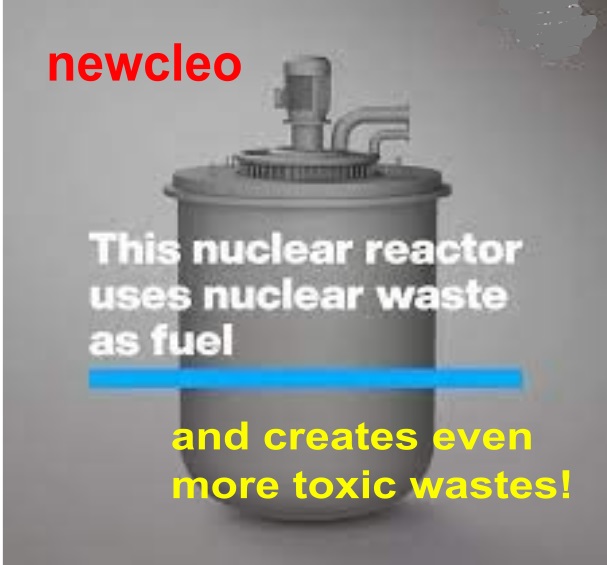
COMMENT. This is a very interesting article. For one thing, it shows that these “advanced” nuclear reactors require plutonium to get the fission process happening. It also claims that these advanced nuclear reactors can solve the problem of plutonium wastes. That is not true. The wastes resulting from this process are smaller in volume, but more highly toxic. That means that they require the same area/voume of space for disposal as the original plutonium. On another angle, it does indicate the confusion that the British government is in about the way ahead in their highly suspect “Civil Nuclear Roadmap”. And on another angle again, it shows how Macron’s France is putting all its eggs into the one nuclear basket. When we look at the extreme costs, and the extreme climate effects, Macron’s French nuclear obsession is likely to result in political suicide.
Matt Oliver, Sun, 21 January 2024, https://finance.yahoo.com/news/nuclear-start-drops-plans-british-131702123.html#:~:text=A%20British%20nuclear%20startup%20has,lobbied%20personally%20by%20Emmanuel%20Macron.
A British nuclear startup has dropped plans to build a pioneering power plant in Cumbria and will invest £4bn in France instead, after it was lobbied personally by Emmanuel Macron.
Newcleo, which is headquartered in London, is developing a type of mini nuclear power plant, known as an advanced modular reactor (AMR), that will use nuclear waste for fuel.
The company had hoped to tap into the UK’s vast stockpile of waste at Sellafield, where it wanted to invest £2bn in a waste reprocessing factory and AMR that would have created around 500 jobs.
It was also planning a similarly-sized facility in France.
But Stefano Buono, Newcleo’s chief executive and founder, said the company has now dropped the UK plans after the Government ruled out giving private companies access to the Sellafield stockpile in a nuclear industry “roadmap” published this month.
Instead, Newcleo is planning an enlarged development at an undisclosed location in the south of France, where it now plans to spend £4bn and create around 1,000 jobs, he said.
As part of that scheme, it will buy nuclear waste from French state energy giant EDF.
The company is also currently in the middle of a €1bn (£860m) fundraising.
The decision comes after the company was blocked from participating in the UK’s design competition for mini nuclear reactors.
By comparison, France has eagerly supported Newcleo and Mr Buono was lobbied repeatedly for investment by President Macron in face-to-face meetings.
Newcleo, which was also invited to last year’s “Choose France” business summit at the Palace of Versailles, has never been offered an in-person meeting with a British prime minister.
Mr Buono told The Telegraph: “Our plan initially was to use one factory in France and one in the UK.
“Now, we will double the capacity of France and we are not investing in the UK.”
He added that the company had hoped to pioneer its technology in Britain but added: “In two years, we were not able to even locate the site, so we have decided to accept the offer from France.
“We can proceed with our business model there.”
Newcleo’s decision to build its first plant abroad comes amid growing frustration within the British nuclear industry over the slow progress the Government has made towards identifying sites for new power plants.
The loss of significant investment to France will also be seen as the latest sign that Downing Street’s efforts to attract business investment are being outshone by President Macron, who has launched a charm offensive to lure companies across the Channel since Brexit.
He was the only G7 leader to attend the World Economic Forum in Davos, Switzerland, this week, while he has rolled out the red carpet for business leaders including Tesla boss Elon Musk and JP Morgan banker Jamie Dimon at his annual Choose France event.
Last year’s summit resulted in major deals, with Taiwanese car battery maker ProLogium unveiling plans for a €5.2bn plant at the port of Dunkirk and Verkor, a French company, pledging a €1.6bn battery factory there too.
In the UK, six SMR developers including Rolls-Royce have been shortlisted for support under a competition run by Great British Nuclear.
Newcleo was not considered because of the AMR’s lead cooling system and unusual fuel, Mr Buono has claimed.
The company’s novel design would run on processed plutonium, helping countries such as the UK dispose of the dangerous waste, which is expensive to manage. [Ed. This ignores the fact that this process results in a smaller volume of more highly toxic waste]
At Sellafield, the UK has amassed 140 tonnes of plutonium – the world’s biggest stockpile – as a result of historic nuclear weapons programmes and abandoned efforts to develop so-called fast breeding reactors that would have used it as fuel.
A massive effort is currently under way at the Cumbrian site to safely store the waste, but Mr Buono and his colleagues have argued it could be put to better use as reactor fuel.
The entrepreneur made his fortune selling cancer treatment developer AAA to Novartis for $3.9bn (£3.2bn) in 2017, reportedly earning him $420m.
His company has the backing of the Agnelli industrialist family, which made its money from Fiat and Ferrari.
The French government is expected to confirm a deal with Newcleo later this year.
The UK Government did not respond to requests for comment.
Ontario is about to decide whether to overhaul Canada’s oldest nuclear power plant. Does it deserve a second life?
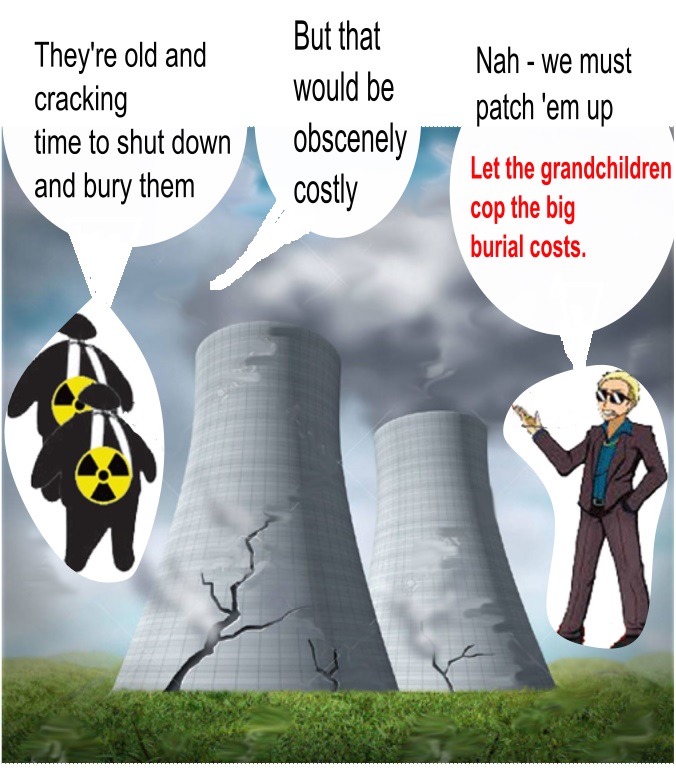
All of these are Candu reactors – Canada’s homegrown reactor design. They deteriorate with age. Inside their cores, pressure tubes (which contain the uranium fuel) grow longer, thinner and weaker. They begin to sag and corrode, increasing the risk of ruptures. Feeder pipes, which supply water to the pressure tubes, also corrode and thin.
Globe and Mail, MATTHEW MCCLEARN, 21 Jan 24
The Pickering Nuclear Generating Station’s dull, mottled-grey concrete domes testify to its more than half a century of faithful service. Lately, its six operating reactors have produced enough electricity to supply 1.5 million people, about one-tenth of Ontario’s total population.
In the coming weeks, Ontario Energy Minister Todd Smith is expected to reveal whether the province will extend the plant’s life. A study last summer from Ontario Power Generation, the station’s owner, examined the feasibility of refurbishing Pickering’s four “B” reactors, commissioned between 1983 and 1986. OPG has said there’s no technical reason the work can’t proceed. If approved, it would begin in 2028, with the aim of returning the reactors to service in the mid-2030s.
The real question is whether it’s worth it.
A firm cost estimate for extending the reactors’ lifespan has not been finalized. Refurbishments under way at OPG’s Darlington nuclear plant in Clarington and Bruce Power’s station in Tiverton have cost between $2-billion and more than $3-billion per reactor. The reactors at Pickering, Canada’s oldest nuclear plant, could cost even more, though their output is relatively small by modern standards.
Ontario’s government has said little about how it is weighing this decision, and it’s unclear what other options, if any, the province is considering. OPG has said its feasibility study would compare the refurbishment’s economic viability to “potential alternatives,” but the finished report has not been released publicly.
The Globe and Mail made a freedom of information request for a copy of the study. But Sean Keelor, chief administrative officer at Ontario’s Ministry of Energy, withheld the document in its entirety. He cited exemptions within the province’s Freedom of Information Act for “advice to government” and for information that could damage the “economic or other interests of Ontario.”
The Canadian Nuclear Safety Commission, which regulates the industry, allows utilitiesto perform upgrades thateffectively double reactors’ lives, as long as “all practicable safety improvements to bring the facility up to modern standards” have been identified. Upgrading Pickering would be no small undertaking.
“They are very old reactors, and the equipment is out of date,” said Ibrahim Attieh, a reactor physicist who worked on Candu designs. “It’s going to be a lot more costly to retrofit new equipment in.”
The Pickering station, situated on the shore of Lake Ontario about 30 kilometres east of downtown Toronto, also includes the four 1970s-era Pickering “A” reactors, which are not under consideration for refurbishment.
Two have been dormant for decades after an aborted refurbishment, and the remaining two are scheduled to shut down permanently this year.
All of these are Candu reactors – Canada’s homegrown reactor design. They deteriorate with age. Inside their cores, pressure tubes (which contain the uranium fuel) grow longer, thinner and weaker. They begin to sag and corrode, increasing the risk of ruptures. Feeder pipes, which supply water to the pressure tubes, also corrode and thin.
Candus were originally expected to operate for about 30 years. The industry has said decisions on whether to refurbish should be made after a quarter century – a milestone Pickering B has already passed.
All refurbishments involve sending workers into a reactor’s radioactive core, to replace major components such as pressure tubes and feeder pipes. But the scope of work varies considerably, depending on the age, design and condition of components, as well as other factors. A utility might also improve other infrastructure at a nuclear plant, such as turbines and control room equipment.
Subo Sinnathamby, OPG’s chief projects officer, said that among the components that would need to be replaced at Pickering B are the steam generators, which use heat produced inside the core to boil water, creating steam that drives turbine blades.
Ms. Sinnathamby said these components are too large to be removed through the reactor’s airlocks.
“We will have to cut a hole in the dome to remove it,” she said.
Pickering B’s control room is straight out of the Cold War and would also require modernization.
Continue reading1 This Month
23-25 October – on Zoom – World BEYOND War’s annual global conferenc


Shut down the radiation-damaged Heysham nuclear reactors now
To see nuclear-related stories in greater depth and intensity – go to https://nuclearinformation.wordpress.com

Say No to NASA’s Reckless Nuclear Reactor on the Moon
Say No to NASA’s Reckless Nuclear Reactor on the Moon
-
Archives
- October 2026 (180)
- September 2026 (339)
- August 2026 (330)
- July 2026 (355)
- June 2026 (287)
- May 2026 (306)
- April 2026 (356)
- March 2026 (251)
- February 2026 (267)
- January 2026 (308)
- December 2025 (358)
- November 2025 (359)
-
Categories
- 1
- 1 NUCLEAR ISSUES
- business and costs
- climate change
- culture and arts
- ENERGY
- environment
- health
- history
- indigenous issues
- Legal
- marketing of nuclear
- media
- opposition to nuclear
- PERSONAL STORIES
- politics
- politics international
- Religion and ethics
- safety
- secrets,lies and civil liberties
- spinbuster
- technology
- Uranium
- wastes
- weapons and war
- Women
- 2 WORLD
- ACTION
- AFRICA
- Atrocities
- AUSTRALIA
- Christina's notes
- Christina's themes
- culture and arts
- Events
- Fuk 2022
- Fuk 2023
- Fukushima 2017
- Fukushima 2018
- fukushima 2019
- Fukushima 2020
- Fukushima 2021
- general
- global warming
- Humour (God we need it)
- Nuclear
- RARE EARTHS
- Reference
- resources – print
- Resources -audiovicual
- Weekly Newsletter
- World
- World Nuclear
- YouTube
-
RSS
Entries RSS
Comments RSS

