Fish v. electricity: Could Salem nuclear plant be shut down?

Delaware Live KARL BAKER FEBRUARY 16, 2024
A judge in an obscure administrative court in Trenton, N.J., is set to hand down a ruling that could end a challenge to the Salem nuclear plant’s ability to pump billions of gallons of water out of the Delaware River each day.
The case, which strikes at the heart of the mid-Atlantic electricity ecosystem, pits a tenacious environmental group against one of the region’s largest energy companies, and its ultimate resolution could impact electricity prices for Delawareans, the health of birds and fish in the Delaware estuary, and President Joe Biden’s most ambitious energy initiative to date.
In short, it’s the region’s biggest environmental battle that you’ve probably never heard of.
At issue is the way in which the Salem Nuclear Generating Station’s two reactors cool steam created by the heat of nuclear fission. Currently, the plant pumps cold water from the Delaware River through a system of pipes that lead it to the steam, which is then cooled back to a liquid form.
The river water then returns to the estuary, but at far higher temperatures than when it was pumped in.
In all, the process kills large numbers of fish and fish larvae, though the exact amounts are disputed.
In late 2016, the Delaware Riverkeeper Network , an environment group and active critic of heavy industry in the region – petitioned New Jersey to rescind a permit that allows the plant to pump water out of the river.
When filed, the challenge was the latest of more than a decade of petitions, disputes and complaints brought against the Salem facility by the environmental group and its outspoken leader Maya van Rossum, who calls the power plant the largest “predator” in the Delaware estuary.
Van Rossum claims that 3 billion adult fish are killed on average each year by the plant’s cooling operations, plus billions more eggs and larvae. Those include the bay anchovy, a species that has suffered a declining local population even as larger fish, eagles, herons, and even whales rely on it for food.
“The cause of the problem for the fish is that the Salem Nuclear Generating Station is sucking them in, cooking them, ripping them apart, destroying them,” she said.
The New Jersey Department of Environmental Protection, which declined to comment for this story, suggested in their permit issued to Salem that the mortality figures cited by van Rossum and other critics are overstated.
Still, they do not appear to have presented current, counter estimate
During the early 2000s, the U.S. Environmental Protection Agency issued new rules mandating that new large power plants use closed-cycle cooling…………………………………………………………………………………………………………………………. more https://delawarelive.com/fish-v-electricity-could-salem-be-shut-down/
Nuclear security is under attack in Ukraine, say experts at Bellona forum.

These and other questions were raised during today’s Bellona forum, “War and the Russian Nuclear Industry,” which brough together experts from Norway and Bellona’s new offices in Vilnius — the new locale for the organization’s Russian staff, who can no longer safely conduct their work on Russian soil.
“We have full-scale war in a country with full-scale nuclear installations, and a situation where international cooperation on nuclear security no longer exists,” said Bellona founder Frederic Hauge in the forum’s opening remarks.
Bellona has worked on nuclear cleanup in Russia since the early 1990s, and this month mark 30 years since Bellona released its first report on the nuclear threat caused by the legacy of the Soviet nuclear navy. It has also been almost exactly two years since Russia invaded Ukraine. That was the backdrop for today’s Bellona Forum, where about 100 people participated physically or digitally.
Tons of Nuclear Waste
Aleksandr Nikitin, a former Russian nuclear submarine officer and Bellona employee of 30 years standing, opened the forum by discussing Bellona’s strategic goals for its nuclear project in Russia.
“First and foremost, together with international actors, we have worked to prevent radiation and nuclear accidents at Russian facilities,” he said. “We have also been concerned with ensuring the elimination or safe conversion of the Soviet nuclear and radiation legacy.”
He noted that the Russian nuclear and radiation legacy consists of nearly 20,000 tons of used nuclear fuel, approximately 800,000 cubic meters of radioactive waste, over 4,700 nuclear and radiation hazardous facilities — as well as more than 30,000 cubic meters of radioactive waste dumped on the seabed.
Since Russia invaded Ukraine on February 24, 2022, international efforts to grapple with those issues have stalled.
“But at Bellona, we still have full focus on the Russian nuclear industry, even though now, since we were banned by Russian authorities, we must operate from outside Russia’s borders,” Nikitin said. “We are still working to gather and disseminate information; we share knowledge about the use of nuclear technologies and how the Russian nuclear industry contributes to the continuation of the war in Ukraine.”
‘Rosatom Significantly Involved in the War’
One of the employees at Bellona’s Environmental Transparency Center in Vilnius is nuclear expert Dmitry Gorchakov, who spoke at the Bellona Forum about the role of the Russian atomic agency Rosatom in Russia’s war against Ukraine.
“We closely monitor nuclear risks in Ukraine. And we monitor Rosatom’s global nuclear activities and the agency’s role in the international nuclear market closely,” said Gorchakov.
Rosatom is the world’s largest builder of nuclear power plants. One-third of all nuclear power plants under construction in the world are either built by Rosatom or according to Rosatom’s technology and design.
“Rosatom is significantly involved in the ongoing war. One of the most critical situations is the occupation of Europe’s largest nuclear power plant, Zaporizhzhia (in southeastern Ukraine), which the Russians have occupied since the first weeks of the war. Inspectors from the International Atomic Energy Agency (IAEA) have been denied access to several areas of the facility,” said Gorchakov.
He highlighted three main risks at the nuclear power plant as it continues to be controlled by Russia on the front lines of the conflict.
“First, there is a risk of equipment damage due to abnormal operation and lack of maintenance. The second risk is the lack of qualified personnel. But the biggest risk, of course, is the war itself; it is unpredictable and creates chaos. Dramatic changes can occur at any time. For example, if Russia decides to switch reactors to power mode or if military activity escalates near the plant,” said Gorchakov.
Secret Nuclear Weapons Program
Thomas Nilsen from The Independent Barents Observer also participated in the Bellona forum. He talked about Russia’s secret reactor-driven nuclear weapons program and its development and testing in the Arctic.
We are in a new arms race involving new nuclear weapons and new reactor systems. And we are back to the flow of information that existed during the Soviet era, meaning almost no information. We at The Barents Observer have not reported a single incident from Russian nuclear submarines in the past four years, and that’s not because accidents haven’t happened. It’s becoming harder and harder to obtain information from Russia,” Nilsen explained.
The Barents Observer is the only Norwegian media outlet with four exiled Russian journalists on its editorial staff.
You can watch the entire Bellona forum by clicking on this link.
Release of fourth batch of Fukushima treated radioactive water begins

Japan Times, 28 Feb 24
The operator of the crippled Fukushima No. 1 nuclear power plant on Wednesday started releasing a fourth batch of treated radioactive water into the sea, in what will be the last discharge for the fiscal year ending March.
As in previous rounds, Tokyo Electric Power Company Holdings (Tepco) will discharge 7,800 metric tons of treated water over about 17 days, having confirmed that the radioactivity level of the latest batch of water meets the standards set by the government and the utility.
China, which opposes the water release, has banned Japanese seafood imports since the first discharge in late August. The two countries have engaged in informal discussions to resolve the matter, but no substantial progress has been made……………………….. more https://www.japantimes.co.jp/news/2024/02/28/japan/society/fukushima-radioactive-water-fourth-release/
Locals oppose nuclear waste plant – parish council
Bob Cooper, Political reporter, BBC Radio Cumbria, 28 Feb 24 https://www.bbc.com/news/articles/c0jvjx8kn5xo—
Opponents of plans to seal some of the UK’s most lethal nuclear waste underground have called for communities to have more of say.
Whicham Parish Council in west Cumbria held a postal survey, in which more than three quarters of those who responded opposed the idea.
It is part of an area in which officials are exploring the possibility of siting a Geological Disposal Facility (GDF).
Cumberland Council said there was “no reason” for parish councils to conduct ballots.
Nuclear Waste Services, the body that oversees the project, described a GDF as “a highly engineered structure consisting of multiple barriers that will provide protection over hundreds of thousands of years.”
High-level nuclear waste would be sealed up to 1km (0.62 mile) underground, or possibly under the seabed.
Searches for a potential place for the facility are taking place in three areas, including two in Cumbria and another in Lincolnshire.
‘Impact on communities’
The process of identifying a site is expected to take 10 to 15 years and it could be ready to start receiving waste in the 2050s.
The Whicham postal vote was carried out in 2023 and the parish council said 251 out of 400 parishioners replied, which was a 63% turnout.
The council said 77% were opposed to a GDF in the parish, 15% were in favour, 6% were neutral, while the rest of the forms were blank.
Richard Outram, from Nuclear Free Local Authorities, a group of councils opposed to nuclear developments, said other parish councils should follow Whicham and conduct polls.
“The geological disposal facility, or a nuclear waste dump, is a massive engineering project that’s going to impact on communities for tens of years,” he said.
“It’s important to regularly take the public temperature and one way of doing that is by each parish council holding a regular parish poll.”
‘Too early’
Cumberland Council is the authority with the power to withdraw local communities from the siting process, external.
It is also responsible for conducting a formal test of public support, external, such as a local referendum, before a site can be approved.
The Labour-led authority recently wrote to parish councils telling them they did not need to conduct polls because “detailed public opinion monitoring in the Search Areas is already carried out”.
It also said it was too early in the process to carry out an official test of public support.
Meanwhile, Nuclear Waste Services said surveys to monitor local opinion would be carried out by a professional polling company.
‘I was a guinea pig during secret Christmas Island nuclear tests’

By Nicola Haseler & Lewis Adams. BBC News, Bedfordshire. 28 Feb 24
A former Royal Engineer who witnessed several atomic and hydrogen bomb explosions as part of the UK’s nuclear tests said he was a “guinea pig”.
Brian Cantle, from Bedfordshire, was 21 when he was sent to Christmas Island as part of his national service in 1957.
He and the other soldiers were not told what they were going to do there – due to the covert nature of the programme.
Mr Cantle, now 87, has been awarded a Nuclear Test Medal for his work on the Pacific Ocean island.
The veteran, from Whipsnade, witnessed several atomic and hydrogen bomb explosions during his 12 months on the island.
He was one of 22,000 British servicemen who participated in the British and United States’ nuclear tests and clean-ups between 1952 and 1965……………………………………………
On the days when bombs were tested, Mr Cantle said troops would have to put on brown overalls and face the other way to the bomb going off.
He added: “It was just a big flash and then we were told we could turn round and see it. It was an enormous explosion.”
‘We were guinea pigs’
In the decades that have followed the tests, calls have been made for the men who witnessed a nuclear test to receive an apology for the health risks they were exposed to.
“We were guinea pigs, we were just told what to do and did it,” Mr Cantle said………
The Grapple H-bomb nuclear test series was intended to show that the British had the technology to influence the Cold War, following the development of the atomic bomb by U.S. scientist Robert Oppenheimer.
The hydrogen bombs, which were much more powerful than atomic bombs, were detonated every three months……. https://www.bbc.com/news/uk-england-beds-bucks-herts-68415338
Burying nuclear waste the best of a bad bunch of options
A reader offers her opinion on what to do with nuclear waste as Saskatchewan considers small modular reactors for its future energy needs.
I share the concern that Dale Dewar expressed in the StarPhoenix of Feb. 20 about the long-term management of Canada’s used nuclear fuel.
However, my conclusion is that, while far from ideal, deep burial is the best of a bunch of bad available options. There are no good options. Even proposals to extract recyclable material from the used fuel will leave behind most of the waste to be somehow disposed of.
Dewar’s suggestion that the wastes should remain permanently on the surface, with a system of rolling stewardship that would be passed on from generation to generation, might work in a world that could be guaranteed to be permanently free of war, terrorism, natural disasters, negligence and political instability.
But that’s not the world we live in. We cannot assume that safe stewardship would be maintained in perpetuity. Leaving the wastes indefinitely on the surface would seem to create far greater risk than deep geological burial would.
Of course, it would have been nice if we had thought about this problem before we started creating these wastes.
Has the nuclear lobby hijacked Welsh democracy?

25 Feb 2024, Robat Idris https://nation.cymru/opinion/has-the-nuclear-lobby-hijacked-welsh-democracy/
A sadly but unsurprising travesty of democracy slid out of Cardiff Bay with the release of the Senedd’s Economy, Trade and Rural Affairs Committee report on “Nuclear Energy and the Welsh Economy” on 21st February.
As a case study in lobbying power, it is surely worthy of inclusion in the Hall of Infamy.
Its recommendations could have been written by the nuclear lobby itself, rather than by our democratically elected Senedd Members.
Despite the collapse of the Wylfa project in 2019, all of the recommendations enthusiastically back the case for nuclear, with a plea to the UK Government to get on with the job. Einstein reportedly said: “Insanity is doing the same thing over and over again and expecting different results”.
Informed voices
If we are to have a credible Senedd, and a real democracy, then it is crucial that informed voices are heard.
This report, pandering to the self-interest of denizens of the nuclear village, merely reinforces the view that politics is about kowtowing to powerful corporate interests.
Meanwhile Cymru bleeds while real and credible solutions to energy and jobs exist.
The blurb preceding the report assures us that: “The Welsh Parliament is the democratically elected body that represents the interests of Wales and its people”. Yet this Committee took oral evidence from nine pro-nuclear individuals, and written evidence from six pro-nuclear organisations, and none from any individual or organisation having an anti-nuclear or indeed a sceptical view.
The rationale for this appears to be that the terms of reference deliberately chose not to include other voices:
“The terms of reference for this one-day inquiry were to consider the potential economic impact of new nuclear developments in north Wales, how to maximise local employment and benefits to local or Wales-based supply chains of new nuclear projects, and the challenges posed by skills shortages and how to overcome them. By its nature the inquiry did not examine the pros and cons of nuclear energy itself, but recognised its place in an overall energy security strategy and net zero targets.”
Apparently the only relevant voices are those backing nuclear.
The committee’s duty is to the people of Cymru, and not to the nuclear industry, or to the desire of the UK to remain a nuclear armed state.
Balanced view
As should be apparent if the Wellbeing of Future Generations Act is taken seriously. This is such a vital matter that evidence should be given to the committee which would enable its members to form a fully informed and balanced view on nuclear energy.
Why wasn’t evidence sought from experts and interested parties on such questions as:
- why new nuclear may never happen.
- why nuclear can’t be built in time to influence climate change.
- why should Cymru support civil nuclear when the UK Government admits its intrinsic links with military nuclear weapons capability?
- why should such reliance be placed on the voices of an industry which consistently fails to deliver on cost and on time?
- why should Cymru accept nuclear when renewable energy technology can provide 100% of our energy needs?
- why should Ynys Môn and Gwynedd become a nuclear dump to satisfy the needs of the nuclear industry and the UK state?
- why should we believe that the effects on language, culture, biodiversity can be mitigated?
- why have an influx of workers at a time when housing is a major issue for local people, when the NHS is on the point of collapse, when council services are creaking?
- why does the Welsh Government not acknowledge that nuclear is in retreat globally?
It’s time to recognise that the priority for Cymru is to look to our own natural resources for energy and job solutions. If fully harnessed, offshore wind has the potential to provide double our energy needs.
And why don’t our Senedd Members look critically at the companies which gave evidence?
- In 2020 the American company Bechtel had to pay (with another company) $57.5 million to the US Department of Justice for irregularities at the Hanford Waste Treatment Plant (Hanford is considered to be the most toxic nuclear waste facility in the US). In 2008 it had to pay (with another company) $407 million to the state and federal governments to settle litigation over leaky tunnels and a fatal ceiling collapse in the Boston Big Dig project.
- Rolls-Royce make the nuclear engines for Trident submarines which carry nuclear weapons. The company has publicly stated that there are synergies between the civil and military nuclear industries. Its Small Modular Reactor Design is unlicenced and unproven, and as for being small, it is at 470 MW twice the size of the old Trawsfynydd reactors. Rolls-Royce’s new CEO Tufan Erginbilgic described the company as a “burning platform” as 2.500 job cuts were announced in 2023.
Caught up amongst the corporate and academic behemoths, Ynys Môn council leader Llinos Medi inherited the poisoned chalice of support for nuclear from her predecessors. Like many of us on Ynys Môn, she has a burning desire for our youngsters to have a future locally, and for the language to thrive.
Can she be persuaded that another, better, way can be found?
The Council’s support for a future project at Wylfa is “based on confirmation that the development is sustainable and that it should not be at the expense of the island’s communities”. Nowhere on the globe is nuclear sustainable, and communities worldwide have paid the price. Not only in Chernobyl and Fukushima, but in many countries where uranium is mined and land, water and workers are poisoned.
On Saturday 16th March PAWB (People Against Wylfa B), backed by other concerned organisations, is holding an open meeting called “Green Revolution – Opportunity Knocks” to open minds to the possibilities of truly sustainable economic and community growth in Ynys Môn and Gwynedd. Perhaps members of the Economy, Trade and Rural Affairs Committee should attend!
Robat Idris is a member of PAWB. He is also vice-chair of Cymdeithas y Cymod, member of CND Cymru and past chair of Cymdeithas yr Iaith. He contributed a chapter on “Atomic Wales” in “The Welsh Way”.
Biden administration restores Trump-rescinded policy on illegitimacy of Israeli settlements
BY MATTHEW LEE, February 24, 2024
WASHINGTON (AP) — The Biden administration on Friday restored a U.S. legal finding dating back nearly 50 years that Israeli settlements in the occupied Palestinian territories are “illegitimate” under international law.
Secretary of State Antony Blinken said the U.S. believes settlements are inconsistent with Israel’s obligations, reversing a determination made by his predecessor, Mike Pompeo, in the Biden administration’s latest shift away from the pro-Israel policies pursued by former President Donald Trump.
Blinken’s comments came in response to a reporter’s question about an announcement that Israel would build more than 3,300 new homes in West Bank settlements as a riposte to a fatal Palestinian shooting attack.
It wasn’t clear why Blinken chose this moment, more than three years into his tenure, to reverse Pompeo’s decision. But it came at a time of growing U.S.-Israeli tensions over the war in Gaza, with the latest settlement announcement only adding to the strain. It also came as the United Nations’ highest court, the International Court of Justice, is holding hearings into the legality of the Israeli occupation.
Biden administration officials did not cast Blinken’s comments as a reversal — but only because they claim Pompeo’s determination was never issued formally. Biden administration lawyers concluded Pompeo’s determination was merely his opinion and not legally binding, according to two administration officials who spoke on condition of anonymity to discuss private discussions.
But formally issued or not, Pompeo’s announcement in November 2019 was widely accepted as U.S. policy and had not been publicly repudiated until Blinken spoke on Friday.
Speaking in the Argentine capital of Buenos Aires, Blinken said the U.S. was “disappointed” to learn of the new settlement plan announced by Israel’s far-right firebrand finance minister, Bezalel Smotrich, after three Palestinian gunmen opened fire on cars near the Maale Adumim settlement, killing one Israeli and wounding five.
Blinken condemned the attack but said the U.S. is opposed to settlement expansion and made clear that Washington would once again abide by the Carter administration-era legal finding that determined settlements were not consistent with international law.
“It’s been longstanding U.S. policy under Republican and Democratic administrations alike that new settlements are counter-productive to reaching an enduring peace,” he said in his news conference with Argentine Foreign Minister Diana Mondino.
“They’re also inconsistent with international law. Our administration maintains a firm opposition to settlement expansion and in our judgment this only weakens, it doesn’t strengthen, Israel’s security,” Blinken said……………………………….. more https://apnews.com/article/israel-settlements-illegitimate-palestine-biden-rescind-law-0bed7cf5d6f98012193e9f5075eb719a
China is ‘unlikely’ to lift import ban on Japanese seafood as dumping continues

predatory species higher up in the food chain have a greater chance of experiencing bioaccumulation and biomagnification of radioactive substances. As time goes on and more nuclear-contaminated water is discharged, the negative effects will only increase
By GT staff Feb 25, 2024 , https://www.globaltimes.cn/page/202402/1307658.shtml
Half a year after Japan opened Pandora’s box by dumping nuclear-contaminated wastewater from the crippled Fukushima Daiichi nuclear power plant into the ocean, Japanese media are discussing the possibility of bilateral talks for getting China to revoke its import ban on Japanese marine products, in an apparent attempt to test the waters.
In response, Chinese experts told the Global Times on Sunday that, in the short term, it is unlikely that China will revoke the ban as there are currently no conditions for a withdrawal.
Meanwhile, a Kyodo News survey on Friday showed that most Japanese fishery groups have been affected by the discharge, with many feeling the impact through China’s import ban on Japanese seafood.
The survey found that 29 out of 36 respondents among the members of the National Federation of Fisheries Cooperative Associations said they “had felt” or “had somewhat felt” negative effects, including financial damage due to the contaminated water dumping, overwhelmingly due to the subsequent import ban by China.
Chinese Foreign Ministry spokesperson Mao Ning said at a regular press conference that the precautionary measures taken by China and some other countries in response to Japan’s move are aimed at protecting food safety and people’s health.
“These measures are entirely legitimate, reasonable and necessary,” Mao said.
Chang Yen-chiang, director of the Yellow Sea and Bohai Sea Research Institute of Dalian Maritime University, revealed several main factors why China is less likely to revoke the ban in the short run.
There is no halt in the ocean discharge, that is, the Japanese side has not withdrawn from their erroneous actions, he said.
Currently, half a year has passed since the dumping began, meaning that under the influence of ocean currents, the impact of Japan’s nuclear-contaminated water discharge on East Asia may just be starting, and further impacts need to be assessed, Chang said.
In addition, predatory species higher up in the food chain have a greater chance of experiencing bioaccumulation and biomagnification of radioactive substances. As time goes on and more nuclear-contaminated water is discharged, the negative effects will only increase, Chang said. “Under these circumstances, how could the ban be lifted?” the expert asked.
TEPCO – operator of the Daiichi plant – plans to release a total of about 54,600 tons of nuclear-contaminated water on seven occasions in the 2024 fiscal year, more than double the amount of 2023, according to media reports.
Chang called on Japan to consider solving the Fukushima nuclear power plant issue on a fundamental level, such as focusing on research on how to handle the burnt-out nuclear reactors. Otherwise, radioactive substances will continue to be produced endlessly, and the discharge of nuclear contamination could last for over 100 years, making the situation increasingly worse.
Japanese media have reported on a series of scandals concerning leaks occurring during the contaminated water discharge process, which led to soil contamination around the nuclear power plant.
Most recently, 1.5 metric tons of highly radioactive water escaped in early February during valve checks at a treatment machine designed to remove cesium and strontium from the contaminated water, according to TEPCO.
According to Japanese experts studying the soil, the radiation levels in Fukushima soil are much higher compared to other areas.
“We should be more vigilant toward crops and plants grown in this contaminated soil. China should increase radioactive testing of Japanese agricultural products and cosmetics imports,” Chang stated.

China is ‘unlikely’ to lift import ban on Japanese seafood as dumping continues
By GT staff reportersPublished: Feb 25, 2024 09:50 PM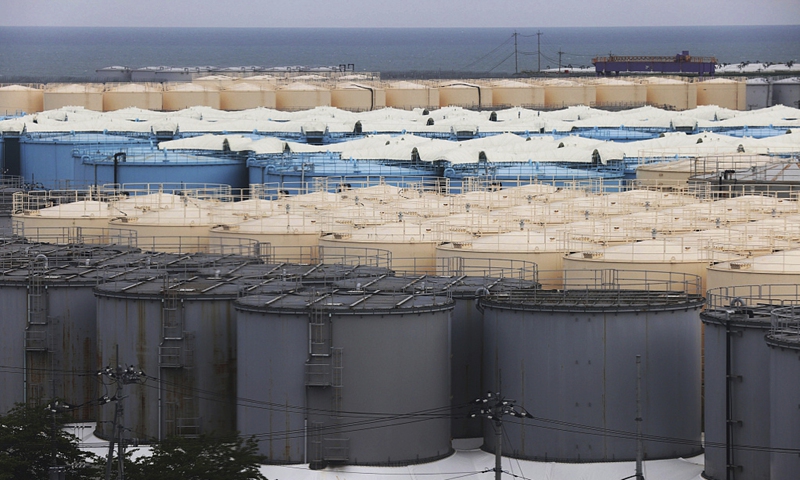
Water tanks near Fukushima Daiichi nuclear power plant in Okuma town of Fukushima prefecture on May 26, 2023 Photo: VCG
Half a year after Japan opened Pandora’s box by dumping nuclear-contaminated wastewater from the crippled Fukushima Daiichi nuclear power plant into the ocean, Japanese media are discussing the possibility of bilateral talks for getting China to revoke its import ban on Japanese marine products, in an apparent attempt to test the waters.
In response, Chinese experts told the Global Times on Sunday that, in the short term, it is unlikely that China will revoke the ban as there are currently no conditions for a withdrawal.
Meanwhile, a Kyodo News survey on Friday showed that most Japanese fishery groups have been affected by the discharge, with many feeling the impact through China’s import ban on Japanese seafood.
The survey found that 29 out of 36 respondents among the members of the National Federation of Fisheries Cooperative Associations said they “had felt” or “had somewhat felt” negative effects, including financial damage due to the contaminated water dumping, overwhelmingly due to the subsequent import ban by China.
Chinese Foreign Ministry spokesperson Mao Ning said at a regular press conference that the precautionary measures taken by China and some other countries in response to Japan’s move are aimed at protecting food safety and people’s health.
“These measures are entirely legitimate, reasonable and necessary,” Mao said.
Chang Yen-chiang, director of the Yellow Sea and Bohai Sea Research Institute of Dalian Maritime University, revealed several main factors why China is less likely to revoke the ban in the short run.
There is no halt in the ocean discharge, that is, the Japanese side has not withdrawn from their erroneous actions, he said.
Currently, half a year has passed since the dumping began, meaning that under the influence of ocean currents, the impact of Japan’s nuclear-contaminated water discharge on East Asia may just be starting, and further impacts need to be assessed, Chang said.
In addition, predatory species higher up in the food chain have a greater chance of experiencing bioaccumulation and biomagnification of radioactive substances. As time goes on and more nuclear-contaminated water is discharged, the negative effects will only increase, Chang said. “Under these circumstances, how could the ban be lifted?” the expert asked.
TEPCO – operator of the Daiichi plant – plans to release a total of about 54,600 tons of nuclear-contaminated water on seven occasions in the 2024 fiscal year, more than double the amount of 2023, according to media reports.
Chang called on Japan to consider solving the Fukushima nuclear power plant issue on a fundamental level, such as focusing on research on how to handle the burnt-out nuclear reactors. Otherwise, radioactive substances will continue to be produced endlessly, and the discharge of nuclear contamination could last for over 100 years, making the situation increasingly worse.
Japanese media have reported on a series of scandals concerning leaks occurring during the contaminated water discharge process, which led to soil contamination around the nuclear power plant.
Most recently, 1.5 metric tons of highly radioactive water escaped in early February during valve checks at a treatment machine designed to remove cesium and strontium from the contaminated water, according to TEPCO.
According to Japanese experts studying the soil, the radiation levels in Fukushima soil are much higher compared to other areas.
“We should be more vigilant toward crops and plants grown in this contaminated soil. China should increase radioactive testing of Japanese agricultural products and cosmetics imports,” Chang stated.
As Japanese industries, including fisheries and cosmetics, have been affected, Japanese media continues to report news about bilateral talks aimed at getting China to revoke its import ban on Japanese marine products, trying to test the reaction from China.
The Asahi Shimbun revealed Friday that nuclear experts from Japan and China started talks in January regarding contaminated water. The report noted that the Chinese side has still shown no signs of ending its import ban.
The Kyodo News reported on Thursday that when Chinese Ambassador to Japan Wu Jianghao met with the leader of the Social Democratic Party, Mizuho Fukushima, in January, China’s import suspension was also discussed, but there were no conditions for lifting the ban at present.
Iran Reduces Near-Weapons-Grade Stockpile, Defying Expectations
Move could signal an effort to de-escalate nuclear tensions with Washington
By Laurence Norman, Feb. 26, 2024
VIENNA—Iran reduced its stockpile of near-weapons-grade nuclear material even as it continued expanding its overall nuclear program, the United Nations’ atomic watchdog said Monday, marking a surprise step that could ease tensions with Washington.
The move comes at a moment when Iran and the U.S. have sought to avoid direct confrontation in the regional conflict that grew out of Hamas’s terrorist attack on Israel on Oct. 7 and Israel’s aggressive response………… (Subscribers only) more https://www.wsj.com/world/middle-east/iran-reduces-near-weapons-grade-stockpile-defying-expectations-ba384777
Fatal Flaws Undermine America’s Defense Industrial Base
Many elements of the traditional DIB have yet to adopt advanced manufacturing technologies, as they struggle to develop business cases for needed capital investment.
In other words, while adopting advanced manufacturing technologies would fulfill the purpose of the US Department of Defense, it is not profitable for private industry to do so.
Despite virtually all the problems the report identifies stemming from private industry’s disproportionate influence over the US DIB, the report never identifies private industry itself as a problem.
If private industry and its prioritization of profits is the central problem inhibiting the DIB from fulfilling its purpose, the obvious solution is nationalizing the DIB by replacing private industry with state-owned enterprises. This allows the government to prioritize purpose over profits. Yet in the United States and across Europe, the so-called “military industrial complex” has grown to such proportions that it is no longer subordinated to the government and national interests, but rather the government and national interests are subordinated to it.
US defense industrial strategy built on a flawed premise
Beyond private industry’s hold on the US DIB, the very premise the NDIS is built on is fundamentally flawed, deeply rooted in private industry’s profit-driven prioritization.
The report claims:
The purpose of this National Defense Industrial Strategy is to drive development of an industrial ecosystem that provides a sustained competitive advantage to the United States over its adversaries.
The notion of the United States perpetually expanding its wealth and power across the globe, unrivaled by its so-called “adversaries” is unrealistic.
China alone has a population 4-5 times greater than the US. China’s population is, in fact, larger than that of the G7 combined. China has a larger industrial base, economy, and education system than the US. China’s education system not only produces millions more graduates each year in essential fields like science, technology, and engineering than the US, the proportion of such graduates is higher in China than in the US.
China alone possesses the means to maintain a competitive advantage over the United States now and well into the foreseeable future. The US, attempting to draw up a strategy to maintain an advantage over China (not to mention over the rest of the world) regardless of these realities, borders on delusion.
Yet for 60 pages, US policymakers attempt to lay out a strategy to do just that.
Not just China, but also Russia
While China is repeatedly mentioned as America’s “pacing challenge,” the ongoing conflict in Ukraine is perhaps the most acute example of a shifting balance of global power.
Despite a combined population, GDP, and military budget many times greater than Russia’s, the collective West is incapable of matching Russian production of even relatively simple munitions like artillery shells, let alone more complex systems like tanks, aircraft, and precision-guided missiles.
While the US and its allies appear to have every conceivable advantage over Russia on paper, the collective West has organized itself as a profit-driven rather than purpose-driven society.
In Russia, the defense industry exists to serve national security. While one might believe this goes without saying, across the collective West, the defense industry, like all other industries in the West, exists solely to maximize profits.
To best serve national security, the defense industry is required to maintain substantial surge capacity – meaning additional, unused factory space, machines, and labor on standby if and when large surges in production are required in relatively short periods of time. Across the West, in order to maximize profits, surge capacity has been ruthlessly slashed, deemed economically inefficient. Only rare exceptions exist, such as US 155 mm artillery shell production.
While the West’s defense industry remains the most profitable on Earth, its ability to actually churn out arms and ammunition in the quantities and quality required for large-scale conflict is clearly compromised by its maximization of profits.
The result is evident today as the West struggles to expand production of arms and ammunition for its Ukrainian proxies.
The NDIS report would note:
Prior to the invasion, weapon procurements for some of the in-demand systems were driven by annual training requirements and ongoing combat operations. This modest demand, along with recent market dynamics, drove companies to divest excess capacity due to cost. This meant that any increased production requirements would require an increase in workforce hours in existing facilities—commonly referred to as “surge” capacity. These, in turn, were limited further by similar down-stream considerations of workforce, facility, and supply chain limitations.
Costs are most certainly a consideration across any defense industry, but costs cannot be the primary consideration.
A central element of Russia’s defense industry is Rostec, a massive state-owned enterprise under which hundreds of companies related to national industrial needs including defense are organized. Rostec is profitable. However, the industrial concerns organized under Rostec serve purposes related to Russia’s national interests first and foremost, be it national health, infrastructure or security.
Because Russia’s defense industry is purpose-driven, it produced military equipment because it was necessary, not because it was profitable. As a result, Russia possessed huge stockpiles of ammunition and equipment ahead of the Special Military Operation (SMO) in February 2022. In addition to this, Russia maintained large amounts of surge capacity enabling production rates of everything from artillery shells to armored vehicles to expand quickly over the past 2 years.
Only relatively recently have Western analysts acknowledged this.
Continue reading

“military industrial complex” has grown to such proportions that it is no longer subordinated to the government and national interests, but rather the government and national interests are subordinated to it.
the collective West has organized itself as a profit-driven rather than purpose-driven society………………………………across the collective West, the defense industry, like all other industries in the West, exists solely to maximize profits.
By Brian Berletic, Orinoco Tribune. February 24, 2024 https://popularresistance.org/fatal-flaws-undermine-americas-defense-industrial-base/
The first-ever US Department of Defense National Defense Industrial Strategy (NDIS) confirms what many analysts have concluded in regard to the unsustainable nature of Washington’s global-spanning foreign policy objectives and its defense industrial base’s (DIB) inability to achieve them.
The report lays out a multitude of problems plaguing the US DIB including a lack of surge capacity, inadequate workforce, off-shore downstream suppliers, as well as insufficient “demand signals” to motivate private industry partners to produce what’s needed, in the quantities needed, when it is needed.
In fact, the majority of the problems identified by the report involved private industry and its unwillingness to meet national security requirements because they were not profitable.
For example, the report attempts to explain why many companies across the US DIB lack advanced manufacturing capabilities, claiming:
Many elements of the traditional DIB have yet to adopt advanced manufacturing technologies, as they struggle to develop business cases for needed capital investment.
In other words, while adopting advanced manufacturing technologies would fulfill the purpose of the US Department of Defense, it is not profitable for private industry to do so.
Despite virtually all the problems the report identifies stemming from private industry’s disproportionate influence over the US DIB, the report never identifies private industry itself as a problem.
If private industry and its prioritization of profits is the central problem inhibiting the DIB from fulfilling its purpose, the obvious solution is nationalizing the DIB by replacing private industry with state-owned enterprises. This allows the government to prioritize purpose over profits. Yet in the United States and across Europe, the so-called “military industrial complex” has grown to such proportions that it is no longer subordinated to the government and national interests, but rather the government and national interests are subordinated to it.
US defense industrial strategy built on a flawed premise
Beyond private industry’s hold on the US DIB, the very premise the NDIS is built on is fundamentally flawed, deeply rooted in private industry’s profit-driven prioritization.
The report claims:
The purpose of this National Defense Industrial Strategy is to drive development of an industrial ecosystem that provides a sustained competitive advantage to the United States over its adversaries.
The notion of the United States perpetually expanding its wealth and power across the globe, unrivaled by its so-called “adversaries” is unrealistic.
China alone has a population 4-5 times greater than the US. China’s population is, in fact, larger than that of the G7 combined. China has a larger industrial base, economy, and education system than the US. China’s education system not only produces millions more graduates each year in essential fields like science, technology, and engineering than the US, the proportion of such graduates is higher in China than in the US.
China alone possesses the means to maintain a competitive advantage over the United States now and well into the foreseeable future. The US, attempting to draw up a strategy to maintain an advantage over China (not to mention over the rest of the world) regardless of these realities, borders on delusion.
Yet for 60 pages, US policymakers attempt to lay out a strategy to do just that.
Not just China, but also Russia
While China is repeatedly mentioned as America’s “pacing challenge,” the ongoing conflict in Ukraine is perhaps the most acute example of a shifting balance of global power.
Despite a combined population, GDP, and military budget many times greater than Russia’s, the collective West is incapable of matching Russian production of even relatively simple munitions like artillery shells, let alone more complex systems like tanks, aircraft, and precision-guided missiles.
While the US and its allies appear to have every conceivable advantage over Russia on paper, the collective West has organized itself as a profit-driven rather than purpose-driven society.
In Russia, the defense industry exists to serve national security. While one might believe this goes without saying, across the collective West, the defense industry, like all other industries in the West, exists solely to maximize profits.
To best serve national security, the defense industry is required to maintain substantial surge capacity – meaning additional, unused factory space, machines, and labor on standby if and when large surges in production are required in relatively short periods of time. Across the West, in order to maximize profits, surge capacity has been ruthlessly slashed, deemed economically inefficient. Only rare exceptions exist, such as US 155 mm artillery shell production.
While the West’s defense industry remains the most profitable on Earth, its ability to actually churn out arms and ammunition in the quantities and quality required for large-scale conflict is clearly compromised by its maximization of profits.
The result is evident today as the West struggles to expand production of arms and ammunition for its Ukrainian proxies.
The NDIS report would note:
Prior to the invasion, weapon procurements for some of the in-demand systems were driven by annual training requirements and ongoing combat operations. This modest demand, along with recent market dynamics, drove companies to divest excess capacity due to cost. This meant that any increased production requirements would require an increase in workforce hours in existing facilities—commonly referred to as “surge” capacity. These, in turn, were limited further by similar down-stream considerations of workforce, facility, and supply chain limitations.
Costs are most certainly a consideration across any defense industry, but costs cannot be the primary consideration.
A central element of Russia’s defense industry is Rostec, a massive state-owned enterprise under which hundreds of companies related to national industrial needs including defense are organized. Rostec is profitable. However, the industrial concerns organized under Rostec serve purposes related to Russia’s national interests first and foremost, be it national health, infrastructure or security.
Because Russia’s defense industry is purpose-driven, it produced military equipment because it was necessary, not because it was profitable. As a result, Russia possessed huge stockpiles of ammunition and equipment ahead of the Special Military Operation (SMO) in February 2022. In addition to this, Russia maintained large amounts of surge capacity enabling production rates of everything from artillery shells to armored vehicles to expand quickly over the past 2 years.
Only relatively recently have Western analysts acknowledged this.
Continue reading
SMRs are useless says the UK’s leading SMR analyst! – 100 per cent renewable energy is much more feasible!

by David Toke, https://100percentrenewableuk.org/smrs-are-useless-says-the-uks-leading-smr-analyst-100-per-cent-renewable-energy-is-much-more-feasible 25 Feb 24
Professor Stephen Thomas, the UK’s leading analyst of ‘small modular (nuclear) reactors’, has concluded that the idea faces a dead end, with no future. Yet the UK continues to give large grants to hopeful companies to develop these white elephants. The Government has proclaimed the need for ‘billions of pounds‘ of investment in SMRs. Meanwhile badly needed district heating networks to be supplied by large-scale heat pumps and a range of other realistic clean energy initiatives go unfunded!
The UK’s political institutions, including the House of Commons Environmental Audit Committee (EAC), continue to promote these fantasy SMRs through one-sided hearings and ignore possibilities for 100% renewable energy scenarios. Has the EAC set up an enquiry into the practicalities of 100 per cent or near 100 per cent renewable energy for the UK? No, it hasn’t, because it seems to prefer to spend time pursuing dead-ends such as SMRs.
Steve Thomas’s analysis lampooned the concept of SMRs when he said ‘The cheap way to produce SMRs is to scale down their failed designs’ (ie to scale down the larger versions of nuclear manufacturers previous failures). This highlights the central silliness of the idea of SMRs. On the one hand nuclear manufacturers built nuclear plant larger to improve economies of scale, but they have not produced economically viable results, so now there are pressures for them to reverse this process and make the resulting smaller nuclear power plant even worse!
He also commented that
‘All things equal, a large PWR/BWR will create less (nuclear) waste than the same capacity of small reactors’.
Thomas concluded that:
- the impression is that large numbers of SMRs are being ordered around the world
- These claims are unproven or misleading or simply wrong
- No modern design SMR is operating, 3 prototype SMRs are under construction (China, Russia, India)
- No current design has completed a full safety review by an experienced & credible regulator. Until this is done, it will not be known if the design is licensable or what the costs would be. So no design of SMR is commercially available to order
You can watch and hear Steve Thomas’s presentation on SMRs in the full youtube recording of our seminar on 100 per cent renewable energy rather than SMRs HERE Please go to 55 minutes into the recording to start watching from the beginning of Steve’s presentation.
The full power point presentation (on its own) can be downloaded from HERE
We shall soon be sending in the petition asking the EAC to launch an enquiry into 100 per cent renewable energy for the UK instead of the one it did on small modular reactors. It should be obvious that faced with new nuclear power failing and fossil fuel carbon capture and storage schemes that do not work we should be urgently looking at how we can run a 100 per cent renewable energy system for the UK! PLEASE SIGN IT NOW! Go to THIS PAGE HERE to sign the petition now!
Netanyahu’s Post-War Plans for Gaza Call for Military Occupation ‘Without Time Limit’
The Israeli Prime Minister also wants to deploy troops along the border with Egypt
by Kyle Anzalone February 23, 2024, https://news.antiwar.com/2024/02/23/netanyahus-post-war-plans-for-gaza-call-for-military-occupation-without-time-limit/
Israel has released its first draft of its plans for post-war Gaza. Throughout the four months of a brutal onslaught, Israeli forces have decimated the Strip and killed 30,000 Palestinians. Israeli Prime Minister Benjamin Netanyahu’s post-war plans call for “operational freedom of action in the entire Gaza Strip without a time limit” and “demilitarization” of Palestinians.
The Israeli government first released the document to some media outlets on Thursday. According to the translation from NBC News, the document says, Israel will “maintain its operational freedom of action in the entire Gaza Strip, without a time limit,” and “The security perimeter being created in the Gaza Strip on the border with Israel will remain as long as there is a security need for it.”
Israel is also requesting control of the border between Egypt and Gaza. Netanyahu’s plan may face resistance in Washington and Cairo. Egypt has demanded that Israel not deploy its forces along the border. The US has asked Israel not to expand buffer zones in Gaza. However, Tel Aviv has ignored nearly all of Washington’s requests over the past four months with no impact on US aid shipments to Israel.
Netanyahu says he will not allow the rebuilding of the Strip to begin until the Palestinians have been “deradicalized.” Additionally, Tel Aviv plans to have complete control over the future political system in Gaza. Netanyahu says the Strip will be fully demilitarized.
President Joe Biden has requested that Netanyahu allow Arab states to finance the reconstruction of Gaza and allow the Palestinian Authority (PA) to govern Gaza in the process of creating a sovereign Palestine. Netanyahu’s proposal did not mention the PA.
The Israeli government has repeatedly stated that it will not allow the PA to control Gaza or the Palestinians to have a state. In the statement released by the Israeli government, Netanyahu says, “Israel utterly rejects international diktats over a final-status agreement with the Palestinians.”
Netanyahu additionally plans to shut down UNRWA, the main aid agency in Gaza, that hundreds of thousands of Palestinians rely on for survival. Tel Aviv recently accused the UN Relief and Works Agency of employing 12 people who took part in the Hamas attack in Israel. However, a US intelligence community assessment only endorsed the claim with “low confidence.”
NATO says Kiev can use F-16 jets to strike targets ‘outside Ukraine’, despite Russia’s warning
More recently, some Russian officials have threatened that further western backing for Ukraine could lead to a global nuclear war.
Financial Times, Thu, 22 Feb 2024 https://www.sott.net/article/489220-NATO-says-Kiev-can-use-F-16-jets-to-strike-targets-outside-Ukraine-despite-Russias-warning
Ukraine has the right to strike “Russian military targets outside Ukraine” in line with international law, the Nato secretary-general has said for the first time since the start of the full-scale war nearly two years ago.
Jens Stoltenberg earlier this week acknowledged that the use of western-supplied arms to strike targets in Russia had long been a point of contention among Kyiv’s allies, due to fears of escalating the conflict.
“It’s for each and every ally to decide whether there are some caveats on what they deliver, and different allies have had a bit different policies on that,” Stoltenberg told Radio Free Europe in an interview published on Tuesday.
“But in general, we need to remember what this is. This is a war of aggression by Russia against Ukraine, in blatant violation of international law. And according to international law, Ukraine has the right to self-defence,” Stoltenberg added. “And that includes also striking legitimate military targets, Russian military targets, outside Ukraine. That is international law and, of course, Ukraine has the right to do so, to protect itself.”
A Nato official confirmed to the Financial Times on Thursday that Stoltenberg said Kyiv had the right to self-defence, including by striking legitimate Russian military targets outside Ukraine.
The comments represent a step up in rhetoric from Stoltenberg, who has previously referred to Kyiv’s rights under international law without explicitly mentioning attacks on Russian territory.
Comment: There have been a significant number of attacks on Russian territory, albeit mostly sabotage, but indeed this would represent an overt escalation, and to which Russia will be forced to respond: 14th Feb Massive explosion at Russia’s Voktinsk munitions factory
The debate over using western weapons to strike Russia is likely to intensify as some Nato allies begin to ship F-16 fighter jets to Ukraine. The US-made aircraft, if armed with long-range missiles, could significantly increase the potential range of Kyiv’s strikes into Russian territory.
In recent months Kyiv has stepped up strikes on military targets inside Russia with drones and long-range missiles, including an oil depot used by the Russian army near St Petersburg.
However, due to western sensitivities around attacks on Russian territory, Ukraine has only ever alluded to its responsibility. A spokesperson for Ukraine’s air defence forces, Yuriy Ignat, said that Ukraine “as a rule, does not comment”.
France and the UK, which have already supplied Kyiv with long-range missiles, have been cautious about endorsing such strikes for fear of escalation with Moscow.
In Germany, lawmakers are seeking to persuade Chancellor Olaf Scholz to send Taurus missiles to Ukraine, a long-standing demand from Kyiv as it could use the advanced German weapon to strike Russia’s supply lines.
The government’s parliamentary majority on Thursday was set to approve a motion asking Scholz to deliver “additional long-range weapons systems” to Kyiv, which many take to mean Taurus. The German missile has a slightly longer range than its French and British equivalents and is more sophisticated against reinforced structures, such as bunkers and bridges.
Russian President Vladimir Putin hinted last year that Moscow could strike western-supplied F-16s outside Ukraine’s borders, which he said risked bringing Nato into a direct conflict with Russia. “This seriously risks dragging Nato further into this armed conflict,” Putin said in June.” The tanks are burning and the F-16s will burn just as well.”
More recently, some Russian officials have threatened that further western backing for Ukraine could lead to a global nuclear war.
“We should do everything to stop [nuclear war] happening, but the clock is ticking faster and faster,” Dmitry Medvedev, a former president and prime minister, said in an interview published on Thursday.
“And in this I also see the impotence of western governments that are always saying the same thing: ‘The Russians are trying to scare us, they’ll never do it.’ They are mistaken. If the existence of our country is at stake, then what choice does our head of state have? None.”
Long-range strike capabilities for Kyiv have become more critical as the situation on the frontline becomes increasingly stalled in a gruelling artillery battle where Russian troops are able to outfire Ukraine’s by about three to one.
While Russia captured the town of Avdiivka last week, its first major battlefield victory since May 2023, the 1,000km frontline is largely static.
“It’s also important to actually recognise that even though the situation on the battlefield is difficult, we should not overestimate Russia and underestimate Ukraine,” Stoltenberg told reporters last week, noting that Ukrainian forces were able to carry out “deep strikes” into Russian-occupied Crimea and that they succeeded in sinking one of Russia’s ships in the Black Sea.
Comment: RT explains Russia’s position:
The way the US-made jet is designed means it might have difficulties operating from Ukrainian runways, sparking speculation that they could be flown from Poland, Romania or the Baltic states instead.
Russia has repeatedly warned such a deployment would be an escalation of the conflict and may even risk nuclear war, as the F-16 is capable of delivering B61 gravity bombs.
“So, if one of those planes takes off from a NATO nation – what would that be? An attack on Russia. I shall not describe what could happen next,” Dmitry Medvedev, former Russian president and deputy head of Russia’s National Security Council, said in an interview on Thursday.
It’s becoming clear that the US is intent on escalating the situation in one way or another, and alongside this Russia has been revealing just how involved with the proxy war the West is:
More indictments for Ohio nuclear crimes

Why does the nuclear industry find itself mired in these kinds of criminal conspiracies? Because it has no chance of standing on its own financial feet.
by beyondnuclearinternational, By Linda Pentz Gunter
Former executives face a judge — in their ankle monitors
It was called “likely the largest bribery money-laundering scheme ever perpetrated against the people of the state of Ohio.” And the shoes are still dropping. Or should that be ankle monitors? Because these latter belong to the three latest criminals indicted for their roles in a scheme that saw FirstEnergy hand over $61 million in bribes to Ohio politicians and their co-conspirators to secure favorable legislation.
That bill, known as HB6, guaranteed a $1.3 billion bailout to FirstEnergy in order to keep open its two failing Ohio nuclear power plants, Davis-Besse and Perry, as well as struggling coal plants. The nuclear portion of the bill has since been rescinded, but Ohio consumers are still paying to prop up two aging coal plants, to the tune of half a million dollars a day, amounting to an extra $1.50 a month on every ratepayer’s electric bill.
The $61 million bribery plot was the mastermind of then speaker of the Ohio House, Larry Householder, who is now a household name in Ohio for all the wrong reasons. He was sentenced last June to 20 years in prison for his part in the conspiracy. GOP Chairman Matt Borges, was also found guilty of racketeering conspiracy and sentenced to five years in federal prison. Both men say they will appeal.
Householder may have been the instigator, but in those earlier trials, FirstEnergy was described as a company that went “looking for someone to bribe them”. They found willing accomplices among politicians but also in the person of then Ohio Public Utilities Commission chairman, Samuel Randazzo.
So on February 12, yet more indictments were handed down, this time to Randazzo and the two FirstEnergy executives who corrupted him — former CEO Charles Jones, and former senior vice president of external affairs, Michael Dowling.
Their list of crimes, including a collective 27 felonies, was announced at a press conference by Ohio Attorney General Dave Yost. But although the presence of their company had been requested, the accused were not there. ………………………………………………………..
Householder, somewhat of a gangster lookalike himself, was described during his earlier trial as “the quintessential mob boss, directing the criminal enterprise from the shadows and using his casket carriers to execute the scheme.”
The mainstream national press has scarcely reported any of this. Maybe they view it as a local story. But this kind of nuclear corruption has also occurred in South Carolina and Illinois, culminating in multiple indictments and prison sentences. It’s possible we could yet see something similar go down in Georgia as electricity rates there soar to pay for the two late-arriving and over-budget Vogtle reactors, the second of which just started fissioning earlier this month.
Why does the nuclear industry find itself mired in these kinds of criminal conspiracies? Because it has no chance of standing on its own financial feet. Meanwhile, cheaper, faster, more job-friendly renewable energy industry options are leaving nuclear power behind in a cloud of radioactive dust.
This economic collapse has, in turn, put pressure on politicians to make things right for their corporate nuclear friends, something Senator Joe Manchin and others are currently working hard to do on Capitol Hill.
So there may yet be more shoes (and ankle monitors) to drop and it’s going to be very interesting to see who’s wearing them.
Linda Pentz Gunter is the international specialist at Beyond Nuclear and writes for and edits Beyond Nuclear International. https://beyondnuclearinternational.org/2024/02/25/more-indictments-for-ohio-nuclear-crimes/—
1 This Month
23-25 October – on Zoom – World BEYOND War’s annual global conferenc


Shut down the radiation-damaged Heysham nuclear reactors now
To see nuclear-related stories in greater depth and intensity – go to https://nuclearinformation.wordpress.com

Say No to NASA’s Reckless Nuclear Reactor on the Moon
Say No to NASA’s Reckless Nuclear Reactor on the Moon
-
Archives
- October 2026 (168)
- September 2026 (339)
- August 2026 (330)
- July 2026 (355)
- June 2026 (287)
- May 2026 (306)
- April 2026 (356)
- March 2026 (251)
- February 2026 (267)
- January 2026 (308)
- December 2025 (358)
- November 2025 (359)
-
Categories
- 1
- 1 NUCLEAR ISSUES
- business and costs
- climate change
- culture and arts
- ENERGY
- environment
- health
- history
- indigenous issues
- Legal
- marketing of nuclear
- media
- opposition to nuclear
- PERSONAL STORIES
- politics
- politics international
- Religion and ethics
- safety
- secrets,lies and civil liberties
- spinbuster
- technology
- Uranium
- wastes
- weapons and war
- Women
- 2 WORLD
- ACTION
- AFRICA
- Atrocities
- AUSTRALIA
- Christina's notes
- Christina's themes
- culture and arts
- Events
- Fuk 2022
- Fuk 2023
- Fukushima 2017
- Fukushima 2018
- fukushima 2019
- Fukushima 2020
- Fukushima 2021
- general
- global warming
- Humour (God we need it)
- Nuclear
- RARE EARTHS
- Reference
- resources – print
- Resources -audiovicual
- Weekly Newsletter
- World
- World Nuclear
- YouTube
-
RSS
Entries RSS
Comments RSS

