The last stammering of Jewish fascism

In Israel, the Jewish democratic opposition organized anti-Zionist demonstrations, which were not very well attended. Speakers emphasized the betrayal of the Prime Minister, who used the shock of October 7 not to save the hostages, but to realize his colonial dream.
Washington then decided to radically change its policy. Until then, it had considered that it could not afford to let Israel lose. It had therefore supported its crime. Now, it could no longer afford to let the Jewish fascists win. It’s important to understand that Washington didn’t change its mind when it saw the suffering of the Gazans, nor because of a sudden outburst of anti-fascism, but because of the threats of the “revisionist Zionists”. Its positions are dictated exclusively by its desire to maintain its domination of the world. It could not contemplate another defeat for its Israeli allies, this time after those in Syria and Ukraine. But it could even less envisage losing to the “revisionist Zionists”.
Victoria Nuland’s dismissal demonstrates the Biden Administration’s desire to clean up its own house, while doing the same for Israel.
https://www.voltairenet.org/article220564.html VOLTAIRE NETWORK | PARIS (FRANCE) | 12 MARCH 2024, by Thierry Meyssan
Anyone acting in good faith understands that murdering 30,000 innocent people has nothing to do with eliminating Hamas. Operation Iron Glaive appears for what it is: a cover to realize the old dream pursued by Jewish fascists from Jabotinsky to Netanyahu: to expel the Arab population from Palestine. From then on, this mass crime, committed for the first time live on television, turned the world’s political chessboard upside down. Feeling threatened, the Jewish supremacists themselves threatened the United States. Anxious to remain masters of the “free world”, the United States is preparing to topple the Jewish supremacists.
The Biden administration watched with bated breath as Israel reacted to the attack by the Palestinian Resistance, including Hamas, known as the “Flood of Al-Aqsa” (October 7). Operation Iron Glaive began with a massive pounding of Gaza City on a scale unprecedented anywhere in the world, including the World Wars. From October 27 onwards, this was followed by ground intervention, looting and the torture of thousands of Gazan civilians. In five months, 37,534 civilians were killed or disappeared, including 13,430 children and 8,900 women, 364 medical personnel and 132 journalists. [1].
At first, Washington reacted by unwaveringly supporting “Israel’s right to defend itself”, threatening to veto any ceasefire request and supplying as many bombs as necessary for the widespread destruction of the Palestinian enclave. It was unthinkable, in its eyes, to suffer yet another defeat, after those in Syria and Ukraine. However, Americans were watching the horrors live on their cell phones. Many high-ranking State Department officials wrote and spoke of their shame at supporting this butchery. Petitions were circulated. Prominent figures, both Jewish and Muslim, resigned.
In the midst of a presidential election campaign, Joe Biden’s team could no longer stain its hands with blood. It therefore began to put pressure on the Israeli war cabinet to negotiate the release of the hostages and conclude a ceasefire. However, Benjamin Netanyahu’s coalition refused, playing on the trauma of its citizens to ensure that peace would only return once Hamas had been eradicated. Washington eventually realized that the events of October 7 were merely a pretext for Jabotinsky’s followers to do what they had always wanted to do: expel the Arabs from Palestine. He became more insistent, stressing that the Palestinians had a right to live, that the colonization of their land was illegal under international law, and that the Israeli-Palestinian question would be resolved by a “two-state solution” (and not by the binational state envisaged by Resolution 181 of 1947).
Revisionist Zionists” (i.e., followers of Jabotinsky [2]) responded by organizing the “Conference for the Victory of Israel” [3] on January 28, 2024. Headlining the event was Rabbi Uzi Sharbaf, sentenced in Israel to life imprisonment for his racist crimes against Arabs, but pardoned by his friends. Sharbaf did not hesitate to proclaim himself heir to the Lehi and Stern groups who fought against the Allies alongside duce Benito Mussolini.
The message was perfectly received in Washington and London: this tiny group intended to impose its will on the Anglo-Saxons and would not hesitate to attack them if they tried to prevent ethnic cleansing.
The White House immediately issued a ban on fundraising and transfers to them [4]. This ban was extended to all Western banks under the Foreign Account Tax Compliance Act (FATCA).
In addition, on February 8, President Joe Biden signed a Memorandum on the conditions of US arms transfers [5]. Israel has until March 25 to guarantee in writing that it will not violate either International Humanitarian Law (but not International Law itself) or Human Rights (in the sense of the US Constitution).
For their part, the parliaments of the Netherlands and the United Kingdom have begun debating the possibility of ceasing arms trading with Israel.
In Israel, the Jewish democratic opposition organized anti-Zionist demonstrations, which were not very well attended. Speakers emphasized the betrayal of the Prime Minister, who used the shock of October 7 not to save the hostages, but to realize his colonial dream.
The “revisionist Zionists” then launched a media offensive against the United Nations Relief and Works Agency for Palestine Refugees in the Near East (UNRWA). Since 1949, this UN agency has been providing education, food, healthcare and social services to 5.8 million stateless Palestinians in Palestine itself, as well as in Jordan, Lebanon and Syria. It has an annual budget of over $1 billion and employs over 30,000 people. Already in 2018, President Donald Trump had questioned the agency’s assistance to Palestinians and suspended US funding for it. His intention was to force the Palestinian factions back to the negotiating table. Five years on, the aim of the “revisionist Zionists” is very different. By attacking UNRWA, they intend to force Jordan, Lebanon and Syria to expel Palestinian refugees too. To this end, they accused 0.04% of its staff of having taken part in Operation Flood of Al-Aqsa, and blocked their bank accounts in Israel. UNRWA Director Philippe Lazzarini of Switzerland immediately suspended the 12 accused employees and ordered an internal investigation.
Of course, he never received the proof the Israelis claimed to have, but one donor after another, led by the United States and the European Union, suspended funding. Within days in Gaza, and weeks in Jordan, Lebanon and Syria, the United Nations aid system collapsed.
Continue readingUkraine could need dictatorship to survive – Zelensky party MP
https://www.rt.com/russia/594489-ukraine-dictatorship-zelensky-party/ 20 Mar 24
The president is already “making most of the decisions” in the country, Sergey Demchenko has said
Ukraine may need to become a dictatorship in order to prevail in the conflict with Russia, an MP from President Vladimir Zelensky’s party has suggested.
Zelensky has already concentrated a great deal of power in his hands and “makes most of the decisions” on behalf of the government, Sergey Demchenko told Novyny.Live news on Monday. The situation is “reasonable” and does not mean that Ukraine is a dictatorship, though the country may need to become one, he argued.
”That is possible. During war, people sometimes say that the only way for a nation to emerge victorious is a state of dictatorship,” the lawmaker said. “For the country, for the people, dictatorship always plays negatively, but this tool may help beat the enemy.”
At present, Ukraine can be described as a “democratorship,” the host suggested, to which Demchenko replied that the term for the political system is not important.
The MP did not say whether he personally supports this path, but claimed that the Ukrainian people love freedom too much to accept life under a dictator.
Long before open hostilities with Russia erupted in February 2022, Zelensky cracked down on opposition politicians and critical media, claiming to do so in order to fight against Russian influence and domestic oligarchs.
His term in office is technically set to expire in late May, while a new presidential election must be held by the end of March. However, martial law suspends regular democratic procedures, and Zelensky has indicated that he has no intention of changing the constitution to allow a wartime election. The domination of his Servant of the People party in the parliament would likely have allowed the passage of such amendments, Ukrainian political experts have argued.
The parliament is currently debating a radical reform of the mobilization system, which would introduce hefty punishments for draft dodgers. Kiev intends to add up to 500,000 people to the armed forces with the proposed system in place.
Moscow has claimed that Zelensky is refusing to negotiate a peaceful settlement of the conflict, with the goal of protecting his personal power.
Ukraine’s losses ‘in the millions’ – retired Polish general
https://www.sott.net/article/489939-Ukraines-losses-in-the-millions-retired-Polish-general 20 Mar 24
Kiev does not have the resources or manpower to continue the fight against Russia, Rajmund Andrzejczak has said
Ukraine’s losses in the conflict with Russia should be counted “in the millions,” the former chief of the Polish General Staff, Rajmund Andrzejczak, has claimed. Kiev “is losing the war” and does not have the resources to sustain the fight against Moscow, he added.
In an interview with the Polsat broadcaster on Monday, the retired general described Ukraine’s battlefield situation as “very dramatic” and insisted that “there are no miracles in war.”
Ukrainian President Vladimir Zelensky’s decision to replace his top general, Valery Zaluzhny, with Aleksandr Syrsky has failed to make a significant difference as the same issues remain for Kiev’s new commander-in-chief, Andrzejczak added.
According to the retired general, Ukraine is suffering deficits in equipment and manpower, with losses taking their toll on its capabilities.
“They are missing over 10 million people. I estimate that the losses should be counted in the millions, not hundreds of thousands. There are no resources in this country, there is no one to fight.”
“The Ukrainians are losing this war,” Andrzejczak stated, pointing to media reports suggesting that Kiev is running out of anti-aircraft missiles to protect itself from Russian strikes.
Echoing warnings from several Western leaders in recent weeks, Andrzejczak called for arms production to be boosted and argued that the West should prepare for a full-scale conflict with Russia within two or three years. Russian President Vladimir Putin has insisted that Moscow has no plans or interest in attacking NATO.
Russian Defense Minister Sergey Shoigu stated last month that Ukraine had lost more than 444,000 troops since the start of the conflict in February 2022. The hostilities have also triggered an exodus of Ukrainian refugees, with almost 6.5 million recorded worldwide, according to UN data.
Officials in Kiev have repeatedly complained that Western arms shipments have been inadequate. Those calls have grown louder as US President Joe Biden’s request to provide an additional $60 billion in aid remains stalled in Congress, due to Republican demands to strengthen American border security.
Kiev is also mulling a new mobilization bill that would lower the minimum draft age for men from 27 to 25, with reported plans to send 500,000 new troops to the frontline.
Against this backdrop, the Russian military last month pushed Kiev out of the strategic Donbass city of Avdeevka, also liberating several nearby settlements. The former stronghold has been on the front line since 2014 and was frequently used by Kiev to shell residential blocks in the nearby city of Donetsk.
Without Extensive Narrative Manipulation, None Of This Would Be Consented To

CAITLIN JOHNSTONE, MAR 20, 2024,
Without extensive narrative manipulation, it would never occur to anyone that bombing Gaza into rubble is a reasonable response to a single Hamas attack.
Without extensive narrative manipulation, it would never occur to anyone that killing tens of thousands of Palestinians and starving hundreds of thousands more is a reasonable response to a thousand Israelis being killed.
Without extensive narrative manipulation, it would never occur to anyone that criticizing the actions of the state of Israel is antisemitic.
Without extensive narrative manipulation, it would never occur to anyone that saying “from the river to the sea” is a call for genocide.
Without extensive narrative manipulation, it would never occur to anyone to think about this onslaught and the discourse around it in terms of “Jews vs Jew haters”.
Without extensive narrative manipulation, it would never occur to anyone that it was fine and normal to keep an unwanted ethnic group in a walled-in area whose resources are tightly controlled by those in power.
Without extensive narrative manipulation, it would never occur to anyone that TikTok is a massive problem that needs to be eliminated.
Without extensive narrative manipulation, it would never occur to anyone that Israel should be able to inflict violence and abuse upon the Palestinian population for generations without ever receiving any violence in return.
Without extensive narrative manipulation, it would never occur to anyone that Israel using the Israeli army to murder civilians in an Israeli military campaign is something that can be blamed on Hamas.
Without extensive narrative manipulation, it would never occur to anyone that it is fine and acceptable for the IDF to be targeting healthcare workers, journalists and scholars and destroying hospitals, universities and mosques.
Without extensive narrative manipulation, it would never occur to anyone that dozens of Israeli hostages are more important than the hundreds of thousands of Palestinians who are being starved and murdered.
Without extensive narrative manipulation, it would never occur to anyone that the US war machine should be bombing people in Yemen, Iraq and Syria to stop their retaliations for the destruction of Gaza.
Without extensive narrative manipulation, it would never occur to anyone that the governments who are backing a genocide are not personally responsible for it.
Without extensive narrative manipulation, it would never occur to anyone that the unfathomable suffering that is taking place in Gaza right now should not be at the forefront of our attention.
Without extensive narrative manipulation, it would never occur to anyone that the genocide in Gaza should be allowed to continue instead of being brought to an immediate end.
And that’s why we’ve been seeing such extensive narrative manipulation — from our news media, from our government officials, and from Israel apologists on social media.
It’s because without extensive narrative manipulation, none of this would be consented to.
New Brunswick’s Point Lepreau nuclear plant ranked as poor performer among international peers
Consultant ranks Lepreau in ‘bottom quartile’ in multiple performance categories
Robert Jones · CBC News · Mar 20, 2024
Since 2014 the Point Lepreau nuclear generating station has been one of the poorest-performing reactors among dozens of similar facilities in five countries, a pair of unflinching reports commissioned by N.B. Power about the troubled plant suggest.
The U.S.-based energy consulting firm ScottMadden found N.B. Power spent less on upkeep at Lepreau since it completed a major refurbishment in 2012 than owners of more reliable reactors, and they provided evidence that Lepreau’s troubles may be connected to a failure to invest enough on maintenance.
The reports also suggest Lepreau’s performance may worsen in future years if amounts spent on keeping ahead of trouble are not increased significantly………………………………………………………..
Lepreau, originally commissioned in 1983, had a disappointing production record in its first 25 operational years that has continued over the last decade, despite a major overhaul of its reactor and nuclear components between 2008 and 2012.
In the 11 years from 2013 and 2023, Lepreau suffered 400 more days of downtime than originally projected, costing the utility up to $1 billion in lost production and repair costs that have been battering the utility’s finances…………………………………………………………………………. more https://www.cbc.ca/news/canada/new-brunswick/nb-power-point-lepreau-poor-1.7148879
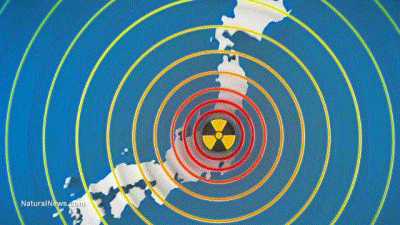
Japan finishes first-year ocean discharge of nuclear-tainted wastewater amid backlash
“All fishermen are against ocean dumping. The contaminated water has flowed into what we fishermen call ‘the sea of treasure’, and the process will last for at least 30 years,“
“There is no good reason to dump radioactive materials into the ocean. There is no reason to just dilute them and flush them away,“
https://thesun.my/world/japan-finishes-first-year-ocean-discharge-of-nuclear-tainted-wastewater-amid-backlash-PD12227910 18 Mar 24,
TOKYO: Despite opposition and concern from at home and abroad, Japan’s crippled Fukushima Daiichi Nuclear Power Plant has finished its initial year of discharging nuclear-contaminated wastewater into the ocean, according to the plant’s operator, said Xinhua.
As per the initial plan, approximately 31,200 tons of wastewater, containing radioactive tritium, was released into the ocean since the discharge started in August 2023, with each round of discharge carried out for about two weeks. Earlier this week, International Atomic Energy Agency Director-General Rafael Grossi emphasised continued efforts in monitoring Japan’s ocean discharge of nuclear-contaminated wastewater from the crippled plant, following his first visit to Fukushima prefecture since the discharge started.
Stressing that the discharge marks merely the initial phase of a long process, Grossi said that “much effort will be required in the lengthy process ahead,“ and reiterated the organisation’s stance on maintaining vigilance throughout the process.
While the Japanese government and TEPCO have asserted the safety and necessity of the discharge, concerns have been raised by neighbouring countries and local stakeholders regarding environmental impacts.
“All fishermen are against ocean dumping. The contaminated water has flowed into what we fishermen call ‘the sea of treasure’, and the process will last for at least 30 years,“ said Haruo Ono, a fisherman in the town of Shinchi in Fukushima.
“There is no good reason to dump radioactive materials into the ocean. There is no reason to just dilute them and flush them away,“ said the man in his 70s.
“Is it really necessary, in the first place, to dump what has been stored in tanks into the sea? How can we say it’s ‘safe’ when the discharged water clearly consists of harmful radioactive substances? I think the government and TEPCO must provide a solid answer,“ said Chiyo Oda, a resident of Fukushima’s Iwaki city.
Concerns were fuelled among the Japanese public over the recent leakage of contaminated water from pipes at the Fukushima plant. – Bernama, Xinhua
Bulgarian nuclear experts question economic viability of new nuclear project
By Emiliya Milcheva and Krassen Nikolov | Euractiv.bg 18 Mar 24
Bulgarian nuclear experts are questioning the economic feasibility of the country’s plan to build two US nuclear reactors at the Kozloduy nuclear power plant, raising questions on funding and whether the country has the means to purchase energy from these plants.
“It will be very difficult to find banks to finance the project,” Valentin Kolev, energy expert and a member of the American Association of Energy Engineers told Euractiv. “If we assume that we will produce 15 terawatt-hours per year, in 20 years of operation, it makes 300 terawatt hours. At a price of €17.6 billion for the two reactors, a price of close to €60/MWh would result, but this is only the investment. Fuel costs and much more are not included. The price cannot be below €100-125.”
Energy Minister Rumen Radev said that the electricity from the new Kozloduy NPP reactors will cost €65/MWh.
Bulgaria will build the two nuclear reactors with loans, and only 30% of the construction costs will be financed with money from the state budget, according to an investigation by Euractiv.
At the end of last year, Bulgarian Prime Minister Nikolai Denkov told Euractiv that Greece, Serbia, and North Macedonia were interested in signing long-term contracts for the purchase of electricity from the future seventh and eighth units of the Kozloduy NPP. However, Bulgaria has not been able to attract the three neighbouring countries as investors.
European companies also showed no interest in building the new plant, with the Bulgarian parliament voting to open negotiations with the Korean company Hyundai. The nuclear reactors will be based on the AR-1000 technology of the American company Westinghouse.
Bulgarian Energy Minister Rumen Radev sets the final price for the new reactors at €13 billion, but most experts claim that the price will exceed €17.5 billion.
Kolev recalled the HSBC investment study for the abandoned Belene nuclear power plant project, set to comprise two Russian reactors. This study calculated the cost of electricity at €75/MWh, which led the government to abandon the project as the return on investment would not be high enough.
“For now, it is not clear how the new nuclear plants will be paid for,” Neykov commented.
Another Bulgarian energy expert – Georgi Stefanov – also expressed fears billions of euro might be spent from the state budget, but in the end, nothing would be built.
“The construction of a power plant should be looked at like this: How much money do we need, how much money will we earn, and then how much money will we pay for the disposal when the NPP is closed, and for the maintenance of the nuclear waste?” Stefanov said……………………………….https://www.euractiv.com/section/politics/news/bulgarian-nuclear-experts-question-economic-viability-of-new-nuclear-project/
—
A chance to break the nuclear links – Kate Hudson, CND

,
https://labouroutlook.org/2024/03/17/a-chance-to-break-the-nuclear-links-kate-hudson-cnd/
“It’s just not possible for the UK to have an independent foreign policy, or defence and security policies, if it remains attached at the hip to the US nuclear programme.”
By Kate Hudson, Campaign for Nuclear Disarmament (CND)
Whoever is in the White House after the upcoming presidential election, one thing is clear: Britain has to break its ‘special nuclear relationship’ with the US. We’re all familiar with the so-called ‘special relationship’, basically tying Britain into really bad foreign policy decisions. But not so many people know about the US-UK Mutual Defence
Agreement (MDA) – the world’s most extensive nuclear sharing agreement.
Known in full as the ‘Agreement between the UK and the USA for cooperation in the Uses of Atomic Energy for Mutual Defence Purposes’, the treaty initially established an agreement between both countries to exchange classified information to develop their respective nuclear weapon systems.
At the start, the MDA prohibited the transfer of nuclear weapons, but an amendment in 1959 allowed for the transfer of nuclear materials and equipment between both countries up to a certain deadline.
This amendment is extended through a renewal of the treaty every ten years, most recently in2014 – without any parliamentary debate or vote. The British public and parliamentarians initially found out about that extension and ratification when President Obama informed the United States Congress.
Renewing such agreements on the nod, without transparency or accountability, is never a good thing. When it ties us so tightly to nuclear cooperation with the White House this is an even greater cause for concern. The time has come to really vigorously oppose this Agreement.
It also puts us at odds with our commitments under the NPT: the MDA confirms an indefinite commitment by the US and UK to collaborate on nuclear weapons technology and violates both countries’ obligations as signatories to the NPT. The NPT states that countries should undertake ‘to pursue negotiations in good faith on effective measures relating to… nuclear disarmament’.
Rather than working together to get rid of their nuclear weapons, the UK and US are collaborating on further advancing their nuclear arsenals. Indeed, a 2004 legal advice paper by Rabinder Singh QC and Professor Christine Chinkin concluded that it is ‘strongly arguable that the renewal of the Mutual Defence Agreement is in breach of the nuclear Non-Proliferation Treaty’, as it implies ‘continuation and indeed enhancement of thenuclear programme, not progress towards its discontinuation’.
On every level the MDA must be challenged. It’s just not possible for the UK to have an independent foreign policy, or defence and security policies, if it remains attached at the hip to the US nuclear programme. When the US seems hell-bent on taking us into war after war, unquestioning allegiance from the UK cannot continue.
The MDA is up for renewal again this year. Now is the time to start asking the questions, raising the protest,and making the case for independence. It’s time for the special nuclear relationship to end. Watch this space!
The spending horrors facing UK’s next PM from old nuclear subs to RAAC in schools
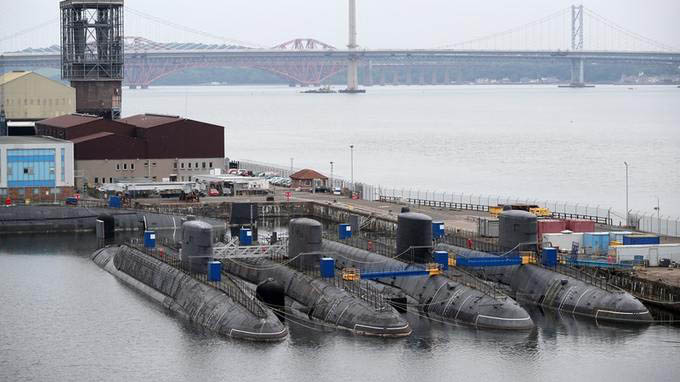
Meg Hillier warned that the next Government will face many spending ‘big nasties’ that will eat up already stretched budgets
The spending horrors facing the next PM from old nuclear subs to RAAC in
schools. Meg Hillier warned that the next Government will face many
spending ‘big nasties’ that will eat up already stretched budgets.
The influential chair of the Public Accounts Committee (PAC) has warned of the
“big nasties” of public spending that face the next Government. In an
interview with i, Labour MP Meg Hillier warned that there wasn’t
“nearly enough good project management” in Government to ensure that
the numerous issues she’s identified, from crumbling hospitals to an out
of service a nuclear submarine fleet, are dealt with.
The UK also needs to
consider how it will safely dispose of its fleet of retired nuclear
submarines, a job that is expected to be very costly for the Ministry of
Defence. The current Vanguard class of submarines are due to be phased out
by 2032 and replaced by the Dreadnought class, and it was estimated in 2016
that the renewal of the programme could cost between £167bn and £179bn
over its 30-year life span.
iNews 17th March 2024
https://inews.co.uk/news/politics/spending-horrors-facing-next-prime-minister-2960825
Deadlines, costs, production: France’s nuclear company EDF in a moment of truth
By Paul Messad | Euractiv France, Mar 18, 2024
EDF, the French state-owned energy giant faces criticism for rising costs and delays in its nuclear projects, its existing reactors have also been encountering problems. Euractiv looks at the implications of these challenges for EDF and the wider nuclear energy industry.
January 23, 2023: EDF, Europe’s leading energy company, announces a further extension of the costs and construction times of its two 3rd generation pressurized water reactors (EPR) located at Hinkley Point in England. The budget could increase by 70 to 90% compared to initial estimates and the start-up could be four to six years late.
……….the delays are “not likely to undermine the confidence of the British government in its nuclear strategy” , defends SFEN. Proof of this would be its reinvestment of more than a billion pounds sterling in two other reactors built by EDF in England, at Sizewell.
For others, on the contrary, the Anglo-Saxon situation is symptomatic of the challenge faced by the largest nuclear operator in the world, in whose confidence is eroded as projects progress, while it aims, in particular, at the construction of six, then 14 EPRs in France, and one (or even four in total) in the Czech Republic for which the authorities are awaiting guarantees.
Especially since another project tarnishes the image of the French giant. On the continent, EDF is in fact building an EPR in France, in Flamanville (Normandy). But as in England, construction is experiencing significant delays (12 years) and additional costs (+470%). The start-up of the reactor planned for “mid-2024” could even be further delayed .
……………………..In France, the government intends to get started since it plans to build six EPRs — and possibly eight others. Estimated costs and deadlines for the first six: 52 billion euros and a first commissioning in 2035.
For once, according to Les Échos , costs have already been revised upwards… by 30%. When questioned, the CEO of EDF, Luc Rémont, “does not confirm any figures” .
“We will be there when we have made all the optimizations [engineering design, component manufacturing, etc., Editor’s note] ,” he explained on the sidelines of the Franco-Czech nuclear summit organized in Prague. on March 8 and 9.
The deadlines, already “very demanding” , he agreed at the end of November, have since been postponed to 2040.
This back and forth annoys the Minister of the Economy and Energy. “EDF must learn to keep its costs and its schedule ,” criticized Bruno Le Maire at the beginning of March in Le Monde .
Czech Republic, Poland, Slovakia…
It must be said that EDF is playing on its international reputation.
In Prague, Mr. Rémont accompanied the President of the Republic, Emmanuel Macron, who came to defend EDF’s candidacy for the construction of one, or even four reactors in total, in the Czech Republic.
However, the country’s authorities have emphasized their commitment to respecting deadlines and costs.
“We are interested in the lowest possible price, the highest possible guarantees that the plant will be built on time ,” Jozef Síkela, Czech Minister of Industry and Trade, told Euractiv .
Clearly, it is not because EDF is the only European company in the running that it will be chosen. Worse, the company is walking on eggshells, competing, as in 2009 on the reactor issue in the United Arab Emirates, by a subsidiary of the South Korean KEPCO.
“Fifteen years later, the Flamanville EPR […] is still not in service. Three of the South Korean reactors in Abu Dhabi are there and the last one very soon [with delay, Editor’s note]” , reminded the former representative of EDF to the European institutions (1987 to 2000) Lionel Taccoen, resumed on
The situation may seem all the more worrying as EDF is also interested in building reactors in the Netherlands, Bulgaria , Slovenia, Slovakia and Poland where the French firm was recently defeated .
In addition, the Czech authorities have left the door open for the American Westinghouse to propose a new offer. The latter has also won several contracts for reactors in Europe in recent years. …………………….
The other dark spot on EDF’s picture lies in the management of its existing fleet and in particular the annus horribilis 2022 where, in the midst of the energy crisis, production has fallen back to pre-1990 levels .
“The year in which France should have shone is exactly the year in which we had a 50% reduction in the fleet,” argued to Euractiv at the end of January Xavier Daval, vice-president of the Renewable Energies Union, the main actors’ union. of the sector in France.
We will now have to wait until 2027, according to EDF , to once again reach production levels slightly higher than those of 1995 (around 360 TWh over the year), far from the 400-420 TWh reached between 2002 and 2015.
As if more was needed, EDF discovered at the beginning of March new “indications” of corrosion , a nightmare of 2022, on one of the reactors in the park.
Nevertheless, the company and the nuclear industry benefit more than ever from government support. France, like the fifteen other European states, which are part of the “nuclear alliance”, supports the emergence of 30 to 45 large reactors by 2050 . Will EDF be the main architect? https://www.euractiv.com/section/energy-environment/news/frances-edf-faces-uphill-battle-as-europes-demand-for-nuclear-reactors-grows/
Fourth discharge of treated Fukushima water completed
The release of the fourth batch of treated radioactive water from the
crippled Fukushima No. 1 nuclear power plant into the sea concluded Sunday,
with the next round possibly starting next month, the plant’s operator
said.
Japan Times 17th March 2024
https://www.japantimes.co.jp/news/2024/03/17/japan/fourth-fukushima-water-release-completed
100,000 years and counting: how do we tell future generations about highly radioactive nuclear waste repositories?
Sweden and Finland have described KBS-3 as a world-first nuclear-waste management solution.

Critical questions remain about the storage method, however. There have been widely publicised concerns in Sweden about the corrosion of test copper canisters after just a few decades. This is worrying, to say the least, because it’s based on a principle of passive safety. The storage sites will be constructed, the canisters filled and sealed, and then everything will be left in the ground without any human monitoring its safe functioning and with no technological option for retrieving it. Yet, over 100,000 years the prospect of human or non-human intrusion into the site – both accidental or intentional – remains a serious threat.

International attention is increasingly fixated on “impactful” short-term responses to environmental problems – usually limited to the lifespan of two or three future generations of human life. Yet the nature of long-lived nuclear waste requires us to imagine and care for a future well beyond that time horizon, and perhaps even beyond the existence of humanity.
International attention is increasingly fixated on “impactful” short-term responses to environmental problems – usually limited to the lifespan of two or three future generations of human life. Yet the nature of long-lived nuclear waste requires us to imagine and care for a future well beyond that time horizon, and perhaps even beyond the existence of humanity.
March 19, 2024 Thomas Keating. Postdoctoral Researcher, Linköping University, Anna Storm, Professor of Technology and Social Change, Linköping University https://theconversation.com/100-000-years-and-counting-how-do-we-tell-future-generations-about-highly-radioactive-nuclear-waste-repositories-199441
In Europe, increasing efforts on climate change mitigation, a sudden focus on energy independence after Russia’s invasion of Ukraine, and reported breakthroughs in nuclear fusion have sparked renewed interest in the potential of nuclear power. So-called small modular reactors (SMRs) are increasingly under development, and familiar promises about nuclear power’s potential are being revived.
Nuclear power is routinely portrayed by proponents as the source of “limitless” amounts of carbon-free electricity. The rhetorical move from speaking about “renewable energy” to “fossil-free energy” is increasingly evident, and telling.
Yet nuclear energy production requires managing what is known as “spent” nuclear fuel where major problems arise about how best to safeguard these waste materials into the future – especially should nuclear energy production increase. Short-term storage facilities have been in place for decades, but the question of their long-term deposition has caused intense political debates, with a number of projects being delayed or cancelled entirely. In the United States, work on the Yucca Mountain facility has stopped completely leaving the country with 93 nuclear reactors and no long-term storage site for the waste they produce.
Nuclear power plants produce three kinds of radioactive waste:
- Short-lived low- and intermediate-level waste;
- Long-lived low- and intermediate-level waste;
- Long-lived and highly radioactive waste, known as spent nuclear fuel.
The critical challenge for nuclear energy production is the management of long-lived waste, which refers to nuclear materials that take thousands of years to return to a level of radioactivity that is deemed “safe”. According to the US Nuclear Regulatory Commission (NRC), in spent fuel half of the radiation in strontium-90 and cesium-137 can decay in 30 years, while it would take 24,000 years for plutonium-239 to return to a state considered “harmless”. However, exactly what is meant by “safe” and “harmless” in this context is something that remains poorly defined by international nuclear management organisations, and there is surprisingly little international consensus about the time it takes for radioactive waste to return to a state considered “safe” for organic life.
“Permanent” geological repositories
Despite the seeming revival of nuclear energy production today, very few of the countries that produce nuclear energy have defined a long-term strategy for managing highly radioactive spent fuel into the future. Only Finland and Sweden have confirmed plans for so-called “final” or “permanent” geological repositories.
The Swedish government granted approval for a final repository in the village of Forsmark in January 2022, with plans to construct, fill and seal the facility over the next century. This repository is designed to last 100,000 years, which is how long planners say that it will take to return to a level of radioactivity comparable to uranium found in the earth’s bedrock.
Finland is well underway in the construction of its Onkalo high-level nuclear waste repository, which they began building in 2004 with plans to seal their facility by the end of the 21st century.
The technological method that Finland and Sweden plan to use in their permanent repositories is referred to as KBS-3 storage. In this method, spent nuclear fuel is encased in cast iron, which is then placed inside copper canisters, which are then surrounded by clay and bedrock approximately 500 metres below ground. The same or similar methods are being considered by other countries, such as the United Kingdom.
Sweden and Finland have described KBS-3 as a world-first nuclear-waste management solution. It is the product of decades of scientific research and negotiation with stakeholders, in particular with the communities that will eventually live near the buried waste.
Critical questions remain about the storage method, however. There have been widely publicised concerns in Sweden about the corrosion of test copper canisters after just a few decades. This is worrying, to say the least, because it’s based on a principle of passive safety. The storage sites will be constructed, the canisters filled and sealed, and then everything will be left in the ground without any human monitoring its safe functioning and with no technological option for retrieving it. Yet, over 100,000 years the prospect of human or non-human intrusion into the site – both accidental or intentional – remains a serious threat.
The Key Information File
Another major problem is how to communicate the presence of buried nuclear waste to future generations. If spent fuel remains dangerous for 100,000 years, then clearly this is a time frame where languages can disappear and where the existence of humanity cannot be guaranteed. Transferring information about these sites into the future is a sizeable task that demands expertise and collaboration internationally across the social sciences and sciences into practices of nuclear waste memory transfer – what we refer to as nuclear memory communication.
In a project commissioned by the Swedish Nuclear Waste Management Company (SKB), we take up this precise task by writing the “Key Information File” – a document aimed at non-expert readers containing only the most essential information about Sweden’s nuclear waste repository under development.
The Key Information File has been formulated as a summary document that would help future readers understand the dangers posed by buried waste. Its purpose is to guide the reader to where they can find more detailed information about the repository – acting as a “key” to other archives and forms of nuclear memory communication until the site’s closure at the end of the 21st century. What happens to the Key Information File after this time is undecided, yet communicating the information that it contains to future generations is crucial.
The Key Information File we will publish in 2024 is intended to be securely stored at the entrance to the nuclear waste repository in Sweden, as well as at the National Archives in Stockholm. To ensure its durability and survival through time, the plan is for it to be reproduced in different media formats and translated into multiple languages. The initial version is in English and, when finalised, it will be translated into Swedish and other languages that have yet to be decided.
Our aim is for the file to be updated every 10 years to ensure that essential information is correct and that it remains understandable to a wide audience. We also see the need for the file to be incorporated into other intergenerational practices of knowledge transfer in the future – from its inclusion into educational syllabi in schools, to the use of graphic design and artwork to make the document distinctive and memorable, to the formation of international networks of Key Information File writing and storage in countries where, at the time of writing, decisions have not yet been made about how to store highly radioactive long-lived nuclear waste.
Fragility and short-termism: a great irony
In the process of writing the Key Information File, we have discovered many issues surrounding the efficacy of these strategies for communicating memory of nuclear waste repositories into the future. One is the remarkable fragility of programs and institutions – on more than one occasion in recent years, it has taken just one person to retire from a nuclear organisation for the knowledge of an entire programme of memory communication to be halted or even lost.
And if it is difficult to preserve and communicate crucial information even in the short term, what chance do we have over 100,000 years?
International attention is increasingly fixated on “impactful” short-term responses to environmental problems – usually limited to the lifespan of two or three future generations of human life. Yet the nature of long-lived nuclear waste requires us to imagine and care for a future well beyond that time horizon, and perhaps even beyond the existence of humanity.
Responding to these challenges, even partially, requires governments and research funders internationally to provide the capacity for long-term intergenerational research on these and related issues. It also demands care in developing succession plans for retiring experts to ensure their institutional knowledge and expertise is not lost. In Sweden, this could also mean committing long-term funding from the Swedish nuclear waste fund so that not only future technical problems with the waste deposition are tackled, but also future societal problems of memory and information transfer can be addressed by people with appropriate capacity and expertise.
How Biden’s budget plunged the Aukus submarines pact into doubt
Alarm in Australia as the US suddenly struggles to fortify its own fleet
Matt Oliver, INDUSTRY EDITOR, 18 March 2024
A year on from the trio’s meeting, the Aukus partnership is suddenly
looking decidedly more fragile. Inside defence circles, there are growing
doubts about America’s ability and willingness to deliver following a
shock proposal from the Biden administration that cuts to the heart of the
deal.
Amid a row at home over government budgets, the White House this
month suggested halving the number of Virginia-class submarines it builds
next year – the very same type it has promised to Australia under Aukus.
That means the US faces a shortfall itself, raising the prospect it may
refuse to sell its existing vessels and leave Canberra in the lurch.
Telegraph 18th March 2024
Exposing myths about building French nuclear power
How French nuclear construction times and costs have been getting longer and longer – for a long time
DAVID TOKE, MAR 16, 2024, https://davidtoke.substack.com/p/exposing-myths-about-building-french
It has been standard in the UK to talk about the wonders of the French nuclear programme and how if only we copied them nuclear power would get cheaper and cheaper. The story has gone ‘If only we built a series of nuclear power plant like they did’. But it turns out that the idea that the French nuclear programme was ever getting any cheaper was a myth.
In the UK Government policy documents would use their own language to describe nuclear prospects. Special terms are used that are not usually used to discuss other energy developments. These include the acronym ‘FOAK’ which stands for ‘First of a Kind’. In other words the first plant will be relatively more expensive than the plants of the same model that followed them. Another term used of course is ‘overnight’ costs – that is a wonderful piece of euphemism given that nuclear power plants are anything but built overnight. Its use obscures the fact that very large interest costs mount up during the time that the plant is being constructed, costs which are not included in the total cost estimates. That is because the plant in the spreadsheet is being built overnight (?!).
But when we examine the actual ‘overnight’ costs of French nuclear power, as reported, they have always been increasing. Look at the analysis by Arnulf Grubler published in the journal Energy Policy in 2010: [graph on original]
Grubler’s analysis did not include the length of time taken to construct the latest French nuclear power plant at Flamanville. This is an EPR (the same design as is being built at Hinkley C and planned for Sizewell C. Construction of the Flamanville EPR began in 2007 but it has still not been completed. Hence the Figure below includes the time taken to build Flamanville up until now, with the proviso that the plant still has not been completed.
It should be understood that, broadly speaking, the cost of building reactors is proportionate to the amount of construction time. So the cost has gone up, and in recent years cost has been going up at a rapid rate,.
In my forthcoming book ‘Energy Revolutions – Profiteering versus Democracy’ I outliner four reasons for the increasing difficulties of building nuclear power plants:
‘First is the fact that nuclear power plant designers have incorporated safety features designed to minimise the consequences of nuclear accidents, but in doing so the plants have become much more complicated and difficult to build without great expense.
A second reason is that large construction projects of whatever type, at least in the West, tend to greatly overrun their budgets. In the West, improvements in health and safety regulations to protect construction workers have no doubt played a part in this.
A third factor is that, in the West at least, the cheap industrialised labour force that dominated the industrial economies of the past and which could be used to develop nuclear programmes (in the way that France did in the 1980s) has ceased to exist.
A fourth factor is simply that renewable energy technologies, especially wind and solar power, can be largely manufactured offsite in a modular fashion and their costs have rapidly fallen, leaving nuclear power increasingly uncompetitive.’ (page 30)
This book shows how we can move forward to an energy system powered by renewable energy rather than nuclear power or ‘carbon capture’ fossil fuels. It reveals how selective public ownership and targeted interventions, as part of an energy democracy programme will protect consumer interests better than the chaotic energy supply system that failed consumers so expensively in the recent energy crisis. We want no more of that!
Essentially, the idea of using nuclear power as a significant measure to engineer the global energy transition is at best a tremendous waste of resources. It is not just France that is seeing its nuclear power programme stall. It is a global phenomenon. Renewable energy is, by contrast, expanding at ever-incredible rates. As can be seen from the following graphs which is taken from my book ‘Energy Revolutions’. [on original]
1 This Month
23-25 October – on Zoom – World BEYOND War’s annual global conferenc

To see nuclear-related stories in greater depth and intensity – go to https://nuclearinformation.wordpress.com

Say No to NASA’s Reckless Nuclear Reactor on the Moon
Say No to NASA’s Reckless Nuclear Reactor on the Moon
-
Archives
- October 2026 (160)
- September 2026 (339)
- August 2026 (330)
- July 2026 (355)
- June 2026 (287)
- May 2026 (306)
- April 2026 (356)
- March 2026 (251)
- February 2026 (267)
- January 2026 (308)
- December 2025 (358)
- November 2025 (359)
-
Categories
- 1
- 1 NUCLEAR ISSUES
- business and costs
- climate change
- culture and arts
- ENERGY
- environment
- health
- history
- indigenous issues
- Legal
- marketing of nuclear
- media
- opposition to nuclear
- PERSONAL STORIES
- politics
- politics international
- Religion and ethics
- safety
- secrets,lies and civil liberties
- spinbuster
- technology
- Uranium
- wastes
- weapons and war
- Women
- 2 WORLD
- ACTION
- AFRICA
- Atrocities
- AUSTRALIA
- Christina's notes
- Christina's themes
- culture and arts
- Events
- Fuk 2022
- Fuk 2023
- Fukushima 2017
- Fukushima 2018
- fukushima 2019
- Fukushima 2020
- Fukushima 2021
- general
- global warming
- Humour (God we need it)
- Nuclear
- RARE EARTHS
- Reference
- resources – print
- Resources -audiovicual
- Weekly Newsletter
- World
- World Nuclear
- YouTube
-
RSS
Entries RSS
Comments RSS

