Iran Israel: An audible sigh of relief in the Middle East
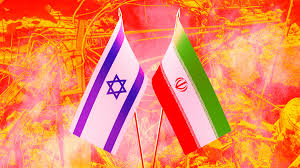
By Lyse Doucet,Chief international correspondent, 20 Apr 24, more https://www.bbc.com/news/world-middle-east-68861607
The latest round in the region’s most dangerous rivalry appears to be over, for now.
Israel still has not officially acknowledged that the attack in Iran in the early hours of Friday morning was its doing.
Meanwhile, Iran’s military and political leaders have downplayed, dismissed and even mocked that anything of consequence happened at all.
The accounts over what kind of weaponry was deployed on Friday and how much damage was caused are still conflicting and incomplete.
American officials speak of a missile strike, but Iranian officials say the attacks, in the central province of Isfahan and in northwest Tabriz, were caused by small exploding drones.
“The downed micro air vehicles caused no damage and no casualties,” Iran’s Foreign Minister Hossein Amir-Abdollahian insisted to the semi-official Tasnim News Agency.
But these simple quadcopters are Israel’s calling card – it has deployed them time and again in its years of covert operations inside Iran.
This time their main target was the storied central province of Isfahan, which is celebrated for its stunning Islamic heritage.
Of late, however, the province is more famous for the Natanz nuclear facility, the Isfahan Nuclear Technology Centre and a major air base, which was used during Iran’s 14 April attack on Israel.
It is also an industrial heartland housing factories which produce the drones and ballistic missiles that were fired by the hundreds in Israel’s direction last Sunday.
So a limited operation seems to have carried a powerful warning – that Israel has the intelligence and assets to strike at will at Iran’s beating heart.
It is a message so urgent that Israel made sure it was sent before, rather than after, the start of the Jewish Passover, as was widely predicted by Israel watchers.
US officials have also indicated that Israel targeted sites such as Iran’s air defence radar system, which protects Natanz. There is still no confirmed account of its success.
So this attack may also be just an opening salvo. But it was, for the moment, an unintended 85th birthday gift to Iran’s Supreme Leader, Ayatollah Ali Khamenei.
Israel’s official silence gave Iran’s ultimate decision-maker vital political space. Tehran did not have to invoke its new rule that whenever its arch-enemy strikes, Iran will hit back hard, with the risk of sparking a perilous escalatory spiral.
Hardline President Ebrahim Raisi did not even mention these most recent events in his Friday speeches.
For the Islamic Republic, it is all about what it dubs Operation True Promise – its unprecedented onslaught against Israel in the dead of night last Sunday. He hailed what he called his country’s “steely will”.
Iran has prided itself for years on its “strategic patience”, its policy of playing a long game rather than retaliating immediately and directly to any provocations.
Now, it is invoking “strategic deterrence”. This new doctrine was triggered by the 1 April attack on its diplomatic compound in Damascus, which destroyed its consular annex and killed seven Revolutionary Guards, including its most senior commander in the region.
Iran’s supreme leader was under mounting pressure to draw a line as Israel ramped up its targets during the last six months of the grievous Gaza war.
No longer just striking Tehran’s assets, including arms caches, buildings, bases and supply routes on battle grounds like Syria and Lebanon, Israel was also assassinating top-ranking officials.
A decades-long hostility, which had previously played out in shadow wars and covert operations, erupted in open confrontation.
Whatever the specifics of this latest tit for tat, there is a more fundamental priority for both sides: deterrence – a more solid certainty that strikes on its own soil will not happen again. If they do, there is a cost to pay, and it will hurt.
For the moment there is an audible sigh of relief in the region, and in capitals far and wide.
Israel’s latest move, under anxious urging from its allies to limit its retaliation, will have eased this tension, for now. Everyone wants to stop a catastrophic all-out war. But no one will be in any doubt that any lull may not last.
The region is still on fire.
The Gaza war grinds on, causing a staggering number of Palestinian casualties.
Under pressure from its staunchest allies, Israel has facilitated the delivery of greater quantities of desperately needed aid, but the blighted territory still teeters on the brink of famine.
Israeli hostages have still not come home, and ceasefire talks are stalled. Israel still warns of battles to come in Hamas’s last stronghold in Rafah – what aid chiefs and world leaders say would be yet another untold humanitarian disaster.
Iran’s network of proxies across the region, what it calls an “Axis of Resistance” stretching from Hezbollah strongholds in Lebanon through Iran-aligned militias in Iraq and Syria, to the Houthis of Yemen, are at the ready, still attacking daily.
In the last few weeks, simultaneously everything and nothing has changed in the region’s darkest, most dangerous days.
How Long Can Israel Defy the World?

More probably, however, Israel will resist such pressure and threat to resort to the Samson Option, i.e., a nuclear attack on the countries endangering “Israel’s right to exist”. In this worst-case scenario, Israel would be annihilated, but those who put pressure on it would also suffer enormous casualties. Obviously, no country in the world will run the risk of a nuclear attack to free the Palestinians.

By Prof. Yakov M. Rabkin, https://www.juancole.com/2024/01/long-israel-world.htm .
Palestinians in Gaza are being decimated. Over 20,000 have been killed, mostly women and children. Three times more have been wounded. Some experts qualify it as genocide, others as massacre. Two million people have been displaced, many more than during the entire history of displacement of the Palestinians since the start of the Zionist settlement at the turn of the 20th century.
As Israel takes out hospitals and civilian infrastructure, infectious diseases and famine threaten to kill many more people. Several Israeli soldiers have been reported infected during the ground operations, one has died. General Giora Eiland suggests relying on the weapon of imminent epidemics in lieu of endangering the lives of Israeli soldiers in real warfare. Gaza is violently demodernized, bombed into stone age: hospitals, schools, power stations are bombed to rubble. What is happening appears unprecedented.
The number of victims is, indeed, unprecedented. Yet the unfolding tragedy follows the old script of the Zionist project, which is European in more than one sense. It is rooted in ethnic nationalisms of Eastern and Central Europe. Nations must live in their “natural” environment where those not of the titular nationality would be at best tolerated. According to an Iraqi journalist writing in 1945, the Zionists’ goal was “to expel the British and the Arabs from Palestine so that it will be a pure Zionist state. … Terrorism [was] the only means that can bring the Zionist aspirations to fruition.” Significantly, the journalist did not consider the future state Jewish but Zionist. He must have known that Jews from countries other than those of Europe and European colonization constituted a miniscule part of the Zionist movement.
Zionism is also European because it is a settler colonial project, the most recent of all. The Palestine Jewish Colonization Association was among several agencies devoted to turning the multi-ethnic and multi-confessional Palestine into “the Jewish homeland”. The Jewish Colonial Trust, the predecessor of Bank Leumi, today Israel’s largest bank, financed the segregated economic development of the Zionist settlement in Palestine. In the usual colonial manner, the early Zionist settlers were eager to establish a separate colony rather than integrate in the existing Palestinian society.
Zionism is not only the most recent case of settler colonialism. Israel is unique in that, unlike Algeria or Kenya, it is not populated by migrants from the colonial metropolis. But this distinction matters little to the indigenous Palestinians who, just like in many other such situations, are being displaced, dispossessed, and massacred by the settlers. Displacement is enacted not only in Gaza, where it is massive and indiscriminate, but also in the West Bank where it is more focused.
To attain its objectives Zionism has had to rely on major powers, the British Empire, the Soviet Union, France and, nowadays, the United States. The Zionists, committed to the success of their project, have been pragmatic and ideologically promiscuous. They would enjoy the support of the Socialist International during most of of the 20th century and then switch to become the darlings of White supremacists and the extreme-right.
Zionism is a nationalist response to anti-Jewish discrimination and violence in Europe. It deems antisemitism endemic and ineradicable, explicitly rejecting long-term viability of Jewish life anywhere except in “the Jewish state” in Palestine. The Nazi genocide in Europe reinforced this conviction and offered legitimacy to the fledgling colonial project while such projects were crumbling elsewhere in the world. The Zionist project, ignoring the opposition of the Palestinians and other Arabs, simply exported Europe’s “Jewish question” to Palestine.
Palestinians gradually understood that the Zionist project would deprive them of their land and resisted it. This is why the early Zionist settlers, most of them from the Russian Empire, formed militias to fight local population. They perfected their terrorist experience gained during the Russian revolution of 1905 with colonial counterinsurgency measures learned from the vast experience of the British. Established against the will of the entire Arab world, including the local Palestinians, the state of Israel has had to live by the sword. The army and the police have worked hard to keep the Palestinians down (the British used to call it “pacification of the natives”). Their task has been to conquer as much land as possible with as few Palestinians remaining on it as possible.
Many Palestinians now in Gaza had been expelled from the very area in what is now Israel that experienced the Hamas attack in October. They are mostly refugees or descendants of refugees. The high density of the population in an enclosed area (some called it “the largest open-air prison) makes them particularly vulnerable. When Israel did not like the election of Hamas in 2006, it laid siege to Gaza, limiting access to food, medicines, work etc. Israeli officials were openly admitting they were putting the Gazans “on a diet” while having to “mow the lawn” from time to time, subjecting the Gazans to violent “pacification”.
The 16 years of siege intensified anger, frustration and despair leading to the Hamas attack. In response, Israeli used drones, missiles, and aircraft to continue what used to be done with rifles and machine-guns. The death rate has increased, but the goal of terrorizing Palestinians into submission has remained the same. The name of the current onslaught on Gaza is “Iron Swords”, aptly reflects the Zionists’ century-old choice to live by the sword rather than coexist with the Palestinians on equal terms. Ein berera, “we have no choice”, the common Israeli excuse for unleashing violence, is therefore misleading.
Impunity and Impotence
Israel has enjoyed a large degree of impunity, with dozens of UN resolutions simply ignored. Only once, in the wake of the 1956 Suez War, was Israel forced to give up territorial conquest. This happened under a threat coming from both the United States and the Soviet Union. Since then, Israel has relied on firm U.S. diplomatic and military support, which has become more brazen with the advent of America’s unipolar moment after the dissolution of the Soviet Union. This support is now embodied in the supply of American munitions for the war on Gaza, in the presence of U.S. Navy vessels protecting Israel from third parties and in the U.S. vetoes at the Security Council. Israel and the United States are joined at the hip. Europe, while being more critical of Israel rhetorically, closely follows the U.S. line just as it does in the Ukraine conflict. In both conflicts, European chanceries appear to have abdicated independence and, possibly, ability of action.
Israel’s impunity also reflects impotence of the rest of the world. While Muslim and Arab governments decry and protest Israel’s assault on Gaza, none has imposed or even proposed economic, let alone military, sanctions. Fewer than a dozen of countries has suspended diplomatic relations or withdrawn diplomatic personnel from Israel. None has broken relations. Russia and China, along with most of the Global South, express their dismay at civilian casualties in Gaza but they too stop short of going beyond words.
The double standard of the Western reactions is obvious. Drastic economic sanctions imposed on Russia contrast with the generous supply of arms and at best verbal pleas for moderation in response to the Israeli actions in Gaza. In just a few months, the IDF surpassed Russia’s almost two-year record in the Ukraine with respect to the volume of explosives dropped, the number of people killed and wounded, and the civilian/military ratio among the casualties. Western sermons about inclusion and democracy are unlikely to carry much weight in the rest of the world. Palestinian lives do not really matter to Western governments.
This lackadaisical reaction to the massacres in Gaza contrasts with the indignation they provoke in the population in much of the world. Massive demonstrations call on governments to stop the violence. In response, most Western governments have strengthened measures to restrict freedom of speech. Opposition to Zionism has been declared antisemitic, the most recent such measure is the equivalence between anti-Zionism and antisemitism decided by the U.S. Congress in December 2023. Accusations of antisemitism are leveled at students, often Jewish, who organize pro-Palestinian demonstrations. Televised debates as to what constitutes “genocidal antisemitism” on elite university campuses divert attention from what looks like a real genocide in Gaza. Antisemitism serves as Israel’s Wunderwaffe, its ultimate weapon of mass distraction.
Pro-Palestinian demonstrations have been banned in several European capitals where commercial or cultural boycott of Israel has been made illegal. This pressure from the ruling class, including courts, police, corporate media, employers, and university administrations, creates a powerful sense of frustration among the rank-and-file. Shortly after attacking Gaza in 2009, and over sharp criticism of its treatment of the Palestinians, Israel was unanimously accepted into the Organization for Economic Cooperation and Development (OECD), made up of some 30 countries that boast democratic structures of governance. Former Canadian prime minister Stephen Harper, while still in office, placed solidarity with Israel above Canada’s interests to the point of claiming that his government would support Israel “whatever the cost.”
Support for Israel, tending to increase with income, has become a class issue. It serves as another reminder of the growing estrangement between the rulers and the ruled, the proverbial One Per Cent and the rest. It remains to be seen if popular frustration with the hypocrisy of governments in their support for the war on Gaza may one day result in political change that would begin to dent Israel’s impunity.
Israel is a state without borders. Geographically, it has expanded with military conquest or colonization. The Zionist movement and successive Israeli governments have taken great pains never to define the borders they envisage for their state. Israeli secret services and the army pay no heed to borders, striking targets in its neighboring countries at will. This borderless character is also embodied in Israel’s claim that it belongs to the world’s Jews rather than to its citizens. This leads to the overt transformation of Jewish organizations around the world into Israeli agents. This is particularly the case in the United States. Israeli agents, such AIPAC, ensure Israel’s interests in elections on all levels, from school boards to the White House. Israel has even played the legislative against the executive branch in Washington. Yet this unabashed political interference attracts a lot less criticism in mainstream media that the alleged meddling of China or Russia. Israel also intervenes in the political process of other countries.
Conflict Between Jewish and Zionist Values
Zionism has provoked controversy among Jews from its very inception. The first Zionist congress in 1897 had to be moved from Germany to Switzerland because German Jewish organizations objected to holding a Zionist event in their country. The Zionist argument that the homeland of the Jews is not the country, where they have lived for centuries and for which many have spilled their blood in wars, but in a land in Western Asia. For many Jews, this message bears disconcerting resemblance to that of the antisemites who resent their social integration.
Initially irreligious, Zionism transforms spiritual terms into political ones. Thus, ‘am Israel, “the people of Israel”, defined by their relationship to the Torah, becomes ethnicity or nationality in the Zionist vocabulary. This prompted the prominent European rabbi Jechiel Weinberg (1884-1966) to emphasize that “Jewish nationality is different from that of all nations in the sense that it is uniquely spiritual, and that its spirituality is nothing but the Torah. […] In this respect we are different from all other nations, and whoever does not recognize it, denies the fundamental principle of Judaism.”
Another reason for Jewish opposition to Zionism has been moral and religious. While prayers for the return to the Holy Land is part of the daily Judaic ritual, it is not a political, let alone a military objective. Moreover, the Talmud spells out specific prohibitions of a mass move to Palestine before Messianic times, even “with the accord of the nations”. This is why the Zionist project with its addiction to armed violence continues to repel many Jews causing them embarrassment and even revulsion.
True, the Pentateuch and several of the books of the Prophets, such as Joshua and Judges, teem with violent images. But far from glorifying war, Jewish tradition identifies allegiance to God, and not military prowess, as the principal reason for the victories mentioned in the Bible. Jewish tradition abhors violence and reinterprets war episodes, plentiful in the Hebrew Bible, in a pacifist mode. Tradition clearly privileges compromise and accommodation. Albert Einstein was among the Jewish humanists who denounced Beitar, the paramilitary Zionist youth movement, today affiliated with the ruling Likud. He deemed it to be“ as much of a danger to our youth as Hitlerism is to German youth”.
Zionism vigorously rejects this “exilic” tradition, which it deems “consolation of the weak”. Generations of Israelis have been brought up on the values of martial courage, proud of serving in the military. Zionists regularly refer to their state as a continuation of biblical history. The idea of the Greater Israel is rooted in the literal reading of the Pentateuch. Zionism demands total commitment and brooks little opposition or criticism. The passion of the Zionist commitment has led to assassination of opponents, pitched fathers against sons, splitting Jewish families and communities. The historian Eli Barnavi, former Israeli ambassador in Paris, warns that “the dream of a ‘Third Kingdom of Israel’ could only lead to totalitarianism”. Indeed, many Jewish community leaders, undisturbed by the specter of “dual loyalty”, insist that allegiance to the state of Israel must prevail over all others, including allegiance toward their own country.
The Zionists, whether in Israel or elsewhere, have long claimed to be “the vanguard of the Jewish people” with Zionism replacing Judaism for quite a few Jews. Their identity, initially religious, has become political: they are supporters and patriots of Israel, “my country right or wrong” rather than adherents of Judaism.
Generationally, Israel appears an exception among the wealthy countries. With every generation Israelis become more combative and anti-Arab. While in other countries young Jews are usually less conservative than their parents and embrace ideas of social and political justice, young Israeli Jews defy this trend. Israeli education inculcates martial values and the belief that, had the state of Israel existed before World War II, the Nazi genocide would never have taken place. What sustains the fragile unity of the non-Arab majority is fear: a siege mentality that most frequently takes the self-image of a virtuous victim determined to prevent a repetition of the Nazi genocide. The memory of that European tragedy has become a tool of mobilizing Jews to the Zionist cause. Its political utility is still far from exhausted.
Use of the genocide to foster Israeli patriotism has been unflagging since the early 1960s. After an air show in Poland in 2008, three Israeli F-15 fighter jets bearing the Star of David and piloted by descendants of genocide survivors overflew the former Nazi extermination camp while two hundred Israeli soldiers observed the flyover from the Birkenau death camp adjacent to Auschwitz. The remarks of one of the Israeli pilots stressed confidence in the armed forces: “This is triumph for us. Sixty years ago, we had nothing. No country, no army, nothing.”
State schools promote the model of a fighter against “the Arabs” (the word “Palestinian” is usually avoided), glorifies military service turning it into an aspiration and a rite of passage to adulthood. No wonder that Hamas and, by extension, all the Gazans, are often referred to as Nazis. Dozens of Israeli officials and public figures have openly incited genocide of Palestinians: dropping a nuclear bomb on Gaza, flattening it into a parking lot, etc. Israeli political scientists have pointed out that civic religion provides no answers to questions of ultimate meaning, while at the same time it obliges its practitioners to accept the ultimate sacrifice. Civic space in Israel has become associated above all with “death for the fatherland.”
Elsewhere in the world, the Hamas attack has galvanized the Zionist commitment under the slogan “We stand with Israel!”. Massive and organized efforts are made to fight the information war. Israeli officials rely on a network of powerful supporters, including executives of high-tech companies, who make sure that the internet amplifies pro-Israel voices and muffles or cancels pro-Palestinian discourse. Censorship leads to self-censorship because pro-Palestinian involvement impedes job prospects and threatens careers.
However, unlike Israelis, diaspora Jews become less and less committed to Jewish nationalism with every generation. Growing numbers of young Jews refuse to be associated with Israel and choose to support the Palestinians. The systematic AI assisted massacre of Palestinians in Gaza has swollen their ranks, particularly in North America. Most spectacular protests against Israel’s ferocity have been organized by Jewish organizations, such as Not in My Name and Jewish Voice for Peace in the United States, Independent Jewish Voices in Canada, and Union juive française pour la paix in France. Prominent Jewish intellectuals denounce Israel and are found among the most consistent opponents of Zionism.
Albeit incongruently, these Jews are accused of antisemitism. Even more incongruently, the same accusation is hurled at ultra-Orthodox anti-Zionists. While Israel’s claim to be the state of all Jews exposes them to disgrace and danger, many Jews who support the Palestinians rehabilitate Judaism in the eyes of the world.
The Samson Option
Since its beginning, critics of Zionism have insisted that the Zionist state would become a death trap for both the colonizers and the colonized. In the wake of the ongoing tragedy triggered by the Hamas attack, these words of an ultra-Orthodox activist spoken decades ago sound prescient:
“Only blind dogmatism could present Israel as something positive for the Jewish people. Established as a so-called refuge, it has, unfailingly been the most dangerous place on the face of the earth for a Jew. It has been the cause of tens of thousands of Jewish deaths … it has left in its wake a trail of mourning widows, orphans and friends…. And let us not forget that to this account of the physical suffering of the Jews, must be added those of the Palestinian people, a nation condemned to indigence, persecution, to life without shelter, to overwhelming despair, and all too often to premature death.”
The fate of the colonized is, of course, incomparably more tragic than that of the colonizer. Palestinian citizens of Israel face systemic discrimination while their kin in the West Bank are subject to repression from both the Israeli military and their subcontractors in the Palestinian Authority. Arbitrary detention without trial, dispossession, checkpoints, segregated roads, house searches without warrant and more and more frequent death at the hands of soldiers and settler vigilantes have become routine on the West Bank. Palestinians in Gaza, even prior to the operation Iron Swords, lived isolated on a small territory, with their access to food and medicine strictly rationed by Israel. Even peaceful protest would be met by lethal fire from Israeli soldiers sitting on the other side of the barrier. There was little work and no prospects for the future. The pressure cooker was ready to explode as it did on October 7.
Since then, thousands of Gazans have been killed and wounded by one of the most sophisticated war machines in the world. This provokes more anger and hatred among the Palestinians both in Gaza and the West Bank. Israelis find themselves in a vicious circle: chronic insecurity inevitable in a settler colony reinforces the Zionist postulate that a Jew must rely on force to survive, which in turn provokes hostility and creates insecurity.
Over two decades ago David Grossman, one of the best-known Israeli authors, addressed the then prime minister Ariel Sharon known for his bellicosity:
“We start to wonder whether, for the sake of your goals, you have made a strategic decision to move the battlefield not into enemy territory, as is normally done, but into a completely different dimension of reality — into the realm of utter absurdity, into the realm of utter self-obliteration, in which we will get nothing, and neither will they. A big fat zero….”
Critical voices within and particularly outside Israel call on the Israelis to recognize that “the Zionist experiment was a tragic error. The sooner it is put to rest, the better it will be for all mankind.” In practice this would mean ensuring equality for all the inhabitants between the Jordan and the Mediterranean and a transformation of the existing ethnocracy into a state of all its citizens. However, Israeli society is conditioned to see in such calls an existential threat and a rejection of “Israel’s right to exist”.
The settler colonial logic radicalizes society in the direction of ethnic cleansing and even genocide. No Israeli government would be capable of evacuating hundreds of thousands of settlers to free space for a separate Palestinian state; the chances of giving up Zionist supremacy in the entire land are even lower. Only strong-armed international pressure may make Israel consider such a reform.
More probably, however, Israel will resist such pressure and threat to resort to the Samson Option, i.e., a nuclear attack on the countries endangering “Israel’s right to exist”. In this worst-case scenario, Israel would be annihilated, but those who put pressure on it would also suffer enormous casualties. Obviously, no country in the world will run the risk of a nuclear attack to free the Palestinians.
Pressure is more likely to come from the public but largely misdirected at local Jewish communities, almost all of them associated in the public mind with Israel. While these Jews, even the most Zionist, have never influenced Israel’s policies towards the Arabs, they have become easy scapegoats for Israel’s misdeeds.
American politicians seem to agree. President Trump referred to Israel as “your state” when addressing a Jewish audience in the United States. President Biden said that “without Israel, no Jew anywhere is safe.” Israeli leaders appreciate such conflations between Judaism and Zionism, between Jews and Israelis. These conflations boost Zionism, feed antisemitism and push Jews to migrate to Israel. This is a welcome prospect for the country, which these new Israelis will strengthen with their intellectual, entrepreneurial, and financial resources as well as supply more soldiers for the IDF.
Despite the opprobrium and public denunciations, Israel appears immune to pressure from the rest of the world. Israeli disdain for international law, the United Nations and, a fortiori, to moral arguments is proverbial. “What matters is what the Jews do, not what the gentiles say”, was Ben-Gurion’s favorite quip. His successors, a lot more radical than Israel’s founding father, will make sure that the tragedy of Gaza does not lead to any compromise with the Palestinians. The Israeli mainstream mocks or simply ignores well-intentioned pleas of liberal Zionists, an endangered species, to “save Israel from itself”. However counterintuitive today, only changes within Israeli society may shake the usual hubris. In the meantime, Israel will continue to defy the world.
About the Author:
Yakov M. Rabkin is Professor Emeritus of History at the Université of Montréal. His publications include over 300 articles and a few books: Science between Superpowers, A Threat from Within: a Century of Jewish Opposition to Zionism, What is Modern Israel?, Demodernization: A Future in the Past and Judaïsme, islam et modernité. He did consulting work for, inter alia, OECD, NATO, UNESCO and the World Bank. E-mail: yakov.rabkin@umontreal.ca. Website: www.yakovrabkin.ca
I’ve seen Iran’s nuclear HQ – these are the risks if Israel tries to destroy it.
The fortified Natanz uranium enrichment facility is thought to
be a top target if Israel attacks Iran. The uranium enrichment plant in the
Iranian desert has long been a centre of geopolitical controversy.
“Don’t take any photos. The guards will be watching. If they see you holding a camera, they’ll probably shoot us.”
That was my guide’s strict instruction as our mini-bus slowly approached
the Natanz uranium enrichment plant in the heart of the Iranian desert,
during my trip to the country in 2014. Despite growing optimism back then
about international negotiations over Iran’s nuclear programme, security
for Iran’s biggest and most controversial nuclear facility remained as
tight as ever.
You might think it odd that a public road would run within a
few hundred metres of such a sensitive area. We were driving on Freeway 7
from the city of Esfahan to the ancient village of Abyaneh, and the
quickest route happened to pass by Natanz.
One thing I remember from that
journey is the sight of anti-aircraft guns pointing towards the sky. If
Israel attacks Iran in vengeance for its drone and missile assault at the
weekend – following Israel’s own strike on the Iranian consulate in
Damascus – then Natanz is likely to be among the top desired targets for
its jets.
Rafael Grossi, director general of the International Atomic
Energy Agency, revealed on Monday that the extreme Islamic regime in Tehran
closed its nuclear sites over the weekend because of “security
considerations”. Asked if he believed that Israel might attack the
facilities, the head of the UN watchdog replied: “We are always concerned
about this possibility.” Mr Grossi called for “extreme restraint”.
Natanz has long been central to Iran’s nuclear programme. It is where
centrifuges spin uranium gas at extremely high speed to separate a lighter
form – uranium-235- from a heavier variant. It is the uranium-235 isotope
that can be split to produce energy. Even if Israel succeeded in blowing up
Natanz, the Washington-based Arms Control Association has warned: “Tehran
may have already diverted certain materials, such as advanced centrifuges
used to enrich uranium, to covert sites.
” If the Israeli prime minister
Benjamin Netanyahu decides to strike Natanz, or any other site in Iran,
then it’s hard to know where this crisis might end – with worries about a
wider regional conflict or even World War Three suddenly seeming realistic.
iNews 17th April 2024
https://inews.co.uk/news/world/iran-nuclear-hq-israel-risks-3010773
Iranian commander says Tehran could review ‘nuclear doctrine’ amid Israeli threats
By Reuters, April 18, 2024, Reporting by Dubai Newsroom, editing by Edmund Blair, Alex Richardson and Timothy Heritage https://www.reuters.com/world/middle-east/iranian-commander-warns-tehran-could-review-its-nuclear-doctrine-amid-israeli-2024-04-18/
DUBAI, April 18 (Reuters) – Iran could review its “nuclear doctrine” following Israeli threats, a senior Iranian Revolutionary Guards commander said on Thursday, raising concerns about Tehran’s nuclear programme which it has always said was strictly for peaceful purposes.
Israel has said it will retaliate against Iran’s April 13 missile and drone attack, which Tehran says was carried out in response to a suspected Israeli strike on its embassy compound in Damascus earlier this month.
“The threats of the Zionist regime (Israel) against Iran’s nuclear facilities make it possible to review our nuclear doctrine and deviate from our previous considerations,” Ahmad Haghtalab, the Guards commander in charge of nuclear security, was quoted as saying by the semi-official Tasnim news agency.
Iran’s Supreme Leader, Ayatollah Ali Khamenei, has the last say on Tehran’s nuclear programme, which the West suspects has military purposes
In 2021, Iran’s then-intelligence minister said Western pressure could push Tehran to seek nuclear weapons, the development of which Khamenei banned in a fatwa, or religious decree, in the early 2000s.
“Building and stockpiling nuclear bombs is wrong and using it is haram (religiously forbidden) … Although we have nuclear technology, Iran has firmly avoided it,” Khamenei reiterated in 2019.
Iran’s foreign ministry did not immediately respond to a Reuters request for comment.
“If the Zionist regime wants to take action against our nuclear centres and facilities, we will surely and categorically reciprocate with advanced missiles against their own nuclear sites,” Haghtalab said.
Indirect talks between Tehran and Washington to revive Iran’s 2015 nuclear pact has stalled since 2022. The accord, aimed at keeping Iran from developing a nuclear weapon, required Tehran to accept restrictions on its nuclear program and more extensive United Nations’ inspections, in exchange for an end to U.N., European Union and U.S. sanctions.
The deal, which had capped Iran’s uranium enrichment at 3.67%, was abandoned in 2018 by then-U.S. President Donald Trump, who said it was too generous to Tehran.
Rafael Grossi, the head of the U.N. nuclear watchdog, said in February that Iran continued to enrich uranium at rates up to 60% purity, which is far beyond the needs for commercial nuclear use.
Israel has nuclear weapons. Iran does not
Israel has always refused to confirm its possession of a nuclear arsenal and maintains a policy of strategic ambiguity throughout the region.
The country’s ballistic missile programme, called Jericho, is highly classified. Few details are in the public domain, but the International Institute for Strategic Studies (IISS) estimates Israel has around 24 nuclear-capable missiles.
In general, Israeli leaders do not say much about their country’s atomic capabilities. But in November, far-right cabinet minister Amichai Eliyahu claimed it was an option to launch a nuclear strike on the Gaza strip – comments that were quickly disavowed by Benjamin Netanyahu.
In 2016, a leaked cache of emails from former US secretary of state Colin Powell included one that read: “The boys in Tehran know Israel has 200 [nuclear weapons], all targeted on Tehran, and we have thousands.”
Iran does not have nuclear weapons, but has several nuclear facilities across its territory which experts fear are being used to develop them. Tehran claims they are for civilian use.
In 2016, the country signed the Joint Comprehensive Plan of Action – widely known as the Iran nuclear deal – which lifted sanctions and around $100bn of frozen funds in exchange for an end to atomic weapon research.
………..Tehran has continued to enrich uranium at these sites of rates up to 60 per cent purity – which exceeds needs for commercial use and is just a step away from weapons-grade 90 per cent, according to the International Atomic Energy Agency.
That means Iran’s so-called “breakout time” – the time it would need to produce enough weapons-grade uranium for a nuclear bomb – is between six months to a year, according to experts.
Iran also vowed to revise its weapons doctrine if its nuclear sites were targeted by Israel before the attack on Friday morning.
What happens next?
So far, it is unclear. Israel maintains its policy of strategic ambiguity and Iran has immediately downplayed the severity of Israel’s attack – saying it would not respond.
A senior official said the country was looking at it more as an “infiltration” rather than an “external attack” – but previously Iran’s president said an attack would be met with a “severe response”. https://au.news.yahoo.com/many-nuclear-weapons-israel-iran-144603850.html
No more Russian language on air in three months – Kiev

COMMENT: It is a sad thing to see the Western world, supposed bastion of freedom, individual rights, “multiculture”…. complacently agreeing with the cultural repression that is going on in Ukraine.
Ukraine has long been a bilingual country, and also a country which valued the very good parts of its Russian heritage.
It’s one thing to trash and destroy Ukrainian cultural history, like the memory of Catherine the Great – who promoted public health and education, especially for women, and who established Kiev as a centre of the arts.
Even worse is the frenzied nationalism that punishes the quite large minority of Russian-only speakers across Ukraine, and especially in the Donbass area.
Thu, 18 Apr 2024 , https://www.sott.net/article/490743-No-more-Russian-language-on-air-in-three-months-Kiev
Ukraine’s goal of eradicating bilingual media content has almost been achieved, the government has claimed
Ukraine’s ban on using the Russian language in the media will take full effect three months from now, Kiev’s state language protection commissioner, Taras Kremin, has said.
Since gaining independence, Ukraine has been a bilingual nation, with most citizens able to speak or understand both Russian and Ukrainian. After the US-backed coup in Kiev in 2014, the new nationalist authorities adopted policies aimed at suppressing the Russian language, on the grounds of national unity and security.
The restrictions include a requirement for national media to predominantly use Ukrainian in broadcasts. The permitted share of content in Russian has declined from 40% in 2016 to an almost complete ban, which will come into force in July – the deadline that Kremin referred to in his statement on Wednesday.
“Today national television channels practice bilingual Ukrainian-Russian programming, in which participants use the Russian language without a translation or subtitles,” he said. “Starting on July 17, this practice will end. There will be more Ukrainian language!”
The push by Ukrainian nationalist leaders to impose the state language on Russian-speakers living in the east of the country was a major reason for locals’ rejection of the post-coup authorities. One of the first acts of those who seized power in Kiev was to abolish a law adopted in 2012, which gave the Russian language official regional status.
The new authorities have been adopting laws to eradicate Russian from all spheres of public life, including education, entertainment, and even services provided by private businesses.
In an interview last year, Kremin denied that some Ukrainian citizens could be called Russian-speaking, describing the term was “a marker introduced by Russian ideology,” and declared that “everyone in the country must have a command of the Ukrainian language.”
In contrast, this week the leader of another post-Soviet nation, Kazakhstan, rejected the notion that one language spoken by his people should be favored over others.
“Young people now are fluent in the state [Kazakh] language, in Russian language, in English and other languages, and that is good,” President Kassym-Jomart Tokayev said on Tuesday. “It’s ridiculous to ramp up hysterics over a language, let alone fight against one, as they did in some other states. We all see what they have now as a result.”
The Kazakh leader did not specify which other nations he was referring to.
Comment: The current policies of the Ukrainian government is what the collective west with few exceptions support. If voters in Western countries have difficulties finding out what their governments are about, keep the example of Ukraine in mind. if their government supports them, they might themselves not be far behind in how far they would be willing to go given the chance.
22 Nov, 2023 15:22
‘There are no Russian-speaking Ukrainians’ – Kiev
There is no such thing as a Russian-speaking Ukrainian citizen, Kiev’s state language protection commissioner, Taras Kremin, has declared. In recent years, the country has introduced a frenzy of measures to sever historical and cultural ties with Russia, as it scrambles to strengthen the status of its own language despite accusations of prejudice against national minorities.
In an interview aired by the Ukrainian branch of the US state-run Radio Free Europe/Radio Liberty (RFE/RL), Kremin rejected the suggestion that some Ukrainians could be called “Russophones,” describing the term as “a marker introduced by the Russian ideology.”
“We are all Ukrainian citizens… Ukrainian is the dominant language in all spheres of public life. Regardless of whether it is national communities or foreigners, everyone in the country must have a command of the Ukrainian language,” the ombudsman insisted.
Earlier this year, Kremin stated that Ukrainians who speak Russian should not be referred to as “Russian-speaking,” claiming that the term had been used for decades by “Russian propaganda” to promote internal divisions in Ukraine. Citing a 2021 Constitutional Court ruling, he also insisted there were only Ukrainian citizens who had been “Russianized.”
According to a March 2022 poll by the Sociological Group Rating, about 20% of Ukrainians considered Russian to be their native language. A Social Monitoring survey in 2021 suggested that more than 50% of Ukrainians were willing to read books and watch movies in Russian.
Ukrainian authorities embarked on a campaign to push Russian out of all areas of life immediately after the 2014 Western-backed Maidan coup. The measures sparked widespread public outrage and were among the key reasons behind the hostilities in Donbass.
In 2018, the Ukrainian Constitutional Court overturned a 2012 law granting regional status to the Russian language, while at the same time Kiev adopted initiatives seeking to curb its use in education, mass media, business, and culture.
Russia has repeatedly denounced Ukraine’s language policies. President Vladimir Putin said that Moscow’s military operation against its neighbor was partly to protect people who consider themselves part of Russian culture.
On Monday, the speaker of the Ukrainian parliament, Ruslan Stefanchuk, went as far as to deny the existence of Russian ethnic minorities, arguing that they had no special rights. The statement sparked outrage in Moscow, with Foreign Ministry spokeswoman Maria Zakharova saying the remarks came from “the Nazis of the 21st century.”
4 Apr, 2024 20:19
Zelensky’s comedy partner slams campaign against Russian language
Boris Shefir co-founded the Kvartal 95 (District 95) comedy studio in 2003 with Zelensky and a group of their school friends. Most of these comedians and producers – including Shefir’s brother, Sergey – followed Zelensky into politics, taking prime positions in his administration after he was elected president of Ukraine in 2019.
Shefir was not among them.Speaking to the Ukrainian branch of the US government-funded Radio Free Europe/Radio Liberty (RFE/RL) outlet on Thursday, he said that he has had “no relationship” with Zelensky since the conflict with Russia began in 2022.
“For two years, I have not called or talked to him,” Shefir said. “He is working with other people now. He does not communicate with me, does not call me. My calls remain unanswered.”
“Well, you see, I speak Russian,” he explained. “I love the Russian language, Russian culture…I can’t watch Pushkin’s monuments being destroyed in my country.”
U.S. is building first new nuclear warhead in decades

Gustaf Kilander, Sat, 20 April 2024
The United States is building its first new nuclear warhead in decades but will do so without nuclear testing, according to energy department officials on Wednesday.
The warhead, known as the W93, is set to be used on ballistic missiles launched from submarines. It is being built using funds, $19.8bn, requested by the National Nuclear Security Agency (NNSA) for the 2025 fiscal year, energy secretary Jennifer Granholm and NNSA Administrator Jill Hruby told the Senate Armed Services Committee, according to The Washington Times.
The warhead is in its early design stages at the Los Alamos National Laboratory, the main site for the Manhattan Project which built the first nuclear bombs during World War II.
Production on the warhead is set to begin in the middle of the next decade, the officials testified.
The issue of updating its nuclear capabilities is a top priority for the Pentagon and the nuclear-armed submarines are central to the US nuclear forces. Other parts of the strategic capabilities include bombers and intercontinental ballistic missiles.
“The W93 is a new program of record being established to meet requirements set by the [Department of Defense],” the NNSA states on its site.
“The Navy’s ballistic missile submarine force is the most survivable leg of the Triad and is currently equipped with two warhead types: the W76 and W88. These warheads provide approximately two-thirds of the total U.S. deployed force. The W93 will reduce current over-reliance on the W76 system and will allow the US to keep pace with future adversary threats.”
“All W93 key nuclear components will be based on currently deployed and/or previously tested nuclear designs, as well as extensive stockpile component and materials experience,” the NNSA adds…………………………………….
The Savannah River National Laboratory in South Carolina will produce plutonium pits for the new warhead, requested by now-retired Admiral Charles Richard in late 2020.
It will be built with help from the UK, which will also use the weapon. Admiral Richard had warned of nuclear developments in China, which has doubled its stockpile of nuclear warheads. https://au.news.yahoo.com/us-building-first-nuclear-warhead-143533346.html?guccounter=1&guce_referrer=aHR0cHM6Ly9uZXdzLmdvb2dsZS5jb20v&guce_referrer_sig=AQAAAExkFb73zWCbee9AK_vuFm2BTmp0kiQDmDUXiBzV6qklzWqYIFsX_LXu9LAxNrBCYBq1jiKFYYNtTql41UYxMkGOceFZGslm7ZB2DP56ACiY6zTGQry2jsKbYix7589Hu54kZpAcm6jfdeJQDJs1JEs77sAiMK0vhn8GH6AyXa6s
A new Iranian nuclear deal is being considered
A veteran of the Foreign Office told i: “I don’t think the world realises
how advanced the Iran nuclear programme has got. The issue has long been
how to bring Iran back to some form of a deal.” They suggested Tehran
could have been stepping up work on the nuclear programme while Western
powers were focussed on Russia and China, saying: “When the world’s
attention is elsewhere, they accelerate.”
A source close to the Biden
administration added: “Iran has made it quite clear that it has no
intention of attacking Israel again, unless Israel strikes back in response
to last weekend. The administration believes a diplomatic route is by far
the best route forward, and that both sides can be catered for. “The
president is doing everything he can to avert a war in the Middle East, and
a new Iran nuclear deal is one way being considered to achieve that. It’s
not the only strategy, but it’s on the table.”
iNews 17th April 2024
Biden could try to revive Iran nuclear deal to avert wider war, source says
Continuing Safety Problems with New Waste Isolation Pilot Plant (WIPP) Shaft.
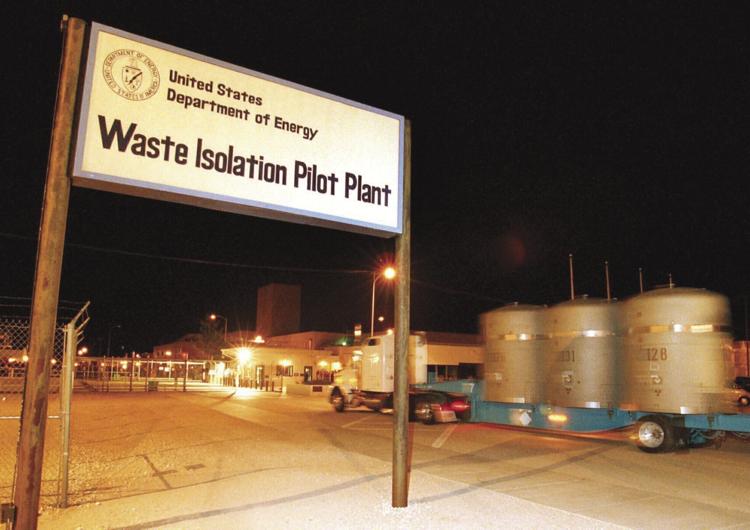
Recent monthly reports by the Defense Nuclear Facilities Safety Board relate disturbing stories about near-miss operational incidents in the fifth shaft, under construction, at the Waste Isolation Pilot Plant (WIPP). The underground federal radioactive waste disposal site is located 2,150 feet below ground surface in a salt formation almost 30 miles east of Carlsbad, New Mexico. The Board has reported broken cables, misaligned transport platforms for workers to reach the underground, and workers stuck in the new shaft. https://www.dnfsb.gov/
On November 20th, 2023, the third incident in that month occurred when a basket for transporting materials fell 2,150 feet down the new shaft. SIMCO, the management and operating contractor at WIPP, issued a formal stop work order to Harrison Western Shaft Sinkers JV, LLC, the subcontractor. Preliminary findings indicate the subcontractor did not implement formal controls for hoisting and rigging activities and allowed informal operator actions to take their place. https://www.dnfsb.gov/sites/default/files/document/29506/WIPP%20Monthly%20Ending%20November%202023.pdf and https://www.dnfsb.gov/sites/default/files/document/29776/WIPP%20Monthly%20Ending%20December%202023.pdf
The Shaft Sinkers hired a safety culture expert to make improvements to the operating practices and procedures. https://www.dnfsb.gov/sites/default/files/document/30376/WIPP%20Monthly%20Ending%20March%202024.pdf
More deficiencies in the @NuScale_Power standard design approval application
Ed Lyman (@NucSafetyUCS): More deficiencies in the @NuScale_Power standard
design approval application: @NRCgov staff are “unable to verify whether
the internal flood analysis has been performed to conclude equipment can
perform their safety function.”
USNRC 31st March 2024
Biden Administration Defies Australia’s Call To End Assange Case, Submits ‘Assurances’ To UK Court
Streamed live on 17 Apr 2024Join Kevin Gosztola, author of “Guilty of Journalism: The Political Case Against Julian Assange,” as he covers the U.S. government’s “assurances” that were submitted to a British appeals court. They represent a clear indication that President Joe Biden’s administration is not going to end the case. If Biden was “considering” a plea deal for Assange, as was reported, he has made the decision to keep pursuing extradition and a U.S. trial on Espionage Act charges.
Nuclear expert fears flooded radioactive dump sites in Siberia can threaten Arctic Ocean
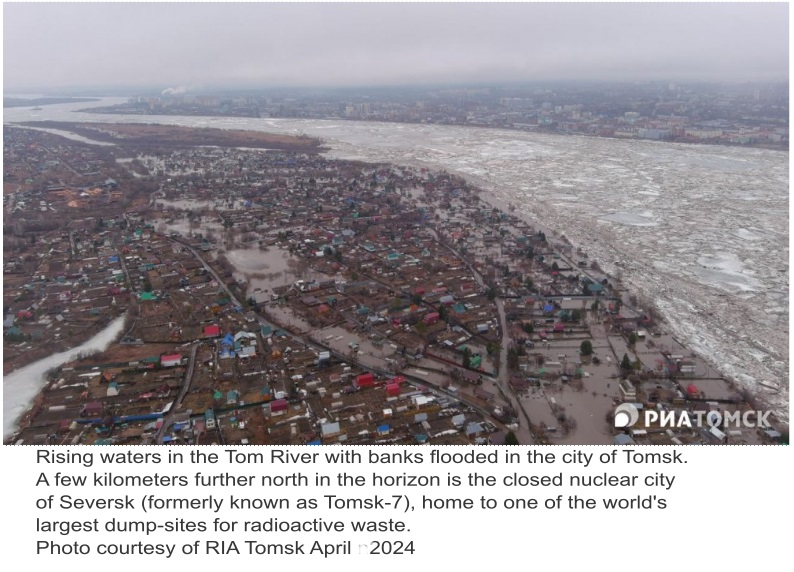
Floodwaters in Tomsk region threatens to submerge the river banks in Seversk where highly radioactive liquid waste from the Soviet Union’s nuclear weapons program for decades were injected into two unprotected underground reservoirs.
Water level on Monday continues to rise in the Tom River in Western Siberia.
The record floods are among the worst ever in the region and local emergency services help in evacuation of people living near tributaries of the Ob river system, including Tobol, Irtysh and Tom rivers.
Thousands of houses and tens of thousands of people live in the emergency zones, according to Kremlin information platform RIA Novosti. High snow falls in winter combined with swiftly rising spring temperatures and heavy rains are the reasons for the current extreme flood, Reuters reports.
Drone photos by RIA Tomsk shows how the swelling Tom River is inundating villages on the westside river banks. According to NEXTA news channel, water in Tom River has risen by nearly a meter over the day.
On the east side, a short 15 kilometers north of the city of Tomsk, is the closed city of Seversk. Until 1992, the secret city was code-named Tomsk-7 and was home to one of three production facilities for weapons-grade plutonium for the Soviet Union’s nuclear weapons program.
“There ain’t one single public message that Rosatom is monitoring the situation, that they have the situation under control,” says Aleksandr Nikitin, an exile nuclear safety expert working for the environmental foundation Bellona.
Nikitin was until the all-out war against Ukraine a member of Rosatom’s Public Council. The Council involved civic organizations and scientists in Russia and was aimed at raising public awareness of Rosatom’s core operations
“It’s surprising that there aren’t even simple statements like we have everything under control,” Nikitin adds.
According to the World Nuclear Association, the Siberian Chemical Combine in Seversk had five plutonium production reactors, an uranium enrichment plant and a processing plant for plutonium warheads. Although shut down, enormous amount of nuclear waste is still on site.
Most challenging are the liquid radioactive waste, both on the surface and pumped down in deep-well injections. The nuclear dump is likely Russia’s largest, by IAEA estimated to be 70 million cubic meters.
Widespread contamination in an area up to 28 kilometers came after a concrete cover blew off a reaction vessel at the plutonium extraction facility in 1993. The International Atomic Energy Agency (IAEA) listed it as a major radiological accident.
In 2000, a joint U.S.-Russian study found dangerous levels of radioactivity flowing into Russia’s Tom River from the Siberian Nuclear Combine.
Critics crumbled
Local environmentalists in Tomsk filed a lawsuit against the company in the late 1990s in an attempt to revoke a dumping permit for highly radioactive liquid waste down under. They feared for the city’s drinking water.
In Putin’s Russia, critical voices are gone. Environmental groups like Greenpeace, World Wide Fund for Nature, and Bellona are all listed as undesirable by law.
TV2 in Tomsk, known for its independent journalism and free debate since the early years after the breakup of the Soviet Union, got its broadcast shut down in 2014. After the start of the full-scale war in 2022, the reporters closed their YouTube producing newsroom and left Russia.
Aleksandr Nikitin is worried radioactivity could leak out to the river system under the current flood, but that information will not come before it is too late.
“Putin doesn’t give a fuck about these floods and other shitty lives of people in Russia.., he has a war and geopolitical goals of fighting the damned West,” Nikitin says.
For Rosatom, he adds, the logic is simple: “.. if you say that everything is under control, and then something happens, then you will have to answer for it.”
Nikitin says Rosatom is sure that in any case it will not bear any responsibility.
“Rosatom is today Putin’s “favorite child,” he explains.
It was Lavrenty Beria, director of Joseph Stalin’s secret police, who lead the establishment of the first plutonium production facilities east of the Ural mountains in the late 1940ties, early 1950ties. KGB and the Soviet nuclear establishment walked hand-in-hand for decades. What nowadays is Ulitsa Pervomayskaya (May 1st Street) in Seversk, was previously named Ulitsa Beria.
Arctic Ocean
A major concern for Aleksandr Nikitin and Bellona is that no one can exclude that leakages from a possible overflowed radioactive waste site could reach the Arctic Ocean.
Tom River is a tributary of the Ob which flows out in the Ob Bay and Kara Sea above the Arctic Circle.
During the years 1948-56, liquid radioactive waste from the Mayak reprocessing plant north of Chelyabinsk was discharged directly into the nearby river Techa which is connected to the river system Iset, Tobol, Irtysh and Ob. Especially Strontium-90, but also other isotopes, were carried by the water more than 2,000 kilometers downstream and measured in the Kara Sea, first time in 1951.
A joint Norwegian-Russian expedition to the Kara Sea in 1994 found traces of the same radionuclides, although in lower levels.
“Everything is now possible,” says Aleksandr Nikitin when seeing the photos of the flooded riverbanks of the Tom River.
“It all depends on the scale of leakages.”
“I’m sure the Siberian Chemical Combine sit quietly and wait. Hoping for it all to go over,” Nikitin says to the Barents Observer.
The climate crisis and nuclear weapons

It seems we haven’t the money to save the planet, but we can stump up any amount to fund nuclear death
NORTH EAST BYLINES, by Caroline Westgate, 15-04-2024
A massive and accelerating crisis faces all of us on Planet Earth: the climate is warming, and we will rapidly reach a point where the damage to our ecosystem will be irreversible. Dismayed by the political inertia which fails to address this emergency, increasing numbers of people are resorting to protest through nonviolent direct action.
International conferences regularly agree on aims but fail to implement action with the urgency and on the scale needed to challenge the hegemony of Big Oil. We are told that the money simply isn’t there.
But here in the UK there is one hugely costly project which, if it were cancelled, would release an income-stream which could be directed to the electorate’s real priorities: the climate crisis, the NHS, education and transport. I’m talking about Trident.
Nuclear weapons
I was five years old when America’s atomic bombs destroyed Hiroshima and Nagasaki. Those events ended WW2 but triggered the Cold War. When the Soviet Union, the UK, France and China acquired their own nuclear arsenals, the Cold War settled into a 35-year stalemate of Mutually Assured Destruction (appropriately dubbed MAD), in which it was assumed that a nuclear exchange would be prevented by a ‘balance of terror’.
But in the 1980s, NATO strategists dropped the MAD policy, because advances in military technology gave them the confidence that they could fight and win a nuclear war: their new nuclear-armed Cruise missiles could launch pre-emptive strikes, capable of destroying the Soviets’ nuclear weapons in their silos.
Ordinary people rapidly realised that this development posed an existential threat to millions of civilians on both sides of the Iron Curtain: we had all been conscripted as front-line troops, expendable pawns in NATO’s nuclear game. A re-energised peace movement vociferously opposed Cruise missiles when they arrived on British soil: they were totally under American control, but they made the UK a target.
Embrace the Base at Greenham Common
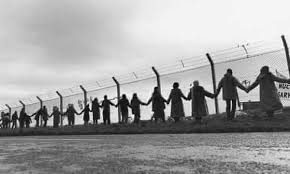
Greenham Common in Berkshire was one of the Cruise sites. In the summer of 1981, a small group of women from South Wales established a peace camp there. During the first winter of their protest they struggled to get any support or publicity. In conditions of great hardship, they kept the camp going. Their protest grew amid evictions, arrests, imprisonments, and physical attacks. One woman was killed. All of this was accompanied by often viciously mendacious press coverage.
In December 1982, I was one of 30,000 women who responded to an unsigned chain letter, inviting us to ‘Embrace the Base’. We joined hands and encircled Greenham’s 9-mile perimeter fence. We decorated it with objects of significance to us, transforming it into a nine mile work of art.
‘Embrace the Base’ was a high-profile event, but small-scale protests were frequently staged with daring, creativity and humour, either by the women who lived at the camp or by autonomous groups of women who travelled to Berkshire to carry out some anarchic plot of their own devising.
In September 1985, with a group of women from the North East, I made the 300-odd mile journey to Greenham again.
My group had hatched a plan to enter the base to access a small outbuilding on which they were going to paint anti-nuclear slogans, and I was there to support them. By that stage it was ludicrously easy to get through the fence because hundreds of women with bolt cutters had reduced it to shreds. The army kept patching it up, but their efforts were futile. The women from my group walked on to the base, slapped a lot of blue gloss paint on the wall of the outbuilding, then stood quietly, dripping brushes in hand, waiting to be arrested. A group of policemen duly arrived and handcuffed them. To my surprise, I was also arrested, even though I was outside the fence and hadn’t actually done anything wrong. We were all charged with criminal damage and summonsed to appear at Newbury Magistrates’ Court a few weeks later.
From the dock, I made a stirring speech to justify protesting at the base. It cut no ice whatsoever. I was found guilty of criminal damage and ordered to pay a fine and costs, which amounted to £67.75p. I refused to pay. The magistrates, who had seen it all before, wearily referred my case to my local court in Hexham. I knew that the length of time to be spent inside would be calculated pro rata from the amount of the fine I’d refused to pay. It worked out at less than a week in prison, which I felt confident I could cope with.
However, time wore on and nobody arrived to take me away. It was getting perilously near Christmas, when I really didn’t want to be away from my family. I enquired of the clerk to Hexham’s Magistrates when the law would come for me. He said:
“They don’t put people like you in prison. It’s much too expensive. We will contact your employer and put an Attachment of Earnings order on your salary.” I realised that my gesture of defiance would pointless if the only person who knew about it would be the wages clerk at County Hall. Since I was going to have to pay anyway, I decided to turn it into a stunt by making the payment on a novelty cheque……………………………………………………………………………………..
The carbon footprint of the UK military
All this is good for a laugh, but what it says about our priorities is far from funny. It is high time we looked at this issue from the perspective of the climate catastrophe, factoring-in what the military contributes to the UK’s carbon footprint. Dr Stuart Parkinson, of Scientists for Global Responsibility, calculates that the annual carbon footprint of the UK military is roughly equivalent to the carbon emissions of six million average cars. Trident must account for a sizeable proportion of that. Of course, the government omits all mention of those figures when it claims we are progressing nicely towards net zero.
The cost of Trident

We also need to challenge why we spend such colossal amounts of money on Trident, when there are so many urgent rival claims on the public purse. The arguments against the possession of nuclear weapons are as valid now as they were when I wrote my novelty cheque nearly forty years ago.
- the moral objection to threatening the deaths of countless numbers of people.
- nuclear weapons make their possessors a target.
- early-warning systems make it more likely that nuclear war will be triggered by accident.
- nuclear war will be followed by nuclear winter, causing ecocide and wrecking forever any chance of addressing climate change.
But let’s focus on the cost of Trident, which falls on the UK at a time when serious investment in public services is urgently needed on a huge scale. The figures bandied about are quoted not in millions but in billions. The difference between those two quantities is so vast it is hard to grasp, so try this analogy: a million seconds would last for about eleven days, but a billion seconds would last for 31 and a half years.
The Nuclear Information Service calculates the cost of Trident as £172 billion (including its new warheads and its running costs over its projected lifetime). That is a stupendous amount of money to lavish on maintaining the fiction that the UK is a world-class power. Neither the Tories nor Labour dares to question that expenditure. By contrast, Labour’s new idea for a Green Investment Fund (a mere £28 billion) was recently cancelled as unaffordable.
Apparently, we haven’t the money to save the planet, but we can stump up any amount to fund nuclear death.
Why are our priorities so badly skewed? https://northeastbylines.co.uk/the-climate-crisis-and-nuclear-weapons/
US Issues Assurances on Assange

The U.S. Tuesday filed assurances on the death penalty and the 1st Amendment, the latter of which Stella Assange called a “non-assurance.”
Joe Lauria, in London, Consortium News, 17 Apr 24, https://consortiumnews.com/2024/04/16/us-issues-assurances-assange/
The United States Embassy on Tuesday filed two assurances with the British Foreign Office saying it would not seek the death penalty against imprisoned WikiLeaks‘ publisher Julian Assange and would allow Assange “the ability to raise and seek to reply upon at trial … the rights and protections given under the First Amendment,” according to the U.S. diplomatic note.
Assange’s wife Stella Assange said the note “makes no undertaking to withdraw the prosecution’s previous assertion that Julian has no First Amendment rights because he is not a U.S citizen. Instead,” she said, “the US has limited itself to blatant weasel words claiming that Julian can ‘seek to raise’ the First Amendment if extradited.”
The note contains a hollow statement, namely, that Assange can try to raise the First Amendment at trial (and at sentencing), but the U.S. Department of Justice can’t guarantee he would get those rights, which is precisely what it must do under British extradition law based on the European Convention on Human Rights.
The U.S. Department of Justice is legally restricted to assure a free speech guarantee to Assange equivalent to Article 10 of the European Convention, which the British court is bound to follow. But without that assurance, Assange should be freed according to a British Crown Prosecution Service comment on extraditions.
In USAID v. Alliance for Open Society, the U.S. Supreme Court ruled in 2020 that non-U.S. citizens outside the U.S. don’t possess constitutional rights. Both former C.I.A. Director Mike Pompeo and Gordon Kromberg, Assange’s U.S. prosecutor, have said Assange does not have First Amendment protection.
Because of the separation of powers in the United States, the executive branch’s Justice Department can’t guarantee to the British courts what the U.S. judicial branch decides about the rights of a non-U.S. citizen in court, said Marjorie Cohn, law professor and former president of the National Lawyers’ Guild.
“Let’s assume that … the Biden administration, does give assurances that he would be able to raise the First Amendment and that the [High] Court found that those were significant assurances,” Cohn told Consortium News‘ webcast CN Live! last month.
“That really doesn’t mean anything, because one of the things that the British courts don’t understand is the U.S. doctrine of separation of powers,” she said.
“The prosecutors can give all the assurances they want, but the judiciary, another [one] .. of these three branches of government in the U.S., doesn’t have to abide by the executive branch claim or assurance,” Cohn said.
In other words, whether Assange can rely on the First Amendment in his defense in a U.S. court is up to that court not Kromberg or the Department of Justice, which issued the assurance on Tuesday.
The United States has issued a non-assurance in relation to the First Amendment,” said Stella Assange
Assange’s legal team now has the right to challenge the credibility and validity of the U.S. assurances filed on Tuesday. The U.S. would then have a right to reply to Assange’s legal submissions to the court, which will hold a hearing on May 20 to determine whether or not to accept the U.S. assurances.
If the court does, Assange can be put on a plane to the U.S. theoretically that day. If not Assange would be granted a full appeal against the Home Office’s 2022 order to extradite him. Assange is wanted in the U.S. on 17 charges under the 1917 Espionage Act and one on conspiracy to commit computer intrusion. He faces up to 175 years in a U.S. dungeon.
“The diplomatic note does nothing to relieve our family’s extreme distress about his future — his grim expectation of spending the rest of his life in isolation in US prison for publishing award-winning journalism,” Stella Assange said.
In its 66-page ruling on March 26, the two High Court judges wrote Kromberg wouldn’t have said Assange would be without First Amendment rights at trial “unless that was a tenable argument that the prosecution was entitled to deploy with a real prospect of success.”
“If such an argument were to succeed it would (at least arguably) cause the applicant [Assange] prejudice on the grounds of his non-US citizenship (and hence, on the grounds of his nationality),” the judges said. They added:
“The applicant wishes to argue, at any trial in the United States, that his actions were protected by the First Amendment. He contends that if he is given First Amendment rights, the prosecution will be stopped. The First Amendment is therefore of central importance to his defence to the extradition charge.”
This is the statement Stella Assange put out on X Tuesday at 11:36 am EDT:
“The United States has issued a non-assurance in relation to the First Amendment, and a standard assurance in relation to the death penalty. It makes no undertaking to withdraw the prosecution’s previous assertion that Julian has no First Amendment rights because he is not a U.S citizen. Instead, the US has limited itself to blatant weasel words claiming that Julian can ‘seek to raise’ the First Amendment if extradited. The diplomatic note does nothing to relieve our family’s extreme distress about his future — his grim expectation of spending the rest of his life in isolation in US prison for publishing award-winning journalism. The Biden Administration must drop this dangerous prosecution before it is too late.”
No Russian heavy weapons at Zaporozhye plant – IAEA boss
https://www.rt.com/russia/596018-no-heavy-russian-arms-zaporozhye/—16 Apr 24
Europe’s largest nuclear power plant was attacked by drones last week
Russia has not stationed heavy weapons at Zaporozhye Nuclear Power Plant, International Atomic Energy Agency (IAEA) Director General Rafael Grossi told reporters on Monday.
Moscow and Kiev have accused each other of shelling Europe’s largest nuclear plant, which sits close to the front line. Ukraine and its Western backers have also accused Moscow of using the facility as cover for its troops.
“There is no heavy weaponry there,” Grossi told reporters, after a UN Security Council meeting dedicated to the renewed strikes on the plant.
Although there are Russian “armored vehicles and some security presence at the plant,” IAEA monitors did not see any prohibited weapons, such as multiple rocket launchers, tanks, and artillery, Grossi explained.
He added that the IAEA does not have the mandate to determine which side has been attacking the facility, and argued that “indisputable evidence” is needed to establish who is responsible.
Addressing the Security Council, Grossi confirmed that Europe’s largest nuclear power plant was struck on April 7, which was the first direct attack on the site since November 2022. Inspectors have determined that the apex of the containment dome of the Unit 6 reactor building was hit, he added. “Whilst the damage to the structure is superficial, the attack sets a very dangerous precedent of the successful targeting of the reactor containment,” Grossi stressed, warning that “these reckless attacks must cease immediately.”
Russian UN Ambassador Vassily Nebenzia told the Security Council that Ukrainian forces have been “systematically” targeting the plant and surrounding areas. The Russian army has been “spotting and intercepting up to 100 drones per week,” Nebenzia added, insisting that Moscow has never placed heavy weapons at the facility or used the plant to stage attacks on Ukraine.
Officials in Kiev have denied striking the nuclear plant. “The position of Ukraine is clear and unequivocal: we are not conducting any military activities or provocations against nuclear sites,” Andrey Yusov, spokesman for Ukraine’s military intelligence, told national TV this month. Andrey Kovalenko, the head of the state-run Center for Countering Disinformation, has accused Moscow of spreading false information and “manipulating the IAEA.”
The agency said in its report this week that all of the facility’s six reactors are currently in cold shutdown. According to the plant’s management, only one reactor had been working since 2022 in order to keep the site operational. IAEA inspectors were deployed to monitor the facility in September 2022.
1 This Month
19 November – Webinar – The Reality of Reprocessing
Time: 11:00 AM Pacific Time (US & Canada) / 2:00 PM Eastern / 7:00 PM UK / 8:00 PM CET
Register for the Zoom Event Here

Tell Congress: Prevent Nuclear Catastrophe in Iran

Tell Congress: Prevent Nuclear Catastrophe in Iran

Read the Public Inquiry Report, the Commissioners’ report, Surrendering Australia: The AUKUS Deception is available to download for free at aukuspublicinquiry.com. Or just watch the replay of the National Press Club Luncheon.


Shut down the radiation-damaged Heysham nuclear reactors now
To see nuclear-related stories in greater depth and intensity – go to https://nuclearinformation.wordpress.com

Say No to NASA’s Reckless Nuclear Reactor on the Moon
Say No to NASA’s Reckless Nuclear Reactor on the Moon
-
Archives
- November 2026 (178)
- October 2026 (302)
- September 2026 (339)
- August 2026 (330)
- July 2026 (355)
- June 2026 (287)
- May 2026 (306)
- April 2026 (356)
- March 2026 (251)
- February 2026 (267)
- January 2026 (308)
- December 2025 (358)
-
Categories
- 1
- 1 NUCLEAR ISSUES
- business and costs
- climate change
- culture and arts
- ENERGY
- environment
- health
- history
- indigenous issues
- Legal
- marketing of nuclear
- media
- opposition to nuclear
- PERSONAL STORIES
- politics
- politics international
- Religion and ethics
- safety
- secrets,lies and civil liberties
- spinbuster
- technology
- Uranium
- wastes
- weapons and war
- Women
- 2 WORLD
- ACTION
- AFRICA
- Atrocities
- AUSTRALIA
- Christina's notes
- Christina's themes
- culture and arts
- Events
- Fuk 2022
- Fuk 2023
- Fukushima 2017
- Fukushima 2018
- fukushima 2019
- Fukushima 2020
- Fukushima 2021
- general
- global warming
- Humour (God we need it)
- Nuclear
- RARE EARTHS
- Reference
- resources – print
- Resources -audiovicual
- Weekly Newsletter
- World
- World Nuclear
- YouTube
-
RSS
Entries RSS
Comments RSS

