They’re Still Pushing The Ethnic Cleansing Of Gaza
Caitlin Johnstone, Jun 29, 2026, https://www.caitlinjohnst.one/p/theyre-still-pushing-the-ethnic-cleansing?utm_source=post-email-title&publication_id=82124&post_id=204102630&utm_campaign=email-post-title&isFreemail=true&r=1ise1&triedRedirect=true&utm_medium=email
Israel is still pushing for the ethnic cleansing of Gaza. They keep trying different angles and rebranding it under different names, but the end goal has remained the same since October 2023: the removal of all Palestinians from the Gaza Strip.
From The Times of Israel:
“Israel is seeking to revive its moribund plan for the voluntary migration of Gazans out of the Strip, and has rebranded it in an effort to soften the blanket international opposition to it, Channel 13 news reports, citing unnamed Israeli officials.
“Security agencies have in recent days been told to abandon the “voluntary migration” title due to the global opposition, and it will from now on be officially referred to as a ‘plan for free movement,’ the report says.
“The network cites officials familiar with ties with countries that could potentially receive Gazans as voicing optimism that the terminology change will persuade them to drop their current refusal to cooperate with the plan, and recruit other countries.
“A senior Israeli official is quoted as saying Jerusalem wants as many Gazans as possible to leave the Strip, viewing this as contributing to any future plan implemented in the territory.”
From the early months of the Gaza holocaust, Israel apologists had been referring to the ethnic cleansing agenda as a plan for the “voluntary migration” of Gaza’s inhabitants. This framing conveniently ignored the fact that you cannot destroy a populated area and deliberately make it uninhabitable and then say the inhabitants of that area are leaving “voluntarily”.
According to a Haaretz report that was published last week, Israel’s new National Security Council chief convened a meeting of top national security officials to discuss the issue of “encouraging the voluntary emigration” of Palestinians from the Gaza Strip.
And now they’re rebranding the initiative as “a plan of free movement”, which is just so fucking Israeli. They never stop doing the evil thing, they just play around with the words people say about it, like how Israel’s Foreign Ministry announced last year that it was going to stop referring to its propaganda operations as “hasbara” due to the public revulsion that has developed around that label. They never say “It’s time to stop doing the things that cause people to hate us,” they just say “It’s time for a rebrand.”
And to be clear, the mass displacement of Palestinians in Gaza is already well underway. Israel now controls more than 60 percent of Gaza, and the IDF has been instructed to expand it to 70 percent. The survivors of the genocide have already been shifted and concentrated into a steadily shrinking thirty some-odd percent of the Strip, while Israel attempts diplomatic maneuvers to persuade foreign states to take them in.
Israel’s mass atrocities in Gaza have always been about ethnic cleansing, from the very beginning. Within days of Israel’s assault on Gaza in October 2023, Israel’s Intelligence Ministry was circulating a plan for the entire population of Gaza to be moved to the Sinai Peninsula in Egypt, and an Israeli think tank had drawn up a strategy for the “relocation and final settlement of the entire Gaza population.”
They had these plans locked and loaded and ready to go because the elimination of Palestinians from the Palestinian territories has always been the goal.
Israel has been scheming to purge the Palestinians from the enclave and relocate them to other countries for generations. There’s a 1970 article from Life Magazine talking about how the Israelis see relocating Palestinians from Gaza to the Sinai Peninsula as the only viable path to peace, adding that “The problem is that the people of Gaza don’t want to go.”
historian Benny Morris writes that the agenda to “transfer” Palestinians to other countries has existed for as long as modern Zionism:
“The idea of transfer is as old as modern Zionism and has accompanied its evolution and praxis during the past century. And driving it was an iron logic: There could be no viable Jewish state in all or part of Palestine unless there was a mass displacement of Arab inhabitants, who opposed its emergence and would constitute an active or potential fifth column in its midst. This logic was understood, and enunciated, before and during 1948, by Zionist, Arab and British leaders and officials.
“As early as 1895, Theodor Herzl, the prophet and founder of Zionism, wrote in his diary in anticipation of the establishment of the Jewish state: ‘We shall try to spirit the penniless [Arab] population across the border by procuring employment for it in the transit countries, while denying it any employment in our country … The removal of the poor must be carried out discreetly and circumspectly.’”
So Israel was founded on the premise that the country’s previous inhabitants need to be eliminated in some way.
That’s all this has ever been about.
It was never about October 7.
It was never about Hamas.
It was never about hostages.
It was never about terrorism.
It was never about self-defense.
It was never about any of the countless excuses the hasbarists and imperial spinmeisters have offered up over the last three years to justify Israel’s monstrous abuses.
It was only ever about eliminating Palestinians because of their ethnicity and replacing them with Jews.
Anyone who tells you otherwise is lying.
White Flag Judgments: Palestine Action, Protest and the UK Courts
1 July 2026 Dr Binoy Kampmark, https://theaimn.net/white-flag-judgments-palestine-action-protest-and-the-uk-courts/
The justice system of the United Kingdom, represented by stout cathedral structures and solemn rituals, tends to resemble a casino rather than a priestly haven of solemn judgment. It’s the justice of the punt, the throw of the dice, not the fairness of judicial deliberation, that prevails. That, at least, has been the prevailing view of Richard Ingrams, a co-founder of Britain’s rapier satirical publication Private Eye.
Since the decision by Home Secretary Yvette Cooper to ban Palestine Action in 2025, some 3,000 people have been arrested for doing such unthreatening things as holding placards with the following words: “I oppose genocide. I support Palestine Action.” Over 700 of these, according to Human Rights Watch, “are pending in the courts of England and Wales, with many more at the recharges stage.” This, in a country where free speech is said to be a verdant forest, and the right to protest a sacred right.
In the middle of last month, the Court of Appeal quashed the decision of the High Court regarding the proscription of Palestine Action which had been made under section 3 and schedule 2 of the Terrorism Act 2000. Palestine Action, described by their founders as “a direct-action protest group aimed at preventing military targets in the UK from facilitating gross abuses of international law,” had made its stock and trade targeting Israeli arms manufacturers such as Elbit Systems and businesses with links to the Israeli arms trade. The proscription followed the group’s break-in at RAF Brize Norton, where two aircraft were spray painted. In the proscribed list, which includes such violent luminaries as Boko Haram and Islamic State, Palestine Action is hysterically assessed as an entity that “prepares for terrorism” and “promotes and encourages terrorism.” Its attacks had included “targets affecting UK national security, and the impact on innocent members of the public.”
Co-founder of Palestine Action, Huda Ammori, challenged the lawfulness of the proscription in the High Court in November 2025, claiming, along with the intervening parties Liberty and Amnesty International UK, that it had involved a disproportionate use of counter-terrorism powers. Initially, Ammori scored a resounding success, all the more remarkable given the persistent record of courts in Britain to side with the national security apparatus.
The Divisional Court held in February 2026 in R (Ammori)v Secretary of State for the Home Department that the Home Secretary’s approach on proscription had failed to follow her own long-standing proscription policy. These involved five factors intended to constrain the office holder’s discretion. The resort to “other factors” would have to be read with that constraining purpose in mind.
The Court also found that a fair balance between the rights of individuals to free speech (Article 10 of the European Convention of Human Rights) and freedom of assembly under Article 11 of the ECHR as against the national security and protection of the rights of others (Articles 10.2 and 11.2 of the ECHR) had not been struck. In applying the test of proportionality to the decision the Court held that “the nature and scale of Palestine Action’s activities, so far as they [comprised] acts of terrorism, [had] not yet reached the level, scale and persistence that would justify the application of the criminal law measures that are a consequence of proscription, and the very significant interference with Convention rights consequent on those measures.”
The government of Sir Keir “Human Rights” Starmer was never going to let things stand, nor should not be forgotten that the High Court decision was hardly brimming with praise for the actions of Palestine Action. The definition of terrorism in UK counter-terrorism legislation is intentionally outrageous in its broadness, encompassing causing or threatening “serious damage to property” that would suggest an intention to influence government policy and advance a political case. The High Court did, at least, note that the act of proscription was based on 385 actions committed over 5 years, of which only three were deemed “terrorist incidents.”
Back to the casino of justice the case went. On June 15, the Court of Appeal handed down its quashing judgment. The national security state could again rejoice at this grand exhibition of judicial abdication before the alleged, and unfounded wisdom, of executive power. The judges found, for instance, that the Home Secretary had, in fact, conducted a proper evaluation of the rights issue in considering the banning of Palestine Action. This analysis was shallow at best, given the Home Secretary’s continual insistence that neither Article 10 nor 11 off the ECHR applied in the case. Article 17 of the Convention – the prohibition of an abuse of rights – was what counted in her mind.
The Court of Appeal went so far as to admit that the rights of those holding placards opposing genocide and supporting the Palestinian cause “may be affected by proscription, because they may be dissuaded by it from exercising their lawful individual rights to free speech and freedom of assembly.” The Home Secretary had been wrong to assume that Article 10 and 11 rights were not engaged, or that no test of proportionality was required. The court even conceded that the ban was “highly controversial” and possibly even “borderline.” But in their own assessment on proportionality, the judges felt reluctant to challenge the vast, self-evident wisdom of the executive, given that the Home Secretary was “invested with the statutory and constitutional authority to make proscription decisions to protect the public where national security is at stake.” It was not for the court to “take over the function of the primary decision-maker, least of all in a case such as this.” Such proscription decisions were part of national security, an area that no UK judges would have thought inappropriate to scrutinise before the Human Rights Act 1998. (How mothballed can judges be?)
The logic of this abysmal abdication before power was guided by the views of Lord Robert Reed made in the UK Supreme Court decision of ABJ, which was decided in February this year: “Although a strict approach is generally taken to restrictions on political speech, the European Court has recognised that states must enjoy a wider margin of appreciation when countering terrorism.” In a rather conflating, muddled manner, Lord Reed thought judicial supervision, be it by UK courts applying the Human Rights Act or the European court applying the ECHR, had “to respect the institutional expertise and constitutional legitimacy underlying the judgment made by those authorities by according them a correspondingly wide margin of appreciation.” This is what surrender by the wigged classes looks like.
The Court of Appeal also decided to make much of the fact that Palestine Action had committed three deemed “terrorist incidents” over three years, a mere 0.78% of its list of actions. With disapproval, they noted the organisation had not “disowned or condemned” such actions. It was therefore “permissible for the Home Secretary (and, therefore, is permissible for us), in considering Palestine Action’s characteristics and activities, not just its activities classified as terrorist.” The rationale for this bumbling reasoning was that proscription was preventative: the Home Secretary had to “assess the risk of future acts of terrorism. All of an organisation’s activities, such as recruitment, fundraising, radicalisation and all terrorist and non-terrorist activities may be relevant to that assessment.”
Veering off into the feral undergrowth of the bizarre, the appeals court also considered the allegedly more sinister nature of the group, mangling the history of British protest along the way. Its activities had been “planned and undertaken secretly with the objective of avoiding detection.” Its members had not shown “sincerity by accepting” the imposed penalties. But most of all, “on a fair analysis, Palestine Action has little or nothing in common with the suffragettes or the anti-apartheid or Iraq War protest groups.”
With this sort of fair analysis, one rooted in a distorted reading of history, a horrendous refusal to consider a flawed, executive assessment of protest activities, and a general concession to an anti-democratic temper, the only thing left to do is exactly what the suffragettes, anti-apartheid activists, and previous anti-war activists did: break the law with courage and clog the prisons with effect.
Poll shows many Danes worried about planned nuclear reactors at Barsebäck, near Copenhagen

Mon 29 Jun 2026 , https://swedenherald.com/article/poll-finds-many-danes-worried-about-new-nuclear-plant-plans-near-copenhagen
Plans to build new nuclear reactors at Barsebäck worry many Danes, according to an opinion poll conducted on behalf of the Ritzau news agency.
39.5 percent say they agree or completely agree when asked whether they are concerned about plans to locate reactors just over 20 kilometres from Copenhagen, according to a survey conducted by the Voxmeter institute. Almost as many, over 38 percent, believe the reactors should not be built.
Just over 1,000 people responded to the survey.
Earlier in June, Nordic Baseload Power submitted an application to the government for state aid to build two full-scale boiling water reactors of the BWR-N type at Barsebäck. However, Uniper, which owns Barsebäck, has stated that it does not plan to provide any land for the company’s plans.
EDF agrees to sell US, Canada unit to KKR
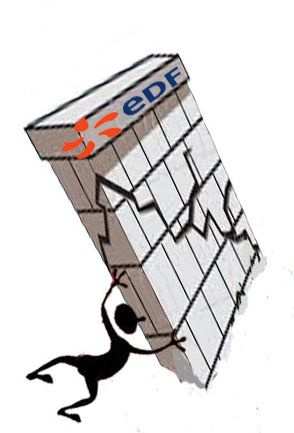
EDF, which owns and operates France’s nuclear fleet, must raise cash to maintain its 57 aging reactors and finance the construction of six new units.
By Reuter, June 27, 2026, https://www.reuters.com/business/energy/edf-signs-deal-sell-us-canada-unit-kkr-2026-06-26/
June 26 (Reuters) – EDF signed an agreement to sell EDF Power Solutions in the United States and Canada to private equity firm KKR, the company said on Friday.
KKR will acquire the operations and assets. In the U.S. and Canada, EDF Power Solutions operates 5.6 gigawatts of renewable assets.
EDF, which owns and operates France’s nuclear fleet, must raise cash to maintain its 57 aging reactors and finance the construction of six new units.
In November EDF CEO Bernard Fontana told Reuters the company was considering selling between 50% and 100% of its U.S. renewable unit, a deal that could value the business at nearly €4 billion ($4.56 billion).
EDF has developed 26 gigawatts of wind, solar and battery storage projects plus electric vehicle charging sites and has 17 GW under service contracts in North America, which includes a small amount in Canada and Mexico, according to its website.
($1 = 0.8773 euros)
Reporting by Margaux Perrin in Gdansk, Editing by Louise Heavens
All of our submarines are missing
Five nuclear-powered hunter-killers are
out of action leaving the Arctic front door wide open to Russia. None of
the Royal Navy’s attack submarines are currently at sea. A fleet of
nuclear-powered hunter-killers all tied up alongside or in dock, every one
of them, is a serious matter.
This is not the first time it’s happened
and last time it did, the Ministry of Defence trotted out the tired mantra
“we continue to meet all our operational tasks”. We do not. The
excellent Navy Lookout website has set out the position boat-by-boat. HMS
Audacious is only now leaving dry dock in Devonport in Plymouth; HMS Anson,
the only attack boat to have been to sea recently, is alongside after a
curtailed deployment to Australia; HMS Astute is undergoing a multi-year
refit; and Ambush and Artful have not sailed in years. The site described
the overall posture as “a disaster”.
Telegraph 27th June 2026, https://www.telegraph.co.uk/news/2026/06/27/royal-navy-attack-submarines-absent-harbour-nuclear-missing/
Record heatwave cripples Europe’s energy supply as nuclear reactors are taken offline.

Europe’s brutal heatwave is closing schools and factories and claiming lives. Now, its nuclear power plants are shutting down.
Jamie Seidel, News.au 28th June 2026
Record heatwave cripples Europe’s energy supply as nuclear reactors are
taken offline. Europe’s brutal heatwave is closing schools and factories
and claiming lives. Now, its nuclear power plants are shutting down. France
has already shut down three of its nuclear reactors.
“The main pressure
comes from a triple squeeze: Cooling demand rises sharply, while power
plants and grids become less efficient, and some thermal and nuclear plants
must cut output because cooling water is too warm or scarce,” Simone
Tagliapietra, a researcher for the Bruegel think-tank, told the
Massachusetts Institute of Technology (MIT). Nuclear reactors require water
to keep their radioactive cores cool and contained. But the river water
feeding this process has become hot.
That reduces its cooling effect.
And the wastewater comes out even hotter. Which threatens to breach environmental safety limits.
Other French reactors are operating at reduced power. And more are being wound down as the heatwave lingers.
Blackouts are now a thing. The supply problem, explains MIT climate analyst Casey Crownhart, is being exacerbated by other nuclear reactors being offline.
Peak European electricity demand is traditionally during winter. That’s when everyone turns their electric heaters on. Summer is supposed to experience far less demand. So maintenance cycles and repairs are scheduled for the warmer months. Those months are now unexpectedly hot. Switzerland is experiencing the same problem. It says the output of its Beznau nuclear reactors have been reduced. They will be shut down if the extreme heat continues.
Heat isn’t only a problem for nuclear power plants………………………………………………………………………………………………………………………………………………………………………………………………..
The French government is scrambling to respond to the reactor shutdown crisis. Emergency meetings are being held in stuffy offices. Similar meetings are happening across Europe.
Meanwhile, El Nino’s fallout is beginning to reach across Africa and Australia and into the Indian Ocean. https://www.news.com.au/technology/environment/record-heatwave-cripples-europes-energy-supply-as-nuclear-reactors-are-taken-offline/news-story/5962d04f0b8268a57217dc7ab12f213e
We’re up against forces that have all the money in the world’: Erin Brockovich on her battle against AI datacentres

What is certain, though, is that the land cannot withstand these centres’ immense demand for water. According to analysis by the Guardian, two-thirds of planned datacentres in the US are in drought-stricken areas. The larger centres need up to 5m gallons of water a day for cooling, equivalent to the average usage of 50,000 people. It is unclear what the plan is and whose needs will take priority between AI, agriculture and everyone else.
In 1993, she squeezed a $333m settlement from a Californian energy company in a scandal over contaminated water. Three decades later, she has a new target in her sights – and it’s global
Guardian, Mon 29 Jun 2026
When Erin Brockovich woke to find 30 emails from people from the same town, she realised something was going on. People email Brockovich all the time because of what happened in 1993, when she was instrumental in suing Pacific Gas and Electric Company (PG&E) on behalf of residents of the town of Hinkley, California, whose groundwater had been contaminated. The case resulted in a settlement of $333m – then the largest ever payout for a direct-action lawsuit. When she was immortalised by Julia Roberts in the 2000 film Erin Brockovich, she became the hero we didn’t know we needed, a modern day Joan of Arc. She had won against PG&E with no formal legal training.
The emails she received a few weeks ago were about datacentres. In April, she put a callout on her website asking for anyone with concerns about one near them to get in touch. Within a month, 3,862 people had replied. Tech companies have needed datacentres to power their technology “for ever”, she says, but the new ones being built to power AI? “This feels like Hinkley on steroids.”
This isn’t a story about AI, she says. “That genie is out of the bottle: it’s here, it’s an effective tool, you can use it or not,” Brockovich says matter-of-factly. This is about the massive structures being built to house the vast computing facilities AI requires. These datacentres, she says, stretch over “hundreds and hundreds of acres”. In May, Utah gave approval to a centre twice the size of Manhattan.
Some of the emails Brockovich gets from people near datacentres express genuine bafflement: “Why did I not know about this? How did this construction just start? Why am I now getting a notice from the city council that this has already passed when I didn’t even have a voice in it?” Others reflect concerns about the impact of the centres: “What about our resources? What’s happening to the water? Who’s paying for all this energy and am I going to foot that bill? What will the future impact on health be from these monstrosities? What’s going to happen to the wildlife?”
From the emails, Brockovich built a map of significant AI datacentres in the US that are either operational or under construction, overlaid with locations where community members have emailed in concerns. This open-source document is chilling: as of 24 June, 33 AI datacenters have been completed and are operational, 68 are under construction and 41 are proposed. And there had been 7,005 reports submitted through the online form, which is to say, all that is known about them is what people have seen. As a post on her Substack blog is headlined: “If data centers are so great, why are they being built in secret?”
“It’s happening in every US state, multiple counties, rural areas, ranches, farms and neighbourhoods. People watch nature because they respect it, they need it. And they’re watching it being destroyed,” says Brockovich. She has heard from people saying: “I’m concerned this is where the bald eagles nest,” “I’m watching wildlife disappear,” “I’m seeing dead animals.” Some communities learn about a centre months after it has been approved; others don’t hear anything about them and watch as a vast building emerges.
What is certain, though, is that the land cannot withstand these centres’ immense demand for water. According to analysis by the Guardian, two-thirds of planned datacentres in the US are in drought-stricken areas. The larger centres need up to 5m gallons of water a day for cooling, equivalent to the average usage of 50,000 people. It is unclear what the plan is and whose needs will take priority between AI, agriculture and everyone else.
“People are reporting bill spikes,” Brockovich says, reading an email from someone who says their monthly water bill went from $22 (£17) to more than $350 (£265). The threat of these centres is about more than money – it feels existential. “How will the water use disrupt the balance of nature? People are asking: “What will happen to us?”
………………………………………………………………………………………………………………………..After Hinkley, she worked on other environmental pollution cases against PG&E related to hexavalent chromium, the chemical that contaminated Hinkley’s water. More recently, she has focused on Pfas (per- and polyfluoroalkyl substances), “forever chemicals” that are a component in firefighting foam used heavily on US military bases. Pfas have been linked to health problems, including fertility issues and some cancers. In 2017, communities living near military bases reported worrying levels of these chemicals in their drinking water.
Brockovich’s renown is plainly the reason people email her when they have concerns. This is what led her to north-west Georgia last year, where staggeringly high levels of Pfas were found in the water and the wider environment. It was believed that they came from carpet factories that used stain-resistant chemicals. The major carpet factories say they complied with all regulations and no longer use Pfas. She is still supporting people there with their campaigns.
Unlike toxic chemicals leaking into water, nothing about datacentres is discreet. Signs that might be subtle one day – an absence of birdsong – the next day will be a centre up and running at full volume. “It really becomes about the noise, the decibels,” Brockovich says. People will write to her and say: “We’re going insane 24/7,” “It’s got to stop,” “It’s humming, it’s hissing, it’s buzzing.” She says: “It’s generators. It’s increased electric bills. It’s power surges.”
These structures are appearing without the consultation you would need to erect a new sports hall, as if people won’t notice. But people certainly will notice, because the buildings are vast. It feels like a step into post-democracy, which is a tech bro fantasy, a world in which laws and regulations have been obviated. The big tech companies seem to have blueprinted their fantasy and started building it.
Alternatives are now being mooted. “People are talking about putting them at the bottom of the ocean,” says Brockovich. “They’re talking about having barges and putting the datacentres there, using waves as the energy in cooler climates. Elon Musk wants to put them in space.” But with innumerable Earth-based datacentres already built or in the works, this feels like puff – the future you could have had, had you not sleepwalked into the one that has arrived.
For Brockovich, this is all a distraction. The first thing she wants is a case-by-case moratorium on approving datacentres. ( (She is collating these cases through her open-source mapping site and says councils vary in the action they are prepared to take, according to how surprised by, or receptive to, local complaints their officials are. Many states are only now stopping to consider whether there should be state-level regulation and oversight of datacentres – and, if so, what implications that would have for local decision-making and autonomy.
This takes time. Seventy-nine municipalities in the US have so far have issued moratoriums, many immediately being hit with lawsuits for breaking their original deal. Pauses have been introduced in Georgia, Maryland, Michigan and South Carolina – one introduced in Maine was then vetoed – but these are early interventions against tech behemoths.
When I ask Brockovich about the political climate – a president committed to AI and blatantly dismissive of environmental concerns – she is careful to stress that opposition to datacentres is bipartisan. She knows from her work fighting Pfas, though, that a change in administration can make an enormous difference to the success of these campaigns. In the final days of Joe Biden’s presidency, a clean-up operation was announced by the Pentagon. However, this plan has quietly been delayed by Donald Trump’s Department of Defense: in some areas, it won’t start until 2039.
Yet the nature of Brockovich’s campaigning is not to go straight to the top and demand policy change, but rather to build lawsuits from the ground up. Victory, to her, is won by way of a pragmatic to-do list. To start, she would go to local government and say: “I’d like to see an environmental-impact report. I’d like to see how you propose to power all this. Are you going to build your own power? Are you relying on our already strained resources?” She says: “Let’s get that information first and then have a town hall meeting where the people can be a voice in it.” She has a degree of confidence that the law still has teeth. “Lawsuits aren’t settling for $333m any more; they’re settling for billions,” she says.
Brockovich’s datacentre work goes beyond the US; she has been contacted by people in Australia, India, Scotland and Ireland. There is already a moratorium on any more datacentres in Dublin; even by 2023, such centres were accounting for a fifth of Ireland’s electricity usage. “This is a planetary thing,” she says. “It’s overwhelming. We have to have some courage to show up, and it’s difficult to do that when you’re up against forces that have all the money and all the intelligence and all the bandwidth in the world.” She, meanwhile, is “getting too old for this, by the way. I’m in my legacy phase. I have six grandchildren.”
She is smiling. All that may be true, but even if this is her final campaign, she won’t walk away until it’s over. She can beat this – she just can’t beat it on her own. https://www.theguardian.com/environment/2026/jun/29/were-up-against-forces-that-have-all-the-money-in-the-world-erin-brockovich-on-her-battle-against-ai-datacentres
Swiss nuclear power station shut down as river warms
The two Beznau nuclear reactors in Switzerland which are cooled by water from the river Aare, have been taken off grid due to the water overheating.
Swiss Info 26th June 2026, https://www.swissinfo.ch/eng/energy-transition/the-river-cooled-beznau-nuclear-power-station-is-being-shut-down-the-aare-is-too-warm/91657359
The energy company Axpo announced the decision on Friday.
Axpo stated that the two reactors are currently in a shut-down state. The temperature of the river Aare reached 25 degrees Celcius, which does not allow sufficient cooling.
The output of the two reactors had already been reduced on Tuesday – most recently to 50%. According to Axpo, the temperature of the River Aare reached 25 degrees for the first time on Wednesday after the cooling water had been fully mixed.
Axpo indicated that if there was no prospect of the Aare cooling down, the reactors would be shut down completely on Friday. The two reactor units on the Aare island in Döttingen had already temporarily suspended electricity production in July 2025.
Obliterating Gaza’s Children: The Damning UN Report
SCHEERPOST, June 27, 2026, Dan Steinbock Informed Comment
From Gaza and beyond, Israeli authorities and security forces have deliberately targeted Palestinian children. It is in line with the new Obliteration Doctrine and the topic of a new UN report.
When I was working on The Fall of Israel (2024) and particularly The Obliteration Doctrine (2025), what I found most repulsive was the targeting of children in the Gaza Strip.
By late 2024, the testimonies of health professionals on location indicated that the deaths of many children in Gaza were not just collateral damage, but outcomes of deliberate, targeted actions.
The testimony of Dr. Feroze Sidhwa, a young American trauma and general surgeon who had volunteered in Palestine including the European Hospital in Khan Younis, was particularly compelling.
“I’ve seen violence and worked in conflict zones,” Sidhwa said. “But of the many things that stood out about working in a hospital in Gaza, one got to me: Nearly every day I was there, I saw a new young child who had been shot in the head or the chest, virtually all of whom went on to die.”
The statement of Dr. Sidhwa, who subsequently became one of the endorsers of my book, The Obliteration Doctrine, was supported by dozens of other remarkable and courageous medical volunteers in Gaza. And these testimonies, in turn, have been supported by many reports of multiple international NGOs and multilateral organizations.
So, the latest report of the UN Independent International Commission is hardly new. Nonetheless, it is among the most consequential documents to emerge from the Gaza war. Its conclusion is stark: Israeli authorities and security forces have deliberately targeted Palestinian children, actions that the Commission argues constitute genocide, crimes against humanity, and war crimes.
The Commission’s findings
The Commission’s report concludes that the deliberate targeting of Palestinian children is not incidental collateral damage but part of a recurring pattern of conduct. In line with the Genocide Convention, it argues that such actions are a key indicator of genocidal intent because they strike at the future existence of the Palestinian people.
According to the inquiry, more than 20,000 Palestinian children were killed between October 2023 and October 2025, representing roughly 30 percent of all fatalities, while over 44,000 were injured. Even since the October 2025 ceasefire, at least 265 children have been killed by Israeli military fire, and 400 more injured, many of them with “catastrophic” wounds.
Children and the logic of genocide
In The Obliteration Doctrine, I showed that modern warfare in Gaza evolved beyond traditional military objectives toward the destruction of the social foundations of Palestinian existence. The Commission’s findings reinforce this interpretation.
Historically, genocide scholars have emphasized that attacks on children occupy a unique place in genocidal campaigns. The 1948 Genocide Convention identifies not only direct killing but also the infliction of conditions calculated to destroy a protected group. In Gaza, famine served the same genocidal function as starvation in the Warsaw ghetto.
Children embody demographic continuity, cultural reproduction, and collective future. Consequently, systematic violence against children has appeared repeatedly in cases later recognized as genocide, from the Armenian genocide to Rwanda.
The Commission explicitly states that targeting children attacks “the very capacity of the Palestinian people to exist and determine their future.” Its findings connect killings to broader patterns: destruction of schools, hospitals, pediatric facilities, neonatal care units, food systems, and water infrastructure.
That’s the ultimate objective: the genocide and ecocide of Palestine, its culture and children. Israel’s devastation of Lebanon follows in the footprints.
From an empirical perspective, the cumulative effect is measurable. Public-health research consistently demonstrates that childhood exposure to mass violence produces lifelong deficits in physical health, educational attainment, psychological resilience, and economic productivity.
Israel did not triumph in Gaza. Moral darkness did.
Human cost beyond death statistics……………………………………………………………………
Hind Rajab, the voice that refuses to disappear…………………………………………………………………………….
High technology and moral decay……………………………………………………………….
The cost to Israeli society and soldiers………………………………………………………
If Gaza becomes the new norm
The broader international implications may be even more alarming. If the deliberate targeting of children becomes normalized, the consequences extend far, far beyond the Middle East.
International humanitarian law depends fundamentally on protecting civilians, especially children. If powerful states can openly disregard these norms without meaningful accountability, the deterrent effect of international law weakens everywhere.
Empirical evidence suggests that impunity encourages repetition. The failures to prevent atrocities in Rwanda, Bosnia, and Darfur contributed to future violations by signaling weak enforcement. Conversely, successful accountability mechanisms have historically reduced recurrence.
The risks include greater regional radicalization, transnational terrorism, refugee flows, intensified great-power rivalry, erosion of international institutions, and the spread of increasingly unrestricted warfare.
In The Obliteration Doctrine, I warned repeatedly that what happened in Gaza won’t stay in Gaza. The Strip became a laboratory for new forms of warfare later exported elsewhere.
The Commission’s findings raise precisely that concern. If the systematic destruction of children, schools, hospitals, and civilian infrastructure becomes accepted in one conflict, future belligerents may invoke the precedent.
The ultimate question raised by the report is therefore not only what happened to Gaza’s children. It is whether the international community is willing to preserve the principle that children remain beyond the reach of war itself.
For if that principle fails in Gaza, it will not survive elsewhere.
Dan Steinbock is the author of The Obliteration Doctrine and The Fall of Israel, . He is the founder of Difference Group and has served at the India, China and America Institute (US), Shanghai Institute for International Studies (China) and the EU Center (Singapore). For more, see https://www.differencegroup.net https://scheerpost.com/2026/06/27/obliterating-gazas-children-the-damning-un-report/
Senior U.S. Diplomats, Journalists, Academics and Secretaries of Defense Say: the U.S. Provoked Russia in Ukraine
it should come as no surprise that our government is lying now about the war in Ukraine.
it should come as no surprise that our government is lying now about the war in Ukraine.
The Ukraine Papers, by Donald A. Smith, PhD, 27 June 26
It took some years for Americans to realize they’d been lied to about the war in Vietnam. Thanks to the publication of the Pentagon Papers, and thanks to the antiwar movement, Americans eventually learned about the injustices and failures of that war.
Likewise, it took several years after the starts of the wars in Iraq and Afghanistan for Americans to realize they’d been lied to about those wars as well.
Americans are just now starting to realize that they’ve been lied to about the war in Ukraine. (The propaganda effort has been quite effective, with the New York Times, in particular, acting as a mouthpiece for the government’s position.) More and more mainstream publications are exposing the lies, and a majority of Americans now oppose further arming of Ukraine.
This essay is a summary of what the U.S. government has been hiding about the war in Ukraine, with links to sources for further information.
According to Brown University’s Costs of War project, U.S. military actions since 9/11 directly killed over 900,000 people, with an additional 3.5 million people dying from indirect effects. The wars cost Americans at least $8 trillion and displaced over 38 million people from their homes. The U.S. spends over a trillion dollars a year on its military, if you count all expenditures.
If we go back to the 1960s, the number killed by U.S. wars includes the several million killed in the Vietnam war, the approximately 1 million killed by U.S. support for Indonesian military’s attacks on left wing groups, and the hundreds of thousands, at least, killed in proxy wars and government overthrows in Latin America.
The wars, overthrows, and associated sanctions caused mass migrations worldwide — particularly in Europe and at the southern U.S. border — and destabilized politics. The Lancet medical journal reported that between 1971 and 2021, US and EU sanctions killed over half a million people annually. Yet almost nobody (except for whistleblowers) was held accountable for these disasters; indeed, many of the same people are in Congress or work for the government or the weapons industry.
Moreover, the U.S. government lied about almost all the wars — in particular, about the wars in Vietnam, Iraq, and Afghanistan, but also about the war in Yugoslavia, as documented in Harper’s Magazine, here (Chapter 3), and here. In short, the Kosovo Liberation Army that the U.S. supported was, basically, a terrorist organization funded by the CIA, and U.S. propaganda greatly overstated the nobility of the U.S. intervention. Likewise, The U.S. backed ethnic cleansing of Serbs in Croatia.
The United States withdrew from the following arms treaties: Anti-Ballistic Missile (ABM) Treaty, Strategic Arms Reduction (START II)Treaty, Intermediate-Range Nuclear Forces (INF) Treaty, Joint Comprehensive Plan of Action (JCPOA), the Iran deal, Open Skies Treaty, and Conventional Armed Forces Treaty (Russia withdrew after alleged NATO non-compliance)
So, it should come as no surprise that our government is lying now about the war in Ukraine. Specifically, claims by President Biden and others that the Russian invasion was “unprovoked” are greatly exaggerated.
Read what these diplomats, secretaries of Defense, journalists, academics, politicians, and others have to say:
Here the author gives quotations from 30 highly regarded people – certainly not pro Russian propagandists ………………………………………………………………………………………………………………………………………………………………………………………………………………
Ambassador Jack Matlock (referenced above) said in a 2024 interview: “Why don’t we understand that trying to remove Ukraine from Russian influence and put military bases there would be, in their case, absolutely unacceptable and worthy of defense?” Matlock said the U.S. backed the 2014 coup, and “Obviously, to any Russian leader, not just Vladimir Putin, that would have been an absolutely impossible, hostile act, which they had to react to. And in particular, they were not going to lose their naval base in Crimea.” Finally, Matlock said the Ukrainians are “dominated in their thinking by neo-Nazis — we tend to ignore that, or when Putin points it out, we say he’s lying. He’s not lying.” And Matlock wrote: “I have been appalled that a succession of American presidents and European leaders discarded the diplomacy that ended the Cold War, abandoned the agreements that curbed the nuclear arms race, and provoked a new cold war which has now become hot.”
See this for dozens of mainstream news articles about the presence Nazis in Ukraine and U.S. support for them.
Evidence of U.S. involvement in the coup is overwhelming. The Cato Institute (not a radical Marxist outfit!) wrote America’ Ukraine Hypocrisy which includes:
The extent of the Obama administration’ meddling in Ukraine’ politics was breathtaking. Russian intelligence intercepted and leaked to the international media a [U.S. Assistant Secretary of State Victoria] Nuland telephone call in which she and U.S. ambassador to Ukraine Geoffey Pyatt discussed in detail their preferences for specific personnel in a post-Yanukovych government… Both the Obama administration and most of the American news media portrayed the Euromaidan Revolution as a spontaneous, popular uprising against a corrupt and brutal government… It was a grotesque distortion to portray the events in Ukraine as a purely indigenous, popular uprising.
The 2019 RAND Corporation study Overextending and Unbalancing Russia examines “cost-imposing options that the United States and its allies could pursue across economic, political, and military areas to stress — overextend and unbalance — Russia’s economy and armed forces and the regime’s political standing at home and abroad.” It includes the paragraph:
“Providing lethal aid to Ukraine would exploit Russia’s greatest point of external vulnerability. But any increase in US military arms and advice to Ukraine would need to be carefully calibrated to increase the costs to Russia of sustaining its existing commitment without provoking a much wider conflict in which Russia, by reason of proximity, would have significant advantages.”
The highlighted words indicate that the authors were quite aware that US provocations would cause Russia to respond militarily.
The New Yorker’s Is the F.B.I. Truly Biased Against Trump? contains a telling paragraph on the U.S. government’s efforts to suppress information about exactly what happened in Ukraine:
According to [FBI agent] Buma’s statement, shortly after Russia invaded Ukraine, on February 24, 2022, he was told to terminate relations with one of his most valuable sources in that field, Dynamo. The order came from both his supervisors and the F.B.I.’s Foreign Influence Task Force, and, per Buma, superiors told him that the shutdown of Dynamo was based on “highly classified information from the National Security Agency” which he could not access. They also said that it was part of a broader effort, around the time of the invasion, to close off many “sources related to Russia/Ukraine matters.”
After the collapse of the USSR, Russia wanted desperately to be integrated into the West and, up to the end of 2021, pleaded with D.C. to come to an equitable peace in Ukraine, but the U.S. wanted to weaken Russia, and NATO needed an enemy to justify its existence. The expansion of NATO — which violated multiple verbal promises given to Soviet leaders — provoked the war that is now touted as showing the need for NATO.
According to the LA Times’s Russia feels threatened by NATO. There’s history behind that, “some of Russia’s security concerns are real. Offering to discuss them doesn’t qualify as appeasement; Thirty years ago, Russia had a buffer zone of satellite states to its west. Now it has only the unimpressive presence of Belarus.”
From 2018, in Medium’s American Lethal Weapons Could Already Be on the Ukrainian Front Line: “Two weeks ago, the Trump administration announced it will allow the sale of some lethal weapons to Ukraine, including the Javelin anti-tank missile….Butusov identified the [Nazi] Azov Battalion as a recipient of the PSRL-1 [grenade launcher] systems.”
Right before the Russian invasion, in January of 2022, Yahoo News reported: CIA-trained Ukrainian paramilitaries may take central role if Russia invades. After the invasion, in March of 2022, Yahoo News reported: Secret CIA training program in Ukraine helped Kyiv prepare for Russian invasion..
In November of 2023, the Washington Post exposed that “Since 2015, the CIA has spent tens of millions of dollars to transform Ukraine’s Soviet-formed services into potent allies against Moscow, officials said…. The extent of the CIA’s involvement with Ukraine’s security services has not previously been disclosed.” Foreign Policy’s essay of July 11, 2025 mentions the “CIA’s decade of covert support for Ukraine.” ABC News also has an article about CIA involevment in Ukraine since 2015.
Likewise, a New York Times article The Spy War: How the C.I.A. Secretly Helps Ukraine Fight Putin, dated February 25, 2024, revealed that the CIA had been coordinating with Ukrainian intelligence since at least 2014 and that the Ukrainians had been launching assasinations and other kinetic actions in Crimea and Russia. As Mark Episkopos writes in Responsible Statecraft, CIA in Ukraine: Why is this not seen as provocation?: “An explosive new NYT report shows how Washington needlessly fed into Russia’s worst fears and precipitated the invasion, justified or not.”……………………………………………………………………………………………………………………………………………………………………………………………………
These facts and opinions do not justify Russia’s brutal invasion, but they certainly give the lie to statements by President Biden and others that the invasion was “unprovoked.” Even the Russian occupation of Crimea in 2014 was provoked: it occurred after, and partially in response to, the U.S.-backed overthrow of the pro-Russian government of Ukraine.
And the facts expose stunning hyprocrisy. The U.S. launched numerous unjustified wars, proxy wars, bombings and coups far from U.S. borders; surrounded Russia and China with pro-US allies and military bases (about 800 worldwide); exited multiple arms treaties; and increased military spending to about $1 trillion a year despite $34 trillion in debt and dire domestic needs. Yet we accuse Russia and China of being the aggressors.
Both sides can be at fault in a conflict. The U.S. too has blood on its hands.
Finally, the facts are strong reasons why the U.S. should not be arming Ukraine to the teeth, pushing it to fight to the last Ukrainian and risking a nuclear war. Instead, it should push for a negotiated end to the war. https://theukrainepapers.org/senior-US-diplomats-academics-journalists-and-secretaries-of-defense-say-the-US-provoked-Russia-in-Ukraine.html
Edge of Armageddon: why does one of the world’s top thinkers believe we’re nearing nuclear apocalypse?

Putin is so terrified of Ukraine becoming a member of Nato: that would enable the west to place nukes in the country
“With Nato weapons, Ukrainians bombed St Petersburg and they tried to bomb Moscow. So a country with nuclear weapons is being ‘bombed’ by the British. Not the British pushing the button, but the bombs come from Britain, as well as from Germany and France, with less from the US.”
In a chilling new book, theoretical physicist Carlo Rovelli says we’re back on the brink – and this time, leaders chronically lack the nous of Kennedy and Khrushchev. So why is he against rearming?
Stuart Jeffries, Thu 25 Jun 2026, https://www.theguardian.com/books/2026/jun/25/armageddon-physicist-carlo-rovelli-nuclear-apocalypse
Should European members of Nato be rearming in the face of the Russian threat? And if not, I ask Carlo Rovelli, why not? The Italian theoretical physicist seems a good person to answer these questions since his timely new book, 85 Seconds to Midnight, is subtitled A Physicist’s Argument against Rearmament.
Rovelli, 70, brown eyed, genial, with enviably luxuriant grey locks, removes his glasses before answering. “The idea of the Russian military being a threat to Europe is ridiculous. Russia can’t even get to Kyiv! A few years ago, Russia had 4% of the world’s military spending and Nato had 40%.”
At the same time, though, Russia has more than 4,000 nuclear warheads, making it the planet’s biggest stockpiler. “So we cannot take Russia down,” says Rovelli, “because it would react.” Of the three nuclear superpowers – Russia, US and China – only China has resolved not to be a first-use nuclear state. Russia, like the US, reserves the right to respond to conventional attacks with nuclear strikes.
The real problem, Rovelli suggests, is mutual fear. “We are trapped in a lack of reciprocal trust. We sleepwalk through these patterns of everybody becoming more armed, more aggressive.” He cites what happened a few weeks ago in St Petersburg. “With Nato weapons, Ukrainians bombed St Petersburg and they tried to bomb Moscow. So a country with nuclear weapons is being ‘bombed’ by the British. Not the British pushing the button, but the bombs come from Britain, as well as from Germany and France, with less from the US.”
Why was this so frightening for Rovelli? “It’s the first time a [superpower] with nuclear weapons has been actually bombed. There was a situation in which if you have nuclear weapons, you don’t get invaded. You don’t get bombed. No more.”
Rovelli invites me to consider what that bombing looks like from the Kremlin’s perspective. Moscow has long feared western aggression, he argues. A key moment came in 1962 when Americans placed nuclear missiles in Turkey. That, he argues, prompted then Soviet premier Khrushchev to put nuclear weapons in Cuba, the US’s back yard.
True, the Cuban missile crisis was de-escalated by Khrushchev and US president Kennedy, but Russian fear of western invasion persists. That’s why, Rovelli suggests, Putin is so terrified of Ukraine becoming a member of Nato: that would enable the west to place nukes in the country. Hence, Rovelli argues, Putin embarking on his full-blown invasion four years ago.
Rovelli believes this Russian aggression has caused a whirlwind of fears and clamours for rearmament in western Europe. “You have the French government saying French people should be ready again to sacrifice their children; the British government saying we should be ready for war because it might happen; the German government saying all this anti-war sentiment in schools is not good and we should change education, make war more acceptable. This is motivated by the idea that Russia is invading Europe. It’s nonsense.”
But isn’t it sometimes right to be fearful? Indeed, isn’t the lesson of the second world war that western European countries should have rearmed sooner to counter a demagogue bent on expansion? “I think everybody should read Mein Kampf,” he replies, referring to Adolf Hitler’s 1925 autobiography and manifesto. “Mein Kampf does not say, ‘We are German, we are the strongest, we are going to run the world, we are great, we are white, we are Aryans, whatever.’ It says, ‘We are weak. And the only way we have to survive is to become stronger and overcome the others.’ So what fuelled the violence of nazism was fear.”
Today’s Middle Eastern conflict has a similar basis, Rovelli contends. “What fuels the aggressiveness of Israel is fear. What fuels the aggressiveness of Hamas is fear. They are going to destroy us in Gaza unless we are aggressive. To answer fear with fear, to escalate, seems to me disgusting.”
But isn’t this naive? Putin isn’t just acting out of fear, surely, but is prompted by some warped sense of historical destiny to claim Ukraine. “That’s obviously nonsense. You create these narratives that fuel tribal ideology. And that’s exactly what we don’t want. I don’t think anybody has any natural historical right to anything.”
Why should we listen to what theoretical physicists have to say about rearmament? Yes, Rovelli is the go-to guy to explain loop gravity, the theoretical framework that merges quantum mechanics with Einstein’s general theory of relativity. He is also a great populariser of difficult ideas in such books as Seven Brief Lessons on Physics and The Order of Time. But when it comes to war and realpolitik, theoretical physicists have often proved themselves utter boobs.
“We physicists,” Rovelli concedes, “did create this thing [nuclear weapons]. It is our poisoned gift to humankind. But historically, the voices of scientists – raising awareness about the nuclear risk – have been effective.” It was thanks to the wisdom of scientists and other intellectuals, he argues, that Gorbachev and Reagan were convinced to sign the now defunct 1991 Strategic Arms Reduction Treaty (Start).
Equally true, though, is that theoretical physicists have been disastrous for humanity. Rovelli cites his countryman Enrico Fermi who in 1934 found a way to shatter atomic nuclei – giving humanity a new source of energy. “But the gift is too great,” writes Rovelli. “A small bit of uranium can release energy to demolish cities, burn alive millions of human beings and destroy civilisation itself.”
Consider too what happened in Copenhagen in 1941 when two great theoretical physicists, the Dane Niels Bohr and the German Werner Heisenberg, met. Bohr, who soon after the meeting was spirited to the US, came away from the meeting convinced that Nazi Germany was making a nuclear bomb to win the war.
Rovelli takes up the story: “Once in the US, Bohr said, ‘Look, this is a sketch given to me by Heisenberg of an atomic bomb.’ And it was definitely not. It was a sketch of a peaceful nuclear reactor. One of the outcomes of that was that the Manhattan Project was motivated by a belief that Nazi Germany was close to having nuclear bombs, which was completely unfounded.”
The unintended consequence, as Rovelli puts it in his book, was “the burning alive of 200,000 men, women and children in Hiroshima and Nagasaki”. Not, as some have argued, to end the war more quickly but as an immense demonstration of US power – or as he puts it: “The scream of the gorilla beating its chest and telling the forest that it is the strongest.”
Surely there were other and possibly better rationales to dropping nuclear weapons on Japan than that? I remind Rovelli of a conversation at Princeton he had with his friend and mentor, the late relativity theorist John Wheeler, who worked on the Manhattan Project. Wheeler believed bombing Hiroshima and Nagasaki was justified to spare the enormous number of American lives that would be lost in a mainland invasion.
“John was one of the people I admire most, and half of my thinking is based on what he did,” recalls Rovelli with a sad chuckle. “He was the one who first recognised my work.” But when Wheeler invited the young Rovelli to Princeton, the pair fell to talking about Hiroshima and Nagasaki. “I found the argument he used – it’s OK to kill many hundreds of thousands of Japanese civilians to save the lives of a few American boys – disgusting. Not a few American boys in America living a life – but sent there to conquer an island which is not American. Japan had already lost the war.”
Rovelli’s early years help explain his revulsion for rearmament. He was jailed as a student for refusing the draft in Italy. “I’m Italian and we remember fascism grew with the idea that war is beautiful. War is what makes us great. War is fantastic.”
Let’s talk about Iran, I suggest. Isn’t it entitled to have nuclear weapons if Israel and the US do? “I don’t think we should think in terms of absolute right,” says Rovelli. “We have to live together, so we have to find compromises. If Iran did not feel under threat, it probably wouldn’t feel the need to go nuclear.”
The title of Rovelli’s book comes from the 2026 edition of the Bulletin of Atomic Scientists that set the Doomsday Clock at 85 seconds to midnight, the closest we’ve ever been to nuclear catastrophe. For Rovelli, the stupidity of our leaders has increased that risk. He thinks that everybody – from Trump, Putin and Netanyahu to the leaders of Nato and Iran – lacks the good sense shown by Khrushchev, Kennedy, Gorbachev and Reagan each of whom, he believes, helped pull humanity back from Armageddon.
As we finish, Rovelli asks me: “What politician has the courage to say, ‘Rather than making my own country stronger, I want to make humankind better’?’” Perhaps it’s not just my shortcomings but the nature of humanity’s plight in 2026 that no one comes to mind.
85 Seconds to Midnight by Carlo Rovelli is published by Penguin (£9.99). To order your copy, go to guardianbookshop.com. Delivery charges may apply.
In Historic First, Congress Passes Concurrent War Powers Resolution To End Iran War
The bill passed the Senate in a vote of 50-48 after it was advanced by the House
by Dave DeCamp | June 23, 2026, https://news.antiwar.com/2026/06/23/in-historic-first-congress-passes-concurrent-war-powers-resolution-to-end-iran-war/
The Senate on Tuesday approved a House-passed concurrent War Powers Resolution directing President Trump to end hostilities against Iran, marking the first time Congress has approved a concurrent resolution under the 1973 War Powers Act directing the termination of an unauthorized war.
In previous years, Congress has passed joint resolutions directing the president to end wars, such as the 2019 bill to end US support for the Saudi war in Yemen, which President Trump vetoed at the time, but a concurrent resolution doesn’t require the president’s signature.
Section 5(c) of the 1973 War Powers Act states that “at any time that United States Armed Forces are engaged in hostilities outside the territory of the United States, its possessions and territories without a declaration of war or specific statutory authorization, such forces shall be removed by the President if the Congress so directs by concurrent resolution.”
The bill passed the Senate on Tuesday by a 50-48 vote, with four Republicans — Senators Rand Paul (KY), Lisa Murkowski (AK), Susan Collins (ME), and Bill Cassidy (LA) — voting in favor. Senator Jon Fetterman (PA) was the only Democrat to oppose the effort, and Republican Senators Mitch McConnell (KY) and Dave McCormick (PA) were not present for the vote.
Trump administration officials will likely claim that the vote is meaningless since there is currently a ceasefire between the US and Iran as they negotiate a deal under the Memorandum of Understanding, but proponents of the War Powers effort say the passage of the concurrent resolution means the administration is now legally bound not to restart the war without congressional authorization.
Rep. Ro Khanna (D-CA), who sponsored the legislation in the House, told The Lever earlier this month that if the resolution passed the Senate, he would work with “House counsel to urge leadership to bring a court case to enforce the Iran War Powers Resolution.”
While the US and Iran have been engaged in negotiations, President Trump has continued issuing threats against Iran and has maintained forces in the region to potentially re-impose the blockade or restart the bombing campaign.
Radioactive cesium from 2011 Fukushima nuclear disaster spread over wide area: study

June 26, 2026 (Mainichi Japan), https://mainichi.jp/english/articles/20260626/p2a/00m/0na/004000c
TOKYO — A research team including members of the University of Tsukuba and National Taiwan University has clarified the dispersal routes of highly radioactive “cesium-rich microparticles” (CsMPs) released in the Fukushima nuclear disaster.
In the accident at Tokyo Electric Power Company Holdings Inc. (TEPCO)’s Fukushima Daiichi Nuclear Power Station in 2011, radioactive materials mainly contaminated areas to the plant’s northwest, but CsMPs were carried across a wide area of Fukushima Prefecture. The team also found that they were generated in large quantities four days after the March 11 Great East Japan Earthquake that year.
Actual extent of dispersal had remained unclear
CsMPs are spherical microparticles several micrometers in diameter. In the Fukushima Daiichi accident, they were formed when high-temperature nuclear fuel melted through to the floor and components of the melted concrete turned glasslike, encasing radioactive materials. The microparticles do not dissolve easily in water, and there are concerns that if inhaled they can remain lodged in the lungs, but the reality of how they spread had not been well understood.
The research team developed a method to examine the number of CsMPs contained in soil and analyzed soil samples taken from 100 locations in Fukushima Prefecture immediately after the accident. As a result, large numbers of CsMPs were found to the northwest and southwest of the plant, with as many as 52 particles per gram of soil. At some locations, 60% of the radioactivity in the soil was due to CsMPs.
The team then examined the dispersal process together with simulations of radioactive plumes, or air flows, and found that large-scale releases had begun in the early hours of March 15, 2011. A radioactive plume containing as many as 4,700 CsMPs per cubic meter was carried clockwise over a wide area of the prefecture, starting at the plant and moving from south to southwest and then northwest. It also reached Tokyo, the team said.
On the other hand, radioactive plumes released from 12 a.m. on March 16 onward contained no CsMPs. Instead, they are believed to have contained cesium in a form that easily dissolves in water.
‘Highly significant’ for future responses
Satoshi Utsunomiya, a National Taiwan University professor of environmental science on the team, said, “It is highly significant that we have clarified the process of when CsMPs were generated inside the plant and when their formation ceased.” The findings are expected to lead to decontamination efforts that better reflect actual conditions and to guidelines for responding to nuclear disasters.
Shinya Yamasaki, an associate professor of analytical chemistry at the University of Tsukuba, commented, “It has been shown that radiation maps and the distribution of CsMPs are different.”
The findings were published in the Journal of Hazardous Materials.
(Japanese original by Yurika Tarumi, Lifestyle, Science & Environment News Department)
Iran deal grants access to nuclear inspectors, IAEA chief says
By Reuters, June 26, 2026, Reporting by Tim Kelly; Editing by Thomas Derpinghaus and David Dolan,
https://www.reuters.com/world/middle-east/iran-deal-grants-access-nuclear-inspectors-iaea-chief-says-2026-06-26/
TOKYO, June 26 (Reuters) – The interim U.S.-Iran peace accord gives U.N. nuclear inspectors access to Iran, the watchdog’s top official said on Friday, after Tehran indicated key sites would remain off-limits until a final deal with Washington was reached and sanctions lifted.
The U.S. and Iran last week signed a memorandum of understanding paving the way for 60 days of talks to resolve thornier issues, including those related to Iran’s nuclear programme. Iran’s deputy foreign minister Kazem Gharibabadi said on Wednesday there were no plans to grant access to inspectors.
But International Atomic Energy Agency boss Rafael Grossi said on Friday that inspections had to happen.
“There is an agreement and to comply with that agreement, the IAEA will have to have access and inspect,” he told a press conference in Japan. “We hope to be there soon.”
U.N. inspectors have already held an initial exchange with Iranian officials to discuss technical issues, Grossi said. The first goal of any visit to Iran would be to check whether IAEA seals on previously inspected material remained intact and whether any material was missing, he said.
“Intentions are not enough. We have to have a very strong verification system in place,” he said.
Iran has not informed the watchdog how much of its enriched uranium survived U.S. and Israeli attacks or where it is.
The IAEA estimates Iran had 440.9 kg of uranium enriched to up to 60% before the conflict began. If enriched further, that would be enough for 10 nuclear weapons, according to an IAEA yardstick.
‘Extreme’ weather having ‘significant impact’ on Kent’s nuclear power stations

Mary Harris Senior Reporter, Kent Live, 26 Jun 2026
“Extreme” weather is hitting Kent’s two nuclear power stations, but the Government said it was “not an issue for nuclear safety”. Dungeness has two power stations, next to the coast on Romney Marsh, and the committee on radioactive waste management spent a day there.
The visit was part of the committee’s scrutiny of such facilities across the UK. After its visit, the committee has said today (June 26): “Both reactor facilities are highly exposed to weather conditions, and it is an area where these conditions can be extreme.”
Dungeness, Romney Marsh and Rye Bay have the designation of a special protection area, and the area is of international importance, for its topography, i.e. the area’s physical features, along with its plant and invertebrates, the latter being animals without a backbone or skeleton, such as spiders, worms, snails, lobsters, crabs and insects like butterflies.
The power stations here are rather unimaginatively called Dungeness A and Dungeness B, with A connected to the grid in 1965. It had two reactors which stopped operation on December 31, 2006.
The reactors were designed to operate for 25 years but lasted far beyond this. For those after more detail, it was a “legacy Magnox” power station.
And B also had two reactors which started operating in 1983 and 1985. They were closed for maintenance in 2018, with an announcement three years later they would be moved to their “defueling phase”.
This one was an Advanced Gas-cooled Reactor (AGR), operated by EDF Energy. But their coastal location is having an effect on the structures, said the committee following its tour.
In feedback just published today, it said: “Both reactor facilities are highly exposed to weather conditions, and it is an area where these conditions can be extreme. Whilst it is not an issue for nuclear safety and security, during the tour, it was clear that the combination of high winds and its coastal location meant that salt-water was a particular challenge, with corrosion having a significant impact on infrastructure.”…………………………………..https://www.kentlive.news/news/kent-news/extreme-weather-having-significant-impact-11032284
1 This Month

26 September – International Day for the Total Elimination of Nuclear Weapons


PLEASE OPPOSE HR 8255 AND S.3639 – bills would accelerate satellite deployment, with no environmental review or safeguards – https://ncstd5li.quorum.us/campaign/169331/
To see nuclear-related stories in greater depth and intensity – go to https://nuclearinformation.wordpress.com
-
Archives
- September 2026 (206)
- August 2026 (330)
- July 2026 (355)
- June 2026 (287)
- May 2026 (306)
- April 2026 (356)
- March 2026 (251)
- February 2026 (267)
- January 2026 (308)
- December 2025 (358)
- November 2025 (359)
- October 2025 (375)
-
Categories
- 1
- 1 NUCLEAR ISSUES
- business and costs
- climate change
- culture and arts
- ENERGY
- environment
- health
- history
- indigenous issues
- Legal
- marketing of nuclear
- media
- opposition to nuclear
- PERSONAL STORIES
- politics
- politics international
- Religion and ethics
- safety
- secrets,lies and civil liberties
- spinbuster
- technology
- Uranium
- wastes
- weapons and war
- Women
- 2 WORLD
- ACTION
- AFRICA
- Atrocities
- AUSTRALIA
- Christina's notes
- Christina's themes
- culture and arts
- Events
- Fuk 2022
- Fuk 2023
- Fukushima 2017
- Fukushima 2018
- fukushima 2019
- Fukushima 2020
- Fukushima 2021
- general
- global warming
- Humour (God we need it)
- Nuclear
- RARE EARTHS
- Reference
- resources – print
- Resources -audiovicual
- Weekly Newsletter
- World
- World Nuclear
- YouTube
-
RSS
Entries RSS
Comments RSS
 nuclear-news