Are US, Israel Heading for Divorce?
It’s unclear how much longer Netanyahu can hold on to power in Israel in the face of a torrent of bad news for Israel about declining international support for — and dire economic consequences derived from — its ongoing military operation in Gaza
Scott Ritter, Washington, Apr 1, 2024, Energy Intelligence Group, https://www.energyintel.com/0000018e-9900-d183-abef-9f430f020000
The crisis in Gaza that has been ongoing since Hamas’ Oct. 7 attack on Israel has resulted in a sea change in political opinion on the question of Israeli security prerogatives and Palestinian statehood. While international opinion has decisively shifted to the Palestinian cause, Israel has until recently been ably backstopped by the US, which has wielded its veto at the UN Security Council to shield Israel from any binding consequences. But shifting global priorities, coupled with turbulent domestic political realities, have caused the US stance on Israel to shift, creating the possibility of Israel, for the first time, standing alone in the crosshairs of global condemnation.
On Mar. 25, the 10 non-permanent members of the UN Security Council tabled a draft resolution demanding a ceasefire in Gaza during Ramadan, the immediate release of hostages and humanitarian access. The resolution was the latest in a succession of similar calls from the Security Council seeking an end to the violence that has wracked Gaza and the region since Oct. 7.
Prior to the Mar. 25 draft resolution being tabled, all previous efforts to bring an end to violence in Gaza had failed, with the draft texts either vetoed by the US or, on one occasion, Russia and China. But the latest call for a ceasefire passed muster, receiving 14 “yes” votes, zero “no” votes, and one abstention — from the US.
The Security Council resolution has no enforcement clause, making it little more than a formal notice of disapproval by the UN of Israeli actions. The administration of President Joe Biden made it clear that it continued to blame Hamas over Israel when it comes to the root cause of the current crisis, and that the US supported the overall Israeli objective of destroying Hamas both militarily and politically. Circumstances at home and abroad, however, raise questions about the sustainability of this policy position.
Changing Times
The Israeli government headed by Benjamin Netanyahu is the most conservative in its history, the byproduct of a desperate politician (Netanyahu) seeking to bury his personal legal problems under the weight of governing what has, for several election cycles, become an increasingly ungovernable state. To accomplish this, Netanyahu made common cause with Israel’s extreme right-wing political element, crafting a coalition that not only rejected the notion of a peaceful resolution of the Palestinian question but also embraced the idea of a greater Israel that would do away with the idea of a Palestinian state in general.
Israel was able to capitalize on the general apathy of the global collective to the plight of the Palestinian people, allowing the dream of a viable Palestinian state to be supplanted by a road map toward regional economic connectivity and prosperity defined by the normalization of relations between Israel and the Arab world. This generated schemes such as the India-Middle East Economic Corridor (Imec), an ambitious sea-rail collaboration designed to link India with Europe via the Gulf Arab states, Jordan and Israel.
The Hamas attack of Oct. 7 and Israel’s heavy-handed response changed all that. Imec is dead in the water, alongside any notion of normalized relations with Arab countries until the question of Palestinian statehood is resolved. The resilience of Hamas militarily and politically has compelled Israel to undertake military action that has resulted in the deaths in Gaza of over 30,000 civilians (some 19,000 of whom are children). This has prompted allegations of genocide presented to the International Court of Justice. Cities across the world are full of protesters condemning Israel and praising the cause of a free and independent Palestine. More and more US cities are hosting such actions.
The tidal wave of public sentiment has moved the needle of government policy in many nations. The US State Department has put the White House on notice that the US is in danger of losing the support of the Global South at a time when US policy objectives are centered on slowing the pace of multipolarity and preserving the rules-based international order that serves as the centerpiece of US foreign and national security policy. The US abstention at the Security Council reflected a new reality, where the US must weigh its own foreign policy objectives against the established principle of unquestioned support for Israel.
Local Politics
The US and Israel could attempt to ride out the storm of international protest, waiting for a world that had long been indifferent to the plight of the Palestinian people to lose interest again and shift its attention to a new crisis — in a world fully capable of generating one at a moment’s notice.
But as Tip O’Neill, a former Speaker of the US House of Representatives, once quipped, “all politics is local,” and the Gaza crisis is no exception. The UN abstention was an attempt at damage control which, under normal circumstances, might have allayed the concerns of people more interested in words over action. But 2024 is a US presidential election year, with incumbent Joe Biden set to face former President Donald Trump in a race that is expected to be every bit as heated — or more — than the tumultuous 2020 election.
The 2020 election, like the 2016 one before it, was won on the margins, in so-called “battleground states” where the difference between winning and losing came down to a few thousand votes derived from distinct demographics. One such demographic is the Muslim-American community, which is overwhelmingly sympathetic to the Palestinian cause.
The UN abstention was an effort to dampen the negative feelings of this community. But void of any meaningful follow-on action by the Biden administration to enforce the will of the Security Council, this won’t be enough to secure this demographic come election time. As a result, the US political theater is witnessing previously unimaginable scenes, such as the ardently pro-Israeli Senate Majority Leader Chuck Schumer calling for the removal of Netanyahu or Biden threatening to withhold military aid, something previously unimaginable in US politics, should Israel not yield to the demand for a ceasefire.
It’s unclear how much longer Netanyahu can hold on to power in Israel in the face of a torrent of bad news for Israel about declining international support for — and dire economic consequences derived from — its ongoing military operation in Gaza. Netanyahu, who failed in his bid to cloak himself with judicial immunity, faces not just political defeat but also personal ruin should he be removed from office.
Netanyahu’s political viability is linked to his ability to sustain the current conflict in the hope that he can pull a miraculous victory over Hamas out of the hat. Netanyahu, however, is running into a brick wall of US political opposition where the presidential political imperative is starting to trump loyalty to Israel. No Israeli prime minister has survived without US political support. And no US presidential candidate has prevailed in an election where the cause of Israel was forsaken. The question now is who will blink first, Netanyahu or Biden — the answer to which remains very much up in the air.
Killing Humanitarians: Israel’s War on Aid Workers in Gaza
April 3, 2024, by: Dr Binoy Kampmark, https://theaimn.com/killing-humanitarians-israels-war-on-aid-workers-in-gaza/
Eulogies should rarely be taken at face value. Plaster saints take the place of complex individuals; faults transmute into golden virtues. But there was little in the way of fault regarding Lalzawmi “Zomi” Frankcom’s messianic purpose, whose tireless work for the charity, World Central Kitchen (WCK) in northern Gaza had not gone unnoticed. Sadly, the Australian national, along with six other members of WCK, were noticed by the Israeli Defense Forces (IDF) around midnight of April 1 and 2 and targeted in a strike that killed all of them.
Other members of the slain crew included Polish citizen Damian Sobol, three British nationals whose names are yet to be released, a US-Canadian dual citizen, and the driver and translator Saif Abu Taha.
The charity workers had been unloading food supplies from Cyprus that had been sent via sea in a designated “deconflicted” area. All three vehicles, two armoured and one “soft skin”, sported the WCK logo. Even more galling for the charity was the fact that coordinating efforts between WCK and the IDF had taken place as it left the Deir al-Balah warehouse, where the individuals had been responsible for uploading over 100 tonnes of humanitarian food aid.
On April 2, Haaretz reported that three missiles had been fired in rapid succession at the convoy by a Hermes 450 UAV on direction of a unit guarding the aid transport route. The troops in question claimed to have spotted what they thought was an armed figure riding a truck that had entered one of the aid storage areas with three WCK vehicles. The armed figure, presumed to be a Hamas militant, never left the warehouse in the company of the vehicles.
In a public relations war Israel is increasingly losing, various statements of variable quality and sincerity could only confirm that fact. IDF spokesman Rear Adm. Daniel Hagari stated that he had spoken to WCK founder Chef José Andrés “and expressed the deepest condolences of the Israel Defense Forces to the families and the entire World Central Kitchen family.”
Hagari went on to add the IDF’s expression of “sincere sorrow to our allied nations who have been doing and continue to do so much to assist those in need.” This was a bit rich given the programmatic efforts of the IDF and Israeli officials to stifle and strangulate the provision of aid into the Gaza Strip, from the logistical side of keeping land crossings closed and delaying access to existing ones, to aggressive efforts to defund the United Nations Relief and Works Agency (UNRWA).
As for the operation itself, Hagari announced that “the highest levels” of military officialdom had been “reviewing the incident” to comprehend the circumstances that led to the deaths. “We will get to the bottom of this and we will share our findings transparently.” Again exalting the prowess of his organisation in investigating such matters, he promised that the army’s General Staff Fact-Finding Assessment Mechanism – yet another independent body designed to give the impression of thoroughness and impartiality – would look into this “serious incident” to “reduce the risk of such an event from occurring again.”
Israeli Prime Minister Benjamin Netanyahu gave a better barometric reading of the mood, and it was certainly not one of grieving or feeling aggrieved. The killings had merely been “a tragic instance of our forces unintentionally harming innocent people in the Gaza Strip. It happens in war.” Israel would “investigate it” and had been “in contact with the governments and we will do everything we can so that it doesn’t happen again.”
This is mightily optimistic given the butcher’s toll of 173 aid workers from UNRWA alone, with 196 humanitarians said to have died as of March 20, 2024 since October 7 last year. Aid workers have been killed in IDF strikes despite the regular provision of coordinates on their locations. Be it through reckless indifference, conscious intent, or a lack of competence, the morgues continue to be filled with humanitarian workers.
A bristling CEO of WCK, Erin Gore, proved blunter about the implications of the strike. “This is not only an attack against WCK, this is an attack on humanitarian organisations showing up in the most dire of situations where food is being used as a weapon of war.”
Project HOPE’s Executive Vice President, Chris Skopec, drew attention to the obvious, yet repeatedly neglected fact in the Gaza conflict that aid workers are protected by international humanitarian law. Gaza had become “one of the most dangerous places in the world to be a humanitarian worker. This is unacceptable and demands accountability through the International Criminal Court.”
Responsibility for the killings is unlikely to translate into accountability, let alone any public outing of the individuals involved. This is not to say that such exercises are impossible, even with Israel not being a member of the International Criminal Court. The pageantry of guilt can still be pursued.
When Malaysian Airlines MH17 was downed over Ukraine in July 2014 by a Buk missile, killing all 298 on board, international efforts of terrier-like ferocity were initiated against those responsible for the deadly feat. The MH17 Joint Investigation Team (JIT), comprising the Netherlands, Australia, Malaysia, Belgium and Ukraine, identified the missile as having come from the 53rd Anti-Aircraft Missile Brigade of the Russian armed forces from Kursk. Four suspects were identified. Of the four, one was acquitted, with the district Court of The Hague handing down three life sentences in November 2022 along with an order to pay over €16 million in compensation to the victims. The individuals remain at large, and the Kremlin largely unmoved, but the point was made.
In this case, any hope for seeking an external accounting for the event is likely to be kept in-house. Excuses of error and misidentification are already filling press releases and conferences. Doing so will enable the IDF to continue its program of quashing the Palestinian cause while pursuing an undisclosed war against those it considers, publicly or otherwise, to be its ameliorating collaborators. With an announcement by various humanitarian groups, including WCK, Anera and Project Hope, that their operations will be suspended following the killings, starvation, as a policy in Gaza, can receive its official blessing.
Russia’s state-owned energy company Rosatom is drumming up new nuclear business in Africa
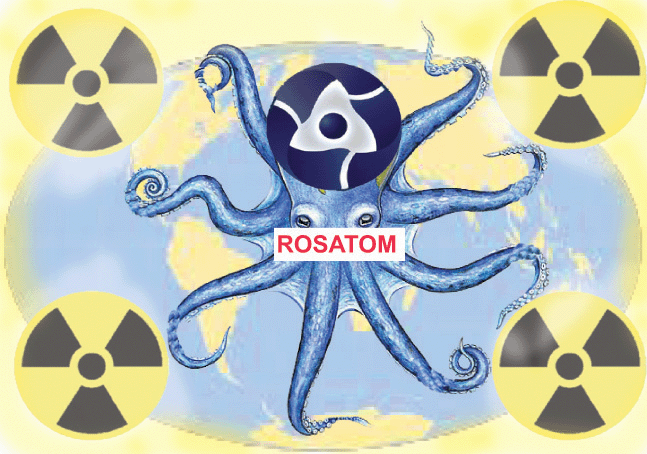
As the sabre-rattling over possible sanctions against Russia’s nuclear
industry intensifies, the country’s state-owned energy company Rosatom is
busily drumming up new business in Africa.
Last month, speaking at the
African Energy Indaba in Cape Town, Rosatom’s chief executive for central
and southern Africa, Ryan Collyer, urged the continent’s most
industrialised country, South Africa, to press go on its nuclear programme
to ensure “stable, affordable and environmentally friendly” power. It
was a message that resonated with South Africa’s energy minister Gwede
Mantashe, who said the country, which has been battling electricity
blackouts for the past 16 years, expects nuclear energy to be part of the
fix.
“The proposal to develop 2,500MW of nuclear power is not a dream —
there’s already an agreement, and the procurement capacity is being
worked on. We’re going to be investing in that capacity,” he told the
conference. While nuclear power provides about 10 per cent of electricity
generated globally, according to the Paris-based International Energy
Agency, the Koeberg plant in Cape Town is the only nuclear power station on
the African continent. Yet a number of African countries have announced
plans to build nuclear power plants in the past year — including Uganda,
Rwanda and Kenya.
FT 2nd April 2024
https://www.ft.com/content/4f1d0d1d-3a98-4b03-8771-54d88ed0a023
United Arab Emirates in talks to invest in European nuclear power infrastructure
The United Arab Emirates (UAE) is exploring opportunities to invest in
nuclear power infrastructure across Europe, including in Britain, Reuters
has reported.
The state-owned Emirates Nuclear Energy Company (ENEC) is
considering becoming a minority investor in several nuclear power assets.
ENEC, which is owned by Abu Dhabi’s investment fund, the Abu Dhabi
Developmental Holding Company, has ambitions to expand its international
footprint by acquiring minority stakes in nuclear projects.
The company has
been in discussions to invest in the UK, specifically in the Sizewell C
nuclear project, which is currently seeking additional private investment
following the exit of a Chinese investor. Alongside Saudi Arabia, the UAE
is looking to diversify its economy beyond oil, while Britain is actively
seeking private investment to support its nuclear energy ambitions.
Power Technology 2nd April 2024
https://www.power-technology.com/news/uae-invest-european-nuclear-infrastructure
UKRAINIAN WAR PEACE TALKS: To Be or Not To Be?
Russian and Eurasian Politics by GORDONHAHN, April 2, 2024
Despite Western media reports over recent months and weeks regarding supposed secret talks between Westerners and Russians to settle or at least stop the NATO-Russia Ukrainian War, there are no such talks ongoing. But this does not mean that they cannot emerge.
First we heard of supposedly secret talks between Ukrainian Armed Forces General Staff Chief Gen. Valeriy Zaluzhniy and Russian General Staff Chief Gen. Valerii Gerasimov. Then there were Russian President Vladimir Putin’s alleged ‘signals’ indicating that he seeks negotiations. In reality, there are no peace talks underway between Russia, on the one hand, and the West and/or Ukraine, on the other hand. There are no signals that Putin is seeking negotiations. Although he is willing to hold talks, he expects that any negotiations be requested first by the West and/or Ukrainian President Volodomyr Zelenskiy. The New York Times piece about ‘Putin’s signals’ published just before Christmas was nothing more than another attempt to portray Russia and Putin as ‘losing the war’ and desperate for an exit ramp, and it was nothing less than a contribution in support of US President Joseph Biden’s desperate re-election prospects as the American presidential campaign is about to kickoff.
Nothing could be further from the truth than the tale of Russian desperation told since the war began. This is most evident now for anyone following the recent course of events on the front; a front that is collapsing on the Ukrainian side. In Zelenskiy’s eternal PR mode, the Ukrainian front’s collapse will be framed as an orderly retreat to new defense lines and part of a new defensive strategy replacing the offensive one that so ignominiously failed with this summer’s predictably disastrous counteroffensive. Nevertheless, the hard, cold realities of the summer campaign’s defeat following the fall of the strategic hub of Bakhmut (Artyomevsk) and preceding the fall of the heavily fortified town of Avdiivka (Avdeevka) are trumping Zelenskiy’s simulated reality productions both in the West and Ukraine ever so gradually.
As Russian forces slowly but but surely advance westward across the entire front ranging from Zaporozhe (and perhaps soon Kherson) to Kharkov — an advance that is likely to accelerate in spring and summer, the Kremlin has no burning need to negotiate. To be sure, Moscow would prefer ending the war, but on its own terms. The longer Washington, Brussels, and Kiev refuse negotiations, the more fluid the situation becomes and the less likely Moscow will be easy to negotiate with before its forces reach the Dnieper River. Some Russian officials are trumpeting a hard line. For example, a month ago Russian ambassador to the UN Dmitri Polyanskiy said that Kiev’s chance for talks had passed and now only capitulation talks are possible (https://t.me/RusskajaIdea/5265 and https://t.me/Slavyangrad/79622).
But Putin appears open to talks. However, he certainly is not desperate for them and may prefer holding off until more Ukrainian military force and territory is attritted. He has indicated numerous times since the war began that he is open to talks…………………..
The lack of talks is best explained by the West’s and Ukraine’s unwillingness to negotiate. In fact, since December 2022 Ukrainian law forbids Ukrainians from conducting peace talks with Putin’s Russia. The U.S. has apparently held to its proclaimed policy of ‘no talks about Ukraine without Ukraine’ at least in terms of any peace negotiations, though the US’s CIA chief, William Burns, and his Russian counterpart, SVR chief Sergei Narynskii met a few months back for discussions on undisclosed issues.
Therefore, Zelenskiy consistently rejects talks until such time as Russia has withdrawn all of its troops beyond Ukraine’s 1991 borders—the core of his supposed ‘peace plan.’ Obviously, without defeat on the battlefield Russia will not give up Crimea and the four oblasts it now considers to be its sovereign territory. Recently, Zelenskiy rejected negotiations out of hand. Several weeks ago, visiting Turkey, Zelenskiy spurned Turkish President Tayyip Recep Erdogan’s entreaties to start talks with Moscow under Ankara’s mediation…………………………………………………………………………. https://gordonhahn.com/2024/04/02/ukrainian-war-peace-talks-to-be-or-not-to-be/—
The $97 billion mess – spent nuclear fuel reprocessing in Japan

The reprocessing plant was initially scheduled for completion in 1997.
Including expenditures for the future decommissioning of the plant, the total budget has reached 14.7 trillion yen. (close to $97 billion)
Even if the reprocessing plant is completed, it can treat only 800 tons of spent nuclear fuel annually at full capacity, compared with 19,250 tons of spent fuel stored nationwide.
“They have invested too much money in the program to give up on it halfway,“
Another delay feared at nuclear fuel reprocessing plant in Aomori
By AKI FUKUYAMA/ Staff Writer, April 1, 2024, https://www.asahi.com/ajw/articles/15183716
Long-flustered nuclear fuel cycle officials fear there could be another delay in the project.
In a surprise to hardly anyone, the “hopeful outlook” for completion in June of a spent fuel reprocessing plant, a key component in Japan’s nuclear fuel cycle project, was pushed back in late January.
The facility is supposed to extract plutonium and uranium from used nuclear fuel. The recycled fuel can then be used to create mixed-oxide (MOX) fuel, which can run certain nuclear reactors.
But the incompletion of the plant has left Japan with 19,000 tons of spent nuclear fuel with nowhere to go.
The nuclear waste stockpile will only grow, as the administration of Prime Minister Fumio Kishida is turning to nuclear energy to cut Japan’s greenhouse gas emissions and reduce the country’s dependence on increasingly expensive fossil fuels.
Under the plan, 25 to 28 reactors will be running by 2030, more than double the current figure. Tokyo Electric Power Co. is seeking to restart reactors at its Kashiwazaki-Kariwa nuclear power plant in Niigata Prefecture this year.
31 YEARS AND COUNTING
A sign reading “village of energy” stands near Japan Nuclear Fuel Ltd.’s nuclear fuel reprocessing plant in Rokkasho, Aomori Prefecture.
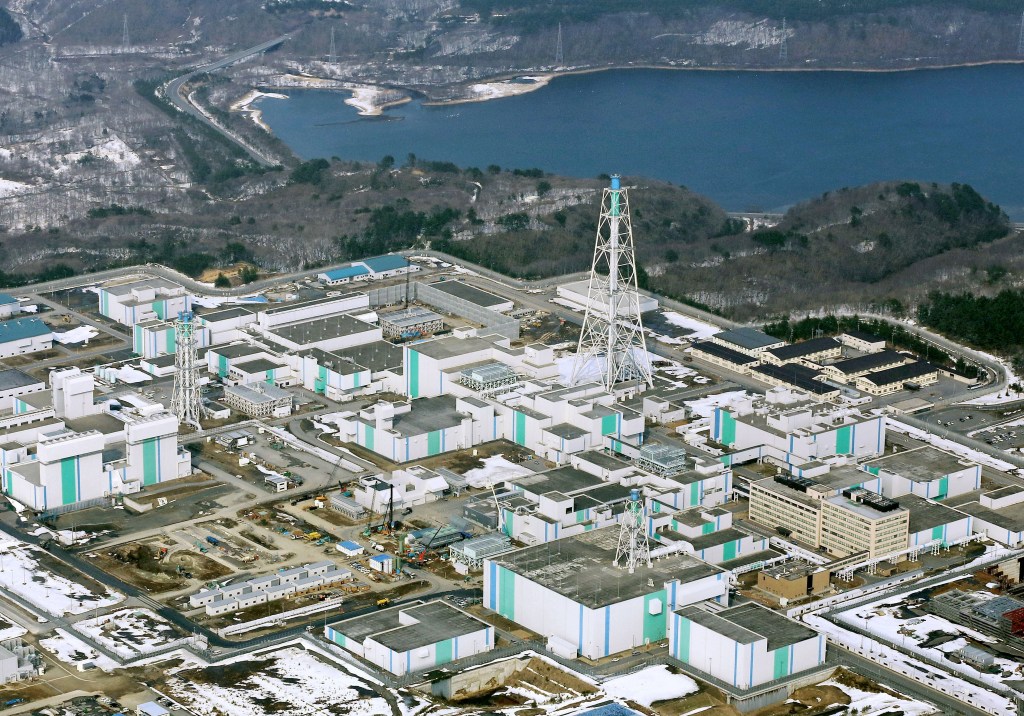
The site, which is 159 times the size of Tokyo Dome, is lined with white buildings with no windows.
Construction started 31 years ago. It was still being built in late November last year, when it was shown to reporters.
The reprocessing plant is located on the Shimokita Peninsula at the northern tip of the main Honshu island.
Crops in the area are often damaged by cold humid winds during summer, so Rokkasho village accepted the plant in 1985 for local revitalization in place of agriculture.
Employees of privately-run Japan Nuclear Fuel, which is affiliated with nine major power companies, and other industry-related personnel account for more than 10 percent of Rokkasho’s population.
After repeated readjustments to the schedule, Naohiro Masuda, president of Japan Nuclear Fuel, said in December 2022 that the plant’s completion should come as early as possible during the first half of fiscal 2024, which is April to September 2024. More specifically, he pointed to “around June 2024.”
But at a news conference on Jan. 31 this year, Masuda said it is “inappropriate to keep saying the plant will be completed in June.”
The reprocessing plant was initially scheduled for completion in 1997.
Many insiders at the plant say it will be “quite difficult” to complete the work within the first half of fiscal 2024.
If officially decided, it will be the 27th postponement of the completion.
PROLONGED SCREENING, ACCIDENTS
One of the reasons for the delay of the completion is prolonged screenings by the Nuclear Regulation Authority.
Flaws were identified one after another in the company’s documents submitted to the nuclear watchdog, and around 400 Japan Nuclear Fuel employees are working on the papers within a gymnasium at the plant site.
Mechanical problems have also hampered progress. In 2022, for example, a system to cool high-level radioactive liquid waste broke down.
Masuda visited industry minister Ken Saito on Jan. 19 to report on the situation at the plant.
Saito told Masuda about the construction, “I expect you to forge ahead at full tilt.”
Masuda stressed his company “is fully devoted to finishing construction as soon as possible,” but said safety “screening is taking so much time because we have myriad devices.”
The cost to build the reprocessing plant, including new safety measures, has ballooned to 3.1 trillion yen ($20.57 billion), compared with the initial estimate of 760 billion yen.
Including expenditures for the future decommissioning of the plant, the total budget has reached 14.7 trillion yen. (close to $97 billion)
Even if the reprocessing plant is completed, it can treat only 800 tons of spent nuclear fuel annually at full capacity, compared with 19,250 tons of spent fuel stored nationwide.
Kyushu Electric Power Co. said in January that it would tentatively suspend pluthermal power generation at the No. 3 reactor of its Genkai nuclear power plant in Saga Prefecture. The reactor uses MOX fuel.
Kyushu Electric commissioned a French company to handle used fuel, but it recently ran out of stocks of MOX fuel.
Kyushu Electric has a stockpile of plutonium in Britain, but it cannot take advantage of it because a local MOX production plant shut down.
HUGE INVESTMENT
Calls have grown over the years to abandon the nuclear fuel cycle project.
Many insiders of leading power companies doubt whether the reprocessing plant “will really be completed” at some point.
But the government has maintained the nuclear fuel cycle policy, despite the huge amounts of time and funds poured into it.
“The policy is retained just because it is driven by the state,” a utility executive said.
Hajime Matsukubo, secretary-general of nonprofit organization Citizens’ Nuclear Information Center, said the government’s huge investment explains why the fuel cycle program has yet to be abandoned.
“They have invested too much money in the program to give up on it halfway,” Matsukubo said.
Xi Jinping’s Thoughts on China’s Nuclear Weapons

Xi noted the increased readiness those new silos might provide was necessary to prepare to respond to foreign military intervention. That sounds more defensive than aggressive. ……………….. China’s long-standing commitment not to use nuclear weapons first at any time or under any circumstances.
UCS is concerned about the future direction of Chinese nuclear weapons policy. We agree with Gen. Cotton that “the PRC’s long-term nuclear strategy and requirements remain unclear.” We urge influential US voices, including the media, to refrain from encouraging the public, and especially US decision-makers, to jump to conclusions the available evidence does not support. We also urge the Biden administration, and the US Congress, to wait until they have a clearer understanding of Chinese nuclear thinking before making precipitous decisions about the future of the US nuclear arsenal.
April 1, 2024, Gregory Kulacki, China Project Manager, This blog was co-authored with UCS China analyst Robert Rust. https://blog.ucsusa.org/gregory-kulacki/xi-jinpings-thoughts-on-chinas-nuclear-weapons/
Last month UCS published a critique of a New York Times article that claimed Chinese military strategists, “are looking to nuclear weapons as not only a defensive shield, but as a potential sword — to intimidate and subjugate adversaries.” We examined the evidence and found it did not support that claim.
However, there was one piece of evidence in the article we could not examine; a speech by Chinese leader Xi Jinping to China’s Second Artillery in December of 2012. It operates China’s conventional and nuclear missiles and was renamed the People’s Liberation Army Rocket Force in 2016. We’ve since obtained a copy of that speech and found it doesn’t support the New York Times claim either. There is no language in Xi’s speech that suggests he thinks about the purpose of China’s nuclear arsenal differently than his predecessors.
We posted the original Chinese text with an English translation. It is classified as an “internal publication” that should be “handled with care.” It was printed and distributed to all Chinese military officers at the regimental level and above by the General Political Department of the People’s Liberation Army (PLA) in February 2014.
Why is this speech worth reading?
UCS first learned about the speech ten years ago when a Chinese colleague drew our attention to language in a commentary on the speech by generals Wei Fenghe and Zhang Haiyang, the commander and party secretary of the Second Artillery at the time. Our colleague noticed it contained new language describing the alert level of Chinese missiles. He thought the two officers might be trying to influence Xi’s thinking. UCS took note of that the new language in our 2016 report on a possible change in China’s nuclear posture.
That report concluded China may shift some of its nuclear forces to what is called a “launch on warning” or “launch under attack” alert status that would give Chinese leaders the option to launch those nuclear missiles quickly before they could be destroyed by an incoming attack. Traditionally, China kept its nuclear missile force off-alert, and the Second Artillery trained to launch a retaliatory nuclear strike only after being struck first. Currently, China is believed to keep most of its nuclear warheads in storage, separated from the missiles that carry them, to prevent an accidental or unauthorized launch.
Although China may still be moving to a launch on warning posture, the full text of Xi’s December 2012 speech, and the phrase it contains related to alert levels, reveals Xi did not discuss nuclear strategy or announce an intention to put Chinese nuclear forces on alert. He addresses more general concerns about the combat readiness, ideological orientation, and human qualities of Chinese military officers. Every Chinese head of state since 1842, when the United Kingdom defeated Imperial China in the Opium War, shared the same concerns. Xi did not say anything new, specific, or surprising. There is no language in his speech that justifies the suggestion he communicated aggressive new nuclear ambitions that day.
What did Xi say?
Continue readingAmerica’s Nuclear War Plan in the 1960s Was Utter Madness. It Still Is.
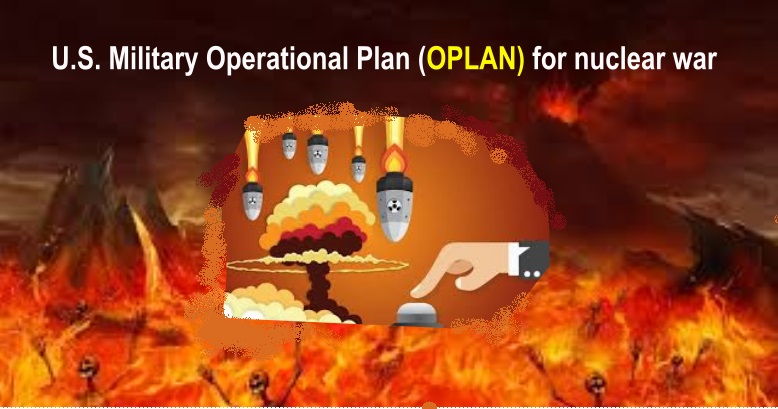
The Final Solution was enacted. The SIOP never has been—not so far. But a similar, still-classified plan exists today. Over the years, its name has changed. It is now simply the Operational Plan (OPLAN).
We rarely consider the dangers these days, but our existence depends on it.
ANNIE JACOBSEN, MARCH 27, 2024, Mother Jones
This article was adapted from Nuclear War: A Scenario, published March 26, 2024, by Dutton, an imprint of Penguin Publishing Group, a division of Penguin Random House, LLC. Copyright 2024 by Annie M. Jacobsen.
Nuclear war is madness. Were a nuclear weapon to be launched at the United States, including from a rogue nuclear-armed nation like North Korea, American policy dictates a nuclear counterattack. This response would almost certainly set off a series of events that would quickly spiral out of control. “The world could end in the next couple of hours,” Gen. Robert Kehler, the former commander of US Strategic Command, told me in an interview.
We sit on the razor’s edge. Vladimir Putin has said he is “not bluffing” about the possibility of using weapons of mass destruction should NATO overstep on Ukraine, and North Korea accuses the US of having “a sinister intention to provoke a nuclear war.” For generations, the American public has viewed a nuclear World War III as a remote prospect, but the threat is ever-present. “Humanity is one misunderstanding, one miscalculation away from nuclear annihilation,” cautions UN Secretary-General António Guterres. “We must reverse course.”
So far, we haven’t. The Pentagon’s plans for nuclear war remain firmly in place.
The US government has spent trillions of dollars over the decades preparing to fight a nuclear war, while refining protocols meant to keep the government functioning after hundreds of millions of Americans become casualties of a nuclear holocaust, and the annual budgets continue to grow. The nation’s integrated nuclear war plan in the 1960s was utter madness. It almost certainly remains so today. ……………………………………………………………………………………………………………………………………………….
Atomic bombs were “a threat to mankind and to civilization,” warned the group of admirals, generals, and scientists who authored the report—“weapons of mass destruction” able to “depopulate vast areas of the Earth’s surface.” But they could also be very useful, the group told the Joint Chiefs. “If used in numbers,” they wrote, “atomic bombs not only can nullify any nation’s military effort, but can demolish its social and economic structures and prevent their reestablishment for long periods of time.”……………………………………………….
What America had created presaged its own potential demise. “The United States has no alternative but to continue the manufacture and stockpiling of weapons,” the Joint Chiefs were advised. They took notice and approved……………………………………………………………………….
the atomic bomb—its extraordinary power, its mass-killing capacity—would pale in comparison to what was coming next. American and Russian weapons designers each had radical new plans on their individual drawing boards. What followed was the invention, in 1952, of “the most destructive, inhumane, and indiscriminate weapon ever created,” in the words of a group of Nobel laureates. A climate-altering, famine-causing, civilization-ending, genome-changing, newer, bigger, and even more monstrous nuclear weapon—one that the scientists involved called “the Super.”
Indeed, the Super “works better in large sizes than in small sizes,” its designer, Richard Garwin, told me in an interview, confirming that, yes, “I am the architect of the Super…of this first thermonuclear bomb.” Edward Teller conceived it and Garwin drew it at a time when no one else knew how.
The Super was a two-stage mega-weapon: a nuclear bomb within a nuclear bomb. A thermonuclear weapon, also called a hydrogen bomb, uses an atomic (fission) bomb as its triggering mechanism—as an internal, explosive fuse. The Super’s explosive power is the result of an uncontrolled chain reaction in which the nuclei of hydrogen isotopes combine under extremely high temperatures, releasing tremendous energy.
An atomic bomb will kill tens of thousands of people immediately (and tens of thousands later, from follow-on effects), as did the bombs dropped on Hiroshima and Nagasaki. Whereas a thermonuclear bomb detonated on or over a city like New York or Seoul will kill millions of people in a superheated flash, followed by millions more from blast, firestorms, and radioactive fallout.
Garwin’s 1952 prototype had an explosive power of 10.4 megatons—the near equivalent of 1,000 Hiroshima bombs exploding all at once. It was an atrocious weapon. Garwin’s mentor, the Manhattan Project physicist Enrico Fermi, experienced a crisis of conscience at the very thought of such a horrifying weapon being built. Fermi and his colleague I.I. Rabi temporarily broke ranks with their weapons-building colleagues and wrote to President Truman, declaring the Super “an evil thing.”
As they put it: “The fact that no limits exist to the destructiveness of this weapon makes its very existence and the knowledge of its construction a danger to humanity as a whole. It is necessarily an evil thing considered in any light.”
But the president ignored the plea to stop building the Super, and Garwin was given the go-ahead to draw the plans. “If the hydrogen bomb was inherently evil, it’s still evil,” Garwin told me.
The Super was built. Its code name was Mike. The series was Ivy. “So it was the Ivy Mike test,” he said.
On November 1, 1952, it was test-fired on Elugelab island in the Marshall Islands. The Ivy Mike prototype weighed around 80 tons, an instrument of destruction so physically enormous it had to be constructed inside a corrugated-aluminum building 88 feet long and 46 feet wide.
Ivy Mike exploded with an unprecedented yield. The crater left behind was described in a classified report as being “large enough to hold 14 buildings the size of the Pentagon.” And while there is much to say about the inhumanely destructive power of thermonuclear weapons in general, two aircraft photographs—before and after shots of the Ivy Mike bomb test—tell the story.
What happened after America’s war planners saw what 10.4 megatons could instantly destroy simply boggles the mind. What came next was a mad, mad rush to stockpile thermonuclear weapons, first by the hundreds and then by the thousands.
In 1952 there were 841 nuclear bombs. The next year there were 1,169.
“The process became industrialized,” historian McDuff explains. “These were not science projects anymore.”………………………………..
By 1967, it hit an all-time high: 31,255.
One nation. Thirty-one thousand, two hundred and fifty-five nuclear bombs.
Why stockpile 31,255 nuclear bombs when a single bomb the size of Ivy Mike, dropped on New York City or Moscow, could wipe out 10 million people? Why continue to mass-produce such weapons when the use of a single thermonuclear bomb will almost certainly ignite an unstoppable, civilization-ending nuclear war?
As the nuclear stockpile multiplied out of control, so did each of the US military branches’ plans for nuclear war. As crazy as this now seems, before December 1960, each Army, Navy, and Air Force chief had control over his own nuclear stockpile, delivery systems, and target lists. In an attempt to rein in the potential for mayhem from these multiple, competing plans, the secretary of defense ordered them all to be integrated into a single plan, which is how the Single Integrated Operational Plan (SIOP) for General Nuclear War got its name.
……………………………… The secret plan that, if activated, would result in the deaths of at least 600 million people on the other side of the world.
The SIOP showed how the entire US military force would be launched at Moscow in a preemptive first strike. How defense scientists had carefully calculated that 275 million people would be killed in the first hour, and that at least 325 million more people would die from radioactive fallout over the next six or so months. Roughly half of these deaths would be in the Soviet Union’s neighboring countries—countries not at war with America, but that would be caught in the crosswinds. This included as many as 300 million Chinese.
………………………………………………………………………………………………….. No one spoke up to object to the indiscriminate killing of 600 million people in a preemptive, US–led first-strike, Rubel wrote. Not any of the Joint Chiefs. Not the secretary of defense. Not John Rubel. Then, finally, one man did: Gen. David Shoup, the Marine Corps commandant, who’d been awarded the Medal of Honor for his actions in World War II.
“Shoup was a short man with rimless glasses who could have passed for a schoolteacher from a rural mid-American community,” recalled Rubel. He remembered how Shoup spoke in a calm, level voice when he offered the sole opposing view: “All I can say is, any plan that murders 300 million Chinese, when it might not even be their war, is not a good plan. That is not the American way.”
The room fell silent, Rubel wrote. “Nobody moved a muscle.”
Nobody seconded Shoup’s dissent.
No one else said anything.
According to Rubel, everyone just looked the other way.
Decades later, Rubel confessed that the SIOP had reminded him of the Nazis’ plans for genocide. In his memoir, he referred to a time when a group of Third Reich officials met at a lakeside villa in the German town of Wannsee. It was there, over the course of a 90-minute meeting, that this group of allegedly rational men decided among themselves how to move forward with the genocide in a war they were presently winning—World War II—so as to ensure total victory. Millions of people needed to die, these officials agreed.
Millions of them.
The Final Solution called for the extermination of all of Europe’s millions of Jews and millions more people the Nazis considered subhuman. The plan for General Nuclear War that Rubel and his colleagues signed off on—the SIOP—called for the mass extermination of some 600 million Russians, Chinese, Poles, Czechs, Austrians, Yugoslavians, Hungarians, Romanians, Albanians, Bulgarians, Latvians, Estonians, Lithuanians, Finns, Swedes, Indians, Afghans, Japanese, and others whom US defense scientists calculated would be caught in the crosswinds.
The Final Solution was enacted. The SIOP never has been—not so far. But a similar, still-classified plan exists today. Over the years, its name has changed. It is now simply the Operational Plan (OPLAN).
When the SIOP was created, there were just two nuclear-armed nations. Today there are nine: the United States, Russia, China, France, the United Kingdom, Pakistan, India, Israel, and North Korea. Several of these countries are in direct conflict with one another. There is great instability between Pakistan and India…………………………………………………………….
For the Nuclear Information Project, in consort with the Federation of American Scientists, project director Hans Kristensen and senior researcher Matt Korda have identified the current Operational Plan for nuclear war as OPLAN 8010-12, consisting of “‘a family of plans’ directed against four identified adversaries: Russia, China, North Korea, and Iran.” But like all the Exceptionally Controlled Information in the nuclear command and control domain, the details of what, exactly, these war plans entail are off limits to the public…………………………………………………….
So here we are. Teetering at the edge—perhaps even closer than ever before……………………………….more https://www.motherjones.com/politics/2024/03/nuclear-war-scenario-book-siop-weapons-annie-jacobsen/
How much will extra decades of nuclear decommissioning work at Dounreay cost?
By Gordon Calder gordon.calder@hnmedia.co.uk, 28 March 2024
The cost of extending the decommissioning work at Dounreay is expected to
be published in the summer, according to a spokeswoman at the site.
She was responding to questions from the John O’ Groat Journal, following last
week’s announcement that the clean up-operation at the nuclear plant will
continue until the 2070s – almost 40 years longer than the previous date of
2033. The cost of the programme was previously said to be about £2.9
billion.
Asked about the estimated cost of extending the decommissioning,
the spokeswoman said: ” The estimate for delivering the revised lifetime
plan to take the Dounreay site to its interim end point, will form part of
the Nuclear Provision, and be published in the NDA (Nuclear Decommissioning
Authority) 2023/24 annual report in the summer. We are committed to
delivering the Dounreay mission as effectively and efficiently as
possible.”
John O’Groat Journal 28th March 2024
Radioactive nuclear waste burial ground in Pittsburgh area to be cleaned up by federal government

By Andy Sheehan, April 1, 2024 ,
https://www.cbsnews.com/pittsburgh/news/radioactive-nuclear-waste-burial-ground-armstrong-county-parks-township/
KISKIMERE, Pa. (KDKA) — An untold number of 55-gallon drums containing radioactive waste are buried in shallow trenches on a 144-acre site in Armstrong County.
They pose a health and safety danger to those who live nearby. But now after decades of lawsuits and public outcry, the federal government is getting ready to finally clean it up.
Debbie Secreto has lived next to the contaminated field in Parks Township all of her life. She played on it as a kid, unaware of the hidden danger. She was diagnosed with breast cancer at 44 years old.
There are 10 shallow trenches filled with haphazardly disposed of radioactive nuclear waste. Though she and other cancer survivors won a class action settlement years ago, she’s remained in her childhood home.
“It’s hard living like this, but what are you going to do? Move? I don’t want to move. I’m 71 years old,” Secreto of Kiskimere said.
In the 1950s and 1960s, the company MUMEC in nearby Apollo produced nuclear fuels for power plants and nuclear submarines and buried the waste in Parks Township. Now, after decades of fighting for it, neighbors like Secreto have won another major victory.
The United States government is finally taking action, now building the needed infrastructure to commence a six-year, $500-million project to excavate all of that nuclear waste to decontaminate and clean the entire 144-acre site.
Beginning next year, contractors for the U.S. Army Corps of Engineers will begin the slow and methodical process of excavating an estimated 30,000 cubic yards of contaminated waste. They will unearth a little bit at a time, scanning it with X-rays and radiation detectors before encapsulating it in steel containers.
The waste will then be trucked and shipped by rail to a disposal site in Utah, where it will be permanently buried deep underground.
But while happy the waste is going elsewhere, neighbors are concerned the unearthing could spark a nuclear event, releasing toxins into the air and water.
“Everybody up here is worried about it. It’s going to be dangerous,” said Karen Brenner of Kiskimere.
“I can promise that we are committed to protecting the health and welfare of the community and the environment,” said Steven Vriesen, project manager for the U.S. Army Corps of Engineers.
In participating in reports like this, the U.S. Army Corps of Engineers said it is committed to transparency with the public and will be holding meetings to assure the community every safeguard to safely remove the waste will be taken.
“We have multiple layers of safety,” said David Romano, deputy district engineer. “From air monitors on the workers that are right on the site, groundwater monitoring, surface water monitoring, air monitors around the perimeter, all to ensure our actions ensure the health and safety of our environment.”
If all goes well, this six-year project will restore the site and make this Armstrong County community a safe place to live again.
Sprawling Sellafield Nuclear Waste Site Prosecuted for Cybersecurity Failings

UK regulator said that one of the world’s most toxic sites accumulated cybersecurity “offenses” from 2019 to 2023
Dark Reading Staff, Dark Reading, April 2, 2024, https://www.darkreading.com/ics-ot-security/sellafield-nuclear-waste-site-prosecuted-cybersecurity-failings
Sellafield Ltd, the managing company of the Sellafield nuclear site, will be prosecuted by the UK’s independent nuclear safety regulator for alleged cybersecurity offenses.
According to the safety regulator, the infractions were garnered over a four-year period from 2019 to 2023. However, the regulator noted in its announcement that there is nothing to suggest that public safety has been compromised over these “information technology security offenses.” The Office for Nuclear Regulation (ONR) provided little comment regarding what the specific issues are, or the legal proceedings, but noted that “details of the first court hearing will be announced when available.”
This is not the first time the company has been under scrutiny. Its cybersecurity issues were also addressed in the Chief Nuclear Inspector’s annual report on the country’s nuclear industry, released last September. And in December, the Guardian released a bombshell report that advanced persistent threats (APTs) backed by Russia and China have been breaching the Sellafield’s IT systems as far back as 2015 — attacks that the paper alleged have been consistently covered up by senior staff at the site, which holds a vast store of radioactive waste and the world’s largest store of plutonium
Though it’s not currently known whether any senior managers were involved in these security failings and, if so, whether they’ll face charges, if convicted, an individual can face a maximum of two years in prison.
A nuclear reactor is located on the Sellafield grounds. Even though it was closed in 2003, it is still Europe’s largest nuclear site, and the ONR considers it to be “one of the most complex and hazardous nuclear sites in the world.” That’s likely a big part of the reason why the company’s cybersecurity failings are of notable concern.
Though cyberattacks on power plants aren’t necessarily common, they have occurred on rare occasions, such as the 2017 spate of attacks using Triton malware, also known as Trisis and HatMan, that was used to target a Middle East petrochemical facility at the hands of the Russian Central Scientific Research Institute of Chemistry and Mechanics (TsNIIkhM). The threat actor moved through IT and operational technology (OT) networks to gain entry to the safety system and targeted the Schneider Electric Triconex safety instrumented system, which allows initiation of a safe shutdown process in case of emergencies. With the system modified by malware, it could have led to damages to the facility, operational shutdown, and even fatalities.
That said, what kind of damage a cyberattack would cause Sellafield and whether it could have a similar catastrophic fallout is unknown, since the nuclear reactor is no longer operational.
‘Oppenheimer’ finally opens in Japan, the only nation to experience horror of nuclear war
By Chris Lau and Moeri Karasawa, CNN, Mon April 1, 2024
Japanese moviegoers finally got the chance to see “Oppenheimer” this weekend, eight months after the biopic’s worldwide release, following concerns over how it might be received in the only country to directly experience the horror of nuclear weapons.
The Oscar-winning blockbuster by British-American director Christopher Nolan was one of 2023’s most successful films and its joint release on the same weekend as “Barbie” created a global movie spectacle dubbed “Barbenheimer.”
But that framing left many Japanese people feeling uncomfortable — as did the painful content of a movie that centers on the devastating technology unleashed by J. Robert Oppenheimer and his team of scientists.
Some in Japan felt that the unofficial “Barbenheimer” marketing campaign trivialized the 1945 nuclear attacks on Hiroshima and Nagasaki, and studio Universal Pictures opted not to include the country in its global release rollout last July.
The three-hour biopic has broken several records since its release last year, becoming the highest-grossing movie set during World War II, according to Universal.
In Japan, it ranked fourth at the box office following its release Friday, according to industry tracker Kogyo Tsushinsha, raking in 379 million yen ($2.5 million) in its first three days.
As part of its promotional campaign, Universal sought the views of atomic bomb survivor Tomonaga Masao, who is the president of a Nagasaki-based “hibakusha” group — the name survivors call themselves. In quotes published on the movie’s official Japanese website, Masao said could feel the titular character’s struggle in the latter part of the film, when Oppenheimer begins to push back against the nuclear arms race that emerges after the war.
“This is… connected to the fundamental problem of the world today, where a nuclear-free world is becoming more and more distant,” he is quoted as saying
“Here we sense Nolan’s hidden message of pursuing the responsibility of politicians,” he added.
Former Hiroshima Mayor Hiraoka Takashi is meanwhile quoted saying that he saw “a man full of contradictions,” whose scientific work was weaponized by the state and whose warning against downplaying the threat of nuclear war was later ignored by those same authorities.
“The atmosphere of those days still fills our world today,” he said, adding: “I would like to watch it again and think about what a nation that believes in nuclear deterrence is”
……………………………………………………………………………………
Rishu Kanemoto, a 19-year-old student, saw the film on Friday.
“Hiroshima and Nagasaki, where the atomic bombs were dropped, are certainly the victims,” he told Reuters.
But he also expressed sympathy for Oppenheimer.
“I think even though the inventor is one of the perpetrators, he’s also the victim caught up in the war,” he added. https://edition.cnn.com/2024/04/01/style/japan-oppenheimer-release-nuclear-intl-hnk/index.html
Say no to small modular reactors: Stop normalizing the exploitation of nature

The Bulletin, By Erin Hurley | April 1, 2024 Erin Hurley is a fourth-year student at St. Thomas University in Fredericton, New Brunswick, where she studies Environment & Society and Journalism. She was a research assistant last year on the Plutonium Project, funded by the Social Sciences and Humanities Research Council (SSHRC), for which she explored news media discourses on proposed small modular reactors in New Brunswick. This year, she is a research assistant on the SSHRC-funded CEDAR (Contesting Energy Discourses through Action Research) Project, for which she is focusing on news media coverage of energy transitions in the province.
Among other global crises, the worsening impacts of climate change are intensifying every year. Last year was the warmest on record and, beginning in March 2023, raging wildfires filled cities across Canada with smoke for months. This year is already shaping up to be warmer than the last. This is why a lot of young people are questioning the very systems we live under. This is why many of us support a rapid and just transition in energy. But in this process, some governments are promoting an expansion of nuclear power, supposedly to solve climate change. I fear that such an expansion will result in my generation having to confront an equally terrifying set of problems resulting from the nuclear fuel chain.
This is precisely what I already see happening around me in the Canadian province of New Brunswick where I live and study. Over the last few years, the province’s government has advocated for and funded the development of what it calls small modular reactors (SMRs). Even though SMR doesn’t include the word “nuclear,” these are nuclear reactors. Ostensibly, these reactors are meant to decarbonize the Canadian economy. But in 2021, New Brunswick Energy Minister Mike Holland protested the 2030 target for phasing out coal in the province, saying new nuclear reactors would not be ready in time to meet that goal. How will the expansion of nuclear power decarbonize the economy if, meanwhile, New Brunswick is still extracting and burning fossil fuels?
The province has funded two companies—Moltex Energy and ARC Clean Technology—to develop small modular reactors. On their websites, Moltex and ARC market nuclear power as “clean,” “carbon free,” and a “clean energy solution.”
Last year, Moltex CEO Rory O’Sullivan spoke to me, my fellow students, and professors working on the Plutonium Project at St. Thomas University in Fredericton, New Brunswick, in which we explored these small modular reactors being proposed for the province to develop an understanding of the assumptions, claims, and implications of these technologies. I remember O’Sullivan as friendly and well-spoken. He emphasized that a transition away from fossil fuels is necessary and that renewable energy is a key element in this transition. Yet he told us that wind farms, for example, could not generate enough energy to sustain our society, and that battery storage was not advanced enough to help with this, and thus renewables could not be considered an effective climate solution on their own. This is why he advocates for small modular reactors—as a necessary supplement to renewables in the energy transition. But, again, he stressed that, at Moltex, they were working to reduce any potential safety risks.
This made me wonder: What about the highly radioactive waste these reactors will produce?
Even if SMRs produce less waste than past nuclear reactors (although not when weighted by how much electricity they produce), spent fuel will remain dangerously radioactive for thousands of years. While nuclear proponents have argued that a deep geological repository would be an effective storage space for the waste, there are many uncertainties surrounding this proposal, and the long-term impacts are unknown. The proposed sites for the repository are located on traditional Indigenous lands in the Wabigoon Lake Ojibway Nation-Ignace and Saugeen Ojibway Nation-South Bruce areas in Ontario. Because the safety of the proposed repository is unproven, storing radioactive waste there would jeopardize the health of the local Indigenous communities and their lands.
Moltex and ARC have advertised reprocessing as a way to recycle waste and use it to power other reactors. However, this is also incredibly dangerous, because once plutonium is separated from used nuclear fuel, it can be used much more easily in the production of atomic weapons. If separated plutonium were to fall into the wrong hands, the result would be nuclear proliferation—an increased number of nuclear weapons across the globe.
In addition to the waste and proliferation problems, small modular reactors will not be built and operating in time to be an effective climate solution. Canada’s climate targets involve decreasing greenhouse gas emissions to 40 per cent below 2005 levels by 2030 and reaching net-zero by 2050. However, ARC predicts that it will finish building its first small modular reactor by 2028 which will “replace the existing coal generation station in 2030” at Point Lepreau Nuclear Generating Station in Saint John, New Brunswick. And Moltex does not expect to have an “operational reactor” until “the early 2030s.”
This timeline will clearly not help Canada reach its decarbonization goal by 2030, and so the country will not be on track for the 2050 goal either. Given these realities, I find it hard to believe that nuclear power is in the best interest of humans, non-human species, or the planet as a whole.
Capitalist nations that prioritize economic growth above all else, such as the United States and Canada, have normalized the exploitation of nature……………………………………………….. more https://thebulletin.org/2024/04/say-no-to-small-modular-reactors-stop-normalizing-the-exploitation-of-nature/#post-heading
UK Court Gives Biden Chance to Dodge Assange Appeal by “Assuring” His Rights
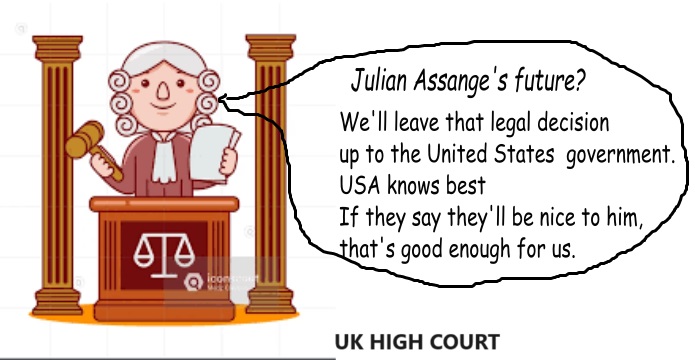
The WikiLeaks publisher could be extradited if the US gives “satisfactory assurances” of rights and no death penalty.
By Marjorie Cohn , TRUTHOUT 29 Mar 24, https://truthout.org/articles/uk-gives-biden-opportunity-to-dodge-assange-appeal-by-assuring-his-rights/
WikiLeaks publisher Julian Assange is closer than ever to being extradited to the United States for trial on 17 counts under the Espionage Act and one count of conspiracy to commit computer intrusion over WikiLeaks’s 2010-2011 revelation of evidence of U.S. war crimes in Iraq, Afghanistan and Guantánamo Bay. He faces 175 years in prison.
“This is a signal to all of you that if you expose the interests that are driving war they will come after you, they will put you in prison and they will try to kill you,” said Stella Assange, Julian’s wife, of his prosecution.
On March 26, the United Kingdom Divisional Court denied Assange the opportunity to make most of his appellate arguments. But the two-judge panel of Justice Jeremy Johnson and Dame Victoria Sharp left open the possibility that Assange could appeal on three grounds. They found that Assange “has a real prospect of success” on the following issues: If extradited to the U.S., he will be denied the right to freedom of expression, will suffer discrimination because he’s not a U.S. citizen and could be sentenced to death.
Rather than simply allowing Assange to argue the three issues on appeal, however, the panel gave the Biden administration an out. If the U.S. provides the court with “satisfactory assurances” that Assange won’t be denied any of these rights, his extradition to the U.S. can proceed without an appeals hearing.
Stella Assange called the decision “astounding,” adding, “The court’s recognized that Julian has been exposed to flagrant denial of his freedom of expression rights, that he is being discriminated against on the basis of his nationality and that he remains exposed to the death penalty.”
At an earlier stage in this case, the U.S. gave the U.K. High Court “assurances” that Assange would be treated humanely if extradited. That caused the court to reverse the magistrate judge’s denial of extradition (which was based on the likelihood of suicide if Assange is held in harsh conditions of confinement in the U.S.). The High Court accepted those assurances at face value in spite of the U.S.’s history of reneging on similar assurances.
The current ruling, however, requires U.S. assurances to be “satisfactory” and the defense will have an opportunity to challenge them at a hearing.
“Mr. Assange will not, therefore, be extradited immediately,” the panel wrote, implying that if they had denied his appeal outright, the U.K. authorities would put him on a plane to the U.S. forthwith. They gave the U.S. three weeks to come forward with satisfactory assurances.
If the U.S. fails to provide any assurances, Assange will be granted a hearing on the three grounds. If the U.S. does give assurances, a hearing to decide whether they are satisfactory will occur on May 20.
“The Biden administration should not offer assurances. They should drop this shameful case that should never have been brought,” Stella Assange said.
These are the grounds the High Court will review if the U.S. fails to provide “satisfactory assurances”:
1. Extradition Would Violate Freedom of Expression Guaranteed by Article 10 of European Convention on Human Rights
Assange would argue at trial that his actions were protected by the First Amendment to the U.S. Constitution. “He contends that if he is given First Amendment rights, the prosecution will be stopped. The First Amendment is therefore of central importance to his defence,” the panel concluded.
The First Amendment provides “strong protection” to freedom of expression, similar to that provided by Article 10 of the European Convention on Human Rights, the panel noted. Article 10 (1) of the convention says, “Everyone has the right to freedom of expression. This right shall include freedom to hold opinions and to receive and impart information and ideas without interference by public authority and regardless of frontiers.”
Gordon Kromberg, assistant U.S. attorney in the Eastern District of Virginia, where Assange’s trial would be held, said the prosecution might argue at trial that “foreign nationals are not entitled to protections under the First Amendment,” the panel noted. In 2017, then-CIA Director Mike Pompeo said that Assange “has no First Amendment freedoms” because “he is not a U.S. citizen.”
In addition, the U.S. Supreme Court ruled in the 2020 case of Agency for International Development v. Alliance for Open Society International that “it is long settled as a matter of American constitutional law that foreign citizens outside United States territory do not possess rights under the US Constitution.”
The panel wrote that if Assange “is not permitted to rely on the First Amendment, then it is arguable that his extradition would be incompatible with article 10 of the Convention.”
But even if the U.S. Department of Justice prosecutors give “satisfactory assurances” that Assange’s First Amendment rights would be protected, that is no guarantee. Prosecutors are part of the executive branch, which cannot bind the judicial branch due to the constitutional doctrine of separation of powers.
“The ruling reveals that the High Court does not understand the American system of government,” Stephen Rohde, who practiced First Amendment law for almost 50 years and writes extensively about the Assange case, told Truthout. “It only has before it the executive branch of the U.S. government. Whatever ‘satisfactory assurances’ the Department of Justice may give the High Court, they are not binding on the judicial branch.”
Moreover, Rohde said, “The High Court is obligated to uphold Assange’s rights to ‘freedom of expression’ under Article 10 of the European Convention on Human Rights, which protects Assange even if the U.S. courts refuse to do so. The only way to do that is to deny extradition.”
2. The U.K. Extradition Act Forbids Discrimination Based on Nationality
Julian Assange is an Australian citizen who would be tried in the U.S. if the Biden administration’s pursuit of extradition is successful.
Section 81(b) of the U.K. Extradition Act says that extradition is barred for an individual who “might be prejudiced at his trial or punished, detained or restricted in his personal liberty by reason of his … nationality.”
Due to the centrality of the First Amendment to Assange’s defense, the panel noted, “If he is not permitted to rely on the First Amendment because of his status as a foreign national, he will thereby be prejudiced (potentially very greatly prejudiced) by reason of his nationality.”
3. Extradition Is Barred by Inadequate Death Penalty Protection Required by the Extradition Act
Section 94 of the U.K. Extradition Act says, “The Secretary of State must not order a person’s extradition … if he could be, will be or has been sentenced to death for the offence” in the receiving state. That limitation does not apply if a written “assurance” that is “adequate” says “that a sentence of death- (a) will not be imposed, or (b) will not be carried out (if imposed).”
None of the charges that Assange is currently facing carry the death penalty. But if extradited to the U.S., he could be charged with aiding and abetting treason or espionage, both of which are capital offenses.
Ben Watson KC, secretary of state for the Home Department, admitted that:
a.) The facts alleged against [Assange] could sustain a charge of aiding or abetting treason, or espionage.
b.) If [Assange] is extradited, there is nothing to prevent a charge of aiding or abetting treason, or a charge of espionage, from being added to the indictment.
c.) The death penalty is available on conviction for aiding or abetting treason, or espionage.
d.) There are no arrangements in place to prevent the imposition of the death penalty.
e.) The existing assurance does not explicitly prevent the imposition of the death.
The panel noted that when former President Donald Trump was asked about WikiLeaks publishing the leaked documents, he said, “I think it was disgraceful…. I think there should be like a death penalty or something.” If Trump is reelected, he may seek to ensure that his Justice Department adds capital charges to the indictment.
In concluding that Assange could raise this issue on appeal subject to “satisfactory assurances,” the panel cited “the potential, on the facts, for capital charges to be laid; the calls for the imposition of the death penalty by leading politicians and other public figures; the fact that the Treaty does not preclude extradition for death penalty charges, and the fact that the existing assurance does not explicitly cover the death penalty.”
Appeal Grounds Denied by Panel
Remaining grounds for appeal that Assange requested were denied by the panel. They include prosecution for a political offense, prosecution based on political opinion; violation of right to a fair trial; violation of right to life; and violation of right to be free from torture and inhuman or degrading treatment or punishment. In addition, since no publisher has ever been prosecuted under the Espionage Act for publishing government secrets, Assange could not have known it was a crime.
The panel also ruled that Assange could not introduce new evidence adduced after the magistrate judge’s ruling. This includes a Yahoo News report detailing the CIA’s plan to kidnap and kill Assange when he was living under a grant of asylum in the Ecuadorian Embassy in London.
If the U.S. offers “satisfactory assurances” and extradition is ordered, Assange could appeal to the European Court of Human Rights and raise these additional issues as well.
Meanwhile, there is a possibility that instead of filing “assurances,” the Biden administration will opt to avoid the political pitfalls of Assange’s extradition to the U.S. and offer a plea bargain to end the case.
Marjorie Cohn is professor emerita at Thomas Jefferson School of Law, former president of the National Lawyers Guild, and a member of the national advisory boards of Assange Defense and Veterans For Peace, and the bureau of the International Association of Democratic Lawyers. She is founding dean of the People’s Academy of International Law and the U.S. representative to the continental advisory council of the Association of American Jurists. Her books include Drones and Targeted Killing: Legal, Moral and Geopolitical Issues.
British nuclear site Sellafield to be prosecuted for cybersecurity failures

Alexander Martin, March 29th, 2024, https://therecord.media/sellafield-site-prosecution-nuclear-facility-cybersecurity
The United Kingdom’s independent nuclear safety regulator has announced that it will be prosecuting the company managing the Sellafield nuclear site over “alleged information technology security offenses during a four year period between 2019 and early 2023.”
It is not clear whether senior managers at the state-owned Sellafield Ltd. will face charges. Under the Nuclear Industries Security Regulations 2003, individuals convicted of an offense can face up to two years imprisonment.
“There is no suggestion that public safety has been compromised as a result of these issues,” the regulator announced on Thursday, adding that the decision to begin legal proceedings followed an investigation.
“Details of the first court hearing will be announced when available,” stated the ONR.
Sellafield had previously been the focus of enhanced regulatory attention over its cybersecurity failings, as the U.K. chief nuclear inspector’s annual report revealed last year. At the same time, EDF, the company operating several nuclear power plants in Britain, was placed under similar measures.
As set out in the U.K.’s civil nuclear cybersecurity strategy, the National Cyber Security Centre (NCSC) threat assessment warns that ransomware “almost certainly represents the most likely disruptive threat.”
A ransomware attack on the IT systems used by a nuclear power plant could disrupt its operations, although the industrial systems are designed with multiple failsafes to prevent a radiological accident.
Sellafield’s nuclear reactor was closed in 2003, but the sprawling complex remains the largest nuclear site in Europe, with the ONR describing it as “one of the most complex and hazardous nuclear sites in the world.”
It houses more plutonium — in particular the isotopes created as a byproduct of nuclear reactor operations — than any other location on the planet, alongside a range of facilities for nuclear decommissioning, and waste processing and storage.
It was the location of the country’s worst-ever nuclear accident in 1957, when a reactor caught fire leading to radioactive material spreading in the atmosphere across Britain and Europe.
Cyberattacks targeting the operational technology (OT) systems at power plants are rare, but not unheard of — with the Triton malware discovered in Saudi Arabia in 2017 among the best known and most concerning examples.
It is not known whether the suspected Russian actors behind that attack could have engineered a method to overcome the failsafe mechanisms preventing an explosion.
According to the British government’s National Risk Register, a cyberattack on the computer systems controlling a nuclear reactor could potentially require a controlled shutdown as a protective measure, although there is not a major concern about them causing any radiological discharge.
As Sellafield no longer has an operational nuclear reactor, it is not clear what damage a cyber incident at the facility could cause.
1 This Month
23-25 October – on Zoom – World BEYOND War’s annual global conferenc

To see nuclear-related stories in greater depth and intensity – go to https://nuclearinformation.wordpress.com

Say No to NASA’s Reckless Nuclear Reactor on the Moon
Say No to NASA’s Reckless Nuclear Reactor on the Moon
-
Archives
- October 2026 (160)
- September 2026 (339)
- August 2026 (330)
- July 2026 (355)
- June 2026 (287)
- May 2026 (306)
- April 2026 (356)
- March 2026 (251)
- February 2026 (267)
- January 2026 (308)
- December 2025 (358)
- November 2025 (359)
-
Categories
- 1
- 1 NUCLEAR ISSUES
- business and costs
- climate change
- culture and arts
- ENERGY
- environment
- health
- history
- indigenous issues
- Legal
- marketing of nuclear
- media
- opposition to nuclear
- PERSONAL STORIES
- politics
- politics international
- Religion and ethics
- safety
- secrets,lies and civil liberties
- spinbuster
- technology
- Uranium
- wastes
- weapons and war
- Women
- 2 WORLD
- ACTION
- AFRICA
- Atrocities
- AUSTRALIA
- Christina's notes
- Christina's themes
- culture and arts
- Events
- Fuk 2022
- Fuk 2023
- Fukushima 2017
- Fukushima 2018
- fukushima 2019
- Fukushima 2020
- Fukushima 2021
- general
- global warming
- Humour (God we need it)
- Nuclear
- RARE EARTHS
- Reference
- resources – print
- Resources -audiovicual
- Weekly Newsletter
- World
- World Nuclear
- YouTube
-
RSS
Entries RSS
Comments RSS

