New York Times Not Much Concerned About Israel’s Mass Murder of Journalists
HARRY ZEHNER, 1 May 24 https://fair.org/home/nyt-not-much-concerned-about-israels-mass-murder-of-journalists/
A devoted New York Times reader might get the impression that the paper cares deeply about protecting journalists from those who seek to suppress the press.
After all, the Times runs sympathetic features on journalists like Evan Gershkovich, a Wall Street Journal reporter who was detained by Russia over a year ago. The paper (6/3/22) has written stingingly of Russia’s “clamp down on war criticism,” including in a recent editorial (3/22/24) headlined “Jailed in Putin’s Russia for Speaking the Truth.”
It has castigated China for its “draconian” attacks on the press in Hong Kong (6/23/21). The Times has similarly criticized Venezuela for an “expanding crackdown on press freedom” (3/6/19) and Iran for a “campaign of intimidation” against journalists (4/26/16).
Times publisher A.G. Sulzberger, in his keynote address at the 2023 World Press Freedom Day, spoke forcefully:
All over the world, independent journalists and press freedoms are under attack. Without journalists to provide news and information that people can depend on, I fear we will continue to see the unraveling of civic bonds, the erosion of democratic norms and the weakening of the trust—in institutions and in each other—that is so essential to the global order.
‘Targeting of journalists’
Yet since October 7—as Israel has killed more journalists, in a shorter period of time, than any country in modern history—the Times has minimized when not ignoring this mass murder. Conservative estimates from the Committee to Protect Journalists (CPJ) estimate that 95 journalists have been killed in the Israel/Gaza conflict since October 7, all but two being Palestinian and Lebanese journalists killed by Israeli Defense Forces (IDF). Other estimates, like those from the Palestinian Journalists Syndicate (4/4/24), place the number closer to 130. All told, Israel has killed about one out every 10 journalists in Gaza, a staggering toll.
(Two Israeli journalists were killed by Hamas on October 7, according to CPJ, and none have been killed since. Other tallies include two other Israeli journalists who were killed as part of the audience at the Supernova music festival on October 7.)
CPJ (12/31/23) wrote in December that it was “particularly concerned about an apparent pattern of targeting of journalists and their families by the Israeli military.” It noted that, in at least two instances, “journalists reported receiving threats from Israeli officials and IDF officers before their family members were killed.” This accusation has been echoed by groups like Doctors Without Borders. Israel has demonstrably targeted reporters, like Issam Abdallah, the Reuters journalist who was murdered on October 13 (Human Rights Watch, 3/29/24).
In a May 2023 report, CPJ (5/9/23) found that the IDF had killed 20 journalists since 2000. None of the killers faced accountability from the Israeli government, despite the incidents being generally well-documented. Despite its demonstration that Israel’s military has targeted—and murdered—journalists in the past, important context like this report is generally absent from the Times. (The CPJ report was mentioned at the very end of one Times article—12/7/23.)
We used the New York Times API and archive to create a database of every Times news article that included the keyword “Gaza” written between October 7, 2023, and April 7, 2024 (the first six months of the war). We then checked that database for headlines, subheads and leads which included the words (singular or plural) “journalist,” “media worker,” “news worker,” “reporter” or “photojournalist.” Opinion articles, briefings and video content were excluded from the search.
Failing to name the killer
We found that the Times wrote just nine articles focused on Israel’s killing of specific journalists, and just two which examined the phenomenon as a whole.
Of the nine headlines which directly noted that journalists have been killed, only two headlines—in six months!—named Israel as responsible for the deaths. Both of these headlines (11/21/23, 12/7/23) presented Israel’s responsibility as an accusation, not a fact.
Some headlines (e.g., 11/3/23) simply said that a journalist had been killed, without naming the perpetrator. Others blamed “the war” (e.g., 10/13/23).
During this same six-month period, the Times wrote the same number of articles (nine) on Evan Gershkovitch and Alsu Kurmasheva, two US journalists being held on trumped-up espionage charges by Russia.
From October 7 until April 7, the Times wrote 43 stories that mentioned either the overall journalist death toll or the deaths of specific journalists. As noted, 11 of these articles (26%) either focused on the death of a specific journalist or on the whole phenomenon. But in the vast majority of these articles, 32 out of 43 (74%), the killing of journalists was mentioned in passing, or only to add context, often towards the end of a report.
Many of these articles (e.g., 10/25/23, 11/3/23, 11/21/23, 12/15/23) contained a boilerplate paragraph like this one from November 4:
The war continues to take a heavy toll on those gathering the news. The Committee to Protect Journalists said that more news media workers have been killed in the Israel/Hamas war than in any other conflict in the area since it started tracking the data in 1992. As of Friday, 36 news workers—31 Palestinians, four Israelis and one Lebanese—have been killed since Hamas attacked Israel on October 7, the group said.
Saying that “the war” was taking a heavy toll, and listing the number of journalists “killed in the Israel/Hamas war,” the Times‘ standard language on the death toll for reporters omits that the vast majority have been killed by Israel. It does note, however, that these deaths occurred “since Hamas attacked Israel,” suggesting that Hamas was directly or indirectly to blame.
It took a month for the Times to write a single article (11/10/23) focused on what had become “the deadliest month for journalists in at least three decades.” This November article, published on page 8 of the print edition, and apparently not even deserving of its own web page—named “the war” as the killer, managing for its entire ten paragraphs to avoid saying that Israel had killed anyone.
Again, the writing subtly implied that Hamas was to blame for Israel’s war crimes (emphasis added):
At least 40 journalists and other media workers have been killed in the Israel/Hamas war since October 7, when Hamas launched a surprise attack on Israel, making the past month the deadliest for journalists in at least three decades, according to the Committee to Protect Journalists.
There was no mention of Israel’s long pattern of targeting journalists.
Obscuring responsibility
It took until January 30, nearly four months and at least 85 dead journalists into the war, for the New York Times to address this mass murder in any kind of comprehensive manner. This article—“The War the World Can’t See”—aligned with the Times practice of obscuring and qualifying Israeli responsibility for its destruction of Gaza. Neither the headline, the subhead nor the lead named Israel as responsible for reporters’ killings. Israel’s responsibility for the deaths of scores of reporters appeared almost incidental.
The lead positioned the mass death of journalists and the accompanying communications blackout as tragic consequences of “the war”:
o many people outside Gaza, the war flashes by as a doomscroll of headlines and casualty tolls and photos of screaming children, the bloody shreds of somebody else’s anguish.
But the true scale of death and destruction is impossible to grasp, the details hazy and shrouded by internet and cellphone blackouts that obstruct communication, restrictions barring international journalists and the extreme, often life-threatening challenges of reporting as a local journalist from Gaza.
Remarkably, we have to wait until the 11th paragraph for the Times to acknowledge that Israel is responsible for all of the journalists’ deaths in Gaza. Palestinian accusations that Israel is intentionally targeting journalists were juxtaposed, in classic Times fashion, with a quote from the Israeli military: Israel “has never and will never deliberately target journalists,” spokesperson Nir Dinar said, and the suggestion that Israel was deliberately preventing the world from seeing what it was doing in Gaza was a “blood libel.”
This rebuttal was presented without the context that, as discussed earlier, Israel has for decades been accused by human rights groups and other media organizations of intentionally targeting journalists. The article leaves the reader with the general impression that a terrible tragedy—not a campaign of mass murder—is unfolding.
This review of six months of the New York Times’ coverage exposes a remarkable selective interest in threats to journalism. Despite Sulzberger’s lofty rhetoric, the Times seems to only care about the “worldwide assault on journalists and journalism” when those journalists are fighting repression in enemy states.
Barrels Of Radioactive Waste Turn Up Off The Coast Of California

by Trisha Leigh, 27 Apr 24, https://twistedsifter.com/2024/04/barrels-of-radioactive-waste-turn-up-off-the-coast-of-california/
Mysterious radioactive waste showing up anywhere would be cause for concern, but today it’s barrels full of it off the coast of Los Angeles.
There is a notorious “graveyard” of discarded barrels off the coast of Los Angeles. They’re half-sucked into the seafloor and now scientists believe they contain not only toxic chemicals, but low-level radioactive waste as well.
For a long time, people assumed the barrels contained a dangerous pesticide called DDT, but this new study, published in Environmental Science & Technology, suggests they contain radioactive isotopes tritium and carbon-14.
These chemicals were once used in hospitals, labs, and industrial operations in the area.
David Valentine, lead researcher at UC Santa Barbara, says this might not be the worst thing they could have learned.
“This is a classic situation of bad versus worse. It’s bad we have potential low-level radioactive waste just sitting there on the seafloor. It’s worse that we have DDT compounds spread across a wide area of the seafloor at concerning concentrations.”
To be clear, they’re both bad, even if one compound might be a little bit worse.
The barrels were first discovered in 2020, and scientists have been working since to analyze the surrounding sediment and water to understand what could be inside of them.
They also went through hundreds of pages of old records to find evidence for who might have been dumping waste in the area.
One of them, California Salvage, could have been dumping radioactive waste.
They had received a permit for disposing of the stuff, but the US Atomic Energy Commission claims this permit was never activated.
There’s pretty much no accountability and no way to retroactively apply any now, either. Researchers say it’s more than possible that the radioactive material was dumped within 150 miles of shore.
The Atomic Energy Commission has a map that shows that, between 1946 and 1970, more than 56,000 barrels of radioactive waste was dumped on the US end of the Pacific Ocean.
Marine radiochemist Ken Buesseler, who was not involved in the study, says these are grim findings.
“The problem with the oceans as a dumping solution is once it’s there, you can’t go back and get it. These 56,000 barrels, for example, we’re never going to get them back.”
As always, it seems today’s scientists are hamstrung by the actions of the past.
And all of the ways we have to correct them aren’t working fast enough to keep up
Fears raised over Wales accident risk involving aircraft carrying nuclear materials
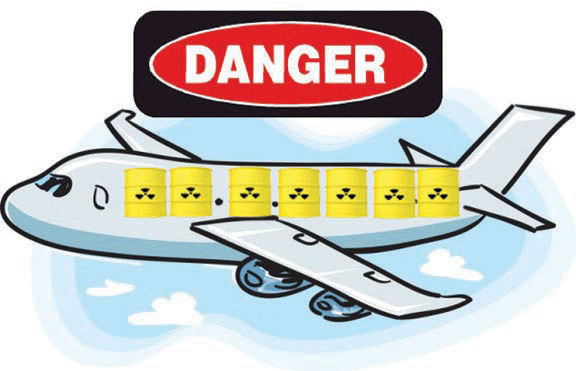
An air crash involving an RAF aircraft carrying US nuclear materials over South Wales may be the stuff of nightmares, but the Chair of the Welsh Nuclear Free Local Authorities has just written to the First Minister of Wales asking him to contemplate just that possibility.
The Campaign for Nuclear Disarmament and Nukewatch have just published a disturbing briefing titled ‘Special nuclear flights between the UK and US: the dangers involved’. The briefing references the transport of nuclear materials made by RAF C-17 Globemaster flying between RAF Brize Norton in Oxfordshire and airbases in the United States. Around ten such round-trips are made every year to transport nuclear materials utilised for the maintenance of Britain’s nuclear arsenal.
The report says of the route taken by these flights: ‘Aircraft fly from Brize Norton out into the Atlantic, overflying the Cotswolds and then the northern edges of Bristol and Cardiff to reach the Bristol Channel, flying south of Ireland to cross the Atlantic. A variation of this route takes the plane further to the north where it overflies Gloucestershire and the South Wales valleys, heading out to sea over Swansea and the Gower, and, again, South of Ireland.’
Although the C-17 Globemasters involved in these flights are four-engine aircraft, and are subject to an enhanced maintenance regime, so catastrophic mechanical failure is less likely, Welsh Forum Chair Councillor Sue Lent wants Welsh emergency planning authorities to properly consider the likely impact of any accident involving nuclear materials. Cllr Lent serves on Cardiff City Council, one of the municipalities flown over, and one of several South Wales local authorities who are members of the NFLAs.
The First Minister acts as Chair of the Wales Resilience Forum. The Forum ‘supports good communication and improves emergency planning across agencies and services’ acting as a coordinating body for local resilience forums across Wales. These ‘bring together all responder organisations that have a duty to co-operate under the Civil Contingencies Act. The groups also include other organisations who would respond to an emergency. Together, they ensure they prepare for emergencies by working in a coordinated and effective way.’[i]
The Minister of Defence hosts annual Astral Bend exercises ‘to practice and test the emergency response to an accident involving an RAF aircraft transporting special nuclear materials’, but investigative reporter Rob Edwards uncovered evidence that such an exercise held in February 2011 at the Caerwent military base in South Wales identified several failures in the actions of first responders which would have led to ‘“avoidable deaths” in a real-life situation’. The MoD has refused to release details of recent exercises held after 2012 in response to Freedom of Information requests; nonetheless the NFLA Secretary has just submitted one.
Councillor Lent asks First Minister Gething to ‘seek a reassurance from the MoD / RAF that such flights will be diverted out to sea, well away from our South Wales municipalities, and revisit emergency planning arrangements should an accident involving these special nuclear materials occur’ and suggests that as the last exercise conducted at Caerwent appears to be that held in 2011 a follow-up exercise to test the preparedness of Welsh emergency service agencies is ‘long overdue.’
IAEA’s top nuclear salesman-cum-watchdog to visit Iran
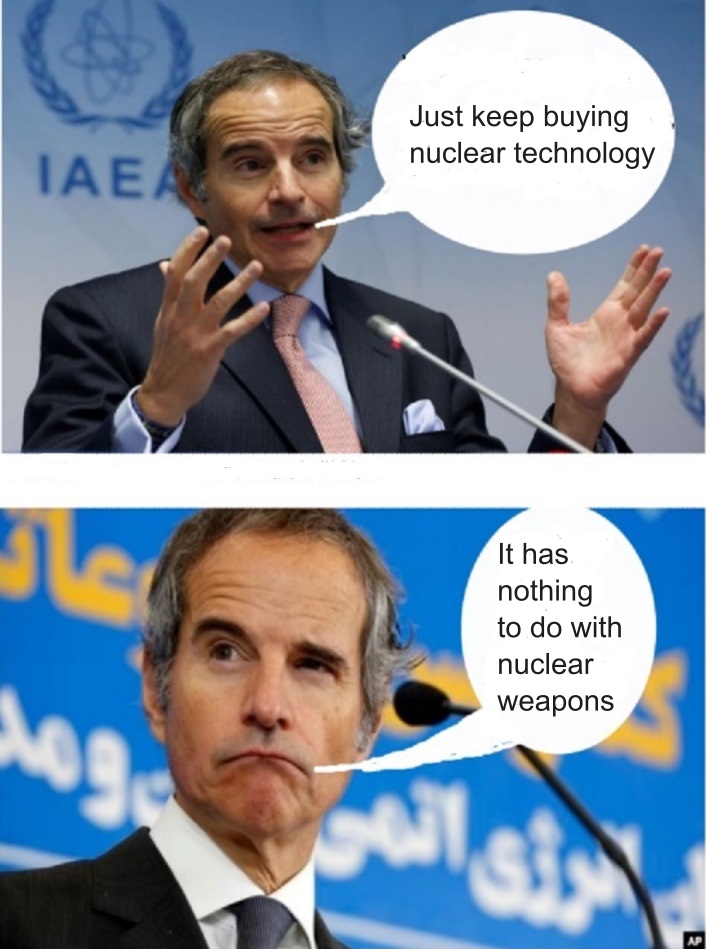
The International Atomic Energy Agency (IAEA) has confirmed that its Director-General, Rafael Grossi, will travel to Iran on May 6 to engage with high-ranking officials.
He will attend the International Conference on Nuclear Science and Technology during the visit, taking place in Isfahan, just months after officials in Iran claimed to be within reach of nuclear weapons. Grossi just days ago also claimed Iran was “weeks not months” from a nuclear weapon.
Im February Grossi admitted a “drifting apart” in relations between the agency and an increasingly defiant Iran.
Grossi noted in the same month that although the rate of uranium enrichment in Iran had decreased slightly since the previous year’s end, Iran continued to enrich uranium at a significant rate of approximately 7 kg per month to 60 percent purity, near weapons grade.
Under the terms of a 2015 agreement with world powers, Iran was only permitted to enrich uranium up to 3.67 percent.
However, after former President Donald Trump withdrew the United States from the agreement in 2018 and reinstated sanctions, Iran exceeded the limits. As a result, the IAEA has stated that the 2015 nuclear deal has “all but disintegrated”.
Industrial action by nuclear submarine workforce hits Rolls Royce
GMB members working on the company’s nuclear submarine programme have
begun industrial action. The action comes after 90 per cent of GMB members
at the company supported action if company bosses failed to present a pay
rise acceptable to union members. Known as ‘work to rule’, the
industrial action will see GMB members applying strict limits to working
outside of pre-agreed processes. Rolls-Royce is a world leader in the field
of submarine technology, as well as being the supplier to Britain’s
domestic nuclear submarine fleet.
UK Defence Journal 30th April 2024
https://ukdefencejournal.org.uk/industrial-action-by-nuclear-sub-workforce-hits-rolls-royce
UK/Ireland Nuclear Free Local Authorities to join new “Rock Solid2” art exhibition

The UK/Ireland Nuclear Free Local Authorities Secretary will be joining Cumbrian artists and activists at the launch of a new art exhibition at Kendal Museum next month.
Rock Solid 2 has been organised by co-ordinator and artist Marianne Birkby. Marianne supports local campaign groups Radiation Free Lakeland / Lakes against the Nuclear Dump in opposing plans to impose a Geological Disposal Facility upon Cumbria. This could be located by the coast in Mid- or South-Copeland to receive Britain’s legacy and future most toxic radioactive waste, which would be transferred from the Sellafield nuclear complex and buried in tunnels beneath the Irish Sea.
Marianne described the exhibition as “a must see for all those who love Cumbria.” She explained that it was “a unique celebration of Lakeland’s jewel-like geology, landscape, flora, and fauna seen through the lens of a ‘quixotic’ plan to bury atomic wastes deep under the Cumbrian coast and the sea. Altogether 20 artists have produced artworks including comic books, installations, sculpture, and multi-media in a vibrant and thought-provoking exhibition.”.
Winner of the John Moore’s Painting Prize, guest artist Martin Greenland will be joined by internationally renowned mountain painter Julian Cooper, record producer Russell Mills, Lake Artist Society award winners Kate Bentley and Andrea Pentecost, Steve Wallis, and Irene Rogan amongst others. Artists have spent time looking at the Museum’s natural history collection for inspiration.
The exhibition will open in the People’s Gallery on 9th May, but a special official launch will be held on Friday 10th May from 6pm to 8pm.
A follow-up talk, titled ‘Atomic Wastes Under Cumbria’, will be held on the following day on Saturday 11th May in The Venue, which is accessed through the Museum.
Kendal Museum can be found on Station Road, Kendal, LA9 6BT. It is a short distance from the railway station.
Everyone is welcome to both events, which are FREE, but attendees are asked to contact the Museum to book a place at the official launch and/or the meeting by email to info@kendalmuseum.org.uk or by telephone on 01539 815597.
NFLA Secretary Richard Outram has been asked to join radiation expert Dr Ian Fairlie in speaking at the official launch and at the meeting.
Following the events, the exhibition will be open to the public on Thursdays, Fridays, or Saturdays from 9.30am to 4.30pm until 29 June. There is also a related art trail to explore around the galleries and shops of Kendal.
Ends//… For more information please contact the NFLA Secretary Richard Outram by email at richard.outram@manchester.gov.uk
The Israel-US game plan for Gaza is staring us in the face

The western media is pretending the West’s efforts to secure a ceasefire are serious. But a different script has clearly been written in advance
JONATHAN COOK, APR 30, 2024, https://jonathancook.substack.com/p/the-israel-us-game-plan-for-gaza
One does not need to be a fortune-teller to understand that the Israel-US game plan for Gaza runs something like this:
1. In public, Biden appears “tough” on Netanyahu, urging him not to “invade” Rafah and pressuring him to allow more “humanitarian aid” into Gaza.
2. But already the White House is preparing the ground to subvert its own messaging. It insists that Israel has offered an “extraordinarily generous” deal to Hamas – one that, Washington suggests, amounts to a ceasefire. It doesn’t. According to reports, the best Israel has offered is an undefined “period of sustained calm”. Even that promise can’t be trusted.
3. If Hamas accepts the “deal” and agrees to return some of the hostages, the bombing eases for a short while but the famine intensifies, justified by Israel’s determination for “total victory” against Hamas – something that is impossible to achieve. This will simply delay, for a matter of days or weeks, Israel’s move to step 5 below.
4. If, as seems more likely, Hamas rejects the “deal”, it will be painted as the intransigent party and blamed for seeking to continue the “war”. (Note: This was never a war. Only the West pretends either that you can be at war with a territory you’ve been occupying for decades, or that Hamas “started the war” with its October 7 attack when Israel has been blockading the enclave, creating despair and incremental malnutrition there, for 17 years.)
Last night US Secretary of State Anthony Blinken moved this script on by stating Hamas was “the only thing standing between the people of Gaza and a ceasefire… They have to decide and they have to decide quickly”.
5. The US will announce that Israel has devised a humanitarian plan that satisfies the conditions Biden laid down for an attack on Rafah to begin.
6. This will give the US, Europe and the region the pretext to stand back as Israel launches the long-awaited assault – an attack Biden has previously asserted would be a “red line”, leading to mass civilian casualties. All that will be forgotten.
7. As Middle East Eye reports, Israel is building a ring of checkpoints around Rafah. Netanyahu will suggest, falsely, that these guarantee its attack meets the conditions laid down in international humanitarian law. Women and children will be allowed out – if they can reach a checkpoint before Israel’s carpet bombing kills them along the way.
8. All men in Rafah, and any women and children who remain, will be treated as armed combatants. If they are not killed by the bombing or falling rubble, they will be either summarily executed or dragged off to Israel’s torture chambers. No one will mention that any Hamas fighters who were in Rafah were able to leave through the tunnels.
9. Rafah will be destroyed, leaving the entire strip in ruins, and the Israeli-induced famine will worsen. The West will throw up its hands, say Hamas brought this on Gaza, agonise over what to do, and press third countries – especially Arab countries – for a “humanitarian plan” that relocates the survivors out of Gaza.
10. The western media will continue describing Israel’s genocide in Gaza in purely humanitarian terms, as though this “disaster” was an act of God.
11. Under US pressure, the International Court of Justice, or World Court, will be in no hurry to issue a definitive ruling on whether South Africa’s case that Israel is committing a genocide – which it has already found “plausible” – is proved.
12. Whatever the World Court eventually decides, and it is almost impossible to imagine it won’t determine that Israel carried out a genocide, it will be too late. The western political and media class will have moved on, leaving it to the historians to decide what it all meant.
13. Meanwhile, Israel is already using the precedents it has created in Gaza, and its erosion of the long-established principles of international law, as the blueprint for the West Bank. Saying Hamas has not been completely routed in Gaza but is using this other Palestinian enclave as its base, Israel will gradually intensify the pressures on the West Bank with another blockade. Rinse and repeat.
That’s the likely plan. Our job is to do everything in our power to stop them making it a reality.
How Israel violates International Law in Gaza: expert report
https://mondoweiss.net/2024/04/how-israel-violates-international-law-in-gaza-expert-report/
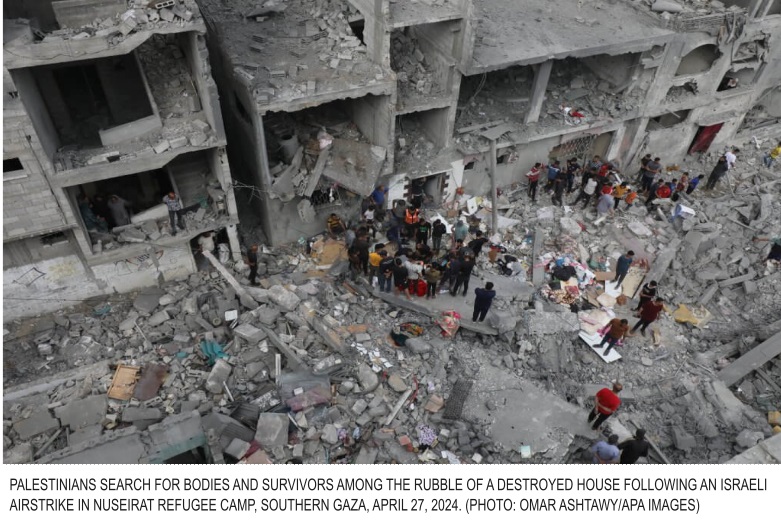
The findings are illustrated by 17 specific, horrific “incidents” and 18 pages of additional incidents. This review of incidents is said to be “supported by both credible media and civil society reporting and statements by Government of Israel officials and IDF uniformed officers.” But the incidents identified are “just the most easily identifiable among a clear pattern of violations of international law, failures to apply civilian harm mitigation best practices, and restrictions on humanitarian assistance,” by Israel and the IDF, often using U.S.-provided arms.
An independent expert report lays out how Israel systematically violated U.S. and International Law in Gaza, concluding that Israel launched indiscriminate and disproportionate attacks on civilian areas due to “extremely relaxed rules of engagement.”
BY STEVE FRANCE
Just days after the Biden administration showered the Israeli military with billions of dollars more in lethal aid, still with no apparent effort to restrict its use on non-military populations and structures, Palestinian solidarity activists were gifted with powerful ammunition to challenge Israel’s genocidal disregard for the International and U.S. laws and norms that protect civilians in war situations.
In a sober but scathing 76-page report, publicly released on April 24, the Independent Task Force on the Application of National Security Memorandum-20 (NSM-20), details “multiple credible incidents constituting violations of international humanitarian law, military best practices, and [improper] restrictions on humanitarian assistance.”
The volunteer and unaffiliated task force of prominent experts — including two recently departed senior State Department officials, legal scholar Noura Erekat, and a former senior “joint terminal attack controller,” Wes Bryant — was rapidly formed after President Biden signed NSM-20 on February 8, 2024. The memorandum tasked the Departments of State and Defense to report to Congress by May 8 on the compliance of Israel (and, nominally, other U.S. allies) with International Humanitarian Law and military best practices, as well as on whether it has impeded humanitarian assistance to Gaza.
Co-chair Noura Erekat said at a briefing that the task force report has two main goals: first, to “inform” State and Defense officials’ review with a selection of well-documented and assessed incidents of misuse of aid, and second, to put pressure on the agencies and the White House to act vigorously to curb the abuses. The pressure will depend on the report’s ability to focus the understanding of the media, the relevant experts, and activists on specific illustrative cases and to clearly explain the legal framework and standards that are supposed to apply.
The panel reported that its
“aggregate analysis of credible reports involving U.S-provided weapons by Israeli forces indicates a context of systematic disregard for fundamental principles of international law, including recurrent attacks launched despite foreseeably disproportionate harm to civilians and civilian objects, wide area attacks without prior warnings in some of the most densely populated residential neighborhoods in the world, direct attacks on civilians…and attacks against civilian objects, including those indispensable for the survival of the civilian population.”
The experts further reported:
“Israeli intelligence sources cited by credible media reports indicate that these patterns of unlawful attacks reflect reliance on an unyielding and unconditioned supply of U.S. weapons, relaxed rules of engagement, application of collective punishment, and the use of artificial intelligence technology to generate thousands of targets (including civilian police and civil defense personnel), at maximum speed and with minimal human oversight.”
The findings are illustrated by 17 specific, horrific “incidents” and 18 pages of additional incidents. This review of incidents is said to be “supported by both credible media and civil society reporting and statements by Government of Israel officials and IDF uniformed officers.” But the incidents identified are “just the most easily identifiable among a clear pattern of violations of international law, failures to apply civilian harm mitigation best practices, and restrictions on humanitarian assistance,” by Israel and the IDF, often using U.S.-provided arms.
Just as important for non-experts is the report’s outline of exactly how the U.S. and international legal systems are supposed to protect civilians from harm — and how they are flouted. Thus, the experts point to three “fundamental rules [that] govern targeting decisions in armed conflict”:
1 Distinguish between civilians and combatants, and between civilian objects and military objectives, with a presumption that persons or objects are protected from attack unless the information available at the time indicates that they are military objectives.
2. Take all feasible “precautions” in planning and conducting attacks to avoid or at least minimize incidental loss of civilian life, injury to civilians, and damage to civilian objects.
3. Respect “proportionality,” i.e., conduct no attacks that are excessive in relation to the concrete and direct military advantage anticipated. The greater the foreseeable harm to civilians and civilian objects, the greater the foreseeable military advantage necessary to justify a particular attack. International humanitarian law (IHL) gives special protection to hospitals, clinics, and ambulances, as well as to humanitarian relief operations, and UN premises.
The report outlines the basics of “civilian harm mitigation practices,” including U.S. Defense Department practices. A key concept is “no-strike entities” (NSEs), which DOD says “may include, but are not limited to, medical, educational, diplomatic, cultural, religious, and historical sites, or other objects that do not, by their nature, location, purpose, or use, effectively contribute to the enemy’s war-fighting or war-sustaining capability.” The task force charges that Israel has “routinely and repeatedly” targeted six fundamental categories of NSEs, plus a broad array of slightly less protected entities.
Proportionality ‘rendered meaningless’
A common excuse the Israelis advance for the death and wounding of civilians is that they are being used by Hamas as “human shields.” The report notes that “taking advantage of the presence of civilians or other protected persons with intent to shield a military objective from attack constitutes a war crime.” However, U.S. military rules “affirm that an attacker shares responsibility for civilian harm with its enemies if it fails to take feasible precautions” to avoid killing shields.
NSM-20 itself spells out that its allies must “facilitate and not arbitrarily deny, restrict, or otherwise impede . . . the transport or delivery of [U.S.] humanitarian assistance and U.S. Government-supported international…humanitarian assistance.”
Outlining the “context” of Israel’s “systematic disregard for IHL,” the report cites “recurrent attacks launched despite foreseeably disproportionate harm to civilians and civilian objects, wide-area attacks without prior warnings in some of the most densely populated residential neighborhoods in the world, direct attacks on civilians or otherwise protected persons…and attacks against civilians objects, including those indispensable for the survival of the civilian population.” A high-ranking former IDF officer is quoted as condemning Israel’s “reckless conduct,” which he says “reflects an absolute assumption that the U.S. will continue to arm and finance it.”
“Extremely relaxed rules of engagement” inconsistent with IHL also explain much of the harm done to civilians. Thus, Chief of Staff of the Israeli Air Force, Omar Tishler, has stated that neighborhoods have been attacked “on a large scale and not in a surgical manner.”
Such attacks are facilitated by an expansion of the concept of “military advantage” in its proportionality assessments to weigh civilian harms against the advantages of “an operation as a whole,” rather than against each individual attack. That move “renders the proportionality rule meaningless,” the report says, as it’s impossible to compare the harms of a single specific attack with all the military advantages allegedly achieved or sought by the whole Gaza operation, which has lasted more than six months.
Similarly, former U.S. Air Force drone controller Bryant noted how Israel blurs the requirement of taking precautions to protect civilians “by employing precautions it knows are ineffective,” such as texting populations whose phones are not functional.
Also “relaxed” is Israel’s use of the term terrorist. Thus, a reserve officer told Ha’aretz, “In practice, a terrorist is anyone the IDF has killed in the areas in which its forces operate.” The extensive, open-ended imposition of “kill zones” is another way to disguise genocide, an Israeli intelligence officer has explained. With a “kill zone” lasting a month or two, “you could stick with an order that anyone approaching should be shot…But we’ve been there for six months, and people have to start coming out; they are trying to survive, and that leads to very serious incidents.”
Lastly, Israel asserts it can block humanitarian aid, if it has “serious reasons for fearing” that relief consignments “will be diverted from their civilian destination or otherwise provide a definite advantage to the enemy’s military efforts” — a position the task force says relies on a “defective rule” from 1949 that was modified in 1977 and superseded by a rule of customary international law. Recent UN Security Council and General Assembly resolutions confirm that Israel “must allow and facilitate rapid and unimpeded humanitarian relief and may not deny such relief based on fears that a small portion of aid may be seized by armed groups.”
In conclusion, the report warns that “the Task Force’s findings raise grave concerns regarding the Administration’s compliance with both U.S. and international law, particularly with respect to security assistance and arms transfers.” It then identifies the laws in question, as well as citing “obligations under customary international law to ensure respect for international humanitarian law and to cooperate to bring serious violations of peremptory norms of general international law to an end through lawful means.”
France Increases State Funding for Advanced Nuclear R&D Project

by Jov Onsat, Rigzone Staff, Thursday, May 02, 2024
The French government has received clearance from the European Commission to provide Electricité de France (EDF) a further EUR 300 million ($321.6 million) for the front-end design phase of a project to develop small modular nuclear reactors (SMRs).
The project by Nuward, the nuclear energy-focused subsidiary of state-owned EDF, aims to come up with a design that has a power output of up to 300 megawatts electric.
The front-end design is the third phase of the five-phase project. The Commission previously approved EUR 50 million ($53.6 million) in French state aid for the second phase, which focused on gathering new knowledge for SMR design and construction.
Under the measure, the aid will take the form of a direct grant of up to EUR 300 million that will cover the R&D [research and development] project until early 2027”, the Commission said in a statement announcing clearance for the new funding from European Union competition regulations. “The measure will support Nuward in sizing the modules and components of the SMRs and validating their integration in the SMRs by means of numerical simulators and laboratory tests.
“Nuward will also carry out industrialization studies relating to the modular design and mass production of SMRs. Finally, the measure will also support Nuward in the preparation of the required safety demonstrations for the approval of the project by the national nuclear safety authorities”.
The Commission recently launched an alliance to accelerate the development of SMRs, following moves by the United Kingdom and United States to commercially scale up the advanced nuclear generation technology.
The public-private coalition aims to come up with a working model by the 2030s. “The Alliance targets a wide range of SMR stakeholders including vendors, utilities, specialized nuclear companies, financial institutions, research organizations, training centers and civil society organizations”, the Commission said in a press release February 9 announcing the initiative…………………..
Earlier the UK government announced an investment of GBP 300 million ($376 million) for the domestic production of high-assay low-enriched uranium (HALEU), challenging Russia’s status as the only commercial manufacturer of the fuel for SMRs. The UK previously funded a program by Rolls-Royce PLCs to design an SMR model, which is currently awaiting approval for deployment in Poland, as announced by the company last week—though the product is still undergoing the regulatory design assessment in the UK.
The UK will become the first country in Europe to launch a high-tech HALEU nuclear fuel program, strengthening supply for new nuclear projects and driving Putin further out of global energy markets”, the UK Department of Energy Security and Net Zero (DESNZ) said in a news release January 7 announcing the HALEU funding.
The DESNZ said GBP 10 million ($12.5 million) has also been allotted to develop sites and promote skills development for the production of other “advanced nuclear fuels”.
The International Atomic Energy Agency says HALEU is only produced in the U.S. and Russia but only the latter makes the fuel at a commercial scale. SMRs need HALEU, which contains five to 20 percent of uranium-235, beyond the five percent level that fuels most of today’s nuclear power plants, according to the United Nations nuclear watchdog.
The UK move was followed by an announcement by the US Department of Energy (DOE) offering contracts worth up to $500 million in total for HALEU production, besides funding offers for SMR design development. “Currently, HALEU is not commercially available from U.S.-based suppliers, and boosting domestic supply could spur the development and deployment of advanced reactors in the United States”, the DOE noted in a media statement January 9 announcing the funding offer.
Last year the U.S. Nuclear Regulator Commission issued the country’s first certification for an SMR design, that of NuScale Power Corp. https://www.rigzone.com/news/france_increases_state_funding_for_advanced_nuclear_rd_project-02-may-2024-176607-article/
Indigenous leaders decry lack of consent for nuclear waste on their homelands
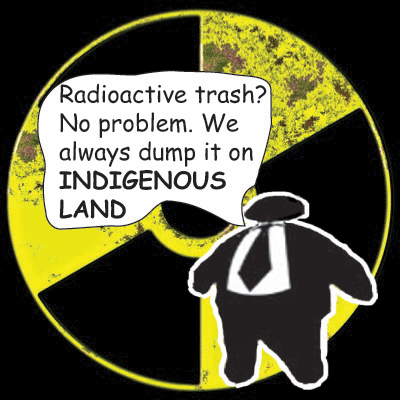
OTTAWA, April 30, 2024 — Today, leaders of Indigenous communities in New Brunswick, Quebec and Ontario express their strong concern about the lack of Indigenous consent for nuclear waste, uranium mining and refining on their homelands.
Article 29(2) of the United Nations Declaration on the Rights of Indigenous Peoples (UNDRIP) states: “States shall take effective measures to ensure that no storage or disposal of hazardous materials shall take place in the lands or territories of Indigenous peoples without their free, prior and informed consent.”
The Government of Canada is promoting an expansion of nuclear energy across the country without the free, prior and informed consent of Indigenous Nations affected. Like the existing reactors, new nuclear reactors will leave a toxic legacy for all living things for thousands of years.
Already, dozens of communities have radioactively contaminated sites on their homelands, and they and others must carefully consider the impacts of proposed permanent repositories for nuclear waste on the next seven generations.
Hugh Akagi is Chief of the Peskotomuhkati Nation in Canada, whose homeland is the unwilling host of the Point Lepreau Nuclear Generating Station on the world-renowned Bay of Fundy in New Brunswick. The reactor was built and later refurbished without the Nation’s consent. Now the federal and New Brunswick governments are spending public funds to develop two new nuclear reactors on the Point Lepreau site.
Chief Akagi has written several times to the Minister of Environment and Climate Change Canada, to express concerns about the proposed projects and ask questions about the high-level used nuclear fuel waste in temporary storage at the Point Lepreau site.
“The nuclear fuel chain – mining uranium, chemically processing the ore, fabricating the fuel, fissioning uranium in a reactor creating toxic radioactive waste remaining hazardous for tens of thousands of years – leaves a legacy of injustices disproportionately felt by Indigenous peoples and all our relations,” says Chief Akagi.
In 2021, the Wolastoq Grand Council in New Brunswick published a resolution on nuclear energy and nuclear waste on traditional Wolastoq homeland.
Grand Council Chief Ron Tremblay, says: “Wolastoqewi-Elders define Nuclear in their language as ‘Askomiw Sanaqak,’ which translates as ‘Forever Dangerous.’ That’s why we called for First Nation alternative energy solutions, including renewables and energy efficiency, as well as no more public funding for nuclear and the phasing out of the Point Lepreau reactor.”
The Blind River uranium refinery owned and operated by Cameco is located on lands which since AD 800 have been the site of vibrant Indigenous occupation and life, including as the ancestral lands of the people of Mississauga First Nation (MFN), and MFN’s access to these lands and waters has been barred by virtue of Cameco’s nuclear operations at the site.
Mississauga First Nation has never consented to the lands being used for nuclear activities nor as disposal grounds for radioactive wastes and there continues to be no equitable redress for this loss of access to their ancestral lands located on the Mississauga Delta.
“The existence of nuclear operations on our ancestral lands has contributed to our loss of culture and spiritual traditions and has been detrimental to our health and well-being of our First Nation, said Mississauga First Nation Councillor Peyton Pitawanakwat. “Cameco has materially benefitted and continues to benefit, from the operations at Blind River, which remains the world’s largest uranium refinery. The proposal to now site radioactive wastes on our lands would perpetuate an existing environmental injustice and amount to environmental racism.”
The Kichi Sibi or Ottawa River, which forms the boundary between Ontario and Quebec, is another site of conflict. The Chiefs of Kebaowek and Kitigan Zibi Anishinabeg First Nations in Quebec last year made public their Indigenous-led assessment of a million-cubic-metre radioactive waste mound to be built at Chalk River Laboratories on the shores of the Kichi Sibi on unceded Algonquin territory. Their assessment covered the project’s impact on their culture, land, water and wildlife. An experimental nuclear reactor is also planned for Chalk River.
“The Kichi Sibi is sacred to our peoples and at the heart of our unceded homeland,” said Chief Lance Haymond, of Kebaowek First Nation. “The Algonquin peoples never consented to the Chalk River site being used for over 75 years for nuclear reactors and research, and now being the site for a permanent radioactive waste dump. Consultation was far too late and inadequate, and we reject the plan.”
In spite of the clear opposition to the project by ten Algonquin First Nations, the Canadian Nuclear Safety Commission approved the Near Surface Disposal Facility in January 2024. Two First Nations have launched a legal challenge to the decision, as have several citizen groups.
The federal government says that reconciliation is a priority. How UNDRIP will be respected by the Government of Canada – which signed it in 2016 and passed the United Nations Declaration on the Rights of Indigenous Peoples Act in 2021 – remains to be seen.
Rolls-Royce scales back plans to build nuclear factories in UK
Rolls-Royce has scaled back plans to build two new factories for its small modular reactor (SMR) programme in the UK, following delays to a government design competition.
The FTSE 100 company had originally proposed one factory to make heavy pressure vessels for its SMRs and another to make the building blocks of the reactors.
It had drawn up a final shortlist of locations for the pressure vessels factory, including the International Advanced Manufacturing Park on the outskirts of Sunderland, Teesworks in Redcar and the Gateway industrial park in Deeside, Wales.
But on Friday Rolls confirmed it no longer intends to proceed with that plan because there is no longer time to build the factory and make the first pressure vessels for the early 2030s, when it hopes to complete its first SMRs.
It is still proceeding with work to build the second factory, however.
The company had been waiting for the outcome of an ongoing SMR design competition in the UK – first announced by the Government in 2015 – before it made a decision on the pressure vessel plant.
But that competition has been repeatedly delayed, with the arms length body Great British Nuclear only formally created last summer and winners not due to be announced until this June at the earliest.
Instead the engineering giant will now buy its heavy pressure vessels from a third party supplier.
The large, metal components sit at the heart of nuclear reactors and must be able to withstand extremely high temperatures and pressures. They are only made by a select group of companies, partly due to the need for specialist welding techniques.
Among their number is now Sheffield Forgemasters, which was nationalised by the Ministry of Defence in 2021.
Earlier this month, Sheffield became the sole UK company to gain the qualifications needed to make SMR reactor vessel components.
Despite having shelved its plans for a heavy pressure vessel factory, Rolls is still pressing ahead with plans to build its second factory, which will build the modular units that make up its SMRs.
It is understood that sites shortlisted for the pressure vessel factory will also be contenders for the second plant but no decisions have been made.
On Friday, a spokesman for Rolls-Royce SMR confirmed the company had now “prioritised work on our modules assembly and test facility”, adding: “Our efforts are focused on identifying the best site to support our deployment at pace.”
The company has also not ruled out reviving its plan for a heavy pressure vessel factory at some point in the future, so long as it manages to build up a healthy pipeline of orders.
A Government spokesman said: “Our world leading SMR competition aims to be the fastest of its kind, helping secure billions in investment for the UK, meaning cleaner, cheaper and more secure energy in the long-term.”
Academic arrested for “statements against Zionism” as Israel intensifies anti-genocide crackdown
Jean Shaoul, WSWS, 1 May 24
This month, Israeli police arrested and detained for questioning Professor Nadera Shalhoub-Kevorkian, a leading Palestinian legal academic, over comments made on a podcast weeks earlier. Shalhoub-Kevorkian holds a chair in law at the Hebrew University in Jerusalem and another at Queen Mary University of London.
The police said, “The detainee is suspected of making serious incitement against the State of Israel and for having said statements against Zionism and even claims that Israel is currently committing genocide in the Gaza Strip.” They added that they had found posters and pictures in her home depicting Israel Defense Forces (IDF) soldiers as an occupying army.
Freedom of political expression in relation to the Israeli-Palestinian conflict has always been restricted and there have been widespread detentions of Palestinian citizens of Israel who have publicly criticised the war in Gaza. But this is the first time an academic has been targeted over opposition to Zionism, possession of posters against the occupation and claims of Israeli genocide in Gaza—statements that pose no “security threat,” let alone any “incitement” to violence, terror and racism. Since the attorney general’s office must approve all prosecutions relating to freedom of speech, Shalhoub-Kevorkian’s detention was greenlighted not just by the police but at the very heart of government.
Her detention is part of a broader crackdown on dissent and the targeting of Israel’s critics by Prime Minister Benjamin Netanyahu’s fascistic regime, aimed at intimidating and silencing Israel’s Palestinian citizens who make up 20 percent of the population. Netanyahu’s strategic goal of annexing Palestinian territory illegally occupied since the 1967 Arab-Israeli war and establishing an ethno-religious regime between the River Jordan and the Mediterranean Sea means the “only democracy in the Middle East” eliminating even the tattered, democratic façade of the Israeli state.
The police confiscated books and posters from Shalhoub-Kevorkian’s home and questioned her extensively about her academic work, including articles published years ago, even though academic writing is afforded special legal protections in Israel. In her 60s, she was strip-searched, handcuffed so tightly it caused pain, denied access to food, water and medication for several hours, and held overnight in a cold cell without adequate clothing or blankets, conditions her lawyers described as “terrible” and designed to humiliate. While she was released on bail the next day, after a magistrate and a district court judge both ruled she posed no threat, days later she was summoned for further questioning.
Her lawyer, the director of the human rights organisation Adalah, Hassan Jabareen, said, “This case is unique. This is not only about one professor; it could be a [precedent] for any academic who goes against the consensus in wartime.” As he explained, “They could have asked her to come to the police station for two or three hours to discuss, investigate. To carry out the arrest like that, as if she was a dangerous person, shows the main purpose was to humiliate her. It was illegal, that’s why the magistrates court accepted my argument that she should be released and the district court confirmed it.”
Her arrest follows months of political attacks orchestrated by the Hebrew University, which likes to present itself as a model of liberalism and inclusion, in the run-up to her detention. The rector had called on her to resign in late 2023 after she signed a letter calling for a ceasefire in Gaza and describing Israel’s campaign as genocide, and she was briefly suspended over a podcast in which she discussed the tragic events of October 7 and the subsequent destruction, death, and starvation in Gaza. He had objected to her calling for Zionism to be abolished and casting doubt about some aspects of the October 7 attack, particularly reports of sexual assaults.
More than 100 academics at the Hebrew University published an open letter backing Shalhoub-Kevorkian, criticising the university for not supporting her. They wrote, “Regardless of the content of Nadera’s words, their interpretation and the opinions she expressed, it is clear to everyone that this is a political arrest, the whole purpose of which is to gag mouths and limit freedom of expression. Today it is Nadera who stands on the bench, and tomorrow it is each and every one of us.”…………………………………………………………………….. more https://www.wsws.org/en/articles/2024/04/30/dxoj-a30.html
Remember, All This Fascism Would Feel Way More Fascismy Under Trump

CAITLIN JOHNSTONE, MAY 01, 2024
Okay, yes, police are currently in the process of violently stomping out political dissent on university campuses across America following multiple statements from President Biden attacking the protesters as “antisemitic” for opposing the genocide he’s been enthusiastically facilitating in Gaza. And okay, fine, bands of right wing thugs are currently going around terrorizing students who don’t align with the US government’s support for the state of Israel.
But before any of my fellow liberals get any wild ideas about ceasing their support for Biden during an election year just because of a little tyranny and genocide, I think it’s important to remind everyone that all this fascism would feel way more fascisty if Trump was president…………………………………………………………… https://www.caitlinjohnst.one/p/remember-all-this-fascism-would-feel?utm_source=post-email-title&publication_id=82124&post_id=144202169&utm_campaign=email-post-title&isFreemail=true&r=1ise1&triedRedirect=true&utm_medium=email
Will this whistleblower be heard by anyone?
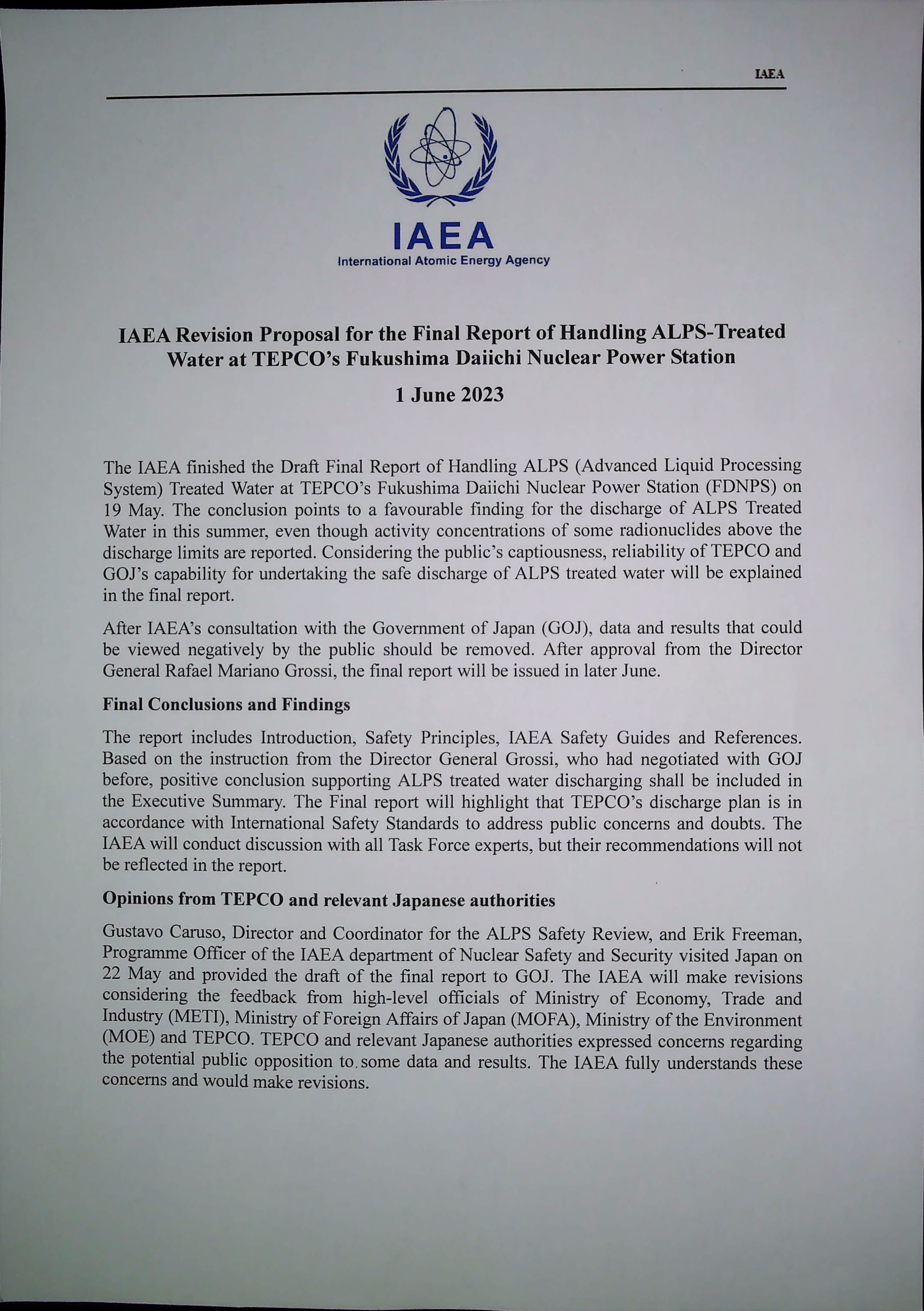
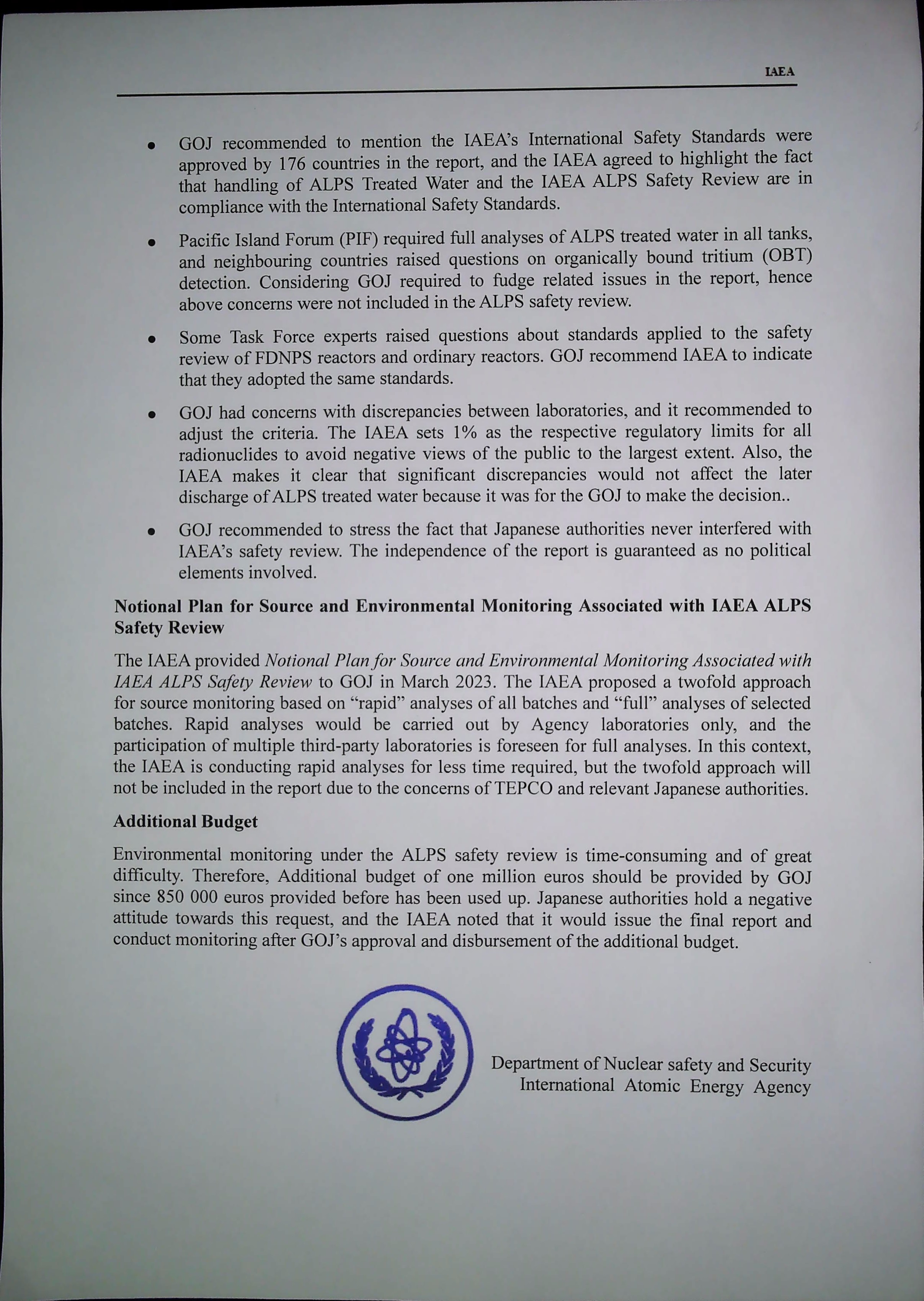
Date: June 28, 2023, Author: dunrenard, https://dunrenard.wordpress.com/2023/06/28/will-this-whistleblower-be-heard-by-anyone/

RELEASES INTERNAL IAEA DOCUMENT PROVING COLLUSION WITH JAPAN OVER FUKUSHIMA RADIOACTIVE WATER RELEASE.
A whistleblower-released document created by the International Atomic Energy Agency (IAEA) on June 1, 2023, shows that “the fix is in” – IAEA is not only is planning to approve the release of 1.3 million tons of radioactive water from Fukushima but to manipulate their communication to the world in support Japan’s position despite facts showing otherwise, eliminating anything that might “be viewed negatively by the public.”
This is outrageous and dangerous for the entire world. Japan, with the IAEA’s support – NOT protection – is planning to commit its own nuclear assault on the world through this radioactive water release.
We’ve suspected and accused the IAEA and Japan of working together in the past, and now we have the proof
Please, do what you can to get this word out – not just to our echo chamber, but to media.
**************************************************
Few days ago a well-intentioned whistleblower has sent me an internal document of the IAEA.
In this IAEA’s internal document the IAEA is seen coaching TEPCO about what to tell and what not tell to the public regarding the « treated » water to be soon discharged into the Pacific Ocean.
One thing that can be drawn from that document’s content is that the IAEA and TEPCO have no intention to be fully transparent about the radioactive contamination of the said « treated water », only the one to cushion insidiously the real facts to the public eyes.
« Treated water » is quite an euphemism as it is public knowledge that in 12 years the TEPCO’s ALPs filtering system has never been capable to fully remove all the 64 radionuclides present in that radioactive water. Not even to mention the radioactive mud which has accumulated at the bottom of all those water tanks. For them to mention in their press releases only the tritium as being present in that “treated” water is their habitual lying by omission.
According to the news, Rafael Mariano Grossi, the director general of IAEA, will visit Japan on 4 July. The IAEA’s final report will be published soon and the nuclear water will be discharged into the ocean after the report.
This internal document is quite certainly making us question their future transparency, and their intention to protect truly the marine life and the health of the people. Cheap expediency, lying by omission when not just plain lying, are part of their usual modus operandi.
This whistleblower, who wishes to remain anonymous for his own protection, took a real risk leaking this document out, ascting out of his conscience as he knows from the inside the dangers of such radioactive marine pollution. Will it be enough to wake up the consciences and stop such dumping of radioactive polllution into our ocean?
Time is crucial in this matter, as for sure soon after the visit of the director general of the AIEA TEPCO will start discharging that water, and then it will be impossible to have them to stop.
I am just a blogger blogging on this little blog, I am sending this message in a bottle out to the world in the hope that someone, some journalists will take up this information and use it to influence the various governments to pressure Japan to not use our Pacific ocean as its personal trash backyard. The Asian countries neighboring Japan and the Pacific nations should protect their population from such marine radioactive pollution.
With all my prayerful wishes, asking for your help. Please share this article widely so that document will be of some use.
Many thanks to the anonymous whistleblower who did his part, now it is our turn to do ours.
Rolls-Royce scales back plans to build nuclear factories in UK

Curtailing comes after repeated delays to an ongoing government design competition
Rolls-Royce has scaled back plans to build two new factories for its small
modular reactor (SMR) programme in the UK, following delays to a government
design competition. The FTSE 100 company had originally proposed one
factory to make heavy pressure vessels for its SMRs and another to make the
building blocks of the reactors.
It had drawn up a final shortlist of
locations for the pressure vessels factory, including the International
Advanced Manufacturing Park on the outskirts of Sunderland, Teesworks in
Redcar and the Gateway industrial park in Deeside, Wales.
But on Friday Rolls confirmed it no longer intends to proceed with that plan because
there is no longer time to build the factory and make the first pressure
vessels for the early 2030s, when it hopes to complete its first SMRs.
It is still proceeding with work to build the second factory, however. The
company had been waiting for the outcome of an ongoing SMR design
competition in the UK – first announced by the Government in 2015 –
before it made a decision on the pressure vessel plant.
But that competition has been repeatedly delayed, with the arms-length body Great
British Nuclear only formally created last summer and winners not due to be
announced until this June at the earliest. Instead the engineering giant
will now buy its heavy pressure vessels from a third party supplier. The
large, metal components sit at the heart of nuclear reactors and must be
able to withstand extremely high temperatures and pressures. They are only
made by a select group of companies, partly due to the need for specialist
welding techniques.
Rolls is still pressing ahead with plans to build its
second factory, which will build the modular units that make up its SMRs.
It is understood that sites shortlisted for the pressure vessel factory
will also be contenders for the second plant but no decisions have been
made.
Telegraph 27th April 2024
https://www.telegraph.co.uk/business/2024/04/27/rolls-royce-plans-build-smr-water-vessel-factory-uk
1 This Month
15 October. Joint Appeal for Nuclear Abolition Day -presentation to the UN on October 15 will be live on UNWebTV
Endorse the Nuclear Abolition Day Appeal
23-25 October – on Zoom – World BEYOND War’s annual global conference

To see nuclear-related stories in greater depth and intensity – go to https://nuclearinformation.wordpress.com
-
Archives
- October 2026 (149)
- September 2026 (339)
- August 2026 (330)
- July 2026 (355)
- June 2026 (287)
- May 2026 (306)
- April 2026 (356)
- March 2026 (251)
- February 2026 (267)
- January 2026 (308)
- December 2025 (358)
- November 2025 (359)
-
Categories
- 1
- 1 NUCLEAR ISSUES
- business and costs
- climate change
- culture and arts
- ENERGY
- environment
- health
- history
- indigenous issues
- Legal
- marketing of nuclear
- media
- opposition to nuclear
- PERSONAL STORIES
- politics
- politics international
- Religion and ethics
- safety
- secrets,lies and civil liberties
- spinbuster
- technology
- Uranium
- wastes
- weapons and war
- Women
- 2 WORLD
- ACTION
- AFRICA
- Atrocities
- AUSTRALIA
- Christina's notes
- Christina's themes
- culture and arts
- Events
- Fuk 2022
- Fuk 2023
- Fukushima 2017
- Fukushima 2018
- fukushima 2019
- Fukushima 2020
- Fukushima 2021
- general
- global warming
- Humour (God we need it)
- Nuclear
- RARE EARTHS
- Reference
- resources – print
- Resources -audiovicual
- Weekly Newsletter
- World
- World Nuclear
- YouTube
-
RSS
Entries RSS
Comments RSS

