California hits stunning new solar and battery records in postcard from energy future
Giles Parkinson , 3 May 24, https://reneweconomy.com.au/california-hits-stunning-new-solar-and-battery-records-in-postcard-of-energy-future/—
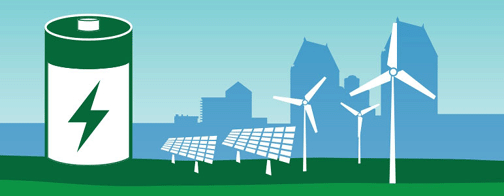
The records on renewable and battery storage continue to tumble in the northern spring as the technologies plays an increasingly important role in two of the biggest state grids in the world – California and Texas.
In California, as Renew Economy has reported over the last week, battery storage has emerged as often the biggest supplier of power for multiple hours in the state’s evening peak, meeting as much as 27 per cent of demand from its fleet of more than 10,000 MW of big batteries.
On Tuesday, California time, battery output jumped about 7,000 MW for the first time, reaching a peak of 7,046 MW at 7.55pm local time, nearly 300 MW above the peak set just a day earlier, and more than 1GW above the record that stood just two weeks earlier.
In Texas, battery capacity is also setting new benchmarks, reaching above 2,000 MW for just the second time ever and for the first time this summer. That share will grow dramatically with another 5 GW of battery capacity being added to the grid this year.
Solar records are also tumbling in quick fashion on both grids, underlying the need for battery storage as the solar output ramps down leading into the evening peaks in both states.
In California, a new peak of 18.54 GW of solar was reached at 1.10pm on Thursday, when battery storage was soaking up 4.4 GW of this output. It was the third time the solar output record had occurred in the last week.
Over the past two months, the share of wind, water and solar has imposed itself on the grid, reaching more than 100 per cent of demand on the last 19 consecutive days, sometimes for nine hours or more, and for 48 out of the last 56 days.
In Texas, a new record for solar also occurred last month when it reached 18.8 GW. This week, the PJM grid in the mid-west of the US set a new solar output record of 7.05 GW, the first time it reached above 7GW, and nearly double its record output from a year ago.
Giles Parkinson is founder and editor of Renew Economy, and is also the founder of One Step Off The Grid and founder/editor of the EV-focused The Driven. He is the co-host of the weekly Energy Insiders Podcast. Giles has been a journalist for 40 years and is a former business and deputy editor of the Australian Financial Review.
Nuclear-waste compensation (?bribery) numbers raise eyebrows

South Bruce would receive $418 million in total compensation if its site is selected; the comparison figure for Ignace is $170 million.
NWO Newswatch, Mike Stimpson, Local Journalism Initiative Reporter, 3 May 24
IGNACE – As a community vote on nuclear-waste concluded, residents of this Northwest municipality were talking about the deep geological repository’s other potential host municipality.
The Municipality of South Bruce, in southwestern Ontario near Lake Huron, on Monday published the hosting agreement it negotiated with the Nuclear Waste Management Organization.
The South Bruce agreement promises far more for that municipality than Ignace would receive if it is selected to host repository operations.
If the South Bruce site is selected for the proposed underground waste storage facility, the municipality would receive about $418 million over the project’s 138-year life, according to documents released by South Bruce.
The comparison figure for Ignace is approximately $170 million.
Reaction on social media included Ignace residents saying the divergent figures make Ignace look either foolish or an attractive bargain………………………………………………………..
Both municipalities must communicate their continued willingness to be host communities to the NWMO before a site is chosen.
If South Bruce voters decide in a referendum on Oct. 28 that they are not willing to continue as a potential host community, the industry-funded NWMO would remit a $4-million “exit payment” to the municipality.
If the Township of Ignace declares itself not willing, the exit payment would be $5 million.
If South Bruce is willing but not selected, it is to receive $8 million; Ignace would receive the same amount if willing but not selected.
In addition to the municipalities, nearby First Nations must be willing to participate in order for a site to be selected.
For the Revell Lake site, Wabigoon Lake Ojibway Nation must express willingness. The potential First Nations partner for the South Bruce site is Saugeen Ojibway Nation.
The NWMO has committed to selecting a site by December 31, 2024.
Construction is projected to begin around 2034 and take about 10 years to complete, Ponka said. https://www.nwonewswatch.com/local-news/nuclear-waste-compensation-numbers-raise-eyebrows-8683186
Land Defence Alliance stands united against the burial of nuclear waste
The group held a rally in Waverley Park on Tuesday afternoon.
NWO Newswatch, Clint Fleury, Apr 30, 2024
THUNDER BAY – With the decision on where Canada will store its nuclear waste looming, four of the six First Nations representatives from the Land Defence Alliance held a rally in Waverley Park to voice their concerns and dangers of this controversial project.
“We’re concerned about future leaks and accidents and we’re very concerned that if that should happen, it could contaminate the local environment like the animals and also the air and the grounds,” said Grassy Narrows Chief Rudy Turtle in an interview with Dougall Media.
Turtle was the first to take the microphone and send out a profound message of solidarity with his fellow First Nations who are opposed to the burial of used nuclear waste in the Revell Lake area.
Currently, Ignace Township and nearby Wabigoon Lake Ojibway Nation are each in a “willingness process” to decide whether they will be hosts for a deep geological repository between their communities.
Outside of Ignace and Wabigoon Lake Ojibway Nation, no other municipality or First Nation communities have a right to vote on their willingness to allow the storage of nuclear waste in Northwestern Ontario.
In southern Ontario, the municipalities of South Bruce and Saugeen Ojibway Nation are also considering being willing hosts to the repository where it is situated near them.
For many, there are too many variables and “what if” questions as the deep geological repository project slowly becomes less like a science fiction concept.
The trouble is that for many First Nation communities, the government’s track record of leaving contaminated industrial sites on treaty land has given way to skepticism. ……………………………………………………………………..
Turtle explained: “It’s coming from down south which is like 28 hours of driving, or whether it’s coming by train, it’s still like over 20 hours and there’s always the possibility of an accident. We’ve seen it happen with other chemicals. We’ve seen it happen with oil transportation.
“So, the potential, the possibility is there of an accident and people should be concerned about that. The towns that are in between during those 20-hour travel times. Those towns should be concerned. Those towns should be worried about the potential of having nuclear waste dumped or accidentally dumped along their communities.”
At the end of the rally, the Land Defence Alliance stood united to say no to the burial of nuclear waste in Northwestern Ontario. https://www.nwonewswatch.com/local-news/land-defence-alliance-stands-united-against-the-burial-of-nuclear-waste-8676906
Nuclear Waste Management Organization (NWMO) responds to Land Defence Alliance protest
In response to the recent Land Defence Alliance protest where a coalition of First Nations said “no” to burying nuclear waste in Northwestern Ontario, Vince Ponka, NWMO’s regional communications manager, attempts to dispel concerns surrounding the deep geological repository project.
Clint Fleury, May 2, 2024
THUNDER BAY – At a protest on Tuesday, Grassy Narrows Chief Rudy Turtle shared his strong opposition to the Nuclear Waste Management Organization’s (NWMO) proposed deep geological repository where Canada’s used nuclear fuel will potentially be stored.
In an interview with Dougall Media, Chief Turtle said the Land Defence Alliance has reached out to NWMO to speak with them about the project, but NWMO had a scheduling conflict which prevented them from attending a meeting.
“Well, the Land Defence Alliance just finished meeting these past couple of days and we had invited NWMO to come and sit with us but they didn’t show up, and they had a change of schedule or something and we were looking forward to talking to them,” said Chief Turtle.
Turtle stated they would like to set up a future meeting, but there was no date set at this time.
Vince Ponka, regional communications manager with the NWMO, said the organization was aware of the protest, however they were attending the final day of the “willingness process” in Ignace.
Ponka said the NWMO did reach out to Grassy Narrows to schedule a meeting. According to Ponka, the chief and council asked to meet with NWMO’s chief executive officer, Laurie Swami, the next day.
“Unfortunately, she just wasn’t able to make that quick of a turnaround,” said Ponka.
Ignace Township and nearby Wabigoon Lake Ojibway Nation are two of four potential hosting communities for the DGR. The other two are the municipalities of South Bruce and Saugeen Ojibway Nation.
Once the “willingness process” is complete in all four host communities, NWMO will start the site selection process.
Ponka said NWMO will have a site selected by the end of the year.
In the meantime, Ponka said he would like to meet with the Land Defence Alliance at any point in the future………………………….
The Land Defence Alliance is concerned about limiting the “willingness” vote to residents of Ignace and Wabigoon Lake Ojibway Nation. However, Ponka did say once the site selection process is finished, NWMO will branch out to the surrounding region to gather input on the next part of the process……………………………………………. https://www.nwonewswatch.com/local-news/nwmo-responds-to-land-defence-alliance-protest-8683263
Inside story: Will Iran’s supreme leader revise his ‘nuclear fatwa’?
https://amwaj.media/article/inside-story-will-iran-s-supreme-leader-revise-his-nuclear-fatwa 5 May 24
The direct confrontation between Iran and Israel has sparked speculation about a potential shift in the Islamic Republic’s nuclear policies under the leadership of Ayatollah Ali Khamenei.
Following Iran’s Apr. 14 military action against Israel in response to the Apr. 1 bombing of the Iranian consulate in Damascus, a senior commander of the Islamic Revolutionary Guard Corps (IRGC) explicitly suggested the possibility of a revision to Tehran’s objection to atomic weapons. The suggestion may only be a part of the war of words between Iran and Israel. However, the fact that such discourse is rapidly becoming mainstream in Iran raises questions of what may lie ahead—including whether a shift may take place under Khamenei, who has long opposed atomic weapons on a religious basis.
Rapidly changing discourse
Amid media speculations of a major Israeli attack in response to Iran’s Apr. 14 drone and missile strike on sites inside Israel, Gen. Ahmad Haqtalab—the commander of the Protection and Security Corps of Nuclear Centers—on Apr. 18 stated, “If the Zionist regime wants to use the threat of attacking our country’s nuclear centers as a tool to pressure Iran, it is possible to review the nuclear doctrine and policies of the Islamic Republic of Iran and deviate from the previous considerations.”
The warning was rare, and even as tensions eased between Tehran and Tel Aviv, Iranian officials continued to underscore the significance of the matter. Four days after Haqtalab’s intervention, former IRGC commander and current MP Javad Karimi Qoddousi tweeted, “If permission is issued, there will be [only a] week before the first [nuclear] test.” Qoddousi separately posited that the same amount of time was needed to test missiles with an increased range of 12,000 km (7,456 miles).
However, Iranian Foreign Ministry spokesman Nasser Kanani promptly interjected, dismissing the notion of any alteration to the country’s nuclear doctrine. Meanwhile, government-run Iran daily slammed Qoddousi, characterizing his statements as “untrue” and possibly being exploited by “enemies” to pursue further sanctions and fear mongering against Iran. Several other outlets, including conservative-run media, notably echoed such criticisms.
Yet, despite the blowback, Qoddousi went ahead and posted a video on Apr. 25 in which he said that Iran needs only half a day to produce the 90%-enriched uranium necessary to build nuclear bombs.
Khamenei and the ‘nuclear fatwa’
In Shiite Islam, a fatwa is a religious edict issued by a high-ranking Islamic jurist on the basis of interpretation of Islamic law. To followers of the jurist in question, fatwas are binding and the primary point of reference for everything from major life decisions to day-to-day matters. Fatwas can also be a part of state policies.
Ayatollah Khamenei has on multiple occasions over the past two decades reiterated his objection to the development, stockpiling, and usage of nuclear weapons as haram or religiously impermissible. Among believers, violating what is deemed haram would have serious consequences both in this life and the hereafter. In 2010, the supreme leader reiterated his objection to weapons of mass destruction in a message to an international conference on nuclear disarmament, stating they “pose a serious threat to humanity” and that “everyone must make efforts to secure humanity against this great calamity.”
Critics of what became known as the nuclear fatwa have over the years raised a variety of objections, from the modality of Khamenei’s religious edict to the manner in which it has been presented. Some even question whether the ruling really exists. What is indisputable, however, is that the religious edict has previously averted conflict by aiding diplomacy.
For instance, in connection with the 2013-15 nuclear negotiations that led to the signing of the Joint Comprehensive Plan of Action (JCPOA) between Iran and world powers—which saw Tehran agree to restrictions on its atomic program in exchange for sanctions relief—there were suggestions that the Islamic Republic should codify the fatwa.
Amid the nuclear negotiations with Iran, then-US secretary of state John Kerry in 2014 stated, “We take [Khamenei’s fatwa] very seriously….a fatwa issued by a cleric is an extremely powerful statement about intent. Our need is to codify it.” In another interview the same year, Kerry asserted that “the requirement here is to translate the fatwa into a legally binding, globally recognized, international understanding…that goes beyond an article of faith within a religious belief.”
Only days after the signing of the JCPOA in 2015, Khamenei said, “The Americans say they stopped Iran from acquiring a nuclear weapon. They know it is not true. We had a fatwa, declaring nuclear weapons to be religiously forbidden under Islamic law. It had nothing to do with the nuclear talks.”
Will Khamenei change his fatwa?
Khamenei is not the first Iranian Islamic jurist to issue a fateful religious edict on a highly politicized matter. Back in 1891, Mirza Mohammad Shirazi (1815-95), a leading Shiite religious authority at the time, issued a hokm or verdict against the usage of tobacco in what became known as the Tobacco Protest. The move came in protest against a concession granted by the Qajar monarch Naser Al-Din (1848-98) to the British Empire, granting control over the growth, sale, and export of tobacco to an Englishman. The hokm issued by Shirazi ultimately led to the repeal of the concession.
Neither a fatwa nor a hokm is set in stone and can be revised. The main distinction between the two types of rulings is that a hokm tends to have more conditions and requirements attached to it. Moreover, while a fatwa must be followed by the followers of the Islamic jurist who issued it, a hokm must be followed by all believers—including Shiites who are not followers of the jurist in question.
Explaining the intricacies of a hokm, a cleric and professor of Islamic law (fiqh) at the Qom Seminary told Amwaj.media, “There are primary hokm and secondary hokm. The former is like the necessity of the daily prayer that is mentioned in the Quran and the hadiths [traditions], or the prohibition on consuming alcohol. The secondary hokm is based on expediency and necessity that leads to the first ruling being changed. For example, if alcohol helps someone stay alive, then it is not haram [religiously impermissible] for him or her [to make use of it].” He added, “A fatwa can be changed too.”
France’s Macron wants to build 14 new Nuclear reactors by 2050. 6 is more realistic
energy post eu, April 29, 2024 by Jonathan Bruegel
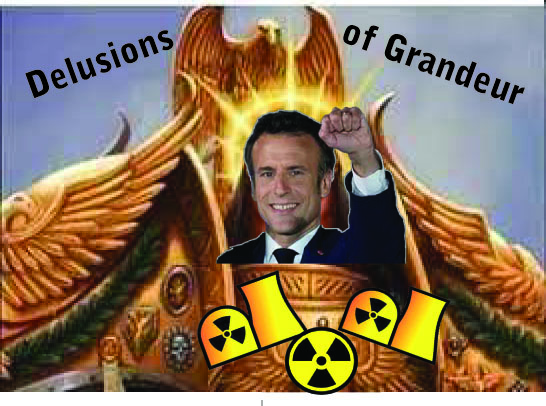
France’s President Macron is talking about a nuclear renaissance, after years of uncertainty over its future. The goal is to build 14 new reactors by 2050. But Jonathan Bruegel at IEEFA says this is unrealistc. France’s nuclear sector has much to recommend it. It produces up to 80% of the country’s total power generation, the highest share of nuclear in the generation mix anywhere in the world, and CO2-free. However, France hasn’t built a nuclear reactor since 1999, and construction delays and budget overruns plague the completion of its latest reactor, Flamanville 3, started in 2007. And with many of the 56 currently operational reactors reaching the end of their 40-year lifetime, decisions must be made whether to shut them down or extend their lifetimes by 10 or 20 years through major refits. Bruegel looks at the fundamentals and estimates that a more realistic goal is to build 6 new reactors by 2050, and to extend the lifetimes of 13 (or a maximum of 20) reactors. That would leave nuclear’s share in France’s 2050 mix at a maximum of 40% and more realistically 30%.
Key findings
- Given that new nuclear projects have faced significant construction delays and cost overruns, France’s plan to build 14 new reactors by 2050 is unrealistic.
- Nuclear should continue playing a key role in France’s power sector but not at the expense of renewables growth.
- French policy has recently shifted from a commitment to reduce nuclear generation to calls for a “renaissance” of the technology.
- France’s heavy reliance on nuclear has kept its power sector emissions relatively low but left it exposed to the many challenges associated with the technology.
Energy security
………………………… In the last two years, Europe’s imports of Russian piped gas have been largely replaced by liquified natural gas (LNG) from alternative sources. Curtailments and demand response mechanisms have contributed to absorbing the price shock…………………………..
In the case of France, this energy crisis was especially challenging since it coincided with many nuclear reactors being taken offline for maintenance work. In 2022, the country was a net power importer for the first time in more than 40 years. In 2023, as most nuclear reactors went back online, it resumed being a net power exporter. The episode illustrated the risks of France’s exposure to nuclear power.
Nuclear has dominated France’s power mix since the 1980s
……………………………..However, as Chart 1 [on original] shows, France hasn’t built a nuclear reactor since 1999, meaning its EPR expertise hasn’t benefitted its domestic nuclear fleet as much as it could have. Construction of the latest reactor, Flamanville 3, started in 2007. It has yet to be commissioned. So far, it is delayed by 12 years and is almost four times over budget.
With many reactors reaching the end of their 40-year lifetime, decision-makers must choose whether to shut them down or extend their operations by 10 or 20 years through major refitting programmes.
Policy shift sees France plan a “nuclear renaissance”
Nuclear’s role in France’s future power mix has become an increasingly crucial and controversial political debate.
After his election to the presidency in 2012, François Hollande committed to reducing the share of nuclear in France’s power production to 50% by 2035, with an ambitious decommissioning plan. However, not one nuclear unit was decommissioned under his presidency and no legally binding decommissioning dates for plants were set. The only binding commitment was to cap French nuclear capacity to 63GW.
During his first term between 2017 and 2022, President Emmanuel Macron did not engage in any nuclear policy shift, postponing the debate. The Flamanville 1 and 2 nuclear reactors were decommissioned in 2020 because they had exceeded their 40-year lifetime and no agreement had been made with operator EDF for a major refit programme.
Criticisms
During his second term, Macron has called for a “nuclear renaissance” and announced a goal to build 14 new reactors by 2050, implicitly targeting a maintenance of the 63GW of capacity and nuclear’s share in the power generation mix. The announcement was heavily criticised from across the political spectrum, with the main argument being that nuclear would slow the growth of renewables. Concerns have also been raised about the challenges associated with nuclear technology such as safety issues, long construction times, massive capital expenditures (see Chart 2 on original), a levelised cost of electricity higher than renewables and waste management.
Despite its role in reducing carbon emissions, Nuclear must not limit Renewables growth
Nuclear is not considered a renewable technology since uranium is needed, but the debate remains open on whether nuclear is green.
Although its challenges are well known (e.g., safety, costs, waste management), the French plan to build 14 new nuclear units by 2050 seems at best unrealistic.
Significant construction delays and cost overruns faced by the two latest EPRs, Flamanville 3 in France and Olkiluoto 3 in Finland, are evidence that building an average of one reactor every two years until 2050 is not a feasible goal…………………………………………………. more https://energypost.eu/frances-macron-wants-to-build-14-new-nuclear-reactors-by-2050-6-is-more-realistic/
First Nations leaders voice opposition to nuclear power plants
By Angel Moore, Apr 30, 2024, https://www.aptnnews.ca/national-news/first-nations-leaders-voice-opposition-to-nuclear-power-plants/
Leaders from three First Nations in New Brunswick made the trip to Ottawa to voice their opposition to the expansion of a nuclear power plant in the province.
The federal government, which is pushing the concept of small modular reactors, or SMRs, and the province are proposing to put new nuclear power plants on the Point Lepreau nuclear site.
The plant sits next to the Bay of Fundy and is Atlantic Canada’s only nuclear facility.
“Our people were never consulted or asked about our input or concerns about nuclear so we’re sitting here today talking about nuclear waste and where to put it, where to place it,” said Wolastoq Council Grand Chief Rom Tremblay.
The plant also sits on the traditional territory of the Passamaquoddy nation.
“Every child needs to see what I saw, they need see those fish they need to see those trees they need healthy air and they do not need nuclear contamination for thousands of years,” said Chief Hugh Akagi at the news conference in Ottawa.
The power plant has been operating since 1983 and provides New Brunswick with 40 per cent of its power.
Like other plants, it uses uranium processed in refineries such as the d’uranium de Blind, located in Blind River, Ont., a small community west of Sudbury on the traditional land of the Mississauga First Nation.
Band Councillor Peyton Pitawanakwat said her band council issued a resolution that said, “To declare opposition to any future use of the Blind River refinery site that would see these lands being used as a disposal site for radioactive wastes unfortunately that challenges faced by our first nation are not unique, and the environmental discrimination is happening all across the country.”
Pitawanakwat said the community is consulting with the Canada Nuclear Safety Commission and that their treaty rights are not being upheld.
“There’s a lot of more in-depth discussions that need to be had and we really are at a point where we need to re-set the relationship and ensure that our rights are being upheld,” she said.
New Brunswick Power didn’t respond to a request for an interview. The Canada Nuclear Safety Commission said an interview was not possible.
NATO using war games to ‘prepare for conflict’ – Moscow
https://www.rt.com/russia/596996-nato-conflict-prepares-russia/ 5 May 24
The US-led bloc is holding its largest exercises in decades near the Russian border, the Foreign Ministry has pointed out
NATO’s largest exercise since the Cold War are being held near Russia’s border, indicating that the US-led bloc is “seriously preparing” for a potential conflict with Moscow, Foreign Ministry spokeswoman Maria Zakharova has said.
The Steadfast Defender drills, featuring some 90,000 troops from all 32 NATO member states and 1,100 combat vehicles, started in late January and will end in May.
According to the wargame scenario, “the coalition’s actions against Russia are being practiced using all the instruments, including hybrid and conventional weapons,” Zakharova said in a statement on Saturday.
”We have to admit that NATO is seriously preparing for a ‘potential conflict’ with us,” Zakharova said.
The diplomat was commenting on accusations made by NATO earlier this week that Russia was allegedly carrying out “hybrid activities” on the member countries’ soil, which they insist constitute a threat to their security. These actions include “sabotage, acts of violence, cyber and electronic interference, disinformation campaigns, and other hybrid operations,” the bloc claimed in a statement on Thursday.
Zakharova dismissed the allegations as “disinformation” and an attempt to shift public attention from NATO’s own activities.
The bloc and the leadership of individual member states are “increasing the degree of anti-Russian hysteria in order to justify the unprecedented scale of militarization in Europe,” the official stated.
According to the diplomat, it was NATO that launched “a hybrid war against Russia in all operational environments and in all geographic directions.” In addition, the bloc members are actively involved in the Ukraine conflict. They are providing Kiev not only with financial support, but also with weapons and intelligence data – which are then used “to strike civilians and civilian infrastructure in Russia,” Zakharova added
Back in March, Russian Security Council Secretary Nikolay Patrushev said that NATO’s Steadfast Defender 2024 exercises were “increasing tensions and destabilizing the situation in the world” by simulating a military confrontation with Moscow. The official described the bloc as an “important tool” employed by the US to exert pressure and influence on other nations. NATO has come directly to Russia’s western border and is preparing for future conflicts, he stressed.
In recent months, multiple senior officials from NATO member states claimed that Moscow was planning to launch an attack against the military bloc in the coming years.
Russia has repeatedly denied those claims, with President Vladimir Putin saying the country “has no interest … geopolitically, economically or militarily … in waging war against NATO.”
The undersea nuclear graveyard now more costly than HS2
Behind the much delayed plan to store the radioactive waste generated over decades
A vast subsea nuclear graveyard planned to hold Britain’s burgeoning piles of radioactive waste is set to become the biggest, longest-lasting and most expensive infrastructure project ever undertaken in the UK… ……………………………..(Subscribers only) https://www.telegraph.co.uk/business/2024/05/05/66bn-nuclear-graveyard-became-expensive-challenge/
Germany records 50 hours of negative electricity prices for April, largely due to renewables.

Average retail prices fell to €6.24 ($6.70)/kWh on the German electricity spot
market in April, largely due to renewables covering about 70% of the
network load. These low price levels in the electricity market can be
attributed to the high shares of renewables in Germany. According to Rabot
Charge, renewable energy systems covered 70% of the network load in April.
PV Magazine 3rd May 2024
Israel’s Defenders Talk So Much About Feelings Because They Can’t Talk About Facts

Last October the imperial media suddenly got a lot less interested in reporting on the facts on the ground with Israel and Gaza, and a whole lot more interested in reporting on how some groups of people feel about it instead.
CAITLIN JOHNSTONE, MAY 04, 2024, https://www.caitlinjohnst.one/p/israels-defenders-talk-so-much-about?utm_source=post-email-title&publication_id=82124&post_id=144302441&utm_campaign=email-post-title&isFreemail=true&r=1ise1&triedRedirect=true&utm_medium=email
The Guardian has an article out titled “Israelis voice sadness and defiance over Gaza protests on US campuses”, subtitled “People in Jerusalem express little sympathy with anti-war demonstrators, with some accusing them of hatred for Israel”.
It’s exactly what it sounds like: an entire news report about the feelings that some Israelis are feeling in their feely bits about protests in another country on the other side of the world. The Guardian’s Jason Burke asked some random people about their feelings outside a theater in Jerusalem, and then presented this weird nothing thing as relevant news reporting.
“We didn’t know so many people hated Israel,” some random security guard is quoted as saying.
“Such feelings appear widespread among the Jewish majority in Israel, seven months after war was triggered by surprise attacks launched by Hamas into the south of the country in which about 1,200 people, mostly civilians, were killed and 250 taken hostage,” writes Burke.
“Jewish Israelis interviewed by the Guardian this week blame outrage overseas on misinformation, ignorance, historical hostility from international institutions such as the UN, global ‘double standards’ and entrenched antisemitism,” Burke informs us.
If you’re just tuning in, it might seem odd to you that a major news outlet would publish a story about the emotions that some Israelis are feeling about foreign protests against an active genocide being committed by their country. After all, this is not a news story. A story about how some people’s feelings are feeling is not news, and is not journalism.
But that’s exactly what the last seven months have looked like in the imperial media: a nonstop fixation on feelings instead of facts. Israelis have upset feelings about anti-genocide protests. Western Jews have upset feelings at campus demonstrators. Biden has upset feelings at Netanyahu. Last October the imperial media suddenly got a lot less interested in reporting on the facts on the ground with Israel and Gaza, and a whole lot more interested in reporting on how some groups of people feel about it instead.
Western reporters, pundits, politicians and officials cannot stop talking about this. The feelings of Israelis and western Jews are not only given more importance than the feelings of Palestinians or any other group, they are given more importance than Palestinian lives. Some Zionist kid pretending to feel “threatened” on an Ivy League campus will get more coverage than the daily massacres that have been occurring in the densely-packed city of Rafah.
Watch Matt Orfalea’s latest video about the deluge of coddling, cooing media coverage that was given to a Zionist activist who falsely pretended to have been “stabbed in the eye” by a pro-Palestine activist for a good example of this behavior:
Israel is the only issue where the western political-media class treats people’s feelings as a matter of supreme importance.
If you’re a stressed-out single parent struggling to pay bills and keep a roof over your kids’ head, they don’t care about your feelings.
If you’re an American who’s been cast into destitution and homelessness by medical bills, they don’t care about your feelings.
If you’re a Palestinian whose apartment complex was bombed with your entire family inside, they definitely don’t care about your feelings.
But if you’re a western Zionist who doesn’t like the cognitive dissonance that comes with encountering anti-genocide protesters, or even if you’re an Israeli who’s upset about anti-genocide protests in whole other country on the other side of the planet, they’re very, very interested in your feelings.
This is of course because the west’s unconditional support for Israel cannot be defended through facts, so the narrative control needs to focus instead on one nonstop appeal to emotion fallacy. Their position is so gross and indefensible that all they have left is babbling about some select people having upset feelings and holding those feelings as more important than stopping an active genocide.
The propagandists and empire managers don’t have facts on their side and don’t have morality on their side, so they attempt to manipulate by pulling on the heart strings using sympathy and compassion. They appeal to some of the healthiest impulses within us in order to dupe us into supporting some of the most evil actions the world has ever seen.
Which is an absolutely disgusting thing to do, naturally. But, again, it’s all these freaks have left.
The breadth and depth of the nuclear lobby in Canada.

Brennain Lloyd, 4 May 24 Tt appears from the url that the Canadian Nuclear Yearbook for 2019 wasn’t published until 2022, and it is the most recent one, but it’s still worth a scroll through, out of interest. All promotional stuff, of course, but a couple of things to note:
- CNSC has a full page ad for the participant funding program; be interesting to see their procurement policy for paid advertising
- summary reports from the major nuclear advocacy organizations (Canadian Nuclear Society, Canadian Nuclear Association, Nuclear Workers, Council, Organization of Canadian Nuclear Industries (OCNI), Women in Nuclear)
- list of all nuclear facilities in Canada, including the multiple facilities within large complexes, such as at Whiteshell and Chalk River
- list of all CANDU operations
- various lists of suppliers and services
The lists give you a sense of the breadth and depth of the nuclear lobby in Canada. It’s seems to me that it is not OPG, NB Power and Hydro Quebec doing the heavy lifting in terms of the nuclear lobby; it all these other organizations and companies that are making large amounts of money from promoting and perpetuating this industry.
It’s posted online at https://cns-snc.ca/wp-content/uploads/2022/01/CNS_Yearbook_2019_web.pdf
Huge success of renewable energy in California – over 100% of demand for many days

Statistics and Graphs for the 48 of 56 Days From March 8-May 2, 2024,
Where Wind-Water-Solar (WWS) Supply Exceeded 100% of Demand on
California’s Main Grid for 0.25-9.92 Hours Per Day.
Stanford University 3rd May 2024
Why UK Government nuclear quango has ruled out Trawsfynydd from initial mini-nuke rollout
The site in Gwynedd could still be considered later on in the process
Owen Hughes, Business correspondent, 3 MAY 2024
A UK Government nuclear quango has dropped Trawsfynydd from the initial rollout of small modular reactors. Former Prime Minister Boris Johnson had said in 2022 that the UK Government are “looking to build another small modular reactor(SMR) on the site at Trawsfynydd”.
The Nuclear Decommissioning Authority (NDA) and Welsh Government owned Cwmni Egino had been working up plans for a new nuclear station close to the former power station, which stopped generating in 1991 and is in the long process of being decommissioned. The location had also previously been tipped by Rolls Royce SMR as a location for an SMR.
But those hopes have been dealt a blow after Great British Nuclear(GBN) said the site would not be considered in its initial rollout phase. It is understood the size of the site and the volume of cooling water counted against it. They also said it may not be able to deploy as quickly as some other sites.
It has though not been ruled out completely and could play a part in the future. A source explained that the initial rollout was looking at locations that could host four or five SMRs, which Traws does not have capacity for.
But once these larger sites are developed a further rollout would consider smaller sites that could host one or two SMRs, with would put the Gwynedd site back in contention.
On Anglesey, UK Government is buying the Wylfa site in a bid to progress nuclear development on the island after two failed attempts for a Wylfa B. This could be used for four or five SMRs or a single large scale nuclear power station…………………………………
GBN’s plans for its first phase of work for SMRs proposes to make decisions on investments by 2029, with power on the grid by the mid-2030s. https://www.dailypost.co.uk/news/north-wales-news/uk-government-nuclear-quango-ruled-29108206
Banned By Germany
Apr 30, 2024 YANIS VAROUFAKIS
Germany recently prohibited a Palestinian Congress from taking place in Berlin, arrested its Jewish supporters, and barred one of its organizers, Greece’s former finance minister, from entering the country. But the turn to repression is powerful evidence that the country’s pro-Israel political consensus is breaking down.
ATHENS – Three weeks ago, I was banned from entering Germany. When I asked the German authorities who decided this, when, and under what rationale, I received a formal reply that, for reasons of national security, my questions would receive no formal reply. Suddenly, my mind raced back to another era when my ten-year-old self thought of Germany as a refuge from authoritarianism.
During Greece’s fascist dictatorship, listening to foreign radio broadcasts was banned. So, every evening, at around nine, my parents would huddle under a red blanket with a short-wave wireless, straining to hear Deutsche Welle’s dedicated Greek broadcast. My boyish imagination was propelled to a mythical place called Germany – a place, my parents told me, that was “the democrats’ friend.”
Years later, in 2015, the German media presented me as Germany’s foe. I was aghast; nothing could be further from the truth. As Greece’s finance minister, I opposed the German government’s monomaniacal insistence on harsh universal austerity, not merely because I thought it would be catastrophic for most Greeks, but also because I thought it would be detrimental to most Germans’ long-term interests.
The specter of deindustrialization that today casts a depressing shadow across Germany is consistent with my prognosis.
In 2016, when choosing a European capital to launch DiEM25, the pan-European political movement that I helped to found, I chose Berlin. At Berlin’s Volksbühne Theatre, I explained the reason: “Nothing good can happen in Europe if it does not begin in Berlin.” To reinforce the point, in the 2019 European Parliament elections I chose symbolically to be DiEM25’s candidate not in Greece (where I could win easily) but in Germany.
Given my lengthy relationship with the land of Goethe, Hegel, and Brecht, the German center-left government’s decision to ban me is more bewildering than even my nearest and dearest can imagine. I shall leave to my lawyers the legality of being denied the right to know the rationale behind the ban, and I will set aside the threat to my safety from the reckless insinuation that I am, somehow, a threat to Germany’s national security. Nor will I delve into what my ban means for a European Union where free movement and association are singular virtues. Instead, I want to focus on the ban’s deeper significance.
The trigger for banning me was a Palestinian Congress co-organized by DiEM25’s German party (MERA25), various Palestinian support groups and, crucially, the German organization Jewish Voice for a Just Peace. But the writing had been on the wall well before that.
Last November, Iris Hefets, a friend and member of the aforementioned Jewish organization, staged a one-woman protest in Berlin. Walking alone, in silence, she held a placard on which she had written: “As an Israeli and as a Jew, stop the genocide in Gaza.” Astonishingly, she was arrested for anti-Semitism. Soon after, the bank account of her organization was frozen – by officials unable to grasp the irony, indeed the horror, of the German state seizing Jewish assets and arresting peaceful Jews in Berlin.
In the run-up to our Palestinian Congress, a coalition of political parties representing almost the entire German political spectrum (including two leaders of my former comrades in the Left party) took the extraordinary step of creating a dedicated website for denouncing us. Their charges?
First, they branded us as “terrorism trivializers” vis-à-vis Hamas’s October 7 attacks in Israel. It was not enough for them that we had condemned as war crimes all acts of violence against civilians (regardless of the identity of perpetrator or victim). They wanted us to condemn resistance to what even Tamir Pardo, the former Mossad director, described as an apartheid system designed to push Palestinians either into exile or into permanent servitude.
Second, they claimed that we were “not interested in talking about possibilities for peaceful coexistence in the Middle East against the background of the war in Gaza.” Seriously? All participants in our Congress are committed to equal political rights for Jews and Palestinians – and many of us, taking our cue from the late Edward Said, support a single federal state as the solution to the conflict.
Dismissing their groundless accusations, let me home in on the central question: How could almost the entire German political class embrace this denunciation, which prepared the ground for the subsequent police action? How could they remain silent as the police arrested Udi Raz (another Jewish comrade), prohibited our conference and, yes, banned me from entering Germany – even from connecting via video link to any event in the country?
Their most likely answer is the German state’s official semi-rationale, or Staatsräson: the protection of Jewish lives and Israel’s security. But the German state’s recent behavior is not at all about protecting Jews (especially my friends Iris and Udi) or Israel. The purpose is to defend Israel’s right to commit any war crime its leaders choose in the process of enforcing an agenda whose goal is to render impossible the two-state solution that the German government claims to favor.
If I am right, something else is behind the current political consensus in Germany. My hypothesis is that Germany’s political class has a penchant for national catechisms that unite its members behind a common will: net exports as Germany’s strength; China as German industry’s playground; Russia as its source of cheap energy; and Zionism as proof that it has turned a page, morally.
Once such a catechism is established, debating it rationally becomes next to impossible. Moreover, the fear of being denounced for abandoning it motivates the concerted denunciation of any apostate who questions it.
A silver lining here is that young Germans, seeing the bodies piling up in Gaza, are not afraid that they will be denounced if they challenge a catechism that has jeopardized German democracy, the rule of law, and basic common sense. This is why, despite the ban, I am not giving up on Germany.
1 This Month
15 October. Joint Appeal for Nuclear Abolition Day -presentation to the UN on October 15 will be live on UNWebTV
Endorse the Nuclear Abolition Day Appeal
23-25 October – on Zoom – World BEYOND War’s annual global conference

To see nuclear-related stories in greater depth and intensity – go to https://nuclearinformation.wordpress.com
-
Archives
- October 2026 (149)
- September 2026 (339)
- August 2026 (330)
- July 2026 (355)
- June 2026 (287)
- May 2026 (306)
- April 2026 (356)
- March 2026 (251)
- February 2026 (267)
- January 2026 (308)
- December 2025 (358)
- November 2025 (359)
-
Categories
- 1
- 1 NUCLEAR ISSUES
- business and costs
- climate change
- culture and arts
- ENERGY
- environment
- health
- history
- indigenous issues
- Legal
- marketing of nuclear
- media
- opposition to nuclear
- PERSONAL STORIES
- politics
- politics international
- Religion and ethics
- safety
- secrets,lies and civil liberties
- spinbuster
- technology
- Uranium
- wastes
- weapons and war
- Women
- 2 WORLD
- ACTION
- AFRICA
- Atrocities
- AUSTRALIA
- Christina's notes
- Christina's themes
- culture and arts
- Events
- Fuk 2022
- Fuk 2023
- Fukushima 2017
- Fukushima 2018
- fukushima 2019
- Fukushima 2020
- Fukushima 2021
- general
- global warming
- Humour (God we need it)
- Nuclear
- RARE EARTHS
- Reference
- resources – print
- Resources -audiovicual
- Weekly Newsletter
- World
- World Nuclear
- YouTube
-
RSS
Entries RSS
Comments RSS

