University of Manchester and United Kingdom National Nuclear Laboratory (UKNNL) sign landmark nuclear partnership agreement.

Manchester University 3 Jul 2026
The University of Manchester and United Kingdom National Nuclear Laboratory (UKNNL) have signed a Memorandum of Understanding (MoU) formalising a wide-ranging partnership to advance nuclear science, grow the UK’s nuclear workforce, and strengthen the country’s position as a global leader in nuclear technology.
The agreement was signed at The University of Manchester by UKNNL Chief Executive Officer Julianne Antrobus and Professor Sarah Sharples, Vice President and Dean of the Faculty of Science and Engineering.
The MoU sets out a shared commitment to collaboration across decommissioning research, materials science, nuclear fuels and energy systems, waste management, and innovation — building on a relationship stretching back many years.
Julianne Antrobus, CEO, United Kingdom National Nuclear Laboratory UKNNL, said: “I am looking forward to our collaboration with the University of Manchester moving from strength to strength as we work together to develop the next generation of nuclear talent and technology.
“The 2024 Strategic Review gave us a clear direction: become the partnerships-led national laboratory that government and the sector needs. One of the most important things we can do in pursuit of that is to work strategically with the academic institutions that can genuinely help us deliver our mission.
The University of Manchester is one of those vitally important institutions. This MoU formalises a relationship that is already delivering world-leading science and growing the next generation of nuclear talent — and it signals our intent to do much more together. Our partnership with Manchester, alongside our recent agreements with CEA, Bangor University, Japan Atomic Energy Agency (JAEA) and Rolls-Royce, positions UKNNL at the centre of a network of world-class partners, so that we can deliver on our purpose: nuclear science to benefit society.”
Professor Zara Hodgson, Director of the Dalton Nuclear Institute, said: “I am delighted to see this MoU between UKNNL and The University of Manchester signed today. It provides us with a firm platform for a renewed and strengthened collaborative approach to serve the sector. Enabling our teams to work together more closely is a foundational step towards progress in vital research and innovation for a transforming sector and to achieve an accelerated pathway to nuclear expertise that the sector needs now, and in the future……………………….
The agreement also establishes arrangements for sharing facilities and expertise, including access to UKNNL’s Preston and Central Laboratory facilities for Manchester PhD students and researchers, and reciprocal access to University facilities for UKNNL staff……………………………………………………………………………………………
A track record of collaboration
The two organisations have an established history of joint working that is already delivering results for the UK nuclear sector, including published research in leading journals on nuclear fuels and materials, support for PhD researchers in next-generation nuclear technologies, shared personnel arrangements including visiting and honorary academic appointments, and the establishment of centres of excellence such as the Effluents Centre of Excellence and the PHLAME (Photonics and Laser Analysis of Materials and Environments) collaborative research group. https://www.manchester.ac.uk/about/news/university-of-manchester-and-uknnl-sign-landmark-nuclear-partnership-agreement/
SGE unveils plans for 4.2GW UK Small Modular Reactor fleet
News provided by SGE 01 Jul, 2026, https://www.prnewswire.co.uk/news-releases/sge-unveils-plans-for-4-2gw-uk-small-modular-reactor-fleet-302816135.html
Programme of 14 Small Modular Nuclear Reactors could accelerate UK new nuclear and power almost eight million UK homes
LONDON, July 2, 2026 /PRNewswire/ — SGE, a European Small Modular Reactor (SMR) development and investment platform, yesterday announced its plans to build fourteen GE Vernova Hitachi BWRX-300 Small Modular Reactors on three sites in the UK. The deployment team includes SGE, GE Vernova Hitachi Nuclear Energy, Samsung C&T, Laing O’Rourke, Aecon Group Inc., Google Cloud, Fermi Development, Etara and an experienced nuclear operator.
The company has submitted an application under the UK’s Advanced Nuclear Framework (ANF) to develop a combined 4.2GW fleet which could deliver enough clean power for 11% of UK power demand or equivalent to an estimated almost eight million homes for at least sixty years. To support this ambition, SGE has established SGE SMR UK Limited as its dedicated UK-based project vehicle.
SGE’s proposal reflects a fleet-based development model, centred on repeatable deployment at scale. The project is targeting three multi-unit sites, the first to host six BWRX-300 units, with two further sites to follow in quick succession. In total, the programme represents a significant addition to the UK’s future nuclear capacity and supports the country’s long-term energy security, clean power and industrial growth ambitions.
The UK project builds on significant regulatory groundwork already in place for the BWRX-300, a tenth generation, proven technology that draws on the experience of 67 successful reactor deployments. The technology is under licensed construction in Canada and is on schedule to be the first SMR to operate in the OECD. In December 2025, the BWRX-300 successfully completed Step 2 of the UK’s Generic Design Assessment.
The partnership brings together proven reactor technology, significant project development experience, industrial capability and supply chain expertise and financing structure experience to support the deployment of the BWRX-300 in the UK. SGE is presenting a privately financed, commercially-led investment, supported by strong delivery partners. SGE plans to deploy under a Contract for Difference framework with National Wealth Fund engagement, meaning there will be no charges to consumers prior to operations.
Michał Sołowow, Founder of SGE, said: “We are focused on delivering efficient, safe, affordable, and clean nuclear energy power at fleet scale. The UK is home to one of the world’s most experienced nuclear workforce and the British Government has provided a clear path to market with the Advanced Nuclear Framework. Because of this, I am confident we will set a new standard for nuclear development by combining our disruptive business model with the BWRX-300’s tenth generation proven technology. We will rely strongly on the UK supply chain; it is a critical element for our project. Our project will create a distinct competitive advantage for UK economy.”
Rafał Kasprów, CEO of SGE, said: “The submission of our application under the Advanced Nuclear Framework marks a major milestone in our ambition to develop a fleet of BWRX-300 small modular reactors across the UK and the European Union. The United Kingdom is one of Europe’s most important and capable nuclear markets, with a highly skilled workforce, a strong industrial base, and a strategic need to lead the next generation of nuclear deployment. With a clear requirement for substantial new nuclear capacity over the coming decades, we believe our approach can make a meaningful contribution at scale. Standardisation, repetition, modularisation, and a fleet deployment strategy are the most effective ways to deliver new nuclear projects successfully, reducing costs, construction risk, and delivery times. We are committed to working with UK partners to provide secure, affordable, and clean electricity to millions of British households for generations to come.”
Jason Cooper, CEO of GE Vernova Hitachi Nuclear Energy, said: “SGE’s vision reflects the growing momentum behind new nuclear across Europe and the critical role SMRs can play in strengthening energy security while delivering reliable, lower-carbon electricity. With construction already underway at the Darlington New Nuclear Project in Ontario, Canada, the first commercial-scale SMR under construction in the Western world, the BWRX-300 offers the confidence that comes from real project execution. We are proud to support SGE as they pursue this important opportunity in the UK.”
John O’Connor, Group Commercial Director of Laing O’Rourke, said: “Laing O’Rourke brings the power of its nuclear experience and pioneering industrialised construction methods to the development of Small Modular Reactors, like this programme, of which we are pleased to play a part. We are applying lessons learned from the use of advanced manufacturing in the construction of large-scale and other complex infrastructure to boost safety and certainty for our partners and clients.”
Aaron Johnson, Senior Vice President, Nuclear, Aecon Group Inc., said: “Aecon is proud to serve as a leading partner on Ontario Power Generation’s Darlington New Nuclear Project, supporting the first-of-a-kind BWRX-300 deployment in Canada. Drawing on deep expertise in construction management, advanced automation, fabrication, and modularization, Aecon is helping to drive meaningful improvements in safety, quality, schedule certainty, and cost efficiency. Early involvement in this landmark project positions Aecon to leverage first-of-a-kind experience and tailor proven approaches for SGE in the UK and in other international markets. We are building capabilities and insights that will enable us to support efficient and scalable deployment across North America and in global markets, including the UK.”
SGE anticipates this project will enter the Advanced Nuclear Pipeline in November 2026, with site selection and government support scheme negotiations completed in the first half of 2027; after which major investment, site preparation and licensing work would begin within approximately a year, with first commercial operation of the first unit targeted for 2034.
Media contact
Paulina Chorazewska
SGE
Communications Director
+48 539 992 967
paulina.chorazewska@sge.eu
U.S.-Israel Military Merger Delayed: Here’s Why and How You Can Stop It
A procedural vote bought Congress—and the American people—one more chance to defend American sovereignty. Welcome to civics class, Washington, D.C. style.
The Kucinich Report, Dennis Kucinich and Elizabeth Kucinich, Jul 03, 2026
The U.S.-Israel military merger has not become law – yet.
Not because Congress rejected it, but because the House unexpectedly voted down the procedural rule governing debate on the National Defense Authorization Act (NDAA).
That vote delayed consideration of the bill, but it did not remove the military merger from it. When the House returns, Congress will almost certainly have another opportunity to consider the legislation.
The American people now have another opportunity to stop it.
What Happened?
The Massie-Khanna Amendment, which would have removed the military merger from the bill, was not made in order by the House Rules Committee, which serves as the traffic cop on legislation, deciding which bills and which amendments move forward.
In this case, the Rules Committee played dirty cop and the fix was in to make sure the House would not be able to vote on the military merger because the amendment was simply not placed in the rule. In fact, the amendment was not taken up by the committee and did not even receive a vote.
It was ignored.
Welcome to civics class, Washington, D.C. style, on how a bill isn’t made
How Congress Was Prevented from Voting
Every piece of legislation has its own specific rule, which determines, among other matters, how much time will be permitted for debate, what amendments are made in order, whether legislation can be further amended from the House floor, and whether a point of order can be raised to challenge the bill.
The Rules Committee makes up the rules for each bill as it goes along.
And it does.
Since Republicans control the House, they determine the committee’s membership. The Rules Committee consists of nine Republicans and four Democrats.
This particular rule governed consideration of the National Defense Authorization Act for Fiscal Year 2027, legislation that would increase annual Pentagon spending by an astonishing 67 percent to $1.5 trillion. The rule, approved by the committee on a partisan vote at the request of the President, also combined the NDAA with the so-called SAVE Act, restricting voter registration.
Before Members can vote on the underlying legislation, they must first vote separately on the rule. The rule establishes the terms of debate and determines which amendments may be considered.
If the rule goes down, the bill goes down with it.
Why Was the NDAA Vote Delayed?
Here is what happened.
Because of a dispute over the SAVE Act, the House voted down the rule. The NDAA never came before the House for debate or final passage. A disappointed Speaker adjourned the House until July 13.
As a consequence, the NDAA has not passed and the U.S.-Israel military merger it authorizes has not become law.
Yet.
The Fight Continues………………………………………………..https://kucinichreport.substack.com/p/us-israel-military-merger-delayed?utm_source=post-email-title&publication_id=1441588&post_id=204708708&utm_campaign=email-post-title&isFreemail=true&r=c9zhh&triedRedirect=true&utm_medium=email
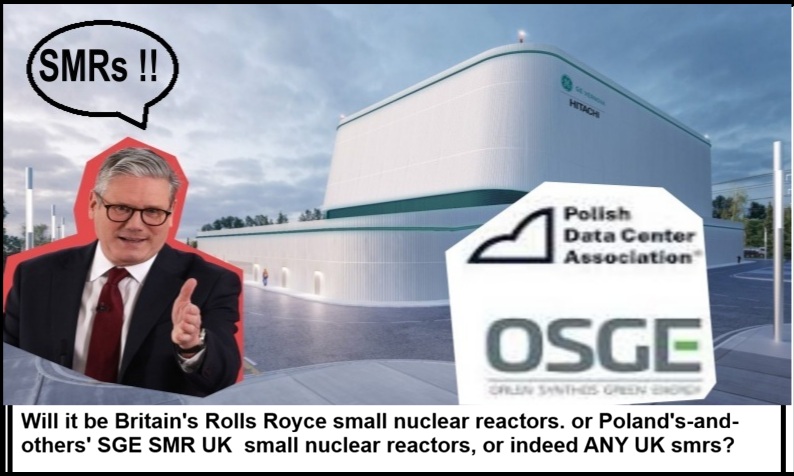
As UK’s Prime Minister fades away, will his beloved Small Nuclear Reactor dream fade too?
5 July 2026, https://theaimn.net/as-uks-prime-minister-fades-away-will-his-beloved-small-nuclear-reactor-dream-fade-too/
As soon as mid-July, Sir Keir Starmer is expected to finally quit his job as British Prime Minister. He’s not very popular, either within his own party, or with the general public. Labour’s previous popular leader, Jeremy Corbyn, opposed nuclear power. Soon after coming to power, Starmer called for tech companies to work alongside the government’s Great British Energy – Nuclear, to build SMRs to power energy-intensive AI data centres across Britain. Starmer might be hoping to be, later on, renowned for his legacy in revolutionising British energy systems, and producing a glorious renaissance for the global nuclear industry.
But possibly not.
“I say: build, baby, build,” – Starmer’s theme on Small Nuclear Reactors looks now, on the face of it, to be a resounding winner for Britain on the global nuclear scene. Why? Because… haven’t you heard? It is all over the British press that the UK is to get a fleet of SMRs with a multi-billion dollar “privately financed” scheme (helped just a bit by the government), to start generating in 2034.
SGE is a European Small Modular Reactor (SMR) development and investment platform. Founded by Polish billionaire Michał Sołowow, SGE has plans for SMR developments across Europe. On July 1st SGE announced in glowing terms, its UK plans for “delivering efficient, safe, affordable, and clean nuclear energy power at fleet scale.” It has established a consortium, SGE SMR UK Limited, as its dedicated UK-based project vehicle.
SGE hopes to use the GE Vernova Hitachi BWRX-300 design, to build under the government’s advanced nuclear framework (which was initiated by Starmer in February after the government promised to rip up “archaic rules” and slash regulations to “get Britain building”). SGE boasts that this SMR design is a “proven technology,” but it’s really a smaller, and as yet untested, version of the large boiling water nuclear reactor.
Where’s the money coming from?
The plan is to put in £35bn of private capital to build 14 small modular nuclear reactors on three sites across the UK. The consortium SGE SMR UK consists of SGE (formerly Synthos Green Energy), GE Vernova, Hitachi Nuclear, Samsung C&T, Laing O’Rourke, Aecon Group, Google Cloud, Fermi Development, and Etara. The biggest investor presumably is the Polish company.
Under the National Wealth Fund, Great British Energy – Nuclear (GBE-N) set up its Small Modular Reactor (SMR) Technical Partner contract (TP Contract) as a way for the government to help fund SMR development. It initially forecast that it may need £20bn to cover the cost of the (TP) Contract. “GBE-N has ultimately decided to award only one TP Contract and the contract award notice value reflects this.”
SGE plans to deploy under a Contract for Difference framework with National Wealth Fund engagement. I know that the contract for difference scheme means a fixed price for electricity bills once the project begins generating electricity. If the market price is below the fixed price, the government tops up the payment to the company. I don’t know what the National Wealth Fund engagement means, and I suspect that I’m not the only one puzzled about this.
In May 2026 Great British Energy – Nuclear (GBE-N) announced that Rolls-Royce SMR has been awarded Stage 1 of its Small Modular Reactor (SMR) Technical Partner contract (TP Contract). Stage 1 has a “forecast” price of £359M. A furtherr £8.17bn is estimated for the second delivery phase. Rolls Royce expects the SMRs to start operating in the mid 2030s.
So how much of the tax-payers’ £20bn is Rolls Royce going to get? And is SGE SMR UK going to get some too, and if so, how much? Or is the Polish entrepreneur’s SGE SMR UK truly really going to go it alone – with private financing?
Mysterious unanswered questions
Through the Freedom of Information Act, The New Civil Engineer requested some detail on the breakdown of the TP Contract award ‘s available £20bn. Great British Energy – Nuclear ‘s reply was – “GBE-N does not hold the information you have requested.”
Given the nuclear industry’s notorious history of delays and cost overruns, it’s pretty important to know how much each of these competing SMR projects is likely to cost, how long each would really take to come into operation, and how much the tax-payer will have to cough up.
What a complicated mess!
In 2023 the UK joined enthusiastically with world leaders in The Declaration to Triple Nuclear Energy by 2050. The Starmer Labour government took this up with zeal, and the message has been reinforced by academia and the media. Several UK universities have jumped on the nuclear bandwagon. Just this week, the Manchester University announced:
The University of Manchester and United Kingdom National Nuclear Laboratory (UKNNL) have signed a Memorandum of Understanding (MoU) formalising a wide-ranging partnership to advance nuclear science, grow the UK’s nuclear workforce, and strengthen the country’s position as a global leader in nuclear technology.
The UK media, except for The Guardian and New Civil Engineer, is ecstatically regurgitating nuclear lobby handouts. On July 2nd we have excited and positive articles on the SGE SMR UK project – from The Times, Telegraph, PR Newswire, Energy Live, Business Green, as well as from leading international news media. This privately-funded SMR project is a global first.
The New Civil Engineer is peskily pursuing its search for information on the UK government’s planned funding of small nuclear reactors, while the rest of them continue applauding this small nuclear fantasy.
I’m not here to push the points that SMRs are not cheap, not proven, not safe, not clean, not environmentally beneficial, not free of toxic wastes, and not actually in existence. Plenty of economists and scientists have made those assessments. Is the SGE UK thing going to really happen? Or is the Rolls Royce SMR thing going to beat it? When and where are these reactors going to operate? I’m just wondering about – for how long the UK pro SMR charade is going to play. Now that the leading actor Keir Starmer is about to bow out, will the whole performance have a very short season indeed?
Starmer Lied: Britain Is Cutting £11 Billion from Frontline Defence
The new Defence Investment Plan delivers almost nothing for our armed forces in the near term
Ian Proud, The Peacemonger, Jul 02, 2026
The United Kingdom is in effect going to spend up to £11 billion less per year on the day-to-day running of its armed forces under Keir Starmer’s Defence Investment Plan — and that’s before we even take inflation into account.
Despite the apparent uplift in spending toward 2.7% of GDP by 2029, the UK will get no meaningful increase in front-line conventional capability or personnel.
Our armed forces are at their smallest size in two hundred years, and that situation is not going to change under this plan.
Spending on long-term nuclear capabilities — programmes that will not deliver anything usable until the 2030s and 2040s — is absorbing the great majority of the headline increase.
This comes at a time when the government claims Russia could be ready to use military force against NATO by the end of this decade.
At the heart of the problem is a foreign policy that wants to confront multiple adversaries while maintaining armed forces that simply do not have the mass or readiness to do so credibly.
Important to point out that I am the son of a former British soldier and I am incredibly proud of the armed forces and anyone who serves this country. I also served alongside the British Army in Helmand province in 2010 and worked with some truly remarkable people. I am not criticising the men and women who put on the uniform. I am criticising how badly led we are as a country.
Keir Starmer announced the UK’s long-awaited Defence Investment Plan yesterday, 30 June. To describe it as a damp squib would be generous. It is a document that confirms the continued stagnation of the UK armed forces and the deep sclerosis at the heart of defence procurement.
Do not believe the headlines and the spin.
This plan will not transform our hollowed-out forces.
The British Army is already at its smallest size since 1823. That will not change.
There are no new soldiers being recruited in any significant numbers. Money available for the day-to-day operation of the armed forces is not going up — in real terms it is under severe pressure.
Having crunched the numbers, it’s clear to me that yearly spending on the actual running of the armed forces has effectively declined by up to £11 billion per year under this plan, set against the government’s claim of a £15 billion per year increase by 2027…………………………………………………………………………………………………………………………………………………………………………………………..
The outgoing UK Prime Minister has declared a big increase in defence spending, yet we are getting no new troops and very little new conventional capability in the near term.
Why?
Because the great majority of the additional money is being directed into nuclear programmes and a procurement system that has repeatedly failed to deliver on time or on budget.
………………………………………………….. As I write, I understand that all of the Astute-class submarines are operationally unavailable.
……………………the largest cost increases and overruns have been in the nuclear and naval programmes.
………….As the National Audit Office reported in 2023, the combined costs of nuclear and naval programmes rose by £54.6 billion between 2022 and 2023, with the nuclear element increasing by £38.2 billion.
The three biggest programmes are the SSN-AUKUS attack submarines, the Dreadnought ballistic missile submarines, and the new Astraea nuclear warhead.
The first UK-built AUKUS submarines are not expected until the late 2030s.
We already have ballistic missile submarines maintaining Continuous At-Sea Deterrence.
We already have attack submarines, even if they cost too much, took too long to build, and don’t work.
We already have nuclear warheads. Do we really need a slightly flashier design folks? Serious question.
The plan is being presented as a response to current and near-term threats, while a war continues in Ukraine and with political leaders abandoning diplomacy.
……………………I have a clear alternative. We should cancel or significantly scale back the highest-risk and longest-lead nuclear programmes — particularly the new Astraea warhead and major elements of the SSN-AUKUS programme.
The savings should be redirected into fixing and sustaining the equipment we already possess, improving the availability of existing platforms, and beginning the serious work of rebuilding conventional force numbers and readiness for the core task of defending the United Kingdom and its immediate interests………………………….. https://thepeacemonger.substack.com/p/starmer-lied-britain-is-cutting-11?utm_source=post-email-title&publication_id=3221990&post_id=204491995&utm_campaign=email-post-title&isFreemail=true&r=1ise1&triedRedirect=true&utm_medium=email
Poland revokes the Order of the White Eagle it had awarded to Volodymyr Zelensky

Voltaire Network | 26 June 2026
Polish President Karol Nawrocki, former president of the Institute of National Remembrance, revoked the Order of the White Eagle — Poland’s highest honor — awarded to Ukraine’s expired president Volodymyr Zelensky, on June 19, 2026.
This decision follows the designation of a Ukrainian military unit as “Heroes of the UPA”, in reference to the Ukrainian Insurgent Army (UPA), the military wing of the “Banderists” or “integral nationalists” of World War II. Any reference to the UPA conjures painful memories in Poland as its supporters murdered about 100,000 Poles in a campaign of ethnic cleansing in Volhynia in 1943-1945.
A majority of Poles (51%) reacted negatively to President Zelensky’s announcement………………………… https://www.voltairenet.org/article224771.html
Say goodbye to independent assessments of nuclear projects in Canada
3 July 2026
The Nuclear Fist: Five Federal Initiatives Pushing and Promoting Nuclear Power
There are currently five federal nuclear related initiatives / announcements: “Getting Major Projects Built in Canada – Discussion Paper on Proposed Legislative, Regulatory, and Policy Reforms” announced May 8th with the deadline now extended to July 22; the electricity strategy “Powering Canada Strong: A National Strategy for an Electrified Canadian Economy” which was announced May 14 with comment invited but no deadline; the Standing Committee on Natural Resources and the Environment electrification study with the deadline – and the study – now extended to mid-September; the Nuclear Energy Strategy for Canada announced June 22 with no comment invited and so no deadline for comment, and the June 24 announcement of the potential “listing” of the NWMO DGR under the Build Canada Act (aka Bill C-5), also no public comment period.
Prime Minister Mark Carney wants to end independent assessment of nuclear projects and hand over this responsibility to the Canadian Nuclear Safety Commission. READ SUBMISSIONS
Why is this a bad idea?
The CNSC cannot be trusted because it:
- Is led by industry insiders
- Often is seen as a promoter and co-proponent of nuclear projects
- Reports to the Minister who promotes nuclear power
- Has never denied a licence application
- Often excludes the public from its hearings
- Does not have the required independence from the nuclear industry
- Secretly authorised transport of radioactive fuel waste from Gentilly-1 nuclear plant across Quebec into Ontario
Nuclear power is uniquely complex and risky.
Fast-tracking nuclear projects is outright dangerous:
- Accidents can have catastrophic consequences
- Nuclear materials are toxic and radioactive – some literally forever!
- Nuclear power is linked to nuclear proliferation
Decisions about nuclear projects must be based on sound information that has been examined and tested by the public, independent experts and an independent review panel. Social concerns, protection of public health and the environment, and economic value must all be considered.
What can you do?
Between now and July 22 you can provide comments on the government’s discussion paper. Following that, when legislation is tabled, you can comment on the legislation. Throughout this time, contact your Member of Parliament and members of Cabinet by email, phone and in-office visits and share your concerns about these changes, and the speed with which they are being made.
…………………………………………………………………………………………………………………………………https://nuclearwastewatch.weebly.com/assessing-nuclear-risk.html
MSP says ‘no’ to nuclear power plant as UK Government eyes Fife
Dunfermline Press 1st July 2026
Fife has been revealed as a potential site for a nuclear power plant in a new UK Government report – but a local MSP says it “wouldn’t go down well” with communities.
The document, titled ‘Potential future nuclear power plant siting in Scotland ‘, published on Tuesday, June 30, was penned by both the Department for Energy Security and Net Zero and Great British Energy – Nuclear.
The report sets out to offer “technical advice” on potential future sites.
In a section called ‘Land Areas of Interest ‘, Fife was identified as part of areas across eastern Scotland which could be eyed up for new development by the UK Government.
The report read: “The northern shore of the Firth of Forth benefits from a strong industrial heritage, existing brownfield land, good transport connections and historic use of river water for power station cooling.
“The presence of previous energy generation sites and proximity to major industrial hubs supports technical suitability.”
However, it did note that flood risks were a notable constraint, with some areas identified as high likelihood for coastal flooding and limited existing defences.
It continued: “The proximity of major COMAH sites and oil and gas infrastructure, including the Forties Pipeline System, introduces additional safety and planning complexity.”
MSP for Cowdenbeath, David Barratt said: “The document implies quite heavily, I would say, about nuclear power at Longannet. It’s talking about a site on the north side of the Forth, in close proximity to areas of flood risk and oil and gas.
“The SNP’s position aligns, from my perspective, closely with what communities think. I don’t think if you went to any community and asked them whether they like a nuclear power station next door, I struggle to imagine any in Fife, or along the Forth shore, would say yes please.
“I don’t think that would go down well at all with communities (near Longannet) who have put up with enough environmental consequences of that site. Scotland is blessed with an abundance of renewable sources, and we don’t require nuclear.”…………….. https://www.dunfermlinepress.com/news/26243980.mps-says-no-nuclear-power-plant-fife-uk-government-eyes-fife/
Westminster’s nuclear obsession will cost us dearly – Scotland
The irony of Scotland’s sky-high bills is that we sit on one of the goldmines of clean, renewable energy potential in Europe.
Scotland does not need dangerous, extortionate nuclear white elephants built in our communities against our will.
the SNP, 12 July 26, https://www.snp.org/westminsters-nuclear-obsession-will-cost-us-dearly/
The case for transferring full control of energy policy to the Scottish Parliament has never been more urgent.
As we head toward what is shaping up to be a winter of deep financial hardship for households across the country, it is clearer than ever that the only way to secure affordable, stable energy bills for the people and businesses of Scotland is to take control of our own immense resources from Westminster.
Before taking office, Labour campaigned heavily on a promise to lower energy bills for families across Scotland by £300. The reality since July 2024 has been a story of utter failure to deliver.
When Labour entered government in July 2024, the Energy Price Cap stood at £1,568 per year. To fulfil their signature pledge, that cap should heading towards £1,268.
Instead, fresh analysis from Cornwall Insight shows that the price cap is set to soar to £1,849 by this October.
That leaves Scottish households facing a staggering bill that is £581 higher than what was promised.
It is a profound injustice that in energy-rich Scotland, citizens are paying some of the highest energy bills in Europe while the country is haemorrhaging up to 1,000 energy sector jobs every single month.
The irony of Scotland’s sky-high bills is that we sit on one of the goldmines of clean, renewable energy potential in Europe.
Scotland regularly produces more clean electricity than it actually consumes, achieving an historic milestone where renewable generation already reached the equivalent of 113% of our gross electricity consumption in 2024.
Our natural landscape and seas make Scotland a significant green powerhouse:
- Wind Power: Scotland is often described as the “windbreak of Europe”, holding over 11GW of installed wind capacity – which makes up roughly 39% of the entire UK capacity.
- Hydro Power: Scotland commands 85% of the UK’s total hydroelectric resource.
- Increased Generation: The Scottish Government has expanded its offshore wind targets to a massive 40 GW by 2040.
Instead of letting Westminster mismanage this wealth, these resources should be utilised directly to lower local energy tariffs in Scotland and build a thriving green economy, much like Norway has done with its own native energy supplies.
Rather than supporting Scotland’s booming renewables sector or honoring promises to fund vital carbon-capture carbon capture infrastructure, Westminster remains locked into an obsession with nuclear energy.
Reports indicate that Labour’s GB Energy has secretly identified multiple sites for nuclear plants across Scotland, completely ignoring the Scottish Government that was democratically elected last month.
The push for nuclear power ignores the hard economic and environmental facts:
1 It is the most expensive power generation: Nuclear energy is financially draining. Industry experts and watchdogs routinely highlight it as one of the most expensive forms of electricity generation on Earth, with ballooning strike prices that lock consumers into high bills for generations.
2 t takes decades to come online: Major projects are notoriously crippled by logistical failure. For example, the flagship Hinkley Point C nuclear plant in Somerset was originally expected to cost £18 billion and open by 2025; it has now spiralled to an estimated cost of up to £46–£48 billion and is delayed until at least 2030 or 2031. Future projects like Sizewell C are projected to face similarly restrictive timeframes and even higher starting expenses.
3 A deadly legacy of radioactive waste: Nuclear reactors leave behind hazardous, highly radioactive waste that must be managed and monitored for centuries. The most toxic components of this spent fuel remain lethal to human life and the environment for up to 100,000 years, passing a dangerous and expensive ecological debt onto dozens of future generations.
Scotland does not need dangerous, extortionate nuclear white elephants built in our communities against our will. The Scottish Parliament has already passed an SNP motion demanding that power over our energy resources be fully devolved to Holyrood.
If the Westminster government is truly committed to the principles of devolution, they must listen to the Scottish people, remove the punitive taxes currently stifling our domestic energy markets, and transfer energy powers to the hands of the people who live here.
With the fresh start of independence, we can finally link Scotland’s immense natural wealth directly to lower, affordable bills for everyone.
Billionaire to invest £35bn in small modular nuclear reactors rollout across UK
Consortium led by Michał Sołowow planning enough SMRs to power equivalent of 8m homes for more than 60 years.
Jillian Ambrose, 2 July 26
A consortium led by the billionaire industrialist Michał Sołowow has announced plans to build 14 small modular nuclear reactors on three sites across the UK, including the location of a former nuclear plant in Gloucestershire..
The Polish entrepreneur and rally driver plans to use £35bn of private capital to roll out enough small modular reactors (SMRs) to power the equivalent of 8m UK homes for more than 60 years, or even power datacentre investments alongside Google.
Sołowow’s nuclear development company, SGE, plans to make the “significant investment” of between £2.2bn to £2.5bn in each 300 megawatt reactor alongside a string of industrial partners including the US manufacturer GE Vernova and Japanese industrial conglomerate Hitachi, which are responsible for the design.
The consortium, known as SGE SMR, hopes to secure three sites for the boiling water reactors (BWRs) by this time next year as well as a government support contract which would guarantee a “competitive” price for its electricity once it starts generating in 2034.
It has not disclosed which sites it hopes to use for the GE Vernova Hitachi BWRX-300 design, or which energy company would be the operator. However, the Guardian understands the consortium has submitted an application to use the Oldbury site in south Gloucestershire which was earmarked earlier this year for the development of SMRs under the government’s advanced nuclear framework.
Sołowow said the government’s framework, which aims to fasttrack the rollout of nuclear technologies, had created “a clear path to market” in the “home to one of the world’s most experienced nuclear workforces”.
Because of this, I am confident we will set a new standard for nuclear development by combining our disruptive business model with the BWRX-300’s 10th-generation proven technology. We will rely strongly on the UK supply chain; it is a critical element for our project. Our project will create a distinct competitive advantage for the UK economy,” he said.
The Labour government unveiled plans for a historic expansion in nuclear power across England and Wales within months of coming to power, with Keir Starmer calling for tech companies to work alongside the government to build SMRs to power energy-intensive AI datacentres across Britain.
SGE’s plans will put it in competition with Rolls-Royce to be the first to roll out SMEs in the UK, after the British engineering company won a government competition earlier this year to allow it to start generating power by 2032 at the earliest.
SGE’s joint venture agreement, signed this week in London, includes Google Cloud, which Sołowow hopes will also partner on investing up to £4.5bn in datacentres to make use of the nuclear output. The Guardian understands this is viewed as an accompanying proposal which is not part of its current application.
Instead, the consortium hopes to secure a similar deal to the contract offered to the Hinkley Point C nuclear project. It has opted for the contracts for difference scheme, which pays a fixed rate from energy bills once the project begins generating electricity, rather than the controversial model used to fund the Sizewell C project. Under that scheme the developer is paid during the construction phase, meaning billpayers risk bigger costs if there are delays.
Tom Greatrex, chief executive of the nuclear industry association, said SGE’s SMR plans showed the government’s nuclear framework “has really revived and spurred interest in privately led nuclear projects”.
The Pentagon’s Budget Redirected Would Exceed Our Wildest Dreams.
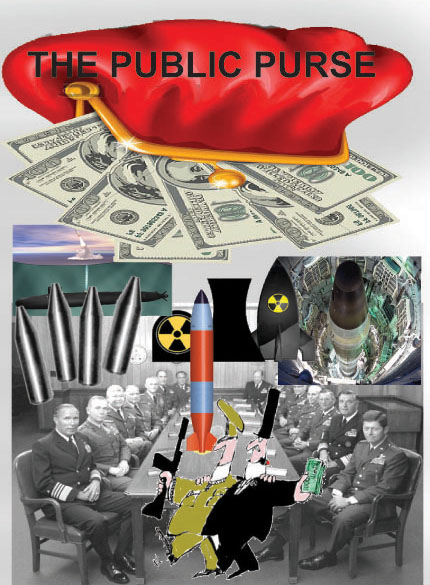
The actual cost of the U.S. military budget that Trump is asking for is $3 trillion.
By David Swanson, World BEYOND War, July 1, 2026, https://worldbeyondwar.org/the-pentagons-budget-redirected-would-exceed-our-wildest-dreams/
Legacy “news” outlets have declared a national disaster emergency. It seems that we the people of the United States may be in imminent danger of having about 10% of the U.S. Congress give a damn about us, and — what’s worse — perhaps 5% give a damn about the other 96% of humanity too.
The panic seems misplaced, not only because Uncle Sam’s Oligarchs have still got 90% of our court jesters, the one emperor, and a majority of the Supremes, but also because the proposals for preschools, grocery stores, buses, and so forth hardly scratch the surface of the enormous pile of money dumped each and every year into a single criminal enterpr – er, I mean, government program. The actual cost of the U.S. military budget that Trump is asking for is $3 trillion. The point I am making here still works if you can’t be bothered with new facts and want to claim that the proposed military budget is half of that, but I think going with the most accurate facts we can find is always the best policy.
For some $3.7 trillion a year, the United States could have something that every other country in the World Cup has: healthcare as a human right free to all. That is, with only $0.7 trillion in new revenue each year (or the cost of a fairly mediocre war), everybody paying for health insurance could stop, everybody without health coverage could have it, and preventive care could begin to take over from emergency care. I don’t know how to calculate all the hours reclaimed from dealing with health insurance forms and so forth. But this would be a transformation of the U.S. government from principally a killing machine to principally a healthcare provider. Let’s look at some smaller proposals.
We could make college free for $75 billion a year, preschool for $35 billion, provide housing to everyone who lacks it for $29 billion a year. See those first three teeny tiny orange bars in the chart above. Can you image having those unbelievable things and still only be scratching the surface?
We could hire 100,000 people at $100,000 a year to work on what’s needed most. Total cost: $10 billion. We could end hunger on Earth for $93 billion a year. We could provide solar power to every house in the United States over 10 years for $120 billion each year. We could build 1,000 miles of high-speed rail each year for perhaps (depending how efficiently and where it’s done, of course) $200 billion. Or double or triple that for more efficiencies. It’s not as if we’re running our of money.
We could do all of these things, exceeding the wildest nightmares of Republicans and corporate Democrats alike, and still maintain absolute faith in militarism. We’d only have to assume that the United States was remotely like the rest of the world, which spends a tiny fraction of what the United States does on war machinery. Or we could grow more enlightened than that and go a lot further. The process would, by stages, enlighten us in any case. Regardless, we would need to invest something in the transition to peaceful industries, and to compensate, assist, and retrain anyone wanting such measures. Just to ridiculously over-invest in that concern, let’s chalk up another $200 billion.
Now, the things one can do for safety while disarming are many and include ceasing to supply the world with weapons, as well as making disarmament agreements, providing disarmament incentives, and supporting the rule of law, cooperation, investment in unarmed civilian defense, truth and reconciliation commissions, and so on. One thing on that list is actual aid — not military “aid” but actual, no-strings, support for human and environmental needs. I think a healthy quarter trillion on that each year would produce rallies around the world celebrating the United States instead of burning its flag.
Even then, we’d be only a bit over $1 trillion total. We could think a little harder about what’s needed most. Or we could send a check for $5,696 to every person in the United States and call it a good day’s work. We’ve not, of course, counted here the widely understood economic advantages of spending money in these ways rather than on wars — but everyone would share in those benefits too.
Dream bigger.
No nuclear energy in Scotland – Greens

Labour’s nuclear obsession would be waste of time and money.
1 June 26, https://greens.scot/news/no-nuclear-energy-in-scotland
Labour’s plans to build nuclear power plants all over Scotland would be a costly error, says Scottish Green MSP Kristopher Leask.
This week saw the publication of a report by Great British Energy Nuclear, ordered by Ed Miliband, which identified multiple sites in Scotland which could be used if the Scottish Government’s opposition to nuclear was to change.
The report was publicly welcomed by Anas Sarwar, Michael Shanks and other Scottish Labour bosses.
Kristopher said:
“Labour’s obsession with forcing a new generation of nuclear power on Scotland rides roughshod over devolution and ignores the will of the Scottish Parliament.
“Opening new plants across Scotland would be a huge waste of time and money. It would swallow billions of pounds and take decades to deliver, while doing nothing to tackle energy bills or the climate crisis.
“Focusing on nuclear energy would be a huge missed opportunity. It would mean turning our backs on Scotland’s world-leading renewable resources.
“Instead of pouring money into expensive nuclear projects, the UK Government should be backing renewable energy that can create jobs, cut bills and strengthen energy security at a fraction of the cost.
“Our priority should be creating clean, green, secure jobs that support nuclear workers into new industries while revitalising communities across Scotland.”
Four US presidents steered European NATO into decline in furtherance of US proxy war against Russia.
Besides Starmer in the UK, French President Emmanuel Macron and German Chancellor in Friedrich Merz may be following Starmer out the door by the end of the year.
Walt Zlotow West Suburban Peace Coalition Glen Ellyn IL , 25 June 26
The resignation of UK Prime Minister Keir Starmer Monday comes as no surprise. Serving just 23 months, Starmer failed to revive the British economy. Possibly his biggest failing was going all in supporting the US proxy war against Russia using Ukraine as a Trojan horse to weaken, isolate Russia from the European political economy.
Starmer is the seventh UK Prime Minister to leave office since the US, under President George W. Bush, pitched NATO membership to Ukraine at the April 2008 Bucharest NATO Summit. His six predecessors all followed the US plan to totally isolate Russia from Europe by putting NATO and its nukes on Ukraine’s border with Russia.
Bush’s successor Obama greenlighted a coup against the Russian leaning Ukraine President Yanukovych in 2014 to keep Ukraine NATO membership alive. That sparked a civil war with Russian leaning Ukrainians in Donbas which claimed over 10,000 Ukrainian lives there, all with US support and approval. Obama was also fine with Europe’s deceiving Russia that Minsk I and II would give Donbas Ukrainians peaceful autonomy when it was a stall for time to build up the Ukraine military to finish off the Donbas separatists. It was dastardly diplomatic duplicity.
Obama’s successor Trump was worse, funning hundreds of millions in weapons to Ukraine’s military to complete the ultra-right Ukraine victory against the separatists.
Trump’s successor Biden was the worst. Essentially, he made Ukraine a de facto NATO member while totally dismissing Russia’s valid security concerns. With tens of thousands of US funded and supported Ukrainian troops massed on the Donbas border, Biden gave Russia’s Putin the back of his hand knowing Putin would invade. Biden believed this would be Russia’s Afghanistan 2.0 sealing Russia’s demise as a European power and US rival.
Instead, it’s turned Ukraine into a failed state utterly dependent on US and European treasure in weapons and staples to simply survive against the overwhelming Russian military. But it has also greatly weakened Europe economically and politically. Besides Starmer in the UK, French President Emmanuel Macron and German Chancellor in Friedrich Merz may be following Starmer out the door by the end of the year.
Macron’s disapproval rating has soared to between 73 and 79 %. Merz’s is worse at 80 at 84 %. Both are largely due to their flinging badly needed domestic treasure at the lost Ukraine cause. All three fools running the biggest European economies keep flayling around like Chicken Little chirping ‘The Russians are coming, the Russians are coming.’ Very few of their fleeing voters are buying that nonsense. Nationalist opponents in France and Germany may soon achieve power opposing continued military aid to Ukraine, demanding the commons be served instead.
Meanwhile, Trump in term two has had enough of his infamous four predecessors’ Russian fearmongering, including his in term one. He’s sick of supporting European defense that has no real enemies except themselves. He’s largely cut off the weapons spigot to Ukraine, leaving the big three and their 27 lessor NATO members to squander themselves into economic decline.
At least Trump has seller’s remorse regarding his support of US provocations which led to the inevitable Russian invasion just 13 months after he left office.
The other three, George W., Obama and Biden will live out their lives as Russophobes, with nary a thought or concern of the enormous carnage they unleashed which continues unabated.
Israel Is An Apartheid State – And Its Weird Marriage Laws Show Us How

in 2018 the Israeli government passed a Nation-State Law declaring that Israel belongs exclusively to the Jewish people, not to all citizens who live there.
Israeli nationality exists only as a fiction on Israeli passports to allow the population to travel internationally. Inside Israel, everyone is identified by their confessional group.
In Israel, “Jewish” is treated as a nationality. Remember the 2018 Nation State Law. What it declared is that the state of Israel belongs exclusively to the “nation” of Jews – that is, to every Jew around the globe, not just those living in Israel.
July 1, 2026 , Jonathan Cook
Israel is the only country in the world that does not recognise its own nationality. Why? Because a common national identity would sabotage Israel’s carefully veiled system of segregation
Israel’s supporters have gone apoplectic over a short post on X from the journalist Mehdi Hasan, highlighting Israel’s peculiar marriage laws.
Hasan asks: “Did you know that you can’t have a civil or secular marriage in Israel?”
Did you know that you can’t have a civil or secular marriage in Israel?
Michael A. Cohen (NOT TRUMP’S FORMER FIXER) @speechboy, 71Jun 28
Something like 40 countries have an official state religion. Israel is not one of them! In fact, that Israel defines itself as a Jewish state is not even a religious designation. That Mamdani continues to make this mistake and continues to focus on the world’s one Jewish Show more 4:24 AM · Jun 29, 2026
He’s not wrong. Israel has banned civil marriage. You can wed only in a ceremony strictly controlled by religious authorities. If you want a civil marriage, you have to travel to another country.
Why, you might reasonably wonder. Isn’t Israel a modern, secular, western-style liberal democracy? After all, that’s what our politicians and media keep telling us.
The most popular rejoinder to Hasan from Israel’s apologists – that the situation is no better in Saudi Arabia – is not quite the flex they seem to imagine. So Israel offers the same human rights protections as Saudi Arabia? Impressive.
Others have pointed out that Israel inherited the so-called “millet” system from the Ottoman empire, which gave the leaders of each confessional group across the Middle East autonomous control over their community’s religious affairs.
Doubtless, 150 years ago the system worked relatively well in reducing communal tensions in religiously diverse parts of a large empire. It prevented officials in Constantinople – modern-day Istanbul – from getting dragged deeply into the day-to-day affairs of its often distant subjects.
But 150 years ago, Britain sent children up chimneys to sweep them. The law was changed around that time to stop this abusive and dangerous practice.
Israel was established nearly eight decades ago, supposedly as a secular, western-style liberal democracy. It has had 78 years to change those archaic Ottoman marriage laws.
Why hasn’t it done so?
All the bluster decrying Hasan’s post is a desperate attempt to deflect attention away from the fact that Israel’s antiquated marriage laws survive because they are useful to Israel.
In fact, they are more than that. They are a core component of Israel’s version of apartheid – a racist system of segregation Israel has successfully shielded from the view of western publics with the help of western politicians and media.
‘Demographic threat’
Israel’s ban on civil marriage is central to its efforts to prevent what past racist societies, such as apartheid South Africa and the American Deep South, termed “miscegenation” – that is, sexual relations between different ethnic groups. You might remember that the Nazis had unpleasant views on this subject too.
Here is the current finance minister, Bezalel Smotrich, opposing miscegenation in 2016:
“Preventing assimilation in the Jewish state is completely legitimate and not at all racist. You are assuming as a basis for the discussion that preventing intermarriage is wrong, while ignoring the fact that most [Jewish] girls who go with Arabs are poor girls who are being used.”
Former education minister Rafi Peretz called mixed marriages involving Jews a “second Holocaust”.
In Israel, such views are entirely mainstream. In 2018, Yitzhak Herzog, Israel’s current president and the former leader of an ostensible leftwing Israeli party, described mixed marriages among American Jews as a “plague” for which a “solution” had to be found – presumably by copying Israel’s approach.
In Israel, the chief concern is not about marriages between Jews and the Palestinians under occupation – which Israel and its supporters like to present, bogusly, as a straightforward “security” matter.
In the occupied territories, Israel uses far blunter methods than laws to prevent any kind of intimate relations developing between Jews and a captive Palestinian population. It prefers physical containment and violence.
Palestinians under occupation are forcibly separated from Israeli Jews. They are hemmed into their own tightly confined ghettoes by Israel’s network of steel and concrete barriers; by the Israeli army; by checkpoints; by separate, apartheid roads in the West Bank; and by Jewish militias living on stolen lands in so-called “settlements”.
There is little chance of interaction, let alone intermarriage, in such circumstances – except when Israeli soldiers or armed Jewish settlers come rampaging into Palestinian communities to destroy crops, kill livestock, poison wells, torch homes and cars, and beat up – and sometimes kill – the inhabitants.
Nonetheless, there is still a potential vulnerability in Israel’s system of segregation.
In 1948, Israel expelled 80 per cent of the Palestinian population from their homes and lands in an area that was henceforth to be called, not Palestine, but the “Jewish” state of Israel.
A few Palestinians remained, however, inside those borders – mostly from oversight or error. Despite covert efforts by Israel for several years after the 1948 war to force them out of the state, its officials soon came under international pressure to give these stranded Palestinians citizenship – even if in practice, as we shall see, this conferred on them very inferior rights.
Even today, Israel is extremely worried about a supposed threat from its third-class Palestinian “citizens” – officially termed “Israel’s Arabs”. Given a higher birth rate, their numbers have grown exponentially over eight decades. They now comprise a fifth of Israel’s population.
Israeli journalists, academics and politicians, including prime minister Benjamin Netanyahu, regularly call the country’s Palestinian citizens a “demographic threat”, and endlessly worry about the “Palestinian womb”.
No state of all its citizens
But Israel faces a countervailing pressure. If it makes its treatment of Palestinian citizens too obviously racist and oppressive, some outsiders might start to realise it is not the secular western-style liberal democracy it claims to be.
You will hear the pro-Israel lobby in the West tell you that so-called “Israeli Arabs” have exactly the same rights as Israel’s Jewish population, guaranteed by Israel’s Declaration of Independence. That is not even remotely true.
Adalah, a leading legal rights group in Israel, has a database showing more than 70 laws that explicitly discriminate between Jewish citizens and Palestinian citizens. These laws form the core of Israel’s apartheid system.
Israel’s Basic Laws, a sort of constitution, explicitly exclude any principle of civic equality. Every attempt by a Palestinian party in Israel to get a debate in the parliament on Israel becoming a “state of all its citizens” – that is, a liberal democracy – is barred from discussion. And in 2018 the Israeli government passed a Nation-State Law declaring that Israel belongs exclusively to the Jewish people, not to all citizens who live there.
As with Palestinians under occupation, Israel has almost entirely confined its Palestinian citizens to their own segregated, underfunded, under-resourced communities (townships) on less then 3 per cent of the country’s territory.
A small minority of Palestinian citizens inside Israel live in segregated, deprived neighbourhoods of what are misleadingly termed “mixed” cities. Other Palestinian citizens, the most oppressed of all, live in communities inhabited by their families for centuries but which have been criminalised by an Israeli state that refuses to recognise them.
Many hundreds of Jewish rural communities, by contrast, operate effectively as exclusive membership clubs. They have the power to exclude Palestinian citizens – a right they take full advantage of.
Separate planning structures ensure massively overcrowded Palestinian communities inside Israel are unable to build new homes and expand. Palestinian children are schooled in a separate and much inferior education system.
For the who wish to dig deeper, I have written a lengthy essay setting out the details of Israel’s apartheid system here.
The ban on civil marriage inside Israel’s borders is not usually cited, even by critics, as an example of its apartheid system of rule. But the ban persists because it is the ideal way to conceal segregation under the veneer of equal treatment.
Israel’s Palestinian citizens must marry in ceremonies conducted by their religious community’s leaders: by Muslim clerics, or by various Christian churches, or by the Druze clergy.
It is the same for Jews in israel. They must be married by an Orthodox rabbi.
So everyone faces the same restrictions. But the point is this: the equality of treatment ensures very unequal outcomes. It is designed that way.
Fascist thugs
Inside Israel, intermarriage is only possible if one party can convert to their partner’s religion.
Israel’s Orthodox rabbinate makes it impossible for Palestinians under occupation to convert to Judaism in Israel, with the head of its conversion authority stating in 2016 that any such applicants are rejected “without review because of their ethnic origin”.
Meanwhile, Israel makes it almost as difficult for anyone else considered a non-Jew to convert to Judaism, most especially Palestinian citizens. Over decades, there have been only a handful of such cases.
In practice, this means that in any relationship between a Palestinian citizen of Israel and an Israeli Jew, it almost always falls to the Israeli Jew to convert to the religion of the Palestinian citizen, whether a Muslim, Christian or Druze. That entails the Jewish partner losing their Jewish status and the many consequential privileges inside Israel that derive from that status.
Israel has found this is a much better solution than apartheid South Africa’s, where blacks and whites were explicitly barred by law from marrying. Israel can achieve the same result more quietly.
Given the entirely segregated structure of Israeli society, and the strong social taboos among Israeli Jews on “miscegenation”, the number of intermarriages in Israel between Jews and Palestinian citizens barely reaches double digits each year.
There are even groups like Lehava – Israel’s version of the Ku Klux Klan – that go around beating up Palestinians caught anywhere near the Jewish neighbourhoods of Jerusalem and terrorising any young Jewish women suspected of being romantically involved with a Palestinian. Lehava hold noisy and disruptive protests to shame the odd Jewish woman who converts and marries a Palestinian citizen.
All of this happens with a quiet wink from the authorities. The current police minister, Itamar Ben Gvir, has long been a patron of the fascist, Jewish supremacist thugs of Lehava.
In the rare cases of a Jew converting and marrying a Palestinian citizen, the Palestinian partner faces innumerable legal and social obstacles to integrating into a Jewish community to which they do not belong.
Instead, the Jewish partner moves to a Palestinian community – an Israeli version of a township like Soweto – and educates their children inside the vastly inferior “Arab” school system. The former Jew loses most of the ethnic privileges they previously enjoyed inside the world’s only “Jewish” state.
Faced with this as their future, such couples often seize the opportunity for neither to convert and instead marry and live abroad.
Unwelcome guests
None of these difficulties are accidental. It is exactly how you would expect an apartheid system that prefers to obscure its apartheid character to structure its laws – and thereby help its lobby in the West, including the western political and media class, to claim that Israel is “the only democracy in the Middle East”.
Israel learnt from the mistakes of the old South Africa. It mastered the modern arts of public relations – or at least it did until Benjamin Netanyahu tore up the script by erasing Gaza.
Inside Israel, the apartheid system extends far beyond marriage laws to touch all areas of life.
Here is another way Israel has obscured its apartheid system – again not in the occupied territories, but inside Israel itself.
The same system that denies Israelis the possibility of a civil or secular marriage also refuses to recognise that they have any kind of civil or secular identity, simply as Israelis. By law, everyone in Israel must belong to a confessional group, identified as a Jew, Muslim, Christian or Druze.
Which makes sense of another little-known fact about Israel: Israel is the only country in the world that does not recognise its own – in this case, Israeli – nationality. Why? For the simple reason that, were Israelis to share a common national identity, it would be much harder for the Israeli state to operate its apartheid system.
Israeli nationality exists only as a fiction on Israeli passports to allow the population to travel internationally. Inside Israel, everyone is identified by their confessional group.
In Israel, “Jewish” is treated as a nationality. Remember the 2018 Nation State Law. What it declared is that the state of Israel belongs exclusively to the “nation” of Jews – that is, to every Jew around the globe, not just those living in Israel.
Muslims and Christians are lumped together into a similarly artificial “Arab” nationality, while the Druze have their own, different nationality. The same Nation State Law makes clear that the state of Israel does not belong to these other, non-Jewish “nations”, despite their families having lived on the same lands for centuries. Palestinian citizens are nothing more than guests – and unwelcome ones at that.
This segregation carries through to Israel’s ID cards. These cards, which must be carried at all times, used to include a section that expressly showed the “nationality” of each Israeli. But this section attracted uncomfortable scrutiny during a lengthy and ultimately unsuccessful legal battle by a group of dissident Israelis seeking recognition of an Israeli nationality. Officials removed the category from the card. However, Israel’s population register still includes a nationality classification.
In addition to Jew, Arab and Druze, there are more than 120 other categories to deal with all the anomalies. I was just one such anomaly after I married a Palestinian Christian and entered a lengthy and difficult naturalisation process. My nationality was classed as “British”.
Why all this complexity? Why all this unique weirdness?
Because Israel needs to conceal its system of apartheid. The old South Africa simply said: one law for whites and another for blacks.
Israel knows this no longer plays well. So it has devised a convoluted, baffling system that few understand as a way to avoid attracting attention and criticism.
Special Jewish rights
So let’s end with just one example of how Israel’s apartheid system works in practice.
Notionally, Israel confers on all its citizens – Jews, Muslims, Christians, Druze – equal rights as citizens. But with a sleight of hand, it then undermines those equal rights by conferring superior “national” rights on one group only, Jews. If there is a conflict between a citizenship right and a Jewish “national” right, you’ve probably already guessed that the Jewish national right takes precedence.
Education is a good illustration. All Israeli citizens enjoy a right to have their children educated, because education is a citizenship right. But lots of veiled manoeuvres – like extra budgets for National Priority Areas, special subsidies for Jewish religious schools, funding from the diaspora, and bigger tax disbursements from central government for Jewish local authorities – mean Jewish schools are far better funded than “Arab” schools.
Education for Israel’s Palestinian citizens has been underfunded for eight decades. So even though Israel’s apologists will claim the funding gaps are slowly narrowing, the continuing shortfall simply compounds a decades-long historical injustice. Arab schools are so far behind they can never catch up without aggressive additional funding Israel clearly has no intention of ever providing them with.
There are massive shortages of classrooms and staff in dilapidated school buildings. Old books are often grossly outdated and poorly translated into Arabic by the state. Palestinian educational leaders have no input into the curriculum the community’s children are taught. There are strict controls by Jewish (usually racist) officials over what can be taught and who can teach. And on top of all this, huge cultural biases in qualifying tests make it far harder for Palestinian citizens to gain entry to universities in Israel.
There are many other problems in education. For example, nearly one in 10 Palestinian children in Israel live in historic communities built on lands that the Israeli state now wishes to “Judaise” – reserve for the Jewish population – and are therefore denied all recognition.
Treated like criminals, these children rarely have schools in their communities because no permanent buildings are allowed. What buildings there are cannot be connected to the electricity or water grids. Even children of kindergarten age must typically travel long distances – sometimes close to 60 km a day – to get to a licensed school.
The forms of discrimination in education alone are endless. But they do not stop there. The discrimination is replicated in all major facets of life for Israel’s more than 2 million Palestinian citizens through these conceptual and legal contortions over religion, citizenship and nationality.
None of this should be a surprise. It is exactly what you would expect in an apartheid state like Israel.
Anishinabek Nation stands united in unequivocal opposition to the transportation of nuclear waste through the entire Anishinabek Nation territory.

ANISHINABEK NATION TERRITORY (July 1, 2026) – The Anishinabek Nation Grand Council Chief shares a statement as the Nation prepares to celebrate Canada Day.
“We wish you a Happy Canada Day!
Anishinabek Nation statement on Canada Day
ANISHINABEK NATION TERRITORY (July 1, 2026) – The Anishinabek Nation Grand Council Chief shares a statement as the Nation prepares to celebrate Canada Day. https://anishinabeknews.ca/2026/07/anishinabek-nation-statement-on-canada-day/
“We wish you a Happy Canada Day! We celebrate the diversity, cultures, and contributions of this Nation with pride and encourage others to join in celebration. However, we also encourage citizens of this Nation to take the time to understand that this land you have come to know as Canada has a colourful past with a legacy that continues to negatively affect the Original People of this land. While some parts of the country are celebrating, First Nations people are contemplating the Government of Canada’s plans for a toxic nuclear waste dump in a small town in Northwestern Ontario within the Treaty 3 territory.
The Anishinabek Nation stands united in unequivocal opposition to the transportation of nuclear waste through the entire Anishinabek Nation territory from southern Ontario to the proposed burial of nuclear waste in the Township of Ignace, Ontario, and Wabigoon Lake Ojibway Nation. While Prime Minister Carney claims, ‘We are defending and building together, the true North, strong and free’, there is a stark contrast between words and actions, and rightsholders and citizens of this land are taking note. Instead of protecting our homeland, the plan is to pollute it with toxic nuclear waste, far from the populations that utilize and benefit from nuclear energy produced in the south.
The Anishinabek Nation stands united in unequivocal opposition to the transportation of nuclear waste through the entire Anishinabek Nation territory from southern Ontario to the proposed burial of nuclear waste in the Township of Ignace, Ontario, and Wabigoon Lake Ojibway Nation. While Prime Minister Carney claims, ‘We are defending and building together, the true North, strong and free’, there is a stark contrast between words and actions, and rightsholders and citizens of this land are taking note. Instead of protecting our homeland, the plan is to pollute it with toxic nuclear waste, far from the populations that utilize and benefit from nuclear energy produced in the south.
Imagine for a moment that the federal and provincial governments proposed nuclear waste in a DGR in Southern Ontario, the most densely populated heart of the country. Would you be so eager to impose such a dangerous burden on those communities that have no choice but to live with the risk? Would there be silence or dismissiveness? Or would Canadians stand up and demand meaningful engagement, transparency, and respect for their health and environment?
magine for a moment that the federal and provincial governments proposed nuclear waste in a DGR in Southern Ontario, the most densely populated heart of the country. Would you be so eager to impose such a dangerous burden on those communities that have no choice but to live with the risk? Would there be silence or dismissiveness? Or would Canadians stand up and demand meaningful engagement, transparency, and respect for their health and environment?
As stated in Article 29 of the United Nations Declaration on the Rights of Indigenous Peoples, “States shall take effective measures to ensure that no storage or disposal of hazardous materials shall take place in the lands or territories of Indigenous Peoples without their free, prior and informed consent,” and we do not consent to the transportation of this nuclear waste in our territory and member First Nations.
We call on the federal government to reconsider its pursuit of a dangerous, toxic nuclear waste dump that threatens our future generations, and to cease these reckless plans immediately. We ask that you respect the treaty relationship, our inherent rights, and our sovereignty. Listen to our voices and prioritize safe and environmentally sound solutions that do not put any communities or the environment at risk. It is painfully clear that the transportation and disposal of hazardous nuclear waste bring risks, uncertainty, and consequences for all.
1 This Month

26 September – International Day for the Total Elimination of Nuclear Weapons


PLEASE OPPOSE HR 8255 AND S.3639 – bills would accelerate satellite deployment, with no environmental review or safeguards – https://ncstd5li.quorum.us/campaign/169331/
To see nuclear-related stories in greater depth and intensity – go to https://nuclearinformation.wordpress.com
-
Archives
- September 2026 (194)
- August 2026 (330)
- July 2026 (355)
- June 2026 (287)
- May 2026 (306)
- April 2026 (356)
- March 2026 (251)
- February 2026 (267)
- January 2026 (308)
- December 2025 (358)
- November 2025 (359)
- October 2025 (375)
-
Categories
- 1
- 1 NUCLEAR ISSUES
- business and costs
- climate change
- culture and arts
- ENERGY
- environment
- health
- history
- indigenous issues
- Legal
- marketing of nuclear
- media
- opposition to nuclear
- PERSONAL STORIES
- politics
- politics international
- Religion and ethics
- safety
- secrets,lies and civil liberties
- spinbuster
- technology
- Uranium
- wastes
- weapons and war
- Women
- 2 WORLD
- ACTION
- AFRICA
- Atrocities
- AUSTRALIA
- Christina's notes
- Christina's themes
- culture and arts
- Events
- Fuk 2022
- Fuk 2023
- Fukushima 2017
- Fukushima 2018
- fukushima 2019
- Fukushima 2020
- Fukushima 2021
- general
- global warming
- Humour (God we need it)
- Nuclear
- RARE EARTHS
- Reference
- resources – print
- Resources -audiovicual
- Weekly Newsletter
- World
- World Nuclear
- YouTube
-
RSS
Entries RSS
Comments RSS
 nuclear-news