Biden would rather defend Israeli impunity than stop a regional war

As Israel intensified its deadly attacks on Lebanon, the U.S. moved more troops to the Middle East. The move shows Joe Biden’s priority is not to avoid escalation but to ensure that Israel has full impunity.
Mondoweiss. By Mitchell Plitnick September 27, 2024
As Israel was intensifying its deadly attacks on Lebanon, the United States decided to move more troops to the Middle East. The number of soldiers was not announced, but the force was said to be small.
The stated purpose was to protect Americans stationed in the region, but the more likely reason was to send a message to Iran, Ansarallah, and other allies of Hezbollah that the United States would protect Israel in the event of escalation, regardless of who was responsible for that escalation.
U.S. President Joe Biden might hope that such a message would deter escalation, but his decision to communicate it by increasing the U.S. military presence rather than acting to restrain Israel demonstrates that, just as with Gaza, Biden’s priority is not to avoid escalation, but to ensure that Israel has full impunity to act as it wants.
Confronting Iran is Israel’s endgame
In fact, this response plays right into the tactics Israel is pursuing in its attack on Lebanon. The Israeli right doesn’t have a real strategy, but it has long clung to an ideological belief that Israel should throw off the “restraints” placed on it by the United States and Europe and fully exercise its military might to utterly destroy its enemies.
This is what has played out in Gaza since last October. The genocidal campaign is meant not to destroy Hamas, but rather to destroy the Palestinian national movement. That’s why it was inevitable that the genocide would expand to the West Bank, despite the fact that there were virtually no Palestinian actions there in response to the horror in Gaza.
The Israeli right believes it must decisively defeat Iran, not merely deter it. Israel’s provocative actions such as its bombing of the Iranian embassy in Syria and assassinating Hamas leader Ismail Haniyeh in Tehran were meant to force a response from Iran that would escalate regional tensions. Iran didn’t take the bait, despite the fact that its lack of response to Israel’s activities invites more and greater provocative Israeli actions.
The latest Israeli escalation indicates that Israel is making good on its promise to shift its attention from Gaza to Lebanon. That won’t mean the slaughter in Gaza will stop, but it will mean that Israel will focus its forces more in the north once it feels it is ready to engage Hezbollah on the ground, an eventuality its current activities are an attempt at paving the path toward.
Both Israeli and American military leaders are less enthusiastic about escalation with Lebanon……………………………………………………………………
A potential Iranian diplomatic response
Iran has been an obsession for Israeli Prime Minister Benjamin Netanyahu from his earliest days in the public eye. Few in Israel disagree with that obsession, but past governments had significant internal dissent from the idea of provoking a conflict with the Islamic Republic.
This government is much more willing to take bold steps to provoke that confrontation. Worse, successive American administrations have raised Israeli hopes that they can get the support from Washington that they would need to effectively fight Iran. ……………………………………………………………………………………… more https://mondoweiss.net/2024/09/biden-would-rather-defend-israeli-impunity-than-stop-a-regional-war/
Chinese nuclear-powered attack submarine sank earlier this year, says senior US defence official
ABC News, 27 Sept 24
In short:
China’s newest nuclear-powered attack submarine sank earlier this year, according to a senior US defence official.
A series of satellite images from Planet Labs from June appear to show cranes at the Wuchang shipyard, where the submarine would have been docked.
What’s next?
China’s submarine force is expected to grow to 65 by 2025 and 80 by 2035, the US Department of Defense has said.
A senior US defence official has said that China’s newest nuclear-powered attack submarine sank earlier this year, marking a potential embarrassment for Beijing as it seeks to expand its military capabilities.
China already has the largest navy in the world, with over 370 ships, and it has embarked on production of a new generation of nuclear-armed submarines.
The US defence official, speaking on condition of anonymity on Thursday, local time, said China’s new first-in-class nuclear-powered attack submarine sank alongside a pier sometime between May and June.
A Chinese embassy spokesperson in Washington said they had no information to provide.
“In addition to the obvious questions about training standards and equipment quality, the incident raises deeper questions about the PLA’s internal accountability and oversight of China’s defence industry — which has long been plagued by corruption,” the official said, using an acronym for the People’s Liberation Army.
“It’s not surprising that the PLA Navy would try to conceal the sinking,” the official added………………………………………………. more https://www.abc.net.au/news/2024-09-27/one-of-china-submarine-sank-says-us-defence-official/104406362
Questions still remain on the suspicious death of nuclear worker Karen Silkwood


Karen Gay Silkwood (February 19, 1946 – November 13, 1974) was an American chemical technician and labor union activist known for raising concerns about corporate practices related to health and safety of workers in a nuclear facility. Following her mysterious death, which received extensive coverage, her estate filed a lawsuit against chemical company Kerr-McGee, which was eventually settled for $1.38 million. Silkwood was portrayed by Meryl Streep in Mike Nichols‘ 1983 Academy Award-nominated film Silkwood.
She worked at the Kerr-McGee Cimarron Fuel Fabrication Site plant near Crescent, Oklahoma, United States. Silkwood’s job was making plutonium pellets for nuclear reactor fuel rods. This plant experienced theft of plutonium by workers during this era. She joined the union and became an activist on behalf of issues of health and safety at the plant as a member of the union’s negotiating team, the first woman to have that position at Kerr-McGee. In the summer of 1974, she testified to the Atomic Energy Commission about her concerns.
For three days in November, she was found to have plutonium contamination on her person and in her home. That month, while driving to meet with David Burnham, a New York Times journalist, and Steve Wodka, an official of her union’s national office, she died in a car crash under unclear circumstances.
Her family sued Kerr-McGee on behalf of her estate. In what was the longest trial up until then in Oklahoma history, the jury found Kerr-McGee liable for the plutonium contamination of Silkwood, and awarded substantial damages. These were reduced on appeal, but the case reached the United States Supreme Court in 1979, which upheld the damages verdict. Before another trial took place, Kerr-McGee settled with the estate out of court for US $1.38 million, while not admitting liability. https://en.wikipedia.org/wiki/Karen_Silkwood
Questions Still Remain In Suspicious Death Of Karen Silkwood
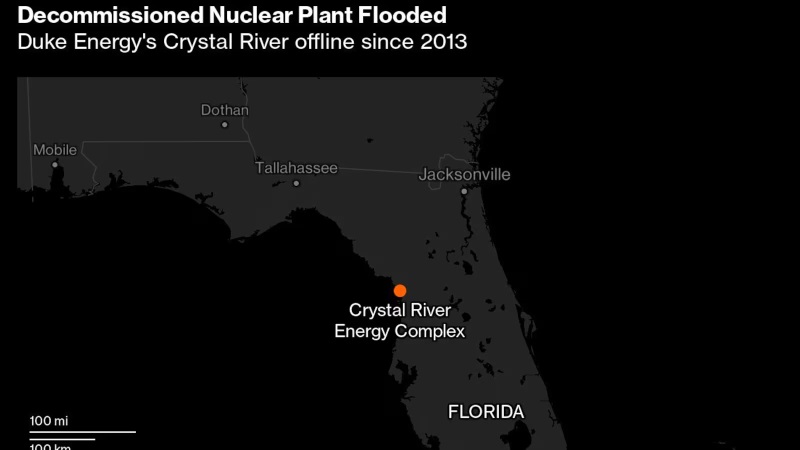
Hurricane Helene Floods Closed Duke Nuclear Plant in Florida
By Ari Natter, September 28, 2024 , https://www.bnnbloomberg.ca/investing/2024/09/28/hurricane-helene-floods-retired-duke-nuclear-plant-in-florida/
(Bloomberg) — Floodwaters from Hurricane Helene have swamped a retired Duke Energy Corp. nuclear power plant, according to a filing with the Florida Department of Environmental Protection, though an escape of contaminated fuel appears unlikely.
The Crystal River plant, which has been shuttered since 2013, experienced a storm surge of as much as 12 feet, according to the filing, which was posted online.
“The whole site was flooded, including buildings, sumps, and lift stations. Industrial Wastewater Pond #5 was observed overflowing to the ground due to the surge,” according to the report, which was filed Friday, the day after Helene roared ashore.
“We are still in the process of obtaining access and assessing the damage, but due to the nature of this event we anticipate difficulty with estimating the total discharge amount of wastewater, and impacts are unknown at this time,” the report said.
The used nuclear fuel at the site remains secure, Duke Energy said in a statement Sunday. “All radioactive material has been segmented and permanently packaged in shielded containers impervious to the effects of extreme weather,” the company said.
The facility, just south of Cedar Key, is still in the process of being dismantled. It’s likely that the spent fuel, which is kept onsite in dry storage, is safe, Edwin Lyman, a nuclear specialist with the Union of Concerned Scientists, said in an email before Duke Energy commented.
“There is probably still quite a bit of low-level radioactive waste awaiting shipment, and it’s likely the site wastewater has low levels of radioactive contamination,” Lyman said in an email. “Although anything is possible, based on the Fukushima experience, if the storage area were immersed in water for a short period of time, there is unlikely to be significant damage or leakage from the canisters.”
The site also flooded in 2023 after Hurricane Idalia made landfall, according to a report in Newsweek, that said spent fuel was scheduled to remain on site until 2037.
–With assistance from Tony Czuczka.
Nuclear Weapons and the U.S. Presidential Elections

by beyondnuclearinternational, https://beyondnuclearinternational.org/2024/09/29/nuclear-weapons-and-the-u-s-presidential-elections/
Whoever becomes the next US president, we’ll need to redouble our efforts for nuclear abolition, writes Jackie Cabasso
Nuclear weapons policy is not an issue in the presidential election. In fact, U.S. foreign policy, with the exception of some controversy over ongoing U.S. arms provisions to Israel, is barely an issue. Even though nuclear weapons are in the media more than they have been for many years—due mainly to the Russian government’s nuclear threats, and to some extent, North Korea’s, there is basically no public discussion or political debate about nuclear weapons in the United States.
The political situation in the U.S. is more volatile and uncertain than at any time in my life. Predicting who is going to be elected president in November is impossible. In the short weeks since President Biden withdrew from the campaign and threw his support behind his vice president Kamala Harris, there has been an extraordinary outpouring of enthusiasm for her campaign, especially among young people and people of color, and a massive surge of financial support from a wide range of constituencies. But at this point, the outcome of the presidential election is too close to call.
What I can say is that U.S. national security policy has been remarkably consistent in the post-World War II and post-Cold War eras. “Deterrence” – the threatened use of nuclear weapons – has been reaffirmed as the “cornerstone” of U.S. national security policy by every president, Republican or Democrat, since 1945, when President Harry Truman, a Democrat, oversaw the atomic bombings of Hiroshima and Nagasaki.
If Kamala Harris is elected in 2024, we can expect more of the same. As confirmed in an August 20, 2024, New York Times story that attracted some notice, an initiative is quietly underway by the Biden administration to beef up the U.S. nuclear arsenal. As reported by the Times, in March, President Biden approved a highly classified “Nuclear Employment Guidance” plan that seeks to prepare the United States for possible coordinated nuclear challenges from China, Russia and North Korea. This comes as the Pentagon believes China’s nuclear arsenal will rival the size and diversity of the U.S.’ and Russia’s over the next decade.
This plan was hinted at by Vipin Narang, a top Department of Defense nuclear policy official, who recently stated that, while current modernization plans — estimated to cost at least $350 billion over the next two decades — are “necessary,” they “may well be insufficient” to meet current and future threats. According to Narang, in the face of growing threats from Russia, China and North Korea, “We have begun exploring options to increase future launcher capacity or additional deployed warheads on the land, sea and air legs that could offer national leadership increased flexibility, if desired, and executed.”
According to the head of the National Nuclear Security Administration, Jill Hruby, the U.S. is launching a new nuclear arms race to catch up with and outsmart Russia and China. “We now have seven systems that should be developed and put into production by the mid-2030s. This program is not only a major modernization of all three components of the nuclear triad, but also adds new deterrence capabilities that do not currently exist,” she said.
Donald Trump’s likely nuclear policy is spelled out in a manifesto by Project 2025, a coalition of far-right groups led by the Heritage Foundation. Its 900-page book, “Mandate for Leadership,” is a blueprint for the most dramatic takeover and transformation of U.S. democracy in history and is widely seen as the playbook for a possible second Trump administration.
Trump himself, and a number of Republican members of Congress, have attempted to distance themselves from Project 2025, in some cases, claiming they haven’t even heard of it. This is not plausible. Speaking at a 2022 Heritage Foundation event, Donald Trump declared, “[T]his is a great group. And they’re going to lay the groundwork and detail plans for exactly what our movement will do and what your movement will do when the American people give us a colossal mandate to save America and that’s coming.”
Project 2025 proposes that a second Trump administration prioritize nuclear weapons programs over other security programs, accelerate the development and production of all nuclear weapons programs, increase funding for the development and production of new and modernized nuclear warheads, and prepare to test new nuclear weapons.
Separately, Robert O’Brien, an ex-adviser to former President Trump, has written that in order to counter China and Russia’s continued investments in their nuclear arsenals, the U.S. should resume nuclear testing.
While she did not mention nuclear weapons in her presidential nomination acceptance speech, Kamala Harris chillingly pledged, “As Commander-in-Chief, I will ensure America always has the strongest, most lethal fighting force in the world.” A Harris administration would undoubtedly be far more progressive on domestic issues, but whoever wins the U.S. presidency, our redoubled efforts to press for nuclear abolition will remain an urgent necessity.
Japan’s new Prime Minister calls for deployment of US nuclear weapons
MILITARNYI 29 Sept 24
Japan’s new Prime Minister Shigeru Ishiba considers it necessary to discuss the prospect of deploying US nuclear weapons.
The deployment of nuclear weapons in the Asia-Pacific region should be discussed during the revision of the agreement on the status of the US contingent in Japan.
He also called for the creation of the country’s own nuclear arsenal to strengthen national security. According to Mr. Ishiba, the absence of a collective self-defense system similar to that of NATO in Asia creates a risk of new military conflicts in the region.
In particular, he expressed concern about China’s growing military activity around the Japanese islands…………………………….
The Asian version of NATO should specifically consider the joint use of nuclear weapons with the United States or the introduction of nuclear weapons into the region.
Officially, Shigeru Ishiba will become the new Prime Minister of Japan on October 1 after being approved by the parliament.
Since the 1990s, the politician has been actively involved in defense issues. He has consistently advocated for expanding the use of the Japan Self-Defense Forces and revising the pacifist provisions of the postwar Constitution………………..
In September, it was reported that the United States expressed an interest in deploying its MRC Typhon medium-range missile system with Tomahawk missiles to Japan…………………………….. more https://mil.in.ua/en/news/japan-s-new-prime-minister-calls-for-deployment-of-us-nuclear-weapons/
Ukraine army attacks nuclear plant substation: Russia
Canberra Times, September 30 2024
The management of the Russian-held Zaporizhzhia nuclear power station says Ukrainian forces have launched a new attack on a nearby electricity substation, destroying a transformer.
The Zaporizhzhia station, Europe’s largest with six reactors, was seized by Russian forces in the early days of Russia’s February 2022 invasion of Ukraine.
Each side regularly accuses the other of attacking or plotting to attack the plant.
The plant’s management, writing on Telegram, said an artillery strike had hit the transformer at the “Raduga” substation in the town of Enerhodar in southeastern Ukraine.
It described the incident as “yet another terrorist act aimed at destabilising the situation in the Zaporizhzhia nuclear plant’s satellite city”.
Also posted was a photograph showing smoke billowing from the top of a building.
It said power supplies to Enerhodar had not been interrupted.
The plant’s management accused the Ukrainian military on September 20 of attacking a second substation in Enerhodar.
The following day, Ukrainian Foreign Minister Andriy Sybiha accused Russia of planning strikes on Ukrainian nuclear facilities before the winter.
He provided no detailed explanation.
Power lines to the Zaporizhzia plant have been cut on several occasions, increasing the chance of a blackout that could cause a nuclear accident.
The United Nations nuclear watchdog, the International Atomic Energy Agency, has stationed monitors permanently at the plant and urged both sides to refrain from all attacks on it…………………………………………………………………………………. https://www.canberratimes.com.au/story/8777883/ukraine-army-attacks-nuclear-plant-substation-russia/
Charities call for greater transparency over Sizewell C
Bird Guides, 29 Sept 24
Suffolk Wildlife Trust and the RSPB have called for greater transparency from Sizewell C in relation to its wildlife compensation schemes.
Earlier this month, developers of the nuclear power station announced a new partnership with the nature-restoration movement WildEast to promote the return of land to nature across the region.
In announcing the partnership, Sizewell C flagged up how it had pledged to return a large part of the land to nature during the construction of the new power station.
Not doing enough
Its involvement in leading on a wildlife habitat scheme at Wild Aldhurst NR in Leiston was mentioned, along with plans for wetland habitat creation at three nature reserves at Benhall, Halesworth and Pakenham.
Planning consent obligations mean that the developers of the new power station, situated just to the south of the RSPB’s flagship Minsmere reserve, must offset damage caused by the construction by creating new areas for nature.
However, in a joint statement with the RSPB, Suffolk Wildlife Trust – which has long held concerns – spoke of its “real disappointment” that Sizewell C had included the work at the three nature reserves, which is part of its legal duty to compensate for the impacts of the power station’s construction on wildlife.
Misrepresented
The charities said the projects were a “minimum requirement,” but were being “misrepresented” as examples of the developers going the extra mile for nature.
A spokesperson for the trust said: “People have a right to expect far better transparency from Sizewell C when it comes to its wildlife compensation. Sizewell C must do better to be clear about the compensation they are required to deliver by law, versus what is truly ‘additional’ for nature.”………………………………………… https://www.birdguides.com/news/charities-call-for-greater-transparency-over-sizewell-c/
The Illusion of a Solution: Killing Hassan Nasrallah
Australian Independent Media, September 29, 2024, by: Dr Binoy Kampmark,
The ongoing Israeli operation against Hezbollah, the Iranian-backed militia group so dominant in Lebanon, is following a standard pattern. Ignore base causes. Ignore context. Target leaders, and target personnel. See matters in conventional terms of civilisational warrior against barbarian despot. Israel, the valiant and bold, fighting the forces of darkness.
The entire blood woven tapestry of the Middle East offers uncomfortable explanations. The region has seen false political boundaries sketched and pronounced by foreign powers, fictional countries proclaimed, and entities brought into being on the pure interests of powers in Europe. These empires produced shoddy cartography in the name of the nation state and plundering self-interest, leaving aside the complexities of ethnic belonging and tribal dispositions. Tragically, such cartographic fictions tended to keep company with crime, dispossession, displacement, ethnic cleansing and enthusiastic hatreds.
……………………………………………………… The Israeli strategy in this latest phase was made all too apparent by the number of military commanders and high-ranking operatives in Hezbollah the IDF has targeted. Added to this the pager-walkie talkie killings as a prelude to a likely ground invasion of Lebanon, it was clear that Hezbollah’s leader, Sayyed Hassan Nasrallah, figured as an exemplary target.
……………………..Israeli officials have been prematurely thrilled. Like deluded scientists obsessed with eliminating a symptom, they ignore the disease with habitual obsession. “Most of the senior leaders of Hezbollah have been eliminated,” claimed a triumphant Israeli military spokesman Lieutenant Colonel Nadav Shoshani.
Defence Minister Yoav Gallant called the measure “the most significant strike since the founding of the State of Israel.” Israeli Prime Minister Benjamin Netanyahu stated with simplicity that killing Nasrallah was necessary to “changing the balance of power in the region for years to come” and enable displaced Israelis to return to their homes in the north.
Various reports swallowed the Israeli narrative…………………………………………………………………………………..
Ibrahim Al-Marashi of California State University, San Marcos, summarises the efforts of Israel’s high-profile killing strategy as shortsighted feats of miscalculation. “History shows every single Israeli assassination of a high-profile political or military operator, even after being initially hailed as a game-changing victory, eventually led to the killed leader being replaced by someone more determined, adept and hawkish.” Another Nasrallah is bound to be in tow, with several others in incubation. https://theaimn.com/the-illusion-of-a-solution-killing-hassan-nasrallah/
Mistaking Militarism for Statecraft, Empire for Democracy and Debt for Prosperity

No strategy to the war game, no accounting to our economy, we have fumbled and stumbled to the precipice of global war, now led by a Democratic Administration
Dennis Kucinich, Substack, Sep 27, 2024
As of May 2024, the United States has committed over $175 (borrowed) billion to escalating the proxy war against Russia, and, as in the case of the Iraq and Afghan wars, with little regard for accountability pertaining to tracking military hardware, equipment, funding, or fraud prevention.
One of the most grotesque moments in this bloody global Punch and Judy show preliminary to nuclear war, was the recent arrival of Vladimir Zelenskyy, former president of Ukraine, making a campaign stop at an ammunition factory in Scranton, Pennsylvania, where some of the three million 155mm artillery shells the US has given Ukraine are produced.
Alongside Zelenskyy, in an incitement-op photo promising further escalation of war, the Democratic Governor of Pennsylvania autographed one of the high-velocity artillery shells which will be aimed at Russia. Pennsylvania, which is home to the City of Brotherly Love, was unwitting re-Christened by its top official, with a cursive flair, as the state of brotherly hate.
The fervor of warmongering, fueled by machismo and high bravado illustrates the failure of leadership and a fatal ignorance of the diplomatic process. We should be exercising the science of human relations, not propelling a hubristic and ego-driven brinkmanship which accelerates the dialectic of war.
For decades I have led opposition to war and advocated for the transformation of America’s prevailing policy of “Peace through Strength” to a forward-looking policy of “Strength through Peace.”
I challenged the Bush II Administration’s foreign policies, and introduced Articles of Impeachment against President George W. Bush and Vice President Dick Cheney over Iraq and the lies which led us into war. Illegal and unnecessary, the Iraq war (debt-funded and authorized by both Democrats and Republicans) has cost our nation over $3 trillion, and the loss of 5,000 of our brave men and women who serve and injuries to countless more troops.
The war caused the deaths of over one million Iraqis. Let that sink in. One million Iraqis perished in a war based on lies. Iraq had nothing to do with 9/11. The war further damaged America’s global reputation and set us upon a path where, since 9/11, America has borrowed $8 trillion to keep the war machine in tune as our own nation’s pressing domestic needs for housing, health care, education, child care, and retirement security have been set aside.
When I heard Vice President Harris brag about former Vice President Dick Cheney endorsing her candidacy, that put the exclamation point on the fact that the leaders of the Democratic party are for war. I am not.
Why else would Vice President Harris become the front person for such virulent bravado, invoking lethality abroad?
A paradox of this campaign is that the much-villainized former President Trump, (representing a party that has also taken us into unnecessary wars) is the one who speaks to the need to negotiate and to talk directly with potential foes in order to avoid war, or to end it. …………………………………………….
a faulty military strategy is based upon baiting one’s targets to have an excuse to attack preemptively. This type of thinking isn’t about taking care of and protecting our allies. I would call it lunacy but it happens far more frequently than once every full moon! We need level-headed leadership, not political actors mindlessly playing in the flash of WWIII, pandering for votes or for cash from the military industrial complex.
The U.S. government’s endless quest to instigate, fulminate or otherwise set our nation on a path of either participating in or of funding endless war has become an inconscient force which is now sweeping up nations in its maw and, if left unchecked, with soon draw in American troops and inevitably a world war will come home in ways that no one in the continental United States has ever experienced, far exceeding the horrors of 9/11.
………………..Ronan Farrow, in his brilliant book “War on Peace, the End of Diplomacy and the Decline of American Influence,” traced the catastrophe of substituting militarism for statecraft.
So we arrive at a point where we fully fund war in the Middle East, and, astonishingly stand helpless, vainly begging the recipients of our billions of dollars, our weapons, “intelligence,” and of our strategic advice – not to expand the war we are paying for, not to visit death upon innocents. …………………………………………………
Two years ago, the US, with the back door machinations of Britain’s Boris Johnson, rejected a peace agreement which would have kept Ukraine neutral, restored the peace and spared the lives of hundreds of thousands of Ukrainians and Russians.
Instead, we now trot out muddle-headed EU politicians and our NATO sock puppets to support advancing the war deeper and deeper into Russia, sending missiles with more and more destructive power, hyping the fantasy of capsizing the government of a country which remembers losing nearly 30,000,000 people in World War II, during which Russia was on our side.
…………………………………………………..Do you remember how back in October 2022, thirty Members of the U.S. Congress’ Democratic Progressive Caucus signed a letter calling for President Biden to consider diplomacy, and then in a matter of hours were pressured to retract the letter? The Members were reprimanded by the Administration and the Democratic leadership for their advocacy of peace.
In that withdrawn, forbidden letter, the Progressive Members stated,
“The risk of nuclear weapons being used has been estimated to be higher now than at any time since the height of the Cold War. Given the catastrophic possibilities of nuclear escalation and miscalculation, which only increase the longer this war continues, we agree with your goal of avoiding direct military conflict as an overriding national-security priority. Given the destruction created by this war for Ukraine and the world, as well as the risk of catastrophic escalation, we also believe it is in the interests of Ukraine, the United States, and the world to avoid a prolonged conflict. For this reason, we urge you to pair the military and economic support the United States has provided to Ukraine with a proactive diplomatic push, redoubling efforts to seek a realistic framework for a ceasefire.”
Later in April 2023, nineteen Conservative Republicans, including now VP candidate Senator J.D. Vance, similarly communicated to the Administration the perils of escalating the war without diplomatic strategy…………………………………………………………………………………
And so, the U.S. forks over endless rivers of U.S. taxpayers’ cash for endless wars, without any thought of how this all ends, or how or who ultimately pays. Red or blue, there are no winners in a war devouring our lives, our blood and our national wealth.
There is madness to all of this. Our so-called leaders are whistling merry tunes through the graveyard of history, mocking the dead of Hiroshima and Nagasaki, because it happened to THEM, not us. Because something like that could never happen to us. Because we are smarter and stronger and have God on our side.
It is time to wake up, America. It is time to stop this madness which presents as legitimate governance, and to think, to speak and to stand for peace, diplomacy and the continuation of life on our small planet.
A sense of urgency requires me to speak out for the common good, with common sense, to illuminate the truth, to show a better way as a response to those who would lead America, and the world, further down a path towards destruction.
I am running for Congress as an Independent, with allegiance to America, not one political party, in OH-7. Please join our movement at www.Kucinich.com https://denniskucinich.substack.com/p/mistaking-militarism-for-statecraft?utm_campaign=email-half-post&r=l0q44&utm_source=substack&utm_medium=email
The Israeli nuclear risk no one is talking about

Israel’s ability to build and deploy nuclear weapons, while never officially acknowledged, remains at the heart of its security doctrine
September 27, 2024 https://inews.co.uk/news/world/what-happens-us-stops-supporting-israel-3296914
A tenuous and inherently unstable military stand-off between Israel and Hezbollah – has finally shattered.
The latest outbreak in fighting is certain to result in increasing civilian casualties as Israel and Hezbollah exchange fire across the border.
As Israel faces numerous threats its possession of nuclear bombs lurk behind the growing debate over arms supplies to the nation.
Israel’s use of US-supplied weapons in Gaza in the past year has already forced the Biden administration to address the option of limiting the supply of US arms if US officials determine that Israel has committed gross human rights violations or blocked the movement of humanitarian assistance.
In addition, Senator Bernie Sanders is preparing several resolutions that would affect more than $20bn (£15bn) in US arms sales to Israel.
There is no chance that such measures will pass, but that is not the point. As an AP report noted, “the move is designed to send a message to the Netanyahu regime that its war effort is eroding the US’s long-time bipartisan support for Israel.”
Indeed, Washington and Jerusalem must face the unwelcome fact that such actions by Congress or the White House, however symbolic, may well undermine the longstanding bargain that not only keeps Israel’s conventional arsenals full … but also ensures that its nuclear bombs stay in the basement – undeclared and shrouded in a veil of ambiguity.
The Jewish state has long enjoyed a nuclear weapons monopoly in the region, and its ability to build and deploy nuclear weapons, while never officially acknowledged, remains at the heart of its security doctrine.
In the first days of the October 1973 “Yom Kippur” War, for example, Israel is believed to have placed a small number of nuclear warheads on alert and may have considered their deployment to stop a Syrian tank advance into Israel’s heartland.
It is no accident that Israel has never acknowledged having nuclear weapons. US policies developed in the aftermath of the June 1967 Six Day War have played a critical role in shaping Israel’s conventional and nuclear superiority.
Washington did oppose Israel’s nuclear weapons activities in the 50s and 60s. In the wake of the June 1967 war, however, a quid pro quo with Israel was established.
In return for Israel maintaining a policy of nuclear weapons ambiguity, Washington would guarantee what was termed Israel’s “qualitative military edge” – QME. That is, Washington will ensure that as long as Israel keeps its “bombs in the basement” – undeclared, unacknowledged, and unused – Washington will guarantee Israel the conventional weapons arsenal necessary to defeat any combination of regional enemies.
In the decades since, every change in US political or defence policy, every diplomatic or military engagement with Israel, has featured a ritualistic reaffirmation of Washington’s commitment to maintain Israel’s QME. See for example, the Democrats’ election platform, which declares that “our commitment to Israel’s security, its qualitative military edge, its right to defend itself … is ironclad.”
Indeed, the State Department recently reaffirmed that “the US is by statute mandated … to guarantee that … Israel has a qualitative military edge over rivals in the region. It’s not a discretionary question. It is a statutory requirement, and it is one that we are committed to.,, There is also an important deterrent effect to the United States continuing to send a message to Israel’s adversaries that if they attack Israel, we will defend it. And that’s a message that we will continue to send loud and clear.”
Since Israel’s peace treaty with Egypt in 1979, Iran under the rule of the ayatollahs has been deemed the biggest challenge to Israel’s regional hegemony in both the conventional and nuclear realms. and the biggest test of “ironclad” US support for QME.
Notwithstanding an officially declared intention to refrain from creating a nuclear weapons option, Iran’s production of highly enriched uranium continues.
Iran’s stock of uranium in the form of uranium hexafluoride enriched to up to 60 per cent purity, close to the roughly 90 per cent of weapons grade, grew an estimated 22.6kg to 164.7kg, according to a confidential quarterly International Atomic Energy Agency report recently sent to member states. According to an IAEA yardstick, that is 2kg short of being enough, in theory, if enriched further, for four nuclear bombs.
US Secretary of State Antony Blinken observed in July that “instead of being at least a year away from having the breakout capacity of producing fissile material for a nuclear weapon, (Iran) is now probably one or two weeks away from doing that… what we’ve seen in the last weeks and months is an Iran that’s actually moving forward” with its nuclear programme.
One might think that the prospect of a nuclear stand-off in the Middle East might arouse an international chorus of concern, especially since Blinken’s plaintive warning about a nuclear Iran is part and parcel of the metastasizing failure of US led effort to stabilise the cascading crises already consuming the heart of the Middle East.
Iran has declared its opposition to the development of a nuclear weapons capability and has shown no progress in integrating such a capability as part of its strategic doctrine.
Nevertheless, as Blinken’s remarks illustrate, Iran is proceeding with developing critical constituent parts necessary to achieve a weapons capability while retaining a veil of ambiguity about its intentions.
In the wake of the demise of the JCPOA, Iran’s cultivation of nuclear ambiguity has established a new policy framework for its continuing nuclear programme and tested the continuing relevance of Washington’s commitment to QME.
The blowback from the Gaza war, has had an unexpected and unwelcome impact on this long-held policy.
National Security Memorandum, NSM-20 requires US military aid recipients to provide “credible and reliable assurances” that they will abide by international law when using the weapons or risk losing access to US arms. Israel, it is argued, has violated laws prohibiting the transfer of American military aid to governments that have committed gross human rights violations or blocked the movement of humanitarian assistance.
Prime Minister Benjamin Netanyahu wants Washington to swing the pendulum in the opposite direction. “Give us the tools faster,” he advised Congress, “and we’ll finish the job faster.”
A US decision to withhold arms for Gaza won’t affect the course of the war and it is in any scenario unlikely.
But any US action along such lines, however symbolic, will no doubt test Israel’s confidence in the continuing US commitment to the broader security assurances at the heart of QME, which, like it or not, has succeeded over the decades in restraining the nuclear weaponisation of the entire region and preserved Israel’s nuclear weapons monopoly.
Indeed, the current crisis creates an opportunity for Israel to exploit the relative freedom enabled by Washington’s ineffectual Gaza diplomacy and to test its support for QME to destroy two threats at the heart of Israel’s security doctrine – to destroy Iran’s nuclear and missile infrastructure and to defeat the Iran-led axis now active along Israel’s frontiers.
Should Washington fail the QME test in Israel’s eyes, it might well precipitate a dramatic change in Israel’s nuclear doctrine – ending the thin veil of ambiguity about Israel’s nuclear weapons arsenal and sparking a regional nuclear arms race.
Policies that make sense in Jerusalem, however, may not survive scrutiny in Washington. The Biden administration continues to give its “partner” Israel an unprecedented free hand in Gaza, the West Bank and now Lebanon.
And it is taking extraordinary pains to demonstrate its “ironclad” commitment to QME, and thus keep the lid on a potential slide towards the nuclearisation of the crisis and an explicit change in Israel’s nuclear deployment and war fighting doctrine.
President Biden strives to contain rather than confront. He has no interest in prompting a crisis of confidence between Washington and Jerusalem that raises questions about Washington’s commitment to QME and its unwritten support for Israel’s nuclear monopoly. So he is deploying unprecedented military and diplomatic resources, so far without success, to prevent a hot war that has the potential to define the region and perhaps beyond for generations.
Geoffrey Aronson writes about Middle East affairs. He consults with a variety of public and private institutions dealing with regional political, security, and development issues. He has advised the World Bank on Israel’s disengagement and has worked for the European Union Coordinating Office for the Palestinian Police Support mission to the West Bank and Gaza
Despite vastly different social and political contexts, Finland, Germany and France are all grappling with the question of safe nuclear waste disposal.
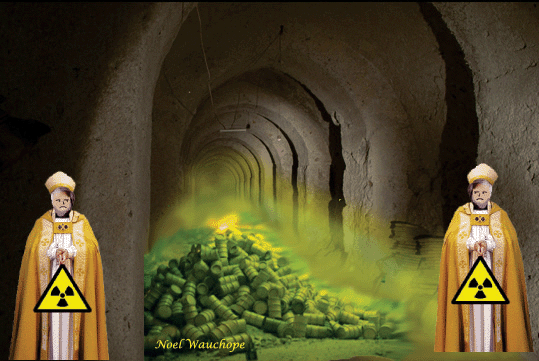
“At first, there was strong opposition to the reactors, but it eventually disappeared”,……… One explanation lies in the massive financial support provided by the nuclear power plant operator, TVO, to the municipality of Eurajoki. ……………………………..[Opponents] all share a common trait: they feel that they have been silenced, either by unspoken ostracisation or by more explicit confrontations.
The waste to be stored in Cigéo amounts to only 3 per cent of France’s waste, but 99 per cent of its radioactivity.
in a leaked document produced by a Land Operations Engineer of Andra, consulted by Equal Times, farmers of the region are listed and labelled according to whether they have been or can be “managed”.
By Guillaume Amouret, Michalina Kowol, Maxime Riché, 24 September 2024 https://www.equaltimes.org/despite-vastly-different-social?lang=en
“It looks just like wallpaper,” Jean-Pierre Simon says, pointing at the dark green line of trees that separate the fields, now glimmering in the setting sun. It is a landscape that he has admired for decades. “But soon, there will be a railway, and a train carrying nuclear waste on the horizon,” laments the farmer, his voice becoming bitter. His family has been living here, near Bure in the Meuse department of north-eastern France, for three generations. The question is, how many more generations will stay here to cultivate these fields in the future.
“Our goal is to reconcile the economy with our planet,” promised Ursula von der Leyen when she presented the adoption of the European Green Deal in 2019, shortly after she first assumed the presidency of the European Commission. Two years later, the European Parliament adopted the European Climate Law, which promised to turn the European Union climate-neutral by 2050. Another year later, in 2022, the European Parliament agreed to label both natural gas and nuclear power investments as climate-friendly sources of energy. In the latest European elections, held in June 2024, the centre-right European People’s Party, led by von der Leyen, again secured the majority of the seats.
But EU member states remain divided when it comes to investing in – and relying on – nuclear energy. On one hand, there’s France, which currently produces around 70 per cent of its electricity using nuclear power, and which recently passed a law to facilitate the construction of six (and up to 14) new reactors. In 2023, Finland’s first European Pressurised Water Reactor (EPR) in the country’s second nuclear power plant, Olkiluoto, started regular production; the country’s first nuclear power plant, Loviisa, began operating in 1977. And while some EU countries, like Poland, are planning to start building their first nuclear power plants in the coming years, others – like Germany – have opted out of nuclear energy production. The country’s last remaining nuclear power plants were closed in April 2023.
But it is not only the process of producing nuclear energy that sparks controversy, especially after the devastation caused by the accidents in Chernobyl (in Ukraine in 1986) and Fukushima (in Japan in 2011). Countries that have produced and relied on nuclear energy, like France, Germany and Finland, all face the same question: how to safely dispose of nuclear waste?
Finland: silenced detractors amid widespread support
Finland is considered one of the forerunners when it comes to nuclear energy. Roughly 20 years ago, the municipality of Eurajoki in western Finland not only accepted the erection of an EPR nuclear power generator but also the digging of Onkalo. Finnish for ‘cave’, it is a repository for spent nuclear fuel. It will become the first of its kind in the world at its opening, planned for 2025, after €900 million of construction costs. The overall cost is expected to reach €5 billion.
Run by the Finnish energy company Posiva Oy about 240 kilometres from Helsinki and situated 400 metres under the surface of the Earth, dug into the Finnish granite bedrock, Onkalo will become the final resting place for used nuclear fuel rods originating from the country’s five reactors: three on the island of Olkiluoto, right next door, and two in Loviisa in the south-east of the country.
The Onkalo project works according to the KBS-3 model, first developed in Sweden: spent fuel rods are inserted in copper cylinders, which offer the first barrier against the propagation of radioactive materials. The cylinders are then put in slots dug into granite. Finally, bentonite clay seals the copper capsules in their slots and fills in the deposition tunnels, and acts as a buffer between the copper and the granite.
One explanation lies in the massive financial support provided by the nuclear power plant operator, TVO, to the municipality of Eurajoki. In 2022, over a total of €57 million in tax revenues for the town, TVO would have paid €20 million in property taxes, according to Eurajoki’s mayor.
Sirkka supports the presence of TVO and the Onkalo, like most of the inhabitants of Eurajoki that Equal Times spoke to. Their trust could be considered as representative of the Finnish population nowadays. If acceptance of nuclear power was under 25 per cent back in 1983, it jumped to 61 per cent in 2024, according to a recent poll. And negative views decreased from 40 per cent to 9 per cent during the same time period.
But this does not mean that everyone agrees to the project.
We spoke to several residents – either historical opposition figures involved for decades in the protests against the construction of Onkalo or younger people, active until recently – who asked to remain anonymous. They all share a common trait: they feel that they have been silenced, either by unspoken ostracisation or by more explicit confrontations.
Some went as far as intimidating those against the plan, “sometimes walking under their windows with rifle guns”, as one person recalls. Another person we met had the feeling that because her opposition to the project was publicly known, she slowly lost her friends and had to search for work in other cities, further and further away from her hometown. She felt local employers would not want to hire her because of her opinions – although none explicitly gave this reason. Another opponent, after being involved in one of the marches organised against nuclear energy a few years ago, suffered from violent police repression and also decided to drop the fight, seeking refuge in a secluded property, far away from those painful memories.
On the other side of the Bothnia Gulf, work by researchers at the KTH Royal Institute of Technology in Stockholm, Sweden, questions the durability of copper containers in the long term. To offer protection from any radiation, the capsules would have to hold the nuclear waste safely for 100,000 years. But in a study published in January 2023, the corrosion scientist Jinshan Pan and his team point out the risks regarding embrittlements, cracks and corrosion due to sulphides in groundwater and called for “a comprehensive understanding of the corrosion mechanism […] to provide a solid scientific basis for the risk assessment of copper canisters in the final disposal of nuclear waste”. In a nutshell, he called for more studies on copper corrosion. The operator of Onkalo, Posiva, opposed these findings, arguing that sulphide levels are low enough to ignore this particular type of corrosion. It has not conducted any new research on the topic so far.
Germany’s nuclear phase-out
While Finland races ahead to be the first country to have a fully functioning spent nuclear fuel deposit, other countries like Germany seem to be far from even designing a location.
It all started on shaky ground in 1977, as a salt dome near Gorleben, right between Hamburg and Berlin, was designated to be the last resting place for spent nuclear fuel.
This decision sparked a massive opposition movement, which contributed to forming the ‘Anti-Atom-Bewegung’, the anti-nuclear-movement in Germany. Wolfgang Ehmke, spokesperson of the Bürgerinitiative Lüchow-Dannenberg, the anti-nuclear movement near Gorleben, is an activist of the first hour. To him, the nuclear phase-out in Germany is “not only due to our action, but also a series of lucky and unlucky events”.
The first phase of the new search terminated in 2020 and stated de facto that Gorleben is not suited for such an infrastructure. Its geological characteristics did not meet the conditions which the future disposal site should respond to.
The location analysis is currently making slow but steady progress. In a recent interview with the local newspaper Braunschweiger Zeitung, the president of the federal agency for nuclear wastes disposal (BGE), Iris Graffunder, explained that ten potential locations should be set for 2027. However, a final decision on the location will not be announced before 2046.
As for Gorleben, the federal agency for nuclear waste disposal announced its dismantlement last year. The salt that was dug out from the site for the construction and stored in a heap ever since, should be returned to the dome later this year. Observing every action and gesture of the agency, Bürgerinitiative Lüchow-Dannenberg remains critical concerning the date: “We are still waiting for the announced test run, before the final dismantlement,” explains Ehmke. Until then, its maintenance will have cost €20 million per year.
High tension over new waste repositories in France
Swallows fly in and out of Jean-Pierre’s barn, which provides shelter and shade on a hot June evening. JP, as everybody in Bure knows him, now armed with a rake, has been working since the early morning – like he does every day. A row of white and brown cows chew lazily on their hay. Only every now and then a low-pitched moo breaks the silence.
But Bure, in north-eastern France, about 300 km east of Paris, is far from quiet. The village, home to about 80 people, is the main stage of a political fight between the French state and anti-nuclear activists. Here, demonstrators have clashed with police on numerous occasions. In 2018, about 500 policemen were mobilised to evacuate protesters occupying a nearby forest. Even today, tensions are still palpable in Bure and the neighbouring villages. Police cars patrol the streets frequently, inhabitants denounce house searches and living under constant police supervision.
The reason? Bure’s underground is a construction site. France’s nuclear waste repository – named Cigéo for “industrial centre for geological deposit” – is supposed to store a total of 83,000m³ of high-level, long-life and medium-level nuclear waste. France produces around 70 per cent of its electricity from nuclear power.
Some of the demonstrators who came to Bure to support the local protest decided to stay and revive the countryside with sustainable farming. Like Mila and Jan, who hoped to start a new chapter in their lives here, far from the clamour of the city. Their dream is to raise goats: “We would like to produce our own goat cheese, to have just enough for ourselves and perhaps sell or exchange with others,” says the young couple who until recently, lived in an old house in a village next to Bure. However, this summer, they were forced out by the prefecture. While local authorities invoked the apparently ‘unsanitary conditions’ of the habitation, Jan and Mila’s landlord is convinced that the mayor of the village simply doesn’t want anyone who opposes Andra, the French national agency for nuclear waste management, to settle in the municipality. Since last year, Andra embarked on an unprecedented large-scale appropriation programme to acquire the land needed to construct the deposit.
Despite the nuclear waste’s high radioactivity levels, Andra has offered assurances that the location in Bure is safe: Cigéo is being constructed within a layer of Callovo-Oxfordian clay, deposited on-site about 160 million years ago. The conditioning of the waste and the protective layer of clay rock will help to avoid radioactive dispersion, the agency says. The storage is designed to remain safe during its operation for 100 years, as well as after its closure, for another 100,000 years. The deep storage project should enter its pilot phase in 2035.
But whether generations-old farmers like JP, or newcomers like Jan and Mila, will be able to continue their lives here is a different question. Andra plans to acquire an additional 550 plots to continue with the construction of its mega-project. Cigéo was declared of public interest in 2022, so the company now has the right to expropriate landowners. “I am 64, it is time for me to retire,” says JP. “My son applied to take over the farm, but Cigéo also covets some of my land parcels,” he laments. The agency recently asked for an extra strip of land alongside the former railway that will become the transportation channel for incoming spent nuclear fuel, and this further threatens the viability of JP’s plots, which would become much harder to work – or sell – if Andra’s request is granted.
In January 2023, Andra submitted an application to the national nuclear security agency, IRSN (Institute for Radiation Protection and Nuclear Safety), to authorise the construction of the final disposal in place of the current underground laboratory. After a reform of the nuclear security agency last year, and the termination of its previous president’s mandate, its new head was nominated in May 2024. And it is no less than the current president of Andra, Pierre-Marie Abadie, designated by President Emmanuel Macron. This choice raised doubts regarding the integrity of the entire project’s authorisation process, as critics pointed out conflict of interests.
“For now, we don’t see the bulldozers smashing the ground,” says JP. But he still remains sceptical: “I have doubts about my ability to stay here, should my farm be taken over. But I don’t have much time to reflect and think,” he says.
For now, JP must go back to work.
This article was developed with the support of Journalismfund.eu.
Scottish National Party blasts Labour for ‘frittering away’ money on nuclear plant instead of winter fuel payment
The party’s energy spokesperson Dave Doogan said Labour “is more concerned with funding needless nuclear projects… than it is with supporting hard-pressed pension
Andrew Quinn, Westminster Reporter, 28 SEP 2024.
https://www.dailyrecord.co.uk/news/politics/snp-blasts-labour-frittering-away-33767683
The SNP has claimed the Labour Government is “frittering away” £5 billion on a nuclear power plant while cutting the Winter Fuel Payment.
The party’s energy spokesperson Dave Doogan said the party is “more concerned with funding needless nuclear projects… than it is with supporting hard-pressed pensioners.”
The UK Government announced earlier this month that an extra £5.5bn is being made available to the Sizewell C nuclear power plant.
The plant is being built in Suffolk and the UK Government has said it will help secure the country’s energy independence. It will supply up to seven per cent of the UK’s energy needs but won’t start generating electricity until the 2030s.
t comes after the Labour Government decided to make the Winter Fuel Payment means-tested. Nearly 900,000 Scots pensioners will now miss out on the benefit.
Doogan said: “When Labour frittered away more than £5bn to the blackhole that is Sizewell C nuclear plant, what they did was fund a French owned company that will have no benefit to Scotland all the while picking the pockets of Scottish pensioners by robbing them of their Winter Fuel Payment.
“England’s Sizewell C will cost the tax payer some £30bn, yet just £1.4bn was deemed too high a price to keep 880,000 pensioners Scottish warm this winter – Sir Keir Starmer’s priorities are all wrong.
“The British Government is more concerned with funding needless nuclear projects and defending indefensible designer clothing funds than it is with supporting hard-pressed pensioners as the frost bites this winter and heating bills rise.
“Scotland is energy rich and our future is in renewables, but instead the Labour Government is choosing to pump money into English nuclear power plants and letting Scottish pensioners go cold – the SNP will always put Scotland’s interests first and that includes our pensioners in the face of swingeing Labour cuts.”
“Given the dire state of the public finances we have inherited, it’s right we target support to those who need it most. Over a million pensioners will still receive the Winter Fuel Payment, while many others will also benefit from the £150 Warm Home Discount to help with their energy bills over winter.
“We are also committed to helping the UK achieve energy security and net zero and new nuclear power stations such as Sizewell C will help us achieve that, while securing thousands of good, skilled jobs.”
Weatherwatch: Labour’s stance on nuclear power is worryingly familiar
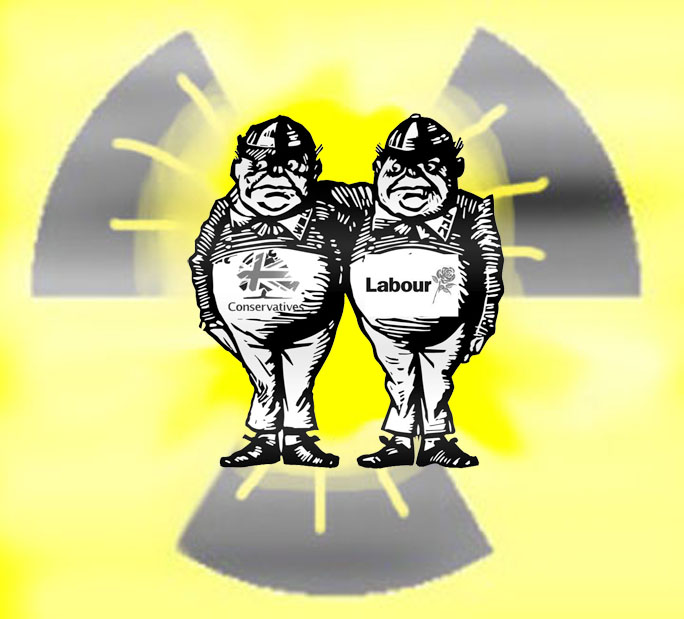
There is little difference between this government’s and its Conservative predecessor’s policies on expansion
Paul Brown, Fri 27 Sep 2024, https://www.theguardian.com/news/2024/sep/27/weatherwatch-labour-nuclear-power-conservative-policies
There seems to be no difference between Conservative and Labour policies on nuclear power. Both support the current building of Hinkley Point C in Somerset, the planned Sizewell C station in Suffolk, an unspecified number of small modular reactors all over Britain as well as the far-off dream of nuclear fusion.
However, few scientists serious about the threat of the climate crisis believe new nuclear power stations are part of the solution in reducing carbon output. Building them is too slow and costly, while solar and wind are quicker and cheaper in making a dent in fossil fuel consumption and eliminating it.
While supporting nuclear expansion seems to be politically expedient, the reality on the ground appears to be different. As the 2024 World Nuclear Status report published this month points out, if Britain gets anywhere near its plan to double onshore wind, triple solar power and quadruple offshore wind by 2030, it will be producing more electricity from these sources than the country consumes.
The experts also say if Rolls-Royce’s “heroic assumption” of the cost of electricity from small modular reactors was correct, any planned construction of large stations would immediately be abandoned.
Why NuScale Power Stock Dropped Today

Motley Fool, By Rich Smith – Sep 26, 2024
NuScale’s potential growth just got smaller by exactly one country.
Shares of NuScale Power (SMR 5.55%) slipped 3.2% through 11 a.m. ET Thursday on some disconcerting news out of Great Britain. According to World Nuclear News (WNN), the British government just narrowed the list of companies competing to begin building small modular nuclear reactors (SMRs) in the U.K. to four names.
NuScale isn’t one of them.
SMRs in the U.K.
According to WNN, the list of companies competing for this program initially numbered six, but two companies have been cut: NuScale and France’s EDF. General Electric subsidiary GE Hitachi Nuclear Energy, Rolls-Royce-owned Rolls-Royce SMR, and privately owned Holtec and Westinghouse all made the cut with reactor designs based on existing technology married to “modular production techniques.”
Britain plans to narrow its list further to two or perhaps three companies that will win co-funding contracts to complete their designs and obtain permits. Then the government will make a final decision to proceed with power plant construction in 2029.
………………….The bad news is that the closest company to a pure play in this new technology, NuScale Power, is now no longer an option in the U.K. Furthermore, Britain’s decision to pass on NuScale’s technology may give U.S. regulators second thoughts about it as well. All things considered, I’d say this is bad news for NuScale stock.
The other bad news is that the options that remain, Rolls-Royce and GE, are valued at $60 billion and $200 billion, respectively. While nuclear power may one day become a bigger part of their businesses, it’s going to be a long time before either company gets big enough in nuclear to move the needle on their revenue or earnings, or for investors to see them primarily as nuclear power stocks.
Investors seeking pure plays on nuclear power should probably look elsewhere. https://www.fool.com/investing/2024/09/26/why-nuscale-power-stock-dropped-today/
1 This Month


Read the Public Inquiry Report, the Commissioners’ report, Surrendering Australia: The AUKUS Deception is available to download for free at aukuspublicinquiry.com. Or just watch the replay of the National Press Club Luncheon.



19 November – Webinar – The Reality of Reprocessing
Time: 11:00 AM Pacific Time (US & Canada) / 2:00 PM Eastern / 7:00 PM UK / 8:00 PM CET
Register for the Zoom Event Here



Shut down the radiation-damaged Heysham nuclear reactors now
To see nuclear-related stories in greater depth and intensity – go to https://nuclearinformation.wordpress.com

Say No to NASA’s Reckless Nuclear Reactor on the Moon
Say No to NASA’s Reckless Nuclear Reactor on the Moon
-
Archives
- November 2026 (119)
- October 2026 (302)
- September 2026 (339)
- August 2026 (330)
- July 2026 (355)
- June 2026 (287)
- May 2026 (306)
- April 2026 (356)
- March 2026 (251)
- February 2026 (267)
- January 2026 (308)
- December 2025 (358)
-
Categories
- 1
- 1 NUCLEAR ISSUES
- business and costs
- climate change
- culture and arts
- ENERGY
- environment
- health
- history
- indigenous issues
- Legal
- marketing of nuclear
- media
- opposition to nuclear
- PERSONAL STORIES
- politics
- politics international
- Religion and ethics
- safety
- secrets,lies and civil liberties
- spinbuster
- technology
- Uranium
- wastes
- weapons and war
- Women
- 2 WORLD
- ACTION
- AFRICA
- Atrocities
- AUSTRALIA
- Christina's notes
- Christina's themes
- culture and arts
- Events
- Fuk 2022
- Fuk 2023
- Fukushima 2017
- Fukushima 2018
- fukushima 2019
- Fukushima 2020
- Fukushima 2021
- general
- global warming
- Humour (God we need it)
- Nuclear
- RARE EARTHS
- Reference
- resources – print
- Resources -audiovicual
- Weekly Newsletter
- World
- World Nuclear
- YouTube
-
RSS
Entries RSS
Comments RSS

