Russia says it will change nuclear doctrine because of Western role in Ukraine

In short:
Russia will make changes to its doctrine on the use of nuclear weapons.
The decision is “connected with the escalation course of our Western adversaries”, Russia’s deputy foreign minister said.
What’s next?
It is not clear when the updated nuclear doctrine will be ready.
Russia will make changes to its doctrine on the use of nuclear weapons in response to what it regards as Western escalation in the war in Ukraine, state media quoted Deputy Foreign Minister Sergei Ryabkov as saying on Sunday.
The existing nuclear doctrine, set out in a decree by President Vladimir Putin in 2020, says Russia may use nuclear weapons in the event of a nuclear attack by an enemy or a conventional attack that threatens the existence of the state.
Some hawks among Russia’s military analysts have urged Mr Putin to lower the threshold for nuclear use in order to “sober up” Russia’s enemies in the West.
Mr Putin said in June that the nuclear doctrine was a “living instrument” that could change, depending on world events.
Mr Ryabkov’s comments on Sunday were the clearest statement yet that changes would indeed be made.
“The work is at an advanced stage, and there is a clear intent to make corrections,” state news agency TASS cited Mr Ryabkov as saying.
He said the decision is “connected with the escalation course of our Western adversaries” in connection with the Ukraine conflict.
Moscow accuses the West of using Ukraine as a proxy to wage war against it, with the aim of inflicting a “strategic defeat” on Russia and breaking it apart.
The United States and its allies deny that, saying they are helping Ukraine defend itself against a colonial-style war of aggression by Russia.
Putin said on day one of Russia’s full-scale invasion of Ukraine in February 2022 that anyone who tried to hinder or threaten it would suffer “consequences that you have never faced in your history”.
Since then, he has issued a series of further statements that the West regards as nuclear threats, and announced the deployment of Russian tactical nuclear weapons in Belarus.
That has not deterred the US and its allies from stepping up military aid to Ukraine in ways that were unthinkable when the war started, including by supplying tanks, long-range missiles and F-16 fighter jets.
Ukraine shocked Moscow last month by piercing its western border in an incursion by thousands of troops that Russia is still fighting to repel.
President Volodymyr Zelenskyy said the operation made a mockery of Mr Putin’s “red lines”.
He is also lobbying hard for the US to allow it to use advanced Western weapons to strike targets deep inside Russia.
Kremlin spokesman Dmitry Peskov said in an interview published on Sunday that the West was “going too far” and that Russia would do everything to protect its interests.
Mr Ryabkov did not say when the updated nuclear doctrine would be ready.
“The time for completing this work is a rather difficult question, given that we are talking about the most important aspects of ensuring our national security,” he said.
Russia has more nuclear weapons than any other country. Mr Putin said in March that Moscow was ready for the eventuality of a nuclear war “from a military-technical point of view”.
He said, however, that he saw no rush towards nuclear confrontation and that Russia had never faced a need to use nuclear weapons in Ukraine.
France still faces problems in starting up long-delayed super-expensive Flamanville nuclear reactor

https://www.ft.com/content/31bb42d9-603c-4456-a8d3-9dcaa19c7759, Sarah White in Paris, 2 Sept 24
New unit could be connected to grid by end of year but optimism over further expansion faces political hurdles
France is starting up its first newly built nuclear reactor in a quarter of a century, 12 years behind schedule and after multiple setbacks as the industry looks to a revival with plans for more new plants.
EDF, the French state-owned operator of Europe’s biggest fleet of nuclear power stations, said late on Monday that the first chain reactions — or so-called divergence operations — at the Flamanville 3 reactor on France’s Normandy coast were due to get under way overnight.
If these are successful the reactor will eventually be connected to the grid before the end of the year, once it has reached 25 per cent of its total 1.65 gigawatt capacity — enough to power a large city.
Please use the sharing tools found via the share button at the top or side of articles. Copying articles to share with others is a breach of FT.comT&Cs and Copyright Policy. Email licensing@ft.com to buy additional rights. Subscribers may share up to 10 or 20 articles per month using the gift article service. More information can be found here.
https://www.ft.com/content/31bb42d9-603c-4456-a8d3-9dcaa19c7759
The reactor, France’s 57th and a prototype of models EDF wants to develop at home and overseas, had come to epitomise the reversals the nuclear industry was suffering globally in the wake of a downturn in orders over recent decades, which prompted skilled workers to leave the sector.
Flamanville ended up costing more than four times its initial budget at €13.2bn, and took longer to finish than similar models EDF built in China and Finland that were also hit by delays.
Components for the complex design had to be retooled, some after complaints from safety regulators. EDF was also criticised by the French government for how it struggled to co-ordinate the project that involved hundreds of suppliers.
Please use the sharing tools found via the share button at the top or side of articles. Copying articles to share with others is a breach of FT.comT&Cs and Copyright Policy. Email licensing@ft.com to buy additional rights. Subscribers may share up to 10 or 20 articles per month using the gift article service. More information can be found here.
https://www.ft.com/content/31bb42d9-603c-4456-a8d3-9dcaa19c7759
“It’s a historic step in this project,” Régis Clement, co-head of EDF’s nuclear production division, said of the launch. “Our teams are on the starting blocks.”
EDF, which has contracts to build new reactors in Britain and is tendering to export its design elsewhere, said it had learned valuable lessons from Flamanville 3 that will allow it to whittle down construction times in future.
But it still faces a series of hurdles at home despite French President Emmanuel Macron launching a plan to build at least six new reactors.
The orders have yet to be formalised, and a political impasse in Paris may only delay the process further, after legislative elections this summer delivered a hung parliament.
EDF, which is spending money filling thousands of new positions to prepare for the orders, needs to agree on a funding plan for the projects, which could cost over €52bn.
Hopes of reaching a deal by the end of the year are fading, several people close to the company said. An initial ambition to deliver the new reactors by 2037 seems optimistic as a result, they added.
Other challenges include improving design updates for the future reactors while training a range of staff from engineers to welders will take time. EDF also faces competition overseas from other players, such as South Korean rivals, amid a worldwide revival of nuclear technology.
Though valued for its low carbon emissions, nuclear power has faced an atmosphere of distrust after the Chernobyl accident of 1986 and the Fukushima meltdown in Japan following a tsunami in 2011.
Campaigners against government scheme boost for Sizewell C

“Funds wasted on Sizewell C would be better spent on measures such as insulation and energy efficiency that could reduce bills now.”
By Oli Picton, 31st August, https://www.lowestoftjournal.co.uk/news/24554123.campaigners-government-scheme-boost-sizewell-c/
The government has announced billions of pounds in funding is available to Sizewell C in a proposal that has been branded “appalling” by campaigners.
Together Against Sizewell C (TASC) responded to the government’s announcement that up to £5.5 billion has been unlocked for a new nuclear power station subsidy scheme – with Sizewell C Limited set to be the main beneficiary.
Approval for the building of a third site at the coastal town was granted in 2020 under the previous Conservative government.
………………….A department spokesperson said: “Subject to all the relevant approvals we aim to reach a final investment decision before the end of the year, and we have established a new subsidy scheme of up to £5.5 billion to provide certainty and ensure the project has access to the necessary financial support to remain on track………
However, TASC argue that the project will be “slow to build”, harm nearby habitats and damage the tourism around Suffolk’s coastline.
Jenny Kirtley, chairperson for TASC, said: “We find this announcement appalling – Labour promised ‘change’ but there is no change here.
“Funds wasted on Sizewell C would be better spent on measures such as insulation and energy efficiency that could reduce bills now.”
“Labour complained about a black hole in the country’s finances yet now they are proposing to dig still further.”
In July, Chancellor Rachel Reeves warned that there was a £22 billion “black hole” left by the previous government, encouraging Labour to reduce the winter fuel allowance for millions of pensioners across the country.
Ukrainian Tipping Points

Paid liars from Washington, Stanford, London and elsewhere have tried and likely will continue to try to tell you ‘Ukraine is winning’. It is not and cannot do so without a full-scale NATO intervention and a likely resulting World War III.
Russian and Eurasian Politics, Gordonhahn, September 1, 2024
The NATO-Russia Ukrainian war is at a tipping point; one that leads to a Russian march to the Dniepr River and the relocation of what remains of pro-NATO Ukraine’s populace to right bank Ukraine and its Maidan government away from the western banks of the Diner and deeper into western Ukraine, likely Lvov.
Not surprisingly, Kiev therefore is desperate and trying to escalate in ways that implicate or bring deeper, more direct NATO involvement, which has been deep and escalating on NATO’s part for years. For Kiev, ideal would be a full-scale NATO military intervention. The West’s previous strategy of gradual escalation – ‘boiling the frog’ by providing redlined air defense systems, then short-range missile/artillery systems, then tanks, then F-16s – has run its course.
The only options now are permitting Kiev to use Western missiles to hit deep inside Russia and target Russian President Vladimir Putin and other top leaders. Until now neither Kiev nor the West has crossed any Russian or ‘Putin red lines’ because there have not been any Russian-declared ‘red lines’ but Western MSM-set red lines. One would-be hard-pressed to cite even one clearly expressed Putin ‘red line.’
I fear the Western escalation will continue up to crossing an actual ‘red line’ that Russians have indirectly hinted at – Ukraine’s use of long-range Western missiles such as American ATACMs and British Storm Shadows to strike deep into Russia – will be crossed one way or another, likely after the U.S. presidential election on November 5th.
The crossing of all previous red lines drawn largely by Western media produce a demonstration effect of supposed Russian weakness, which many play up in order to also facilitate a NATO decision to cross the long-range missile red line or to intervene overtly and officially on the ground in the war. The latter has been Volodomyr Zelenskiy’s goal since the war began and even before during the Minsk ‘ceasefire’. The repeated targeting of civilian areas in Donbass and now in Russia proper, bombing harvesting combines in Belgorod, and the now failed Kursk invasion itself is of the same genre. This desire, indeed desparate need to draw NATO ‘all in’ stands behind Zelenskiy’s fakes –Bucha, Russia attacked Zaporozhe Nuclear Power Plant Rus controls, a children’s hospital, schools, the Kramatorsk train station, etc., etc. This fakery is all part and parcel of the simulated reality that has been the Maidan and its resulting regime, built on legends of police brutality and mass shooting perpetrated by the Maidanists themselves.
Western propagandists use the alleged ‘failure of Putin to respond’ to Western-created ‘Putin red lines’ and to West-Ukraine provocations in order to give the impression that Russia is a paper bear and beatable, that Ukraine is winning and can win, and that the West and Ukraine should continue escalating and intensify its support and perhaps have NATO intervene full-scale. Zelensky himself – the premier propagandist and stage director in today’s West — has pointed to the mini invasion into Kursk as proof that Moscow’s ‘red lines’ are “illusory” and appealed to the leaders of Britain, France, Germay, and the US to allow the use of long-range missiles to strike air bases on Russian territory (www.thetimes.com/world/russia-ukraine-war/article/kursk-incursion-proves-putins-red-lines-are-a-bluff-says-zelensky-bdc893ztw).
At the same time, the West has played up ‘Putin’s nuclear threats’ – of whch there have been none. Russia has a clearly stated and codified nuclear use doctrine: nuclear weapons will be used only in the event od an existential threat to the survival of the Russian state……………………………..
So far, Washington has conducted a controlled but likely open-ended escalation until dominance is achieved; hence the relative U.S. restraint and its constraning of the UK, Poland, and others hitherto. But this restraint and constraint should not be overdrawn. The U.S. will escalate as far as is imaginable if it is safe to do so in order to deal a ‘strategic defeat’ to ‘Putin’s Russia.’ …………………………………………
Thus, the defeat of Kiev on the left bank augurs for a long standoff with Western support for continung attacks of various kinds across the Dniepr against Russian-controlled eastern Ukraine that will likely lead to a second phase of the war in right bank Ukraine. The only way to avoid this outcome is by way of a negotiated treaty involving at least Kiev and Moscow; the West is an unlikely partner in a peace endeavor, given the chaos now reigning in Washington. ……………………………..
The threat of such developments is peaking now. Zelenskiy and the Ukrainians are desparate given the not-so-long-coming collapse of Ukraine’s defense across the entire front; hence the desparate throw of the dice that is the Kursk invasion—a last desparate attempt to turn the tables on Moscow……………………
…………………………………………………Paid liars from Washington, Stanford, London and elsewhere have tried and likely will continue to try to tell you ‘Ukraine is winning’. It is not and cannot do so without a full-scale NATO intervention and a likely resulting World War III.
Western ‘experts’ and intel propagandists have failed Ukraine and their own peoples by their ignorance of Russia and their professional malfeasance. They have misunderstood and underestimated Russia for 35 years ………………..
……………. They underestimated how Russia would respond to NATO expansion and the broken promise it entailed, a Western-backed. ………………………….
………………………The grave failure of Western rusology, academia, and government, I suspect, is bringing the world back to schism and nuclear confrontation.
………………………………….. The U.S. Democrat Party-state and the media-academic-military-industrial-congressional complex cannot allow prior to the presidential election neither an obvious Ukrainian collapse to materialize as an ‘October surprise’ nor a a major escalation that brings or clearly risks U.S. troops or the homeland.
But there should be no doubt; there are domestic options of an escalatory nature being examined in Western decisionmaking and research centers. When one of the next Western or Western-backed Ukrainian escalations is enacted – regardless if it is engineered under a Trump or Harris administration or the guise thereof – there will follow, as sure as night follows day, a Russian response targetting not just ruined, disappearing Ukraine but the West. https://gordonhahn.com/2024/09/01/ukrainian-tipping-points/
A Return to Form: Expediting US Arms to Israel

Dr Binoy Kampmark, 1 Sept 24, https://theaimn.com/a-return-to-form-expediting-us-arms-to-israel/
Despite much grandstanding in the Biden administration about halting specific arms shipments to Israel over feigned concerns about how they might be used (inflicting death is the expected form), US military supplies have been restored with barely a murmur. In a report in Haaretz on August 29, a rush of weapons to Israel has been noticed since the end of July.
August proved to be the second busiest month for US arms deliveries to Israel’s Nevatim Airbase since the October 2023 attacks by Hamas. This has taken place alongside an increased concentration of US forces in the region since Israel’s assassinations of Hezbollah commander Fuad Shukr and Hamas political chief Ismail Haniyeh at the end of last month. Two aircraft carriers, a guided missile submarine, and deployments of advanced F-22 stealth aircraft in Qatar, have featured in a show intended to deter Tehran from any retaliatory strikes.
After examining open-source aviation data from the end of July, Haaretz concluded that the issue of delayed shipments of US weapons had “been solved.” Dozens of flights by US military transport planes, along with civilian and military Israeli cargo planes, mostly from Qatar and the Dover Air Force Base in Delaware, had been noted. Demands by Israeli Prime Minister Benjamin Netanyahu in his July 24 speech to Congress that US military aid be “dramatically” expedited to “end the war in Gaza and help prevent a broader war in the Middle East,” had been heeded.
On August 26, Israel received its 500th aerial shipment of weapons and military supplies from the United States since the latest war’s commencement. The 500 flights have also been supplemented by 107 sea shipments, altogether facilitating the transfer of 50,000 tons of military equipmentin an initiativebetween the US military, Israel’s Defence Ministry’s Directorate of Production and Procurement and Mission to the United States, the IDF’s planning Directorate and the Israeli Air Force.
During the same month, the Democratic National Convention, which saw no debate about the candidature of Kamala Harris as its choice for presidential candidate, had tepidly promised some agitation on continued arms to Israel. Ahead of the event, the Uncommitted movement’s 30 delegates, picked by voters alarmed by US support for Israel’s war machine in Gaza, were hoping to convince the 4,000 pledged delegates Harris had captured to add an arms embargo to its campaign in order to induce a ceasefire.
A petition by the group sought two outcomes: the adding of language to both the party and campaign platform “that unequivocally supports a permanent ceasefire in Gaza and a cessation of supplying weapons for Israel’s assault and occupation against Palestinians.”
These wishes proved much too salty for the apparatchiks and party managers. The Democratic Party’s 2024 national platform ironically enough begins with an effusive “land acknowledgment” to “the ancestors and descendants of Tribal Nations” but plays it safe regarding an ally very much the product of territorial seizure, violence and occupation. Despite mutterings in the party room about a split between moderate and progressive members on Israel’s conduct of the war, the topic of a ceasefire never made it to the committee hearings when the document was drafted.
In firmly insisting on continued US support for Israel in its war against Hamas, much is made in the platform about US efforts to forge a way that will see a release of the hostages, “a durable ceasefire”, the easing of “humanitarian suffering in Gaza” and the “possible normalization between Israel and key Arab states, together with meaningful progress and a political horizon for the Palestinian people.” The language is instructive: the Palestinians are objects of pitiful charity, at the mercy of Israel, the US, and various Arab states. Like toddlers, they are to be managed, steered, guided, their political choices forever mediated through the wishes of other powers.
-Advertisement-
With Israel remaining Washington’s paramount ally in the Middle East, that process of steering and managing the unruly Palestinians has been, thus far, lethal. During her first interview given after the convention (she has an aversion to them), Harris scotched any suggestions on going wobbly on Israel. “I’m unequivocal and unwavering in my commitment to Israel’s defence and its ability to defend itself, and that’s not going to change,” she told CNN’s Dana Bush. In what has become a standard refrain, Harris lamented that “far too many innocent Palestinians have been killed” while acknowledging Israel’s right to self-defence.
When asked whether she would alter President Biden’s policy on furnishing military assistance to Israel, “No” came the reply. “We have to get a deal done. The war must end, and we must get a deal that is about getting the hostages out. I’ve met with the families of the American hostages. Let’s get the hostages out. Let’s get the ceasefire done.”
This middle-management lingo says much about Harris’s worldview; in wishing to “get the ceasefire done”, she is encouraging a range of factors that will make sure nothing of the sort will be achieved. The Netanyahu formula has worked its usual black magic. Hence, the lack of an arms embargo, and the continued, generous supply to the IDF from their largest military benefactor.
UK arrests TWO prominent anti-genocide journalists under ‘anti-terrorism’ laws, as West ramps up attacks on dissenters

Human rights activist Sarah Wilkinson arrested by UK police
Her arrest follows the detention of Syrian-British journalist Richard Medhurst in London and Telegram founder Pavel Durov in Paris
News Desk, AUG 29, 2024, https://thecradle.co/articles-id/26634
British human rights activist and social media influencer Sarah Wilkinson was arrested by UK police on 29 August, reportedly over “content she posted online.”
“The police came to her house just before 7.30am. [Twelve] of them in total, some of them in plain clothes from the counter-terrorism police. They said she was under arrest for ‘content that she has posted online.’ Her house is being raided, and they have seized all her electronic devices,” Jack Wilkinson is quoted as saying by the social media account Suppressed News.
“The pro-genocide UK regime has arrested [MENAUncensored’s] roving reporter and Human Rights Activist Sarah Wilkinson for supporting the Palestinian resistance and relaying what is really happening in Gaza and the West Bank to the world,” MENA Uncensored announced via social media, alleging Wilkinson was accused of supporting “terrorism.”
UK police did not issue a statement about Wilkinson’s arrest at the time of publication.
The British activist and reporter has been an outspoken critic of the Israeli genocide of Palestinians in Gaza. Earlier this year, she took part in the “Freedom Flotilla Coalition,” an international initiative that tried to deliver humanitarian aid directly into Gaza.
Wilkinson’s arrest comes two weeks after Syrian-British journalist Richard Medhurst was detained and questioned by UK police upon his arrival at Heathrow Airport under the Terrorism Act, Section 12.
“I believe I’m the first journalist to be arrested under this provision of the Terrorism Act. I feel that this is a political persecution and hampers my ability to work as a journalist,” Medhurst explained.
Other British journalists who have reported critically on Israeli, UK, and US foreign policy have also been detained and harassed upon returning to their home country, including The Cradle contributor Kit Klarenberg and Vanessa Beeley.
Last week, Telegram founder Pavel Durov was arrested in Paris and faces being indicted on 12 different charges, including refusing to “share information or documents with investigators when required by law” and “complicity in managing an online platform to allow illicit transactions by an organized group.”
Durov’s messaging app has played a significant role in the ongoing information war surrounding the genocide in Gaza. Supporters of the Palestinians have been able to use the app to freely share information exposing ongoing Israeli war crimes while highlighting the efforts of Hamas, Hezbollah, Yemen, and Iran to resist Israel.
It just seems crazy what is happening. It reminds me of the Birmingham six. The fact that traditional UK media is ignoring both Medhurst and Wilkinson is shocking.
Ukrainian defense chief visits Pentagon
“Ukraine has been given carte blanche for operations in Russian regions. “
https://www.rt.com/news/603337-ukraine-defense-minister-meets-austin/ 1 Sept 24
Politico reported earlier that Rustem Umerov would try to persuade the US to lift its restrictions on long-range strikes against Russia
Ukrainian Defense Minister Rustem Umerov has met with US Secretary of Defense Lloyd Austin to discuss additional military aid. The visit came amid renewed requests by Kiev for Washington to lift its restrictions on the use of US-supplied weapons for long-range strikes deep inside Russia.
Earlier this week, Politico claimed, citing anonymous sources, that Umerov and Vladimir Zelensky’s chief of staff Andrey Yermak would attempt to persuade their American backers to change their minds.
On Friday, the Pentagon’s Deputy Press Secretary Sabrina Singh announced that “Secretary of Defense Lloyd J. Austin III held bilateral talks with Ukrainian Minister of Defense Rustem Umerov today regarding Ukraine’s ongoing operations [and] security assistance priorities.”
The latter include air defense systems, artillery and armored vehicles needed to help Ukraine “build additional combat power.”
Another topic high on the officials’ agenda was the upcoming meeting of the Ukraine Defense Contact Group on September 6. The gathering will see more than 50 of the countries which support Kiev congregate in Ramstein, Germany to deliberate over plans for more military supplies for Ukraine, in order to cover both its immediate and long-term needs.
Austin pledged to “continue to build on the strategic partnership between” the US and Ukraine, Singh concluded.
On Tuesday, Pentagon spokesman Major-General Patrick Ryder clarified that Washington’s “policy has not changed,” meaning that Ukraine is allowed to use US-supplied weapons to defend against cross-border attacks, but not for “deep strikes” into what the US recognizes as Russian territory.
Meanwhile, White House National Security Council spokesman John Kirby told reporters on Monday that Washington “will keep the conversations with the Ukrainians going [on the issue], but we are going to keep them private.”
That same day, Zelensky insisted that “there should be no restrictions on the range of weapons for Ukraine.”
Commenting on Kirby’s statement on Friday, Russian Foreign Ministry spokeswoman Maria Zakharova claimed that it indicated that “Ukraine has been given carte blanche for operations in Russian regions.”
“The administration of [US President] Joe Biden is obviously getting ready to make new concessions to Zelensky and give him a free hand to use virtually any type of American weapons, including [for attacks] deep into Russian territory,” the diplomat alleged, as quoted by RIA Novosti.
Her remarks echoed those made on Tuesday by Russian Foreign Minister Sergey Lavrov, who insisted that the “West does not want to avoid escalation.”
The minister warned that Kiev’s backers would be “playing with fire” if they were to allow Ukraine to use their weapons to conduct long-range strikes deep inside Russia.
How the U.S. Enabled Netanyahu to Sabotage a Gaza Ceasefire
Drop Site, Jeremy Scahill, Sep 01, 2024
After the bodies of six more Israeli hostages of Hamas were found in the Gaza Strip, pressure in Israel is mounting on the government to secure a ceasefire deal and free the remaining hostages and soldiers taken captive on October 7. The announcement Sunday that the captives, including a dual citizen of the U.S., were discovered in a tunnel in Rafah has further fueled the rage toward Prime Minister Benjamin Netanyahu, particularly from the families of those held in Gaza. They have accused the prime minister of sabotaging deals to free their loved ones, saying “their blood is on his hands.”
Senior Israeli officials, most prominently the defense minister, have joined the public demands for Netanyahu to stop obstructing ceasefire negotiations, while Hamas has said they will not participate in any process until the U.S. convinces Israel to accept a negotiating framework Hamas agreed to in early July. Both Hamas and the families of Israeli captives still held in Gaza have stated that Netanyahu bears responsibility for continuing the war and preventing the exchange of prisoners.
The White House clearly hopes the events of the past 24 hours alter the current course. After being briefed on Saturday evening on the hostages found in Rafah, President Joe Biden, who is vacationing in Delaware, said, “I think we’re on the verge of having an agreement,” adding, “We think we can close the deal, they’ve all said they agree on the principles.”
By Sunday afternoon, street protests were staged throughout parts of Israel and the mayor of Tel Aviv announced a municipal strike for Monday. “[W]e will allow all employees to go out and support the families’ struggle,” he wrote on Twitter/X.
Following a meeting Sunday with an association of family members of Israeli captives, the head of the Histadrut labor federation, Israel’s largest trade union, announced a general strike. If that action extends beyond a symbolic strike of one or two days, it could cascade into a formidable crisis for Netanyahu. “Netanyahu abandoned the hostages. This is now a fact,” the family association said in a statement. “We call on the public to prepare. We will bring the country to a halt. The abandonment is over.”
Vice President Kamala Harris released a statement endorsing Israel’s version of events on the captives discovered in Rafah and echoed Netanyahu’s pledge to eliminate Hamas. ……………………………..
Hamas has not yet offered a detailed response to Israel’s accusation that Hamas fighters murdered the six captives, but blamed Israel for their deaths.
……………………………..as U.S. negotiators have worked to placate Netanyahu, the Israeli leader has waged a relentless two-month campaign aimed at thwarting a deal and Hamas has denounced the process and asserted that the U.S. framework it agreed to in early July should be respected.
………………………………………………………………………………………………………………………………………………. A Hamas official involved with the ceasefire negotiations told Drop Site News that the vice president and other U.S. officials have deliberately misled the public about the process out of concerns that the Gaza war will hurt the Democrats’ chances of victory in November.
“Kamala Harris is now obsessed with how to defeat Trump, how to win the election, and she knows that the genocide in Gaza and these massacres are a crucial element in the campaign,” said Basem Naim, a member of Hamas’s political bureau. “She wants to create a delusional image that there is something in process, which is not right.”
In an interview, Naim said that while the U.S.—for political purposes—wants to achieve a temporary truce that facilitates the release of Israelis held captive in Gaza and allows aid to reach the besieged Strip, it has given no indication it would insist on Israel ending its war against the Palestinians of Gaza.
“They are looking for a ceasefire, but they are not for ending the war permanently,” Naim said………………………………..
Establishing a Framework
In May, Biden laid out what he characterized as “a roadmap to an enduring ceasefire and the release of all hostages” that had been proposed by Israel itself. “This is truly a decisive moment. Israel has made their proposal,” Biden said on May 31. “Hamas says it wants a ceasefire. This deal is an opportunity to prove whether they really mean it. Hamas needs to take the deal.”
On June 10, the UN Security Council approved a resolution affirming the framework. On July 2, Hamas announced that it had agreed to restart ceasefire talks based on the framework. “We are ready for negotiations that achieve a cessation of aggression and a complete withdrawal from the Gaza Strip,” said senior negotiator Khalil Al-Hayya, a deputy of Hamas leader Yahya Sinwar. “We are ready for genuine negotiations if Netanyahu adheres to the principles outlined by President Biden.”
…………………..Drop Site News has reviewed internal documents from the negotiations showing that on July 2 Hamas formally informed international mediators that it had accepted the framework, which Hamas says it was told had been amended by the U.S. and approved by Israel on June 24. This amendment removed language Hamas had previously insisted on that called for negotiations no later than 14 days into the first phase of a deal on the “necessary arrangements for the return of a sustainable calm (permanent ceasefire),” according to a draft seen by Drop Site News. Hamas believed this compromise was strong evidence of their desire to reach a deal.
………………………………..Netanyahu’s “Coup” Against His Own Ceasefire Proposal
Since early July, Netanyahu has intensified Israel’s attacks in Gaza, repeatedly added new terms to the framework, and assassinated Ismail Haniyeh, Hamas’s political leader and its lead negotiator, in Tehran. Among the new demands put forward by Netanyahu is the right to continue occupying the Philadelphi corridor along the border with Egypt, to maintain control of the Rafah border crossing and to position Israeli troops in central Gaza along the Netzarim axis where IDF forces would establish checkpoints to search Palestinians seeking to return to their homes in northern Gaza.
……………………………………………………………………..Rather than insisting on upholding what Biden said was Israel’s own proposal in May, the U.S. has appeased Netanyahu’s efforts to allow an indefinite presence of Israeli forces in Gaza and an open-ended campaign of military attacks.
………………………………………………………….more https://www.dropsitenews.com/p/netanyahu-sabotage-ceasefire-hamas?utm_source=post-email-title&publication_id=2510348&post_id=148340330&utm_campaign=email-post-title&isFreemail=true&r=cqey&triedRedirect=true&utm_medium=email
Biden’s ‘new’ nuclear strategy and the super-fuse that sets it off.
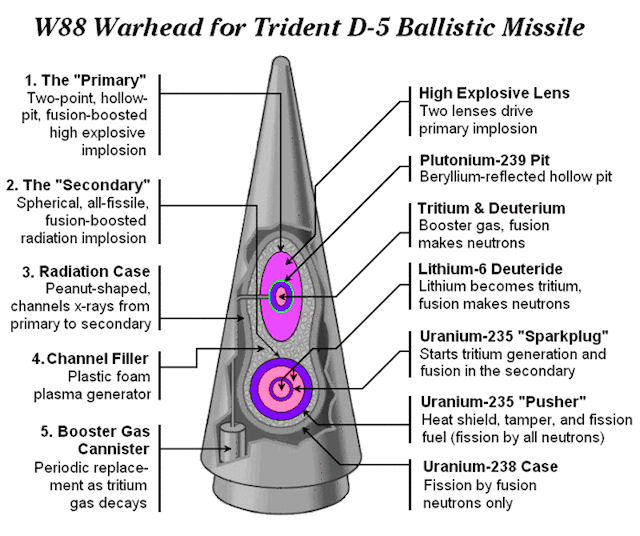
Although any technically accurate assessment of the physical consequences of the large-scale use of nuclear weapons instantly shows that “winning” a nuclear war has no meaning, the United States has strenuously emphasized the development of nuclear weapons technologies that could only make sense if their intended purpose is for fighting and winning nuclear wars.
The super-fuze is exactly that kind of technology.
The military is already upgrading warheads capable of fighting a war with both China and Russia simultaneously
Theodore Postol, Aug 29, 2024, Responsible Statecraft,
The New York Timesreported last week that President Biden has approved a secret nuclear strategy refocusing on Chinese and Russian nuclear forces.
According to the paper, the new nuclear guidance “reorients America’s deterrent strategy” to meet “the need to deter Russia, the PRC (China) and North Korea simultaneously.”
However, Biden’s approval of this strategy is no more than a tacit acknowledgment of a two-decade-long U.S. technical program that has been more than just a “slight modernization” of weapons components, but a dramatic step towards the capability to fight and win nuclear wars with both China and Russia. In other words, there is nothing really “new” here at all, save the very public nature of the strategy’s acknowledgement.
In the face of all of this, Chinese and Russian leaders will have no choice but to implement countermeasures that further increase the already dangerously high readiness of their nuclear forces. This includes intensified worst-case planning that will increase the chances of nuclear responses to false warnings of attack.
The technical source of this vast improvement in U.S. nuclear firepower is a relatively new super fuse or “super fuze” that is already being fitted onto all U.S. strategic ballistic missiles. This fuse more than doubles the ability of the Trident II Submarine Launched Ballistic Missiles (SLBMs) carrying W-76 100kt warheads to destroy Chinese and Russian nuclear-tipped Intercontinental Ballistic Missiles (ICBMs) in hardened silos.
The currently (not fully loaded) U.S. Trident Submarine force carries about 890 W-76 100kt and 400 W-88 475kt warheads. The 400 W-88 warheads have been outfitted with the super-fuze and were originally supposed to have the combination of accuracy and yield to destroy Russian silo-based ICBMs before they are launched. But there are not enough W-88s to attack both Russian and Chinese silo-based ICBMs before they can be launched.
So, with the fuse upgrade of W-76s, the W-88 warheads are no longer needed for this job. Numerous upgraded W-76 warheads can instead be used for planned missions against silo-based missiles in Russia and China.
Although 890 W-76s are currently on Trident II submarines, the U.S. has 1600 in total, making the W-76 the most numerous warhead in the American arsenal today. In the eventuality that arms control limitations no longer constrain the size of U.S. nuclear forces, these warheads could readily be added to and carried by the already available at-sea Trident II ballistic missiles, each of which can carry up to 12 W-76 warheads.
With such an “uploading,” there would still be more than enough remaining Trident II ballistic missiles on submarines to carry all of the 400 available 475kt W-88 “heavy” warheads as well.
But let’s talk more about the secret super-fuze or Burst Height Compensating Fuse.
Figure 1 [above on original] illustrates how the super-fuze drastically increases the “killing power” of a ballistic missile delivered warhead…………………………………………………………………………..
The super-fuze achieves its fantastic increase in killing efficiency by measuring its altitude at a chosen time while it is still outside the atmosphere but relatively close to its target. …………………………………………………………………………….
The military implications of this “technically sweet” added capability to U.S. ballistic missile warheads has major implications for the war-fighting capabilities of the United States.
Although any technically accurate assessment of the physical consequences of the large-scale use of nuclear weapons instantly shows that “winning” a nuclear war has no meaning, the United States has strenuously emphasized the development of nuclear weapons technologies that could only make sense if their intended purpose is for fighting and winning nuclear wars.
The super-fuze is exactly that kind of technology.
………………………………….Couching the development and deployment of these kinds of preemptive strike technologies in misleading terms like “enhancing deterrence,” does not fool the military and political leadership of Russia and China. It instead leaves them no choice but to consider ways of deterring a dangerous U.S. preemption-oriented nuclear-weaponized nation that is constantly striving for better ways to “disarm” large parts of their nuclear forces.
It is no accident that Russian President Vladimir Putin himself approved the development and revealed the existence of the ultimate doomsday weapon — the Poseidon robot submarine, which can carry a 100Mt warhead into the harbors of U.S., European, and east Asian cities — capable of destroying urban areas to ranges beyond 50 miles (80 km) from its underwater detonation point.
The deployment of the Poseidon system by Russia serves as a warning to those who think they can fight and win nuclear wars by preemptively destroying significant parts of China and Russia’s nuclear retaliation forces. No matter how successful a planned preemptive nuclear attack might look like on paper, the reality of a nuclear war initiated with the delusional belief it could be won will be global destruction so great in scale that the very end of human civilization cannot be ruled out.
This is the real bequest of Biden’s new nuclear strategy and the super-fuze. https://responsiblestatecraft.org/biden-nuclear-strategy/
That time when Canada cancelled its nuclear submarine order
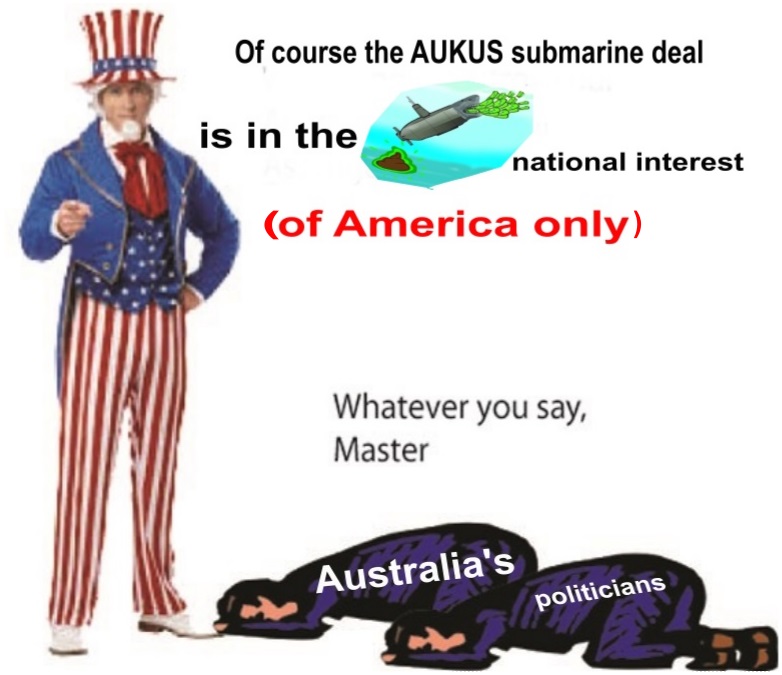
The decision to cut the Australian community out altogether — except where we will be called upon to service the US military as it builds its base in WA — puts us in the relationship of a vassal state, existing only to do the bidding of our powerful friend.
By Julie Macken and Michael Walker, Aug 30, 2024, https://johnmenadue.com/that-time-when-canada-cancelled-its-nuclear-submarine-order/
Back in 1987, when no one knew that the Cold War was just about to end, the Canadian Government signed up to build 10 nuclear-powered submarines. That submarine program lasted for all of two years before being cancelled in 1989. No nuclear Canadian sub ever even began construction, let alone getting put in the water.
There is a very real sense of déjà vu when we look at the Canadian experience and the current Australian experience of AUKUS. The good news is that it is not too late to learn the lessons the Canadians learnt for us.
One of the reasons for the Canadian cancellation was the $8 billion price tag, or about $19 billion in today’s money. Two billion dollars per submarine now sounds like a bargain compared to the astronomical $45 billion per submarine under AUKUS. Canada decided it had other priorities where that money could be put to better use.
But before the contract was cancelled in Canada, the ministries involved in its construction became embroiled in conflict, the Government itself was in a cost-of-living-crisis with immediate, real-world needs pressing and the hasty and secretive choice of vessel design came under withering criticism from the Treasury department for poor procurement with the cost expected to blow out to $30 billion ($70 billion today). And finally, media support eroded, with 71% of the population opposed to the project.
Déjà vu much?
On 12 June, the US Congressional Research Document service produced a research and advice document called the Navy Virginia-Class Submarine Program and AUKUS Submarine (Pillar 1) Project: Background and Issues for Congress.
The document points out the AUKUS deal was a three-step process. The first was to establish a US-UK rotational submarine force in Western Australia. The second was that the US would sell us three or five Virginia nuclear powered submarines and the third would be that the UK assists us in building our own AUKUS class nuclear submarines.
But the Congressional report outlines when comparing the “potential benefits, costs, and risks” of the three stage plan, it might just be better for the US to operate more of its own boats out of WA. That is, “procuring up to eight additional Virginia-class SSNs that would be retained in US Navy service and operated out of Australia along with the US and UK SSNs”.
That’s right, why bother with the whole step two and three when the US is best served by simply operating its nuclear-powered attack submarines out of WA?
This is an extraordinary development and one that demands more attention than has been given previously because a number of issues flow from this kind of thinking.
First, this potentially frees up $400 billion that could be put to far better use on a national housing construction program or high-speed rail network running the entire east coast of Australia or other large and much-needed nation-building projects. But not so fast.
The US Congressional Research Document suggests that “those funds (the $400 billion) could be invested in other military capabilities”, such as long-range missiles and bombers, “so as to create an Australian capacity for performing non-SSN military missions for both Australia and the United States”.
The decision to cut the Australian community out altogether — except where we will be called upon to service the US military as it builds its base in WA — puts us in the relationship of a vassal state, existing only to do the bidding of our powerful friend.
The fact that the document only referenced the “potential benefits, costs, and risks” from the US perspective, without any attempt to imagine how Australia may view becoming a life support for a US submarine base, makes the nature of our relationship pretty clear.
Australia’s Government may not consider it necessary to have done its due diligence on AUKUS but the Americans are happy to do that for us and, you guessed it, even though they quietly have doubts about the SSN project, they’ve already thought of plenty of other ways to spend our money on their own defence objectives. Spending it on the well-being and prosperity of our own people didn’t even rate a mention.
UK unveils GBP 5.5bn subsidy plan for 3.2 GW nuclear plant

The UK government has approved a GBP 5.5bn subsidy scheme aimed at getting the planned 3.2 GW Sizewell C nuclear power plant in southeast England to a final investment decision (FID) later this year.
Reporting by: Kelly Paul, 30 Aug 2024 ,
https://montelnews.com/news/4f3631b9-b370-4dda-a878-61850539b094/uk-unveils-gbp-55bn-subsidy-plan-for-32-gw-nuclear-plant
The so-called Sizewell C Development Expenditure (Devex) Scheme will enable the government to increase equity injections into the project, giving it greater flexibility to cover development costs up to and including an FID, it said in a statement on Friday.
Funding for the Devex scheme will be subject to the Labour government’s forthcoming spending review.
The UK is targeting 50 GW of nuclear capacity by 2050 as part of its plans for energy security. Currently, the country’s eight nuclear power sites have a total combined capacity of about 6.5 GW.
The government is seeking private investors for Sizewell C via a regulated asset base (RAB) financing mechanism.
Sizewell C received a nuclear site licence from the country’s Office for Nuclear Regulation in May.
White elephant?
However, in the wake of today’s announcement, campaign group Stop Sizewell C questioned where the money was going to come from.
“Sizewell C has already chewed through GBP 2.5bn and now we learn that there is the potential for a staggering GBP 5.5bn more of our taxpayers’ money to be thrown at this white elephant,” it said in a statement.
“Labour complained about a black hole in the country’s finances, yet now they are proposing to dig still further. Where would this cash come from?”
‘No,’ Kamala Harris Says to Withholding Arms From Israel
“Harris is saying she will reject 77% of Democrats, 61% of Americans, international law, domestic U.S. law, and basic humanity to continue the flow of weapons to Israel while it stands accused of genocide,” said one analyst.
Common Dreams. Jake Johnson, Aug 30, 2024
Democratic presidential nominee Kamala Harris said in a CNN interview that aired late Thursday that, if elected in November, she would not change the Biden administration’s policy of steadfast military support for Israel, rejecting widespread calls for an arms embargo to help bring about an end to the devastating assault on Gaza.
“I’m unequivocal and unwavering in my commitment to Israel’s defense and its ability to defend itself, and that’s not gonna change,” said Harris, recounting the horrors of the Hamas-led October 7 attack. “Israel had a right, has a right to defend itself.”
Acknowledging that “far too many innocent Palestinians have been killed,” the vice president responded “no” when CNN‘s Dana Bash asked whether a Harris administration would implement a “change in policy in terms of arms” and withhold even “some” weapons shipments to Israel………………………………………………………………………………………………………………………….
“Poll after poll after poll tells us that a majority of Americans and even more key Democratic constituencies want the US to stop giving arms to Israel that it’s using to kill and displace Palestinian families,” Lieberman added. “Not sending bombs to Israel is politically expedient and—quite obviously!—the morally correct thing to do for anyone reading the daily headlines of Israeli massacres being done with U.S. weapons.”
Democratic presidential nominee Kamala Harris said in a CNN interview that aired late Thursday that, if elected in November, she would not change the Biden administration’s policy of steadfast military support for Israel, rejecting widespread calls for an arms embargo to help bring about an end to the devastating assault on Gaza.
“I’m unequivocal and unwavering in my commitment to Israel’s defense and its ability to defend itself, and that’s not gonna change,” said Harris, recounting the horrors of the Hamas-led October 7 attack. “Israel had a right, has a right to defend itself.”
Acknowledging that “far too many innocent Palestinians have been killed,” the vice president responded “no” when CNN‘s Dana Bash asked whether a Harris administration would implement a “change in policy in terms of arms” and withhold even “some” weapons shipments to Israel.
Watch:
The CNN appearance marked Harris’ first major television interview since becoming the Democratic nominee, a change at the top of the party’s 2024 ticket that Palestinian rights advocates hoped would open the door to a fundamental shift away from the Biden administration’s Gaza policy—which has been to arm Israel to the teeth while tepidly pressuring the country’s far-right government to protect civilians and agree to a cease-fire deal.
“The vice president’s statement was morally indefensible and politically shortsighted as the lack of American consequences for Netanyahu’s horrific assault on Palestinian civilians in Gaza has emboldened Israel to now invade the West Bank,” Layla Elabed and Abbas Alawieh, co-founders of the Uncommitted National Movement, said in a statement Friday. “Vice President Harris must turn the page from one of the most glaring foreign policy failures of our time by aligning with the American majority that opposes sending weapons to Israel’s assault on Gaza.”
Despite Bash’s characterization of calls for an arms embargo against Israel as a demand from the “progressive left,” survey data has shown that a majority of U.S. voters oppose sending weapons to Israel as it commits appalling war crimes in Gaza and the West Bank. Since October, the U.S. has sent Israel over 50,000 tons of weaponry.
“Harris is saying she will reject 77% of Democrats, 61% of Americans, international law, domestic U.S. law, and basic humanity to continue the flow of weapons to Israel while it stands accused of genocide,” Middle East scholar Assal Rad said late Thursday, citing the results of a recent CBS News/YouGov poll.
A separate poll commissioned by the IMEU Policy Project suggested that voters in key U.S. battleground states would be more likely to vote for a Democratic nominee who pledged to withhold weapons from Israel.
The CNN interview aired as Israel continued its multi-day assault on the West Bank, a deadly military campaign that the head of the United Nations and others warned could become an extension of the nearly 11-month war on Gaza, during which Israel has killed more than 40,600 people, displaced 90% of the enclave’s population, and sparked famine across the territory.
On Thursday, Israel’s military killed five Palestinians in an airstrike on a vehicle convoy of the Washington, D.C.-based American Near East Refugee Aid (ANERA) agency. It is a violation of U.S. law to provide weaponry to a country obstructing the delivery of American humanitarian aid.
The attack on the ANERA convoy came a day after Israeli forces opened fire on a World Food Program vehicle, forcing the U.N. agency to suspend employee movement in Gaza.
Harris’ refusal to express openness to an arms embargo against a military that has repeatedly targeted aid and healthcare workers, journalists, and other civilians sparked immediate backlash from Palestinian rights advocates, including at least one member of Congress.
Rep. Rashida Tlaib (D-Mich.), the only Palestinian American in the U.S. Congress, said Harris’ answer signaled that “war crimes and genocide will continue.”
Yonah Lieberman, co-founder of IfNotNow, called the Democratic nominee’s answer on Gaza “terrible” and “out of touch with voters, especially those in key battleground states who Harris needs to feel motivated to go to the polls.”
“Poll after poll after poll tells us that a majority of Americans and even more key Democratic constituencies want the US to stop giving arms to Israel that it’s using to kill and displace Palestinian families,” Lieberman added. “Not sending bombs to Israel is politically expedient and—quite obviously!—the morally correct thing to do for anyone reading the daily headlines of Israeli massacres being done with U.S. weapons.”
In an op-ed for Common Dreams on Friday, RootsAction national director Norman Solomon warned that “time is running out for Kamala Harris to distance herself from U.S. policies that enable Israel to continue with mass murder and genocide in Gaza.”
“Polling shows that a pivot toward moral decency would improve her chances of defeating Donald Trump,” Solomon wrote. “But during her CNN interview Thursday night, Harris remained in lockstep with President Biden’s unconditional arming of Israel.” https://www.commondreams.org/news/kamala-harris-arms-embargo
Israel Launches Major West Bank Raid as Israeli Minister Vows Gaza-Like Attack

it is clear that Israel is aiming to do what it has done in Gaza to the occupied West Bank.
Israel is cutting off the northern West Bank, destroying roads, surrounding hospitals and implementing curfews there.
By Sharon Zhang , Truthout, August 28, 2024
Israel has embarked on its largest raid of the occupied West Bank in decades, launching attacks from the land and air against areas home to 80,000 Palestinians as Israel’s foreign minister is pledging “war” using the same genocidal tactics the Israeli military has used on Gaza.
Israel has attacked the West Bank with drone strikes and deployed military vehicles on the ground, with troops opening fire on Palestinians. Israeli forces are shutting down and destroying roads with bulldozers leading to Jenin, Tulkarem and Tubas in the northern West Bank, effectively cutting the cities off from the rest of the West Bank. Jenin has a population of roughly 39,000 Palestinians.
The raid is especially sinister as it comes amid Israel’s genocide in Gaza, which experts say has been an opportunity for Israeli forces to test and hone violence against Palestinians. Alarmingly, Foreign Affairs Minister Israel Katz pledged that Israeli forces would handle the occupied West Bank the same way it has Gaza — where it has isolated the population and then carried out a genocide and ethnic cleansing campaign of unprecedented proportions.
………………….Experts warn it is clear that Israel is aiming to do what it has done in Gaza to the occupied West Bank. “What’s happening is absolutely horrifying, because what we see here is Israel trying to transfer the genocide war that is conducted in Gaza and the war of ethnic cleansing from Gaza to the West Bank,” Mustafa Barghouti, Palestinian physician, general secretary of the Palestinian National Initiative and West Bank resident, told Democracy Now!. “Their goal is very clear. It’s as the Israeli minister of foreign affairs said: it’s ethnic cleansing of Palestinians.”…………………………………….. more https://truthout.org/articles/israel-launches-major-west-bank-raid-as-israeli-minister-vows-gaza-like-attack/
The US presidential candidates are not confronting the nuclear threat that haunts the world

Bulletin, By Robert Jay Lifton | August 29, 2024
The candidates in the coming election in the United States have said little, certainly nothing coherently, about nuclear weapons. Yet those weapons continue to haunt us, even as they move in and out of our conscious awareness.
We are reminded of this disconnect by the recent revelation of a shift in the American strategy of “nuclear deterrence” to give greater emphasis to China because of evidence of its rapid build-up of the weapons.1 That strategy change suggests China has been granted the dubious status of player in the game of bringing an end to humanity.
This “nuclear end,” as we came to call it in the antinuclear movement, was oddly treated in the recent Musk interview of Trump. Trump spoke vaguely of “nuclear warming,” though he has constantly dismissed the danger of climate change. Musk referred to the relatively rapid rebuilding of Nagasaki as a thriving city, failing to recognize that reconstruction was possible only because of the existence of an outside world to bring the necessary energy and know-how for such rebuilding. The use of contemporary nuclear weapons would allow for no such outside world. And the statement also ignores the residual pain and nuclear fear brought on by the atomic bombing of that city.2
And in her Democratic National Convention acceptance speech, Kamala Harris committed herself to a military that “always has the strongest, most lethal fighting force in the world.”3 We do not know whether she had nuclear weapons in mind.
What are the nuclear truths that are still rarely taken into account?
Nuclear weapons represent a revolution in the human capacity for destructiveness. Whether it begins with battlefield use of relatively small nuclear weapons or with larger ones, a nuclear war is likely to bring about a “nuclear winter”—the blocking of the sun’s rays by soot and other debris blown into the stratosphere—bringing about the lowering of Earth’s temperature to an extent that agriculture and human life could no longer be sustained. There is also more recent research suggesting that even a “limited” nuclear war could bring about worldwide starvation, affecting hundreds of thousands or even millions of people.
From this standpoint, Robert Oppenheimer’s brilliant success in guiding his fellow scientists at Los Alamos to the creation of nuclear weapons was his also tragedy. He could never decide whether to go along with the society’s rendering him a hero or to insist on his guilt, as he did when he told President Harry Truman, “I have blood on my hands.”
The larger US society has the same conflict. It is unable to decide whether the weapons are crucial to keeping the peace and even keeping the world going—the US addition to what I call nuclearism—or whether their very existence, not just their use but their stockpiling, is what threatens our future. The latter idea is central to the treaty put forward by the United Nations banning the “use, possession, testing, and transfer of nuclear weapons under international law.”4 Recently 150 medical journals, including The New England Journal of Medicine, Journal of the American Medical Association, Lancet, and the British Medical Journal made a joint call for the elimination of nuclear weapons with an editorial statement: “The nuclear arms states must eliminate their nuclear arsenals before they eliminate us.”5
That reasonable advocacy of nuclear abolition could not of course abolish our capacity to rebuild the weapons. But such re-creation would be highly demanding, and abolition would make the world a much safer place even if the possibility of building new nuclear weapons existed………………………………………………………………………………..more https://thebulletin.org/2024/08/the-us-presidential-candidates-are-not-confronting-the-nuclear-threat-that-haunts-the-world/?utm_source=Newsletter&utm_medium=Email&utm_campaign=ThursdayNewsletter08292024&utm_content=NuclearRisk_LiftonNuclear_082024
Iran urges elimination of atomic weapons, end to nuclear tests
Friday, 30 August 2024, https://www.presstv.ir/Detail/2024/08/30/732332/Iran–elimination-of-atomic-weapons
Iran’s ambassador and permanent representative to the United Nations Office in Geneva has called on the international community to work towards ending nuclear tests and eliminating atomic weapons.
Ali Bahreini made the remarks in an X post on Thursday, on the occasion of the International Day against Nuclear Tests.
“Nuclear testing is a threat to our planet and future generations,” he said.
“On the International Day against Nuclear Tests, let’s pledge to protect our world by advocating for a complete end to nuclear tests and total elimination of NWs,” he added, referring to nuclear weapons.
“Each nuclear explosion is a step backward in the journey towards a world free of nuclear weapons. Today, more than ever, we need a global commitment to the complete elimination of nuclear weapons,” Bahreini wrote in a separate post on X in Persian.
In 2009, the UN General Assembly declared August 29 the International Day against Nuclear Tests by unanimously adopting Resolution 64/35.
The document calls for increasing awareness and education “about the effects of nuclear weapon test explosions or any other nuclear explosions and the need for their cessation as one of the means of achieving the goal of a nuclear-weapon-free world.”
The United States is the only country on Earth that has used nuclear weapons in wartime.
On August 6, 1945, the US dropped the world’s first atomic bomb on the Japanese city of Hiroshima, killing thousands instantly and about 140,000 by the end of the year. Three days later, it dropped a second bomb on Nagasaki, killing another 70,000.
-
Archives
- October 2026 (120)
- September 2026 (339)
- August 2026 (330)
- July 2026 (355)
- June 2026 (287)
- May 2026 (306)
- April 2026 (356)
- March 2026 (251)
- February 2026 (267)
- January 2026 (308)
- December 2025 (358)
- November 2025 (359)
-
Categories
- 1
- 1 NUCLEAR ISSUES
- business and costs
- climate change
- culture and arts
- ENERGY
- environment
- health
- history
- indigenous issues
- Legal
- marketing of nuclear
- media
- opposition to nuclear
- PERSONAL STORIES
- politics
- politics international
- Religion and ethics
- safety
- secrets,lies and civil liberties
- spinbuster
- technology
- Uranium
- wastes
- weapons and war
- Women
- 2 WORLD
- ACTION
- AFRICA
- Atrocities
- AUSTRALIA
- Christina's notes
- Christina's themes
- culture and arts
- Events
- Fuk 2022
- Fuk 2023
- Fukushima 2017
- Fukushima 2018
- fukushima 2019
- Fukushima 2020
- Fukushima 2021
- general
- global warming
- Humour (God we need it)
- Nuclear
- RARE EARTHS
- Reference
- resources – print
- Resources -audiovicual
- Weekly Newsletter
- World
- World Nuclear
- YouTube
-
RSS
Entries RSS
Comments RSS

