The Energy Department just made one plutonium pit. Making more is uncertain

Bulletin, By Dylan Spaulding | October 10, 2024
Two conflicting developments arose this month in US efforts to produce new plutonium pits for its nuclear weapons: The National Nuclear Security Administration (NNSA) announced it had produced a warhead-ready pit—the explosive core of a nuclear weapon—for the first time in decades, and a federal court ruled that NNSA will be required to consider the cumulative environmental and health impacts of its pit production program.
Overshadowing these events is a vigorous debate over the necessity for new pits at all. Previous analyses have found that plutonium pits have viable lifespans well beyond the expected service life of the current stockpile, whereas production of pits for new weapons is part of a sweeping US nuclear modernization that raises concern over the future of arms control and any possibility for stockpile reductions at a time of deteriorating international relations.
The two most recent developments illustrate a critical tension in the US nuclear weapons program: New pit production demonstrates a doubling down of US reliance on nuclear weapons for the 21st century. The failure to adhere to environmental policy in doing so highlights the unwitting cost that US citizens may bear for this policy choice—as they have repeatedly in the past………………………………………………………………………………………………………………………………………………………………….
…….Production challenges. Despite any fanfare, demonstrating the ability to certify one plutonium pit doesn’t guarantee smooth sailing toward Los Alamos’s mandated production goals.
The Los Alamos’ Plutonium Facility at Technical Area 55 (PF-4) is conducting the dangerous and difficult work of pit production while also undergoing construction and modernization, with work happening round-the-clock—several other plutonium-related missions are pursued under the same roof. The facility has been criticized for deficiencies in personal safety and safety-related engineering, including recent glovebox fires, floods, worker exposure to plutonium and beryllium, and violations of criticality safety rules. The likelihood of such incidents increases as a result of fast-paced work in close-quarters with a mostly new workforce. In 2013, the PF-4 facility was shut down for three years following a severe criticality safety violation; a repeat could prove fatal, literally and figuratively.
…………………………………………… Regardless of Los Alamos’ success, the congressionally mandated quota of 80 pits per year remains impossible to meet by NNSA’s own admission. This number relies on completion and commissioning of a second production facility at the Savannah River Site in South Carolina, which won’t be operational until the mid-2030s at the earliest.
Just as the future rate of plutonium pit production is uncertain, the missile these pits are intended for—the new Sentinel intercontinental ballistic missile—is also not likely to be completed on schedule. The troubled Sentinel project remains vastly over budget and behind schedule, putting its future at risk and making coordination of the warhead and missile difficult to foresee. Problems or changes in scope for either program will affect the other.
A federal court ruling. Coinciding with NNSA’s announcement of the first diamond-stamped pit, a US District Court ruled that the Energy Department and the NNSA violated the National Environmental Policy Act (NEPA) by failing to properly consider alternatives before proceeding with pit production, requiring the agency to conduct a programmatic environmental impact assessment.
This was a victory for transparency and the community groups—among them, Savannah River Site Watch, Nuclear Watch New Mexico, Tri-Valley Communities Against a Radioactive Environment (CAREs), and the Gullah/Geechee Sea Island Coalition—who, for years, have been asking for such an assessment.
Reestablishing pit production on the scale now contemplated is potentially the biggest investment in the nuclear weapons complex since the Manhattan Project. With it comes hiring and training of thousands of new employees, increased transportation between sites, new construction, safely handing radioactive material, and the generation of new nuclear waste. The cumulative nature of these activities, occurring across many Energy Department’s sites, demands that the impacts of pit production be considered holistically in the form of a programmatic environmental impact assessment.
The environmental impact statements issued by the national laboratories offer perhaps the best public-facing analyses of whether their plans comply with standards for protection of public safety and the environment, including the likelihood of specific scenarios and associated risk of public exposure to hazards such as chemicals or radiation. Still, the NNSA has—until now—resisted issuing such a programmatic statement.
The agency clearly recognizes that pit production involves much of the US nuclear weapons complex. The press release announcing the first diamond-stamped pit thanked workers in Kansas City, Lawrence Livermore National Labs, Los Alamos, and the Pantex plant in Texas. But the NNSA has so far relied on a series of addenda and supplements to a 2008 environmental impact statement for work at Los Alamos and considers Savannah River separately. These assessments largely ignore the cross-complex collaboration required and the subsequent risks, including impacts on the potentially overburdened Waste Isolation Pilot Plant in New Mexico that must absorb the prolific—and complex—waste stream from the pit production process.
The court ruling—which holds that the Energy Department and the NNSA did not follow environmental requirements in pursuing two production sites—will require the NNSA to conduct a new review, bringing renewed public scrutiny and allowing a new opportunity for input from concerned opponents.
An unclear horizon. A programmatic environmental impact statement can take years before it’s finalized. The judge in the case declined to halt construction at NNSA’s second pit production site at Savannah River while the new assessment is being carried out, and the two parties have until October 21st to seek an agreement. It’s likely that the NNSA will argue that stopping pit-production work would be too expensive, too disruptive, and too damaging to national security to consider. It remains unclear what the potential consequences could be if the NNSA decides to challenge the ruling.
While work at Los Alamos is likely to continue amid a programmatic assessment, design choices are still underway at the Savannah River Site, where the NNSA is attempting to retrofit the troubled former mixed oxide (MOX) fuel fabrication plant which never reached productivity despite more than $7 billion of investment. This site is years away from being active and will require extensive transformation that may cost as much as $25 billion. Given this enormous investment, a programmatic environmental impact statement can ensure that this transformation better addresses the actual hazards and better protects communities, workers, and the environment.
Reestablishing pit production in the United States is a massive undertaking. It involves resurrecting a lost capacity that requires complicated engineering, construction, and extremely hazardous work processes that will be carried out by a largely new work force with little to no prior experience. NNSA and its contractors must manage safety risks across multiple sites where new hazardous waste will be generated in communities that don’t want it and where the Energy Department has a poor historic track record of environmental stewardship.
Congress and the Biden administration should eliminate the mandated 80 pit per year requirement while the NNSA conducts a new, thorough environmental assessment that would go a long way toward promoting increased safety and public protection—a challenge that the NNSA and the labs should take seriously. https://thebulletin.org/2024/10/the-energy-department-just-made-one-plutonium-pit-making-more-is-uncertain/
Small nuclear reactors won’t be ready in time for the needs of energy-guzzling needs of Artificial Intelligence.
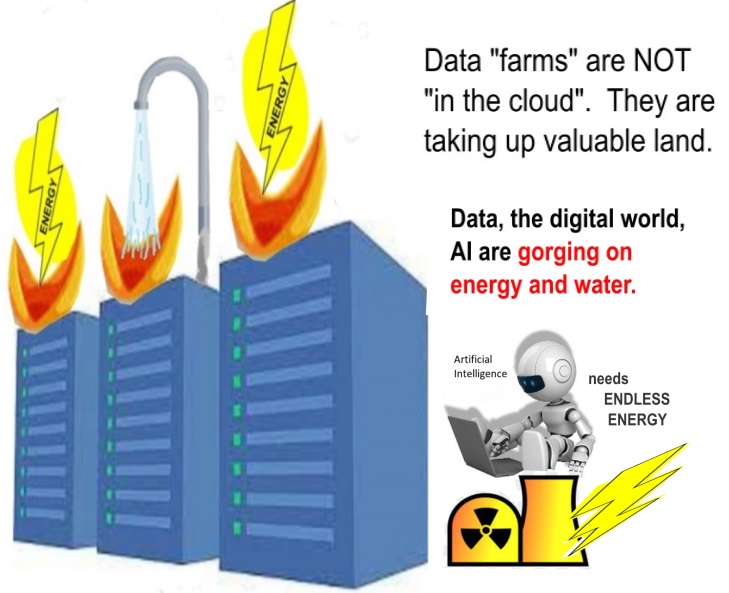
As of last month, when [data centres] were classed as critical national
infrastructure, data centres are on a par with utilities, meaning the
government would step in were there a risk to connectivity. Nonetheless, as
Rohan Kelkar, the executive vice-president of power products at Schneider
Electric, puts it, the “lack of grid capacity puts UK’s AI and data
centre ambitions and energy transition goals at risk”.
So much so that we have seen the boroughs of Hillingdon, Ealing and Hounslow all rejecting
data centre projects in order to retain supply for housing. This is far
from a UK-specific issue. In Ireland, the pressure on the national grid
from computing needs is so acute they have had to pause some data centre
approvals over concerns that excessive demand from data centres could lead
to blackouts.
On the other side of the Atlantic, Big Tech companies are
also grappling with the energy conundrum: how to find low-carbon, reliable
sources of power for their power-hungry warehouses without jeopardising
customer needs or their net zero goals. Along with renewable energy and
improving battery storage, right now they all seem to be turning in one
direction: towards nuclear power. Microsoft signed a deal last month to
help resurrect a unit of the Three Mile Island plant in Pennsylvania.
Amazon bought a nuclear-powered data centre earlier in the year. On Monday,
Google became the latest to announce a nuclear energy deal to meet the
needs of its data centres, looking at mini reactors developed by a
Californian company.
A cocktail of technological innovation means this
could happen in the UK, too. Rolls-Royce, the engineer, is at the forefront
of developing mini reactors and is already having conversations with
operators in the UK about their use. While mini nukes would not have been
commercially viable in the past, now that demand for data centres has
jumped exponentially, their potential use has become more feasible. Another
key component in the future marriage of computing and nuclear power is that
data centres are becoming less location driven because of improvements in
latency, the time it takes for data to travel from one point to another.
The immediate problem with the introduction of small nuclear reactors?
Rolls-Royce estimates that they remain a decade or more away, with none
currently operating and generating electricity in the UK. In the meantime,
connection to the “constrained” grid, remains all-important headache
for those looking to build data centres.
Times 16th Oct 2024
Germany Dismisses Ukraine’s Demands for Taurus Missiles and NATO Membership
By Ahmed Adel, Global Research, October 14, 2024
Berlin has spurned two key demands that Ukrainian President Volodymyr Zelensky tried to “sell” during his European tour to promote his so-called Victory Plan: getting the green light for deep strikes into Russian territory (which would require German Taurus missiles, among others) and speeding up Ukraine’s accession to NATO, German media reported.
According to Bild, Zelensky had a packed itinerary that included a whirlwind tour of the UK, France, Italy, and Germany in a bid to garner Western support for his “Victory Plan.” However, the outlet emphasised that although German Chancellor Olaf Scholz did not give a categorical “no”, he did not respond positively to the Ukrainian requests.
Moreover, Bild said the chancellor’s talk about the promised “billions in aid for Ukraine” at a press conference with Zelensky was nothing more than a farce. This package does not include any new weapons since the amount and projects mentioned were, in fact, “already approved and financed last year.”
The outlet said Kiev’s hopes of obtaining more Leopard 2 tanks had been dashed despite the Bundeswehr (German Armed Forces) still having around 300 of the main battle tanks in its inventory. The same applies to infantry fighting vehicles and armoured howitzers. The decision comes as the German Defence Ministry does not believe that Kiev will be able to carry out a new counteroffensive in the near future, the sources told the newspaper.
“By the end of the year, with the support of Belgium, Denmark and Norway, we will deliver another package to Ukraine worth €1.4 billion,” Scholz announced on October 11.
According to him, the package includes IRIS-T and Skynex air defence systems, Gepard anti-aircraft guns, self-propelled artillery systems, armoured vehicles, combat drones and radars.
Germany, Ukraine’s second-largest military donor after the US, has so far provided (or planned) military assistance worth approximately €28 billion. However, according to the draft budget, it has halved its military aid to Ukraine for 2025 compared to this year.
Although Zelensky has long insisted that there can be no peace negotiations with the Kremlin and that Russian forces must be driven back to its pre-2014 borders, officials in Kiev reportedly realise this position is unrealistic. The leadership of the current Ukrainian administration is beginning to discuss the handover of territories claimed by Ukraine as part of a peace agreement with Russia, a high-ranking Ukrainian official admitted to a German magazine.
The unnamed source also expressed concern that Washington will cut its previously generous support for Ukraine no matter who wins next month’s US presidential election. The prospects of losing foreign military aid, which has prolonged the conflict so far, coupled with growing discontent in Ukrainian society, may explain Kiev’s shift in position from refusing to negotiate with Russia and its other irreducible demands.
However, the magazine warned that powerful figures in Ukraine still remain staunchly opposed to peace talks.
Kiev’s insistence on joining NATO is a major obstacle to efforts to resolve the Ukrainian conflict through diplomacy. In addition to recognising the Donetsk and Lugansk People’s Republics and the Zaporozhye and Kherson regions, Russia insists that Ukraine must remain neutral, non-nuclear and unaligned with any military bloc. The Kiev regime, which cancelled elections scheduled for this year and remains in power without being re-elected, is losing Western support and has been considering negotiating with Russia because of this………………………………….more https://www.globalresearch.ca/germany-dismisses-ukraine-demands-taurus-missiles-nato-membership/5870164
‘A catastrophically poor bargain for the UK’: Experts verdict on government plan for new nuclear finance
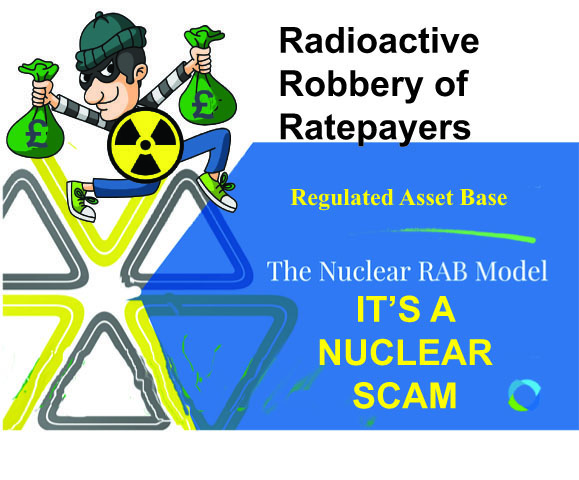
NFLA 14th Oct 2024
As Prime Minister Sir Kier Starmer meets world finance leaders today at the UK International Investment Summit, the Chair of the Nuclear Free Local Authorities has co-signed a letter sent to the Energy Secretary and government departments challenging plans to use the Regulated Asset Base model to finance future nuclear power plants.
The letter, drafted by the former Chief Statistician of the Scottish Office, has been endorsed by thirty high-level experts, comprising senior academics, former civil servants, nuclear regulators, citizen scientists and NGOs. It has been sent to Energy Secretary, Ed Miliband, and several Whitehall departments – the Energy Security and Net Zero Committee, the National Audit Office, the Public Accounts Committee, and the Comptroller and Auditor General.
14th October 2024
‘A catastrophically poor bargain for the UK’: Experts verdict on government plan for new nuclear finance
As Prime Minister Sir Kier Starmer meets world finance leaders today at the UK International Investment Summit, the Chair of the Nuclear Free Local Authorities has co-signed a letter sent to the Energy Secretary and government departments challenging plans to use the Regulated Asset Base model to finance future nuclear power plants.
The letter, drafted by the former Chief Statistician of the Scottish Office, has been endorsed by thirty high-level experts, comprising senior academics, former civil servants, nuclear regulators, citizen scientists and NGOs. It has been sent to Energy Secretary, Ed Miliband, and several Whitehall departments – the Energy Security and Net Zero Committee, the National Audit Office, the Public Accounts Committee, and the Comptroller and Auditor General.
Due to the inevitable huge costs and construction delays, the private sector is loath to finance new nuclear power projects; Sizewell C is struggling to find financial backers. Consequently, new plants can only be built with a significant public subsidy.
The latest subsidy mechanism to be adopted by the UK Government is the Regulated Asset Base model, in which an additional nuclear levy will be imposed on hard-pressed electricity consumers to make interim payments to developers of new nuclear projects to periodically offset their construction costs; this lifts the burden of rising costs and costly delays from the shoulders of developers and places this upon those of the customer. In so doing, not only is the project derisked for the developer, but the latter has less incentive to arrest costs or prevent delays because they know electricity consumers will have to meet them.
The experts have labelled RAB ‘a catastrophically poor bargain for the UK’.
The NFLAs have labelled RAB ‘ROB’, calling it daylight robbery and especially iniquitous when imposed upon the poorest and oldest customers. Many households are already struggling to pay huge, and rising, energy bills, and will be further burdened by a nuclear levy, and as new nuclear plants take so long to build many older customers are unlikely to be around to access any electricity from them.
In a response to a 2022 government consultation by the Business Department,[1] we denounced the proposal to impose a RAB levy on these groups, who are most vulnerable to cold and fuel poverty, and called for them to be exempted from the levy or promptly recompensed by the government if they are required to pay it.
Letter………………………………………………………………………………………………………. https://www.nuclearpolicy.info/news/a-catastrophically-poor-bargain-for-the-uk-experts-verdict-on-government-plan-for-new-nuclear-finance/
A nuclear kettle of fish at Hinkley Point C
Is a trawler’s worth of fish getting in the way of our nuclear
ambitions? Tali Fraser investigates something fishy going on around Hinkley
Point C. Among ministers of the last government, it is known as “the fish
disco”, and it is, they say, a cautionary tale that illustrates the
nation’s inability to build critical infrastructure.
The story centres on
the massive construction site on the Bristol Channel where EDF is building
the Hinkley Point C nuclear power station that is essential to meet the
nation’s future energy needs. Nuclear reactors need to be cooled – one
reason they are often based on the coast – but the intake of the water
poses a risk to fish. EDF’s initial solution included what they called an
“acoustic fish deterrent”, essentially a series of 280 underwater
speakers blasting a series of high-pitched sound pulses louder than a jumbo
jet. The company, however, has begun to argue that the deterrent, mockingly
dubbed “the fish disco” by former environment secretary Michael Gove,
is unnecessary and wants instead to mitigate the risk by other means.
Critics, however, say the company is reneging on a promise it made to win
planning consent because it wants to save cash (the cost of the deterrent
is estimated to run to the tens of millions of pounds).
Politics Home, 15th Oct 2024
https://www.politicshome.com/thehouse/article/fish-disco-hinkley-point-c-nuclear-energy
Israel attacks the United Nations

Contrary to popular belief, the United Nations General Assembly has only accepted Israel’s membership conditionally (resolution 273). However, Tel Aviv has never respected its commitments. It refuses to implement 229 resolutions of the Security Council and the General Assembly. It has just declared a UN agency a “terrorist organization,” called for its headquarters in New York to be razed, designated its Secretary General António Guterres persona non grata, and has just attacked four times UN peacekeepers in Lebanon (UNIFIL), wounding two blue helmets.
Voltaire Network | Paris (France) | 15 October 2024 by Thierry Meyssan, https://www.voltairenet.org/article221376.html
Israel has just attacked a position of the UN peacekeepers in Lebanon. When the British withdrew from Mandatory Palestine (i.e. Palestine placed by the League of Nations under the provisional administration of the United Kingdom) on May 14, 1948, the Zionist General Council, an offshoot of the Haganah (i.e. the main militia of the immigrant Jewish community), unilaterally proclaimed the independence of the State of Israel. It was announced by the chairman of the Jewish Agency (i.e. the executive of the World Zionist Organization).
It is important to note here that the British occupier withdrew from only about a quarter of Mandatory Palestine. It had already officially left the other three quarters, constituting Mandatory Transjordan, the future Jordan.
After a few days of reflection, the United Nations General Assembly decided to recognize the new state, not without having emphasized that in principle, it was not up to a militia, the Haganah, to proclaim a state, even if this proclamation came to fill the void left by the departure of the mandatory authority, that is to say the British. The General Assembly had noted that the proclamation of independence said nothing about the regime of this state (theocracy or republic), nor about its borders. It intended to pursue its plan for the creation of a binational state, both Arab and Jewish, without territorial continuity between the two entities (Jerusalem and Bethlehem having an international status). It had been reassured by the new state’s reference to “complete equality of social and political rights for all citizens without distinction of belief, race and sex.”
The day after independence, Egypt, Iraq, Transjordan, Lebanon, Syria and Yemen sent their armies to Palestine. Official history today assures that these six countries (the “Arabs”, understand the “Muslims”) did not accept a Jewish state, while five of them opposed Jewish colonization after British colonization and the sixth supported Israel. Religion was a problem only for Izz al-Din al-Qassam, the Muslim Brotherhood and the Nazi mufti Mohammed Amin al-Husseini.
Identicaly, propaganda assures that these armies were defeated by the valiant Israeli army, implying “from the first day, the Jews are morally superior to the Arabs”. The reality was quite different. The world war had just ended and none of these countries, except Transjordan, had an army worthy of the name.
Their troops were exclusively formed of volunteers. In addition, the Transjordanian army, which ended the conflict, fought on the side of Israel against the other Arabs. Indeed, Transjordan, still under British influence, hoped to prevent the creation of a Palestinian state and annex its territory. Its army was none other than that of the British (the “Arab Legion”) and was still placed under the command of General John Bagot Glubb (alias “Glubb Pasha”). It was the Transjordanians (in fact the British) and not the Israelis who defeated the other Arab armies.
During the conflict, its sovereign, King Abdullah I was also proclaimed “King of Palestine.” During this conflict, the Israeli forces let the British of Transjordan fight against the Arabs and applied Plan D (in Hebrew: Plan “Dalet”). The Haganh intended to share as little territory as possible with Transjordan. Israeli forces illegally imported weapons from Czechoslovakia (already ruled by the communists), probably with the agreement of the USSR, supposedly to fight against British colonization, in reality to expel the Palestinians. This is the Nakhba (catastrophe). 750,000 Palestinians (between 50 and 80% of the population) were forcibly displaced.
Israel requested and obtained, the following year, its membership in the United Nations. At that time, no decolonized state was part of it. The countries under Anglo-Saxon influence were in the majority. However, they only accepted Israel under conditions. In its resolution 273, the UN General Assembly referred to a written commitment by the Minister of Foreign Affairs of the provisional government of Israel, Moshe Shertok, by which he “accepts without any reservation the obligations arising from the Charter of the United Nations and undertakes to observe them from the day it becomes a Member of the United Nations” [1].
To date, Israel has failed to uphold this commitment and has failed to comply with 229 Security Council and General Assembly resolutions. Its membership could therefore be suspended at any time.
In recent months,
• Israeli Foreign Minister Israel Katz said on March 23 that the UN had become “an anti-Semitic and anti-Israeli organization that harbors and encourages terrorism.”
• Israel has campaigned against a UN agency, the United Nations Relief and Works Agency for Palestine Refugees in the Near East (UNRWA), accusing it of serving Hamas. Last July, the Knesset passed three laws (1) banning UNRWA from operating on Israeli territory (2) stripping its staff of diplomatic immunities (3) declaring it a terrorist organization.
• Israel’s permanent representative to the United Nations, Gilad Erdan, declared at the end of his term last August, speaking from the UN headquarters in New York, that “this edifice must be razed from the face of the Earth.”
• Israeli Foreign Minister Israel Katz declared UN Secretary-General António Guterres persona non grata.
• The Israel Defense Forces (IDF) deliberately targeted French, Italian and Irish soldiers of the United Nations Interim Force in Lebanon (UNIFIL).
The bottom line:
• Israel was not created by its people, but by its army.
• The first Arab-Israeli war was not won by the Israelis, but by the Arabs of Transjordan under British command.
• By joining the United Nations, Israel committed itself to respecting all its resolutions, which it has violated 229 times.
• After Palestine, Lebanon, Syria, Iraq, Yemen and Iran, the Netanyahu government has opened an eighth front against the United Nations.
An Israeli attack on Iran’s nuclear facilities could backfire
And recent Iraqi history can tell us how.
Ibrahim Al-Marashi, Associate Professor of Middle East History at California State University San Marcos, Aljazeera, 16 Oct 24,
Since Iran’s October 1 missile attack on Israel in response to the killing of Hezbollah leader Hassan Nasrallah in Beirut and Hamas leader Ismail Haniyeh in Tehran, there has been much speculation about how Tel Aviv will retaliate. Some observers have suggested that it could hit Iranian oil installations, and others, its nuclear facilities.
US President Joe Biden’s administration seems to oppose both options, but it has approved the deployment of a Terminal High Altitude Area Defense (THAAD) missile defence system and United States troops to Israel, possibly in anticipation of an Iranian response to an Israeli strike.
Biden says he would not back Israeli strike on Iran’s nuclear sites
Iran’s President Pezeshkian says Tehran ready to improve ties with West
Iranian president says ‘ready to engage’ on nuclear deal
Iran ready to resume nuclear negotiations immediately: Foreign minister
Meanwhile, Biden’s political adversary, Republican presidential candidate Donald Trump, has egged on Israel to “hit the nuclear first”. Trump’s son-in-law Jared Kushner has also suggested the same.
While Trump, Kushner and other staunch Israel supporters are happy to cheer on an Israeli strike on Iran’s nuclear facilities, they likely know very little about the consequences of another such Israeli attack that targeted an Iraqi nuclear site.
Israel’s destruction of Iraq’s French-built Osiraq nuclear reactor in 1981 actually pushed what was largely a peaceful nuclear programme underground and motivated Iraqi leader Saddam Hussein to invest in the pursuit of a nuclear weapon. An aggressive act against Iran’s nuclear programme will likely have a similar effect.
A ‘pre-emptive’ strike
Iraq’s nuclear programme started in the 1960s with the USSR building a small nuclear research reactor and providing it with some know-how. In the 1970s, Iraq purchased a bigger reactor from France – called Osiraq – and expanded its civilian nuclear programme with significant French and Italian assistance.
The French government had made sure that technical measures were in place to prevent any possible dual use of the reactor and it shared this information with the US, Israel’s closest ally. Iraq, which was a signatory to the Nuclear Non-Proliferation Treaty and had its nuclear sites inspected regularly by the International Atomic Energy Agency (IAEA), was not “on the brink of” developing a nuclear weapon, as Israel falsely asserted.
Nevertheless, the Israeli government, which was facing growing discontent domestically and a potential loss at the approaching legislative elections, decided to proceed with the “pre-emptive” strike…………………………………………………
A trove of declassified US documents released in 2021 demonstrates that Israel’s strike did not eliminate Iraq’s programme, but rather made Saddam more determined to acquire a nuclear weapon………………………………..
The consequences of a strike on Iran
…………………….assassinations may have killed key cadres, they have inspired a new generation of Iranians to pursue nuclear science, part of an Iranian “nuclear nationalism” emerging as a result of the constant attacks on Iran’s nuclear programme.
…………………………….. Israel’s actions so far are only increasing Iranian determination to continue its nuclear programme. A strike on any of its nuclear facilities would make that determination even stronger. And if we are to go by the Iraqi example, it may drive the Iranian nuclear programme underground and accelerate it towards the development of a nuclear weapon.
………. what Netanyahu is doing in Gaza and Lebanon now and will do in Iran will not bring victory to Israel. His strategy produces resentment in these countries and across the Middle East, which will help Iran and its allies rebuild swiftly whatever capabilities they lose to reckless Israeli strikes. https://www.aljazeera.com/opinions/2024/10/14/an-israeli-attack-on-irans-nuclear-facilities-could-backfire
We’re Basically Being Asked To Believe That The Palestinians Are Genociding Themselves
Caitlin Johnstone, 16 Oct 24
One of the dumbest things we are asked to believe about Israel’s genocide in Gaza is that all these civilians are being butchered because the Palestinians are evil and not the Israelis. That it’s the victims doing evil things and not the perpetrators.
That’s all this gibberish about “human shields” and “self-defense” is meant to do, you know. To make it look like the victims of siege warfare and carpet bombing are the ones responsible for all the death and destruction we are seeing and not the people who are actually doing it.
Can you think of anything more insulting to your intelligence? So self-evidently counter to common sense? They’re seriously asking you to believe that the people who are being starved, shot and bombed to death are the perpetrators of their own genocide, and that the side which has attacked every hospital in Gaza are just the innocent bystanders responding to unprovoked acts of aggression in the most ethical and responsible way they can manage.
Off the top of my head I really can’t think of anything more absurd.
❖
Everyone who reacted with more sympathy or outrage over October 7 than they have over the last year of Israeli atrocities has just spent a year confessing that they don’t see Palestinians as human beings.
I am not a dog person or a cat person, but if I saw dogs or cats being treated the way Palestinian human beings are being treated I would care more than the average western liberal cares about Palestinians.
A liberal is someone who thinks the moderate position between being pro-Israel and being pro-Palestine is giving Israel everything it needs to genocide the Palestinians and then watching the genocide and saying “Oh how heartbreaking and tragic, this is all very complicated.”
Israel to continue blocking humanitarian aid from Gaza on the grounds that the aid could fall into the hands of Palestinian civilians.
❖
Imagine getting into journalism school thinking you’ll change the world for the better, finally graduating and making your family proud, getting into a prominent news outlet, spending years working your way up to editor, only to wind up spending your days writing headlines like “Gaza children perish after chance encounter with missile.”……………………………………………………… more https://www.caitlinjohnst.one/p/were-basically-being-asked-to-believe?utm_source=post-email-title&publication_id=82124&post_id=150287267&utm_campaign=email-post-title&isFreemail=true&r=1ise1&triedRedirect=true&utm_medium=email
NATO Announces Nuclear Drills as Nobel Goes to Atomic Weapon Abolitionists

Disarmament advocate Beatrice Fihn stressed that the exercise is practice for “wiping out hundreds of thousands of civilians” with weapons that would also “flatten cities and poison survivors.”
Common Dreams, Jessica Corbett, Oct 11, 2024
The NATO military block announced Friday that its annual nuclear exercise is set to begin next week—news that arrived just as Japanese atomic bomb survivors who advocate for disarmament received the Nobel Peace Prize.
“There is bad timing, there is dropping a brick… and then there is this. Nice work,” the Geneva Nuclear Disarmament Initiative said in response to NATO Spokesperson Farah Dakhlallah on social media.
Dakhlallah shared a NATO statement explaining that “Steadfast Noon,” the two-week military drills scheduled to start Monday, will include 2,000 soldiers from eight air bases and more than 60 “nuclear-capable jets, bombers, fighter escorts, refueling aircraft, and planes capable of reconnaissance and electronic warfare” flying over western Europe……………………………………………
Beatrice Fihn, director of Lex International and a senior fellow at the United Nations Institute for Disarmament Research, stressed on social media Friday that NATO exercise is practice for “wiping out hundreds of thousands of civilians” with weapons that would also “flatten cities and poison survivors.”…………………………………………………………….. more https://www.commondreams.org/news/nato-nuclear-exercises?fbclid=IwY2xjawF72b9leHRuA2FlbQIxMQABHbdEtEt3u1G3K6vFGqSUwlo0GYYZISJscIk8fgwESepw2hUlLNbiSvjdcg_aem_mtsxSBbbl4fVS7RmjAzK_w
200+ Jewish-Led Protesters Arrested at NY Stock Exchange Say ‘Stop Arming Israel’

“The U.S. war economy is profiting from genocide,” said Jewish Voice for Peace. “The 50+ members of Congress who invest in arms companies get richer every day.”
Jessica Corbett, 14 Oct 24, https://www.commondreams.org/news/israel-wall-street
As the Israeli assault of the Gaza Strip and Lebanon continued on Monday, over 200 Jewish-led protesters, including descendants of Holocaust survivors, were arrested at the New York Stock Exchange while demanding that the United States “stop arming Israel and profiting from genocide.”
Jewish Voice for Peace (JVP)—which has led several anti-genocide protests across the country over the past year of war—said that hundreds of people joined the action in New York City. The advocacy group shared photos and videos on social media of participants in red T-shirts with messages including “Not in Our Name” and “Stop Arming Israel.”
They sat in rows outside the iconic NYC building with banners that said, “Jews Say Stop Arming Israel,” “Arms Embargo Now,” “Jews Say Divest From Israel,” “Gaza Bombed, Wall Street Boomed,” and “Fund FEMA Not Genocide,” a reference to the Federal Emergency Management Agency, which is responding to damage from hurricanes in the Southeast.
As NBC Newsreported on Monday:
Individuals representing Jewish Voices for Peace, a Jewish-led pro-Palestinian group, arrived at the exchange at 85 Broad St. as part of an “unscheduled protest” just before the stock market’s official 9:30 am opening, according to a New York Police Department spokesperson.
A number of arrests were made, the spokesperson said, but an exact figure could not immediately be obtained. An NYSE representative said at least one person had handcuffed himself between an interior and exterior door.
JVP, which said that over 200 people were arrested, posted footage of multiple protesters in red shirts chained to a door and a fence and of officers carrying away demonstrators. The group said that “police are dragging Jewish protesters by their arms and legs as they refuse to leave the global epicenter of capital on Wall Street.”
“As Gaza is bombed, Wall Street booms,” the group said. “The stock prices of weapons manufacturers have skyrocketed this year. The U.S. war economy is profiting from genocide. The 50+ members of Congress who invest in arms companies get richer every day.”
As Common Dreams has reported, stocks of American war profiteers—including Lockheed Martin, Northrop Grumman, and RTX, formerly known as Raytheon—soared in response to Israel launching its assault on Gaza after the Hamas-led October 7, 2023 attack as well as earlier this month, after Israeli forces began a ground invasion of Lebanon and Iran fired off ballistic missiles.
“Remember that members of Congress are permitted to own stock in war manufacturing, so when they vote to send more bombs or send our loved ones to war, they profit personally,” U.S. Rep. Rashida Tlaib (D-Mich.) said in early October.
Tlaib, the only Palestinian American in Congress, has introduced the Stop Politicians Profiting from War Act, which would prohibit federal lawmakers along with their spouses and dependent children from trading defense stocks or having financial interests in companies that do business with the U.S. Department of Defense.
“Politicians should not be allowed to profit from genocide,” said MacArthur fellow Ros Petchesky, an 82-year-old JVP member who was active in the movement to end the war in Vietnam, and the oldest person chained to the Wall Street gates on Monday. “There can be no business as usual while the U.S. arms Israel and profits from genocide. We’re here to demand an arms embargo now.”
Open Letter to the Department for Energy Security -new nuclear power ‘a catastrophically poor bargain’.
1 Open Letter to the Department for Energy Security and Net Zero. Senior
academics, former civil servants, nuclear regulators, and NGOs write to
ESNZ, NAO, PAC, saying new nuclear power ‘a catastrophically poor bargain’………………………………………. signatures,
Bylines Scotland 14th Oct 2024
https://bylines.scot/environment/open-letter-to-the-department-for-energy-security-and-net-zero/
Campaigners welcome international investors to UK summit but urge them to boycott “toxic investment” Sizewell C 14.10.24
Campaigners opposed to Sizewell C unfurled two banners saying “Sizewell
C is a Toxic Investment” this morning outside the City of London’s
Guildhall. The protest took place as world business leaders gathered for
Labour’s first International Investment Summit, and the Labour government
launched its Industrial Strategy consultation.
A Sizewell C Final Investment Decision (FID) has been delayed and rumours are swirling around about which, if any, of the small pool of private investors reported to be
taking part in the equity raise are still involved. Alison Downes of Stop
Sizewell C said “It’s fantastic that Britain is open for business, but
we’re here to tell international investors that, unless they want to find
themselves embroiled in another HS2, they should put their money into
renewables instead of slow, risky, expensive, “toxic” Sizewell C. The
reality is that Sizewell C cannot help the Labour government achieve its
Energy Mission, and if UK investors won’t touch it, neither should
international ones, nor the taxpayer.” https://tasizewellc.org.uk/campaigners-welcome-international-investors-to-uk-summit-but-urge-them-to-boycott-toxic-investment-sizewell-c-14-10-24/
Stop Sizewell C 14th Oct 2024
Report: Israel Plans To Strike Iran Before US Presidential Election

Officials told The Washington Post that Netanyahu told Biden he plans to target military sites inside Iran
by Dave DeCamp October 14, 2024, https://news.antiwar.com/2024/10/14/report-israel-plans-to-strike-iran-before-us-presidential-election/#gsc.tab=0
Israel is planning to launch its expected attack on Iran before the US presidential elections are held on November 5, The Washington Post reported on Monday.
An unnamed official told the Post that waiting any longer could be perceived as weakness and that the planned strike “will be one in a series of responses” to the Iranian ballistic missile barrage that was fired at Israel on October 1, which came in response to a series of Israeli escalations.
A source close to Israeli Prime Minister Benjamin Netanyahu told the Post that while Israel was coordinating with the US to some extent on its plans to attack Iran, it wouldn’t wait for a green light from the US. “The person who will decide on the Israeli response to Iran will be [Netanyahu],” the official said.
The report said that when Netanyahu spoke with President Biden last week, he said that Israel planned to hit military infrastructure inside Iran, not oil or nuclear facilities. The conversation was a factor in Biden’s decision to deploy a Terminal High-Altitude Area Defense (THAAD) missile battery to Israel.
The Pentagon announced Sunday that it was deploying the THAAD and about 100 troops to operate it “to support the defense of Israel.” Iran has vowed that it would respond to any Israeli attack on its territory, and the US deployment makes US troops a potential target of Iranian missiles.
The Post report noted how the Biden administration has been fully supportive of Israel’s invasion of Lebanon and its dramatic escalation of airstrikes against the country. A former Israeli official said the US was “giving Israel and the Netanyahu government a bear hug, but for Hezbollah.”
“It is sending THAAD and promising all kinds of weapons that we need to finish off Hezbollah, saying that we can deal with Iran later,” the former official added.
US military and diplomatic support for Israel over the past year has fueled the genocidal slaughter in Gaza and emboldened Israeli escalations across the Middle East, and has now brought the US and Iran to the brink of war. Brown University’s Costs of War project recently released a report that supporting Israel has cost the US $22.76 Billion in just one year.
Senior U.S. Diplomats, Journalists, Academics and Secretaries of Defense Say: the U.S. Provoked Russia in Ukraine
by Donald A. Smith, PhD, The Ukraine Papers, 14 Oct 24
It took some years for Americans to realize they’d been lied to about the war in Vietnam. Thanks to the publication of the Pentagon Papers, and thanks to the antiwar movement, Americans eventually learned about the injustices and failures of that war.
Likewise, it took several years after the starts of the wars in Iraq and Afghanistan for Americans to realize they’d been lied to about those wars as well.
Americans are just now starting to realize that they’ve been lied to about the war in Ukraine. (The propaganda effort has been quite effective, with the New York Times, in particular, acting as a mouthpiece for the government’s position.) More and more mainstream publications are exposing the lies, and a majority of Americans now oppose further arming of Ukraine.
This essay is a summary of what the U.S. government has been hiding about the war in Ukraine, with links to sources for further information
According to Brown University’s Costs of War project, U.S. military actions since 9/11 directly killed over 900,000 people, with an additional 3.5 million people dying from indirect effects. The wars cost Americans at least $8 trillion and displaced over 38 million people from their homes. The U.S. spends over a trillion dollars a year on its military, if you count all expenditures.
If we go back to the 1960s, the number killed by U.S. wars includes the several million killed in the Vietnam war, the approximately 1 million killed by U.S. support for Indonesian military’s attacks on left wing groups, and the hundreds of thousands, at least, killed in proxy wars and government overthrows in Latin America.
The wars, overthrows, and associated sanctions caused mass migrations worldwide — particularly in Europe and at the southern U.S. border — and destabilized politics. Yet almost nobody (except for whistleblowers) was held accountable for these disasters; indeed, many of the same people are in Congress or work for the government or the weapons industry.
Moreover, the U.S. government lied about almost all the wars — in particular, about the wars in Vietnam, Iraq, and Afghanistan, but also about the war in Yugoslovia, as documented in Harper’s Magazine, here (Chapter 3), and here. (In short, the Kosovo Liberation Army that the U.S. supported was, basically, a terrorist organization funded by the CIA, and U.S. propaganda greatly overstated the nobility of the U.S. intervention.)
So, it should come as no surprise that our government is lying now about the war in Ukraine. Specifically, claims by President Biden and others that the Russian invasion was “unprovoked” are greatly exaggerated.
Read what these diplomats, secretaries of Defense, journalists, academics, politicians, and others have to say:………………………………………………………………………………………………………………………………………………………………………………………………more https://theukrainepapers.org/senior-US-diplomats-academics-journalists-and-secretaries-of-defense-say-the-US-provoked-Russia-in-Ukraine.html
Nuclear – not the way ahead

12 Oct 24 https://renewextraweekly.blogspot.com/2024/10/nuclear-not-way-ahead.html
Renewable energies consistently outperform nuclear power in terms of cost and deployment speed and are therefore chosen over nuclear power in most countries’ – so says this years independent World Nuclear Industry status report (WNISR). It notes that in 2023, 5 new nuclear reactors (5 GW) started up and 5 were closed (6 GW), capacity thus declining by 1 GW. So overall it says that nuclear energy’s share of global commercial gross electricity generation declined from 9.2 % to 9.1%, little more than half of its peak of 17.5 % in 1996. In 2023, total investment in non-hydro renewable electricity capacity reached a record US$623 billion, 27 times the reported global investment decisions for the construction of nuclear power plants, with solar and wind power capacities growing by 73% and 51%, respectively.
Nevertheless, some countries are still pushing on with new nuclear, despite its poor economics, including the UK and Sweden. Sweden has mooted a new financing model but its critics say support for nuclear ‘is like throwing money down the drain’ since ‘the expansion of solar energy will make nuclear power obsolete and push it out of the electricity market by the 2030s’. In the UK, and also in France, it has been argued that part of the reason for the political commitment to new nuclear is link between civil and military nuclear, with cross-funding and technical collaboration seen as beneficial.
However, be that as it may, Emeritus Profs. Stephen Thomas (University of Greenwich) and Andrew Blowers (OU) do not see nuclear civil power prospering in the UK, indeed they say that ‘it is time to expose the Great British nuclear fantasy once and for all.’ They claim that ‘no amount of political commitment can overcome the lack of investors, the absence of credible builders and operators or available technologies let alone secure regulatory assessment and approval. Moreover, in an era of climate change there will be few potentially suitable sites to host new nuclear power stations for indefinite, indeed unknowable, operating, decommissioning and waste management lifetimes. And there are the anxieties and fears that nuclear foments, the danger of accidents and proliferation and the environmental and public health issues arising from the legacy of radioactive waste scattered on sites around the country’.
They go on to suggest backing off new nuclear projects. They do recognise that ‘abandoning Sizewell C and the SMR competition will lead to howls of anguish from interest groups such as the nuclear industry and trade unions with a strong presence in the sector. It will also require compensation payments to be made to organisations affected. However, the scale of these payments will be tiny in comparison with the cost of not abandoning them’.
Certainly the cost of construction is vast- and expanding. The EPR being built by EDF at Hinkley Point may in the event cost £35bn, with there’s still being a way to go- 2030 for unit 1 start up, maybe 2031 for Unit 2. And as industry commentators have noted ‘as the cost of Hinkley Point has increased, the backers have had to provide more funding. The souring of relations between Britain & China saw CGN stop providing any more money, leaving EDF to fund the shortfall. EDF has called upon the UK government to help out with the escalating cost but it has refused. EDF was fully nationalised in 2023, leaving the French taxpayer to pick up the tab for the cost overruns’.
UK consumers will of course pay the high cost of the power when it comes on the grid. They will also be expected to shell out for the next EPR that is planned in the UK, at Sizewell, but this time in advanced of completion, under the RAB financing system. However, although the government has provided £5.5bn to move things along, the final (private) investment decision on Sizewell C keeps being delayed. EDF aimed to secure funding by the end 2024, but that may now be extended to 2025 – and EDF is still looking for £4bn to finish Hinkley Point!
All in all, with EDF’s finances in a mess, and few other companies keen to take risks with this technology, it looks a bit uncertain. Even the UK government seems to be having doubts, with plans for a new large project on Wylfa in Wales may be subject to a review. Proposals are currently being considered for small modular reactors under a UK SMR competition, but the US NuScale PWR has just been eliminated from the race. It was once seen as the leader, but it had lost a US order. EDF had earlier dropped out. So that leaves Rolls-Royce, GE-Hitachi, Westinghouse, and Holtec Britain, with the newly formed agency, Great British Nuclear, expected to announce 2 winners later this year or early next year. Up to £20bn is at stake. However few see any power being available anywhere from SMRs until the early or mid 2030s. Despite a lot of hype, in reality it has been slow going. And there are risks.
Overall then, the prospects for new nuclear in the UK, or indeed elsewhere, do not look too good. Even in China, renewables are expanding very much faster, with according to the WNISR/IRENA, at the end of 2023, there being over 1000GW of wind and solar and around 421GW of hydro in place, compared to just 53GW of nuclear. Given the scale and rate of deployment, and the costs, it’s pretty clear which should be the way forward in terms of energy supply there and everywhere else.
Nuclear fission may have a small role to play in some isolated locations and in some applications, and fusion may be viable at commercial scale at some stage, but we have to be aware of hype and overselling in this area, and also in the wider nuclear debate, with nuclear sometimes being sold as the answer to climate change. It’s not. As I have indicated in earlier posts, there is no shortage of studies from around the world confirming the view that nuclear is a costly and risky distraction from renewables, which are the main energy supply solutions to climate change. And Germany has shown how the exit from nuclear can be done, led by renewables. Although they do have some issues in terms of balancing, renewables, along with energy efficiency, demand management and storage, are the way ahead to an economically viable and sustainable energy future.
1 This Month


Read the Public Inquiry Report, the Commissioners’ report, Surrendering Australia: The AUKUS Deception is available to download for free at aukuspublicinquiry.com. Or just watch the replay of the National Press Club Luncheon.



19 November – Webinar – The Reality of Reprocessing
Time: 11:00 AM Pacific Time (US & Canada) / 2:00 PM Eastern / 7:00 PM UK / 8:00 PM CET
Register for the Zoom Event Here



Shut down the radiation-damaged Heysham nuclear reactors now
To see nuclear-related stories in greater depth and intensity – go to https://nuclearinformation.wordpress.com

Say No to NASA’s Reckless Nuclear Reactor on the Moon
Say No to NASA’s Reckless Nuclear Reactor on the Moon
-
Archives
- November 2026 (119)
- October 2026 (302)
- September 2026 (339)
- August 2026 (330)
- July 2026 (355)
- June 2026 (287)
- May 2026 (306)
- April 2026 (356)
- March 2026 (251)
- February 2026 (267)
- January 2026 (308)
- December 2025 (358)
-
Categories
- 1
- 1 NUCLEAR ISSUES
- business and costs
- climate change
- culture and arts
- ENERGY
- environment
- health
- history
- indigenous issues
- Legal
- marketing of nuclear
- media
- opposition to nuclear
- PERSONAL STORIES
- politics
- politics international
- Religion and ethics
- safety
- secrets,lies and civil liberties
- spinbuster
- technology
- Uranium
- wastes
- weapons and war
- Women
- 2 WORLD
- ACTION
- AFRICA
- Atrocities
- AUSTRALIA
- Christina's notes
- Christina's themes
- culture and arts
- Events
- Fuk 2022
- Fuk 2023
- Fukushima 2017
- Fukushima 2018
- fukushima 2019
- Fukushima 2020
- Fukushima 2021
- general
- global warming
- Humour (God we need it)
- Nuclear
- RARE EARTHS
- Reference
- resources – print
- Resources -audiovicual
- Weekly Newsletter
- World
- World Nuclear
- YouTube
-
RSS
Entries RSS
Comments RSS

