Nuclear site holds emergency exercise
BBC 12th Nov 2024
A safety exercise which simulates an emergency at a nuclear site is taking place.
People who live close to the Sellafield nuclear reprocessing plant in Cumbria may hear the site siren and receive text, email and telephone warnings if they have signed up for them.
If the siren sounds, the gates will be shut and the site placed into lockdown.
Full-scale safety tests have to take place at Sellafield at least once a year and are observed by the Office for Nuclear Regulation (ONR).
This is a “daylight exercise”, but details of timings or the scenario are not revealed in advance.
A Sellafield spokesperson said everyone on site is expected to “respond appropriately and follow instructions”.
ONS inspectors will provide feedback and learning points following the exercise. https://www.bbc.co.uk/news/articles/cgj7dezyed2o
How a Secluded 1984 Conference Forged Israel’s Unprecedented Influence Over US Media

Buoyed by its success, the operation soon expanded to include school and university students worldwide, training them to act as vigorous advocates for Israel in classrooms and on campuses. Graduates of these Israeli-funded programs frequently enter influential fields, including journalism, where they continue to promote Hasbara narratives and defend Israel’s actions. The impact on Western media coverage of Palestine has been profound.
Mint Press News, November 11, 2024
As Israel’s October 1 invasion of Lebanon unfolds, the media’s complicity in shaping public perception raises urgent questions, particularly when viewed through the lens of a controversial 1984 conference where influential advertising and media figures gathered to refine Israel’s narrative strategies. This conference laid the groundwork for a sophisticated propaganda campaign—Hasbara—that sought to sanitize Israel’s actions and cast its military operations in a favorable light. Today, as Western journalists whitewash, distort, and conceal Israel’s the realities of Israel’s deadly campaign of violence, the enduring legacy of this meeting becomes alarmingly clear, revealing how narratives crafted decades ago continue to shape the coverage of a conflict that claims countless lives.
…………………………………………………………………………… The mainstream media’s systematic use of distancing and evasive language, omission and other duplicitous chicanery to downplay or outright justify Israel’s murder of innocent civilians while simultaneously dehumanizing their victims and delegitimizing Palestinian resistance against brutal, illegal IDF occupation is as unconscionable as it is well-documented. Amazingly though, ‘twasn’t ever thus. Once upon a time, mainstream news networks exposed Israel’s war crimes without qualification, and anchors and pundits openly condemned these actions on live TV to audiences of millions.
The story of how Western media was transformed into Israel’s doting, servile propaganda appendage is not only a fascinating and sordid hidden chronicle. It is a deeply educational lesson in how imperial power can easily subordinate supposed arbiters of truth to its will. Comprehending how we got to this point equips us with the tools to assess, identify, and deconstruct lies large and small – and effectively challenge and counter not only Israel’s falsehoods but the entire settler colonial endeavor.
‘Neighborhood Bully’
On June 6, 1982, Israel invaded Lebanon. The effort was ostensibly intended to drive Palestinian Liberation Organization freedom fighters away from their positions on Israel’s northern border. But, as the IDF savagely pushed ever-deeper into the country, including Beirut, it became clear that ethnic cleansing, massacres, and land theft were – as in Palestine – the true goal. Throughout the Lebanese capital, news crews from major networks and reporters from the West’s biggest newspapers were waiting.
Israel’s rapacious bloodlust and casual contempt for Arab lives had hitherto been, by and large, successfully concealed from the outside world. Suddenly, though, scenes of deliberate IDF airstrikes on residential housing blocks, Tel Aviv’s trigger-happy soldiers running amok in Beirut’s streets, and hospitals overflowing with civilians suffering from grave injuries, including chemical burns due to Israel’s use of phosphorus shells, were broadcast the world over, to nigh-universal outcry. As veteran NBC news anchor John Chancellor contemporarily explained to Western viewers:
What in the world is going on? Israel’s security problem, on its border, is 50 miles to the south. What’s an Israeli army doing here in Beirut? The answer is we are now dealing with an imperial Israel, which is solving its problems in someone else’s country, world opinion be damned.”
Global shock and repulsion at Israel’s conduct would only ratchet during the IDF’s resultant illegal military occupation of swaths of Lebanon. …………………………………………………………..
To say the least, Israel had an international PR disaster of historic proportions on its blood-soaked hands…………………………………………………..
So it was that in the summer of 1984, the American Jewish Congress – a major Zionist lobby organization – convened a conference in Jerusalem, Israel’s Public Image: Problems and Remedies. It was chaired by U.S. advertising supremo Carl Spielgovel, who a decade earlier provided pro bono advice to the Israeli government on strategies for publicly communicating why Tel Aviv refused to adhere to the terms of the Henry Kissinger-brokered 1973 Sinai Accords. Spielgovel later recalled:
It occurred to me then that the Israelis were doing a good job at training their military people, and they were doing a relatively good job at training their diplomatic corps. But they weren’t spending any time training information officers, people who could present Israel’s case to embassies and TV anchormen around the world. Over the years, I made this a personal cause celebre.”
The 1984 Jerusalem conference offered Spielgovel and a welter of Western advertising and public relations executives, media specialists, editors, journalists, and leaders of major Zionist advocacy groups an opportunity to achieve that malign objective. Together, they hammered out a dedicated strategy for ensuring the “crisis” caused by news reporting on the invasion of Lebanon two years earlier would never be repeated. Their antidote? Ceaseless, methodical, and wide-ranging “Hasbara” – Hebrew for propaganda – for “changing people’s minds [and] making them think differently.”
‘Big Scoop’
The AJC subsequently published records of the conference. They offer extraordinarily candid insight into how multiple Hasbara strategies, which have been in perpetual operation ever since were birthed. …………………………………………………………
There was extensive discussion of how to present “unpalatable policies” to Western populations…….. ” The necessity of training the Jewish diaspora in countering criticism of Israel was considered paramount.
………………….. media framing on Israel’s actions needed to be determined in advance…………………
It was also suggested that on an individual and organizational level, Zionist activists serve as a rapid reaction force, deluging news outlets with complaints en masse should their coverage of Israel be at all critical. One attendee boasted of their personal success in this regard:
“One day CBS News Radio reported that an American soldier had been hurt by stepping on an Israeli cluster bomb at the Beirut airport. I called CBS to point out that no one had established the bomb was an Israeli one. One hour later CBS reported that an American soldier had stepped on a bomb; this time the report omitted any reference to Israel.”
‘Frequent Violations’
Another significant recommendation came from Carl Spielgovel: creating a “training program” to bring carefully selected Israeli information specialists into U.S. advertising, PR agencies, and major news outlets. The initiative aimed to equip them with industry insights, ensure Hasbara efforts were maximized, and establish close relationships between Israeli officials and the organizations to which they were assigned.
These “specialists” would operate under the guidance of a U.S.-Israeli council described as “wise persons who can project different scenarios and how to cope with them” on complex issues like “annexation and Jerusalem.”
……………………………………………………………….. Since then, a dedicated Hasbara program aimed at cultivating skilled Zionist advocates in the U.S. has operated continuously.
Buoyed by its success, the operation soon expanded to include school and university students worldwide, training them to act as vigorous advocates for Israel in classrooms and on campuses. Graduates of these Israeli-funded programs frequently enter influential fields, including journalism, where they continue to promote Hasbara narratives and defend Israel’s actions. The impact on Western media coverage of Palestine has been profound.
To a significant degree, the portrayal of Tel Aviv as “the gallant little underdog democracy fighting for survival against all the odds” has been firmly reestablished. Despite the ongoing crisis in Gaza, mainstream outlets seldom provide context for Palestinian resistance to Israel’s policies of annexation, occupation, and military actions. Coverage nearly always frames Israel’s actions as “self-defense” against “terrorist” threats, with Western journalists keenly aware of potential repercussions for diverging from this narrative.
The rapid reaction force proposed at the 1984 AJC conference remains highly active. An extensive network of Hasbara-trained individuals and Israel lobby organizations is always on standby, ready to pressure and intimidate news outlets if coverage diverges from favorable framing or casts Israel in a critical light. As a senior BBC producer once confided to veteran media critic Greg Philo:
“We wait in fear for the telephone call from the Israelis. The only issue we face then is how high up it’s come from them. Has it come from a monitoring group? Has it come from the Israeli embassy? And how high has it gone up our organization? Has it reached the editor or director general? I have had journalists on the phone to me before a major news report, asking which words can I use – ‘is it alright I say this’?”
An October exposé by Al Jazeera, citing testimony from BBC and CNN whistleblowers, detailed “pro-Israel bias in coverage, systematic double standards, and frequent violations of journalistic principles” at both networks.
Were it not for the persistent investigations by outlets like MintPress News, The Grayzone, and Electronic Intifada, unfounded allegations promoted by Israel since the outset of the Gaza conflict—such as claims of Hamas committing mass rape or beheading infants—might never have been thoroughly debunked and might still shape the “context” for Israel’s actions against Palestinians. Meanwhile, countless concerned citizens have actively challenged Western narratives on the conflict in real-time across social media, a groundswell of critique that may be fueling pushback within some mainstream newsrooms. ……………………………………. https://www.mintpressnews.com/1984-hasbara-conference-israel-influence-us-media/288534/
Witnesses describe alleged Ukrainian war crimes in Donbass city
https://www.rt.com/russia/607474-ugledar-war-crimes-report/ 11 Nov 24
Ukrainian troops were given carte blanche to harass and commit crimes against the Russian-speaking population in the southern Donbass city of Ugledar, a Moscow-backed investigative mission has alleged.
Human rights defender Maksim Grigoriev, who chairs an international body investigating suspected crimes of the Ukrainian government, previewed on Monday a new report which focuses on the events in Ugledar. Russian troops liberated the town in early October, allowing civilian access to its remaining residents.
Witnesses said they had faced mistreatment since the armed coup in Kiev in 2014. One woman explained how she could not receive justice for her son, who was killed in a fight with a Ukrainian volunteer battalion member in 2016.
The woman said her son had been a large, strong man who had been stabbed to death after trying to defend local girls from a group of drunken troops from the Aidar unit. The criminal case was clear-cut and resulted in a conviction, but the sentence allowed the killer to be released on parole, Grigoriev said. The perpetrator reportedly did not see the inside of a prison cell.
The case exemplified the bias against the Russian-speaking population which was facilitated by the government in Kiev, the investigator said. It also helps explain the scale of criminality which Ugledar residents have endured in recent years amid open hostility between Russia and Ukraine, he added.
Among other things, the Ukrainian military had a strategy of forcing people out of the city by shelling it and claiming that the attacks were coming from the Russian side, Grigoriev said. Some residents said they personally saw such attacks.
“The [town’s] mayor reported in 2022 that there was nobody here, even though there were some 3,000 people left,” one witness said. “They [Ukrainian troops] were riding outside of Ugledar… and firing at it with mortars to incite panic and make people leave as fast as possible.”
Another man said he witnessed a foreign reporter on a guided tour. It came during a lull, so a Ukrainian soldier accompanying the woman gave an order on his radio: “It’s too quiet, make some noise.” Firing started immediately, scaring the journalist and causing her to run for her life, the man recalled.
Ugledar was subjected to “total looting” by the Ukrainians, Grigoriev claimed. Some homes were stripped down, with faucets, electric sockets and even wall tiling taken by marauders, according to witnesses.
Stolen goods were allegedly moved to other places and sold, sometimes marketed as “goods from Donbass” – a euphemism to designate their criminal origin.
Inside the secret plan to re-open America’s most infamous nuclear power plant code named Tetris
Daily Mail, By RACHEL BOWMAN FOR DAILYMAIL.COM, 11 November 2024
The mastermind behind the plan to reopen the nuclear plant that caused America’s worst reactor accident hatched the idea after learning tech CEOs were desperately searching for energy to power artificial-intelligence.
Constellation Energy and Microsoft announced a power purchase agreement in September to reopen the Three Mile Island (TMI) nuclear plant in Pennsylvania.
The plant is home the worst commercial nuclear power accident after the Unit 2 reactor suffered a partial meltdown due to mechanical failure and human error in 1979.
Joe Dominguez, the chief executive of Constellation Energy, said he came up with the idea after OpenAI co-founder Sam Altman revealed data centers for some AI models would require as much power as a large city during a gathering for CEOs in May 2023. ……………………………………………………………………………..
The Unit 1 reactor located on TMI Unit 2 was shut down in 1979 after its partial meltdown. Its twin – the Unit 2 rector – was operating until 2019.
To restart Unit 2, Constellation will invest $1.6 billion in the turbine, generator, main power transformer and cooling and control systems.
Then Dominguez had to get Pennsylvania Gov. Josh Shapiro’s support for the move. The two met for the first time last December and the CEO said Shapiro questioned him on the plant conditions and if a restart could be done safely without cost to the state……………………………………………
The companies have not released the financial details of the deal, but analysts at Jefferies estimate Microsoft will pay between $110 to $115 per megawatt hour of electricity.
The plant is expected to start delivering energy in 2028 under the agreement, and Constellation said they will pursue license renewal that will extend plant operations to at least 2054. https://www.dailymail.co.uk/news/article-14067243/Inside-secret-plan-open-Americas-infamous-nuclear-power-plant-code-named-Tetris.html
Nuclear sector’s views on second Trump administration mixed as Rogan interview raises questions
Donald Trump enacted pro-nuclear policies during his first term and supported an “all-of-the-above” energy policy during the campaign, but some advocates fear a “divide between words and actions.”
Utility Dive, By Brian Martucci. 8 Nov 24
Dive Brief:
- President-elect Donald Trump in August vowed to “approve new drilling, new pipelines, new refineries, new power plants [and] new reactors” on “day one” of his administration.
- But Trump has more recently sounded skeptical about federal backing for large-scale nuclear builds like Vogtle, which he said in an Oct. 25 interview with podcaster Joe Rogan “get too big, and too complex and too expensive,” raising questions about his second administration’s willingness to support the industry.
- The nuclear sector has mixed views on the incoming administration’s potential support, with some expressing optimism that Trump would build on pro-nuclear policies enacted during the Biden and first Trump administrations and others concerned about a pullback in federal funding for advanced nuclear development.
Dive Insight:
The second Trump administration is likely to “pursue an overall domestic energy agenda focused on energy production and dominance in the United States” but may not continue the Biden-Harris administration’s “massive appropriations” to the nuclear sector, American Nuclear Society Director of Public Policy John Starkey said.
At least one prominent Trump ally, environmental lawyer and former presidential candidate Robert F. Kennedy Jr., has an anti-nuclear track record. Kennedy, a Trump ally who is expected to have an official role in the incoming administration, fought for years to close New York’s Indian Point nuclear plant. More recently, he has voiced opposition to federal nuclear energy subsidies.
“We should have no subsidies … all the companies should internalize their costs in the way that they internalize their profits,” Kennedy told Tesla CEO and fellow Trump backer Elon Musk in an online discussion last year.
But the first Trump administration was broadly supportive of the U.S. nuclear industry……………………………………………………….
…………………………………..the incoming administration’s likely focus on reducing federal discretionary spending — Musk called for at least $2 trillion in spending cuts last month after Trump in September floated his appointment to a new “government efficiency commission” — “is a concern for a lot of potential customers” for advanced nuclear, said Jessica Lovering, co-founder and executive director of the Good Energy Collective, a pro-nuclear advocacy group. ………………………………………………………………………………………………………………..
https://www.utilitydive.com/news/nuclear-energy-sector-mixed-views-second-trump-administration-joe-rogan/732
Farmers slam ‘crazy’ plans to flood 1,500 acres to save fish from a power plant.
Farmers and locals say their ‘lives will be destroyed’ by ‘crazy’ plans to
flood 1,500 acres – to compensate for fish lost to a nuclear power plant.
EDF Energy wants the land – much of it used for agriculture and businesses
like camping and tourism – to create a saltmarsh habitat.
Hinkley Point C is currently being built and will ingest 44 tonnes of fish a year – and EDF
wants to mitigate that loss and the wider environmental impact of the site.
It wants to compensate the death of the fish and its carbon footprint by
creating the saltmarsh at one of four sites along the River Severn in
Somerset. Plans are currently focused on Kingston Seymour, between Clevedon
and Weston-super-Mare, where landowners have received letters and documents
from EDF.
SWNS 10th Nov 2024 https://www.youtube.com/watch?v=Z1IDkPWZ46g
America Can’t Afford a New Nuclear Buildup

William Hartung, 11 Nov 24, https://www.forbes.com/sites/williamhartung/2024/11/11/america-cant-afford-a-new-nuclear-buildup/
The return to power of Donald Trump raises serious questions about the future of the U.S. nuclear arsenal. His statements on nuclear weapons have been all over the map, but a 2017 review by Anthony Zurcher of The Guardian of Trump’s statements since the 980s concluded that “his thoughts on atomic weaponry reflect a certain strain of Cold War arms-race enthusiasm and diplomatic brinkmanship.” And in 2016, after he was challenged when he said ‘possibly, possibly” nuclear weapons could be used, Trump went on to say that if they weren’t to be used, “Then why are we making them?” On the flip side, he has also called nuclear war “the ultimate catastrophe.”
As for his actions in office, Trump pulled the U.S. out of the Iran nuclear deal, formally known as the Joint Comprehensive Plan of Action (JCPOA), which by all objective accounts had been working to stop Tehran’s pursuit of a nuclear weapon. And in 2019, the Trump administration withdrew from the Intermediate Nuclear Forces in Europe treaty (INF), which had banned ground-based ballistic missiles and cruise missiles in the range of between 500 and 5,500 kilometers.
On the other hand, Trump was roundly (and unfairly) criticized for his short-lived effort at nuclear negotiations with North Korea. The talks ultimately failed, but critics who slammed Trump for “rewarding” North Korean dictator Kim Jong Un seemed to be ignoring the fact that in the final analysis talking with adversaries is a precondition for any sort of agreement. Criticism of Trump for being ill-prepared or inconsistent was fair game, but slamming him for talking to the North Korean leader at all didn’t make a lot of sense.
The real test of Trump’s stance on all-things nuclear will be his approach to the Pentagon’s multi-year effort to build a new generation of nuclear-armed missiles, bombers, and submarines, plus new warheads to go with them, a plan that some experts suggest could cost up to $2 trillion in the next three decades.
The nuclear plan has already been plagued by major cost overruns, including an 81% increase in the projected cost of the new intercontinental ballistic missile, dubbed the Sentinel, and developed and produced by Northrop Grumman. The cost overrun prompted a government review of the program, but the assessment ended up pronouncing that the program was too important to cancel.
The review of the Sentinel was a missed opportunity. Former secretary of defense William Perry has called ICBMs “some of the most dangerous weapons we have,” because the president would have only a matter of minutes to decide whether to launch them on warning of attack, increasing the risk of a nuclear confrontation sparked by a false alarm.
The Pentagon has a big shopping list – a larger Navy, more combat aircraft, new armored vehicles, drones and other unpiloted vehicles. Even with a Pentagon budget soaring towards $1 trillion per year, something may have to be cut. There’s also a chance that at least a few fiscal conservatives in Congress may seek across-the-board cuts, including the Pentagon, upon news that for the first time interest on the federal debt is larger than the Pentagon budget.
On the other hand, despite the occasional criticism, Trump has come to see weapons contractors as important allies in executing his domestic strategy because of the jobs created by contracts with the Pentagon and foreign buyers. This alliance was on display in Trump’s effort to make a huge weapons deal with Saudi Arabia, which he claimed could create 500,000 jobs in the United States, when a more realistic estimate would be one-tenth to one-twentieth of that figure. The ultimate test came after the Saudi regime’s murder of the U.S.-resident Saudi dissident Jamal Khashoggi, when Trump issued a statement saying that U.S. arms to the Saudi regime would continue, in part because he didn’t want to reduce business for “our wonderful defense companies.”
Donald Trump is nothing if not unpredictable. Will Trump the deal maker pleasantly surprise us by attempting to enter into negotiations to reduce nuclear arsenals, or will he resort to bluster and threats that make negotiations more difficult, even as he helps line the pockets of major weapons makers with billions of dollars of our tax money? To some degree it’s up to what kind of pressure he gets for and against the current buildup, which is a question that can only be answered once he is in office.
Prepping Readers to Accept Mass Slaughter in Lebanese ‘Strongholds’

Belén Fernández, November 9, 2024, https://fair.org/home/prepping-readers-to-accept-mass-slaughter-in-lebanese-strongholds/
Back in May 2015, the New York Times’ Isabel Kershner decided to moonlight as an Israeli military propagandist by penning an alleged exposé (5/12/15)—headlined “Israel Says Hezbollah Positions Put Lebanese at Risk”—in which she diligently conveyed all that Israel had to say about Hezbollah’s infrastructure in south Lebanon.
The minuscule hamlet of Muhaybib, for example, was said to contain no fewer than “nine arms depots, five rocket-launching sites, four infantry positions, signs of three underground tunnels, three anti-tank positions and, in the very center of the village, a Hezbollah command post.” In the village of Shaqra, home to approximately 4,000 people, the Israeli army had meanwhile identified some “400 military sites and facilities belonging to Hezbollah.”
Only after 11 full paragraphs of transmitting the Israeli line did Kershner manage to insert the disclaimer that “the Israeli claims could not be independently verified.” But by that time, of course, the damage had been done, the reader having already been persuaded that south Lebanon was one big Hezbollah military installation, where Israel could not afford to concern itself with civilian lives in any future conflict. Driving the point home was former Israeli national security adviser Yaakov Amidror, who informed Kershner that “many, many Lebanese will be killed” in the next showdown with Hezbollah.
I happened to be in south Lebanon at the time of the article’s publication, and drove over to Muhaybib and Shaqra to check out the fearsome landscape. Though I did not encounter any Hezbollah command posts, I did see some schoolchildren, elderly folks, bakeries, farms, clothing shops and, in Shaqra, a colorful establishment offering “Botox filling.”
Legitimizing destruction
Nine years have now passed since Kershner’s bout of weaponized journalism, and Amidror’s words have certainly rung true: Many, many Lebanese have been killed in Israel’s latest war on Lebanon.
From October 2023 through November 5, more than 3,000 people have been slaughtered in the country—among them 589 women and at least 185 children. The vast majority were killed in September through November of 2024, when Israel ramped up its assault on Lebanese territory as a sideshow to the ongoing genocide in the Gaza Strip.
More than 800,000 people have been displaced. Muhaybib has literally been blown up in its entirety, and much of Shaqra has been pulverized as well. Israel has damaged or destroyed nearly a quarter of all buildings along the entire southern border.
And while the United States newspaper of record and other Western corporate media outlets have not exactly been preemptively calling in the strikes, à la Kershner, they have nonetheless done a fine job of legitimizing mass killing, displacement and destruction in other ways.
For starters, as FAIR has written about recently (10/10/24), there’s the insistence on following the US/Israeli lead in branding Hezbollah a “terrorist” organization and a “proxy” for Iran. Never mind that the Shia political party and armed group emerged as a direct consequence of the 1982 US-backed Israeli invasion of Lebanon that killed tens of thousands of people and constituted a textbook case of terrorism, including the cold-blooded murder of thousands of Palestinian refugees and Lebanese civilians in the Sabra and Shatila massacre.
When Israel in September staged an unprecedented terrorist attack in Lebanon by detonating personal electronic devices across the country — killing 12 people, including two children—CNN (9/17/24) spun the episode thusly: “Exploding Pagers Injure Members of Iran-Backed Terror Group.”
Converting communities into targets
Then there is the matter of the term “Hezbollah stronghold,” to which pretty much every corporate media outlet has proved itself hopelessly addicted when describing the densely populated neighborhood of Dahiyeh in the Lebanese capital of Beirut.
The Guardian (10/4/24) was one of numerous outlets that referred to Dahiyeh, a densely packed Beirut suburb, as a “Hezbollah stronghold”—painting the entire community was a legitimate military target.
Devastated in Israel’s 2006 war on Lebanon, Dahiyeh is now once again under maniacal bombardment by the Israeli military, which on September 27 leveled a whole residential block in order to assassinate Hezbollah secretary general Hassan Nasrallah. Sure enough, the New York Times (9/27/24) was standing by with the headline: “Israel Strikes Hezbollah Stronghold in Attempt to Kill Leader.”
Just google “Hezbollah stronghold” and you’ll see what I mean — that the press is apparently incapable of talking about Dahiyeh any other way. Or, if you’re not in the mood for googling, here are some illustrative links to the Washington Post, Guardian, Wall Street Journal, ABC News, NBC News, Reuters and Associated Press. And that’s just the tip of the iceberg.
To be sure, there is substantial public support in Dahiyeh for Hezbollah—not that support for an anti-Zionist resistance organization should make anyone fair game for extrajudicial slaughter. There is also support for numerous other Lebanese parties and groups in this neighborhood of nearly 1 million people, although the “stronghold” designation tends to erase the diversity that exists.
But the real problem with the terminology is that, when deployed in the context of war, a “stronghold” is more likely to be interpreted as “a fortified place”—the first definition of the word appearing in the Merriam-Webster dictionary. In that sense, then, Dahiyeh is effectively converted into a legitimate military target, its inhabitants dehumanized by the linguistic arsenal of a media establishment that is ultimately committed to validating Israeli massacres of civilians.
And it’s not only Dahiyeh. The press has now expanded its obsessive use of the “stronghold” descriptor in accordance with Israel’s current killing spree in south Lebanon and the Bekaa Valley in the east of the country, both of which regions we are now continuously reminded are also “Hezbollah strongholds.” When the Lebanese health ministry reported 60 killed in airstrikes in Lebanon’s Bekaa Valley on October 29, the BBC noted that “rescue efforts were still under way in the valley, which is a Hezbollah stronghold.”
Back in July, the same outlet had warned that the south Lebanese city of Tyre would “be in the firing line in the event of all-out war, along with the rest of southern Lebanon, a Hezbollah stronghold.” Four months later, Tyre and the rest of southern Lebanon are an unmitigated horrorscape, blunted for a Western audience by media euphemism.
Hinkley Point C ‘using cheap foreign labour’, say striking workers.
Engineers claim colleagues brought in from outside the UK and EU are paid
less than half their wages.
EDF Energy is investigating claims that a
company in its supply chain is using cheap foreign labour to undercut
British engineers working on its Hinkley Point C and Sizewell C nuclear
power station projects.
The allegation was made by cabling and pipework
engineers who went on strike last week after claiming that they had not
received a pay rise in four years. They allege that since beginning their
dispute last year with Alten, their employer, which provides engineering
services for the projects, they have discovered that foreign colleagues
brought in from outside the UK and EU from places such as India and Nigeria
are being paid about half their wages.
Times 11th Nov 2024 https://www.thetimes.com/business-money/energy/article/hinkley-point-c-using-cheap-foreign-labour-say-striking-workers-g3gw20v65
Israel Keeps Finding New Ways To Play Victim While Committing Genocide
Caitlin Johnstone, Nov 10, 2024, https://www.caitlinjohnst.one/p/israel-keeps-finding-new-ways-to?utm_source=post-email-title&publication_id=82124&post_id=151441702&utm_campaign=email-post-title&isFreemail=true&r=1ise1&triedRedirect=true&utm_medium=email
Israel is really struggling with how difficult its present circumstances make playing the victim. It keeps having to invent new abuses to be victimized by like the imaginary Amsterdam “pogrom” and the fake mass rape narrative that surfaced months after October 7, because it can’t sit comfortably in the role of victimizer while on trial for genocide in international courts.
Playing victim is too deeply ingrained in the narrative control strategies of Israel and its apologists, so they have to keep coming up with new and innovative ways for Israel to be victimized even when it is very clearly the last state on earth who has any business being viewed as such.
We keep seeing the word “pogrom” used to refer to Israeli hooligans getting their asses kicked for obnoxious behavior in Amsterdam even as Israeli settlers keep committing textbook pogroms in the occupied West Bank.
Just a week ago armed Israeli settlers went on a violent rampage torching Palestinian people’s houses, vehicles and olive trees in order to terrorize them and drive them away. This is the exact type of behavior that the word “pogrom” has historically been used to describe, but you never hear that word used in the mass media to describe Israeli thuggishness. Instead we’re seeing it used to describe Israeli soccer hooligans getting beat up after they tore down Palestinian flags and sang chants about murdering children in Gaza.
So we’re seeing some good news and some bad news about Donald Trump’s potential cabinet picks when it comes to US warmongering and militarism.
The good news is that Trump has publicly ruled out giving psychopathic war hawks Nikki Haley and Mike Pompeo a role in his next administration, explicitly naming them in a post on Truth Social and saying they won’t be invited.
This announcement suggests that Trump is at least trying to win the favor of the more anti-interventionist faction of his base. Pundits like Tucker Carlson have been publicly crusading against both Haley and Pompeo throughout this election cycle, and I mention Carlson specifically because he reportedly has Trump’s ear and was believed to have played a role in talking Trump out of bombing Iran in 2019.
The bad news is that other professional warmongers appear to be working their way into the administration. Reports from both Bloomberg and Fox News say the horrible Mike Rogers is under consideration to be the next secretary of defense. The Ron Paul Institute’s Daniel McAdams has a good thread on Twitter calling Rogers “an utter warhawk neocon” who is “arguably worse than Pompeo and Rubio,” noting that Rogers has promoted insanely hawkish positions on Ukraine/Russia, Israel/Iran, and China.
This news, in addition to Trump’s selection of Iran hawk Brian Hook to help staff the incoming State Department, makes it clear that Trump could still easily wind up with a cabinet packed full of warmongering swamp monsters just like last time. Hopefully he keeps getting pressured not to do so.
In a new article on “the expanding ground occupation of the Gaza Strip by the IDF” about the way Israel has been carving up Gaza and seizing more and more territory, Israel’s Ynet News reports that far right elements within the Israeli government are simply waiting for the Israeli hostages held by Hamas to die so that their deaths can be used to justify continued occupation and the construction of Jewish settlements in Gaza.
It’s like a false flag conspiracy theory, except it’s definitely happening and is being done right out in the open, and is even being announced ahead of time.
Democrats: Oh no the right wing voters we again tried to win over voted Republican again and we lost again.
Leftists: So stop doing that and win over the left instead by promoting immensely popular social policies.
Democrats: No way man, if we do that we’ll lose.
‘Unaffordable, Undesirable and Unachievable’ – NFLAs welcome launch of academic papers exposing ‘nuclear fantasy’

The UK/Ireland Nuclear Free Local Authorities have welcomed the publication
earlier this month by two renowned academics and opponents of nuclear power
of reports exposing the folly of the Labour Government in pursuing an
energy future for Britain which embraces nuclear power.
Professor Andy Blowers OBE is an Emeritus Professor of Social Sciences with the Open
University; a former member of the Committee on Radioactive Waste
Management (CoRWM) and the Radioactive Waste Management Advisory Committee
(RWMAC); and is the author of The Legacy of Nuclear Power. Professor
Stephen Thomas is an Emeritus Professor of Energy Policy at the University
of Greenwich and the Editor-in-Chief of the journal Energy Policy.
Professor Thomas is also a member of the EPA Radiological Protection
Advisory Committee, which plays an advisory role to the Irish Government.
NFLA 8th Nov 2024 https://www.nuclearpolicy.info/news/unaffordable-undesirable-and-unachievable-nflas-welcome-launch-of-academic-papers-exposing-nuclear-fantasy/
US F-15 Fighter Jets Arrive in Middle East as Part of Buildup Aimed at Iran
The US announced last week that it was sending additional military assets to the region for the ‘defense’ of Israelby Dave DeCamp November 7, 2024
By Dave DeCamp / Antiwar.com, https://news.antiwar.com/2024/11/07/us-f-15-fighter-jets-arrive-in-middle-east-as-part-of-buildup-aimed-at-iran/
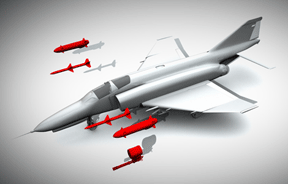
The US military said Thursday that additional F-15 fighter jets arrived in the Middle East as part of a buildup meant as a threat to Iran as Tehran is vowing it will respond to Israel’s October 26 airstrikes on Iranian territory.
“Today, US Air Force F-15E Strike Eagles from the 492nd Fighter Squadron, RAF Lakenheath, England, arrive in the US Central Command area of responsibility,” US Central Command wrote on X.
The Pentagon announced last week that it was sending additional military assets to the region for the “defense” of Israel. CENTCOM said that B-52 bombers arrived in the region on November 2.
According to flight and satellite data, six US B-52 bombers are at al-Udeid Air Base in Qatar. Haaretz reported that the US F-15 fighter jets were being sent to Jordan. The Pentagon said it would also be deploying additional US Navy destroyers and tanker aircraft to the region.
Before the latest US deployments, the Pentagon sent a THAAD missile defense system and about 100 troops to Israel. The US assets in Israel and elsewhere in the region could become potential targets of Iranian missiles since the US is vowing to defend Israel.
Recent media reports have said Iran is planning to launch a major attack on Israel from Iraqi territory. Baghdad has denied the rumors, saying they’re “false pretexts” to justify aggression against Iraq.
Poodles and puppet masters – Mutual Defence Agreement puts USA in charge of UK military policy

The Mutual Defence Agreement (MDA) of 1958 effectively ensures that the UK remains a nuclear weapon power by allowing the US to provide it with nuclear materials, including uranium and plutonium, nuclear weapons components, and submarine reactors. It also permits the sharing of staff and know-how between the two countries.
There will be no dispute mechanisms allowed. No parliamentary scrutiny. And it will not be subject to approval by the US congress.”
The Mutual Defence Agreement now permanently ties British nuclear weapon dependency to the United States, writes Linda Pentz Gunter
Remember the pet poodle that used to belong to US President George W. Bush? “I must correct you,” I hear you say. It was Scottish terriers that W had, not poodles.
Yes, but I refer here not to Barney and Beazley but to Bush’s third dutiful dog, Blair, as in Tony Blair, the contemporaneous British prime minister, who was routinely featured in cartoons as the compliant canine — specifically a poodle — glued to W’s side.
“I will be with you, whatever,” Blair had written to Bush in a confidential note eight months before the ill-fated invasion of Iraq, launched on the basis of exaggerated and downright false information.That declaration and other professions of poodlish loyalty, were revealed in the 2016 report issued by the Chilcot Commission examining events around the ensuing Iraq war.
“I express more sorrow, regret, and apology than you can ever believe,” was Blair’s response to the report’s findings. Based on his activities since then —which include serving as a well-paid advisor to corporate financial institutions, charging speaking fees as high as $300,000 a pop, and amassing a net worth of at least $60 million — no, we won’t ever believe it.
Perhaps Sir Keir Starmer, whose popularity continues to plummet, is also eagerly awaiting such post-prime ministerial plentitude. At least then, he will be able to pay for his own suitable suits.
But after winning the UK general election in July and duly ascending to US poodlehood, Starmer knew he needed to quickly mark some territory before the departure of the gray-muzzled mutt then occupying both the dog house and the White House.
In order to ensure that the so-called special relationship — the canine cordiale — between the UK and the US remained intact, Starmer orchestrated a fundamental change to a key joint defense policy, cunningly by-passing parliamentary oversight.
The Mutual Defence Agreement (MDA) of 1958 effectively ensures that the UK remains a nuclear weapon power by allowing the US to provide it with nuclear materials, including uranium and plutonium, nuclear weapons components, and submarine reactors. It also permits the sharing of staff and know-how between the two countries.
Thus far, a section of the MDA has required renewal by the UK parliament every ten years. Those key clauses were due to expire this December.
Britain is in possession of four Vanguard class attack submarines armed with American-made Trident II D-5 ballistic missiles carrying UK-made warheads. As long time British national security correspondent, Richard Norton-Tayor, explained in Declassified: “The MDA enables the US to provide Britain with nuclear weapons materials and know-how without which Trident would not be able to function.” It also makes the program affordable for UK coffers.
In a briefing put out by the British nuclear watchdog group, Nuclear Information Service, the MDA is described as “the treaty that governs the relationship between the nuclear weapons programmes of the United Kingdom (UK) and the United States (US), which is unique amongst nuclear armed states for the level of dependency and technical integration involved.”
Now the MDA will endure in perpetuity. That’s because the Starmer government skillfully avoided a vote on the lifting of the sunset clause by first introducing its amendment during parliamentary recess, thus guaranteeing six weeks of inaction, then setting the expiry deadline for October 23 during which politicians from both parties were consumed with party conferences and budget issues.
Consequently, the key amendments to the MDA slipped through without debate.
As NIS’s David Cullen summed it up, “The idea is to put this beyond democratic accountability in perpetuity.”
Specifically, the amended treaty contains three important clauses that leash the nuclear poodle tightly to its American owner. As reported in a debate in the British House of Lords, which did discuss the MDA renewal, can choose to oppose any changes, but has no actual jurisdiction over it, these are:
- Article 4 which makes the provisions on naval nuclear propulsion cooperation reciprocal and allows the UK to transfer technology to, and share information with, the US.
- Article 5 which removes the expiry provisions that relate to article III bis and allows for the MDA, as a whole, to remain in force on an “enduring basis”. As such, the agreement will not require renewal every ten years.
- Article 13 adds new final provisions to the agreement that will ensure that information, material or equipment shared or transferred under the MDA will continue to be protected should the agreement be terminated by either party in the future.
What this means in real terms, explained NIS’s Cullen at a recent conference held in London by the Campaign for Nuclear Disarmament, is that Rolls Royce parts “can be used in the next generation of US nuclear submarines. There will be no dispute mechanisms allowed. No parliamentary scrutiny. And it will not be subject to approval by the US congress.”
The amendment also increases the already considerable secrecy shrouding the precise language in the MDA. “Efforts to scrutinise this relationship are regularly deflected by the government under the guise of national security,” said outgoing CND general secretary, Kate Hudson, in a statement.
According to the NIS report, “no information abut plutonium transfers after March 1999 or transfers of HEU [highly enriched uranium] and tritium outside the three barter exchanges has been made public, and the MOD [Ministry of Defence] has rejected Freedom of Information Requests for information about more recent transfers.”
Likewise, “there is little information in the public domain about the quantity and nature of transfers of non-nuclear components under the MDA,” says NIS.
“This ‘special relationship’ tethers British military and foreign policy to Washington – and makes redundant the claim that Britain has an independent nuclear weapons system,” Hudson added. “Without US support, Britain would be unable to sustain its nuclear arsenal.”
But why the rush to do away with the renewal clause and preserve key terms of the agreement in aspic? The answer, it appears, was insurance, to make the treaty impervious to the bite of the orange attack dog then potentially poised to return to the White House. This was necessary, the argument went, because Donald Trump had already shown a predilection under his previous presidential term for shredding nuclear treaties.
Trump withdrew the US from the 1987 Intermediate-Range Nuclear Forces (INF) Treaty with Russia, a key instrument of global arms control, leaving Russia free to develop as many intermediate-range nuclear missiles as it wants and potentially triggering a new nuclear arms race.
Trump also tore up the Joint Comprehensive Plan of Action — or Iran nuclear deal — which, while still in place, at least allowed for independent verification and oversight of Iran’s civil uranium enrichment activities in exchange for sanctions relief. Iran has already said it has now enriched uranium above 60%, well within the weapons-usable range if not yet weapons-grade.
In January, Trump will indeed be US president again. Starmer has decided to remain as his nuclear lapdog. The MDA may be impermeable to MAGA meddling. But how else Trump may choose to use his UK nuclear proxy should fill all of us with dread.
Linda Pentz Gunter is the international specialist at Beyond Nuclear and writes for and edits Beyond Nuclear International. Her forthcoming book, Hot Stories. Reflections from a Radioactive World, will be published in the new year.
‘Horrific Reality’: Nearly 70% of UN-Verified Gaza Deaths Are Women and Children

The United Nations human rights office noted the “unprecedented levels of killings, death, injury, starvation, illness, disease, displacement, detention, and destruction” wrought by Israel’s 13-month onslaught.
Brett Wilkins, Nov 08, 2024, https://www.commondreams.org/news/how-many-women-and-children-have-died-in-gaza
Nearly 7 in 10 people killed by Israeli forces in Gaza during an earlier six-month period of the ongoing assault on the Palestinian enclave were women and children, the United Nations human rights office said Friday.
The U.N. Office of the High Commissioner for Human Rights (OHCHR) verified 8,119 of the more than 34,500 Palestinians killed by Israel Defense Forces (IDF) bombs and bullets between November 2023 and April 2024. Among those killed were 3,588 children and 2,036 women ranging in age from newborns to nonagenarians. Minors under the age of 18 made up 44% of the victims in the analysis.
The OHCHR report noted the “unprecedented levels of killings, death, injury, starvation, illness, disease, displacement, detention, and destruction” wrought by Israel’s onslaught, as well as the “wanton disregard” by Israeli forces and Hamas of international humanitarian law.
The analysis also highlights “the Israeli government’s continuing unlawful failures to allow, facilitate, and ensure the entry of humanitarian aid, the destruction of civilian infrastructure, and repeated mass displacement.”
“If committed as part of a widespread or systematic attack directed against a civilian population… these violations may constitute crimes against humanity,” OHCHR said. “And if committed with intent to destroy—in whole or in part—a national, ethnical, racial, or religious group, they may also constitute genocide.”
South Africa is leading a genocide case against Israel at the International Court of Justice (ICJ) in The Hague. On Thursday, Ireland became the latest of around 30 countries and regional blocs to announce its intent to intervene in the case on behalf of Palestine.
OHCHR found that 88% of the verified Palestinian fatalities from Israeli attacks on residential buildings were people killed in strikes that claimed at least five lives. In recent weeks, Israel’s renewed offensive in northern Gaza—which some experts believe is an attempt to ethnically cleanse the area by bombing and starving its people before forcibly expelling them to make way for Israeli recolonization—has wiped out a staggering number of civilians, including many women and children, in single strikes on homes, hospitals, and refugee camps.
“The high number of fatalities per attack was due to the IDF’s use of weapons with wide area effects in densely populated areas,” the analysis states, adding that some Palestinians may have been killed by errant projectiles launched by Hamas or other Gaza-based militants.
The new report also raises concerns over Isrsel’s forcible transfer of Palestinians, systematic attacks on medical workers, journalists, and reported use of white phosphorus munitions—which are banned in populated areas.
Israel has not yet responded to the OHCHR report but has previously said that it “will continue to act, as it always has done, according to international law.”
Since October 7, 2023, when Israeli forces launched their assault on the densely populated coastal enclave of 2.3 million people in response to the Hamas-led attack on Israel, the Gaza Ministry of Health and U.N. agencies say that more than 43,600 Palestinians have been killed and over 102,500 others wounded. More than 10,000 others are missing and believed dead and buried beneath the ruins of bombed homes and other structures.
Among those killed, say officials, are more than 18,000 children. Last month, the U.K.-based charity Oxfam International said that Israel’s yearlong assault on Gaza has been the deadliest year of conflict for women and children anywhere in the world over the past two decades.
The relentless death and destruction has caused the “complete psychological destruction” of Gaza’s youth, according to the charity Save the Children. The same has been said of many Gazans of all ages.
Last December, the U.N. Children’s Fund called Gaza “the world’s most dangerous place to be a child.” Earlier this year, U.N. Secretary-General António Guterres for the first time added Israel to his so-called “List of Shame” of countries that kill and injure children during wars and other armed conflicts.
The ICJ—which is a U.N. body—has issued three provisionsal orders in the ongoing genocide case, including directives for Israel to prevent genocidal acts, stop its assault on Rafah, and allow humanitarian aid into Gaza. Israel has been accused of flouting all three orders.
The trends and patterns of violations, and of applicable international law as clarified by the International Court of Justice, must inform the steps to be taken to end the current crisis,” U.N. High Commissioner for Human Rights Volker Türk said in a statement Friday.
“The violence must stop immediately, the hostages and those arbitrarily detained must be released, and we must focus on flooding Gaza with humanitarian aid,” he added.
UN nuclear head to visit Iran for talks on country’s nuclear program as next Trump presidency looms
VIENNA (AP) — The head of the United Nations’ nuclear watchdog said Sunday he will travel to Iran in the coming days to hold talks regarding the country’s nuclear program. The visit comes amid wider tensions gripping the Mideast over the Israel-Hamas war and uncertainty over how U.S. President-elect Donald Trump will approach Iran after his inauguration in January.
Specifically, the Director General of the International Atomic Energy Agency, Mariano Grossi, will have high level meetings with the Iranian government and will hold technical discussions on all aspects related to the joint statement agreed with Iran in March 2023.
It is intended as a path forward for cooperation between the IAEA and Iran on how to expand inspections of the Islamic Republic’s rapidly advancing atomic program.
The 2023 statement included a pledge by Iran to resolve issues around sites where inspectors have questions about possible undeclared nuclear activity, and to allow the IAEA to “implement further appropriate verification and monitoring activities.”
The meetings in Tehran will build on Grossi’s discussions with Iranian Foreign Minister Abbas Araghchi on the sidelines of the United Nations General Assembly in September, a statement by the IAEA said.
“It is essential that we make substantive progress in the implementation of the joint statement agreed with Iran in March 2023,” Grossi said. “My visit to Tehran will be very important in that regard.”
Iran is rapidly advancing its atomic program and continues to increase its stockpile of uranium enriched to near weapons-grade levels in defiance of international demands, according to recent reports by the IAEA.
Grossi, has warned that Tehran has enough uranium enriched to near-weapons-grade levels to make “several” nuclear bombs if it chose to do so. He has acknowledged the U.N. agency cannot guarantee that none of Iran’s centrifuges may have been peeled away for clandestine enrichment………………………………………………………………………………………………………………………………………
As Trump is to take office again in a few weeks, Iranians are divided on what his next presidency will bring. Some foresee an all-out war between Tehran and Washington, particularly as other conflicts rage in the region. Others hold out hope that America’s 47th president might engage in unexpected diplomacy as he did with North Korea. https://apnews.com/article/iaea-grossi-iran-nuclear-negotiations-efa8ad94a3424135eb21261cccaf4641
-
Archives
- October 2026 (112)
- September 2026 (339)
- August 2026 (330)
- July 2026 (355)
- June 2026 (287)
- May 2026 (306)
- April 2026 (356)
- March 2026 (251)
- February 2026 (267)
- January 2026 (308)
- December 2025 (358)
- November 2025 (359)
-
Categories
- 1
- 1 NUCLEAR ISSUES
- business and costs
- climate change
- culture and arts
- ENERGY
- environment
- health
- history
- indigenous issues
- Legal
- marketing of nuclear
- media
- opposition to nuclear
- PERSONAL STORIES
- politics
- politics international
- Religion and ethics
- safety
- secrets,lies and civil liberties
- spinbuster
- technology
- Uranium
- wastes
- weapons and war
- Women
- 2 WORLD
- ACTION
- AFRICA
- Atrocities
- AUSTRALIA
- Christina's notes
- Christina's themes
- culture and arts
- Events
- Fuk 2022
- Fuk 2023
- Fukushima 2017
- Fukushima 2018
- fukushima 2019
- Fukushima 2020
- Fukushima 2021
- general
- global warming
- Humour (God we need it)
- Nuclear
- RARE EARTHS
- Reference
- resources – print
- Resources -audiovicual
- Weekly Newsletter
- World
- World Nuclear
- YouTube
-
RSS
Entries RSS
Comments RSS

