Ukraine confirms deep strikes into Russia with Western weapons
https://www.rt.com/russia/599214-ukraine-deep-strikes-russia-budanov/ 13 June 24
The head of Kiev’s military intelligence claims Moscow is “already feeling” the attacks
Ukraine is already using Western-supplied weapons for long-range strikes on Russian territory, the head of Kiev’s Main Intelligence Directorate (GUR) confirmed on Wednesday.
Asked by reporters how the use of foreign weapons has changed the situation on the battlefield and how Moscow is planning to respond to these attacks, Kirill Budanov said the Russian forces are “already feeling them.”
He added that easing of restrictions on the use of Western-made munitions against Russian forces has “definitely made the situation easier” but “no more or less than that.”
The intelligence chief was also asked how Russia might perceive the crossing of a potential “red line.” Budanov argued that no such lines actually exist, claiming they have already been crossed multiple times.
Several of Kiev’s Western backers recently gave Ukraine the green light to use weapons supplied by them to strike targets deep inside Russian territory. The US and other countries claimed the move was needed to stall Moscow’s push into Kharkov Region, which borders on Russia’s Belgorod Region.
Russian forces have recently been making advances near Kharkov, Ukraine’s second-largest city, taking over key settlements and inflicting heavy casualties on the Ukrainian military. The cross-border operation, announced in response to Kiev’s repeated attacks on Belgorod, is aimed at creating a buffer zone to prevent further artillery and missile strikes on Russian cities.
Top Ukrainian officials, including Budanov, have admitted that the situation in Kharkov Region is critical, and have ramped up demands for longer-range Western weapons. In late May the Biden administration granted permission to use the munitions on parts of Russia not claimed by Ukraine.
Russia, however, has repeatedly warned against using Western-produced weapons to strike deep into its territory, with President Vladimir Putin warning that such attacks amount to direct Western participation in the conflict and could lead to disastrous consequences.
“If someone deems it possible to supply such weapons to the war zone, to strike our territory… why shouldn’t we supply similar weapons to those regions of the world, where they will be used against sensitive sites of these countries?” the Russian president said last week. “We can respond asymmetrically. We will give it some thought.”
Russia ready to strike NATO airfields hosting Ukrainian jets – MP
13 June 24
The head of Kiev’s air force, Sergey Golubtsov, previously stated that some F-16s donated to his country will be based abroad
Any airfields hosting Ukraine’s F-16 fighter jets, whether they are in or outside the country, will be legitimate targets for the Russian military if they participate in combat missions against Moscow’s forces, the chairman of the Russian State Duma Defense Committee, Andrey Kartapolov, has warned.
The comments come as Kiev prepares to receive the first delivery of US-made fighter jets from its Western backers, after Ukrainian pilots were trained to fly them.
In a statement to RIA Novosti published on Monday, Kartapolov clarified that if the F-16s “are not used for their intended purpose” or are simply held in storage at foreign airbases with the intent to transfer them to Ukraine, where they will be equipped, maintained, and flown from Ukrainian airfields, then Russia would have no claims against its “former partners” and would not target them.
However, if the jets take off from foreign bases and carry out sorties and strikes against Russian forces, both the fighter planes and the airfields they are stationed at will be “legitimate targets,” according to Kartapolov.
“As for [our ability] to shoot [them] down, we can shoot down anyone, anywhere,” the MP insisted.
Kartapolov’s statement comes after the chief of aviation of Ukraine’s Air Force Command, Sergey Golubtsov, stated in an interview with Radio Liberty on Sunday that some of the F-16 fighter jets donated to Kiev by the West would be stationed at foreign airbases.
He explained that only a portion of the jets would be stationed directly on Ukrainian territory, corresponding to the number of pilots trained to operate the aircraft. The other jets would be kept in reserve at “safe airbases” abroad so that they are not targeted by the Russian military.
Golubtsov stated that so far four countries have agreed to transfer F-16s to Ukraine, namely Belgium, Denmark, Norway, and the Netherlands. While he did not specify exactly how many aircraft would be donated, he claimed it was between 30 and 40 planes, with potentially more to come in the future.
Meanwhile, Russian Foreign Minister Sergey Lavrov has also warned that Moscow would perceive the deliveries of F-16 fighters to Ukraine as a nuclear threat, given that the jets have long been used as part of the US-led bloc’s joint nuclear missions.
At the same time, the minister stressed that the US-designed jets would not change the situation on the battlefield, and would be shot down and destroyed like any other foreign weapons supplied to Ukraine.
NATO chief insists that use of F-16 fighter jets over Russian territory is ‘not escalation’ –
Use of F-16s over Russian territory ‘not escalation’ – NATO chief
Ukraine has the right to defend itself, and this includes “striking legitimate military targets” on the territory of Russia, Stoltenberg declared. “Self-defense is not escalation,” he added.
Andrey Kartapolov, the chairman of the Russian State Duma Defense Committee, said last week that Moscow would consider any bases used by Kiev to fly donated F-16s as legitimate military targets regardless of what country they are located in.
Any airfields hosting Ukraine’s F-16 fighter jets, whether they are in or outside the country, will be legitimate targets for the Russian military if they participate in combat missions against Moscow’s forces, the chairman of the Russian State Duma Defense Committee, Andrey Kartapolov, has warned.
Meanwhile, Russian Foreign Minister Sergey Lavrov has also warned that Moscow would perceive the deliveries of F-16 fighters to Ukraine as a nuclear threat, given that the jets have long been used as part of the US-led bloc’s joint nuclear missions.
Use of F-16s over Russian territory ‘not escalation’ – NATO chief. 13 Jun, 2024 HomeWorld News
Donating fighter jets to Kiev will not involve members of the alliance in the conflict, Jens Stoltenberg has insisted
Ukrainian strikes anywhere inside Russia using Western-donated F-16 aircraft would not be an escalation of the conflict and would not make NATO member states parties to it, the military bloc’s Secretary General Jens Stoltenberg has claimed.
Several European nations intend to provide dozens of the warplanes once Ukraine has pilots and ground infrastructure to fly them.
Speaking ahead of a NATO defense ministers’ gathering in Brussels, Stoltenberg said “different allies have different types of restrictions on the use of their weapons,” and welcomed the recent relaxation of these rules by some member states.
Washington reportedly gave Kiev the green light to fire American weapons at targets outside of what the two nations insist is Ukrainian territory, allowing strikes inside Russia’s Belgorod Region as part of the fight for the neighboring Kharkov Region. Other Western nations have also said their weapons can be used in similar ways.
Ukraine has the right to defend itself, and this includes “striking legitimate military targets” on the territory of Russia, Stoltenberg declared. “Self-defense is not escalation,” he added.
“And we have the right to help Ukraine,” he continued. “By doing that, NATO allies don’t become party to the conflict.”
Moscow perceives the entire conflict as part of a US-initiated proxy war against Russia. It considers NATO’s increasing military presence in Ukraine and its intention to eventually bring the nation into the fold as major national security risks.
NATO member states arming Ukraine, providing “mercenaries” to bolster its troops, and helping Kiev to plan and deliver attacks against Russia are de facto participants in the hostilities, senior Russian officials have claimed.
Russian President Vladimir Putinhas warned that any attacks using Western weapons deep inside Russia will be retaliated against.Moscow could supply long-range weapons from its own arsenal to third parties, who would then use them against Western military assets, he suggested. Such tit-for-tat escalation could lead to a major disaster for all parties involved, Putin has warned.
Andrey Kartapolov, the chairman of the Russian State Duma Defense Committee, said last week that Moscow would consider any bases used by Kiev to fly donated F-16s as legitimate military targets regardless of what country they are located in.
——
https://swentr.site/russia/599085-russia-strike-nato-airfields-f16/
Active-Duty US Service Members Issue Appeal to Congress to Stop Funding Genocide
As Israel continues its genocide against the Palestinians, the number of US conscientious objectors is increasing.
By Marjorie Cohn , TRUTHOUT, June 13, 2024
On June 4, a coalition of active-duty service members, veterans and G.I. rights groups launched a campaign called Appeal for Redress V2 to encourage military personnel to tell Congress to stop funding genocide in Gaza. Israel’s genocidal operation, now in its ninth month, has killed more than 37,000 Palestinians and wounded nearly 85,000.
The campaign is sponsored by Veterans For Peace (VFP), the Military Law Task Force of the National Lawyers Guild, About Face: Veterans Against the War and the Center on Conscience & War. It is modeled after the 2006 Appeal for Redress issued during the occupation of Iraq. During that campaign, almost 3,000 active-duty, Reserve and Guard personnel sent protected communications to their members of Congress urging an end to the wars and occupations in Iraq and Afghanistan.
Appeal for Redress V2 was formulated to help G.I.s directly tell their representatives that they oppose U.S. support for Israel’s genocide in Gaza.
“We will not stand by silently while genocide unfolds,” Senior Airman Juan Bettancourt, an active-duty member of the U.S. Air Force, stated at a June 4 press conference announcing the campaign. “We refuse to be complicit” in the “unspeakable carnage,” said Bettancourt, who is seeking separation from the U.S. military as a conscientious objector.
Kathleen Gilberd, executive director of the Military Law Task Force of the National Lawyers Guild and my coauthor for Rules of Disengagement: The Politics and Honor of Military Dissent, told Truthout there has been an increase in the number of applications for conscientious objection (CO) and other types of honorable discharge from the military. “Many military personnel have serious objections to the U.S. support for Israel’s genocide against the Palestinians,” Gilberd said…………………………………………………………………………
The Appeal for Redress
“We know many young people join the military out of necessity to get their needs met. But they are not obligated to contribute to genocide and unjust, unlawful wars that go against their conscience,” said Shiloh Emelein, U.S. Marine Corps veteran and operations director of About Face: Veterans Against the War, in the Appeal’s June 3 press release. “You do have rights, you do have options to object, and there’s a large community of post-9/11 veterans ready to welcome you.”………………………………………………………………………………………….
U.S. Provision of Weapons to Israel Violates Several U.S. Statutes
These active-duty service members oppose U.S. funding of Israel’s genocide both because it’s immoral and because U.S. government employees are violating several federal statutes when weapons are shipped to Israel…………………………………………..more https://truthout.org/articles/active-duty-us-service-members-issue-appeal-to-congress-to-stop-funding-genocide/
U.S. – NATO threats ignore ‘red lines’ in Ukraine.

NATO’s long-range missiles target Russia
Stoltenberg was explicit: “We are giving weapons to Kyiv and consider them Ukrainian from this moment, so Ukraine can do whatever it wants with these arms, in part, strike at Russian territory where it deems necessary.” (bne IntelliNews, May 31)
Previously, the United States, Germany and other NATO members had forbidden the Ukrainian military from using the weapons delivered to them to strike targets inside Russia.
Workers World, By Sara Flounders June 7, 2024
Front lines are collapsing for the Ukrainian army, whole units surrendering. Top commanders are fired. Faced with complete disarray of the U.S.-NATO instigated war in Ukraine, U.S. militarists are doubling down.
According to the Ukrainian constitution, President Volodymir Zelensky’s term in office is over. But he remains in power by martial law. This has led Ukrainian workers to hold strikes and work stoppages. But this news is ignored in the Western media.
A national truckers’ work slowdown inside Ukraine moved traffic to a 5-mile-an hour crawl and halted grain exports based on national anger at the expanded draft mobilization made by Zelensky, now an unelected president. (yahoonews.com, May 18)
Ukraine’s combat units are so severely understaffed that the government would have to triple its mobilization in order to continue the current level of fighting, according to Eric Ciaramella, former U.S. National Intelligence Council official. The draft can’t fill the current gap,…………………………………………………………………………………………………………..
U.S.-NATO plans are in total disarray. Rather than reconsider their strategy, which has brought setbacks and defeats in Ukraine and for Israel in Gaza, this has led to an ominous escalation in U.S. military threats.
The threat to dangerously escalate the war in Ukraine arises from the plans to give Ukraine high-speed missiles and allow the Kyiv regime to use the weapons to strike inside Russia. This threat is not just from a single statement or one delivery of weapons.
The statements promoting strikes with the U.S.-supplied weapons to targets inside Russia are being made directly by President Biden and Secretary of State Antony Blinken, U.S. Speaker of the House Mike Johnson and NATO Secretary General Jens Stoltenberg, who is a former prime minister of Norway, but acts as if he were a U.S. official.
Ukraine at center of 75th Anniversary NATO Summit
NATO officials are frantic that Ukrainian defense lines of Kharkov, the second-largest city in Ukraine, located in the northeast of the country, are about to fall.
Kharkov is a majority Russian-speaking city. It is the industrial, energy, science, rail and transport hub. It lies east of the Dnieper River on the Donetsk-Donbass Canal. Kharkov is the key industrial center still under Ukrainian control east of the Dnieper River.
According to a May 16 New York Times article, fear of Kharkov’s imminent collapse is what is driving U.S. threats. This loss is decisive in any control of Ukraine’s east, including the entire Donbass industrial region.
Adding to the urgency is that at the 75th Anniversary NATO Summit, July 9-11 in Washington, D.C., NATO plans to unveil a “Security Package” for Ukraine involving 32 countries’ bilateral agreements with Ukraine. These bilateral agreements would serve as a bridge for Ukraine’s entry into NATO.
Ukrainian entry into NATO would allow Kyiv to invoke the alliance’s collective defense clause, potentially triggering a broader regional conflict with Russia. During an April visit to Kyiv, NATO Secretary General Jens Stoltenberg vowed that “Ukraine will become a member of NATO.” (defensenews.com, June 3)
All these elaborate plans would be dashed if Ukrainian defense lines crumbled before the NATO Summit in Washington, D.C. This 75th anniversary NATO Summit is a grand plan to showcase U.S. and Western imperialist dominance.
NATO’s long-range missiles target Russia
NATO’s dangerous escalation is galloping forward on several fronts.
Stoltenberg was explicit: “We are giving weapons to Kyiv and consider them Ukrainian from this moment, so Ukraine can do whatever it wants with these arms, in part, strike at Russian territory where it deems necessary.” (bne IntelliNews, May 31)
Previously, the United States, Germany and other NATO members had forbidden the Ukrainian military from using the weapons delivered to them to strike targets inside Russia.
In the past, the Ukrainian military command had violated NATO’s official statements and used U.S. Stinger air defense missiles, M142 HIMARS, MLRS and other multiple launch rockets to strike the Belgorod region of Russia. The Russian Army’s air defense forces destroyed more than 10 missiles in the sky over Belgorod and displayed the U.S. stamped shells.
Weeks ago, the British government allowed Ukraine to use its long-range Storm Shadow missile systems for attacks anywhere in Russia. Now France and Germany have taken the same position as Britain. The Storm Shadow cruise missile has a range of over 180 miles, triple the range of the missiles Ukraine has used until now.
French President Emmanuel Macron further escalated the threat by stating the West must not exclude sending NATO ground troops to Ukraine…………………………………………………………………………………..
Internationally, many voices are sounding the alarm. Such attacks are of the most extreme danger, because the slightest targeting slip up, a misinterpretation of instructions, a rogue operator on the ground, could lead to a global conflagration.
These attacks require a satellite-based military network that Ukraine does not have. Only U.S. and NATO forces under U.S. command are capable of conducting such attacks against Russia.
Divisions appear inside NATO
Divisions within the U.S. commanded and dominated NATO military alliance are appearing. Frustration and failure are intensifying the infighting even among members of the G7 and major NATO participants.
Many NATO countries’ leaders, reacting to mass pressure from below, have already sharply expressed opposition to U.S. total support of Israel’s genocidal campaign against Palestine.
Italy’s Deputy Prime Minister Matteo Salvini objected to Stoltenberg’s call for allies to lift restrictions on using Western-supplied weapons against targets in Russia. “It is out of the question to lift the ban on Kyiv to strike military targets in Russia. … We want peace, not the antechamber of World War III” (Ukrainian Pravda, May 27)
Italian Foreign Minister Antonia Tajani reinforced this position: “We will send no Italian soldier to Ukraine, and the military tools that Italy sends are used inside Ukraine. We are working for peace.” (Italian news agency Ansa, as reported by European Pravda, May 25)
On May 28, Belgian Prime Minister Alexander De Croo told Biden during talks in Washington, D.C., that he rules out the use of Belgium’s weapons, including F-16 fighter jets, outside Ukraine. To reinforce his point, De Croo reminded the reporters that the bilateral security agreement Belgium signed with Ukraine means, “We are sending 30 F-16s, and we will thus become the biggest supplier of fighter aircraft for the Ukrainian air force. But the agreement is very clear. It is about fighter aircraft that can be used by the Ukrainians on Ukrainian territory.” (belganewsagency.eu, May 31)
Phony ‘Peace Summit’
Zelensky’s effort to call a “Peace Summit” on June 15 and 16 in Lucerne, Switzerland, exposes Ukraine’s dwindling support. The “Peace Summit” bars Russian participation. The effort is so flimsy that not even Biden is bothering to attend.
In desperation, Zelensky has blamed China’s decision not to participate as the reason other countries are ignoring the phony event.
Russian Foreign minister Sergey Lavrov dismissed the Lucerne summit, saying, “This conference in Switzerland has no meaning. The only meaning it can have is to try to preserve this anti-Russian bloc which is in the process of crumbling.”
Silence continues to prevail in Western corporate media regarding the four negotiation offers made by President Putin in the past two weeks.
RAND Corporation: ‘Pour it on’
The Rand Corporation, a powerful think tank for the major military industries, confirms the cynical calculations that justify war profits, regardless of the danger.
U.S. escalation will push the Europeans to ante up, the Rand article said. Even more ominous: “From a narrow U.S. perspective, greater U.S. involvement is an opportunity to test new capabilities and gain experience helping a partner facing a numerically superior foe. Such experience could be very relevant for helping Taiwan resist Chinese aggression.” (Rand, May 22, defenseone.com, “How to win in Ukraine: pour it on, and don’t worry about escalation”)
Russia warns NATO
President Putin delivered Russia’s strongest warning to date against the NATO escalation. He chose a meeting in Tashkent, Uzbekistan, with top Uzbek officials. With 37 million people, Uzbekistan is the second most populous country of the former Soviet Union. ……………………….. At a large press conference following the meetings, Putin said, “Long-range precision weapons cannot be used without space-based reconnaissance. … Final target selection and what is known as launch mission can only be made by highly skilled specialists who rely on this technical reconnaissance data. It can happen without the participation of the Ukrainian military.
“Launching other systems, such as ATACMS, for example,” Putin continued, “also relies on space reconnaissance data. Targets are identified and automatically communicated to the relevant crews. … The mission is put together by representatives of NATO countries, not the Ukrainian military. This unending escalation can lead to serious consequences. If Europe were to face those serious consequences, what will the United States do, considering our strategic arms parity? It is hard to tell…………………………………………..
Rather than reassess their deteriorating global position, U.S. strategists seem determined to put the fate of the world at risk. https://www.workers.org/2024/06/79079/
LANL plans to release highly radioactive tritium to prevent explosions. Will it just release danger in the air?

The venting may harm pregnant women and fetuses, advocates say. |
| SEARCHLIGHT NEW MEXICO, by Alicia Inez Guzmán 12 June 24 |
Last fall, the international community rose up in defense of the Pacific Ocean. Seafood and salt purveyors, public policy professors, scientists and environmentalists, all lambasted Japan’s release of radioactive wastewater from the disastrously damaged Fukushima Daiichi nuclear plant into the sea.
At the heart of the contention was tritium, an element that, by mass, is 150,000 times more radioactive than the plutonium used in the cores of nuclear weapons. Odorless and colorless, tritium — the radioactive form of hydrogen — combines with oxygen to form water. Just one teaspoon is enough to contaminate 100 billion gallons more water up to the U.S. drinking water standard, according to Arjun Makhijani, an expert on nuclear fusion and author of the monograph, “Exploring Tritium Dangers.”

What didn’t make international headlines — but was quietly taking place on the other side of the world — was Los Alamos National Laboratory’s own plans to vent the same radioactive substance into northern New Mexico’s mountain air. Japan’s releases would take place over three decades. LANL’s would include up to three times more tritium — and take place in a matter of days.
There is no hard timeline for the release, but if the plans are approved by the Environmental Protection Agency, LANL is looking at a period with “sufficiently warm weather,” a spokesperson from the National Nuclear Security Administration wrote by email. That could mean as soon as this summer.
Those controversial plans date back to 2016, when LANL discovered that a potentially explosive amount of hydrogen and oxygen was building up in four containers of tritium waste stored in a decades-old nuclear dump called Area G. The safest and most technically viable solution, the lab decided — and the best way to protect workers — would be to release the pressure and, with it, thousands of curies of tritium into the air.
When advocates caught wind of the venting in March 2020, Covid was in its earliest and most unnerving phase. Pueblo leaders, advocates and environmentalists wrote impassioned letters to the lab and the EPA, demanding that they change or, at the very least, postpone the release until after the pandemic. At the same time, Tewa Women United, a nonprofit founded by Indigenous women from northern New Mexico, issued its first online petition, focusing on tritium’s ability to cross the placental barrier and possibly harm pregnant women and their fetuses. Only after a maelstrom of opposition did the lab pause its plans and begin briefing local tribes and other concerned members of the community.
“We see this as a generational health issue,” said Kayleigh Warren, Tewa Women United’s food and seed sovereignty coordinator. “Just like all the issues of radioactive exposure are generational health issues.”
Last fall, the lab again sought the EPA’s consent. A second petition from Tewa Women United followed. Eight months later, the federal agency’s decision is still pending.
The NNSA, which oversees the health of America’s nuclear weapons stockpile from within the Department of Energy, declined Searchlight New Mexico’s requests for an interview.
The crux of the issue comes down to what is and isn’t known about the state of the containers’ contents. Computer modeling suggests they are pressurized and flammable, but the actual explosive risk has not been measured, the lab has conceded.
Critics have requested that the contents be sampled first to determine whether there is any explosive risk and whether venting is even needed. The EPA says that sampling would require going through the same red tape as venting. The lab, for its part, plans to sample and vent the contents in one fell swoop.
But why, critics wonder, are these containers in this state in the first place? Were they knowingly over packed and left for years to grow into ticking time bombs?
“I do not like the position we’re in,” James Kenney, cabinet secretary of the New Mexico Environment Department, told the Legislature’s Radioactive and Hazardous Materials Committee in 2020. The containers, he said, had been “neglected for so long by both DOE and the Environment Department” that NMED potentially faces a lose-lose situation: Vent the tritium drums and try to prevent the emissions from being released into the air or “run the risk of leaving those drums onsite knowing that they are pressurized and could rupture, meaning an uncontrolled amount of tritium would go out.”
Venting and vexing
State and federal documents paint a kind of chicken-and-egg dilemma. The containers can’t be moved until the pressure is vented. But the movement itself may cause more pressure to build up, requiring a second, third or even fourth venting……………………………………………………………………………………………………………………
Tritium 101
Plutonium and uranium are familiar to most people, if by name only. But few know anything at all about tritium — a radioactive isotope of hydrogen that is used to make watch dials and EXIT signs glow bright neon. Tritium’s other, lesser-known use is as a “boost gas,” which, when inserted into the hollow core of a plutonium pit, amplifies a nuclear weapon’s yield. Globally, hundreds of atmospheric weapons tests dispersed tritium into the atmosphere, steeping rain, sea, and groundwater with the element and, ultimately, lacing sediment worldwide.
Tritium is widely produced at nuclear reactors and is today tested, handled and routinely released at Los Alamos National Laboratory.
Criticisms of this venting have always centered on two of the element’s key characteristics: First, it travels “tens to hundreds of miles,” according to lab documents. Second, when tritium is in the form of water, it becomes omnipresent and easy for bodies to absorb.
“Tritium is unique in this,” wrote Makhijani. “It makes water, the stuff of life, most of the mass of living beings, radioactive.”
Years of LANL reports depict tritium’s ubiquity in the lands and ecosystem within its bounds, a palimpsest of radioactive decay. This is measured in curies, a basic unit that counts the rate of decay second by second.
The lab’s first environmental impact statement, published in 1979, estimated that it had buried close to 262,000 curies of tritium at Area G and released tens of thousands more into the air from various stacks over the decades. The lab had two major accidental releases of tritium around the same time — 22,000 curies in the summer of 1976 and nearly 31,000 curies in the fall of 1977.
Today, trees have taken it into their root systems on Area G’s southeast edge. Rodents scurrying in and out of waste shafts are riddled with the substance, owing to tritium vapors from years past. A barn owl ate those rodents and had 740 times more tritium concentration in its body than the U.S. drinking water standard, the common reference value for indicating tritium contamination. The lab’s honeybee colonies — kept to determine how radioactive contaminants are absorbed — produced tritiated honey up to 380 times more concentrated than the drinking water standard, reports show.
The EPA set the current standard for radioactive emissions at DOE facilities in 1989, but that didn’t stop the lab from releasing thousands of curies of tritium into the air shortly afterward. In 1991, the EPA issued a notice of non-compliance to the lab for not calculating how much of a radiation dose the public received. Another notice followed in 1992.
Concerned Citizens for Nuclear Safety filed a lawsuit two years later alleging that the DOE hadn’t properly monitored radioactive emissions, as required by the Clean Air Act. At the time, a former lab safety officer, Luke Bartlein, observed what he described in an affidavit as a “pattern and practice of deception at LANL with respect to the radionuclide air monitoring system.” It was routine for lab staffers and management to vent glove boxes and other materials contaminated with tritium outside so that the contamination would deliberately “not register” on the stack monitors, he recounted, leading to false emissions reports.
The lab settled in 1997; a consent decree followed and would stay in effect until 2003. The lab says it has maintained low annual emissions ever since…………………………………………………………………………………………………………………………………….
In 1999, Makhijani and more than 100 scientists, activists and physicians across the country and worldwide signed a letter to the National Academy of Sciences. Their ask? To evaluate how radionuclides that cross the placental boundary, including tritium, impact the fetus, a request Makhijani renewed in 2022.
As he put it, tritium — the “most ubiquitous pollutant from both nuclear power and nuclear weapons” — has largely escaped regulatory and scientific scrutiny when it comes to matters of pregnancy.
Cindy Folkers, the radiation and health hazard specialist at Beyond Nuclear, a national advocacy organization, believes the reason is rooted in the radiation establishment’s fear of liability. “You get layers and layers and layers and layers of denial.”
The scant research that does exist comes from pregnant women who survived atomic bombs in Hiroshima and Nagasaki. In 1986, the International Commission on Radiation Protection concluded that exposing a fetus to ionizing radiation, the kind that tritium emits, has a “damaging effect…upon the development of the embryonic and fetal brain.” The area most at risk of harm, it went on, is the forebrain, which controls complex and fundamental functions like thinking and processing information, eating, sleeping and reproduction.
Ionizing radiation damages the cell in two ways. On the one hand, it breaks apart the building blocks from which humans are made, causing rifts in DNA. On the other, it fundamentally changes the chemistry of the cell, breaking apart its water molecules and upsetting its metabolism.
That’s what makes it different from, say, an X-ray, Folkers said. “A machine can be shut off,” but “a radioactive particle that’s inside your body will continue irradiating you.” For a pregnant woman, this adds up to “cumulative biological damage,” the kind that cuts across generations.
“We’re dealing with a life cycle,” Folkers said. “And females are an integral part of that life cycle. Not only are they more damaged by radioactivity, and their risks are higher for cancer, but they are also carrying in them the future generations. So when you’re dealing with a female baby who’s developing in the womb, you are dealing with that child’s children at the very least.”
In other words, a mother is like a Russian nesting doll. She holds a fetus and that fetus, if a female, holds all future eggs. Exposure to her is exposure to future generations. https://searchlightnm.org/lanl-plans-to-release-highly-radioactive-tritium-to-prevent-explosions-will-it-just-release-danger-in-the-air/?utm_source=Searchlight+New+Mexico&utm_campaign=08e25288bd-6%2F12%2F2024+-+LANL+Tritium+Release&utm_medium=email&utm_term=0_8e05fb0467-08e25288bd-395610620&mc_cid=08e25288bd&mc_eid=a70296a261
Sodium cooled nuclear reactors are not necessarily safer

While no sodium-cooled reactors currently operate in the United States, the U.S. Department of Energy (DOE) is working with industry on a number of “advanced” reactor designs, including the Sodium-Cooled Fast Reactor (SFR). One of the SFR’s safety advantages, to quote the DOE, is that the design provides a “Long grace period for corrective action, if needed.” SRE’s meltdown transpired over a two-week period. Fermi Unit 1 had indications of inadequate core cooling in June that were repeated in August and dismissed until extensive damage occurred in October 1966. The “if needed” grace period is never long enough when warning sign after warning sign is dismissed or ignored.
DOE did acknowledge some “challenges” for the SFR: their higher speed and higher energy neutrons can embrittle and degrade nearby materials, liquid sodium coolant reactors with air and water and degrades concrete, and the opaqueness of the liquid sodium coolant complicates in-service inspections and maintenance.
Thank goodness for the “Long grace period for corrective actions, if needed.” That and the fact that SFRs only operate in cyberspace where the primary threat is carpal tunnel syndrome

 Nuclear Plant Accidents: Fermi Unit 1, Union of Concerned Scientists Dave Lochbaum, director, Nuclear Safety Project | July 12, 2016, Disaster by Design
Jorge Agustin Nicolás Ruiz de Santayana y Borrás, also known as George Santayana, wrote that “Those who cannot remember the past are condemned to repeat it.” Continue reading
Israel committed crime of ‘extermination’ in Gaza, says UN investigation
Commission accuses Israel and Hamas of both engaging in acts of torture and sexual violence
By MEE staff, 12 June 2024, https://www.middleeasteye.net/news/israel-committed-crime-extermination-gaza-says-un-body
Israel is guilty of a committing the crime of “extermination” in Gaza, as well as the crimes of sexual violence, torture, and starvation as a weapon of war, along with other war crimes and crimes against humanity, UN investigators have found.
The UN Independent International Commission of Inquiry on the Occupied Palestinian Territory, including East Jerusalem, and Israel also said Palestinian groups were guilty of war crimes, particularly over the taking of hostages.
The report covers the period between the 7 October Hamas-led attack on Israeli communities and 31 December. During those 12 weeks Israel began a ferocious war on the Gaza Strip that has now killed more than 37,000 people.
Among the war crimes that the COI said Israel was guilty of since 7 October were:
- Extermination
- Gender persecution targeting Palestinian men and boys
- Murder
- Forcible transfer
- Torture
- Inhuman and cruel treatment
It also found that Israeli security forces had enforced “public stripping and nudity intended to humiliate the community at large and accentuate the subordination of an occupied people.”
“It is imperative that all those who have committed crimes be held accountable,” said Navi Pillay, chair of the commission.
“The only way to stop the recurring cycles of violence, including aggression and retribution by both sides, is to ensure strict adherence to international law.”
Pillay said Israel must “immediately stop its military operations and attacks in Gaza, including the assault on Rafah”.
The report also found widespread abuses by Palestinian armed groups, including torture, hostage-taking and acts of gender-based and sexual violence against civilians and security personnel.
“Hamas and Palestinian armed groups must immediately cease rocket attacks and release all hostages,” said Pillay.
“The taking of hostages constitutes a war crime.”
Israel does not cooperate with the commission, which it says has an anti-Israel bias.
The COI says Israel obstructs its work and prevented investigators from accessing both Israel and the occupied Palestinian territories.
Israel condemned the report and accused the commission of “systematic anti-Israeli discrimination”.
The COI “has once again proven that its actions are all in the service of a narrow-led political agenda against Israel”, said Meirav Eilon Shahar, Israel’s ambassador to the United Nations in Geneva.
Hamas did not immediately comment.
Famine risk
Rights groups have warned that the blocking of aid combined with the destruction of Gaza’s infrastructure means there is a high risk of famine.
A new food security report issued last week by an independent group of experts known as the Famine Early Warning Systems Network, or Fews Net, warned that it is possible Gaza has suffered famine since April, and this assessment is likely to continue until July at least, “if there is not a fundamental change in how food assistance is distributed and accessed” after it enters the enclave.
Meanwhile, Israel continues to block the Rafah crossing with Egypt and restrict aid entry via the Kerem Shalom crossing with southern Gaza.
On Tuesday, UN Relief chief Martin Griffiths posted on X that in Gaza “delivering aid has become almost impossible”. He called for an immediate reopening of all border crossings, and safe and unimpeded access.
On 29 May, Palestinian NGOs and professional unions declared that the besieged Gaza Strip is now a “famine-stricken zone”, at a conference held in Ramallah by Amjad Shawa, director of the Palestinian NGOs Network (PNGO) in central Gaza’s Deir al-Balah.
He said the deteriorating situation in Gaza is made worse by the “ruthless, merciless bombardment by the Israeli warplanes”.
The head of Gaza’s media office, Salama Marouf, has also said the threat of famine has returned to northern Gaza as Israel continues to restrict the entry of aid from all crossings.
He added that relief efforts remain well below the minimum needs.
Russia broadens tactical nuclear weapons drills
Reuters, By Guy Faulconbridge and Lidia Kelly, June 12, 20247
MOSCOW, June 12 (Reuters) – Russia said on Wednesday that soldiers and sailors from its northern Leningrad military district bordering NATO members Norway, Finland, Poland, Estonia, Latvia and Lithuania took part in drills to deploy tactical nuclear weapons.
The move appears to broaden the disclosed geography of the nuclear drills to include soldiers from military districts which cover almost all of Russia’s European border, which stretches from the Arctic Ocean down to the Black Sea.
President Vladimir Putin ordered the drills, which were announced last month to take place in the Southern Military district bordering Ukraine, after what Russia said were signals from Western officials that they would allow Ukraine to strike deep into Russia with Western weapons.
“The personnel of the Leningrad Military District missile unit are practicing combat training tasks,” Russia’s defence ministry said in a statement about the drills…………………………………….. more https://www.reuters.com/world/europe/russia-says-its-non-strategic-nuclear-drills-involve-iskander-missiles-2024-06-12/—
Nuclear Power Is Hard. Billionaire Bill Gates Wants to Make It Easier

COMMENT. Sodium cooled nuclear reactors are not necessarily safer. Nuclear power: molten salt reactors and sodium-cooled fast reactors make the radioactive waste problem WORSE
Work is starting in Wyoming coal country on a new type of reactor.
Its main backer, Bill Gates, says he’s in it for the emissions-free
electricity. Outside a small coal town in southwest Wyoming, a
multibillion-dollar effort to build the first in a new generation of
American nuclear power plants is underway. Workers began construction on
Tuesday on a novel type of nuclear reactor meant to be smaller and cheaper
than the hulking reactors of old and designed to produce electricity
without the carbon dioxide that is rapidly heating the planet.
The reactor being built by TerraPower, a start-up, won’t be finished until 2030 at the
earliest and faces daunting obstacles. The Nuclear Regulatory Commission
hasn’t yet approved the design, and the company will have to overcome the
inevitable delays and cost overruns that have doomed countless nuclear
projects before.
What TerraPower does have, however, is an influential and
deep-pocketed founder. Bill Gates, currently ranked as the seventh-richest
person in the world, has poured more than $1 billion of his fortune into
TerraPower, an amount that he expects to increase.
At a recent conference in New York, David Crane, the Energy Department under secretary for
infrastructure, said that two years ago he “didn’t really see” a case
for next-generation reactors. But as demand for electricity surges because
of new data centers, factories and electric vehicles, Mr. Crane said he had
become “very bullish” on nuclear to provide carbon-free power around
the clock without needing much land. One problem with nuclear power,
though, is that it has become prohibitively expensive.
Traditional reactors are huge, complex, strictly regulated projects that are difficult to build
and finance. The only two American reactors built in the last 30 years,
Vogtle Units 3 and 4 in Georgia, cost $35 billion, more than double initial
estimates, and arrived seven years behind schedule. TerraPower’s reactor,
by contrast, uses liquid sodium instead of water, allowing it to operate at
lower pressures. In theory, that reduces the need for thick shielding. In
an emergency, the plant can be cooled with air vents rather than
complicated pump systems. The reactor is just 345 megawatts, one-third the
size of Vogtle’s reactors, making for a smaller investment.
New York Times 11th June 2024 https://www.nytimes.com/2024/06/11/climate/bill-gates-nuclear-wyoming.html
UN Security Council Adopts Gaza Ceasefire Resolution
The US claims Israel has accepted the proposal, but Netanyahu continues to reject the idea of a permanent ceasefire
by Dave DeCamp June 10, 2024, https://news.antiwar.com/2024/06/10/un-security-council-adopts-gaza-ceasefire-resolution/
On Monday, the UN Security Council adopted a US-drafted ceasefire resolution for Gaza based on a proposal recently outlined by President Biden. Fourteen members of the 15-member body voted in favor, and Russia abstained.
The US claims Israel has accepted the proposal, but Israeli Prime Minister Benjamin Netanyahu has publicly rejected it and continues to rule out the idea of a permanent ceasefire. Russia said it couldn’t support the resolution because it wasn’t clear what Israel had agreed on and that the language was too “vague.”
While Hamas hasn’t formally responded to President Biden’s proposal, it welcomed the ceasefire resolution and released a statement showing strong support. The Palestinian group said it was ready to “enter into indirect negotiations on the implementation of these principles.”
The resolution outlines a three-phase deal. The first phase includes an “immediate, full, and complete ceasefire with the release of hostages including women, the elderly, and the wounded, the return of the remains of some hostages who have been killed, and the exchange of Palestinian prisoners.”
The first phase would also involve an Israeli withdrawal from densely populated areas of Gaza, the return of displaced Palestinians, and a significant increase in humanitarian aid.
The two sides are supposed to negotiate a permanent ceasefire during the first phase, and the second phase would see a permanent end to hostilities “in exchange for the release of all other hostages still in Gaza, and a full withdrawal of Israeli forces from Gaza.” The third phase would start “a major multi-year reconstruction plan for Gaza, and the remains of any Israelis in Gaza would be returned to Israel.
The resolution calls on Israel and Hamas to implement the deal “without delay and without condition.” US officials are claiming Hamas is the only thing standing in the way of a deal despite Netanyahu reaffirming his opposition to a permanent ceasefire.
“My message to governments throughout the region, to people throughout the region, is – if you want a ceasefire, press Hamas to say ‘yes,’” Secretary of State Antony Blinken told reporters during a visit in Cairo.
US officials told NBC News that the Israeli operation in Nuseirat that killed over 200 Palestinians and freed four Israeli hostages makes a ceasefire deal less likely since it has emboldened Netanyahu. While claiming it has been pushing for a ceasefire, the US supported the massacre by providing intelligence.
Great British Nuclear Small Reactors competition timeline delayed for General Election, amid doubts on their viability
There have been some doubts cast, with the Environmental Audit Committee claiming that SMRs will not be able to help the UK decarbonise by 2035. Additionally, US think tank Institute for Energy Economics and Financial Analysis (IEEFA) has said that SMRs are “too expensive, too slow, and too risky”.
10 JUN, 2024 BY TOM PASHBY
The six small modular reactor (SMR) developers shortlisted in Great British Nuclear’s (GBN’s) competition now have an extra two weeks to submit documentation due to the General Election.
The competition winner will receive government backing to deploy a fleet of SMRs in the UK. At the time of the competition announcement, GBN chief executive Gwyn Parry-Jones
said parties would be “aiming for a final contract agreement in the
summer”. Even if not successful in GBN’s competition, many of the
shortlisted firms have signalled intent to deliver SMRs in the UK.
Rolls-Royce SMR recently announced a prototype module testing facility at
the University of Sheffield and Holtec has shortlisted four UK sites for
its SMR module factory. Westinghouse has plans to deploy the first
privately funded SMRs in North Teesside by the 2030s.
There have been some doubts cast, with the Environmental Audit Committee claiming that SMRs will not be able to help the UK decarbonise by 2035. Additionally, US think tank
Institute for Energy Economics and Financial Analysis (IEEFA) has said that
SMRs are “too expensive, too slow, and too risky”.
New Civil Engineer 10th June 2024
Top civil servant joins EDF after running department that struck nuclear deal
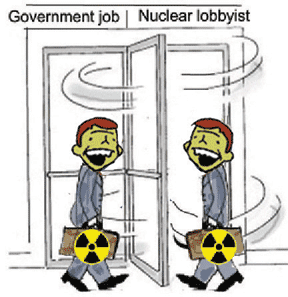
Alex Chisholm, who led business office during Hinkley Point C negotiations, appointed UK chair of energy firm
Rowena Mason Guardian, Whitehall editor, Wed 12 Jun 2024
One of the UK’s most senior civil servants, Alex Chisholm, has been revealed as the new UK chair of the energy company EDF, after having previously run the department that struck a deal for it to build a new nuclear power station.
Chisholm was permanent secretary at the Cabinet Office, and before that led the business department, which worked on the government deal for EDF to go ahead with the Hinkley Point C nuclear plant in Somerset. The agreement was struck in 2016 with UK bill payers bearing the cost of the construction over a 35-year period.
The long-delayed project’s costs have soared from an estimated £18bn to at least £31bn and it is due to be completed in 2031 – about 14 years after EDF thought it would be up and running.
The French state-owned company is a specialist in nuclear power, and one of the “big six” energy providers that have been criticised for huge profits during the energy crisis sparked by the war in Ukraine.
Chisholm’s departure is one of a number of high-profile exits from the civil service before a likely change of governing party. Alex Aiken, a former longstanding head of government communications, recently left Whitehall for a job as an adviser on communications to the government of the United Arab Emirates.
There is also speculation about the future of Simon Case, the cabinet secretary and former royal aide installed by Boris Johnson, given incoming prime ministers often want their own preferred candidate in the job.
Chisholm’s EDF role was approved by the watchdog on post-government jobs, known as the Advisory Committee on Business Appointments. But the watchdog said he must wait three months after departing government to take up the job and observe a ban on lobbying the government or involvement in negotiating government contracts for two years after leaving office.
The watchdog said: “In 2016, his department was responsible for the decision on finalising the first contract for difference [a pricing mechanism], with respect to EDF and the construction of Hinkley Point C. However, this was ultimately a decision for the secretary of state and followed the 2014 approval from the European Commission and was based on terms agreed then, 10 years ago.
“Significantly, due to the period of time that has elapsed, the committee did not consider Sir Alex could reasonably be seen to have influenced this decision in anticipation of an offer of work a decade later.”
Chisholm said his appointment came “at a time of great change and opportunity in the energy sector”……….https://www.theguardian.com/politics/article/2024/jun/11/top-civil-servant-edf-department-nuclear-deal-alex-chisholm
Alarm over 174 security breaches at Clyde nuclear bases

Rob Edwards, June 10, 2024, https://theferret.scot/security-breaches-clyde-nuclear-bases/—
Two nuclear bomb bases on the Clyde recorded 174 security breaches over five years, according to information released by the Ministry of Defence (MoD).
Between 2018 and 2022 there were 130 breaches reported at the Trident submarine base at Faslane, near Helensburgh, and a further 44 breaches at the nearby nuclear weapons store at Coulport.
The MoD has not given any details of the incidents, but suggested that some were “minor”. They could include lost identity cards, misplaced documents and data protection breaches, it said.
The MoD stressed that it investigated every incident “no matter how small” with the aim of continuously improving security.
Campaigners, however, warned there were “risks of major catastrophe” at Faslane and Coulport. They called on whoever wins the general election to “get to grips” with security problems.
The Conservatives, Labour and the Liberal Democrats all support the UK’s nuclear weapons programme. The Scottish National Party and the Greens oppose it.
A freedom of information response released by the MoD in May revealed that the Royal Naval Armaments Depot at Coulport recorded the highest number of security breaches – 13 – in 2019. Since then, there were 11 in 2020, nine in 2021 and nine in 2022.
Coulport is where around 200 of the UK’s arsenal of nuclear warheads are kept in underground bunkers. Spread across the slopes above Loch Long, the site is dotted with watchtowers and protected by a series of barbed wire fences.
The latest MoD release also confirmed a previous report that there were 60 security breaches at Faslane in 2022. Another report in 2022 said that there were 16 breaches at Faslane in 2021, and 18 in each of the previous three years.
Faslane, on the Gareloch, is the home port for the UK’s four Vanguard-class submarines that carry nuclear-armed Trident missiles. One submarine is meant to be continuously on patrol at sea, but in recent years the service has been stretched.
The numbers of security breaches in 2023 and so far in 2024 have not been published by the MoD. But it has previously released figures for nuclear safety incidents that have also plagued the Clyde bases.
The Ferret reported in April that Faslane and Coulport logged 843 “nuclear site events” from 2019 to April 2024. Twelve of them were classified by the MoD as having “actual or potential for radioactive release to the environment”.
We also revealed in August 2023 that the MoD’s Defence Nuclear Organisation, which oversees the UK nuclear weapons programme, had recorded 113 “security concerns” since 2017-18. Again, no details were given.
The Scottish Campaign for Nuclear Disarmament warned that security breaches should not be “shrugged off” as minor. “Faslane and Coulport combine nuclear bombs, nuclear reactors and missiles – radioactivity, explosives and highly flammable rocket fuel – always presenting potential targets and risks of major catastrophe,” said the campaign’s chair, Lynn Jamieson.
“At these most dangerous places, regular breaches signal either a grossly-inappropriate casual culture or the impossibility of 100 per cent security. Incidents rising to 60, averaging more than one a week, is a warning and calls for public investigation.”
Jamieson also attacked the MoD failure to provide details of the breaches. “Secrecy cloaks the reality of the everyday risks in our own backyard,” she told The Ferret.
“Secrecy is convenient for politicians who spout the myth that threatening to destroy half the planet with nuclear weapons keeps us safe.”
Some nuclear security breaches ‘serious’
The Nuclear Information Service, which researches and criticises nuclear weapons, argued that any security breaches were concerning. “If, as the MoD imply, some of these incidents were relatively minor, why have no further details been disclosed?” asked the service’s director, David Cullen.
“The obvious inference is that some of the incidents were much more serious. Whoever wins the election, I hope the incoming government will get to grips with this.”
The large increase in security breaches at Faslane between 2021 and 2022 was “especially worrying”, he said. A report by the London news broadcaster, LBC, in September 2023 suggested that this could be linked to Russian activity in the wake of the invasion of Ukraine in February 2022.
According to the MoD, incidents “can include minor breaches”. They can also include “the mis-accounting of documentation, loss of identity cards, inadvertent use of personal electronic devices and breaches in general data protection,” it said.
A spokesperson for the Royal Navy added: “Security is of paramount importance and we investigate every incident, no matter how small, to ensure we learn from experience and continuously improve our security.”
Will NATO member states individually or collectively go to war against Russia?

VOLTAIRE NETWORK | 31 MAY 2024, https://www.voltairenet.org/article220954.html
Spokesman for the German government Steffen Hebestreit said his country opposed the deployment of NATO’s anti-missile system on Ukrainian territory.
The German point of view matches that of Secretary General of the Alliance Jens Stoltenberg who said in an interview with The Economist: “The time has come for allies to reflect on whether they should lift some of the restrictions on the use of weapons given to Ukraine (…) Especially now, when a lot of fighting is taking place in Kharkov, near the border, denying Ukraine the ability to use these weapons against legitimate military targets on Russian territory makes it very difficult to defend it.”
He also said: “We have no intention of sending NATO ground troops to Ukraine because our objective… is twofold: to support Ukraine as we do, but also to ensure that it does not escalate into a full-scale conflict”
According to the New York Times, US Secretary of State Antony Blinken would be in favor of this second proposal. Steffen Hebestreit, for his part, evaded journalists’ questions on this subject.
☞ Extending the protection of the Atlantic anti-missile shield to Ukrainian territory would mean going to war collectively against Russia. But allowing Ukraine to attack Russia with weapons supplied by NATO member states would mean their individual entry into war against Russia.
For his part, Italy’s deputy prime minister Matteo Salvini commented: “This gentleman [Jens Stoltenberg] is dangerous because talking about World War III, Western weapons capable of striking and killing inside Russia, seems to me very, very dangerous and reckless (…) NATO cannot force us to kill in Russia, nor can anyone force us to send Italian soldiers to fight or die in Ukraine.”
Russian president Vladimir Putin told reporters: “This constant escalation can lead to serious consequences. If these serious consequences occur in Europe, how will the United States behave, given our parity in the field of strategic weapons? It’s hard to say. Do they want a world conflict?”. “Let them [European NATO member states] remember that their territory is small and their population is dense,” he continued.
Russian senator Dmitry Rogozin, former director of Roscosmos, directly warned Washington: “We are not only on the threshold, but already on the edge, beyond which, if the enemy is not stopped in such actions, an irreversible collapse of the strategic security of the nuclear powers will begin.”
In all likelihood, Poland is expected to be the first NATO member state to allow Ukraine to strike Russia with the weapons it has supplied. Moscow would then have to retaliate by striking at least the NATO logistics center on Polish territory in Rzeszów. It will be up to the other NATO member states to consider whether or not to activate Article 5 of the North Atlantic Treaty and start World War III.
From a strategic point of view, the deployment of US medium-range missiles on the borders of Russia and China now exposes them to this eventuality. That is why Russian Foreign Minister Sergei Lavrov announced that the two countries reached a joint defense agreement during President Vladimir Putin’s last visit to Beijing. In addition, Russia is currently conducting simulations with Belarus of the use of tactical (not strategic) nuclear weapons.
1 This Month

of the week– Nuclear Reactor Information Task Force

14 May – online event From Bombs to Data Centres: the Face of Nuclear Colonialism
To see nuclear-related stories in greater depth and intensity – go to https://nuclearinformation.wordpress.com
-
Archives
- May 2026 (92)
- April 2026 (356)
- March 2026 (251)
- February 2026 (268)
- January 2026 (308)
- December 2025 (358)
- November 2025 (359)
- October 2025 (376)
- September 2025 (257)
- August 2025 (319)
- July 2025 (230)
- June 2025 (348)
-
Categories
- 1
- 1 NUCLEAR ISSUES
- business and costs
- climate change
- culture and arts
- ENERGY
- environment
- health
- history
- indigenous issues
- Legal
- marketing of nuclear
- media
- opposition to nuclear
- PERSONAL STORIES
- politics
- politics international
- Religion and ethics
- safety
- secrets,lies and civil liberties
- spinbuster
- technology
- Uranium
- wastes
- weapons and war
- Women
- 2 WORLD
- ACTION
- AFRICA
- Atrocities
- AUSTRALIA
- Christina's notes
- Christina's themes
- culture and arts
- Events
- Fuk 2022
- Fuk 2023
- Fukushima 2017
- Fukushima 2018
- fukushima 2019
- Fukushima 2020
- Fukushima 2021
- general
- global warming
- Humour (God we need it)
- Nuclear
- RARE EARTHS
- Reference
- resources – print
- Resources -audiovicual
- Weekly Newsletter
- World
- World Nuclear
- YouTube
-
RSS
Entries RSS
Comments RSS
 nuclear-news