Robot starts 2nd mission to retrieve debris at Fukushima nuclear plant
Apr. 16 , By Mari Yamaguchi, TOKYO, https://japantoday.com/category/national/robot-starts-2nd-mission-to-retrieve-debris-at-fukushima-nuclear-plant
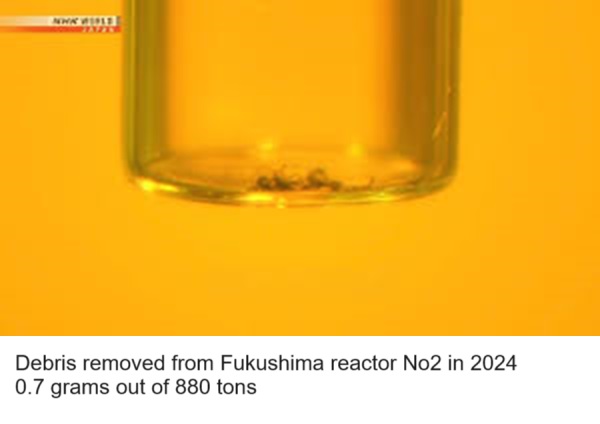
A remote-controlled robot on Tuesday embarked on its second mission to retrieve tiny bits of melted fuel debris from inside a damaged reactor at the Fukushima nuclear plant that was wrecked by a tsunami 14 years ago.
The mission, which follows the first such debris retrieval in November, is aimed at eventually developing the technology and robots needed for a larger scale cleanup of the plant, destroyed by the earthquake and tsunami in March 2011.
The extendable “Telesco” robot carries cameras and a tong to grip tiny nuggets of radioactive debris. It entered the No. 2 reactor’s primary containment vessel Tuesday, according to Tokyo Electric Power Company.
This time, the company aims to send the robot further into the containment vessel to get a sample from an area closer to the center where more melted fuel is believed to have fallen.
It is expected to take several days before the front tip of the robot reaches the targeted area, where it will lower a device carrying a tong and camera in a fishing-rod style.
That first sample retrieval in November, despite a number of mishaps, was a crucial step in what will be a daunting, decades-long decommissioning that must deal with at least 880 tons of melted nuclear fuel that has mixed with broken parts of internal structures and other debris inside the three reactors ruined in 2011.
After a series of small missions by robots to gather samples, experts will determine a larger-scale method for removing melted fuel, first at the No. 3 reactor, beginning in the 2030s.
Experts say the huge challenge of decommissioning the plant is just beginning, and that the work could take more than a century.
Gender Stunts in Space: Blue Origin’s Female Celebrity Envoys

April 15, 2025 Dr Binoy Kampmark, https://theaimn.net/gender-stunts-in-space-blue-origins-female-celebrity-envoys/
Indulgent, vain and profligate, the all-female venture into space on the self-piloted New Shepard (NS-31) operated by Jeff Bezos’ Blue Origin was space capitalism and celebrity shallowness on full show, masquerading as profound, moving and useful.
The crew consisted of bioastronautics research scientist and civil rights activist Amanda Nguyen, CBS Mornings co-host Gayle King, pop entertainer Katy Perry, film producer Kerianne Flynn, former NASA scientist and entrepreneur Aisha Bowe and Lauren Sánchez, fiancée of Jeff Bezos. The journey took 11 minutes and reached the Kármán line at approximately 96 kilometres above the earth.
Blue Origin had advertised the enterprise as an incentive to draw girls to pursue careers in science, technology, engineering and mathematics (STEM). It also shamelessly played on the background of some of the crew, with Nguyen promoted as “the first Vietnamese and south-east Asian female astronaut” whose presence would “highlight science as a tool for peace” and also project a potent “symbol of reconciliation between the US and Vietnam.”
Phil Joyce, Senior Vice President of New Shepard, thought it a “privilege to witness this crew of trailblazers depart the capsule today.” Each woman was “a storyteller” who would “use their voices – individually and together – to channel their life-changing experience today into creating lasting impact that will inspire people across our planet for generations.”
What was more accurately on show were celebrity space marketers on an expensive jaunt, showing us all that women can play the space capitalism game as well, albeit as the suborbital version of a catwalk or fashion show. Far from pushing some variant of feminism in the frontier of space, with scientific rewards for girls the world over, we got the eclipsing, if not a wholesale junking, of female astronauts and their monumental expertise.
It hardly compared, at any stretch or by any quantum of measure, with the achievement of Russian cosmonaut, Valentina Tereshkova, who piloted a Vostok 6 into earth’s orbit lasting 70 hours over six decades prior. To have Sánchez claiming to be “so proud of this crew”, tears cued for effect, gave the impression that they had shown technical expertise and skill when neither was required. It was far better to have deep pockets fronting the appropriate deposit, along with the necessary safe return, over which they had virtually no control over.
Dr Kai-Uwe Schrogl, special advisor for political affairs at the European Space Agency, offered a necessarily cold corrective. “A celebrity isn’t an envoy of humankind – they go into space for their own reasons,” he told BBC News. “These flights are significant and exciting, but I think maybe they can also be a source of frustration for space scientists.” How silly of those scientists, who regard space flight as an extension of “science, knowledge and the interests of humanity.”
The Guardian was also awake to the motivations of the Bezos project. “The pseudo progressiveness of this celebrity space mission, coupled with Bezos’s conduct in his other businesses, should mean we are under no illusion what purpose these flights serve.” With Richard Branson’s Virgin Galactic and Elon Musk’s SpaceX, the space tourism market, marked by its bratty oligarchs, is becoming competitive. In an effort to corner the market, attractive gimmicks are in high demand.
The cringingly superficial nature of the exercise was evident in various comments on the fashion aspect of the suits worn by the crew. Here was branding, and the sort that could be taken to space. As Sánchez stated: “Usually, you know, these suits are made for a man. Then they get tailored to fit a woman. I think the suits are elegant, but they also bring a little spice to space.” Blue Origin had capitalised on NASA’s own failings in 2019, which saw the abandoning of an all-female spacewalk for lacking appropriately fitting spacesuits.
On their return, the female cast performed their contractual undertakings to bore the press with deadly clichés and meaningless observations, reducing space travel to an exercise for the trivial. “Earth looked so quiet,” remarked Sánchez. “It was quiet, but really alive.” King, after getting on her knees to kiss the earth, merely wanted “to have a moment with the ground, just appreciate the ground for just a second.” (Surely she has had longer than that.) Perry, on her return after singing What a Wonderful World during the trip, overflowed with inanities. She felt “super connected to life”, as well as being “so connected to love.”
On the ground were other celebrities, delighted to offer their cliché-clotted thoughts. “I didn’t realise how emotional it would be, it’s hard to explain,” reflected Khloé Kardashian. “I have all this adrenaline and I’m just standing here.” From a family of celebrities that merely exist as celebrities and nothing else, she had some advice: “Dream big, wish for the stars – and one day, you could maybe be amongst them.”
Amanda Hess, reflecting on the mission in The New York Times, tried to put her finger on what it all meant. “The message is that a little girl can grow up to be whatever she wishes: a rocket scientist or a pop star, a television journalist or a billionaire’s fiancée who is empowered to pursue her various ambitions and whims in the face of tremendous costs.” Just not an astronaut.
Campaign for Nuclear Disarmament (CND), to blockade RAF Lakenheath after US exemption to British nuclear safety rules revealed

Berny Torre, Sunday, April 13, 2025, https://morningstaronline.co.uk/article/cnd-blockade-raf-lakenheath-after-us-exemption-british-nuclear-safety-rules-revealed
PROTESTERS will set up a two-week peace camp outside RAF Lakenheath tomorrow after it emerged that all United States forces in Britain are exempt from meeting nuclear safety regulations.
And CND said that activists will block the Suffolk base on April 26, the last day of their vigil.
Declassified documents uncovered by CND show that former defence secretary Ben Wallace signed the “sensitive” waiver exempting US troops from telling local authorities they are storing nuclear weapons and exempt from sticking to regulations applied to radiation risks, leaving local authorities unable to draft disaster emergency plans.
It is known that RAF Lakenheath is being prepared to host new US nuclear weapons, but the March 2021 waiver exempts all US bases in Britain.
CND general secretary Sophie Bolt said: “Far from keeping people safe, all these nuclear weapons make Britain a target. Yet the government is more concerned about its special relationship with the US than people’s safety.
“The peace camp comes just as we learn that Britain’s cover-up of a US nuclear weapons deployment has been in the works for at least four years, alongside proof that people living close to any US base in this country, not just in East Anglia, are at great risk.”
Lakenheath Alliance for Peace co-founder Angie Zelter said: “It is horrifying and shameful that USAF Lakenheath, on British soil and with the connivance of the UK government, is involved in war crimes and genocide.
“Pilots from Israel and Saudi Arabia are trained at Lakenheath and US planes and bombs go out to take part in the bombings in Gaza and Yemen.
“We are here to say this is not in our name and to warn service personnel in the base that they should never obey illegal orders and should refuse to take part in the never-ending wars that are destroying people and planet.”
Greenham Common campaigner Ginnie Herbert said: “The cruise missiles left Greenham Common, international law changed and the common was handed back to the people.
“Forty years later and here we are protesting again as secret decisions are made and US nuclear weapons return to Lakenheath.”
The new camp will include a programme of events and actions taking place at the base and in nearby towns and villages.
A Ministry of Defence spokesman said: “It remains a long-standing UK and Nato policy to neither confirm nor deny the presence of nuclear weapons at a given location.”
Nuclear waste returns to Germany amid protests.
Matt Ford with dpa, NDR, 04/01/2025April 1, 2025, Edited by: Sean Sinico
https://www.dw.com/en/nuclear-waste-returns-to-germany-amid-protests/a-72108958
Seven containers filled with nuclear waste were transferred from ship to train in northern Germany for transport to Bavaria. But Germany still has no permanent storage solution for its radioactive material.
A ship carrying castor seven containers filled with highly radioactive nuclear waste docked in the northern German port of Nordenham, Lower Saxony, on Tuesday morning, amid protests and a heightened police presence.
The nuclear waste is being transported from Sellafield in northwest England to a temporary storage unit in Niederaichbach in the southern German state of Bavaria. The waste left the northwestern English port of Barrow-in-Furness last Wednesday and is being transferred from ship to train in Nordenham before continuing southwards. The nuclear waste was what remained after the reprocessing of fuel elements from decommissioned German nuclear power plants.
The first of the containers, which are four meters (13 feet) long and weigh over 100 tons, was lifted off the special “Pacific Grebe” transport ship by a large crane on Tuesday morning and underwent inspection to measure radiation levels and ensure they matched those taken in Sellafield.
The port in Nordenham remains sealed off and guarded by heavily armed police, who have thus far reported no incidents, despite a number of protests by anti-atomic energy groups.
Nuclear waste: Why are people protesting?
“Every castor container carries enormous risk,” said Helge Bauer from the protest group Ausgestrahlt, which means “radiated.” “Nuclear waste should, therefore, only be transported once — to a permanent storage site.”
Further protests are planned along the presumed route of the train carrying the waste over the coming days, including in the cities of Bremen and Göttingen.
“Every castor transport is one too many because it only postpones the problem and does not solve it,” Kerstin Rudek, a spokesperson for the group Castor-Stoppen, said in a statement, adding that nuclear waste should not be moved until a safe, final storage location is determined.
Where is the waste from if Germany phased out nuclear energy?
Germany began phasing out the use of nuclear power in 2003, a process which was accelerated following the Fukushima disaster in Japan in 2011. Germany’s final remaining nuclear power plants were shut down in 2023.
But Germany is still obligated to take back nuclear waste produced by used elements from its plants which, up until 2005, were regularly transported to reprocessing plants in Sellafield and La Hague, France. The transport of processed German nuclear waste back to the country has often been subject to protests.
According to the Society for Nuclear Service (GNS), over 100 castor containers were transported from La Hague to Gorleben, Lower Saxony, between 1995 and 2011. The final four were transported to Philippsburg, Baden-Württemberg, in 2024. Six containers were reportedly transported from Sellafield to Biblis, Hesse, in 2020, with seven more still to come.
Where does Germany store nuclear waste?
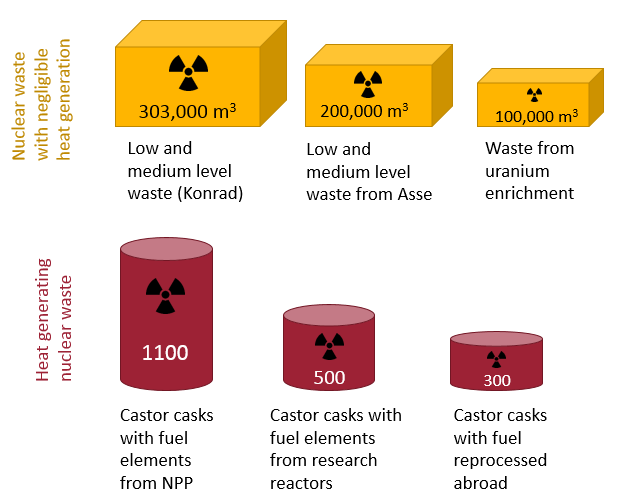
Germany’s Federal Company for Radioactive Waste Disposal (BGE) is still in the process of identifying a suitable location for the permanent underground storage of 27,000 cubic meters of nuclear waste produced over the course of 60 years of German nuclear energy production.
Nuclear waste, which can remain radioactive and, therefore, highly dangerous for hundreds of thousands of years, is currently stored in 16 temporary locations above ground, but it can’t stay there forever.
“We are using an empiric process to identify a location which offers the best possible security,” the BGE’s Lisa Seidel told public broadcaster NDR in November 2024.
CIA: Undermining and Nazifying Ukraine Since 1953

In 1969, AERODYNAMIC began advancing the cause of the Crimean Tatars. In 1959, owing to Canada’s large Ukrainian population, Canada’s intelligence service began a program similar to AERODYNAMIC codenamed «REDSKIN».
AERODYNAMIC continued into the 1980s as operation QRDYNAMIC, which was assigned to the CIA’s Political and Psychological Staff’s Soviet East Europe Covert Action Program. Prolog saw its operations expanded from New York and Munich to London, Paris, and Tokyo.
Assistant Secretary of State for European/Eurasian Affairs Victoria Nuland, the baked goods-bearing «Maiden of Maidan,» told the US Congress that the United States spent $5 billion to wrest control of Ukraine from the Russian sphere since the collapse of the Soviet Union. With the recent disclosures from the CIA it appears that the price tag to the American tax payers of such foreign shenanigans was much higher.
by Wayne Madsen, Voltaire Network | 14 January 2016
The CIA programs spanned some four decades. Starting as a paramilitary operation that provided funding and equipment for such anti-Soviet Ukrainian resistance groups as the Ukrainian Supreme Liberation Council (UHVR); its affiliates, the Organization of Ukrainian Nationalists (OUN) and Ukrainian Insurgent Army (UPA), all Nazi Banderists. The CIA also provided support to a relatively anti-Bandera faction of the UHVR, the ZP-UHVR, a foreign-based virtual branch of the CIA and British MI-6 intelligence services. The early CIA operation to destabilize Ukraine, using exile Ukrainian agents in the West who were infiltrated into Soviet Ukraine, was codenamed Project AERODYNAMIC.
The recent declassification of over 3800 documents by the Central Intelligence Agency provides detailed proof that since 1953 the CIA operated two major programs intent on not only destabilizing Ukraine but Nazifying it with followers of the World War II Ukrainian Nazi leader Stepan Bandera.
A formerly TOP SECRET CIA document dated July 13, 1953, provides a description of AERODYNAMIC: «The purpose of Project AERODYNAMIC is to provide for the exploitation and expansion of the anti-Soviet Ukrainian resistance for cold war and hot war purposes. Such groups as the Ukrainian Supreme Council of Liberation (UHVR) and its Ukrainian Insurgent Army (OUN), the Foreign Representation of the Ukrainian Supreme Council of Liberation (ZPUHVR) in Western Europe and the United States, and other organizations such as the OUN/B will be utilized». The CIA admitted in a 1970 formerly SECRET document that it had been in contact with the ZPUHVR since 1950.
The OUN-B was the Bandera faction of the OUN and its neo-Nazi sympathizers are today found embedded in the Ukrainian national government in Kiev and in regional and municipal governments throughout the country.
AERODYNAMIC placed field agents inside Soviet Ukraine who, in turn, established contact with Ukrainian Resistance Movement, particularly SB (intelligence service) agents of the OUN who were already operating inside Ukraine. The CIA arranged for airdrops of communications equipment and other supplies, presumably including arms and ammunition, to the «secret» CIA army in Ukraine. Most of the CIA’s Ukrainian agents received training in West Germany from the US Army’s Foreign Intelligence Political and Psychological (FI-PP) branch. Communications between the CIA agents in Ukraine and their Western handlers were conducted by two-way walkie-talkie (WT), shortwave via international postal channels, and clandestine airborne and overland couriers.
Agents airdropped into Ukraine carried a kit that contained, among other items, a pen gun with tear gas, an arctic sleeping bag, a camp axe, a trenching tool, a pocket knife, a chocolate wafer, a Minox camera and a 35 mm Leica camera, film, a Soviet toiletry kit, a Soviet cap and jacket, a .22 caliber pistol and bullets, and rubber «contraceptives» for ‘waterproofing film’. Other agents were issued radio sets, hand generators, nickel-cadmium batteries, and homing beacons.
An affiliated project under AERODYNAMIC was codenamed CAPACHO.
CIA documents show that AERODYNAMIC continued in operation through the Richard Nixon administration into 1970.
The program took on more of a psychological warfare operation veneer than a real-life facsimile of a John Le Carré «behind the Iron Curtain» spy novel. The CIA set up a propaganda company in Manhattan that catered to printing and publishing anti-Soviet ZPUHVR literature that would be smuggled into Ukraine. The new battleground would not be swampy retreats near Odessa and cold deserted warehouses in Kiev but at the center of the world of publishing and the broadcast media.
Read more: CIA: Undermining and Nazifying Ukraine Since 1953The CIA front company was Prolog Research and Publishing Associates, Inc., which later became known simply as Prolog. The CIA codename for Prolog was AETENURE. The group published the Ukrainian language «Prolog» magazine. The CIA referred to Prolog as a «non-profit, tax exempt cover company for the ZP/UHVR’s activities». The «legal entity» used by the CIA to fund Prolog remains classified information. However, the SECRET CIA document does state that the funds for Prolog were passed to the New York office «via Denver and Los Angeles and receipts are furnished Prolog showing fund origin to backstop questioning by New York fiscal authorities».
As for the Munich office of Prolog, the CIA document states that funding for it comes from an account separate from that of Prolog in New York from a cooperating bank, which also remains classified. In 1967, the CIA merged the activities of Prolog Munich and the Munich office of the Ukrainian exiled nationalist «Suchasnist» journal. The Munich office also supported the «Ukrainische Gesellschaft fur Auslandstudien». The CIA documents also indicate that US Federal Bureau of Investigation (FBI) agents may have interfered with AERODYNAMIC agents in New York. A 1967 CIA directive advised all ZPUHVR agents in the United States to either report their contacts with United Nations mission diplomats and UN employees from the USSR and the Ukrainian SSR to the FBI or their own CIA project case officer. CIA agents in charge of AERODYNAMIC in New York and Munich were codenamed AECASSOWARY agents. Apparently not all that taken with the brevity of MI-6’s famed agent «007», one CIA agent in Munich was codenamed AECASSOWARY/6 and the senior agent in New York was AECASSOWARY/2.
AECASSOWARY agents took part in and ran other AERODYNAMIC teams that infiltrated the Vienna World Youth Conference in 1959. The Vienna infiltration operation, where contact with made with young Ukrainians, was codenamed LCOUTBOUND by the CIA.
In 1968, the CIA ordered Prolog Research and Publishing Associates, Inc. terminated and replaced by Prolog Research Corporation, «a profit-making, commercial enterprise ostensibly serving contracts for unspecified users as private individuals and institutions».
The shakeup of Prolog was reported by the CIA to have arisen from operation MHDOWEL. There is not much known about MHDOWEL other than it involved the blowing of the CIA cover of a non-profit foundation. The following is from a memo to file, dated January 31, 1969, from CIA assistant general counsel John Greany, «Concerns a meeting of Greaney, counsel Lawrence Houston and Rocca about a ‘confrontation’ with NY FBI office on January 17, 1969. They discussed two individuals whose names were redacted. One was said to be a staff agent of the CIA since 8/28/61 who had been assigned in 1964 to write a monograph, which had been funded by a grant from a foundation whose cover was blown in MHDOWEL (I suspect that is code for US Press). One of the individuals [name redacted] had been requested for use with Project DTPILLAR in November 1953 to Feb. 1955 and later in March 1964 for WUBRINY. When the Domestic Operations Division advised Security that this person would not be used in WUBRINY, Rocca commented that ‘there are some rather ominous allegations against members of the firm of [redacted],’ indicating one member of that firm was a ‘card-carrying member of the Communist Party.’ The memo went on to say that Rocca was investigating the use of the individual in Project DTPILLAR concerning whether that person had mentioned activities in Geneva in March 1966 in connection with Herbert Itkin». Raymond Rocca was the deputy chief of the CIA’s Counterintelligence Division. Itkin was an undercover agent for the FBI and CIA who allegedly infiltrated the Mafia and was given a new identity in California as «Herbert Atkin» in 1972.
In 1969, AERODYNAMIC began advancing the cause of the Crimean Tatars. In 1959, owing to Canada’s large Ukrainian population, Canada’s intelligence service began a program similar to AERODYNAMIC codenamed «REDSKIN».
As international air travel increased, so did the number of visitors to the West from Soviet Ukraine. These travelers were of primary interest to AERODYNAMIC. Travelers were asked by CIA agents to clandestinely carry Prolog materials, all censored by the Soviet government, back to Ukraine for distribution. Later, AERODYNAMIC agents began approaching Ukrainian visitors to eastern European countries, particularly Soviet Ukrainian visitors to Czechoslovakia during the «Prague Spring» of 1968. The Ukrainian CIA agents had the same request to carry back subversive literature to Ukraine.
AERODYNAMIC continued into the 1980s as operation QRDYNAMIC, which was assigned to the CIA’s Political and Psychological Staff’s Soviet East Europe Covert Action Program. Prolog saw its operations expanded from New York and Munich to London, Paris, and Tokyo.
QRDYNAMIC began linking up with operations financed by hedge fund tycoon George Soros, particularly the Helsinki Watch Group’s operatives in Kiev and Moscow. Distribution of underground material expanded from journals and pamphlets to audio cassette tapes, self-inking stamps with anti-Soviet messages, stickers, and T-shirts.
QRDYNAMIC expanded its operations into China, obviously from the Tokyo office, and Czechoslovakia, Poland, Estonia, Lithuania, Latvia, Yugoslavia, Afghanistan, Soviet Central Asia, the Soviet Pacific Maritime region, and among Ukrainian-Canadians. QRDYNAMIC also paid journalist agents-of-influence for their articles. These journalists were located in Sweden, Switzerland, Australia, Israel, and Austria.
But at the outset of glasnost and perestroika in the mid-1980s, things began to look bleak for QRDYNAMIC. The high cost of rent in Manhattan had it looking for cheaper quarters in New Jersey.
Assistant Secretary of State for European/Eurasian Affairs Victoria Nuland, the baked goods-bearing «Maiden of Maidan,» told the US Congress that the United States spent $5 billion to wrest control of Ukraine from the Russian sphere since the collapse of the Soviet Union. With the recent disclosures from the CIA it appears that the price tag to the American tax payers of such foreign shenanigans was much higher.
Germany’s New federal government wants nuclear fusion instead of nuclear power plants – no word on nuclear energy in the coalition agreement.

Achim Melde, April 10, 2025, https://www.iwr.de/news/neue-bundesregierung-will-kernfusion-statt-atomkraftwerke-kein-wort-zur-atomenergie-im-koalitionsvertrag-news39104 Translation: Dieter Kaufmann, Working Group Against Nuclear Power Plants, Frankfurt am Main, Germany
Berlin – In the last election campaign, the CDU/CSU heavily criticized the “traffic light” coalition for shutting down the last three nuclear power plants in Germany and announced a return to nuclear energy. Following the election, however, the coalition agreement no longer mentions a single word about nuclear energy. Instead, the focus shifts to the use of nuclear fusion, which lies far in the future.
According to the current coalition agreement, the CDU/CSU-SPD coalition does not plan a return to nuclear power in Germany. The previously announced review and inventory of the recently shut-down nuclear power plants is also apparently off the table. Instead, the expansion of renewable energies will be further accelerated, and nuclear fusion is intended to solve the energy problem of the future.
Nuclear power plants: Union and SPD do not want to return to nuclear energy in Germany
Of the 17 nuclear power plants that were still in operation in Germany in 2010, a total of 14 nuclear power plants were shut down by the end of 2021 with the involvement of the CDU/CSU federal government. However, the shutdown of the last three nuclear power plants by the traffic light coalition, in particular, regularly caused criticism in Germany.
The coalition parties have not yet provided a justification for not considering nuclear energy. The reasons are likely varied, but all were known long before the elections. The advanced age and high costs of reactivating the old nuclear power plants would be just one of the numerous challenges. The most recently shut down nuclear power plants, Emsland (1985), Isar II (1988), and Neckarwestheim 2 (1989), are already 35 years old and have already exceeded their designed operating life. Furthermore, the dismantling of the old nuclear power plants is already underway; the Atomic Energy Act would have to be reopened, and the resulting additional nuclear waste would have to be re-regulated.
Energy industry is not available for new nuclear power plants – no price reduction effect from nuclear energy
Furthermore, the energy industry, as the operator of the old nuclear power plants that are to be reactivated, is unavailable. RWE CEO Markus Krebber has repeatedly rejected a return to nuclear power. The energy supplier EnBW has also ruled out restarting its decommissioned nuclear power plants, deeming the construction of new reactors unrealistic. E.ON CEO Leonhard Birnbaum, for his part, stated in an interview with Handelsblatt that there is no private company in Germany that would invest money in new nuclear power plants.
A price-reducing effect is also not expected from the expansion of nuclear power. The public often misunderstands that a higher electricity supply alone will lead to lower electricity prices. In fact, the formation of electricity prices on the exchange works differently, based on the marginal cost model (merit order).
All power plants used are ranked in the hourly auction according to their costs, from lowest to highest. The highest price of the last power plant to enter the auction determines the price for all other power plants. This “clearance price” is currently determined primarily by the gas price and thus by the gas-fired power plants. Cheaper power plants then play no role and do not lower the electricity price. The extremely high gas prices—and not a problem with the quantity of electricity—were a key driver of the subsequent exploding electricity prices following Russia’s invasion of Ukraine and the resulting rapid rise in inflation.

Fusion reactor: political timetables completely unrealistic
According to the coalition agreement, the coalition is committed to the use of nuclear fusion. The first fusion reactor in Germany is to be built afterward, and regulation will be outside of nuclear law. Bavarian Science Minister Markus Blume (CSU) predicted a period of 10 to 15 years for the realization of this technology, as of early 2025. Experts such as Dr. Reinhard Grünwald of the Institute for Technology Assessment and Systems Analysis (ITAS) consider this timeframe unrealistic.
After that, it will take at least another 20 years before the first demonstration reactor with a closed tritium cycle is available. Following that, a power plant that also generates electricity would have to be built. According to Grünwald, this would take another 20 years.
The ITER fusion device (Tokamak principle) currently under construction is a pure research facility, not designed as a demonstration reactor. The completion of the ITER research facility for test operation was postponed again last year, from 2024 to 2034 (instead of 2025).
In nuclear fusion, hydrogen atom nuclei are fused to form helium. Enormous amounts of energy are released in the process. This process takes place on the sun. The challenges are diverse and, due to the enormous ignition and combustion temperatures of 100 million degrees Celsius, range from material issues for the reactor walls to the production and handling of radioactive tritium.
How and where is nuclear waste stored in the US?

Gerald Frankel , Distinguished Professor of Materials Science and Engineering, The Ohio State University, April 14, 2025, https://theconversation.com/how-and-where-is-nuclear-waste-stored-in-the-us-252475
Around the U.S., about 90,000 tons of nuclear waste is stored at over 100 sites in 39 states, in a range of different structures and containers.
For decades, the nation has been trying to send it all to one secure location.
A 1987 federal law named Yucca Mountain, in Nevada, as a permanent disposal site for nuclear waste – but political and legal challenges led to construction delays. Work on the site had barely started before Congress ended the project’s funding altogether in 2011.
The 94 nuclear reactors currently operating at 54 power plants continue to generate more radioactive waste. Public and commercial interest in nuclear power is rising because of concerns regarding emissions from fossil fuel power plants and the possibility of new applications for smaller-scale nuclear plants to power data centers and manufacturing. This renewed interest gives new urgency to the effort to find a place to put the waste.
In March 2025, the U.S. Supreme Court heard arguments related to the effort to find a temporary storage location for the nation’s nuclear waste – a ruling is expected by late June. No matter the outcome, the decades-long struggle to find a permanent place to dispose of nuclear waste will probably continue for many years to come.
I am a scholar who specializes in corrosion; one focus of my work has been containing nuclear waste during temporary storage and permanent disposal. There are generally two forms of significantly radioactive waste in the U.S.: waste from making nuclear weapons during the Cold War, and waste from generating electricity at nuclear power plants. There are also small amounts of other radioactive waste, such as that associated with medical treatments.
Waste from weapons manufacturing
Remnants of the chemical processing of radioactive material needed to manufacture nuclear weapons, often called “defense waste,” will eventually be melted along with glass, with the resulting material poured into stainless steel containers. These canisters are 10 feet tall and 2 feet in diameter, weighing approximately 5,000 pounds when filled.
For now, though, most of it is stored in underground steel tanks, primarily at Hanford, Washington, and Savannah River, South Carolina, key sites in U.S. nuclear weapons development. At Savannah River, some of the waste has already been processed with glass, but much of it remains untreated.
At both of those locations, some of the radioactive waste has already leaked into the soil beneath the tanks, though officials have said there is no danger to human health. Most of the current efforts to contain the waste focus on protecting the tanks from corrosion and cracking to prevent further leakage.
Waste from electricity generation
The vast majority of nuclear waste in the U.S. is spent nuclear fuel from commercial nuclear power plants.
Before it is used, nuclear fuel exists as uranium oxide pellets that are sealed within zirconium tubes, which are themselves bundled together. These bundles of fuel rods are about 12 to 16 feet long and about 5 to 8 inches in diameter. In a nuclear reactor, the fission reactions fueled by the uranium in those rods emit heat that is used to create hot water or steam to drive turbines and generate electricity.
After about three to five years, the fission reactions in a given bundle of fuel slow down significantly, even though the material remains highly radioactive. The spent fuel bundles are removed from the reactor and moved elsewhere on the power plant’s property, where they are placed into a massive pool of water to cool them down.
After about five years, the fuel bundles are removed, dried and sealed in welded stainless steel canisters. These canisters are still radioactive and thermally hot, so they are stored outdoors in concrete vaults that sit on concrete pads, also on the power plant’s property. These vaults have vents to ensure air flows past the canisters to continue cooling them.
As of December 2024, there were over 315,000 bundles of spent nuclear fuel rods in the U.S., and over 3,800 dry storage casks in concrete vaults above ground, located at current and former power plants across the country.
Even reactors that have been decommissioned and demolished still have concrete vaults storing radioactive waste, which must be secured and maintained by the power company that owned the nuclear plant.
The threat of water
One threat to these storage methods is corrosion.
Because they need water to both transfer nuclear energy into electricity and to cool the reactor, nuclear power plants are always located alongside sources of water.
In the U.S., nine are within two miles of the ocean, which poses a particular threat to the waste containers. As waves break on the coastline, saltwater is sprayed into the air as particles. When those salt and water particles settle on metal surfaces, they can cause corrosion, which is why it’s common to see heavily corroded structures near the ocean.
At nuclear waste storage locations near the ocean, that salt spray can settle on the steel canisters. Generally, stainless steel is resistant to corrosion, which you can see in the shiny pots and pans in many Americans’ kitchens. But in certain circumstances, localized pits and cracks can form on stainless steel surfaces.
In recent years, the U.S. Department of Energy has funded research, including my own, into the potential dangers of this type of corrosion. The general findings are that stainless steel canisters could pit or crack when stored near a seashore. But a radioactive leak would require not only corrosion of the container but also of the zirconium rods and of the fuel inside them. So it is unlikely that this type of corrosion would result in the release of radioactivity.
A long way off
A more permanent solution is likely years, or decades, away.
Not only must a long-term site be geologically suitable to store nuclear waste for thousands of years, but it must also be politically palatable to the American people. In addition, there will be many challenges associated with transporting the waste, in its containers, by road or rail, from reactors across the country to wherever that permanent site ultimately is.
Perhaps there will be a temporary site whose location passes muster with the Supreme Court. But in the meantime, the waste will stay where it is.
UK deeply involved in Ukraine conflict – The Times
12 Apr 25 https://www.rt.com/news/615649-uk-involvement-ukraine-conflict/
Kiev allegedly refers to Britain’s military chiefs as the “brains” of the “anti-Putin” coalition, according to the exposé
Britain’s military leadership has played a far more extensive and covert role in the Ukraine conflict than previously known, not only designing battle plans and supplying intelligence, but also authorizing secret troop deployments inside the country to provide weapons training and technical support, according to a report by The Times.
While London’s political and military backing for Kiev has been public since the 2014 Western-backed coup, the extent of its involvement after the escalation in February 2022 “remained largely hidden… until now,” the British newspaper wrote on Friday, citing unnamed Ukrainian and British military officers.
The Times claimed that British troops were sent into Ukraine in small numbers on several occasions throughout 2022 and 2023, operating discreetly to avoid provoking Russia. In particular, UK forces were deployed to fit Ukrainian aircraft with Storm Shadow long-range cruise missiles and train pilots and ground crews in their use.
“UK troops were secretly sent to fit Ukraine’s aircraft with the missiles and teach troops how to use them,” the publication wrote, noting that it “would not be the first time British troops had been deployed on the ground.”
The UK had been delivering thousands of NLAW anti-tank missiles to Kiev and sending instructors to train Ukrainian soldiers in their use since 2015. While British troops were pulled out of Ukraine shortly before the escalation in February 2022, the deteriorating battlefield situation and the urgent need for technical expertise saw small teams of UK personnel redeployed quietly alongside fresh supplies of missiles, the newspaper reported.
London also reportedly played a key role in helping Ukraine prepare its much-touted 2023 “counteroffensive” against Russia – and in mediating between Kiev and Washington when the operation failed to meet US expectations.
The newspaper claimed that “behind the scenes,” the Ukrainians referred to Britain’s military chiefs as the “brains” of what they called an “anti-Putin” coalition. Former UK Defense Secretary Ben Wallace was even reportedly nicknamed “the man who saved Kiev” by military officials.
“The Americans went to Ukraine only on rare occasions because of concerns that they would be seen to be too involved in the war, unlike Britain’s military chiefs, who were given the freedom to go whenever necessary,” The Times wrote. “Sometimes their visits were so sensitive they went in civilian clothing.”
Moscow perceives the Ukraine conflict as a Western-led proxy war against Russia, in which Ukrainians serve as “cannon fodder.” It considers foreigners fighting for Kiev as “mercenaries” acting on behalf of Western governments.
Senior Moscow officials have suggested that the more complex weapon systems provided to Kiev are highly likely operated by NATO staff.
The presence of current and former NATO troops has also been tacitly admitted, but never openly confirmed, by Western officials. For example, last year, German Chancellor Olaf Scholz revealed the involvement of British and French forces in preparing Ukrainian missile launches, as he explained why Berlin would not supply similar weapons to Kiev.
Earlier this month, a New York Times investigation found that the administration of former US President Joe Biden provided Ukraine with support that went far beyond arms shipments – extending to daily battlefield coordination, intelligence sharing, and joint strategy planning, which were described as indispensable to Kiev’s fight against Russia.
Uranium Hot Particles Detected in Soil Samples from Site of Israel Bomb in Beirut
Marianne Birkby, Apr 15, 2025, https://radiationfreelakeland.substack.com/p/uranium-hot-particles-detected-in?utm_source=post-email-title&publication_id=2706406&post_id=161332055&utm_campaign=email-post-title&isFreemail=true&r=ln98x&triedRedirect=true&utm_medium=email
Dr Chris Busby; Analysis of soil samples from site of Israel bomb in Beirut, Lebanon where Hassan Nasrallah was killed using CR39 track imaging plastic show presence of Uranium hot particles. It was discovered that the micron size hot particles become self-resuspended and airborne. This has public health implications. Dr Busby explains the methodology, showing how the images and results were obtained and discusses the implications of the findings with emphasis on the health risks both local and global.
People may remember Dr Chris Busby was demonised by George Monbiot when the “UKs leading environmentalist’ was silencing “green” opposition against new nuclear build (the results of which can be seen in the appalling devastation already at Hinkley C and Sizewell)
A nuclear play in New Brunswick is facing a fragile outlook.

14 Apr 25
- What’s happening: The British owner of New Brunswick’s small modular reactor startup has entered insolvency, throwing its assets on the auction block.
- Why it matters now: The Canadian subsidiary says it’s forging ahead, but with delays, money troubles and fading momentum, Ottawa’s nuclear play is wobbling.
- The broader view: It’s a gut check for Canada’s SMR strategy – and a reminder of how fragile government-backed innovation can be when the scaffolding cracks.
Trump’s Iran talks can succeed if the administration embraces reality rather than myth

What is routinely absent from the conversation is that one of the people who agrees, at least for the moment, that Iran must not have a nuclear weapon is Ayatollah Ali Khamenei. The fatwa (ruling under Islamic law) he issued dates back to at least 2003 and as much as a decade before that.
The talks between Iran and the U.S. set to begin today have a chance to succeed if the Trump administration grounds its policy in the realities of Iran’s nuclear program, not fearmongering promoted by Israel and its allies.
By Mitchell Plitnick April 12, 2025, Mitchell Plitnick, https://mondoweiss.net/2025/04/trumps-iran-talks-can-succeed-if-the-administration-embraces-reality-rather-than-myth/
Mitchell Plitnick is the president of ReThinking Foreign Policy. He is the co-author, with Marc Lamont Hill, of Except for Palestine: The Limits of Progressive Politics. Mitchell’s previous positions include vice president at the Foundation for Middle East Peace, Director of the US Office of B’Tselem, and Co-Director of Jewish Voice for Peace. You can find him on Twitter @MJPlitnick.
Iran and the United States are set to meet indirectly on today in Oman, in the hopes of finding a way to resolve their confrontations over Iran’s nuclear program without a resort to an “Israeli-led” attack on Iran.
There are a lot of details to parse if these discussions are to bear fruit. It will be important to see whether each side—though most of the concern here really lays with the American side—is willing, at least in the context of these talks, to deal with realities over propaganda and pragmatism over sloganeering.
These talks are different from earlier ones. High-level officials from Donald Trump’s administration are leading these talks. Trump’s schizophrenic approach to policy makes negotiations volatile but also leaves open possibilities for breakthroughs.
Netanyahu sidelined
Israeli Prime Minister Benjamin Netanyahu’s visit to Washington earlier this week clearly indicated the potential here.
Netanyahu came with the proper fealty to Trump, kissing the proverbial ring. He desperately needed a boost from Trump as protests and scandals swirled around him in Israel. He also needed Trump to back his aggressive stance against Iran, a crucial point in ensuring the perpetual state of active war that Netanyahu needs to forestall elections next year and to continue to delay his trials in court and investigations of his administration’s failures.
He got none of it. Only hours before Netanyahu was to meet with Trump, he was told that Trump was going to hold talks with Iran to avert war. The large press conference that was scheduled for the two leaders was quickly reduced to a small group of hand-picked “journalists.”
At that mini-conference, Netanyahu was clearly discomfited by Trump’s mention of negotiations with Iran. It got worse for him as Trump mildly rebuked Netanyahu on his reluctance to engage with Türkiye over both countries (illegal) presences in Syria. It’s worth noting how quickly Israel and Türkiye started productive talks after that.
There was a clear message that Trump was sending, although he didn’t use the same kind of language that got one of his negotiators into trouble a few weeks ago: Israel is not going to drive this process. The United States is.
More precisely, Netanyahu is not going to drive the process; Trump is. Trump later clarified Israel’s role. After saying that the U.S. will use a military option against Iran if necessary, Trump said, “Israel will obviously be very much involved in that — it’ll be the leader of that. But nobody leads us. We do what we want to do.”
Trump will allow the Israeli military to take the lead, and the risks, while he expects that the U.S. will be a full partner in the planning and strategizing of an attack, and offer the needed support while not risking backlash from Trump’s own base should American military personnel be injured or killed in another “foreign war.”
So Netanyahu is now reduced to trying to sabotage a diplomatic process that is out of his hands in the hope of provoking a military confrontation that he will not be able to drive but merely partner in. After four years of Joe Biden needlessly acquiescing to every Israeli desire, this is an unwelcome change for Netanyahu.
It is ironic that the Democratic administration, which claimed to defend the “rules-based order,” and claimed to respect established political traditions domestically, routinely broke U.S. law and quite possibly delivered the death blow to both the “rules-based” post-Cold War order and to the international legal system; while Trump’s Republican administration, which has openly defied the rule of law, has moved quickly and decisively into brutal authoritarianism and blatant racism, is restraining Israels’ relentless push for a regional war, at least for the moment.
A fictional crisis
Yet, on the whole, and in their effects on the ground, Trump’s policies have not been much different materially in Gaza, or even with Iran, from Biden’s. And one of those similarities is the ongoing denial of the fictional basis of the Iranian “nuclear threat.”
That “Iran must not be allowed to obtain a nuclear weapon” is a mantra we hear every day, and also a point that most people agree with, even if, for some of us, it is not so much about “allowing” Iran a nuke, as it is that no one should have these awful weapons and the last thing we need is another country, friend or foe, possessing them.
What is routinely absent from the conversation is that one of the people who agrees, at least for the moment, that Iran must not have a nuclear weapon is Ayatollah Ali Khamenei. The fatwa (ruling under Islamic law) he issued dates back to at least 2003 and as much as a decade before that.
There are, of course, those who think the fatwa is just words and others who believe it to be deception. So, if further proof is needed, the United States has provided it.
The United States intelligence services confirmed in 2007 that Iran had formally abandoned the pursuit of nuclear weapons technology in 2003.
That intelligence assessment has been repeatedly confirmed ever since, most recently by Trump’s own Director of National Intelligence Tulsi Gabbard in testimony before Congress. “The IC (Intelligence Community) continues to assess that Iran is not building a nuclear weapon and Supreme Leader Khamenei has not authorized the nuclear weapons program he suspended in 2003,” she said.
It can’t be any clearer. Gabbard is here representing eighteen different American intelligence agencies. There has been no pushback from that entire community on her statement.
Of course, there is no shortage of bad faith actors who will say that all of this doesn’t matter because Iran is evil and so every bad thing anyone thinks about them must be true.
Those forces feed off the fact that Iran has enriched uranium to near-weapons grade and always, without fail, decline to mention that they have only done that because the United States abrogated the 2015 Iran nuclear deal (called the JCPOA) and reinstated crippling sanctions and that Iran’s only way to retaliate at all was to also take the steps that were denied it by the JCPOA.3
Again, we need to recall that it was Donald Trump who, for no reason other than his wish to reverse any positive step by his then-immediate predecessor Barack Obama, tore up the JCPOA. He did this despite the statement by his own top aides, such as then-Defense Secretary Jim Mattis, who told a House of Representatives hearing, “I believe that they fundamentally are (in compliance). There have been certainly some areas where they were not temporarily in that regard, but overall our intelligence community believes that they have been compliant, and the IAEA also says so.”
Six months later, Mattis said it again, even while Trump was getting ready to scrap the deal. He told a Senate Armed Services Committee hearing, “I’ve read (the JCPOA) now three times … and I will say that it is written almost with an assumption that Iran would try to cheat…So the verification, what is in there, is actually pretty robust as far as our intrusive ability” to inspect and supervise the Iranian nuclear facilities and program.
This isn’t just about getting history right. This is the perspective that Iran is bringing to the talks, one that is confirmed by Trump’s own people when they are forced to speak the truth rather than just say whatever their boss wants them to say.
This perspective was never brought to the Biden administration’s dealings with Iran, despite Biden having been fully immersed in the JCPOA talks as Obama’s vice president.
If Trump wants to avoid the military conflict that he has already primed American military forces in the region for, his negotiators need to appreciate the reality that the only steps Iran has taken toward a nuclear weapon since 2003 are entirely due to the U.S.’ refusal to live up to the deal it pushed for and got in 2015.
Netanyahu’s Libya option
Another reality Trump needs to recognize is the message that has been sent to countries that surrender their nuclear deterrent.
Ukraine is an obvious current example. Of the many ways the West betrayed Ukraine’s trust after the collapse of the Soviet Union, a big one is the neglect of Ukrainian security, particularly between 1995 and 2014, that was promised to Kyiv in exchange for their agreement to give up the Soviet nuclear weapons they possessed.
That didn’t work out well for Gaddafi or Libya, and the state itself remains divided and unstable to this day.
This explains some of what Gabbard was talking about when, later in her recent testimony, she said, “In the past year, we have seen an erosion of a decades-long taboo in Iran on discussing nuclear weapons in public, likely emboldening nuclear weapons advocates within Iran’s decision-making apparatus.”
If Iran should agree, as it did in 2015, to surrender its entire nuclear weapons program, does the same fate await it as those of Libya and Ukraine? Given that its enemies, the U.S. and Israel, both have nuclear arsenals as well as massive stores of both conventional weapons and WMDs and have wreaked unimaginable destruction around the world and in the Middle East specifically, it is a real concern, and one that the country, both in the public and governmental discourses, would be irresponsible not to discuss and consider.
This must inform the American approach to the talks in Oman. Benjamin Netanyahu is one person who knows that.
To save face, and to give the impression that what he says is going to matter to Trump, Netanyahu spoke to the issue of U.S.-Iran talks after he left Washington. He said, “Iran will not have nuclear weapons. This can be done by agreement, but only if the agreement is a Libya-style agreement (where international and American agencies) go in, blow up the facilities, dismantle all the equipment, under American supervision with American execution. That is good.”
Netanyahu wants Iran’s entire nuclear program destroyed, including the civilian aspect. That’s a non-starter for Iran. While nuclear power accounts for only a small portion of Iran’s electricity use, it is expected to grow in coming years as even more of its oil will be exported in an attempt to rebuild its shattered economy.
Anti-Iran hawks are going to push the “Libya option.” Iran, for its part, will need to find the space to agree to the sort of intrusive inspections it allowed in 2015, at least, and probably some other concessions for Trump to show off. They very likely know that. And if the U.S. wants that agreement, it will need to commit to ending sanctions more reliably than it did in 2015.
That path is reasonable, it is a win for Iran, and Trump can sell it as a triumph. It’s there for the taking, but only if Trump does something well outside of both his and, for the most part, the U.S.’s comfort zone: act in good faith and grounded in reality rather than myth.
Forget Sizewell C nuclear – go for a warm home plan

April 12, 2025, https://renewextraweekly.blogspot.com/2025/04/forget-sizewell-c-go-for-warm-home-plan.html
Sizewell C will cost much too much and there are much better alternatives. So says a new plan by Alison Downes of Stop Sizewell C and Colin Hines of the Green New Deal Group. They argue that ‘there is a clear political advantage from halting Sizewell C and redirecting the billions saved into making millions of homes more energy efficient, thus reducing fuel poverty’. They say this approach ‘will benefit every city, town, village and hamlet in Britain. It will generate long term, secure jobs, particularly for young people. It will be quick to implement, so by the next election new jobs and cheaper, warmer, healthier homes will have appeared in every constituency’
By contrast, they say ‘should Sizewell C go ahead, it is expected to cost around £40bn between now and when it opens, potentially around 2040: an average of £2.7bn per year for the next 15 years’. But, ‘deducting money already spent, if Sizewell is cancelled now, the public money saved by 2030 is £7.1bn, assuming (as seems likely) no private investors are found to share the cost.’ And they propose that ‘this £7.1bn should be added to the £6.6bn to be spent over the current Parliament on home energy efficiency, as promised in Labour’s 2024 manifesto.’ They say ‘this shift of funds would massively increase the chances of achieving the Government’s aim to ‘Make Britain a clean energy superpower to cut bills, create jobs and deliver security with cheaper, zero-carbon electricity by 2030, accelerating to net zero’.
It certainly does sound a strong case. On costs, they say that ‘no European Pressurised Reactor (EPR) project has ever been completed even close to budget or on time. All six EPR reactors worldwide have or will cost at least double their expected budgets and are, or have been, six to 14 years late. The case of Hinkley Point C is especially stark: EDF’s most recent estimates of the construction cost is up to £35bn [2015], or £46bn in 2023 money – almost double its £18bn [2015] budget when the FID was taken in 2016. These costs do not include financing costs, which EDF has said might double the total construction cost. Hinkley’s Unit 1 is now delayed to between 2029 and 2031, four to six years late, with the second reactor at least a year behind. EDF has made five cost and completion revisions for Hinkley since FID, and with several years to go, it is implausible that there will not be further revisions.’
Claims that there will be ‘replication’ cost savings seem to be illusory: ‘Taishan 1 & 2 in China took well over double the predicted build time and were reportedly 50% over budget. Olkiluoto 3 in Finland was 14 years late and three times over budget, and Olkiluoto 4 was cancelled. Flamanville 3 in France came online (though is not yet up to full power) 12 years behind schedule and four times over budget; £11.2bn [2015] for a single reactor. These repeated failures suggest that learning from previous EPRs has not happened, and at £17.5bn [2015] for each of Hinkley’s two reactors, replication seems to have increased cost’.
As an alternative, the report argues, we should cancel Sizewell and use the money saved to boost home energy efficiency and the Warm Homes plan. It notes that ‘Labour has promised to invest an extra £6.6bn over the next Parliament, doubling the existing planned government investment, to upgrade five million homes to cut bills for families.’ It says the Warm Homes Plan ‘will offer grants & low interest loans to support investment in insulation and other improvements such as solar panels, batteries and low-carbon heating to cut bills. Another aim is to ensure homes in the private rented sector meet minimum energy efficiency standards by 2030, potentially saving renters hundreds of pounds per year.’
And it says this could and should be dramatically expanded, ‘by more than doubling its budget to decarbonise and make the UK’s 30 million homes & buildings energy-efficient’. It notes that ‘the Energy Efficiency Infrastructure Group (EEIG) estimates that to carry out all of the necessary work needed to dramatically reduce emissions from homes between now and 2030 will require at least 250,000 more tradespeople’. And the report says that ‘were the Government to scrap Sizewell C and transfer the £7.1bn saved to making UK homes more energy efficient, this would allow it to fund what the EEIG describes as an ambitious zero-carbon skills strategy, working with industry, unions, schools, and colleges, to tackle any skills gaps that could hinder progress. Examples of required skills include those for designers, builders, and installers of energy-efficient and zero-carbon heating, for which demand will increase sharply. This should also result in a major expansion of high quality and advanced apprenticeships, backed up with new sector-led national colleges.’ And why not! And they should start with the fuel poor and the left behind.
That is very much what the new green heat campaign also has in mind- something that is also being pushed by the Association for Decentralised Energy. It’s part of Labour International’s green deal, looking at all the new green technology options, aiming to create jobs locally, not least by releasing money from having to be spent on high cash-cost heat, with added environmental costs. It says that ‘clean heat can play a major role in regenerating flagging local economies, making them more attractive to new inward investment due to the improved levels of disposable household incomes that result from reduced energy outgoings and increased opportunities to secure better employment and income. Higher levels of local economic demand are most likely to be expended in the local economies in which they arose, growing local economies wealth, health, resilience and prospects; beneficial economic outcomes that will feed up into the national economy.’
Is this sort of future going to happen? The official position is that Sizewell C will be funded by recourse to the Regulated Asset Base (RAB) model, with consumers paying up-front, in advance, before construction even starts. It is claimed that this would mean that, all being well, developers and backers will face less investment risks than otherwise, and can pass on savings to consumers. But will they? And will all go well? There can be big delays and overspends, as we have seen in the past. The report notes that ‘RAB would require residential consumers… to potentially financing half the total construction cost,’ and, if it goes bad, they could even be stuck with paying off excesses into the 22nd Century, when the plant is forecast to be retired.
The other key message from the developers and government is that we need more nuclear- to balance variable renewables. Well this is easily squashed. The last thing you want, if you are trying to back up a variable energy source, is a large, costly and inflexible one that can only run continuously at full output. There are plenty of alternative option for flexible balancing systems including short and long storage. With renewables booming and storage at last getting established, who needs Sizewell? Well it seems not EDF- so the UK has had to provide a further £2.7bn!
Attacked, demonized and forced into hiding
by beyondnuclearinternational, https://beyondnuclearinternational.org/2025/04/13/attacked-demonized-and-forced-into-hiding/
S.P. Udayakumar and thousands of other Indian activists challenged a Russian nuclear plant
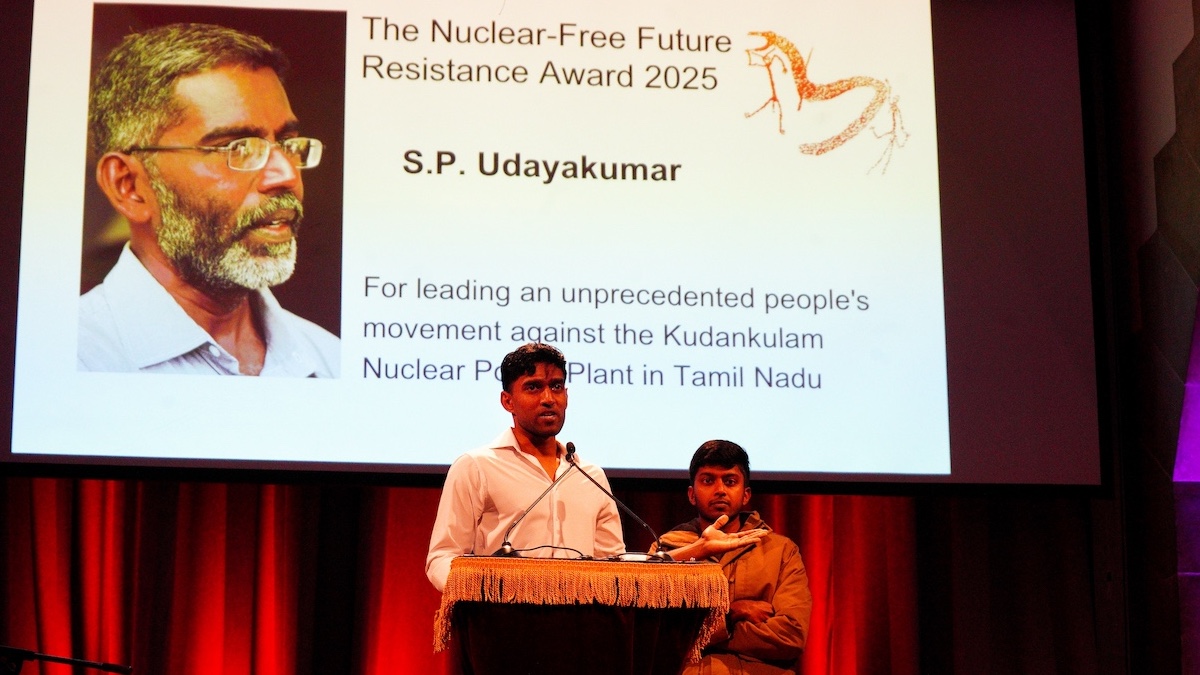
S.P. Udayakumar was awarded the 2025 Nuclear-Free Future Award for resistance. Owing to visa constraints he was not able to be present in New York City, where the Awards ceremony was held, to accept his prize in person. He delivered these remarks via a video recording, which was met with prolonged applause. We reproduce his speech here. (A report and photos of the 2025 Nuclear-Free Future Awards ceremony, was published last week.)
I am extremely happy and immensely grateful that the Nuclear-Free Future Awards family that includes Beyond Nuclear, IPPNW and the international jury have chosen me and our struggle for the 2025 “Nuclear-Free Future” Award in the resistance category.
Tens of thousands of people including children, youth, women and men are struggling against the Russian-supplied Koodankulam Nuclear Power Project near the southernmost tip of India. Several people have sacrificed their lives, scores of people have gone to prison, so many of us have braved police harassment, State surveillance, court cases, property losses, income deprivation, and umpteen number of various difficulties.
Lots and lots of religious leaders, community leaders, political leaders, lawyers, film personalities, intellectuals, writers, publishers, poets, artists, media persons, international human rights activists, even some conscientious government officials, police officers and the general public from all over Tamil Nadu and the larger India have contributed significantly to this 2011-2014 phase of a much longer struggle.
I know that you cannot honor all the people who have taken part in our struggle and that I have been chosen as a representative of all of them. On behalf of all those thousands and thousands of fellow protesters, I humbly accept this great award. Thank you!
Although I am disappointed that I could not be with you all this evening and accept this award in the hall where the ‘Great Emancipator’ President Abraham Lincoln’s voice had once reverberated, I am glad that my sons, who had to undergo so much suffering, are receiving this award from you and celebrating this timely and important recognition of our people and the struggle.
The struggle against the Koodankulam nuclear power project began back in 1988 right after the Chernobyl accident in April 1986. The government of India has adopted the 4-I strategy of Ignore, Insult, Intimidate and Incinerate. We were totally ignored when we asked for the basic information about the project, such as the detailed project report, environmental impact assessment, site evaluation study, safety analysis report etc. When we persisted with our campaign, we were called all kinds of names, that we were anti-Indian, anti-national, foreign-funded, American stooges, left-wing radicals and so forth.
When we still pressed ahead with our campaign, the State came down upon us heavily with 349 cases with very serious charges, including sedition, waging war on the state, attempt to murder and so on. We are attending court hearings even now. Our passports have been impounded, bank accounts frozen, ‘Look Out Circular’ issued, our properties vandalized, and we are still being treated as dangerous criminals.
We were physically attacked when we went for a dialogue with government officials, several of us were imprisoned for months together, and a few of us were shot to death by police, and killed by low-flying coastguard planes, and prison negligence etc.
Because of all this highhanded behavior of the State, the concerted campaign was ended in 2014 but we have been propagating our anti-nuclear messages to the people of India through peaceful and democratic means.
Our messages are simple and straightforward:
Nuclear power is NOT cheap, or safe, or clean, or climate-friendly.
Nuclear power and nuclear bomb are both sides of the same coin. Nuclear reactors are stationary bombs and nuclear bombs are moving reactors.
Nuclear power is not suitable for a country like India that is highly and densely-populated. As you all know, the world’s worst industrial disaster took place in the Union Carbide pesticide plant in Bhopal in December 1984. The debilitating chemical waste of the Bhopal gas disaster has just been removed after 40 long years.
Both nationally and internationally, the nuclear hawks and hawkers promote nuclear power as THE answer for climate destruction. But consider the amount of carbon-emitting power that is used for uranium mining, milling, reactor construction (with thousands of tons of steel and cement over 20-30 years of construction), reactor operation for 40-60 years, decommissioning, waste management and so forth! Can anyone honestly claim that nuclear power is the answer for climate destruction? Even if it was, can poisoned earth be the answer for polluted air? How are we going to deal with the dangerous nuclear wastes for the next 48,000 years?
Nuclearism is part and parcel of profiteering globalism. The India-US nuclear deal is not about India’s energy security, or national security or safeguarding India’s growth and development. This deal is a naked corporate business deal which will bring humongous profits to a few American corporate houses. Similarly, the nuclear deals that India has signed with Russia, France, Kazakhstan, Namibia, Argentina, and others will bring profits and prosperity to these countries’ corporate houses but will result in disaster and destruction for the poor in India. Yes, desire for profit, power, and prominence drives the nuclear industry.
On the other hand, it is hate, fear and recklessness that fuel this very industry. Some countries’ revision of nuclear doctrines, refusal to extend nuclear arms treaties, rising weapons count, continuing Uranium enrichment, constant testing, actual threat to use nuclear bombs, and several wars around the world poised to reach a “nuclear threshold” foretell the precarious situation of our global society today. Yes, Nuclearism and Fascism are inter-related. Fascism is the ideology behind Nuclearism and Nuclearism is the penultimate expression of Fascism.
When all is said and done, this beautiful planet of ours, the Earth, can be likened to a humongous commercial airplane with clear class divisions, limited supply of resources, lopsided opportunity structures, and unbalanced entitlement arrangements, etc. And this plane of ours has been hijacked by the P-5 and the other nuclear States such as Israel, India, Pakistan, North Korea and who knows who else?
The great poet, Robert Frost had predicted back in 1920:
Some say the world will end in fire,
Some say in ice.
From what I’ve tasted of desire
I hold with those who favor fire.
But if it had to perish twice,
I think I know enough of hate
To say that for destruction ice
Is also great
And would suffice.
The delegates of the Third Meeting of States Parties (3MSP) to the Treaty on the Prohibition of Nuclear Weapons (TPNW) who are meeting in New York City right now have a tough task ahead. We wish them all the best!
And let us continue to strive for a nuclear-free future that will have No Deals, No Mines, No Reactors, No Dumps, and No Bombs! Nowhere in the world!!
To quote my favorite Robert Frost again:
Woods are lovely, dark and deep,
But we have promises to keep!
And miles to go before we sleep,
And miles to go before we sleep!
Saudi Arabia, US on ‘pathway’ to civil nuclear agreement, US Energy Secretary says

The United States and Saudi Arabia will sign a preliminary agreement to cooperate over the kingdom’s ambitions to develop a civil nuclear industry, U.S. Energy Secretary Chris Wright told reporters in the Saudi capital
Riyadh on Sunday.
Wright, who had met with Saudi Energy Minister Prince
Abdulaziz bin Salman earlier on Sunday, said Riyadh and Washington were on a “a pathway” to reaching an agreement to work together to develop a Saudi
civil nuclear programme.
Reuters 13th April 2025 https://www.reuters.com/world/saudi-arabia-us-pathway-civil-nuclear-agreement-us-energy-secretary-says-2025-04-13/
California Nuclear Plant Integrates AI for Efficiency
Oil Price By Haley Zaremba – Apr 13, 2025,
- The Diablo Canyon nuclear power plant in California is utilizing AI technology to improve the efficiency of its document retrieval processes, aiming to reduce the time and resources spent on managing technical documentation.
- While the initial use of AI is limited to document retrieval, there are concerns among lawmakers and watchdogs regarding the potential for broader automation and the safety implications within a nuclear setting.
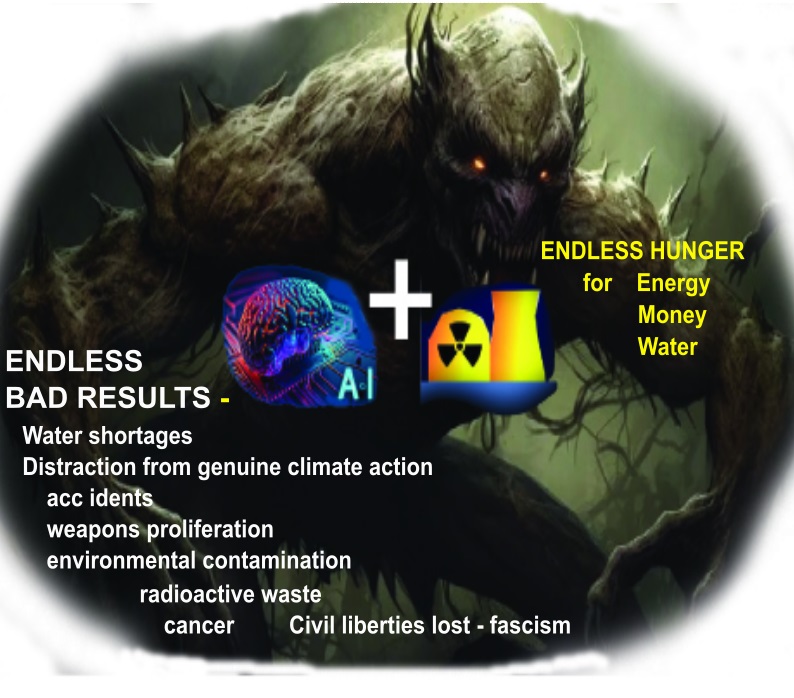
- The convergence of nuclear energy and AI is being driven by the increasing energy demands of data centers, with tech leaders and the federal government exploring the symbiotic relationship between these technologies for future energy solutions.
……………………………………………………………………………………………………………………lawmakers are very concerned about what the introduction of artificial intelligence into nuclear power production could mean for the future, and are pushing for more concrete guardrails. However, under the Trump administration, such parameters may not be forthcoming. Trump has already walked back a Biden-era ??executive order outlining goals for AI regulation, which the current administration sees as anti-innovation.
While there is little risk in the use of AI for document retrieval, there is concern about what comes next.
“The idea that you could just use generative AI for one specific kind of task at the nuclear power plant and then call it a day, I don’t really trust that it would stop there,” Tamara Kneese, the director of tech policy nonprofit Data & Society’s Climate, Technology, and Justice program, was recently quoted by Cal Matters. “And trusting PG&E to safely use generative AI in a nuclear setting is something that is deserving of more scrutiny.”
Nuclear energy and AI have become increasingly entangled as the runaway energy demand growth of data centers has threatened domestic energy security as well as Silicon Valley’s decarbonization goals. Tech bigwigs like Bill Gates and Sam Altman have increasingly touted nuclear energy as a carbon-free solution to meeting AI’s fast-growing energy demand, and have even envisioned a symbiotic relationship between nuclear and AI, wherein machine learning can help plan and design more efficient and cost-effective next-gen power plants.
The federal government has also pushed this angle. The U.S. Department of Energy recently identified 16 federal sites that ??are “uniquely positioned for rapid data center construction, including in-place energy infrastructure with the ability to fast-track permitting for new energy generation such as nuclear.” https://oilprice.com/Alternative-Energy/Nuclear-Power/California-Nuclear-Plant-Integrates-AI-for-Efficiency.html
1 This Month





PLEASE OPPOSE HR 8255 AND S.3639 – bills would accelerate satellite deployment, with no environmental review or safeguards – https://ncstd5li.quorum.us/campaign/169331/
To see nuclear-related stories in greater depth and intensity – go to https://nuclearinformation.wordpress.com
-
Archives
- October 2026 (58)
- September 2026 (339)
- August 2026 (330)
- July 2026 (355)
- June 2026 (287)
- May 2026 (306)
- April 2026 (356)
- March 2026 (251)
- February 2026 (267)
- January 2026 (308)
- December 2025 (358)
- November 2025 (359)
-
Categories
- 1
- 1 NUCLEAR ISSUES
- business and costs
- climate change
- culture and arts
- ENERGY
- environment
- health
- history
- indigenous issues
- Legal
- marketing of nuclear
- media
- opposition to nuclear
- PERSONAL STORIES
- politics
- politics international
- Religion and ethics
- safety
- secrets,lies and civil liberties
- spinbuster
- technology
- Uranium
- wastes
- weapons and war
- Women
- 2 WORLD
- ACTION
- AFRICA
- Atrocities
- AUSTRALIA
- Christina's notes
- Christina's themes
- culture and arts
- Events
- Fuk 2022
- Fuk 2023
- Fukushima 2017
- Fukushima 2018
- fukushima 2019
- Fukushima 2020
- Fukushima 2021
- general
- global warming
- Humour (God we need it)
- Nuclear
- RARE EARTHS
- Reference
- resources – print
- Resources -audiovicual
- Weekly Newsletter
- World
- World Nuclear
- YouTube
-
RSS
Entries RSS
Comments RSS


