Sellafield’s massive water abstraction plan for its new construction work has no environmental impact assessment and inadequate monitoring
Sellafield blithely apply to the Environment Agency for new water abstraction and in the same application admit that they have already contaminated the freshwater aquifer beneath them
Lakes against Nuclear Dump and NFLA , Marianne Birkby, May 07, 2025
Campaigners concerned that Sellafield’s water abstraction plan has no environmental impact assessment and inadequate monitoring
In a recent response to an Environment Agency consultation on a application by Sellafield Limited to extract water to support construction work at the site, campaigners at Lakes against the Nuclear Dump [LAND], a campaign of Radiation Free Lakeland, and the UK/Ireland Nuclear Free Local Authorities have expressed concerns that no environmental impact assessment has been carried out and that plans to monitor contamination in discharges are inadequate.
Sellafield plans to extract an additional 350,000 cubic metres of water a year from the Lake District to support the construction of new facility to repackage radioactive waste, whilst proposing to discharge almost a million litres of contaminated water every day into the River Calder and out into the sea. This for an indefinite and uncertain period.
LAND and the NFLAs are concerned that this will be done without an Environmental Impact Assessment being carried out and with no proper plans in place to monitor the discharged water, adding to fears that the work will lead to yet more radioactive contamination in the already fragile local environment.
Sellafield may believe that the discharges are safe and within legal limits, but the two campaign groups do not subscribe to the view that there is a safe limit when it comes to radiation and in recent years there have been large research studies demonstrating the cumulative effects of low-level, but legal, radiation on human health.
Israel Will Even Persecute Palestinians For Simply Talking To Journalists
Caitlin Johnstone, May 05, 2025, https://www.caitlinjohnst.one/p/israel-will-even-persecute-palestinians?utm_source=post-email-title&publication_id=82124&post_id=162858742&utm_campaign=email-post-title&isFreemail=true&r=1ise1&triedRedirect=true&utm_medium=email
Israeli soldiers have been harassing a Palestinian activist who appeared in Louis Theroux’s recent documentary The Settlers to talk about Israel’s apartheid abuses in the occupied West Bank. Issa Amro shared footage of IDF troops raiding his home over the weekend, days after Theroux’s film debuted on the BBC.
Israelis not only murder journalists, attack journalistic institutions and block journalists from entering the Gaza Strip, they also persecute Palestinian civilians who speak with journalists.
If you haven’t yet watched The Settlers, I highly recommend doing so. It’s so damning that I’ve seen people expressing astonishment that it made it past the BBC’s censors, but really, what’s to censor? It’s an hour of Israelis telling a video camera what Israelis think in their own words.
One of the best ways to tell the truth about the real Israel is to just point a camera at these freaks and let them tell it themselves. Theroux’s interviewing style lends itself particularly well to this type of exposure.
A ship trying to bring humanitarian aid to Gaza was drone bombed by Israel near Malta on Friday. Activist Greta Thunberg was preparing to board the ship to travel with it to its destination.
Which is just wild to think about. Things are so fucked up on this timeline that there is a non-zero probability that Israel ends up assassinating Greta Thunberg.
Imagine the western reaction if Iran had bombed a humanitarian aid ship trying to feed starving civilians.
Imagine the reaction if Chinese forces were caught massacring medical workers in ambulances.
Imagine the reaction if Russia bombed an international humanitarian aid convoy in clearly marked vehicles.
It would be all we’d hear about for weeks.
My social media feeds are filling up with footage of skeletal starving children in Gaza. If we had sane and responsible news media in the west, this would be the lead story in every outlet and publication. But we do not have sane and responsible news media. We have propaganda services disguised as news media.
People who continue to support Israel are only able to do so because they actively avoid watching the video footage the rest of us are watching.
If I built a home and then discovered that it could only remain standing if I constantly massacred children, I would simply change my living arrangements.
I would not claim my building “has a right to exist”.
I would not spend years explaining why my child massacres are okay.
I would not spend decades accusing anyone who criticized my child massacres of unfair discrimination against me and my family.
I would simply change my building so that its existence no longer required me to routinely massacre children. If I could not find a way to restructure my building in this way, I would move.
I would not do this because I am a remarkably kind and special person. I would do it because I am not a psychopath.
Only a psychopath would want to continue living in that kind of building. Only a psychopath would want that kind of building to remain standing.
I said the preceding on Twitter yesterday and Israel apologists immediately came in yelling at me for saying evil things about Israel, but what’s funny is that I never mentioned Israel once; I just talked about a building. They only knew I was actually talking about Israel because of all the stuff I said about constantly massacring civilians.
Gets ’em every time.
❖
It’s good that Trump’s “MAGA” base opposes war with Iran so forcefully, but it’s pretty revealing how absent they’ve been on Trump’s butchery in Yemen and Gaza. They’re not opposed to war or mass murder, they’re just opposed to fighting people who are strong enough to fight back.
Who are Britain Remade?

Britain Remade is a Tory think-tank and lobby group campaigning on behalf of nuclear power.
By Mike Small, https://bellacaledonia.org.uk/2025/05/01/who-are-britain-remade/
There’s a concerted attempt to attack Scotland’s long-standing commitment to no new nuclear power, alongside a full-scale assault on the idea of Net Zero, and the very basics of climate policy (however inadequate mainstream policy is).
This is being led by Nigel Farage who has called Net Zero ‘the New Brexit’, whatever that means. All this has been echoed by Tony Blair’s intervention this week where he argued that any attempt to limit fossil fuels in the short term or encourages people to limit consumption is “doomed to fail”. Alongside this we can see Scottish Labour’s recent commitment to the cause of new nuclear power in Scotland.
Today The Scotsman ran with a front-page splash all about how ‘SNP voters back nuclear power’ by Deputy Political Editor David Bol and Alexander Brown.
he article was replete with quotes from Labour MSP for East Lothian, Martin Whitfield, Scottish Conservative MP, John Lamont, who said the Scottish Government embracing nuclear power would be “basic common sense”. Then there’s a quote from Sam Richards, founder and campaign director for Britain Remade, who, it turns out commissioned the poll and was also enthusiastically pro-nuclear.
What The Scotsman didn’t explain though, was who ‘Britain Remade’ are? They’re presented as if they’re maybe pollsters or some independent think-tank.
But Britain Remade is a Tory think-tank and lobby group campaigning on behalf of nuclear power. Jason Brown is Head of Communications for Britain Remade, a former No. 10 media Special Adviser and Ben Houchen’s comms Adviser.
Jeremy Driver is the Head of Campaigns at Britain Remade, a former Lloyds Banker and Parliamentary Assistant to Ann Soubry. Sam Dumitriu is Head of Policy at Britain Remade who formerly worked at the Adam Smith Institute. These are Tory SPADS working on their own campaign to support new nuclear in Scotland: Lift The Ban On New Scottish Nuclear Power.
Britain Remade claimed they are not affiliated: “We’re an independent grassroots organisation. We are not affiliated with, or part of, any political party” their website says. They may not be officially affiliated to any party, but it’s very clear where their politics (and their staff) come from.
So here we have the Scotsman giving over its front-page to a Tory lobby group to promote their campaign. On the same day they published a similar piece in the Telegraph “SNP’s ‘senseless’ nuclear ban ‘damaging Scotland’” so it’s really working for them.
This is not just a question of client journalism, it’s a question of how far right-wing forces, often working with dark money, will attempt to derail even the most modest (and completely inadequate) environmental policies. Quite why Saudi-funded Tony Blair should jump on the anti Net Zero bandwagon is anybody’s guess, but it’s quite clear there is a coordinated pro-nuclear lobbying group in action in Scotland that pans across the Conservatives and Labour parties, and is supported by astroturf groups and pliant media friends. Watch this space for more on the new nuclear lobby.
Durbin successor must not be co opted by the Israel Lobby.
Walt Zlotow, West Suburban Peace Coalition, Glen Ellyn IL 5 May 25
My outgoing senator Dick Durbin spent his entire 29 year Senate career beholding to the Israel Lobby. In the past 25 years alone he’s received $1,131,900 in campaign cash to ignore Israel’s ethnic cleansing of Palestinians in Gaza, transformed into genocide after the October 7, 2023 Hamas attack. His support for a 2 state solution (Palestinian statehood) is worthless virtue signaling as he’s done nothing of substance to achieve that goal along with making America the 148th nation out of 193 to recognize Palestinian statehood.
We need to replace Durbin with a principled candidate not ensnared by Israel Lobby money. Alas, the 5 Illinois House members mentioned as possible successors are all in the tank to remain mum on truly promoting Palestinian statehood and seeking end to US enabling Israel’s genocidal ethnic cleansing of 2,300,000 Palestinians in Gaza.
Raja Krishnamoorthi (D-IL 8) $269,530
Nikki Budzinski (D-IL 13) $187660
Darin LaHood (R-IL 16) $112,687
Robin Kelly (D-IL 2) $187,272
Lauren Underwood (D-IL 14) $ 75,593,
Tho not mentioned as a possible candidate, we of peace should encourage Congresswoman Delia Ramirez (D-IL 3) to seek Durbin’s open seat next year.
Her take from the Israel Lobby since her election in November 2022? Zero, nada, zilch.
That allowed Ramirez to push back against US billions funding the Israeli genocide, saying this in March, 2024: “The death toll in Gaza continues to rise. Gazans are starving. Over 1.5 million people have been displaced. Hostilities between the U.S. and Iran are escalating. And just this morning, The New York Times reported that one-fifth of the hostages still in captivity since the start of the conflict have likely died. We must change course. Under no circumstances could I have voted for today’s H.R. 7217 to provide $17.6 billion in unconditioned military funding for Israel. The supplemental funding proposed, which includes no humanitarian aid for Gaza, supports weapons of war and destruction that further jeopardize Israeli hostages and Palestinian civilians. Each U.S.-made or funded bomb dropped in Gaza further jeopardizes the chances of long-lasting peace for Israelis and Palestinians. I’ve said it before, and I’ll say it now: I will only support actions that bring us closer to peace.”
Come on Krishnamoorthi, Budzinski, LaHood, Kelly, Underwood, either drop accepting Israel Lobby money to ignore the genocidal ethnic cleaning of Gaza, or drop any consideration of replacing the Lobby’s million dollar Senator Dick Durbin.
‘Sitting ducks’: the cities most vulnerable to climate disasters.

Extreme weather means wildfires and flooding are becoming more likely,
posing a risk to urban areas around the world. Kostas Lagouvardos and his
colleagues at the Penteli Observatory, which offers sweeping views of
Athens, are what you would call experts on wildfires. They have spent
decades researching the link between meteorological conditions and deadly
infernos, as well as tackling the challenge of forecasting when and where
the disasters might happen.
But even they were caught off-guard by the
wildfire that arrived at their door last August. “It was ironic,” says
Lagouvardos, research director at the Institute for Environmental Research
and Sustainable Development at the National Observatory of Athens. The
Penteli site, which forms part of the NOA and is home to the historic
Newall refractor telescope, was almost engulfed by a blaze that spread from
nearby Mount Pentelicus. Flames whipped around the grounds, coming within
metres of the astronomy tower and other buildings, as helicopters dropped
water from above and firefighters below battled to save the crucial
scientific site. The observatory buildings were spared, but its nearest
neighbour was badly damaged, as were many other buildings in the area. One
person died.
The fact that a wildfire came so close to the very building
where scientists had long attempted to understand the phenomenon highlights
the key challenges for cities around the world as extreme weather
intensifies. Not only are wildfires becoming more common, they are
difficult to predict and are spreading ever closer to densely populated
urban areas. Just last week, Israel’s Prime Minister Benjamin Netanyahu
warned that wildfires in the country were at risk of reaching Jerusalem.
Athens, like other big cities including Dallas, Lisbon, Sydney and Cape
Town, are what some scientists refer to as “sitting ducks”. In these
places, the climate and geographical conditions mean they are extremely
vulnerable to global warming-related disasters.
This could be wildfires,
like those in Los Angeles in January, but also flooding, as seen in
Valencia last year. In some cases, one can follow the other. These
so-called sitting ducks “haven’t had an extreme event” so far, says
Erin Coughlan de Perez, a professor at Tufts University, an expert in
climate risk. “They’ve got lucky.” But the odds might be against
them.
With 2025 expected to be one of the hottest on record, despite a
cooling La Niña weather phenomenon earlier this year, scientists warn of a
rising risk of climate-related disasters. Climate change is causing a rise
in extreme heat, which helps fuel wildfires, while hotter temperatures can
also lead to more intense rainfall and flooding, because warmer air holds
more moisture.
FT 5th May 2025,
https://www.ft.com/content/57835a0c-9e58-4c1a-9c5a-f6a4cbe3f748
As Israelis Blockade Food to Gaza, 9,000 Children have been Admitted for Acute Malnutrition.

Juan Cole, 05/04/2025, https://www.juancole.com/2025/05/israelis-blockade-malnutrition.html
Ann Arbor (Informed Comment) – UNICEF Executive Director Catherine Russell said Friday that “malnutrition is … on the rise. More than 9,000 children have been admitted for treatment of acute malnutrition since the beginning of the year.”
At least 10 NGO aid kitchens have closed in recent weeks for lack of food, and 25 UN bakeries haven’t been operational for a month. The Israeli military has for two months been committing a war crime in preventing shipments of food from entering Gaza.
Meanwhile, a medical source in Gaza told the Anadolu Agency that on Saturday, a child “died from malnutrition and dehydration at Al-Rantisi Children’s Hospital in Gaza City.” Gaza medical authorities have documented 57 deaths from malnutrition in Gaza during the current conflict.
UNICEF says that over 75% of households in Gaza have reported declining access to water. Russell explained that many families with children have to choose between drinking, bathing and cooking.
Because of the lack of clean water, Russell explained, “acute watery diarrhea … now accounts for 1 in every 4 cases of disease recorded in Gaza. Most of these cases are among children under five, for whom it is life-threatening.”
UNICEF’s Russell said, “For two months, children in the Gaza Strip have faced relentless bombardments while being deprived of essential goods, services and lifesaving care. With each passing day of the aid blockade, they face the growing risk of starvation, illness and death – nothing can justify this.”
The UN Office for the Coordination of Humanitarian Affairs said in its weekly report on Gaza on Wednesday that “On 25 April, the World Food Programme (WPF) reported that its food stocks in Gaza have been depleted, as the agency delivered its last remaining supplies to kitchens preparing hot meals. WFP additionally highlighted the impact of deteriorating nutrition on vulnerable groups, including children under five, pregnant and breastfeeding women, and the elderly, warning that the situation has again reached ‘a breaking point.’”
OCHA added that “between 18 March and 27 April, the UN Human Rights Office (OHCHR) recorded 259 attacks on residential buildings and 99 on IDP tents. Most of the attacks resulted in fatalities, including of women and children. Among the strikes on IDP tents, 40 reportedly took place in Al Mawasi area, in Khan Younis, where the Israeli army repeatedly directed civilians to seek refuge.”
Over 400 Palestinians seem to be being killed each week by Israeli bombardment of the Gaza Strip, the vast majority women and children. Thousands have been wounded in the two months since the government of Benjamin Netanyahu breached the January ceasefire.
OCHA writes, “On 27 April, at about 20:10, 13 Palestinians, including a woman and her six children, were reportedly killed and others injured when a residential building was hit in southern Khan Younis. On 28 April, at about 00:30, 10 Palestinians, including at least three children, were reportedly killed and others, including a seven-year-old girl, were injured when a residential building was hit in Al Fakhoura area, west of Jabalya refugee camp, in North Gaza. On 28 April, at about 00:30, 10 Palestinians were reportedly killed and others injured when a residential building was hit in Al Karmah area in northwestern Gaza city.”
Israeli forces have been firing on Palestinian fishing boats, as fishermen desperately attempt to bring in some protein for their families.
Dispatch from France | May ’25

Clean Energy Wire, 02 May 2025, Camille Lafrance
Against the backdrop of the major blackout on the Iberian Peninsula in late April, which also affected parts of France, the country is heading for controversial discussions about its energy strategy for the coming decade. A focus will be on the future roles of renewables and nuclear power. The launch of France’s new generation of nuclear power plants was postponed for several years, while the country’s older reactors continue to cause problems.
- Delay to new generation of nuclear power plants – France’s new generation of nuclear power plants (known as EPR2) is set to go online three years later than previously planned. It is now meant to become operational by 2038, instead of 2035. EPR2 reactors are supposed to be simpler and cheaper to build. The EPR2 programme will be financed by a government loan, which should cover at least half the construction costs. EDF has called for more state money in order to reign in debt.
- Uranium supply and diplomacy – France could lose a large part of its uranium stockpile in Niger as that country’s hostile military leadership might sell it to Russia or China. The mine was operated by French state-owned uranium company Orano’s local subsidiary until the end of 2024. France is entirely dependent on uranium imports. In response, state-owned uranium company Orano is planning to mine the raw material needed for France’s fleet of 57 nuclear reactors in Uzbekistan………………………..
- The Flamanville saga continues – A new malfunction at the controversial Flamanville nuclear power plant has reignited a debate about the future of France’s ageing fleet of nuclear reactors. One of its reactors suffered a steam leak in late March. The incident occurred just one week after the reactor returned to the grid following a two-month maintenance shutdown. The plant already has a twelve-year history of delays and a ballooning budget (from 3.3 billion to 13.2 billion euros)………………………………….. https://www.cleanenergywire.org/news/dispatch-france-may-25
The Challenge to Japan’s Nuclear Restart

The story of Japan’s nuclear village should serve as a
cautionary tale for other places engaged in debates on nuclear energy.
Nuclear power is a key plank in Japan’s national energy vision, but 14 years after the Fukushima meltdown, the restart process hasn’t overcome the central problem.
By Zhuoran Li, May 03, 2025
The restart of nuclear power plants is based on the Sixth Basic Energy
Plan, approved by the Cabinet in October 2021. Given that the trauma of the
2011 Fukushima nuclear disaster remains vivid in the public consciousness,
the government has adopted a cautious, step-by-step approach. The
reactivation of reactors must first be approved by the Nuclear Regulation
Authority under the new regulatory standards. Subsequently, the restart can
proceed only with the consent of local governments and residents.
The government hopes that its safety-first approach will reassure local
communities and alleviate their concerns about nuclear energy. In addition,
efforts are underway to develop and construct next-generation innovative
reactors. These include plans to replace decommissioned nuclear plants with
advanced models, contingent on securing local support.
While maintaining the effective 60-year operational limit, the government is also promoting a policy that excludes certain shutdown periods from being counted toward
that limit. The story of Japan’s nuclear village should serve as a
cautionary tale for other places engaged in debates on nuclear energy. For
example, Taiwan faces many of the same trade-offs as Japan. On one hand,
Taiwan is an energy importer with a vulnerable supply. On the other hand,
it is prone to earthquakes. As a result, nuclear energy has become a
central political debate.
The Diplomat 3rd May 2025,
https://thediplomat.com/2025/05/the-challenge-to-japans-nuclear-restart/
Shut down Elbit Systems everywhere!
Bruce K. Gagnon, Organizing Notes, May 03, 2025
Elbit Systems is an Israeli military corporation making weapons for its current multiple wars as the zionists attempt to build ‘Greater Israel’ and take over the region from indigenous populations.
They are the world’s leading terrorists.
Elbit builds weapon production plants in nations around the globe in order to ‘buy support’ for its colonizing agenda.
Check around and you will likely find one near your community.
Congrats to the movement in Boston for forcing MIT, thru organizing pressure, to cut links with Elbit. Activists in the UK have shut down a couple Elbit facilities and forced some of their other corporate links to be severed such as with insurance companies and the like.
The Elbit facility in nearby Merrimack, New Hampshire has also drawn important protests in recent years. I was involved in one where I got arrested for serving as the police liaison. ……………………………………… https://space4peace.blogspot.com/2025/05/shut-down-elbit-systems-everywhere.html?utm_source=substack&utm_medium=email
US-Ukraine minerals deal ‘hides secret agreements’ – Ukrainian MP
2 May 25 https://www.rt.com/news/616662-ukraine-us-deal-secret-agreements/
Separate provisions outline Kiev’s “indefinite obligations” and bypass parliamentary ratification, Irina Gerashchenko has claimed.
The US-Ukraine minerals agreement announced this week “hides” details of Kiev’s “indefinite obligations” to Washington, a Ukrainian lawmaker has claimed.
In a Facebook post on Friday, Irina Gerashchenko, a member of European Solidarity party said the deal includes two “secret,” supplementary documents that will not be subject to parliamentary ratification.
The minerals deal reportedly grants the US preferential access to Ukrainian mining projects in exchange for assistance with an investment fund to support the country’s reconstruction. Initially portrayed by Washington as repayment forbears of military support – estimated at $350 billion by President Donald Trump – the final text, published on Thursday by the Ukrainian government, states that only future aid will count toward US contributions to the fund.
Gerashchenko claimed however that instead of one agreement, the US and Ukraine signed three.
“The Zelensky government has not provided deputies and society with all the agreements signed in the US, which, as it turned out, are three, not one,” she wrote. “Meanwhile, they want to ratify only one framework document in the Verkhovna Rada. Others are labeled ‘implementation documents,’ despite the fact that it is in these two secret agreements that all the technical details of indefinite Ukrainian obligations are hidden.”
Ukrainian Prime Minister Denis Shmigal “avoided” commenting on the two documents and the lack of security guarantees in the published agreement – reportedly a key point of contention during negotiations – Gerashchenko told the country’s parliament on Friday.
The claim has raised questions among Ukrainian lawmakers and the public on the actual scope of the agreement. MP Yaroslav Zheleznyak claimed on Telegram that, when pressed, Shmigal acknowledged the two additional documents but downplayed them as “technical” and exempt from ratification. The texts “must be signed after the ratification” of the main agreement, Shmigal claimed, noting that lawmakers would see them when the Ukrainian negotiating team returns from the US next week.
Western media reports have also noted the existence of additional documents and claimed that a last-minute dispute arose when Washington demanded Kiev sign all three. Ukrainian officials reportedly argued they could not sign the annexes until the main agreement was ratified in Parliament. Later reports suggested all three documents were ultimately signed.
Further details about the contents of the supplementary documents have not been publicly released, and the Ukrainian government has not issued an official statement addressing their existence or content.
Need to use nuclear weapons has not arisen in Ukraine, says Putin

Russian leader says he hopes nuclear strikes ‘will not be required’ in state TV film about his 25 years in power.
Angelique Chrisafis and agencies, 5 May 25, https://www.theguardian.com/world/2025/may/04/need-to-use-use-nuclear-weapons-has-not-arisen-in-ukraine-says-putin
The Russian president, Vladimir Putin, said in comments broadcast on Sunday said that the need to use nuclear weapons in Ukraine had not arisen, and that he hoped it would not.
Speaking in a film by Russian state television about his 25 years in power, Putin said that Russia has the strength and the means to bring the conflict in Ukraine to what he called a “logical conclusion”.
Responding to a question from a state television reporter about Ukrainian strikes on Russia, Putin said: “There has been no need to use those [nuclear] weapons … and I hope they will not be required.”
Fear of nuclear escalation has been a factor in US officials’ thinking since Russia invaded Ukraine in early 2022. The former CIA director William Burns has said there was a real risk in late 2022 that Russia could use nuclear weapons against Ukraine.
In autumn 2022, the US was so concerned about the possible use of tactical nuclear weapons by Russia that it warned Putin over the consequences of using such weapons, Burns has said. At the same time, the Chinese leader Xi Jinping also warned Putin not to resort to nuclear weapons.
Putin signed a revamped version of Russia’s nuclear doctrine in November 2024, spelling out the circumstances that allow him to use Moscow’s atomic arsenal, the world’s largest. That version lowered the bar, giving him the option of using nuclear weapons in response to even a conventional attack backed by a nuclear power.
The US president, Donald Trump, has said he wants to end the conflict via diplomatic means, raising the question of whether Putin was willing to negotiate a peace settlement. But the Kremlin has rejected calls by Kyiv and Washington for an unconditional 30-day ceasefire.
Putin, in February 2022, ordered tens of thousands of Russian troops to invade Ukraine. Moscow’s forces now control about 20% of Ukraine, including parts of the south and east.
In the carefully choreographed state television film, Putin was shown in his private Kremlin kitchen offering chocolates and a fermented Russian milk drink to the Kremlin correspondent, Pavel Zarubin.
Putin, a former KGB lieutenant colonel who was handed the presidency on the last day of 1999 by an ailing Boris Yeltsin, is the longest serving Kremlin leader since Joseph Stalin, who ruled for 29 years until his death in 1953.
How bloody conflict 4,000 miles away could spark nuclear Armageddon killing billions
The “Army of the Righteous” terror group has been accused of slaughtering 22 Indian tourists holidaying in the Baisaran valley – which is pushing India and Pakistan to the brink of conflict
12:23, 02 May 2025, Ryan Fahey News Reporter, https://www.mirror.co.uk/news/world-news/how-bloody-conflict-4000-miles-35158973
While the West is focused on how close Vladimir Putin is to pushing the red button, the real threat of Armageddon could be brewing in South Asia.
In April, suspected Islamist Pakistani militants shot dead 22 Indian tourists holidaying in the Baisaran valley, which is now pushing India and Pakistan – both nuclear-armed countries – to the brink of a nuclear confrontation. The gunmen are said to have prowled through the group of tourists, picking off any individual unable to recite Islamic verses. It’s being viewed by Indians as the worst massacre since the 2008 Mumbai bombings.
India’s security services are also being blamed for failing to realise the looming threat as the public outcry for retribution continues to grow. Indian national identity and foreign policy expert Dr Manali Kumar said the relations between the two countries are at a critically low point and “just short of war”. However, any overt acts of war would see a swift response from Pakistan, which would likely push the two sides into an escalating conflict that would be impossible to reverse once started.
India has an active army of 1.2million, with an additional 250,000 individuals split between the navy and air force, while Pakistan has less than 700,000 – but experts believe the two sides are far more evenly matched than it would seem.
Defence experts say that Pakistan could still “inflict significant damage and cause massive casualties”, according to the MailOnline.
Where the most concerning comparison comes is when looking at the nuclear arsenals of each country. Both Pakistan and India are understood to have around 170 warheads heads each, according to the Arms Control Association. While India has agreed to a “no first use” nuclear pact”, Pakistan does not adhere to the same moral restriction.
And if the apocalypse did happen in South Asia, 125 million people would be dead in a matter of days, researchers warned back in 2019.
India has accused Pakistani nationals – said to be members of the same “Army of the Righteous” terror group responsible for Mumbai – of carrying out the April 22 killing spree. Pakistan has denied involvement, and has already warned it would respond to any military aggression on the basis of “baseless and concocted allegations”.
The reason India has conflated the Pakistani government with the terror group is that they are said to have links to Pakistan’s Inter-Services-Intelligence (ISI) agency.
In the Bulletin of Atomic Scientists in 2019, researchers said that there would be “tens of millions” of immediate victims if a nuke was launched in South Asia. It would have devastating environmental impacts, causing famines that could affect billions of people across the world.
“The direct effects of this nuclear exchange would be horrible; the authors estimate that 50 to 125 million people would die, depending on whether the weapons used had yields of 15, 50, or 100 kilotons,” the article read.
“The ramifications for Indian and Pakistani society would be major and long-lasting, with many major cities largely destroyed and uninhabitable.
“Smoke and radioactive particles would ‘spread globally within weeks… cooling the global surface, reducing precipitation and threatening mass starvation.”
Israel Bombs Humanitarian Aid Flotilla on Way to Gaza
A similar aid convoy was attacked by Tel Aviv in 2010, killing 10 people and injuring dozens more.
by Will Porter May 2, 2025 , https://news.antiwar.com/2025/05/02/israel-bombs-humanitarian-aid-flotilla-on-way-to-gaza/
A ship carrying supplies bound for the Gaza Strip was attacked by Israeli drones in international waters on Friday, according to the activist group that organized the flotilla. The vessel reportedly took at least one direct hit to its hull and sustained damage from fire, forcing its crew to issue an urgent call for help.
Organizers with the Freedom Flotilla Coalition (FFC) said one of their vessels was attacked by an unidentified drone in the early hours of Friday morning, noting the ship was not far off the coast of Malta when it was hit.
“At 00:23 Maltese time, the Conscience, a Freedom Flotilla Coalition ship, came under direct attack in international waters,” the group said in a press release. “Armed drones attacked the front of an unarmed civilian vessel twice, causing a fire and a substantial breach in the hull. [. . .] The drone strike appears to have deliberately targeted the ship’s generator, leaving the crew without power and placing the vessel at great risk of sinking.”
An FFC spokesperson, Caoimhe Butterly, later told Reuters that the ship was struck en route to Malta, where it was scheduled to pick up other activists, among them climate campaigner Greta Thunberg and retired US Army Colonel Mary Ann Wright. The group said it had arranged the aid shipment “under a media black out to avoid any potential sabotage.”
The FFC also shared footage which allegedly shows the aftermath of the strike, with smoke and flames seen on the ship. At one point in the brief video, an apparent explosion can be heard.
In a second press release, the group later shared a photo of the damage sustained in the strike.
Maltese authorities said they received an SOS call from a vessel in international waters soon after midnight local time, adding that a nearby tugboat assisted the ship, according to Reuters. Officials added that the crew of the Conscience declined to board the tugboat, and also confirmed to CNN that the fire on the ship had been extinguished. No casualties have been reported in the attack.
The FFC press release added that “Israeli ambassadors must be summoned and answer to violations of international law, including the ongoing blockade [on Gaza] and the bombing of our civilian vessel in international waters.”
In a social media post early on Friday, the United Nations special rapporteur on the occupied Palestinian territories, Francesca Albanese, said she “received a distressed call from the people of the Freedom Flotilla that is carrying essential food and medicine to the starving Gaza population.”
“I call on concerned state authorities, including maritime authorities, to support the ship and its crew as needed. I trust the competent authorities will also ascertain the facts and intervene appropriately,” she added.
The Israeli military has yet to comment on the incident, but said it was looking into reports about the attack, according to the BBC. Israel’s Foreign Ministry did not immediately respond to a request for comment by Reuters.
The FFC mission aimed to bring supplies to Gaza some two months into a heightened blockade by Tel Aviv, whose forces have leveled much of the territory in air and ground operations in response to Hamas’ October 7, 2023 attack on Israel. On Friday, the International Committee of the Red Cross said aid operations in Gaza were on the verge of “total collapse” thanks to the blockade.
In 2010, a similar humanitarian aid flotilla organized by the Free Gaza Movement and the Foundation for Human Rights and Freedoms and Humanitarian Relief, a Turkish org, was attacked by Israeli forces in international waters. Nine people were killed in the assault, with another later dying of their injuries, while dozens more were wounded. A UN report later found that all 10 activists had sustained gunshot wounds, and added that “the circumstances of the killing of at least six of the passengers were in a manner consistent with an extra-legal, arbitrary and summary execution.”
Will Porter is assistant news editor and book editor at the Libertarian Institute, and a regular contributor at Antiwar.com. Find more of his work at Consortium News and ZeroHedge.
Senator Strangelove
Like the ghost of Armageddon Future, former Senator Jon Kyl keeps reappearing in nuclear debates, writes William Hartung
A primary responsibility of the government is, of course, to keep us safe. Given that obligation, you might think that the Washington establishment would be hard at work trying to prevent the ultimate catastrophe—a nuclear war. But you would be wrong.
A small, hardworking contingent of elected officials is indeed trying to roll back the nuclear arms race and make it harder for such world-ending weaponry ever to be used again, including stalwarts like Sen. Ed Markey (D-Mass.), Rep. John Garamendi (D-Calif.), and other members of the Congressional Nuclear Weapons and Arms Control Working Group. But they face ever stiffer headwinds from a resurgent network of nuclear hawks who want to build more kinds of nuclear weapons and ever more of them. And mind you, that would all be in addition to the Pentagon’s current plans for spending up to $2 trillion over the next three decades to create a whole new generation of nuclear weapons, stoking a dangerous new nuclear arms race.
There are many drivers of this push for a larger, more dangerous arsenal—from the misguided notion that more nuclear weapons will make us safer to an entrenched network of companies, governmental institutions, members of Congress, and policy pundits who will profit (directly or indirectly) from an accelerated nuclear arms race. One indicator of the current state of affairs is the resurgence of former Arizona Sen. Jon Kyl, who spent 18 years in Congress opposing even the most modest efforts to control nuclear weapons before he went on to work as a lobbyist and policy advocate for the nuclear weapons complex.
His continuing prominence in debates over nuclear policy—evidenced most recently by his position as vice chair of a congressionally appointed commission that sought to legitimize an across-the-board nuclear buildup—is a testament to our historical amnesia about the risks posed by nuclear weapons.
Senator Strangelove
Republican Jon Kyl was elected to the Senate from Arizona in 1995 and served in that body until 2013, plus a brief stint in late 2018 to fill out the term of the late Sen. John McCain.
One of Kyl’s signature accomplishments in his early years in office was his role in lobbying fellow Republican senators to vote against ratifying the Comprehensive Test Ban Treaty (CTBT), which went down to a 51 to 48 Senate defeat in October 1999. That treaty banned explosive nuclear testing and included monitoring and verification procedures meant to ensure that its members met their obligations. Had it been widely adopted, it might have slowed the spread of nuclear weapons, now possessed by nine countries, and prevented a return to the days when aboveground testing spread cancer-causing radiation to downwind communities.
The defeat of the CTBT marked the beginning of a decades-long process of dismantling the global nuclear arms control system, launched by the December 2001 withdrawal of President George W. Bush’s administration from the Nixon-era Anti-Ballistic Missile (ABM) treaty. That treaty was designed to prevent a “defense-offense” nuclear arms race in which one side’s pursuit of anti-missile defenses sparks the other side to build more—and ever more capable—nuclear-armed missiles. James Acton of the Carnegie Endowment for International Peace called the withdrawal from the ABM Treaty an “epic mistake” that fueled a new nuclear arms race. Kyl argued otherwise, claiming the withdrawal removed “a straitjacket from our national security.”
The end of the ABM treaty created the worst of both worlds—an incentive for adversaries to build up their nuclear arsenals coupled with an abject failure to develop weaponry that could actually defend the United States in the event of a real-world nuclear attack………………………………………………………………………………………………………………………………………………………………………………………………….
There is another way. Even as Washington, Moscow, and Beijing continue the production of a new generation of nuclear weapons—such weaponry is also possessed by France, India, Israel, North Korea, Pakistan, and the United Kingdom—a growing number of nations have gone on record against any further nuclear arms race and in favor of eliminating such weapons altogether. In fact, the Treaty for the Prohibition of Nuclear Weapons has now been ratified by 73 countries.
As Beatrice Fihn, former director of the Nobel-prize-winning International Campaign to Abolish Nuclear Weapons, or ICAN, pointed out in a recent essay in The New York Times, there are numerous examples of how collective action has transformed “seemingly impossible situations.” She cited the impact of the antinuclear movement of the 1980s in reversing a superpower nuclear arms race and setting the stage for sharp reductions in the numbers of such weapons, as well as a successful international effort to bring the nuclear ban treaty into existence. She noted that a crucial first step in bringing the potentially catastrophic nuclear arms race under control would involve changing the way we talk about such weapons, especially debunking the myth that they are somehow “magical tools” that make us all more secure. She also emphasized the importance of driving home that this planet’s growing nuclear arsenals are evidence that all too many of those in power are acquiescing in a reckless strategy “based on threatening to commit global collective suicide.”
The next few years will be crucial in determining whether ever growing numbers of nuclear weapons remain entrenched in this country’s budgets and its global strategy for decades to come or whether common sense can carry the day and spark the reduction and eventual elimination of such instruments of mass devastation. A vigorous public debate on the risks of an accelerated nuclear arms race would be a necessary first step toward pulling the world back from the brink of Armageddon.
William D. Hartung is a Senior Research Fellow at the Quincy Institute for Responsible Statecraft, and the author most recently of “Pathways to Pentagon Spending Reductions: Removing the Obstacles.” This article first appeared on Tom Dispatch and on Common Dreams, whose content is available through a Creative Commons license. https://beyondnuclearinternational.org/2025/05/04/senator-strangelove/
Scotland does not need nuclear power and people aren’t being told the truth
Commonweal 1st May 2025,
https://www.commonweal.scot/daily-briefings/briefing-r57be
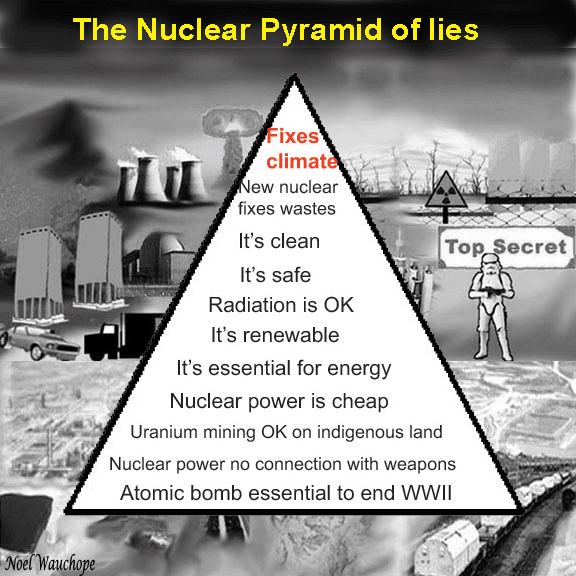
The nuclear industry has one of the most aggressive lobbying and public relations campaigns of all energy sources. It pushes relentlessly on politicians and the public to support the merits of nuclear power based on partial or inaccurate information. Very often this goes unchallenged in the Scottish media.
Given that nuclear power presents itself as a pragmatic response to decarbonising energy and given the scale of the PR campaign, it is perhaps not enormously surprising that SNP voters appear to split with their party over this issue. But would they continue to support nuclear power if they knew the numbers?
Here are some stark realities. The cost of generating of electricity from renewable sources is £38 to £44 per MWh. The estimated cost of the same electricity from nuclear (at the new Hinkley Point C reactor) in 2025 is £150 per MWh. It can only be presumed that the participants in this survey were not told that generating electricity would become between three times as expensive with nuclear.
But even that hides the true costs. Nuclear power is very dangerous and, at the end of its lifecycle, is very complex to decommission and make safe. Every spent rod of nuclear fuel takes a full ten years simply to cool down. They must be immersed in a deep pool of cold, constantly-circulating water and monitored closely for ten years just to bring them down to a cool enough temperature that they can be processed.
That’s just the ongoing fuel. The complexity of decommissioning and entire nuclear power plant is significantly greater. In fact the current estimate of the cost for decommissioning nuclear power is about £132 billion. That is not paid for by consumers in their electricity bill – it is paid for by consumers through their tax.
This is the second stark reality that nuclear power works hard to conceal; not only is it three times as expensive as renewables to run, there is then a cost of at least £4,600 for every household to decommission the nuclear power plants and make them safe for the future.
Of course, safety is another issue here. Nuclear power stations are very vulnerable. They are extremely sensitive sites which require substantial long-term attention. There are currently concerns around the world that unreliable power supplies could mean existing plants may struggle to keep spent fuel rods from combusting if they cannot constantly and continually keep large amounts of cold water circulating round spent fuel.
Nuclear power stations do not like loss of electricity, especially for any extended period of time. This makes them very climate-vulnerable. And of course who knows what sorts of extreme weather we may face before the lifetime of a nuclear station is complete. Fukushima is not a cautionary tale for no reason.
And it is uncomfortable to dwell on the risks of nuclear sites if they become targets for terrorism or in war. No-one is expressing continent-wide anxiety over the threat-to-life status of Ukraine’s wind turbines; they absolutely are over the shelling of Ukrainian nuclear power stations.
The remaining case for nuclear is to provide ‘electricity baseline’ – the ability to bring electricity provision on and off line as renewable generation rates rise or fall (if the wind does blow), or during periods of peak demand. This just isn’t really honest – nuclear power does not like rapid changes in supply and are designed to run flat out, all the time, not least because costs rise rapidly if they are running at less then full power. You can’t just ‘turn them on and off’. So yes, they can provide baseline electricity but not ‘on demand’ electricity that can balance renewables.
Hydrogen storage can though. Scotland currently dumps enormous amounts of perfectly useable electricity in the ground if it is generated when there is no demand. This can be turned into hydrogen and then, on demand, converted back into electricity. At the moment the cost of electricity from hydrogen is about half as much again that of generating by nuclear. But there are big caveats to that.
First, the current hydrogen electricity price is about £230 per MWh, but this is a rapidly-developing area of technology and the current industry target is £100 per MWh. That makes it cheaper than nuclear. Second, there is no hidden capital cost – the incredible costs of building and decommissioning nuclear which are hidden from consumers by subsidy from tax just isn’t there for hydrogen. It is a simple technology.
Third, these costs all assume that you are generating hydrogen from electricity at full wholesale grid prices. But if you are using electricity that would otherwise be dumped because it is being generated at the ‘wrong time’, the hydrogen becomes a waste product. It is in practice much cheaper than nuclear and can supply long-term baseline. (Battery storage for short term is even cheaper.)
That is the reality that respondents in this poll were not given. Try the poll again with ‘do you want to pay three times as much for your electricity with an additional costs to your household of £4,600 to have unsafe nuclear power when renewables with hydrogen storage are cleaner, cheaper and safer’.
Consistent, reliable renewable energy isn’t hard to solve in Scotland. There are nations where nuclear may have to be part of a clean energy solution, but Scotland is not one of them. You need to withhold a lot of information from people to make them believe the wrong thing about nuclear.
1 This Month





PLEASE OPPOSE HR 8255 AND S.3639 – bills would accelerate satellite deployment, with no environmental review or safeguards – https://ncstd5li.quorum.us/campaign/169331/
To see nuclear-related stories in greater depth and intensity – go to https://nuclearinformation.wordpress.com
-
Archives
- October 2026 (49)
- September 2026 (339)
- August 2026 (330)
- July 2026 (355)
- June 2026 (287)
- May 2026 (306)
- April 2026 (356)
- March 2026 (251)
- February 2026 (267)
- January 2026 (308)
- December 2025 (358)
- November 2025 (359)
-
Categories
- 1
- 1 NUCLEAR ISSUES
- business and costs
- climate change
- culture and arts
- ENERGY
- environment
- health
- history
- indigenous issues
- Legal
- marketing of nuclear
- media
- opposition to nuclear
- PERSONAL STORIES
- politics
- politics international
- Religion and ethics
- safety
- secrets,lies and civil liberties
- spinbuster
- technology
- Uranium
- wastes
- weapons and war
- Women
- 2 WORLD
- ACTION
- AFRICA
- Atrocities
- AUSTRALIA
- Christina's notes
- Christina's themes
- culture and arts
- Events
- Fuk 2022
- Fuk 2023
- Fukushima 2017
- Fukushima 2018
- fukushima 2019
- Fukushima 2020
- Fukushima 2021
- general
- global warming
- Humour (God we need it)
- Nuclear
- RARE EARTHS
- Reference
- resources – print
- Resources -audiovicual
- Weekly Newsletter
- World
- World Nuclear
- YouTube
-
RSS
Entries RSS
Comments RSS

