Chernobyl shelter’s drone damage includes 330 openings in outer cladding.
World Nuclear News 9th May 2025
The International Atomic Energy Agency has outlined the scale of the damage caused by a drone strike and subsequent fires to the giant shelter built over the ruins of Chernobyl’s unit 4.
The agency said that investigations continue to determine the extent of the damage sustained by the arch-shaped New Safe Confinement (NSC) shelter following the drone strike on 14 February.
The impact caused a 15-square-metre hole in the external cladding of the arch, with further damage to a wider area of about 200-square-metres, as well as to some joints and bolts. It took about three weeks to fully extinguish smouldering fires in the insulation layers of the shelter.
n its update on the situation, the International Atomic Energy Agency (IAEA) said: “It took several weeks to completely extinguish the fires caused by the strike. The emergency work resulted in approximately 330 openings in the outer cladding of the NSC arch, each with an average size of 30-50 cm.
“According to information provided to the IAEA team at the site, a preliminary assessment of the physical integrity of the large arch-shaped building identified extensive damage, for example to the stainless-steel panels of the outer cladding, insulation materials as well as to a large part of the membrane – located between the layers of insulation materials – that keep out water, moisture and air.”
The main crane system, including the maintenance garage area, was damaged and it is not currently operational, the IAEA said. The heating, ventilation and air conditioning systems are functional but have not been in service since the strike. Radiation and other monitoring systems remain functional, the IAEA said. There has been no increase in radiation levels at any time during or since the drone strike.
IAEA Director General Rafael Mariano Grossi said: “We are gradually getting a more complete picture of the severe damage caused by the drone strike. It will take both considerable time and money to repair all of it.”
…………………………………………………………………………………The New Safe Confinement was financed via the Chernobyl Shelter Fund which was run by the European Bank for Reconstruction and Development (EBRD). It received EUR1.6 billion (USD1.7 billion) from 45 donor countries and the EBRD provided EUR480 million of its own resources.
On 4 March the EBRD allocated EUR400,000 from the administrative budget of the continuing fund for specialist-led damage assessment……………………………..https://www.world-nuclear-news.org/articles/chernobyl-shelters-drone-damage-includes-330-openings-in-outer-cladding
Ontario’s Darlington SMR project to cost nearly $21-billion, significantly higher than expected.

Matthew McClearn, May 8, 2025
The Ontario government approved Ontario Power Generation’s plan to spend $7.7-billion to construct the first small modular reactor in a G7 country – a price far greater than independent observers deem necessary to spark widespread adoption.
On Thursday, the government announced its wholly-owned utility can spend $6.1-billion to build the first BWRX-300 reactor adjacent to OPG’s existing Darlington Nuclear Generating Station. In addition, it can spend another $1.6-billion on common infrastructure such as administrative buildings and cooling water tunnels the new reactor will share with three additional BWRX-300s to be built later.
Those remaining units are expected to cost substantially less: all told, the 1,200-megawatt plant‘s estimated cost is $20.9-billion, expressed in 2024 dollars and including interest charges and contingencies.
Those costs are far higher than what independent observers argue are necessary for widespread adoption of SMRs. For comparison, a recently-completed 377-megawatt natural gas-fired power station in Saskatchewan cost $825-million.
High costs, overruns and delays contributed to the decline of nuclear power in advanced economies such as the U.S., France and Canada, all former leaders in reactor construction. The global reactor fleet‘s collective generating capacity has been largely flat since the 1990s, around the same time Canada’s newest reactor (Darlington Unit 4) was built. Most reactors under construction today are of Chinese and Russian design. Only one reactor is currently under construction in the Western hemisphere, and two in Western Europe, according to Mycle Schneider Consulting.
OPG’s project, known as the Darlington New Nuclear Project, is being watched closely by utilities around the world. The BWRX-300 is a candidate for proposed projects in the U.S., U.K., Poland, Estonia and elsewhere.
Thursday’s announcement marks a significant milestone for major capital projects. Proposals and memorandums of understanding for nuclear power plants abound, but very few advance to this stage.
Construction was scheduled to wrap up in 2028, but OPG has pushed that back by one year. It attributed the delay to a construction licence the Canadian Nuclear Safety Commission granted in April, later than expected; the scheduled months between breaking ground and completion remain unchanged.
OPG’s costs are several times greater than Wilmington, N.C.-based GE Hitachi Nuclear Energy originally promised. Early in the BWRX-300’s development, GE Hitachi emphasized it was designing to achieve a specific cost: US$700-million per reactor, or US$2.25-million per megawatt, low enough to compete with natural gas.
OPG said the government is not funding the project: the utility will pay for it using its own funds, including cash on hand, cash flow from generating stations and debt.
Ontarians will pay OPG back over time through their electricity bills.
Officials estimated the average cost of power from the four reactors at 14.9 cents per kilowatt hour, contingent on the federal government providing investment tax credits.
The IESO said an alternative would be to build between 5,600 and 8,900 megawatts of wind and solar generators supported by batteries. Their capacity would need to be far greater, it reasoned, to account for the intermittent nature of wind and sunlight, and they would also require far more new transmission infrastructure. The IESO estimated the costs for all that at between 13.5 and 18.4 cents per kilowatt hour. Building the BWRX-300, the IESO concluded, is the lower-risk option.
Clean Prosperity, a Canadian climate policy think tank, said in a report last year that the final construction cost of the first BWRX-300 will be influential in determining how many other utilities will be interested in building their own. A cost of $3-billion, or $10.16-million per megawatt, would encourage rapid adoption of SMRs – a level some countries have achieved.
“Russia, India, South Korea and Japan have had average construction costs of $3.4-million to $4.6-million per megawatt since 2000,” the report said.
“In contrast, France and the U.S. built reactors for $12.5-million and $17.5-million per megawatt, respectively, over the same time frame.”
In a January report, the International Energy Agency said costs must come down; SMRs need to reach US$4.5-million per megawatt by 2040 to enjoy rapid uptake, far less than OPG’s estimated costs.
OPG said it‘s confident it will stick to its schedule and budget. The utility pointed to its ongoing $12.8-billion refurbishment of Darlington’s existing four reactors, a complex project it said remains on schedule and on-budget and is scheduled to wrap up next year. But if overruns do occur on the Darlington SMR, OPG and its partners (which include GE Hitachi, architect/engineer AtkinsRéalis and constructor Aecon) will share those costs.
The utility added that 80 per cent of its spending on the project will go to Ontario companies; just 5 per cent goes to U.S. companies, primarily GE Hitachi for its design and development work.
Last fall, the Ford government passed legislation dubbed the Affordable Energy Act, which committed to prioritizing nuclear power to meet future increases in electricity demand. The province plans up to 4,800 megawatts of new nuclear capacity at the Bruce Nuclear Generating Station, and as much as 10,000 megawatts at Wesleyville, a proposed new OPG station in Port Hope.
Improvement notice issued at Dounreay nuclear power plant

By Gabriel McKay, 8 May 25, https://www.heraldscotland.com/news/25146874.improvement-notice-issued-dounreay-nuclear-power-plant/
An improvement notice has been issued at Dounreay nuclear power plant following a “significant potential risk to work safety”.
In February of this year a worker sustained a minor injury when a radiological contamination monitor, which weighed around two tonnes, toppled over.
Though there were no serious injuries, the Office for Nuclear Regulation (ONR) said there was a “significant potential risk to worker safety”.
Dounreay operated from 1955 until 1994 – though research reactors continued to function until 2015 – and is now Scotland’s largest nuclear clean-up and demolition project.
All plutonium on the site had been transferred to Sellafield by December 23, 2019.
The site upon which it stands is scheduled to become available for other uses by 2333.
Tom Eagleton, ONR Superintending Inspector, said: “This was a preventable incident that could have had serious consequences for those nearby.
“The improvement notice requires the Dounreay site to implement measures that will reduce the risk of similar occurrences in the future.
“Specifically, they must identify all operations involving the movement of heavy equipment and ensure comprehensive risk assessments and appropriate control measures are implemented before the work starts.”
Nuclear Restoration Services, which owns the plant has until 25 July 2025 to comply with the notice.
The company said: “We take the protection of people and the environment from harm very seriously.
We are taking action to strengthen our practices and management in this area, and will comply with the requirements of the notice received in April, having reported the incident to ONR and carried out an investigation.”
Torness in East Lothian is the last remaining nuclear power station in Scotland still generating electricity.
It is scheduled for shutdown in 2030, following Hunterston B in North Ayrshire in 2022, Chapelcross in Dumfries and Galloway in 2004 and Hunterston A in 1990.
Hearts and Minds: Report highlights East Lincolnshire still not a ‘willing community’.
A report recently published by campaigners opposed to a Geological Disposal Facility (GDF) in Lincolnshire demonstrates that theirs is still ‘not a willing community’ when it comes to the nuclear waste dump.
‘The Nuclear War for Lincolnshire’ published by Guardians of the East Coast (GOTEC) may conjure up an image of a decimated, burnt out waste land in the aftermath of an attack by nuclear weapons, but fortunately the publication is instead a detailed narrative of the relentless struggle to win public ‘hearts and minds’ support for a GDF first began by Nuclear Waste Services (NWS) in the middle of 2020, and continually valiantly resisted by GOTEC and its allies, amongst them local elected members and the Nuclear Free Local Authorities.
Following the announcement of a new inland ‘Area of Focus’ between Gayton le Marsh and the Carltons at the end of January, NWS ran a series of public events across the Theddlethorpe GDF Search Area. At each of these events, activists from Guardians of the East Coast offered attendees the opportunity to vote outside in a special private ‘ballot box’, built for the purpose by local Councillor Travis Hesketh.
535 members of the public attended these events. 93% took up the opportunity to vote. The result was decisive. 93% of those who voted wanted a public vote on the proposal now and 93% wanted the GDF to end now. The result was consistent across all the events.
A separate parish poll was also held in Gayton le Marsh in February 2025. 88% of parishioners voted and 93% expressed a desire to see an immediate vote.
These are just the latest expressions of the pronounced opposition to the GDF amongst residents…………………………………………………………………………………………………
NFLA 8th May 2025
Why Is US Congress Silent on the Manmade Nightmare It Is Enabling in Gaza? -Bernie Sanders

With Israel having cut off all aid, what we are seeing now is a slow, brutal process of mass starvation and death by the denial of basic necessities. This is methodical, it is intentional, it is the stated policy of the Netanyahu government.
Bernie Sanders, May 08, 2025 , https://www.commondreams.org/opinion/congress-silent-gaza
I want to say a few words about an issue that people all over the world are thinking about—are appalled by—but for some strange reason gets very little discussion here in the nation’s capital or in the halls of Congress. And that is the horrific humanitarian disaster that is unfolding in Gaza.
Thursday marks 68 days and counting since ANY humanitarian aid was allowed into Gaza. For more than nine weeks, Israel has blocked all supplies: no food, no water, no medicine, and no fuel.
Hundreds of truckloads of lifesaving supplies are waiting to enter Gaza, sitting just across the border, but are denied entry by Israeli authorities.
There is no ambiguity here: Israeli Prime Minister Benjamin Netanyahu’s extremist government talks openly about using humanitarian aid as a weapon. Defense Minister Israel Katz said, “Israel’s policy is clear: No humanitarian aid will enter Gaza, and blocking this aid is one of the main pressure levers.”
Starving children to death as a weapon of war is a clear violation of the Geneva Convention, the Foreign Assistance Act, and basic human decency. Civilized people do not starve children to death.
What is going on in Gaza is a war crime, committed openly and in broad daylight, and continuing every single day.
There are 2.2 million people who live in Gaza. Today, these people are trapped. The borders are sealed. And Israel has pushed the population into an ever-smaller area.
With Israel having cut off all aid, what we are seeing now is a slow, brutal process of mass starvation and death by the denial of basic necessities. This is methodical, it is intentional, it is the stated policy of the Netanyahu government.
Without fuel, there is no ability to pump fresh water, leaving people increasingly desperate, unable to find clean water to drink, wash with, or cook properly. Disease is once again spreading in Gaza.
Most of the bakeries in Gaza have now shut down, having run out of fuel and flour. The few remaining community kitchens are also shutting down. Most people are now surviving on scarce canned goods, often a single can of beans or some lentils, shared between a family once a day.
The United Nations reports that more than 2 million people out of a population of 2.2 million face severe food shortages.
The starvation hits children hardest. At least 65,000 children now show symptoms of malnutrition, and dozens have already starved to death.
Malnutrition rates increased 80% in March, the last month for which data is available, after Netanyahu began the siege, but the situation has severely deteriorated since then.
UNICEF reported Wednesday that “the situation is getting worse every day,” and that they are treating about 10,000 children for severe malnutrition.
Without adequate nutrition or access to clean water, many children will die of easily preventable diseases, killed by something as simple as diarrhea.
For the tens of thousands of injured people in Gaza, particularly the countless burn victims from Israeli bombing, their wounds cannot heal without adequate food and clean water. Left to fester, infections will kill many who should have survived.
With no infant formula, and with malnourished mothers unable to breastfeed, many infants are also at severe risk of death. Those that survive will bear the scars of their suffering for the rest of their lives.
And with little medicine available, easily treatable illnesses and chronic diseases like diabetes or heart disease can be a death sentence in Gaza.
What is going on there is not some terrible earthquake, it is not a hurricane, it is not a storm. What is going on in Gaza today is a manmade nightmare. And nothing can justify this.
What is happening in Gaza will be a permanent stain on the world’s collective conscience. History will never forget that we allowed this to happen and, for us here in the United States, that we, in fact, enabled this atrocity.
There is no doubt that Hamas, a terrorist organization, began this terrible war with its barbaric October 7, 2023 attack on Israel, which killed 1,200 innocent people and took 250 hostages.
The International Criminal Court was right to indict Yahya Sinwar and other leaders of Hamas as war criminals for those atrocities.
Clearly, Israel had the right to defend itself against Hamas.
But Netanyahu’s extremist government has not just waged war against Hamas. Instead, they have waged an all-out barbaric war of annihilation against the Palestinian people.
They have intentionally made life unlivable in Gaza.
Israel, up to now, has killed more than 52,000 people and injured more than 118,000—60% of whom are women, children, and the elderly. More than 15,000 children have been killed.
Israel’s indiscriminate bombardment has damaged or destroyed two-thirds of all structures in Gaza, including 92% of the housing units. Most of the population now is living in tents or other makeshift structures.
The healthcare system in Gaza has been essentially destroyed. Most of the territory’s hospitals and primary healthcare facilities have been bombed.
Gaza’s civilian infrastructure has been totally devastated, including almost 90% of water and sanitation facilities. Most of the roads have been destroyed.
Gaza’s education system has been obliterated. Hundreds of schools have been bombed, as has every single one of Gaza’s 12 universities.
And there has been no electricity in Gaza for 18 months.
Given this reality, nobody should have any doubts that Netanyahu is a war criminal. Just like his counterparts in Hamas, he has a massive amount of innocent blood on his hands.
And now Netanyahu and his extremist ministers have a new plan: to indefinitely reoccupy all of Gaza, flatten the few buildings that are still standing, and force the entire population of 2.2 million people into a single tiny area, where hired U.S. security contractors will distribute rations to the survivors.
Israeli officials are quite open about the goal here: to force Palestinians to leave for other countries “in line with President [Donald] Trump’s vision for Gaza,” as one Israeli official said this week.
Israeli Finance Minister Bezalel Smotrich said this week that “Gaza will be entirely destroyed,” and that its population will “leave in great numbers.”
For many in Netanyahu’s extremist government, this has been the plan all along: It’s called ethnic cleansing.
This would be a terrible tragedy, no matter where or why it was happening. But what makes this tragedy so much worse for us in America is that it is our government, the United States government, that is absolutely complicit in creating and sustaining this humanitarian disaster.
Last year alone, the United States provided $18 billion in military aid to Israel. This year, the Trump administration has approved $12 billion more in bombs and weapons.
And for months, Trump has offered blanket support for Netanyahu. More than that, he has repeatedly said that the United States will actually take over Gaza after the war, that the Palestinians will be pushed out, and that the U.S. will redevelop it into what Trump calls “the Riviera of the Middle East,” a playground for billionaires.
This war has killed or injured more than 170,000 people in Gaza. It has cost American taxpayers well over $20 billion in the last year. And right now, as we speak, thousands of children are starving to death. And the U.S. president is actively encouraging the ethnic cleansing of over 2 million people.
Given that reality, one might think that there would be a vigorous discussion right here in the Senate: Do we really want to spend billions of taxpayer dollars starving children in Gaza? You tell me why spending billions of dollars to support Netanyahu’s war and starving children in Gaza is a good idea. I’d love to hear it.
But we are not having that debate. And let me suggest to you why I think we are not having that debate.
That is because we have a corrupt campaign finance system that allows the American Israel Public Affairs Committee (AIPAC) to set the agenda here in Washington.
In the last election cycle, AIPAC’s PAC and Super PAC spent nearly $127 million combined.
And the fact is that, if you are a member of Congress and you vote against Netanyahu’s war in Gaza, AIPAC is there to punish you with millions of dollars in advertisements to see that you’re defeated.
One might think that in a democracy there would be a vigorous debate on an issue of such consequence. But because of our corrupt campaign finance system, people are literally afraid to stand up. If they do, suddenly you will have all kinds of ads coming in to your district to defeat you.
Sadly, I must confess, that this political corruption works. Many of my colleagues will privately express their horror at Netanyahu’s war crimes, but will do or say very little publicly about it.
History will not forgive our complicity in this nightmare. The time is long overdue for us to end our support for Netanyahu’s destruction of the Palestinian people. We must not put another nickel into Netanyahu’s war machine. We must demand an immediate cease-fire, a surge in humanitarian aid, the release of the hostages, and the rebuilding of Gaza—not for billionaires to enjoy their Riviera there—but rebuilding Gaza for the Palestinian people.
How Miliband can make renewables cheaper – but there is really no alternative to renewables

giving longer term contracts to renewable energy developers will make solar and wind schemes even cheaper
In a world where the costs of building all sorts of power plants are
increasing, the Government has a powerful card up its sleeve to keep down
the cost of new renewable energy projects. The Government is considering
extending the contract length under which new renewable energy projects
receive their fixed payments per MWh that is generated.
If contracts for
difference (CfDs) are issued to last for 20 years instead of 15 years, this
could reduce the price of power from the renewable projects by at least 10
per cent (according to my calculations). By offering lower annual returns
over a longer period, the projects can be delivered for a lower fixed price
per MWh that is generated. Such a cost reduction seems likely to offset any
temporary (Trump-induced) cost increases for renewables.
The ‘Trump
effect’ may have led Orsted to discontinue its massive 2.4 GW Hornsea 4
offshore wind project near East Anglia. However, some commentators such as
Jerome Guillet argue that Orsted should have planned better to avoid this
outcome. Other countries operating the CfD system for renewable energy
employ 20-year contracts, and it has always been a mystery to me why the UK
Treasury plumped for a 15 year period. This is an artificially short period
compared to the project lifetime of 25 or 30 years.
Hinkley C, by contrast,
was given a 35-year premium price contract. Meanwhile, the French
Government is pressing the UK Government to put more money into the
long-delayed construction of the Hinkley C power plant. This, it seems, is
part of the price for EDF agreeing to the construction of the successor
Sizewell C plant. This is even though Hinkley C was given a contract that
pays it over £130 per MWh in today’s prices.
That compares to the most
recent auctions of wind and solar PV, whose contracts are worth £71-£83
per MWh at 2025 prices. As I write this, there appears to be a standoff in
negotiations over the terms for Sizewell C between the British and French
governments.
Quite apart from the cost, the idea that nuclear power is
going to be delivered anytime soon is fanciful. The idea that so-called
small modular reactors are any sort of alternative to the big ones is
ridiculous. They are just more expensive still!
At the end of the day,
energy efficiency and renewables are the only real options. After all, over
90 per cent of the new generation being deployed in the world last year was
renewable, almost all of it being solar or wind. The reason this is
happening is that their costs are falling and they continue to fall.
Renewables are the present and future. We need more electricity to
electrify transport, heating, and much else. Sceptics may rail and sneer at
Miliband’s clean power programme. If it has any faults, it is because it
is too mainstream, wasting money and time on carbon capture and storage and
nuclear power.
Dave Toke’s Blog 8th May 2025 https://davidtoke.substack.com/p/how-milband-can-make-renewables-cheaper
‘It’s deceitful’: Critics slam owners of TMI Unit 2 for not reporting fire at plant
Penn Live, By Charles Thompson | cthompson@pennlive.com, May. 08, 2025
Accidents can happen.
But when they happen at a nuclear power plant, who gets told, and when?
That’s a question that some neighbors of the still-shuttered Three Mile Island nuclear power stations are asking after recent disclosures about a small fire at the Three Mile Island Unit 2 reactor building this winter.
The owners of Unit 2 – the scene of the notorious March 1979 partial meltdown – have received a “non-cited violation” from federal regulators for the fire that broke out at its reactor building on Feb. 11.
The fire got its first public disclosure through a May 2 posting on the Nuclear Regulatory Commission’s public library.
No one was hurt in the incident, in which a partition surrounding a worksite at the crippled plant’s ongoing deconstruction ignited.
And according to the NRC’s inspection report, there were no releases of radiation associated with it.
Overall, and importantly, the inspection report concludes, the incident itself was one of “very low safety significance.”
But the fact the fire was not publicly reported in real time is raising some alarm bells with some of the plant’s critics.
Neither plant owners TMI-2 Solutions nor federal or state regulators put out a real-time public notice about the incident.
It also wasn’t briefed at a March meeting of a community advisory panel established specifically “to enhance open communication, public involvement and education about the… decommissioning project,” according to two people who attended that session.
“It’s not only tone-deaf. It’s deceitful, because they know how the public feels about it,” said Joyce Corradi, a Lower Swatara Township resident who 45 years ago was a founding member of Concerned Mothers’ and Women, a grassroots group concerned about the accident.
To be clear, TMI-2 Solutions wasn’t exactly hiding the situation.
The company did make same-day courtesy calls to “appropriate stakeholders” including the NRC, the state Department of Environmental Protection …………………………………………………………………………………………………………………..
“Constellation Energy does not own Three Mile Island Unit 2, but anything that happens at Unit 1 can be influenced by accidents at Unit 2,” Stilp said.
“The best solution is not to restart Unit 1, so that there will never be a chance that a nuclear incident will occur there.”
And the lack of full public disclosure infuriated others.
“It undermines confidence in their ability to communicate during a (bigger) incident or accident,” said Eric Epstein, longtime leader of Three Mile Island Alert.
“This is how we had the (1979) accident in the first place,” said Corradi, who co-founded the women’s group after the partial meltdown. “A lack of checking out the details and doing things safely.”…………………………………………………………………………………………………………………..
Atomic lobby seizes on Spanish blackout
Spain has rejected claims that
more nuclear power would have helped as recriminations erupt over last
week’s outage. Europe’s nuclear advocates are pushing their favorite
energy source as a deterrent against the type of blackout that seized Spain
and Portugal last week — even if the facts paint a muddied picture. The
EU’s atomic allies are claiming that having more nuclear energy coursing
through the grid can help ensure a stable power supply to back up renewable
sources like wind and solar. “If you want a lot of power and you want it
to be fossil-free, then nuclear is your pick,”
Swedish Industry and
Energy Minister Ebba Busch said in an interview. Specialists and other
officials, including those in Spain, aren’t convinced. While they concede
that having more overall power can aid in certain circumstances, they
aren’t convinced nuclear energy would have prevented Monday’s outage,
which was caused by a sudden loss of power in the Iberian grid. Europe’s
grids, like those in Spain, need upgrades, better linkages and more storage
tech like batteries to keep power stable, they stress.
Politico 8th May 2025 https://www.politico.eu/article/nuclear-power-push-europe-spain-portugal-outage-energy-security/
The Stakes of Donald Trump’s Negotiations with the Islamic Republic of Iran.
First, the United States, faithful to Trump’s Art of the Deal technique, threatened Iran while trying to placate it. International relations are not governed by the same rules as business. Giving in to threats is a sign of weakness that the Iranians could not accept in these negotiations.
by Thierry Meyssan, Voltaire Network | Paris (France) | 29 April 2025
The general public is completely unaware of the real stakes in the negotiations between Washington and Tehran. This article presents a situation in which lies have been piling up over three decades, making any progress particularly difficult. Contrary to popular belief, the nuclear issue in Iran is not whether Tehran will acquire an atomic bomb, but whether it will be able to help Palestine without resorting to weapons.
month and a half ago, I announced that even before concluding peace in Ukraine, President Donald Trump would open negotiations with Iran [1]. As usual, commentators steeped in Joe Biden’s ideology showered me with sarcasm, while my colleagues, specialists in international affairs, noted my observations [2].
The difference between the two lay in their understanding of the negotiations in Ukraine. For the former, it was Donald Trump’s revenge against Volodymyr Zelensky, or a genuflection before Vladimir Putin. For the latter, it was, on the contrary, a desire for peace with Russia in order to devote US resources to its economic recovery.
It follows that the two sides approach the Iranian issue differently. For the former, it is a matter of continuing the chaos that began during the first term with the withdrawal from the nuclear agreement (JCPOA). Conversely, for the latter, it is a desire for peace with Iran, given that it is the only regional power that supports the resistance to Israel.
In early March 2024, President Donald Trump sent a letter to the leader of the Revolution, Ayatollah Ali Khamenei. The existence of this document was mentioned by the author himself during his speech to Congress on March 4, and then debated in the press. According to Sky News Arabia, which read this document, Donald Trump called for negotiations, while specifying: “If you reject the outstretched hand and choose the path of escalation and support for terrorist organizations, I warn you of a swift and determined response […] I am writing this letter with the aim of opening new horizons for our relations, away from the years of conflict, misunderstandings and unnecessary confrontations that we have witnessed in recent decades […] The time has come to leave hostility behind and open a new page of cooperation and mutual respect.” A historic opportunity presents itself to us today […] We will not stand idly by in the face of your regime’s threats against our people or our allies […] If you are willing to negotiate, so are we. But if you continue to ignore the world’s demands, history will testify that you missed a great opportunity.”
Simultaneously, the United States and the United Kingdom launched several attacks against Ansar Allah in Yemen. Unlike previous attacks, these did not target hidden military targets, but rather political targets scattered among the civilian population. They therefore killed leaders of the movement and many other collateral victims, which constitutes war crimes.
It should be recalled that Ansar Allah, pejoratively referred to by Westerners as the “Houthi family gang” or “the Houthis,” attacks Israeli ships in the Red Sea in order to force Tel Aviv to agree to allow humanitarian aid to pass through to Gaza.
Washington and London, believing that this was hampering international trade, and having failed to obtain approval from the Security Council, resumed the war. They initially targeted military objectives and quickly realized that these, buried deep within the country, could not be significantly affected.
Donald Trump’s letter only arrived in Tehran on March 12, and the Iranian response was slow in coming. It is important to understand that while Tehran was flattered by Washington’s secret handwritten approach, it could not accept several aspects of its behavior.
• First, the United States, faithful to Trump’s Art of the Deal technique, threatened Iran while trying to placate it. International relations are not governed by the same rules as business. Giving in to threats is a sign of weakness that the Iranians could not accept in these negotiations. Ayatollah Ali Khamenei commented on March 28: “The enmity of the United States and Israel has always existed. They threaten to attack us, which we believe is not very likely, but if they commit a misdeed, they will certainly receive a strong blow in return.” If the enemies think they can instigate sedition in the country, the Iranian nation itself will respond to them.” President Donald Trump further emphasized this on March 30, telling NBC News: “If they don’t reach an agreement, there will be bombing. It will be bombing like they’ve never seen before.”
According to the United Nations Charter (Article 2, paragraph 4), “members of the Organization shall refrain in their international relations from the threat or use of force against the territorial integrity or political independence of any state.”
The negotiations were therefore compromised before they even began.
• Moreover, massacring the leaders of Ansar Allah was a gratuitous war crime: General Qassem Soleimani, by reorganizing the “Axis of Resistance,” had given Iran’s former proxies their complete freedom. Tehran currently has no influence, other than ideological, over Ansar Allah. Ambassador Amir Saeid Iravani therefore raised these points at the United Nations [3].
• Finally, and most importantly, Donald Trump, by accumulating contradictory signals, did not allow the Iranians to assess his relations with Israel. Does he support the project of a binational state in Palestine (the one promoted by the United Nations)? Or of a Jewish state in Palestine (“Zionism”)? Or that of a “Greater Israel” (“Revisionist Zionism”)? No one knows for sure.
Ultimately, Iran sent a secret response to the secret letter from the United States, and negotiations were able to begin, but only indirectly. That is, the two delegations did not speak directly to each other, but only through a mediator. In this way, Tehran responded to the invitation, but expressed its disapproval of the manner in which it was convened.
ntervening directly, France and the United Kingdom convened a closed-door meeting of the Security Council. Paris and London wished to address several outstanding issues. As nothing has been leaked, it is unclear whether President Emmanuel Macron and Prime Minister Keir Starmer wanted to clarify what had caused all other attempts at negotiations to fail or, on the contrary, to obscure what could have been further obscured…………………………………………………………………………………………………………………………………….. https://www.voltairenet.org/article222165.html
Expulsion and Occupation: Israel’s Proposed Gaza Plan
May 7, 2025 Dr Binoy Kampmark, https://theaimn.net/expulsion-and-occupation-israels-proposed-gaza-plan/
Killing civilians wholesale, starving them to convince those unaffected to change course, and shepherding whole populations like livestock into conditions of further misery would all qualify as heinous crimes in international law. When it comes to Israel’s war in Gaza, this approach is seen as necessary politics, unalloyed by the restraints of humanitarianism. When confronted with these harsh realities on the ground, unequivocal denials follow: This is not happening in Gaza; no one is starving. And if that were the case, blame those misguided savages in Hamas.
As the conflict chugs along in pools of blood and bountiful gore, the confused shape of Israel’s intentions continues in all its glorious nebulousness. Pretend moderation clouds murderous desire. There is no sense that those unfortunate Israeli hostages captured by Hamas in its assault on October 7, 2023 matter anymore, being merely decorative for the imminent slaughter. There is even less sense that Hamas will be cleansed and removed from the strip, however attractive this idea continues to be.
Such evident limits have not discouraged Prime Minister Benjamin Netanyahu and his cabinet, who have decided that more force, that old province of the unimaginative, is the answer. According to the PM, the cabinet had agreed on a “forceful operation” to eliminate Hamas and salvage what is left of the hostage situation.
A spokesperson for the Israel Defense Forces, Brigadier-General Effie Defrin, has explained on Israeli radio that the offensive will apparently ensure the return of the hostages. What follows will be “the collapse of the Hamas regime, its defeat, its submission.” Anywhere up to two million Palestinian civilians in Gaza will be herded into the ruins of the south. Humanitarian aid will be arranged by the Israeli forces, to be possibly distributed through approved contractors.
The IDF chief of staff, Lt. General Eyal Zamier, confirmed that the approved plan will involve “the capture of the Strip and holding the territories, moving the Gazan population south for its defence, denying Hamas and the ability to distribute humanitarian supplies, and powerful attacks against Hamas.”
Within the Israeli cabinet, ethnocentric and religious fires burn with bright fanaticism. The Israeli Finance Finister Bezalel Smotrich remains a figure who ignores floral subtlety in favour of the blood-stained sledgehammer. He remains that coherent link between cruel lawmaking and baffling violence. “Within a few months,” he boasts, “we will be able to declare that we have won. Gaza will be totally destroyed.” With pompous certitude, he also claimed that the next six months would see Hamas cease to exist.
Such opinions, expressed at the “Settlements Conference” organised by the Makor Rishon newspaper in Ofra, a West Bank settlement, gives a sense of the flavour. Palestinians are to be “concentrated” on land located between the Egyptian border and the arbitrarily designated Morag Corridor. As with any potential abuser keen to violate his vulnerable charges while justifying it, Smotrich tried to impress with the idea that this was a “humanitarian” zone that would be free of “Hamas and terrorism.”
The program here is clear in its chilling crudeness. Expulsion, relocation, transfer. These are the words famously used to move on populations of sizeable number in history, often at enormous cost. That this should involve lawmakers of the Jewish state adds a stunning, if perverse poignancy to this. They, the moved on in history, the expelled and the condemned wanderers, shall expel others and condemn them in turn. Smotrich also points the finger to desperation and hopelessness, the biting incentives that propel migration. The Palestinians will feel blessed in their banishment. “They will be totally despairing, understanding that there is no hope and nothing to look for in Gaza, and will be looking for relocation to begin a new life in other places.”
Impossible to ignore in Smotrich’s steaming bile against the Palestinians is the broader view that no Palestinian state can arise, necessitating urgent, preventative poisoning. In addition to the eventual depopulation of Gaza, plans to reconstitute the contours of the West Bank, ensuring that Israeli and Palestinian traffic are separated to enable building and construction for settlements as a prelude to annexation, are to be implemented.
The issue of twisting and mangling humanitarian aid in favour of Israel’s territorial lust has raised some tart commentary. A statement from the Humanitarian Country Team of the Occupied Palestinian Territory, a forum led by the UN Office for the Coordination of Humanitarian Affairs (OCHA), does not shy away from the realities on the ground. All supplies, including those vital to survival, have been blocked for nine weeks. Bakeries and community kitchens have closed, while warehouses are empty. Hunger, notably among children, is rampant. Israel’s plan, as presented, “will mean that large parts of Gaza, including the less mobile and most vulnerable people, will continue to go without supplies.”
The UN Secretary General and the Emergency Relief Coordinator have confirmed that they will not cooperate in the scheme, seeing that it “does not adhere to the global humanitarian principles of humanity, impartiality, independence and neutrality.”
The same point has been made by the foreign ministers of the United Kingdom, France and Germany. Despite all being solid allies of Israel, they have warned that violations of international law are taking place. “Humanitarian aid must never be used as a political tool and a Palestinian territory must not be reduced nor subjected to any demographic change.”
To date, a promise lingers that the offensive will only commence once US President Donald Trump’s visit to Saudi Arabia, the United Arab Emirates and Qatar takes place. But no ongoing savaging of Gaza with some crude effort at occupation will solve the historical vortex that continues to drag the Jewish state risk and oblivion.
Russian drone strike caused tens of millions worth of damage to Chornobyl
Attack damaged €1.5bn containment structure over nuclear reactor with repair costs likely to be borne by western governments
Russian drone strike caused tens of millions worth of damage to Chornobyl
Attack damaged €1.5bn containment structure over nuclear reactor with repair costs likely to be borne by western governments
Dan Sabbagh in Chornobyl. Photography by Julia KochetovaWed 7 May 2025
A Russian Shahed drone costing up to £75,000 is estimated to have inflicted tens of millions worth of damage to the site of the Chornobyl nuclear power plant, according to initial assessments and engineering experts.
The cost of a full fix is likely to be borne by western governments including the UK, because initial estimates are that a complete repair will cost more than the €25m available in a special international contingency fund.
The strike in mid February did not cause an immediate radiological risk, but it significantly damaged the €1.5bn containment structure built in 2017 to encase the destroyed reactor and is likely to take months if not years to completely repair.
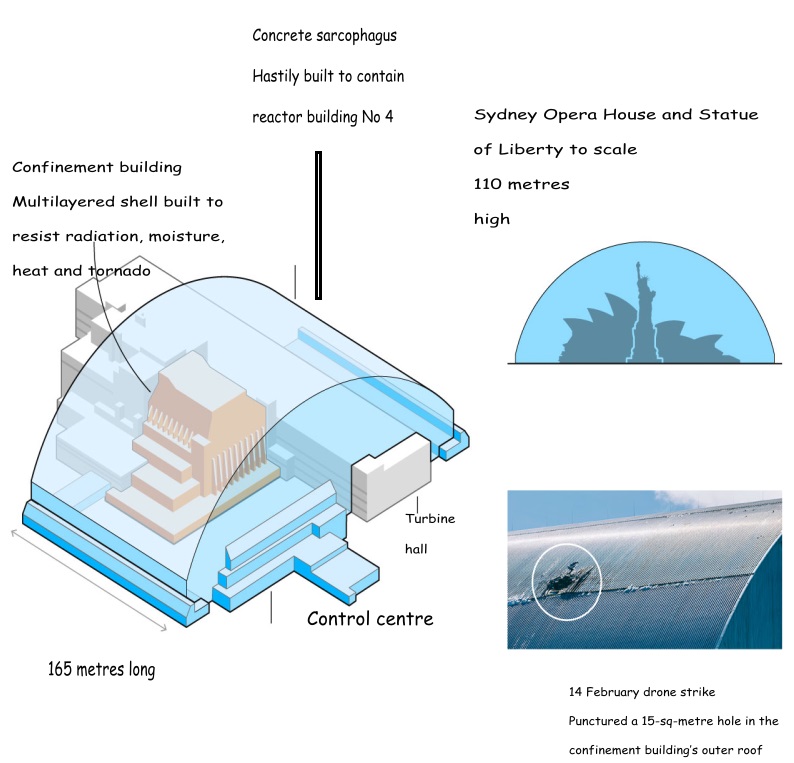
The 110-metre high steel structure at Chornobyl was hit before 2am on 14 February, with sensors registering “something like a 6 to 7 magnitude earthquake,” according to Serhiy Bokov, the chief engineer on duty. “But we clearly understood it wasn’t that,” he said.
The attack – quickly concluded to be caused by a drone flying below at a level where it could not be detected by radar – punctured a 15-sq-metre hole in the outer roof. It also caused a particularly damaging, complex smouldering fire to the inner cladding of the structure that took over a fortnight to put out.
Consisting of two double arches and longer than two jumbo jets, the New Safe Confinement (NSC) was completed in 2017 to secure the hastily built, unstable Soviet-era sarcophagus, which covers over Chornobyl’s ill-fated reactor number four, the site of the world’s worst nuclear disaster in April 1986.
But the attack in February has rendered the sarcophagus open to the elements again, meaning that radioactive dust could get out and rainwater in, though the country’s environmental protection ministry says “the radiation background is currently within normal level and is under constant control”.
More significantly, the confinement structure is now more vulnerable in the longer term to rusting due to greater exposure to the elements and damage to the cladding. Two hundred small boreholes were also drilled into the structure in the effort to douse the cladding fire with water.
“Not fixing it is not an option,” said Eric Schmieman, an American engineer who worked on the design and build of the Chornobyl shelter for 15 years. A complete repair, he said would “cost a minimum of tens of millions of dollars and it could easily go to hundreds of millions” with the repairs taking “months to years,” he added.
Previously the shelter was intended to have a 100-year design life, allowing time to decommission the sarcophagus and nuclear waste below, but this is now in doubt without it being repaired, Schmieman added. Unlike other large metal structures, such as the Eiffel Tower, it was never possible to repaint it to prevent corrosion.
Below the sarcophagus lies a highly radioactive lava like mass, a mix of 200 tonnes of uranium from Chornobyl reactor number four and 5,000 tonnes of sand, lead and boric acid dropped on to the site by Soviet helicopters in the immediate aftermath of the disaster caused by the reactor going out of control.
A more detailed impact assessment is expected to be released in May, but the European Bank for Reconstruction and Development (EBRD), which funded the building of the shelter and is involved in the post bombing analysis, said “it is clear that the attack has caused significant damage”.
Other sources, familiar with the assessment exercise, told the Guardian that Schmieman’s estimates appeared correct. Though the EBRD holds €25m in funds to allow for emergency work, it said “significantly more funding is required” to tackle long-term decommissioning challenges thrown up by the incident…………………………………………………
Further cash for repairs is most likely to come from western governments. Twenty-six countries contributed to the cost of the original shelter, including the US, UK, France, Germany and even Russia – of which the vast steel arch structure cost €1.5bn out of a total €2.1bn fund. Others also made donations, including Turkey.
Home to the remains of a nuclear reactor that went out of control and exploded in April 1986, the Chornobyl site is seven miles from the border with Russia’s ally Belarus. It was occupied by Russian soldiers trying to capture Kyiv in February 2022, and has remained on the frontline after Ukraine regained it that April……………………………………………….
Remotely operated cranes hanging from the confinement shelter were intended to dismantle the sarcophagus and nuclear material below, and the strike hit a point near the maintenance garage Bokov said. That too may impair the plans to gradually dismantle and decommission the disaster site below……………………………….. https://www.theguardian.com/world/2025/may/07/russian-drone-strike-caused-tens-of-millions-worth-of-damage-to-chornobyl
Zaporizhzhia: Hurdle or catalyst for a peace deal in Ukraine?
May 6, 2025, Henry Sokolski , https://npolicy.org/zaporizhzhia-hurdle-or-catalyst-for-a-peace-deal-in-ukraine/
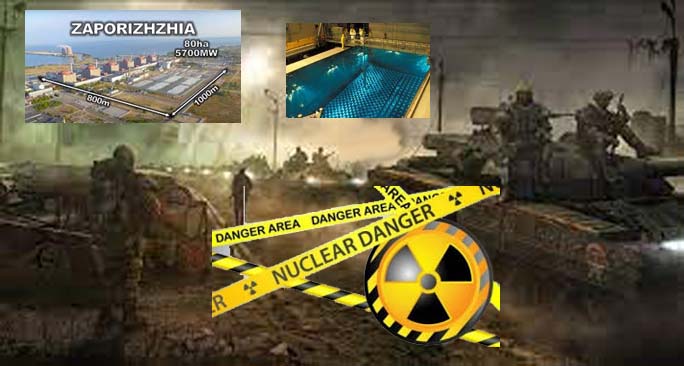
In all the peace proposals the United States, Russia, Europe, and Ukraine have made public, one item always shows up: the reopening of the damaged six-reactor Zaporizhzhia nuclear plant. Washington wants to rebuild and operate it, Moscow insists the plant is theirs, and Kyiv says that it must remain Ukrainian. But, it will be to restart the plant.
Russia insists it can get at least one of the reactors up and running within several months. The United States has no timeline. Ukraine says, even with a solid peace and full control over the plant, bringing all six reactors back online would still take two years or more. No one has ventured how much any of this would cost.
And, there are additional challenges. Russia destroyed the Kakhovka Dam upstream of the plant. Now, what would be required to assure a steady clean supply of cooling water for the reactors? The Russians also laid mines around the plant; the area is also laced with unexploded ordnance. How will these munitions be neutralized? Who will do it? The Russians have looted and damaged much of the plant’s control equipment. How will it be repaired and replaced? Who will certify that the work has been done properly? The U.S. Nuclear Regulatory Commission? The Ukrainian State Nuclear Regulatory Inspectorate? Rosatom?
More than 75 percent of Zaporizhzhia’s nuclear staff no longer work at the plant. Can they be replaced? Who will replace them? Then, there’s the challenge of rebuilding all of the damaged power lines and transformers necessary to export any electricity from the site. Where will the electricity be sent? Ukraine? The European Union? Russian territories? Who will pay for all of this work? Who will be held responsible if there are accidents? Who will defend the plant against future attacks? The United States? Ukraine? Russia? The EU?
There are even more questions than these. But as I make clear in the attached piece, we need to get the answers if we want the situation with Zaporizhzhia to be anything other than a hurdle to reaching any lasting peace.
……… Power for whom and at what cost? Even if the Zaporizhzhia reactors could be safely restarted, the problem of distributing the plant’s power remains. Before the war, Zaporizhzhia helped feed Ukraine’s electrical grid and exported surplus power to Europe. Now, the infrastructure connecting the plant to customers is shattered. Transmission lines must be rebuilt. Substations and transformers need replacement. Technical adjustments will need to be made and agreements negotiated over where the electricity will go and how: western Europe, southern Ukraine, or to Russian-controlled territories?
Another question is who will pay for all this work? Will seized Russian assets foot the bill? Or will it be European Reconstruction Bank funds? What of US investment, taxpayer funds, and any private entity potentially interested in chipping in? Once funds are allocated, who would receive the profits, if any, or be responsible for the losses? Who would assume responsibility for possible accidents and damage to property beyond the plant’s site? And, finally, who will bear the costs of ensuring the plant’s security so that its reactors do not become again the targets of future attacks? None of this is yet clear.
As Ukraine, the United States, and Russia have all made refurbishing and operating Zaporizhzhia a condition for peace, dodging these questions is a prescription for mischief. Without clear answers, resurrecting Zaporizhzhia could become more of an obstacle to than a catalyst for peace.
Henry Sokolski is executive director of the Nonproliferation Policy Education Center in Arlington, Virginia, served as Deputy for Nonproliferation Policy at the Pentagon (1989-93), and is author of China, Russia and the Coming Cool War (2024).
80 years on, US still embattled in senseless Cold War with Russia

Walt Zlotow, West Suburban Peace Coalition, Glen Ellyn IL , 7 May 25, https://theaimn.net/80-years-on-us-still-embattled-in-a-cold-war-with-russia/#google_vignette
May 8 marks 80 years since Victory in Europe Day. That victory kicked off the 46 year long Cold War against our great WWII ally Soviet Union (now Russia).
Sadly, the 1991 end of the Soviet Union simply transferred the Cold War into a cool war against Russia which has since gone cold again.
We’ve spent the last 34 years ever expanding the Cold War NATO alliance to Russia’s borders to keep them out of the European political economy and guarantee a yearly trillion dollar defense budget to prop up American capitalism. What good is the world’s largest military if you do not have a monstrous enemy to justify it?
That could have been avoided except for arguably the worst vice presidential pick in American history.
Every American today knows who Harry Truman was but few have a clue about his predecessor. Henry Wallace was a 20th century American visionary shoved out of the vice presidency in 1944, denying him the presidency upon the death of FDR, and changing America and the world for the worse.
Henry Wallace has been largely written out of the American Story told to succeeding generations of Americans by the protectors of the American Super Power Myth.
Born in 1888 to an affluent Iowa Republican farm family, Wallace increased family wealth with his Hi-Bred Corn Company. But the Depression turned Wallace into a zealous champion of the common man, landing him the Secretary of Agriculture post in FDR’s first term. Possibly the most effective New Dealer, Wallace championed the broken American farmer using curtailed production and price supports to ameliorate rampant rural poverty. His unbridled Bernie Sanders like democratic socialism of the 30’s garnered him FDR’s reverence and the 1940 third term vice presidency.
Wallace transformed the vice presidency for the good, long before Dick Cheney transformed it for evil. FDR made him what journalists tabbed the ‘Assistant President’ in his role mobilizing war production during WWII and championing FDR’s vision for a truly peaceful post WWII world working in partnership with critical war ally Russia for a peaceful Europe and ending European colonialism in Asia and Africa.
In 1942 he gave his famous “Common Man” speech, declaring the 20th century must celebrate the common man, not just, as Time publisher Henry Luce postured, the American Century. In 1943, he joined with the black community following the Detroit race riot, arguing “We cannot crush Nazi brutality abroad and condone race riots at home.”
His near FDR like popularity made him a lock for VP again on the ’44 Democratic ticket. But with FDR fading mentally and physically, party leaders saw opportunity to dump him. His peace proclivities threatened their continuation of a war economy to combat their imaginary new Hitler in the form of Joseph Stalin.
They closed the late night convention session on the brink of re nominating Wallace for a second term. That garnered time to make deals with the other candidates to move the pliant Harry Truman from last to first in the final VP tally.
Three months into term four FDR died thrusting Truman into the White House. This set the stage for the Cold War due to Truman’s capitulation to the neo-conservatives of his day such as Jimmy Byrnes and Jimmy Forestall who demanded a fresh enemy to keep the emerging Military-Industrial Complex in business. A Wallace presidency would have sidelined these anti Russian hardliners. The chance for a truly peaceful post WWII world was irrevocably lost.
The post WWII neocons won out over Wallace, but undaunted he launched a 3rd party progressive campaign in 1948 to unseat Truman. McCarthyite red smears and personal attacks on his progressive philosophy doomed him to just 3% of the ’48 vote, ending his career. Also ended was any opportunity for America to retreat from senseless Cold War.
That leaves us to ponder if today’s new Cold War will rage on for another 80 years.
Westinghouse drops out of UK SMR competition
Nuclear Engineering International 30th April 2025, https://www.neimagazine.com/news/westinghouse-drops-out-of-uk-smr-competition/
S Westinghouse has pulled out of the UK’s small modular reactor (SMR) design competition, according to the UK The Telegraph.
Earlier in April, three of the four competition finalists in Great British Nuclear’s (GBN’s) small modular reactor (SMR) competition submitted their final tenders. The four finalists received an Invitation to Submit Final Tender (ISFT) in February – GE-Hitachi Nuclear Energy International, Holtec Britain, Rolls-Royce SMR, and Westinghouse Electric Company.
GEH (part of GE Vernova) proposed its BWRX-300 boiling water reactor; Holtec proposed its SMR-300 – a 300 MWe pressurised water reactor (PWR); the Rolls-Royce SMR is a 470 MWe PWR; and the Westinghouse AP300 is a 300 MWe/900 MWt PWR. Westinghouse, however, failed to submit its final tender.
GBN was expected to announce two winners this summer with bidders told to prepare to build three to four mini reactors each. The winners will be awarded contracts to co-fund further design development as well as the necessary regulatory, environmental and site-approvals before a final investment decision is taken in 2029. The contracts are expected to total £20bn ($26.7bn) – £10bn each if two companies are selected.
However, The Telegraph reported in February that the Government was considering awarding only one contract as Rachel Reeves, the Chancellor “is struggling to balance the books as weak economic growth makes it harder to meet her self-imposed ‘fiscal rules’ for borrowing.
According to The Telegraph, Westinghouse did not deny it had withdrawn but declined to give its reasons. “One industry source suggested the company had baulked at the commercial offer made by the Government.”
A spokesman from the UK Energy Department said: “Great British Nuclear is driving forward its SMR competition for UK deployment. It has now received final tenders, which it will evaluate ahead of taking final decisions this spring.”
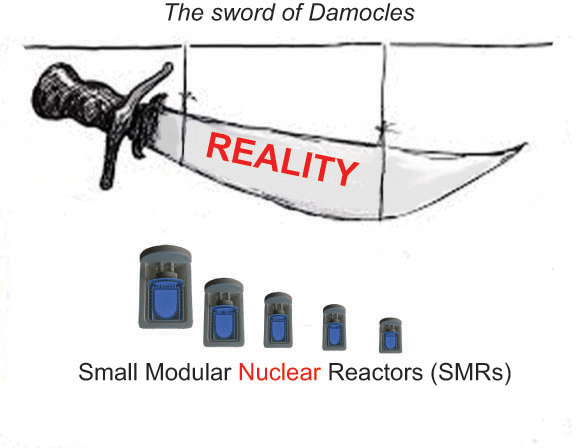
There is growing concern that the economics of SMRs could prove even hard to justify at the high costs for the initial four units. None of the bidders has built their designs which are still in development. All SMRs in the GBN competition will be first-of-a-kind units (FOAK), which will push up costs.
Commenting on the issue, Neutron Bytes noted: “Most estimates are that economies of scale based on factory production of SMRs, promised by all four vendors, only kick in when order books come in “fleet mode,” e.g. by the dozen or more. It follows that even £10bn could be insufficient to cover the costs of four units any of the three 300 MWe offerings based on their status as FOAK projects.”
It added: “Splitting the difference for the GBN competition, e.g. awarding one winner £10bn, keeps the SMR initiative alive, but does nothing to promote long-term “fleet mode” production of SMRs which the UK nuclear industry points out is the only way to achieve economies of scale with factory production of SMRs.”
Ohio EPA launches limited Luckey water testing after independent report shows high radiation in wells.

The Ohio Environmental Protection Agency, now under sharp scrutiny, will begin targeted water sampling in the village of Luckey on Wednesday, May 7. The move comes in response to independent testing conducted by The Toledo Blade, which uncovered elevated levels of radioactive contaminants in residential wells surrounding a former Cold War-era nuclear materials site.
The Ohio EPA said it will collect samples from Eastwood Local School buildings, Pemberville Public Library branches, and the Pemberville water treatment plants. The agency stated that certified laboratories will perform radiological analyses using “standard protocols,” though it has not clarified whether that includes specific isotope detection or testing for beta-emitting radionuclides.
Of the 38 samples tested for gamma radiation, 19 revealed bismuth-214 levels at least 10 times higher than the background thresholds established by the U.S. Army Corps of Engineers. The presence of bismuth-214 strongly indicates the presence of radon-222, a radioactive gas known to increase cancer risk. Some wells also tested positive for radium-226, radon-222, alpha and beta radiation, beryllium, and mercury.
https://googleads.g.doubleclick.net/pagead/ads?gdpr=0&gdpr_consent=tcunavailable&tcfe=3&client=ca-pub-2554767935405984&output=html&h=280&adk=3957413466&adf=830603344&pi=t.aa~a.3453247533~i.6~rp.4&w=634&abgtt=6&fwrn=4&fwrnh=100&lmt=1746683330&num_ads=1&rafmt=1&armr=3&sem=mc&pwprc=3568220565&ad_type=text_image&format=634×280&url=https%3A%2F%2Fappareport.com%2F2025%2F05%2F06%2Fohio-epa-launches-limited-luckey-water-testing-after-independent-report-shows-high-radiation-in-wells%2F%3Futm_source%3Dfacebook%26utm_medium%3Djetpack_social%26fbclid%3DIwY2xjawKH1O9leHRuA2FlbQIxMQBicmlkETFqODFPMTBmQTF5TEZicE1sAR7DD3WHCKFbMcsxONI6PwwU3BG179LZeDq1kHE5syHZgCdNvasXdjpfr-DjYw_aem_DfMkHt4eTpIDIAfrZFlmGQ&host=ca-host-pub-2644536267352236&fwr=0&pra=3&rh=159&rw=633&rpe=1&resp_fmts=3&wgl=1&fa=27&uach=WyJXaW5kb3dzIiwiMTUuMC4wIiwieDg2IiwiIiwiMTM1LjAuNzA0OS4xMTUiLG51bGwsMCxudWxsLCI2NCIsW1siR29vZ2xlIENocm9tZSIsIjEzNS4wLjcwNDkuMTE1Il0sWyJOb3QtQS5CcmFuZCIsIjguMC4wLjAiXSxbIkNocm9taXVtIiwiMTM1LjAuNzA0OS4xMTUiXV0sMF0.&dt=1746683047064&bpp=1&bdt=4365&idt=1&shv=r20250506&mjsv=m202505050101&ptt=9&saldr=aa&abxe=1&cookie=ID%3D64420eca75c0ed2b%3AT%3D1746229513%3ART%3D1746683048%3AS%3DALNI_MadpzcDidvM12j1XEfmCG_w3cmjYA&gpic=UID%3D000010171172a210%3AT%3D1746229513%3ART%3D1746683048%3AS%3DALNI_Ma3MjH8_Lx9G9s2ELouutptKcrFZQ&eo_id_str=ID%3Df70225faa56d1ddf%3AT%3D1746229513%3ART%3D1746683048%3AS%3DAA-AfjY3YWrttstp60Hpetggs1xY&prev_fmts=0x0%2C1265x585&nras=3&correlator=6082623994933&frm=20&pv=1&u_tz=600&u_his=2&u_h=720&u_w=1280&u_ah=672&u_aw=1280&u_cd=24&u_sd=1.5&dmc=8&adx=127&ady=3031&biw=1265&bih=585&scr_x=0&scr_y=699&eid=95358862%2C95358864%2C95354563%2C95359240%2C95359120%2C95359476&oid=2&pvsid=8479030565798310&tmod=1640054256&uas=3&nvt=1&fc=1408&brdim=0%2C0%2C0%2C0%2C1280%2C0%2C1280%2C672%2C1280%2C585&vis=1&rsz=%7C%7Cs%7C&abl=NS&fu=128&bc=31&bz=1&td=1&tdf=2&psd=W251bGwsbnVsbCxudWxsLDNd&nt=1&pgls=CAEQBBoHMS4xNTIuMQ..~CAEQBRoGMy4yOC40&ifi=3&uci=a!3&btvi=1&fsb=1&dtd=M
Beryllium, used at the Luckey site in the 1950s, was a focal point. Of 14 wells tested for it and other metals, multiple locations showed concerning levels. Several samples were also retested to look for specific contamination types.
Katie Boyer, spokesperson for the Ohio EPA, told investigative journalist Jason Salley during an earlier investigation into drinking water concerns in Pike County, that “Ohio public water systems are not required to monitor for gross beta radiation unless they are located near a known contamination source or are at risk of contamination. If initial tests show low or no beta radiation, no further testing is necessary. Gross beta monitoring is very rare in public water systems.”
https://googleads.g.doubleclick.net/pagead/ads?gdpr=0&gdpr_consent=tcunavailable&tcfe=3&client=ca-pub-2554767935405984&output=html&h=280&adk=3957413466&adf=1277231945&pi=t.aa~a.3453247533~i.8~rp.4&w=634&abgtt=6&fwrn=4&fwrnh=100&lmt=1746683332&num_ads=1&rafmt=1&armr=3&sem=mc&pwprc=3568220565&ad_type=text_image&format=634×280&url=https%3A%2F%2Fappareport.com%2F2025%2F05%2F06%2Fohio-epa-launches-limited-luckey-water-testing-after-independent-report-shows-high-radiation-in-wells%2F%3Futm_source%3Dfacebook%26utm_medium%3Djetpack_social%26fbclid%3DIwY2xjawKH1O9leHRuA2FlbQIxMQBicmlkETFqODFPMTBmQTF5TEZicE1sAR7DD3WHCKFbMcsxONI6PwwU3BG179LZeDq1kHE5syHZgCdNvasXdjpfr-DjYw_aem_DfMkHt4eTpIDIAfrZFlmGQ&host=ca-host-pub-2644536267352236&fwr=0&pra=3&rh=159&rw=633&rpe=1&resp_fmts=3&wgl=1&fa=27&uach=WyJXaW5kb3dzIiwiMTUuMC4wIiwieDg2IiwiIiwiMTM1LjAuNzA0OS4xMTUiLG51bGwsMCxudWxsLCI2NCIsW1siR29vZ2xlIENocm9tZSIsIjEzNS4wLjcwNDkuMTE1Il0sWyJOb3QtQS5CcmFuZCIsIjguMC4wLjAiXSxbIkNocm9taXVtIiwiMTM1LjAuNzA0OS4xMTUiXV0sMF0.&dt=1746683047068&bpp=3&bdt=4369&idt=3&shv=r20250506&mjsv=m202505050101&ptt=9&saldr=aa&abxe=1&cookie=ID%3D64420eca75c0ed2b%3AT%3D1746229513%3ART%3D1746683048%3AS%3DALNI_MadpzcDidvM12j1XEfmCG_w3cmjYA&gpic=UID%3D000010171172a210%3AT%3D1746229513%3ART%3D1746683048%3AS%3DALNI_Ma3MjH8_Lx9G9s2ELouutptKcrFZQ&eo_id_str=ID%3Df70225faa56d1ddf%3AT%3D1746229513%3ART%3D1746683048%3AS%3DAA-AfjY3YWrttstp60Hpetggs1xY&prev_fmts=0x0%2C1265x585%2C634x280&nras=4&correlator=6082623994933&frm=20&pv=1&u_tz=600&u_his=2&u_h=720&u_w=1280&u_ah=672&u_aw=1280&u_cd=24&u_sd=1.5&dmc=8&adx=127&ady=3428&biw=1265&bih=585&scr_x=0&scr_y=1123&eid=95358862%2C95358864%2C95354563%2C95359240%2C95359120%2C95359476&oid=2&pvsid=8479030565798310&tmod=1640054256&uas=3&nvt=1&fc=1408&brdim=0%2C0%2C0%2C0%2C1280%2C0%2C1280%2C672%2C1280%2C585&vis=1&rsz=%7C%7Cs%7C&abl=NS&cms=2&fu=128&bc=31&bz=1&td=1&tdf=2&psd=W251bGwsbnVsbCxudWxsLDNd&nt=1&pgls=CAEQBBoHMS4xNTIuMQ..~CAEQBRoGMy4yOC40&ifi=4&uci=a!4&btvi=2&fsb=1&dtd=M
This admission has further fueled public concern, given that Luckey sits adjacent to a federally managed cleanup site under the Formerly Utilized Sites Remedial Action Program (FUSRAP). Critics argue that limited testing of public buildings, rather than the private wells identified in The Blade’s report, leaves gaps in understanding potential exposure risks.
In response to the Ohio EPA’s vague testing plan, the Appalachian Press and Public Affairs Report (APPA Report) submitted a formal request to the agency, pressing for clarity on whether the upcoming analyses will include beta emitters or man-made radionuclides. As of publication, the agency has not responded.
https://googleads.g.doubleclick.net/pagead/ads?gdpr=0&gdpr_consent=tcunavailable&tcfe=3&client=ca-pub-2554767935405984&output=html&h=280&adk=3957413466&adf=3563305841&pi=t.aa~a.3453247533~i.10~rp.4&w=634&abgtt=6&fwrn=4&fwrnh=100&lmt=1746683332&num_ads=1&rafmt=1&armr=3&sem=mc&pwprc=3568220565&ad_type=text_image&format=634×280&url=https%3A%2F%2Fappareport.com%2F2025%2F05%2F06%2Fohio-epa-launches-limited-luckey-water-testing-after-independent-report-shows-high-radiation-in-wells%2F%3Futm_source%3Dfacebook%26utm_medium%3Djetpack_social%26fbclid%3DIwY2xjawKH1O9leHRuA2FlbQIxMQBicmlkETFqODFPMTBmQTF5TEZicE1sAR7DD3WHCKFbMcsxONI6PwwU3BG179LZeDq1kHE5syHZgCdNvasXdjpfr-DjYw_aem_DfMkHt4eTpIDIAfrZFlmGQ&host=ca-host-pub-2644536267352236&fwr=0&pra=3&rh=159&rw=633&rpe=1&resp_fmts=3&wgl=1&fa=27&uach=WyJXaW5kb3dzIiwiMTUuMC4wIiwieDg2IiwiIiwiMTM1LjAuNzA0OS4xMTUiLG51bGwsMCxudWxsLCI2NCIsW1siR29vZ2xlIENocm9tZSIsIjEzNS4wLjcwNDkuMTE1Il0sWyJOb3QtQS5CcmFuZCIsIjguMC4wLjAiXSxbIkNocm9taXVtIiwiMTM1LjAuNzA0OS4xMTUiXV0sMF0.&dt=1746683047074&bpp=1&bdt=4375&idt=1&shv=r20250506&mjsv=m202505050101&ptt=9&saldr=aa&abxe=1&cookie=ID%3D64420eca75c0ed2b%3AT%3D1746229513%3ART%3D1746683048%3AS%3DALNI_MadpzcDidvM12j1XEfmCG_w3cmjYA&gpic=UID%3D000010171172a210%3AT%3D1746229513%3ART%3D1746683048%3AS%3DALNI_Ma3MjH8_Lx9G9s2ELouutptKcrFZQ&eo_id_str=ID%3Df70225faa56d1ddf%3AT%3D1746229513%3ART%3D1746683048%3AS%3DAA-AfjY3YWrttstp60Hpetggs1xY&prev_fmts=0x0%2C1265x585%2C634x280%2C634x280&nras=5&correlator=6082623994933&frm=20&pv=1&u_tz=600&u_his=2&u_h=720&u_w=1280&u_ah=672&u_aw=1280&u_cd=24&u_sd=1.5&dmc=8&adx=127&ady=3794&biw=1265&bih=585&scr_x=0&scr_y=1493&eid=95358862%2C95358864%2C95354563%2C95359240%2C95359120%2C95359476&oid=2&pvsid=8479030565798310&tmod=1640054256&uas=3&nvt=1&fc=1408&brdim=0%2C0%2C0%2C0%2C1280%2C0%2C1280%2C672%2C1280%2C585&vis=1&rsz=%7C%7Cs%7C&abl=NS&fu=128&bc=31&bz=1&td=1&tdf=2&psd=W251bGwsbnVsbCxudWxsLDNd&nt=1&pgls=CAEQBBoHMS4xNTIuMQ..~CAEQBRoGMy4yOC40&ifi=5&uci=a!5&btvi=3&fsb=1&dtd=M
Sampling will begin at 1 p.m. on Wednesday at Basic Park in Luckey. Amy Klei, chief of Ohio EPA’s Division of Drinking and Ground Waters, will be available to address media questions about the scope and intent of the testing.
While state officials move forward with limited action, residents and environmental watchdogs continue to demand transparency and accountability, warning that failure to address the full scope of potential contamination could have long-term public health consequences.
1 This Month





PLEASE OPPOSE HR 8255 AND S.3639 – bills would accelerate satellite deployment, with no environmental review or safeguards – https://ncstd5li.quorum.us/campaign/169331/
To see nuclear-related stories in greater depth and intensity – go to https://nuclearinformation.wordpress.com
-
Archives
- October 2026 (49)
- September 2026 (339)
- August 2026 (330)
- July 2026 (355)
- June 2026 (287)
- May 2026 (306)
- April 2026 (356)
- March 2026 (251)
- February 2026 (267)
- January 2026 (308)
- December 2025 (358)
- November 2025 (359)
-
Categories
- 1
- 1 NUCLEAR ISSUES
- business and costs
- climate change
- culture and arts
- ENERGY
- environment
- health
- history
- indigenous issues
- Legal
- marketing of nuclear
- media
- opposition to nuclear
- PERSONAL STORIES
- politics
- politics international
- Religion and ethics
- safety
- secrets,lies and civil liberties
- spinbuster
- technology
- Uranium
- wastes
- weapons and war
- Women
- 2 WORLD
- ACTION
- AFRICA
- Atrocities
- AUSTRALIA
- Christina's notes
- Christina's themes
- culture and arts
- Events
- Fuk 2022
- Fuk 2023
- Fukushima 2017
- Fukushima 2018
- fukushima 2019
- Fukushima 2020
- Fukushima 2021
- general
- global warming
- Humour (God we need it)
- Nuclear
- RARE EARTHS
- Reference
- resources – print
- Resources -audiovicual
- Weekly Newsletter
- World
- World Nuclear
- YouTube
-
RSS
Entries RSS
Comments RSS

