Trump Bombs Iran, Then Demands Iran Agree to End the War.
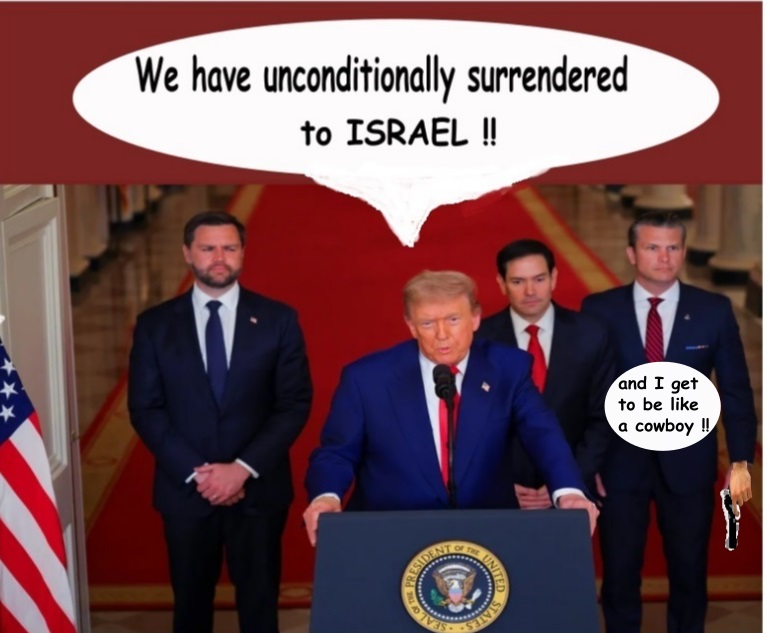
After the unprovoked attack, Trump demanded that Iran effectively surrender while continuing to threaten the country.
By Sharon Zhang , Truthout, June 21, 2025, https://truthout.org/articles/trump-bombs-iran-then-demands-iran-agree-to-end-the-war/?utm_source=Truthout&utm_campaign=4917bf90b8-EMAIL_CAMPAIGN_2025_06_22_07_19_COPY_01&utm_medium=email&utm_term=0_bbb541a1db-cb3a7b1ac8-650192793
resident Donald Trump announced on Saturday that the U.S. military struck three sites in Iran, in an unprovoked act of aggression. The strikes come after Israel launched its own unprovoked attack on Iran on June 13, leading to an all-out war between the two countries. The U.S. strikes mark a major escalation and threaten to bring further instability to the region.
In a post on Truth Social, Trump said that the U.S. has bombed three nuclear facilities in Iran, at Fordow, Natanz, and Esfahan.
The Iranian government’s Atomic Energy Organization confirmed the strikes, saying that they “were attacked in a violent act against international laws, including the Non-Proliferation Treaty, by the enemies of Islamic Iran.” Regional Iranian officials also confirmed the strikes, as Iranian news outlets have reported.
Iran has not directly targeted U.S. bases with an attack thus far in its war with Israel. Still, in his post announcing the strikes, Trump also demanded that Iran effectively surrender.
“NOW IS THE TIME FOR PEACE!” he wrote. In a follow-up post, he said, “IRAN MUST NOW AGREE TO END THIS WAR.”
The strikes mark the U.S.’s official direct entry into the war, though the U.S. has provided Israel with support in its bombings on Iran and has also helped provide defense for Israel. The attacks come after politicians and war mongers in the U.S. have called for war with Iran for decades.
In a brief address on Saturday night, Trump layered further threats against Iran, saying that the U.S. would continue its strikes if Iran doesn’t “make peace.” He called Iran the “bully of the Middle East” and said the strikes had gone “a long way to erasing this horrible threat to Israel” — the state that, in addition to currently conducting a genocide in Gaza, has been relentlessly attacking and invading countries and territories around it for decades.
“This cannot continue. There will be either peace, or there will be tragedy for Iran far greater than we have witnessed over the last eight days. Remember, there are many targets left,” Trump said.
Numerous lawmakers slammed the strikes, saying that they are unconstitutional as domestic law prohibits the president from launching an unprovoked strike without approval from Congress. Rep. Alexandria Ocasio-Cortez (D-New York) called for Trump to be impeached.
“The President’s disastrous decision to bomb Iran without authorization is a grave violation of the Constitution and Congressional War Powers. He has impulsively risked launching a war that may ensnare us for generations. It is absolutely and clearly grounds for impeachment,” said Ocasio-Cortez.
UN Secretary-General António Guterres condemned the strikes, and called for de-escalation and diplomacy.
“This is a dangerous escalation in a region already on the edge — and a direct threat to international peace and security. There is a growing risk that this conflict could rapidly get out of control — with catastrophic consequences for civilians, the region, and the world,” Guterres said.
Rogue States: The illegality of the U.S.-backed Israeli attacks on Iran

Israel has stockpiles of conventional, hi-tech, nuclear, chemical, and biological weapons, allows no international inspections of them, and refuses to ratify the Non-Proliferation Treaty (NPT).
they have extended the argument to absurd levels, basing their justification for war not on a claim that Iran has WMDs, but that they might someday acquire them.
international law does not allow for so-called “anticipatory self-defense” or so-called “pre-emptive strikes.”
The attack on Iran is just the latest crime in the Israeli regime’s path of destruction across the Middle East. Its Western-backed impunity has become a global threat.
Mondoweiss, By Craig Mokhiber June 18, 2025 Craig Mokhiber is an international human rights lawyer and former senior United Nations Official.
The Israeli regime, drunk with western-backed impunity, flush with western-supplied weapons, and driven by a violent, western-born racist ideology, is rampaging across the Middle East, leaving a trail of blood and destruction in its wake.
The Israeli regime’s blatant act of aggression against Iran is just the latest crime perpetrated by the regime in its current twenty-month orgy of violence in the region.
But Israel is not a lone rogue. And it could not get away with its crimes without a powerful backer.
The U.S. provided the Israeli regime with the greenlight for its surprise attack, the distraction of (perhaps disingenuous) diplomatic talks to facilitate the attack, U.S. tax dollars to finance the operation, the intelligence for targeting, the weapons and ammunition for killing, the diplomatic cover to protect it from Security Council action, U.S. forces for the interception of Iran’s defensive response, the promise of direct U.S. military backing if Israel requires it, and the propaganda cover of complicit U.S. media corporations. Now the U.S. appears poised to enter the military assault directly.
Once again, the U.S. is a co-perpetrator in Israel’s crimes.
The resulting Israeli impunity, the principal byproduct of U.S. collaboration with the Israeli regime, not only threatens Palestinian self-determination and the sovereignty of countries across the region, but global peace and security itself.
The global threat of Israeli impunity
In recent months, the Israeli regime has perpetrated genocide and apartheid in Palestine, a transnational terrorism attack with booby trapped pagers in Lebanon, thousands of armed attacks on Lebanon, Syria, Yemen, & Iran, the unlawful occupation of Palestinian, Lebanese, and Syrian territory, several extrajudicial executions on foreign territory, the assault on and commandeering of the humanitarian flotilla ship the Madleen, countless attacks on United Nations staff and facilities, and the use of its proxies in Western countries to harass human rights defenders and to corrupt governments.
Israel has stockpiles of conventional, hi-tech, nuclear, chemical, and biological weapons, allows no international inspections of them, and refuses to ratify the Non-Proliferation Treaty (NPT). And it is governed by a far-right, deeply racist, and fundamentally violent regime that is unconstrained by any norms of international law, international diplomacy, or common morality.
Add the ingredient of impunity, and you have a formula for global disaster. The western-guaranteed impunity that the Israeli regime has enjoyed is what has produced the regime’s serial criminality. And that criminality threatens the entire region and, potentially, the world.
Worse, to further insulate the Israeli regime, the U.S. and its allies have systematically corrupted, captured, or crushed virtually every government in the region, and battered the parts of Lebanon (Hezbollah) and of Yemen (Ansar Allah) still challenging the regime and its violent hegemonic project. Only Iran is left standing. As such, it represents an intolerable element to the Israeli regime and its U.S. sponsor: deterrence.
A war for U.S.-Israel regional hegemony
Thus, Iran is being targeted because it is the last independent state still standing in the region, following the corruption and capture of most Arab governments by the U.S., and the systematic destruction of those that refused to submit (e.g. Iraq, Libya, Syria).
The essence of this plan was revealed more than two decades ago by U.S. General and former NATO Commander Wesley Clarke, when he described U.S. plans to “attack seven Muslim countries in five years.” On the list were Iraq, Libya, Syria, Lebanon, Somalia, Sudan and, of course, Iran.
Even after decades of sanctions, sabotage, aggression, destabilization efforts, and the meddling of Western intelligence agencies, Iran has defiantly refused to submit to the U.S.. Despite sustained pressure, it has refused to abandon the Palestinian people, to normalize Israeli settler-colonialism and apartheid, or to look the other way as Israel perpetrates a genocide.
Importantly, it has also refused to surrender control of its natural resources (including significant oil and gas reserves) to the U.S. empire. And, famously, it refuses to give up its right, as a sovereign state, to develop peaceful nuclear energy for the benefit of its developing economy.
Because decades of efforts by the U.S.-Israel axis to strangle and destabilize the country (while causing great civilian suffering in the country) have failed to force Iran to submit, the U.S. and Israel have now moved to large-scale military aggression, dusting off the old, fabricated “WMD” justifications that served them so well in justifying their aggression in neighboring Iraq more than twenty years ago.
But, in this case, they have extended the argument to absurd levels, basing their justification for war not on a claim that Iran has WMDs, but that they might someday acquire them. A charge made all the more ridiculous by the fact that the attackers themselves- both the U.S. and Israel- in fact possess such weapons, and that both are themselves guilty of serial acts of aggression, while Iran is not.
Jus ad bellum: The crime of aggression
The U.S.-backed Israeli regime’s unprovoked attack on Iran was a crime under international law. Indeed, it was a treacherous attack, launched in the middle of ongoing U.S. negotiations, and even targeting the Iranian official in charge of the negotiations. (And, by the way, right after Israel cut off the internet in Gaza, drawing a digital curtain around its accelerating genocide there).
Article 51 of the UN Charter recognizes the right of self-defense only in response to an “armed attack,” or when specifically authorized by the Security Council. Any other armed attack constitutes the crime of aggression in international law.
That means that the Israeli regime is using force against Iran unlawfully, in violation of Article 2(4) of the UN Charter, prohibiting the threat or use of force, and, as such, is committing the crime of aggression. In this case, as a matter of law, the right to self-defense belongs to Iran, and decidedly not to Israel (or the U.S.).
Furthermore, contrary to the claims of the Israeli regime’s proxies in the West, international law does not allow for so-called “anticipatory self-defense” or so-called “pre-emptive strikes.”
Some, like the Bush administration in the lead up to the Iraq aggression, have tried to argue that anticipatory self-defense is permissible. But that argument was widely rejected, since the intent of the Charter was to prohibit claims of self-defense unless and until an armed attack has occurred, or military force is authorized by the Security Council.
…………………………………….Of course, Israel, the quintessential rogue regime, wrapped in the armor of U.S.-guaranteed impunity, cares little about legality. But its representatives and proxies will often try to adopt a veneer of legality as part of the regime’s propaganda efforts in Western media.
As such, Israel proxies have tried to distort the idea of anticipatory self-defense even further by claiming the right to attack anybody who might someday in the future decide to attack Israel. They seek to claim that Iran may one day develop nuclear weapons, that it may use them on Israel if it develops them, and that therefore Israel has no choice but to attack Iran now.
Clearly, as a matter of international law, that is entirely impermissible. If that were the rule, any state could lawfully attack any other state at any time, just by claiming a potential future threat. And that would effectively annul the UN Charter.
But, for Israel, this makes perfect sense. Israel is, in essence, an annihilatory state. It was created in violence, has expanded through violence, and is sustained by way of constant violence. Its official ideology is premised on a militarized conception of security that essentially says that anyone who does not submit to us must be destroyed, lest they someday try to fight back.
Thus, the entire history of the Israeli regime has been defined by militarization, conquest, colonization, expansion, and aggression. In practical terms, this has meant genocide against the indigenous people of Palestine and constant attacks against the regime’s neighbors.
But even under the broadest possible arguments of anticipatory self-defense (which, again, is rejected by almost the entire discipline of international law), Israel’s use of force against Iran would still be illegal.
This is not a hard case. (1) Iran does not have nuclear weapons, (2) there is no evidence that it is developing nuclear weapons, (3) there is no evidence that it would use those weapons against the Israeli regime even if it obtained them, (4) there was no imminent threat, and (5) the Israeli regime has not exhausted peaceful means, as required by international law.
…………………………………Jus in Bello: Attacking civilians and civilian infrastructure
Beyond the crime of aggression, the Israeli regime’s attacks on Iran have included a number of other grave breaches of international humanitarian law. As of the drafting of this article, the Israeli regime has already killed hundreds of Iranians, overwhelmingly civilians. It has targeted apartment buildings, media buildings, and at least one hospital. And it has murdered several Iranian scientists. Needless to say, such acts violate the principle of distinction and the prohibition of targeting protected persons and protected civilian infrastructure.
The killing of scientists is a case in point. Only if a scientist is a member of the military (that is, not a civilian working for the military), then, in some circumstances, s/he may be a legitimate target. But most scientists, including the Iranian scientists, are civilians, even if they were working on weapons. (And the Iranian scientists are not even working on weapons, just nuclear energy.) As such, targeting them is entirely unlawful. And, needless to say, it is impermissible, as a matter of law, to target people in their homes just because they are scientists who might someday work on weapons. This, in simple terms, is the crime of murder.
Attacks on nuclear facilities
Particularly egregious, as a matter of both law and humanity, is the Israeli regime’s attacks on Iran’s nuclear facilities. In international humanitarian law, attacks on dangerous facilities, such as nuclear power plants and other facilities containing what the law calls “dangerous forces”, are generally prohibited. Indeed, the International Atomic Energy Agency has affirmed that such attacks are prohibited in international law and are a violation of the UN Charter.
These facilities are protected under international law due to the potential for severe harm to the civilian population if attacked. ………………………………………………………………………….
Reining in the rogues
The open lawlessness of the Israeli regime and its sponsors has wreaked havoc both on the countries and peoples of the Middle East, and on the very legitimacy of international law itself. Calling out the crimes of these states and pursuing accountability for them are essential to the cause of justice.
While the West obsesses about the risks of peaceful nuclear programmes, the true threat to global security at this moment in history rests not in reactors and centrifuges, but rather in aggression, genocide, and impunity. Containing these threats is a global imperative. …………………………………………… https://mondoweiss.net/2025/06/rogue-states-the-illegality-of-the-u-s-backed-israeli-attacks-on-iran/
Juan Cole: The Current Iran War Will Likely End Soon, But the Arms Race Will Heat Up
Regime change in Iran as a result of the US and Israeli attacks is unlikely. Even Iranians in the opposition are likely to rally around the flag.
America’s credibility as a negotiator and mediator is completely ruined, since Trump hit Iran in the midst of negotiations
It is still not clear to me that the ayatollahs’ longstanding opposition to nuclear weapons will change.
June 23, 2025
Ann Arbor (Informed Comment) – The Al Jazeera bureau chief in Tehran, Abdul Qader Fayez, reports from “informed sources” in Tehran that Iran’s clerical Leader, Ali Khamenei, and his National Security Council have still not decided how to respond to the US attack on Iranian civilian nuclear facilities, though they want the response to be appropriate to the damage done them.
Al Jazeera notes, “Fayez pointed out that this Iranian hesitation suggests a tendency to respond in a carefully considered strategic manner not based on momentary revenge, but rather on a more comprehensive approach that allows Tehran multiple options rather than drawing it into a specific tactical confrontation or a direct, ill-considered reaction.”
Fayez says that the Iranian elite is attempting to distinguish between Washington’s attack and the ongoing Israeli escalation, especially since the US bombardment was unprecedented.
I would add (this is Juan Cole speaking) that Iran is weak. It has lost control of its own skies and so is as helpless as Lebanon and Syria before the Israeli Air Force (and the American). Iran still has some drones and hypersonic missiles that can penetrate Israeli defenses, but although it is able to do some damage to Tel Aviv and Haifa, it isn’t anything the Israelis can’t survive.
The weapons of the weak are guerrilla warfare, covert operations and terrorism. The US and Israel do not have troops on Iranian soil, so a guerrilla war against them is difficult to mount. Moreover, Iran has a return address and so cannot pursue classic guerrilla warfare.
Iran can hit bases in the Middle East that host US troops, as it did in January 2020 after Trump assassinated Iranian General Qasem Soleimani. In that instance, Iranian commanders were careful not to kill the troops, though the latter did get severe concussions from the missile impacts. Such a response would be purely symbolic and for the sake of Iranian domestic politics, with no military significance. US troops in Iraq and Syria are particularly vulnerable to this sort of reprisal.
If Trump is speaking truly and the strikes really were a one-off, then the direct US-Iran engagement could subside quickly. Iran has no reason to want continued direct involvement with the US while it is facing an concerted Israeli campaign. It should be noted that in his first term Trump bombed Syria, then largely ignored the country except for the Obama-initiated defeat of ISIL in Raqqa. He bombed Afghanistan and then more or less surrendered to the Taliban. He bombed an Iranian general at Baghdad International Airport and watched Iran reply, but then went back to using economic sanctions. Trump has a history of splashy one-off bombings with no follow-through, and this episode could be just as transitory.
During the first Trump round of “maximum pressure” sanctions, Iran covertly set fires to petroleum tankers of the United Arab Emirates in the Gulf. But Iran now has good relations with the Arab Gulf states and is unlikely to take the American strikes out on them.
There may, however, be attacks on other oil pipelines or tankers of states with bad relations with Iran. Oil attacks would benefit Iran by raising the price of the petroleum it smuggles to China and by hurting the US and Israeli economies.
Terrorism is a possibility, but there is a danger it would be traced back to Iran, and it is bad for a country’s reputation, foreign relations, and economic affairs.
Regime change in Iran as a result of the US and Israeli attacks is unlikely. Even Iranians in the opposition are likely to rally around the flag. Some disgruntled ethnic minorities may attempt to take advantage of perceived state weakness, but they are small and cannot disrupt the Persian Iranian Plateau, the regime stronghold. If anything, the Israeli and US attacks may have extended the life of an oppressive government that is widely disliked inside the country but which can now claim to stand against powerful external foes dedicated to attacking and destroying the Iranian nation.
……………………………………………………………………………….. The hot war will end, but the Middle East arms race is with us for the foreseeable future, and the opportunities for Russia and China, should they want them, to play a bigger role in the region have expanded.
America’s credibility as a negotiator and mediator is completely ruined, since Trump hit Iran in the midst of negotiations, which a reader reminded me is a violation of the Hague Regulations of 1907 and was held against Japan in the attack on Pearl Harbor.
It is still not clear to me that the ayatollahs’ longstanding opposition to nuclear weapons will change. Many countries throughout the world, however, may now be tempted to go for a nuclear weapon, since the difference between North Korea on the one hand and Iraq and Iran on the other is glaringly clear.
The real threat to Israel is Netanyahu
23 June 2025 AIMN Editorial, By Walt Zlotow, https://theaimn.net/the-real-threat-to-israel-is-netanyahu/
Steven Katz misunderstands the real existential fight occurring in Israel and its performance in its unprovoked attack on Iran.
In his Chicago Tribune op-ed, ‘Israel’s war against Iran is just’ Katz begins with; “Israel is waging an existential fight for its survival as a Jewish state. And it is winning and fighting well.”
While Israel is waging an existential fight for its survival as a Jewish state, it’s not from Iran. Iran never was, is not now and won’t in the future be an existential threat to Israel. It has neither the will nor the means to do that.
Israeli leadership under Prime Minister Benjamin Netanyahu and his even more extreme cabinet are doing that quite well without any help from Iran or any of its other neighbors. Netanyahu’s genocidal campaign of ethnically cleansing all 2,300,000 Palestinians in Gaza has made Israel a pariah state being shunned by much of the world.
Tourism is down 90%, inflicting a $3.4 billion drop in tourist revenue. Almost 470,000 Israelis have emigrated since the genocide began October 8, 2023, a day after the Hamas attack. Israel’s economy has been battered. Bank of Israel estimates war costs since October, 2023 will amount to $55.6 billion costing Israel 10% of its economy. Israeli GDP dropped to 2% since the Gaza genocide from 6.5% before. Consumer spending declined 27%, imports dropped 42% and exports fell 18%.
Instead of ending the bleeding in Gaza and the Israeli economy, Netanyahu launched another murderous misadventure sure to make all these demographic and economic declines worse. The existential threat to Israel lies not in Tehran but in the Israeli Prime Minister’s office
Regarding Katz’s take on Israel’s war performance, it’s neither winning nor fighting well. Israel cannot destroy Iran’s nuclear capability by itself nor topple the Iranian regime. Only massive US military involvement can possibly do that and with no certainty of success.
Israel knows this which is why it has goaded the US to attack Iran for decades, beginning with their cheering on America’s illegal, immoral, criminal war on Iraq 22 years ago. That war was designed then to end up toppling the Iranian regime in Tehran. Instead it backfired and didn’t.
Israel’s sneak attack enabled by duplicitous US diplomacy to lull Iran into complacency, has caused retaliatory strikes never before experienced in Israel’s 77 year existence. And they will get worse as Israel runs out of weapons to shoot down incoming missiles.
Steven Katz certainly knows all of this. But in the service of US and Israeli exceptionalism promoting world/regional dominance, he turns a blind eye. The Tribune’s readership deserves better.
Israel’s war with Iran costs $200M a day, raising pressure for swift end

Oh dear! – Killing people is so expensive!
Israel’s war with Iran is costing the country an estimated $200 million per day, according to early assessments reported by The Wall Street Journal—a staggering figure that is quickly becoming a major constraint on the duration of the conflict, Anadolu reports.
The most expensive burden is the interception of Iranian missiles, which alone can run into tens or even hundreds of millions daily, the WSJ reported on Thursday.
Systems like David’s Sling and Arrow 3—each interception costing between $700,000 and $4 million—have been activated repeatedly in response to over 400 missiles launched by Iran in recent days.
Offensive operations are also increasing costs. Deploying Israeli F-35s over 1,000 miles to hit targets in Iran costs approximately $10,000 per hour per jet, in addition to the price of precision bombs like JDAMs and MK84s.
Altogether, the Aaron Institute for Economic Policy estimates that a month-long war could cost Israel $12 billion.
“This war is far more expensive than Gaza or Hezbollah,” said economist Zvi Eckstein. “The ammunition—defensive and offensive—is the big expense.”
The economic pressure is leading to calls for a shorter war, though Prime Minister Benjamin Netanyahu has not indicated any intention to halt operations before achieving strategic objectives such as crippling Iran’s nuclear and missile programs.
While Israeli markets remain stable—some even rising—damage on the ground is mounting.
Engineers estimate that reconstruction costs from missile strikes will exceed $400 million, as hundreds of buildings have been damaged, and more than 5,000 civilians have been evacuated.
Israel’s largest oil refinery was temporarily shut down after being hit, and work in several critical infrastructure sectors has been suspended.
Former Bank of Israel Governor Karnit Flug told the WSJ that the duration of the conflict is key to economic sustainability: “If it is a week, it is one thing. If it is two weeks or a month, it is a very different story.”
Trump Has Bombed Iran. What Happens Next Is His Fault.
Caitlin Johnstone, Jun 22, 2025,https://www.caitlinjohnst.one/p/trump-has-bombed-iran-what-happens?utm_source=post-email-title&publication_id=82124&post_id=166504460&utm_campaign=email-post-title&isFreemail=true&r=1ise1&triedRedirect=true&utm_medium=email
The US military has bombed multiple Iranian nuclear sites on the orders of President Trump, immediately putting tens of thousands of US military personnel in the region at risk of an Iranian retaliation which can then escalate to full-scale war.
Earlier this month Iran’s Defense Minister Aziz Nasirzadeh explicitly warned the United States that a direct US attack would result in Tehran ordering strikes on US bases in the middle east, saying “all US bases are within our reach and we will boldly target them in host countries.”
In the lead-up to Trump’s act of war on Iran, the president told the press that an attack on American troops will mean a harsh response from the US, saying, “We’ll come down so hard if they do anything to our people. We’ll come down so hard. The gloves are off. I think they know not to touch our troops.”
Trump reiterated this threat to Iran in his announcement of the US attack today.
“There will be either peace, or there will be tragedy for Iran, far greater than we have witnessed over the last eight days,” Trump said. “Remember, there are many targets left. Tonight’s was the most difficult of them all, by far, and perhaps the most lethal. But if peace does not come quickly, we will go after those other targets with precision, speed and skill. Most of them can be taken out in a matter of minutes.”
So you can see how we might already be on our way toward a war of nightmarish proportions as a result of the president’s unprovoked act of aggression. Tehran now has to choose between reestablishing deterrence with extreme aggression or opening the floodgates to a whole host of existential threats from both outside and inside the country. Add to that the possibility of Iran blockading the Strait of Hormuz and the fact that Iran has now been strongly incentivized to actually obtain a nuclear weapon, and it looks very likely that we are plunging into a situation that could unfold in any number of horrific ways.
Right now American political discourse is rife with the narrative that the US has been “dragged” into Israel’s war, which I reject entirely. Every step of the way this entire thing has been signed off on by US leadership. We are at this point because Trump and his regime knowingly chose to take us here.
US troops within reach of Iran’s missiles are reportedly being briefed that they can expect to be on the receiving end of retaliatory strikes in the coming days.
Again, Iran explicitly warned it would attack the US military if the US military did the thing it just did. If and when these retaliatory strikes come, the warmongers will try to argue that this is a valid reason to escalate this war. They will be lying. They chose to make this happen.
Whatever transpires from this point on is the fault of Donald Trump and the unelected thugs he listens to. If US troops are killed, the war sluts in Washington and the Pentagon propagandists in the press will list their names and bandy about their photos and demand that their deaths be avenged with further acts of war — but it will not be Iran’s fault that they died.
It will be Trump’s fault. It will be the fault of everyone whose decisions led up to bombs being dropped on Iranian energy infrastructure, and the fault of everyone who put those soldiers in harm’s way.
None of this needed to happen. Iran was at the negotiating table. The Iran deal was working fine before Trump shredded it to put us on this terrible trajectory. The warmongers artificially manufactured this situation and knowingly inflicted this horror upon our world.
I am really not looking forward to all the melodramatic victim-LARPing if and when Iran kills US military personnel stationed in west Asia. The US is the only nation on earth that can rival Israel in its ability to play the victim when the ball they’ve thrown at the wall bounces back.
Nuclear power plant warning as heatwave hits France.

Independent Forrest Crellin, Friday 20 June 2025
France’s electricity supply faces potential disruption as soaring river temperatures, driven by an impending heatwave, threaten to curtail nuclear power generation along the Rhone.
Nuclear operator EDF announced on Friday that high water temperatures are expected to impact electricity production from 25 June, particularly at the 3.6-gigawatt Bugey nuclear power plant in eastern France.
This marks the first such warning for high river temperatures in France for 2025.
The issue stems from environmental regulations governing the discharge of cooling water, which can be breached when river temperatures become excessively high due to heatwave conditions.
The alert comes as state forecaster Meteo France predicts a significant heatwave will sweep across the country this weekend.
Ted Cruz Suggests US Is Involved in Israeli Strikes on Iran, Despite US Denials
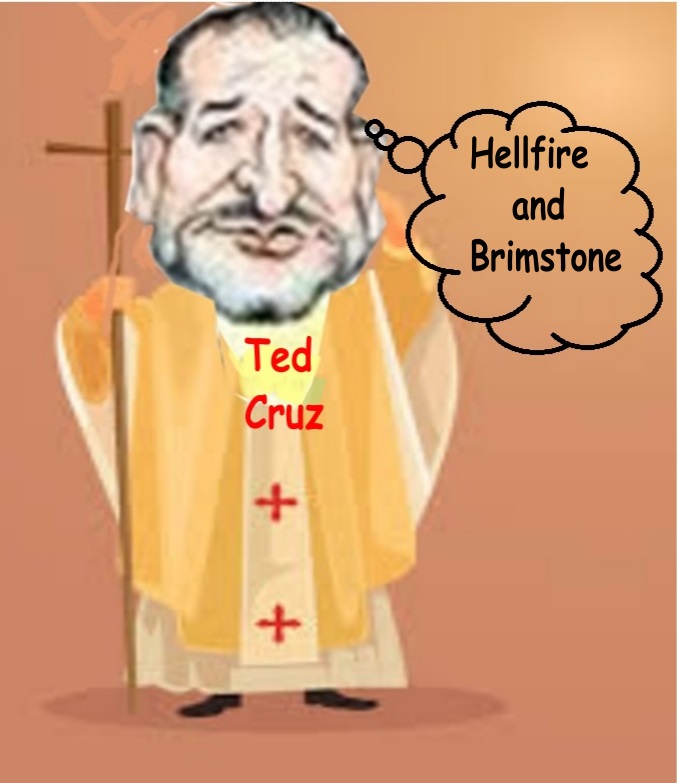
“We are carrying out military strikes today,” Senator Cruz said in an interview.
By Sharon Zhang , Truthout, June 18, 2025, https://truthout.org/articles/ted-cruz-suggests-us-is-involved-in-israeli-strikes-on-iran-despite-us-denials/
Sen. Ted Cruz (R-Texas) was caught stumbling to answer basic questions about Iran and the U.S.’s role in Israel’s war in an eye-opening interview airing Wednesday, despite his full-throated support for overthrowing the Iranian government and deeper U.S. involvement in the fighting.
In clips of the interview with far right provocateur Tucker Carlson posted on social media on Tuesday, the senator alarmingly suggests that the U.S. is, in fact, already heavily involved in Israel’s strikes on Iran.
“We are carrying out military strikes today,” Cruz said. “I said we — Israel is leading them, but we’re supporting them.”
This directly contradicts what federal officials have said about the U.S.’s involvement. The State Department has said that Israel’s strikes are “unilateral,” and directed all embassies and consular posts to reiterate that claim in a cable, CBS reported on Sunday. The cable instructed officials to emphasize to their respective host governments that the U.S. “is not involved in Israel’s unilateral action against targets in Iran and did not provide tanker support.”
This position has not changed in recent days, as the strikes have intensified and President Donald Trump openly mulls becoming more deeply involved in the war. Numerous Trump administration spokespeople claimed on Tuesday that any reports of the U.S. participating in Israeli strikes in Iran are “not true.”
“American forces are maintaining their defensive posture, and that has not changed. We will defend American interests,” said spokesperson Alex Pfeiffer on Tuesday.
The U.S. military is already involved in the conflict. Officials have been open about the U.S.’s defensive positions in helping to strike down missiles fired at Israel.
However, direct U.S. involvement in conducting strikes on Iran, as Cruz suggests is happening, would be a major escalation of the war. Cruz’s statements potentially suggest that the U.S. is actually directly aiding in the bombings, as the Senate is privy to classified information about the military not available to the public.
“You’re breaking news here,” said Carlson. “This is high stakes, you’re a senator. If you’re saying the United States government is at war with Iran right now, people are listening!”
It’s possible that Cruz is suggesting deeper U.S. involvement to push the Trump administration into striking Iran, as many conservative lawmakers have done in recent days — in hopes of pushing the dangerous pipe dream of regime change in Iran.
“I think it is very much in the interest of America to see regime change,” Cruz told Fox News on Sunday. “I don’t think there’s any redeeming the ayatollah.”
Despite his confidence that he could install a better government in Iran, earlier in the interview, Cruz is caught unable to even name basic facts about Iran’s population.
“I don’t know the population,” Cruz says.
“You don’t know the population of the country you seek to topple?” Carlson asks, incredulously. “How could you not know that?”
In a follow up, Carlson says, “okay, what’s the ethnic mix of Iran?”
Cruz hesitates, then says, “they are Persians, and predominantly Shia,” he says, tellingly naming a religious sect rather than an ethnicity. When Carlson asks what proportion of the population is Persian, Cruz becomes incensed.
“I’m not the Tucker Carlson expert on Iran,” Cruz says sarcastically, his voice raised.
“You’re a senator who’s calling for the overthrow of the government!” Carlson exclaims in response.
The exchange highlights a rift among the right over the U.S.’s role in the Middle East. Carlson’s interview circulated widely online for exposing Cruz’s blasé ignorance of the country he wants to wage war against.
However, Carlson, who has consistently allied with white supremacists, himself owes much of his career to the figures who peddled the lies that led to the Iraq War. Early on, Carlson was a proponent of the U.S.’s invasion, and only changed his mind later because of racist beliefs that Iraq and Afghanistan aren’t “worth invading” because “the people aren’t civilized.”
This is, as commentators have noted, a drastically different approach to anti-interventionism from the left’s anti-war and anti-imperialist foundations. And yet, Carlson’s interview caught attention online as the right has sought to capitalize on genuine anti-war sentiment among the public that’s been completely dismissed by the Democratic Party.
What are the nuclear contamination risks from Israel’s attacks on Iran?
By Andrew Macaskill, Federico Maccioni and Pesha Magid, June 21, 2025,
https://www.reuters.com/world/middle-east/what-are-nuclear-contamination-risks-israels-attacks-iran-2025-06-19/
LONDON/DUBAI, June 19 (Reuters) – Israel’s strikes on Iran’s nuclear installations so far pose only limited risks of contamination, experts say. But they warn that any attack on the country’s nuclear power station at Bushehr could cause a nuclear disaster.
Israel says it is determined to destroy Iran’s nuclear capabilities in its military campaign, but that it also wants to avoid any nuclear disaster in a region that is home to tens of millions of people and produces much of the world’s oil.
Fears of catastrophe rippled through the Gulf on Thursday when the Israeli military said it had struck a site in Bushehr on the Gulf coast – home to Iran’s only nuclear power station – only to say later that the announcement was a mistake.
WHAT HAS ISRAEL HIT SO FAR?
Israel has announced attacks on nuclear sites in Natanz, Isfahan, Arak and Tehran itself. Israel says it aims to stop Iran building an atom bomb. Iran denies ever seeking one.
The international nuclear watchdog IAEA has reported damage to the uranium enrichment plant at Natanz, to the nuclear complex at Isfahan, including the Uranium Conversion Facility, and to centrifuge production facilities in Karaj and Tehran.
Israel has also attacked Arak, also known as Khondab.
The IAEA said Israeli military strikes hit the Khondab Heavy Water Research Reactor, which was under construction and had not begun operating, and damaged the nearby plant that makes heavy water. The IAEA said that it was not operational and contained no nuclear material, so there were no radiological effects.
In an update of its assessment on Friday, the IAEA said key buildings at the site were damaged. Heavy-water reactors can be used to produce plutonium which, like enriched uranium, can be used to make an atom bomb.
WHAT RISKS DO THESE STRIKES POSE?
Peter Bryant, a professor at the University of Liverpool in England who specialises in radiation protection science and nuclear energy policy, said he is not too concerned about fallout risks from the strikes so far.
He noted that the Arak site was not operational while the Natanz facility was underground and no release of radiation was reported. “The issue is controlling what has happened inside that facility, but nuclear facilities are designed for that,” he said. “Uranium is only dangerous if it gets physically inhaled or ingested or gets into the body at low enrichments,” he said.
Darya Dolzikova, a senior research fellow at London think tank RUSI, said attacks on facilities at the front end of the nuclear fuel cycle – the stages where uranium is prepared for use in a reactor – pose primarily chemical, not radiological risks.
At enrichment facilities, UF6, or uranium hexafluoride, is the concern. “When UF6 interacts with water vapour in the air, it produces harmful chemicals,” she said.
The extent to which any material is dispersed would depend on factors including the weather, she added. “In low winds, much of the material can be expected to settle in the vicinity of the facility; in high winds, the material will travel farther, but is also likely to disperse more widely.”
The risk of dispersal is lower for underground facilities.
Simon Bennett, who leads the civil safety and security unit at the University of Leicester in the UK, said risks to the environment were minimal if Israel hits subterranean facilities because you are “burying nuclear material in possibly thousands of tonnes of concrete, earth and rock”.
WHAT ABOUT NUCLEAR REACTORS?
The major concern would be a strike on Iran’s nuclear reactor at Bushehr.
Richard Wakeford, Honorary Professor of Epidemiology at the University of Manchester, said that while contamination from attacks on enrichment facilities would be “mainly a chemical problem” for the surrounding areas, extensive damage to large power reactors “is a different story”.
Radioactive elements would be released either through a plume of volatile materials or into the sea, he added.
James Acton, co-director of the Nuclear Policy Program at the Carnegie Endowment for International Peace, said an attack on Bushehr “could cause an absolute radiological catastrophe”, but that attacks on enrichment facilities were “unlikely to cause significant off-site consequences”.
Before uranium goes into a nuclear reactor it is barely radioactive, he said. “The chemical form uranium hexafluoride is toxic … but it actually doesn’t tend to travel large distances and it’s barely radioactive. So far the radiological consequences of Israel’s attacks have been virtually nil,” he added, while stating his opposition to Israel’s campaign.
Bennett of the University of Leicester said it would be “foolhardy for the Israelis to attack” Bushehr because they could pierce the reactor, which would mean releasing radioactive material into the atmosphere.
WHY ARE GULF STATES ESPECIALLY WORRIED?
For Gulf states, the impact of any strike on Bushehr would be worsened by the potential contamination of Gulf waters, jeopardizing a critical source of desalinated potable water.
In the UAE, desalinated water accounts for more than 80% of drinking water, while Bahrain became fully reliant on desalinated water in 2016, with 100% of groundwater reserved for contingency plans, according to authorities.
Qatar is 100% dependent on desalinated water.
In Saudi Arabia, a much larger nation with a greater reserve of natural groundwater, about 50% of the water supply came from desalinated water as of 2023, according to the General Authority for Statistics.
While some Gulf states like Saudi Arabia, Oman and the United Arab Emirates have access to more than one sea to draw water from, countries like Qatar, Bahrain and Kuwait are crowded along the shoreline of the Gulf with no other coastline.
“If a natural disaster, oil spill, or even a targeted attack were to disrupt a desalination plant, hundreds of thousands could lose access to freshwater almost instantly,” said Nidal Hilal, Professor of Engineering and Director of New York University Abu Dhabi’s Water Research Center.
“Coastal desalination plants are especially vulnerable to regional hazards like oil spills and potential nuclear contamination,” he said.
Ford’s nuclear obsession is robbing Ontario of its true clean energy future
Canada’s National Observer Adrienne Tanner, June 19th 2025
Ontario’s Premier Doug Ford just can’t seem to shake his aversion to renewables.
Ford’s new Energy for Generations plan, mapping out energy generation from now to 2050, is laudable for its end goal: to all but end Ontario’s reliance on gas for electricity generation. But its single-minded pursuit of new nuclear power projects is myopic when it comes to solar and wind, the gold standard sources of clean energy.
Ontario is seriously eyeing sites for three even bigger nuclear plants than it already has — “the equivalent of adding about five Darlington Nuclear Generating Stations to the grid,” the report states — with the possibility of even more of them down the road.
As for solar and wind, the plan calls for a modest increase of slightly more than double the small amounts produced now which comprise 11 per cent of Ontario’s power supply. And the clincher: solar and wind will get a boost while nuclear plants are being scaled up, but only for a short while.
Once new nuclear plants are up and running, Ontario actually plans to dial back progress on renewables. It sounds like the province plans to tear down solar installations and wind farms and haul the pieces off to metal recyclers and landfills. And why? On those questions, the plan is silent.
The only hint is a bullseye graphic comparing the amount of land needed for a new nuclear plant compared to the much greater amounts needed to generate the same amount of power from solar or wind. As might be expected from a plan that reads like a pro-nuclear manifesto, there isn’t a single mention of the radioactive waste generated from nuclear power plants and the still-unsolved challenges associated with its disposal.
Like his Alberta counterpart, Premier Danielle Smith, Ford seems almost pathologically opposed to solar and wind energy. From the moment he was elected, Ford made it clear he was not interested in clean technology of any description; he cancelled 750 renewable energy projects, slowed the buildout of electric vehicle charging stations, ended the provincial EV rebate, repeatedly lowered gas taxes and has sided with Enbridge, Ontario’s natural gas provider, at every turn.
He’s budged on EV charging stations recently, probably because failing to build at least some would be a bad look for a province trying to capture EV and battery manufacturing industries. And last year, when it became clear Ontario needed more energy to meet skyrocketing demand, the Ontario government finally opened the door to more solar and wind. Judging by his past record, I would bet that wasn’t Ford’s idea.
…………………………………………. There might be other forces at play causing Ford to favour Big Nuclear over solar and wind. Ford’s government has always been open-minded, shall we say, to the siren songs of business lobbyists, and the nuclear industry is currently in high gear. It could be Ford can only get excited about energy megaprojects with their jobs and potential for federal backing, regardless of the risk and cost. https://www.nationalobserver.com/2025/06/19/opinion/ford-ontario-energy-nuclear-solar-wind?nih=Vf0DQztC-W6YOqBGCjgdMvyuSr-jgXEgtm__lNRKxi0&utm_source=National+Observer&utm_campaign=d7478891e6-EMAIL_CAMPAIGN_2025_06_19_01_16&utm_medium=email&utm_term=0_cacd0f141f-d7478891e6-277039322
EU Needs $280 Billion for Nuclear Energy, And That’s Just the Start

Oil Price.com, By Tsvetana Paraskova – Jun 18, 2025
- The European Union estimates it will require $277 billion in investments for conventional nuclear power expansion by 2050.
- Some EU countries are considering Small Modular Reactors and other advanced nuclear technologies as alternatives or supplements to traditional large-scale nuclear plants.
- The EU is also pursuing nuclear fusion research as a potential long-term solution for energy independence and decarbonization.
The European Union countries planning to expand their nuclear power capacities will need as much as $277 billion (241 billion euros) in investments by 2050, according to Brussels’ estimates.
That’s only the investment needed for the conventional large-scale nuclear reactors currently in the plans of nearly half of the EU member states. The sum doesn’t include investment in Small Modular Reactors (SMRs), Advanced Modular Reactors (AMRs), or microreactors, or investment in nuclear fusion efforts.
Some EU countries are open to returning to nuclear power generation, but only via SMRs and other advanced nuclear energy technology—not conventional large-scale nuclear power plants. These will require additional billions of U.S. dollars in investment.
Delivering the EU’s current plans to boost nuclear energy capacity will require $277 billion (241 billion euros), both for lifetime extensions of existing reactors and the construction of new large-scale reactors, the European Commission said in its latest assessment of nuclear investment needs by 2050.
While the EU’s biggest economy, Germany phased out nuclear power in 2023, some other EU countries see nuclear energy as an important part of their decarbonization, industrial competitiveness, and security of supply strategies.
…………………………………………………… the required investment in SMRs will be in addition to the $277 billion the EU estimates is necessary for large-scale conventional reactors.
So, the price tag of Europe’s nuclear power ambitions will be much higher. While SMRs hold promise, they are unlikely to be deployed commercially before the 2030s, and large-scale conventional reactors are notoriously facing delays and cost overruns.
It’s good to talk: US-UK anti-nuclear alliance forged from film discussion
The NFLAs were delighted to partner with film makers and producers from
the United States in promoting the documentary film ‘SOS – The San
Onofre Syndrome: Nuclear Power’s Legacy’ and by participating in a
discussion last week of the issues raised. NFLA Secretary Richard Outram
joined US filmmakers James Heddle, Mary Beth Brangan and Morgan Peterson
for the discussion on Wednesday 11 June. UK participants were invited to
watch the documentary film before the event and then contribute their
questions and comments. Attendees included academics and activists from
several of the established campaigns opposed to nuclear power in the UK,
and their knowledge and experience helped make the discussion more
engaging.
NFLA 19th June 2025 https://www.nuclearpolicy.info/news/its-good-to-talk-us-uk-anti-nuclear-alliance-forged-from-film-discussion/
Improvements required following Barrow nuclear submarine site fire
The Office for Nuclear Regulation (ONR) has served an enforcement notice
on BAE Systems Marine Ltd (BAESML) following a fire at the
Barrow-in-Furness site in Cumbria. ONR’s enquiries found that five
employees entered an area in the Devonshire Dock Hall facility when the
fire was still in progress on 30 October 2024. As a result, two employees
were taken to hospital for treatment. Both employees were discharged and
returned to work on the same day. Enquiries concluded that the licensee’s
arrangements for ensuring workers did not enter places of danger without
the appropriate safety instructions were inadequate. There was also a lack
of guidance to inform staff of their required actions in the event of a
fire.
ONR 16th June 2025, https://www.onr.org.uk/news/all-news/2025/06/improvements-required-following-barrow-fire/
Trump says US intelligence ‘wrong’ about Iran not building nuclear bomb
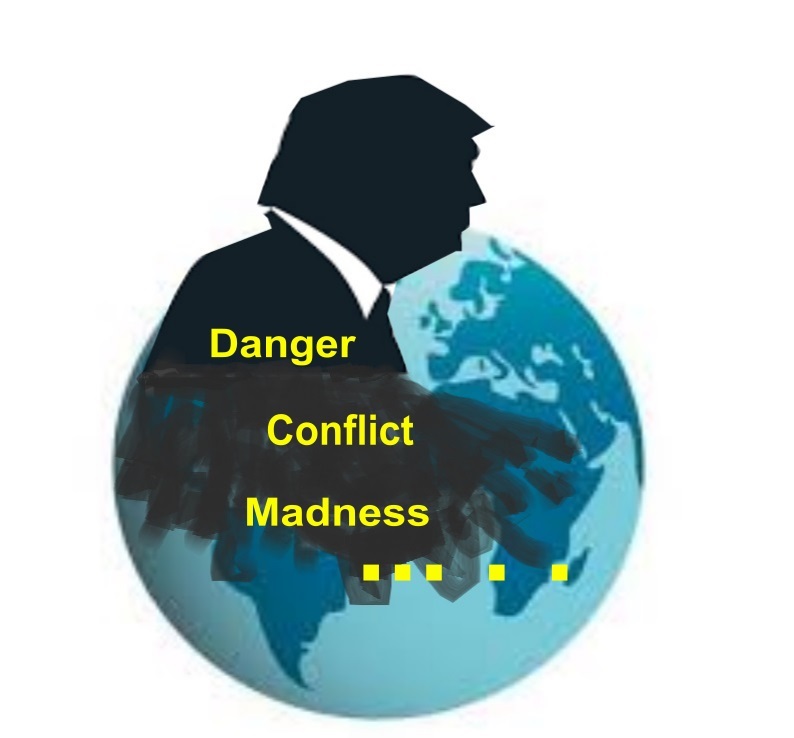
It is extremely rare for a US president to openly contradict the country’s intelligence community.
“This is not just one person, one team saying something,” “It’s the entire intelligence community in the United States. That he would dismiss them … it’s just astounding.”
US president doubles down on claim Iran is building nuclear weapon, again contradicting US intelligence community.
20 Jun 2025, https://www.aljazeera.com/news/2025/6/20/trump-says-us-intelligence-wrong-about-iran-not-building-nuclear-bomb
United States President Donald Trump has said his director of national intelligence was “wrong” when she testified that Iran was not building a nuclear weapon and that Supreme Leader Ayatollah Ali Khamenei had not re-authorised the country’s suspended nuclear weapons programme.
The comments come after Trump earlier this week cast doubt on Tulsi Gabbard’s March 25 report to Congress, in which she reiterated the US intelligence community’s assessment. On Tuesday, Trump told reporters, “I don’t care” that the intelligence community’s finding contradicted his own claims, saying Iran was in the late stages of developing a nuclear weapon.
But speaking on Friday, Trump went further.
A reporter asked, “What intelligence do you have that Iran is building a nuclear weapon? Your intelligence community said they have no evidence.”
The president responded, “Then my intelligence community is wrong. Who in the intelligence community said that?”
“Your DNI [director of national intelligence], Tulsi Gabbard,” the reporter replied.
“She’s wrong,” Trump said.
Gabbard appeared to come to Trump’s defence later on Friday.
“America has intelligence that Iran is at the point that it can produce a nuclear weapon within weeks to months, if they decide to finalize the assembly,” she wrote in a social media post. “President Trump has been clear that can’t happen, and I agree.”
However, that statement does not contradict her earlier assessment that Iran is not building a weapon. No known US intelligence assessment concludes that Iran is weaponising its nuclear programme.
It is extremely rare for a US president to openly contradict the country’s intelligence community, with critics accusing Trump of flagrantly disregarding evidence to justify potential direct US involvement in the fighting, according to Al Jazeera’s senior political analyst Marwan Bishara.
“This is not just one person, one team saying something,” Bishara said. “It’s the entire intelligence community in the United States. That he would dismiss them … it’s just astounding.”
Speaking on Friday, Trump also appeared to downplay the prospect of the US brokering a ceasefire agreement between Iran and Israel, saying he “might” support such a deal, while adding, “Israel’s doing well in terms of war, and I think you would say that Iran is doing less well.”
“It’s hard to make that request right now. When someone’s winning, it’s harder than when they’re losing,” he added.
Reporting from Washington, DC, Al Jazeera’s Heidi Zhou Castro noted that Trump was “really making a point that he’s not going to make an effort to ask Israel to ease up on its aerial bombing of Iranian targets”.
“It seems that Trump is very squarely on Israel’s side as things are progressing, and … it appears that he is not leaning towards the diplomacy route, though, again, he is giving himself that two weeks’ time to make a final decision,” she said.
Trump on Thursday said he would take two weeks to decide the US response to the conflict. Experts say the decision would likely be transformative.
The US is seen as one of the few countries with the leverage to pressure Israel to step back from the brink of wider-scale regional war.
At the same time, the involvement of the US military is seen as key to Israel’s stated mission of completely dismantling Iran’s nuclear programme, which hinges on destroying the underground Fordow enrichment plant.
A successful attack on the facility would require both Washington’s 30,000-pound (13,000kg) GBU-57 Massive Ordnance Penetrator and the B-2 bombers needed to deliver it.
Speaking to reporters on Friday, Trump also downplayed the potential role of European countries in de-escalating the situation. That came hours after Iran’s Foreign Minister Abbas Araghchi met the top diplomats from France, the UK, Germany and the EU in Geneva.
“Europe is not going to be able to help,” the US president said.
Why won’t the BBC report on Israel’s nuclear weapons?

DOES Israel have nuclear weapons? Yes. Will the BBC report that fact?
Apparently not. The broadcaster has quietly updated a story which wrongly
claims the “real answer is we do not know” if Israel has nuclear
weapons.
However, the BBC claim – which relies on the fact that the
Israeli government has not officially acknowledged its nuclear capabilities
– remains even in the updated version of a story purported to offer
answers to readers’ questions on the Iran-Israel conflict.
The National 19th June 2025, https://www.thenational.scot/news/25251643.wont-bbc-report-israels-nuclear-weapons/
1 This Month





PLEASE OPPOSE HR 8255 AND S.3639 – bills would accelerate satellite deployment, with no environmental review or safeguards – https://ncstd5li.quorum.us/campaign/169331/
To see nuclear-related stories in greater depth and intensity – go to https://nuclearinformation.wordpress.com
-
Archives
- October 2026 (10)
- September 2026 (339)
- August 2026 (330)
- July 2026 (355)
- June 2026 (287)
- May 2026 (306)
- April 2026 (356)
- March 2026 (251)
- February 2026 (267)
- January 2026 (308)
- December 2025 (358)
- November 2025 (359)
-
Categories
- 1
- 1 NUCLEAR ISSUES
- business and costs
- climate change
- culture and arts
- ENERGY
- environment
- health
- history
- indigenous issues
- Legal
- marketing of nuclear
- media
- opposition to nuclear
- PERSONAL STORIES
- politics
- politics international
- Religion and ethics
- safety
- secrets,lies and civil liberties
- spinbuster
- technology
- Uranium
- wastes
- weapons and war
- Women
- 2 WORLD
- ACTION
- AFRICA
- Atrocities
- AUSTRALIA
- Christina's notes
- Christina's themes
- culture and arts
- Events
- Fuk 2022
- Fuk 2023
- Fukushima 2017
- Fukushima 2018
- fukushima 2019
- Fukushima 2020
- Fukushima 2021
- general
- global warming
- Humour (God we need it)
- Nuclear
- RARE EARTHS
- Reference
- resources – print
- Resources -audiovicual
- Weekly Newsletter
- World
- World Nuclear
- YouTube
-
RSS
Entries RSS
Comments RSS

