Radioactive water ‘leaked into’ loch from Faslane nuclear base
The investigation uncovered SEPA files revealing that the Navy neglected proper maintenance.
Radioactive water ‘leaked into’ loch from Faslane nuclear base. The
investigation uncovered SEPA files revealing that the Navy neglected proper
maintenance. The Guardian, and The Ferret uncovered the release of
radioactive material into Loch Long, Argyll and Bute, following a six-year
fight to access the files, which involved Scotland’s Information
Commissioner.
Daily Record 10th Aug 2025, https://www.dailyrecord.co.uk/news/scottish-news/radioactive-water-leaked-into-loch-35705786
Russian uranium being used at Sizewell B site in Suffolk.
“It is sheer hypocrisy for energy ministers to say we need new nuclear to stop being dependent on imported Russian energy, when our biggest and newest nuclear plant is fully fuelled by Putin’s uranium.”
East Anglian Daily Times, 11th August, By Will King, Mid Suffolk Reporter
Sizewell B has confirmed it has been using Russian uranium amid criticism of “sheer hypocrisy” while billions of taxpayers’ money is spent on the Ukraine war.
EDF Energy confirmed that Sizewell B’s nuclear fuel supply comes from Russia, but stated that the specific company providing it, MSZJSC, is not subject to sanctions.
Sizewell B provides 3% of the UK’s electricity, and every 18 months, a third of the fuel in the reactor is replaced using recycled enriched uranium using this source.
They said that its presence is due to “long-term commitments struck years before Russia invaded Ukraine”, after a contract was signed by British Energy in 2008.
However, Dr David Lowry, a nuclear policy consultant and former member of the independent advisory panel for the Chief UK Nuclear Safety and Security Inspector, says the fuel is initially mined by Rosatom, a Russian company sanctioned in Febuary 2023, but the company has continued using it.
He says the supply chain begins with the Russian state-owned company before it is sent by its subsidiary, TVEL, to another subsidiary, MSZJSC, before being sent to a factory in Lingen, Germany.
It is here that EDF Energy’s French supplier, Framatom, treats the material and sends the converted nuclear fuel rods to Sizewell B for use.
Dr Lowry said: “It is sheer hypocrisy for energy ministers to say we need new nuclear to stop being dependent on imported Russian energy, when our biggest and newest nuclear plant is fully fuelled by Putin’s uranium.
“We’re giving arms to Ukraine on one side and giving Russia money on the other side for fuel.
……… “Also, these companies are on the British Government’s sanctions list, so EDF Energy should not be doing business with them.”
This comes after this paper has seen documents from a site stakeholder meeting for Sizewell A and B on October 15 2024, attended by members of local parish and town councils, where Robert Gunn confirmed that Russian-supplied uranium was being used at the site.
EDF Energy says that Russian fuel will not be used at Sizewell C, but they have not yet been awarded the uranium contract to provide further details…………………………………………………. https://www.eadt.co.uk/news/25375159.russian-uranium-used-sizewell-b-site-suffolk/
Pete Hegseth Doesn’t Want to Talk About Golden Dome

National missile defense is still impossible—and expensive.
By Tom Nichols. The Atlantic, 8 Aug 25
Donald Trump wants to spend billions of dollars on a successor to President Ronald Reagan’s Strategic Defense Initiative, and he’s calling it “Golden Dome,” inspired by both Israel’s Iron Dome defense and Reagan’s early-1980s concept of a “peace shield” over North America. It’s a hugely ambitious project, but Secretary of Defense Pete Hegseth apparently would prefer that no one talk about it.
This week, military and civilian experts are in Huntsville, Alabama, for the 2025 Space and Missile Defense Symposium, a gathering of more than 7,000 top experts, military officers, and defense-industry representatives from around the world. One might think that such a jamboree is the obvious place to cheerlead for a new American missile-defense plan. But one would be wrong: The Pentagon has barred anyone from speaking about Golden Dome in public. Instead, according to Politico, representatives of the Missile Defense Agency joined a closed meeting that was not part of, or sponsored by, the symposium.
This shyness about discussing Golden Dome is probably part of Hegeseth’s clampdown on Pentagon officials going to meetings at think tanks and attending other public symposia. Still, the choice to go silent at this meeting is strange: Golden Dome is projected to cost gobs of money, and SMDS is exactly the kind of place where the government can tell its story and get science, industry, and the military on the same page…………………..(Subscribers only)…. https://www.theatlantic.com/national-security/archive/2025/08/trump-reagan-golden-dome-missile-defense/683799/?utm_source=firefox-newtab-en-us
To Future Generations: They Knew. They All Knew What Was Happening In Gaza.
Caitlin Johnstone, Aug 09, 2025, https://www.caitlinjohnst.one/p/to-future-generations-they-knew-they?utm_source=post-email-title&publication_id=82124&post_id=170505794&utm_campaign=email-post-title&isFreemail=true&r=1ise1&triedRedirect=true&utm_medium=email
A note to future generations for historical record:
Every pundit, politician and reporter of our time who claims they didn’t know what was happening in Gaza is lying.
They knew what was happening. They knew Israel was telling lies. They knew about everything.
They had access to the same information as all the rest of us. We watched them make excuses and ignore indisputable facts every step of the way. There was absolutely no confusion about what they were looking at. It was all right out in the open.
Don’t let them get away with saying they didn’t know. They knew. They knew the entire time. Brand them permanently with this shame, and force them to carry it with them for the rest of their lives.
I hate all genocide supporters equally, regardless of their religion. Telling me your religion is like telling me about your dreams: it’s completely uninteresting to me. If you support an active genocide you’re a bad person who deserves to be shunned and reviled, regardless of what your religion happens to be.
It’s so wild how Jewish people will just stride confidently into public discourse about Gaza while strongly emphasizing their Jewishness, as though their support for genocide is somehow special and different from any other asshole’s support for genocide. Wanting to starve civilians and mass murder children makes you a piece of shit, whether you are Jewish, Mormon, Buddhist, or atheist.
Nobody cares what religious belief systems you happen to hold in your head while you advocate massacring civilians, they care about the fact that you advocate massacring civilians. Being Jewish doesn’t give you some kind of magical immunity from being held to basic moral standards and being judged by society for supporting a mass atrocity. It’s got nothing to do with anything.
After a whistleblower on the so-called Gaza Humanitarian Foundation named Tony Aguilar shared the heartbreaking story about a boy named Amir who became one of the many Palestinians massacred by Israeli forces while trying to obtain food at an aid site, his family reported that he had been missing since that day and they hadn’t known what had happened to him. They still don’t know where his body is.
The fact that people just “go missing” in Gaza after being killed indicates Israel often buries the bodies of victims to cover up their deaths — something they’ve been caught doing before. This is one of many reasons why we can be sure that the actual death toll is much higher than the official record.
Still can’t believe Israel supporters spent days yelling “Israel isn’t starving children, it’s starving SICK children!” and thought that was an awesome argument.
Friendly periodic reminder that the “Israel bombs hospitals because the hospitals are Hamas bases” narrative was conclusively debunked when IDF soldiers were repeatedly documented entering the hospitals they attacked and destroying individual pieces of medical equipment, one by one. Hamas isn’t the target, healthcare is the target. That has been irrefutably established.
Opposing the Gaza genocide has meant being proven right about everything from the very beginning every step of the way, hating being proven right, and then having the liberals who kept yelling at you for your rightness slowly begin to acknowledge that you were right, while still finding excuses to hate you for being right anyway.
A new poll by the Israel Democracy Institute has found that only 6.7 percent of Jewish Israelis say they are “very troubled” by reports of starvation and suffering in Gaza, with 67 percent saying they are either “not at all troubled” or “not so troubled” by the news. That means those who are pretty much fine with deliberately starving children outnumber those who hold a normal attitude on the matter ten to one.
Poll after poll after poll shows that Jewish Israelis are horrible people who are quantifiably much more cruel and immoral than pretty much any other population. At a certain point you have to stop thinking the polls might be mistaken and see that the only real mistake is Israel.
Meanwhile, Ukrainian support for the war with Russia has plunged even further, with a new Gallup poll finding that just 24 percent of Ukrainians now support continuing the fight until victory. A 69 percent supermajority now say they want peace negotiations as soon as possible.
I get called a Putin-loving cryptofascist vatnik tankie Kremlin agent whenever I say this, but a majority of Ukrainians have wanted this war to end for a while now. At this point the only ones who want more war are westerners, plus some of the Ukrainians who live far away from the fighting.
We’re being told the holocaust in Gaza can’t be ended, and we’re being told the war nobody wants in Ukraine must continue. We are ruled by monsters.
Israeli military plans to occupy Gaza City in major escalation of war
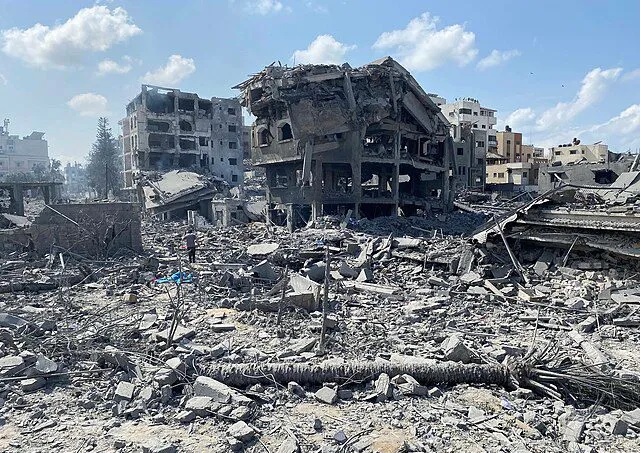
The plan will “take months, lead to the death of the hostages, the killing of many soldiers, cost tens of billions to the Israeli taxpayers, and lead to a political collapse,”
Prime Minister Benjamin Netanyahu suggested earlier that Israel’s military will ‘take control of all Gaza’.
Israel’s security cabinet has approved a plan by Israeli Prime Minister Benjamin Netanyahu for the military occupation of Gaza City, located in the north of the Palestinian enclave.
“The [Israeli military] will prepare to take control of Gaza City while providing humanitarian aid to the civilian population outside the combat zones,” Netanyahu’s office said in a statement early on Friday announcing the takeover plan.
Two Israeli government sources told the Reuters news agency that any resolution by the security cabinet would now need to be approved by the full government cabinet, which may not meet until Sunday.
Occupying Gaza City marks a major escalation by Israel in its war on the Palestinian territory and will likely result in the forced displacement of tens of thousands of exhausted and starving residents who are experiencing famine conditions as Israel continues to block humanitarian aid from entering the territory.
United Kingdom Prime Minister Keir Starmer said Israel’s plan to escalate the assault on Gaza was “wrong”.
“This action will do nothing to bring an end to this conflict or to help secure the release of the hostages. It will only bring more bloodshed,” he said in a statement.
Axios news reporter Barak Ravid, who first reported the security cabinet’s approval of the plan, quoted an unnamed Israeli official as saying the operation will involve the forced displacement of “all Palestinian civilians from Gaza City to the central camps and other areas by October 7”.
“A siege will be imposed on the Hamas militants who remain in Gaza City, and at the same time, a ground offensive will be carried out in Gaza City,” Ravid wrote on X, citing the official.
On Thursday, in advance of the security cabinet meeting, Netanyahu said Israel would “take control of all Gaza”.
In a television interview with US outlet Fox News, Netanyahu also said Israel does not want to be “a governing body” in Gaza and would hand over responsibility to an unspecified third party.
“We don’t want to keep it. We want to have a security perimeter. We don’t want to govern it,” he said.
Netanyahu’s comments followed reports in Israeli media earlier this week that the Israeli leader would imminently announce plans to fully occupy the entirety of the Gaza Strip.
Hamas said Netanyahu’s comments “represent a blatant reversal of the negotiation process and clearly expose the real motives behind his withdrawal from the last ceasefire round, despite our nearing a final agreement.”
“His plans to expand the aggression confirm beyond doubt that he seeks to abandon his own prisoners, sacrificing them to serve his personal interests and extremist ideological agenda,” the group said in a statement.
Israeli opposition leader Yair Lapid said the decision to take over Gaza City was a “disaster that will lead to many more disasters”.
The plan will “take months, lead to the death of the hostages, the killing of many soldiers, cost tens of billions to the Israeli taxpayers, and lead to a political collapse,” he wrote in a post on X.
“This is exactly what Hamas wanted: for Israel to be trapped in the field without a goal, without defining the picture of the day after, in a useless occupation that no one understands where it is leading.”
Shihab Rattansi, Al Jazeera’s correspondent in Washington, DC, said Israel’s move to occupy Gaza has been “telegraphed for several days now”.
“Donald Trump has all but greenlit whatever Benjamin Netanyahu wants to do. He said it would be up to the Israelis,” Rattansi said.
It is unclear how many people still live in Gaza City, the enclave’s largest population centre before Israel’s war on the territory that has now killed more than 61,000 Palestinians since October 2023.
Hundreds of thousands of people fled Gaza City under forced evacuation orders issued by the Israeli military in the opening weeks of the war, but many returned during a brief ceasefire at the start of this year.
A major ground operation in Gaza City could displace many thousands and further disrupt efforts to deliver food to the famine-stricken territory, where almost 200 people have now died from starvation and malnutrition.
“There is nothing left to occupy,” Gaza resident Maysaa al-Heila said on hearing of the planned takeover of the city.
“There is no Gaza left,” al-Heila told The Associated Press news agency.
A Second CANDU Reactor for Point Lepreau? Let’s Ponder.

A new CANDU reactor does not exist. The current reactor at Point Lepreau is a CANDU 6, the same model as the one Hydro-Québec shut down permanently in 2012 and is now in the process of decommissioning. There are no plans to design a new CANDU 6.
August 6, 2025, Susan O’Donnell and Frank Greening, https://www.theenergymix.com/a-second-candu-reactor-for-point-lepreau-lets-ponder/
Over the summer, New Brunswick Premier Susan Holt mused to journalists about building a second CANDU reactor at the Point Lepreau nuclear site on the Bay of Fundy.
“A second CANDU is not far-fetched,” she told the Telegraph Journal. On the weekend, Holt enthused about the idea in a CBC story about the Eastern Energy Partnership pitch to Prime Minister Mark Carney.
A new CANDU reactor for New Brunswick? It’s a puzzling thought, worth pondering.
Let’s put aside for a moment that the current CANDU reactor at the Point Lepreau site is an economic nightmare, its poor performance the main reason NB Power loses money almost every year. Overspends on the original reactor and the rebuild together represent almost two-thirds of NB Power’s nearly $6-billion debt.
Let’s forget that more than 25 years ago in Ontario, the provincial utility Ontario Hydro was similarly effectively bankrupt before it was split up, leaving a $20-billion stranded debt, largely left over from its CANDU nuclear construction program. Ontario taxpayers and ratepayers were left holding the bag for that $20 billion, paying it back on their electricity bills. A recent investigation found that: “In 2050 Ontario will still be paying the debt of the nuclear program of the 1970s and 80s.”
Let’s also try to forget that the New Brunswick government gets its nuclear advice from NB Power (the utility that loses money almost every year), the same utility that in 2018 recommended the province invite two start-up companies from the United Kingdom and the United States that had never built a nuclear reactor to come to New Brunswick and, with their experimental reactor designs, start a new nuclear export industry.
It was a breathtakingly risky recommendation that can most kindly be described as “wishful thinking.” In the seven years since, despite more than $95 million to the companies from provincial and federal taxpayers, their two “advanced” designs for small modular nuclear reactors (SMRs) have failed to attract enough private sector financing and almost certainly will never be built in New Brunswick.
Finally, are we willing to ignore the fact that the Peskotomuhkati Nation never consented to the current CANDU reactor on its homeland at Point Lepreau, has made numerous interventions against plans to put the two SMRs on the site, and is highly unlikely to consent to a second CANDU?
For this ponder, let’s park all those troubling facts and focus on what we know about a potential second CANDU reactor for Point Lepreau.
A new CANDU reactor does not exist. The current reactor at Point Lepreau is a CANDU 6, the same model as the one Hydro-Québec shut down permanently in 2012 and is now in the process of decommissioning. There are no plans to design a new CANDU 6.
AtkinsRéalis (formerly SNC-Lavalin) owns the exclusive rights to design a new CANDU. The engineering firm announced in late 2023 that its new CANDU design is called Monark. So far, the CANDU Monark is a computer model, currently registered with the Canadian Nuclear Safety Commission as in a “familiarization and planning” stage with the start date for regulatory reviews “to be determined”.

Although AtkinsRéalis has released almost no technical details about its proposed design, the company did predict the CANDU Monark’s capacity factor, an important parameter for evaluating a nuclear reactor design. The capacity factor is a measure of efficiency, how often a nuclear reactor (or any other kind of power plant) operates at maximum power output over a specific period.
Predicted capacity factors require years of reactor operation to prove reliability. In 2023, the global average nuclear power plant capacity factor was 81.5%. Predicting a higher average capacity factor would mean AtkinsRéalis believes the CANDU Monark design can produce power more consistently and at a greater percentage of its potential than the average reactor.
This “new” CANDU Monark design has similar features (cooled and moderated with heavy water, similar core channels and heat transport system) to the design of the reactor at the Darlington nuclear site in Ontario, the last CANDU ordered in Canada more than 30 years ago. The lifetime average capacity factor for Darlington’s four CANDU units is 83%, in line with the global average.
Yet a paper sponsored by AtkinsRéalis at the June 2024 conference of the Canadian Nuclear Society claims the annual capacity of the CANDU Monark design is more than 95%, much higher than the global average or the actual number at Darlington.
How does AtkinsRéalis plan to boost this CANDU’s average capacity factor from 83% to 95%? The answer: more wishful thinking!
Now, back to the existing CANDU 6 reactor at Point Lepreau—which is currently, again, closed for repairs, this time for five months. After refurbishment, from the start of 2013 to the end of 2024, its capacity factor was 78%, below the global average. Last year, with a multi-month, unplanned shutdown for a generator repair, the reactor operated at 32% capacity. An investigation by CBC predicts that 2024 may be its worst operational year ever.
Earlier this year, the NB Power CEO said the root of the reactor’s problems can be traced to when the reactor was refurbished from 2008 to 2012. To save money, the plant’s supporting infrastructure was not upgraded, and now that infrastructure is breaking down.
Lack of money is a core constraint for New Brunswick’s nuclear plans. In 2024, another CBC investigation revealed a consultant report that linked the poor performance of NB Power’s nuclear reactor to the fact that since the refurbishment, the utility has not spent nearly enough to maintain it.
The basic problem is that New Brunswick lacks the capacity to operate a nuclear reactor. In addition to a financially stretched utility with a small grid, the province lacks nuclear management expertise.
When the plant reopened in 2012 after refurbishment, NB Power contracted a management team from Ontario Power Generation (OPG). Later, the utility hired a manager living outside the country. He billed the utility for travel expenses from his home to his work in New Brunswick in addition to his salary, a total that reached $1.3 million but delivered no improvement in the reactor’s performance. In 2023, NB Power said goodbye to the American and contracted OPG management again.
Across the globe [pdf], it is hard to find an electrical grid as small as NB Power’s with a nuclear reactor. The International Atomic Energy Agency recommends that: “A single power plant should represent no more than 10% of the total installed grid capacity.” NB Power’s Point Lepreau plant exceeds 15% of its grid capacity, including the energy available under power purchase agreements.
For decades, the utility has had oversized nuclear ambitions. As far back as 1972, a federal Department of Finance official warned [pdf] against subsidizing a power reactor for “a small, high-cost utility with barely enough cash flow to finance its present debt,” calling New Brunswick’s nuclear plans “the equivalent of a Volkswagen family acquiring a Cadillac as a second car.”
The nuclear industry depends on wishful thinking, plus its hubris and supreme confidence that have bamboozled generations of energy ministers and premiers into believing its overblown hype.
So, a second CANDU at Point Lepreau? The Premier would be wise to ignore the promotion and sales puff from NB Power and its nuclear industry friends and review the facts. Follow the money, or in this case, the billions the province has lost so far. A decision to build a second CANDU at Point Lepreau would be not only puzzling, but economically reckless.
Dr. Susan O’Donnell is a social scientist specializing in technology adoption and an Adjunct Research Professor and lead investigator of the CEDAR project at St. Thomas University. Dr. Frank Greening is nuclear research scientist with a PhD in Chemistry, retired from Ontario Power Generation (OPG). This story was first published by NB Media Co-op, and is republished by permission.
1,500 Killed While Seeking Aid in Gaza Since May: UN.

August 5, 2025, https://www.middleeastmonitor.com/20250804-1500-killed-while-seeking-aid-in-gaza-since-may-un/
Around 1,500 people have been killed in Gaza since May while seeking humanitarian aid, the UN said Monday, Anadolu reports.
“The Office for the Coordination of Humanitarian Affairs says that many people reportedly continue to be killed and injured, including people seeking food along the UN convoy routes and militarized distribution points. Some 1,500 people have been reportedly killed since May,” Farhan Haq, UN deputy spokesperson, told reporters.
He added that a health care worker with the Palestine Red Crescent Society was killed Sunday in an Israeli airstrike in Khan Yunus, southern Gaza.
Since May 27, a US- and Israeli-backed aid scheme in Gaza has been widely criticized as being ineffective as well as being a “death trap” for starving civilians.
Asked by Anadolu whether the UN secretary-general believes the UN’s reputation and effectiveness can be salvaged given its failure to stop Israel’s actions, including plans to expand the annexation of Palestinian land, Haq responded: “He certainly does.”
Haq said the UN’s record includes “successful diplomatic negotiations” and humanitarian aid that continues to “keep billions of people alive.” He emphasized that lack of international unity, particularly within the UN Security Council, hinders the organization’s effectiveness.
Gaza’s Government Media Office said Monday that Israel had allowed in just 674 aid trucks since July 27 – only 14% of the strip’s minimum daily requirement of 600 trucks.
It said most of the 80 trucks that entered on Sunday were looted amid what it called “a deliberately engineered climate of chaos and starvation,” accusing Israel of weaponizing hunger to undermine Palestinian resilience.
Rejecting international calls for a ceasefire, the Israeli army has pursued a brutal offensive on Gaza since Oct. 7, 2023, killing nearly 61,000 Palestinians, almost half of them women and children. The military campaign has devastated the enclave and brought it to the verge of famine.
Weekly Briefing: A tipping point for Israel’s legitimacy

Global pressure mounts as Israel chooses famine over peace
By Dave Reed August 9, 2025, https://mondoweiss.net/2025/08/weekly-briefing-a-tipping-point-for-israels-legitimacy/
Israel’s war on Gaza has never been solely about “defeating” Hamas. This week’s reporting makes that clearer than ever. If you read just one article this week, Tareq Hajjaj documents how Israel is engineering chaos in Gaza’s aid system, shooting at desperate civilians, and allowing looters to operate freely so that food does not reach starving people. Qassam Muaddi reports on leaked Israeli cabinet minutes that confirm they deliberately chose starvation as a weapon of war, rejecting a ceasefire in favor of forcing Gaza’s surrender through hunger.
This policy is not hidden. It was discussed from the very beginning, nearly two years ago, and is still openly embraced by senior Israeli figures and the majority of the Israeli population. That brazenness is finally eroding Israel’s legitimacy around the world. The International Sociological Association’s suspension of the Israeli Sociological Society is the latest sign of an expanding academic boycott. In United States politics, Bernie Sanders’s recent resolutions to block weapons sales did not pass, but they showed something important: Palestine is becoming a litmus test inside the Democratic Party, and electeds are starting to respond to the shift in the party’s base on these issues.
At the same time, the rot inside Israel’s political culture is on full display. A new poll shows that seventy-nine percent of Jewish Israelis are not troubled by the famine in Gaza. This normalization of atrocity makes it easier for Israeli leaders to escalate the suffering of the Palestinians there. Netanyahu is now ordering the army to expand the war and reoccupy the entire Strip. There are few defences of this genocidal behavior available to the pro-Israel, anti-Palestinian crowd.
Governments and institutions desperate to protect Israel’s impunity are cracking down even harder on dissent. In the United States, Columbia University’s mass suspensions of Palestine activists and PEN America’s firing of Kori Davis show how institutions are bending to political pressure. Trump’s looming overhaul of the federal workforce threatens to hardwire this repression into the government itself. These are not separate battles. They are part of the same effort to shield Israel and complicit institutions from accountability.
We are witnessing the tipping point that the movement for Palestinian liberation has labored on for decades. Israel’s legitimacy is being contested in more places and by more voices than ever. But breaking its genocide, apartheid, and occupation will depend on escalating the movement across civil society around the world.
Occupation and Slaughter: Netanyahu and Taking Over Gaza

9 August 2025 Dr Binoy Kampmark, https://theaimn.net/occupation-and-slaughter-netanyahu-and-taking-over-gaza/
To say that Israel’s Prime Minister, Benjamin Netanyahu, had lost the plot is to assume he ever had one. With a dearth of ideas as to how to come up with a “final solution” to the Palestinian problem, he has received a majority approval from his cabinet colleagues to take over Gaza City. It took a late-night meeting with the security cabinet lasting some ten hours.
A statement released on the morning of August 8 from his office mentioned a five-point plan intended to defeat Hamas and conclude the war. None of this is an improved version of what has come before: the intended disarming of Hamas, the return of all hostages, demilitarising the Gaza Strip, assuming security control of the territory and creating “an alternative civil administration that is neither Hamas nor the Palestinian Authority.”
There is also not much difference here from recent proposals made by the French President Emmanuel Macron, UK Prime Minister Sir Keir Starmer, and Canadian Prime Minister Mark Carney, with one fundamental difference: the Israelis want no current Palestinian representative authority to govern the people they so loathe. What all the proposals share is a core belief that the Palestinians be reduced to subordinate status, forever policed and monitored by watchful authorities. Their representatives are to be vetted by the Israelis and any number of international partners. Genuine sovereignty can sod off.
The Israeli military has announced that it “will prepare to take control of Gaza City while providing humanitarian aid to the civilian population outside the combat zones.” Little change then given the current model of aid distribution that features daily massacres of the desperate and the starving overseen by trigger itchy personnel from both the IDF and the obscenely named Gaza Humanitarian Foundation. OHCHR, the United Nations human rights office, claims that at least 1,373 Palestinians seeking food have been killed since May 27, 859 in proximity of the GHF’s distribution points. Another 514 have perished along the routes traversed by food convoys.
The UN Human Rights chief Volker Türk has done his best to reiterate a certain ghastly obviousness in the plan. The military takeover “runs contrary to the ruling of the International Court of Justice that Israel bring its occupation to an end as soon as possible, to the realisation of the agreed two-State solution and to the right of Palestinians to self-determination.” The takeover would entail further escalation, resulting in “more massive forced displacement, more killing, more unbearable suffering, senseless destruction and atrocity crimes.”
The IDF’s chief of staff, Lt. General Eyal Zamier, is not a fan of the plan, concerned that itwould do more to imperil the surviving Israeli hostages held in the Strip. The New York Times reports that the country’s military leadership would prefer a fresh ceasefire, with the IDF suffering from the effects of attrition from the conflict. The head of Israel’s National Security Council, Tzachi Hanegbi, is in furious agreement: such an operation would further endanger the surviving Israeli hostages. Mossad’s director, David Barnea, also adds his name to the list of sceptics.
Israeli opposition leader Yair Lapid did not shy away from excoriating the cabinet decision, something he called “a disaster” that would breed further disasters. The far-right figures of Itamar Ben–Gvir and Bezalel Smotrich had “dragged” the Prime Minister into a strategy that would lead to the death of the hostages and Israeli troops while costing billions to the Israeli taxpayer.
An announcement from Hamas proved suitably contemptuous of the latest Netanyahu gambit. “We warn the criminal occupation that this criminal adventure will cost it dearly. It will not be a walk in the park. Our people and their resistance are resilient to defeat or surrender, and Netanyahu’s plans, ambitions, and delusions will fail miserably.” The group also thought it fitting to name the United States as “fully responsible for the occupation’s crimes, due to its political cover and direct military support for its aggression.”
In a turn up for the books for those opposing Netanyahu’s blood-soaked adventurism, some of Israel’s closest allies are going beyond muttering criticism. Modest as it is, Germany has announced that weapons exports to Israel for use in the Strip had been suspended “until further notice.” (Between 2020 and 2024, the country accounted for a third of Israel’s arms imports.) A statement from German Chancellor Friedrich Merz, while acknowledging the usual proviso that Israel had “the right to defend itself against Hamas terrorism,” expressed concern that “even tougher military action by the Israeli army in the Gaza Strip” undermined prospects for releasing the hostages and pursuing negotiations for a ceasefire. Merz further warned that Israel “not take any further steps toward annexing the West Bank.”
For his part, Starmer called Israel’s “decision to further escalate its offensive in Gaza […] wrong, and we urge it to reconsider immediately. This action will do nothing to bring an end to this conflict or to help secure the release of the hostages. It will only bring more bloodshed.”
Türk, if somewhat hollowly, demands an end to the war in Gaza with a rosy vision: an arrangement where Israelis and Palestinians are “allowed to live side by side in peace.” Admirable as this aspiration is, optimistic in its transcendence, it misunderstands the currency of hate and vengeance currently traded in Netanyahu’s cabinet and swathes of the Israeli populace. This is not a matter of side by side, but above and below, living in a state of permanent conflict, suppression and suspicion.
From boots to orbits: Army develops space skills amid growing battlefield reliance on satellites

The service is launching “40 Delta” military occupational specialty to build expertise in space domain operations
by Sandra Erwin, August 6, 2025, https://spacenews.com/from-boots-to-orbits-army-develops-space-skills-amid-growing-battlefield-reliance-on-satellites/?utm_source=ActiveCampaign&utm_medium=email&utm_content=Top stories%3A NASA s commercial space station pivot%2C China tests crewed lunar lander&utm_campaign=SNTW 8%2F8%2F2025
The U.S. Army will begin recruiting soldiers for its first dedicated enlisted specialty in space operations. This is part of a broader push by the service to build organic expertise as satellites become increasingly critical to modern ground warfare….
…The initiative comes as military leaders increasingly view space capabilities as essential to ground operations, driven in part by lessons from the conflict in Ukraine, where electronic jamming, cyber threats and satellite-denied environments have become routine challenges for forces.
HUNTSVILLE, Ala. — The U.S. Army will begin recruiting soldiers for its first dedicated enlisted specialty in space operations. This is part of a broader push by the service to build organic expertise as satellites become increasingly critical to modern ground warfare.
Army officials at the Space & Missile Defense Symposium this week said the 40 Delta (40D) Space Operations Specialist military occupational specialty is moving from planning to implementation, with full operations expected by October 2026.
Lt. Gen. Sean Gainey, head of the Army’s Space and Missile Defense Command, said the service is just weeks away from the official launch of the new specialty. The goal is to “build long-term, institutional knowledge and to retain noncommissioned officers (NCOs) with space expertise,” Gainey said.
The 40D program was approved in December and will begin accepting applications early next year, with selection boards starting in May, according to Command Sergeant Major John Foley, the Army’s senior enlisted leader for space operations. Selected soldiers will receive specialized training in Colorado Springs to become space operations specialists.
The initiative comes as military leaders increasingly view space capabilities as essential to ground operations, driven in part by lessons from the conflict in Ukraine, where electronic jamming, cyber threats and satellite-denied environments have become routine challenges for forces.
Organizational structure
Beyond the new enlisted specialty, the Army is developing what it calls a “space branch” – a professional category similar to existing branches like Infantry, Armor and Artillery. Foley said the space branch would initially encompass about 1,000 enlisted soldiers and officers and would allow space professionals to advocate for programs and resources. The branch is not officially in place yet but should be coming soon, he added.
These organizational changes build on the evolution of the 1st Space Brigade and expansion of “multidomain” task forces, which Gainey identified as significant developments in Army space capabilities. These units have integrated space operations with ground maneuver formations through exercises and collaboration with special operations and cyber elements, giving soldiers hands-on experience in spectrum awareness and techniques to deceive and disrupt adversaries’ satellite use.
The Army’s own labs also have produced weapons like BADGR, a portable system that combines surveillance sensors and jamming devices for electronic attack missions. Brig. Gen. Don Brooks, deputy commander for operations at the Army Space and Missile Defense Command, said five BADGR prototypes have been delivered to Army units based on feedback from ground forces requesting specialized equipment for “electronic attack.”
A joint endeavor, not a turf war
The Army’s push to develop internal space expertise has drawn criticism from some observers who view it as creating a “mini Space Force” that could duplicate the newer service’s mission. Army leaders have pushed back against such characterizations, emphasizing their goal is to cultivate organic space competencies rather than compete with the Space Force.
Army officials argue that having soldiers on the ground who understand space-based assets and can immediately translate satellite data, communication support and threat warnings into real-time action is essential for modern warfare. They contend that waiting for external support, even from an expert service like the Space Force, is often impractical when ground units need instant solutions integrated into their tactical operations.
The Army continues to rely on the Space Force for satellite launches, advanced systems and global networks, but maintains that a land component with skilled space professionals can make the entire joint force more capable and resilient.
Gen. Stephen Whiting, head of U.S. Space Command, offered support for the Army’s approach during remarks at the symposium. “I’m gratified to see that all of our military services are understanding the criticality of space,” Whiting said. “The Army recognizes that for maneuver elements to be successful, that there needs to be soldiers who understand space.”
Whiting emphasized that the Space Force maintains its “global space mission to provide space capabilities to the entire force and also to protect and defend capabilities in the domain,” while acknowledging that “all of our services have real institutional strengths.” Rather than viewing the Army’s efforts as competitive, Whiting said, “I don’t see it as being an overlapping and competitive set of responsibilities … but I do see them being complimentary.”
“Memories that do not heal”: the legacy of uranium mining at Laguna Pueblo.

Following passage of the Radiation and Exposure and Compensation Act expansion, which includes post-1971 miners for the first time, Searchlight spoke with three tribal members whose lives were changed forever by a toxic industry.
SEARCHLIGHT NEW MEXICO, by Aviva Nathan, August 8, 2025
On July 25, I drove to the Pueblo of Laguna to speak with Loretta Anderson, Millie Chino and Vincent Rodriguez, steering members of an advocacy group called the Southwest Uranium Miners Coalition Post-71. Anderson co-founded the organization in 2014 to fight for the expansion of paid benefits — to uranium workers who entered the industry after 1971 — under the Radiation Exposure and Compensation Act (RECA), the 1990 law created to provide financial support to people exposed to radiation from atomic weapons testing as well as the milling, mining and transporting of uranium.
At Laguna, the mines deformed the hills into tiered sites of extraction that are still gray from the uranium. Infrastructure that was built for the mining still remains, now in a state of disrepair. In the wake of mining, what was once a hill collapsed into a contaminated green pond that smells like methane. (The mine in question, called Jackpile Mine, was the largest open-pit uranium mine in the world and operated both underground and open-pit areas.) Anderson’s late husband, Roy Cheresposy, was a miner. Chino lost her husband, James, another miner, in 2023. Vincent Rodriguez was also a miner.
Our conversation took place while we drove around various sites on pueblo land that were affected by mining that happened here between 1953 and 1982. It followed the recent RECA expansion that’s part of President Trump’s One Big Beautiful Bill Act, passed on July 4. This legislation, for the first time, will compensate post-1971 uranium workers, offering a one-time payment of $100,000 to New Mexico workers who meet certain criteria related to exposure and health consequences. Compensation will be overseen by the U.S. Department of Justice (DOJ); the agency has yet to release the new RECA application forms.
The urgent desire of downwinders and uranium workers to be compensated after decades of waiting has been seized upon by lawyers, home health care companies and other third parties that hope to get a slice of the pie for themselves. Already, there has been a cacophony of misinformation and rumors of unlawful solicitation. (For details on how the application process should work, see our sidebar about frequently asked questions.) Right now, it’s difficult to estimate how much will be paid in expanded compensation. Since Reca was first passed, more than $2.7 billion has been awarded.
While potential applicants are in limbo, the physical source of harm remains unattended. The Jackpile Mine, which was declared a Superfund site in 2013, is vacant, but it’s still exposed and quietly lethal. Meanwhile, members of the steering committee have expressed concern that uranium mining could begin again shortly, given the Trump administration’s eagerness to expand uranium mining, which includes efforts to fast-track the opening of mines in New Mexico. Susan Gordon, a coordinator with the Multicultural Alliance for a Safe Environment, adds that further steps are required of companies before they can start mining again in this state.
Land and memory converged as Anderson, Chino and Rodriguez spoke about the history and intimate impact of uranium mining in Laguna Pueblo. The following transcript is edited for clarity and length.
As I drove onto Laguna land, which sits around 50 miles west of Albuquerque, Anderson drove ahead of me and contextualized the landscape over the phone. I’ve added Chino’s comments from a trip on the same roads a few hours later.
Millie Chino: They used to have sheep camps along these hills, years ago before the mining started. But once it started, they couldn’t herd anymore, because of the blasting and all the production going on. Many of our people were farmers and sheepherders and cattle workers.
Lorretta Anderson: There was no acknowledgement of the harm being done by the mines. That’s the terrible part. If you look up at those hills, you can see where the gray clay is. That gray color is uranium.
That was where the mines were. Part of it, anyway. They did do a reclamation at one time, but they only put on a thin layer of dirt. They didn’t clean it up. That dirt all has to have blown away already. The people who did the reclamation are sick. They didn’t have any protective gear.
Chino: On your left, you’ll see the housing area where the supervisors of the mines and their children and families lived. We’ve been told they’re all deceased. Even their children, they died of cancers. My mom worked there as a housekeeper for one of the big shots. Both my parents passed away from radiation diseases.
Anderson: On the right, you can see the arroyo. Now it’s highly contaminated. It’s seeping down the Rio San Jose. Uranium contaminated our Mesita Dam. And there’s a little lake here that’s highly contaminated. That is a hot spot. They don’t know what to do with it. If you stop here, you will see that the horses, cattle and all the animals drink off that area where it’s highly contaminated.
Now we’re entering the village of Paguate. People here are very sick. They’re suffering and dying. The majority of our people were working at the mines. From January 1, 1972, the uranium mining industry just expanded so much, and everybody was employed there at that point. I was living in Seama Village. I live about 11 miles from the mines, down in the valley. I’m in the farthest village, actually. We have six villages in Laguna Pueblo.
We arrived at Chino’s house. In her living room, she read from a poster she’d made.
Chino: These are recollections of my childhood memories, and I’ve titled it, “Memories That Do Not Heal.” The recollections of childhood memories living in Paguate village are of pain, heartbreak and anger. Anger. Uranium mining operations began near our village in the 1950s. A frightening sound became an everyday event. A dynamite blasting happened at least twice per day. When the blasting occurred, everything vibrated. The village shook. The houses built with rock and mud were affected by the vibrations. The pictures that hung on the walls fell.
As children, we were so curious and excited by the loud explosive booms coming from the uranium mine. We figured out the blasting schedule. We gathered at the edge of the village to observe the huge billowing of dust clouds after the blast. The clouds of dust drifted over the village and settled on everything. Women dried fruit and meat outside their homes. Families ate the contaminated food, not knowing the eventual consequences. Years passed. The continued blasting caused cracks in the walls of homes. The outdoor oven walls cracked. The women could not bake bread, roast corn or cook. Today, there are no ovens to be used as they once were. They are in disrepair. As mining operations continued, miners and community members were exposed to the toxic environment.
The Jackpile Mine closed in 1982. Since then, we’ve lived with the knowledge that many community members are sick and dying from cancers. Kidney and respiratory diseases. My beloved spouse, a Vietnam veteran, parents and other relatives passed away from the uranium diseases. These are memories of my childhood growing up in the village so near to the uranium mine.
Anderson: Once you disrupt uranium — and the government knew this — you can’t do anything to stop it from contaminating people. You just open up a porthole of illnesses and diseases. And that’s what our people are suffering from right now. They don’t know how to stop the contamination. There’s nothing they can do. It’s awful. It’s headed down the Rio San Jose, which is going toward Albuquerque and Las Lunas and Belen. And they can’t stop it.
They only have given us until 2027 to file RECA claims. That’s not enough time. Right now, I’m working with over 500 living miners, trying to get them going. We have all these attorneys and home health care groups that are causing so much havoc throughout the community. I told people: Don’t answer them. Do not give out your information. The city of Grants right now is just craziness.
We had a meeting recently and went through everything — and we told everybody to hold off. Our people are calling me asking how to apply, and to get tested, but right now the Radiation Exposure Screening and Education Program at the University of New Mexico is just swamped, because so many people are trying to get tested. I’m telling everyone to get a disc and a radiology report from their doctor, and then we can have the pulmonologist from RESEP read it, so he can do a B-read, in which a diagnosis is made from looking at an X-ray, to determine if miners qualify for compensation………………………………………………………………………………………………………………………………… https://searchlightnm.org/radiation-exposure-compensation-act-expansion-trump-one-big-beautiful-bill-act-new-mexico-laguna-pueblo-uranium-miners-jackpile/?utm_source=Searchlight+New+Mexico&utm_campaign=5a9ee266ce-8%2F8%2F2025+%E2%80%93+%E2%80%9CMemories+that+do+not+heal%E2%80%9D&utm_medium=email&utm_term=0_8e05fb0467-5a9ee266ce-395610620&mc_cid=5a9ee266ce&mc_eid=a70296a261
How industry is positioning itself for the giant Golden Dome budget.

…What emerges from these individual fundraising rounds, tests and production increases…is companies who see a generational windfall…
.
| PART 3 | AUGUST 6, 2025 |
Welcome to the third part of our four-part newsletter series on the funding, technology and mission of the Golden Dome missile defense initiative, where we break down the highly ambitious space-based military program, from its history to its planned architecture to its budget and to the role of AI. We’ll keep you up to date on what stands to become one of the most expansive military defense systems in United States history.
Today, we’ll talk more about industry’s visions for Golden Dome, and how some companies are already positioning themselves to win Pentagon contracts.
Almost immediately after President Donald Trump announced the idea that came to be known as Golden Dome, space and defense companies started making their case for how their technology could be a fit for the program.
| As a result, industry officials have several visions for what Golden Dome might include and how it might work. While Gen. Michael Guetlein, recently appointed program manager for Golden Dome of America, only recently kicked off a 60-daysprint to deliver an architecture, some of the pitches and procurements already out there may offer ideas on the range of possibilities and the technologies involved. |
| Many of the defense industry’s largest players have started touting a vision for Golden Dome. Among them: L3Harris is touting its history and pedigree to develop part of the system. The company has built a missile-tracking satellite that successfully demonstrated the ability to track a hypersonic missile from space, the Missile Defense Agency confirmed April 25. L3Harris has also recently expanded its manufacturing capabilities, ramping up its ability to produce infrared sensing payloads — a central technology for the Golden Dome missile-defense shield that relies heavily on space-based capabilities. In addition, the company announced plans to leverage its AI partnerships with Palantir and Shield AI in the interest of securing Golden Dome contracts. And in July, L3Harris named Rob Mitrevski, who recently oversaw the company’s expansion of infrared sensor payload production capacity, as president of Golden Dome strategy and integration — signalling the company’s intent to steer its growing portfolio of work on Golden Dome. |
Northrop Grumman, too, is discussing its experience as a lead contractor for the Space Development Agency’s Tracking Layer. In a recent interview with SpaceNews, Raymond Sharp, vice president of Northrop Grumman’s missile defense solutions business unit, said the company is “all in” on Golden Dome, and hopes to cement a systems-integrator role that goes beyond supplying components. The company would incorporate modular networking technologies that it’s already developed for other military contracts into Golden Dome concepts to demonstrate “plug-and-play” integration — a key requirement for a system expected to absorb a range of sensors, weapons and decision-support software from across the industrial base.
Northrop also intends to offer components — in a second-quarter earnings call, CEO Kathy Warden said the company is significantly ramping up solid rocket motor production and plans to offer a space-based interceptor concept soon, saying that ground-based tests are already happening. During an Aug. 5 meeting with reporters, Northrop Grumman executives said the company’s billion-dollar investment in solid rocket motor production facilities put the company in a strong position to capitalize on the demand likely to be generated by Golden Dome.
Similarly, Lockheed Martin announced it hopes to conduct orbital tests of space-based interceptors, which is thought to be a key part of Golden Dome, in 2028. However, the company has not clarified whether those interceptors will rely on kinetic or directed energy weaponry and probably won’t announce those details until an architecture is released.
| Booz Allen Hamilton unveiled a concept for a megaconstellation of 2,000 smallsats operating as an artificial intelligence-powered network that the company is calling “Brilliant Swarms.” The company said the satellites would serve as both detection systems and as “kill vehicles” that would de-orbit targets by physically slamming into them — no space-based missiles required. The project is also expected to attract disruptors to the Pentagon’s business. Reutersreported in April that executives from SpaceX, Anduril and Palantir met with the Trump administration to pitch a Golden Dome architecture that involves a constellation of 400 to 1,000 missile detecting and tracking satellites and another constellation of 200 attack satellites that would target and disable missiles with lasers or with missiles of their own. The trio is reportedly being considered a frontrunner for Golden Dome, though SpaceX CEO Elon Musk disputed Reuters’ claims and those reports came prior to the public dissolution of Trump and Musk’s relationship. More recently, Reuters reported that the administration is looking to expand the companies involved in Golden Dome to reduce reliance on SpaceX. Officials have reached out to companies like Amazon, Rocket Lab and Stoke Space about participating in the effort in an attempt to reduce the role SpaceX would play. |
At the same time, more traditional space companies are also now seeing a potential lane for defense work. For example, Voyager is working to paint a clear line between the technology it’s already been building and the presumed needs for an advanced missile defense system. Voyager plans to offer up its propulsion technology — the company has developed a solid propulsion roll control system designed to stabilize a missile’s flight trajectory — to Golden Dome. Voyager has also pitched edge computing systems it’s developing in partnership with Palantir.
Redwire, which includes spacecraft, sensors and digital engineering systems, is also offering up many of its core technology for Golden Dome.
Top-down visions
Some aspects of what will become Golden Dome are likely already underway; last week we mentioned that BAE Systems had won a $1.2 billion Space Force contractfor 10 medium Earth orbit missile (MEO) tracking satellites. The satellites will become part of the Resilient Missile Warning Tracking Epoch 2, which marks the second phase of the Space Force’s program to develop a missile-tracking network in MEO. The constellation is intended to help defend against evolving missile threats, particularly hypersonic weapons that have become a key focus for U.S. defense planners, and as a result will be integrated into the overall Golden Dome project.
| Several other space industry firms are presenting themselves as capable of handling the work necessary for building the Golden Dome. Take Rocket Lab, which in recent months took several steps to expand into the military sector and pursue coveted status as a prime contractor for the Pentagon and a worthwhile partner for high-value contracts. Those steps include a $275 million acquisition of Geost, which produces electro-optical and infrared (EO/IR) sensor payloads that are already used in U.S. military satellites, with plans for more acquisitions down the road. |
| Other companies have been busy raising funds or ramping up their own capabilities, such as Sophia Space, which raised $3.5 million in pre-seed funding to develop orbiting data centers, which it hopes to demonstrate as useful for Golden Dome through a memorandum of understanding with Axiom Space. Apex recently raised money in a $200 million Series C, which it will use to increase satellite bus production — similarly arguing that they would be useful for missile defense. And Quantum Space raised $40 million to develop its national security-focused Ranger spacecraft, also hiring to its executive team former Defense Department official Richard Matlock, who previously worked in missile defense. What emerges from these individual fundraising rounds, tests and production increases — whether it’s Virgin Galactic’s work on suborbital spaceplanes or Ursa Major’s contract to test a hypersonic-capable engine — is companies who see a generational windfall. |
Uncertainty about the scope of Golden Dome translates to uncertainty about which firms and which technologies will make their way into the program. It also means it’s way too early to guess who the winners will be. But with the size of Golden Dome’s $25 budget, many space companies will look to show off their capabilities.
follow all our coverage at SpaceNews.com,
$10 billion, 10 year US Army contract elevates Palantir to defense contracting royalty.

Crashes the multibillion-dollar DoD party alongside Boeing, Lockheed, and Raytheon.
Brandon Vigliarolo. Fri 1 Aug 2025 , https://www.theregister.com/2025/08/01/palantir_us_army_contract/
There are no official criteria for what constitutes membership in the upper echelon of the US military industrial complex, but a $10 billion deal that consolidates dozens of contracts under a single blanket purchase agreement sure makes it seem like Palantir has earned entry.
The US Army announced on Thursday that, rather than continue to buy Palantir products on one of 75 different contracts the branch has with the data analytics software company, it’s awarding a ten-year Enterprise Agreement (EA) with the aforementioned cap of $10 billion. Like a standard blanket purchase agreement, the deal allows the Army to buy what it needs from Palantir over the course of a decade.
It doesn’t appear that the Army is awarding Palantir any new contracts based on the press release or a procurement notice published about the contract in May. According to that document, the Army had figured out that it’s doing so much business with Palantir over so many separate procurement actions that it’s wasting a lot of time and money.
“Consolidating these efforts under an EA will streamline future modifications and task orders under a single set of ordering instructions and terms and conditions,” the May publication pointed out. “Instead of managing dozens of contracts with varying terms, the government will empower a single team to manage the contract.”
With 75 active contracts between the Army and Palantir, it’s nearly impossible to track down what exactly the Army is using from Palantir, though we do have some ideas.
Palantir won its first major defense contract from the Army in 2019 when it scored $800 million to work on new battlefield intelligence software for the branch. It also scored contracts to build things like mobile battlefield intelligence trucks, and the Pentagon tapped it to develop the Maven Smart System after Google backed out of the deal following employee protests.
More broadly, Palantir offers various data analytics tools and suites, any number of which may be in use.
Beyond the US Army and the DoD, Palantir has also worked with US Immigration officials to develop deportation software, at the IRS to help it with new software initiatives, and even at US-backed mortgage broker Fannie Mae, where the company’s code has been put to use detecting fraud.
Palantir has found itself in US President Donald Trump’s good graces thanks to CEO Alex Karp’s previous comments about his opposition to “woke” ideology, support for DOGE, and comments about “powering the West to innate superiority.” This latest contract will likely do little to assuage conspiracy-minded fears that Palantir is gobbling up and monetizing government data for the benefit of Trump and a coterie of right-wing billionaires.
By scoring an EA, Palantir finds itself in the company of defense contractors like Boeing, Northrop Grumman, and Lockheed Martin – an elite club, to be sure.
Palantir declined to comment on this story beyond pointing to the Army press release, while the US Army didn’t immediately respond to questions.
Fire safety improvements required at Dungeness A

Sam Williams, 7 Aug 25, https://www.kentonline.co.uk/romney-marsh/news/fire-safety-improvements-required-at-power-station-328268/
Fire safety failings have been uncovered at a nuclear site in Kent, prompting a formal enforcement notice from the UK’s watchdog.
The Office for Nuclear Regulation (ONR) issued the notice to Nuclear Restoration Services (NRS) following inspections at its Dungeness A site on Romney Marsh.
Inspectors identified several safety shortfalls in the Fill House facility, a building used to retrieve and manage nuclear waste.
According to the ONR, issues were found with the site’s risk assessment, fire safety protocols, firefighting arrangements, and fire detection systems.
Tom Eagleton, ONR superintending inspector, said: “Fire safety is important in order to protect workers and the public, and we expect the necessary standards to be maintained at all times.
“This enforcement notice sets out the specific improvements that must be made by NRS to ensure adequate fire safety provisions are in place.
“We will continue to monitor NRS’ progress in addressing these issues in line with the relevant legislation.”
The enforcement action has been taken under the Regulatory Reform (Fire Safety) Order 2005. NRS has been given a deadline of September 30, 2025, to rectify the problems and meet the required standards.
Israel Preparing To Escalate Military Offensive in Gaza
An Israeli official said Netanyahu is pushing for ‘the release of hostages as part of a military resolution’
by Dave DeCamp | August 3, 2025 https://news.antiwar.com/2025/08/03/israel-preparing-to-escalate-military-offensive-in-gaza/
The Israeli military is drawing up plans to escalate its genocidal war in the Gaza Strip that will soon be presented to Israeli political leadership, Haaretz reported on Sunday.
An Israeli official said Israeli Prime Minister Benjamin Netanyahu “is pushing for the release of hostages as part of a military resolution,” and he is set to discuss the matter with his cabinet on Tuesday. According to the Haaretz report, the idea is to extend ground operations into sensitive areas, including Gaza’s central refugee camps, where Israeli captives are believed to be held.
Israeli officials are now claiming that Hamas doesn’t want a deal, even though the group has long said it is willing to release all remaining Israeli captives in exchange for a permanent ceasefire. Officials are pointing to Hamas’s denial of a claim by US envoy Steve Witkoff, who said the group was willing to disarm. Hamas responded that it would only give up its weapons if an independent Palestinian state were established.
Witkoff was in Israel on Friday and Saturday and met with family members of Israelis being held in Gaza. He told them that President Trump no longer seeks a temporary ceasefire deal but wants a comprehensive one that will free the remaining 20 living Israeli captives. However, Netanyahu hasn’t shown interest in a deal, and there’s no sign that Trump is willing to put pressure on him.
The family members of Israeli captives in Gaza want a diplomatic solution and are against military escalation. The Hostages and Missing Families Forum has criticized the reported plans for the expansion of military operations, warning that “expanding the war endangers the lives of the hostages, who are already in immediate danger of death.”
Netanyahu claimed on Sunday that the videos of two emaciated Israeli captives released by Hamas and Palestinian Islamic Jihad (PIJ) show that Hamas “doesn’t want a deal” and vowed that he would work to “eliminate” the Palestinian group. For its part, Hamas insisted that the Israeli prisoners eat “what our fighters and our people eat” and said that the Red Cross could deliver aid to them if Israel permanently opened humanitarian corridors and halted airstrikes during aid deliveries.
Israel has been under significant international pressure to allow more aid into Gaza as Palestinians are starving to death due to its blockade. The Haaretz report said that the US and Israel appear to be moving toward expanding Gaza Humanitarian Foundation (GHF) distribution points in north Gaza, which would require Israel to occupy more territory.
Nearly 1,000 Palestinians have been killed by the IDF near GHF distribution sites, according to the UN. Anthony Aguilar, a retired US Army Green Beret who worked at GHF sites, has blown the whistle on the operation and says that the sites were designed purposely so Palestinians seeking aid would have to walk through combat zones where they can be killed. He said that he witnessed the IDF commit war crimes by firing into crowds of hungry civilians.
Despite the massacres near GHF sites, the operation has received a resounding endorsement from the Trump administration. On Friday, Witkoff and US Ambassador to Israel Mike Huckabee visited a GHF site, a move that was criticized as a PR stunt.
1 This Month




PLEASE OPPOSE HR 8255 AND S.3639 – bills would accelerate satellite deployment, with no environmental review or safeguards – https://ncstd5li.quorum.us/campaign/169331/
To see nuclear-related stories in greater depth and intensity – go to https://nuclearinformation.wordpress.com
-
Archives
- September 2026 (330)
- August 2026 (330)
- July 2026 (355)
- June 2026 (287)
- May 2026 (306)
- April 2026 (356)
- March 2026 (251)
- February 2026 (267)
- January 2026 (308)
- December 2025 (358)
- November 2025 (359)
- October 2025 (375)
-
Categories
- 1
- 1 NUCLEAR ISSUES
- business and costs
- climate change
- culture and arts
- ENERGY
- environment
- health
- history
- indigenous issues
- Legal
- marketing of nuclear
- media
- opposition to nuclear
- PERSONAL STORIES
- politics
- politics international
- Religion and ethics
- safety
- secrets,lies and civil liberties
- spinbuster
- technology
- Uranium
- wastes
- weapons and war
- Women
- 2 WORLD
- ACTION
- AFRICA
- Atrocities
- AUSTRALIA
- Christina's notes
- Christina's themes
- culture and arts
- Events
- Fuk 2022
- Fuk 2023
- Fukushima 2017
- Fukushima 2018
- fukushima 2019
- Fukushima 2020
- Fukushima 2021
- general
- global warming
- Humour (God we need it)
- Nuclear
- RARE EARTHS
- Reference
- resources – print
- Resources -audiovicual
- Weekly Newsletter
- World
- World Nuclear
- YouTube
-
RSS
Entries RSS
Comments RSS

