Trump Pauses All Military Aid to Ukraine

The pause applies to weapons that are already in transit
by Dave DeCamp March 3, 2025, https://news.antiwar.com/2025/03/03/trump-pauses-all-military-aid-to-ukraine/
President Trump has paused all military aid to Ukraine, Bloomberg reported on Monday, citing a senior Pentagon official.
The pause applies to all US military equipment bound for Ukraine that’s not currently in the country, including weapons that are in transit on aircraft and ships or waiting in Poland to be delivered.
The Pentagon official said the US was pausing all military to Ukraine until the country’s leadership demonstrates a good faith commitment to peace. A senior Trump administration official told Fox News, “This is not permanent termination of aid, it’s a pause.”
The move comes a few days after Ukrainian President Volodymyr Zelensky clashed with President Trump and Vice President JD Vance in the Oval Office, an argument that started after Zelensky questioned the administration’s push for diplomacy with Russia.
News of the pause comes after reports said the Trump administration was holding a meeting on Monday afternoon on the possibility of pausing military aid to Ukraine. Before the meeting, the US had already frozen weapons sales to Ukraine under the State Department’s Foreign Military Financing program, which only accounted for a small portion of the US weapons supply to Ukraine.
While the Trump administration hasn’t approved any new military aid for Ukraine, President Biden signed off on a massive number of arms packages during his final months in office that would take years to deliver.
The aid approved by Biden came in two forms: the Presidential Drawdown Authority (PDA), which ships weapons straight from US military stockpiles, and the Ukraine Security Assistance Initiative (USAI), which allows the Pentagon to purchase arms for Ukraine.
US poised to house nuclear weapons in Britain for first time in two decades

Mothballed bunkers in Suffolk undergo extensive upgrade as America eyes ‘special weapons’ sites
US nuclear weapons could be set to return to British soil almost two decades after Washington removed its last warheads, satellite images have revealed.
The images, published in a report from the Federation of American Scientists (FAS), indicate that 22 previously mothballed nuclear bunkers at RAF Lakenheath in Suffolk have
undergone extensive upgrade work. A decision to reactivate Lakenheath’s
nuclear capability for US aircraft was made as long ago as 2021, the report
suggests, with the proposals gathering force following Russia’s invasion
of Ukraine three years ago.
Telegraph 4th March 2025, https://www.telegraph.co.uk/business/2025/03/04/us-readies-british-air-base-house-nuclear-weapons/
Keir Starmer faces backbench rebellion over ‘shortsighted’ cuts to aid budget
Keir Starmer is facing a backbench revolt by Labour MPs this week as anger
mounts over the government’s decision to cut the international
development budget by almost half in order to pay for an increase in
defence spending.
The Labour chair of the all-party select committee on
international development, Sarah Champion, who has already called on the
government to rethink the decision, has secured a debate in the Commons on
Wednesday at which dozens of Labour backbenchers are considering
intervening to express their dismay. One of those who may speak out,
according to colleagues, is Anneliese Dodds, who resigned as international
development minister on Friday.
Guardian 2nd March 2025, https://www.theguardian.com/politics/2025/mar/02/keir-starmer-faces-backbench-rebellion-over-shortsighted-cuts-to-aid-budget
Conservatives’ push to identify ‘suitable sites’ for nuclear reactors in Telford and Wrekin is defeated.
A Conservative move to get Telford and
Wrekin’s local plan to ‘identify suitable sites’ for small nuclear
reactors was defeated as the borough’s all important development
blueprint moved to the next stage.
Shropshire Star 3rd March 2025 https://www.shropshirestar.com/news/2025/03/03/conservatives-push-to-identify-suitable-sites-for-nuclear-reactors-in-telford-and-wrekin-is-defeated/
Zelensky needs to go …been risking nuclear war far too long

Walt Zlotow, West Suburban Peace Coalition, Glen Ellyn IL, 2 Mar 25
Ukraine President Volodymyr Zelensky is a spectacularly failed leader. He’s failed on every indicator of good governance.
He failed the largely Russian cultured Ukrainians in the Donbas who overwhelmingly voted him for president in 2019. He promised he’d end the war on them by their own government after the 2014 coup toppled elected pro Russian President Victor Yanukovych. Once in office Zelensky caved to the ultra-nationalists who wielded the real power in Kyiv. The war on the Donbas separatist movement escalated under Zelensky. He massed 60,000 elite troops on the Donbas border to complete destruction of the separatist movement. Guess what that provoked February 24, 2022?
He failed by continuing his predecessors’ desire to join NATO, knowing full well Ukraine in NATO crossed a red line Russia viewed as an existential security threat. That made the February 22, 2022 Russian invasion even more inevitable.
Two months into the war he failed to conclude a peace treaty with Russia in April, 2022 that was about to be signed. He allowed US and UK war hawks bully him into rejecting the settlement which would have cost Ukraine nary a square mile of territory. He swallowed whole their delusion he could win the war with US weapons but not US cannon fodder Now he’s lost about 45,000 square miles for caving to his US/UK masters of war..
Worst of all, Zelensky failed the most important responsibility of any leader: do nothing that could risk nuclear annihilation. He’s spent the entire 3 years of war asking, begging, demanding the US give him the weaponry to attack deep inside Russia. He appears oblivious how easily such attacks could trigger nuclear war between the US and Russ
Astoundingly, when an errant Ukrainian missile killed a couple of Poles in Poland, Zelensky claimed that represented a Russian attack on NATO requiring an immediate NATO military response. Hello WWIII. That alone made Zelensky unfit to serve another day as Ukraine leader.
With the US proxy war on Russia lost and Ukraine in ruins, Zelensky’s failed days in power are dwindling. His exit cannot come soon enough.
Ageing nuclear plant in Florida at risk from climate crisis, advocates warn

we also have to consider the risks of climate on the plants. “We have to be clear-eyed about those risks, and we have to be elevating, fortifying, preparing these plants for storms, for floods, for sea level rise, for drought, and for heat.”
Guardian, Richard Luscombe , 2 Mar 25
Regulators extended the life of two of the oldest US reactors in Miami. Millions of people in the area are now vulnerable
A decision by regulators to extend the life of two of the oldest reactors in the US decades beyond their original permits has elevated the risk of a nuclear disaster in heavily populated south Florida, environmental groups are warning.
The Miami Waterkeeper says the ageing Turkey Point facility in south Miami-Dade county, which was built in 1967 and generates power for a metropolitan area covering about 3 million people, is especially vulnerable to flooding and excessive heat from the climate emergency, in part because of its low-lying position and coastal exposure to a major hurricane.
One of the major risks, the group told a packed public meeting in Miami this week, is contamination of drinking water in the Biscayne Aquifer on which the plant and its two nuclear units sit.
Consultants said last month that the plant’s owners, Florida Power & Light (FPL), will not meet a crucial deadline to clean up a toxic hyper-salinated water plume produced in the reactors’ network of cooling canals that has been creeping closer to freshwater wells.
More generally, the activists fear the potential consequences of an unprecedented decision by the Nuclear Regulatory Commission (NRC) to extend Turkey Point’s operating license to 2053, a reversal of its earlier refusal.
They point out that the Florida plant’s two nuclear power reactors are already among the oldest of 94 currently operating in the US, and beyond the age of both the Three Mile Island reactor in Pennsylvania that suffered a partial meltdown in 1979 in the country’s worst nuclear accident and radiation leak; and Ukraine’s Chornobyl plant, site of the 1986 catastrophe.
Turkey Point is also the same age as the Fukushima Daiichi plant in Japan, which is similarly located on a coastline exposed to severe weather events, and where a 2011 earthquake and tsunami triggered a nuclear disaster.
“Nobody needs to be reminded what a worst-case scenario looks like, but I will say this plant is within 30 miles of millions of people,” said Rachel Silverstein, the chief executive of Miami Waterkeeper, which has worked with Friends of the Earth and the Natural Resources Defense Council on legislation to try to block the license extension.
“Turkey Point was the first reactor in the country to apply to run for a total of 80 years, and no one in the world has ever run a nuclear power plant for 80 years. They all came online in the early 1970s and have gone through their first license extensions into the 2030s, more or less.
“Now, because the world is looking for low-carbon energy sources, we’re looking into extending the operating license of all of these plants into the coming decades. Our position is not anti-nuclear, but if we’re going to rely on nuclear in the coming decades as a primary source of energy that’s going to help us address climate risks, we also have to consider the risks of climate on the plants.
“We have to be clear-eyed about those risks, and we have to be elevating, fortifying, preparing these plants for storms, for floods, for sea level rise, for drought, and for heat.”
Silverstein’s group has partnered with the Miccosukee Tribe of Indians of Florida, whose ancestral homelands cover much of south Florida, to appeal the NRC’s decision allowing Turkey Point to become the first to test the outer limits of its “80-year rule” for license extensions for nuclear power reactors.
They argue that the regulators failed to properly acknowledge a critical report from the Government Accountability Office published last year that stated climate change “was expected to exacerbate natural hazards that pose risks” to Turkey Point.
The report also noted that, instead of issuing a citation or fines, the regulators’ response to FPL’s breach of the maximum allowable cooling water temperature of 100F (38C) during an incident in 2014 was to raise the acceptable figure to 104F, the amount of the overage.
Environmentalists, meanwhile, insist the true operational lifespan of nuclear power generating facilities is far below the NRC’s eight-decade guideline, and point to data showing that among US plants built before 1973, half were decommissioned within 40 years.
According to the New Hampshire-based Seacoast Anti-Pollution League: “In most cases the plants simply wore out, broke down, or never functioned properly.”…………………………………… https://www.theguardian.com/us-news/2025/mar/01/nuclear-power-plants-miami-florida?fbclid=IwY2xjawIweO1leHRuA2FlbQIxMQABHWBZlpSR5NRSL4LqL1lZ0b75I0XzH-D6EPnvsLdoGDbj9-XZOy6MV4–YQ_aem_3Qx31WNB3HCZKhro973QUQ
Techno-Fascism Comes to America

American techno-fascism is no longer a philosophical abstraction for Silicon Valley to tinker with, in the vein of intermittent fasting or therapeutic ketamine doses. It is a policy program whose constitutional limits are being tested right now as DOGE, staffed with inexperienced engineers linked to Musk’s own companies, rampages through the federal government.
Silicon Valley is premised on the idea that its founders and engineers know better than anyone else: they can do better at disseminating information, at designing an office, at developing satellites and advancing space travel. By the same logic, they must be able to govern better than politicians and federal employees.
The historic parallels that help explain Elon Musk’s rampage on the federal government.
New Yorker By Kyle Chayka, February 26, 2025
When a phalanx of the top Silicon Valley executives—Mark Zuckerberg, Jeff Bezos, Elon Musk, and Google’s Sundar Pichai—aligned behind President Trump during the Inauguration in January, many observers saw an allegiance based on corporate interests. The ultra-wealthy C.E.O.s were turning out to support a fellow-magnate, hoping perhaps for an era of deregulation, tax breaks, and anti-“woke” cultural shifts. The historian Janis Mimura saw something more ominous: a new, proactive union of industry and governmental power, wherein the state would drive aggressive industrial policy at the expense of liberal norms. In the second Trump Administration, a class of Silicon Valley leaders was insinuating itself into politics in a way that recalled one of Mimura’s primary subjects of study: the élite bureaucrats who seized political power and drove Japan into the Second World War. “These are experts with a technological mind-set and background, often engineers, who now have a special role in the government,” Mimura told me. The result is what, in her book “Planning for Empire” (2011), she labelled “techno-fascism”: authoritarianism driven by technocrats. Technology “is considered the driving force” of such a regime, Mimura said. “There’s a sort of technicization of all aspects of government and society.”
In the nineteen-thirties, Japan colonized Manchuria, in northeastern China, and the region became a test ground for techno-fascism. Nobusuke Kishi, a Japanese commerce-ministry bureaucrat, was appointed to head the industrial program in Manchuria, in 1936, and, with the collaboration of a new crop of the Japanese conglomerates known as zaibatsu, he instituted a policy of forced industrial development based on the exploitation of the local population. When Kishi returned to national politics in Japan, in 1939, along with a clique of other Japanese technocrats who had worked in Manchuria, he pursued similar strategies of state-dictated industrialization, at the expense of private interests and labor rights. This fascistic regime would not be structured the same way as Mussolini’s or Hitler’s, with power concentrated in the hands of a single charismatic leader, although Kishi had travelled to Germany in the nineteen-twenties, as the Nazi movement expanded, and drew inspiration from German industrialization for his Manchurian project. Instead, Mimura said, Japan “kind of slid into fascism” as bureaucrats exercised their authority behind the scenes, under the aegis of the Japanese emperor. As she explained, techno-fascist officials “acquire power by creating these supra-ministerial organs and agencies, subgroups within the bureaucracy that are unaccountable.” Today, Elon Musk’s DOGE is the Trumpian equivalent.
American corporations of the twentieth century flirted with a merging of state and industrial power. The entrepreneur Henry Ford promoted a system of industrial organization that came to be known as “Fordism,” whereby the state would intervene in the economy to guarantee mass production and consumption. In the nineteen-thirties, I.B.M. did business with the Nazi government through a German subsidiary, lending its technology to projects like the 1933 census, which helped identify Jews in the country. As a recent feature in the Guardian by Becca Lewis laid out, Silicon Valley itself has exhibited right-wing tendencies for decades, embracing misogynist and hierarchical attitudes about achievement. The journalist Michael S. Malone was issuing warnings about emerging “technofascism” way back in the late nineties, when he warned about “IQ bigotry” in the tech industry and the willingness of people to push forward digital revolution while “tossing out the weak and wounded along the way.” But our current moment marks a new conjunction of Internet entrepreneurs and day-to-day government operations.
American techno-fascism is no longer a philosophical abstraction for Silicon Valley to tinker with, in the vein of intermittent fasting or therapeutic ketamine doses. It is a policy program whose constitutional limits are being tested right now as DOGE, staffed with inexperienced engineers linked to Musk’s own companies, rampages through the federal government.
Musk has slashed the ranks of federal employees, shut down agencies whose authority challenges his own, and leveraged artificial intelligence to decide where to cut, promising a government executed by chatbots such as Grok, from Musk’s own A.I. company. DOGE has gained access to Americans’ private data and developed tools to e-mail the entire federal government at once, a digital megaphone that Musk recently used to demand that employees send in a list of their weekly accomplishments. As Mimura put it, “You try to apply technical concepts and rationality to human beings and human society, and then you’re getting into something almost totalitarian.”
The techno-fascist opportunism goes beyond Musk; one can sense other tech entrepreneurs and investors slavering to exploit the alliance between Trumpism and Silicon Valley capitalism, building infrastructure on a national scale. Sam Altman, the C.E.O. of OpenAI, has arranged his own deals with Trump’s government, including Stargate, a heavily hyped data-center project worth a potential five hundred billion dollars. Apple recently announced its own five-hundred-billion-dollar investment campaign in the U.S. over the next four years, including a plan to begin building A.I. servers in Texas.
However nebulous, these extravagant plans signal a spirit of collaboration. On Truth Social, Trump posted approvingly that Apple’s plans demonstrated “FAITH IN WHAT WE ARE DOING.”
Erin McElroy, a geographer at the University of Washington who studies Silicon Valley, has used the term “siliconization” to describe the way that places such as San Francisco or Cluj-Napoca, Romania, to which many western tech companies have outsourced I.T. services, have been remade in the image and ideology of Silicon Valley.
According to McElroy, the first signs of Washington’s current siliconization can be traced back, in part, to the Administration of Barack Obama, who embraced social-media platforms such as Facebook as a vector of government communication. For a time, digital platforms seemed to support democratic government as a kind of communal megaphone; but now, a decade later, technology seems to be supplanting the established authority of the government. “There is a crisis of the state,” McElroy said, and Silicon Valley may be “trying to corrode state power” in order to more quickly replace it.
Silicon Valley is premised on the idea that its founders and engineers know better than anyone else: they can do better at disseminating information, at designing an office, at developing satellites and advancing space travel. By the same logic, they must be able to govern better than politicians and federal employees. Voguish concepts in Silicon Valley such as seasteading and “network states” feature independent, self-contained societies running on tech principles. Efforts to create such entities have either failed or remained confined to the realm of brand-building, as in the startup Praxis, a hypothetical plan for a new tech-driven city on the Mediterranean.
Under the new Trump White House, though, the U.S. government is being offered up as a guinea pig, McElroy said. “Now that we’ve got Musk running the state, I don’t know if they need their little offshore bubbles as much as they thought they did before.”
Such visions of a technologized society represent a break from the Make America Great Again populism that drove the first Trump Administration. MAGA reactionaries such as Steve Bannon tend to be skeptical of technological progress; ………………………………………………………………………………………………………………….. more https://www.newyorker.com/culture/infinite-scroll/techno-fascism-comes-to-america-elon-musk?utm_source=nl&utm_brand=tny&utm_mailing=TNY_Science_030125&utm_campaign=aud-dev&utm_medium=email&bxid=5be9d23d24c17c6adf3bf435&cndid=30183386&hasha=432fc0d0ad6543e820e2dfcd39f76c35&hashb=e1c24f6a6459c7d1d625eb2ea55d9dfbbb4633bf&hashc=ac5a1f5526e7292c73f49dfa8fb6d5d0cb87d8773cec3b9b03d38a4ce482d7c8&esrc=subscribe-page&mbid=CRMNYR012019&utm_term=TNY_Science_Tech
Israel seen as likely to attack Iran’s nuclear programme by midyear
Reuters, February 13, 2025, https://www.theglobeandmail.com/world/article-israel-seen-as-likely-to-attack-iran-by-midyear/?fbclid=IwY2xjawIweXtleHRuA2FlbQIxMQABHTyVoerHeMoOkbmz2sR-4a0lveMK8ur9BHOtpEZn2L3SWnF0gbx4LTMdwQ_aem_FR1Zy_kD1oyRJKFZoi095Q
U.S. intelligence warns that Israel is likely to launch a pre-emptive attack on Iran’s nuclear program by midyear, the Washington Post reported on Wednesday, citing multiple intelligence reports.
Such an attack would set back Iran’s nuclear program by weeks or months while escalating tension in the region and risking a wider conflict, according to multiple intelligence reports from the end of the Biden administration and start of the Trump administration, the newspaper reported.
Reuters could not immediately confirm the report. The White House declined to comment. The Post said the Israeli government, CIA, Defense Intelligence Agency and Office of the Director of National Intelligence declined to comment.
Brian Hughes, a spokesman for the White House National Security Council, told the Post that President Donald Trump “will not permit Iran to get a nuclear weapon.”
“While he prefers negotiating a resolution to American’s long-standing issues with the Iranian regime peacefully, he will not wait indefinitely if Iran isn’t willing to deal, and soon,” Hughes told The Post.
The most comprehensive of the intelligence reports came in early January and was produced by the intelligence directorate of the Joint Chiefs of Staff and the Defense Intelligence Agency, the Post said.
It warned that Israel was likely to attempt an attack on Iran’s Fordow and Natanz nuclear facilities.
Current and former U.S. officials familiar with the intelligence said Israel has determined its bombing of Iran in October degraded Iran’s air defences and left the country exposed to a follow-on assault, said the Post, which did not name the officials.
Iran and Israel engaged in tit-for-tat strikes last year amid wider tensions over Israel’s war in Gaza.
The intelligence reports envisioned two potential strike options that each would involve the United States providing aerial refuelling support and intelligence, the Post said.
Trump told Fox News in an interview that aired on Monday he would prefer to make a deal with Iran to prevent it from obtaining a nuclear weapon, saying he also believed Iran would prefer a deal over an armed conflict.
“Everyone thinks Israel, with our help or our approval, will go in and bomb the hell out of them. I would prefer that not happen,” Trump said.
The United States under President Barack Obama and European allies negotiated an agreement with Iran to halt its nuclear program, but Trump in his first term in office, encouraged by Israeli Prime Minister Benjamin Netanyahu, withdrew the United States from the landmark accord and ordered sanctions reimposed on Tehran in 2018.
Iran has since restarted its nuclear program and is enriching uranium, according to the U.N. International Atomic Energy Agency.
Iran, Britain, France and Germany have met in Geneva to search for a way to resume nuclear talks, Iran Foreign Minister Abbas Araqchi told Iran’s state TV in January.
The National goes to the UN: The fight for nuclear disarmament
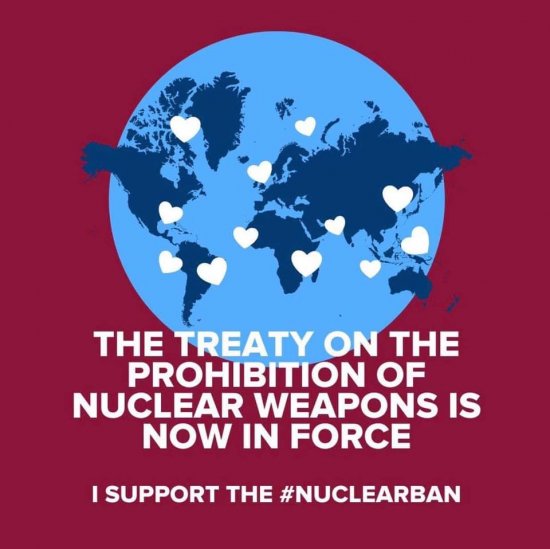
1st March, By Xander Elliards
Next week will see the third Meeting of States Parties to the Treaty on
the Prohibition of Nuclear Weapons (3MSP TPNW, for short). In practice,
that means that delegates from across the globe will attend a meeting at
the UN in New York to discuss how to push for wider acceptance of a
worldwide ban on nuclear weapons. The TPNW is backed by 73 states parties,
including Austria, Ireland, New Zealand, Mexico, and South Africa, and 21
others are signatories, including Colombia, Brazil, and Barbados.
The SNP has committed an independent Scotland to signing the TPNW – but the UK,
as a nuclear power, has declined to sign it. Thanks to a partnership with
the philanthropic fund Lex International, The National will be on the
ground in New York and at the UN building as thousands of delegates from
across the globe meet to discuss how to push nuclear states like the UK
into action.
The National 1st March 2025,
https://www.thenational.scot/news/24969230.national-goes-un-fight-nuclear-disarmament/
The Guardian view on PM’s gamble: exploiting crisis to remake Labour was a step too far for an ally

Guardian 28th Feb 2025, https://www.theguardian.com/commentisfree/2025/feb/28/the-guardian-view-on-pms-gamble-exploiting-crisis-to-remake-labour-was-a-step-too-far-for-an-ally
The exit of a soft-left intellectual politician from government highlights a growing unease about the reordering of the party’s priorities.
The resignation of Anneliese Dodds, the international development minister, from Labour’s cabinet may not have been entirely unexpected. Sir Keir Starmer’s decision to cut the aid budget to “pay” for increased defence spending was wrong. Making the world’s poorest foot the bill for Britain’s security is reckless and self-defeating. Slashing aid fuels instability – it won’t buy safety. From her perch in government Ms Dodds, who was Sir Keir’s first shadow chancellor, knew this better than most.
The former cabinet minister’s letter is right to warn that the cuts will mean the UK withdrawing from many developing countries and having a diminished role in global institutions like the World Bank, the G7 and climate negotiations. She pointedly argued Britain will find it “impossible” to deliver on its commitment to maintain development spending in Gaza, Sudan and Ukraine with the shrunken budget. Sir Keir rebuffed this charge, but Ms Dodds is right to say his move is being seen as following the Trumpian lead in cutting USAid – a framing that implies the UK is losing its independent foreign policy direction.
Like many others, including this column, she understood that in an increasingly volatile world, defence spending must rise. But rather than a collective discussion on whether the government’s fiscal rules and tax policies remain fit for purpose, the prime minister chose to gut aid budgets to fund defence spending with little debate, as if stability abroad weren’t essential to security at home. Such high-handed treatment left Ms Dodds, a soft-left intellectual politician, with no choice but to resign.
Her departure had been in the air since Sir Keir made his announcement – but she held off until he returned from Washington. Sir Keir now owns the decision, and its consequences will define his leadership. That he was shaped by events rather than shaping them will not be lost on his MPs.
Clive Lewis, a leftwing Labour MP and former soldier, has called for a wealth tax to fund defence. This is a sensible idea that merits wider discussion, as does relaxing borrowing rules – a debate already under way in Europe. The party’s right wing wants to frame Sir Keir’s move as more than fiscal, briefing that Sir Keir has made a deliberate break from the party’s pro-aid stance. It is reported that the Treasury didn’t push this – it was the prime minister’s personal call. Ms Dodds’ rise and fall mirrors his hardening leadership style.
Sir Keir is seizing this crisis to remake his party. His government has embraced militarisation, welfare cuts, climate backtracking and nationalist asylum policies. The political rationale is to ward off attacks from the extreme right and particularly Reform, which has seen its support rise. Why amplify rightwing narratives instead of challenging them? If this is just tactical positioning, fine. If not, he risks losing Labour’s soul – a perilous path as concerns over the lack of good jobs, equality, child poverty and pensioner support are likely to keep growing. Labour voters may turn away if “hard-headed” geopolitics trumps fairness. The reaction from MPs and the electorate will determine whether this gamble pays off – or exposes rifts within Labour’s coalition.
‘The climate crisis is the biggest security threat of them all’: Anneliese Dodds quits government over aid budget cuts

Michael Holder, 28 February 2025
Anneliese Dodds has today quit the Cabinet over plans to raid the
international aid budget to boost defence spending, warning in her
resignation letter the decision risks damaging the UK’s interests and
undermining efforts to tackle a climate crisis that “is the biggest
security threat of them all”.
Dodds, who resigned as Minister of State for
both International Development and Women and Equalities, said while she
fully supported the government’s decision to increase defence spending, she
disagreed that the UK overseas development budget should “absorb the entire
burden”.
Business Green 28th Feb 2025,
https://www.businessgreen.com/news/4410216/climate-crisis-biggest-security-threat-anneliese-dodds-quits-government-aid-budget-cuts
Donald Trump was rude to Zelensky, but he did tell him the hard truths.
Much of what President Trump told Ukraine President Zelensky in their contentious public meeting Friday was valid…and needed to be said to achieve peace. A sampling of the truths Trump told Zelensky:
1. Ukraine must seek immediate ceasefire not more war
2. Why? The war is lost with Zelensky having “no more cards to play” to achieve his unrealistic, indeed delusional war objectives.
3. Only the US can achieve war’s end thru a negotiated peace with Russia. What Trump omitted is that this has always been America’s war simply using Ukraine proxies to fight it.
4. Ukraine is running out of soldiers, relying on old men and conscripts snatched off the street to fight a lost cause.
5. Zelensky could start WWIII with his efforts to keep war going by attacking deep into Russia.
Trump’s comments signaled a near complete break with predecessor Biden’s embrace of the weak, compliant Zelensky to fight the war to weaken Russia and keep it out of the European political economy.
Trump knows the war has nothing to do with Europe or America’s national security interests and must be ended.
If the Oval Office dustup offends people who want this war to continue indefinitely, possibly going nuclear, then by all means be outraged. But if you want to end this lost war utterly destroying Ukraine so US can weaken Russia, then join the peace community in supporting Trump’s peace initiative.
This war has put peoplekind at risk of nuclear annihilation for all 1,100 days since it began. That must end.
As Freed Palestinians Describe Torture, Trump OKs $3 Billion Arms Package for Israel
Like the Biden administration, Trump is claiming an “emergency” in order to bypass Congress.
Common Dreams, Brett Wilkins, 28 Feb 25
As Palestinians released from Israeli imprisonment recount torture and other abuse suffered at the hands of their former captors, the Trump administration on Friday approved a new $3 billion weapons package for Israel.
The new package, reported by Zeteo‘s Prem Thakker, includes nearly $2.716 billion worth of bombs and weapons guidance kits, as well as $295 million in bulldozers. The Trump administration said that “an emergency exists that requires the immediate sale,” allowing it to bypass Congress, as the Biden administration did on multiple occasions. However, the weapons won’t be delivered until 2026 or 2027.
From October 2023 to October 2024, Israel received a record $17.9 billion worth of U.S. arms as it waged a war of annihilation against the Gaza Strip that left more than 170,000 Palestinians dead, maimed, or missing and millions more displaced, starved, or sickened. Israel is facing genocide allegations in an International Court of Justice case brought by South Africa. The International Criminal Court has also issued arrest warrants for Israeli Prime Minister Benjamin Netanyahu and former Israeli Defense Minister Yoav Gallant.
Reporting on the new package came after U.S. Sen. Bernie Sanders (I-Vt.) on Monday announced an effort to block four other arms sales totaling $8.56 billion in offensive American weaponry to Israel.
Meanwhile, some of the approximately 1,000 Palestinians released by Israel as part of a prisoner swap described grim stories of abuse by Israeli forces. The former detainees, who were arrested but never charged with any crimes, “have returned visibly malnourished and scarred by the physical and psychological torture they say they faced in Israeli prisons,” according toThe Washington Post. Some returned to what were once their homes to find them destroyed and their relatives killed or wounded by Israeli forces.
Eyas al-Bursh, a doctor volunteering at al-Shifa Hospital in Gaza City when he was captured by Israeli troops, was held in Sde Teiman and the Ofer military prison in the illegally occupied West Bank for 11 months.
“The places where we were held were harsh, sleep was impossible, and we remained handcuffed and blindfolded,” al-Bursh told the Post……………………………………………………………………
Rahdi also said that Mohammed al-Akka, a 44-year-old detainee held with him, died last December. Al-Akka is one of dozens of Palestinian prisoners who have died in Israeli custody, some from suspected torture and, in at least one case, rape with an electric baton. A number of Israeli reservists are being investigated for the alleged gang-rape of a Sde Teiman prisoner. https://www.commondreams.org/news/trump-arms-to-israel
Small modular reactor plans edge closer, amid claims that the technology makes no economic sense

By Simon Hacker, Punchline Gloucester 28th Feb 2025
…………………………………….Dale Vince, the owner of Stroud-based green energy group Ecotricity, has
roundly condemned the technology for “defying the economic laws of
gravity”.
Speaking on his weekly Zerocarbonista podcast, Mr Vince said:
“When you come to small nukes, the government and the nuclear industry have
consistently said that we will get lower bills, but they don’t put a number
on it. They are ecomonists without numbers!
Energy minister Ed Miliband: keen to move ahead on SMR plans. Big nuclear is the most expensive electricity we have ever made, it’s off the charts compared to renewable
energy and one of the fundamental laws of physics is that the economies of
scale come by making something bigger, not by making something smaller –
it always costs money to miniaturise.
So here they are, saying we can
miniatarise nuclear reactors that famously went decades late and billions
over budget… and they’ll be cheap. I don’t believe that for a second and
what we are of course doing is proliferating the risk.”
He added: “It’s always worth imagining what it would be like if the Romans had nuclear
power. If they did, Bath would be a toxic no-go zone. It’s only 2,000 years
ago and sounds like a long time, but not in the context of toxic nuclear
waste.” Whether Berkeley and neighbouring site Oldbury-on-Severn progress
with Rolls Royce’s SMR bid, the technology’s pathway to viable commercial
models for energy production remains challenging: as of today, only China
and Russia have operational SMRs, with China’s HTR-PM pebble-bed reactor
connected to the grid and Russia’s floating Akademik Lomonosov plant
utilizing two 35MW SMRs. https://www.punchline-gloucester.com/articles/aanews/smr-plans-edge-closer-amid-claims-the-technology-makes-no-economic-sense
Rachel Reeves eyes cuts to nuclear in spending review

Energy industry insiders fear the Chancellor could target Britain’s mini-nuke programme
Matt Oliver, Industry Editor, Telegraph 28th Feb 2025
Rachel Reeves is eyeing cuts to Britain’s £20bn mini-nuclear reactor programme amid a scramble to slash government expenditure, insiders fear.
Sources believe the Chancellor is considering approving a smaller number of reactors than previously expected in an attempt to reduce the costs of the programme, which is part of wider efforts to transform Britain’s power grid.
The competition to design and build the first small modular reactors (SMRs) entered its last phase on Friday, with four finalists – Rolls-Royce, GE-Hitachi, Westinghouse and Holtec – told to submit final bids by mid-April.
It was previously suggested that up to three winners would be chosen by Great British Nuclear (GBN), the quango in charge of running the contest.
But sources said there was concern this has quietly been scaled back to a “maximum” of two – raising the possibility that only one winner will be chosen. Fewer reactors would be built overall as a result………………………………………
The Chancellor is struggling to balance the books as weak economic growth makes it harder to meet her self-imposed “fiscal rules” for borrowing.
Everything is on the table’
Industry sources said there had as yet been no suggestion that ministers had decided to scale back the SMR programme.
But the final outcome has been linked to the spending review and there remains uncertainty about how many vendors will be chosen.
One person briefed on the discussions warned: “It all comes down to the spending review. Everything is on the table.”……………………..
the nascent technology remains commercially unproven, with a string of European countries and the US all currently pursuing their own individual competitions to fund the first examples of the technology.
Scaling back Britain’s SMR programme would represent a significant retreat for Sir Keir Starmer, the Prime Minister, who this month announced plans to speed up the development of the mini reactors and vowed to “build, baby, build”.
………there are fears that Mr Miliband, the Energy Secretary, is under pressure to choose which energy schemes he will prioritise as he scrambles to deliver Labour’s promise…
………….The competition has suffered repeated delays, with ministers in the previous Conservative government originally suggesting it would be concluded last spring.
This week it emerged there had been yet another delay, with the deadline for final bid submissions moved back from the end of March to mid-April.
……………………….The Treasury was contacted for comment.
https://www.telegraph.co.uk/business/2025/02/28/reeves-eyes-cuts-to-nuclear-in-spending-review/
1 This Month
26 April – Chernobyl: Inside the Meltdown airs on National Geographic on Sunday 26th April from 4pm


29 April – Nuclear Expert Webinar #1 – Radiation Impacts on Families with Mary Olson and Cindy Folkers
- 12:15 PM MT – 1:45 PM MT
- Location: Virtual – REGISTER TODAY

4 May -West Suburban Peace Coalition to discuss Iran war at May Educational Forum
Monday, May 4, 7:00 – 8:00 PM Central Standard Time
Title: : How Trump’s Narrative Tries to Shape the Reality of the War on Iran.
Contact Walt Zlotow, zlotow@hotmail.com 630 442 3045 for further information
14 May – online event From Bombs to Data Centres: the Face of Nuclear Colonialism

Pine Ridge Uranium is the real threat, not Tehran- Tell Burgum: Stop the Extraction.
Chernobyl: The Lost Tapes – A good documentary on Chernobyl on SBS available On Demand for the next 3 weeks– https://www.sbs.com.au/ondemand/tv-program/chernobyl-the-lost-tapes/2352741955560
To see nuclear-related stories in greater depth and intensity – go to https://nuclearinformation.wordpress.com
-
Archives
- April 2026 (356)
- March 2026 (251)
- February 2026 (268)
- January 2026 (308)
- December 2025 (358)
- November 2025 (359)
- October 2025 (376)
- September 2025 (257)
- August 2025 (319)
- July 2025 (230)
- June 2025 (348)
- May 2025 (261)
-
Categories
- 1
- 1 NUCLEAR ISSUES
- business and costs
- climate change
- culture and arts
- ENERGY
- environment
- health
- history
- indigenous issues
- Legal
- marketing of nuclear
- media
- opposition to nuclear
- PERSONAL STORIES
- politics
- politics international
- Religion and ethics
- safety
- secrets,lies and civil liberties
- spinbuster
- technology
- Uranium
- wastes
- weapons and war
- Women
- 2 WORLD
- ACTION
- AFRICA
- Atrocities
- AUSTRALIA
- Christina's notes
- Christina's themes
- culture and arts
- Events
- Fuk 2022
- Fuk 2023
- Fukushima 2017
- Fukushima 2018
- fukushima 2019
- Fukushima 2020
- Fukushima 2021
- general
- global warming
- Humour (God we need it)
- Nuclear
- RARE EARTHS
- Reference
- resources – print
- Resources -audiovicual
- Weekly Newsletter
- World
- World Nuclear
- YouTube
-
RSS
Entries RSS
Comments RSS
 nuclear-news