The Ultimate Test of Allegiance
3 October 2025 AIMN Editorial, By Peter Brown, https://theaimn.net/the-ultimate-test-of-allegiance/
Watching American politics from afar, it’s often easy to get lost in the noise and drama. But sometimes, a fundamental issue cuts through the static – one that should alarm every citizen and international onlooker alike. What I see now is a direct challenge to one of the most sacred principles of their republic. To see that foundational principle now being tested is, frankly, chilling.
The bedrock principle of the American military is its oath to “support and defend the Constitution of the United States against all enemies, foreign and domestic.” This sacred commitment is deliberately to an idea, a set of laws, and a nation – not to a person. Yet, they now face the unsettling prospect of a commander-in-chief, Donald Trump, who has consistently demonstrated that his primary demand is personal loyalty.
This creates a terrifying binary choice for the armed forces, with monumental repercussions for the republic.
Scenario One: They Pledge Loyalty to Him
If the military and its leadership were to prioritise loyalty to the president over loyalty to the Constitution, the very foundation of their democracy would crack. The armed forces would be transformed from a guardian of the state into a potential tool of a single leader. Orders that test constitutional boundaries would go unchallenged. The principle of civilian control of the military would remain in letter, but be utterly corrupted in spirit, becoming personal control of the military. The chain of command would exist not to execute the law, but to execute the will of one man.
Scenario Two: They Refuse
If the military holds fast to its constitutional oath, the result would be a crisis of a different kind. A president demanding personal fealty would inevitably view any constitutional resistance as disloyalty. We could see the politically charged dismissal of principled military leaders, creating a “Saturday Night Massacre” scenario within the Pentagon. This would shatter morale, politicise the most respected institution in the country, and create a dangerous rift between a president and the very forces tasked with protecting the nation.
This is not a partisan issue; it is a foundational one. The immense power of the U.S. military must never be contingent on a personality. The terrifying truth of the current moment is that they are forced to contemplate a scenario where the ultimate check and balance – the military’s refusal to follow an unlawful order – could be triggered, with consequences that would ripple through history.
The men and women in uniform swear an oath that ends with “So help me God.” The question they must all ask is: what happens if their commander-in-chief asks them to break it?
U.S. to gift Plutonium-239 to private nuclear industry
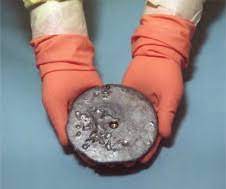
The Trump Administration’s trafficking of nuclear weapons-grade usable plutonium would significantly increase the global proliferation of nation state-sponsored nuclear weapon programs as well as the nuclear weapons material acquisition by thief and purchase for acts of nuclear terrorism.
The Trump Administration’s trafficking of nuclear weapons-grade usable plutonium would significantly increase the global proliferation of nation state-sponsored nuclear weapon programs as well as the nuclear weapons material acquisition by thief and purchase for acts of nuclear terrorism.
October 2, 2025, https://beyondnuclear.org/u-s-to-gift-pu-239-to-private-nuclear-utilities/
Trump Administration’s give away of 20 MT of US plutonium weapons stockpile to private companies threatens nuclear proliferation
According to previously unreleased government documents obtained and reviewed by Politico and addressed in a letter from three Democrat members of Congress to President Donald Trump, The White House is preparing to give away 20 metric tons of weapons-usable plutonium to new nuclear start companies. The Trump deal calls for the equivalent of 2000 nuclear bombs previously slated for permanent disposal as nuclear waste) from the nation’s Cold War era nuclear weapons stockpile to be freed up to help jump start privately-owned U.S. commercial nuclear startup companies. The fledgling nuclear companies would instead use the plutonium fuel in a still unproven and unlicensed new generation of nuclear power plants for domestic power production. The plan includes U.S. startups to reprocess plutonium used in nuclear fuel for international export. The Trump Administration’s trafficking of nuclear weapons-grade usable plutonium would significantly increase the global proliferation of nation state-sponsored nuclear weapon programs as well as the nuclear weapons material acquisition by thief and purchase for acts of nuclear terrorism.
The White House proposal calls for the U.S. Department of Energy (DOE), currently charged with the nation’s nuclear weapons development and nuclear power promotion, to “alter” the military-grade plutonium so it can be used as fuel by civilian startup power companies in new reactor designs. Theses unfinished and yet to be approved designs (such as the sodium cooled metal fuel fast reactors “Aurora” by the Santa Clara, CA start-up Oklo, Inc.’s and Bill Gates’ TerraPower’s “Natrium”) are already being privately marketed for the domestic and international export of fast reactors by companies such as Oklo.
The White House Executive Orders originally issued in May 2025 as part of the President Trump’s national call to “Unleash Nuclear Energy” had directed that the US Department of Energy draw down the from the nation’s plutonium surplus. The current White House plan now additionally includes the military to civilian utility transfer of reserve warhead parts known as “plutonium pits.
The Politico article quotes Oklo’s CEO Jacob DeWitte, “Oklo, wants to take advantage of the plutonium fuel program. Unlike its competitors, Oklo’s fast-neutron reactors can use plutonium as a ‘bridge’ fuel to get around the bottlenecks that exist in obtaining the more desirable grades of uranium.” Those “desirable grades of uranium” fuel are currently only commercially available from the Russia global monopoly on High Assay Low Enriched Uranium (HALEU) which is just less than 20% enriched U-235.
Oklo’s prestigious former board member, Chris Wright, stepped down from the company when he was confirmed to be President Trump’s new Secretary of Energy. Oklo’s Aurora reactor design now under review by the U.S. Nuclear Regulatory Commission is a controversial liquid sodium-cooled metal fueled fast reactor. The fast reactor design is controversial chiefly because it can be retrofitted as a “dual purpose” (military and commercial) reactor to breed more plutonium for nuclear weapons and commercial power generation.
The concept for Oklo’s plan was opposed in a July 25, 2025 letter to Congress signed by 17 scientific experts on global non-proliferation of nuclear weapons. First and foremost, nothing has fundamentally changed to break with the five decades that the United States has opposed from using plutonium fuel in commercial power plants due to security and economic concerns. Their letter further pronounces that authorizing funds for the proposed civilian use of nuclear weapons-usable plutonium as fuel in nuclear power plants will only accelerate the global spread of nuclear weapons in two obvious ways; 1) US companies plan to internationally export plutonium fuel and the plutonium extraction technology, and; 2) the US cannot discourage other countries from further trafficking of weapons-usable plutonium as civilian nuclear fuel if the US is doing it ourselves.
Moreover, pyro-processing or “recycling” to extract plutonium and uranium for reuse as reactor fuel has already proven to be unsustainable economically and will only deepen the already bad economics of nuclear power. The processing is acknowledged as “very costly, due to safety and security concerns, both to extract from nuclear waste and to fabricate into fuel.”
Will Tony Blair rule over Gaza?
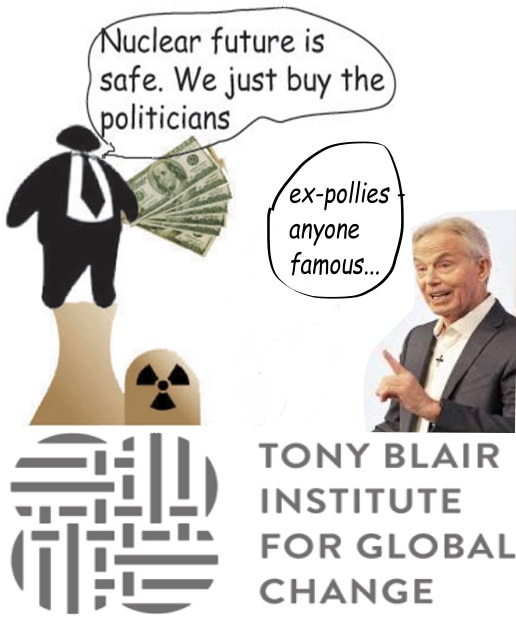
Declassified UK, 2 Oct 25, John McEvoy
This week, US president Donald Trump unveiled his 20-point “comprehensive plan to end the Gaza conflict”. The plan aims, in effect, to help Israel to achieve diplomatically what it has failed to achieve militarily: the neutering of armed resistance, the dismembering of Hamas, and the removal of political agency from Palestinians in Gaza. The first point notes that “Gaza will be a deradicalized terror-free zone that does not pose a threat to its neighbors”, and it later says that “all military, terror, and offensive infrastructure” in the strip “will be destroyed and not rebuilt”. The document also implicitly acknowledges that the Israeli government has been collectively punishing the Palestinian population by refusing to allow aid into the besieged enclave. |
“Upon acceptance of this agreement, full aid will be immediately sent into the Gaza strip”, says point seven. “Entry and distribution of aid in the Gaza strip will proceed without interference”.
But perhaps most remarkably, Trump’s so-called peace plan includes a proposal for Gaza to be “governed under the temporary transitional governance of a technocratic, apolitical Palestinian committee”.
This committee would be “made up of qualified Palestinians and international experts, with oversight and supervision by a new international transitional body” chaired by Trump alongside former UK prime minister Tony Blair.
Blair’s credentials for promoting peace in the Middle East are far from impeccable.
After sponsoring the illegal war on Iraq in 2003 – which ignited violence and extremism across the region – Blair worked for the Quartet on the Middle East, an unsuccessful attempt at mediating the Israeli-Palestinian peace process. The former prime minister has also been historically sympathetic to Israel’s interests. “I have never actually found it hard to be a friend of Israel, I am proud to be a friend of Israel”, Blair told a Labour Friends of Israel reception in September 2006.More concerningly, Blair is now closely linked to pro-Israel businessmen. |
Larry Ellison, a US tycoon who has donated millions to the Israel Defence Forces, is one of the key funders of the Tony Blair Institute, having pledged around $500m over recent years.
None of this appears to worry Keir Starmer, who came out in support of Trump’s plan, saying it “is profoundly welcome and I am grateful for President Trump’s leadership”.
Trump says Hamas has “three or four days” to respond to the proposal, saying the group will “pay in hell” if it rejects the deal.
But Hamas looks unlikely to accept it. A senior official told the BBC that the group will reject the plan, claiming it “serves Israel’s interests and ignores those of the Palestinian people”.
Blair’s campaign to profit from the rubble of Gaza, then, is far from a done deal.
Leah McGrath Goodman, Tony Blair and issues on torture (with added radiation)


Published by arclight2011- date 15 Sep 2012 -nuclear-news.net
[…]
Accusations: Despite the mockery of the film Borat, leaked U.S. cables suggest the country was undemocratic and used torture in detention
Other dignitaries at the meeting included former Italian Prime Minister and ex-EU Commission President
Romano Prodi. Mr Mittal’s employees in Kazakhstan have accused him of ‘slave labour’ conditions after a series of coal mining accidents between 2004 and 2007 which led to 91 deaths.
[…]
Last week a senior adviser to the Kazakh president said that Mr Blair had opened an office in the capital.Presidential adviser Yermukhamet Yertysbayev said: ‘A large working group is here and, to my knowledge, it has already opened Tony Blair’s permanent office in Astana.’
It was reported last week that Mr Blair had secured an £8 million deal to clean up the image of Kazakhstan.
[…]
Mr Blair also visited Kazakhstan in 2008, and in 2003 Lord Levy went there to help UK firms win contracts.
[…]
Max Keiser talks to investigative journalist and author, Leah McGrath Goodman about her being banned from the UK for reporting on the Jersey sex and murder scandal. They discuss the $5 billion per square mile in laundered money that means Jersey rises, while Switzerland sinks.
http://www.youtube.com/watch?v=gA_aVZrR5NI&feature=player_detailpage#t=749s
And as well as protecting the guilty child sex/torturers/murderers of the island of Jersey I believe that they are also protecting the tax dodgers from any association.. its just good PR!
FORMER Prime Minister Tony Blair was reportedly involved in helping to keep alive the world’s biggest takeover by Jersey-incorporated commodities trader Glencore of mining company Xstrata.
11/September/2012
[…]
Mr Blair was said to have attended a meeting at Claridge’s Hotel in London towards the end of last week which led to the Qatari Sovereign wealth fund supporting a final revised bid from Glencore for its shareholding. Continue reading
Solar becomes main source of electricity in the EU for first time.

More than half of the EU’s electricity in the second quarter of 2025 came from
renewable energy. Solar energy was the main source of electricity in the
European Union for the first time in history in June, according to new
figures. The renewable energy source accounted for 22 per cent of the
electricity generated in the EU, overtaking nuclear energy, which produced
21.6 per cent of the electricity.
The data from Eurostat, the statistical
office of the EU, showed that more than half of the EU’s electricity in the
second quarter of 2025 came from renewables. Three countries in Europe
managed to generate more than 90 per cent of their electricity from
renewable energy sources, while 15 countries were able to increase the
renewables share in their energy mix compared to the same period last year.
“Denmark, with 94.7 per cent, had the highest share of renewables in net
electricity generated, followed by Latvia (93.4 per cent) [and] Austria
(91.8 per cent),” a Eurostat report noted.
Independent 2nd Oct 2025, https://www.independent.co.uk/tech/solar-power-eu-renewable-energy-b2837926.html
Iran won’t risk Russia, China’s ire by quitting nuclear treaty, expert says
Threats by Iranian hardliners to leave the Non-Proliferation Treaty (NPT)
after a June war are likely headed nowhere because of Tehran’s keenness not
to irritate Russia and China, Middle East expert Kenneth Pollack told Iran
International. “The Chinese absolutely do not want to see Iran acquire
nuclear weapons. That would be very problematic for them. For the same
reason, the Chinese do not want to see Iran violate the NPT,” added
Pollack, Vice President for Policy at the Middle East Institute think tank
in Washington DC.
Iran International 2nd Oct 2025, https://www.iranintl.com/en/202510021782
Power fully restored to Chernobyl site
The International Atomic Energy Agency says that power was restored on Thursday morning to the New Safe Confinement at Chernobyl Nuclear Power Plant after 16 hours, following damage to a nearby substation. Rafael Mariano Grossi, Director General of the International Atomic Energy Agency (IAEA) said the loss of power to the Chernobyl site “once again underlines risks to nuclear safety during the military conflict”.
World Nuclear News 2nd Oct 202, https://www.world-nuclear-news.org/articles/power-fully-restored-to-chernobyl-site
Powering forward the Transatlantic Nuclear Free Alliance
2 Oct 25, https://www.nuclearpolicy.info/news/powering-forward-the-transatlantic-nuclear-free-alliance/
The UK/Ireland Nuclear Free Local Authorities were proud to partner with Canadian and United States anti nuclear activists at a lively webinar, kindly hosted and organised by SOS: The San Onofre Syndrome, last Thursday (25 September).
Richard Outram, NFLA Secretary, was humbled to join an online panel of distinguished speakers who are working in opposition to new nuclear plants and nuclear waste dumps in both nations. There was an audience of around 50 activists joining us from across the globe, from Colwyn Bay to Hawaii, who had been invited to view the award-winning film ‘SOS – The San Onofre Syndrome: Nuclear Power’s Legacy’.
This time the focus was upon examining the situation in Canada.
Britain’s Nuclear Waste Services, being responsible for locating and building an undersea repository for our nation’s legacy and future high-level radioactive waste – the so called Geological Disposal Facility – has established strong ties with its Canadian counterparts, the Nuclear Waste Management Organisation which has determined to build a similar, though inland and underground, repository – called a Deep Geological Repository – at Ignace in Ontario.
Dr Gordon Edwards is a mathematician, physicist, nuclear consultant, and president of the Canadian Coalition for Nuclear Responsibility (https://www.ccnr.org). CCNR is a not-for-profit organization, federally incorporated in 1978, dedicated to education and research on all issues related to nuclear energy, whether civilian or military — including non-nuclear alternatives — especially those pertaining to Canada. He is based in Montreal.
Brennain Lloyd from We the Nuclear Free North (https://wethenuclearfreenorth.ca/) is a community organizer, public interest researcher and writer. For the last 30 plus years, Brennain has worked with environmental, peace and women’s organizations as a facilitator and adult educator supporting public participation in environmental and natural resource decision-making and various planning processes. She is based in northeastern Ontario.
The panel was also joined by Team SOS in the United States, namely
Mary Beth Brangan and James Heddle, who are award-winning filmmakers of ‘SOS – The San Onofre Syndrome: Nuclear Power’s Legacy’ and co-directors of EON – the Ecological Options Network (https://www.eon3.org) and Morgan Peterson is an Oscar-nominated producer/director and director/editor of ‘SOS – The San Onofre Syndrome’. Mary Beth and James are based in Northern California, USA, whilst Morgan is based in Indiana, USA.
Richard is delighted that colleagues in the USA are looking to start work to build a network of nuclear free local authorities based on the model established from 1981 in the UK and Ireland.
It is almost 45 years since Manchester declared itself the world’s first nuclear free city and hosted the Secretariat of the Nuclear Free Local Authorities. Many cities across the globe followed Manchester’s lead in making similar declarations, many notably in the United States. It would be gratifying if these nuclear free cities could take the lead in establishing a new network across the Atlantic.
Richard said: “The purpose of establishing this Transatlantic Nuclear Free Alliance was to bring together anti-nuclear activists from both sides of the huge ocean which physically divides us in an online forum where we can share information on developments, support one another with campaigns, celebrate our successes, and share our common goals for a nuclear-free, peaceful and sustainable world.
“The UK / Ireland NFLAs would be delighted if from this meeting our colleagues in the United States could begin work to build their own network of nuclear free municipalities and we stand ready to lend support to such an initiative, where we can”.
Lisa Smithline from Moca Media TV, who ably performed the critical job of facilitating the event, summarised the event: “It was a deep and meaningful conversation. The feedback has been extremely positive, people are hungry for this information, the attendees didn’t want it to end!”
A future event will be held in around two months’ time – so do watch out for the invitation.
If you would like to attend and are not yet on the NFLA mailing list for news and future events, please email Richard Outram at richard.outram@manchester.gov.uk
In the meantime, the 25 September event can be viewed online at:
https://us02web.zoom.us/rec/share/Y3wQ_8YDumxukIDLCS5_uuBpUxnuYe9SbUHTF2PhVWEmPtE0Id2qNglFWDShT91n.dY8SN70Lrx5xxyqc
Passcode: RgMr442*
The War Department’s War on Media
The Pentagon’s new restrictions will bar correspondents covering the American military from covering the American military, as the Trump regime attempts to exert full-spectrum control over media.
By Patrick Lawrence, Consortium News, September 30, 2025
It should be evident by now to anyone paying even casual attention that exerting full-spectrum control over American media is among the Trump regime’s most perniciously obsessive projects.
Of all the extra-constitutional messes this vulgar ignoramus is making, I count his assaults on media his gravest attempt to destroy what remains of American democracy and what little chance there may be to restore it.
There are all sorts of cases in point. President Trump has a citizen’s right to file lawsuits against various media — ABC News, The New York Times, The Wall Street Journal, Paramount Global (the parent of CBS News) — but to call these anything other than an antidemocratic assertion of executive power is out of the question.
Lately there are the threats of Brendan Carr, the mad-dog chairman of the Federal Communications Commission, to take licenses away from broadcasters whose reportage and commentary are not to Trump’s liking.
“We can do this the easy way or the hard way,” saith Carr when he forced ABC to take Jimmy Kimmel off the air (temporarily, it turned out) for a few utterly harmless remarks the late-night host made after the assassination of Charlie Kirk, the influential conservative.
What a ridiculous comment from a ridiculous man, what a capricious display of authoritarian power. This is a war on media the Trump regime intends to wage on many fronts, to finish this pencil-sketch of the landscape.
What is to my mind the most portentous attack yet on media of all sorts and what little independence remains among the mainstream variety came a couple of weeks ago, when the Defense Department announced severe new restrictions on journalists covering the Pentagon.
To put the case simply, these rules will bar correspondents covering the American military from covering the American military.
My mind goes first to Jefferson’s famous remark in 1787, while serving as the young United States’ minister in Paris.
“Were it left to me to decide whether we should have a government without newspapers or newspapers without a government,” he wrote to Edward Carrington, a prominent Virginian and a friend, “I should not hesitate a moment to prefer the latter.”
Taking the Pentagon’s new restrictions on their own terms and also as a harbinger, Trump and Pete Hegseth, his buffoonish defense secretary, appear intent on delivering Americans to that condition Jefferson warned against 238 years ago.
Turning his question another way, I remind readers of W.E.B. DuBois, Mark Twain, Samuel Gompers, the James brothers (William and Henry), and other critics of the American imperium as it emerged at the end of the 19th century. There will be empire abroad or democracy at home, they asserted with a sort of desperate alarm, but Americans will not have both.
Considered in this context, Hegseth, with Trump’s evident approval, has just nodded in favor of this argument. Operating the late-phase imperium, Hegseth effectively advises Americans, requires the sequestration of power from public scrutiny.
The document announcing the Defense Department’s new restrictions on correspondents covering the American military runs to 17 pages; a covering letter signed by Sean Parnell, the Pentagon spokesman, describes it as “implementing the Secretary of War [sic] memorandum, ‘Updated Physical Control Measures for Press/Media Access Within the Pentagon,’ dated May 23, 2025.”
Note the date. By mid–May Pentagon correspondents had reported that Hegseth was using unsecured internet lines to conduct classified business and had brought his wife, brother, and personal attorney into a chat room where a top-secret aerial attack on Yemen was under discussion. A few days after that it was reported that he had invited Elon Musk to a briefing on potential war plans against China.
This guy had a lot of stupidity and incompetence to cover up. And the restrictions Hegseth authorized in May, detailed in the memorandum dated Sept. 18 and due to come into effect over the next few days, reek of the sort of revenge — against Democrats, against the universities, against the courts, against the media — that seems to rule within the Trump regime.
How damaging to our tattered republic, you have to conclude, are the petty vendettas of these thankfully passing people.
These new restrictions are beyond Draconian. Journalists covering the Pentagon are to be required to pledge not to report anything, anything at all, that has not been explicitly authorized by a department official. They will not be allowed even to gather information without such authorization. Access even to unclassified information will be limited to occasions “when there is a lawful government purpose for doing so.”
Reporters assigned to cover the Defense Department will now have to take pledges to get in the Pentagon’s front door? Just how far are these people going to go? This reminds me of the loyalty oaths required of federal employees during the McCarthyist 1950s.
Roughly 90 journalists cover the Pentagon at any given time. They will henceforth be restricted even from walking most of the building’s halls without an escort. “Failure to abide by these rules,” the memorandum warns, “may result in suspension or revocation of your building pass and loss of access.”
This is pretty close to Soviet, in my estimation.
“Journalists covering the Pentagon are to be required to pledge not to report anything, anything at all, that has not been explicitly authorized by a department official…. Access even to unclassified information will be limited…
Hegseth took to social media the day these restrictions were issued to journalists and, so, reported in their media. “The ‘press’ does not run the Pentagon,” he declared to all, “the people do.”
Tell me if this is not altogether Soviet.
It would be difficult to overstate the gravity of these measures. Taken to their extreme, and to go by the hyper-officious phrasing of the Sept. 18 memorandum the extreme is what Hegseth’s Pentagon has in mind, once these regulations go live the conduct of the imperium will no longer be visible to the public.
The imposition of total control of information — and so of all “narratives” — and the concealment of all conduct: These are the all-but-stated objectives. We are looking at unlimited prerogative and the strictest enforcement of secrecy, to describe this new regime another way. At this early moment I find it hard to imagine the extent of the lawlessness this may turn out to license.
I start to think the Trump II regime’s relations with media exceed the corruptions of the Cold War decades, and this is going some. But no president then was as brutishly ignorant and as indifferent to the Constitution as Trump. The imperium was on the ascendant during those first post–1945 decades; now it is bankrupt (in lots of ways) and obviously on the wane. The game is bound to get rougher as strength gives way to weakness…………………………………………………………………………………………………………………………………………..
Pete Hegseth has decreed a radical departure in professional practice for journalists covering the national security state. True and highly condemnable.
Pete Hegseth has codified long-established practices and a longstanding relationship between the press and power. True and highly condemnable. https://consortiumnews.com/2025/09/30/patrick-lawrence-the-war-depts-war-on-media/
The ‘Golden Age of nuclear’ deal is all a veneer
2 October 2025, https://morningstaronline.co.uk/article/golden-age-nuclear-deal-all-veneer
Once again, working people have been betrayed with false promises about jobs in an industry that is actually making climate change worse, writes LINDA PENTZ GUNTER
AT THIS point there is no need for any of us who are inclined toward commentary to further point out the utter dereliction of the Keir Starmer government. It is doing a perfectly fine job on its own.
One clear indication of the malaise running rampant through the ranks of Starmer’s seemingly ever-diminishing inner circle, is the craven subservience to war criminals. The British government managed to kowtow to two in the space of one week — first the Israeli President Isaac Herzog, followed by US President Donald Trump.
Upon arrival, Herzog might have heard the distant echo of a door slamming behind the departing deputy prime minister, Angela Rayner. He might also have caught sight of disgraced British ambassador to the US, Peter Mandelson, who was summarily sent back to Britain the day after Herzog’s arrival in London.
Now the turmoil has turned to Starmer’s inside — and right-hand — man, Morgan McSweeney, another “we told you so” category of rogue who has been accused of potentially buying Starmer’s party leadership victory.
Amid the general gloating and glee on the right, inevitable and hypocritical albeit self-inflicted by the Starmer team, came this observation by Daily Mail columnist Dan Hodges. “Keir Starmer hoped the stench of sleaze and scandal enveloping his administration would begin to dissipate following the successful state visit of Donald Trump.”
If Starmer truly believed that embracing Trump, the one person whose stench of sleaze and scandal is even more malodorous than his own, was likely to restore confidence in the current Labour government, we are in even bigger trouble than we thought.
And we are. Because far from “successful,” one outcome of Trump’s visit was yet another great betrayal of British working people. This time it came in the form of the “golden age of nuclear” contract struck between the US and British governments. The title alone betrays its false veneer and utter subservience to Trump and his cabal.
On May 23, Trump had proudly announced in an executive order that he was “restoring gold standard science,” although it will come as no surprise that it in fact dismantles anything that smacks of actual science.
Trump is also promoting his “Golden Dome” missile defence system and on the day he unveiled his commitment to “gold standard science” he also “unleashed” (a favourite word) four executive orders trumpeting a nuclear renaissance.
How sad then, that neither Starmer nor energy secretary Ed Miliband can come up with their own language to describe the new nuclear contract. They must, perforce, sing from Trump’s golden hymnbook.
Their plagiarised “golden age” announcement was replete with Trump-style hyper-masculine hyperbole. They boasted of “homegrown energy” and “major new deals that will turbocharge the build-out of new nuclear power stations.”
The deal would drive forward “the government’s energy superpower mission to take back control of Britain’s energy for good.” Working people will be the big winners.
Unfortunately, the track record of nuclear power to date, and the extreme uncertainty surrounding whether any of the companies vying to build new reactors will actually deliver, means that the opposite is true.
Timelines for reactor construction, even for the known, familiar models such as the two being built at Hinkley Point C, for example, are far longer than before. Recently completed new reactors in the US, Finland and France have uniformly run well over budget, sometimes as much as three times over or more.
There will be no jobs in new nuclear power projects for working people anytime soon. When and if jobs do materialise, those suited to working people will likely be temporary, in construction. Many jobs will require highly specialised skills for which working people will not have been trained.
Instead of wasting time and money on new, unproven reactor designs, including so-called small modular reactors, we could achieve greater carbon emissions far faster for the same investment in renewable energy. Therefore, choosing the slow, expensive nuclear path instead of renewables results in more use of fossil fuels in the meantime.
Furthermore, the “golden age” contract lists a whole rogues’ gallery of companies who have already proven to be unreliable at best and certainly devoid of any interest in serving the needs of working people. Indeed, as with all major corporations their sole motive is profit.
Among them are companies such as Holtec, mired in corruption, and TerraPower, owned by billionaire, Bill Gates, who went cap in hand to score a $2 billion subsidy from the US Department of Energy for his $4bn Natrium reactor. British taxpayers can expect to be similarly fleeced.
None of the reactors promoted by the US companies on the list have actually received a licence. They are simply paper reactors.
The notion that somehow this deal will deliver “energy independence” and “homegrown energy” is, to be generous, disingenuous. What’s missing from the conversation is the uranium necessary to make the fuel for these reactors. Unless the Starmer government is plotting to reopen the fight with residents of Orkney, who already beat back efforts in the mid-1970s to mine uranium there, there is nothing “homegrown” about nuclear energy.
Where will that uranium come from? The main uranium exporting countries are Canada, Australia and Kazakhstan. Niger is also high on the list. In almost all cases around the world, uranium is mined on the land of Indigenous peoples who take the full burden of the contamination this causes to their air, water and land, but languish in poverty while the mining companies profit.
When the mines close, the companies leave, abandoning surrounding populations to suffer the often serious and even fatal health consequences resulting for endless exposure to the radioactive waste left behind.
The high-assay low enriched uranium (HALEU) fuel needed for some of the new reactor designs — including the one promoted by Gates — is almost exclusively produced by Russia. Trump has bragged about opening HALEU production facilities in the US, but nothing has happened. Whilst he has deployed an embargo on Russian oil and gas, uranium imports remain exempt.
Perhaps the most alarming aspect of the “golden” nuclear deal is the declared intention to shortcut the regulatory process. Nuclear power plants are inherently dangerous. The new designs have not demonstrated that they have overcome these challenges. Indeed, most if not all of them are new versions of old designs whose predecessors have a record of fires, explosions and meltdowns.
But the British-US contract states it “will make it quicker for companies to build new nuclear power stations in both countries, for example by speeding up the time it takes for a nuclear project to get a licence from roughly three or four years to roughly two.”
Shortcutting safety oversight in any sector is never a good idea. It is particularly reckless when dealing with nuclear power. And it is even more so if Britain is to take the Trump administration on its word that a particular reactor has been deemed safe by the US and therefore requires no safety scrutiny by British regulatory authorities.
That’s because Trump has set about to dismantle the US Nuclear Regulatory Commission, ordering the agency to “rubber-stamp” new licence applications and prioritise production over safety. He is picking off anyone within the agency that disagrees and replacing them with “yes-men,” one of whom is the compliant lapdog chair of the NRC, David Wright, a Republican appointee.
Starmer calls the US nuclear partnership a “landmark.” He says it’s about “powering our homes, it’s about powering our economy, our communities, and our ambition.” It’s that last word that contains the only morsel of truth.
Linda Pentz Gunter is a writer based in Takoma Park, Maryland, where she works as the international specialist at Beyond Nuclear. She is currently covering events in London.
Danger déjà vu

by beyondnuclearinternational, https://beyondnuclearinternational.org/2025/10/01/danger-deja-vu/
With offsite power cut, peril returns to the Zaporizhzhia nuclear power plant in war-torn Ukraine, writes Linda Pentz Gunter
We have been here before, nine times. External power provided by the grid has been lost, backup diesel generators have been called into duty, and Ukraine and the rest of the world has held its collective breath, hoping we are not about to witness another major nuclear disaster.
This is once again the situation at the six-reactor Zaporizhzhia nuclear power plant (ZNPP) in southeast Ukraine, where for the tenth time external power has been lost. By September 30, that blackout had lasted seven days, the longest such stretch since the plant was first occupied by Russian forces on March 4, 2022, ten days after Russia invaded Ukraine and provoked a war that shows no sign of ending anytime soon.
Alarm is especially high at the Zaporizhzhia site given its size — the largest nuclear power plant in Europe — and enormous radioactive waste inventory of more than 2,000 metric tons. The plant has been embroiled in some of the worst of the fighting and has already suffered previous damage.
Meanwhile, Ukraine’s other nine reactors at three other sites are by no means immune to the dangers of being caught up in an indefinite war zone. In late September, a drone detonated just 875 yards from the perimeter of the South Ukraine three-reactor nuclear power plant. Monitors from the International Atomic Energy Agency (IAEA) said they observed at least 22 drones close to the facility.
“Once again, drones are flying far too close to nuclear power plants, putting nuclear safety at risk,” wrote the IAEA’s director general, Rafael Grossi in a September 25 statement after the drone incident. “Fortunately, last night’s incident did not result in any damage to the South Ukraine Nuclear Power Plant itself. Next time we may not be so lucky.” The IAEA nevertheless continues ardently to promote the use and expansion of nuclear power around the world.
Currently, all six reactors at Zaporizhzhia are in cold shutdown, which means less cooling is needed, but they are by no means out of danger. However, it is unclear how many members of the trained Ukrainian plant staff remain to operate the facility. According to an alarming new investigative report, Seizing Power, prepared by Truth Hounds and supported by Greenpeace Ukraine, numerous personnel have been abducted from the plant, interned and even tortured.
Cold shutdown means that fissioning in the reactors has stopped and the temperature of the reactor cores is below 200 F with the coolant system at atmospheric pressure. But this does not mean that further cooling is no longer required.
The fuel inside the reactors remains hot and requires a steady flow of cooling water which is why power is still needed on the site. Failure to achieve this would mean the fuel rods would heat up the water in the core, causing it to boil away, exposing the rods. This could then lead to fires, which in turn could cause hydrogen explosions of the kind we saw at the Fukushima Daiichi nuclear plant in March 2011. A meltdown is also still possible, although the time it would take to reach such a critical juncture is longer when the reactors are not operating.
The fuel pools, where much of the irradiated fuel is stored, also require continued cooling, although less so than the reactors, and risk the same outcome if cooling stops— a boiling away of the water exposing the rods and leading to a potential fuel pool fire.
The offsite power was being provided by the one still functioning power line into the site. Without it, workers have had to deploy backup diesel generators. There are reportedly 18 of these on site, with seven currently in use. But they cannot provide power indefinitely.
Accessing cooling water has also become more of a challenge. The Kakhovka Dam was destroyed in June 2023 leading to the depletion of the Kakhovka Reservoir, the vital water source for the Zaporizhzhia plant. Indeed, according Seizing Power, “the license to operate the ZNPP was premised on the availability of the Kakhovka Reservoir to supply water to the ZNPP and, in the event of an emergency, to function as a vital heat sink.” Instead, operators have been drilling for groundwater wells on-site in order to keep cooling water flowing into the reactors and the pools.
Of the 2,000 tons of radioactive waste stored on the Zaporizhzhia site, 855 tons are in the fuel pools and the rest in waste fuel casks. There are 200 different radioactive isotopes that could be released in the event of a disaster, an eventuality that could lead to both serious and fatal health consequences for those exposed, as well as longterm contamination of the environment and natural resources.
Such a release would also have a devastating impact on Ukraine’s economy, given the country’s role as a major agricultural exporter. Known as the “breadbasket of Europe,” Ukraine’s agricultural products account for close to 60 percent of all exports, predominantly grains.
And yet, despite the on-going war, “Ukraine’s agricultural exports reached $24.5 billion in 2024, accounting for 59% of the country’s total exports,” according to January 2025 figures from the Ukrainian Agriculture Ministry.
It is a loss Ukraine cannot afford but we have of course seen this very outcome once before, after the April 26, 1986 Chornobyl explosion and meltdown in Ukraine that left lands in much of the former Soviet Union and parts of Europe permanently radioactively contaminated.
Operating a nuclear power plant safely, even in shutdown mode, can be jeopardized by multiple external factors, but how the workforce functions is also key. Both the Three Mile Island and Chornobyl nuclear disasters were the result of human error. When people are working under duress and especially extreme fear, mistakes become more likely.
That makes the revelations in Seizing Power all the more shocking. Researchers compiled their evidence through firsthand accounts from the residents of Enerhodar, the city where the plant is located and which was also captured on March 4, 2022. After resistance to the occupation failed, the report said, “Repression and violence quickly became systematic, targeting territorial defense volunteers, pro-Ukrainian activists, and ZNPP staff who refused to collaborate, among others.”
At least seven detention centers were established, said the report, where at least 226 Enerhodar residents and ZNPP employees were held captive, “subjected to physical and psychological torture to extract information, force confessions, punish dissent, intimidate, and coerce collaboration. Russian forces deprived detainees of food, water, and medical care, contrary to the provisions of international law. Torture, including beatings, electrocution, sexual violence, mock executions, and threats to family members of detainees, became routine.”
Why would either side gamble with such a lethal liability as the safety of a nuclear power plant, given the potentially drastic outcome whose resulting deadly radioactive plume would know no borders? Russia has accused Ukraine of damaging the power lines near the plant. The Ukrainians have in turn suggested the Russians are using the disabling of the plant as a threat to drive them into submission and cede territory in the east. The Russians have already signaled that they intend to use the plant to supply electricity to Russia once it is safe to restart the reactors.
That the war in Ukraine (and others elsewhere) must end, is stating the obvious. Human suffering around the world is already too great and entirely avoidable. Wars involving nuclear power plants ramp up the risks monumentally. But those dangers are also ever present, given nuclear power is inherently dangerous both on good days and bad.
As we watch ever greater militarization occurring here in the United States, with war declared by the White House on our own cities and “the enemy within”; with the abrupt and unlawful detentions and deportations of workers; and with the reckless determination to keep not only our aging nuclear fleet in operation but also to revive already closed and dangerously decrepit reactors; we, too, are one wrong move away from experiencing a nuclear disaster.
US Military Doctrine – Goodbye to Geneva

1 October 2025 AIMN Editorial, By Andrew Klein, https://theaimn.net/us-military-doctrine-goodbye-to-geneva/
Recent developments in the United States of America and the performances of President Trump and his Secretary of War Pete Hegseth should be concerning to us all.
There are indeed reports and analyses indicating that Secretary Hegseth is pursuing a significant overhaul of the U.S. military’s legal framework, with the stated goal of empowering commanders and adopting a more aggressive approach to warfare.
Policy Shifts and International Law
The planned changes have raised concerns among observers about their potential impact on the international rules-based order.
Overhauling Military Lawyers
Reports note that Hegseth has made it a priority to “retrain” military lawyers (the Judge Advocate General’s corps, or JAGs) so they provide advice that allows commanders to “pursue more aggressive tactics” and take a “more lenient approach in charging soldiers with battlefield crimes.” Critics of the JAG corps have argued that their interpretation of rules of engagement, such as the requirement to positively identify an enemy combatant, has been too restrictive.
Historical Context and Criticism
This effort is not happening in a vacuum. During the George W. Bush administration after the 9/11 attacks, JAG lawyers resisted the administration’s view that it could lawfully direct the military to ignore the Geneva Conventions regarding detainees.
A Stated Vision for Warfare
In his writings, Hegseth has been explicit about his philosophy, questioning the value of the Geneva Conventions and suggesting that the U.S. military should fight wars on its own terms, with less regard for the opinions of other countries or international courts. He has publicly argued that modern fighters “face lawyers as much as enemies” and that adversaries should receive “bullets, not lawyers.”
When evaluating these developments, it is helpful to consider the following perspectives:
A Deliberate Agenda
The evidence suggests that the actions of Secretary Hegseth are not ad hoc but part of a coherent, long-held belief system aimed at reducing legal constraints on the battlefield, which he views as detrimental to a “warrior ethos.”
A Contentious Debate
This shift represents one side of a long-standing and profound debate within military and international circles. It pits a view prioritising maximum operational freedom against one that holds that adhering to laws of war is a strategic and moral necessity, a stance historically defended by military lawyers themselves.
The potential consequences of altering the U.S. military’s relationship with international humanitarian law are a significant subject of global concern and analysis.
Democrats alarmed as Trump eyes weapons material to fuel nuclear reactors
The scramble to build new reactors to supply power to AI data centers may include plutonium from the nation’s nuclear deterrent.
Politico, By Zack Colman, 09/29/2025
The Trump administration is considering a proposal to divert plutonium that plays a central role in the U.S. nuclear weapons stockpile to fuel a new generation of power plants, according to an Energy Department official and previously undisclosed department documents.
The proposal calls for the department to alter the plutonium so it can be used by civilian power companies, including startups pitching advanced reactor designs. It’s part of a broader push by President Donald Trump to convert tons of the Energy Department’s plutonium to civilian use, a notion that some lawmakers argue would undermine the U.S. weapons program for the benefit of untested private companies.
The initiative would involve harvesting plutonium on a large scale: According to a department official and a July 31 DOE memo seen by POLITICO, more than a fifth of the plutonium needed to meet Trump’s mandates would come from the highly radioactive spheres manufactured for the cores of nuclear weapons. DOE already faces a crunch to make more of those spheres, known as plutonium pits — it’s lagging behind Congress’ demands that it boost pit production to modernize the country’s nuclear deterrence.
The department is “not meeting the current pit manufacturing schedule,” said a former DOE official who is familiar with the department’s plutonium reserves. “So to make pit plutonium available would be a huge shift, and I’d be shocked.”
Both the current and former officials were granted anonymity to share sensitive details about national security matters.
Trump didn’t mention the pits in a May executive order in which he directed DOE to draw from another source — its stores of surplus plutonium — to help revive the nuclear power industry and meet the soaring electricity demands of data centers used in artificial intelligence. The U.S. officially halted its program that made weapons-grade plutonium in 1992.
The department declined to confirm or deny any details of its plutonium plans in response to questions from POLITICO.
“The Department of Energy is evaluating a variety of strategies to build and strengthen domestic supply chains for nuclear fuel, including plutonium, as directed by President Trump’s Executive Orders,” the department said in a statement. “We have no announcements to share at this time.”
The White House referred POLITICO’s questions about the plutonium plans to DOE. The Defense Department referred questions to the White House.
Government watchdogs and congressional Democrats have spent weeks objecting to the entire notion of transferring government-owned plutonium to the power sector. Such a move “goes against long-standing, bipartisan U.S. nuclear security policy,” Democratic Sen. Ed Markey and Reps. Don Beyer and John Garamendi wrote in a Sept. 10 letter to Trump. “It raises serious weapons proliferation concerns, makes little economic sense, and may adversely affect the nation’s defense posture.”
In a separate Sept. 23 letter to Trump, Markey said he was concerned that Energy Secretary Chris Wright was pushing the plutonium proposals to help a Californian nuclear power startup named Oklo, on whose board Wright once sat………….
Oklo spokesperson Paul Day declined to comment on Markey’s concerns of a possible conflict of interest. He also declined to comment on how much plutonium the company intends or has agreed to acquire from DOE. He said DOE “has not, as far as we know, established a plutonium fuel program.”
One nuclear safety watchdog echoed many of the Democrats’ concerns in an interview, saying DOE’s proposal could hollow out the nation’s nuclear defenses and compromise the Pentagon’s long-term deterrence strategy. And it appears to be happening without coordination with the Defense Department, said Hans Kristensen, director of the nuclear information project at the Federation of American Scientists, a nonprofit group that focuses on global security.
…………………………………………..U.S. civilian reactors now use only uranium for their nuclear fuel, but some reactors under development are planning to use plutonium. Spent plutonium from reactors is far more radioactive than uranium — and could pose a greater security risk than uranium if it were to fall into the hands of hostile nations or terrorist groups.
………………………………………… The DOE memo called for delivering 18.5 metric tons of the government’s surplus plutonium and an additional 6.5 metric tons pulled from “material in classified form once it has been declassified.” That latter term, the current DOE official who spoke to POLITICO said, refers to the plutonium pits, whose shape and characteristics can reveal information about nuclear weapons.
The company where Wright was once a board member, Oklo, wants to take advantage of the plutonium fuel program. Unlike its competitors, Oklo’s fast-neutron reactors can use plutonium as a “bridge” fuel to get around the bottlenecks that exist in obtaining the more desirable grades of uranium, CEO Jacob DeWitte told POLITICO in an interview.
DeWitte said Oklo has not publicly revealed how much plutonium the company is seeking to run its new reactors, or from where precisely it plans to obtain that plutonium. He also said the Trump administration has not detailed exactly how much plutonium it will make available, noting that “there is disagreement” over how much surplus plutonium the federal government can hand off before harming nuclear deterrence……………………………………………………………………………………………………………………………………… https://www.politico.com/news/2025/09/29/trumps-nuclear-power-push-stirs-worries-about-us-weapons-stockpile-00583424
The nuclear choice: a people’s economy or the bosses’ bomb?

30 September 2025, https://www.morningstaronline.co.uk/article/nuclear-choice-peoples-economy-or-bosses-bomb
CND’s Stop the Nuclear Nightmare conference in Glasgow will be an important step towards destroying the false arguments that weapons and war spending will lead to job creation and prosperity, rather than bringing Armageddon closer, writes SIMON BARROW
N a month’s time, trade unionists, environmentalists, community organisations and political activists will gather in Glasgow to push back firmly against the British government’s drive towards rearmament and further investment in Britain’s dangerous and wasteful nuclear weapons programme.
The gathering, organised by Scottish CND, will bring together campaigners from across these islands. But the particular spectre of Trident submarines located just a few miles down the road at Faslane will not be lost on anyone attending in person or online.
Bluntly entitled Stop the Nuclear Nightmare, the aim of this timely event in the heart of Scotland’s largest city — a former shipbuilding and heavy industry powerhouse — is to make the direct connection between the threat nuclear weapons pose in an increasingly unstable world and the vast misdirection of economic resources they represent.
As large arms companies savour the prospect of many more billions being poured into military production across Europe, and as the Labour government powers ahead with an unstable, unreliable and unnecessary Trident replacement programme, the choices facing us become abundantly clear.
Will the AI-driven technological revolution of the coming decades lead to an unprecedented era of opportunity and possibility for the great majority, or will our needs and future be sacrificed to the remorseless drive for accumulation by a heavily armed few?
A major focus of Scottish CND’s mobilising conference will therefore be on the back-to-front economics of nuclear-fronted militarism, and the huge potential benefits in terms of jobs, prosperity and environment which a genuinely “just transition” way from both nuclear and fossil fuel dependence could represent.
At the centre of this debate is the political challenge of reframing the discourse about defence towards the concrete issues of human need and security arising from a continuing cost-of-living crisis and the political fragmentation which a lack of a clear vision around this worsens.
The spin from Prime Minister Keir Starmer and his defence secretary John Healey is that a massive expansion of military industry and capability is necessary to ensure Britain’s security and to guarantee jobs and prosperity for its people. Neither of these assertions is true.
As far as security goes, the reality is that the drive to rearmament will increase insecurity and deepen potential conflict, likely leading to a new and perilous wave of nuclear proliferation. But the grim lesson of modern history is that almost all arms races lead to war.
Nor is this expansion necessary. Britain’s military spending was among the highest in the world, well before the latest hike was proposed, and in real terms exceeded spending on defence at the height of the cold war in 1980.
Yet this Labour government has committed to vast increases in the arms bill, from 2.3 per cent of GDP currently (£66.3 billion) to 2.5 per cent by 2027/2028 (£80.5bn) and 3.5 per cent (£121.2bn based on the 2029/30 GDP forecast) by 2035.
Unsurprisingly, it is transnational arms companies themselves who are lobbying hard for all this. They smell profits and the chance to retool in a way which will create neither sustainable jobs nor socially beneficial production.
The promise of “military Keynesianism” (a big boost to civilian benefit from military investment) is a false one. A people’s economy is effectively being sacrificed for a bosses’ bomb.
That picture is reinforced by research coming from an unlikely source, the leading military think tank the Royal United Services Institute (RUSI).
“Framing defence spending as a path to prosperity ignores its poor economic returns, limited job creation, and the opportunity costs of not making alternative public investments,” argue Noah Sylvia and Khem Rogaly in their recent RUSI paper, The False Promise of Defence as Prosperity.
They continue: “Starmer’s government claims that the defence sector will become an ‘engine for growth,’ a route to ‘prosperity’ and a source of security for working people. These arguments are now lynchpins of the government’s narrative as it fails to deal with stagnation and real incomes are squeezed.”
Sylvia and Rogaly then proceed systematically to dismantle such claims, citing sobering arguments and data from the European Commission, the Rand Corporation and other eminently Establishment sources.
Trade unions are among those who are waking up fast to the spectre of a dangerous and damaging future unless we make the link between economic security and a major shift away from the old technologies of human and climate destruction.
Others are yet to be convinced. There is understandable concern about the future of jobs and livelihoods currently tied to the arms sector and nuclear weapons.
But unless we start to build pressure now, to counteract the new military-industrial complex rhetoric, we will find ourselves with fewer and fewer genuine choices.
The Stop the Nuclear Nightmare conference in Glasgow is a major opportunity to articulate a different vision, to mobilise for change, and to organise for a better and safer future.
Simon Barrow is a writer, trade union activist and consultant to Scottish CND on the Stop the Nuclear Nightmare conference at Adelaide Place, Glasgow, from 10am to 4:30pm on Saturday November 1. Full details at www.banthebomb.org.
Russian nuclear submarine: Fears as K-159 nuke vessel, that sank over 20 years ago, rusty and resting on seabed with highly radioactive fuel

By Isabella Boneham, Reporter, https://www.nationalworld.com/news/world/russian-nuclear-submarine-fears-as-k-159-nuke-vessel-that-sank-years-ago-resting-on-seabed-5337748
The decommissioned Soviet nuclear submarine K-159 is still at the bottom of the Barents Sea after sinking more than 20 years ago.
In August 2003, the K-159 sank in a storm while being towed for scrapping. The submarine, which had been decommissioned since 1989, was in poor condition and was not defueled.
The submarine lies at a depth of about 246 meters in Russian territorial waters, near the entrance to the Kola Bay. Russia was soon to announce that the sub should be lifted, although it would be challenging due to the outer hull’s rusty conditions.
But nothing happened and Europe-Russia ties turned gradually colder. Researchers have since then monitored the wreck, fearing leakages of radioactivity from the two old nuclear reactors onboard could contaminate the important fishing grounds in the Barents Sea.
The K-159 still contains about 800 kg of spent nuclear fuel in its two reactors, posing a long-term environmental risk. The rusty hull is in a state of advanced corrosion, increasing the chance of future radioactive leaks.
A joint Norwegian-Russian expedition examined the site in 2014 and concluded that no leakage has so far occurred from the reactors to the surrounding marine environment. According to the Barents Observer, Lithuania-based nuclear expert Dmitry Gorchakov with the Bellona Environmental Transparency Center is worried.
He said: “There is a possibility of leaks, of course. Especially since K-159 was not prepared for flooding”. He underlined that so far, to his knowledge, “no leaks have been found.”
Dmitry Gorchakov says it one day eventually will be necessary to bring up the K-159. However, plans have been put on hold due to the Russia-Ukraine war.
He said: “In the current conditions of isolation, it is unlikely Russia will be able to conduct such an operation alone. There is no necessary equipment, and there may not be money for this in the budget. I think in the coming years they will depict preparations for the lift, but nothing more”.
Thomas Nilsen, editor of The Barents Observer online newspaper, previously described the submarines as a “Chernobyl in slow motion on the seabed”. In a BBC report, Ingar Amundsen, head of international nuclear safety at the Norwegian Radiation and Nuclear Safety Authority, agreed that it is a question of when, not if, the sunken submarines will contaminate the waters if left as they are.
1 This Month
26 September – International Day for the Total Elimination of Nuclear Weapons





PLEASE OPPOSE HR 8255 AND S.3639 – bills would accelerate satellite deployment, with no environmental review or safeguards – https://ncstd5li.quorum.us/campaign/169331/
To see nuclear-related stories in greater depth and intensity – go to https://nuclearinformation.wordpress.com
-
Archives
- September 2026 (323)
- August 2026 (330)
- July 2026 (355)
- June 2026 (287)
- May 2026 (306)
- April 2026 (356)
- March 2026 (251)
- February 2026 (267)
- January 2026 (308)
- December 2025 (358)
- November 2025 (359)
- October 2025 (375)
-
Categories
- 1
- 1 NUCLEAR ISSUES
- business and costs
- climate change
- culture and arts
- ENERGY
- environment
- health
- history
- indigenous issues
- Legal
- marketing of nuclear
- media
- opposition to nuclear
- PERSONAL STORIES
- politics
- politics international
- Religion and ethics
- safety
- secrets,lies and civil liberties
- spinbuster
- technology
- Uranium
- wastes
- weapons and war
- Women
- 2 WORLD
- ACTION
- AFRICA
- Atrocities
- AUSTRALIA
- Christina's notes
- Christina's themes
- culture and arts
- Events
- Fuk 2022
- Fuk 2023
- Fukushima 2017
- Fukushima 2018
- fukushima 2019
- Fukushima 2020
- Fukushima 2021
- general
- global warming
- Humour (God we need it)
- Nuclear
- RARE EARTHS
- Reference
- resources – print
- Resources -audiovicual
- Weekly Newsletter
- World
- World Nuclear
- YouTube
-
RSS
Entries RSS
Comments RSS

