Lies Of Omission As Fresh American War Crimes Loom
The US has been at war for 222 out of 239 years since 1776. The country is hardly going to stop now, especially not with the stars aligning for a project the US-Israel-Zionist axis has been desperate to undertake for nearly 50 years.
And despite the fact that a nation at almost constant war is going to attack a country that last initiated a war nearly 300 years ago, the US and Israel are going to pose as the saviours and pacifiers.
Do not panic, February 22, 2026 , Nate Bear
The US has amassed the largest military force in the Middle East since the invasion of Iraq almost 23 years ago and is poised once again to commit mass murder and gleefully perpetrate an astonishing amount of war crimes.
Yesterday a huge number of planes, from fighter jets to air-to-air refuelling tankers to command and control planes, left the US en route to the Middle East. The planes had stop-overs on US military bases in England and Germany, because no imperial war crime is ever complete without the involvement of Europe.
A US attack on Iran, a flagrant violation of international law, if such a thing is even worth mentioning any more, appears imminent.
Why? For Israel, for oil, for power projection, for Trump’s legacy. Because the logic of the military-industrial complex demands that $1 trillion dollars a year and an astonishing array of killing machinery doesn’t just sit idle.
Because this is what empires do.
Because the US is violence.
And there is no more stunning display of American violence than a big war.
The US has been at war for 222 out of 239 years since 1776. The country is hardly going to stop now, especially not with the stars aligning for a project the US-Israel-Zionist axis has been desperate to undertake for nearly 50 years.
And despite the fact that a nation at almost constant war is going to attack a country that last initiated a war nearly 300 years ago, the US and Israel are going to pose as the saviours and pacifiers.
The leaders of these countries will self-anoint themselves as such, while western media will subject their readers and viewers to a dizzying display of propaganda to enable the murders and wash the crimes.
The groundwork
But the propaganda won’t start from the day of the attack.
The truth is, we wouldn’t be in this situation without the groundwork laid by the media over the years.
We wouldn’t be on the verge of another major US war without the often subtle lies of omission that have characterised western reporting on Iran for decades, and have been especially evident in recent months.
Let’s go through some of them.
Shifting narratives
Firstly, and importantly, the premise for an attack.
Last June Trump said the US had ‘obliterated’ Iran’s nuclear sites.
But now, eight months later, the US apparently needs to do a much bigger war to take out Iran’s nuclear programme.
No one will ask the obvious question.
The premise, that Iran’s nuclear programme is a threat, will stand tall and uninterrogated in the mind of the propagandised western media consumer who just eight months ago was told it had all been destroyed.
Loaded terms
“Iran’s nuclear programme.”
The words themselves are loaded with an intent that is rarely examined or explained.
They never come with any context and are purposefully designed to shut down any critical thinking, as I’ve written about before.
Western media never explains that Iran is one of the world’s biggest producers of radiopharmaceuticals used for cancer diagnostics and treatments. And to diagnose cancer and make cancer drugs, you need medical isotopes. And you can’t make medical isotopes without enriching uranium. Iran is in the top five global exporters of radioactive drugs, supplying fifteen countries, including European countries, with nuclear medicines. And sanctions on Iran prohibit the import of radiopharmaceuticals.
So without its deliberately misrepresented “nuclear programme” Iran would find it hard, if not impossible, to diagnose and treat people with cancer and other illnesses.
The nuclear deal
Media never explains this and also never explains the background to US threats towards Iran over this programme. Amid all the coverage of talks and possible deals, Western media never mentions the fact that in 2018 Trump himself ripped up a deal, signed in 2016, that was working just fine.
That agreement, ratified by the UN Security Council, facilitated regular site inspections and allowed Iran to manufacture nuclear material for medicine and energy. The media will never remind us of this, nor that the last inspection by the International Atomic Energy Agency reported Iran to be in full compliance with their obligations.
We are never told that Trump, under pressure from his Zionist backers to manufacture a crisis which could move the US and Israel towards war, and eager to undo a rare Obama success, deliberately created a problem to solve.
And as we’re about to find out, there was never any intention of solving it peacefully.
But media will keep up the pretence that these were good faith negotiations that broke down because of Iran’s demands. And they won’t tell us those demands included being able to diagnose and treat cancer.
Unilateralism
The fact of the US unilaterally withdrawing from the previous deal is also a key omission in the coverage……………………………………………………..
Israel’s nukes
Talking of rogue states, the media will never examine the foundational premise underlying the whole issue of Iranian nuclear capability.
They’ll never question why Israel is allowed to have a nuclear weapon but Iran isn’t. They’ll never lead readers or viewers to question why the region’s preeminent aggressor, a perpetrator of genocide and a constant violator of laws and norms, is the one trusted with the most destructive weapon in human history.
Because then they’d have to frame Israel as the aggressor.
Then they’d have to explain how empire works.
Then they’d have to examine glaring double standards and hypocrisies and introduce people to critical thinking which doesn’t lead to reflexive cheerleading for empire.
And that is a big no-no.
It is, after all, much easier to manufacture consent for war if a large chunk of the population thinks you’re the good guys doing freedom and peace things.
New pretexts
If you’ve been following the news, you might be aware that the latest talks go beyond the nuclear programme and introduce new pretexts for war, one of which is Iran’s ballistic missile programme.
Israel, having been shocked at Iran’s ability to strike its territory last June, wants the new deal to include the elimination of all Iran’s long-range missiles.
When the US and Israel attack, we’ll be told that it’s Iran’s fault. We’ll be told that wanting to retain defensive capability in the face of an expansionist, genocidal enemy loudly committed to your destruction is an irrational position.
The Guardian among others have already started pushing this line.
By contrast, we won’t be asked to think about why Israel can have any weapon it likes.
We won’t be asked to think about why the US would go to war to stop a country being able to defend itself from Israel.
This will just be presented as the natural order of things.
American violence
The coming war on Iran will be a completely illegal war of unprovoked aggression committed by the US against a country 4500 miles away which poses zero threat………………………………………………………………………………………………… https://www.donotpanic.news/p/lies-of-omission-as-fresh-american
Proposed Saudi-U.S. deal could allow uranium enrichment, arms control experts warn
PBS News, Jon Gambrell, Associated Press, Feb 20, 2026
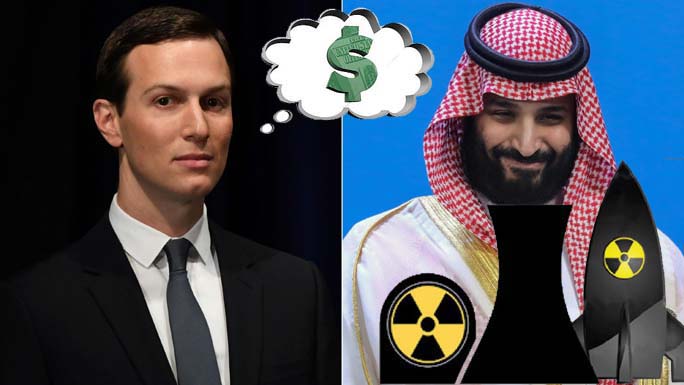
DUBAI, United Arab Emirates (AP) — Saudi Arabia could have some form of uranium enrichment within the kingdom under a proposed nuclear deal with the United States, congressional documents and an arms control group suggest, raising proliferation concerns as an atomic standoff between Iran and America continues.
U.S. Presidents Donald Trump and Joe Biden both tried to reach a nuclear deal with the kingdom to share American technology. Nonproliferation experts warn any spinning centrifuges within Saudi Arabia could open the door to a possible weapons program for the kingdom, something its assertive crown prince has suggested he could pursue if Tehran obtains an atomic bomb.
Already, Saudi Arabia and nuclear-armed Pakistan signed a mutual defense pact last year after Israel launched an attack on Qatar targeting Hamas officials. Pakistan’s defense minister then said his nation’s nuclear program “will be made available” to Saudi Arabia if needed, something seen as a warning for Israel, long believed to be the Middle East’s only nuclear-armed state.
“Nuclear cooperation can be a positive mechanism for upholding nonproliferation norms and increasing transparency, but the devil is in the details,” wrote Kelsey Davenport, the director for nonproliferation policy at the Washington-based Arms Control Association.
The documents raise “concerns that the Trump administration has not carefully considered the proliferation risks posed by its proposed nuclear cooperation agreement with Saudi Arabia or the precedent this agreement may set.”
Saudi Arabia did not respond to questions Friday from The Associated Press.
Congressional report outlines possible deal
The congressional document, also seen by the AP, shows the Trump administration aims to reach 20 nuclear business deals with nations around the world, including Saudi Arabia. The deal with Saudi Arabia could be worth billions of dollars, it adds.
The document contends that reaching a deal with the kingdom “will advance the national security interests of the United States, breaking with the failed policies of inaction and indecision that our competitors have capitalized on to disadvantage American industry and diminish the United States standing globally in this critical sector.” China, France, Russia and South Korea are among the leading nations that sell nuclear power plant technology abroad.
The draft deal would see America and Saudi Arabia enter safeguard agreements with the United Nations’ nuclear watchdog — the International Atomic Energy Agency or IAEA. That would include oversight of the “most proliferation-sensitive areas of potential nuclear cooperation,” it added. It listed enrichment, fuel fabrication and reprocessing as potential areas………………………………………………………………………………..
Saudi-U.S. proposal comes amid Iran tensions
The push for a Saudi-U.S. deal comes as Trump threatens military action against Iran if it doesn’t reach a deal over its nuclear program. The Trump military push follows nationwide protests in Iran that saw its theocratic government launch a bloody crackdown on dissent that killed thousands and saw tens of thousands more reportedly detained.
In Iran’s case, it long has insisted its nuclear enrichment program is peaceful. However, the West and the IAEA say Iran had an organized military nuclear program up until 2003. Tehran also had been enriching uranium up to 60% purity, a short, technical step from weapons-grade levels of 90% — making it the only country in the world to do so without a weapons program.
Iranian diplomats long have pointed to 86-year-old Supreme Leader Ayatollah Ali Khamenei’s comments as a binding fatwa, or religious edict, that Iran won’t build an atomic bomb. However, Iranian officials increasingly have made the threat they could seek the bomb as tensions have risen with the U.S.
Saudi Crown Prince Mohammed bin Salman, the kingdom’s day-to-day ruler, has said if Iran obtains the bomb, “we will have to get one.” https://www.pbs.org/newshour/amp/world/proposed-saudi-u-s-deal-could-allow-uranium-enrichment-arms-control-experts-warn
Israel and American Hawks are pushing US to Iran War with Catastrophic Consequences.

Former U.S. Ambassador to Saudi Arabia, Chas Freeman, observes in an on-line interview, that “to be hated means that one does hateful things” and Israel’s leaders are behaving badly”.He noted that what Netanyahu means by peace is pacification [of Arab nations]. It is delusional and [shows] a complete lack of understanding of one’s enemies”.
Hugh J. Curran, INFORMED COMMENT, 02/22/2026
Orono, Maine – It seems clear that Israeli proponents of conflict in the Middle East, as well as supporters in the US media and politics, are determined to take America to war with Iran. This observation was forcefully stated by the global affairs analyst, Patrick Henningsen, who has recently returned from Iran.
The causes of the protests have not so much to do with the regime itself but with economic conditions, including an inflation rate of 42% in December, 2025 while food prices rose by 72% and medical costs increased by 50%. The Iranian Rial has suffered sharp depreciation with poor fiscal policies and mismanagement being causes, although numerous sanctions have been taking a serious toll on Iran’s economy and its people.
Israel and the U.S. claim that Iran “poses an existential threat and therefore must give up its ballistic missile program, which is its primary deterrent”. In addition, Trump has renewed a claim that Iran cannot have a nuclear weapon although they are not planning such a program according to Iran sources and U.S. intelligence assessments.
An additional justification for war is that thousands of protestors were injured or killed in recent demonstrations in Iran. Mai Sato, the U.N. Special Rapporteur on Iran has cited “around 5000 deaths” while the “Human Rights Activists News Agency” states that there were 7,015 deaths. The Iran state media reports that 3117 died, including over 100 officers. Others report a “spiral of disinformation”, promoted by supporters of the former Shah’s son, Reza Pahlavi, who have grossly inflated the numbers.
Former CIA director, Mike Pompeo was quoted in the Jerusalem Post as saying that “every Mossad agent walks beside them [Iranian demonstrators] Mossad encouraged the anti-regime protestors: “Go out together into the streets. The time has come, “Mossad operatives are with the protestors “not only from a distance. We are with [them] in the field.”
Other extreme conservative views that have gained recent attention include those of Sen. Lindsey Graham: “The best answer to all the problems created by Iran is regime change ………………………
Israel’s Netanyahu has been, for some time, promoting conflict with Iran and is once again attempting to persuade American leaders to engage in an attack in order to bring about regime change in the Islamic Republic.
A writer for Israel’s Haaretz News has warned that the U.S. ”is approaching the precipice without articulating a vision as to what will follow …[and is] plunging toward a large-scale war against the Islamic Republic of Iran”
Iran is receiving support from China which has become dependent upon the 1.5 million barrels of oil being shipped daily. Henningsen noted that “Iran possesses advanced missile technology, including newer hypersonic generations not yet deployed, improved targeting systems capable of hitting moving naval targets, proprietary guidance systems, and Chinese-assisted navigation technology”. Despite these defenses, “it’s… clear that the Neocons and Israeli operatives in US media and politics seem determined to take America,…to war.” And this, in spite of the dire consequences, which are likely to be devastating, not only to Iran but also to Israel itself.
Former U.S. Ambassador to Saudi Arabia, Chas Freeman, observes in an on-line interview, that “to be hated means that one does hateful things” and Israel’s leaders are behaving badly”.He noted that what Netanyahu means by peace is pacification [of Arab nations]. It is delusional and [shows] a complete lack of understanding of one’s enemies”. Ambassador Freeman observes that: “Israel is an apartheid state and is enabling dictatorial decisions that are not the “will of the people”. The leaders believe in their own propaganda, but they are not hated because they are Jews but because of their behavior in the destruction of Gaza as well as their targeted assassinations. https://www.juancole.com/2026/02/american-catastrophic-consequences.html
“Dumping Radioactive Wastewater into the Hudson River”
A U.S. District Court judge has allowed Holtec International to move forward with plans to dump more than a million gallons of radioactive wastewater from the closed Indian Point nuclear plants into the Hudson River, ruling that federal authority over nuclear discharges overrides New York State’s “Save the Hudson” Act.
Guests Deborah Porder, Michel Lee, and S.D. Smith (“Owl”), all attorneys involved in the issue, explore the environmental, legal, economic, and health implications of the radioactive wastewater dumping.
Owl, attorney general to the Ramapough Munsee Lenape Nation, underscores the Hudson’s tidal, fjord-like dynamics, explaining how contamination can spread widely and persist over long timescales, cycling through ecosystems and into human bodies. He frames the issue as part of a broader pattern of industrial decision-making that prioritizes short-term gain over long-term environmental integrity.
Michel Lee of United for Clean Energy explains that a key component of the radioactive wastewater—tritium—combines into water and, inside a body, distributes to cells and incorporates into tissues causing prolonged internal radiation exposure.
Deborah Porder of the Stop Holtec Coalition focuses on public health impacts, including elevated cancer risks and adverse pregnancy outcomes near nuclear facilities, noting that tritium can cross the placenta and enter breast milk.
The panel also raises concerns about halted federal cancer studies, the economic viability of nuclear power compared to renewables, and the risk caused by Holtec to the public. Together, they call for strong regulatory oversight, public engagement, and a move away from nuclear power to safe, green, clean energy sources.
Murica: US throws pennies at massive UN debt
Sat, 21 Feb 2026 , https://www.sott.net/article/504763-Murica-US-throws-pennies-at-massive-UN-debt
Washington still reportedly owes the intergovernmental organization billions of dollars in mandatory funding
The US has paid $160 million towards the more than $4 billion it owes the UN in the first payment since President Donald Trump’s return to the White House.
The UN faces a mounting financial crisis, while the US president positions his Gaza Board of Peace to “oversee” the global body. Some experts have already warned that the initiative could undermine the UN.
Washington’s latest contribution is a “partial payment of its past dues,” Reuters cited a UN spokesperson as saying on Thursday.
The money is a small fraction of the $2.19 billion the US reportedly owes for the UN regular budget and $2.4 it owes for current and past peacekeeping missions. The US is responsible for around 95% of the overdue payments to the UN’s regular budget, Reuters quoted the organization’s spokesperson as saying.
Secretary-General Antonio Guterres has warned that the UN is facing a looming crisis which could end in “imminent financial collapse,” unless member states started making mandatory payments or the organization overhauled its financial rules.
The US, the organization’s biggest contributor, cut voluntary funding to multiple UN programs and cut aid spending last year, as part of Trump’s ‘America First’ policy pivot. In December, Washington pledged $2 billion for the UN’s humanitarian programs, warning it to “adapt or die.” By comparison, the US had contributed $14.1 billion in 2024.
In a speech on Thursday, Trump again criticized the UN as ineffective.
“The United Nations… is going to be much stronger and the ‘Board of Peace’ is going to almost be looking over the United Nations and making sure it runs properly,” he said at the inaugural Board of Peace event in Washington.
The board would help the struggling UN “money-wise” and make sure it’s “viable,” he said.
The Board of Peace was established to guide the stabilization of Gaza following the Israel-Hamas war. UN experts, however, have argued that oversight by such a body is “reminiscent of colonial practices,” due to it being chaired by Trump, rather than being under transparent multilateral or UN control.
Comment: The US behaves like a customer who goes into a restaurant, orders the most expensive meal and after gorging itself, complains about the food while commanding the staff around and growling at the other guests in the restaurant. When presented with the bill it throws a $5 dollar note to the waiter while leaving the restaurant in a huff without paying the main bill while yelling loudly how ungrateful the restaurant was for the honor to have their visit.
Massive military convoy carrying ‘nuclear weapons’ passes through Glasgow.
Footage captured on Thursday shows the convoy headed along the M74 motorway towards Kinning Park
Jordan Shepherd Reporter, 20 Feb 2026, https://www.glasgowlive.co.uk/news/glasgow-news/massive-military-convoy-carrying-nuclear-33464341
A massive military convoy believed to be carrying nuclear weapons has been spotted passing through Glasgow..
Footage captured on Thursday shows the convoy headed along the M74 motorway towards Kinning Park. The clip shows MOD police vehicles and Police Scotland escorting the military vehicles through the city.
The convoys usually travel between Atomic Weapons Establishment Burghfield near Reading and RNAD Coulport on Loch Long, right through Glasgow on the M74 and M8, passing within 1.5 miles of George Square in the process.
It is understood that the convoys make the journey around six times per year to refurbish the warheads, then transport them back up again.
The convoys include huge lead-lined lorries carrying the nuclear warheads, along with a fire engine in case a blaze breaks out, a moving workshop, a decontamination unit, tow truck and scores of MOD police vehicles.
Democrats Aren’t Resisting Trump’s Iran War Because They Secretly Support It.
Caitlin Johnston, Feb 20, 2026, https://www.caitlinjohnst.one/p/democrats-arent-resisting-trumps?utm_source=post-email-title&publication_id=82124&post_id=188566363&utm_campaign=email-post-title&isFreemail=true&r=1ise1&triedRedirect=true&utm_medium=email
The Wall Street Journal reports that the US has been gathering the most air power seen in the middle east since the Iraq invasion in 2003.
CNN says the US military is prepared to strike Iran as early as this weekend.
A Trump advisor has reportedly told Axios that “The boss is getting fed up. Some people around him warn him against going to war with Iran, but I think there is 90% chance we see kinetic action in the next few weeks.”
The US is by every indication headed straight toward war with Iran, and Trump’s ostensible opposition has conspicuously little to say about it. We’re seeing some pushback from House Democrats like Ro Khanna, but party leaders like Hakeem Jeffries and Chuck Schumer are completely missing from the scene on this issue of unparalleled urgency.
Democratic Party leaders are doing nothing to oppose Trump’s war plans for Iran because they support those plans. They just don’t want to be the ones pulling the trigger.
When the attack begins they’ll do the same thing they did with Venezuela: publicly finger-wag about rules and protocol while providing no meaningful resistance and privately being glad the empire took out another unauthorized leader.
Democratic Party empire managers love Trump. They love having a bad cop who’s willing to get his hands dirty and slit the throats that need slitting while they sit back looking pretty and fundraise off his depravity.
Democrats hate having to be the bad guy. They hated trying to come up with excuses for why it was fine for Biden to aggressively back a live-streamed genocide in Gaza, and they were relieved to finally hand off that PR nightmare to Trump. They wanted to lose in 2024, and they were glad when they did.
Now they get to just coast along and let Trump take the blame for all the imperial depravity.
On Wednesday, Democratic Senator Mark Warner told MS NOW’s Katy Tur that “I think it’s appropriate that the president has all the options on the table” with regard to war with Iran, complaining only that Trump was too incompetent to strike last month when Iranian domestic turmoil was at its peak.
Warner said that “seeing regime change in Iran would make sense” and made it clear that he would like to see the Iranian government removed, with his only criticism being that Trump was going about obtaining it in a clumsy and impolite way.
“First of all, remember the president said in our previous bombing that we had obliterated Iran’s nuclear program,” Warner said. “While clearly our military did an exquisite job, we did not obliterate Iran’s nuclear program, number one. Number two, if the president is calling for regime change in Iran — and Iran is an awful regime — but he should make the case to the American public and to the world of how we’re going to go about doing that.”
This is such a perfect example of the Democratic Party’s relationship with all of Trump’s most depraved agendas. Here’s this monstrous warmonger, poised to unleash violence in the middle east of potentially devastating consequence, and all Warner can do is hem and haw about proper war etiquette and criticize the president for failing to drop enough bombs on Iran’s nuclear energy infrastructure.
The United States has two right wing war parties: the polite one and the rude one. No party or faction which advances peace and human interests is allowed to flourish at the heart of the empire.
Trump is responsible for the war crimes of his administration, and he belongs in a cell in The Hague. But these Republican swamp monsters wouldn’t be able to do the damage they do without the assistance of the Democratic Party.
A Dangerous Equation: Trump’s Iran Plans and the Democrats Who Expect to Benefit
SCHEERPOST, February 22, 2026 , by Joshua Scheer
Recent reporting suggests that President Donald Trump privately envisions a bold “regime change” in Iran, seeing it as a historical legacy project. Sources indicate he has pressed military planners for contingency strategies that could allow major attacks while keeping potential chaos politically manageable for the midterms.
At the same time, some Democratic leaders appear less focused on preventing war than on the political calculus of who would bear the consequences. Internal discussions reveal a tension: a portion of the party sees a potential conflict as both strategically and politically advantageous if Trump ends up owning the fallout. Meanwhile, a few members of Congress, including Reps. Ro Khanna and Thomas Massie, have pushed for a War Powers resolution to require public accountability.
This coverage raises pressing questions about political expediency versus ethical responsibility in decisions that could imperil thousands of lives abroad and American service members. The stakes are high, and the calculation of winners and losers in Washington may come at a catastrophic human cost………………………………………………………… https://scheerpost.com/2026/02/22/a-dangerous-equation-trumps-iran-plans-and-the-democrats-who-expect-to-benefit/
Cost of Hinkley Point C nuclear plant jumps again to nearly £50bn
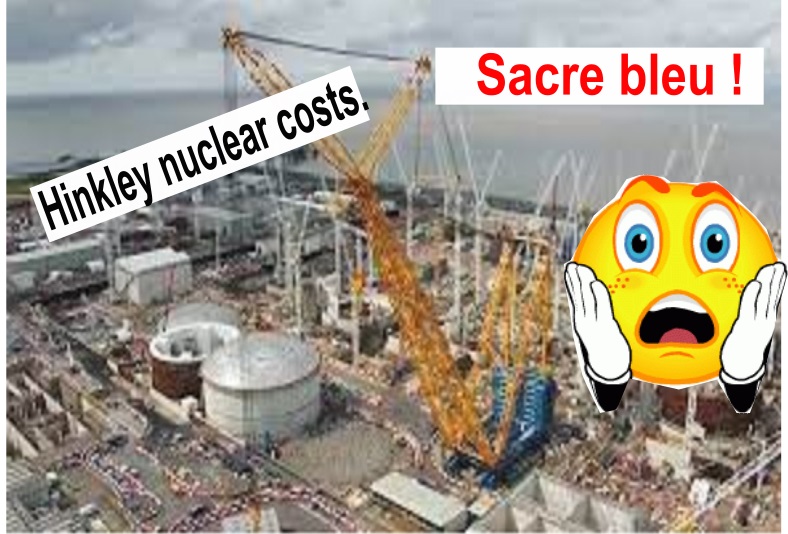
The rising cost — and a further delay to the completion date — will be seen as a blow to the UK’s energy security and an indictment of its infrastructure record. The cost of the Hinkley Point C nuclear power station has ballooned to nearly £50 billion and the date when it is expected to be in service has been put back again to 2030.
It does not
augur well either for a second major new nuclear power station, Sizewell C
in Suffolk, which is in the early stages of construction. The news was
revealed in statements in Paris on Friday by EDF, the state-owned French
energy company contracted to build Hinkley Point and Sizewell C.
The company estimated that the cost of Hinkley C was now £35 billion at 2015
prices. Adjusted for inflation, that translates to up to £49 billion. The
original projected cost was £15 billion. The plant is already years late,
as it was originally expected to go into commission in the mid-2020s.
Some argue that the date could yet be pushed back into the 2030s, leaving a
significant gap in UK energy policy after coal-fired power stations were
closed, leaving the country increasingly dependent on giant wind farms in
the North Sea. Consumer energy bills are at historically high levels.
Times 20th Feb 2026, https://www.thetimes.com/business/companies-markets/article/hinkley-point-c-nuclear-power-station-rise-nearly-50bn-gncq0j6rp
EDF has further pushed back the start-up of the UK’s flagship HinkleyPoint C nuclear plant.

EDF has further pushed back the start-up of the UK’s flagship Hinkley
Point C nuclear plant, taking a €1.8bn charge and pushing up the final
bill for a project that has suffered several delays and cost overruns.
The French state energy company said the first of the two reactors at the 3.2
gigawatt project in Somerset would now begin operating in 2030, blaming
delays in “electromechanical work”. That compares with a previous
“best case” target of 2029, itself a two-year delay from an earlier
timetable.
When the project was given the go-ahead in 2016, it was due to
come online in 2025. EDF said the plant was now expected to cost £35bn in
2015 prices — or almost £49bn at today’s prices — compared with a
previous range of £31bn-£34bn. The project was costed in 2016 at £18bn
in then-current prices. EDF warned that a further delay to 2031 would add
another £1bn.
FT 20th Feb 2026, https://www.ft.com/content/3a1ccd4b-1faf-40e9-a53a-f7961cf16d62
A $33 billion nuclear bailout is coming to your electric bill.

the “advanced” nuclear power plants being promoted today are decades-old designs that didn’t work then and are now being wheeled out as new-and-improved nuclear power plants.
By Karl Grossman, Feb 20, 2026, https://riverheadlocal.com/2026/02/20/a-33-billion-nuclear-bailout-is-coming-to-your-electric-bill/
$33 billion.
That’s the amount of money the New York State Public Service Commission—its members appointed by the state’s governor—has just approved for you as an electric ratepayer, and every other ratepayer in the state including all businesses and non-profit institutions, to pay from 2029 to 2049 to bail out four nuclear power plants upstate.
The $33 billion would be included as a charge in the bills electric utilities send to all the state’s ratepayers.
In 2017, the PSC approved a $7.6 billion 12-year bail-out of the plants, which their owners had wanted to shut down because they said they were not economical.
They include the oldest nuclear power plant of the 94 now operating in the United States, the Nine Mile Point 1 nuclear power plant in upstate Oswego, which began operating in 1969, and the second-oldest nuclear plant running in the nation, the R.E. Ginna plant, near Rochester.
Nuclear power plants, when they were first introduced in the U.S. in the 1950s, were licensed for 40 years. After 40 years, it was determined that internal parts, especially metals, would become so embrittled by radioactivity that the plants would not be safe to operate.
Now, our money, to the tune of $33 billion, would be used in the coming two decades to keep Nine Mile Point 1, having run in 2026 for 57 years, and Ginna, running for 56 years, going far longer.
If there is an accident at any of these plants, upstate is not that far from Suffolk County, as the radioactivity would blow in the wind. A check on Google says they are in the range of 200 air miles, and a little more depending on what part of Suffolk.
Consider taking a drive in a 57-year-old automobile upstate, or anywhere. How confident would you be in its mechanical ability?
But Hochul is totally enamored of nuclear power. She seemingly believes that the Chernobyl, Three Mile Island and Fukushima disasters never happened. She has been calling for New York State to become the “center” of a nuclear revival in the U.S.
As she said in her “State of the State” address last month, in 2025 “I took the bold step of greenlighting the first nuclear power project in a generation….We set a goal of building one gigawatt of nuclear power,” the equivalent of one large nuclear power plant. She went on that for 2026, it’s “go big” on nuclear power. “So I’ve decided to raise the bar to five gigawatts. That’s more nuclear energy than has been built anywhere in the United States in the last 30 years.”
She is pushing particularly so-called “advanced” nuclear power plants—even though, as a comprehensive analysis by the Union of Concerned Scientists, and other studies, have found they are not “advanced.”
“If nuclear power is to play an expanded role in helping address climate change, newly built reactors must be demonstrably safer and more secure than current generation reactors. Unfortunately, most ‘advanced’ nuclear reactors are anything but,” concluded its report.
“Not So Advanced: Hype vs. Reality for Nuclear Technology,” was the headline of a piece from the Natural Resources Defense Council.
But, as Hochul declared recently, “This is not your grandmothers’ and your grandfathers’ nuclear. This is advanced. This is state-of-the-art. This is safe.”
In fact, the “advanced” nuclear power plants being promoted today are decades-old designs that didn’t work then and are now being wheeled out as new-and-improved nuclear power plants.
Meanwhile, Hochul also keeps insisting that nuclear power is “zero-emission” and thus an antidote to climate change. But the nuclear-fuel-cycle—mining, milling and enrichment of nuclear fuel—is heavily carbon-intensive, and nuclear power plants also emit carbon, a radioactive form of carbon, Carbon-14.
She is fond of old nuclear plants, too, like the four upstate plants the $33 billion bail-out would keep running. “They’re all up on Lake Ontario and one is actually the oldest operating nuclear facility in the United States going strong and safe since 1969,” Hochul claims
Of the bail-out and Hochul’s push for nuclear power, Laura Shindell, the New York State director of the organization Food & Water Watch, says: “It’s outrageous that New Yorkers will once again be forced to bail out this toxic, money-burning industry with billions and billions more in the coming years. Despite decades of evidence that nuclear power is both inherently dangerous and cost-foolish, Governor Hochul insists on throwing good money after bad, with everyday families footing the bill. We’re fed up with the governor’s repeated failure to deliver on promises of clean, affordable energy for this state. She claims she cares about affordability, and then approves this rate increase.”
Says Avni Pravni-Buck, deputy director of Alliance for a Green Economy: “Governor Hochul and her Public Service Commission have locked New Yorkers into an expensive and inefficient scheme to enrich Constellation Energy, while taking New York further away from our renewable energy and climate goals. Every dollar spent on Constellation’s reactors is a dollar that could have gone to building renewable energy and storage, which is cheaper, cleaner, and better for our electricity grid. We’re dismayed to hear that electric ratepayers will now be footing a $33 billion bailout for the upstate nuclear reactors, without any forward-looking plan to transition to renewable resources…”
Tim Judson, executive director of the Nuclear Information and Resource Service, says: “New York’s nuclear bailout program has always been a classic ‘bridge-to-nowhere’—forcing households and businesses to fork over pots of gold, only to leave us with an ever-growing pile of radioactive waste. Since 2017, we have been charged over $4 billion to prop up old, uneconomical nuclear power plants—12 times more than we have spent on incentives for renewable energy. The bailout program was supposed to be expensive but temporary, a $7 billion ‘bridge to renewable energy.’ Here we are years down the road, and the PSC has decided not only to make the bailout basically permanent, but to dramatically increase the cost to $33 billion over an extra 20 years. New York needs to pull the plug on it.”
A true green energy path is before us. This is not it.
New Mexico Environment Department Holds LANL Accountable for Hexavalent Chromium Plume.
Concerned Citizens for Nuclear Safety, 20 Feb 26
Today’s Update is continuation of our reporting on the diligent and thorough work done by the New Mexico Environment Department to hold Los Alamos National Laboratory (LANL) accountable for not responsibly addressing the hexavalent chromium plume beneath LANL that has now spread beneath Pueblo de San Ildefonso.
On Tuesday, February 11th, the New Mexico Environment Department issued two Administrative Compliance Orders under the New Mexico Hazardous Waste Act and the New Mexico Water Quality Act to address the on-going migration of hexavalent chromium into the sole source regional drinking water aquifer that feeds the Rio Grande and those living downstream. The Orders proposed civil penalties for multiple violations of both laws that total nearly $16,000,000. https://www.env.nm.gov/wp-content/uploads/2026/02/2026-02-11-COMMS-NMED-acts-to-hold-DOE-accountable-for-legacy-waste-Final.pdf
Both Orders provide detailed histories of what has led the Environment Department to issue civil penalties for contamination of groundwater, which was first discovered in 2004 in a newly drilled monitoring well in Sandia Canyon.
Since then LANL has not done everything in its power to properly investigate and protect against the groundwater contamination. It has drilled wells at least 1,000 deep to reach the contaminated waters, extracted those waters, treated the waters on the surface, and returned them back into the deep aquifer. Due to the findings of contamination beneath Pueblo de San Ildefonso, in November 2025, the Environment Department ordered the cessation of these operations. This is not the first time the Environment Department ceased operations.
Why Epstein’s Links to the CIA Are So Important
The word unclassified potentially gives Trump and the CIA wide latitude to hold back Epstein-related materials that they claim are too sensitive to release.
We won’t know the full truth about his crimes until the extent of his ties to US intelligence are clear.
Jeet Heer, January 2026, https://www.thenation.com/article/society/jeffrey-epstein-cia-ties/
On November 18, Donald Trump suffered a major political defeat when the House of Representatives passed the Epstein Files Transparency Act by a nearly unanimous vote: 427–1. But while emphatic, the House measure included a significant proviso that might yet prevent a full reckoning with Jeffrey Epstein’s crimes.
Trump had fought for months against the bill, which was drafted by a bipartisan coalition created by California Democrat Ro Khanna and Kentucky Republican Thomas Massie. In the end, the strong public revulsion for Epstein’s crimes made opposing the bill untenable. But the final version specified that the Department of Justice must make public “all unclassified” documents on Epstein
The word unclassified potentially gives Trump and the CIA wide latitude to hold back Epstein-related materials that they claim are too sensitive to release. In this, they have the support of House Speaker Mike Johnson, who insisted that US intelligence agencies be allowed to “protect their critical sources and methods. It is incredibly dangerous to demand that officials or employees of the DOJ declassify material that originated in other agencies and intelligence agencies.”
Johnson’s words stand in stark contrast to the remarks by Marjorie Taylor Greene, one of four dissident House Republicans who forced Trump to abandon his opposition to the Epstein bill. “The real test will be: Will the Department of Justice release the files, or will it all remain tied up in investigations?” she asked in a November 18 press conference. “Will the CIA release the files?” Greene—perhaps feeling too bruised by the clash with Trump, who attacked her repeatedly over her Epstein heresy—subsequently announced that she will be retiring from Congress. But her words still cut to the heart of why getting……………………………………..[Subscribers only]
Ministry of Defence’s nuclear clean-up project brings new risks.
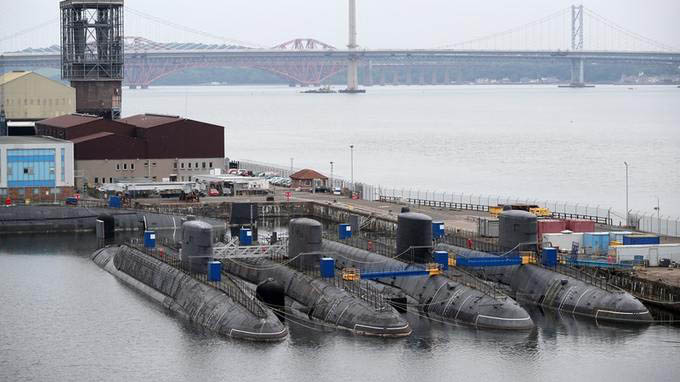
21st February, By Lynn Jamieson, chair, Scottish Campaign Nuclear Disarmament:
ROSYTH dockyard leads in the clean-up of retired nuclear
submarines as part of the Submarine Dismantling Project (SDP). Addressing a
legacy mess affords opportunities for building a skilled workforce.
But please, no more mess. Rosyth may become more deadly if operational
nuclear-armed submarines station there. As a contingency docking station
for the nuclear-weapon system now under construction, radioactive risks
will increase from nuclear reactors and weapons. T
he Ministry of Defence
(MoD) has not ruled out nuclear bombs being onboard a temporarily docked
submarine at Rosyth. In 40 years, newly built reactors become a long-term
legacy of nuclear waste, sitting in another generation of retired
submarines to be decommissioned at enormous cost.
Since the 1980s,
intermediate-level radioactive waste in the form of retired nuclear-powered
submarines – currently seven in total – sit at Rosyth, a hazard costing
money every day. Fifteen more sit in Devonport Royal Dockyard, Plymouth. Of
the 15 vessels at Devonport, 10 retain the highly radioactive fuel rods
that once powered them.
The National 21st Feb 2026,
https://www.thenational.scot/politics/25874840.mods-nuclear-clean-up-project-brings-new-risks/
The Apocalyptic President

a science fiction novel with a distinctly bizarre premise: that, at some future moment, thanks to the endless burning of fossil fuels, we humans would essentially threaten to burn ourselves off planet Earth. And when the voters of the world’s largest democracy heard that such a thing might, sooner or later, actually happen to us, they would respond by freely electing a genuine madman — who ran his second candidacy in 2024 on the all-too-bluntly apocalyptic slogan “drill, baby, drill” — to “lead” us into a literal hell on earth.
the American people elected as president, twice, a man who, as a businessman, had either four or more likely six bankruptcies to his name,
Our planet is melting in a climate broiler that we control and we’re not only not turning down the heat fast enough, but we Americans elected someone (twice!) determined to turn it up ever higher.
The Personification of an Imperial Power (and Planet) in Decline
February 18, 2026 , By Tom Engelhardt, https://tomdispatch.com/the-apocalyptic-president/
Once upon a time, if you had described Donald Trump’s America to me (the second time around), I would have thought you mad as Alice in Wonderland‘s proverbial hatter — or, if you were a fiction writer, I would have considered your plot so ludicrous that, after reading a few pages, I would undoubtedly have tossed your book in the trash.
And yet here we are, not once (yes, all of us can make a mistake once, can’t we?) but twice!
And the one thing you should take for granted is that Donald Trump in the White House a second time around is the all-too-literal personification of imperial decline. In fact, decline is hardly an adequate word for it. We just don’t happen to have another word or phrase that would describe him and his crew aptly enough in all their eerie strangeness. Yes, this country, even in the best of (imperial) times, certainly had its problems. (Remember the Vietnam War, for instance, or President “Tricky Dick” Nixon and the Watergate scandal.) Still, nothing was ever quite like this, was it? Never.
The First American King?
A literal Mad Hatter in command in Washington, D.C. Once upon a time, who would have believed it? In fact, if we could indeed travel into the past and I were able to take you back to 1991 when the Soviet Union collapsed, ending the Cold War, while China had not yet faintly “risen,” the world of that moment might essentially have been considered American property, lock, stock, and proverbial barrel.
This planet could have been thought of then as the property of just one great power — my country, of course — that, in imperial terms, had essentially been left alone on planet Earth in a fashion that might never have happened before in the history of humanity. And if I had then been able to see into our future and had tried to fill you in on the Trumpian world we’re now living through a mere three decades later, you would have quite literally laughed me off the planet (and, believe me, that’s putting it politely).
Truly, who could have ever (ever!) imagined this bizarre Trumpian era of ours in which the joker (in the worst sense of the term) in the ultimate deck of cards is indeed sitting in the White House. Yes, unbelievably enough, he was elected a second time in 2024 by a “sweeping,” “landslide,” “historic” 49.7% of American voters. It’s true, not even 50% of us voted to make him the first American king a second time around.
And if that made you chuckle just a little, well, stop doing so right now! Yes, what happened to us in Trumpian terms was and remains genuinely absurd. Still, given this deeply endangered world of ours, it should be anything but funny. Just imagine for a moment, a president who, before entering the White House, was essentially known for only one thing: being the host of the TV show The Apprentice (“You’re fired!”). Once upon a time, if you had described the (ir)reality we’re now living through, you would have been laughed not just out of the room but off this planet. You would, in short, have been fired.
In fact, if what we’re now experiencing were a novel, it would be considered to have the most ludicrous plot imaginable and, a few pages in, you would undoubtedly have tossed it into — yes, again! — the trash. (Unfortunately, it’s not just you or me but this planet itself that Donald Trump now threatens to toss into that garbage pail.)
So here we are in February 2026 and, like it or not, we’re all apprentices to one Donald J. Trump — oops, sorry, one President Donald J. Trump. And the ongoing TV show he emcees these days from the White House is undoubtedly the wackiest one in our history, as he fires not just everyone but everything that rubs him the wrong way from the Kennedy Center (gone!) to the East Wing of the White House (now rubble) to the U.S. Agency for International Development (once upon a time…).
One way to think about all of this is to go back in time and imagine that, long, long ago, Isaac Asimov or Ray Bradbury wrote a science fiction novel with a distinctly bizarre premise: that, at some future moment, thanks to the endless burning of fossil fuels, we humans would essentially threaten to burn ourselves off planet Earth. And when the voters of the world’s largest democracy heard that such a thing might, sooner or later, actually happen to us, they would respond by freely electing a genuine madman — who ran his second candidacy in 2024 on the all-too-bluntly apocalyptic slogan “drill, baby, drill” — to “lead” us into a literal hell on earth. Now, of course, that “president” is insisting that he be given the largest iced island on this planet, Greenland, that, were all its ice to melt (as indeed is already beginning to happen), could send global sea levels up by 23 feet and quite literally drown this world’s coastal cities. Imagine that!
And now, try to imagine this: in 2026, such terrible fiction is, in fact, our reality and one thing is guaranteed (excuse the colons inside colons but this is a strange, strange world to try to sum up): it’s only going to get worse in the three years to come before Donald Trump’s presidency is officially ended, if, of course, it ever does end. (As he typically said at one point last year, “Based on what I read, I guess I’m not allowed to run. So we’ll see what happens,” and he’s now talking about “nationalizing” — think “Trumpifying” — our elections!)
Given him and everything that’s gone on so far in his second term in office, including the way he recently had Director of National Intelligence Tulsi Gabbard accompany FBI agents to an election voting hub in Fulton County, Georgia, where they “seized hundreds of boxes containing ballots and other documents related to the 2020 election,” I wouldn’t count on anything Trumpian ending according to plan. Whew! That was one long sentence!
Continue reading1 This Month

of the week – Shut Down Drone Warfare!


Tell the Ukrainian Government to Drop Prosecution of Peace Activist Yurii Sheliazhenko

Petition to revoke the licensing of the Near Surface Nuclear Disposal Facility (NSDF) at Chalk River. https://www.ourcommons.ca/petitions/en/Petition/Details?Petition=e-7247
To see nuclear-related stories in greater depth and intensity – go to https://nuclearinformation.wordpress.com
-
Archives
- April 2026 (57)
- March 2026 (251)
- February 2026 (268)
- January 2026 (308)
- December 2025 (358)
- November 2025 (359)
- October 2025 (376)
- September 2025 (257)
- August 2025 (319)
- July 2025 (230)
- June 2025 (348)
- May 2025 (261)
-
Categories
- 1
- 1 NUCLEAR ISSUES
- business and costs
- climate change
- culture and arts
- ENERGY
- environment
- health
- history
- indigenous issues
- Legal
- marketing of nuclear
- media
- opposition to nuclear
- PERSONAL STORIES
- politics
- politics international
- Religion and ethics
- safety
- secrets,lies and civil liberties
- spinbuster
- technology
- Uranium
- wastes
- weapons and war
- Women
- 2 WORLD
- ACTION
- AFRICA
- Atrocities
- AUSTRALIA
- Christina's notes
- Christina's themes
- culture and arts
- Events
- Fuk 2022
- Fuk 2023
- Fukushima 2017
- Fukushima 2018
- fukushima 2019
- Fukushima 2020
- Fukushima 2021
- general
- global warming
- Humour (God we need it)
- Nuclear
- RARE EARTHS
- Reference
- resources – print
- Resources -audiovicual
- Weekly Newsletter
- World
- World Nuclear
- YouTube
-
RSS
Entries RSS
Comments RSS
 nuclear-news