73 Organizations Send Joint Letter Calling on the Federal Government to Improve Nuclear Waste Oversight
73 organizations representing a broad segment of Canadian society have sent a joint letter to the federal government urging more oversight of the nuclear industry and of nuclear waste projects.
In the letter, the groups urged the Prime Minister and the Ministers of Environment and Climate Change and of Energy and Natural Resources to exercise oversight of the Nuclear Waste Management Organization’s “Adaptive Phased Management Project” to transport, process, bury and eventually abandon all of Canada’s nuclear fuel waste at the NWMO’s selected site in the heart of Treaty 3 Territory in northwestern Ontario and its upcoming impact assessment process.
The groups expressed an overarching concern about the lack of federal oversight of this project since its inception in 2002.
More recently, the NWMO has made it known that they are seeking to have transportation of the radioactive wastes excluded from the project’s impact assessment process. But for 20 years the NWMO has been describing transportation as part of their project, and the Impact Assessment Act requires activities that are integral to – or, in the language of the Act “incidental” to – the project be included in the assessment.
The joint letter requests that the federal government provide immediate oversight and direction in four areas:
Trump’s rush to build nuclear reactors across the U.S. raises safety worries
NPR, December 17, 2025
In May, President Trump sat in the Oval Office flanked by executives from America’s nuclear power industry.
“It’s a hot industry. It’s a brilliant industry,” the president said from behind the Resolute desk.
It’s also an industry that’s having a moment. Billions of dollars in capital are currently flowing into dozens of companies chasing new kinds of nuclear technologies. These are small modular designs that can potentially be mass produced in the hundreds or even thousands. Their proponents say these advanced designs promise to deliver megawatts of power safely and cheaply.
But there’s a problem, Joseph Dominguez, the CEO of Constellation Energy, told the president.
New nuclear plants keep getting caught up in safety regulations.
“Mr. President, you know this because you’re the best at building things,” Dominguez, whose company runs about a quarter of America’s existing nuclear reactors, said. “Delay in regulations and permitting will absolutely kill you. Because if you can’t get the plant on, you can’t get the revenue.”
Now, a new Trump administration program is sidestepping the regulatory system that’s overseen the nuclear industry for half a century. The program will fast-track construction of new and untested reactor designs built by private firms, with an explicit goal of having at least three nuclear test reactors up and running by the United States’ 250th birthday, July 4, 2026.
If that goal is met, it will be without the direct oversight of America’s primary nuclear regulator. Since the 1970s, safety for commercial reactors has been the purview of the Nuclear Regulatory Commission. But the NRC is only consulting on the new Reactor Pilot Program, which is being run by the Department of Energy’s Office of Nuclear Energy……………………………………………………………………………………………………
Sites across the country will host new reactor designs
The new pilot program may be an unproven regulatory path run by an agency with limited experience in the commercial sector, but supporters say it’s energizing an industry that’s been moribund for decades.
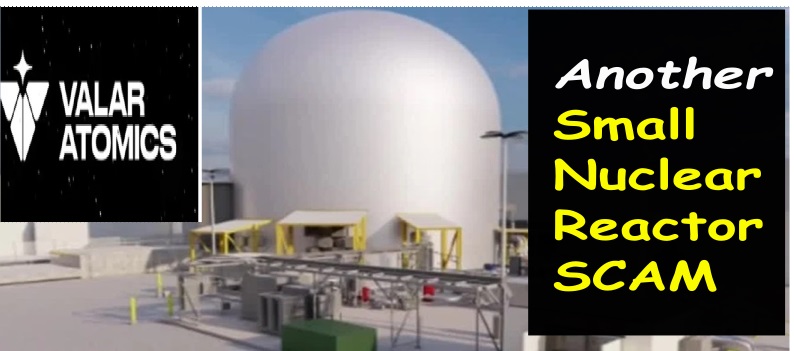
“This is exactly what we need to do,” said Isaiah Taylor, founder and CEO of Valar Atomics, a small nuclear startup headquartered in Hawthorne, Calif. “We need to make nuclear great again.”
Valar and other companies plan to build smaller reactors than those currently used in the nuclear industry, and that makes a Chernobyl or Fukushima-type accident impossible, noted Nick Touran, an independent nuclear consultant. “The overall worst-case scenario is definitely less when you’re a smaller reactor,” he said.
Critics, however, worry that the tight July 4 deadline, political pressure and a lack of transparency are all compromising safety. Even a “small” release of radioactive material could cause damage to people and the environment around the test sites.
“This is not normal, and this is not OK, and this is not going to lead to success,” warned Allison Macfarlane, a professor at the University of British Columbia who served as chairman of the NRC under President Barack Obama. “This is how to have an accident.”
AI’s need for speed
……………………………………………………………………………………………………………. Right from the start it was clear that, unlike the slow and deliberate safety culture that has dominated nuclear power for decades, this new program would be all about speed.
…………officials responsible for overseeing safety would do “whatever we need to ensure that the government is not stopping you from reaching [nuclear] criticality on or before July 4, 2026.”
A new regulator
Before the executive order, the Energy Department did not regulate the safety of commercial nuclear reactors. That job fell to another body: the Nuclear Regulatory Commission.
The commission was set up in 1975 by Congress as an independent safety watchdog, said Allison Macfarlane, the former NRC chair. Part of the reason the NRC was formed was because the predecessor to the DOE, known as the Atomic Energy Commission, oversaw both safety and promotion of nuclear power at the same time.
“This was a very strong conflict of interest,” Macfarlane said.
But in recent years, companies, particularly those trying to build new kinds of reactors, had become frustrated with the NRC, Macfarlane said. “The promoters of these small modular reactors were becoming very vociferous about the NRC being the problem,” she said.

In 2022, the NRC rejected a combined license application for Oklo, a new nuclear startup. Oklo had submitted an application to build and operate its small reactor, called the Aurora powerhouse. But the NRC denied the application because it contained “significant information gaps in its description of Aurora’s potential accidents as well as its classification of safety systems and components.”
Oklo was told it could resubmit its application to the NRC, but it never did.
Then at the May signing of the executive order, Oklo’s CEO Jacob DeWitte appeared behind President Trump applauding the new reactor program at DOE.
“Changing the permitting dynamics is going to help things move faster,” DeWitte said to the president. “It’s never been more exciting.”
Oklo had another connection to the Energy Department — the secretary of energy, Chris Wright, was a member of Oklo’s board of directors until he took the helm at the DOE. Wright stepped down following his confirmation in February.
In August, a little over a month after that initial meeting between industry executives and the DOE, the Office of Nuclear Energy announced the 11 advanced reactor projects had been selected for the Reactor Pilot Program. Three of Oklo’s reactors were part of the new pilot program, including a test version of the reactor design rejected by the NRC…………………………………………………………………………………………………………
Valar’s design looks far different from the reactors that are running today. It will use a special type of fuel together with a high-temperature gas to generate heat and electricity. Taylor said gathering real data will speed development and increase safety over the long-term….
(Valar is also party to a lawsuit against the NRC arguing the commission does not have the authority to regulate small reactors. In his interview, Taylor told NPR the company intends to file for an NRC license “when we’re ready.”)
………………………………………………….. critics question whether the pilot program will really produce safe nuclear reactors.
The July 4, 2026, deadline puts enormous pressure on the program, said Heidy Khlaaf, the chief AI scientist at the AI Now Institute, which recently published a report warning that AI development could undermine nuclear safety.
“I think these manufactured timelines are actually incredibly concerning,” Khlaaf said. “There’s no timeline for assessing a new design and making sure it’s safe, especially something we haven’t seen before.”
Then there’s the question of public transparency. The NRC makes many of the documents around its decisions available publicly. It also frequently allows the public to comment as well, added Edwin Lyman, director of nuclear power safety at the nonprofit Union of Concerned Scientists. The new pilot program is far more opaque and “is really an attempt to subvert the laws and regulations that go around commercial nuclear power,” he said.
While many of the test reactors are small and tout themselves as inherently safer than existing nuclear power plants, they are still capable of leaking radiation in an accident, Lyman noted. “If they are located closer to populated areas, if there aren’t any provisions for offsite radiological emergency planning … then you are potentially putting the public at greater risk, even if the reactors are small,” he said.
Perhaps most worrying, said former NRC Chair Macfarlane, is how the DOE’s safety assessment might be used to build more small reactors across the country, once the pilot reactors are built.
………………………………………..Macfarlane is unconvinced. She said relying on the hasty DOE analysis for the construction of potentially dozens or even hundreds of small reactors around the U.S. is the real risk.
“They can look at what the DOE did, they can take it as a piece of input, but they have to do their own separate analysis,” she warned. “Otherwise, none of us are safe.” https://www.npr.org/2025/12/17/nx-s1-5608371/trump-executive-order-new-nuclear-reactors-safety-concerns
Julian Assange: Sweden Broke Own Laws With Nobel Prize to Venezuela’s Machado

The same dynamic is at play in the Caribbean once again, according to Assange, as the Nobel Committee crowns a Venezuelan politician best known for her unhinged appeals for foreign military intervention and her dedication of her Nobel victory to US President Donald Trump.
Max Blumenthal and Wyatt Reed, The Grayzone, December 17, 2025
By awarding its peace prize to Trump’s favorite Venezuelan opposition figure, pro-war coup plotter Maria Corina Machado, the Nobel Committee contravened the principles enshrined in its founding documents, as well as Swedish law, Julian Assange alleged in an explosive brief reviewed by The Grayzone.
The Swedish government violated its own laws by awarding the Nobel Peace Prize to Venezuelan opposition figure Maria Corina Machado, according to an explosive legal brief filed by Julian Assange, the Wikileaks co-founder and former political prisoner who was hounded across the globe, confined in harsh conditions, and subjected to physical and psychological torment over the course of a decade by the US and its allies.
The Nobel committee’s decision to award Machado the Peace Prize — and the 11 million Swedish Kroner ($1.18 million USD) reward which accompanies it — means that “there is a real risk that funds derived from Nobel’s endowment have been or will be… diverted from their charitable purpose to facilitate aggression, crimes against humanity, and war crimes,” Assange stated.
The Wikileaks founder pointed to the “ample public statements… showing that the U.S. government and María Corina Machado have exploited the authority of the prize to provide them with a casus moralis for war,” adding that the explicitly stated purpose of the war sought by Machado and her wealthy Latin American backers would be “installing her by force in order to plunder $1.7 trillion in Venezuelan oil and other resources.”
The Nobel Foundation stands accused of a number of violations of Swedish criminal law, including breach of trust, misappropriation and gross misappropriation, conspiracy, crimes against international law, as well as financing of aggression, facilitation of war crimes and crimes against humanity, and breaching Sweden’s stated obligations under the Rome Statute, to which Stockholm says it is “deeply committed.”
Under Swedish law, “Alfred Nobel’s endowment for peace cannot be spent on the promotion of war,” Assange noted. “Nor can it be used as a tool in foreign military intervention. Venezuela, whatever the status of its political system, is no exception.”
By granting Nobel funds to Machado, Assange argues that the Committee is effectively financing “a conspiracy to murder civilians, to violate national sovereignty using military force…” By refusing to end payments, “they flagrantly violate Nobel’s will and clearly cross the threshold into criminality,” he alleged. The Wikileaks co-founder seeks the “immediate freezing of all remaining funds and a full criminal investigation” into Committee members who awarded the prize.
The Nobel Prizes were established in 1901 according to Swedish inventor Alfred Nobel’s last will and testament, which was later incorporated into the Swedish and Norwegian legal systems. The Peace Prize, which is meant to be bestowed on the figure who has contributed most to “fraternity between nations,” the “abolition or reduction of standing armies,” and “the holding and promotion of peace congresses,” has served as a cornerstone of Scandinavian soft power ever since.
Since its inception, however, the prize was marred by controversy due to the violent legacy of its recipients, and the political ambitions of its Norwegian sponsors. In the case of one of the Prize’s first winners, US President Theodore Roosevelt, the Norwegian Nobel Committee was criticized at the time for overlooking the American statesman’s naked warmongering in Latin America in order to curry favor with the nascent US empire. The New York Times sardonically observed that “a broad smile illuminated the face of the globe when the prize was awarded … to the most warlike citizen of these United States.”
The same dynamic is at play in the Caribbean once again, according to Assange, as the Nobel Committee crowns a Venezuelan politician best known for her unhinged appeals for foreign military intervention and her dedication of her Nobel victory to US President Donald Trump.
As Assange explained, Trump’s massive buildup of US military forces off the coast of Venezuela “has already committed undeniable war crimes, including the lethal targeting of civilian boats and survivors at sea, which has killed at least 95 people.”
“The Office of the United Nations High Commissioner for Human Rights labeled these U.S. coastal strikes against civilian boats “extrajudicial executions,” the Wikileaks co-founder wrote. And the “principal architect of this aggression” was none other than Trump’s Secretary of State Marco Rubio, who “nominated María Corina Machado for the peace prize.”
Norwegian Nobel judges tied to influential Venezuelan regime change lobbyist
The awarding of the Nobel Peace Prize to a figure as clearly unqualified as Machado – and in apparent violation of Swedish law – raised questions about whether the Committee had been influenced by powerful outside interests. Machado’s nomination for the prize by the US Secretary of State had an undeniable impact on the decision, as the Nobel ceremony serves as a central channel of Norwegian soft power. But inside Oslo, a political powerbroker determined to return to power in his family’s native Venezuela may have also played a role in swinging votes for Machado. ………………………………………………………………………………………………………………………………..
The odds of Machado winning surged from 3.75% to 72.8% just hours before the Nobel Committee officially informed Machado of her victory. One unusually prescient bettor won $65,000 gambling on the Venezuelan opposition figure. “It seems we have been prey to a criminal actor who wants to earn money on our information,” said Kristian Berg Harpviken, the head of the Nobel Institute.
Months later, The Nobel committee still has yet to conclude its investigation into the corruption scandal. As of publication, the committee did not respond to a request for comment by The Grayzone.
For what promotes itself as the world’s premiere peacemaking institution, it may be too late to undo the damage wrought by giving the Nobel Prize to an avowed champion of violent regime change.
“Using her elevated position as the recipient of the Nobel Peace Prize, Machado may well have” already “tipped the balance in favor of war,” Assange concluded. https://thegrayzone.com/2025/12/17/julian-assange-sweden-nobel-venezuelas-machado/
Nuclear power plant is threat to our future.

Western Morning News, Jo Smoldon Bridgwater, Somerset18 Dec 2025,
https://www.pressreader.com/uk/western-morning-news/20251218/281835765040539
YES, of course the Stop Hinkley event you publicised (Letters, December 13) was Christmas humour, but it does concern us that significant facts are being ignored about the outdated Hinkley Point C new (old) nuclear power plant being built on our precious Severn estuary when climate change predictions suggest that the Hinkley coastline will be inundated and flooding will occur across Somerset.
How will this be safe when HPC radioactive waste will be too hot to move and will have to reside on the fragile coastline for over 200 years?
It seems that there are not enough skilled workers to complete the HPC job which has had design problems, despite supposedly learning from the mistakes at Olkiluoto, in Finland, Flammanville, in France, and Taishan, in China.
The original workforce of 8,000 has now had to increase to 15,000, and still the start-up date is up in the clouds. The costs have escalated from £18 billion to current predicted costs of £46 billion and rising.
How is the country going to pay for this and all the other pie in the sky so-called new nuclear builds that roll off the tongues of the fast turnover of politicians that have been involved?
So far it has taken 10 Prime Ministers, starting with Thatcher, to partially build HPC. Their legacy is a big mistake that nobody has the courage to say we shouldn’t have started this, it’s a runaway train on which nobody has figured out how to apply the brakes.
HPC is finished. HPC will never be needed, I believe, other than for a building site training programme.
Not one of those Prime Ministers will be accountable for the toxic high level radioactive waste that will be lurking on the Severn estuary coastline far into the future for our children’s children to pay for and deal with.
The level of radioactivity of the waste will be in total around 80% of the radioactivity level currently of Sellafield. This fact alone will mean that Hinkley will be the Sellafield of the South.
Hinkley’s design is currently in the news due to its intention of destroying more of our precious Severn estuary fish and marine life in its massive cooling water intakes, which will suck in an Olympic-sized swimming pool of water every 20 seconds.
EDF is faltering over its requirement to protect the fish with an acoustic fish deterrent. Even so, this technology may save some of the fish, but the eggs and fry will pass into the cooling system and be destroyed by the heat and chemicals, which will then be pumped back out into the estuary.
The technology of nuclear power belongs to the last century and is wasteful of energy. The steam process results in two thirds of the heat energy being pumped out into the estuary warming the sea.
Stop Hinkley continues to hold EDF to account, and we will be watching, and we will be back for the next predicted finish date of 2027 with our HPC Christmas turkey to cook.
Arctic endured year of record heat as climate scientists warn of ‘winter being redefined’

Oliver Milman, Guardian 16th Dec 2025
Region known as ‘world’s refrigerator’ is heating up as much as four times as quickly as global average, Noaa experts say
The Arctic endured a year of record heat and shrunken sea ice as the world’s northern latitudes continue a rapid shift to becoming rainier and less ice-bound due to the climate crisis, scientists have reported.
From October 2024 to September 2025, temperatures across the entire Arctic region were the hottest in 125 years of modern record keeping, the US National Oceanic and Atmospheric Administration (Noaa) said, with the last 10 years being the 10 warmest on record in the Arctic.
The Arctic is heating up as much as four times as quickly as the global average, due to the burning of fossil fuels, and this extra heat is warping the world’s refrigerator – a region that acts as a key climate regulator for the rest of the planet……………………………………………………………………….. https://www.theguardian.com/world/2025/dec/16/artic-record-heat-shrunken-sea-ice-report
Subject: Rushing to Deregulation – the report of the Nuclear Regulatory Taskforce

NFLA 18th Dec 2025
Introduction:
‘Nuclear plants should be built closer to urban areas and should be allowed to harm the local environment’ so concluded The Times, 24 November 2025 on reporting on the findings of the Nuclear Regulatory Taskforce in its final report to the UK Government. This recommendation made to Ministers
flew in the face of accepted policy, the Semi-Urban Population Density Criteria. that building new nuclear plants near towns and cities should be banned because of the risk posed to large numbers of people in the event of an accident involving radioactive materials.
Many of the other 46 recommendations made by the NRTs were equally disquieting, representing a
manifesto of deregulation – a ‘radical reset’ – in the vain hope that this will spark a renaissance in the nuclear industry, with new nuclear plants thrown up more quickly and more cheaply.
The outcome of the inquiry was effectively predetermined in line with a press release from the Office of the Prime Minister issued 6 February 2025. This appeared to mirror the front pages of vituperative pro-nuclear newspapers, with Prime Minister Starmer speaking of his determination to ‘slash red tape to get Britain building [new nuclear power stations] – as part of his Plan for Change ‘with the government ‘ripping up archaic rules and saying no to the NIMBYS to prioritise growth’.
The press release announced that the Prime Minister was establishing a Nuclear Regulatory Taskforce charged
with making this vision a reality which will ‘report directly to the PM’.
i
Although supposedly independent, three of the five taskforce members had clear links to the nuclear industry (Andrew Sherry is former chief scientist at the National Nuclear Laboratory, Dame Sue Ion has held various posts in UK nuclear industry bodies, and Mark Bassett is a member of the InternationalNuclear Safety Advisory Group), handy for a body charged with identifying the means to sideline Britain’s ‘overly bureaucratic’ nuclear regulations.
Cynics – like this author – might postulate that the findings were largely pre-written at the outset and that the real purpose of the taskforce was to seek to justify them.
In working upon this justification, the taskforce, reinforced by intermittent but consistent statements from Government Ministers, nuclear trades unions, and industry lobbyists, has sought to trash regulators as overzealous, and their regulations as disproportionate, and campaigners and members of the public who oppose nuclear development as NIMBYS and BLOCKERS, with their recourse to legal remedies seen as irksome……………………………………………………………………………………………………………………………………………………https://www.nuclearpolicy.info/wp/wp-content/uploads/2025/12/A445-NB331-Rushing-to-Deregulation-Dec-2025.pdf
Transition will halve our energy costs by 2050

NESO report says net zero will make energy cheaper within 25 years
Energy Live News 11th Dec 2025
Britain could halve its energy spending by 2050 as decarbonisation cuts costs and shields the economy from fossil fuel shocks.
That is the headline finding from NESO’s new analysis of the Future Energy Scenarios 2025 which lays out three illustrative routes to net zero and the price tags attached.
NESO says energy-related costs fall in every pathway dropping from roughly 10% of GDP today to around 5-6% by mid-century even as demand rises due to population growth, economic expansion and power-hungry data centres.
The reason is simple. Spending shifts from imported fossil fuels to homegrown renewables, stronger networks and efficient electric heating which cut operating costs and create local jobs.
The report also shows just how much a net zero system protects the country………….. https://www.energylivenews.com/2025/12/11/transition-will-halve-our-energy-costs-by-2050/
Panic as Chernobyl’s $2 billion protective shield cracks open sparking fears of a deadly radiation leak
Daily Mail, By STACY LIBERATORE, US SCIENCE & TECHNOLOGY EDITOR, 18 December 2025
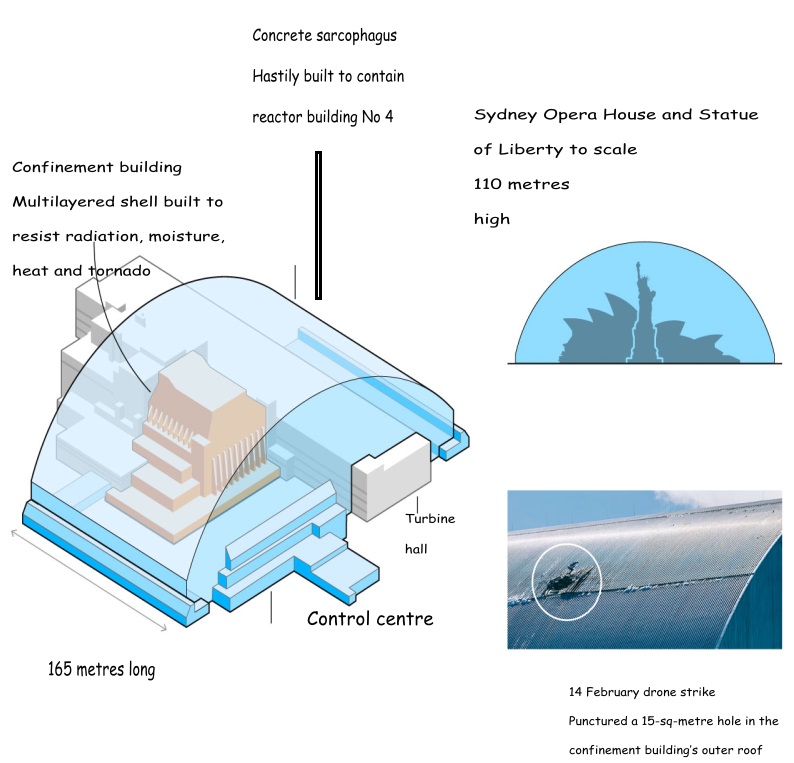
The dome built over the remains of the Chernobyl disaster has been damaged, raising fears it may no longer be able to contain radioactive material.
Officially known as the New Safe Confinement (NSC), the at least $2 billion protective shield was constructed over Reactor 4, which caused the world’s worst nuclear disaster in 1986.
The United Nations‘ International Atomic Energy Agency (IAEA), a nuclear watchdog, revealed this month that the NSC was severely damaged in a Russian drone strike in February.
The IAEA team conducted a safety assessment earlier this month, finding the dome had lost its primary safety functions, including confinement capability.
IAEA director general Rafael Mariano Grossi said: ‘Limited temporary repairs have been carried out on the roof, but timely and comprehensive restoration remains essential to prevent further degradation and ensure long-term nuclear safety.’
The inspection brought some relief, confirming that the dome’s main structure and monitoring systems remain intact.
But beneath the damaged shelter lies massive quantities of radioactive material from the 1986 disaster, making the site a ticking time bomb.
The IAEA has urged urgent repairs and upgrades to Chernobyl’s protective shelter, calling for better humidity control, advanced corrosion monitoring, and a high-tech automatic system to keep the radioactive reactor remains under control.
The damaged dome is the latest of several such expert missions since September last year, when the substations became increasingly affected by the military conflict.
‘These substations are essential for nuclear safety and security. They are absolutely indispensable for providing the electricity all nuclear power plants need for reactor cooling and other safety systems,’ Grossi said
‘They are also needed to distribute the electricity that they produce to households and industry.’
In 2026, with support from the European Bank for Reconstruction and Development (EBRD), the Chornobyl site will undertake additional temporary repairs to support the re-establishment of the NSC’s confinement function, paving the way for full restoration once the conflict ends.
‘The IAEA – which has a team permanently at the site – will continue to do everything it can to support efforts to fully restore nuclear safety and security at the Chornobyl site,’ Grossi said in a statement……………………………………………………………………………………………… https://www.dailymail.co.uk/sciencetech/article-15393121/Chernobyl-protective-shield-radiation-leak.html
New UK-France Nuclear Steering Group Meets to Advance Cooperation Under Northwood Declaration
Statement by the United Kingdom and the French Republic on Nuclear Policy and Cooperation.
From: Cabinet Office, 18 December 2025, https://www.gov.uk/government/news/new-uk-france-nuclear-steering-group-meets-to-advance-cooperation-under-northwood-declaration
At the UK-France Summit in July 2025, Prime Minister Keir Starmer and President Emmanuel Macron affirmed their commitment to strengthening the UK-France nuclear relationship. They signed the Northwood Declaration, which established the UK-France Nuclear Steering Group in order to provide political direction and coordinate bilateral work across nuclear policy, capability and operations.
On 10 December, the Nuclear Steering Group met for the first time in Paris, jointly chaired by senior officials from the UK Cabinet Office and the Presidency of the French Republic.
They were accompanied by senior military personnel and officials from defence and foreign ministries to discuss Euro-Atlantic security issues and coordination of their respective independent deterrents. They discussed their approach to strengthening deterrence in Europe and confirmed their ambition for bilateral co-operation on nuclear deterrence.
They also observed Operation POKER which was the first time foreign officials were given access to this demonstration of France’s strategic nuclear airborne component.
‘Unquestionably an Act of War’: Trump Declares Naval Blockade Against Venezuela
“This is the Iraq War 2.0 with a South American flavor to it,” warned one Democratic senator

Jake Johnson, Common Dreams, Dec 17, 2025
US President Donald Trump late Tuesday declared a blockade on “all sanctioned oil tankers” approaching and leaving Venezuela, a major escalation in what’s widely seen as an accelerating march to war with the South American country.
The “total and complete blockade,” Trump wrote on his social media platform, will only be lifted when Venezuela returns to the US “all of the Oil, Land, and other Assets that they previously stole from us.”
“Venezuela is completely surrounded by the largest Armada ever assembled in the History of South America,” Trump wrote, referring to the massive US military buildup in the Caribbean. “It will only get bigger, and the shock to them will be like nothing they have ever seen before.”
The government of Venezuelan President Nicolás Maduro, which has mobilized its military in response to the US president’s warmongering, denounced Trump’s comments as a “grotesque threat” aimed at “stealing the riches that belong to our homeland.”
The US-based anti-war group CodePink said in a statement that “Trump’s assertion that Venezuela must ‘return’ oil, land, and other assets to the United States exposes the true objective” of his military campaign.
“Venezuela did not steal anything from the United States. What Trump describes as ‘theft’ is Venezuela’s lawful assertion of sovereignty over its own natural resources and its refusal to allow US corporations to control its economy,” said CodePink. “A blockade, a terrorist designation, and a military buildup are steps toward war. Congress must act immediately to stop this escalation, and the international community must reject this lawless threat.”
The announced naval blockade—an act of aggression under international law—came a week after the Trump administration seized an oil tanker off the coast of Venezuela and made clear that it intends to intercept more.
US Rep. Joaquin Castro (D-Texas), one of the leaders of a war powers resolution aimed at preventing the Trump administration from launching a war on Venezuela without congressional approval, said Tuesday that “a naval blockade is unquestionably an act of war.”
“A war that the Congress never authorized and the American people do not want,” Castro added, noting that a vote on his resolution is set for Thursday. “Every member of the House of Representatives will have the opportunity to decide if they support sending Americans into yet another regime change war.”………………………………………….https://www.commondreams.org/news/unquestionably-an-act-of-war-trump-declares-naval-blockade-against-venezuela
Zaporizhzhia nuclear plant running on single power line, Russia says.

By Reuters, December 17, 2025, https://www.reuters.com/business/energy/zaporizhzhia-nuclear-plant-running-single-power-line-russia-says-2025-12-16/
MOSCOW, Dec 16 (Reuters) – The Russian-controlled Zaporizhzhia nuclear power plant in Ukraine is currently receiving electricity through only one of two external power lines, its Russian management said on Tuesday.
The other line was disconnected due to military activity, the management said, adding that radiation levels remain normal. Repair work will begin as soon as possible.
The nuclear plant, Europe’s largest, has been under Russian control since March 2022, when Russian forces overran much of southeastern Ukraine. It is not currently producing electricity but relies on external power to keep the nuclear material cool and avoid a meltdown.
Each side has regularly accused the other of shelling the facility. It experienced a couple of complete power outages earlier this month but was subsequently reconnected.
In September and October the plant was without external power for 30 days, relying on backup diesel generators, until a damaged line was reconnected during a local ceasefire arranged with the help of the U.N. nuclear agency.
Reporting by Reuters Writing by Maxim Rodionov Editing by Mark Trevelyan
Scottish National Party says UK nuclear deterrent is ‘America-first’.

By Tom Dunlop, UK Defence Journal, December 17, 2025
A disagreement over defence innovation and reliance on US technology surfaced in the House of Commons during Defence questions.
SNP MP Dave Doogan argued that what he described as an “America-first posture” is harming UK defence innovation, particularly in relation to the nuclear deterrent. He said the system relies heavily on US technology, citing components including “fusing, firing, arming, neutron initiators, the gas transfer system and the Mark 4 aeroshell.” Doogan also criticised plans to buy additional F-35 aircraft for what he characterised as “US-manufactured gravity-delivered nuclear weapons.”
He questioned why the government appeared aligned with US priorities while, in his view, overlooking European initiatives. “President Trump will put America first, but it is difficult to understand why this Labour Government seem keen to do the same, while spurning the innovation opportunity of the £130 billion SAFE programme in the EU,” Doogan told the House……………https://ukdefencejournal.org.uk/snp-says-uk-nuclear-deterrent-is-america-first/
–
Council battling illegal work near nuclear site.
Niki Hinman, Local Democracy Reporting Service, 17 Dec 25, https://www.bbc.com/news/articles/c4g583jlpl3o
A council continues to gather evidence to prosecute those responsible for an illegal development near a nuclear weapons site.
Work has been carried out on land opposite the Atomic Weapons Establishment’s (AWE) Aldermaston campus despite a temporary stop notice, West Berkshire Council said.
Hundreds of people have signed an online petition that states the work has left others feeling “unsafe, anxious and unprotected”, according to the Local Democracy Reporting Service.
The authority said the applicant has not submitted additional information to make it a valid application and so it is not being considered.
Neither the council nor the police have legal powers to remove individuals or items from the land and the council says the relevant civil legal processes must be followed to enable this.
“The temporary stop notice remains in force,” a council spokesperson said.
“Any activity that breaches it is a criminal offence, and officers are continuing to gather evidence to support potential prosecution.”
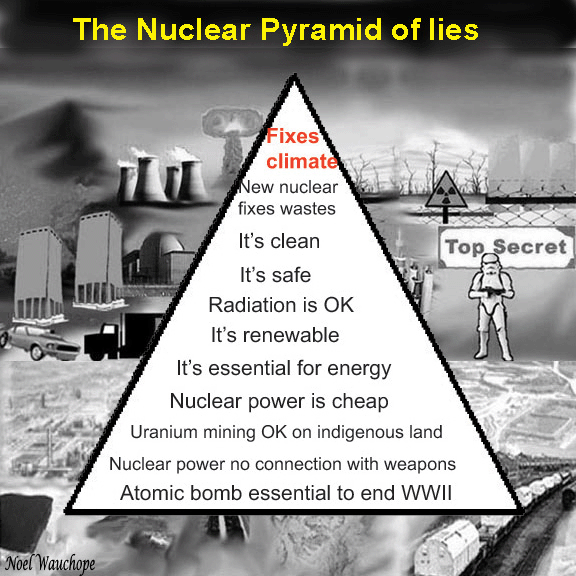
CLEAN? -WHAT A LIE! NIA welcomes first-ever nuclear appointment to Government’s Clean? Power Advisory Commission.
Sizewell C’s Julia Pyke brings expertise in delivering major infrastructure projects and effective community engagement
The Nuclear Industry Association has welcomed the appointment of Julia Pyke, Co-Managing Director of Sizewell C, as one of the UK Government’s eight new Clean Power 2030 Advisory Commissioners – marking the first time somebody with significant nuclear experience has been appointed to the Commission.
The appointment recognises the vital role nuclear power plays in delivering secure, reliable and low-carbon electricity, and ensures nuclear expertise is at the heart of advice shaping the UK’s clean power future.
Tom Greatrex, Chief Executive of the Nuclear Industry Association, said:
“Julia Pyke’s appointment is a hugely positive step and a clear recognition that nuclear must be central to delivering the UK’s clean power mission. The fact that this is the first time a nuclear leader has been appointed to the Commission ensures that decisions on the UK’s energy future are informed by the realities of building and operating clean, reliable power at scale.”
The first Zionist targeted assassination – 1924

Eli Ku, Aug 25, 2025, https://lenabloch.medium.com/the-first-zionist-targeted-assassination-was-of-the-orthodox-jewish-peace-negotiator-jaacob-israel-de5b0eb7844b
The first Zionist targeted assassination was of the Orthodox Jewish peace negotiator, Jaacob Israel De Haan, in 1924. Jewish terrorists unleashed a brutal terror campaign on Palestinians and the British, with bombings, assassinations, pogroms of Arab businesses and villages, destruction of civilian places of commonality, sabotaging railroads.
“By the time the Balfour Declaration was finalised, thirty-plus years of Zionist settlement had made clear that the Zionists intended to ethnically cleanse the land for a settler state based on racial superiority; and it was the behind-the-scenes demands of the principal Zionist leaders, notably Chaim Weizmann and Baron Rothschild.
First-hand accounts of Zionist settlement in Palestine had already painted a picture of violent racial displacement. I will cite one of the lesser known reports, by Dr. Paul Nathan, a prominent Jewish leader in Berlin, who went to Palestine on behalf of the German Jewish National Relief Association. He was so horrified by what he found that he published a pamphlet in January, 1914, in which he described the Zionist settlers as carrying on
“a campaign of terror modelled almost on Russian pogrom models [against settlers refusing to adopt Hebrew].”
A few years later, the Balfour Declaration’s deliberately ambiguous wording was being finalized. Sceptics—and the British Cabinet—were assured that it did not mean a Zionist state. Yet simultaneously, Weizmann was pushing to create that very state immediately. He demanded that his state extend all the way to the Jordan River within three or four years of the Declaration—that is, by 1921—and then expand beyond it.
In their behind-the-scenes meetings, Weizmann and Rothschild treated the ethnic cleansing of non-Jewish Palestinians as indispensable to their plans, and they repeatedly complained to the British that the settlers were not being treated preferentially enough over the Palestinians. And they insisted that the British must lie about the scheme until it is too late for anyone to do anything about it.
In correspondence with Balfour, Weizmann justified his lies by slandering the Palestinians and Jews—that is, the Middle East’s indigenous Jews, who were overwhelmingly opposed to Zionism and whom Weizmann smeared with classic anti-Semitic stereotypes. The Palestinians he dismissed as, in so many words, a lower type of human, and this was among the reasons he and other Zionist leaders used for refusing democracy in Palestine—if the “Arabs” had the vote, he said, it would lower the Jew down to the level of a “native”.
With the establishment of the British Mandate, four decades of peaceful Palestinian resistance had proved futile, and armed Palestinian resistance—which included terrorism—began. Zionist terror became the domain of formal organizations that attacked anyone in the way of its messianic goals—Palestinian, Jew, or British. These terror organizations operated from within the Zionist settlements and were actively empowered and shielded by the settlements and the Jewish Agency, the recognized semi-autonomous government of the Zionist settlements, what would become the Israeli government.
There was no substantive difference between the acknowledged terror organizations—most famously, the Irgun, and Lehi, the so-called Stern Gang—and the Jewish Agency, and its terror gang, the Hagana. The Agency cooperated, collaborated, and even helped finance the Irgun.
The relationship between the Jewish Agency, and the Irgun and Lehi, was symbiotic. The Irgun in particular would act on behalf of the Hagana so that the Jewish Agency could feign innocence. The Agency would then tell the British that they condemn the terror, while steadfastly refusing any cooperation against it, indeed doing what they could to shield it.
The fascist nature of the Zionist enterprise was apparent both to US and British intelligence. The Jewish Agency tolerated no dissent and sought to dictate the fates of all Jews. Children were radicalised as part of the methodology of all three major organizations, and by extension, the Jewish Agency.”
Thomas Suarez, London House of Lords, December 2016.
1 This Month



19 November – Webinar – The Reality of Reprocessing
Time: 11:00 AM Pacific Time (US & Canada) / 2:00 PM Eastern / 7:00 PM UK / 8:00 PM CET
Register for the Zoom Event Here



Shut down the radiation-damaged Heysham nuclear reactors now
To see nuclear-related stories in greater depth and intensity – go to https://nuclearinformation.wordpress.com

Say No to NASA’s Reckless Nuclear Reactor on the Moon
Say No to NASA’s Reckless Nuclear Reactor on the Moon
-
Archives
- November 2026 (64)
- October 2026 (302)
- September 2026 (339)
- August 2026 (330)
- July 2026 (355)
- June 2026 (287)
- May 2026 (306)
- April 2026 (356)
- March 2026 (251)
- February 2026 (267)
- January 2026 (308)
- December 2025 (358)
-
Categories
- 1
- 1 NUCLEAR ISSUES
- business and costs
- climate change
- culture and arts
- ENERGY
- environment
- health
- history
- indigenous issues
- Legal
- marketing of nuclear
- media
- opposition to nuclear
- PERSONAL STORIES
- politics
- politics international
- Religion and ethics
- safety
- secrets,lies and civil liberties
- spinbuster
- technology
- Uranium
- wastes
- weapons and war
- Women
- 2 WORLD
- ACTION
- AFRICA
- Atrocities
- AUSTRALIA
- Christina's notes
- Christina's themes
- culture and arts
- Events
- Fuk 2022
- Fuk 2023
- Fukushima 2017
- Fukushima 2018
- fukushima 2019
- Fukushima 2020
- Fukushima 2021
- general
- global warming
- Humour (God we need it)
- Nuclear
- RARE EARTHS
- Reference
- resources – print
- Resources -audiovicual
- Weekly Newsletter
- World
- World Nuclear
- YouTube
-
RSS
Entries RSS
Comments RSS

