Could Hungary’s fight over oil change course of Ukraine War?
If Budapest doesn’t play ball, the EU can’t impose new sanctions on Russia, nor loan Kyiv 90 billion euros to keep fighting.
an Proud, Feb 26, 2026, https://responsiblestatecraft.org/hungary-eu-ukraine/?utm_source=substack&utm_medium=email
The EU’s plan to impose its 20th package of sanctions against Russia crashed against a seemingly immovable wall of Hungarian resistance this week, when the Central Europe country used its veto to block it.
That is not necessarily the end of the matter, yet I hope it is the beginning of the end, with Europe finally choosing peace over war.
At a fraught EU Council meeting on February 23, agreement could not be reached on a new round of EU sanctions, leading the EU High Representative for Foreign Policy and Security, Kaja Kallas, to announce, “I deeply regret that we did not reach an agreement today, given that tomorrow [February 24] is the solemn anniversary of the start of this war.”
Hungarian resistance to collective decisions on Ukraine policy has been overcome before. In June 2025, Prime Minister Viktor Orban stepped out of the European Council meeting to allow a unanimous vote of those present to extend existing EU sanctions against Russia. Yet, this latest blockage is fueled by growing bad blood between Hungary and its eastern neighbour Ukraine, over the issue of oil.
It is an uncomfortable reality that Europe has continued to purchase Russian oil and gas throughout the war, in the face of President Trump’s exhortations to stop purchases. Gas imports still accounted for 12% of Europe’s total as of October 2025. And while Hungary and Slovakia are the largest importers, other western European powers such as France, the Netherlands, and Belgium, have also continued purchases. The addiction is a hard habit to break, and for largely domestic reasons.
As Gladden Pappin, the American President of the Hungarian Institute for International Affairs, has pointed out, if Hungary agreed to sanction Russian oil and gas, “Hungarian gas at the pump doubles overnight. Household energy prices triple or quadruple, and the German industry moving to Hungary immediately halts. Whatever government imposes that policy will collapse within weeks.”
While sanctioning Russia is a geopolitical tool, it has real world consequences for regular citizens across Europe. Germany has seen its economy tip into deindustrialization since the start of the war in Ukraine and the progressive cutting off of access to Russian, shedding over 250,000 industrial jobs, a contraction of 4.3%, amid widespread factory closures.
Sanctions require European states voluntarily to choose economic self-harm ahead of an end to the war in Ukraine. And in Hungary and Slovakia, that is not a palatable choice, not least ahead of a hotly contested election in Hungary on April 12. Prime Minister Viktor Orban has framed the election as a choice between “war or peace.“
Four years after the war in Ukraine started, increasing numbers of Europeans are desperate for peace and not war, not just for their long-term personal security, but for the benefits to their check books.
Yet that runs counter to Ukraine, which frames the war as existential to them. So, they have pushed Europe to go tougher and faster against Russia’s economy and are doing everything they can to add further pressure. Ukraine launched drone attacks against the Druzhba pipeline network which supplies oil to Hungary and Slovakia, cutting this supply route on January 27.
It is a statement of the crazy world in which we live, that Ukraine can attack facilities that supply EU and NATO countries without opprobrium in the west. Unfortunately, out of sympathy for Ukraine’s war plight, EU member states are quick then to criticize Hungary and Slovakia for taking retaliatory action. Poland’s Foreign Minister, Radek Sikorski, labeled the Hungarian veto as “an escalation.” And yet he doesn’t have to answer to Hungarian voters.
Blocking the EU’s 20th sanctions package is one measure. Hungary and Slovakia have also blocked the promised 90 bln euro loan package for Kviv to keep the war effort going. They have also threatened to cut off supplies of gas, electricity, and diesel to Ukraine (as it no longer imports gas from Russia, Ukraine relies of supplies piped in from proximate EU countries). Ukrainian media has predictably labeled this energy blackmail. Not least given the enormous electricity and heating shortages Ukraine faces in light Russia’s campaign of strategic bombing against their energy infrastructure.
At a TV interview that I attended recently, a Ukrainian MP pointed out that she uses a local app that tells her how many hours of electricity her building will receive each day. Who in Europe would want to live in such conditions, not the least during a bitterly cold winter?
Of course, the stark brutality of the air attacks and Ukraine’s energy crisis drives Europe’s mainstream politicians to pursue more punitive actions against Russia, including economic sanctions. Yet the inescapable reality is that the EU’s 20th sanctions package amounts to more of the same — tactical scrapes at the bottom of the barrel — to bear down on Russia’s energy exports and financial services sector, together with small beer restrictions on some other goods’ exports.
The President of the European Commission, Ursula von der Leyen, claims that Russia’s energy exports were cut by 24% in 2025. And yet, look at the real data, and you’ll see that Russia’s exports in 2025, at $419.4 billion, were down just 3.3% on 2025, with an overall current account surplus of $41.4 billion. That surplus will go into purchases of gold, which now accounts for almost one half of Russia’s soaring international reserves, which stand at $833 billion.
Meanwhile, Ukraine’s current account deficit more than doubled to $31.9 billion in 2025, or 14.9% of GDP, liquidity that will need to be met by printing money or donations from Europe.
At some point, European leaders need to ask themselves, after 19 rounds of sanctions already, “is this really working?”
It’s not only that economic sanctions against Russia hit diminishing marginal returns soon after the war in Ukraine started four years ago. But that the addition of new sanctions, self-evidently, disincentivizes Putin from settling for peace. Yes, Russia’s economy is undoubtedly feeling the pain, through high inflation and interest rates, plus slowing growth. But there has never been a time when it appeared that, for economic reasons, Russia was under greater pressure to end the war than Ukraine and its European sponsors.So, and as I have said before, sanctions, and their phased removal, could play a positive role in leveraging an end to the war. Continuing to blame Hungary and Slovakia for the continued intransigence in blocking yet another round of EU sanctions misses this point.
Ian Proud was a member of His Britannic Majesty’s Diplomatic Service from 1999 to 2023. He served as the Economic Counsellor at the British Embassy in Moscow from July 2014 to February 2019. He recently published his memoir, “A Misfit in Moscow: How British diplomacy in Russia failed, 2014-2019,” and is a Non-Resident Fellow at the Quincy Institute.
Renewables projected to overtake gas on cost within five years, report finds

20 February 2026, https://eibi.co.uk/news/renewables-projected-to-overtake-gas-on-cost-within-five-years-report-finds/
Renewable electricity is set to become the most economically favourable source of power in the UK by 2028 to 2029, according to new analysis by the Renewable Energy Association (REA), even after accounting for the full costs of expanding grids, storage and transmission.
The findings are set out in the Renewable Energy Association’s Renewable Cost Analysis Report 2025, which models two scenarios for the electricity system. Under a ‘Clean Power 2030’ pathway, annual investment of about £40bn would expand renewable capacity and cut the share of unabated gas to below 5%.
An alternative ‘No New Renewables’ scenario assumes no additional wind or solar capacity until 2040, with natural gas meeting future demand, which would mean lower upfront spending but higher ongoing fuel costs.
The REA concludes that although electricity generation will remain expensive across all technologies, renewables represent the most cost-effective long-term option. Including employment impacts, the analysis suggests renewable generation becomes the net economic winner by the end of the decade.
The modelling assumes flat gas prices over the next five years. If gas prices fall by 25% between 2025 and 2030, the point at which renewables become cheaper is delayed by only one year when excluding job benefits.
The report says its analysis includes all additional grid, transmission, storage and system costs associated with higher renewable deployment, in contrast to traditional levelised cost estimates that focus on generation costs alone.
It also highlights wider benefits from renewables, including reduced exposure to volatile international gas markets, improved energy security and environmental gains such as lower carbon emissions and cleaner air.
The REA recommends continued government support to manage short-term electricity costs, including possible reductions to green levies and value added tax, alongside stable policy to encourage investment. It says early investment in renewables would deliver long-term economic benefits, domestic employment and greater energy security for the UK.
Read REA’s Renewable Cost Analysis Report 2025.
US and Israeli attack on Iran: At least 51 girls reported killed in strike on school
February 28, 2026 , by Joshua Scheer, https://scheerpost.com/2026/02/28/us-and-israeli-attack-on-iran-at-least-51-girls-reported-killed-in-strike-on-school/
In the latest escalation of the U.S.–Israel assault on Iran, at least 51 young girls were reportedly killed when an airstrike struck a primary school in the southern city of Minab. According to Iranian state media, the victims — between the ages of seven and twelve — were inside Shajareh Tayyebeh elementary school when the building was hit in broad daylight.
Footage circulating online appears to show civilians digging through the rubble as smoke rises over the surrounding neighborhood.
Washington says the strikes are aimed at “eliminating imminent threats.” Tehran calls it a massacre.
The truth — and the consequences — demand scrutiny.
Here is breakthrough news on the ground
In moments like this, journalism is not a matter of slogans — it is a matter of moral clarity.
If the reports from Minab are confirmed, the bombing of an elementary school filled with young girls is not a “strike on imminent threats.” It is the annihilation of children. It is the kind of act that shatters whatever remains of the language of precision warfare and exposes the brutality beneath it.
The United States and Israel insist they are acting defensively. Tehran calls it a massacre. The world is left with rubble, grieving families, and the now-familiar choreography of denial, justification and geopolitical spin.
But certain facts demand scrutiny regardless of allegiance: Why were negotiations underway if war was already being prepared? What intelligence justified striking a civilian school in broad daylight? Who will independently verify the casualty count? And most importantly — who will be held accountable if the worst fears are confirmed?
The pattern is not new. From the siege of Gaza to suffocating sanctions regimes, from covert operations to open bombardment, the language of “security” has too often masked policies that devastate civilian life. The human cost is absorbed by those with the least power: children in classrooms, families in apartment blocks, workers in cities far from decision-making centers.
We should resist both reflexive propaganda and reflexive dismissal. Iranian state media must be scrutinized. Pentagon briefings must be scrutinized. Viral footage must be verified. But skepticism cannot become moral paralysis. If dozens of schoolgirls have been killed, that reality outweighs every talking point.
Escalation with Iran is not a contained regional maneuver. It risks a wider war, global economic shock, environmental catastrophe, and a further erosion of international law. Once normalized, the bombing of civilian infrastructure becomes precedent.
The responsibility of independent media is not to amplify rage, but to insist on evidence, accountability, and humanity. If civilians are being killed in the name of “security,” the public deserves answers that go far beyond press releases.
The truth — and the consequences — demand scrutiny.
This tweet bears repeating again and again:
“Bombing Iran in the middle of negotiations, while starving Cuba, while genociding Palestinians, while threatening to invade Greenland… the U.S. and Israel are the single greatest threat to humanity — and it’s not even close. We are all forced to live in the nightmare they create.” https://x.com/jasonhickel
‘Bombs Will Be Dropping Everywhere’: Trump Launches Illegal Regime Change War Against Iran
February 28, 2026, By Jake Johnson for Common Dreams, https://scheerpost.com/2026/02/28/bombs-will-be-dropping-everywhere-trump-launches-illegal-regime-change-war-against-iran/
President Donald Trump announced in the early hours of Saturday morning that the US has launched a massive military operation aimed at toppling the Iranian government as blasts were reported in Tehran, including near the offices of Supreme Leader Ayatollah Ali Khamenei.
Israel, under the leadership of Prime Minister Benjamin Netanyahu, is taking part in the assault. Unnamed Israeli security sources told Channel 12 that Israel and the Trump administration are “going all in” against Iran as Trump instructed Iranians to “stay sheltered,” warning that “bombs will be dropping everywhere.” People were seen seeking cover in Tehran as the US and Israeli bombs began to fall.
The assault, dubbed “Operation Epic Fury” by the Pentagon, comes days after the US and Iran took part in talks in Geneva, which Trump’s envoys characterized as “positive.” In announcing military action on Saturday, Trump said falsely that the Iranian government has “rejected every opportunity to renounce their nuclear ambitions.”
The US and Israeli attacks—which both nations characterized as “preemptive”—are plainly illegal under international law, which prohibits the threat or use of force except in response to an armed attack. The Trump administration is also violating US law, which gives Congress the sole power to declare war.
“The term ‘preemptive’ is pure propaganda,” wrote Drop Site journalist Jeremy Scahill. “The US once again used the veneer of negotiations as a cover to bomb Iran. Tehran had just offered terms that went far beyond the 2015 nuclear deal. What was preempted was diplomacy. The same propaganda tactics used in the 2003 Iraq war.”
Trump, who ditched the 2015 nuclear deal during his first White House term, repeatedly made clear in his remarks Saturday that he does not intend the new assault on Iran to be limited in scope like his bombings of Iranian nuclear sites last year. In the weeks leading up to Saturday’s attack, the Trump administration carried out a massive military buildup in the Middle East even as the president publicly claimed he was open to a diplomatic resolution.
“We may have casualties,” the US president said of American troops. “That often happens in war. But we’re doing this not for now. We’re doing this for the future.”
Trump also urged the Iranian armed forces to surrender or “face certain death” as the US fired Tomahawk cruise missiles and other munitions at Iran.
The Iranian government’s immediate response to Saturday’s onslaught was a pledge of “crushing retaliation” and a wave of drone and missile attacks on Israel. The Associated Press reported that “hours after the strikes on Iran, explosions rocked northern Israel as the country worked to intercept incoming Iranian missiles.”
Iran’s foreign minister later informed his Iraqi counterpart that Iran would be targeting US military installations in the region in retaliation for Saturday’s attacks.
A spokesperson for the Iranian military declared that “we will teach Israel and America a lesson they have never experienced in their history.”
“Any base that helps America and Israel will be the target of the Iranian armed forces,” the official added.
“Selling a dream”: the French nuclear start-up that ran aground

Naarea’s unravelling provides cautionary tale for dozens of small reactor
developers racing to bring designs to fruition.
In December 2023 the founder of French nuclear start-up Naarea gathered employees and investors
in Paris for a black-tie dinner and dance at which it revealed a large
model of the mini reactor it hoped would revolutionise the world of energy.
The gala capped an ebullient year for the group after it scored €10mn in
public subsidies and encapsulated the verve of its chief executive Jean-Luc
Alexandre, according to people who know him and a person who attended the
party.
Then came a cash squeeze and a brutal unravelling. The six-year-old
company, which had pledged to start rolling out reactors by the start of
the next decade, is now a step away from a court-managed liquidation.
The downfall of Naarea — “Nuclear Abundant Affordable Resourceful Energy
for All” — comes as more than 100 nuclear ventures around the world
race to bring their designs for small reactors to fruition. Yet the
technical challenges of some projects, and the huge funding many will need
to withstand years without revenues, are becoming increasingly apparent.
Earlier experiments with microreactors were largely abandoned in the 1970s
as the atomic energy industry sought economies of scale by moving towards
much bigger plants, including in France, home to Europe’s biggest fleet of
57 nuclear power stations.
FT 26th Feb 2026, https://www.ft.com/content/a782639d-1ac1-4252-a7ef-e8052925bbce
The hidden health crisis tied to America’s nuclear arsenal: How Native American families suffer the grisly side-effects from uranium mines

The Navajo Nation – a 27,000-square-mile piece of land that overlaps with parts of Arizona, New Mexico, and Utah – has more than 500 abandoned uranium mines that have been identified by the EPA.
‘The government was mining this uranium for the nuclear program, for nuclear weapons, and they put national security and having easy, inexpensive access to uranium ahead of the interests of the health and well-being of the people living there
By JAMES CIRRONE, US NEWS REPORTER, Daily Mail 25th Feb 2026 [Excellent pictures]
Teracita Keyanna’s youngest son was born with a hole in his heart after she spent decades living in a uranium-contaminated Navajo community in New Mexico.
Kravin Keyanna, now 19, spent the first decade of his life dealing with a severely weakened immune system. He constantly got ear infections, his mother said, which led to him having sensitive hearing.
‘We spent a lot of time in the hospital because he was more sickly than most kids,’ Teracita told the Daily Mail. ‘Because of his immune system, they didn’t want to do surgery on him because they were afraid that it was going to cause more harm in the long run.’
After about 11 years, his heart closed up on its own and healed without surgical intervention.
Meanwhile, Teracita’s 11-year-old daughter, Katherine, has continued to develop abnormal tissue growths underneath her top layer of skin near her lymph nodes.
‘She’s had to have them removed. And so she has gone through four different surgeries in five different locations,’ Teracita said. ‘Her first surgery was when she was 3 years old and the latest one was last year at 10 years old.’
Kravin and Katherine spent years of their childhood living on Red Water Pond Road, a Navajo settlement less than two miles away from the New Mexico border. Their family home was sandwiched between three abandoned uranium mines that remain highly toxic to this day.
These mines were part of a Cold War-era uranium boom that helped build America’s nuclear arsenal. Extraordinarily high levels of radiation from hundreds of long-forgotten sites in the Navajo Nation have exposed generations of Native American families to elevated health risks, including cancer and other unknown ailments.
Teracita was born in 1981 and has spent the majority of her life in the Red Water Pond Road community. Uranium ore extraction continued in the area until 1986 at the two nearby mining sites owned by Quivira Mining.
Mining at the United Nuclear Corporation-owned Northeast Church Rock Mine, immediately south of her ancestral home, lasted until 1982.
‘When I was young, nobody ever told me personally about the dangers of uranium,’ she said. ‘I didn’t know that the mines that were near my home were uranium mines. It was like living with a time bomb, and you didn’t even know that it was there.’
Doug Brugge, the chair of the Department of Public Health Sciences at the University of Connecticut School of Medicine, said Kravin and Katherine’s conditions cannot be definitively tied to uranium exposure. But he didn’t dismiss the possibility either.
Brugge led a project in the 1990s that interviewed Navajo uranium miners, many of whom developed lung cancer from the radon gas released when cutting into uranium ore.
The effects on them are ‘unequivocally well established,’ Brugge said. The effects on their wives, children and grandchildren are murkier and harder to pin down.
Brugge actually grew up in the Navajo Nation as one of the few white children among his peers. He left with his family when he was 14 and when he returned in his thirties to study the uranium issue, he heard many stories similar to Teracita’s.
‘The thing that has long bothered me is many people told us they didn’t know. They had no idea there was anything hazardous associated with this mining,’ he said. ‘A lot of them didn’t speak English. They had a limited education level. Their access to news and media was fairly limited.’
On top of a lack of communication from authorities about the dangers, Teracita said the mines near her did not have fences or barriers, which meant people and livestock could freely wander into contaminated areas.
n March 2024, the Environmental Protection Agency took soil samples from Church Rock No. 1, the nearest Quivira-owned mine to where Teracita lived.
Exposure to contaminated surface soil at and around the 44-acre site carried an estimated one-in-100 cancer risk — meaning one additional person out of every 100 exposed residents could develop cancer in their lifetime. About 30 families, including Teracita’s, lived near the mine as of 2006, according to the EPA.
Brugge said that level of risk is ‘really high’ and pointed out that the EPA is usually already concerned if it’s at one in 100,000 or one in a million.
Teracita also lived half a mile away from the Church Rock uranium mill, also owned by United Nuclear Corporation. Facilities like this can extract uranium from mined rock to produce a powder called ‘yellowcake’.
This material can later be converted for use as fuel in nuclear power plants or, at higher enrichment levels, in nuclear weapons. The process is not entirely clean, however, as it also produces sandy-looking radioactive waste called ‘mill tailings’.
In 1979, two years before Teracita was born, the Church Rock uranium mill had a catastrophic spill that sent 1,100 tons of mill tailings and 93 million gallons of radioactive wastewater into the Navajo Nation via the Puerco River.
There have not been extensive studies on the extent of the damage caused by this disaster, which to this day is considered the largest accidental release of radioactive material in US history.
While it is unknown how many people were possibly exposed and developed health conditions later in life, children who swam in the river or herded sheep across the water were left with serious burns on their skin.
Teracita said many of her neighbors and friends on Red Water Pond Road have mysteriously developed diabetes or cirrhosis of the liver without excessive drinking or smoking.
Teracita lived on Red Water Pond Road with her family until around 2018, when the EPA offered them financial assistance to move away while the agency cleaned up the mines. Prior to that, she had been exploring economically feasible ways to leave.
‘I was already trying to figure out what we could do for our kids in order to safeguard them further, considering that when I was a kid, nobody safeguarded me,’ she said.
The Department of Energy says there are a total of 4,225 uranium mines across the United States, the vast majority of them abandoned.
The Navajo Nation – a 27,000-square-mile piece of land that overlaps with parts of Arizona, New Mexico, and Utah – has more than 500 abandoned uranium mines that have been identified by the EPA.
This means the Navajo have just over 11 percent of the country’s abandoned mines within their borders, despite making up just 0.8 percent of America’s total landmass.
‘The government was mining this uranium for the nuclear program, for nuclear weapons, and they put national security and having easy, inexpensive access to uranium ahead of the interests of the health and well-being of the people living there” Brugge said.
It is not just the Navajo, who call themselves Diné in their language, who have been disproportionately exposed to the radioactive byproducts of mining operations, most of which ceased in the 1980s.
Although Native American land takes up 5.6 percent of the western US, about 25 percent of uranium mines in this area of the country are located within 6 miles of a reservation, a 2015 study from the Native American Budget & Policy Institute found………………………………………………………………………………………………………..
https://www.dailymail.co.uk/news/article-15503365/navajo-kids-health-defects-uranium-exposure-nuclear-weapons.html
Appeal court refuses TASC’s appeal against the High Court’s Sizewell C JR application decision

23rd February 2026. https://tasizewellc.org.uk/appeal-court-refuses-tascs-appeal-against-the-high-courts-sizewell-c-jr-application-decision-23-02-26/
Together Against Sizewell C Ltd (TASC) is extremely disappointed to learn that our appeal against the Secretary of State, Ed Miliband’s, decision not to subject Sizewell C’s secret sea defences to public scrutiny and assessment has been refused. We are, however, thankful that our legal challenge has helped to expose the Sizewell C project’s lack of resilience to extreme climate change.
TASC spokesperson, Chris Wilson, said, “TASC fear for the safety of our descendants and the precious Suffolk coastline because this judgement leaves future generations to rely on the developer’s ‘hypothetical’ i.e. ’imaginary or suggested’ (note 1), unassessed sea defences to protect Sizewell C and its 3,900 tonnes of spent nuclear fuel from flooding in an extreme sea level rise scenario over the next 150 years.
This decision rules out consideration of alternatives, such as raising the platform height, an option that will be lost once the plant has been built – a raised platform height will likely be less impactful on the environment and would negate the need for future generations to build the two additional huge sea defences.
“The Appeal Court’s decision sanctions the Government and developer’s choice to push ahead with £40 billion Sizewell C in the full knowledge that the project currently under construction is not resilient to a ‘credible maximum climate change scenario’ – contrary to Habitat Regulations, government policies and Labour’s claims that infrastructure projects are resilient to climate change impacts (note 2). Yet here, the project approved in the Development Consent Order (DCO) makes no provision for the two additional sea defences.
“Sizewell C is sited on one of Europe’s fastest eroding coastlines. Recent rapid erosion at nearby Thorpeness has resulted in many homes having to be demolished and in front of the development site the beach may need to be replenished before the nuclear plant has even been built (note 3) – demonstrating the threat of erosion is real and immediate and should be a wake-up call for government that Sizewell is not a suitable site for new nuclear “This government wants to ‘rip up the rules to fire-up nuclear power’ (also refer to note 5). TASC, however, believe there should be an inquiry into how the developer, EDF, was allowed to exclude the additional sea defences from their 2020 DCO application, even though national policy statements require developers to include plans for adaptive sea defences to deal with a credible maximum climate change scenario – EDF knew as far back as 2015 that the site requires additional flood defences in an extreme sea level rise scenario but chose to keep them secret, thereby avoiding public scrutiny and environmental impact assessment. One would have hoped that any sensible government would want to guarantee that there is a viable, fully assessed plan to ensure the plant and its spent fuel can be kept safe for its full lifetime to avoid a catastrophic event.
“It is imperative we all speak up for future generations, who have no voice in the decision-making of today, to ensure it is demonstrated that there is a fully assessed, viable option to keep the Sizewell C site and its 3,900 tonnes of spent fuel safe from flooding throughout its full lifetime. By not doing so, this government is placing an immoral burden on our descendants who will be forced to clear up the mess resulting from ill thought-out choices made today.”
Fuel Supply Gap Could Hold Back U.S. Nuclear Energy Renaissance
- The U.S. push to quadruple nuclear capacity by 2050 faces a near-term fuel bottleneck.
- Centrus, Orano, and Urenco are expanding U.S. enrichment facilities, backed by billions in DOE funding.
- Surging electricity needs driven by AI and data centers are accelerating urgency, with enrichment capacity needing to scale dramatically if nuclear power is to play a central role in meeting long-term U.S. energy demand.
By Tsvetana Paraskova Oil Price 25th Feb 2026- https://oilprice.com/Alternative-Energy/Nuclear-Power/Fuel-Supply-Gap-Could-Hold-Back-US-Nuclear-Energy-Renaissance.html
Nuclear energy is a distant prospect – wind and solar are here now
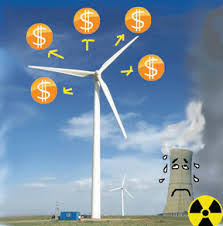
Sceptics don’t outright deny climate change but dismiss solutions as unrealistic
Sadhbh O’Neill, Irish Times 26th Feb 2026
Recent commentary on Ireland’s energy system is a reminder that not everyone is comfortable with change.
For people unconvinced by the potential of renewable energy to provide all our energy needs, the focus of energy policy should still be on large-scale sources of generation, as it was in the glory days of the ESB when it ran everything (and it took up to 18 months to get a grid connection).
Amid nostalgia for a simpler past, there are still voices making the case that fossil fuels and nuclear energy should form the backbone of the grid. This case is made on the basis that renewables can only match demand up to a certain point due to their intermittency, low energy densities and the challenges of integrating them into the grid.
And it is always hard to make the case for energy efficiency and demand management when fossil fuels, on paper at least, are plentiful, and there is no sign yet of the big energy producers slowing down extraction or divesting from fossil energy………………………………………………..
With regard to nuclear energy, there is a lot of interest in small modular reactors (SMRs), which, at approximately 400MW generating capacity, would be much more appropriate in scale for Irish electricity needs. The problem with nuclear energy is that traditional power plants, at about 1.3GW, are too individually large for Ireland, not to mention the likelihood of a nuclear plant taking decades to secure the required approvals and get built.
The ESB in its 2025 Emerging Technology Insights report notes that SMRs remain unproven due to a lack of demonstration projects. None of the SMR projects to date will have a demonstration plant completed before 2030.
Given that we are just four years away from key climate deadlines, nuclear power is so unrealistic in the context of what we need to do right now that it might as well be irrelevant.
The SEAI Energy in Ireland 2025 report highlights that Ireland needs proven, immediate solutions to avoid missing its second carbon budget (2026–2030). Luckily for Ireland, we have abundant renewable resources, which have never been so cheap to develop.
Renewable energy costs have come down so fast and by so much that even when you factor in the grid upgrades required, in 90 per cent of the world they outcompete new fossil fuel infrastructure easily, including the US. This is because wind and solar technologies are proven, scalable and cost-competitive over the long run, making them more attractive to investors…………………………………………. https://www.irishtimes.com/environment/climate-crisis/2026/02/26/nuclear-energy-is-a-distant-prospect-wind-and-solar-are-here-now/
Babcock CEO responds to Rosyth nuclear handling concerns
Dunfermline Press 25th Feb 2026, By Hannah Shedden
Babcock International Group’s CEO has sought to reassure residents who are concerned about the potential presence of nuclear weapons or waste at Rosyth Dockyard.
Fears were raised after SNP councillor Brian Goodall said that iodine tablets to counteract the effects of radiation would need to be given to “half the population of Rosyth” if proposals to bring more nuclear subs to the dockyard went ahead.
Cllr Goodall highlighted the “seriousness of the implications” of providing a contingency dock for the Dreadnought class of vessels that could be carrying Trident missiles.
His comments last year then prompted a row between the councillor and Labour MP, Graeme Downie, who accused Cllr Goodall of spreading “misinformation” and “arguing against highly skilled nuclear jobs in the safe dismantlement of nuclear subs at Rosyth”.
The Press spoke to Babcock CEO, David Lockwood, and asked him what his response would be to those who are fearful about nuclear materials in Rosyth.
He said: “I would say that we are the largest nuclear company in the UK and probably have the most experience handling civilian and military waste than anyone else, so I think you can take a lot of assurance from that…………………..
https://www.dunfermlinepress.com/news/25885325.babcock-ceo-responds-rosyth-nuclear-handling-concerns/
How will free-spending Ford pay for Ontario’s $400-billion nuclear plans?

One of the central unanswered questions about the Doug Ford government’s nuclear expansion plans for Ontario has been: How they will be paid for?
Estimates of the capital costs of the government’s plans, based on past projects and recent experiences in the United States and Europe, exceed $400-billion.
Mark Winfield, The Globe and Mail, Feb. 24, 2026, Mark Winfield is a professor of environmental and urban change at York University and co-editor of Sustainable Energy Transitions in Canada (UBC Press 2023). https://www.theglobeandmail.com/business/commentary/article-how-will-free-spending-ford-pay-for-ontarios-400-billion-nuclear-plans/#comments
One of the central unanswered questions about the Doug Ford government’s nuclear expansion plans for Ontario has been: How they will be paid for? The program includes new nuclear power plants at Darlington, Bruce and Wesleyville, and the refurbishments of existing reactors at the Bruce, Pickering and Darlington sites. Estimates of the capital costs of the government’s plans, based on past projects and recent experiences in the United States and Europe, exceed $400-billion.
The government’s plans envision an electricity system that is 75-per-cent nuclear in terms of output, up from approximately 50 per cent today. If the costs of these plans are to be paid for through the rates charged for the electricity produced, electricity bills will rise dramatically.
Estimates of the costs of electricity from new nuclear plants in Ontario range from the mid-20 cents a kilowatt-hour to more than 40 cents a kwh – double or even triple current consumer electricity costs. Such increases would undermine energy affordability, Ontario’s economic competitiveness and any plans for decarbonization through electrification.
Another alternative could be to hide the capital costs as debt, while keeping hydro rates low. That was the strategy followed by previous governments with the province’s original nuclear construction program between 1966 and 1993. In the end, the accumulation of debt flowing from that approach reached $38-billion (about $72-billion in current dollars), leaving the provincial utility, Ontario Hydro, economically inviable and effectively bankrupt.
A series of revelations over the past few months have made it clear that the province seems to have another, potentially equally problematic, plan in mind. It has become apparent that the 29-per-cent increase in electricity rates last Nov. 1 was directly related to the financing arrangements for the $25-billion Ontario Power Generation’s Darlington new-build reactor project, and the $26-billion refurbishment of the Pickering B nuclear station.
The impact on residential hydro bills of the November increase was mitigated through a near doubling of the province’s electricity rebate program, at a cost of approximately $2-billion a year, paid out of general revenues. In effect, that meant the province had begun paying for the capital costs of the Darlington and Pickering projects out of general provincial revenues. Moreover, recent changes to Ontario Energy Board rules have created an unprecedented situation in which ratepayers and taxpayers are now being asked to pay for nuclear projects that may never be completed or function.
The November increase in the rebate program brought the total costs of the province’s electricity rate subsidy programs to approximately $8.5-billion a year. These expenditures now amount to the equivalent of nearly two-thirds of the province’s deficit, exceed total expenditures in the justice sector, and are approximately double the annual capital investments in schools and health care.
The Pickering B and Darlington new-build projects are only the beginnings of the province’s nuclear expansion plans. Additional projects proposed for Wesleyville and the Bruce nuclear site could involve capital expenditures in excess of $300-billion.
If financed in the same way, the portion of the provincial budget consumed by electricity subsidies could reach $20-billion a year – nearly 10 per cent of the province’s total budget. That would force either dramatic increases in the provincial deficit to more than $30-billion a year, substantial tax increases or major reductions in spending in other – already in the view of many analysts – chronically underfunded areas such as health care, education, municipal and social services, and non-electricity public infrastructure.
There is, however, another, and better, option. None of the province’s plans have been subject to any external review in terms of their economic, technological or environmental rationality. Moreover, the province’s plans seem premised on assumptions of absolute technological, economic, social, environmental and political certainty reaching decades into the future. These are things about which, in a ruptured and destabilized world, there can only be absolute certainty of uncertainty. The situation adds to the risks of the province locking into a deeply inflexible energy pathway centred on large, high-cost and high-risk generating assets.
Ontario has been the subject of more efforts to develop and model alternative pathways for its electricity system, and the broader decarbonization of its energy system, than any other province in Canada. But there is no process to assess whether the directions set by the provincial government represent the best options for the province in economic and environmental terms relative to the alternative pathways that have been identified.
That situation needs to change rapidly. The province needs to engage in a serious, objective and independent assessment of its energy options for meeting future energy needs, while controlling costs, decarbonizing the province’s electricity system and advancing sustainability.
Britain must rethink its disastrous nuclear expansion – public protest can make it happen!

Sophie Bolt, CND General Secretary, 24 Feb 26, https://cnduk.org/britain-must-rethink-its-disastrous-nuclear-expansion-public-protest-can-make-it-happen/
Caroline Lucas is a former leader of the Green Party of England and Wales and a vice-president of the Campaign for Nuclear Disarmament. Here she writes ahead of Saturday’s national demonstration against Britain’s nuclear jets at RAF Marham and why public protest can make the government rethink its nuclear expansion plans.
With the end of the New START Treaty, the last remaining arms control agreement between the US and Russia, we now face the prospect of a new nuclear arms race without any limits on the two biggest nuclear armed states, who together own 90% of the world’s nuclear weapons. Given the world-destroying power of these nuclear arsenals it is critical that pressure is brought to bear on both Donald Trump and Vladimir Putin to support its voluntary extension for at least another year. This would give space to kick-start a formal extension of the Treaty, bringing an element of stability and transparency to what is an increasingly dangerous and unstable world in which the threat of nuclear weapons being used is higher than at any time since the Cold War.
The expiry of New START was one of the reasons given by the Bulletin of the Atomic Scientists to push forward the hands of the Doomsday Clock by four seconds. Now standing at 85 seconds to midnight, it acts as a stark warning of just how close we are to an irreversible catastrophe caused by humanity – through nuclear war or climate collapse. Rather than pursuing policies that will help push back the clock, nuclear states spent over $100 billion on these weapons in 2024, replacing and modernising them. Meanwhile, challenges to the nuclear taboo are intensifying with increasing calls for the use of so-called ‘tactical’ nuclear weapons on the battlefield.
Shamefully, Britain is part of the problem, with the ongoing replacement of its nuclear-armed submarine fleet and the announcement last summer of its decision to purchase US nuclear-capable F-35A fighter jets. Based at RAF Marham in Norfolk, the first 12 jets will be delivered by 2030 and a total of 75 will be bought over the course of the programme’s 40-year lifespan.
Even before the first delivery, expenditure on the programme has already spiralled out of control. The MoD initially costed the F-35 programme – which also includes non-nuclear F-35Bs – at £57 billion. However, this failed to include any sustainment costs, including staff, fuelling and maintenance. The National Audit Office has now estimated the programme will cost at least £71 billion. But this still doesn’t cover any of the costs for the lengthy, involved process of NATO integration. As the Public Accounts Committee revealed, this is because the MoD themselves have yet to figure this out. Footing the bill for this ‘blank cheque’ purchase will be the British public, at the expense of public services and climate action.
The purchase also ties us closer to the dangerous leadership of Donald Trump. These jets and their crews will be assigned to NATO’s nuclear Dual Capable Aircraft mission and RAF pilots will be trained to carry US B61-12 nuclear bombs now likely deployed to RAF Lakenheath in Suffolk. One of these bombs has the destructive power three times greater than the bomb dropped on Hiroshima in 1945. Modelling from Princeton University found that the use of these so-called ‘battlefield nukes’ could quickly escalate into a wider nuclear confrontation, leading to 2.6 million deaths in the first few hours alone. Rather than keeping us safe, these nuclear weapons undermine our security and ensure we are firmly on the frontline of a nuclear war.
The expansion also breaches international law. As a signatory to the nuclear Non-Proliferation Treaty, Britain is obliged to pursue disarmament in good faith. However, a new legal opinion argues ‘[t]he decision of the UK to purchase F-35A fighter jets rather than any other model is precisely because the aircraft can “deliver both conventional and nuclear weapons” and thereby enable the RAF to reacquire “a nuclear role for the first time since 1998.” Reinstating a nuclear role for the RAF represents a reversal of the UK’s long-term commitment to nuclear disarmament, including under the NPT.’
Given the grave consequences of this expansion, this would surely warrant a robust and serious debate in Parliament. Yet MPs were not consulted about the purchase ahead of Starmer’s announcement at last summer’s NATO summit. Since then, the government has stated it has no plans for such a debate.
Not surprisingly, there is widespread opposition to the decision, including from the Green’s Party Leader, Zack Polanski, and our MPs and Peers. They join many trade union leaders, faith communities, civil society and climate groups all calling for the government to rethink this disastrous nuclear expansion and instead pursue a foreign policy based on de-escalation, diplomacy, and international cooperation.
That’s why I’m urging all those who want to halt this deadly nuclear expansion to join CND’s upcoming demonstration at RAF Marham, in Norfolk, on Saturday 28 February. Not only is this base the central hub for the government’s notorious F-35 fighter jet programme, from where parts for these jets have been transported to Israel. It is also where these new nuclear-capable jets will be stationed. Of course, the government doesn’t want you to know what goes on at this base. And it certainly doesn’t want peaceful protesters shining a spotlight on it. But protest has always been central in making political leaders step back from the nuclear brink and take action to disarm nuclear weapons. It is a rich part of Britain’s history. And we need this now more than ever.
National Endowment for Democracy leader cut off in Congress after boasting of ‘deploying’ 200 Starlinks to Iran amid violence.

The National Endowment for Democracy’s president, Damon Wilson, bragged to a House committee of his group’s aggressive efforts to spark unrest in Iran, including by smuggling Starlink terminals and fashioning anti-Iran narratives for the media.
Max Blumenthal and Wyatt Reed, The Grayzone, February 24, 2026

Damon Wilson, the head of the National Endowment for Democracy (NED), was interrupted by a member of Congress during a House oversight hearing on February 24 after revealing that his agency “began supporting the deployment [and] operation of about 200 Starlinks early on” amid the violence which swept through Iran last month.
Before he could finish the sentence, he was cut off by the ranking member of the House Subcommittee on State, Foreign Operations, and Related Programs, Rep. Lois Frankel, who told Wilson: “You know what, I’m going to interrupt you – we’d better not talk about it.”
Wilson’s comments had been prompted by a question from Frankel, who requested details of what appears to be a new and apparently secret initiative by the State Department to provide Starlink terminals to Iranians.
Wilson appeared to take credit for both the recent unrest and Iran and subsequent media framing of the chaos. “What we’re seeing today, the Endowment has been making investments over years that have ensured that there have been secure communications, including Starlinks… that allowed information to go both in and out of the country,” he stated.
According to the New York Times, the Elon Musk-produced internet systems had been smuggled into the country by a “ragtag network of activists, developers and engineers [who] pierced Iran’s digital barricades.” It is clear now that the NED was at least partly responsible for funding and coordinating that network.
With Starlink emerging as a key weapon in the information war waged against Iran, it’s unclear how anti-government actors have managed to smuggle the devices into the country. But a recent incident in which a senior Dutch diplomat was caught trying to sneak multiple Starlink units and satellite phones through security at Iran’s Imam Khomeini Airport gives a hint.
The National Endowment for Democracy was founded in 1982 under the auspices of then-CIA Director William Casey to topple socialist and independent governments through the direct sponsorship of NGO’s, media organizations and political parties. “A lot of what we do today was done covertly 25 years ago by the CIA,” NED co-founder Allen Weinstein said of the Endowment’s work in 1991.
Despite its mission of promoting transparency and “fundamental freedoms” abroad, the NED is now a dark money group which conceals the names of its local partners under a “duty of care” policy announced in 2025. During his congressional testimony this February, Wilson insisted the policy was necessary for the security of grantees on the ground.
The NED’s work to smuggle Starlink terminals into Iran is therefore a covert operation aimed at promoting unrest. And according to Wilson, it is now a key part of the Endowment’s most aggressive initiative.
Iran “has been a huge priority for the Endowment. Iran has been, since I arrived at the Endowment, our fastest-growing program,” Wilson told Frankel.
“It’s now one of our largest programs globally, that involves both direct partners – Iranian groups – as well as our core institutes.”…………………………………………………………………………………………..
Violent regime change riots erupted again this January 8 and 9 across Iran, resulting in the burning of police stations, hundreds of mosques and worship sites, government buildings, marketplaces and lethal mob assaults on unarmed guards as well as police officers. The violence only stopped when Iranian security services imposed an internet blackout and neutralized thousands of Starlink terminals.
The Iranian government has provided the names and identification numbers of over 3000 citizens who were killed during the two days of rioting. But as The Grayzone reported, the NED-funded NGO, Human Rights Activists in Iran, initially claimed the death toll was over twice as high.
Now, as mainstream outlets like The Guardian cite dubious monarchist sources to exaggerate the death toll even further, the NED’s Wilson has revealed that his organization is working with “human rights networks” to “provide international media and other credible sources of what’s happened.”
…………………………………………… Rep. Frankel closed the session by suggesting that the US government was mirroring many of the repressive tactics the NED condemned abroad: “Political enemies being imprisoned by autocratic leaders. Masked men going into homes and terrorizing people. Certainly can understand why so many people are fleeing their countries. Unfortunately, it sounds very sad, because it sounds like the story that’s going on here.” https://thegrayzone.com/2026/02/24/ned-congress-starlinks-iran-violence/
Democratic congressional leaders are working to stop War Powers Resolution opposing Trump’s criminal Iran war.

Walt Zlotow, West Suburban Peace Coalition Glen Ellyn IL , 26 Feb 26
Senate Minority leader Chuck Schumer and House Minority Leader Hakeem Jeffries are horrified that a bipartisan War Powers Resolution to stop Trump’s planned criminal war on Iran might actually come to a vote this week.
The last thing they want is for Democrats, including themselves, to go on record to stop Trump from his dastardly planned attack. Why? Both leaders, like many fellow Democrats, support the likely upcoming Trump attack but are loathe to admit such. They either truly believe the nonsense Iran is seeking nuclear weapons and represents a threat to the homeland…or they are simply aligning themselves with Israel’s interests, not America’s, due to the millions pumped into Democratic campaign coffers by the Israel lobby.
Neither Schumer nor Jeffries utter a word about their pro Israel, pro Iran war beliefs. They know a large majority of voters reject Trump’s rush to war to cater to Israel’s military interests over America’s national security interests. Schumer and Jeffries stay silent so Trump can self-destruct when US body bags arrive home from Iran’s missile killing fields.
Unlike pro Israel Republican lawmakers who brag about their fealty to Israel and the need to topple Iran into failed state status, Democratic lawmakers want it both ways. Destroy Iran while laying the blame for all the lethal blowback killing Americans on Trump’s doorstep.
Schumer and Jeffries had no issue supporting the War Powers Resolution to stop Trump from invading Venezuela to kidnap its president. That resolution neither affected Israel nor was likely to incur massive US casualties. Voting for the resolution, bound to fail due to solid Republican support, brought no political fallout.
Schumer and Jeffries will not publically oppose bringing the Iran War Powers Resolution to a vote. They can’t leave any fingerprints on their opposition to it. Behind the scenes they offer process concerns, objections and caucus unity arguments to slow down the march to a vote; indeed possibly prevent it before Trump launches possible the most catastrophic war this century.
Chuck Schumer and Hakeem Jeffries want their cake and eat it too. Destroy Iran and the Trump presidency by remaining AWOL from the most critical issue they have ever faced. You cannot get more cynical than the Schumer, Jeffries tag team allowing Trump to blunder into catastrophic war to serve a foreign government.
US-UK tech talks restart with a focus on nuclear projects.

London and Washington have tentatively restarted work on their
multibillion-pound “tech prosperity deal”, which was paused last year
after President Donald Trump piled pressure on the UK to cede ground in
wider trade talks.
Senior US and UK officials have initiated discussions
about collaboration on civil nuclear technologies and on hosting a joint
summit on fusion technologies, according to multiple people briefed on the
talks. They described the deal as “unsticking”. The US-UK “tech
prosperity deal”, which was announced in September last year during
Trump’s state visit, aimed to spur co-operation between the two countries
in areas including AI, quantum computing and nuclear energy.
UK Prime Minister Sir Keir Starmer said at the time that the two nations were
embarking upon a “golden age of nuclear” energy, with more
transatlantic co-operation and speedier regulatory approvals for atomic
projects. The deal was touted by the UK as including £31bn worth of
investment from America’s top technology companies.
However, the US
suspended the deal in early December, with UK officials claiming the Trump
administration was pushing for wider trade concessions outside the tech
partnership. One of the projects announced was an agreement between UK
energy company Centrica and US nuclear group X-energy to build advanced
high-temperature, gas-cooled reactors in Hartlepool. Aerospace and
engineering company Rolls-Royce also said it had entered the US regulatory
process for its small modular reactors, signalling its intent to roll them
out in the US.
The tech deal was paused late last year after US officials
became increasingly frustrated with the UK’s lack of willingness to address
so-called non-tariff barriers in its wider trade negotiations, including
regulations governing food and industrial goods.
FT 25th Feb 2026, https://www.ft.com/content/0992b6d0-5d10-4a7a-a505-6cda84946e6d
1 This Month

of the week – Shut Down Drone Warfare!


Tell the Ukrainian Government to Drop Prosecution of Peace Activist Yurii Sheliazhenko

Petition to revoke the licensing of the Near Surface Nuclear Disposal Facility (NSDF) at Chalk River. https://www.ourcommons.ca/petitions/en/Petition/Details?Petition=e-7247
To see nuclear-related stories in greater depth and intensity – go to https://nuclearinformation.wordpress.com
-
Archives
- April 2026 (57)
- March 2026 (251)
- February 2026 (268)
- January 2026 (308)
- December 2025 (358)
- November 2025 (359)
- October 2025 (376)
- September 2025 (257)
- August 2025 (319)
- July 2025 (230)
- June 2025 (348)
- May 2025 (261)
-
Categories
- 1
- 1 NUCLEAR ISSUES
- business and costs
- climate change
- culture and arts
- ENERGY
- environment
- health
- history
- indigenous issues
- Legal
- marketing of nuclear
- media
- opposition to nuclear
- PERSONAL STORIES
- politics
- politics international
- Religion and ethics
- safety
- secrets,lies and civil liberties
- spinbuster
- technology
- Uranium
- wastes
- weapons and war
- Women
- 2 WORLD
- ACTION
- AFRICA
- Atrocities
- AUSTRALIA
- Christina's notes
- Christina's themes
- culture and arts
- Events
- Fuk 2022
- Fuk 2023
- Fukushima 2017
- Fukushima 2018
- fukushima 2019
- Fukushima 2020
- Fukushima 2021
- general
- global warming
- Humour (God we need it)
- Nuclear
- RARE EARTHS
- Reference
- resources – print
- Resources -audiovicual
- Weekly Newsletter
- World
- World Nuclear
- YouTube
-
RSS
Entries RSS
Comments RSS
 nuclear-news