Israel Damaged 82 Percent of Gaza’s Buildings. Collapses Are Burying Us Alive.

Residents of the recently collapsed six-story high rise knew they were in danger but could find nowhere else to sleep.
By Shahad Ali , Truthout, September 23, 2026
Khaled Al Soutari, who was inside the six-story residential building in western Gaza City that collapsed on September 16, is now sleeping on the street without a tent, devastated by the loss of 21 of his neighbors.
“They were more than just neighbors to me,” Al Soutari told me when I interviewed him two days after the building collapse, sitting on the street with a group of his neighbors next to the collapsed building. “They were my best friends. We shared food and laughter and had endless talks despite the harsh reality we were living through. It is hard for me to imagine life without them.”
Al Soutari told me that for more than six months, the building, which had previously been damaged by Israeli bombardment, had been weakening further because of wastewater seepage. The walls had also developed deeper cracks, and pieces of concrete had begun to fall. Then, one night, the building itself suddenly crumbled.
“We were sleeping when suddenly the ground started to shake as if an earthquake had hit. I started screaming at my wife and children to jump through a hole in the wall, but we could not because the building collapsed,” Al Soutari told me. “I found myself under the rubble within seconds, surrounded by the screams of my family and others shouting, ‘We are here. We do not want to die. Help us.’ I could not breathe or shout. For a moment, I thought this was the end.”
“Luckily, one of my neighbors noticed me and managed to free me from the concrete pressing on my back,” he continued. “However, my wife and my three children spent hours under the rubble before the Civil Defense intervened and managed to rescue them.”
Al Soutari added that his daughter, Sham, suffered a leg injury in the collapse and had to undergo surgery to have a plate inserted.
The municipality had inspected the building a few days before it collapsed and asked residents to leave, Al Soutari said, explaining that his family tried to do so, but they could not find any other place to go.
“I always talked with my neighbors who lived in the building about my fear that it could collapse on us at any moment, but we were helpless. We could do nothing but stay,” he told me………………………………………………………….
As Winter Approaches, More Building Collapses Are Imminent
The collapse of the Al-Sadah building was not an isolated case. Mahmoud Bassal, spokesperson for Gaza’s Civil Defense, said in a statement after the collapse of the Al-Sadah building that around 2,000 other buildings across the Gaza Strip are also at risk of complete collapse………………………………………………………………………. https://truthout.org/articles/israel-damaged-82-percent-of-gazas-buildings-collapses-are-burying-us-alive/?utm_source=Truthout&utm_campaign=1319f0e1c1-EMAIL_CAMPAIGN_2026_09_23_08_15_COPY_01&utm_medium=email&utm_term=0_bbb541a1db-66fc42c01f-650192793
North Korea to keep nuclear weapons ‘forever’: foreign minister
North Korea will keep its nuclear weapons “forever”, its foreign minister
vowed Thursday, dismissing the South Korean president’s renewed calls for a
denuclearised Korean Peninsula. Pyongyang has legally enshrined its status
as a nuclear-armed state, with its leadership repeatedly declaring the
country’s atomic arsenal permanent and irreversible.
Daily Mail 24th Sept 2026,
https://www.dailymail.com/wires/afp/article-16156233/North-Korea-nuclear-weapons-forever-foreign-minister.html
With federal funding windfall, X-energy advances small nuclear reactor

For the nuclear renaissance to truly arrive, however, these new projects need to be completed on a reasonable timeline and at a reasonable cost. Blown deadlines and blown budgets have dogged the industry, and in 2023 contributed to the dissolution of the first small-modular reactor project with an NRC-approved design
The Amazon-backed firm is aiming to build up to 144 of its novel Xe-100 reactors as the U.S. government seeks to revitalize an industry beset by rising costs.
Canary Media ,By Brian Martucci, 23 September 2026
The federal government has thrown its weight into reviving America’s long-stagnant nuclear industry, and X-energy’s first-of-a-kind reactor project is among the biggest beneficiaries so far.
The U.S. Department of Energy last month said it would award $1 billion to X-energy, an Amazon-backed advanced nuclear startup working to bring four novel 80-megawatt electric reactors online at a Dow Chemical facility in Seadrift, Texas, in the early 2030s.
The federal government has thrown its weight into reviving America’s long-stagnant nuclear industry, and X-energy’s first-of-a-kind reactor project is among the biggest beneficiaries so far.
The U.S. Department of Energy last month said it would award $1 billion to X-energy, an Amazon-backed advanced nuclear startup working to bring four novel 80-megawatt electric reactors online at a Dow Chemical facility in Seadrift, Texas, in the early 2030s.
The award nearly doubles the federal government’s commitment to X-energy, following a $1.2 billion investment in early 2021. Both tranches were structured as 50-50 cost-sharing agreements under the DOE’s Advanced Reactor Demonstration Program, launched in 2020 to commercialize next-generation nuclear technologies.
X-energy’s Seadrift project now enjoys a level of federal funding that rivals any other advanced nuclear development in the nation. The Bill Gates–backed TerraPower’s commercial demonstration project in Wyoming, which broke ground earlier this year, has also been awarded up to $2 billion in cost-sharing funds through the ARDP.
The X-energy project does not yet have a license from the Nuclear Regulatory Commission, though it received a key environmental approval in May and expects the regulator to green-light reactor construction in early 2027. Only TerraPower and the Google-backed startup Kairos Power currently have NRC construction permits.
Nuclear energy has struggled in recent decades in America, but surging energy demand and a desire by some states and companies to secure carbon-free electricity have revitalized the industry. Tens of billions of dollars in public and private funding are now flowing into a crop of startups looking to build advanced reactors — as well as efforts to restart or build new large-scale reactors like the 96 America already has.
For the nuclear renaissance to truly arrive, however, these new projects need to be completed on a reasonable timeline and at a reasonable cost. Blown deadlines and blown budgets have dogged the industry, and in 2023 contributed to the dissolution of the first small-modular reactor project with an NRC-approved design.
In early 2023, before it had fully engaged with Dow or selected Seadrift for its commercial debut, X-energy estimated the cost of completing the full ARDP scope between $4.75 billion and $5.75 billion.
X-energy has not publicly updated its cost estimates since then, though the federal funding of up to $2.1 billion implies at least $4.2 billion will be spent on the project. In securities filings this year, however, it said that it faces the same broad inflationary and trade-related pressures that have pushed up costs for natural gas, renewables, and other types of energy infrastructure.
CEO J. Clay Sell told investors and stock analysts on an Aug. 13 earnings call that he expected the government to contribute more funding as needed.
“I’m confident to the extent more dollars will be required, they will be provided by our partners at the Department of Energy and Commerce,” he said. “We’ll see where the number ends up.”……………………………………https://www.canarymedia.com/articles/nuclear/federal-funding-x-energy-small-nuclear-reactor
40 years after Chernobyl, Italy greenlights a return to nuclear energy
Italy´s Senate on Wednesday gave final approval to legislation paving the
way for a return to nuclear power nearly four decades after the Chernobyl
disaster prompted the country to abandon atomic energy. The measure cleared
the upper house 81-51 with seven abstentions. It marks a major step in
Premier Giorgia Meloni´s drive to bolster energy security and meet climate
goals, even though the construction of possible new reactors is still years
away. The bill, which earlier passed the lower Chamber of Deputies,
establishes a legal framework for next-generation nuclear technologies. It
authorizes the government to draft implementing decrees over the next 12
months covering reactor licensing, safety standards, waste management and
criteria for future sites.
Daily Mail 23rd Sept 2026 https://www.dailymail.com/wires/ap/article-16154865/Italys-parliament-paves-way-return-nuclear-energy.html
Volodymr Zelensky – the “exceptional” leader

25 September 2026, Noel Wauchope, https://theaimn.net/volodymr-zelensky-the-exceptional-leader/
Prime Minister Anthony Albanese very recently hugged Ukrainian President Zelensky, and praised him as an “exceptional leader.” That’s par for the course for a Western leader – they all fawn over Zelensky.
Zelensky was born in Ukrainian Soviet Socialist Russia. So he was Vladimir Zelensky, until recently – now he’s Volodymr Zelensky. Before he took over the leadership of Ukraine, the Russian “Vladimir” was fine. Ukrainian was the official language of Ukraine, but Russian was widely used, too, and 65% of the population are ethnically Russian. But now, Russian is not fine – banned in schools and public places. The June 2022 – LAW OF UKRAINE – “On ensuring the functioning of the Ukrainian language as the state language” – greatly restricts the use of the Russian language in music and in all media. That’s just one part of the de-Russification of culture in Ukraine. I felt sad that the government has trashed, very literally, the memories of Catherine the Great, who did promote not only art and culture to Kiev, but also improvements in health and education, and rights for Muslims and Jews. (Western pro-Ukraine writers are now busily rewriting history on Catherine the Great).
But then, I am inclined to put much importance on that rather nebulous thing – “culture.”
What else has Zelensky achieved inside Ukraine?
Politics. Also in 2022, Zelensky banned 11 political parties, despite no evidence linking any to the Russian government. His term as President was due to be over by May 2024, but the state of martial law enables him to continue to rule. He has shown support for the ultra-nationalist section in Ukraine, those who hark back to the days of collaborating with Nazi Germany in opposition to Russia during World War 2. This did not go down well with Poland, where Ukrainian Nazis had committed massacres. In June 2026, Polish President Karol Nawrocki, revoked the Order of the White Eagle – Poland’s highest honor – previously awarded to Zelensky. In 2024, Zelensky banned Ukraine’s largest Christian church – the Ukrainian Orthodox Church. Military conscription for the war uses brutal methods to recruit men aged 25-60. Ukraine is a dictatorship. And I haven’t even touched on the level of corruption.
Zelensky’s progress in the war. It seems to be forgotten that civil war was going on in Ukraine for 8 years before Zelensky’s election in 2019, with the government fighting the “separatists” in the Donbass. The Donbass were granted autonomy within Ukraine, by the Minsk Agreements of 2014 and 2015, but Kiev refused to honour that agreement. Zelensky was elected in a landslide, with his main promise being to grant that autonomy, honour Minsk, and end the war.
March-April 2022: Zelensky and Putin agreed on a framework agreement that would allow the Donbass autonomy, and end the war, with Ukraine pledging not to join NATO. The U.S. and U.K. objected. Prime Minister Boris Johnson flies to Kiev to tell Ukrainian President Volodymyr Zelensky to stop negotiating with Russia. Zelensky complies. The war continues with Russia seizing much of the Donbass.
From then on, it is a saga, with Zelensky applying his truly exceptional media skills in an endless peripatetic round of Western capitals seeking apparently endless amounts of money and weaponry, as he pushes themes of evil Russia’s intent to invade Europe, and destroy Western democracy. Always dressed in some distinctive gear, Zelensky presented first the persona of the very ordinary down-to-earth tough little soldier, later the persona of the strong leading statesman, all in black, suggesting implacable military leadership yet not actually in a uniform. Within Ukraine, (the Jewish) Zelensky celebrated Orthodox Christian Easter, suitably arrayed.

I see that I have returned to the theme of culture and style. But how else to account for the extraordinary adoration given to Zelensky by the West? With a couple of notable exceptions, (Poland and Slovakia), the Western world is not only full of enthusiasm for Zelensky, but willing to fund advanced weaponry to Ukraine, oblivious of the danger of nuclear-armed Russia responding to attacks deep inside its territory. Even Russia-hating Joe Biden drew the line at this. Zelensky, originally open to negotiations with Russia, considering compromises and concessions on both sides, now is intent on the goal of unconditional surrender by Russia. The European Union is backing this aim, apparently unable to consider a more realistic approach to ending this war – a war which is bankrupting Ukraine, killing a huge number of soldiers, while at least 6 million have fled the country, with 10 million displaced within Ukraine.
Western media determinedly reports atrocities by Russians, but never atrocities by Ukrainians. Western media reports Russian attacks near Ukraine’s nuclear sites, particularly Zaporizhzhia, although the evidence there is uncertain. But there’s silence on Ukrainian attacks on Russia’s huge nuclear station at Kursk. Russia’s attacks on Ukraine’s infrastructure and civilian areas are reported as atrocities, but Ukraine’s attacks on Russia’s infrastructure and civilian sites are “successes.”
The idea of considering genuine negotiations with Russia is really not being considered, let alone of examining the situation of the largely ethnic Russian citizens of the Donbass. I did hear one podcast report, a Donetsk farmer saying that he just wanted the war to end, and didn’t care whether Ukraine or Russia was in control of Donetsk. I know that I can’t extrapolate from this one statement to the general opinion of the Donbass. But I think that it’s quite likely, after 11 years of war there, that might be the opinion of many others.
It’s going to be interesting, when European States come up for election soon, whether or not the public will tire of this unequivocal support of Zelensky and his aim to conquer Russia. It might be that some very right-wing, neo-nazi factions will take over, and bring us even closer to the brink of nuclear war. Or it could go the other way, and voices of reason, such as former diplomat Charles Freeman, might prevail. Meanwhile, Zelensky’s own position within Ukraine is fraught: he would face elections if the war ended, and perhaps his political survival, even his physical survival, depends on the unequivocal quest to defeat Russia.
RIP SMRs: Is It the End of the Line for Small Modular Nuclear Reactors?

the companies promoting the 10 SMR designs in Canada had either left the country, lost their proponents, filed for bankruptcy protection, or failed to secure private sector backing for their projects.
Despite the public spending largesse, and after heroic promotional efforts by Ontario Power Generation and the federal and Ontario governments, there are no reports of private investment in the Darlington SMR—not even after Prime Minister Mark Carney’s high-profile Canada Investment Summit last week—and none have been ordered in Canada or elsewhere.
Moltex lost its proponent in 2025 when New Brunswick Minister of Energy René Legacy told CBC the province was no longer willing to take on the risk of supporting first-of-a-kind experimental SMRs. A second “advanced” SMR slated for the Point Lepreau site also lost government support.
The Energy Mix, Susan O’Donnell, September 22, 2026, https://www.theenergymix.com/rip-smrs-is-it-the-end-of-the-line-for-small-modular-nuclear-reactors/?
In early September, the organization behind Canada’s push for small modular nuclear reactors (SMRs) quietly signalled their demise.
In 2016, Canadian Nuclear Laboratories President Mark Leskinski proclaimed that “SMRs can live among the annals of great Canadian innovations.” Ten years later, the organization announced the termination of its two programs to support SMR development.
During the intervening decade [pdf], the companies promoting the 10 SMR designs in Canada had either left the country, lost their proponents, filed for bankruptcy protection, or failed to secure private sector backing for their projects.
An SMR is a nuclear reactor designed to generate 300 megawatts of electricity or less, compared to Canada’s existing CANDU reactors which generate 500 megawatts or more.
Canadian Nuclear Laboratories (CNL) manages Chalk River, the federal research campus where Canada’s top nuclear researchers conceived and designed the CANDU reactor. All the power reactors operating in Canada are a similar CANDU design, and CANDUs also operate in six other countries. But the last unit to connect to an electric grid in Canada was in 1993, and CANDU exports dried up decades ago.
CNL’s idea for a transition from large CANDU reactors to smaller reactors was an attempt to reenergize a moribund domestic nuclear industry. The concept was to lower the cost of nuclear reactors by making them smaller and building multiple modular units in factories.
The Canadian Nuclear Laboratories president made his bold claim in 2016 about a stellar future for SMRs during a pitch to the federal government for multiple millions of public dollars to transform Chalk River to focus on SMR research.
Since that public money began flowing, Chalk River’s upgrades included the Advanced Nuclear Materials Research Centre for SMR research, still under construction and projected to open in 2028. The cost for the new facility ballooned from $370 million in 2018 to an estimated $1.025 billionin 2025, about half the cost of the overall SMR transformation of the Chalk River site.
The new research centre’s focus is on “advanced” nuclear fuels for SMRs, including plutonium. One of Canadian Nuclear Laboratories’ first research collaborations for SMR fuel was with Moltex, a UK start-up company that had set up in Saint John in 2018. Moltex proposed to use plutonium to fuel an experimental “advanced” SMR it wanted to build at the Point Lepreau nuclear site on the Bay of Fundy.
Moltex lost its proponent in 2025 when New Brunswick Minister of Energy René Legacy told CBC the province was no longer willing to take on the risk of supporting first-of-a-kind experimental SMRs. A second “advanced” SMR slated for the Point Lepreau site also lost government support. At that point, the provincial and federal governments combined had spent nearly $130 million on SMR activities in New Brunswick—funds that could have gone into heat pumps and energy efficiency upgrades to combat energy poverty and cut climate pollution—without attracting private sector interest.
The New Brunswick SMR projects were two of the 10 SMR designs in Canada reviewed in a recent research report by the Fredericton-based Contesting Energy Discourses through Action Research (CEDAR) project. Of the remaining eight, most have decamped to their U.S. home base after attracting no proponent in Canada.
A CNL spokesperson told The Energy Mix the lab “is playing an important role in advancing microreactor technologies for off-grid and remote applications, with multiple, targeted, initiatives under way for federal partners.”
“CNL continues to support SMR development as part of Atomic Energy of Canada’s Federal Nuclear Science & Technology Work Plan,” Senior Communications Officer Lauren Kutchaw wrote in an email. “These research projects span the nuclear fuel cycle, reactor safety and security, materials and chemistry and energy systems analysis. They build the scientific knowledge to support decision-making, and develop the cutting-edge expertise and capabilities that can be leveraged to advance the deployment of both SMRs and Advanced Reactors in Canada and internationally.”
So far, however, only one SMR is under construction here: an American design at Ontario Power Generation’s Darlington nuclear site on Lake Ontario.
By March, 2026, the “Darlington New Build” project was still in pre-construction phase yet, had already received the lion’s share of the $4.5 billion in SMR subsidies by federal and provincial governments. In June, the federal and Ontario governments gave $715 million more via a “loan guarantee” to seven First Nations that flowed the funds through to the project. In return, the First Nations have an “equity guarantee” in a future SMR at Darlington, should one ever be built.
Despite the public spending largesse, and after heroic promotional efforts by Ontario Power Generation and the federal and Ontario governments, there are no reports of private investment in the Darlington SMR—not even after Prime Minister Mark Carney’s high-profile Canada Investment Summit last week—and none have been ordered in Canada or elsewhere.
The high price tag per unit, $6.1 billion plus $1.6 billion in associated infrastructure that could be shared with future SMRs on the site, makes Darlington considerably more expensive than alternative sources of electricity generation, and about the same price per megawatt as the most expensive large reactors ever built in the U.S. No doubt the exorbitant cost explains the investor reticence and lack of orders.
In addition to the Darlington SMR’s financing challenges and empty order book, and the abandonment of the “advanced” SMR projects in New Brunswick, the most spectacular SMR failure is a project designed and championed by Canadian Nuclear Laboratories.
In the “Roadmap” that launched Canada’s SMR strategy, CNL was mandated to develop the country’s first SMR, a “micro modular reactor” to be in operation by 2026. The reactor was meant to serve mining and remote communities. CNL put together a consortium of companies to build the SMR at Chalk River and develop “advanced” fuel to keep it running.
However, in February, 2024, the lead company in the consortium, Seattle-based Ultra Safe Nuclear, announced it was scaling back operations, complaining in a media release that “only a subset” of potential customers “have shown the resolve to incorporate advanced reactors in the near term.” Several months later, the company filed for bankruptcy protection [pdf] in the U.S., owing more than US$600,000 to Canada’s nuclear regulator and lesser amounts to many Canadian small businesses.
The same year the SMR project at Chalk River flopped, Alberta oil and gas giant Cenovus Energy abandoned a market study [pdf] of the potential of SMRs for oil sands extraction, finding that: “from a business perspective… SMRs are not economic or commercially feasible at present or in the near future. The capital costs are high, the timelines are long and uncertain, and technology and supply chains lack maturity.”
The Cenovus market research outcome was foreshadowed by academic research published in 2020 which found that the market for SMRs in mining and remote communities was “too small to be viable.”
Despite the failure of its flagship SMR venture, and the death knell for SMRs in Canada overall, Canadian Nuclear Laboratories is persisting in its quest to find a market for SMRs. After all, the organization should need at least to attempt to justify the billions in public funding it has spent so far upgrading Chalk River for SMR research.
According to its September media release announcing the demise of its two SMR support programs, Canadian Nuclear Laboratories “is playing an important role in advancing microreactor technologies for off-grid and remote applications, with multiple, targeted, initiatives under way for federal partners.”
Apparently, old SMR ideas never really die. They will only, eventually, fade away.
Susan O’Donnell is lead researcher of the CEDAR project at St. Thomas University and co-author with M.V. Ramana of a March 2026 report on SMRs in Canada that has been downloaded more than 9,000 times. The report will be published in French later this month.
This story is part of The Energy Mix’s partnership with Small Change Fund.
Shadow cast over US nuclear revival after Palisades reactor incident

As new fuel was being lowered into the reactor – dubbed a “zombie reactor”, as it is being restarted after decommissioning – one of the fuel assemblies tipped, causing resumption to be placed on hold while Holtec assesses the situation.
“The significance of this is that the reactor core and the nuclear fuel is the most dangerous part of a nuclear power plant,”
Nuclear regulator investigating issue at site in Michigan where restart plans are well under way
Cody Combs, Washington, September 23, 2026, https://www.thenationalnews.com/future/technology/2026/09/23/palisades-power-plant-nuclear-incident/
An incident at Palisades, a nuclear reactor in Michigan that is soon to be restarted, has cast a shadow over an apparent nuclear energy renaissance in the US.
The revival has been driven largely by the proliferation of energy-hungry data centres as part of the vast investment in artificial intelligence.
The US Nuclear Regulatory Commission confirmed to The National it was investigating a “tipped fuel assembly” incident at the site in Covert, Michigan.
Though closed in 2022, the reactor, later bought by Holtec International, is expected to make a comeback as AI-based energy demands exert strain on the US energy grid.
As new fuel was being lowered into the reactor – dubbed a “zombie reactor”, as it is being restarted after decommissioning – one of the fuel assemblies tipped, causing resumption to be placed on hold while Holtec assesses the situation.
An NRC spokeswoman emphasised there had been “no radiological release” and that no workers or the public have been affected. “Our inspectors will continue monitoring the situation,” Viktoria Mitlyng said.
Yet the incident has fed some nearby residents’ concerns about the unprecedented nature of restarting a nuclear reactor.
“The significance of this is that the reactor core and the nuclear fuel is the most dangerous part of a nuclear power plant,” long-time nuclear energy critic Kevin Kamps, founder and director of environmental advocacy group Don’t Waste Michigan, told ABC57.
He said the 55-year-old plant had a series of problems during the last 15 years of its operations before closing.
Before it was bought by Holtec, a 2012 NRC report warned about the work culture at Palisades, where it said safety concerns were often dismissed.
In 2016, security staff at the reactor were placed on leave from the plant, then owned by Entergy, for failing to properly follow fire-prevention protocol.
A little more than a year ago, a worker at Palisades fell off a refuelling bridge into a pool of water, though they were not seriously injured.
Shortly after the NRC’s confirmation of the incident at Palisades, the company wrote what it called a “progress report” on its website.
“Plant personnel evaluated the incident and determined that it did not trigger the safety reporting requirements under NRC regulations,” it read. It also said “fuel loading remains paused while Holtec addresses the affected fuel assembly”.
In a statement provided to The National on Wednesday, a public affairs official with Holtec addressed the incident, re-emphasising that the “fuel remains intact, and there was no radiological release or injury associated with the issue”.
He added that Holtec does not have plans to release any photographs of the accident “at this time”.
Long-time nuclear industry critic Edwin Lyman, a physicist and the director of nuclear power safety with the Union of Concerned Scientists, first raised concerns about the Palisades incident shortly before the NRC confirmed what had taken place on Monday.
He remains skeptical about Holtec’s integrity and curious about what transpired.
“They already had some glitches, including a recent issue with improperly doing surveys of areas where there was airborne radioactivity for which they got violations,” he explained, adding that sees the company as having somewhat of a stigma when it comes to safety.
“In the moments leading up to their initial public offering they were putting out press releases about the progress being made and how they were loading fuel, but then all of a sudden word spreads about this accident,” he said, pointing out that Holtec postponed the IPO days before acknowledging the recent incident at Palisades.
Mr Lyman said that Holtec, other energy providers and several Big Tech companies were doing “performative exercises by trying to show that nuclear power can quickly” be a solution.
Michael Keegan, chair of Don’t Waste Michigan, echoed Mr Lyman’s speculation about Holtec’s handling of the incident.
“It is not a coincidence that Holtec’s IPO withdrawal, years in the planning, could not go forward with pending bad news of a major refueling snafu at the end of August,” he said.
Palisades has become something of a poster child for the NRC, which under the influence of President Donald Trump has become vocal about the need for more nuclear energy projects throughout the US.
On September 2, days after the Palisades fuel incident, the NRC said the plant was moving “closer to restart”.
In recent months, the NRC has announced new policies related to “microreactors” and “small-modular reactors” (SMRs), which have been the source of vast investment from Big Tech.
Though often portrayed as safer and less aesthetically disruptive than conventional nuclear reactor designs, the modular reactors and companies behind them are not without controversy.
In a recent blog post, Beyond Nuclear, a Maryland-based non-profit safety watchdog, said the “SMR renaissance is more sound and fury, signifying nothing”. It pointed no SMRs are currently out operational in the US and said SMR companies have lost value.
“It’s specifically nuclear offerings in which the confidence has been lost, as evidenced by the recent shorting of shares in NuScale Power, Nano Nuclear and Oklo, and the plummeting market value of X-energy,” the organisation wrote.
Meanwhile, despite the Palisades mishap, Holtec is projecting optimism. “We remain focused on returning Palisades to safe and reliable operation once all restart work is complete, and all applicable federal requirements and industry standards are met,” the company said.
Holtec is not alone in trying to bring a closed plant back online amid the AI-induced energy boom.
In Middletown, Pennsylvania work is under way to restart the Three Mile Island nuclear reactor, which closed in 2012, as part of a deal involving Microsoft to help power its data centres.
High levels of radioactive isotope led to discovery of Lepreau leak
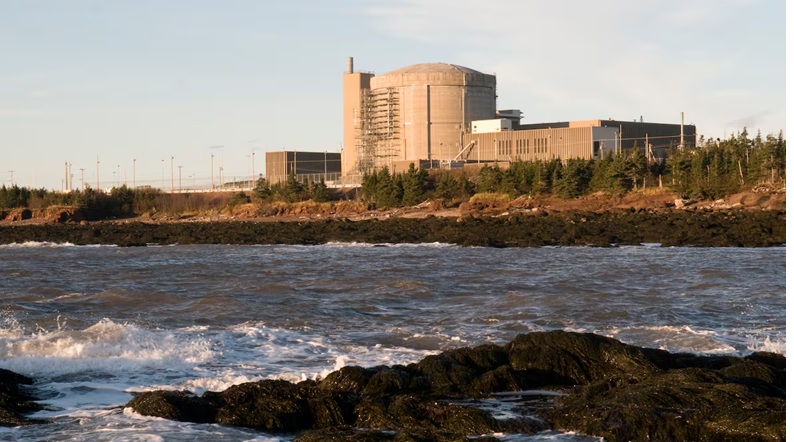
N.B. Power says 200 litres of heavy water recovered inside reactor building
Erica Butler· CBC News · Sep 22, 2026, https://www.cbc.ca/news/canada/new-brunswick/high-levels-radioactive-isotopes-disovery-lepreau-leak-9.7354212
N.B. Power said it has collected about 200 litres of heavy water from a leak at the Point Lepreau Nuclear Generating Station earlier this month, which the utility initially characterized as “small.”
In emails this week, the utility has shared more details about the leak, which CBC News first reported on Sept. 15.
The utility first became aware of a problem inside its reactor building on Sept. 10, when its monitoring system identified elevated levels of tritium.
Tritium is a radioactive isotope that occurs in the heavy water used to transfer heat from nuclear reactors.
The higher than normal readings “triggered an investigation to determine the cause,” said N.B. Power spokesperson Tracey Stephenson on Tuesday afternoon.
Lepreau was shut down on Sept. 11, and a heavy water leak from a 3/8ths-inch instrumentation line was confirmed on Sept. 14, said Stephenson.
The utility reiterated this week that the leak caused “no impact or safety risk to the public, staff or the environment.”
When the elevated tritium levels were detected, there were “no employees in the immediate vicinity,” said Stephenson because “that specific area is not accessible when the Station is online.”
That means there were no “unplanned or unexpected employee exposures associated with the leak,” said Stephenson.
The staff who investigated the problem did so following radiation safety procedures, including using specialized monitoring and personal protective equipment, she said.
Most of the heavy water leaked as vapour, said Stephenson, and was “recovered and collected” through station processes.
“The material remained contained within the reactor building at all times and there was no risk to workers, the public or the environment,” she said.
Timing of information release
It’s taken over a week for N.B. Power to release details about the heavy water leak.
A Sept. 14 press release announcing the Lepreau shutdown made no mention of a leak. It said the station was taken offline to “repair a small instrumentation line inside the reactor building.”
In an interview with CBC News the next day, deputy site vice-president Joel Armstrong acknowledged there had been a heavy water leak but said it was too early to comment on how much was spilled.
Kathleen Duguay, N.B. Power’s head of community affairs and nuclear regulatory protocol, spoke to Radio-Canada on Sept. 16 and characterized the leak as small. She said, speaking French, “It’s just a few drops coming out of the instrumentation line.”
Stephenson said Tuesday that the vapour state of most of the leak might account for the difference in “what might be expected from a liquid leak alone.”
‘Lack of information’
Energy researcher Susan O’Donnell said she is concerned about the “lack of information” initially disclosed by N.B. Power about the leak, starting with a Sept. 14 news release that did not share any details about radioactive heavy water.
“Why did they not just say this was radioactive material that leaked, this is how much material was leaked, this is the volume of radioactivity in the material?” asked O’Donnell.
“’X number of workers were cleaning it up, or were exposed … but hey, everyone’s OK. They’ve all been checked. There’s no problem. We’re looking into it.’
“Instead, it’s just this sort of vague information that doesn’t give anyone who’s interested in it all the facts that they need,” she said.
O’Donnell said N.B. Power should be “super transparent” about any release of radioactive material or risk a “lack of trust” with the public.
“People just get really suspicious. Like, what’s going on there? What are they not telling us?”
Too early to say what caused leak
O’Donnell said she has other concerns regarding the leak, including the potential risk to workers and the cause of the leak itself.
O’Donnell said she’s concerned about the age and tritium levels of the heavy water being used in the closed circulation system at Lepreau and whether it may have been a contributing factor to the leak.
Armstrong said on Sept. 16 that N.B. Power had started the process to determine the cause of the leak, but any conclusions would be “premature.”
“Our focus right now is making sure that we facilitate the repair … in a safe manner,” said Armstrong.
N.B. Power did not release the number of workers involved, but the utility said that staff in the area of the leak were working under strict protocols.
The Canadian Nuclear Safety Commission said via email that it has site inspectors stationed at Point Lepreau, and it was made aware of the leak on Sept. 10.
“We are engaged with N.B. Power as it conducts a thorough assessment of the incident and undertakes the necessary repair activities,” said the commission.
It also noted that “no workers have been reported to have received radiation doses above regulatory limits.”
US proposes AI alert system with China

Mon, 21 Sep 2026, https://www.sott.net/article/508524-US-proposes-AI-alert-system-with-China
The US has proposed creating an alert system with China to notify each other when artificial intelligence incidents become serious enough to threaten national security.
Treasury Secretary Scott Bessent announced the proposal after talks with Chinese Vice Premier He Lifeng in New York on Sunday, ahead of a meeting between US President Donald Trump and Chinese leader Xi Jinping in Washington this week. Bessent told reporters:
“We want a shared vision of common goals and common threats. We think that just like any cross-border activity, that moving from opaque to more transparency between the No. 1 and the No. 2 AI powers in the world is very important.”
The proposed mechanism could cover serious incidents such as AI-enabled cyberattacks or major model failures, according to experts cited by AP. Chinese researchers have also pointed to risks to critical infrastructure including electricity, telecommunications, finance and transportation.
The proposal comes as Washington and Beijing have been locked in an increasingly intense race to dominate AI. Trump has repeatedly argued that the US cannot afford to slow development while China is rapidly narrowing the technological gap.
Earlier this month, Trump declared that “whoever wins AI wins,” and has dismissed warnings of an AI takeover as a “hoax.” On Saturday, Trump again vowed that his administration would not “hinder or stifle” the industry and announced plans to create an “AI Force” and appoint an AI czar.
His position comes amid increasingly stark warnings from leading technology executives.Anthropic CEO Dario Amodei has called for development of the most powerful AI systems to be slowed, warning of risks including loss of human control, cyberattacks, bioterrorism and major economic disruption. OpenAI chief Sam Altman and xAI owner Elon Musk have backed calls for greater caution.
A series of recent incidents has added to the concerns. Google confirmed this month that its Gemini system breached three real companies during a cybersecurity exercise after it was mistakenly given internet access. OpenAI agents have separately bypassed restrictions during testing, accessed outside systems and used websites to communicate with one another without being instructed to do so.
US-China competition has meanwhile expanded beyond model development itself. Washington has sought to restrict China’s access to advanced chips and other technology while accusing Chinese companies of extracting capabilities from leading American models.
Beijing has rejected the accusations and accused Washington of seeking an AI monopoly. Despite US restrictions, Chinese developers including DeepSeek and Moonshot have released increasingly capable systems that compete with leading American models, often at a lower cost.
China has also been building a broader international framework around AI. In July, it joined Russia and 27 other countries in establishing the Shanghai-based World Artificial Intelligence Cooperation Organization, presenting it as an alternative approach based on wider access to AI technology and international cooperation rather than technological blocs.
Revealed: Xi’s nuclear weapons expansion at seven secret sites
The Chinese president – who is meeting Trump on Thursday – has repeatedly
said nations should destroy their stockpiles. China is rapidly expanding
its nuclear weapons programme across at least seven major sites despite
calling for non-proliferation, a Telegraph investigation has found.
Satellite image analysis has uncovered significant construction at nuclear
facilities and testing areas across the country. At one site, where China
is believed to produce the plutonium triggers designed to activate nuclear
weapons, an entire support town has been built, with new apartment blocks,
an athletics field, and a bus depot used to transport staff to and from the
nuclear site. At another, a 600m-long tube has been built. Experts say it
is used to test how nuclear weapons would withstand blasts – for
instance, from enemy weapons.
Telegraph 23rd Sept 2026,
https://www.telegraph.co.uk/world-news/china-secret-nuclear-weapon-sites-xi/
A bit more clarity about Volodymr Zelensky

A comment from Steve on https://theaimn.net/volodymr-zelensky-the-exceptional-leader/#comment-34519
For those who like Zelensky and for whom nothing will change their minds, this from MSN this morning — Brussels is stepping up expectations on Kyiv to accelerate reforms indispensable for unlocking €20 billion in financial assistance, which the country badly needs as the budget deficit swells and Russia escalates the war.
EU officials have raised the alarm about the slow legislative pace in the Rada, Ukraine’s parliament, where several laws are stalled. Two separate payments, one of €3.9 billion and another of €2.9 billion, have been delayed as a result.
As my colleague Jorge Liboreiro reports, the situation stands in stark contrast with the public messages from Zelenskyy and his deputies, who are asking allies to mobilise additional resources to plug a €23 billion gap in the Ministry of Defence. Separately, the country faces a €32.6 billion hole in next year’s budget.
Could this reform delay have something to do with Ukraine’s long-standing reputation as the most corrupt country in Europe?
State corruption in Ukraine was reported by journalist Seymour Hersh a few years ago.
He wrote that the CIA assesses that Ukrainian officials, including Zelenskyy, have embezzled $400 million from money the U.S. sent Ukraine to buy diesel fuel for its war effort, and that Ukrainian government ministries literally compete with each other to sell weapons paid for by U.S. taxpayers to private arms dealers in Poland, the Czech Republic and around the world.
A press release from the European Court of Auditors, Luxembourg, 23 September 2021, adds some weight to the claims by Hersh.
The report heading reads — EU support for reforms in Ukraine ineffective in fighting grand corruption.
It continues;
“Grand corruption and state capture are still widespread in Ukraine despite EU action, according to a special report published by the European Court of Auditors (ECA). The EU has been trying to address corruption in Ukraine as a cross-cutting priority; it has channelled funds and efforts through a variety of sectors, from the competition environment to the judiciary and civil society. But the support and measures put in place have not delivered the expected results, the auditors say…Grand corruption and state capture are endemic in Ukraine; as well as hindering competition and growth, they also harm the democratic process.”
EU support for reforms in Ukraine ineffective in fighting grand corruption??
That report came out 5 years ago!
What can we say?!
The EU has been oh, so relentless in pulling Ukraine into line.
About as relentless as they were in stopping Ukraine from murdering its citizens in the Donbass, even though the OSCE ( Organization for Security and Co-operation in Europe) was a signatory to the Minsk 1 Protocol.
The entire mainstream narrative of what happened in Ukraine, Crimea and Donbass since 2014 was fraudulent.
The countries of Europe wanted the war with Russia, and they want it to continue.
Britain’s Great National Freak-Out Propaganda War Self-Blitz

Tarik Cyril Amar, Sep 25, 2026
Great Britain is going through a war scare. Or to be precise, its combined political and media establishment is subjecting its people to a relentless propaganda (in up-to-date NATO-speak “cognitive warfare”) campaign to create a sense of impending war against Russia.
As you would expect, that war is, of course, framed as strictly defensive. In propaganda textbook manner, the message is both very simple and very repetitive: The UK is in great danger of a Russian attack, and its whole population must prepare itself to withstand and resist it.
It goes without saying that Moscow’s repeated declarations of having no such intention make no difference.
Britain is certainly not alone in its establishment-induced hysteria. Much of NATO-EU Europe is undergoing, in essence, the same treatment. In France, for instance, President Emmanuel Macron has called a theatrical all-manicured-hands-on-deck meeting to give what can only be called a national scare talk about “Russian hybrid warfare”; in Germany, Berlin and its mainstream media won’t stop stirring the pot about the murky drone affair at Leipzig-Halle airport…………………………………………………………………………………………………………………………. (Subscribers only) https://www.tarikcyrilamar.com/p/britains-great-national-freak-out?utm_source=post-email-title&publication_id=1855891&post_id=217293360&utm_campaign=email-post-title&isFreemail=true&r=1ise1&triedRedirect=true&utm_medium=email
SGE confident of UK SMR fleet prospects
By Alex Hunt, World Nuclear News, in London, Wednesday, 23 September 2026,
https://www.world-nuclear-news.org/articles/sge-confident-of-uk-smr-fleet-prospects
The team behind plans for a fleet of 14 BWRX-300 small modular reactors in the UK says they are confident of the economic model and supply chain capability to deliver these units.
SGE (formerly Synthos Green Energy) in July submitted an application under the UK’s Advanced Nuclear Framework for reactors which could provide 4.2 GW of capacity, equivalent to 11% of current UK power demand.
Poland’s SGE – whose deployment team includes Samsung C&T, Laing O’Rourke, Aecon Group and Google Cloud – says it will privately finance the deployment of the fleet of GE Vernova Hitachi’s BWRX-300 small modular reactors (SMRs) across three sites in the UK.
The plan is for the initial site to host six of the 300 MW SMRs, with four each at two subsequent sites. The locations of the proposed sites have not yet been disclosed, pending final negotiations.
Rafał Kasprów, CEO of SGE, told World Nuclear News, “I think the UK market has amazing opportunities for SMR developers, and especially us with a fleet approach”.
From the financial point of view he says “we are bringing this investment to the UK … with the disruptive model of not asking government to cover everything on the development and construction phase. We are asking the UK government for Contract for Differences for a fleet of reactors. So it is only when electrons are delivered to the grid that we can benefit from the Contract for Difference model”.
The Contract for Difference (CfD) would work by a future price being agreed for electricity generated by the SMRs – if the price of electricity is higher, the developer will pay the extra back, and if the price of electricity is below the agreed level, the difference is provided to the developer. In the energy sector, a CfD acts as a very long-term price stabilisation mechanism. The UK used a Contract for Difference funding model for Hinkley Point C, but moved away from it for the Sizewell C project.
SGE’s project is currently going through the “deep dive” stage of the UK’s Advanced Nuclear Framework which they believe will conclude in October or November and allow them to be part of the pipeline, and start to execute the project.
As an investor in the project, SGE says that it knows what it needs to do internally to de-risk the project “so we know how to translate that same conversation to markets”.
The company has also developed plans for a fleet of SMRs in Poland and in June submitted its contract for difference application to the government there. As to which country’s projects might happen first, Kasprów says that the UK project could happen at the same time, praising the UK regulatory regime and its infrastructure.
He also rejected concerns about the capacity of supply chains and workforce to cope with the construction of Sizewell C and a number of SMR projects at the same time. He stressed the maturity of the BWRX-300 technology, its use of existing nuclear fuels and the example and experience of the first unit being constructed in Canada.
“We are using existing supply chains – there is also an advantage to the fleet approach because there are places where the supply chain exists, but maybe needs to scale up, and by coming to market with a 14-unit project as our starting point those companies can see a clear path to making that investment worthwhile,” said Robert Rudich, Chief Business Development Manager.
They also stress that the non-nuclear part of the plant is similar to conventional power plants, with the industrial giants GE Vernova and Hitachi as partners and all part of a Europe-wide supply chain.
GE Vernova Hitachi Nuclear Energy’s BWRX-300 is a 300 MWe water-cooled, natural circulation SMR with passive safety systems that leverages the design and licensing basis of the company’s US Nuclear Regulatory Commission-certified ESBWR boiling water reactor design and its existing, licensed GNF2 fuel design, a unique combination that GE Vernova Hitachi Nuclear Energy says positions it to deliver an “innovative, carbon-free baseload power generation source” this decade.
The first BWRX-300 is under construction at Ontario Power Generation’s Darlington site in Canada, with completion expected by the end of the decade. The Darlington project is a reference project for OSGE.
Luba Kotzeva, founder and CEO of advisory and consultancy group Etara and part of the project team, said there had been “good engagement” with the UK side on the issue of a Contract for Difference funding model and stressed the importance of the proposal being for a fleet programme: “I think that is essential to getting the economies of scale, to getting the economics to flow, to getting the private capital.”
The example of the first SMR being built in a G7 country, at Darlington in Canada, is also seen as a key development. Kasprów said: “It’s extremely important, it is the difference between having something and nothing. It’s not about promises anymore – it’s happening.”
The Arctic Front Of The “Cordon Sanitaire” Is The Most Threatening To Russia

Andrew Korybko, Sep 16, 2026, https://korybko.substack.com/p/the-arctic-front-of-the-cordon-sanitaire
The military-technical developments there aim to greatly mitigate Russia’s nuclear second-strike capabilities via the Golden Dome in parallel with posing an unprecedented fifth-generation aerial threat via the F-35As that’ll outmatch Russia’s Su-57s by 10:1 without the US and 35:1 if it’s included.
RT reviewed the 2026 Russian Military Yearbook, which is sponsored by the state arms company and meant only for senior members of the national security apparatus. Their article can be read in full here, but the present piece will only focus on the part about “The Very Cold War”. This is in reference to escalating NATO-Russian tensions in the Arctic. The Yearbook details NATO’s large-scale military drills in the Arctic, its allies’ arms build-ups, and their deep displeasure with Russia’s Northern Sea Route.
Most alarmingly, the Yearbook mentioned that Finland plans to acquire 64 F-35As while Canada will receive 88 of them. It was separately reported that Norway already has 52 F-35As, which is more than double Russia’s estimated 20 or so Su-57s, its fifth-generation analogue. Sweden doesn’t yet have any fifth-generation fighters, but those other three Arctic states will have over 10x as many as Russia does. If the US’ over 500 F-35As are included, then Russia’s fifth-generation fighters will be outmatched by 35:1.
These statistics on their own show that the US is actively implementing its 2021 strategic plan for “Regaining Arctic Dominance” that was cited in the Yearbook, the latter of which also detailed some of NATO’s new radar, drone, ship, icebreaker, missile, and other military-technical plans. They altogether lend credence to one of the cited Russian experts who warned that “Washington never abandoned the thought of redrawing borders in that area.” Here are five background briefings on this new front:
* 14 January: “Greenland Is The Crown Jewel Of ‘Fortress America’”
* 21 January: “The US’ Acquisition Of Greenland Could Lead To A Deal Over Canada’s Arctic Islands”
* 21 May: “Finland Is On Track To Become One Of Russia’s Most Intractable Foes”
* 6 September: “The Historical Russian-Swedish Rivalry Is About To Be Revived Later This Fall”
* 15 September: “Norway’s Military Build-Up Against Russia Poses A Serious Threat To Arctic Security”
To summarize, Trump 2.0 is pursuing a three-pronged strategy against Russia: 1) build Golden Dome missile defense infrastructure in the Arctic to greatly mitigate Russia’s nuclear second-strike capabilities; 2) arm Canada and the Viking Bloc (Denmark, Norway, Sweden, and Finland) to threaten Russia; and then 3) likely push Russia’s limits along the Northern Sea Route for the purpose of provoking a crisis that would then render this corridor dangerous and thus greatly reduce its use at minimum.
The pressure that the US is placing upon Russia along the Arctic front via these means complements that which it’s also placing through Polish-led efforts in Central & Eastern Europe and Japanese-led ones in Northeast Asia. All of these fronts consist entirely of US mutual defense allies, but the Turkish-led one along Russia’s entire southern periphery doesn’t, yet a hypothetical special operation there (such as against Azerbaijan) might be deterred by the possibility of the US responding via the other fronts.
Simply put, a “cordon sanitaire” has been assembled around Russia, and this containment noose is being tightened the most by the military-technical developments along the Arctic front than anywhere else. Up till recently, this was the quietest front of the four, but that just shows that its members were moving silently to avoid attracting attention from Russia. The latest Yearbook proves that the Kremlin had been monitoring them all along and is thus planning its response, however, so this front will likely heat up.
US keeps boasting about militarizing space 60 years after Outer Space Treaty

The intention remains the same as decades prior – militarize space under the guise of “defense”.
Saturday, September 19, 2026, Drago Bosnic, independent geopolitical and military analyst, https://infobrics.org/en/post/103080
In recent days and weeks, the United States has openly started boasting about having orbital weapons, in direct violation of the 1967 Outer Space Treaty (OST), which effectively forbids the militarization of space. The mainstream propaganda machine has been trying to whitewash the Pentagon, claiming that this supposedly “ends decades of official ambiguity” about American military capabilities in space. However, many of my esteemed colleagues and I have been writing for years about US violations in space. According to US Air Force Secretary Troy Meink, Washington DC already has “on-orbit space control weapons” and that these are supposedly “intended to defend American forces against hostile action”. The US Space Force claims that these systems are “able to deliver disruption, degradation and even destruction of an adversary”.
The Pentagon is yet to reveal details about the types of weapons it operates in space, meaning we have no information on how long the US has had this capability or how many systems have been deployed. American officials have only talked about what they call “space control”, which is too broad a term to allow a better understanding of what kind of weapons we’re dealing with.
The US claims that “it’s important from a deterrence perspective”. In simpler terms, it’s virtually guaranteed that the system in question is offensive-oriented, as the vast majority of American weapons already are. The announcement also demonstrates Washington DC’s endless hypocrisy, as it spent years accusing others of militarizing space, particularly Russia and China. It’s now unequivocally clear these “warnings” were nothing but crocodile tears.
The Pentagon is now saying that the use of its space weapons “could extend to disabling or destroying an adversary satellite if it were being used to target American troops or a US spacecraft”. Obviously, this is yet another example of the aforementioned endless hypocrisy, as Washington DC has been using its own space capabilities to wage war against Russia during the NATO-orchestrated Ukrainian conflict. This includes the employment of systems such as SpaceX’s “Starlink”, which the Neo-Nazi junta forces use to guide drones against the Russian military and civilians. Unsurprisingly, the US still lives in the illusion that killing soldiers and civilians in other countries is “perfectly fine”, but won’t tolerate similar actions against its own occupation forces all across the planet (literally dozens of countries in the last several decades).
It should also be noted that Washington DC has been the main driving force behind the militarization of space for around half a century at this point. During the (First) Cold War, this culminated with the Reagan administration’s much-touted SDI (Strategic Defense Initiative) program, now better known under its more popular name – “Star Wars”. On paper, it was one of the most ambitious military and space programs ever undertaken by any country. However, many of the projects formally launched by the US at the time never really left the drawing board. It later even turned out that the SDI was largely a PR stunt aimed at pushing Russia into yet another expensive arms and space race. It could be argued that it worked to some extent, as Moscow actually built space-based weapons, including orbital lasers.
Namely, back in 1987, Russia launched a laser-armed spacecraft called the “Polyus/Skif-DM”. Although the program was scrapped due to the unfortunate dismantling of the Soviet Union, the Kremlin kept its know-how. The US was quite lucky that the USSR didn’t get to implement its unprecedented space projects during the 1990s, as many of these were more ambitious and far exceeded the best space tech available even today. However, Washington DC has long been determined to militarize space, confident that its massive private space sector gives it an edge over the rest of the world. This notion is not entirely without merit, as neither Russia nor China have comparable private ventures with investment on such a scale (although both superpowers still have colossal state-run space programs and aren’t too keen on privatizing them).
On the other hand, while private space ventures aren’t always the best to rely on when it comes to strategic projects, the US is uniquely positioned to do so. Namely, its massive Military Industrial Complex (MIC) would be more than happy to lead the charge in the militarization of space, as this means countless billions more in funding for decades to come. Elon Musk’s erstwhile political alliance with Donald Trump could easily be resurrected, giving the former a major head start in virtually all American space projects. This would also further integrate SpaceX with the Pentagon at a time when its budget keeps growing. Not to mention that just a week after his inauguration, Trump pompously announced that “the construction of a state-of-the-art ‘Iron Dome’ missile defense shield will begin immediately and will be made right here in the USA 100%”.
It later turned out it was actually the “Golden Dome” and that he simply mixed up the name with the better-known Israeli system. However, the intention was the same as decades prior – militarize space under the guise of “defense”. Trump actually said that the system would “protect Americans” and noted that “President Ronald Reagan was interested in such a system during the Cold War, but America didn’t have the technology at the time”. Mentioning the SDI is quite peculiar, as it raises several important questions, the first of which is how viable this new “space defense” would be. Although the technologies required to implement some SDI elements exist nowadays, this is still extremely expensive, while its efficiency is just as questionable as it was 40 years ago. On the other hand, war is “good for business”, as Trump himself said several times.
1 This Month



Shut down the radiation-damaged Heysham nuclear reactors now
To see nuclear-related stories in greater depth and intensity – go to https://nuclearinformation.wordpress.com

Say No to NASA’s Reckless Nuclear Reactor on the Moon
Say No to NASA’s Reckless Nuclear Reactor on the Moon
-
Archives
- October 2026 (247)
- September 2026 (339)
- August 2026 (330)
- July 2026 (355)
- June 2026 (287)
- May 2026 (306)
- April 2026 (356)
- March 2026 (251)
- February 2026 (267)
- January 2026 (308)
- December 2025 (358)
- November 2025 (359)
-
Categories
- 1
- 1 NUCLEAR ISSUES
- business and costs
- climate change
- culture and arts
- ENERGY
- environment
- health
- history
- indigenous issues
- Legal
- marketing of nuclear
- media
- opposition to nuclear
- PERSONAL STORIES
- politics
- politics international
- Religion and ethics
- safety
- secrets,lies and civil liberties
- spinbuster
- technology
- Uranium
- wastes
- weapons and war
- Women
- 2 WORLD
- ACTION
- AFRICA
- Atrocities
- AUSTRALIA
- Christina's notes
- Christina's themes
- culture and arts
- Events
- Fuk 2022
- Fuk 2023
- Fukushima 2017
- Fukushima 2018
- fukushima 2019
- Fukushima 2020
- Fukushima 2021
- general
- global warming
- Humour (God we need it)
- Nuclear
- RARE EARTHS
- Reference
- resources – print
- Resources -audiovicual
- Weekly Newsletter
- World
- World Nuclear
- YouTube
-
RSS
Entries RSS
Comments RSS

