France not facing up to nuclear problems, as High Commissioner for Atomic Energy leaves the position?
position of High Commissioner for Atomic Energy will be vacant. This is not
surprising. The government has known since May that Yves Bréchet would not continue beyond the end of his term.
that the current political power is not facing up to nuclear
issues, both civilian and military. The High Commissioner, for example, has
a controlling role in the management of plutonium stocks.
http://huet.blog.lemonde.fr/2018/09/27/alerte-rouge-le-nucleaire-na-plus-de-haut-commissaire/
UK: Greenpeace legal action against building of Wylfa Newydd B nuclear reactor.
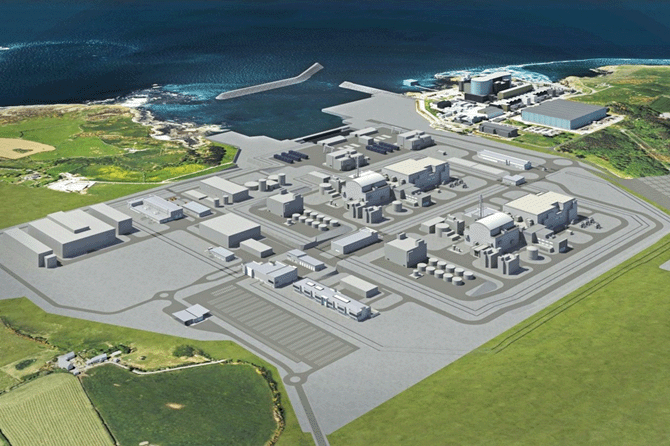 Wylfa no2nuclearpower, 7 Sept 18
Plans to clear a site to build a new £12bn nuclear power station have been approved despite strong opposition. Horizon Nuclear Power will now start the 15-month process to clear an area measuring just over a square mile (740 acres) to build the new Wylfa Newydd B reactor.
France’s push for solar rooftops
 Reuters 27th Sept 2018, French Ecology Minister Francois de Rugy has approved 392 rooftop solar
power projects with a total capacity of 230 megawatts (MW) under a plan
launched in 2016 to develop 1,450 MW of solar capacity within three years.
France wants to develop more wind, solar and other low-carbon energy
sources to cut its dependence on nuclear energy power, which currently
counts for over 75 percent of its needs.
https://uk.reuters.com/article/uk-france-solarpower/france-approves-230-mw-of-rooftop-solar-projects-idUKKCN1M71KO?rpc=401&
UK’s Sizewell C nuclear power project – a figment of the imagination
 NuClear News, October 18 Sizewell C – a figment of the imagination In an interview with The Times in April EDF Energy’s UK chief executive, Simone Rossi, said that rapid progress was needed on the development of Hinkley Point C because promised cost savings would not materialise if there was a significant delay between work on the two. (1)
USA, Russia, South Korea and China, salivating at thought of huge Saudi Arabia market for nuclear reactors
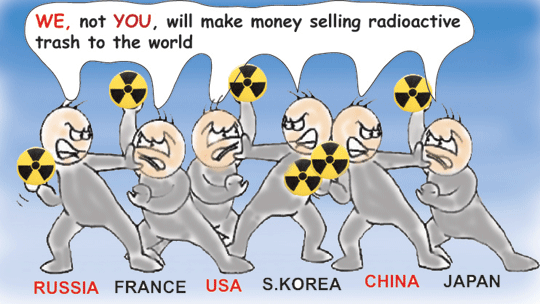
 U.S. Makes Shortlist for Saudi Nuclear-Plant Deal, One stumbling block: Negotiations over restrictions meant to prevent spread of weapons. WSJ By Timothy Puko, Sept. 26, 2018
The kingdom has been hearing offers from several countries, including Russia, South Korea and China, for what could be the biggest new market for nuclear power. Mr. Perry told reporters Wednesday the kingdom recently made a decision that keeps U.S. businesses— foremost Westinghouse… (subscribers only) https://www.wsj.com/articles/u-s-makes-shortlist-for-saudi-nuclear-plant-deal-1538006144
Debunking the claims about generation IV nuclear waste
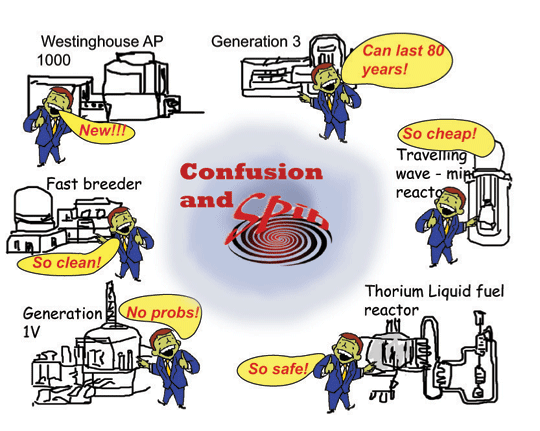
Generation IV nuclear waste claims debunked, Nuclear Monitor 24 Sept 18 Lindsay Krall and Allison Macfarlane have written an important article in the Bulletin of the Atomic Scientists debunking claims that certain Generation IV reactor concepts promise major advantages with respect to nuclear waste management. Krall is a post-doctoral fellow at the George Washington University. Macfarlane is a professor at the same university, a former chair of the US Nuclear Regulatory Commission from July 2012 to December 2014, and a member of the Blue Ribbon Commission on America’s Nuclear Future from 2010 to 2012.
Krall and Macfarlane focus on molten salt reactors and sodium-cooled fast reactors, and draw on the experiences of the US Experimental Breeder Reactor II and the US Molten Salt Reactor Experiment.
The article abstract notes that Generation IV developers and advocates “are receiving substantial funding on the pretense that extraordinary waste management benefits can be reaped through adoption of these technologies” yet “molten salt reactors and sodium-cooled fast reactors – due to the unusual chemical compositions of their fuels – will actually exacerbate spent fuel storage and disposal issues.”
Here is the concluding section of the article: Continue reading
Solar and wind power back on the day after Hurricane Florida: nuclear and coal not so resilient
 Hurricane Florence crippled electricity and coal — solar and wind were back the next day https://www.cbsnews.com/news/hurricane-florence-crippled-electricity-and-coal-solar-and-wind-were-back-the-next-day/, 25 Sept 18, Nearly two weeks after Hurricane Florence swamped North and South Carolina, thousands of residents who get power from coal-fired utilities remain without electricity.Yet solar installations, which provide less than 5 percent of North Carolina’s energy, were up and running the day after the storm, according to electricity news outlet GTM. And while half of Duke Energy’s customers were without power at some point, according to CleanTechnica, the utility’s solar farms sustained no damage.
Traditional energy providers have fared less well. A dam breach at the L.V. Sutton Power Station, a retired coal-fired power plant near Wilmington, North Carolina, has sent coal ash flowing into a nearby river. Another plant near Goldsboro has three flooded ash basins, according to the Associated Press, while in South Carolina, floodwaters are reportedly threatening pits that contain ash, an industrial waste from burning coal.
The lesson, according to environmentalists: Utilities’ vulnerability to major storms underscores the urgency of shifting to energy that it is not only clean and renewable, but also more resilient.
French government group to Mururoa to meet nuclear test veterans
French group to visit French Polynesia nuclear sites https://www.radionz.co.nz/international/pacific-news/367417/french-group-to-visit-french-polynesia-nuclear-sites 27 September 2018 A French government commission is about to visit French Polynesia’s nuclear weapons test sites to help modify the French compensation law. The 12-member commission includes three of French Polynesia’s parliamentarians in Paris as well as representatives of ministries such as defence, health and justice.
Following Transatomic’s failure, small modular nuclear reactors face uncertain future

A good announcement and a bad announcement for two nuclear-energy startups,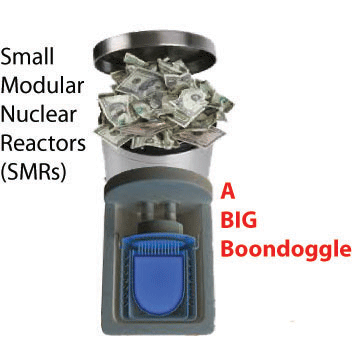 NuScale Power takes a step toward engineering; Transatomic power shuts down. Ars Technica, MEGAN GEUSS – 9/26/2018 “…………….The old light-water reactors that serve America’s grid today create nuclear waste that’s politically impossible to dispose of. Nuclear plants with traditional reactors are also extremely expensive to build and difficult to permit.
For these reasons, many nuclear hopefuls have looked to advanced nuclear technology. Several startups have popped up, promising to make either the waste problem or the expense problem go away.
This week, two advanced nuclear-technology startups have announced major news, both good and bad for the future of advanced nuclear technology………..
Transatomic is going to close down, according to MIT Technology Review. Several years ago, the startup raised millions on promises to use spent nuclear waste as reactor fuel, as well as to “generate electricity 75 times more efficiently than conventional light-water reactors,” according to MIT Technology Review. The company later retracted that “75 times” claim after a review from MIT’s Nuclear Engineering Department found issue with it.
Instead, Transatomic revised its estimates in 2016 to say that its reactor would be able to generate more than two times as much energy per ton of mined uranium than a standard reactor.
The company’s design to use spent nuclear-reactor fuel in a molten salt reactor was also called into question, causing Transatomic to state in its 2016 revision that its design “does not reduce existing stockpiles of spent nuclear fuel.”
The lost confidence made it harder for Transatomic to find funding to complete the $15 million it needed to build a prototype reactor, although it had raised about $4 million already……..
Onward to manufacturing
NuScale Power, based out of Portland, Oregon issued a press release today saying that, after 18 months of searching, it has selected manufacturing company BWX Technologies to begin engineering work that will lead to manufacturing the company’s Small Modular Reactor (SMR) design.
Phase 1 engineering and manufacturing begins today and will last until 2020, NuScale wrote, and then Phases 2 and 3—”preparing for fabrication” and “fabrication,” respectively—will continue from there……..
Small Modular Reactors don’t solve the nuclear-waste problem mentioned at the top of this article, but in theory, they might solve nuclear energy’s expense problem. Building smaller reactors that can be modularly expanded if necessary could not only keep siting, construction, and regulatory costs proportionally lower, but using the same manufacturing and construction crews to build more, smaller reactors would theoretically develop a workforce with expertise in building and installing reactors. https://arstechnica.com/science/2018/09/a-good-announcement-and-a-bad-announcement-for-two-nuclear-energy-startups/
Consumer society, high energy, lifestyle underlies climate change

GLOBAL HUMAN POPULATION ISN’T GOING TO EXPLODE—BUT THAT DOESN’T MEAN WE’RE SAFE | NewsWeek, , PROFESSOR AT THE UNIVERSITY OF MARYLAND
9/26/18 Population has grown super-exponentially over the 20th century, which has led to some alarmist messages along the way. The most well known of them is the 1968 book, The Population Bomb, by Stanford professor Paul Ehrilch. Mass starvation due to the classic Malthusian catastrophe of population growth outpacing food production was predicted for the 1970s and 80s in the absence of immediate implementation of population reduction measures. This dire prediction did not materialize, of course, thanks to the Green Revolution.
The main drivers of population growth are death and birth rates—but the initial population size is important as well. Lifespan has lengthened due to medical miracles, while fertility has dropped across the board due to birth controls and family planning. But most importantly, because of the education and empowerment of women.
While population growth rates have declined, total population has continued to grow due to the initial size of the population, referred to as population momentum. The UN Department of Economic and Social Affairs projected in 2017 that Earth’s population would surpass 11 billion by 2100, despite these fertility and population growth rate trends.
The UN expects that nearly 70 percent of the world’s population for the latter half of the 21st century would be made up of a population with fertility rates below-replacement (less than 2.1 births per woman). And yet, there has been a steady call for population reduction—only now in the context of emission targets developed by the Intergovernmental Panel on Climate Change (IPCC) to meet global warming goals.
This “Population Climate Bomb” alarm is founded on ignoring several important factors that have brought us to this state of affairs as far as climate change is concerned. Foremost is the arbitrary accounting of the impact of population on climate, which neglects the global trade network where emissions are moved around hidden in goods and services.
Even the lowered fertility rates among the educated and empowered women may be associated with an unintended upward bump in per capita consumption (as discussed below). Additional complications arise because humanity has yet to chart a course to increasing the Human Development Index without increasing the environmental footprint. All developed countries have a high environmental footprint and no developing country can achieve higher standards of living without increasing its per capita consumption.
The IPCC has often been accused of ignoring population as a driver of climate change and global warming. Population projections are very much a part of the calculations for future scenarios on emission, mitigation and adaptation—but some would like a more explicit mention of the impact of population reduction on greenhouse gas emissions……….
The developed world has a narrow base of younger population with a nearly even distribution up to the aging population. Japan stands as a stark example of an ever growing aging population due to stagnating birth rates. Developing countries on the other hand display a pyramidal age structure with a large base of population under 25. This offers a golden opportunity to educate and empower girls and young women. Nothing has proven more effective as a contraception than educating and empowering women.
Climate assessments including adaptation and mitigation scenarios by the IPCC are indeed better served by focusing on reducing energy intensity of GDPs and carbon intensity of energy production. Population is a problem that is solving itself. Our penchant for high-energy lifestyle shows no signs of diminishing. Our energies are best focused on evolving into carbon-neutral sapiens who will naturally settle into a healthy population level.
Raghu Murtugudde is a Professor of Atmospheric and Oceanic Science and Earth System Science at the University of Maryland. He is currently a Visiting Professor at the Indian Institute of Technology, Bombay in India. His research focuses On the role of the oceans on climate variability and change including the biological feedbacks on climate. https://www.newsweek.com/global-human-population-explosion-carbon-emissions-consumption-1138996
“Protect Texas from Radioactive Waste Tour” on its way to Midland
Anti-nuclear waste tour to come through Midland, Meetings push to block a proposal to transport used nuclear fuel by train and store it in West Texas, MRT, by Matt Zdun, Texas Tribune , September 26, 2018 Organizers of the “Protect Texas from Radioactive Waste Tour” plan to travel to five Texas cities over the next week in protest of a proposed plan to store used nuclear materials in West Texas.Several Texas organizations gathered in Houston on Tuesday to kick off their “Protect Texas from Radioactive Waste Tour,” the beginning of a renewed push to block a proposal to transport used nuclear fuel by train through Texas and store it in West Texas.
The tour’s organizers said they want to make people aware of the “high risk” implications of a proposal to build and operate a facility for 40,000 metric tons of irradiated fuel rods at an existing site in Andrews County.
If approved by the Nuclear Regulatory Commission, the project by Interim Storage Partners, a joint venture between Waste Control Specialists and Orano USA, would transport nuclear waste from around the country to the consolidated site in Texas and store it until a long-term storage site becomes available, according to the venture’s website.
The Nuclear Regulatory Commission said in an August letter it would begin reviewing Interim Storage Partners’ license application and that its safety, security and environmental reviews of the proposal could conclude as early as August 2020.
Karen Hadden, the executive director of the Sustainable Energy and Economic Development Coalition, told The Texas Tribune that announcement triggered renewed opposition to the project and is one of the reasons for the tour.
The organizations involved — the Coalition of Community Organizations, Nuclear Information and Resource Services, Beyond Nuclear, the Sustainable Energy and Economic Development Coalition and Public Citizen — held a news conference by a railroad crossing in Houston, said Tom Smith, the special projects director of consumer rights advocacy group Public Citizen. Smith, who helped organize the tour, said in an interview with the Tribune that the news conference featured a 16-foot railroad container meant to replicate the transport cask that Interim Storage Partners would use to transport used nuclear fuel.
“We’re by the railroad tracks because we’re emphasizing that Texas businesses, hospitals and schools by the railroads are at high risk,” Hadden said. “It’s a bad idea to bring [nuclear waste] from around the country into Texas.”
The organizations instead want the used nuclear material to be kept at reactor sites in sturdier containers until a permanent storage site becomes available.
Smith said the proposed project presents a number of risks. A railroad accident would be disastrous, he said, because it could expose the public to harmful radiation and could cost municipalities hundreds of millions of dollars to clean up.
He also said nuclear waste on railcars running through densely populated areas like Houston, Dallas and San Antonio is at “high risk of terrorist sabotage.”…….
Smith said that after the news conference, the organizations planned to ask the Houston City Council to adopt a resolution against the proposed transportation of the nuclear material. He added that commissioners in San Antonio and Midland have already adopted similar resolutions.
“We’re trying to raise awareness because a lot of people don’t know this is planned,” Hadden said. She also said she hopes the tour will encourage people to submit comments on the Nuclear Regulatory Commission’s website before the Oct. 19 deadline………https://www.mrt.com/news/local/article/Anti-nuclear-waste-tour-to-come-through-Midland-13260720.php
The relative hazards of nuclear fuel in reactor cores, spent fuel pools, and dry storage
|
Nuclear Reactor Fuel Safety: The Waiting Gain, Union of Concerned Scientists,
DAVE LOCHBAUM, DIRECTOR, NUCLEAR SAFETY PROJECT | SEPTEMBER 27, 2018, Nuclear power reactors spilt atoms to release energy used to generate electricity. Many of the byproducts formed when atoms split are unstable (radioactive) and release particles or gamma rays in search of stability. These radioactive emissions produce energy. Whether in the core of an operating reactor, in the core of a shutdown reactor, in the spent fuel pool after discharge from a reactor core, or in dry storage after offloading from a spent fuel pool, the energy released from nuclear reactor fuel must be removed before it damages the fuel from overheating. This commentary describes the energy levels associated with nuclear fuel in various locations at various times to illustrate the factors that affect the associated hazard levels.
Nuclear Fuel Locations The San Onofre nuclear plant near San Clemente, California is used to describe the nuclear reactor fuel locations and energy levels for this commentary. San Onofre has been permanently shut down, but data from when its reactors operated and for the spent fuel remaining onsite represent conditions at nuclear plants across the country…….. [excellent photos and tables] ……UCS Perspective …… the relative hazards of nuclear fuel in reactor cores, spent fuel pools, and dry storage. Nuclear fuel in the reactor core, even in the core of a shutdown reactor, has a significantly higher energy level than when in the spent fuel pool or dry storage. The higher energy level has two associated hazard implications. First, it translates into less time to successfully intervene to prevent fuel damage when cooling is lost or impaired. Second, it provides a larger catalyst or engine to expel radioactive materials from damaged fuel. Risk is defined as the product of the probability of an accident times its consequences. The first factor affects the probability of an accident while the second factor affects its consequences. Combined, these factors can cause risk to increase. Nuclear fuel in spent fuel pools has lower energy levels than when in reactor cores. The average fuel assembly energy levels are lower than the maximum energy level permitted in a MPC-37 canister. But the associated inventories indicate why spent fuel pools have higher risks than dry storage. The collective higher energy levels in spent fuel pools once again translate into less time to respond should cooling be lost or impaired. And the larger inventory of fuel assemblies emits a larger radioactive cloud should intervention fail. Nuclear fuel in dry storage represents the least amount of fuel at the lowest energy level. If cooling is lost or impaired, more time is available to successfully intervene and less nasty spread gets out when efforts fail. But fuel in dry storage is far from absolutely safe. If it were even close to being so safe, the US would not be spending billions of dollars looking for, but not yet finding, a geological repository that can isolate this hazardous material from people and the environment for at least 10,000 years into the future. Dry storage is the safest and securest way to manage nuclear fuel risks today. However, the more of the 10,000-year period we waste looking for a geological repository, the less competent and responsible we reveal ourselves to be. We can do better. And not just because it would be hard for us to mess this mess up any worse than we’ve mismanaged so far. https://allthingsnuclear.org/dlochbaum/nuclear-waiting-gain |
|
U.S. Appeals Court upholds New York program to subsidize nuclear plants
Federal court upholds New York program to subsidize nuclear plants, Washington Examiner, by Josh Siegel, September 27, 2018 The U.S. Court of Appeals for the 2nd Circuit on Thursday upheld the legality of New York’s program that props up struggling nuclear plants to provide electricity without carbon dioxide emissions.
The court said the state subsidy program does not interfere with the power that the Federal Energy Regulatory Commission has over wholesale electricity markets, as charged by other electricity suppliers who filed suit, including the Electric Power Supply Association.
The three-judge panel acknowledged that New York’s program would keep nuclear plants alive, and raise costs for competitors, but said those effects were “incidental.”
……..The ruling comes a few weeks after the U.S. Circuit Court of Appeals for the 7th Circuit upheld a similar policy in Illinois………
FERC has filed amicus briefs in the cases affirming the programs do not preempt the agency’s legal authority set by the Federal Power Act.
Critics say the programs bailout failing nuclear plants in the state, that are struggling to compete with lower cost natural gas and renewables.
The Trump administration is considering a bigger, widely contested plan, on a national scale, to require grid operators to buy power from a select list of coal and nuclear plants.
Environmentalists cheered the state court rulings as a signal that courts consider states to have broad power to set clean energy goals, and to impose policies to achieve them. For example, many states have renewable portfolio standards requiring generators to obtain more and more of their electricity from clean sources.
“The 2nd Circuit’s decision rejecting a challenge to [New York’s] ZEC program may be narrowly covered as a decision affecting nuclear resources, but the much bigger reason it is major news is because it eliminates legal uncertainty for states in designing clean energy programs,” said Miles Farmer, a clean energy attorney at the Natural Resources Defense Council, in a Twitter post. https://www.washingtonexaminer.com/policy/energy/federal-court-upholds-new-york-program-to-subsidize-nuclear-plants
Kavanaugh Confirmation Fight Has Consequences for Climate Law
|
The Supreme Court could hear cases related to the EPA’s climate obligations and other environmental issues, Scientific American, By Mark K. Matthews, E&E News on September 27, 2018
If Senate Republicans plow ahead and confirm Brett Kavanaugh to the Supreme Court, the longtime jurist could have near-term impact on a slew of environmental cases. Among the disputes the high court has agreed to hear this fall: a case that pits villagers from India against the World Bank in a fight over a coal plant. If the villagers prevail, it could have worldwide economic and political repercussions. Several other climate-related issues have a decent shot, too, of getting a future date with the Supreme Court, including one closely watched fight—the “kids’ climate case”——that makes the far-reaching argument that the government must take action on global warming so as not to imperil future generations. Kavanaugh—currently a judge on the U.S. Court of Appeals for the District of Columbia Circuit—would replace Justice Anthony Kennedy, who retired in July after three decades of service and dozens of landmark decisions. Kennedy was often a swing vote on the ideologically divided court, and he played a key role in several major environmental cases. There’s a lot at stake for domestic and international efforts to address climate change. Here are five brewing legal fights in which the future justice could play a role. ……..https://www.scientificamerican.com/article/kavanaugh-confirmation-fight-has-consequences-for-climate-law/ |
|
|
Vatican will continue condemning nuclear weapons
Arch. Gallagher: Holy See will continue opposing nuclear weapons, Vatican News
The Holy See said on Wednesday it will continue to argue against both the possession and the use of nuclear weapons, saying the total elimination of nuclear weapons is not only a security issue, but a moral, humanitarian and environmental imperative.
The Vatican Secretary for Relations with States, Archbishop Paul Richard Gallagher made the statement at a high-level meeting at the 73rd session of the United Nations General Assembly to mark the September 26 International Day for the Total Elimination of Nuclear Weapons.
Threat of annihilation
“The world is not safer with nuclear weapons; it is more dangerous,” Archbishop Gallagher said. “A policy that relies on the possession of nuclear weapons,” he said, “is contradictory to the spirit and purpose of the United Nations because nuclear weapons cannot create for us a stable and secure world, and because peace and international stability cannot be founded on mutually assured destruction or on the threat of total annihilation.”
Environmental, humanitarian consequences
Speaking about the environmental disasters and humanitarian consequences of the use of nuclear weapons, the Holy See official whose portfolio is equivalent to that of foreign minister, encouraged all countries to make the Comprehensive Nuclear Test-Ban Treaty (CTBT) a reality by ensuring its entry into force….https://www.vaticannews.va/en/vatican-city/news/2018-09/holy-see-un-gallagher-nuclear-weapons.html
1 This Month


Tell Congress: Prevent Nuclear Catastrophe in Iran

Tell Congress: Prevent Nuclear Catastrophe in Iran

Read the Public Inquiry Report, the Commissioners’ report, Surrendering Australia: The AUKUS Deception is available to download for free at aukuspublicinquiry.com. Or just watch the replay of the National Press Club Luncheon.
To see nuclear-related stories in greater depth and intensity – go to https://nuclearinformation.wordpress.com
Say No to NASA’s Reckless Nuclear Reactor on the Moon
-
Archives
- November 2026 (284)
- October 2026 (302)
- September 2026 (339)
- August 2026 (330)
- July 2026 (355)
- June 2026 (287)
- May 2026 (306)
- April 2026 (356)
- March 2026 (251)
- February 2026 (267)
- January 2026 (308)
- December 2025 (358)
-
Categories
- 1
- 1 NUCLEAR ISSUES
- business and costs
- climate change
- culture and arts
- ENERGY
- environment
- health
- history
- indigenous issues
- Legal
- marketing of nuclear
- media
- opposition to nuclear
- PERSONAL STORIES
- politics
- politics international
- Religion and ethics
- safety
- secrets,lies and civil liberties
- spinbuster
- technology
- Uranium
- wastes
- weapons and war
- Women
- 2 WORLD
- ACTION
- AFRICA
- Atrocities
- AUSTRALIA
- Christina's notes
- Christina's themes
- culture and arts
- Events
- Fuk 2022
- Fuk 2023
- Fukushima 2017
- Fukushima 2018
- fukushima 2019
- Fukushima 2020
- Fukushima 2021
- general
- global warming
- Humour (God we need it)
- Nuclear
- RARE EARTHS
- Reference
- resources – print
- Resources -audiovicual
- Weekly Newsletter
- World
- World Nuclear
- YouTube
-
RSS
Entries RSS
Comments RSS

