Residents near West Lake Landfill might not be impressed at EPA’s spin – “radiation is good for you”
 Editorial: Attention West Lake residents: EPA says radiation is good for
 you. https://www.stltoday.com/opinion/editorial/editorial-attention-west-lake-residents-epa-says-radiation-is-good/article_8b288c51-b064-5646-8123-73f943459d57.html By the Editorial Board 15 Oct 18
UN’s Intergovernmental Panel on Climate Change (IPCC) focuses on renewables, dismisses nuclear power
Dr Jim Green, Nuclear Monitor #867, 15 Oct 2018
 https://www.wiseinternational.org/nuclear-monitor/867/nuclear-monitor-867-15-october-2018
The UN’s Intergovernmental Panel on Climate Change (IPCC) has issued a landmark report warning that global warming must be kept to 1.5˚C, requiring “rapid and far-reaching” transitions in land, energy, industry, buildings, transport, and cities.1
The world must invest US$2.4 trillion in clean energy every year through 2035 and cut the use of coal-fired power to almost nothing by 2050 to avoid catastrophic damage from climate change, according to the IPCC. To put the US$2.4 trillion figure in context, about US$1.8 trillion was invested in energy systems globally in 2017, of which about 42% was invested in electricity generation and about 18.5% in renewables.2
Unsurprisingly, the World Nuclear Association (WNA) used the IPCC report to promote nuclear power.

WNA Director General Agneta Rising said the IPCC report “makes clear … the necessity of nuclear energy as an important part of an effective global response” to climate change and that it “highlights the proven qualities of nuclear energy as a highly effective method of reducing greenhouse gas emissions, as well as providing secure, reliable and scalable electricity supplies.”3 In a separate statement, the WNA falsely claimed that nuclear power increases under all of the IPCC scenarios compatible with limiting warming to 1.5˚C.4
Almost all of the WNA’s claims are false or exaggerated. The IPCC report raises numerous concerns about nuclear power (discussed below). In general terms, nearly all of the scenarios presented in the IPCC report envisage a decline in nuclear power generation to 2030 followed by an upswing.5 No logical rationale ‒ or any rationale at all ‒ is provided to support the upswing from 2030 to 2050.
The points that jump out from the IPCC’s low-carbon 1.5°C scenarios are that nuclear accounts for only a small fraction of energy/electricity supply (even if nuclear output increases) whereas renewables do the heavy lifting. For example, in one 1.5°C scenario, nuclear power more than doubles by 2050 but only accounts for 4.2% of primary energy whereas renewables account for 60.8%.6 In another 1.5°C scenario, nuclear nearly doubles by 2050 but its contribution to total electricity supply falls to 8.9%, compared to 77.5% for renewables.7
The IPCC report notes that: “Nuclear power increases its share in most 1.5°C pathways by 2050, but in some pathways both the absolute capacity and share of power from nuclear generators declines. There are large differences in nuclear power between models and across pathways … Some 1.5°C pathways no longer see a role for nuclear fission by the end of the century, while others project over 200 EJ / yr of nuclear power in 2100.”8
Nuclear lobbyist Michael Shellenberger has a very different take on the IPCC report to the WNA … and most of his claims are false as well.9 Shellenberger takes the IPCC to task for stating that nuclear power risks nuclear weapons  proliferation.10,11 That is “unsubstantiated fear-mongering”, he claims, although Shellenberger himself has written at length about the manifold and repeatedly-demonstrated connections between nuclear power and weapons.12 “No nation has used its civilian nuclear plants to create a weapon”, Shellenberger now claims ‒ which is garbage.13
Shellenberger seems troubled by the IPCC’s claims about a possible connection between nuclear power and childhood leukemia ‒ but he doesn’t explain why. The IPCC’s comments are modest: “Increased occurrence of childhood leukaemia in populations living within 5 km of nuclear power plants was identified by some studies, even though a direct causal relation to ionizing radiation could not be established and other studies could not confirm any correlation (low evidence/agreement in this issue).”10 In fact the evidence of a link is stronger than the IPCC suggests.14,15
Shellenberger complains about “biased and misleading cost comparisons” in the IPCC report though the report simply notes that nuclear power provides an example of “where real-world costs have been higher than anticipated … while solar PV is an example where real-world costs have been lower”.16
Shellenberger claims that solar and wind contributed 1.3% and 3.9% to global electricity supply in 2017 ‒ the true figures are 1.9% and 5.6%.17 He fails to note that all renewables combined supplied 26.5% of global electricity supply in 2017 (2.5 times more than nuclear) or that renewable supply has doubled over the past decade while nuclear power has been stagnant.
References: Continue reading
USA nuclear regulators plan to reclassify Hanford High Level Nuclear Waste (HLW) as Low Level Wastes (LLW)
Regulators Discuss New Plans For Nuclear Waste At Hanford https://www.opb.org/news/article/hanford-nuclear-waste-plans-portland-oregon-meetings/, by Cassandra Profita Oct. 15, 2018 Federal and state energy regulators will hold back-to-back meetings in Portland on Tuesday for a proposal to reclassify some of the high-level nuclear waste at the Hanford Site in Washington.
The proposal has major implications for the nuclear waste that remains in Hanford’s storage tanks.
In recent years, the U.S. Department of Energy has been working to retrieve the nuclear waste left in storage tanks, and in one area known as C-Farm, they’ve removed as much as they can get.
“But there is some amount they were not able to get,” said Jeff Burright, nuclear waste remediation specialist with the Oregon Department of Energy. “And that equates to approximately 70,000 gallons of waste.”
The Energy Department wants to downgrade that remainder to “low-level radioactive waste,” so they can leave it in place and fill the tanks with grout. The area would then be sealed off to prevent the waste from migrating.
It’s the first step in a long closure process for about 10 percent of the storage tanks on the site. But the Oregon Department of Energy has raised concernsthat federal officials are moving too quickly. The state has filed public comments asking federal officials to do additional reviews before making any decisions.
“The movement of waste through the Hanford environment is a very complex process that we’re still trying to fully understand,” Burright said. “Despite their best efforts, there are still uncertainties over very long time scales that could represent future risk.”
Burright said closing the tanks could prevent the future removal of the 70,000 gallons of remaining waste should new technologies emerge. Plus, he said, there may be additional risks stemming from the million gallons of waste that have already leaked or spilled into the ground underneath the tanks on the site.
The Oregon Department of Energy is holding its own informational meetingon the issue at 6:30 p.m. after the U.S. Department of Energy’s informational meeting from 3-5 p.m. in Portland on Tuesday. Both meetings will be held at the same location, the Eliot Center at the First Unitarian Church, 1226 SW Salmon St.
Washington DC pushes 100% renewable energy bill
 https://reneweconomy.com.au/washington-dc-pushes-100-renewable-energy-bill-48151/
Donald Trump DOES have the opportunity to end the diplomatic nuclear crisis, promote disarmamament
The Nuclear Trump Card, The American Conservative, The Donald has the best shot at nuclear disarmament of any president over the last 20 years. By • October 15, 2018 There is no greater issue facing America today than that of war and peace. Marginal changes in the corporate tax rate, the precise number of visas provided to foreign workers, minor adjustments to the Social Security retirement age—all are peripheral when compared to the immense weight of foreign policy decisions. Using military force, deciding what’s in the national interest, and setting geopolitical strategy all have consequences that can affect whole nations, regions, even the world.It is the responsibility of statesmen to be as judicious as possible when it comes to military force, to act realistically and practice restraint. This prevents unwarranted infrastructure destruction, unforeseen blowback, and criminal loss of life. This carries over into a duty to work towards mutually beneficial arms control agreements and non-proliferation treaties to rein in the most destructive weapons ever created by man.
Unfortunately, outside the post-retirement advocacy of former secretary of defense William Perry and whistleblower Daniel Ellsberg, very few public figures seem to realize the dangers of nuclear brinksmanship and the importance of disarmament.
Currently, an exchange of 100 atomic bombs would kick up enough dust and debris to blot out part of the sun and starve one third of the earth’s population. Eight countries have the capability to carry out such a mass genocide. Further down the line, if 100 hydrogen weapons (H-bombs) were used, the planet would experience a nuclear winter and up to seven billion people would starve to death. Ellsberg terms this “omnicide”: the murder of everyone. Russia and the United States, as the only countries possessing H-bombs, are especially obligated to reduce their nuclear stockpiles and lessen the danger of nuclear war. The cost of not doing so could be the world itself.
……….Politically, Trump is in a better position than either of his predecessors on nuclear issues. His presidency is not dominated by ideological neoconservatives who buck any tactical diplomacy, and as a Republican his hawkish right flank has been partly neutered. Some of President Obama’s better intentioned efforts, like the nuclear agreement with Iran, were hindered by domestic politics and hawkish Republicans, always adversarial to Democratic-led peace initiatives. Trump, as a Republican, is not encumbered by such political restraints, a la “only Nixon can go to China.”
Thus far, Trump has squandered his opportunity. Jumping feet-first into Obama’s trillion dollar nuclear modernization plan launched in 2016, Trump has not made nuclear discussions with Russia a first-tier, or even fourth tier, issue. And when he has commented on it, it’s with his typical pugnaciousness. This attitude contradicts his efforts with North Korea, and isn’t the first contradiction in “Trumpism.” Meanwhile, pulling out of the nuclear agreement with Iran has exacerbated diplomatic tensions, but from Trump’s point of view, he sees the abrogation as a step in the direction of his vaunted “better deal.” His offer of new negotiations without preconditions shows that his goal is resolution, albeit in a tactically poor way. The administration should crystallize a consistent outlook on nuclear de-escalation, even if it’s only out of selfish motivations………
Most Americans support the Korean peace initiative. In the 2000, 2008, and 2016 presidential elections, voters chose the less hawkish candidate. Peace is popular, especially when the consequences of a possible nuclear fallout are explained. Hypothetically, if Trump were to invite Russian President Vladimir Putin to Washington, D.C. to initiate negotiations on nuclear weapons, he would do so from a position of political strength.
Some analysts postulate that a world power needs no more than a couple hundred nuclear weapons to achieve a deterrence factor as envisioned by MAD (mutually-assured destruction). This makes the United States’ and Russia’s combined 13,500 warheads (active and decommissioned) more than a little overkill. It’s within both countries’ interest to reduce their stockpiles to make accidents less likely and lessen the chance of death on a scale not since the extinction of the dinosaurs. Since the United States and Russia possess over 90 percent of the world’s nuclear weapons, this one diplomatic overture could, over years, end the nuclear crisis on our planet. Donald Trump could make all the difference.
Hunter DeRensis is an editorial assistant at The American Conservative and a student at George Mason University. Follow him on Twitter @HunterDeRensis. nhttps://www.theamericanconservative.com/articles/the-nuclear-trump-card/
The nuclear industry’s deceptive narrative about Fukushima earthquake in March 2011
The status of “Station Blackout” is a serious one.
“it will be many years before the Japanese people know exactly what happened at Fukushima Daiichi on 11 March 2011. One of the key mysteries was role, if any, the magnitude 9 earthquake played in damaging the plant’s reactor cooling systems. Until lethal levels of radiation inside the reactors fall and workers can carry out comprehensive investigations, the truth about the tremor’s impact will remain a subject of conjecture and contention”
Mr. Takamatsu states with expert authority that the pipes of cooling system ware not designed for the 50 second vibration of the magnitude quake. Barry Brook, kangaroo expert, disagrees and tells the world the quake caused no damage at Fukushima. Yet Mr. Brook must surely know the earthquake caused grid blackout. For reactors are all shut down by earthquakes. A solar plant would have kept generating until the last panel shattered. No one would have been evacuated from such a solar plant.
I submit that Prof. Barry Brook’s description of the effects of earthquake upon the Fukushima Diiachi on 11 March 2011 is totally ignorant of the facts as presented by many qualified experts and fly in the face of the independent commission set up by the Japanese Parliament (Diet). It is confirmed that expert investigators concern aspects of TEPCO’s explanations regarding the quake are “irrational”.
Thus any narrative based upon the nuclear industry view, in line with TEPCO’s may fairly be said to be “irrational”. For the industry view is that there is no possibility of quake damage to any structure or sub structure, such as coolant pipes and valves.
Earthquake Damage At Fukushima – is Industry’s Narrative Truthful or Certain? Nuclear History, 16 Oct 18 I am again going to contrast the statements made by Barry Brook in regard to the events and outcomes at Fukushima Daiichi in 2011 with the facts as presented by Mark Willacy. These facts are published in Willacy’s book, “Fukushima – Japan’s tsunami and the inside story of the nuclear meltdowns”, Willacy, M., Pan Macmillan, copyright 2013, Mark Willacy.
However, I will also include information related to the events which were first published and discussed in 2011. ………..
The earthquake generated the tsunami. What else did the earthquake cause?
In this blog I have included posts which give the IAEA considerations for the electrical grids which are connected to nuclear power plants. The IAEA states that the level of engineering and resilience built into such grids may be a significant additional cost for any nation considering generation to nuclear power.
It comes as no surprise then the electrical grid connected to the Fukushima Daiichi NPP failed for two reasons. 1. The earthquake caused all the nuclear reactors connected to the same grid to rapidly shut down. Thus the earthquake caused a blackout due to cessation of electrical generation. 2. The physical grid infrastructure – poles and wires – were damaged by the earthquake. At Fukushima this meant that more than one of the reactors was physically separated from the grid by the earthquake.
It can therefore be seen that the earthquake meant A. Fukushima Diiachi could not generate nuclear electricity as the quake had shut the reactors down. B. The Fukushima Diiachi Nuclear Power Plant was in Station Blackout for one reason: earth quake damage to nuclear infrastructure – the electrical grid. Continue reading
USA nuclear industry hanging out for State laws to subsidise uneconomic nuclear reactors
 Two Federal Courts May Have Just Saved The Nuclear Power
 Industry, Forbes https://www.forbes.com/sites/brianpotts/2018/10/15/two-federal-courts-may-have-just-saved-the-nuclear-power-industry/#4802adfa762e, Brian H. Potts
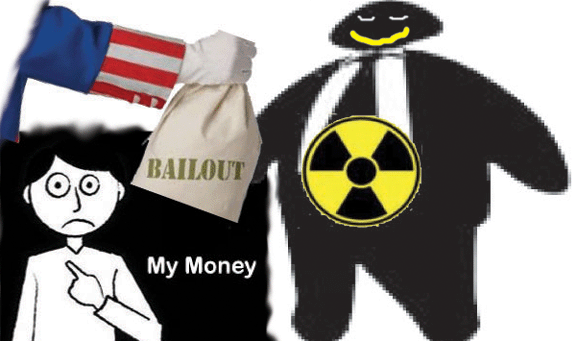
States that want to keep their aging nuclear power fleet from retiring now have a court-approved roadmap for doing so. That’s because two federal courts of appeals last month upheld very similar state laws in Illinois and New York aimed at subsidizing those states’ under-performing and at-risk nuclear power plants.
The current market conditions are, quite literally, killing the nuclear power industry. With natural gas prices low and cheap renewable energy flooding the markets, it’s been virtually impossible for many nuclear power plants to compete.
Some view this as simply the market picking winners and losers. But others see this as a problem. To significantly lower this country’s greenhouse gas emissions, they argue, we’ll need baseload power (i.e., power plants that can run all of the time). And only three current large-scale power sources fit that bill: coal, natural gas, and nuclear. Of those three, only nuclear power can generate energy without carbon dioxide emissions. [ What a lie!!]
Yet in Illinois (and in most other states), nuclear energy does not qualify as a “renewable energy resource,” which means nuclear generation facilities are categorically ineligible to produce and sell renewable energy credits.
That’s why, in response to concerns that two of Exelon Corporations’ nuclear generation facilities were on the brink of closing and that the zero-emission value of nuclear generation was not being recognized, the Illinois legislature passed the Future Energy Jobs Act.
The Act directed the Illinois Power Agency to create a subsidy program requiring generators that use coal or natural gas to buy zero-emissions credits (ZECs) from nuclear power plants connected to the regional grid. The price of each credit was set at $16.50 per megawatt-hour, a number Illinois derived from a federal working group’s calculation of the social cost of carbon emissions. But, to ensure that the new program does not cause power prices to skyrocket, the price of ZECs under the program goes down if average annual energy prices on the market exceed a set cap.
Almost immediately, a group of generation facilities and consumers filed a lawsuit challenging the Illinois law. The group alleged, among other things, that the ZEC program invades the Federal Energy Regulatory Commission’s (FERC) exclusive authority over the wholesale sale of electricity in the interstate markets.
Under the Federal Power Act, FERC has sole jurisdiction over the interstate sale of electricity at wholesale; yet states are authorized to regulate energy production within their borders, including the power plants that produce that energy.
The challengers in the case, called Electric Power Supply Association v. Star, argued that Illinois’ ZEC program went too far because it tied the price of ZECs to future wholesale market prices.
On September 13, 2018, the Seventh Circuit Court of Appeals disagreed. “The zero-emissions credit system can influence the [market] price only indirectly,” according to the Court, because the value of a credit does not depend on the producer’s bid in the market.
Interestingly, at the Seventh Circuit’s request, FERC submitted a brief in the case, which argued that Illinois’ ZECs program was “not preempted” by the Federal Power Act because it does not expressly require generation facilities to participate in the FERC-regulated markets.
Exactly two weeks after the Seventh Circuit issued its decision, the Second Circuit issued a strikingly similar ruling in a case called Coalition for Competitive Electricity v. Zibelman.
Plaintiffs in the Zibelman case, a group of electrical generators and trade groups, also alleged that the Federal Power Act preempts New York’s ZEC program.
That program subsidizes three specific nuclear plants: FitzPatrick, Ginna, and Nine Mile Point, all of which are also owned by Exelon Corporation. Each of the plants under the New York program will obtain an additional $17.48 per megawatt-hour over the program’s first two years, and then the ZEC price every two years thereafter will be reset.
Brushing aside similar arguments from the challengers as the Seventh Circuit did, the Second Circuit Court of Appeals on September 27, 2018 ruled that the ZEC program is not preempted “because Plaintiffs have failed to identify an impermissible ‘tether’ . . . between the ZEC program and wholesale market participation.”
Together, these two decisions won’t just save the specific nuclear power plants at issue. They may give a lifeline to the entire nuclear power industry.
Unless, of course, the U.S. Supreme Court decides to weigh in. https://www.forbes.com/sites/brianpotts/2018/10/15/two-federal-courts-may-have-just-saved-the-nuclear-power-industry/#4802adfa762e
Public hearing in Charleston area: focus is on the failed V.C. Summer nuclear project.

Many South Carolina residents are unaware that they’re paying for $9 billion nuclear debacle
 A lot of SC power customers don’t know they’re paying for $9 billion nuclear debacle, Greenville News
In a statewide poll of electric ratepayers, 40 percent of those surveyed said they were not familiar with the collapse of the V.C. Summer expansion project in Fairfield County.
The joint project by the state-owned Santee Cooper utility and SCE&G, a subsidiary of Cayce-based SCANA, collapsed in July 2017, leaving power customers holding the bag for some $9 billion spent on the now-abandoned project.
The project’s failure has roiled both companies, sparked investigations and prompted action from the Legislature.
But the controversy has passed many South Carolinians by.
Slightly less than half of the S.C. residents surveyed, 48 percent, reported being familiar with the project’s collapse. Another 12 percent weren’t sure.
Part of the reason could be that not all S.C. residents get their electricity from SCE&G or Santee Cooper.
Duke Energy’s S.C. customers made up 25 percent of those surveyed, while 29 percent get their power from SCE&G and 12 percent from Santee Cooper. Another 21 percent are members of electric co-ops — that get their power indirectly from Santee Cooper — and another 13 percent get their energy from some other source or were unsure.
Only 46 percent of Santee Cooper and electric co-op customers reported being familiar with the V.C. Summer debacle.
The poll by Clout Research was conducted for the S.C. Club for Growth, a conservative free-markets advocacy group, to gauge public opinion on the potential sale of state-owned Santee Cooper. But among S.C. residents who are not Santee Cooper customers, 50 percent told pollsters they were unfamiliar with the state-backed utility.
Climate change scientists have “a political agenda” – says Trump
BBC 15th Oct 2018 US President Donald Trump has accused climate change scientists of having a
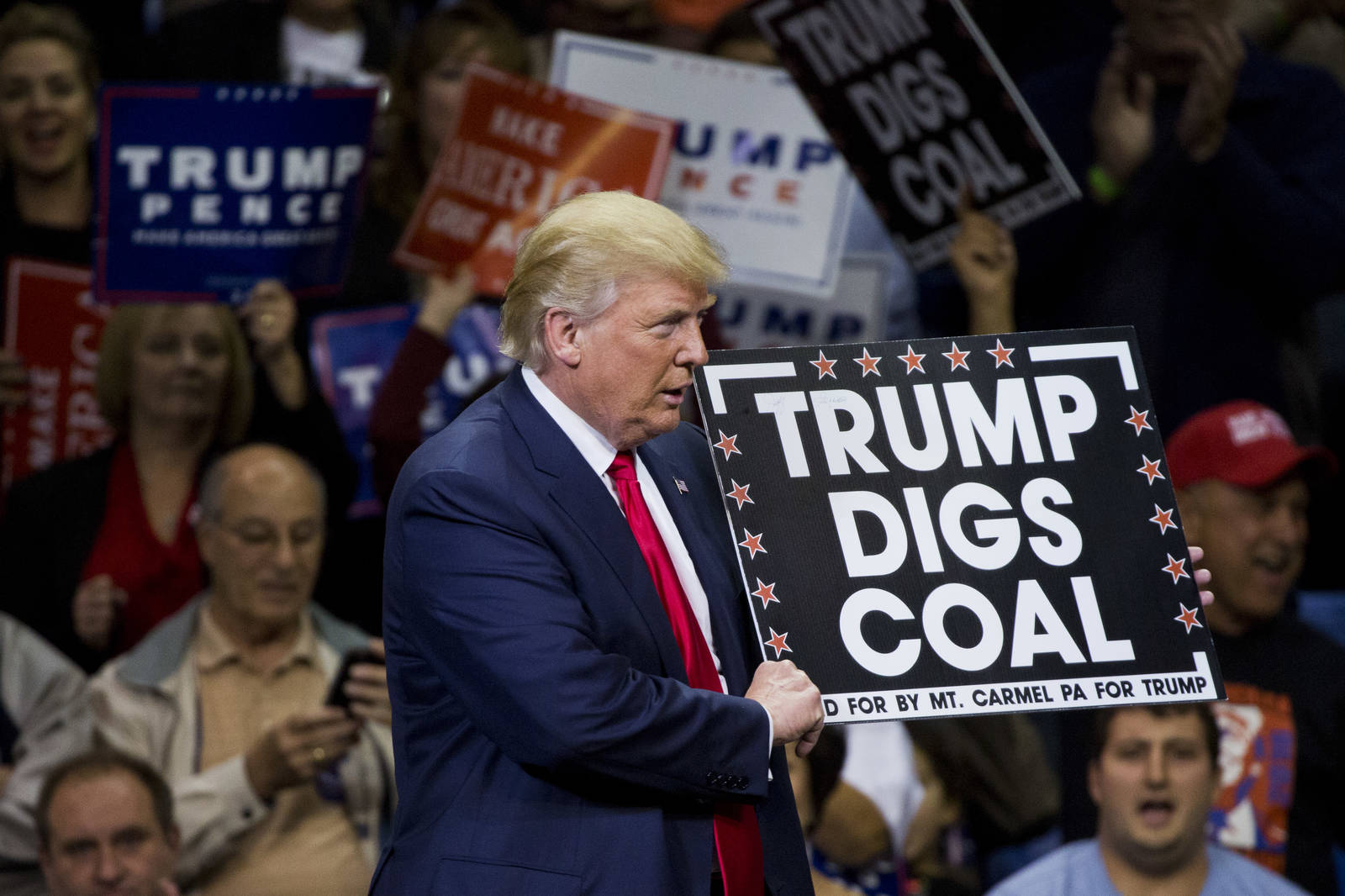 “political agenda” as he cast doubt on whether humans were responsible for
the earth’s rising temperatures. But Mr Trump also said he no longer
believed climate change was a hoax. The comments, made during an interview
with CBS’s 60 Minutes, come less than a week after climate scientists
issued a final call to halt rising temperatures. The world’s leading
scientists agree that climate change is human-induced.
https://www.bbc.co.uk/news/world-us-canada-45859325
Russia’s ROSATOM uses the “medical” propaganda to market nuclear technology to Philippines
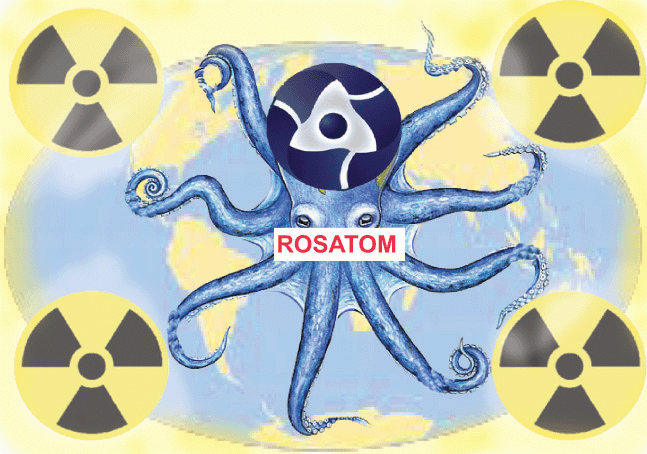 Russian firm offers expertise in nuclear research to Philippines
Nuclear power is disqualified from the race of the climatic fight – IPCC climate change report
Greenpeace France (accessed) 14th Oct 2018, Does the IPCC consider nuclear as a solution for climate? The IPCC points out that “the transition from the energy system that would be needed to limit global warming to 1.5 ° C is underway in many sectors and regions of
the world.
The technical, social, economic and political feasibility of solar energy, wind energy and electricity storage technologies has improved considerably in recent years, while nuclear energy and Carbon dioxide (CCS)
storage in the electricity sector did not show the same improvements.”
The current timeframe between the date of decision and the commissioning of nuclear power plants is between 10 and 19 years, and current deployment capacity is slowed by public concern about the risk of accidents and problems with nuclear waste. In addition, the IPCC notes, that “the costs of nuclear energy have increased over time in some developed nations, mainly because of the prevailing conditions, where increased investment risks in high-capital-intensive technologies have become important.”
The theoretical benefits that nuclear energy could bring in the fight against climate change are therefore far too weak, too slow, too expensive and too risky. While the IPCC report requires us to quickly reduce emissions, it is
not possible to choose the slowest and most expensive electric generation technology to deploy, as well as the dirtiest and riskiest. Nuclear power is disqualified from the race of the climatic fight.
https://www.greenpeace.fr/giec-considere-t-nucleaire-solution-climat/
The decline of nuclear power, as renewables rise
Likening nuclear power to that of a living organism, however, Mycle Schneider, the lead author of the World Nuclear Industry Status Report, told World Finance the industry was like a “dying species” due to the obvious reduction in new nuclear project launches in recent years.
This is seen clearly in the International Energy Agency’s (IEA) annual World Energy Investment report, updated in July, which found that nuclear investment is falling fast.
Nuclear power continues its decline as renewable alternatives steam ahead, World Finance, Author: Courtney Goldsmith, October 15, 2018
Once thought of as the primary answer to the globe’s renewable energy requirements, nuclear energy is now viewed unfavourably in comparison to solar and wind alternatives.
Last year, the largest nuclear power builder in history went bankrupt. Japanese conglomerate Toshiba’s prolific subsidiary Westinghouse filed for bankruptcy after revealing billions of dollars of cost overruns on its US construction projects. At the start of 2018, Toshiba agreed to sell the business for $4.6bn
The high-profile sale followed the French Government’s €5.3bn ($6.2bn) bailout of state-owned nuclear company Areva, which went technically bankrupt after a cumulative six-year
loss of $12.3bn.
These distress signals were noted in the 2017 World Nuclear Industry Status Report, which claimed the debate on nuclear power is over. “Nuclear power has been eclipsed by the sun and the wind,” the report’s forward read. “These renewable, free-fuel sources are no longer a dream or a projection – they are a reality [and] are replacing nuclear as the preferred choice for new power plants worldwide.”
But even while confidence in the industry erodes, strident nuclear advocates still insist the technology is a fundamental ingredient in the global energy mix, providing vital zero-emission, base-load power.
Powering down
The nuclear industry has been shaped in many ways by its biggest disasters: the catastrophic Chernobyl tragedy in Ukraine is considered to be the worst nuclear accident in history, in terms of both cost and casualties. In 1986, four nuclear reactors at the power station exploded, spewing radioactive material into the atmosphere. Decades later, there is still no accurate measure of how many people have indirectly died from the exposure.
Then, in 2011, a 9.0-magnitude earthquake off the coast of Japan triggered a 46-foot tsunami that hit the Fukushima nuclear plant. The event led to the leakage of radioactive materials, and the plant was shut down. Six years later, the total official cost estimate for the catastrophe has reached $200bn, though it could rise to as much as $630bn according to independent estimates.
These incidents have cast a shadow over the sector. In the years since, new nuclear designs have aimed to improve safety features while maintaining low costs. But despite this, the frequency with which cost overruns and delays occur means nuclear projects are still often deemed too risky for private investors.
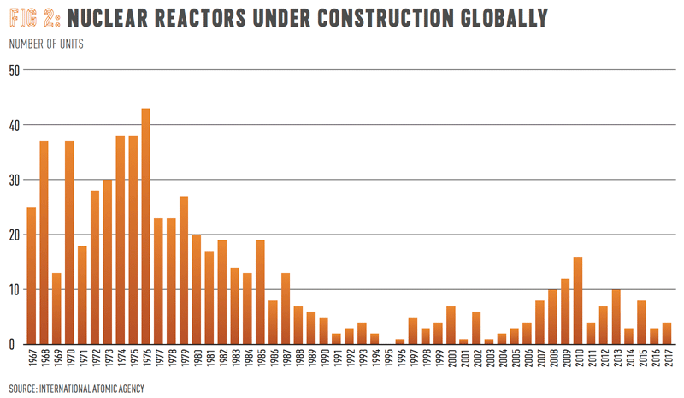
Construction delays are a big factor behind rising costs. According to the 2017 World Nuclear Industry Status Report, 37 of the 53 reactors under construction in mid-2017 were behind schedule. Eight of those projects have been in progress for a decade or more, and three of those have been under construction for more than 30 years.
As recently as July, Électricité de France’s (EDF’s) flagship nuclear project in Flamanville, which is already seven years behind schedule, was set back by another year over piping weld issues. The ‘quality deviations’ found in 33 welds at the European Pressurised Reactor (EPR) would also cause costs to swell by a further €400m ($465m). The cost of the project now sits at a grand total of €10.9bn ($12.7bn), more than three times the original budget.
Flamanville is one of three new EPRs currently being built in Western Europe. The region’s first new nuclear power station in 15 years, Finland’s Olkiluoto 3, was supposed to be completed in 2009. After numerous delays, it is now expected to be finished in May 2019. Meanwhile, the 3.2GW Hinkley Point C reactor in Somerset is expected to become the UK’s first new nuclear power plant in more than 20 years. It is already expected to be around £1.5bn ($2bn) over budget and more than a year behind schedule.
Yves Desbazeille, Director General of FORATOM, the trade organisation for Europe’s nuclear power producers, told World Finance that delays in major construction projects “are relatively common and difficult to predict”, whether in the nuclear sector or elsewhere.
“Nevertheless, we believe that lessons learned from the projects which are currently being developed in Europe will allow us to avoid these risks in the future,” Desbazeille added.
Likening nuclear power to that of a living organism, however, Mycle Schneider, the lead author of the World Nuclear Industry Status Report, told World Finance the industry was like a “dying species” due to the obvious reduction in new nuclear project launches in recent years.
This is seen clearly in the International Energy Agency’s (IEA) annual World Energy Investment report, updated in July, which found that nuclear investment is falling fast. The amount of money funnelled into nuclear power nearly halved in 2017, dropping by 45 percent as fewer new plants came online. New nuclear capacity was hit particularly hard, falling by around 70 percent to the lowest in five years as a growing slice of investment was put towards upgrades for existing reactors. Moreover, the growing popularity of renewable energy must be considered, according to Schneider: “To nuclear power, it’s like an invading species to the living organism.”
Renewables charge ahead
The economics of renewable power generation has transformed in the past five years, with costs plummeting to record lows due to the technology’s exceptional ‘learning rate’. A learning rate is the drop in the initial cost of construction as technology improves over time. The quick decline in the cost of renewables took the industry by “total surprise”, Schneider said.
For power generated by a solar photovoltaic (PV) system, that means real prices have plunged by 90 percent between 2009 and 2016. The real price of wind power, meanwhile, fell by 50 percent.
At the same time, nuclear power has presented a negative learning rate: despite technological advances and years of study, the cost of nuclear power tends to increase due to the high price of taking care of ageing reactors.
Politicians can’t pretend new nuclear projects are a viable economic option, Schneider said: “There is no market anymore in the world where new-build [nuclear reactors are] economic under market economy terms.
Renewable energy is not only threatening new nuclear projects; even existing nuclear power, which costs an average of $35.50 per MWh, was higher than recent renewable energy auctions in a number of countries, where prices have fallen to all-time lows of below $30 per MWh.
But Desbazeille said the issue of comparing costs was more complex. Citing a recent report by the OECD’s Nuclear Energy Agency titled The Full Costs of Electricity Provision, he said the price of electricity in today’s market does not include all the costs that must be taken into account when comparing different energy sources, such as grid-level costs, land-use charges, security of energy and electricity supply, or employment generated in the electricity sector.
Whatever the cost comparison, it appears adding solar and wind power to the grid is more common at the moment. In 2016, global nuclear capacity increased by just 9GW, while solar capacity jumped by 75GW and wind notched a 55GW increase.
Comparing the data since 2000 presents an even starker image. In the 16 years measured by the World Nuclear Industry Status Report, countries around the world added 451GW of wind energy and 301GW of solar energy to power grids, dwarfing an increase of just 36GW for nuclear.
The emissions race
Although the 126 nuclear reactors operating in 14 EU member states generate more than a quarter of all electricity in the EU, and nuclear sources still accounted for close to 30 percent of all electricity production in the eurozone as recently as 2015 (see Fig 1), many governments are beginning to turn their backs on nuclear power.
In March, Belgium agreed to shut down the country’s seven nuclear reactors by 2025, and Germany has been working since 2011 to phase out its nuclear reactors by 2022. In a referendum in 2017, Switzerland also voted to gradually eliminate its nuclear reactors.
The change is even occurring in France, which is the second-biggest user of nuclear power after the US. President Emmanuel Macron’s election campaign in 2017 included a promise to cut nuclear power generation from more than 70 percent of the country’s energy mix to 50 percent………
https://www.worldfinance.com/markets/nuclear-power-continues-its-decline-as-renewable-alternatives-steam-ahead
South Korean President Moon says that Kim Jong Un sincerely wants to abandon nuclear weapons
| North Korea leader sincere, must be rewarded for move to abandon nuclear weapons: South Korean president, 15 Oct 18, PARIS (Reuters) – North Korean leader Kim Jong Un is sincere and really means to abandon nuclear weapons, South Korean President Moon Jae-in told a French newspaper, adding that the international community needed to reward him for that.
……..“This year I have discussed in depth with Kim for hours. These meetings have convinced me that he has taken the strategic decision to abandon his nuclear weapon,” Moon told Le Figaro in an interview before a state visit to Paris. Moon is to meet President Emmanuel Macron on Monday. ……Moon said he hoped another Trump-Kim summit would allow the two leaders to go further than the statements they made at their first meeting in Singapore. “Declaring an end to the Korea war would be a start to establishing a regime of peace,” he said, also calling for the United States to take “reliable corresponding measures to guarantee the security of the regime”. “We could also in the future discuss the easing of sanctions, in accordance with progress on denuclearization,” he added. https://www.reuters.com/article/us-france-southkorea-northkorea/north-korea-leader-sincere-must-be-rewarded-for-move-to-abandon-nuclear-weapons-south-korean-president-idUSKCN1MO0SG?il=0 |
Trump restricting U.S. nuclear power exports to China could hurt America’s nuclear industry
 Trump’s Latest China Salvo Could Hurt U.S. Nuke Industry, Administration says Beijing is diverting U.S. nuclear technology for military use. BY KEITH JOHNSON, FP.COM OCTOBER 12, 2018, The Trump administration is increasing its economic pressure on China by restricting U.S. nuclear power exports, a move that could end up hurting an American industry desperate to compete in the world’s fastest-growing market for nuclear energy.
Senior administration officials say Beijing is stealing U.S. nuclear technology to gain a competitive edge and is also diverting U.S. nuclear technology toward military uses, such as propulsion systems for submarines and aircraft carriers. In response, after almost a year of review, the administration decided Thursday to restrict the export of some U.S. nuclear technology and components to China.
“The United States cannot ignore the national security implications of China’s efforts to obtain nuclear technology outside of established processes of U.S.-China civil nuclear cooperation,” U.S. Energy Secretary Rick Perry said in a statement.
The restrictions essentially prohibit any new technology transfers, as well as the export of advanced reactor technologies, including small, modular reactors that are seen by many as the industry’s future. Additionally, the U.S. government is essentially banning any and all U.S. exports to China General Nuclear Power Group, one of the country’s two big nuclear energy developers. China General Nuclear was indicted in 2016 for organizing an espionage campaign to acquire U.S. nuclear know-how.
But the new restrictions won’t apparently affect some of the highest-profile U.S. projects in China, such as the construction of new nuclear power plants using the state-of-the-art Westinghouse AP1000 reactor. Chinese utilities are currently building four Westinghouse reactors at two locations; the first just became operational.
For the U.S. nuclear power industry, further restrictions on its ability to compete overseas come as a blow. For a year, export licenses to China have been held up by the government’s review, and nuclear industry advocates have repeatedly warned U.S. officials of the economic harms of being locked out of the world’s one real growth market, potentially worth tens of billions of dollars in future sales……..https://foreignpolicy.com/2018/10/12/trumps-latest-china-salvo-could-hurt-u-s-nuke-industry/
1 This Month
Tell Congress: Prevent Nuclear Catastrophe in Iran

Tell Congress: Prevent Nuclear Catastrophe in Iran

Read the Public Inquiry Report, the Commissioners’ report, Surrendering Australia: The AUKUS Deception is available to download for free at aukuspublicinquiry.com. Or just watch the replay of the National Press Club Luncheon.


Shut down the radiation-damaged Heysham nuclear reactors now
To see nuclear-related stories in greater depth and intensity – go to https://nuclearinformation.wordpress.com

Say No to NASA’s Reckless Nuclear Reactor on the Moon
Say No to NASA’s Reckless Nuclear Reactor on the Moon
-
Archives
- November 2026 (255)
- October 2026 (302)
- September 2026 (339)
- August 2026 (330)
- July 2026 (355)
- June 2026 (287)
- May 2026 (306)
- April 2026 (356)
- March 2026 (251)
- February 2026 (267)
- January 2026 (308)
- December 2025 (358)
-
Categories
- 1
- 1 NUCLEAR ISSUES
- business and costs
- climate change
- culture and arts
- ENERGY
- environment
- health
- history
- indigenous issues
- Legal
- marketing of nuclear
- media
- opposition to nuclear
- PERSONAL STORIES
- politics
- politics international
- Religion and ethics
- safety
- secrets,lies and civil liberties
- spinbuster
- technology
- Uranium
- wastes
- weapons and war
- Women
- 2 WORLD
- ACTION
- AFRICA
- Atrocities
- AUSTRALIA
- Christina's notes
- Christina's themes
- culture and arts
- Events
- Fuk 2022
- Fuk 2023
- Fukushima 2017
- Fukushima 2018
- fukushima 2019
- Fukushima 2020
- Fukushima 2021
- general
- global warming
- Humour (God we need it)
- Nuclear
- RARE EARTHS
- Reference
- resources – print
- Resources -audiovicual
- Weekly Newsletter
- World
- World Nuclear
- YouTube
-
RSS
Entries RSS
Comments RSS

