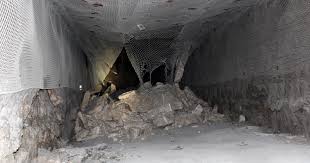
Nuke dump managers: There was waste near ceiling collapse ,By SUSAN MONTOYA BRYAN November 17, 2018 ALBUQUERQUE, N.M. (AP)— Operations at the federal government’s nuclear waste repository in southern New Mexico resumed Friday as managers acknowledged there was radioactive waste in the area where a portion of the underground facility’s ceiling collapsed earlier this week.The acknowledgement came a day after the U.S. Energy Department announced there had been a rock fall at the Waste Isolation Pilot Plant. The agency’s office in Carlsbad initially said there was no waste in the area, but watchdogs voiced concerns.
The radioactive waste included two canisters that were encapsulated in holes bored into the salt formation that makes up the walls and ceilings of the repository and its underground disposal rooms. There also were pieces of equipment in the room where the collapse happened that were contaminated by a 2014 radiation release.
Watchdogs pointed to agency documents and testimony during a recent hearing, saying officials knew what was in the room.
“For them to say there’s no waste, that’s just worse than false,” said Don Hancock with the Southwest Research and Information Center, an Albuquerque-based watchdog group. “Documents available to the public show 320,000 pounds of contaminated equipment in the room. That is waste. They know that.”
Hancock said the equipment contains fuel and other fluids that have never been drained, since crews have been kept out of the area for more than two years due to safety concerns.
Wednesday’s collapse prompted an evacuation. Workers heard a loud thud while doing inspections underground, so they left the area and all work was stopped………..
Access in the underground disposal area has been limited in the wake of the 2014 radiation release, which was caused by an inappropriately packed drum of waste that had come from Los Alamos National Laboratory. That release contaminated part of the area, forcing the closure of the repository for nearly three years and resulting in a costly recovery. https://apnews.com/b5902544d58f4b10bd352f15f0651a5d
Until now, human beings have been spreading, from our beginnings in Africa, out across the globe—slowly at first, and then much faster. But a period of contraction is setting in as we lose parts of the habitable earth.
some of the world is becoming too hot for humans.
As some people flee humidity and rising sea levels, others will be forced to relocate in order to find enough water to survive.
escaping the wreckage is, almost certainly, a fantasy. Even if astronauts did cross the thirty-four million miles to Mars, they’d need to go underground to survive there. To what end?
“People think if we fuck up here on Earth we can always go to Mars or the stars,” “It’s pernicious.”
How Extreme Weather Is Shrinking the Planet, New Yorker, by Bill McKibben November 18, 2018With wildfires, heat waves, and rising sea levels, large tracts of the earth are at risk of becoming uninhabitable. But the fossil-fuel industry continues its assault on the facts …
“……For the past few years, a tide of optimistic thinking has held that conditions for human beings around the globe have been improving. Wars are scarcer, poverty and hunger are less severe, and there are better prospects for wide-scale literacy and education. But there are newer signs that human progress has begun to flag. In the face of our environmental deterioration, it’s now reasonable to ask whether the human game has begun to falter—perhaps even to play itself out. Late in 2017, a United Nations agency announced that the number of chronically malnourished people in the world, after a decade of decline, had started to grow again—by thirty-eight million, to a total of eight hundred and fifteen million, “largely due to the proliferation of violent conflicts and climate-related shocks.” In June, 2018, the Food and Agriculture Organization of the U.N. found that child labor, after years of falling, was growing, “driven in part by an increase in conflicts and climate-induced disasters.”
Scientists have warned for decades that climate change would lead to extreme weather. Shortly before the I.P.C.C. report was published, Hurricane Michael, the strongest hurricane ever to hit the Florida Panhandle, inflicted thirty billion dollars’ worth of material damage and killed forty-five people. President Trump, who has argued that global warming is “a total, and very expensive, hoax,” visited Florida to survey the wreckage, but told reporters that the storm had not caused him to rethink his decision to withdraw the U.S. from the Paris climate accords. He expressed no interest in the I.P. C.C. report beyond asking “who drew it.” (The answer is ninety-one researchers from forty countries.) He later claimed that his “natural instinct” for science made him confident that the climate would soon “change back.” A month later, Trump blamed the fires in California on “gross mismanagement of forests.
……….As a team of scientists recently pointed out in the journal Nature Climate Change, the physical shifts we’re inflicting on the planet will “extend longer than the entire history of human civilization thus far.”
The poorest and most vulnerable will pay the highest price. But already, even in the most affluent areas, many of us hesitate to walk across a grassy meadow because of the proliferation of ticks bearing Lyme disease which have comewith the hot weather; we have found ourselves unable to swim off beaches, because jellyfish, which thrive as warming seas kill off other marine life, have taken over the water.
The planet’s diameter will remain eight thousand miles, and its surface will still cover two hundred million square miles. But the earth, for humans, has begun to shrink, under our feet and in our minds.
Climate change,” like “urban sprawl” or “gun violence,” has become such a familiar term that we tend to read past it. But exactly what we’ve been up to should fill us with awe. During the past two hundred years, we have burned immense quantities of coal and gas and oil—in car motors, basement furnaces, power plants, steel mills—and, as we have done so, carbon atoms have combined with oxygen atoms in the air to produce carbon dioxide. This, along with other gases like methane, has trapped heat that would otherwise have radiated back out to space. ……..
When I say the world has begun to shrink, this is what I mean. Until now, human beings have been spreading, from our beginnings in Africa, out across the globe—slowly at first, and then much faster. But a period of contraction is setting in as we lose parts of the habitable earth. Sometimes our retreat will be hasty and violent; the effort to evacuatethe blazing California towns along narrow roads was so chaotic that many people died in their cars. But most of the pullback will be slower, starting along the world’s coastlines. Each year, another twenty-four thousand people abandon Vietnam’s sublimely fertile Mekong Delta as crop fields are polluted with salt. As sea ice melts along the Alaskan coast, there is nothing to protect towns, cities, and native villages from the waves. In Mexico Beach, Florida, which was all but eradicated by Hurricane Michael, a resident told the Washington Post, “The older people can’t rebuild; it’s too late in their lives. Who is going to be left? Who is going to care?” ………
According to a study from the United Kingdom’s National Oceanography Centre last summer, the damage caused by rising sea levels will cost the world as much as fourteen trillion dollars a year by 2100, if the U.N. targets aren’t met. “Like it or not, we will retreat from most of the world’s non-urban shorelines in the not very distant future,” Orrin Pilkey, an expert on sea levels at Duke University, wrote in his book “Retreat from a Rising Sea.” “We can plan now and retreat in a strategic and calculated fashion, or we can worry about it later and retreat in tactical disarray in response to devastating storms. In other words, we can walk away methodically, or we can flee in panic.” ………
some of the world is becoming too hot for humans. ……….
According to the National Oceanic and Atmospheric Administration, increased heat and humidity have reduced the amount of work people can do outdoors by ten per cent, a figure that is predicted to double by 2050. About a decade ago, Australian and American researchers, setting out to determine the highest survivable so-called “wet-bulb” temperature, concluded that when temperatures passed thirty-five degrees Celsius (ninety-five degrees Fahrenheit) and the humidity was higher than ninety per cent, even in “well-ventilated shaded conditions,” sweating slows down, and humans can survive only “for a few hours, the exact length of time being determined by individual physiology.”
According to the National Oceanic and Atmospheric Administration, increased heat and humidity have reduced the amount of work people can do outdoors by ten per cent, a figure that is predicted to double by 2050. About a decade ago, Australian and American researchers, setting out to determine the highest survivable so-called “wet-bulb” temperature, concluded that when temperatures passed thirty-five degrees Celsius (ninety-five degrees Fahrenheit) and the humidity was higher than ninety per cent, even in “well-ventilated shaded conditions,” sweating slows down, and humans can survive only “for a few hours, the exact length of time being determined by individual physiology.” ………
As some people flee humidity and rising sea levels, others will be forced to relocate in order to find enough water to survive. In late 2017, a study led by Manoj Joshi, of the University of East Anglia, found that, by 2050, if temperatures rise by two degrees a quarter of the earth will experience serious drought and desertification. The early signs are clear:
………We’ve already overpumped the aquifers that lie beneath most of the world’s breadbaskets …
…….All this has played out more or less as scientists warned, albeit faster. What has defied expectations is the slowness of the response.
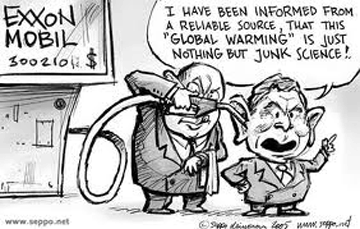
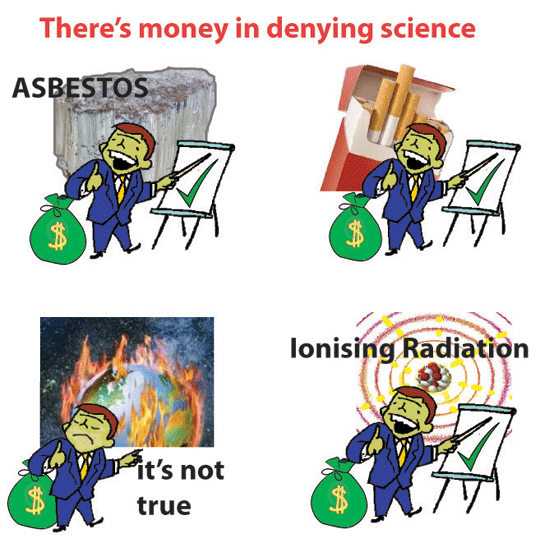
………..Exxon’s behavior is shocking, but not entirely surprising. Philip Morris lied about the effects of cigarette smoking before the government stood up to Big Tobacco. The mystery that historians will have to unravel is what went so wrong in our governance and our culture that we have done, essentially, nothing to stand up to the fossil-fuel industry.
There are undoubtedly myriad intellectual, psychological, and political sources for our inaction, but I cannot help thinking that the influence of Ayn Rand, the Russian émigré novelist, may have played a role. Rand’s disquisitions on the “virtue of selfishness” and unbridled capitalism are admired by many American politicians and economists—Paul Ryan, Tillerson, Mike Pompeo, Andrew Puzder, and Donald Trump, among them.
Trump, who has called “The Fountainhead” his favorite book, said that the novel “relates to business and beauty and life and inner emotions. That book relates to . . . everything.” Long after Rand’s death, in 1982, the libertarian gospel of the novel continues to sway our politics: Government is bad. Solidarity is a trap. Taxes are theft. The Koch brothers, whose enormous fortune derives in large part from the mining and refining of oil and gas, have peddled a similar message, broadening the efforts that Exxon-funded groups like the Global Climate Coalition spearheaded in the late nineteen eighties…….
Musk, Jeff Bezos, and Richard Branson are among the billionaires who have spent some of their fortunes on space travel—a last-ditch effort to expand the human zone of habitability. In November, 2016, Stephen Hawking gave humanity a deadline of a thousand years to leave Earth. Six monthslater, he revised the timetable to a century. In June, 2017, he told an audience that “spreading out may be the only thing that saves us from ourselves.” He continued, “Earth is under threat from so many areas that it is difficult for me to be positive.”
But escaping the wreckage is, almost certainly, a fantasy. Even if astronauts did cross the thirty-four million miles to Mars, they’d need to go underground to survive there. To what end? The multimillion-dollar attempts at building a “biosphere” in the Southwestern desert in 1991 ended in abject failure. Kim Stanley Robinson, the author of a trilogy of novels about the colonization of Mars, recently called such projects a “moral hazard.” “People think if we fuck up here on Earth we can always go to Mars or the stars,” he said. “It’s pernicious.”
CNN Planet Earth: Poisoned Earth – Rocky Mountain Arsenal
The Dangers of Rocky Flats Are Forgotten but Not Gone, Westword, RON BAXENDALE II | NOVEMBER 17, 2018 “……..After nearly forty years of producing plutonium triggers for nuclear bombs, Rocky Flats was closed in 1992 after an endless series of fires, leaking storage containers and other accidents. At that time, it was said that Rocky Flats was likely to become a “national sacrifice zone” — a place so toxic it would never be fit for human habitation.
Then in 2000, only a few years later, Kaiser-Hill was given a contract to complete the closure of Rocky Flats, agreeing to clean up the entire 6,245-acre site in less than six years on a budget of $4 billion.
Really? From “sacrifice zone” to “70-year marginal clean up” to “perfectly safe” in less than six years? How is this possible?
The cleanup of Rocky Flats was declared complete in 2006 and, even more astonishing, new homes in the Candelas development began to appear in 2012, immediately south of Rocky Flats, near the buffer zone. Now, despite continuing protest, the Deputy Secretary of the Interior has ruled that the Rocky Flats National Wildlife Refuge (the innocuous new name for the plant) is safe enough for visits by children on school field trips.
The efforts to hide the dirty secrets of Rocky Flats are nothing new, and neither is the willingness of people to ignore the truth in order to lead lives free of worry. Newbies to Colorado, many of whom have invested much to make major life changes, are the biggest naysayers, wearing blinders to avoid the unsettling truth about their new choice of residence………..
We all lived in the Broomfield area of the Front Range from the early ’60s onward, I told the woman. For more than twenty years, I said, we all drank water from the Great Western Reservoir, Broomfield’s plutonium-laden water supply, and began suffering our health problems in the mid- to late ’80s. And this is just one family, I told her. One little family out of tens of thousands of families, all of which can tell their version of the same horror story. (When the members of a family or multiple families within a community contract this much cancer, says my primary care doctor, the cause is nearly always environmental.)……….
if Rocky Flats is so safe, why did an independent sample of soils east of Rocky Flats along Indiana Street in 2012 show plutonium contamination 100 times greater than allowable background levels? Why did a 2016 study led by Metropolitan State University of Denver find that those living downwind from Rocky Flats have unusually high rates of breast, thyroid, prostate, colon and rare cancers? And why do veterinarians in the Arvada-Westminster area report that dogs that frequent the Westminster Hills Dog Park — located just east of Rocky Flats and adjacent to the contaminated Great Western Reservoir — have abnormally high rates of bone and foot cancers?
More important, if Rocky Flats is so safe, why are home buyers immediately south of ground zero presented with advisory notices only at closing and told not to plant root-bound vegetables in gardens? One would think buyers would pay serious attention to such red flags, especially those buyers with young children……..
Kardashian shared with her 58 million followers Thursday that she was “shocked and furious” to learn that the Woolsey fire, which threatened her Calabasas home, started at the former nuclear testing site and is “potentially radioactive.”
The celebrity’s sister, Kourtney Kardashian, echoed her concerns.
“Our family lives only 20 miles from a nuclear disaster site, Santa Susana Field Lab, and we didn’t even know it. We need Gavin Newsom to do something,” Kardashian tweeted Thursday.
But the contaminated 2,900-acre site is well known to San Fernando Valley residents.
Nearly 490,000 people signed a petition on Change.org, started by West Hills resident Melissa Bumstead whose daughter Grace has twice survived leukemia. The girl is one of 50 children within 20 miles of the site with cancer, a product, some residents say, of an era of nuclear research and rocket engine testing that left a tragic imprint in the area.
The lab appeared on the map in the 1940s, and about two decades later it became the site of a partial meltdown accident that left the area polluted with radioactive and chemical contamination. The United States Department of Energy and NASA signed an agreement in 2010, promising to remove all contamination from the site by 2017. The state’s Department of Toxic Substance Control, or DTSC, asked Boeing, which owns a portion of the area, to commit to its own cleanup.
About a year after the deadline, the companies still have not cleaned the area. Now, Bumstead and other parents worry that their families are being exposed to carcinogenic chemicals.
The Woolsey fire, which started near the former Rocketdyne site, has amplified those concerns.
“DTSC repeatedly minimizes risk from SSFL and has broken every promise it ever made about the SSFL cleanup,” Bumstead wrote in a statement. “Communities throughout the state have also been failed by DTSC. The public has no confidence in this troubled agency.”
Abbott Dutton, a spokeswoman for DTSC, wrote in an email that the agency’s experts accessed the site last Saturday to inspect damage caused by the fire.
“We confirmed that the SSFL facilities that previously handled radioactive and hazardous materials were not affected by the fire,” Dutton wrote. “Over the weekend our multi-agency team took measurements of radiation and hazardous compounds, both on the site and in the surrounding community. The results from this initial round of testing showed no radiation levels above background levels, and no elevated levels of hazardous compounds other than those normally present after a wildfire.”
But Bumstead was skeptical about the test results.
“I was outraged to learn that DTSC and other agencies are telling everyone there’s no risk, and then we find out they haven’t even received many of the test results,” she wrote in an email. “DTSC and Los Angeles County Department of Public Health should not make assurances when they don’t have the data and won’t release whatever measurements they may have taken.”
The strategy of muddling the public’s impression of climate science has proved to be highly effective. In 2017, polls found that almost ninety per cent of Americans did not know that there was a scientific consensus on global warming.
What is certain is that the industry’s campaign cost us the efforts of the human generation that might have made the crucial difference in the climate fight
How Extreme Weather Is Shrinking the Planet, New Yorker, by Bill McKibben November 18, 2018 “………The climatologist James Hansen testified before Congress about the dangers of human-caused climate change thirty years ago. Since then, carbon emissions have increased with each year except 2009 (the height of the global recession) and the newest data show that 2018 will set another record. Simple inertia and the human tendency to prioritize short-term gains have played a role, but the fossil-fuel industry’s contribution has been by far the most damaging. Alex Steffen, an environmental writer, coined the term “predatory delay” to describe “the blocking or slowing of needed change, in order to make money off unsustainable, unjust systems in the meantime.” The behavior of the oil companies, which have pulled off perhaps the most consequential deception in mankind’s history, is a prime example.
As journalists at InsideClimate News and the Los Angeles Times have revealed since 2015, Exxon, the world’s largest oil company, understood that its product was contributing to climate change a decade before Hansen testified. In July, 1977, James F. Black, one of Exxon’s senior scientists, addressed many of the company’s top leaders in New York, explaining the earliest research on the greenhouse effect. “There is general scientific agreement that the most likely manner in which mankind is influencing the global climate is through carbon-dioxide release from the burning of fossil fuels,” he said, according to a written version of the speech which was later recorded, and which was obtained by InsideClimate News. In 1978, speaking to the company’s executives, Black estimated that a doubling of the carbon-dioxide concentration in the atmosphere would increase average global temperatures by between two and three degrees Celsius (5.4 degrees Fahrenheit), and as much as ten degrees Celsius (eighteen degrees Fahrenheit) at the poles.
Exxon spent millions of dollars researching the problem. It outfitted an oil tanker, the Esso Atlantic, with CO2 detectors to measure how fast the oceans could absorb excess carbon, and hired mathematicians to build sophisticated climate models. By 1982, they had concluded that even the company’s earlier estimates were probably too low. In a private corporate primer, they wrote that heading off global warming and “potentially catastrophic events” would “require major reductions in fossil fuel combustion.”
An investigation by the L.A. Times revealed that Exxon executives took these warnings seriously. Ken Croasdale, a senior researcher for the company’s Canadian subsidiary, led a team that investigated the positive and negative effects of warming on Exxon’s Arctic operations. In 1991, he found that greenhouse gases were rising due to the burning of fossil fuels. “Nobody disputes this fact,” he said. The following year, he wrote that “global warming can only help lower exploration and development costs” in the Beaufort Sea. Drilling season in the Arctic, he correctly predicted, would increase from two months to as many as five months. At the same time, he said, the rise in the sea level could threaten onshore infrastructure and create bigger waves that would damage offshore drilling structures. Thawing permafrost could make the earth buckle and slide under buildings and pipelines. As a result of these findings, Exxon and other major oil companies began laying plans to move into the Arctic, and started to build their new drilling platforms with higher decks, to compensate for the anticipated rises in sea level.
The implications of the exposés were startling. Not only did Exxon and other companies know that scientists like Hansen were right; they used his nasaclimate models to figure out how low their drilling costs in the Arctic would eventually fall. Had Exxon and its peers passed on what they knew to the public, geological history would look very different today. The problem of climate change would not be solved, but the crisis would, most likely, now be receding. In 1989, an international ban on chlorine-containing man-made chemicals that had been eroding the earth’s ozone layer went into effect. Last month, researchers reported that the ozone layer was on track to fully heal by 2060. But that was a relatively easy fight, because the chemicals in question were not central to the world’s economy, and the manufacturers had readily available substitutes to sell. In the case of global warming, the culprit is fossil fuel, the most lucrative commodity on earth, and so the companies responsible took a different tack.
A document uncovered by the L.A. Timesshowed that, a month after Hansen’s testimony, in 1988, an unnamed Exxon “public affairs manager” issued an internal memo recommending that the company “emphasize the uncertainty” in the scientific data about climate change. Within a few years, Exxon, Chevron, Shell, Amoco, and others had joined the Global Climate Coalition, “to coordinate business participation in the international policy debate” on global warming. The G.C.C. coördinated with the National Coal Association and the American Petroleum Institute on a campaign, via letters and telephone calls, to prevent a tax on fossil fuels, and produced a video in which the agency insisted that more carbon dioxide would “end world hunger” by promoting plant growth. With such efforts, it ginned up opposition to the Kyoto Protocol, the first global initiative to address climate change.
In October, 1997, two months before the Kyoto meeting, Lee Raymond, Exxon’s president and C.E.O., who had overseen the science department that in the nineteen-eighties produced the findings about climate change, gave a speech in Beijing to the World Petroleum Congress, in which he maintained that the earth was actually cooling. The idea that cutting fossil-fuel emissions could have an effect on the climate, he said, defied common sense. “It is highly unlikely that the temperature in the middle of the next century will be affected whether policies are enacted now, or twenty years from now,” he went on. Exxon’s own scientists had already shown each of these premises to be wrong.
On a December morning in 1997 at the Kyoto Convention Center, after a long night of negotiation, the developed nations reached a tentative accord on climate change. Exhausted delegates lay slumped on couches in the corridor, or on the floor in their suits, but most of them were grinning. Imperfect and limited though the agreement was, it seemed that momentum had gathered behind fighting climate change. But as I watched the delegates cheering and clapping, an American lobbyist, who had been coördinating much of the opposition to the accord, turned to me and said, “I can’t wait to get back to Washington, where we’ve got this under control.”
He was right. On January 29, 2001, nine days after George W. Bush was inaugurated, Lee Raymond visited his old friend Vice-President Dick Cheney, who had just stepped down as the C.E.O. of the oil-drilling giant Halliburton. Cheney helped persuade Bush to abandon his campaign promise to treat carbon dioxide as a pollutant. Within the year, Frank Luntz, a Republican consultant for Bush, had produced an internal memo that made a doctrineof the strategy that the G.C.C. had hit on a decade earlier. “Voters believe that there is no consensus about global warming within the scientific community,” Luntz wrote in the memo, which was obtained by the Environmental Working Group, a Washington-based organization. “Should the public come to believe that the scientific issues are settled, their views about global warming will change accordingly. Therefore, you need to continue to make the lack of scientific certainty a primary issue in the debate.”
The strategy of muddling the public’s impression of climate science has proved to be highly effective. In 2017, polls found that almost ninety per cent of Americans did not know that there was a scientific consensus on global warming. Raymond retired in 2006, after the company posted the biggest corporate profits in history, and his final annual salary was four hundred million dollars. His successor, Rex Tillerson, signed a five-hundred-billion-dollar deal to explore for oil in the rapidly thawing Russian Arctic, and in 2012 was awarded the Russian Order of Friendship. In 2016, Tillerson, at his last shareholder meeting before he briefly joined the Trump Administration as Secretary of State, said, “The world is going to have to continue using fossil fuels, whether they like it or not.”
15th Nov 2018 On the morning after the Financial Times has called on the UK Government to reassess its long-term energy plans following the demise of Toshiba’sMoorside nuclear project, the Stop Hinkley Campaign has published a briefing about lessons we can learn from the Sellafield Thermal Oxide Reprocessing Plant which is in the process of closing after only 24 years of operation and a very chequered performance.
The “Lessons for Hinkley from Sellafield” briefing says: The cost of building THORP increased from
£300m in 1977 to £1.8bn on completion in 1992. With the additional cost of associated facilities this figure rose to £2.8bn. Originally expected to reprocess 7,000 tonnes of spent fuel in its first ten years, it has managed only around 9,300 in 24 years.
The original rationale for THORP ended with the closure of the UK’s fast reactor programme in 1994. The new rationale – to produce plutonium fuel for ordinary reactors – was a disaster costing the taxpayer £2.2bn.
Stop Hinkley Spokesperson Roy Pumfrey said: “The rationale for building the THORP plant at Sellafield had disappeared before it even opened. The lesson for 2018 is that we should scrap Hinkley C now before costs escalate. The cancellation costs are small relative to the £50billion extra we’ll have to pay for Hinkley’s electricity, if it ever generates any. If we wait any longer to scrap it,
we risk heading for another Sellafield-scale financial disaster.” http://www.stophinkley.org/PressReleases/pr181115.pdf
Connecticut utility regulators say Millstone Nuclear Power Plant ‘at risk’ of closing, New Haven Register, By Luther Turmelle, November 17, 2018 A tentative ruling by state utility regulators may boost efforts by the owner of the Millstone Nuclear Power Plant to have the electricity it produces considered in ‘zero carbon’ auction that the state’s Department of Energy and Environmental Protection conducts to procure power.
Commissioners with Connecticut’s Public Utilities Regulatory Authority ruled that the Waterford-based power plant “is at risk of retirement.” Dominion Energy, the Virginia-based company that owns Millstone, has claimed for several years that economic conditions in the nation’s energy markets are making it difficult for the utility to keep operating the plant if it not allowed to compete for lucrative long-term contracts that are awarded to the winners of the zero-carbon auction.
“This interim decision does not reach the issue of whether a purchase power agreement with Millstone should be selected by DEEP or approved,” the tentative ruling says in part. “But (it) addresses solely the basis on which such a bid may be evaluated.”
Dominion officials release a statement Friday following PURA’s ruling say they are pleased with the decision made by regulators.
“They have been given access to our confidential information, have done their own analysis, and reached their own conclusion, Millstone is at risk,” the statement says in part. “We are now focused on the zero carbon procurement at the Department of Energy & Environmental Protection. We made numerous offers that would both ensure Millstone’s continued operations and provide benefits to Connecticut ratepayers ranging from the hundreds of millions of dollars to billions of dollars.”
DEEP officials are expected to announce the winners of the zero carbon auction by the end of the year. PURA’s determination that Millstone is at risk of closing will be a factor that DEEP officials will take into account as they try to determination the winners of the auction from a field of dozens of renewable energy sources that submitted proposals earlier this year……….
Joel Gordes, a West Hartford-based energy industry consultant, said PURA’s commissioners erred in their draft ruling.
Anti-nuclear power plant activists turn to Turkey’s highest court , Ahval, Ezgi Karataş
Nov 17 2018
Turkish environmentalists are deeply concerned about the ongoing construction of the country’s first nuclear power plant and plan to bring their case to Turkey’s highest court.
In the past year, environmental groups have brought up many legal cases against the plant, which is being built in Akkuyu, near Mersin, on the Mediterranean coast. Scientists have argued that the plant will adversely impact the regional ecology and economy, undermining the livelihoods of people who rely on the marine ecosystem and tourism.
Last month, an appeals court upheld a local court’s decision to accept the Turkish government’s environmental impact assessment, even though several news reportssaid some scientists’ signatures on the report were forged.Following the appeals court’s decision, environmentalists say they plan to petition the Constitutional Court. Sevim Küçük, a lawyer and vocal member of the Mersin Anti-Nuclear Platform, believes Turkish President Recep Tayyip Erdoğan influenced the appeals court’s decision.
“The president issued instructions to speed up the work one day before the hearing at the appeals court,” she said. “The judiciary was pressured by the executive. As a result, we were not expecting a just decision.”
Küçük says their appeal to the Constitutional Court does not automatically indicate a motion to stay. Plant construction, which began in April 2018 with a ceremony attended by Russian President Vladimir Putin and Turkish President Recep Erdoğan via video conference, is expected to continue during the proceedings. “Lower courts did not issue a motion to stay either, so the construction was continuing during all our legal battles as well,” says Küçük.
Küçük says that government assessment is out of line with scientific evidence and based on falsified expert reports. She believes the report was copy-pasted from falsified expert reports, and that the court, in its decision, copy-pasted the same reports as well.
A key concern of the environmental group is the storage of nuclear waste, which the assessment does not adequately address. “While Europe, Japan, America are trying to close down their nuclear power plants, why is our government so determined to build one?” asks Küçük. “As locals we are worried that the plant will store its nuclear waste in our neighbourhoods.”
Dr. Ful Uğurhan, another member of the anti-nuclear group, says that
The location of Akkuyu is not suited to build a nuclear power plant, argues Ful Uğurhan, another member of the anti-nuclear group. Uğurhan says that the seawater temperatures in Akkuyu are high, which not only means spending more energy to cool down the reactors, but the process will further increase the seawater temperatures and upset the ecological balance.
An active geological fault line near Akkuyu means additional risk.
“Considering the effects of global climate change, it’s not safe to build a nuclear power plant anywhere,” says Uğurhan. “Storms, earthquakes, tsunamis all increase the risk involved in building a nuclear power plant, instead of ecologically safe electricity production plants.” ………https://ahvalnews.com/akkuyu/anti-nuclear-power-plant-activists-turn-turkeys-highest-court
Ticking time bomb giant stockpile of nuclear waste endangers USA
A Fukushima waiting to happen? Huge stockpile of nuclear waste on California fault line threatens US https://www.rt.com/usa/444089-california-nuclear-san-onofre/16 Nov, 2018 Millions of pounds of toxic waste are being buried under the site of a privately owned former nuclear power plant in California. The only problem? Experts warn that it sits on a major fault line — and in a tsunami zone.
The San Onofre nuclear plant, located just 108 feet from a popular beach, was shut down in 2015 after a leak was discovered. Now, the Southern California Edison energy company is burying the nuclear waste at the failed site — a move which has been approved by federal regulator
Charles Langley, the executive director of Public Watchdogs, told RT that the situation at San Onofre is of “grave concern” because spent nuclear fuel and water “don’t mix.”
Langley claimed that research carried out by experts which highlighted the extreme risks of storing the waste at the facility was “suppressed” by the very government agency responsible for protecting public health and safety.
“There are actually fault lines that run underneath the facility. We’ve documented this in geological reports that were suppressed by the Nuclear Regulatory Commission. It’s in a Tsunami zone and it’s also extremely vulnerable to terrorist attacks.”
So far, 29 of 73 canisters of waste are below the surface of the ground. Langley warns, however, that the canisters are unequipped to store the toxic nuclear waste. The warranty for the containment system is only for 10 years “and the canisters themselves are only guaranteed to last 25 years,” he said.
Nina Babiarz, a board member at Public Watchdogs, told RT that “there should have been a requirement for an underground monitoring system before one can even went in the ground.”
Babiarz believes the San Onofre plant is a ticking time bomb.
“It’s still very prevalent to me that this not only could happen, but it has happened at Three Mile Island, of course it has happened at Chernobyl, it’s happened at Fukushima — and lest we forget, it could happen at San Onofre,” she said.
Edison refused to answer any of RT’s questions. On its website, however, the company says they are “being proactive in seeking out options for the relocation of the fuel, including an off-site facility.”
But San Onofre is not the only nuclear site causing concern to scientists and environmentalists in California.
The Santa Susana Field Laboratory — a highly classified former nuclear testing site, which was the location of the worst nuclear meltdown in nuclear history — was scorched in the California wildfires. During the 1959 disaster, 459 times more radiation was leaked there than during the infamous 1979 Three Mile Island meltdown in Pennsylvania.
Physicians for Social Responsibility say that the toxic materials in the soil and vegetation could become airborne in smoke and ash. More than half a million people live within 10 miles of the area.
Investigative journalist Paul DeRienzo told RT that given the site’s classified status, it’s no surprise that Americans don’t know much about the place.
“It was a tremendous accident [in 1959] that gave off more radiation than Three Mile Island did — and other than that, very little is known. It’s a highly classified site and whatever we learn about it, we learn in dribs and drabs over a long period of time,” DeRienzo said.
Asked whether government assurances that the site is safe could be believed, DeRienzo warned against trusting official guarantees.
“You can’t, because it’s classified, because a lot of the things that happened at Santa Susana were classified and therefore there are things that they’re just never going to tell you and only accidentally does it come out,” he said.
Nov. 13 (UPI)— U.S. Vice President Mike Pence vowed to work toward the complete denuclearization of North Korea and fully enforce sanctions during a joint press conference with Japan’s prime minister on Tuesday.
Pence, who is expected to attend the APEC meeting in Papua New Guinea on Saturday instead of President Donald Trump, said the United States stands firmly against countries that threatened freedom and openness in the region, including North Korea, NHK reported……
U.S. sailors filed a class action in the Southern District of California in 2012 claiming radiation they were exposed to following the meltdown of a nuclear power plant in Fukushima, Japan while aboard U.S. vessels on a humanitarian mission has caused cancer, brain tumors, birth defects in their children and other rare health problems. Some have even died, according to their attorneys.
If U.S. courts dismiss the two related cases – Cooper et al. v. TEPCO et al. and Bartel et al. v. Tokyo Electric Power Company Inc. et al. – the sailors could bring their claims in Japan under its Compensation for Nuclear Damage Act.
Sammartino did clarify throughout the hearing that she would not waste her or the attorneys’ time by holding a court hearing if she wasn’t going to consider their arguments.
Class attorney Charles Bonner of Sausalito, California implored the judge not to dismiss the litigation, noting that attorneys have not been able to conduct discovery in the case, and that the defendants’ motions to dismiss were “based on legal arguments,” not facts.
Bonner suggested class counsel needed to obtain contracts between GE, which designed and helped to maintain the nuclear reactors for 40 years in Fukushima, and TEPCO, which operated the plant. Bonner said the contracts likely contain a choice-of-law provision that would indicate whether the parties would agree to litigate in the U.S. or Japan.
“Our sailors have already been here five years. They need some resolution in this court,” Bonner said……..
Edwards suggested if the Southern District of California dismissed the cases, the sailors wouldn’t “go to Japan and hire Japanese lawyers.”
Bonner buoyed Edwards’ point, noting a declaration from Japanese lawyers who said the class would not get a fair trial in Japan, where no jury would decide the case’s merits……..
Colin James, The Advertiser, August 29, 2014, BRITISH scientists secretly used the Australian population to test for radiation contamination after the nuclear tests at Maralinga in the 1950s, a new book confirms.
Its author, Frank Walker, has obtained the minutes of a top secret meeting in England where the UK Atomic Energy Research Establishment approved a program to determine the long-term effects of the tests on Australia and its citizens.
In his book, Maralinga, Walker details how the meeting at Harwell on May 24, 1957, decided to first obtain soil samples from pasture regions near Adelaide, Sydney, Melbourne, Brisbane and Perth to check for fallout from the nine nuclear bombs detonated at Maralinga and the Monte Bello Islands, off WA.
The second phase was to test vegetation, particularly grass and cabbage, and milk for the presence of the radioactive isotope, Strontium-90, a fission by-product of nuclear explosions.
The meeting was chaired by Professor Ernest Titterton, the nuclear scientist who oversaw the British nuclear tests in Australia.
According to the document obtained by Walker, Professor Titterton told the meeting he wanted to collect animal bones “to see if Strontium-90 is getting into domestic animals”.
The meeting decided to take bone samples from 12 sheep stations along a 800km path of fallout tracked by Royal Australian Air Force planes which flew into the mushroom clouds following each nuclear explosion at Maralinga.
Professor Titterton told the meeting that the final phase of the testing would be to determine if Strontium-90 was being absorbed by the Australian population.
“We have to find out if Strontium-90 is entering the food chain and getting into humans,” says the document, which has the file number DEFE 16/608.
The scientists then agreed to start testing the bones of dead Australian infants and children for radiation contamination.
“As many bones as possible are to be obtained,” says DEFE 16/608.
“The bones should be femurs. The required weight is 20-50 grams wet bone, subsequently ashed to provide samples of weight not less than two grams. The date of birth, age at death and locality of origin are to be reported.”
Professor Titterton said the bones would be crushed into a powder and sent to the UK for analysis along with the soil, animal samples and vegetation collected from the Australian testing sites.
As The Advertiser has previously reported, hundreds of bones were subsequently collected from the bodies of 21,830 dead babies, infants, children, teenagers and young adults across Australia without the knowledge of their parents.
The Strontium-90 testing program in Australia was the longest of its kind in the world, finally ending in 1978.
In September, 2001, following an extensive investigation by The Advertiser, the Australian Radiation Protection and Nuclear Safety Agency revealed it had kept ash samples from bones collected from hospitals in Adelaide, Sydney, Perth, Brisbane and Melbourne.
In a report to the then federal health minister, Michael Wooldridge, the agency said it had detected varying levels of Strontium-90 in all Australian capital cities.
2 Hanford whistleblowers sue. They say they lost their jobs for raising safety concerns, Tri City Herald, BY ANNETTE CARY, acary@tricityherald.com, November 15, 2018 RICHLAND, WA
The company building the Hanford vitrification plant is defending itself in federal court against two former employers who said they lost their jobs after raising concerns about the plant’s safety.
Bechtel National holds the Department of Energy contract to build and start up the $17 billion plant to turn about 56 million gallons of radioactive waste into a stable glass form for disposal.
Government Accountability Project USA https://www.whistleblower.org/blog/034224-urgent-action-requested-sign-petition-below Watchdog and Advocacy Coalition Report Warns of Systemic Attacks on Science The Report Exposes Chronic Interference With Federal Science and Public Health and Safety Measures Under the Trump Administration and Makes Critical Recommendations to Congress
A report released today by a coalition of prominent watchdog and advocacy groups – including Government Accountability Project – chronicles a litany of recent attacks on federal science and scientists by Trump administration officials intent on undermining the critical regulatory role government plays in safeguarding public health and safety. The report, “Protecting Science at Federal Agencies: How Congress Can Help,” arose out of mounting concerns that some of our elected officials are chronically crippling key science programs, and ignoring, suppressing, censoring, and distorting scientific information in order to weaken regulatory functions that serve to protect human health and the environment but disadvantage certain industry interests. Government Accountability Project was the lead contributor to the chapter on whistleblowing and scientific integrity, as well as a contributor to the chapter on reduced communications. The report concludes that widespread, politically-motivated interference in sound science causes unsound policy decisions, and Congress must act swiftly and decisively to reverse this dangerous trend to get the nation back on course.
The new report walks through countless troubling examples of deliberate efforts by Trump administration agency heads and political appointees to dismantle federal science programs, discredit scientific data, disconnect scientific fact from decision-making, and destroy public trust in government. Many current high-level political appointees lack adequate experience and credentials for the positions they are assigned to manage and often bring with them serious conflicts of interest. Meanwhile, Congress has been lax, even negligent, in carrying out its oversight responsibilities. This must change.
The watchdog and public interest groups who authored this report share a strong concern that we are witnessing an epidemic of intentional ignorance and scientific blind spots at the highest levels of government, at a time when all Americans face escalating threats to our health and wellbeing – such as a broken health care system and runaway climate change. Collectively we put forth a set of thoughtful recommendations for the incoming 116th Congress to consider that include specific legislative proposals as well as a call for greatly improved oversight to hold government officials accountable to the public they serve.
The U.S. government invests well over $100 billion a year on scientific research and technology development, and federal agencies have traditionally relied heavily on scientific findings to support complex regulatory and policy decisions. Now, science itself is under attack: this administration is systematically dismantling a host of science advisory committees and hampering them from providing scientific information and guidance to federal regulatory program managers. Blatant disregard of fact-based evidence – even wholesale rejection of facts themselves – fostered by the Trump White House place all of us at greater risk by exposing us to toxic chemicals, polluting our air and water, eroding and blocking access to adequate health care, compromising national security, and raising the risk of exposure to dangerous climate change impacts.
Climate Science & Policy Watch, a flagship program of Government Accountability Project, is especially troubled by the enormous disparity between the alarm bells rung in the most recent Intergovernmental Panel on Climate Change (IPCC) report, and the tepid U.S. response. As President Trump promotes a coal industry come-back and calls for fewer regulatory checks on rampant oil and gas extraction – thereby ramping up carbon emissions when we most need to be making significant cuts – we face the increasingly imminent threat of runaway climate change and its dangerous impacts. Global climate disruption is happening now, as evidenced by western-wildfires-turned-raging-infernos sweeping across California incinerating entire towns and communities; more hazardous hurricanes and unprecedented rainfall and flooding; storm surges and sea level rise inundating coastal areas. Our Environment, Energy, and Climate Change team members are increasingly troubled by the hundreds of regulatory rollbacks of environmental protection provisions across the federal government and the corruption in key agencies such as the Environmental Protection Agency (EPA), the Department of Interior (DOI), and the National Park Service (NPS). The EPA, FEMA, and NPS have all removed references to climate change on their respective websites. One EPA official has even taken it upon himself to weed out grant proposals with the words “climate change” from those eligible for funding. ………..
Sign this petition from Government Accountability Project urging Congress to update the most critical whistleblower legal rights: Government Accountability Project Petition
Tell Congress: Prevent Nuclear Catastrophe in Iran
Read the Public Inquiry Report, the Commissioners’ report, Surrendering Australia: The AUKUS Deception is available to download for free at aukuspublicinquiry.com. Or just watch the replay of the National Press Club Luncheon.