Nuclear waste removed from Sequoyah Fuels site Cherokee Nation, GORE, Okla. 30 Nov 18— A semitrailer quietly left the former Sequoyah Fuels Corporation site near Gore this week, hauling away the last of 511 loads of nuclear waste that has plagued Sequoyah County and its citizens for decades.
The Cherokee Nation and Oklahoma attorney general’s office worked for 18 months to ensure the off-site disposal of 10,000 tons of radioactive material were removed from the Sequoyah Fuels site. The waste was transported to a disposal site in Utah where the uranium will be recycled and reused, leaving the area near the Arkansas River free of this nuclear waste for the first time in nearly 50 years.
“It is a historic day for the Cherokee Nation and the state of Oklahoma. Our lands are safe again, now that we have removed a risk that would have threatened our communities forever,” Cherokee Nation Secretary of State Chuck Hoskin Jr. said. “This would not have been possible if the tribe and state had not worked tirelessly together in court to ensure removal of this material.”
The uranium processing plant was opened by Kerr-McGee in 1970. It converted yellowcake uranium into fuel for nuclear reactors. The plant changed ownership more than once and was eventually sold to General Atomics under the name Sequoyah Fuels Corporation.
An accident at the plant killed one worker and injured dozens of others in 1986. Another accident in 1992 injured about three dozen workers. Following that accident and years of violating numerous environmental rules and nuclear safety standards, the plant was closed in 1993.
Tons of radioactive waste remained at the facility when it closed, so in 2004 the Cherokee Nation and state of Oklahoma entered into a settlement agreement that required the highest-risk waste be removed from the site. The owners of Sequoyah Fuels Corporation announced in 2016 their intention to bury the waste on site, but a judge forced the company to comply with the original agreement. Removal of the material is now complete.
“The Cherokee Nation has been in and out of court with Sequoyah Fuels since 2004, and now this material is no longer a ticking time bomb on the banks of the Arkansas River, one of our most precious natural resources,” Cherokee Nation Secretary of Natural Resources Sara Hill said. “Decommissioning this plant was never enough to satisfy our goals for a clean and safe environment. Removal of this highly contaminated waste was our goal, and we’re pleased that goal has finally been achieved.”
The plant is located where the Arkansas River and Illinois River meet.
“Today’s announcement is another example of the strength behind the continued partnership between the state of Oklahoma and the Cherokee Nation,” said Attorney General Mike Hunter. “The successful outcome is also affirmation of my office’s commitment to finding avenues of collaboration with tribal governments to ensure our state’s natural resources remain protected and our citizens and communities remain safe.”
L’usine Nouvelle 28th Nov 2018 Ongoing reflection on EDF’s structure could lead to the creation of a
public holding company at the head of two major subsidiaries, with the
group’s nuclear fleet on one side and the sale of its production on the
other a group of activities that are most concerned by the energy
transition.
EDF could be reorganized into three blocks, with a central
public holding company controlling two major subsidiaries, one dedicated to
nuclear power and the other to energy transition. The aim would be to
secure the financing and operation of the group’s power stations by
protecting them from the vagaries of the market, which would amount to
making nuclear power an “essential asset” for France, in particular to
justify the operation. to the European Commission.
FT 28th Nov 2018, If you think Britain has a tough job replacing its ageing fleet of nuclear
reactors, spare a thought for France. The world champion of atomic energy
is approaching a cliff edge in its electricity production.
The bulk of its fleet of 58 nuclear reactors was built in a remarkable 15-year burst of
construction in the 1980s and 1990s. France has not brought on stream a new
reactor for 20 years. Even if the lives of its plants were extended from 40
to 60 years, in itself an expensive proposition, 75 per cent of its nuclear
generating capacity would be gone by 2050.
The French government’s 10-year energy plan unveiled on Tuesday by President Emmanuel Macron was supposed
to set a clear framework allowing EDF, the monopoly nuclear operator, to modernise its fleet and for renewables to take a bigger slice of electricity production.
In the end, Mr Macron deferred many of the hard choices – but it was still a good result for EDF. One of the big choices was how quickly to scale back nuclear, which accounted for 71 per cent of electricity generation last year.
Environmentalists want faster decommissioning of older plants to encourage renewables. Some experts say
plants should be taken offline sooner rather than later, to avoid leaving EDF with the monumental task of decommissioning scores of them at the same time. https://www.ft.com/content/c7421fbe-f326-11e8-9623-d7f9881e729f
NFLA 28th Nov 2018, The Nuclear Free Local Authorities (NFLA) welcomes the unanimous decision
made today by Manchester City Council to formally support the International
Treaty for the Prohibition of Nuclear Weapons (TPNW). NFLA calls on the UK
Government to engage with the majority will of United Nations (UN) member
states by engaging in a process they have currently boycotted. The TPNW was
agreed at the UN by 122 countries (including the Republic of Ireland) in
July 2017 and is currently being ratified, a process that is expected to
conclude in 2019. The Treaty is a concerted attempt to move forward with
multilateral nuclear disarmament, but it has been opposed at every stage by
the nuclear weapon states, including the United Kingdom. NATO members, and
states like Australia and Japan who are linked to American security
policies, have also opposed this process. http://www.nuclearpolicy.info/news/nfla-welcomes-manchester-city-council-becoming-first-european-city-formally-support-treaty-prohibition-nuclear-weapons/
World Nuclear News 29th Nov 2018, The start of regular electricity generation at the Olkiluoto 3 (OL3) EPR has been pushed back by a further four months and is now expected to begin
in January 2020, Finnish utility Teollisuuden Voima Oyj (TVO) announced
today.
Last month, the plant’s supplier – the Areva-Siemens consortium –
announced it wanted to update the schedule for completing the unit as
commissioning tests were taking longer than planned. TVO said it has been
informed by the Areva-Siemens consortium that fuel will now be loaded into
the reactor core in June 2019, with grid connection to take place next
October, and the start of regular electricity generation scheduled for
January 2020.
L’express 29th Nov 2018 , Areva: new suspicions of corruption. Anne Lauvergeon’s former right hand
man is suspected of having received money on a contract signed by the
group. After ” atomic Anne ” – the nickname of Anne Lauvergeon, when she
was the powerful boss of the French nuclear group – “radioactive Seb”?
Sebastien de Montessus, a former executive of Areva, recently renamed Orano
, and who was long the darling of Lauvergeon, is shipped as its former
president in the gigantic case Uramin – the purchase by the company of
paid uranium deposits a fortune, whereas they concealed essentially sand
and wind.
Ill Hanford workers, of which there have been far too many dating back far too long to be considered a coincidence, have toiled for decades amid a radioactive bouillabaisse of chemicals related to the federal Energy Department’s cleanup of the nuclear site.
But until Washington state officials stepped up last year and did the right thing by ensuring that workers filing health claims would have an easier time winning compensation, these workers had to prove to the federal government that their variety of cancers and neurological and respiratory ailments were unequivocally caused by what, literally, was a toxic work environment.
It was a burden of proof too daunting for workers, often of little economic means to fight aggressive Energy Department lawyers setting down layers of bureaucratic hurdles. The state was right to champion the plight of sickened employees, even if some in the business and insurance lobby felt the state law was too sweeping in scope.
Under the new law, signed by Gov. Jay Inslee earlier this year, workers’ medical conditions are assumed to be caused by radiological exposure at Hanford – unless convincing evidence can be made showing other causal factors. That, essentially, flipped the so-called burden of proof from the workers to the federal government.
Since then, 28 of the 34 claims reviewed by the state Department of Labor and Industries have been approved, the state agency reported. That’s a far cry from the near blanket denials — five times the rate of other worker comp claims to the state, according to the advocacy group Hanford Challenge — under the previous policy guidelines set forth by the DOE.
But this week, the Justice Department delivered a rebuke to the state — and, by proxy, its workers who spent their careers cleaning up the chemical mess left over from plutonium production for nuclear weapons. In a letter sent to Inslee, the DOJ asserts the state’s law aiding worker claims violates the Supremacy Clause of the U.S. Constitution. The federal government, in short, does not believe a state has the right to “directly regulate” a federal agency. Washington’s new law, therefore, is said to “discriminate” against the federal government and its contractors.
Really? If there’s any discrimination at play here, it’s the Energy Department’s long-standing policy of making it burdensome for sickened workers to receive due compensation.
If the state does not settle with the federal government — presumably halting its practice of giving Hanford workers the benefit of the doubt in health claims — the DOJ will take legal action.
The horrific murder of Jamal Khashoggi shed light on the reckless and dangerous decisionmaking process of Saudi Arabia’s Crown Prince Mohammad Bin Salman (MbS). In addition to the latest crisis The New York Times recently published a story about how the prince’s closest security personnel sought to hire private foreign companies to assassinate senior Iranian officials—an act that could have trigger a regional military conflict. This conduct follows a string of other bizarre events in the last few months, initiated by MbS.
The crown prince has demonstrated arrogant, cruel, amateur and capricious behavior. His aggression has been left almost unmonitored by checks and balances inside the Saudi hierarchy. Indeed, MbS has constrained all his potential rivals and has taken full controlof Saudi Arabia’s security and intelligence bodies. As the Khashoggi scandal has proven—such power enables dictators to secretly execute dangerous operations. In parallel, he managed to become the darling of the West after he initiated economic reforms and launched his so called modern 2030 vision .
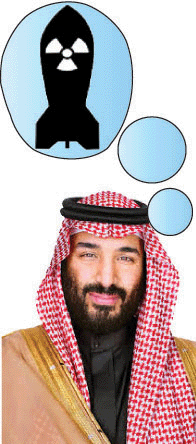
Now add Saudi’s long history of nuclear ambitions to the mix. For years, Saudi officials have warned that Saudi Arabia will not curb its nuclear ambitions if it will sense a threat to its national security, or if Iran advances in its nuclear program. Rumors were that Pakistan was obliged to provide the Saudis a ready-for-use nuclear weapon if and when the time comes. Things only got more complicated once the nuclear agreement (JCPOA) with Iran was signed in 2015, practically legitimizing Iran’s rights to maintain and develop its uranium enrichment capabilities. At the beginning of November 2018, the crown prince participated in the opening ceremony marking the launch of construction of Riyadh’s first research reactor . It’s still early days and only a symbolic act—the Saudis lack knowhow, technicians, infrastructure and academic expertise—but the country has both enough ambition and funds to advance anyway. Shortly after that the Saudi energy minister said the kingdom launches uranium exploration program.
Over the last decade, purchasing sixteen nuclear power reactors—later scaled back to two reactors—plus uranium enrichment capabilities preferably from the United States, has
featured prominently on the Saudi agenda. The official rationale is the country’s future needs to supply energy —with self-sufficient nuclear materials. While having enrichment capabilities can serve to counterbalance Iran, it may also constitute a future military nuclear program. During previous negotiations with Saudi officials, the Obama administration insisted that Saudi Arabia must comply with the “ gold standard ,” reflective of the conditions imposed on the UAE when it agreed to buy U.S. reactors in 2009. This standard requires a commitment not to enrich uranium or to produce plutonium as a strict condition for any agreement to sell nuclear reactors. According to current Secretary of State Mike Pompeo, the Trump administration has maintained this policy . In an interview with CBS in March 2018, MbS maintained that “without a doubt, if Iran developed a nuclear bomb, we would follow suit as soon as possible.”
Following the murder of Khashoggi, Senate members urged the Trump administration to curb any intention to sell nuclear reactors to the Saudi regime. This move is certainly necessary, but not nearly enough. An American refusal to his demands can push the prince to seek an alternative option elsewhere, with producers that will be all too happy to assist—for the right price.
Much of MbS’s current conduct lies parallel to previous experience with three other Middle East tyrants: former Iraqi president Saddam Hussein, Libya’s leader Muammar el-Qaddafi, and Syrian president Bashar al-Assad. These cynical dictators have a common denominator in their infinite ambitions, which ultimately led them to secretly promote a nuclear weapons program. They all relied heavily on their security systems in initiating these plans. Libya and Syria had no sufficient nuclear infrastructure, so they bought a turnkey nuclear project from Pakistan’s A.Q. Khan Network, and in the Syrian case from North Korea .
The Saudi nuclear issue has placed a challenge before the administration. If the prince is successful in surviving the current crisis, then that could prompt him to make even riskier decisions, including taking the nuclear path. Much like in Iraq, Libya and Syria, all the necessary components for that are now in place: A de facto dictator with delusions of grandeur and poor judgment, full control over the security services, unlimited funds for the purpose, a national sense of isolation, an acute threat, and a long-term nuclear vision. As Iran seems to be complying with the JCPOA, a Saudi move could instigate a nuclear arms race in the Middle East. To avoid this, the Trump administration should warn and restrict the Saudi heir. It should also keep a very close eye on Saudi Arabia’s nuclear connections and activities.
Ronen Dangoor is the former deputy head of the research and analysis division at the Israeli prime minister’s office.
For nuclear plants, that warning is particularly grave. Reactors require 720 gallons of water per megawatt-hour of electricity they produce……Solar plants, by contrast, use approximately 20 gallons per megawatt-hour, mostly for cleaning equipment
Trump Administration’s Climate Report Raises New Questions About Nuclear Energy’s Future
The thirstiest source of electricity is already struggling, and greater risk of droughts will only add to those woes. Huffington Post.By Alexander C. Kaufman, 28 Nov 18,
Call it the nuclear power industry’s thirst trap.
The United States’ aging fleet of nuclear reactors ― responsible for one-fifth of the country’s electricity and most of its low-carbon power ― has never been more necessary as policymakers scramble to shrink planet-warming emissions. Yet the plants are struggling to stay afloat, with six stations shut down in the last five years and an additional 16 reactors scheduled to close over the next decade. So far, new coal- and gas-burning facilities are replacing them.
The nuclear industry blames high maintenance costs, competition from cheaper alternatives and hostile regulators concerned about radiation disasters like the 2012 Fukushima meltdown in Japan. But the country’s most water-intensive source of electricity faces what could be an even bigger problem as climate change increases the risk of drought and taxes already crumbling water infrastructure.
That finding, highlighted in the landmark climate change report that the Trump administration released with apparent reluctance last Friday, illustrates the complex and at times paradoxical realities of anthropogenic, or human-caused, warming. It also stokes an already hot debate over the role nuclear energy should play in fighting global warming, a month after United Nations scientists warned that carbon dioxide emissions must be halved in the next 12 years to avoid cataclysmic climate change leading to at least $54 trillion in damage.
The report ― the second installment of the Fourth National Climate Assessment, a congressionally mandated update on the causes and effects of anthropogenic warming from 13 federal agencies ― devoted its entire third chapter to water contamination and depletion. Aging, deteriorating infrastructure means “water systems face considerable risk even without anticipated future climate changes,” the report states. But warming-linked droughts and drastic changes in seasonal precipitation “will add to the stress on water supplies and adversely impact water supply.”
Nearly every sector of the economy is susceptible to water system changes. And utilities are particularly at risk. In the fourth chapter, the report’s roughly 300 authors conclude, “Most U.S. power plants … rely on a steady supply of water for cooling, and operations are expected to be affected by changes in water availability and temperature increases.”
For nuclear plants, that warning is particularly grave. Reactors require 720 gallons of water per megawatt-hour of electricity they produce, according to data from the National Energy Technology Laboratory in West Virginia cited in 2012 by the magazine New Scientist. That compares with the roughly 500 gallons coal requires and 190 gallons natural gas needs to produce the same amount of electricity. Solar plants, by contrast, use approximately 20 gallons per megawatt-hour, mostly for cleaning equipment, according to the Solar Energy Industries Association, a trade group.
Nuclear plants are already vulnerable to drought. Federal regulations require plants to shut down if water in the river or lake that feeds its cooling drops below a certain level. By the end of the 2012 North American heat wave, nuclear generation fell to its lowest point in a decade, with plants operating at only 93 percent of capacity.
The availability of water is one problem, particularly for the majority of U.S. nuclear plants located far from the coasts and dependent on freshwater. Another is the temperature of the water that’s available.
Nearly half the nuclear plants in the U.S. use once-through cooling systems, meaning they draw water from a local source, cool their reactors, then discharge the warmed water into another part of the river, lake, aquifer or ocean. Environmental regulations bar plants from releasing used water back into nature above certain temperatures. In recent years, regulators in states like New York and California rejected plant operators’ requests to pull more water from local rivers, essentially mandating the installation of costly closed-loop systems that cool and reuse cooling water.
In 2012, Connecticut’s lone nuclear power plant shut down one of its two units because the seawater used to cool the plant was too warm. The heat wave that struck Europe this summer forced utilities to scale back electricity production at nuclear plants in Finland, Germany, Sweden and Switzerland. In France the utility EDF shut down four reactors in one day.
“Already they’re having trouble competing against natural gas and renewable energy,” said John Rogers, a senior energy analyst at the Union of Concerned Scientists. “Add onto that high water temperatures, high air temperatures and drought. It’s just another challenge.”
…….. the heart of the biggest question looming over the nuclear industry: Is it, given the radioactive waste it produces, clean energy?
……… For the Sierra Club, the environmental giant making a huge push to get cities and states to go all renewable, nuclear power is “a uniquely dangerous energy technology for humanity” and “no solution to climate change.”
“There’s no reason to keep throwing good money after bad on nuclear energy,” Lauren Lantry, a Sierra Club spokeswoman, said by email. “It’s clear that every dollar spent on nuclear is one less dollar spent on truly safe, affordable, and renewable energy sources like wind, solar, energy efficiency, battery storage, and smart grid technology.” https://www.huffingtonpost.com.au/entry/nuclear-energy-climate-change-report_us_5bfdb9cae4b0a46950dce58f
France to close 14 nuclear reactors by 2035 an all coal-fired power plants by 2022, The Local 28 Nov 18President Emmanuel Macron said on Tuesday that France would shut down 14 of the country’s 58 nuclear reactors currently in operation by 2035, of which between four and six will be closed by 2030.
The total includes the previously announced shutdown of France’s two oldest reactors in Fessenheim, eastern France, which Macron said was now set for summer 2020.
He also announced that France would close its remaining four coal-fired power plants by 2022 as part of the country’s anti-pollution efforts……
Macron said France would aim to triple its wind power electricity output by 2030, and increase solar energy output fivefold in that period.
He added that he would ask French electricity giant EDF to study the feasibility of more next-generation EPR nuclear reactors, but will wait until
2021 before deciding whether to proceed with construction.
Gareth Porter 28 Nov 18 The accidental revelation in mid-November that U.S. federal prosecutors had secretly filed charges against WikiLeaks founder Julian Assange underlines the determination of the Trump administration to end Assange’s asylum in the Ecuadorian Embassy in London, where he has been staying since 2012.
Behind the revelation of those secret charges for supposedly threatening U.S. national security is a murky story of a political ploy by the Ecuadorian and British governments to create a phony rationale for ousting Assange from the embassy. The two regimes agreed to base their plan on the claim that Assange was conspiring to flee to Russia. Continue reading →
Sellafield: Europe’s most radioactively contaminated site
Inside Sellafield’s death zone with the nuclear clean-up robots,By Theo Leggett, Business correspondent, BBC News, 27 November 2018
The Thorp nuclear reprocessing plant at Sellafield, Cumbria, has recycled its final batch of reactor fuel. But it leaves behind a hugely toxic legacy for future generations to deal with. So how will it be made safe?
Thorp still looks almost new; a giant structure of cavernous halls, deep blue-tinged cooling ponds and giant lifting cranes, imposing in fresh yellow paint.
But now the complex process of decontaminating and dismantling begins.
It is a dangerous job that will take decades to complete and require a great deal of engineering ingenuity and state-of-the-art technology – some of which hasn’t even been invented yet.
This is why.
Five sieverts of radiation is considered a lethal dose for humans. Inside the Head End Shear Cave, where nuclear fuel rods were extracted from their casings and cut into pieces before being dissolved in heated nitric acid, the radiation level is 280 sieverts per hour.
We can only peer through leaded glass more than a metre thick at the inside of the steel-lined cell, which gleams under eerie, yellow-tinged lighting.
This is a place only robots can go.
They will begin the first stage of decommissioning – the post-operative clean-out – removing machinery and debris……….. Cleaning up other parts of the plant will also need robots and remotely operated vehicles (ROVs).
Some will need to be developed from scratch, while others can be adapted from systems already used in other industries, such as oil and gas, car manufacturing and even the space sector……..
The site in Cumbria contains a number of other redundant facilities, some dating back to the 1950s and many of them heavily contaminated, which are currently being decommissioned………
Remote submarines have explored and begun cleaning up old storage ponds. Other remote machines are being used to take cameras deep inside decaying bunkers, filled with radioactive debris.
The job of developing machines like these is shared with a large network of specialist companies, many of them based in Cumbria itself. They form part of a growing decommissioning industry within the UK, as the country grapples with the legacy of its first era of nuclear power.
The NDA believes that these companies can use what they learn at Sellafield, and other plants, to attract further business from overseas……..https://www.bbc.com/news/business-46301596
Why Saudi Arabia Will Acquire Nuclear WeaponsIf the Trump administration continues to turn its nuclear negotiations into a boondoggle, then nothing will prevent Riyadh from building bombs.,National Interest by Paul R. Pillar, 28 Nov 18
The Trump administration’s handling of nuclear negotiations with Saudi Arabia promises to lay bare some realities about security issues and nuclear programs in that part of the world that the administration has refused to acknowledge. A front-page article by David Sanger and William Broad in the New York Timesreviews some of the still-unresolved questions. The Saudi regime insists on producing its own nuclear fuel, which would be different from terms the United States has negotiated with some other states, including the United Arab Emirates, that have sought U.S. assistance in developing their nuclear programs. The Saudis have balked at comprehensive international inspections to detect any work on nuclear weapons. And Saudi Arabia’s Crown Prince Mohammed bin Salman (MbS) has explicitly threatened to develop nuclear weapons, ostensibly in response to any similar development by Iran.
A useful model for approaching this situation involves Iran. The model is the Joint Comprehensive Plan of Action (JCPOA), the multilateral accord commonly known as the Iranian nuclear deal, which Donald Trump has castigated and on which his administration has reneged by imposing new economic sanctions despite continued Iranian compliance with the JCPOA. The JCPOA closed all possible pathways to development of an Iranian nuclear weapon through stringent restrictions on enrichment of uranium, the gutting of reactors that otherwise might be used to produce plutonium, and the prohibition of any reprocessing by Iran of nuclear fuel. The agreement also established a thorough inspection system that involves not only routine monitoring of nuclear facilities but also the ability of international inspectors to inspect any other sites they may have reason to suspect are housing nuclear-related activity, with the other parties to the agreement being able to outvote Iran in the event of disagreement about the relevance of a requested inspection. This is the kind of highly intrusive inspection arrangement that the Saudis reportedly are refusing to apply to themselves.
The principal U.S. negotiator has been Secretary of Energy Rick Perry, for whom this is a learning-on-the-job experience. Perry was initially unaware of the Department of Energy’s nuclear responsibilities and believed his job would consist of promoting the oil industry. (This contrasts with Perry’s predecessor, Ernest Moniz, a nuclear physicist who played a key role in negotiation of the highly detailed JCPOA.)………
Amid all the talk among opponents of the JCPOA about ballistic missiles, it is worth noting that Saudi Arabia has been ahead of its regional neighbors on that count as well. Two decades ago, Saudi Arabia secretly purchased medium-range missiles from China that, although reportedly configured to carry conventional weapons, were of a type originally designed to deliver a nuclear warhead. The Saudis in more recent years have modernized their missile force, again relying on China as the supplier.
Destabilizing regional activity also implies that Saudi Arabia is more of a worry than most states regarding the implications of possible acquisition of nuclear weapons. Saudi Arabia has bombed Yemen into becoming a humanitarian catastrophe, has kidnapped and attempted to coerce into resignation the prime minister of Lebanon, and has used diplomatic facilities in foreign countries to assassinate nonviolent dissidents. The impetuous young prince behind these policies has been moving toward one-man rule, shedding even the restraints of what had been a collective family autocracy.
The murder of Jamal Khashoggi has drawn some recent and welcome attention to this pattern of behavior, although it has not budged Donald Trump from his stance of sticking with MbS no matter what he does. California Rep. Brad Sherman has appropriately observed, “A country that can’t be trusted with a bone saw shouldn’t be trusted with nuclear weapons.”
The administration’s assault on the JCPOA may provide the trigger for Saudi Arabia to try to obtain such weapons. If the U.S. “maximum pressure” campaign succeeds in negating completely the economic relief Iran was supposed to have received under the JCPOA, then Iranian leaders may yet throw up their hands in disgust and pronounce the agreement null and void. This would release Iran from all its nuclear restrictions under the agreement, which in turn might provide the perfect rationale for Riyadh, especially as long as MbS is in charge, to acquire the bomb.
Tell Congress: Prevent Nuclear Catastrophe in Iran
Read the Public Inquiry Report, the Commissioners’ report, Surrendering Australia: The AUKUS Deception is available to download for free at aukuspublicinquiry.com. Or just watch the replay of the National Press Club Luncheon.