New UK-France Nuclear Steering Group Meets to Advance Cooperation Under Northwood Declaration
Statement by the United Kingdom and the French Republic on Nuclear Policy and Cooperation.
From: Cabinet Office, 18 December 2025, https://www.gov.uk/government/news/new-uk-france-nuclear-steering-group-meets-to-advance-cooperation-under-northwood-declaration
At the UK-France Summit in July 2025, Prime Minister Keir Starmer and President Emmanuel Macron affirmed their commitment to strengthening the UK-France nuclear relationship. They signed the Northwood Declaration, which established the UK-France Nuclear Steering Group in order to provide political direction and coordinate bilateral work across nuclear policy, capability and operations.
On 10 December, the Nuclear Steering Group met for the first time in Paris, jointly chaired by senior officials from the UK Cabinet Office and the Presidency of the French Republic.
They were accompanied by senior military personnel and officials from defence and foreign ministries to discuss Euro-Atlantic security issues and coordination of their respective independent deterrents. They discussed their approach to strengthening deterrence in Europe and confirmed their ambition for bilateral co-operation on nuclear deterrence.
They also observed Operation POKER which was the first time foreign officials were given access to this demonstration of France’s strategic nuclear airborne component.
‘Unquestionably an Act of War’: Trump Declares Naval Blockade Against Venezuela
“This is the Iraq War 2.0 with a South American flavor to it,” warned one Democratic senator

Jake Johnson, Common Dreams, Dec 17, 2025
US President Donald Trump late Tuesday declared a blockade on “all sanctioned oil tankers” approaching and leaving Venezuela, a major escalation in what’s widely seen as an accelerating march to war with the South American country.
The “total and complete blockade,” Trump wrote on his social media platform, will only be lifted when Venezuela returns to the US “all of the Oil, Land, and other Assets that they previously stole from us.”
US President Donald Trump late Tuesday declared a blockade on “all sanctioned oil tankers” approaching and leaving Venezuela, a major escalation in what’s widely seen as an accelerating march to war with the South American country.
The “total and complete blockade,” Trump wrote on his social media platform, will only be lifted when Venezuela returns to the US “all of the Oil, Land, and other Assets that they previously stole from us.”
“Venezuela is completely surrounded by the largest Armada ever assembled in the History of South America,” Trump wrote, referring to the massive US military buildup in the Caribbean. “It will only get bigger, and the shock to them will be like nothing they have ever seen before.”
The government of Venezuelan President Nicolás Maduro, which has mobilized its military in response to the US president’s warmongering, denounced Trump’s comments as a “grotesque threat” aimed at “stealing the riches that belong to our homeland.”
The US-based anti-war group CodePink said in a statement that “Trump’s assertion that Venezuela must ‘return’ oil, land, and other assets to the United States exposes the true objective” of his military campaign.
“Venezuela did not steal anything from the United States. What Trump describes as ‘theft’ is Venezuela’s lawful assertion of sovereignty over its own natural resources and its refusal to allow US corporations to control its economy,” said CodePink. “A blockade, a terrorist designation, and a military buildup are steps toward war. Congress must act immediately to stop this escalation, and the international community must reject this lawless threat.”
The announced naval blockade—an act of aggression under international law—came a week after the Trump administration seized an oil tanker off the coast of Venezuela and made clear that it intends to intercept more.
US Rep. Joaquin Castro (D-Texas), one of the leaders of a war powers resolution aimed at preventing the Trump administration from launching a war on Venezuela without congressional approval, said Tuesday that “a naval blockade is unquestionably an act of war.”
“A war that the Congress never authorized and the American people do not want,” Castro added, noting that a vote on his resolution is set for Thursday. “Every member of the House of Representatives will have the opportunity to decide if they support sending Americans into yet another regime change war.”………………………………………….https://www.commondreams.org/news/unquestionably-an-act-of-war-trump-declares-naval-blockade-against-venezuela
Zaporizhzhia nuclear plant running on single power line, Russia says.

By Reuters, December 17, 2025, https://www.reuters.com/business/energy/zaporizhzhia-nuclear-plant-running-single-power-line-russia-says-2025-12-16/
MOSCOW, Dec 16 (Reuters) – The Russian-controlled Zaporizhzhia nuclear power plant in Ukraine is currently receiving electricity through only one of two external power lines, its Russian management said on Tuesday.
The other line was disconnected due to military activity, the management said, adding that radiation levels remain normal. Repair work will begin as soon as possible.
The nuclear plant, Europe’s largest, has been under Russian control since March 2022, when Russian forces overran much of southeastern Ukraine. It is not currently producing electricity but relies on external power to keep the nuclear material cool and avoid a meltdown.
Each side has regularly accused the other of shelling the facility. It experienced a couple of complete power outages earlier this month but was subsequently reconnected.
In September and October the plant was without external power for 30 days, relying on backup diesel generators, until a damaged line was reconnected during a local ceasefire arranged with the help of the U.N. nuclear agency.
Reporting by Reuters Writing by Maxim Rodionov Editing by Mark Trevelyan
Scottish National Party says UK nuclear deterrent is ‘America-first’.

By Tom Dunlop, UK Defence Journal, December 17, 2025
A disagreement over defence innovation and reliance on US technology surfaced in the House of Commons during Defence questions.
SNP MP Dave Doogan argued that what he described as an “America-first posture” is harming UK defence innovation, particularly in relation to the nuclear deterrent. He said the system relies heavily on US technology, citing components including “fusing, firing, arming, neutron initiators, the gas transfer system and the Mark 4 aeroshell.” Doogan also criticised plans to buy additional F-35 aircraft for what he characterised as “US-manufactured gravity-delivered nuclear weapons.”
He questioned why the government appeared aligned with US priorities while, in his view, overlooking European initiatives. “President Trump will put America first, but it is difficult to understand why this Labour Government seem keen to do the same, while spurning the innovation opportunity of the £130 billion SAFE programme in the EU,” Doogan told the House……………https://ukdefencejournal.org.uk/snp-says-uk-nuclear-deterrent-is-america-first/
–
Council battling illegal work near nuclear site.
Niki Hinman, Local Democracy Reporting Service, 17 Dec 25, https://www.bbc.com/news/articles/c4g583jlpl3o
A council continues to gather evidence to prosecute those responsible for an illegal development near a nuclear weapons site.
Work has been carried out on land opposite the Atomic Weapons Establishment’s (AWE) Aldermaston campus despite a temporary stop notice, West Berkshire Council said.
Hundreds of people have signed an online petition that states the work has left others feeling “unsafe, anxious and unprotected”, according to the Local Democracy Reporting Service.
The authority said the applicant has not submitted additional information to make it a valid application and so it is not being considered.
Neither the council nor the police have legal powers to remove individuals or items from the land and the council says the relevant civil legal processes must be followed to enable this.
“The temporary stop notice remains in force,” a council spokesperson said.
“Any activity that breaches it is a criminal offence, and officers are continuing to gather evidence to support potential prosecution.”
CLEAN? -WHAT A LIE! NIA welcomes first-ever nuclear appointment to Government’s Clean? Power Advisory Commission.
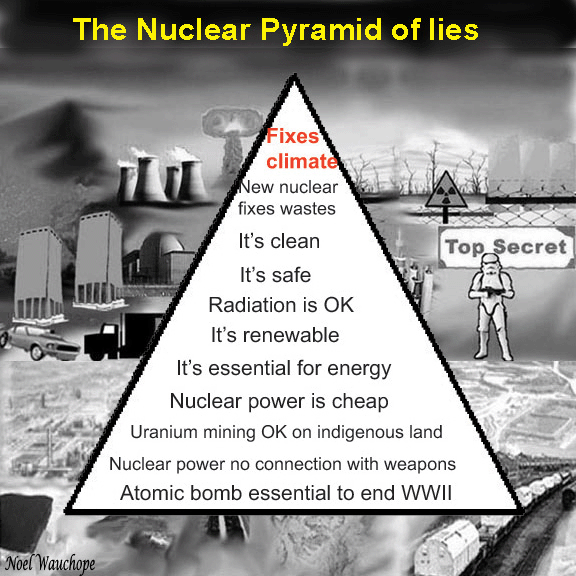
Sizewell C’s Julia Pyke brings expertise in delivering major infrastructure projects and effective community engagement
The Nuclear Industry Association has welcomed the appointment of Julia Pyke, Co-Managing Director of Sizewell C, as one of the UK Government’s eight new Clean Power 2030 Advisory Commissioners – marking the first time somebody with significant nuclear experience has been appointed to the Commission.
The appointment recognises the vital role nuclear power plays in delivering secure, reliable and low-carbon electricity, and ensures nuclear expertise is at the heart of advice shaping the UK’s clean power future.
Tom Greatrex, Chief Executive of the Nuclear Industry Association, said:
“Julia Pyke’s appointment is a hugely positive step and a clear recognition that nuclear must be central to delivering the UK’s clean power mission. The fact that this is the first time a nuclear leader has been appointed to the Commission ensures that decisions on the UK’s energy future are informed by the realities of building and operating clean, reliable power at scale.”
The first Zionist targeted assassination – 1924
Eli Ku, Aug 25, 2025, https://lenabloch.medium.com/the-first-zionist-targeted-assassination-was-of-the-orthodox-jewish-peace-negotiator-jaacob-israel-de5b0eb7844b
The first Zionist targeted assassination was of the Orthodox Jewish peace negotiator, Jaacob Israel De Haan, in 1924. Jewish terrorists unleashed a brutal terror campaign on Palestinians and the British, with bombings, assassinations, pogroms of Arab businesses and villages, destruction of civilian places of commonality, sabotaging railroads.
“By the time the Balfour Declaration was finalised, thirty-plus years of Zionist settlement had made clear that the Zionists intended to ethnically cleanse the land for a settler state based on racial superiority; and it was the behind-the-scenes demands of the principal Zionist leaders, notably Chaim Weizmann and Baron Rothschild.
First-hand accounts of Zionist settlement in Palestine had already painted a picture of violent racial displacement. I will cite one of the lesser known reports, by Dr. Paul Nathan, a prominent Jewish leader in Berlin, who went to Palestine on behalf of the German Jewish National Relief Association. He was so horrified by what he found that he published a pamphlet in January, 1914, in which he described the Zionist settlers as carrying on
“a campaign of terror modelled almost on Russian pogrom models [against settlers refusing to adopt Hebrew].”
A few years later, the Balfour Declaration’s deliberately ambiguous wording was being finalized. Sceptics—and the British Cabinet—were assured that it did not mean a Zionist state. Yet simultaneously, Weizmann was pushing to create that very state immediately. He demanded that his state extend all the way to the Jordan River within three or four years of the Declaration—that is, by 1921—and then expand beyond it.
In their behind-the-scenes meetings, Weizmann and Rothschild treated the ethnic cleansing of non-Jewish Palestinians as indispensable to their plans, and they repeatedly complained to the British that the settlers were not being treated preferentially enough over the Palestinians. And they insisted that the British must lie about the scheme until it is too late for anyone to do anything about it.
In correspondence with Balfour, Weizmann justified his lies by slandering the Palestinians and Jews—that is, the Middle East’s indigenous Jews, who were overwhelmingly opposed to Zionism and whom Weizmann smeared with classic anti-Semitic stereotypes. The Palestinians he dismissed as, in so many words, a lower type of human, and this was among the reasons he and other Zionist leaders used for refusing democracy in Palestine—if the “Arabs” had the vote, he said, it would lower the Jew down to the level of a “native”.
With the establishment of the British Mandate, four decades of peaceful Palestinian resistance had proved futile, and armed Palestinian resistance—which included terrorism—began. Zionist terror became the domain of formal organizations that attacked anyone in the way of its messianic goals—Palestinian, Jew, or British. These terror organizations operated from within the Zionist settlements and were actively empowered and shielded by the settlements and the Jewish Agency, the recognized semi-autonomous government of the Zionist settlements, what would become the Israeli government.
There was no substantive difference between the acknowledged terror organizations—most famously, the Irgun, and Lehi, the so-called Stern Gang—and the Jewish Agency, and its terror gang, the Hagana. The Agency cooperated, collaborated, and even helped finance the Irgun.
The relationship between the Jewish Agency, and the Irgun and Lehi, was symbiotic. The Irgun in particular would act on behalf of the Hagana so that the Jewish Agency could feign innocence. The Agency would then tell the British that they condemn the terror, while steadfastly refusing any cooperation against it, indeed doing what they could to shield it.
The fascist nature of the Zionist enterprise was apparent both to US and British intelligence. The Jewish Agency tolerated no dissent and sought to dictate the fates of all Jews. Children were radicalised as part of the methodology of all three major organizations, and by extension, the Jewish Agency.”
Thomas Suarez, London House of Lords, December 2016.
Chris Hedges: Rebranding Genocide

The newest form of genocidal celebration in Israel — where social media and news channels routinely chortle over the suffering of Palestinians — is the sprouting of golden nooses on the lapels of members of the far-right political party Otzma Yehudit, Israel’s version of the Ku Klux Klan, including one worn by National Security Minister Itamar Ben-Gvir.
December 16, 2025 By Chris Hedges , https://scheerpost.com/2025/12/16/chris-hedges-rebranding-genocide/
First, it was Israel’s right to defend itself. Then it was a war, even though, by Israel’s own military intelligence database, 83 percent of the casualties were civilians. The 2.3 million Palestinians in Gaza, living under an Israeli air, land and sea blockade, have no army, air force, no mechanized units, no tanks, no navy, no missiles, no heavy artillery, no fleets of killer drones, no sophisticated tracking systems to map all movements, or an ally like the United States, which has given Israel at least $21.7 billion in military aid since Oct. 7, 2023.
Now, it is a “ceasefire.” Except of course, as usual, Israel only abided by the first of the 20 stipulations. It freed around 2,000 Palestinian captives held in Israeli prisons — 1700 of whom were detained after Oct. 7 — as well as around 300 bodies of Palestinians, in exchange for the return of the 20 remaining Israeli captives.
Israel has violated every other condition. It has tossed the agreement — brokered by the Trump administration without Palestinian participation — into the bonfire with all the other agreements and peace accords concerning Palestinians. Israel’s extensive and blatant flouting of international agreements and international law — Israel and its allies refuse to abide by three sets of legally binding orders by the International Cout of Justice (ICJ) and two ICJ advisory opinions, as well as the Genocide Convention and international humanitarian law — presage a world where the law is whatever the most militarily advanced countries say it is.
The sham peace plan — “President Donald J. Trump’s Comprehensive Plan to End the Gaza Conflict” — in an act of stunning betrayal of the Palestinian people, was endorsed by most of the U.N. Security Council in November, with China and Russia abstaining. Member states washed their hands of Gaza and turned their backs on the genocide.
The adoption of resolution 2803 (2025), as the Middle East scholar Norman Finkelstein writes, “was simultaneously a revelation of moral insolvency and a declaration of war against Gaza. By proclaiming international law null and void, the Security Council proclaimed itself null and void. Vis-à-vis Gaza, the Council transmuted into a criminal conspiracy.”
The next phase is supposed to see Hamas surrender its weapons and Israel withdraw from Gaza. But these two steps will never happen. Hamas — along with other Palestinian factions — reject the Security Council resolution. They say they will disarm only when the occupation ends and a Palestinian state is created. Prime Minister Benjamin Netanyahu has vowed that if Hamas does not disarm, it will be done “the hard way.”
The “Board of Peace,” headed by Trump, will ostensibly govern Gaza along with armed mercenaries from the Israel-allied International Stabilization Force, although no country seems anxious to commit their troops. Trump promises a Gaza Riviera that will function as a “special economic zone” — a territory operating outside of state law governed entirely by private investors, such as the Peter Thiel-backed charter city in Honduras. This will be achieved through the “voluntary” relocation of Palestinians — with those fortunate enough to own land offered digital tokens in exchange. Trump declares that the U.S. “will take over the Gaza Strip” and “own it.” It is a return to the rule of viceroys — though apparently not the odious Tony Blair. Palestinians, in one of the most laughable points in the plan, will be “deradicalized” by their new colonial masters.
But these fantasies will never come to fruition. Israel knows what it wants to do in Gaza and it knows no nation will intercede. Palestinians will struggle to survive in primitive and dehumanizing conditions. They will, as they have so many times in the past, be betrayed.
Israel has committed 738 violations of the ceasefire agreement between Oct. 10 and Dec. 12, including 358 land and air bombardments, the killing of at least 383 Palestinians and the injuring of 1,002 others, according to the Government Media Office in Gaza and the Palestinian Health Ministry. That’s an average of six Palestinians killed daily in Gaza — down from an average of 250 a day before the “ceasefire.” Israel said it killed a senior Hamas commander, Raed Saad, on Saturday, in a missile strike on a car on Gaza’s coastal road. Three others were also apparently killed in the strike.
The genocide is not over. Yes, the pace has slowed. But the intent remains unchanged. It is slow motion killing. The daily numbers of dead and wounded — with increasing numbers falling sick and dying from the cold and rain — are not in the hundreds but the dozens.
December saw an average of 140 aid trucks allowed into Gaza each day — instead of the promised 600 — to keep Palestinians on the edge of famine and ensure widespread malnutrition. In October, some 9,300 children in Gaza under five were diagnosed with severe acute malnutrition, according to UNICEF. Israel has opened the border crossing into Egypt at Rafah, but only for Palestinians leaving Gaza. It is not open for those who want to return to Gaza, as stipulated in the agreement. Israel has seized some 58 percent of Gaza and is steadily moving its demarcation line — known as “the yellow line” — to expand its occupation. Palestinians who cross this arbitrary line — which constantly shifts and is poorly marked when it is marked at all — are shot dead or blown up — even if they are children.
Palestinians are being crammed into a shrinking, fetid, overcrowded concentration camp until they can be deported. Ninety-two percent of Gaza’s residential buildings have been damaged or destroyed and around 81 percent of all structures are damaged, according to UN estimates. The Strip, only 25 miles long and seven-and-a-half miles wide, has been reduced to 61 million tons of rubble, including nine million tons of hazardous waste that includes asbestos, industrial waste, and heavy metals, in addition to unexploded ordnance and an estimated 10,000 decaying corpses. There is almost no clean water, electricity or sewage treatment. Israel blocks shipments of construction supplies, including cement and steel, shelter materials, water infrastructure and fuel, so nothing can be rebuilt.
Eighty-two percent of Israeli Jews support the ethnic cleansing of the entire population of Gaza and 47 percent support killing all civilians in cities captured by the Israeli military. Fifty-nine percent support doing the same to Palestinian citizens of Israel. Seventy-nine percent of Israeli Jews say they are “not so troubled” or “not troubled at all” by reports of famine and suffering among the population in Gaza, according to a survey conducted in July. The words “Erase Gaza” appeared more than 18,000 times in Hebrew-language Facebook posts in 2024 alone, according to a new report on hate speech and incitement against Palestinians.
The newest form of genocidal celebration in Israel — where social media and news channels routinely chortle over the suffering of Palestinians — is the sprouting of golden nooses on the lapels of members of the far-right political party Otzma Yehudit, Israel’s version of the Ku Klux Klan, including one worn by National Security Minister Itamar Ben-Gvir.
They are pushing a bill through the Knesset which seeks to mandate the death penalty for Palestinians who “intentionally or indifferently causes the death of an Israeli citizen,” if they are said to be motivated by “racism or hostility toward a public,” and with the purpose of harming the Israeli state or “the rebirth of the Jewish people in its land,” the Israeli human rights group Adalah explains. More than 100 Palestinians have been killed in Israeli jails since Oct. 7. If the new bill becomes law — it has been cleared through its first reading — it will join the wave of more than 30 anti-Palestinian laws enacted since October 7.
The message the genocide sends to the rest of the world, more than a billion of whom live on less than a dollar a day, is unequivocable: We have everything and if you try and take it away from us, we will kill you.
This is the new world order. It will look like Gaza. Concentration camps. Starvation. Obliteration of infrastructure and civil society. Mass killing. Wholesale surveillance. Executions. Torture, including the beatings, electrocutions, waterboarding, rape, public humiliation, deprivation of food and denial of medical care routinely used on Palestinians in Israeli prisons. Epidemics. Disease. Mass graves where corpses are bulldozed into unmarked pits and where bodies, as in Gaza, are dug up and torn apart by packs of ravenous wild dogs.
We are not destined for the Shangri-La sold to a gullible public by fatuous academics such as Stephen Pinker. We are destined for extinction. Not only individual extinction — which our consumer society furiously attempts to hide by peddling the fantasy of eternal youth — but wholesale extinction as temperatures rise to make the globe uninhabitable. If you think the human species will respond rationally to the ecocide, you are woefully out of touch with human nature. You need to study Gaza. And history.
If you live in the Global North, you will get to peer out at the horror, but slowly this horror, as the climate breaks down, will migrate home, turning most of us into Palestinians. Given our complicity in the genocide, it is what we deserve.
Empires, when they feel threatened, always embrace the instrument of genocide. Ask the victims of the Spanish conquistadors. Ask Native Americans. Ask the Herero and Nama. Ask the Armenians. Ask the survivors of Hiroshima or Nagasaki. Ask the Indians who survived the Bengal famine or the Kikuyu who rose against their British colonizers in Kenya. Climate refugees will get their turn.
This is not the end of the nightmare. It is the beginning.
The Ukrainian negotiations are dragging on

on December 10, the unelected president, Volodymyr Zelensky, convened a videoconference with Scott Bessent, Jared Kushner (not as a negotiator in Moscow, but as a director of the Affinity Partners fund), and Larry Fink (a director of the BlackRock fund and already the owner of a large portion of the farmland) [ 6 ] . The purpose was clearly to assess what could be purchased in exchange for the rare earths. What was unthinkable ten months ago suddenly became possible.
Thierry Meyssan, voltairenet.org, Tue, 16 Dec 2025, https://www.sott.net/article/503525-The-Ukrainian-negotiations-are-dragging-on
Peace negotiations in Ukraine are hampered by the Zelensky administration’s resistance. The administration is attempting to buy time,first through legal means, then military action, and finally, political maneuvering. However, the contacts made suggest what this peace will look like.
Peace negotiations between Ukraine and Russia are dragging on. Clearly, the Russian side, confident of victory, intends to liberate what remains of the Donbas as soon as possible, while the Ukrainian side refuses to concede anything.
Europeans from the EU and the UK are holding numerous meetings, almost one a day, with the sole obsession of continuing the war, with or without the United States.
Two new events have changed the game:Washington is considering leaving NATO and the Ukrainians are accepting the idea of selling their country.
Washington and NATO
On December 1st, a secret videoconference was held with the participation of the French (Emmanuel Macron) and Finnish (Alexander Stubb) presidents, the German Chancellor (Friedrich Merz), the Polish (Donald Tusk), Italian (Giorgia Meloni), Danish (Mette Frederiksen) and Norwegian (Jonas Gahr Støre) prime ministers, the NATO Secretary General (Mark Rutte), the President of the European Commission (Ursula von der Leyen) and the President of the European Council (António Costa).
According to Der Spiegel, which obtained access to the meeting’s minutes, the NATO Secretary General stated that he agreed with the Finnish President and that Europeans should be wary of the peace agreement in Ukraine that President Donald Trump’s special envoys, Steve Witkoff and Jared Kushner, were negotiating [ 1 ] .
This is the first time a sitting NATO Secretary General has dared to openly criticize a sitting US President.
The National Security Strategy, published on December 4th by the White House, mentions NATO five times.However, it is no longer a crucial alliance for the United States, given that President Trump has signaled the end of the “American Empire.” Washington is too preoccupied with its $33 trillion debt to dedicate itself to the defense of Western Europe. The document therefore merely notes that the member states of the Atlantic Alliance will have to ensure their own security by allocating 5% of their gross domestic product (GDP) to it — a far cry from their current level of spending. It also notes that the alliance is not expected to expand further [ 2 ] .
On December 9, five days later, a Republican representative, Thomas Massie (Kentucky), introduced a bill (HR 6508) aimed at withdrawing the United States from NATO. This bill was sent to the Foreign Affairs Committee on December 12 [ 3 ] . This was the first time this issue would be addressed in Congress.
It is too early to conclude anything, but we must already note that there is a current opposed to the Atlantic alliance within the Trump supporters and that European states are awarethat they will not be able to ensure both their own national defense and attack the Russian Federation.
Privately, President Trump’s aides say he will withdraw from the alliance by mid-2027;a deadline that could be brought forward.
The leaders of the European Union are well aware of this.
Continue readingEurope is about to commit financial self-immolation: Its leaders know it
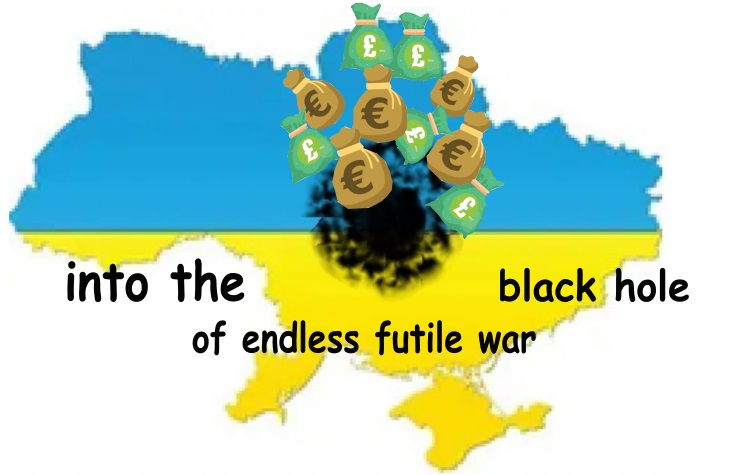
The people who will pay for this are not sitting in Commission buildings, they are the ones whose pensions, currencies, and living standards are being quietly offered up to preserve a collapsing illusion of power
Gerry Nolan, Ron Paul Institute for Political Economy, 15 Dec 2025, https://www.sott.net/article/503527-Europe-is-about-to-commit-financial-self-immolation-Its-leaders-know-it
Italy’s decision to stand with Belgium against the confiscation of Russian sovereign assets is not a diplomatic footnote. It is a moment of clarity breaking through the fog of performative morality that has engulfed Brussels.
Strip away the slogans and the truth is unavoidable: the seizure of Russian sovereign reserves will not change the course of the war in Ukraine by a single inch.
This is not about funding Ukraine, it is about whether sovereign property still exists in a Western financial system that has quietly replaced law with cult-like obedience.
That is why panic has entered the room.
The European Commission wants to pretend this is a clever workaround, a one-off, an emergency measure wrapped in legal contortions and moral posturing masquerading as hysteria. But finance does not function on intentions, rage, or narratives. It functions on precedent, trust, and enforceability. And once that trust is broken, it does not return.
The modern global financial system rests on a single, unglamorous principle, that State assets held in foreign jurisdictions are legally immune from political confiscation.
That principle underwrites reserve currencies, correspondent banking, sovereign debt markets, and cross-border investment. It is why central banks like Russia’s (once) accepted euros instead of bullion shipped under armed guard. It is why settlement systems like Euroclear exist at all.
Once that rule is broken, capital does not debate. It reprices risk instantly and it leaves.
Confiscation sends a message to every country outside the Western political orbit: your savings are safe only as long as you remain politically compliant.
That is not a rules-based order. It is a selectively enforced order whose rules change the moment compliance ends. What we have is a compliance cartel, enforcing law upward and punishment downward, depending on who obeys and who resists.
Belgium’s fear is not legalistic. It is actuarial. Hosting Euroclear means hosting systemic risk. If Russia or any future target successfully challenges the seizure, Belgium could be exposed to claims that dwarf the sums being discussed. Belgium is therefore right to be skeptical of Europe’s promise to underwrite such colossal risk, given the bloc’s now shattered credibility. No serious financial actor would treat such guarantees as reliable.
Italy’s hesitation is not ideological. It is mathematical. With one of Europe’s heaviest debt burdens, Rome understands what happens when markets begin questioning the neutrality of reserve currencies and custodians.
Neither country suddenly developed sympathy for Moscow. They simply did the arithmetic before the slogans.
Paris and London, meanwhile, thunder publicly while quietly insulating their own commercial banks’ exposure to Russian sovereign assets, exposure measured not in rhetoric, but in tens of billions. French financial institutions alone hold an estimated €15-20 billion, while UK-linked banks and custodial structures account for roughly £20-25 billion, much of it routed through London’s clearing and custody ecosystem rather than sitting on government balance sheets.
This hypocrisy and cowardice are not accidental. Paris and London sit at the heart of global custodial banking, derivatives clearing, and FX settlement, nodes embedded deep within the plumbing of global finance. Retaliatory seizures or accelerated capital flight would not be symbolic for them; they would be catastrophic.
So the burden is shifted outward. Smaller states are expected to absorb systemic risk while core financial centers preserve deniability, play a double game, and posture as virtuous.
This is anything but European solidarity. It is class defense at the international level.
The increasingly shrill insistence from the Eurocrats that the assets must be seized betrays something far more revealing than hysteria or resolve: the unmasking of a project sustained by delusion and Russophobic dogma, in which moral certainty did not arise from conviction, but functioned as a mechanism for managing cognitive dissonance, a means of avoiding realities that any serious strategy would already have been forced to confront.
Continue readingTrump Declares Fentanyl a Weapon of Mass Destruction as His ‘Lawless Killing Spree’ Escalates
One expert said the Trump White House is “replaying the Bush administration’s greatest hits as farce.”
Jake Johnson, Dec 16, 2025, https://www.commondreams.org/news/trump-weapon-of-mass-destruction
US President Donald Trump on Monday signed an executive order designating fentanyl a “weapon of mass destruction,” a move that came hours before his administration carried out another flurry of deadly strikes on vessels in the eastern Pacific accused—without evidence—of drug trafficking.
Trump’s order instructs the Pentagon and other US agencies to “take appropriate action” to “eliminate the threat of illicit fentanyl and its core precursor chemicals to the United States.” The order also warns of “the potential for fentanyl to be weaponized for concentrated, large-scale terror attacks by organized adversaries.”
Brian Finucane, a senior adviser with the US Program at the International Crisis Group, said in response to the executive action that Trump is “replaying the Bush administration’s greatest hits as farce,” referencing the lead-up to the Iraq War. Trump has repeatedly threatened military attacks on Venezuela, Colombia, and Mexico, citing fentanyl trafficking as the pretext.
Ahead of the official signing of the fentanyl order, an anonymous State Department official suggested to the independent outlet The Handbasket that the directive’s “purpose is a combination of designating fentanyl cartels as terrorist organizations and creating justification for conducting military operations in Mexico and Canada.”
The official also suspected “that it will be used domestically as justification for rounding up homeless encampments and deporting drug users who are not citizens,” reported The Handbasket’s Marisa Kabas.
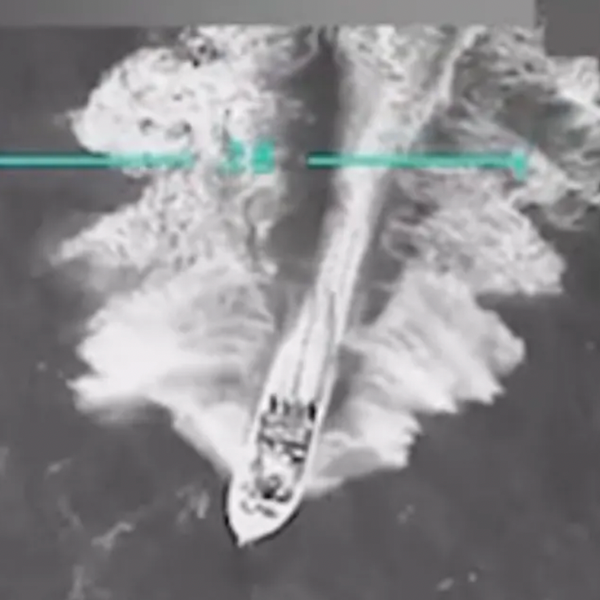
Hours after Trump formally announced the order, the US Southern Command said it carried out strikes on three boats in the eastern Pacific, killing at least eight people.
“The lawless killing spree continues,” Finucane wrote late Monday. “The administration justifies this slaughter by claiming there’s an armed conflict. But it won’t even tell the US public who the supposed enemies are. Of course, there’s no armed conflict. And outside armed conflict, we call premeditated killing murder.”
Kenneth Roth, former executive director of Human Rights Watch, argued that “Trump’s classification of fentanyl as a ‘weapon of mass destruction’ will do nothing to salvage the blatant illegality of his summary executions off the coasts of Venezuela and Colombia because fentanyl largely enters the United States from Mexico.”
US President Donald Trump on Monday signed an executive order designating fentanyl a “weapon of mass destruction,” a move that came hours before his administration carried out another flurry of deadly strikes on vessels in the eastern Pacific accused—without evidence—of drug trafficking.
Trump’s order instructs the Pentagon and other US agencies to “take appropriate action” to “eliminate the threat of illicit fentanyl and its core precursor chemicals to the United States.” The order also warns of “the potential for fentanyl to be weaponized for concentrated, large-scale terror attacks by organized adversaries.”
RECOMMENDED…
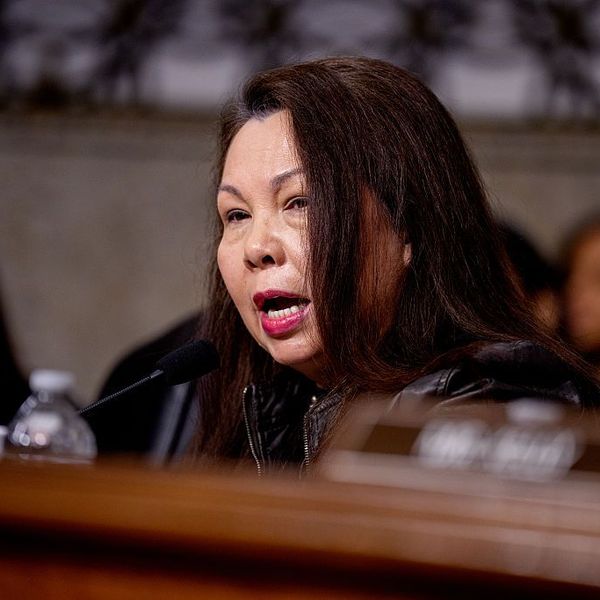
Dem Senator Raises Alarm About Trump Bringing ‘Illegal and Dangerous Misuse of Lethal Force’ to Domestic Foes
Princeton Experts Speak Out Against Trump Boat Strikes as ‘Illegal’ and Destabilizing ‘Murders’
Brian Finucane, a senior adviser with the US Program at the International Crisis Group, said in response to the executive action that Trump is “replaying the Bush administration’s greatest hits as farce,” referencing the lead-up to the Iraq War. Trump has repeatedly threatened military attacks on Venezuela, Colombia, and Mexico, citing fentanyl trafficking as the pretext.
Ahead of the official signing of the fentanyl order, an anonymous State Department official suggested to the independent outlet The Handbasket that the directive’s “purpose is a combination of designating fentanyl cartels as terrorist organizations and creating justification for conducting military operations in Mexico and Canada.”
The official also suspected “that it will be used domestically as justification for rounding up homeless encampments and deporting drug users who are not citizens,” reported The Handbasket’s Marisa Kabas.
Hours after Trump formally announced the order, the US Southern Command said it carried out strikes on three boats in the eastern Pacific, killing at least eight people.
“The lawless killing spree continues,” Finucane wrote late Monday. “The administration justifies this slaughter by claiming there’s an armed conflict. But it won’t even tell the US public who the supposed enemies are. Of course, there’s no armed conflict. And outside armed conflict, we call premeditated killing murder.”
Kenneth Roth, former executive director of Human Rights Watch, argued that “Trump’s classification of fentanyl as a ‘weapon of mass destruction’ will do nothing to salvage the blatant illegality of his summary executions off the coasts of Venezuela and Colombia because fentanyl largely enters the United States from Mexico.”
Monday’s boat bombings brought the death toll from the Trump administration’s illegal strikes in the Caribbean and eastern Pacific, which began in early September, to at least 95.
Writing for Salon last week, Drug Policy Alliance executive director Kassandra Frederique and former counternarcotics official James Saenz observed that “the US is bombing boats that have nothing to do with fentanyl or the overdose crisis devastating American communities.”
“These recent military actions have negligible impact on the transshipment of illicit drugs and absolutely no impact on the production or movement of synthetic opioids. And fentanyl, the synthetic opioid responsible for most US overdoses, is not produced in Venezuela,” they wrote. “These developments raise serious questions about the direction of US drug policy. We must ask ourselves: If these extrajudicial strikes are not stopping fentanyl, then what are the motives?”
“History should be a warning to us. In the Philippines under Rodrigo Duterte, the drug war became a tool of fear,” Frederique and Saenz added. “Thousands were killed without trial, democratic institutions were hollowed out, and civil liberties stripped away—all while drugs continued to flow into the country.”
The Lobby Is Milking the Bondi Beach Attack To Silence Critics of Israel’s Genocide
Jonathon Cook. December 16, 2025
It is years of dedicated work by the Israel lobby that has ensured the mass murder of Palestinians is viewed by governments, the media and parts of the Jewish community as entirely legitimate
I, for one, am struggling to stomach the spew of hypocrisy from pro-Israel groups like the Community Security Trust and its policy director, Dave Rich, in the wake of Sunday’s Bondi Beach attack.
Establishment media, on the other hand, appear to have a bottomless appetite for efforts by Israel apologists to exploit the genuine fear and grief of the Jewish community to advance a political agenda – one designed to silence criticism of Israel over its two-year slaughter and maiming of Palestinian children in Gaza.
Predictably, the supposedly liberal Guardian once again gave Rich a prominent slot in its comment pages, this time to spin the attack in Sydney into a demand for silencing opposition to Israel’s genocide.
Here are extracts from Rich’s piece in italics, followed by my observations. His all-too-obvious double standards and his glaring misdirection ploys should have disqualified this piece from publication. But the British media simply can’t get enough of this kind of bilge.
Rich: “The mobile phone footage of two gunmen calmly taking aim at families enjoying a Hanukah party is utterly chilling. It takes a special kind of dehumanisation, an ideology of pure hatred and self-righteous conviction, to do that.”
If Rich is so troubled by issues of dehumanisation, why has he remained so steadfastly mute about the long and utterly chilling dehumanisation of Palestinians by Israel and by its lobby groups, including his own organisation? Remember, Israeli leaders called the Palestinians “human animals”. It is decades of that kind of dehumanisation that laid the ground for Israel’s genocide. It is precisely because of such dehumanisation that the live-streamed horrors of the past two years made barely any impact on the Israeli public or on opinion among Israel’s supporters.
The truth is it is Rich and his fellow pro-Israel lobbyists who are the ones in the grip of an “ideology of pure hatred” – one that chooses to excuse the mass murder of children when they are Palestinian, blown to pieces and starved for months on end by the very state he identifies with.
Rich: “The whole basis of western liberal democracy, the belief in shared values within a diverse society, is endangered by these attacks.”
No, it’s not the Bondi Beach attack that has endangered “western liberal democracy”. That was irreversibly hollowed out when western leaders chose to actively collude in Israel’s genocide and defy the rulings of the world’s most respected legal institutions, the International Court of Justice and the International Criminal Court. Western liberal democracy was hollowed out when these leaders chose to side with Israeli prime minister Benjamin Netanyahu and prioritise his exterminationist agenda over the rule of law………………………………………………………………………………………………………………………………………….
The real emergency is a rampant anti-Palestinian racism that has utterly normalised genocide and been given institutional support across the West. It is anti-Palestinian racism, not “antisemitism”, that is the consequence of “two years of turning a blind eye, taking the easy path and ignoring the warnings”. Make no mistake: alongside the grief and the defiance, people with a conscience are angry at the two-year genocide endorsed by our governments. And they have every right to be. https://www.jonathan-cook.net/blog/2025-12-16/bondi-beach-silence-critics-israel-genocide/
The Israeli army is creating a ‘new security reality’ in the northern West Bank to advance colonization
In recent weeks, the Israeli army has launched a renewed military campaign in the northern West Bank. Palestinians say these operations aim to establish a new “security reality” to facilitate the rebuilding of Israeli settlements dismantled in 2005.
Mondoweiss, By Shatha Hanaysha December 16, 2025
On December 3, Israeli forces raided a home in the town of Qabatiya, south of Jenin, tearing down a map of Palestine hanging on the wall and confiscating another. The homeowners, a woman and her 11-year-old daughter, were detained for several hours and subjected to on-site field interrogations as Israeli troops vandalised the rest of the house before eventually withdrawing.
Noura Muhammad, the homeowner, told Mondoweiss that Israeli soldiers broke down the front door when they arrived, immediately asking her whether there was any “gold or money” in the house.
She added that after detaining her and her daughter alongside their neighbors, the soldiers interrogated the child, asking, “What do you want to be when you grow up?”
“They were attempting to get inside my daughter’s head to understand the future,” Noura told Mondoweiss, explaining that this is a common question that Israeli soldiers ask children to see whether they answer that they want to become resistance fighters. “They’re asking because they’re afraid of that future,” she explains.
In another home, a Palestinian youth with EU citizenship who spoke to Mondoweiss on the condition of anonymity said that Israeli soldiers had detained and interrogated him for hours, while telling him, “Why are you here? Leave the land of Israel.”
These are not isolated incidents. Over the past several weeks, the Israeli army has launched a renewed military campaign in the northern West Bank, first in Tubas and its neighboring villages and then extending to areas such as Jenin, where Israeli soldiers executed two young men in late November. Since then, Israeli forces have repeatedly conducted raids into cities and towns, imposed curfews, invaded homes before converting them into military outposts, forcibly displaced residents, and detained, interrogated, and arrested hundreds of young men.
But what is behind this renewed military campaign, and why is it unfolding only now? While the official Israeli narrative claims that it is “combating terrorism,” locals in Jenin and other parts of the north say it is really about establishing a new reality on the ground of total Israeli dominance. The objective: to create the necessary “security conditions” to allow the unhindered resettlement of areas of Jenin that Israel had evacuated in 2005.
Military escalation as land confiscation
Israel is attempting to create a new status quo in the West Bank as part of its objective of altering the north’s geography. It is doing so by seizing and repurposing Palestinian land to serve colonization and settler infrastructure, and the ongoing military activities in these areas are a part of that effort, locals say…………………………………………………………………………………………………………..
Israel moves to reinstate evacuated settlements
The colonization of these lands occurs through both military and semi-legal means, according to Amir Daoud, Director of Publishing and Documentation at the Colonization & Wall Resistance Commission. The first stage of the colonization process starts with the seizure of land following the issuing of a military order related to road construction, Daoud says. He explains that such orders aim to establish an Israeli military foothold over the land before eventually handing it over to settler groups, complete with a permanent infrastructure that the army would have built for ostensibly military purposes. In the second stage of this process, Daoud continues, settlement activity gradually yet systematically returns to the area under the army’s control following the passing of amendments to Israeli laws
regulating settlement construction. In the case of the Jenin area, this was achieved through the amendment (and eventual repeal) of the Disengagement Law of 2005, which led in that year to the unilateral Israeli withdrawal of all settlements from Gaza and four settlements from the northern West Bank……………………………………………………………………………………………………..
‘Functional coordination’ between settlers and the army
Daoud explains that the pattern has become clear: settlers build a road illegally, after which the army intervenes by issuing a military order that declares it a closed military zone, thereby granting the road “legal cover.” Later, it becomes a civilian settlement or is used to expand settlement infrastructure…………………..
For this strategy to be effective, there must be a degree of coordination between settlers and the military. Daoud describes this as “functional coordination,” and the way it works is that settlers first impose their presence on the ground by constructing supposedly “unauthorized” outposts, and then the army converts it into a fixed reality by converting it into a closed military zone, only to later be opened up for civilian use.
Daoud also stresses that the ongoing military operations in the north can only be understood as part of the effort to create a “new security reality” that is more conducive to settlement expansion……….
The resulting picture is one in which military and settler activities are proceeding in an integrated manner, Daoud stresses; it is all part of a single project aimed at “reshaping the geography and demography” of the northern West Bank………………………………………………….. https://mondoweiss.net/2025/12/the-israeli-army-is-creating-a-new-security-reality-in-the-northern-west-bank-to-advance-colonization/
US Relied on Illegal Sanctions to Seize Venezuelan Oil Tanker
December 15, 2025 By Marjorie Cohn, https://scheerpost.com/2025/12/15/us-relied-on-illegal-sanctions-to-seize-venezuelan-oil-tanker/
This article was originally published by Truthout
US armed forces’ seizure of the oil tanker constituted an unlawful use of force in violation of the UN Charter.
“We have just seized a tanker on the coast of Venezuela — a large tanker, very large, the largest one ever seized actually,” Donald Trump told reporters on December 10, describing the escalation of his apparently impending illegal war and regime change in Venezuela. Attorney General Pam Bondi ceremoniously released a video clip of the U.S. Marines and National Guard rappelling down from two helicopters onto the tanker.
In seizing the “Skipper,” the Trump administration relied on sanctions the U.S. had imposed on the Venezuelan oil tanker. Bondi said a seizure warrant was executed by the U.S. Coast Guard, FBI, Pentagon, and Homeland Security Investigations. “For multiple years, the oil tanker has been sanctioned by the United States due to its involvement in an illicit oil shipping network supporting foreign terrorist organizations,” she stated.
But those sanctions are illegal and cannot provide a lawful basis for the U.S. to seize this vessel.
Only the Security Council Is Authorized to Impose Sanctions
Although claims in the corporate media that Venezuelan oil is subject to “international sanctions” are ubiquitous, nothing could be further from the truth.
When a country takes it upon itself to impose sanctions without Security Council approval, they are called unilateral coercive measures, which violate the UN Charter.
The U.S. government imposed unilateral coercive measures on the oil tanker in 2022 for its alleged ties to Iran. But the UN Charter empowers only the Security Council to impose and enforce sanctions. Article 41 specifies:
The Security Council may decide what measures not involving the use of armed force are to be employed to give effect to its decisions, and it may call upon the Members of the United Nations to apply such measures. These may include complete or partial interruption of economic relations and of rail, sea, air, postal, telegraphic, radio, and other means of communication, and the severance of diplomatic relations.
“Under international law, we cannot lawfully enforce U.S. domestic law in a foreign state’s territorial sea (12 nautical miles) or contiguous zone (next 12 miles out, to total 24) without the coastal state’s consent,” Jordan Paust, professor emeritus at University of Houston Law Center and former captain in the U.S. Army JAG Corps, told Truthout.
Francisco Rodriguez, senior research fellow at the Center for Economic and Policy Research, concurs. “The US has no jurisdiction to enforce unilateral sanctions on non-US persons outside its territory,” he posted on X. “The seizure of ships in international waters to extraterritorially enforce US sanctions is a dangerous precedent and a violation of international law.”
“Nor can we lawfully do so on a foreign flag vessel there or on the high seas without the flag state’s consent — all absent any international legal justification under the law of war during an actual ‘armed conflict’ or under Article 51 of the UN Charter in case of an actual ‘armed attack,’” Paust added.
Although there are allegations that the Skipper was operating under a false flag, Trump made clear in his December 10 statement that it was in Venezuela’s territorial sea or contiguous zone, not on “the high seas.” Moreover, a senior military official told CBS News that the tanker had just left a port in Venezuela when it was seized.
The Seizure Was an Illegal Act of Aggression
At first blush, it appears that the U.S. military committed piracy when it seized the Skipper. But piracy is defined by Article 101 of the UN Convention on the Law of the Sea as acts committed for private purposes by a private aircraft or ship. State-sponsored or military actions can constitute acts of war or violations of sovereignty, but not piracy.
The UN Charter prohibits the threat or use of force except in self-defense after an armed attack under Article 51 or when approved by the Security Council, neither of which was present before the seizure of the Skipper. Nor was the U.S. engaged in armed conflict with Venezuela.
General Assembly Resolution 3314 sets forth the definition of “aggression,” which has been adopted by the Rome Statute for the International Criminal Court: “Aggression is the use of armed force by a State against the sovereignty, territorial integrity or political independence of another State, or in any other manner inconsistent with the Charter of the United Nations.”
The seizure of the oil tanker by the U.S. armed forces constituted an unlawful use of force in violation of the UN Charter. It was therefore an act of aggression.
This aggression comes on the heels of the Trump administration’s extrajudicial executions (murders) of some 87 alleged drug traffickers on more than 20 small boats in the Caribbean and Eastern Pacific. In all likelihood, the administration doesn’t even know the identity of the victims, nor has it provided any evidence that they were trafficking in narcotics. Even if it had, due process requires arrest, not murder.
The U.S. has seized “sanctioned” oil in the past, during the first Trump administration and the Biden administration as well. But, according to The New York Times, it is not a common practice and “rarely becomes a public spectacle.”
Meanwhile, the administration is engaging in the largest military buildup of U.S. firepower in the Caribbean in decades, including the deployment of the USS Gerald R. Ford, the biggest aircraft carrier in the world. Trump declared a no-fly-zone over Venezuela. And the administration recently added significant combat equipment to that already present in the region.
On December 11, the U.S. Treasury Department imposed additional sanctions on the government of Venezuelan President Nicolás Maduro, targeting his relatives and six shipping companies operating in Venezuela’s oil sector.
If U.S. Regime Change Succeeds in Venezuela, Cuba May Be Next
Trump has clearly stated his intention to attack Venezuela, and his administration has signaled that it aims to change Venezuela’s regime, with opposition leader María Corina Machado waiting in the wings. Hours after it seized the Skipper, the U.S. helped Machado leave Venezuela and travel to Norway to receive the Nobel “Peace” Prize.
Maduro called the seizure of the tanker what it really is: “It has always been about our natural resources, our oil, our energy, the resources that belong exclusively to the Venezuelan people.” Venezuela has the largest proven oil reserves in the world.
This seizure could be the first act in the U.S. imposition of an oil blockade on Venezuela. Such a blockade “would shut down the entire economy,” former Biden administration Latin America adviser Juan González told the Guardian.
“Because Venezuela is so dependent on oil, they could not resist that very long,” retired U.S. Marine Corps Colonel and senior adviser at think tank Center for Strategic and International Studies Mark Cancian, told the BBC. It would be “an act of war.”
The oil tanker had offloaded a small amount of its oil to a smaller ship headed for Cuba and then proceeded east toward Asia before the tanker was seized by the U.S. That seizure “is part of the US escalation aimed at hampering Venezuela’s legitimate right to freely use and trade its natural resources with other nations, including the supplies of hydrocarbons to Cuba,” the Cuban Foreign Ministry said in a statement.
Secretary of State Marco Rubio, architect of Trump’s Venezuela regime change strategy, has long had the Cuban government in his sights. “Their theory of change involves cutting off all support to Cuba,” González told The New York Times. “Under this approach, once Venezuela goes, Cuba will follow.”
For decades, Cuba has suffered under unilateral coercive measures in the form of an economic blockade, which was also imposed by the U.S. in violation of the UN Charter.
Forcible regime change is illegal. The UN Charter prohibits the use of force against the territorial integrity or political independence of another state. Likewise, the Charter of the Organization of American States forbids any state from intervening in the internal or external affairs of another state. And the International Covenant on Civil and Political Rights guarantees the right to self-determination.
Trump’s new National Security Strategy contains the “Trump Corollary” to the Monroe Doctrine, signaling a return to U.S. military interventions in Latin America. The strategy states:
We want to ensure that the Western Hemisphere remains reasonably stable and well-governed enough to prevent and discourage mass migration to the United States; we want a Hemisphere whose governments cooperate with us against narco-terrorists, cartels, and other transnational criminal organizations; we want a Hemisphere that remains free of hostile foreign incursion or ownership of key assets, and that supports critical supply chains; and we want to ensure our continued access to key strategic locations.Washington’s brutal anti-immigrant policies and false accusations that Venezuela is sending drugs to harm the U.S. are consistent with this strategy. And implicit in the strategy is the key goal of U.S. access to Venezuela’s rich oil deposits.
Let the investor beware: why buying UK government Green Savings Bonds now means backing nuclear.

15th December 2025, https://www.nuclearpolicy.info/news/let-the-investor-beware-why-buying-government-green-savings-
In commercial transactions, prospective purchasers are often urged to exercise caution before signing on the dotted line with a Latin phrase, ‘caveat emptor’ or ‘let the buyer beware’. The UK/Ireland Nuclear Free Local Authorities would like to warn future purchasers of government savings products to be wary that they might be investing in nuclear projects.
The UK’s Green Financing Programme raises financing from investors through the issuance of green gilts via the Debt Management Office and the sale of retail Green Savings Bonds to the public via National Savings and Investments. This money has been invested in projects which help the government move toward their ambition to achieve net zero carbon emissions by 2050.
Many savers desiring to help tackle climate change will have invested their hard-earned money into the three-year, interest-bearing bonds which were first launched in October 2021.
To date, the Green Financing Programme has raised over £51 billion.
The Green Financing Framework issued in 2021 included guidelines on the projects that could be backed; these fell into six categories: clean transportation, renewable energy, energy efficiency, pollution prevention and control, living and natural resources, and climate change adaptation.
Every year the government publishes a report identifying which projects have been backed into the last twelve months and their impact on climate emissions[i]. Typically this has including building offshore wind farms, investing in electric buses, offering discounts on electric vehicles, installing electric vehicle charging points, planting masses of trees, and insulating homes.
Now in a retrograde step, the government, obsessed with funnelling as much public money as possible into nuclear power, has issued a revised Green Financing Framework, with future investment in nuclear energy projects now included in the list of Eligible Green Expenditures.[ii]
The Framework makes clear that ‘the proceeds from sales of green gilts or Green Savings Bonds issued prior to 27 November 2025 will not be allocated to nuclear energy related expenditures’, but there will be no restriction on such investment after this date.
In the new supposedly ‘Green’ Category: Nuclear Energy, investment can be made in: ‘Electricity and/or heat (including cogeneration); support for the design, development, construction, commissioning, safe operation, lifetime extension, or supporting infrastructure of new or existing nuclear power generation assets (including enabling fuelcycle activities; radioactive waste and spent fuel storage, management and final disposal), and research and development for future fission and fusion energy technologies
Nuclear is NOT a green energy technology, but permitting the use of money raised from green investors in the management and disposal of high-level radioactive waste, which poisons people and our planet for millenia, must surely be the ultimate travesty. Our advice: avoid.
1 This Month
26 September – International Day for the Total Elimination of Nuclear Weapons





PLEASE OPPOSE HR 8255 AND S.3639 – bills would accelerate satellite deployment, with no environmental review or safeguards – https://ncstd5li.quorum.us/campaign/169331/
To see nuclear-related stories in greater depth and intensity – go to https://nuclearinformation.wordpress.com
-
Archives
- September 2026 (290)
- August 2026 (330)
- July 2026 (355)
- June 2026 (287)
- May 2026 (306)
- April 2026 (356)
- March 2026 (251)
- February 2026 (267)
- January 2026 (308)
- December 2025 (358)
- November 2025 (359)
- October 2025 (375)
-
Categories
- 1
- 1 NUCLEAR ISSUES
- business and costs
- climate change
- culture and arts
- ENERGY
- environment
- health
- history
- indigenous issues
- Legal
- marketing of nuclear
- media
- opposition to nuclear
- PERSONAL STORIES
- politics
- politics international
- Religion and ethics
- safety
- secrets,lies and civil liberties
- spinbuster
- technology
- Uranium
- wastes
- weapons and war
- Women
- 2 WORLD
- ACTION
- AFRICA
- Atrocities
- AUSTRALIA
- Christina's notes
- Christina's themes
- culture and arts
- Events
- Fuk 2022
- Fuk 2023
- Fukushima 2017
- Fukushima 2018
- fukushima 2019
- Fukushima 2020
- Fukushima 2021
- general
- global warming
- Humour (God we need it)
- Nuclear
- RARE EARTHS
- Reference
- resources – print
- Resources -audiovicual
- Weekly Newsletter
- World
- World Nuclear
- YouTube
-
RSS
Entries RSS
Comments RSS

