Russia, China back nuclear as a clean-power fix for Africa
Money Web , Sebastien Malo, Thomson Reuters Foundation / 10 February 2019 “…….For now, South Africa is the only country on the continent operating a nuclear power plant.
But in recent years, at least seven other sub-Saharan African states have signed agreements to deploy nuclear power with backing from Russia, according to public announcements and the World Nuclear Association (WNA), an industry body………
Like Ethiopia, emerging nuclear states Sudan, Kenya, Uganda, Nigeria, Rwanda, Zambia and Ghana have signed agreements with Russia’s state nuclear corporation, ROSATOM – most since 2016.
Their content ranges from language on the construction of nuclear reactors to assistance with feasibility studies and personnel training, press statements show.
ROSATOM’s solutions for managing spent fuel and radioactive waste vary from country to country, but are normally worked out at the later stages of a nuclear new-build programme “in the strictest compliance with international law”, a spokeswoman told the Thomson Reuters Foundation.
Chinese state-owned nuclear firms have also taken the lead in the region, sealing deals with Kenya, Sudan and Uganda, WNA data shows.
South African student Masamaki Masanja, 23, won a ROSATOM competition for young people to make videos about Africa’s nuclear potential, and got to visit the Novovoronezh nuclear power plant in western Russia in 2017.
“It was mind-blowing,” said the second-year mechanical engineering student, via Skype.
The experience left him with a strong sense that nuclear power should be adapted quickly for Africa’s needs………
Rebel risk
Some political observers, however, are concerned about the prospect of nuclear reactors backed by Russia in some countries with rebel groups and weak government institutions.
An Africa-based Western diplomat, who asked to remain anonymous, doubted Russia’s assurances it would collect nuclear waste from projects it helped establish.
“You could end up with very unfortunate situations in parts of Africa … if you have a decaying nuclear power plant overrun by rebels, with waste that’s not going away,” he said.
Multiple requests for an interview with Russia’s ambassador in Ethiopia were declined.
So-called dirty bombs can combine conventional explosives like dynamite with radioactive material such as nuclear waste. ………
It could take 20 years for Ethiopia to build a nuclear power plant, estimated Hong-Jun Ahn, a Korean electrical engineer who advises the Ethiopian government on its nuclear plans.
Yonas Gebru, director of Addis Ababa-based advocacy group Forum for Environment, said green activists could prove another hurdle amid debate over whether nuclear power is “clean” energy.
Late last year, the Energy Department (DOE), began work on a new flagship nuclear project, the Versatile Test Reactor (VTR), a sodium-cooled fast reactor. If completed, the project will dominate nuclear power research at DOE. The department’s objective is to provide the groundwork for building lots of fast-power reactors. This was a dream of the old Atomic Energy Commission, DOE’s predecessor agency. The dream is back. But before this goes any further, Congress needs to ask, what is the question to which the VTR is the answer? It won’t be cheap and there are some serious drawbacks in cost, safety, but mainly in its effect on nonproliferation.
Congress has to ask hard questions: Is there an economic advantage to such reactors? Or one in safety? Or is it just what nuclear engineers, national laboratories, and subsidy-hungry firms would like to do?
The answer of DOE’s Idaho National Laboratory, which would operate the reactor, is cast in terms of engineering and patriotic goals, not economic ones: “US technological leadership in the area of fast reactor systems . . . is critical for our national security. These systems are likely to be deployed around the globe and U.S. leadership in associated safety and security policies is in our best national interest.” In other words, we need to build fast reactors because DOE thinks other people will be building them, and we need to stay ahead.
In the 1960s, when the Atomic Energy Commission concentrated on fast reactors (“fast” because they don’t use a moderator to slow down neutrons in the reactor core), it argued with a certain plausibility that uranium ore was too scarce to provide fuel for large numbers of conventional light-water reactors that “burned” only a couple percent of their uranium fuel. Fast reactors offered the possibility, at least in principle, of using essentially all of the mined uranium as fuel, and thus vastly expanding the fuel supply. To do this you operate them as breeder reactors—making more fuel (that is, using excess neutrons available in fast reactors to convert inert uranium to plutonium) than they consume to produce energy. The possibility of doing so is the principal advantage of fast reactors.
But we then learned there are vast deposits of uranium worldwide, and at the same time many fewer nuclear reactors were installed than were originally projected, so there is no foreseeable fuel shortage. Not only that, the reprocessing of fuel, which is intrinsic to fast reactor operation, has turned out to be vastly more expensive than projected. Finally, by all accounts fast reactors would be more expensive to build than conventional ones, the cost of which is already out of sight. In short, there is no economic argument for building fast reactors.
When it comes to safety, sodium-cooled fast reactors operate under low pressure, which is an advantage. But fast reactors are worrisome because, whereas a change in the configuration of a conventional nuclear core—say, squeezing it tighter—makes it less reactive, the corresponding result in a fast reactor is to make it more reactive, potentially leading to an uncontrolled chain reaction.
With regard to nonproliferation, the issue that mainly concerns us is that the fast reactor fuel cycle depends on reprocessing and recycling of its plutonium fuel (or uranium 233 if using thorium instead of uranium). Both plutonium and uranium 233 are nuclear explosives. Widespread use of fast reactors for electricity generation implies large quantities of nuclear explosives moving through commercial channels. It will not be possible to restrict such use to a small number of countries. The consequent proliferation dangers are obvious. And while it is doubtful the U.S. fast reactor project will lead to commercial exploitation—few, if any, projects from DOE ever do—U.S. pursuit of this technology would encourage other countries interested in this technology, like Japan and South Korea, to do so.
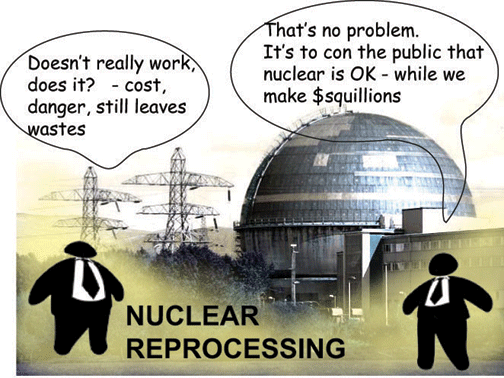
One should add that one of the claims of enthusiasts for recycling spent fuel in fast reactors is that it permits simpler waste management. This is a complicated issue, but the short answer is that rather than simplifying, reprocessing and recycling complicate the waste disposal process.
With all these concerns, and the lack of a valid economic benefit, why does the Energy Department want to start an “aggressive” and expensive program of fast reactor development? It’s true that so far only exploratory contracts have been let, on the order of millions of dollars (to GE-Hitachi). But the Department is already leaning awfully far forward in pursuing the VTR. It estimates the total cost to be about $2 billion, but that’s in DOE-speak. We’ve learned that translates into several times that amount.
But beyond that, the nuclear engineering community, and the wider community of nuclear enthusiasts, have never given up the 1960s AEC dream of a fast breeder-driven, plutonium-fueled world. Such reactors were to have been deployed by 1980 and were to take over electricity generation by 2000. It didn’t even get off the ground, in part because of AEC managerial incompetence, but mainly because it didn’t make sense.
After the 1974 Indian nuclear explosion and the realization that any country with a small reactor and a way to separate a few kilograms of plutonium could make a bomb, proliferation became a serious issue. In 1976 President Gerald Ford announced that we should not rely on plutonium until the world could reliably control its dangers as a bomb material. The plutonium devotees never accepted this change. Jimmy Carter froze construction of an ongoing fast-breeder prototype, the Clinch River Reactor, about three time the size of the proposed VTR. Ronald Reagan tried to revive it but, as its rationale thinned and its cost mounted, Congress shut it down in 1983. The plutonium enthusiasts thought they got their chance under George W. Bush with a fast reactor and a reprocessing and recycling program under of the rubric of Global Nuclear Energy Partnership. But it was so poorly thought out it didn’t go anywhere. More or less the same laboratory participants are now pushing the VTR.
The DOE advanced reactor program has many irons in the fire, mostly in the small reactor category. But do not be misled. They are mostly small potatoes without much future. Only the fast reactor project is the real thing, bureaucratically, that is. Although at this point DOE has only contracted for conceptual design, the follow-up will cost many millions and take many years. Nothing attracts national laboratories, industrial firms, and Washington bureaucracies as much as the possibility of locking into a large multiyear source of funding.
Congress needs to look hard at the rationale for a fast reactor program. This means getting into the details. At a Senate Appropriations hearing last month on advanced reactors, Sen. Dianne Feinstein said rather plaintively, “We cast the votes, and cross our fingers hoping nothing bad will happen.” That’s not good enough.
Victor Gilinsky is program advisor for the Nonproliferation Policy Education Center (NPEC) in Arlington, Virginia. He served on the Nuclear Regulatory Commission under Presidents Ford, Carter, and Reagan. Henry Sokolski is executive director of NPEC and the author of Underestimated: Our Not So Peaceful Nuclear Future (second edition 2019). He served as deputy for nonproliferation policy in the office of the U.S. secretary of defense in the Cheney Pentagon.
There are also meetings in eight areas of England as the government hunts for a single location to bury the lethal waste.
The waste, which has been accumulating from nuclear power stations over the last 60 years, is to be transferred from specially-engineered containers where it is currently building up to a subterranean Geological Disposal Facility (GDF) where it can be left forever.
The government’s official line is that no location has been chosen and that any site will only be picked if a community is willing.
Experts at the RWM (a subsidiary of the Nuclear Decommissioning Authority) have been scouring Wales for suitable regions and this is what they have to say about the area in which you live:
1. North Wales offshore including the Vale of Clwyd……….
2. North Wales Coalfield, comprising Wrexham and north to Prestatyn…….
3. From St Brides Bay to the Severn Estuary, extending north to Welshpool……
4. 20 km offshore strip along the Bristol Channel – from Carmarthen Bay to Cardiff…..
5. Most of North Wales and West Wales – from St Davids to Bangor……
Report: Trump Inaugural Committee Under Investigation for Possible Finance Crime, Slate By MOLLY OLMSTEAD, DEC 13, 2018 “………..Prosecutors also asked for documents from Tennessee developer Franklin Haney, the Journal reported. Haney made a $1 million donation to the inaugural committee and, in April, hired Cohen to help him obtain a $5 billion loan from the U.S. government, among other funding, for a pair of nuclear reactors in Alabama. Prosecutors asked him for documents related to any correspondence with members of the committee. ……
Secret Underground Nuclear City In The Arctic | A Potential Threat
WW3 FEARS: Pentagon’s secret underground tunnels of MOBILE NUCLEAR bases REVEALED THE US government built a fully-functioning mobile nuclear base below the ice ofGreenland in preparation for war, it was revealed during a documentary. https://www.express.co.uk/news/world/1084951/ww3-fears-pentagon-mobile-nuclear-base-greenland-sptIn 1960, the United States ran a highly publicised project known as Camp Century on the island to study the feasibility of working below the ice. However, declassified files show it was actually a cover-up for a top-secret Cold War programme. Project Iceworm was the code name for the United States Army’s mission to build a network of mobile nuclear missile launch sites.
The ultimate objective was to place medium-range missiles under the ice — close enough to strike targets within the Soviet Union.
YouTube series “The Real Secrets of Antarctica” revealed how the project came to light in January 1995.
The 2017 documentary detailed: “Some very interesting disclosures were declassified about US military installations in Greenland which took place in the 1960s.
“They fed the American people a highly publicised story about advances in research and building an underground city below Greenland called Camp Century.
Only later did the truth about Project Iceworm surface.
“The Pentagon was attempting to put in place mobile nuclear launching sites to utilise thousands of miles of tunnels.”
Project Iceworm was to be a system of tunnels 2,500 miles in length, used to deploy up to 600 nuclear missiles, that would be able to reach the Soviet Union in case of nuclear war.
The missile locations would be under the cover of Greenland’s ice sheet and were supposed to be periodically changed.
A total of 21 trenches were cut and covered with arched roofs within which prefabricated buildings were erected.
These tunnels also contained a hospital, a shop, a theatre, and a church and the total number of inhabitants was around 200.
From 1960 until 1963 the electricity supply was provided by means of the world’s first mobile nuclear reactor, named PM-2A.
Water was supplied by melting glaciers and tested to determine whether germs were present, including tests for the plague virus.
However, just three years after it was built, ice core samples taken by geologists demonstrated that the glacier was moving much faster than anticipated and would destroy the tunnels and planned launch stations in about two years.
The facility was evacuated in 1965, and the nuclear generator removed.
Project Iceworm was canceled, and Camp Century closed in 1966.
Feds sue Hanford contractor, claiming kickbacks and lies defrauded taxpayers out of millions, Tri City Herald , BY ANNETTE CARY, FEBRUARY 08, 2019 RICHLAND, WA
The Department of Justice filed a civil lawsuit Friday against Hanford contractor Mission Support Alliance, accusing it of defrauding the federal government out of tens of millions of taxpayer dollars.
Also named in the lawsuit are former Mission Support Alliance President Frank Armijo, Lockheed Martin Corp. and Lockheed Martin Services Inc……….
The Justice Department is accusing Mission Support Alliance of using half-truths, omissions, kickbacks and outright lies before its purchase by Leidos to get the Department of Energy to consent to a $232 million subcontract to a company with which it had ownership ties.
Lockheed Martin Corp. was a principal owner of Mission Support Alliance in 2010, when Mission Support Alliance awarded a subcontract for information technology services at Hanford to Lockheed Martin Services Inc.
The lawsuit alleges that from 2010 to 2015 the defendants misrepresented billing rates charged to DOE, the effort estimated to be needed to complete work and the anticipated additional profit for the subcontractor.
“Defendants’ fraud allowed them to obtain grossly inflated and improper additional profit on the subcontract,” the Justice Department said in a news release.
The lawsuit said that estimates of costs for payment rates were inflated in some cases by basing them on far more employees to perform work than Lockheed Martin Services Inc. included in its internal budget.
In some cases DOE was billed by both Mission Support Alliance and Lockheed Martin Services Inc. for the same labor, the lawsuit said.
‘GROSSLY INFLATED PRICING’ CLAIMS
The profit paid for Lockheed Martin Services Inc. work was in addition to money Lockheed Martin Corp. was already earning on the same work through its partial ownership of Mission Support Alliance, according to the Justice Department.
DOE repeatedly made clear that the subcontractor, Lockheed Martin Services Inc., could not earn profit on top of what its owner was already being paid through Mission Support Alliance, the lawsuit said.
Armijo, and Rich Olsen, the Mission Support Alliance chief financial officer, also worked on behalf of Lockheed Martin Corp. and misused their positions at Hanford to help Lockheed Martin Corp. obtain grossly inflated pricing, the Justice Department alleged.
In addition to serving at times as the Mission Support Alliance president, Armijo also was a vice president of Lockheed Martin Corp., the lawsuit said.
HANFORD OFFICIALS ALLEGEDLY PAID KICKBACKS
The Justice Department said some employees, including Armijo, told DOE that the subcontractor’s pricing did not contain any additional profit for the subcontract for the same work on which Lockheed Martin Corp. was already earning profit through its ownership of Mission Support Alliance.
The millions of dollars that Armijo and other employees were paid in cash and stock as part of an incentive program amounted to kickbacks for improperly using their Mission Support Alliance positions to provide favorable treatment for Lockheed Martin Corp., the Justice Department alleges. ………https://www.tri-cityherald.com/news/local/hanford/article226014785.html
It is one of five sites in Northern Ireland under consideration as possible stores for the waste and among 45 being examined across the UK as whole.
An area of granite bedrock near Newry may be suitable for a geological disposal facility (GDF), according to a recent preliminary report by Radioactive Waste Management (RWM), a UK State-owned company.
The area of rock stretches from Slieve Gullion to the Mourne mountains. Geological disposal sites hold radioactive waste hundreds of metres underground, and there are no current facilities in Northern Ireland.
Future policy decisions on nuclear disposal in Northern Ireland rest with the Stormont executive, where power-sharing has been collapsed for more than two years.
The British government’s current preference is that one facility would service the entire UK, a spokesman for RWM has said. Any future facility would need the support of the local community before it could be approved.
Nuclear waste is stored at about 30 sites across Britain, but predominantly at ground level at the Sellafield reprocessing plant in Cumbria.
Central to the meeting in Vietnam is what the U.S. might offer Kim in return for concrete steps to relinquish his nuclear arsenal, WSJ, By Andrew Jeong andTimothy W. Martin, Feb. 8, 2019 SEOUL—The U.S. special envoy for North Korea concluded three days of nuclear-disarmament talks in Pyongyang ahead of the second summit between President Trump and North Korean leader Kim Jong Un, scheduled for this month in Vietnam, expressing confidence that “real progress” was possible if both sides remain committed…….(subscribers only) https://www.wsj.com/articles/u-s-envoy-voices-optimism-ahead-of-north-korea-nuclear-summit-11549684347
How the Green New Deal Almost Went Nuclear on Its First Day, Yahoo Finance, Ari Natter and Jennifer A. Dlouhy, Bloomberg, February 9, 2019 — As Democrats unveiled their ambitious Green New Deal to fight climate change on Thursday, a controversy erupted over the role of nuclear power that threatened to undermine the whole effort.
A fact sheet distributed by the office of progressive newcomer Alexandria Ocasio-Cortez, a Democratic representative from New York, said there was no room in the nation’s all renewable-energy future for nuclear plants.
But the reference caught many off guard and back-peddling ensued.
Giselle Barry, a spokeswoman for Senator Ed Markey, a Massachusetts Democrat who is the Green New Deal’s lead Senate backer, disowned the fact sheet and said Markey’s office wasn’t consulted before it was sent out. “We did not draft that fact sheet,” she said.
The stumble irked potential supporters. It also illustrated the political challenges ahead as supporters of the Green New Deal struggle to build consensus on issues that divide environmentalists as well as lawmakers.
Markey sought to do damage control at a midday press conference, emphasizing the proposed resolution doesn’t address specific energy technologies. Language on nuclear power “is not part of this legislation,” he said. “The resolution is silent on any individual technology that can move us to a solution.”
The plan, in the form of a non-binding resolution, weaves together what had been a hodgepodge of progressive proposals and aspirations into a single initiative. It sets a goal of shifting the nation to 100 percent “clean, renewable, and zero-emission energy sources,” within 10 years “to achieve net-zero greenhouse gas emissions through a fair and just transition for all communities and workers.”
The proposal has gathered 60 co-sponsors in the House but has little chance of gaining support in the Republican-controlled Senate, let alone being signed into law by President Donald Trump.
House Speaker Nancy Pelosi, who hasn’t explicitly thrown her support behind the Green New Deal, didn’t appear at the unveiling. She described the plan at another event as “one among many” ways to address climate change.
Some of the biggest climate champions in the Senate, including Sheldon Whitehouse, a Democrat from Rhode Island who delivers frequent floor speeches on the urgent need to act, were notably absent from the news conference unveiling the Green New Deal. For any effort to succeed, it will need support from long-time environmental policy advocates in Congress as well as the ardent activists that have rallied behind Ocasio-Cortez’s vision.
The scale and ambition of the initiative also presents problems. Ocasio-Cortez has pitched it not just as an environmental solution but also a World-War II-style “mobilization” against income inequality and social injustice.
That invites criticism that the whole gambit is socialism run amok. The Chamber of Commerce slammed the proposal in a statement that invoked “failed socialist policies.”
Opposition on the left emerged over the plan’s failure to eventually ban fossil fuels, the leading source of the carbon dioxide emissions linked to global warming.
Friends of the Earth president Erich Pica praised the resolution as “a good first step,” but said it was incomplete. “By failing to expressly call for an end of the fossil fuel era, the resolution misses an opportunity to define the scope of the challenge,” Pica said…………https://finance.yahoo.com/news/green-deal-almost-went-nuclear-090000153.html
Bill Kidd will be at the Global Peace Forum in Pyeongchang to renew calls for Scotland to become a nuclear-free zone.
He will be among parliamentarians, anti-nuclear campaigners and experts in the field from the USA, Belgium, Japan and the Philippines, who are joining together to discuss the development of the UN’s Agenda for Disarmament by 2030.
Mr Kidd, co-president of the Parliamentarians for Nuclear Non-proliferation and Disarmament group in Scotland, said: “At a time of such grave uncertainty across the world, Scotland is a leading voice on nuclear disarmament – leaving the UK looking badly out-of-touch with the vast majority of nations.
“The SNP, the Scottish Parliament and the people of Scotland firmly reject the hosting of weapons of mass destruction on Scottish soil, and Westminster should heed those calls.
“By taking a stand on immoral nuclear weapons, we can set a powerful example to the world, influence others and help shape the global agenda.”
He added that in an independent Scotland the SNP would remove all nuclear weapons “as quickly and safely as possible”.
https://www.rt.com/usa/451098-hanford-nuclear-lockheed-lawsuit/10 Feb, 2019 Contractors involved in a multibillion decontamination effort at the notorious Hanford nuclear site have been accused of defrauding US taxpayers, according to a lawsuit against Mission Support Alliance and Lockheed Martin.
MSA has a 10-year, $3.2 billion contract with the Department of Energy (DOE) to support the decontamination effort at the decommissioned nuclear production complex known as the Hanford Site. Allowed to pick subcontractors for the nation’s largest and most expensive environmental cleanup at its own discretion, MSA abused its authority and awarded “improper favorable treatment” for kickbacks, the Justice Department claimed this week.
The lawsuit alleges that Lockheed Martin Corporation (LMC) and Lockheed Martin Services Inc. (LMSI) paid more than $1 million to executives of MSA – which was conveniently co-owned by another Lockheed subsidiary at the time – in order to secure a $232 million subcontract to provide management and technology support at the Washington state nuclear site from 2010-2016.
The services were provided at “inflated rates” and in some cases the DOE was even billed twice, by both MSA and Lockheed, for the same work. In addition, the suit accuses Jorge Francisco Armijo, who served as both the Vice President of LMC and President of MSA, of abusing his authority for financial gain by his simultaneously held posts.
“Where Congress has allocated money for specific purposes, we will not tolerate unlawful conduct by contractors who seek to enhance their profits at the expense of taxpayers,” said Assistant Attorney General Jody Hunt of the Department of Justice’s Civil Division.
Lockheed immediately denied the allegations of being involved in the corruption scheme, rejecting any notion that the “corporation or its executives engaged in any wrongdoing.” MSA also brushed aside the accusations, claiming that the company “stands behind” their employees.
The 586-square-mile former nuclear research facility was used to produce plutonium for the nuclear bomb in the Manhattan Project. After over four decades of nuclear fuel production, the site was closed down in 1987, requiring an extensive clean-up of solid and liquid wastes left from the weapons production processes.
The 30-second spot is aimed at dispelling harmful rumors about the safety of products from the prefecture following the nuclear meltdown at Tokyo Electric Power Company Holdings Inc.’s Fukushima No. 1 power plant, which was heavily damaged in the March 2011 earthquake and tsunami.
The agency hopes to capitalize on rising interest in Fukushima Prefecture ahead of the eighth anniversary of the disaster on March 11.
The commercial, which will also highlight tourism spots in the prefecture, will be broadcast nationwide. It will also be run at movie theaters and online.
The agency has also created a section on its website to explain the current conditions in Fukushima Prefecture, helping visitors to learn about radiation and progress in reconstruction efforts.
The fate of one of the world’s most dangerous atomic reactors is now in the hands of California governor Gavin Newsom.
His vital decision is whether to order cheap, simple, structural tests at Diablo Canyon Unit One, which is currently shut for refueling. Please call him and ask him to do so at (916) 445-2841 and/or sign our moveon.org petition, and contact me at solartopia.org. You may also FAX him: at (916)558-3160 or write him at the Capitol in Sacramento, CA 95814.
Like all things nuclear, the legal situation is complicated, but the economic and safety issues are not.
Diablo Canyon’s owner, Pacific Gas & Electric, is bankrupt.
PG&E is also on legal probation, having been convicted of various felonies for killing eight San Bruno residents in an avoidable 2010 gas explosion. PG&E’s pipes blew up because the company deferred maintenance to save itself some money.
PG&E did the same to northern California power lines that ignited at least 17 fires in which scores died and a thousand homes burned.
The company has been sued for billions, forcing the bankruptcy. Its probation officer, Federal Judge William Alsup, recently asked PG&E’s president, should I “let you keep killing people?”
The rise and demise of the Clinch River Breeder Reactor, Bulletin of the Atomic Scientists, By Henry Sokolski, February 6, 2019This year marks the 36th anniversary of the termination of the Clinch River Breeder Reactor Project, a federally funded commercial demonstration effort. In the very early 1980s, it was the largest public-works project in the United States. Japan, South Korea, China, France, Russia, and the United States are now all again considering building similar plants. For each, how and why Clinch River was launched and killed is a history that speaks to their nuclear future. This history involves more than cost benefit analysis. For the public and political leadership, facts and arguments rarely close an initial sale of a large government-funded, high-tech commercialization program. Nor do they generally goad officials to abandon such projects. Such acts are fundamentally political: Fears and hopes drive them. Certainly, to understand why the US government launched and subsequently killed Clinch River requires knowledge not just of what the public and its political leadership thought, but also of how they felt.
Unwarranted fears of uranium’s scarcity fueled interest in fast-breeder reactors. …….in 1945, uranium 235, a fissile uranium isotope that can readily sustain a chain reaction, was believed to be so scarce, it was assumed there was not enough of it to produce nuclear electricity on a large scale. Scientists saw the answer in fast-breeder reactors………
The Atomic Energy Commission publicly promoted their commercialization with confident, cartoonish optimism. In one publication, the commission asked the upbeat question: “Johnny had three truckloads of plutonium. He used three of them to power New York for a year. How much plutonium did Johnny have left?” The answer: “Four truckloads.”
Unfortunately, this pitch glossed over two stubborn facts. First, because plutonium is so much more toxic and difficult to handle than uranium, it is many times more expensive to use as a reactor fuel than using fresh uranium. Second, because plutonium fast-breeder reactors use liquid metal coolants, such as liquid sodium, operating them safely is far more challenging and expensive than conventional reactors.
When private industry tried in the early 1960s to operate its own commercial-sized fast-breeder, Fermi I, the benefits were negative. Barely three years after Fermi 1 came online, a partial fuel meltdown in 1966 brought it down. It eventually resumed operations before being officially shut down in 1972.
These facts, however, are rarely emphasized. Those backing breeders—whether it be in 1945, 1975, or today—focus not on reliability and economics, but rather that we are about to run out of affordable uranium. For the moment, of course, we are not. Uranium is plentiful and cheap as is enriching it. This helps explain why the United Kingdom, France, Germany, Japan, and the United States, no longer operate any commercial-sized fast-breeder reactors and are in no immediate rush to build new ones………
When the Atomic Energy Commission argued the case for building a breeder reactor in the late 1960s and early 1970s, it projected 1,000 reactors would be on line in the United States by the year 2000 (the real number turned out to be 103) and that the United States would soon run out of affordable uranium. Also, by the mid-1960s, the commission needed a new, massive project to justify its continued existence. Its key mission, to enrich uranium for bombs and reactors, had been completed and was overbuilt. The commission was running out of construction and research projects commensurate with its large budget. A breeder-reactor- commercialization program with all the reprocessing, fuel testing, and fuel fabrication plants that would go with it, seemed a worthy successor.
But the most powerful political supporter of Clinch River, then-President Richard Nixon, focused on a different point. Nixon saw the project less as a commercial proposition than as a way to demonstrate his power to secure more votes by providing government-funded jobs while at the same time affirming his commitment to big-science, engineering, and progress……….
the Energy Department videotaped safety tests it had conducted of how molten sodium might react once it came in contact with the reactor’s concrete containment structure. Concrete contains water crystals. Molten sodium reacts explosively when it comes in contact with oxygen, including oxygen contained in water. What the test demonstrated and the video showed was concrete exploding when it came in contact with liquid sodium.
This set off waves of worry at the department………
Just weeks before the final vote, the Congressional Budget Office released its financial assessment of the Energy Department’s last ditch effort to use loan guarantees to fund the project. Even under the most conservative assumptions, the budget analysts determined that the loan guarantees would only increase the project’s final costs. This helped push the project over a political cliff. The final Senate vote: 56 against, 40 for. All of the 16 deciding votes came from former Clinch River supporters.
No commercial prospects? Militarize. Nixon backed numerous science commercialization projects like Clinch River, including the Space Shuttle Program and the supersonic transport plane……… While the Space Shuttle Program won congressional support, the envisioned satellite contracts never materialized. The program became heavily dependent on military contracts. Finally, our national security depended upon it.
Although Clinch River never was completed, as its costs spiraled, it too attracted military attention. …….
Essentially, it didn’t matter when you asked–1971 or 1983—Clinch River was always another seven years and at least another $2.1 billion away from completion. ……
With Clinch River, what we now know, we may yet repeat. Fast-reactor commercialization projects and support efforts, such as Argonne National Laboratory’s Small Modular Fast Reactor, the US-South Korean Pyroreprocessing effort, the Energy Department’s Virtual (Fast) Test Reactor, France’s Astrid Fast Reactor Project, the PRISM Reactor, the TerraPower Traveling Wave reactor, India’s thorium breeder, Russia’s BN-1200, China’s Demonstration Fast-Breeder Reactor, continue to capture the attention and support of energy officials in Japan, China, Russia, South Korea, France, the US, and India. None of these countries have yet completely locked in their decisions. How sound their final choices turn out to be, will ultimately speak to these governments’ credibility and legitimacy.
In the case of Clinch River, the decision to launch the program ultimately rested on a cynical set of political calculations alloyed to an ideological faith in fast reactors and the future of the “plutonium economy.” Supporters saw this future clearly. As a nuclear engineer explained to me in 1981 at Los Alamos National Laboratory, the United States technically could build enough breeder reactors to keep the country electrically powered for hundreds of years without using any more oil, coal, or uranium. When I asked him, though, who would pay for this, he simply snapped that only fools let economics get in the way of the future.
This argument suggests that the case for fast reactors is beyond calculation or debate, something mandatory and urgent. That, however, never was the case, nor is it now. Instead, the equitable distribution of goods, which is a key metric of both economic and governmental performance (and ultimately of any government’s legitimacy and viability), has always taken and always must take costs into account. In this regard, we can only hope that remembering how and why Clinch River was launched and killed will help get this accounting right for similar such high-tech commercialization projects now and in the future. https://thebulletin. org/2019/02/the-rise-and- demise-of-the-clinch-river- breeder-reactor/?utm_source= Bulletin%20Newsletter&utm_ medium=iContact%20email&utm_ campaign=ClinchRiver_February6
Hokkaido Electric Power Company says a worker discovered the problem at its Tomari nuclear plant in the country’s northernmost prefecture of Hokkaido early Saturday morning.
The problem affected equipment designed to maintain water pressure in the event of firefighting at the No.1 and No.2 reactors. All three of the plant’s reactors have been offline since 2012, following the Fukushima nuclear accident.
The utility says a part of the equipment was frozen due to the severe cold, causing the system to break down. It says there is no problem with the plant’s fire extinguisher system, and the problem did not affect firefighting functions.
Temperatures fell to minus 30 degrees Celsius or lower in many parts of the prefecture on Saturday. A nearby town recorded minus 12.7 degrees Celsius.
.
The company also says the temperature was nearly minus five degrees in the room which houses the equipment, but a worker forgot to turn on the heating system.
The utility says it will work quickly to restore the faulty equipment and take measures to prevent a recurrence.
Tell Congress: Prevent Nuclear Catastrophe in Iran
Read the Public Inquiry Report, the Commissioners’ report, Surrendering Australia: The AUKUS Deception is available to download for free at aukuspublicinquiry.com. Or just watch the replay of the National Press Club Luncheon.