nuclear-news

The News That Matters about the Nuclear Industry Fukushima Chernobyl Mayak Three Mile Island Atomic Testing Radiation Isotope

  • Home
  • 1 This Month
  • ACTION !
  • Disclaimer
  • Links
  • PAGES on NUCLEAR ISSUES

Offshore wind could replace UK’s failed plans for new nuclear power

Orsted’s Hornsea Project Spawns Talk of Offshore Wind Replacing Nuclear, Greentech Media,  JASON DEIGN FEBRUARY 22, 2019 Danish developer Ørsted said its Hornsea One plant, which started delivering power to the grid this month, could help make up for a lack of planned nuclear generation in the U.K., as plans for new reactors have fallen by the wayside.When complete, Hornsea One will cover more than 157 square miles, making it bigger than the city of Denver, and have a peak capacity of 1.2 gigawatts, thanks to 174 turbines of at least 7 megawatts each.

It will be the biggest offshore wind plant on the planet, dwarfing the current leader, Walney Extension, which Ørsted opened last September with a capacity of 659 megawatts. Ørsted has plans for an even bigger project, the 1.8-gigawatt Hornsea Two plant, in U.K. waters………

Not just a U.K. debate

Given that the U.K. is relying on a largely untested reactor design for upcoming nuclear capacity, it is perhaps legitimate to ask if the reliability of new reactors will be significantly greater than those of gigawatt-scale offshore wind farms built at the same time.

Tom Dixon, wholesale team leader at U.K. consultancy Cornwall Insight, said: “New offshore wind farms being developed are now much more reliable than older offshore sites or their onshore counterparts.”

As a result, he said, “it is credible to say that the shortfall in new nuclear could be made up by offshore wind, with improving operational performance and relatively low costs for the technology, but additional flexibility would be required at times when output is low.”

It is not just the U.K. where offshore wind could potentially take over new nuclear’s mantle.

This month, in the wake of a partnership between Ørsted and Tokyo Electric Power Company, the analyst firm Wood Mackenzie Power & Renewables questioned whether offshore wind could also be a cure for rising energy demand as new nuclear languishes in Japan.

“Rising costs and a lack of public confidence in Tepco’s ability as a nuclear operator have led the company to reconsider its future strategy,” said WoodMac senior analyst Robert Liew. “Tepco’s involvement in offshore wind is a crucial development.” https://www.greentechmedia.com/articles/read/hornsea-spawns-talk-of-offshore-wind-replacing-nuclear#gs.v9EFOjv7

February 23, 2019 Posted by Christina Macpherson | renewable, UK | Leave a comment

Ending The U.S. Doctrine of Perpetual War

Mutually Agreed Peace: Ending The U.S. Doctrine of Perpetual War By Ethan Indigo Smith, Contributing Writer for Wake Up World, 22 Feb 19, “Just because you do not take an interest in politics doesn’t mean politics won’t take an interest in you.” ~ Pericles.

Everything is ultimately political these days, but everything is firstly biological. Yet, ignoring our biology and our humanity, the military-industrial complex, with all its toxic modalities, still claims to operate in our best interests.

The fact is, modern politics has become the imposition of institutional formality where individuals and truth once were. Increasingly favoring institutional privilege over individual rights, politicians on all sides of the game act to reinforce and advance the standing of corporations at the expense of our physical world. They embark on resource wars for profit, destroy our environment for energy, construe zealotry as patriotism, and steer a culture of social competition – not cooperation – all the while hiding behind veils of secrecy and meaningless rhetoric. …..

The Nuclear Energy and Armament Experiments

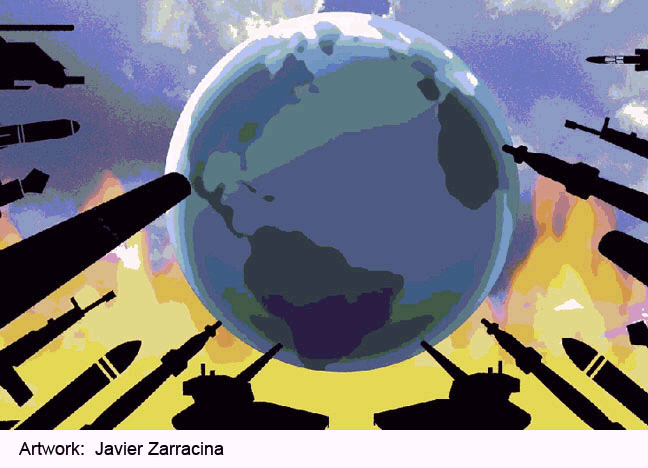
One of the largest tentacles of the military-industrial complex is the nuclear experimentation facet of their operations. These operations include both energy and armament — programs which are inextricably linked, as I will demonstrate – with negative impacts on all life on earth and, and when disaster strikes, capable of negating life altogether.

Maintaining a deafening silence over the ongoing Fukushima disaster, for example, the world’s political heads show zero regard for our biological wellbeing (much less our social wellbeing) in both the formulation and the execution of policy. Instead of shutting down the deadly reactors at Fukushima, the world’s powers simply shut down any information about the situation.

For example, the Japanese government passed a law through Parliament, called the “States Secret Act” following the 2011 Fukushima meltdown. Under this act, both officials and private citizens who leak “special state secrets” (ie. details of the disaster) face prison terms of up to 10 years, while journalists who publish classified information (ie. all relevant information) face up to five years.[1] Meanwhile, in 2011 the U.S. Environmental Protection Agency’s response to increases in detected radiation levels within the United States was to reduce the use of radiation monitoring while at the same time, raising the official allowable levels of radiation in food, water and soil. [2] Of course, this was not reported by mainstream media.

Nor was the 2014 partial shutdown of the Florida Power & Light’s Turkey Point facility in the Miami area, following a steam leak that resulted from the failure of the archaic facility’s cooling system.[3] While mainstream news completely blocked coverage of this potential meltdown situation, the facility remained in operation not because it managed to rectify the cooling problem, but because the corporation lobbied for special permission to violate allowable water temperature safety thresholds from the previous limit of 100’F limit up to 103’F. [4]

The simple reason for the secrecy and suppression of information is that the nuclear experimentation industry is just that — an experiment. Although it is touted as a ‘clean’ technology, the nuclear industry has no mechanism for disposing of the radioactive waste it generates, and no viable plan for such a mechanism in the future. All it has is a plan to contain the mounting radioactive waste it generates each day and store it for the million years it takes for radioactive waste to break down naturally.

o, whether nor not we accept or reject the philosophies of government, it is an inarguable fact that our biology, and that of our grandchildren’s grandchildren’s grandchildren — is at the complete mercy of those individuals who, hiding behind political formality, have their fingers “on the button”. And, for as long as their priorities are clearly shaped by the objectives of the corporate-military-industrial complex, there is very little mercy involved. Instead our collective future and the future of our planet is heavily influenced by corporate profitability and contrived political hemispheres which, with the support of corporate media, teeter between deliberately limited polarities, never really making progress or improvement or exploring possibilities — such as peaceful solutions, or sustainable energy investment — beyond those which may profit those already in power…….

The rise of the military industrial complex changed the whole dynamic of war and peace, and in the process, steered our society from exploring sustainable energy solutions toward the constant danger of nuclear meltdown. Nuclear power generation is inherently risky of itself; both the waste it stores and the pollution it releases pose a largely unseen but no less dangerous threat to our Earth Mother, and to our biology. But it also creates obvious military strike targets for enemy nations which, if detonated, can destroy entire nations in one sweep. Building nuclear power experiments is akin to building a self-destruct button into your nation’s infrastructure; one false move, be it intentional (military) or accidental (like Fukushima), and it destroys the landscape and all who dwell on and around it for an eternity, with no known remedy……..

“I foolishly once believed the myth that nuclear energy is clean and safe. That myth has completely broken down. Restarting nuclear reactors while we still have no place to dispose of nuclear waste is a criminal act toward future generations.” — Morihiro Hosokawa, 79th Prime Minister of Japan

The U.S. Doctrine of Perpetual War

One of the best ways to gain and maintain power is to keep the people in constant fear — in fear of wars, of outsiders, and more recently, of “terrorism”. Maintaining a culture of war-minded fear ensures the public consent to the constant funding of the military-industrial-complex, under the guise of security and protection.

If we look at the history of the Presidents of the United States since the end of the Second World War, we see that each administration invented a presidential Doctrine directly pertaining to war – either inviting involvement in or directly inciting conflict………

the most famously barbarous doctrine was the Bush Doctrine, in which President George W. Bush Jr. essentially declared that the United States was adopting a shoot-first-ask-questions-later policy pertaining to perceived terrorist activities, both in other countries and at home. [19] Advocating the illogical notion of “preventive war”, the Bush Doctrine is based on the faulty reasoning that attacking a potential threat before it attacks the United States is the only way to ensure peace and security, rather than — as history has proven — the most effective way to ensure more wars and security threats…..

The fact is, the United States has been at war for 225 years out of the last 242 years. That’s 93% of the time! Since the Declaration of Independence was written in 1776, the U.S. has actually been at peace (albeit planning for further wars) for a total of only 21 years. [20] Not one U.S. president actually qualifies as a solely peacetime president, and the only time the United States lasted five years without going to war was between 1935 and 1940 — during the period of the Great Depression.

Since U.S. involvement in World War II began in 1940, most of the world’s military operations have been initiated by the U.S., [6] and U.S. military spending today exceeds the rest of the world’s military spending combined. [21]  In addition, the U.S. also supplies in excess of $3 billion each year (over $10 million per day!) in military aid to Israel, funding the continued war in Palestine.[22] ………

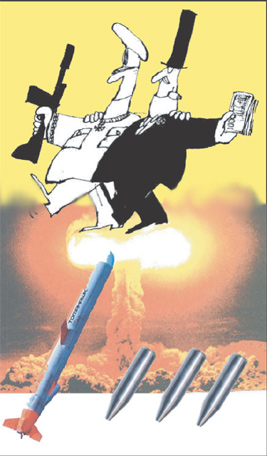
Today, the U.S. economy is now so dependent on war, there is no incentive for the U.S. government to strive for peace — it simply isn’t profitable. The U.S. defense industry employs a staggering 3.5 million Americans, while the private companies supporting the military generate in excess of $300 billion in revenue per year. [24]

With the U.S. economy and military operations so intrinsically linked, the American people have over time come to accept its war culture as normal, believing the increasingly ludicrous propaganda that tells us the U.S. is subject to threats from far weaker military nations and that the U.S. is nobly “fighting for peace” — an oxymoron of the highest order. ……….

clearly, the lessons of history and failed Presidential policy have not been learned by those in power in recent years, who claim to have our interests at heart. Barack Obama, for example, despite his (false) doctrine of negotiation and collaboration (“change”) as a contrast to the confrontation and unilateralism of the Bush Jr. era, invested a trillion dollars of U.S. taxpayers’ money into the military industry to develop and build more nuclear weaponry [25] This, despite the fact that the U.S. is already the most heavily armed nuclear nation in the world — something current President Trump, who also campaigned on a platform of “change”, has done nothing to wind back.  ……

The institutions of the United States and Russia may have different perpetrators behind them, they may play different melodies and use different instruments, but in fact they sound very much the same. The collectivism of the oligarchy in the U.S.A. is flavored with corporate tones, whereas in Russia it is dominated by state tones. Different name, same game. In the U.S.A. the divine right of corporations rules and in Russia it’s the godhead of the state the leads the symphony. Either way though, it’s a war song of militant, nationalistic not individual concerns.

In our every deliberation, we must consider the impact of our decisions on the next seven generations.”  ~ Iroquois Maxim

The Indigo Doctrine: Mutually Agreed Peace

We, The People of the World, can supersede institutional war-mongering concerns that belittle individual life, liberty and pursuit of happiness. We have no other choice. If we do not act to mandate Mutually Agreed Peace, we are allowing politicians to shrug their shoulders and say, “it’s politics”, as Earth Mother is ravaged and its inhabitants are systematically annihilated by nuclear, war-driven madness.

………History has shown us that preparing for war doesn’t just lead to more war; it makes war an economic necessity. The only way to ensure peace in our world is to adopt a doctrine of Mutually Agreed Peace in theory and practice; to give peace a budget, give peace a mandate, and give peace all our energy, both politically and personally — and to remove from government, through the power of our will and our numbers, any individual who fails to act on it……. https://wakeup-world.com/2015/08/29/mutually-agreed-peace-ending-the-doctrine-of-perpetual-war/ 

February 23, 2019 Posted by Christina Macpherson | business and costs, politics international, USA, weapons and war | Leave a comment

With escalating tensions between India and Pakistan, could India consider a pre-emptive nuclear strike?

Is a pre-emptive nuclear strike on the table? https://www.livemint.com/news/india/is-a-pre-emptive-nuclear-strike-on-the-table-1550771055043.html  21 Feb 2019,  Arjun SrinivasIndia has had a long-standing policy of nuclear restraint and is believed to pursue a no first use policy

Any escalation of tensions between the nuclear-armed neighbours can have massive implications for both South Asian and global security. There has been a considerable escalation of tension between nuclear-armed India and Pakistan in the aftermath of the Pulwama attack. While the outbreak of a full-fledged conflict is no more than a distant possibility, a paper by Christopher Clary and Vipin Narang, published in the Massachusetts Institute of Technology’s journal International Security, considers the likelihood of a pre-emptive nuclear strike by India in response to Pakistan’s continued aggression as a ‘counterforce’ strategy.

India has had a long-standing policy of nuclear restraint and is believed to pursue a no first use policy. However, the authors suggest that, since 2003, India has devoted considerable resources to develop nuclear capabilities far in excess of what is required for mere retaliation. In addition to these enhanced capabilities, there has been a host of public comment from both serving and retired Indian national security officials about the possibilities and strategic importance of a pre-emptive nuclear strike.

These strikes, the authors argue, could potentially limit the capabilities of Pakistan’s nuclear arsenal.

However, this shift in policy, or even a perceived shift, would carry major risks. It could potentially lead to an arms race in the subcontinent, and also create a vicious geo-political environment that would provide incentives for both sides to mobilize nuclear weapons first.

The authors also warn that a pre-emptive strike may not destroy enough Pakistani nuclear weapons on the ground, leaving Indian defence systems vulnerable to a retaliatory nuclear attack from Pakistan. As such, though tensions are running high in the aftermath of the Pulwama attack, there is need for caution in determining the way forward. Any escalation of tensions between the nuclear-armed neighbours can have massive implications for both South Asian and global security.

February 23, 2019 Posted by Christina Macpherson | India, politics international, South Korea, weapons and war | Leave a comment

If USA US deploys nuclear weapons in Europe RUSSIA and Belarus will consider a joint military response

‘Things will turn NASTY’ Belarus leader issues warning after collapse of nuclear treaty https://www.express.co.uk/news/world/1090969/belarus-news-inf-treaty-world-war-3-russia-v-usa-nato

RUSSIA and Belarus will consider a joint military response if the US deploys weapons in Europe after pulling out of the Intermediate-range Nuclear Forces (INF) Treaty.

By SIMON OSBORNE, Feb 22, 2019 Belarus President Alexander Lukashenko said he fears “things will turn nasty” should the US decision spark a new arms race at a time of increasing global tensions. The US and Soviet Union signed the INF treaty in 1987 in an historic move that effectively removed nuclear weapons from Europe and signalled the beginning of the end of the Cold War.

But Donald Trump has pulled the US out of the accord after accusing Russia of committing repeated violations and Mr Lukashenko fears the security of Belarus could be compromised as a result.

He said: “It is a catastrophe, particularly for us.

“I am afraid the Americans will grab the fleeting opportunity and deploy the missiles in Europe after breaking the treaty. “If they do, things will turn nasty for us, too. Because together with Russia, we will have to think of reciprocal measures.”

He continued: “It would be unavoidable if this happened. It would be even worse if, God forbid, missiles were deployed in Ukraine.

“This is why I am wholeheartedly against dissolving the Intermediate-Range Nuclear Forces Treaty.

“We pursue a peace-loving policy. We don’t need scuffles between major powers, from which, judging from history, we’ve always suffered.

“This is why we don’t need this slaughter, this fight, particularly now around the Intermediate-Range Nuclear Forces Treaty.”

Mr Lukashenko said he believes NATO is keen to deploy missiles in Europe.

He said: “It seems to me that although NATO claims they are not going to deploy these missiles in Europe, they are running a bluff.

“Otherwise, why would they withdraw? Why did they have to destroy this treaty?

“They should have come to terms with China and make it part of the treaty if China was the focus of it.”

February 23, 2019 Posted by Christina Macpherson | Belarus, politics international, Russia, USA, weapons and war | Leave a comment

An end-of-war declaration would be the first step towards denuclearization of the Korean Peninsula

Denuclearization of the Korean Peninsula begins with a peace declaration, Bulletin of the Atomic Scientists, By David Kim, February 14, 2019 During his State of the Union address, President Donald Trump announced that he will meet with North Korean leader Kim Jong-un at the end of the month to continue a “historic push” for peace on the Korean Peninsula. If one statement stood out from Trump on North Korea, it’s that “much work remains to be done” to achieve complete, verifiable, and irreversible denuclearization on the Korean Peninsula.

Last year’s summit in Singapore between Trump and Kim was historic not for what it achieved on denuclearization, but for what it signaled to the world: Both countries, through the top-down, personality-driven diplomacy of their leaders, are ready to transform their relationship by seeking permanent peace on the Korean Peninsula. The central question moving forward isn’t whether Kim is willing to give up his nuclear weapons; rather it’s whether the United States and North Korea can transform their relationship to a point where Kim and his elites begin to believe their regime can survive without nuclear weapons. More than any other measure, an end-of-war declaration between the two countries would represent the beginning of this transformation. As the State Department’s special representative for North Korea, Stephen Beigun, said in a speechat Stanford University, “President Trump is ready to end this war. It is over. It is done.” Both sides appear ready to make that statement a reality.

Denuclearization is a long-term goal. While some Trump administration officials have suggested otherwise, complete denuclearization isn’t a realistic short- or medium-term goal. After the Singapore summit, President Trump tweeted that North Korea no longer poses a “nuclear threat.” In fact, experts believe that tweet is a decade or more away from being true. It now seems that Trump may have adjusted his views on this point. In a recent tweet, Trump said he looks forward to “advancing the cause of peace” at the next summit in Vietnam, suggesting he accepts that peace and a new relationship should undergird any real denuclearization agreement with North Korea.

Trump should understand that by agreeing to a peace declaration with the North, he won’t necessarily speed up the denuclearization timeline; rather, he’d be laying the foundation for a formal peace regime, an institutional set-up to allow both the United States and North Korea to work toward that goal.  At Stanford, Biegun said the United States is prepared to take parallel steps with North Korea by “simultaneously look[ing] for ways to advance a more stable and peaceful, and ultimately, a more legal peace regime on the Korean Peninsula,” one that can “advance denuclearization.” This is a much more subtle formulation than the previous all-or-nothing approach taken by many US policymakers, the idea that North Korea had to abandon all its weapons first before the United States took any steps such as sanctions relief.

Kim wants an end to the Korean War. Ever since the days of Kim’s grandfather Kim Il Sung’s regime, North Korea has sought a formal peace regime ending the Korean War. The country has repeatedly raised its strong desire for an end-of-war declaration as the next step towards permanent peace. A report on the regime’s state-run news agency, for instance, stated last year “that the issue of the end-of-war declaration should have been resolved a half a century ago.” Trump appears to agree. He reportedly told Kim in Singapore that he’d sign a declaration. Such a peace declaration may serve as a preliminary security guarantee, or litmus test, to see how serious Kim is about denuclearizing.

Unlike a formal peace treaty, an end-of-war declaration, or peace declaration, is a legally non-binding instrument. Getting to a declaration won’t involve difficult negotiations. The document, rather, would represent a symbolic end to a war that has actually been over since 1953. Without abandoning the goal of a peace treaty, Trump could use a declaration to signal to Kim that the United States is serious about negotiating with his regime. As some experts also point out, an end-of-war declaration could be a “game changer” for North Korea because it could help “neutralize the hardliners” within Kim’s regime, creating the breathing space to allow further progress towards denuclearization. It would also counteract the frequent propaganda narrative in North Korea of foreign encroachment………. https://thebulletin.org/2019/02/denuclearization-of-the-korean-peninsula-begins-with-a-peace-declaration/?utm_source=Bulletin%20Newsletter&utm_medium=iContact%20email&utm_campaign=PeaceDeclaration_02152019

February 23, 2019 Posted by Christina Macpherson | North Korea, politics international, South Korea | Leave a comment

Utah Senate gives preliminary approval to bill that could usher in millions of tons of depleted uranium

Radioactive waste bill gets preliminary approval in Utah Senate, Deseret News, By Amy Joi O’Donoghue@amyjoi16, February 20, 2019 SALT LAKE CITY — EnergySolutions is seeking assurances from Utah lawmakers that if it meets disposal requirements and the approval of regulators, it can bury depleted uranium at its Tooele County facility.

That is how Sen. Scott Sandall, R-Tremonton, explained the genesis of HB220, which received a 23-6 vote on its second reading Wednesday in the Utah Senate.

Sandall said the bill, in its fourth version, does not guarantee acceptance of the waste or site suitability but rather ensures that if the company continues to spend money on a site-specific analysis that its investment will not be in vain.

Critics say not only will the measure, if passed into law, give a potential green light on millions of tons of depleted uranium coming to Utah, it opens the door for acceptance of even “hotter’ waste……..

The bill needs another vote in the Senate, House approval and the governor’s signature before it becomes law. https://www.deseretnews.com/article/900056657/radioactive-waste-bill-gets-preliminary-approval-in-utah-senate.html

February 23, 2019 Posted by Christina Macpherson | depleted uranium, USA, wastes | Leave a comment

The need to put a stop to plan for plutonium weapon pits at Savannah River Site

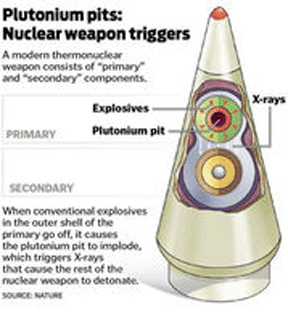
No plutonium pit at SRS,   https://www.augustachronicle.com/opinion/20190220/letter-no-plutonium-pit-at-srs By Cassandra Fralix, Lexington, S.C. With the demise of the MOX fuel plant, good riddance, since there wasn’t a buyer for this dangerous material. There is only one option for the more radioactive plutonium waste, and that is long-term storage.

Long-term for Pu-239 is a half-life of 24,100 years. No one can predict what the state of the country will be in five years, much less 24,000, so who will monitor this dangerous material?

The horrible legacy of plutonium waste is one we are living with because of the development of nuclear weapons and nuclear power. Now, we have the Department of Energy’s plan to use Savannah River Site’s plutonium for nuclear weapons purposes. Plutonium, being radioactive and “pyrophoric,” is very difficult to handle, as the workers at SRS can testify to, and Savannah River Site, a Superfund site, continues a never-ending cleanup.

To return Savannah River Site to a weapons manufacturer is a testament to man’s lack of concern for God’s creation – human and environmental. We have seen the warnings from the increase of cancer rates at Rocky Flats, Colo., a plutonium pit producer – available in the Final Summary Report on the Historical Public Exposures Studies on Rocky Flats – to Fukushima, Japan, where the focus now is on the plutonium plant, so much more toxic than that of most other elements used in nuclear processing.

We must put people over profits and stop this maniacal race to our destruction. Say no to plutonium pit production at SRS!

February 23, 2019 Posted by Christina Macpherson | - plutonium, USA, weapons and war | Leave a comment

Nuclear energy just IS NOT clean energy

Nuclear energy is not the same as clean energy https://chicago.suntimes.com/opinion/illinois-clean-energy-policy-nuclear-energy/  Gail Snyder, board president, Nuclear Energy Information Service , 21 Feb 19,  “……  While legislation advancing renewable energy and energy efficiency is to be applauded, the $2.3 billion bailout to three privately owned Exelon nuclear energy facilities should be evaluated for its costs and the impact on expanding renewable energy. Of course, legislators should do so promptly, as it seems Exelon did so well with their last bailout that they are going to come back for another.

As energy legislation hits Springfield again, the public will be inundated with the terms “clean,” “renewable,” “green,” “low carbon,” “carbon neutral,” “carbon free,” “non-carbon,” and “net-zero emissions.” These terms will be used interchangeably, which only serves to confuse this fact: Nuclear waste and radioactive releases are not part of the calculus when the nuclear industry and others try to sell nuclear energy as “clean.” It is not.

Legislation that speaks only to “clean” as it relates to managing carbon emissions, without considering the 10,000 tons of nuclear waste in Illinois (the most nuclear waste of any state) is misleading. Also, consideration of the entire nuclear fuel cycle and storage of nuclear waste is carbon- intensive, which is not part of the “clean” calculus either.

We would also like to see Illinois legislators ‘step in’ again on energy policy, but this time with both the “carbon footprint” and the “nuclear footprint” included.

February 23, 2019 Posted by Christina Macpherson | politics, spinbuster, USA | Leave a comment

Loss of trust between USA and Europe brings nuclear risks

The Rift Between the U.S. and Europe Brings Nuclear Risks, TIME,  By SIMON SHUSTER/MUNICH  February 21, 2019

“…………The loss of trust between the U.S. and Europe was especially palpable at this year’s Munich summit, a traditional show of mutual reassurance among NATO allies. In her speech to the summit, German Chancellor Angela Merkel complained that the U.S. decision to scrap the INF treaty was made without consulting Europe, even though the treaty concerns Europe’s security most of all. “We sit there in the middle with the result,” Merkel said. Minutes later, when Vice President Mike Pence delivered a greeting from his boss, President Donald Trump, the room full of European diplomats responded with stony silence.
Their chief concern at the summit, at least when it comes to nuclear security, was the U.S. move in May to pull out of the deal with Iran. That deal took nearly a decade to negotiate, and it committed the Islamic Republic in 2015 to halt its nuclear-weapons program. Yet despite U.S. intelligence agencies reporting the deal was working, the Trump Administration scrapped it, imposing new sanctions against Iran and pressuring European allies to do the same. Germany, France and the U.K. have so far refused. ……
without the trust to begin negotiations, the world’s system of nuclear checks and balances will continue unraveling, one treaty at a time.  http://time.com/5534357/us-europe-nuclear-risks/

February 23, 2019 Posted by Christina Macpherson | EUROPE, politics international, USA | Leave a comment

Closing down Yongbyon nuclear facility to be up for discussion at US-North Korea summit

Closing nuclear facility on table as US-NKorea summit nears, BY ERIC TALMADGE News and Observer, ASSOCIATED PRESS, FEBRUARY 22, 2019 TOKYO 

The future of a key North Korean nuclear facility is on the table as leader Kim Jong Un and President Donald Trump prepare to meet in Vietnam next week.

The Yongbyon Nuclear Scientific Research Center, the heart of the North’s nuclear development and research, is Kim’s biggest carrot as he tries to win security guarantees and free his country from the U.S.-backed trade sanctions that are hobbling its economy.

The North Korean leader has suggested he’s ready to talk about closing the facility, capping the amount of fissile material it produces or possibly allowing international inspections. Trump, meanwhile, says he is going into the summit in no hurry to push the North to denuclearize, as long as Kim isn’t conducting nuclear or missile tests.

But time may be of the essence.

As talks drag on, North Korea is believed to have produced enough weapons-grade nuclear fuel to make an estimated half a dozen or so more bombs in 2018 alone.

Here’s the latest on what’s going on at Yongbyon and why it’s so important:

HEDGED BETS

The North has taken steps to disable or dismantle some nuclear and missile facilities since the first Trump-Kim summit last June in Singapore but it has also been hedging its bets.

Using open-source satellite imagery of the Yongbyon complex, a team of experts led by Siegfried Hecker, a former director of the Los Alamos National Laboratory who has visited the Yongbyon facility several times, estimate the North made enough weapons-grade material to boost its stockpile from an estimated 30 nuclear weapons at the end of 2017 to 35-37 by the end of last year.

“North Korea unsurprisingly continued to operate and, in some cases, expand the nuclear weapons complex infrastructure,” they wrote in a report published this month by the Stanford Center for International Security and Cooperation.

The authors note that Kim isn’t violating any agreements with Trump or shocking any military strategists by building up the North’s stockpile — that’s to be expected in an arms negotiation process. But the stepped up activity underscores how important it is for Washington to push for a deal on Yongbyon……..https://www.newsobserver.com/news/business/article226619924.html

February 23, 2019 Posted by Christina Macpherson | North Korea, politics international, USA, weapons and war | Leave a comment

USA rushing to transfer sensitive nuclear power technology to Saudi Arabia

Donald Trump rushing to sell Saudi Arabia nuclear technology

House launches probe of US nuclear plan in Saudi Arabia, https://www.bbc.com/news/world-us-canada-47296641, 20 February 2019 

The US is rushing to transfer sensitive nuclear power technology to Saudi Arabia, according to a new congressional report.

A Democratic-led House panel has launched an inquiry over concerns about the White House plan to build nuclear reactors across the kingdom.

Whistleblowers told the panel it could destabilise the Middle East by boosting nuclear weapons proliferation.

Firms linked to the president have reportedly pushed for these transfers.

The House of Representatives’ Oversight Committee report notes that an inquiry into the matter is “particularly critical because the Administration’s efforts to transfer sensitive US nuclear technology to Saudi Arabia appear to be ongoing”.

President Donald Trump met nuclear power developers at the White House on 12 February to discuss building plants in Middle Eastern nations, including Saudi Arabia.

And Mr Trump’s son-in-law, White House adviser Jared Kushner, will be touring the Middle East this month to discuss the economics of the Trump administration’s peace plan.

Lawmakers have been critical of the plan as it would violate US laws guarding against the transfer of nuclear technology that could be used to support a weapons programme.

They also believe giving Saudi Arabia access to nuclear technology would spark a dangerous arms race in the volatile region.

Saudi Arabia has said it wants nuclear power in order to diversify its energy sources and help address growing energy needs.

But concerns around rival Iran developing nuclear technology are also at play, according to US media.

Previous negotiations for US nuclear technology ended after Saudi Arabia refused to agree to safeguards against using the tech for weaponry, but the Trump administration may not see these safeguards as mandatory, ProPublica reported.

What does the report say?

The House report is based on whistleblower accounts and documents showing communications between Trump administration officials and nuclear power companies.

It states that “within the US, strong private commercial interests have been pressing aggressively for the transfer of highly sensitive nuclear technology to Saudi Arabia”.

These commercial entities could “reap billions of dollars through contracts associated with constructing and operating nuclear facilities in Saudi Arabia”.

Mr Trump is reportedly “directly engaged in the effort”.

The White House has yet to comment on the report.

The report includes a timeline of events and names other administration officials who have been involved with the matter, including Energy Secretary Rick Perry, Mr Kushner, Mr Trump’s inaugural committee chairman Tom Barrack and former National Security Adviser Michael Flynn.

Flynn was found guilty of lying to the FBI about Russian contacts as a part of special counsel Robert Mueller’s inquiry into alleged Russian meddling in the 2016 presidential election.

The commercial entities mentioned in the report are:

  • IP3 International, a private company led by ex-military officers and security officials that organised a group of US companies to build “dozens of nuclear power plants” in Saudi Arabia
  • ACU Strategic Partners, a nuclear power consultancy led by British-American Alex Copson
  • Colony NorthStar, Mr Barrack’s real estate investment firm
  • Flynn Intel Group, a consultancy and lobby set up by Michael Flynn
  • The report states that Flynn had decided to develop IP3’s nuclear initiative, the Middle East Marshall Plan, during his transition, and while he was still serving as an adviser for the company.In January 2017, National Security Council staff began to raise concerns that these plans were inappropriate and possibly illegal, and that Flynn had a potentially criminal conflict of interest.Following Flynn’s dismissal, however, IP3 continued to push for the Middle East Plans to be presented to Mr Trump.

    According to the report, one senior official said the proposal was “a scheme for these generals to make some money”.

    And whistleblowers described the White House working environment as “marked by chaos, dysfunction and backbiting”.

  • What next?

    The report says an investigation will determine whether the administration has been acting “in the national security interests of the United States or, rather, [to] serve those who stand to gain financially” from this policy change.

  • These apparent conflicts of interest among White House advisers may breach federal law, and the report notes that there is bi-partisan concern regarding Saudi Arabia’s access to nuclear technology.The oversight committee is seeking interviews with the companies, “key personnel” who promoted the plan to the White House, as well as the Departments of Commerce, Energy, Defence, State, Treasury, the White House and the CIA.

February 21, 2019 Posted by Christina Macpherson | politics international, Saudi Arabia, secrets,lies and civil liberties, USA | 2 Comments

Climate change bringing crises, population displacement, wars to Middle East countries

Climate change will fuel more wars and displacement in the Middle East, experts warn
‘Terrorist organisations like ISIS also capitalise on climate change to get new members’ https://www.independent.co.uk/news/world/middle-east/middle-east-climate-change-war-food-water-refugees-jihadis-un-a8786911.html,
20 Feb 19,  Borzou Daragahi The Hague @borzo ,Themost volatile region in the world is about to be plunged into further chaos because ongoing climate change, with food scarcity and water shortages adding to the flood of displaced people, sparking wars, and providing opportunities for extremist groups, warned scholars and international officials at a conference on Tuesday.

A UN development official predicted that 7 to 10 million people in the Middle East and North Africa will be forced to leave their ancestral or temporary homes over the next decade because a lack of water, food or owing to wars possibly sparked by conflicts over resources. Others speaking at a panel at the annual Planetary Security Initiative in the Dutch capital cited small and large conflicts in the region over the years, including food riots in 2008 in Jordan, and identified other future hotspots in the Levant and north Africa.

“Food and fuel in security can very quickly quickly lead to unrest,” Jamal Saghir, a professor at McGill University.

“It’s likely that such shocks will happen again. Such crises might trigger violent crisis and increase public support for extremist groups offering viable alternatives,” he told attendees at the conference. “Terrorist organisations like ISIS also capitalise on climate change to get new members. They find impoverished farmers to take advantage of – they are offered food, salaries, and other advantages.”

First launched in 2015, the Planetary Security Initiative is a conference sponsored by the Dutch government and several international organisations to address climate change and associated crises. It seeks to broaden the definition of security beyond weapons and borders to include daily sustenance.

Scholars and policymakers have already attributed to climatic shifts that a decades-long drought that has afflicted the Middle East. During the opening talk, the Iraqi ambassador showed a chart that traced average rainfall in Baghdad collapsing and temperatures rising consistently over the last decade.

The changing conditions contributed to unrest in Syria and Iraq and other Arab nations plunged into chaos in the 2011 Arab Spring uprisings, and the subsequent rise of ISIS. But the troubles are far from over, with warmer temperatures leading to less water, for example along the Tigris and Euphrates rivers that nourish Iraq.

“In Iraq, what is projected is the reduction of rainfall or snow in the headwaters,” said Nadim Farjallah, a professor specialising in climate change issues at the American University of Beirut. “The Middle East has all the problems now and all it needs is a spark. We already have all the tinder there.”

Adding to the complications, the Middle East region imports 65 percent of its grain, with the numbers increasing, making governments and populations even more vulnerable to market shifts or climactic changes in other regions. “The region is completely dependent on the sustainable  management of agriculture in other parts of the world for its food security,” said Johan Schaar, a scholar at the Stockholm International Peace Research Institute.

The United Nations and other development agencies are nibbling at the edges of the looming crisis. They’ve established a fund to find water solutions for Egypt, where the bulk of its nearly 100 million population live along the Nile River. Kishan Khoday, a UNDP official focused on Middle East issues, described initiative bring solar energy to Somalia and manage underground water resources.

Participants spoke of the urgent need of making governments and publics more aware of the need to manage water and other natural resources. “We need to weave climate change more systematically into our analysis of what’s happening in the region,” said Elizabeth Sellwood, an official of the UN’s environment arm.

In Jordan and Gaza, international officials have launched efforts to find  sources of agricultural water that are sustainable.

But in the end, many were sceptical that either policymakers or populations  had a sense of the looming threat, and the waves of crises still ahead.

“We’re looking at a situation of rising scarcity due to climate change and people on the move being the new normal,” said Tessa Terpstra, the Netherlands’ envoy for water matters in the Middle East.

A  handful of governments — including those of Jordan, Tunisia and Morocco — have begun to address the issue of climate change. The preamble to Tunisia’s landmark 2014 constitution stresses “the preservation of a healthy environment that guarantees the sustainability of our natural resources.”

But for the most part, governments are blithely ignoring the issue, especially those wealthy Arabian Peninsula states dependent on the export of oil and gas. “Between the talk and the walk there’s a major discourse that needs to be addressed,” said Mr Saghir. “I don’t think the political will is there.”

February 21, 2019 Posted by Christina Macpherson | climate change, MIDDLE EAST | Leave a comment

Iranian Foreign Minister Mohammad Javad Zarif accuses USA of hypocrisy over plannned nuclear technology sales to Saudi Arabia

Zarif decries ‘US hypocrisy’ over planned nuclear sale to Saudis
Neither human rights or a burgeoning nuclear programme are a real concern for the US, Iran’s foreign minister says. Aljazeera, 21 Feb 19, Iranian Foreign Minister Mohammad Javad Zarif accused the US of hypocrisy for allegedly attempting to sell nuclear technology to Saudi Arabia while Washington tries to wreck Iran’s nuclear programme.

Zarif’s comment on Twitter on Wednesday came after reports the administration of President Donald Trump is trying to bypass US Congress to advance the sale of nuclear power plants to Saudi Arabia.

“Day by day it becomes clearer to the world what was always clear to us: neither human rights nor a nuclear program have been the real concern of the US,” Zarif wrote.

“First a dismembered journalist; now illicit sale of nuclear technology to Saudi Arabia fully expose #USHypocrisy,” Zarif added, referring to the killing of Saudi writer Jamal Khashoggi at the hands of Saudi agents, and the new report by a US congressional committee on the planned technology sale. …….

Mohammad Ali Shabani, Iran Pulse Editor at Al-Monitor, said he doubted the US would sell uranium-enrichment technology to Saudi Arabia and, therefore, Riyadh would not have the capability to develop a nuclear weapon.

“However, the sidestepping of America’s own laws to facilitate sales of nuclear power plants puts the Trump administration’s broader credibility under question,” Shabani told Al Jazeera.

‘Terrorist attack’

Tensions between Washington and Tehran – bitter foes since Iran’s 1979 revolution – have intensified since  Trump withdrew the US from the Joint Comprehensive Plan of Action (JCPOA), better known as the Iran nuclear deal, under which it scaled back its uranium enrichment programme and promised not to pursue nuclear weapons.

In exchange for the deal signed in 2015 in Vienna with six world powers – the US, UK, France, Germany, Russia, China and the European Union – international sanctions were lifted allowing Iran to sell its oil and gas worldwide.

Trump reimposed sanctions with the aim of slashing Iranian oil sales and choking its economy in order to curb its ballistic missile programme and activities in the Middle East, especially in the conflicts in Syria and Yemen.

Iranian President Hassan Rouhani said on Wednesday Iran-US relations are at a new low and sanctions imposed by the Trump administration targeting Tehran’s oil and banking sectors amounted to “a terrorist attack”.

“The struggle between Iran and America is currently at a maximum. America has employed all its power against us,” Rouhani was quoted as saying in a cabinet meeting by the state broadcaster IRIB.

“The US pressures on firms and banks to halt business with Iran is 100 percent a terrorist act,” he said.

The International Atomic Energy Agency (IAEA) has repeatedly confirmed Tehran has been meeting its nuclear commitments fully.

‘Khashoggi cover-up’

The Trump administration has faced additional congressional opposition due to concerns about the role of Saudi Crown Prince Mohammed bin Salman (MBS) in the murder of Jamal Khashoggi……. https://www.aljazeera.com/news/2019/02/zarif-decries-hypocrisy-planned-nuclear-sale-saudis-190220100506949.html

February 21, 2019 Posted by Christina Macpherson | Iran, politics international, Saudi Arabia, USA | Leave a comment

Global weapons trade, war profiteers, booming, in the era of Donald Trump

The Arms Trade Is Intensifying Under Trump, Peter Castagno, Truthout, February 20, 2019 The revolving door between public officials and defense contractors has long distorted U.S. foreign policy to serve war profiteers at the expense of the public interest and basic humanitarian norms. From U.S. weaponry ending up in the hands of ISIS, to supplying arms fueling civil conflict and therefore contributing to the world’s worst humanitarian catastrophe in Yemen, the lack of oversight on arms deals has enabled human rights atrocities.The global arms trade is experiencing its greatest boom since the Cold War, fueled by horrific wars in the Middle East and revitalized power rivalries among China, Russia and the United States. In their most recent report, the Stockholm International Peace Research Institute revealed a 44 percent increase in arms sales from 2002 to 2017. The United States is the world’s biggest arms exporter by far, holding 34 percent of total market share — a 58 percent lead on Russia, its closest competitor. From 2017 to 2018, U.S. arms sales to foreign governments increased 33 percent, in part due to the Trump administration’s diminished legal restraints on supplying foreign militias…..

Before entering the White House, Trump asserted his belief in a “lifetime restriction” on top defense officials working for private defense contractors after their public service. Two years later, the Project on Government Oversight released a detailed analysis of the defense sector, revealing 645 instances of federal employees working for the 20 largest Pentagon contractors in fiscal year 2016, the latest year with complete data. Of the 645 instances of former public servants transitioning to work for private defense corporations, 90 percent were hired to work as lobbyists, where they seek to influence public policy to benefit their private employers.

Trump Cabinet Conflicts

After the resignation of Gen. James Mattis, Deputy Secretary of Defense Patrick Shanahan filled the post as interim head of the Defense Department. Before joining the Trump administration, Shanahan spent three decades working for Boeing — a blatant conflict of interest for the person responsible for overseeing federal contracts with private defense contractors. Col. Lawrence Wilkerson, Colin Powell’s former chief of staff, called Shanahan “a living, breathing product of the military-industrial complex,” and asserted that “this revolving door keeps the national security elite very small, and very wealthy, and increasing its wealth as it goes up the chain.”

One egregious example of that revolving door is Heather Wilson, who has been secretary of the Air Force since 2017. In 2015, Lockheed Martin paid a $4.7 million settlement to the Department of Justice after the revelation it had used taxpayer funds to hire lobbyists for a $2.4 billion contract. One of the lobbyists was former New Mexico Representative Wilson, ranked as one of the “most corrupt members of Congress” by the nonprofit government watchdog group Citizens for Responsibility and Ethics in Washington. Wilson was later confirmed as Air Force secretary in the Senate by a 76-22 vote.

Mark T. Esper, the secretary of the Army, worked as vice president of government relations for Raytheon before joining the Trump administration in 2017. The Hill recognized Esper as one of Washington’s most powerful corporate lobbyists in 2015 and 2016, where he fought to influence acquisition policy and other areas of defense bills. Esper’s undersecretary, Ryan McCarthy, is a former Lockheed executive.

Armament Industry’s Influence on Foreign Policy

The Trump administration’s commitment to advancing arms sales is not only apparent in the legion of officials with severe conflicts of interests occupying the cabinet, but also through directives in official arms export policy. The State Department’s updated Conventional Arms Transfer (CAT) Policy Implementation Plan was released in November 2018 and detailed loosened restrictions on the sale of drones and other weapons, new financing options for countries who can’t afford U.S. weaponry, and aims to put pressure on diplomats to put arms deals at the forefront of their mission. Rachel Stohl, an arms trade expert with the Stimson Center, described the updated policy, saying, “If you read between the lines, it could be a green light for the U.S. to sell more with less restraint.”

A glaring example of the arms industry’s influence on State Department policy is demonstrated by a September 20, 2018, report from The Wall Street Journal. According to the report, Secretary of State Mike Pompeo was convinced to continue support for the Saudi campaign in Yemen for the sake of a $2 billion arms deal with U.S.-based defense contractor Raytheon. The State Department’s legislative affairs staff, who influenced Pompeo’s decision, is led by Assistant Secretary of State Charles Faulkner, a former Raytheon lobbyist……..

A real debate on the arms trade is nearly absent from public conversation because the industry can only thrive in secrecy and duplicity………

After Trump pulled out of the Joint Comprehensive Plan of Action, commonly known as the Iran nuclear deal, defense companies enjoyed an immediate boost to their stock. This is because demand in the arms trade surges alongside geopolitical instability. Heightened volatility encourages higher arms sales, and the dissemination of weapons to despotic regimes increases volatility, creating a vicious cycle further entrenched by a revolving door of defense contractors who influence public policy to benefit private weapons manufacturers……… https://truthout.org/articles/the-arms-trade-is-intensifying-under-trump/

February 21, 2019 Posted by Christina Macpherson | business and costs, USA, weapons and war | Leave a comment

Three Green MP’s arrested after anti-nuclear protest at Belgian military base

Green MEPs held after anti-nuclear protest at Belgian military base, Guardian, Arthur Neslen in Brussels,  20 Feb 2019 1

UK’s Molly Scott Cato among those held after action over stockpiling of US nuclear bombs Three Green MEPs – including one from the UK – have been arrested after breaking into a Belgian military airbase to protest against its stockpiling of American B61 nuclear bombs.

The MEPs – Molly Scott Cato, Michèle Rivasi and Tilly Metz – unfurled a banner on a runway for F-16 fighter jets at the Kleine Brogel base in the east of the country calling for a nuclear-free Europe, before being taken into custody.

Another Green MEP, Thomas Waitz, was arrested in a demonstration outside the base, along with 11 other activists from the Belgian peace group Agir pour la Paix (Act for Peace), three of whom also scaled a 3.5-metre fence to get into the base.

The direct action protest follows the US withdrawal from the intermediate-range nuclear forces (INF) treaty earlier this month.

About 150 US nuclear weapons are thought to be scattered across Europe in Belgium, Germany, Italy and the Netherlands, compared with more than 7,000 at the peak of the cold war.

But campaigners fear this number could rapidly rise in any new arms race, and say each B61 has an explosive yield of up to 340 kilotons, 23 times more powerful than the bomb that devastated Hiroshima……..

Michèle Rivasi, the vice-chair of the Green party in the European parliamentsaid on Tuesday that: ““We are demanding the withdrawal of nuclear bombs at Kleine Brogel and also from Italy, Germany and the Netherlands. We urge all EU member states to sign and ratify the treaty prohibiting nuclear weapons. Our first objective is a Europe without nuclear arms.”.” …..https://www.theguardian.com/politics/2019/feb/20/green-meps-occupy-belgian-f-16-runway-in-anti-nuclear-protest

February 21, 2019 Posted by Christina Macpherson | EUROPE, opposition to nuclear | Leave a comment

« Previous Entries     Next Entries »

1 This Month

Tell Congress: Prevent Nuclear Catastrophe in Iran

Tell Congress: Prevent Nuclear Catastrophe in Iran

Read the Public Inquiry Report, the Commissioners’ report, Surrendering Australia: The AUKUS Deception is available to download for free at aukuspublicinquiry.com. Or just watch the replay of the National Press Club Luncheon.

​

Shut down the radiation-damaged Heysham nuclear reactors now

To see nuclear-related stories in greater depth and intensity – go to https://nuclearinformation.wordpress.com

Say No to NASA’s Reckless Nuclear Reactor on the Moon

Say No to NASA’s Reckless Nuclear Reactor on the Moon

  • Categories

    • 1
      • Arclight's Vision
    • 1 NUCLEAR ISSUES
      • business and costs
        • employment
        • marketing
      • climate change
      • culture and arts
      • ENERGY
        • renewable
          • decentralised
          • energy storage
      • environment
        • oceans
        • water
      • health
        • children
        • psychology – mental health
        • radiation
        • social effects
        • women
      • history
      • indigenous issues
      • Legal
        • deaths by radiation
        • legal
      • marketing of nuclear
      • media
        • investigative journalism
        • Wikileaks
      • opposition to nuclear
      • PERSONAL STORIES
      • politics
        • psychology and culture
          • Trump – personality
        • public opinion
        • USA election 2024
        • USA elections 2016
      • politics international
      • Religion and ethics
      • safety
        • incidents
      • secrets,lies and civil liberties
        • civil liberties
      • spinbuster
        • Education
      • technology
        • reprocessing
        • Small Modular Nuclear Reactors
        • space travel
      • Uranium
      • wastes
        • – plutonium
        • decommission reactor
      • weapons and war
        • Atrocities
        • depleted uranium
      • Women
    • 2 WORLD
      • ANTARCTICA
      • ARCTIC
      • ASIA
        • Burma
        • China
        • India
        • Indonesia
        • Japan
          • – Fukushima 2011
          • Fukushima 2012
          • Fukushima 2013
          • Fukushima 2014
          • Fukushima 2015
          • Fukushima 2016
          • Fukushima continuing
        • Malaysia
        • Mongolia
        • North Korea
        • Pakistan
        • South Korea
        • Taiwan
        • Turkey
        • Vietnam
      • EUROPE
        • Belarus
        • Bulgaria
        • Denmark
        • Finland
        • France
        • Germany
        • Greece
        • Ireland
        • Italy
        • Kazakhstan
        • Kyrgyzstan
        • Russia
        • Spain
        • Sweden
        • Switzerland
        • UK
        • Ukraine
      • MIDDLE EAST
        • Afghanistan
        • Egypt
        • Gaza
        • Iran
        • Iraq
        • Israel
        • Jordan
        • Libya
        • Saudi Arabia
        • Syria
        • Turkey
        • United Arab Emirates
      • NORTH AMERICA
        • Canada
        • USA
          • election USA 2020
      • OCEANIA
        • New Zealand
        • Philippines
      • SOUTH AMERICA
        • Brazil
    • ACTION
    • AFRICA
      • Kenya
      • Malawi
      • Mali
      • Namibia
      • Niger
      • Nigeria
      • Somalia
      • South Africa
    • Atrocities
    • AUSTRALIA
    • Christina's notes
    • Christina's themes
    • culture and arts
    • Events
    • Fuk 2022
    • Fuk 2023
    • Fukushima 2017
    • Fukushima 2018
    • fukushima 2019
    • Fukushima 2020
    • Fukushima 2021
    • general
    • global warming
    • Humour (God we need it)
    • Nuclear
    • RARE EARTHS
      • thorium
    • Reference
      • Reference archives
    • resources – print
    • Resources -audiovicual
    • Weekly Newsletter
    • World
    • World Nuclear
    • YouTube
  • Pages

    • 1 This Month
    • ACTION !
    • Disclaimer
    • Links
    • PAGES on NUCLEAR ISSUES
      • audio-visual news
      • Anti Nuclear, Clean Energy Movement
        • Anti Nuclear movement – a success story
          • – 2013 – the struggle for a nuclear-free, liveable world
          • – 2013: the battle to expose nuclear lies about ionising radiation
            • Speakers at Fukushima Symposium March 2013
            • Symposium 2013 Ian Fairlie
      • Civil Liberties
        • – Civil liberties – China and USA
      • Climate change
      • Climate Change
      • Economics
        • – Employment
        • – Marketing nuclear power
        • – Marketing Nuclear Power Internationally
        • nuclear ‘renaissance’?
        • Nuclear energy – the sick man of the corporate world
      • Energy
        • – Solar energy
      • Environment
        • – Nuclear Power and the Tragedy of the Commons
        • – Water
      • Health
        • Birth Defects in the Chernobyl Radiation Affected Region.
      • History
        • Nuclear History – the forgotten disasters
      • Indigenous issues
      • Ionising radiation
        • – Ionising radiation – medical
        • Fukushima FACT SHEET
      • Media
        • Nuclear Power and Media 2012
      • Nuclear Power and the Consumer Society – theme for December 2012
      • Peace and nuclear disarmament
        • Peace on a Nuclear Free Earth
      • Politics
        • – Politics USA
      • Public opinion
      • Religion and ethics
        • -Ethics of nuclear power
      • Resources – print
      • Safety
      • Secrets and lies
        • – NUCLEAR LIES – theme for January 2012
        • – Nuclear Secrets and Lies
      • Spinbuster
        • 2013 nuclear spin – all about FEAR -theme for June
        • Spinbuster 1
      • Technology
        • TECHNOLOGY Challenges
      • Wastes
        • NUCLEAR WASTES – theme for October 2012
        • – Plutonium
      • Weapons and war
      • Women
  • Archives

    • November 2026 (238)
    • October 2026 (302)
    • September 2026 (339)
    • August 2026 (330)
    • July 2026 (355)
    • June 2026 (287)
    • May 2026 (306)
    • April 2026 (356)
    • March 2026 (251)
    • February 2026 (267)
    • January 2026 (308)
    • December 2025 (358)
  • Categories

    • 1
      • Arclight's Vision
    • 1 NUCLEAR ISSUES
      • business and costs
        • employment
        • marketing
      • climate change
      • culture and arts
      • ENERGY
        • renewable
          • decentralised
          • energy storage
      • environment
        • oceans
        • water
      • health
        • children
        • psychology – mental health
        • radiation
        • social effects
        • women
      • history
      • indigenous issues
      • Legal
        • deaths by radiation
        • legal
      • marketing of nuclear
      • media
        • investigative journalism
        • Wikileaks
      • opposition to nuclear
      • PERSONAL STORIES
      • politics
        • psychology and culture
          • Trump – personality
        • public opinion
        • USA election 2024
        • USA elections 2016
      • politics international
      • Religion and ethics
      • safety
        • incidents
      • secrets,lies and civil liberties
        • civil liberties
      • spinbuster
        • Education
      • technology
        • reprocessing
        • Small Modular Nuclear Reactors
        • space travel
      • Uranium
      • wastes
        • – plutonium
        • decommission reactor
      • weapons and war
        • Atrocities
        • depleted uranium
      • Women
    • 2 WORLD
      • ANTARCTICA
      • ARCTIC
      • ASIA
        • Burma
        • China
        • India
        • Indonesia
        • Japan
          • – Fukushima 2011
          • Fukushima 2012
          • Fukushima 2013
          • Fukushima 2014
          • Fukushima 2015
          • Fukushima 2016
          • Fukushima continuing
        • Malaysia
        • Mongolia
        • North Korea
        • Pakistan
        • South Korea
        • Taiwan
        • Turkey
        • Vietnam
      • EUROPE
        • Belarus
        • Bulgaria
        • Denmark
        • Finland
        • France
        • Germany
        • Greece
        • Ireland
        • Italy
        • Kazakhstan
        • Kyrgyzstan
        • Russia
        • Spain
        • Sweden
        • Switzerland
        • UK
        • Ukraine
      • MIDDLE EAST
        • Afghanistan
        • Egypt
        • Gaza
        • Iran
        • Iraq
        • Israel
        • Jordan
        • Libya
        • Saudi Arabia
        • Syria
        • Turkey
        • United Arab Emirates
      • NORTH AMERICA
        • Canada
        • USA
          • election USA 2020
      • OCEANIA
        • New Zealand
        • Philippines
      • SOUTH AMERICA
        • Brazil
    • ACTION
    • AFRICA
      • Kenya
      • Malawi
      • Mali
      • Namibia
      • Niger
      • Nigeria
      • Somalia
      • South Africa
    • Atrocities
    • AUSTRALIA
    • Christina's notes
    • Christina's themes
    • culture and arts
    • Events
    • Fuk 2022
    • Fuk 2023
    • Fukushima 2017
    • Fukushima 2018
    • fukushima 2019
    • Fukushima 2020
    • Fukushima 2021
    • general
    • global warming
    • Humour (God we need it)
    • Nuclear
    • RARE EARTHS
      • thorium
    • Reference
      • Reference archives
    • resources – print
    • Resources -audiovicual
    • Weekly Newsletter
    • World
    • World Nuclear
    • YouTube
  • RSS

    Entries RSS
    Comments RSS

Site info

nuclear-news
Blog at WordPress.com.
Privacy & Cookies: This site uses cookies. By continuing to use this website, you agree to their use.
To find out more, including how to control cookies, see here: Cookie Policy
  • Subscribe Subscribed
    nuclear-news
    Join 2,035 other subscribers

    Have a WordPress.com account? Log in now.

  • nuclear-news
    View site in Reader
    Manage subscriptionsSign upLog in
    Report this content
    Collapse this bar
Loading Comments...