nuclear-news

The News That Matters about the Nuclear Industry Fukushima Chernobyl Mayak Three Mile Island Atomic Testing Radiation Isotope

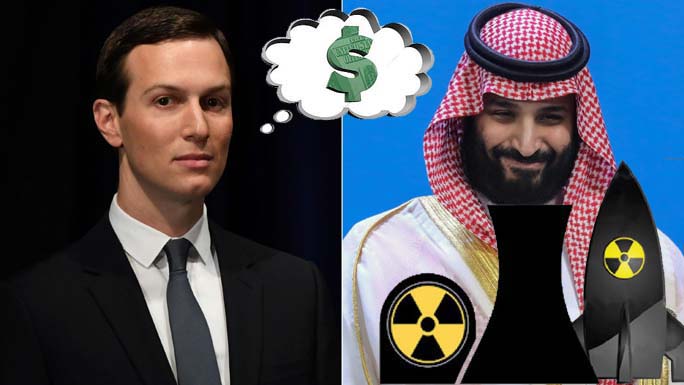
Trump’s son-in-law, Jared Kushner, helping Saudi Crown Prince towards getting nuclear weapons?

Jared and the Saudi Crown Prince Go Nuclear? https://www.nytimes.com/2019/03/02/opinion/sunday/saudi-arabia-jared-kushner-nuclear.html

There are too many unanswered questions about the White House’s role in advancing Saudi ambitions. By Nicholas Kristof, March 2, 2019

Jared Kushner slipped quietly into Saudi Arabia this week for a meeting with Crown Prince Mohammed bin Salman, so the question I’m trying to get the White House to answer is this: Did they discuss American help for a Saudi nuclear program?

Of all the harebrained and unscrupulous dealings of the Trump administration in the last two years, one of the most shocking is a Trump plan to sell nuclear reactors to Saudi Arabia that could be used to make nuclear weapons.

Even as President Trump is trying to denuclearize North Korea and Iran, he may be helping to nuclearize Saudi Arabia. This is abominable policy tainted by a gargantuan conflict of interest involving Kushner.

Kushner’s family real estate business had been teetering because of a disastrously overpriced acquisition he made of a particular Manhattan property called 666 Fifth Avenue, but last August a company called Brookfield Asset Management rescued the Kushners by taking a 99-year lease of the troubled property — and paying the whole sum of about $1.1 billion up front.

Alarm bells should go off: Brookfield also owns Westinghouse Electric, the nuclear services business trying to sell reactors to Saudi Arabia.

Saudi swamp, meet American swamp.

It may be conflicts like these, along with even murkier ones, that led American intelligence officials to refuse a top-secret security clearance for Kushner. The Times reported Thursday that Trump overruled them to grant Kushner the clearance.

This nuclear reactor mess began around the time of Trump’s election, when a group of retired U.S. national security officials put together a plan to enrich themselves by selling nuclear power plants to Saudi Arabia. The officials included Michael Flynn, Trump’s national security adviser, and they initially developed a “plan for 40 nuclear power plants” in Saudi Arabia, according to a report from the House Oversight and Reform Committee. The plan is now to start with just a couple of plants.

As recently as Feb. 12, Trump met in the White House with backers of the project and was supportive, Reuters reported.

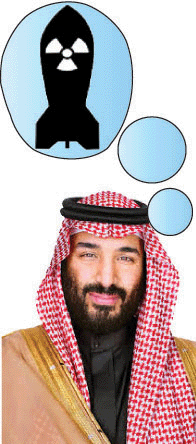
These are civilian nuclear power plants, and Saudi Arabia claims it wants them for electricity. But the Saudis insist on producing their own nuclear fuel, rather than buying it more cheaply abroad. Producing fuel is a standard way for rogue countries to divert fuel for secret nuclear weapons programs, and the Saudi resistance to safeguards against proliferation bolsters suspicions that the real goal is warheads.

Trump may be vigilant (destructively so) about Iran’s nuclear plants, but in the Saudi case his response seems to be: There’s money to be made! When Israeli Prime Minister Benjamin Netanyahu raised objections to the transfer last year, Axios reported, “Trump and his advisers told Netanyahu that, if the U.S. does not sell the Saudis nuclear reactors, other countries like Russia or France will.”

Trump seems to believe that the Saudis have us over a barrel: If we don’t help them with nuclear technology, someone else will. That misunderstands the U.S.-Saudi relationship. The Saudis depend on us for their security, and the blunt truth is that we hold all the cards in this relationship, not them.

Why on earth would America put Prince Mohammed on a path to acquiring nuclear weapons? He is already arguably the most destabilizing leader in an unstable region, for he has invaded Yemen, kidnapped Lebanon’s prime minister, started a feud with Qatar, and, according to American intelligence officials, ordered the murder of the Washington Post columnist Jamal Khashoggi.

The prince has also imprisoned and brutally tortured women’s rights activists, including one who I’m hoping will win the Nobel Peace Prize, Loujain al-Hathloul. As Representative Brad Sherman, a California Democrat, has noted, “A country that can’t be trusted with a bone saw shouldn’t be trusted with nuclear weapons.”

There’s another element of Trump’s Saudi policy that is simply repulsive: the fawning courtship of a foreign prince who has created in Yemen the world’s worst humanitarian crisis, murdered a journalist and tortured women’s rights activists. The White House genuflections are such that Prince Mohammed had a point when, according to The Intercept, he bragged that he had Kushner in his “pocket.”

No one knows whether Prince Muhammed will manage to succeed his father and become the next king, for there is opposition and the Saudi economic transformation he boasts of is running into difficulties. Trump and Kushner seem to be irresponsibly trying to boost the prince’s prospects, increasing the risk that an unstable hothead will mismanage the kingdom for the next 50 years. Perhaps with nuclear weapons.

March 4, 2019 Posted by | business and costs, politics international, Saudi Arabia, secrets,lies and civil liberties, USA | Leave a comment

Rolls Royce largely getting out of the nuclear industry

Times 3rd March 2019 Rolls-Royce is selling the vast bulk of its civil nuclear business, dealing a new blow to efforts to rebuild Britain’s atomic power industry. The FTSE 100 engineer has hired consultants from KPMG to find a buyer for the
nuclear division, which could fetch up to £200m.

The move marks the end of an era for the country’s premier engineering company, which has more than 50 years’ expertise in nuclear power but is being slimmed down by chief executive Warren East to focus on jet engines, power generators and defence. The nuclear business makes instruments and controls to monitor radiation and temperature and prevent reactors overheating. Its equipment is installed in more than 200 reactors around the world, and it has a big presence in France, where it works with the state-backed engineering firm Orano , [formerly Areva, which went bankrupt]

Rolls-Royce’s retreat from civil nuclear work reflects the industry’s broader problems. Plans for new power stations in Britain have been left in tatters after the Japanese industrial giants Toshiba and Hitachi withdrew, leaving just Hinkley Point in Somerset under way.

The Japanese exit has triggered an inquiry by the Commons business committee into future investment in energy infrastructure. The sale will not include Rolls-Royce’s work on Hinkley Point, which is ringfenced, the company’s
project to develop small reactors or its nuclear submarine reactor business.

Rolls-Royce has been in talks to install its equipment at a plant in Essex planned by China General Nuclear, to help assuage security concerns. This work is likely to be transferred to the new owner. Sources said the business, which has more than 1,000 staff, was likely to go to a trade buyer. A Chinese deal is unlikely.

https://www.thetimes.co.uk/edition/business/rolls-royce-to-offload-civil-nuclear-unit-zsq59zlmm

March 4, 2019 Posted by | business and costs, UK | Leave a comment

Cold War-like arms race is likely to follow the collapse of a historic nuclear treaty

Why the collapse of a historic nuclear treaty could lead to a Cold War-like arms race, ABC News, 

Key points:

  • The landmark INF treaty was integral to ending the Cold War
  • Short and intermediate range missiles were banned because of the short flight time
  • Analyst say it’s unlikely to be renegotiated within the six-month notice period

Last week, Russian President Vladimir Putin said Russia was ready for a Cuban Missile-style crisis if the US wanted one, referring to the 1962 standoff that brought the world to the edge of nuclear war.

Decades later, tensions between the two nations are heating up again.

Mr Putin warned that Moscow would retaliate if the US placed new missiles closer to Russia, telling local media that Moscow could deploy hypersonic missiles on ships and submarines outside US territorial waters.

The comments were made after the Trump administration announced it would officially abandon a historic nuclear pact that had kept nuclear missiles out of Europe for three decades.

Here’s a look at what the treaty is, what may come next, and why analysts believe its demise could lead to a 21st-century arms race.

The Intermediate-Range Nuclear Forces Treaty (INF) bans the US and the Russian Federation, previously the Soviet Union, from developing, testing and possessing short- and intermediate-range missiles that could be launched from the ground, as opposed to the sea or sky.

The treaty — signed by former US president Ronald Reagan and Soviet leader Mikhail Gorbachev in December 1987 — declared that “nuclear war cannot be won and must never be fought” and took seven years to negotiate.

Both sides agreed to destroy a total of 2,692 short-, medium- and intermediate-range missiles with a range between 500 and 5,500 kilometres that were stationed in, or aimed at Europe.

The treaty is credited with helping to ending the Cold War.

Maria Rublee, a former US intelligence officer and nuclear politics expert at Monash University, told the ABC these missiles were seen as a “hair trigger for nuclear war” due to how quickly they could strike a target.

“You don’t have time to talk, to pick up the phone, the red hotline, to say what’s going on and ask if this is a mistake.”

Washington and its North Atlantic Treaty Organisation (NATO) allies claim Moscow has been violating the terms of the treaty by developing missiles within the range for years, but Russia has repeatedly denied the allegations.

Earlier this month the Trump administration declared it would suspend US obligations under the treaty, with the intention of withdrawing because of Russia’s alleged non-compliance.

The day after the announcement, Russia also said it would withdraw from the treaty, and accused the US of fabricating the allegations so it could develop new missiles.

The treaty is not dead just yet — both parties must give six months notice before they can officially withdraw — but Dr Rublee said the chances of the treaty being revived were low, although there was some hope.

“[The first step] is not going to come from the Trump administration and it’s not going to come from Russia,” she said.

“It would need to come from NATO because the countries most at risk are European countries.”…….. https://www.abc.net.au/news/2019-03-03/collapse-of-treaty-could-lead-to-new-arms-race/10845950

March 4, 2019 Posted by | politics international, Russia, USA, weapons and war | Leave a comment

It was easy enough to build U.S army’s nuclear stations – but difficult to get rid of them

Kerr: Army planning to demolish Fort Belvoir’s nuclear plant Inside Nova, BY DAVID KERR 3 Mar 19″……

Fort Belvoir’s SM-1 nuclear power plant in 1957.  The plant was in operation for 16 years. It was shut down in 1973 and its nuclear core was removed.  …..

The Army built another working nuclear plant at Fort Greely in Alaska that at the time was serving as an interceptor missile launch site. They also built one on a Liberty Ship called the U.S.S. Sturgis.  That plant, built at Fort Belvoir, in Gunston Cove, was used as a floating power source for facilities in the Panama Canal Zone.

There was also one at the South Pole’s McMurdo Station.  It ran for almost 12 years. Alas, all of these sites ran up against two problems.  First, they turned out to be more expensive to operate than expected. Secondly, by the early 1970s anxiety was growing over nuclear power.  Was it such a good idea to have small nuclear plants? It didn’t sound safe.

As for the South Pole nuclear facility, unlike its counterparts in the U.S., that was demolished almost immediately.  Roughly 12,000 pounds of radioactive material were shipped to a secure nuclear waste site in the United States.

Just how safe this procedure was, given the site’s remoteness and the absence of guidelines for handling radioactive debris at the time, remains an open question.

As for the SM-1, when the core was removed, Army engineers decontaminated the underground liquid radioactive waste tanks and filled them with concrete.  They then sealed the reactor dome, removed the underground piping, tore down some uncontaminated structures and began a decades-long effort to monitor and continually assess the site.

They did the same at Fort Greely.

Now, the facilities are getting old and since they’re still radioactive, the Army wants to go ahead and demolish these facilities. But this is not your average construction contract or your average hazardous waste management project. These are nuclear facilities; everything about them has special requirements.  …….

The SM-1 and its sister facilities were a part of our country’s early commitment to nuclear power and all that it might accomplish.  Our nuclear industry learned a lot from their operations. However, while they were relatively easy to build, it’s turned out to be a lot more difficult to get rid of them than anyone ever would have imagined in the 1950s.  https://www.insidenova.com/opinion/columnists/kerr-army-planning-to-demolish-fort-belvoir-s-nuclear-plant/article_f8b43228-3d4d-11e9-8098-eb75c50b06d9.html

March 4, 2019 Posted by | decommission reactor, USA | Leave a comment

U.S. army wants risky small modular nuclear reactors

The Army wants mobile nuclear reactors for FOBs, but some scientists say that’s ‘naive’, Army Times Todd South  3 Marc 19, The Army wants to bring back mobile nuclear reactors to power forward bases and is asking industry how to make that happen.

March 4, 2019 Posted by | business and costs, spinbuster, USA, weapons and war | Leave a comment

Is it safe to keep ageing nuclear stations running until 2054?

Peach Bottom, other U.S. nuclear power plants could be running until 2054. Is it safe? The Inquirer, by Andrew Maykuth,  February 28, 2019   …….. The Peach Bottom plant, 60 miles west of Philadelphia near the Maryland border, is operating under a 20-year extension from its original 40-year license, like many of America’s aging fleet of nuclear reactors. Last year it became one of the first plants to apply for what the Nuclear Regulatory Commission calls a “Subsequent License Renewal” — that would permit the reactors to run through 2053 and 2054, when they turn 80 years old.

March 4, 2019 Posted by | safety, USA | Leave a comment

Huge workforce at Flamanville nuclear reactor, employed to fix unsafe welds

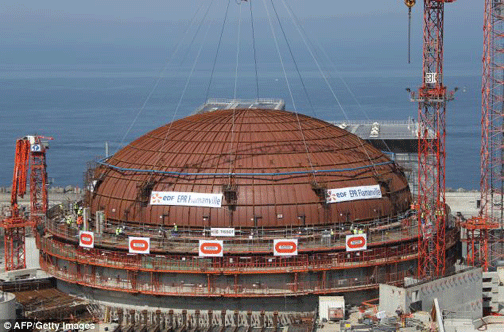
**Flamanville*  Tendance Ouest 1st March 2019 EDF announced that “500 people will intervene to take over twenty welds” non-compliant on the site of the nuclear reactor. A team that will add to
the current workforce of the site, already 3800 people. The operation
should take place in the fall, “after our hot tests , ” said Bertrand
Michoud, director of facilities at the EPR Flamanville.

https://www.tendanceouest.com/actualite-313403-epr-de-flamanville-500-personnes-pour-reprendre-20-soudures-sur-le-chantier.html

March 4, 2019 Posted by | France, safety | Leave a comment

Major presidential candidate in USA running on climate action policy

Think Progress 1st March 2019 , For the first time in history, a major presidential candidate is putting
climate change center stage in their campaign. Washington Gov. Jay Inslee
(D) announced on Friday he will seek to challenge President Donald Trump in
2020. “This is our moment, our climate, our mission — together, we can
defeat climate change. That’s why I’m running for president,” Inslee
said on Twitter. In a video announcing his presidential campaign, he called
climate change “the most urgent challenge of our time,” adding,
“we’re the first generation to feel the sting of climate change. And
we’re the last that can do something about it.”

https://thinkprogress.org/washington-governor-jay-inslee-running-for-president-climate-change-6cd8755ed1d7/

March 4, 2019 Posted by | climate change, politics, USA | Leave a comment

USA officials worried about Saudi Arabia’s nuclear plans

Middle East Monitor 2nd March 2019 , Doubts have been raised about Saudi Arabia’s plans for its nuclear
capabilities, which it maintains are for peaceful purposes, to meet its
population’s energy needs. However a US body charged with looking in to
Saudi’s nuclear plans has warned that “many whistleblowers have warned
against conflicts of interest that could fall within the scope of the
Federal Criminal Law.” The Committee on Oversight and Reform issued the
warning after President Donald Trump announced he intended to sell
“sensitive nuclear technology” to Saudi Arabia to benefit US companies.

https://www.middleeastmonitor.com/20190302-us-officials-question-saudis-nuclear-plans/

March 4, 2019 Posted by | Saudi Arabia, secrets,lies and civil liberties, USA | Leave a comment

A BIG boondoggle – Nuclear And Emerging Technologies For Space

Nuclear In Space — The NETS Meeting, Forbes 28 Feb 19 James Conca  The NETS meeting is wrapping up today at the Pacific Northwest National Laboratory in Richland, Washington. The Nuclear And Emerging Technologies For Space is an annual gathering of people from NASA, National Laboratories, industry, and academia to discuss space nuclear power and propulsion as well as new and emerging technologies that make further space exploration possible…….

The space market, now about $400 billion/year, is set to grow to between $1 trillion and $4 trillion per year by 2040). Last year, the market for electricity in the United States was only $400 billion. So the economic push is great to evolve these systems. Jeff Bezos (Blue Origin) and Elon Musk (SpaceX) started their companies with the mission of enabling millions of people to live and work in space. SpaceX launch vehicles have dropped the cost of spaceflight by a factor of 15, and that should continue to drop by another factor of 5. …….
So the gateway to space is open in the way that the internet was opened in the 1990’s. And nuclear energy is the power that will get us through that gate. When humans are ready to live and work in space, nuclear energy must be ready as well. That nuclear poweris the safest energy source on Earth doesn’t hurt.  https://www.forbes.com/sites/jamesconca/2019/02/28/nuclear-in-space-the-nets-meeting/#1929eb8e465a

March 4, 2019 Posted by | technology, USA | Leave a comment

Destructive power of nuclear explosions documented as never before

March 4, 2019 Posted by | USA, weapons and war | Leave a comment

Japan’s nuclear watchdog concerned at possibility of volcano near nuclear station

RA eyes seabed watch of caldera near Kagoshima nuclear plant, Asahi Shimbun, By CHIKAKO KAWAHARA/ Staff Writer March 3, 2019  The nightmare scenario of a volcanic crater erupting and spewing a pyroclastic flow that engulfs a nuclear plant, causing catastrophic levels of radiation to leak into the atmosphere, doesn’t appear on the horizon … just yet.But the nation’s nuclear watchdog is taking no chances. It plans to install seabed sensors to monitor potential crustal deformations on the Aira Caldera, located just 40 kilometers from the Sendai nuclear power plant in Kagoshima Prefecture.

Little is known of processes that lead to giant eruptions of calderas, or ground depressions formed by volcanic activity, due to a lack of observation data. Such eruptions are extremely rare and occurs every 10,000 years in Japan.

The Aira Caldera, in Kagoshima Bay, was the site of a giant eruption around 30,000 years ago.

The Nuclear Regulation Authority has so far relied on land-based seismic and other sensors to indirectly monitor magma activity and other changes beneath the seabed.

Starting in the new fiscal year from April, the NRA will set up seismic sensors and water-pressure gauges on the seafloor for additional monitoring……..

Huge calderas exist within a 160-km radius of other nuclear plants in Japan, including Kyushu Electric’s Genkai plant in Saga Prefecture, Shikoku Electric Power Co.’s Ikata plant in Ehime Prefecture and Hokkaido Electric Power Co.’s Tomari plant. The NRA intends to conduct studies in those areas, too………http://www.asahi.com/ajw/articles/AJ201903030001.html 

March 4, 2019 Posted by | Japan, safety | 1 Comment

Kim Kardashian West demands Trump, Newsom, lead cleanup of Santa Susana Nuclear Site

Kim Kardashian West demands Trump, Newsom, lead cleanup of Santa Susana Field Lab

Her tweet has sparked hope among nearby residents that the government will act more quickly to clean up the old Cold War site. https://www.dailybulletin.com/2019/03/01/kim-kardashian-west-demands-trump-newsom-lead-clean-up-of-santa-susana-field-lab/ By OLGA GRIGORYANTS | ogrigoryants@scng.com | Los Angeles Daily News  March 1, 2019 

Celebrity Kim Kardashian West is calling on President Donald Trump and other government leaders to lead a cleanup of the contaminated Santa Susana Field Laboratory in the hills above San Fernando and Simi valleys, sparking enthusiasm among residents who have long demanded the action.

Kardashian, who lives in nearby Hidden Hills, demanded via Twitter Wednesday that Trump, Gov. Gavin Newsom and U.S. Energy Secretary Rick Perry help push for the clean up the former nuclear and rocket engine testing site near many Valley schools and homes.

“(The California Department of Toxic and Substance Control, or DTSC, the federal Department of Energy and NASA) promised to clean up contaminated Santa Susana Field Lab by 2017, but the job hasn’t even begun!” Kardashian West shared with nearly 60 million followers. “Time to reform DTSC, and for (the federal agency) to keep its promises.”

March 4, 2019 Posted by | environment, USA | Leave a comment

New report highlights the inability of USA to deal with nuclear waste

March 2, 2019 Posted by | politics, USA, wastes | Leave a comment

Along the 2020 Olympics torch route in Japan – higher radiation levels

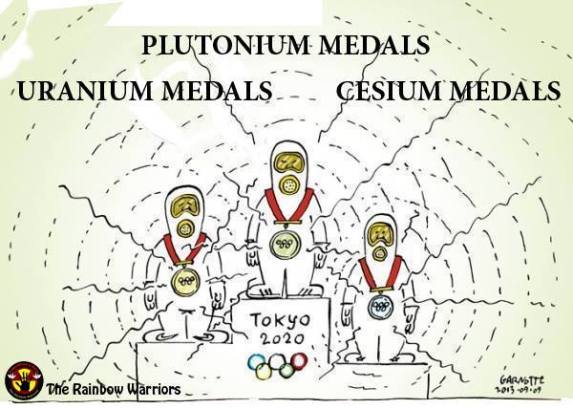
Atomic Balm Part 1: Prime Minister Abe Uses The Tokyo Olympics As Snake Oil Cure For The Fukushima Daiichi Nuclear Meltdowns  Fairewinds Energy Education, By Arnie Gundersen “……….To determine whether or not Olympic athletes might be affected by fallout emanating from the disaster site, Dr. Marco Kaltofen and I were sponsored by Fairewinds Energy Education to look at Olympic venues during the fall of 2017.We took simple dirt and dust samples along the Olympic torch route as well as inside Fukushima’s Olympic stadium and as far away as Tokyo. When the Olympic torch route and Olympic stadium samples were tested, we found samples of dirt in Fukushima’s Olympic Baseball Stadium that were highly radioactive, registering 6,000 Bq/kg of Cesium, which is 3,000 times more radioactive than dirt in the US. We also found that simple parking lot radiation levels were 50-times higher there than here in the US.

Thirty of the dirt and fine dust samples that I took on my last two trips to Japan in February and March 2016 and September 2017 were analyzed at WPI (Worchester Polytechnic Institute. The WPI laboratory analysis are detailed in the report entitled: Measuring Radioactivity in Soil and Dust Samples from Japan, T. Pham, S. Franca and S. Nguyen, Worchester Polytechnic Institute, which found that:

With the upcoming XXXII Olympiad in 2020 hosted by Japan, it is necessary to look into the radioactivity of Olympic venues as well as tourist attractions in the host cities… Since thousands of athletes and millions of visitors are travelling to Japan for the Olympics, there has been widespread concern from the international community about radiation exposure. Therefore, it is important to investigate the extent of radioactive fallout from the Fukushima Dai-ichi incident.

The measured results showed a much higher activity of Cesium-137 in the proposed torch route compared to other areas. Overall, the further away from the Fukushima Dai-ichi Nuclear Power Plant, the lower the radioactivity. The activity of Cesium-137 in Tokyo, the furthest site from the plant, was the lowest when compared to the other sites. Therefore, the activity of Cesium-137 in Tokyo sample was used as the baseline to qualitatively estimate the human exposure to radiation.

At the Azuma Sports Park, the soil and dust samples yielded a range of 78.1 Bq/kg to 6176.0 Bq/kg. This particular Olympic venue is around 90 km from the Nuclear Power Plant. The other sites that are closer to the Nuclear Power Plant like the tourist route, proposed torch route, and non-Olympic samples have higher amounts due to the close proximity to ground zero of the disaster.

… the proposed torch route samples had the highest mean radioactivity due to their close proximity to the plant. Based on the measurement, we estimated qualitatively that the radiation exposure of people living near the Azuma Sports Park area was 20.7 times higher than that of people living in Tokyo. The main tourist and proposed torch routes had radiation exposure of 24.6 and 60.6 times higher, respectively, than in Tokyo…. Olympic officials should consider using the results of this project to decide whether the radioactivity level at the proposed torch route and the Olympic venues are within acceptable level……  https://www.fairewinds.org/demystify/atomic-balm-part-1-prime-minister-abe-uses-the-tokyo-olympics-as-snake-oil-cure-for-the-fukushima-daiichi-nuclear-meltdowns

March 2, 2019 Posted by | environment, Japan, radiation | Leave a comment