Lee Yuan-tseh pushes nuclear phase-out http://www.taipeitimes.com/News/taiwan/archives/2019/03/12/2003711332 By Lin Chia-nan / Staff reporter Local industries should upgrade their production techniques to curb carbon emissions, and the nation should phase out nuclear power to avoid leaving more nuclear waste to future generations, former Academia Sinica president Lee Yuan-tseh (李遠哲) told an energy conference in Taipei.The conference was hosted by the Taiwan Environmental Protection Union (TEPU) and other anti-nuclear groups, following another energy forum on Sunday organized by former president Ma Ying-jeou (馬英九) and former premier Jiang Yi-huah (江宜樺) that called for maintaining nuclear power.
Advocates of nuclear power have gained more momentum after most people voted in favor of abolishing the “nuclear-free homeland by 2025” policy in a referendum on Nov. 24 last year.
Attendees — including Democratic Progressive Party Legislator-at-large Chen Man-li (陳曼麗) and New Power Party Legislator Huang Kuo-chang (黃國昌) — first prayed for victims of the Fukushima Dai-ichi nuclear power plant disaster on March 11, 2011.
Phasing out nuclear power is not only a security concern, but would also curb nuclear waste, said Lee, Taiwan’s first Nobel laureate in chemistry in 1986, adding that the older generation should not leave nuclear waste to future generations for their own convenience.
The nation needs to develop small-scale renewable energy generation systems to curb fossil fuel pollution and global warming, he said.
The global community might start tracking companies’ carbon footprints in two or three years, so local firms should start cutting their use of fossil fuels, he said, reiterating his suggestion that the government implement a carbon tax to curtail emissions.
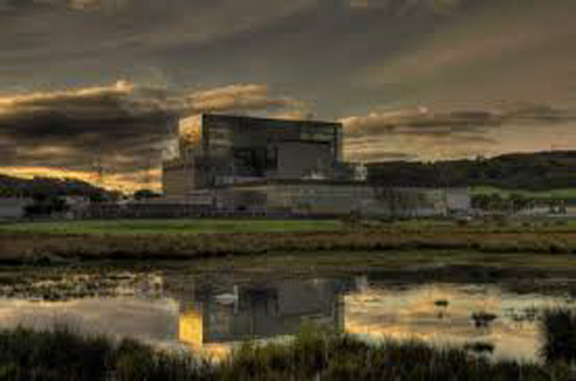
The TEPU is working on two referendum proposals, including one recommending that the mothballed Fourth Nuclear Power Plant compound be converted into a site for renewable power research and development, union founding chairman Shih Shin-min (施信民) said.
The second proposal asks: “Do you agree that any construction or extended operation plans for nuclear power plants can only begin after they are approved by local referendum voters within the 50km-radius of the plants?”
The proposals are aimed at countering two referendum proposals by nuclear power advocates that seek to continue construction of the mothballed plant and to extend the permits of three operational nuclear power plants, Shih said.
The annual parade against nuclear power is scheduled for April 27, which would focus on renewable power development, Green Citizens’ Action Alliance deputy secretary-general Hung Shen-han (洪申翰) said.
Separately, President Tsai Ing-wen (蔡英文) wrote on Facebook that the Fukushima Dai-ichi disaster pushed Taiwanese to seriously consider energy issues and the then-Chinese Nationalist Party (KMT) administration to mothball the plant.
While people hold varied views about when the nuclear-free homeland policy should be achieved, it is the nation’s common goal to ensure that the next generation has safe power generation, Tsai wrote.
‘You’re Contaminated’: The Stigma Against Japan’s Fukushima Survivors, Broadly, 12 Mar 19,
A 2011 quake and tsunami led to a meltdown at the Fukushima Daiichi Nuclear Power Plant, killing thousands and displacing more. Two ‘nuclear refugees’ explain why returning home is more complicated than it seems.
…….. While the nuclear disaster is becoming a distant memory for most Japanese, for some others it is their everyday reality. Nuclear refugees and evacuees face discrimination, separation from loved ones, and in some cases, they are even forced to return to the former evacuation zone.
The government, worried about people getting exposed to radiation, declared a 20-km evacuation zone around the plant and uprooted close to 165,000 people. As of today, there are still 50,000 people who haven’t returned to Fukushima.
Keiko Owada, 66, is one of them. When I meet her in Tokyo, she refers to the Japanese capital as her home for the past seven years. That will soon change due to the government’s decision to withdraw her free housing subsidies.
Because decontamination work has made progress and food declared safe from radiation, it has been deemed safe to return to most villages within the evacuation zone. The same goes for Owada’s village Naraha, where the evacuation order was lifted two years ago.
Owada is not excited about the prospect of returning to Naraha. “Would I continue to get financial support for my apartment here in Tokyo, I would have stayed here, yes. I’ll tell you why: there is no hospital in Naraha, only a small hospital for first aid. There is no supermarket, only a small convenience store. And the reason is simple: only a few people have returned.”
Life as an evacuee hasn’t always been easy, Owada explains. “It wasn’t like people were treating me any different, but my neighbors never greeted me. I think it’s because of the compensation I received and the free housing. They knew I was from Fukushima, that’s why.”
According to Owada, some of the other evacuees in Tokyo she knows have faced harsher treatment. “I know of others whose cars were damaged on purpose because they had a Fukushima license plate. That’s why I never parked my car in the middle of the parking lot, but always in a corner, so no one could see it.”
If anything, Owada’s story illustrates how many evacuees continued to live in fear. Displaced from their homes, dropped in a new community—the disaster is anything but over for them. ……….
When Kamata got in touch with relatives living in other parts of Japan, she was shocked to hear one sister-in-law’s initial response. “After the disaster, I wanted to flee to Chiba [a prefecture next to Tokyo], my sister-in-law picked up the telephone and told me I didn’t have to come to their house. ‘You’re contaminated,’ she told me.”……….
As Kamata remembers what life was like back in Fukushima, she uses a handkerchief to wipe a tear from her cheek. She barely speaks to her friends anymore.
https://havanatimes.org/?p=149927 March 9, 2019 By Akio Matsumura HAVANA TIMES – On March 11, we commemorate the 8th anniversary of the Fukushima nuclear disaster. To an outside observer, this anniversary passes as a technical progress report, a look at new robot, or a short story on how lives there are slowly returning to normal.
Yet in Japan, the government has not figured out how to touch or test the irradiated cores in the three crippled reactors, which continue to contaminate water around the site of the melt down. The government does not know where it will put that radioactive material once it can find a way to move it.
Meanwhile, the government and site operator are running out of room to store the contaminated water, which is filling up more and more tanks. The cleanup is estimated to take forty years and the cost is estimated at $195 billion.
The latest publicly released findings of radiation levels are from 2017, when Tokyo Electric Power Company had to use a remote-controlled robot to detect the levels in Reactor 2, since no human can approach the crippled reactor.
The rates read 530 sieverts per hour, the highest since the March 2011 meltdown. We have no reason to believe that they have fallen since then. Remote-control robots are being used in the other reactors as well, indicating that radiation levels are similarly high there.
Even using the robot, work can only be carried out for very short times, since the robots can only stand 1000 sieverts of exposure – less than two hours in this case.
This is an extremely high amount of radiation. After TEPCO published the rate, the Asahi Shimbun reported that “an official of the National Institute of Radiological Sciences said medical professionals have never considered dealing with this level of radiation in their work.”
The Japan Times quoted Dr. Fumiya Tanabe, an expert on nuclear safety, who said that the “findings show that both the preparation for and the actual decommissioning process at the plant will likely prove much more difficult than expected.”
Fukushima’s Children Need International Attention
There have been many victims of this disaster. Thousands of people have been displaced from their homes. Local fishermen are worried that the government will proceed with its plan to dump the storage tanks of contaminated water into the ocean.
Others worry that the flow of the radioactive wind and contaminated water are reaching North America and will continue to do so for the next forty years.
Above all of these important issues, it is the children of Fukushima who most need our attention. They are at risk of higher rates of cancer because of their exposure to the contamination from the initial explosion. In Chernobyl, the only comparable case we have, more than 6,000 cases of thyroid cancer were found in children according to the UN through 2005.
There is evidence that thyroid cancer rates are higher among Fukushima’s children than the national population, but it is a latent disease: it is still too early to tell what the full impact will be. But it is clear the case needs action.
Scientists will always offer different opinions, swayed first by uncertainty, but also, sadly, by politics, money, and ambition.
Some will claim that the evidence has been exaggerated, underestimated, or that perhaps we’re at too early a stage to be certain. Or that we need more time to clarify the results. I have seen many instances of these arguments at the United Nations and international science conferences. Why do we wait and make another mistake?
Helen Caldicott, a medical doctor and founding president of Physicians for Social Responsibility, part of a larger umbrella group that was awarded the Nobel Peace Prize in 1985, wrote: “The truth is that most politicians, businessmen, engineers and nuclear physicists have no innate understanding of radiobiology and the way radiation induces cancer, congenital malformations and genetic diseases which are passed generation to generation. Nor do they recognize that children are 20 times more radiosensitive than adults, girls twice as vulnerable as little boys and fetuses much more so.”
UNICEF Can Lead
We face many complex challenges of climate change, poverty alleviation, and national security. The health and welfare of children must always be our top priority. They are our future; our deepest purpose is to care and provide for them. By deciding not to fully investigate the effects of Fukushima, we fail them.
We all agree with that personally, but which institution is best positioned to carry out the mission? To me, UNICEF, the United Nations Children’s Fund, is the only answer. Indeed, putting children above national security is at UNICEF’s core.
Maurice Pate, an American humanitarian and businessman who joined UNICEF at its inception in 1947, agreed to serve as the Executive Director upon the condition that UNICEF serves the children of “ex-enemy countries, regardless of race or politics.” In 1965, at the end of Pate’s term, the organization won the Nobel Peace Prize.
To this day, its mission includes a commitment to “ensuring special protection for the most disadvantaged children – victims of war, disasters, extreme poverty, all forms of violence and exploitation and those with disabilities.” The children of Fukushima deserve the protection of UNICEF.
—— *Akio Matsumura is also the Secretary General of the Global Forum Moscow Conference hosted by President Gorbachev at the Kremlin in 1990 as well as of the Parliamentary Earth Summit Conference hosted by Brazil National Assembly in Rio de Janeiro in 1992
Trust fails to recover from nuclear disaster, Borneo Bulletin March 10, 2019 Simon Denyer ……….facts and spreadsheets supplied by the government are one thing.
Rebuilding trust among locals may be significantly harder, thanks to a culture of cover-ups and denials that contributed to the nuclear accident and continues to dog Japan’s efforts to restart its nuclear industry, experts say.
…….. at least 24 countries and territories ban some produce from Fukushima. South Korea and China still impose a total food ban. The US prohibits Fukushima produce such as mushrooms, leafy vegetables and broccoli. Fishermen now only ply the seas two days a week: Fish from Fukushima, which once enjoyed a high reputation in Tokyo’s fish market, is no longer the flavour of the day.
The government blames “harmful rumours”, a phrase that dominated the two-day press tour and has been labelled the fourth disaster to hit Fukushima, after the earthquake, tsunami and nuclear accident.
Yet there is a much deeper trust deficit that remains extremely hard to overcome.
Tokyo Electric Power Company (TEPCO), the operator of the ill-fated plant, spent two months after the nuclear disaster denying that a meltdown had occurred. TEPCO later apologised for a “cover-up” that remains the source of much bitterness among people here.
Katsunobu Sakurai, former mayor of the nearby town of Minamisoma, said TEPCO gave out very little information about the disaster during a chaotic evacuation that ultimately led to the deaths of 3,700 people, including many elderly people whose medical care was interrupted.
In 2012, TEPCO was forced to admit that it had failed to heed safety warnings before the accident, or even consider the risk of a large tsunami, because it feared doing so would undermine public confidence in the industry.
Experts say TEPCO has still failed to come clean about the problems associated with decommissioning the reactors and
Bags of nuclear waste generated after the meltdown of one of Fukushima’s nuclear power plants in 2011 are now stored in the nearby town of Naraha. MUST CREDIT: photo for The Washington Post by Shiho Fukada.
decontaminating the environment.
“To me, talking about ‘harmful rumours’ sounds like they are making someone else the bad guy or villain, as if they are blaming people for saying negative things because they don’t understand science and radiation,” said Riken Komatsu, a community activist in Onahama.
“But those who have lost our trust do not have the right” to talk about harmful rumours, Komatsu added.
The government and TEPCO say the nuclear power plant itself could take 30 or 40 years to decommission and estimates the cleanup will cost 22 trillion yen (USD200 billion).
But in 2015, the plant’s manager told London’s Times newspaper that the technological challenges involved in removing hundreds of tonnes of molten radioactive fuel from three reactors could mean decommissioning will take 200 years.
The Japan Center for Economic Research, a conservative think tank, estimates the cleanup bill could come to 50 trillion to 70 trillion yen (USD460 billion to 640 billion).
One of the biggest problems involves groundwater that seeps into the reactor buildings, mixes with cooling water and becomes radioactive.
TEPCO has been trying to limit water contamination ever since the accident, creating a mile-long “ice wall” of sunken, frozen soil around the reactors to keep water out, and another concrete wall to prevent it from reaching the ocean.
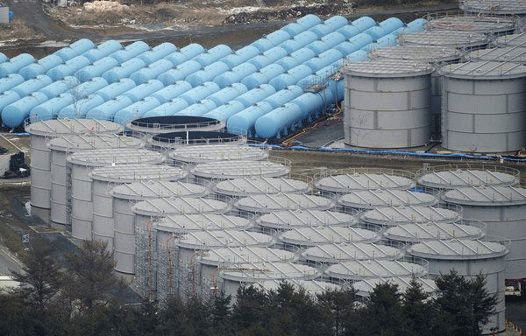
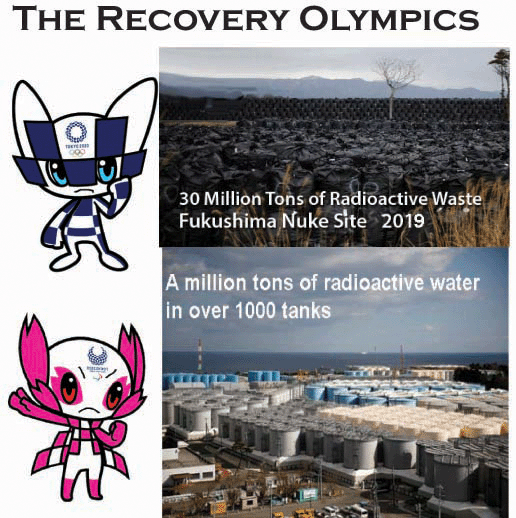
In 2016, TEPCO admitted that the ice wall was only slowing – but not preventing – water seeping in. Today, around 100 cubic metres of groundwater still become contaminated at Fukushima every day, and one million tonnes of radioactive water is stored in 994 huge tanks around the site.
A new tank fills up every seven to 10 days, and storage space is running out.
TEPCO had initially claimed that 26 out of 27 radioactive nuclides had been removed from that water through an advanced treatment system, living only tritium behind.
But after reports by Kyodo news and local media, and a protest by fishermen, the company acknowledged last September that 80 per cent of the tanks contain water that is still contaminated with dangerous radioactive elements, including strontium-90, a bone-seeking radionuclide that causes cancer.
Launching his successful bid for the 2020 Summer Olympics, Japanese Prime Minister Shinzo Abe said the situation at Fukushima was “under control”. One of his predecessors, Junichiro Koizumi said the water crisis showed that was a lie.
8 years on, contaminated water remains big problem for Fukushima clean-up, Japan Today, Mar. 10 By Kiyoshi Takenaka OKUMA
Eight years after the Fukushima nuclear crisis, a fresh obstacle threatens to undermine the massive clean-up: 1 million tons of contaminated water must be stored, possibly for years, at the power plant.
Last year, Tokyo Electric Power Co (TEPCO) said a system meant to purify contaminated water had failed to remove dangerous radioactive contaminants.
That means most of that water – stored in 1,000 tanks around the plant – will need to be reprocessed before it is released into the ocean, the most likely scenario for disposal.
Reprocessing could take nearly two years and divert personnel and energy from dismantling the tsunami-wrecked reactors, a project that will take up to 40 years.
It is unclear how much that would delay decommissioning. But any delay could be pricey; the government estimated in 2016 that the total cost of plant dismantling, decontamination of affected areas, and compensation, would amount to 21.5 trillion yen ($192.5 billion), roughly 20 percent of the country’s annual budget.
Tepco is already running out of space to store treated water. And should another big quake strike, experts say tanks could crack, unleashing tainted liquid and washing highly radioactive debris into the ocean.
Fishermen struggling to win back the confidence of consumers are vehemently opposed to releasing reprocessed water – deemed largely harmless by Japan’s nuclear watchdog, the Nuclear Regulation Authority (NRA) – into the ocean.
“That would destroy what we’ve been building over the past eight years,” said Tetsu Nozaki, head of the Fukushima Prefectural Federation of Fisheries Co-operative Associations. Last year’s catch was just 15 percent of pre-crisis levels, partly because of consumer reluctance to eat fish caught off Fukushima.
SLOW PROGRESS
On a visit to the wrecked Fukushima Daiichi plant last month, huge cranes hovered over the four reactor buildings that hug the coast. Workers could be seen atop the No. 3 building getting equipment ready to lift spent fuel rods out of a storage pool, a process that could start next month.
In most areas around the plant, workers no longer need to wear face masks and full body suits to protect against radiation. Only the reactor buildings or other restricted areas require special equipment.
Fanning out across the plant’s property are enough tanks to fill 400 Olympic-sized swimming pools. Machines called Advanced Liquid Processing Systems, or ALPS, had treated the water inside them. …..
The utility has promised to re-purify the water if the government decides that releasing it into the ocean is the best solution. It is the cheapest of five options a government task force considered in 2016; others included evaporation and burial.
TEPCO and the government are now waiting for another panel of experts to issue recommendations. The head of the panel declined an interview request. No deadline has been set.
……… STORING INDEFINITELY
Another option is to store the water for decades in enormous tanks normally used for crude oil. The tanks have been tested for durability, said Yasuro Kawai, a plant engineer and a member of Citizens’ Commission on Nuclear Energy, a group advocating abandoning nuclear energy.
Each tank holds 100,000 tons, so 10 such tanks could store the roughly 1 million tons of water processed by ALPS so far, he said.
The commission proposes holding the tritium-laced water, which has a half life of 12.3 years, in tanks for 123 years. After that, it will be one thousandth as radioactive as it was when it went into storage.
No Safe Dose – Berkeley
Although experts caution that tanks would be vulnerable to major quakes, Japan’s trade and industry minister, Hiroshige Seko, said the committee would consider them anyway.
“Long-term storage … has an upside as radiation levels come down while it is in storage. But there is a risk of leakage,” Seko told Reuters. “It is difficult to hold the water indefinitely, so the panel will also look into how it should be disposed of eventually.”
Space is also a problem, said Akira Ono, TEPCO’s chief decommissioning officer. By 2020, the utility will expand tank storage capacity by 10 percent to 1.37 million tons, and about 95 percent of total capacity will probably be used by the end of that year, he said.
“Tanks are now being built on flat, elevated spots in stable locations,” Ono said. But such ideal space is getting scarce, he added.
‘Recovery Olympics’ moniker for 2020 Games rubs 3/11 evacuees the wrong way, Japan Times, BY MAGDALENA OSUMISTAFF WRITER, 11 Mar 19,This is the fourth in a series examining how the northeast and the nation are progressing with efforts to deal with the March 2011 earthquake, tsunami and nuclear crisis.ISHINOMAKI, MIYAGI PREF. – The town of Rifu on the outskirts of Sendai is set to host 10 soccer matches during the 2020 Olympics and Paralympics in line with the organizers’ plan to tout the games as the “Recovery Olympics.”
For Rifu, expectations are high the 2020 Games will draw international attention and lure more tourists, as Tohoku’s tourism sector struggles to recover from the Great East Japan Earthquake and ensuing tsunami on March 11, 2001. As part of the plan, an arena in Miyagi Prefecture is set to get a face-lift for the games. …….
The central government hopes the quadrennial sports event will serve as a platform to show that the nation has recovered from the disasters.
But recovery wasn’t one of the original themes for the Tokyo Games. The concept was added when it became apparent Tokyo wouldn’t be able to secure all the venues needed in the capital or its vicinity. When organizers thus turned to the disaster-hit prefectures of Miyagi and Fukushima, which will host the softball and baseball games, the recovery spin was born, with officials saying the event would contribute to reconstruction.
Moreover, the reconstruction plan for the Tohoku region is expected to end when fiscal 2020 closes in March 2021, putting an end to various central government subsidies that helped both victims and municipalities.
“The Tokyo 2020 Games have become a goal for us to show the region has recovered,” said Yasuki Sato, a Miyagi Prefecture official tasked with coordinating the preparations.
As someone who believes he was deceived by the nuclear power lobby during his time as prime minister, he sees it as his duty.
“Just as Confucius said, for someone not to correct themselves after making a mistake — that is a true mistake.”
As Japan’s leader, Junichiro Koizumi backed nuclear power. Now he’s a major foe.WP By Simon Denyer, Akiko Kashiwagi contributed to this report.March 10 TOKYO— With his shock of white hair, his love for Elvis and his reputation as a maverick, Junichiro Koizumi was a burst of color in the sober, dark-suited world of Japanese politics more than a decade ago.
Today, Koizumi has come out of retirement to join a battle against the entrenched business and political interests he had tangled with in the past. A man known for his simple catchphrases has a new one to impart: “Zero nuclear power.”
Eight years after the March 11, 2011, nuclear meltdown at the Fukushima Daiichi Nuclear Power Plant, Koizumi is back in the spotlight, trying to harness the public’s growing distrust of nuclear power and rid his country of an industry he once promoted as prime minister from 2001 to 2006.
His reversal on nuclear power reflects a wider reconsideration across Japan after the Fukushima disaster, which was triggered by an earthquake and tsunami.
A February 2018 poll by Japan’s Asahi Shimbun newspaper found 61 percent of respondents against the nation’s nuclear power plants being restarted and 27 percent in support.
“Momentum is building,” Koizumi said in an interview. “I am getting a strong response. It’s only a matter of time.”
Embarrassed by his own role in advocating nuclear power, Koizumi says he has learned from his mistakes. But Japan’s establishment remains firmly behind nuclear plants, even as other nuclear critics often point out the dangers posed by Japan’s quakes and tsunamis, a word Japan gave the world.
“The disaster brought a severe crisis, but we can turn crisis into opportunity. We can manage ourselves with renewables,” he said. “Take Germany, for example. They saw the disaster in Japan and changed their energy policy. But of all countries, Japan has not changed. It’s truly incomprehensible.”
Japan shut down all of its 54 reactors after the Fukushima catastrophe. Explosions in three reactors sent a cloud of radioactive dust across vast swaths of northeastern Japan and forced 165,000 people to flee their homes.
But since Shinzo Abe was reelected prime minister in 2012, his government has been on a mission to get the nuclear power industry back on its feet.
Nine reactors have already been restarted, six more applications to restart have been approved by a new, nominally independent Nuclear Regulation Authority, and the government wants nuclear power to contribute 20 percent to 22 percent of the nation’s energy by 2030.
….A damning report by an independent parliamentary panel in 2012 concluded that the Fukushima Daiichi disaster was “profoundly man-made,” caused by a disregard of the risks of earthquakes by an industry determined to preserve the illusion that nuclear power was absolutely safe.
Instead of supervising the nuclear power industry, METI colluded with it, the report said. It said the risks of nuclear power were downplayed in a culture of “reflexive obedience” and a “reluctance to question authority.”
…… why are elected politicians so determined to press ahead? The answer, Koizumi asserted, lies in those same vested interests he has spent the best part of his career fighting.
……. So much money has also been invested in the industry that there is a reluctance to write investments off. But Koizumi says nuclear power is neither economic nor necessary. The country, he noted, survived without it for two years without a single blackout.
……. Other voices of criticism struggle to be heard.
Shigeaki Koga, an energy industry expert, says his career was sidelined at METI after he expressed doubts about the safety of nuclear power, until he was ultimately forced to resign. He has since emerged as a leading public critic of nuclear power.
Kunihiko Shimazaki, one of Japan’s leading seismologists, warned of the risks of earthquakes and tsunamis along the country’s northeast coast for years before the disaster struck, but his reports were generally ignored or buried. After March 2011, he served for two years with the nuclear regulator, and spoke out forcefully, but his term was not renewed.
……….. As someone who believes he was deceived by the nuclear power lobby during his time as prime minister, he sees it as his duty.
“Just as Confucius said, for someone not to correct themselves after making a mistake — that is a true mistake.”
Nuclear lobby forgot to invite critics to Romania’s EU debate, EU Observer By PETER TEFFER BRUSSELS, TODAY, 10 Mar 19,
Some 75 people showed up last month at an event organised at Romania’s EU embassy – its so-called ‘permanent representation’ in Brussels.
The topic was ‘How to create a climate-friendly future in Europe’. The sponsors were Foratom and Romatom, two nuclear lobby organisations.
Foratom calls itself “the voice of the European nuclear industry” and represents 15 national nuclear associations, including Romatom, which is a lobby group representing Romanian nuclear companies.
Their message was clear.
It was written on a banner next to the speakers’ lectern at the event on 19 February, which said: “Nuclear energy is essential to an EU low-carbon future”.
The nuclear lobby gave its message extra weight by attaching it to the six-month Romanian presidency of the EU Council.
But there was one thing missing – anyone with an even mildly critical view of nuclear energy. I have not received any invitation and as far as we can see nobody in our office has,” Klaus Rohrig, a green campaigner, told EUobserver afterwards.
Rohrig is the EU climate and energy policy coordinator at Climate Action Network (CAN) Europe, one of the leading environmental NGOs in the ‘Brussels bubble’.
“It is very likely that one of us would have gone to such an event [if there had been invitations], given its troubling focus on nuclear [energy] in the context of the EU’s long-term strategy,” said Rohrig……
Nuclear energy is the most expensive form of electricity production and has massive environmental costs,” Sebastian Mang, EU climate and energy policy adviser at Greenpeace, another leading NGO, told EUobserver.
But Mang also missed the Romanian EU presidency event because Greenpeace was also not invited.
“When discussing climate change people protecting the environment must have a voice,” said Mang.
EUobserver and a handful of other media were invited, according to a list of participants, which was distributed at the event. The invitation came in an email sent from a Foratom domain name.
But the debate was not publicly announced on the Romanian permanent representation’s website, nor on the websites of Foratom or Romatom.
The participants list – which also included people who registered, but who did not show up – consisted of 32 percent of people working for private companies.
Some 28 percent of registered participants came from one of the member states’ permanent representations in Brussels, while another 12 percent came from national ministries.
Around 13 percent of registrations came from employees of the European Commission.
There were no registrations from civil society representatives, unless one counted the handful of representatives of non-profit nuclear energy research institutes……..
The event was held just two weeks after CEO published a report on lobbying via the temporary EU presidencies, in which it said corporate sponsorship of rotating presidencies “now appears to be standard”.
The presidencies were “a target for lobbies both before and during the presidency, as a way to influence its agenda and to curry favour”, the report said.
EU member states have also use the presidency to promote national industries, the report added.
Climate scenarios
The idea of the nuclear lobby event at the Romanian embassy was to frame nuclear energy as part of the “Solutions for a 2050 carbon-free Europe”, as the meeting was titled……..
Ianfairlie 8th March 2019 On March 8, the BBC published a news item about cracks in the Hunterston B nuclear reactors. Whilst it is good that the story highlighted reporting of the safety issues surrounding the plant and, in particular, included photographs of the cracked graphite core, we wish to correct several inaccuracies.
The BBC article claims that early decommissioning could cause serious energy supply problems. This is simply not the case and is alarmist nonsense: the reality is that Scotland has, if anything, an oversupply of electricity. Both Hunterston and Torness could be closed without problem to Scotland’s electricity supplies.
The BBC article then states that “Concerns have also been raised about the consequences for local jobs if Hunterston closed early.”As pointed out in our article, few if any jobs would be lost if the reactors Hunterston B were closed permanently: dealing with the immense heat rates from radioactive decay even from closed reactors will guarantee jobs there for the first 2 to 3 years.
After that decommissioning will provide more jobs then when the reactors operated, just as is occurring at the closed reactors at Dounreay. The BBC cites Councillor Tom Marshall as stating: “Most of the large employers round about here have disappeared – and this is one of the last major employers.
So, if it is safe to run most people locally would be happy to see it running.” We obviously share the concerns of local people about deindustrialisation and the appalling effects of the UK Government’s uncivilised austerity programmes in Scotland. But local councillors should\ not be misled by incorrect statements by the nuclear industry. Closing
Hunterston B for good will not lead to large numbers of job losses: the contrary in fact.
INSTITUTE OF ATMOSPHERIC PHYSICS, CHINESE ACADEMY OF SCIENCES 8-MAR-2019 Enhanced warming in the Arctic (north of 67°N) is found in both recent observational investigations and model simulations with greenhouse gases (GHGs) emissions increasing. Global warming is occurring twice as fast in the Arctic than anywhere else on Earth. However, why the largest the Arctic amplification (AA) only occurs in certain periods over areas with significant sea-ice loss is still under great debate.
Scientists from State University of New York, Albany and Institute of Atmospheric Physics, Chinese Academy of Sciences found the answers by means of historical data analyzation and climate model simulations. Their analyses indicated that AA would not slow down until the 22nd and 23rd centuries, after almost all of the Arctic’s sea ice has melted away with GHGs emissions increasing.
“Rapid Arctic warming and sea ice loss are attracting a lot of attention in the media, public and scientific community. Our study links the two together and suggests that the sea ice loss is causing the rapid warming in the Arctic,” said the lead author, Aiguo DAI, In a news release. “When the sea ice melts away completely, this elevated warming will also disappear and the warming rate in the Arctic will be similar to the rest of the world,”
According to this research, the large AA only occurs in clod season (October to April), and only over the area of prominent sea-ice loss. This is mainly because seasonal sea-ice melting from May to September causes more extensive upper seawater and absorbs more sunlight during the warm season and the heat energy is stored in sea-surface Arctic waters. Most of this energy is released into the atmosphere through longwave radiation, and latent and sensible heat fluxes to heating the atmosphere during the cold season when Arctic Ocean becomes a heat source, leading to the large AA.
Scientists warn that the melting of Arctic sea ice will greatly enhance warming in Arctic for the coming decades and could also impact weather patterns in mid-latitudes, causing more frequent intrusions of winter polar vortex into China and the continental U.S., leading to extreme events including severe winter weather.
US DEFENCE Department plans to build mobile nuclear reactors capable of powering their battlefield bases could trigger another world war, an eminent scientist has warned.
By TOM FISH,Mar 9, 2019 The US military is fighting wars on at least 11 fronts, from the middle East to Africa. And all that cutting-edge equipment and military personnel can consume vast amounts of energy. But the US Defence Department’s announced intention of building an array of mobile nuclear reactors to power its way to victory has been slammed as incredibly dangerous – and could even trigger another nuclear war.
The US army is keen to end its dependance on fossil fuel deliveries to forward operating bases, situated close to conflict zones.
There would be a significant escalation if a nuclear plant was hit
Dr Edwin Lyman
But Dr Edwin Lyman, the senior global security scientist with the Union of Concerned Scientists, believes swapping to nuclear power is “simply trading one problem for another.”
Speaking exclusively to Express.co.uk, Dr Lyman said: “The military generally use diesel fuel that has to be trucked in, creating supply vulnerabilities.
“So they would love to have a constant supply of electricity which does not require these frequent shipments.
“And they think nuclear power can provide that.
“But nuclear reactors also require fuel – admittedly not as regularly – but not only would fresh fuel have to be delivered, but after its use it is highly radioactive spent fuel and there is no discussion over what would happen to that.”
The Defence Department has requested tenders for nuclear reactors capable of producing between one and 10 megawatts of electricity, weigh less than 40 tonnes, and can be transported by ship, truck or C-17 aircraft.
And it would have a so-called “inherently safe design”, ensuring a meltdown is physically impossible in various complete failure scenarios.
However, Dr Lyman, a scientist with several decades in the field, believes it is naive to expect a such nuclear reactor to be safe in the middle of a war zone.
He said: “It is foolish for the US Department of Defence to assume there are reactors that cannot meltdown and devastate their bases with radioactivity.
“And if that is what they are looking for, it is a fools errand.”
The nuclear scientist believes these nuclear reactors would be a target for terrorists, and a direct strike could disperse that hazardous radioactive enriched uranium that could damage the safety systems preventing the reactor from melting down.
Dr Lyman said: “I expect in a worst-case scenario you would have an area of many tens of kilometres that could be contaminated to the extent where the land would be unusable without being decontaminated.
“And anyone at the military base at that time would be exposed to potentially lethal doses of radiation.
“So at best it would be a costly mess and at worse it could imperil the mission and the military personnel, and contaminate the area of the base which would affect the inhabitants of the host country.“
The nuclear scientist believes the US military response to such a devastating nuclear attack on its armed forces could trigger a like-foxlike reaction.
“If you bomb a fossil fuel installation it would not be pretty, but there would be a significant escalation if a nuclear plant was hit.
“And so the military would have to respond in kind or with a more devastating response and it could escalate.”
He said: “There could be a number of disadvantages, both to military forces and also to the countries where the reactors would be located.
“The US military could end up leaving a radioactive mess for other countries to deal with.
There is precedent for this, when the US military dropped nuclear weapons off the coast of Spain and in Greenland.
“The US left a radioactive legacy in both countries for decades.
“So there are a lot of factors to consider, and I fear the military has an unrealistic view as to how successful this project is likely to be.”
Edinburgh Live 8th March 2019 The two reactors at Hunterston B nuclear power plant near Ardrossan are 43 years old – the oldest in Europe. They’re already well beyond their operating lifetimes, which have twice been extended by EDF Energy, and they’re scheduled to close down for good in 2023.
However, there’s a serious safety fault in the reactors. The fault is known as keyway root-cracking: where the graphite moderator cores in the reactors develop cracks leading to instabilities that could lead to a major nuclear accident: which would lead to a large swathe of Scotland’s central belt having to be evacuated.
The reactors have been closed since October 2018 as a result, but owners EDF Energy are currently making a case for turning them back on, with help from trade union GMB. Although the probability of a meltdown is still low, the consequences could be incredibly severe. In such an event, both Glasgow and Edinburgh would need to be entirely evacuated due to radioactive contamination. According to Dr Ian Fairlie, an independent consultant on radioactivity in the environment, and Dr David Toke, Reader in Energy Policy at the University of Aberdeen, the two reactors definitely should not be restarted.
Speaking about the cracks in the barrels, they say: “This is a serious matter because if an untoward incident were to occur – for example an earth tremor, gas excursion, steam surge, sudden outage, or sudden depressurisation, the barrels could
become dislodged and/or misaligned. “These events could in turn lead to large emissions of radioactive gases. Further, if hot spots were to occur and if nuclear fuel were to react with the graphite moderator they could lead to explosions inside the reactor core. “In the very worst case the hot graphite core could become exposed to air and ignite leading to radioactive contamination of large areas of central Scotland, including the metropolitan areas of Glasgow and Edinburgh.”
Bailout bill proposed for Three Mile Island nuclear plant, 21 News, by Jessie McDonough, March 9th 2019 MIDDLETOWN, PA — A 981-million dollar bailout will be proposed next week to keep Three Mile Island Nuclear Plant afloat.
Republican representatives want to amend Pennsylvania’s Alternative Energy Portfolio
MIDDLETOWN, PA — A 981-million dollar bailout will be proposed next week to keep Three Mile Island Nuclear Plant afloat.
Republican representatives want to amend Pennsylvania’s Alternative Energy Portfolio Standard by adding nuclear energy to the plan. Energy providers will have to buy a certain percentage of nuclear which would lead high utility bills for you the consumer.
The proposal would bail out two nuclear energy plants. One of those is Exelon’s Three Mile Island.
Not everyone is on board with the proposal and its’ hefty price tag.
“We are talking almost a billion dollar nuclear bailout and basically it is a tax on consumers. It is going to force energy prices to be higher”, said Commonwealth of Pennsylvania CEO Nathan Benefield.
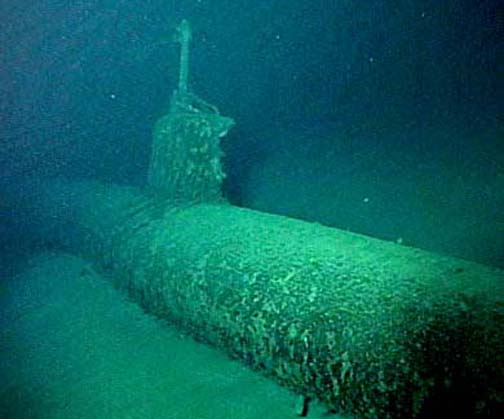
CTY Pisces – Photos of a Japanese midget submarine that was sunk off Pearl Harbor on the day of the attack. There’s a hole at the base of the conning tower where an artillery shell penetrated the hull, sinking the sub and killing the crew. Photos courtesy of Terry Kerby, Hawaii Undersea Research Laboratory. August 2003.
15,000 Feet Below the Waves Lurks Trouble: This Dead Russian Submarine Is Nuclear Armed “Unfortunately, the loss of power onboard and the difficult weather conditions were too much for the crew to overcome. On April 12, K-8 sank with some forty crew members aboard, coming to rest at a rough depth of 15,000 feet. The depth made any effort at recovering the submarine, and the nuclear torpedoes, impractical.” National Interest, by Robert Farley, 10 Mar 19
n April 8, K-8 suffered two fires, resulting in a shutdown of both nuclear reactors. The boat surfaced, and Captain Vsevolod Borisovich Bessonov ordered the crew to abandon ship. Eight crew members, trapped in compartments that were either flooded or burned out, died in the initial incident. Fortunately, a Soviet repair vessel arrived, and took K-8 under tow. However, bad weather made the recover operation a difficult prospect. Much of K-8’s crew reboarded the submarine, and for three days fought a life-and-death struggle to save the boat. Although details remain scarce, there apparently was no opportunity to safely remove the four nuclear torpedoes from K-8, and transfer them to the repair ship.
The Bay of Biscay is one of the world’s great submarine graveyards. In late World War II, British and American aircraft sank nearly seventy German U-boats in the Bay, which joined a handful of Allied and German subs sunk in the region during World War I. On April 12, 1970, a Soviet submarine found the same resting place. Unlike the others, however, K-8 was propelled by two nuclear reactors, and carried four torpedoes tipped by nuclear warheads……… https://nationalinterest.org/blog/buzz/15000-feet-below-waves-lurks-trouble-dead-russian-submarine-nuclear-armed-46652
Eight years after triple nuclear meltdown, Fukushima No. 1’s water woes show no signs of ebbing, Japan Times, BY RYUSEI TAKAHASHI, STAFF WRITER, 8 Mar 19,
This is the first in a series examining how the northeast and the nation are progressing with efforts to deal with the March 2011 earthquake, tsunami and nuclear crisis.
OKUMA, FUKUSHIMA PREF. – Nearly a thousand storage tanks are scattered across the Fukushima No. 1 nuclear power plant, holding a staggering 1.1 million tons of treated water used to keep its melted reactor cores cool while they rust in the sun.
Plant manager Tokyo Electric Power Company Holdings Inc., or Tepco, plans to build more of the gigantic tanks to hold another 0.27 million tons, which is roughly the equivalent of 108 Olympic-size swimming pools. The new tanks are expected reach full capacity in four or five years
Each tank takes seven to 10 days to fill and holds between 1,000 to 1,200 tons of liquid, Tepco officials told reporters during a tour in February organized by the Japan National Press Club. It’s been eight years since Fukushima No. 1 suffered three core meltdowns triggered by tsunami following the Great East Japan Earthquake, but the situation with the tanks may be a sign Tepco has yet to get the facility under control.
“Space isn’t a big issue at this point in time, but five or 10 years from now, after we’ve started removing the melted fuel debris, we’re going to need facilities to store and preserve it,” Akira Ono, president of Fukushima No. 1 Decontamination and Decommissioning Engineering Co., a Tepco unit overseeing the decommissioning process, said at a news conference in January.
The water issue is eating up both space and resources, but a solution is unlikely to emerge anytime soon.
The International Atomic Energy Agency published a report in November that said the physical constraints of the site “leave little room for additional tanks” beyond what Tepco has allocated.
The IAEA report went on to say it believes storing tainted water in “above ground tanks . . . can only be a temporary measure while a more sustainable solution is needed” and a “decision on the disposition path should be taken urgently.”
Beyond 2020, Tepco has not allocated any additional space for holding treated water on the site and has no plans to do so at this time. The utility said the tanks will likely become a headache if they remain at the plant.
“At that point, we may need to rethink how we’re using the space,” Ono said.
Eight years ago when the monstrous tsunami hit, the entire plant lost power and reactors 1, 2 and 3 lost coolant, causing their cores to overheat. The fuel rods consequently melted, dripping molten fuel that burned through their pressure vessels and pooled in their primary containment vessels. Reactors 1, 3 and 4 then suffered hydrogen explosions.
Tepco must inject water into the reactors indefinitely to keep the melted cores cool, but water tainted by contact with the fuel and associated debris has been leaking from the damaged containment vessels and into the basements of the reactor buildings, where tons of fresh groundwater flows in daily through holes in their damaged walls.
The contaminated water is pumped out and passed through a filtration device called the Advanced Liquid Processing System — which is supposed to remove every radionuclide except for tritium — and stored in the tanks.
Tepco has taken steps to limit the amount of groundwater seeping into the reactor buildings, including wells to intercept and divert it and an underground ice wall around the buildings to block any inflow.
According to Tepco, however, about 83 tons of water are seeping into the reactor buildings each day. Although this is an improvement from some 300 tons in previous years, Tepco must keep making more tanks.
At the moment, Tepco is waiting for a government panel’s advice on what to do with the tritium-tainted water. The panel is considering five disposal methods: ground injection, sea discharge after diluting the tritium concentration, discharging it as steam, discharging it as hydrogen, and solidification followed by underground burial……
there are concerns about the impact an ocean discharge may have on fisheries still trying to recover from the nuclear crisis.
Fishing in the area has resumed on a trial basis and workers still perform radiation checks before shipping their hauls to fish markets. The waters off Fukushima Prefecture are at the confluence of two ocean currents — the Oyashio from the north and Kuroshio from the south — which make for the good fishing grounds that have been a vital part of the agrarian prefecture’s economy.
Eight years after the meltdowns, however, residents are still struggling to convince the world that fish from the area are safe to eat. Many believe public perception alone will cripple Fukushima’s fishing industry anew if the tainted water is expelled into the ocean — even if the tritium has been reduced to below international standards.
Trust issues continue to plague Tepco after it claimed ALPS was filtering every radionuclide from the cooling water except tritium. Last August it came to light that the allegedly treated water still contained other dangerous contaminants, including iodine, cesium and strontium. Some of the concentrations were above current safety limits.
This has further angered Fukushima residents and made it harder to get their approval for dumping the water held by the tanks into the sea.
During a public hearing hosted by METI in August, participants urged the government and Tepco to consider finding an off-site location to store the water instead of discharging it into the ocean.
“Without a national debate and without the understanding of Japanese citizens or the countries importing our products, as a fisherman of Fukushima Prefecture, I strongly oppose the plan to discharge the treated water into the ocean,” Tetsu Nozaki, chairman of the Fukushima Prefectural Federation of Fisheries Cooperative Association, told the hearing.
“To release the ALPS-treated water into the ocean, at this time, would deal a disastrous blow to the fishermen of Fukushima and rob them of their hard work and motivation,” he said…….
Meanwhile, the crippled plant faces other serious challenges — including how to extract the molten fuel…….
Tell Congress: Prevent Nuclear Catastrophe in Iran
Read the Public Inquiry Report, the Commissioners’ report, Surrendering Australia: The AUKUS Deception is available to download for free at aukuspublicinquiry.com. Or just watch the replay of the National Press Club Luncheon.