44% of Americans oppose a pre emptive strike on North Korea, 33%, mainly Trump supporters, support that idea
|
ONE-THIRD OF U.S. SUPPORTS NUCLEAR WAR ON NORTH KOREA, KNOWING IT WOULD KILL ONE MILLION, REPORT SHOWS, NewsWeek, BY ON 6/24/19 One-third of the United States population would support a preemptive attack on North Korea, even in a nuclear scenario, knowing it would kill one million innocent people, according to a recent survey.
The Bulletin of the Atomic Scientists, in collaboration with U.K.-based research firm YouGov, published a new study Monday detailing U.S. public opinion on military conflict with North Korea at a time when the pace of a historic peace process between the longtime rivals appeared to slow. Among the most “disturbing” results discovered was that “a large hawkish minority lurks within the U.S. public; over a third of respondents approve of a US preventive strike across the scenarios and appear insensitive to informational cues that most security experts would expect to reduce such levels of support.” Little changed when the U.S. first-strike was switched from conventional to nuclear as “33 percent preferred.” In fact, “there is no significant change in the percentage who would prefer or approve of a U.S. nuclear strike when the number of estimated North Korean fatalities increases from 15,000 to 1.1 million, including 1 million civilians.” The researchers said these results actually demonstrated a previously-established pattern among the U.S. public, which “exhibits only limited aversion to nuclear weapons use and a shocking willingness to support the killing of enemy civilians.”………. Answers were also influenced by political beliefs. While most respondents overall opposed military action against North Korea, the “majority of Trump supporters prefer the US strike in every scenario, except when confidence in the effectiveness of the US conventional strike is 50 percent”—and even then it remained at 44 percent as opposed to a mere 8 percent for non-supporters. Separately, those who backed the death penalty were actually more eager to inflict a higher death toll among North Korean civilians. ….. https://www.newsweek.com/us-support-north-korea-nuclear-war-one-million-dead-1445578 |
|
Israel’s Netanyahu ramps up the rhetoric against Iran
|
Israel will do ‘everything’ to stop Iran going nuclear: Netanyahu https://news.yahoo.com/israel-everything-stop-iran-going-nuclear-netanyahu-161040494.html, 24 June 19 Jerusalem (AFP) – Israel’s Prime Minister Benjamin Netanyahu said Monday his country will do “everything” to prevent arch-rival Iran from obtaining nuclear weapons, during a visit by a senior Russian security official.“Israel will not allow Iran, which calls for our destruction, to entrench on our border; we will do everything to prevent it from attaining nuclear weapons,” Netanyahu said.
He was speaking alongside Nikolai Patrushev, the head of Moscow’s powerful security council, whose visit followed weeks of simmering tensions between Tehran and Washington in the Gulf. Israel has carried out repeated strikes to prevent Iranian forces becoming embedded in neighbouring Syria, where both Iran and Moscow back the government of President Bashar al-Assad.The Israeli government has vowed never to let Iran obtain a nuclear weapon, believing Israel would be the target. Iran insists its nuclear programme is entirely for civilian purposes. Netanyahu has long campaigned against a 2015 nuclear agreement between Iran and world powers, from which the Trump administration unilaterally withdrew last year. Patrushev did not directly mention the Islamic republic in his comments to the press.“We pay great attention to Israel’s security,” he said. “To resolve this issue in practice, it is necessary to bring peace and stability to the region, including on Syrian territory.” Their meeting came a day after Netanyahu hosted US National Security Advisor John Bolton, who shares the Israeli premier’s tough stance on Iran. Bolton is set to meet Patrushev on Tuesday along with their Israeli counterpart Meir Ben-Shabbat. Tensions between Washington and Iran have flared after Iranian forces shot down a US drone Thursday, the latest in a series of incidents including attacks on tankers in sensitive Gulf waters that have raised fears of an unintended slide towards conflict. Trump has tweeted that Washington would place “major additional sanctions on Iran on Monday”. Russia on Monday denounced the new sanctions as “illegal”. Its President Vladimir Putin has warned of “disaster” if the US were to use force against Tehran.
|
|
Worrying feedback loop between damaged ozone layer and climate change
 Damage to the ozone layer and climate change forming feedback loop

New report finds that impacts of ozone-driven climate change span the ecosystem https://www.sciencedaily.com/releases/2019/06/190624111536.htm June 24, 2019 Rensselaer Polytechnic Institute
- Summary:
- Increased solar radiation penetrating through the damaged ozone layer is interacting with the changing climate, and the consequences are rippling through the Earth’s natural systems, effecting everything from weather to the health and abundance of sea mammals like seals and penguins.
- Increased solar radiation penetrating through the damaged ozone layer is interacting with the changing climate, and the consequences are rippling through the Earth’s natural systems, effecting everything from weather to the health and abundance of sea mammals like seals and penguins. These findings were detailed in a review article published today in Nature Sustainability by members of the United Nations Environment Programme’s Environmental Effects Assessment Panel, which informs parties to the Montreal Protocol.
What we’re seeing is that ozone changes have shifted temperature and precipitation patterns in the southern hemisphere, Continue reading
The worrying secrecy of Russia about the true state of its nuclear wastes

Environmentalists concerned about where Andreyeva Bay spent nuclear fuel is being sent Bellona, June 24, 2019 by Anna Kireeva, translated by Charles Digges
Representatives from Rosatom, Russia’s nuclear corporation, have sought to sooth environmentalist over concerns that removing tons of spent nuclear fuel from an old submarine base near Murmansk won’t cause further contamination risks at Mayak, the country’s notorious fuel reprocessor, located 3,000 kilometers to the south.
The submarine base is Andreyeva Bay, situated 60 kilometers east of Russia’s Norwegian border, and its cleanup is one of the most important joint environmental efforts that Oslo and Moscow have taken on in decades. Bellona has been at the forefront of advocating for the removal of the base’s 22,000 spent nuclear submarine fuel rods, which threaten to contaminate the Barents Sea.
After years of negotiations among Bellona, and the governments of Norway and Russia, removal of the fuel at Andreyeva Bay finally began in June of 2017. From there it is taken to Mayak, near the Ural Mountain city of Chelyabinsk, for treatment and reprocessing.
But Mayak has a checkered past. Now one of he world’s most voluminous nuclear fuel reprocessing facilities, the Mayak Production Association is also responsible for decades of nuclear contamination throughout the Ural region.
The Russian government also has a history of covering up that contamination, and it was these concerns that some environmentalists brought to a press conference in Tromsø, Norway when a joint Russian-Norwegian Commission on nuclear submarine disposal wrapped up on Friday.
Vitaly Servetnik, co-chairman of the Russian Social-Ecological Union, was among the environmentalists who attended the press conference, which was a first time event for the Commission, which has traditionally closed its doors to the press and the public.
“Sending spent nuclear fuel and radioactive waste from the Murmansk region to the Chelyabinsk Region, in our opinion, is not only moving the problem from one region to another through the whole country, but also aggravating existing problems in the areas around the Mayak plant,” Servetnik said, addressing the commission. “In addition, there is no information available to us about how much and what kind of waste is being brought there.”
It’s necessary to point out that Russia doesn’t view spent nuclear fuel as waste. The Russian nuclear industry — like the ones Britain and France but unlike the one in the United States — adopts a closed nuclear fuel cycle. This means that it treats spent nuclear fuel – including the submarine fuel found at Andreyeva Bay, as a resource from which more fuel can be synthesized.
At present, and for the foreseeable future, Mayak is the only facility in Russia capable of reprocessing spent nuclear fuel. Simply not taking the spent nuclear fuel from Andreyeva Bay to Mayak, as Servetnik suggests, is therefore a technological impossibility for Russia’s nuclear industry.
Servetnik also expressed concern about the transparency about how Mayak is run, and how difficult it is to get information about its procedures if an environmental group is not a member of Rosatom’s public council.
“The real situation at Mayak is much worse than what Rosatom representatives are telling us about it,” he said at the conference.
Rosatom representatives who were present fundamentally disagreed with Servetnik’s statement……….
After the conclusion of the conference, Servetnik and other environmentalists who attended weren’t reassured by Rosatom’s insistence that they need not worry about the fuel transfers from Andreyeva Bay to Mayak.
“The state corporation views the movement of radioactive waste and spent nuclear fuel as part of an integrated process,” he said. “If that’s the case, then all of the attention the Russian and international community devoted to the project of cleaning up Andreyeva Bay should now be devoted to Chelyabinsk Region [where Mayak is located].”
Andrei Zolotkov, who heads Bellona’s Murmansk office, agrees that much of Mayak’s environmental history leaves much to be desired, that that its transparency about its activities past and present is required.
Russia’s nuclear company Rosatom on a drive to sell nuclear technology overseas
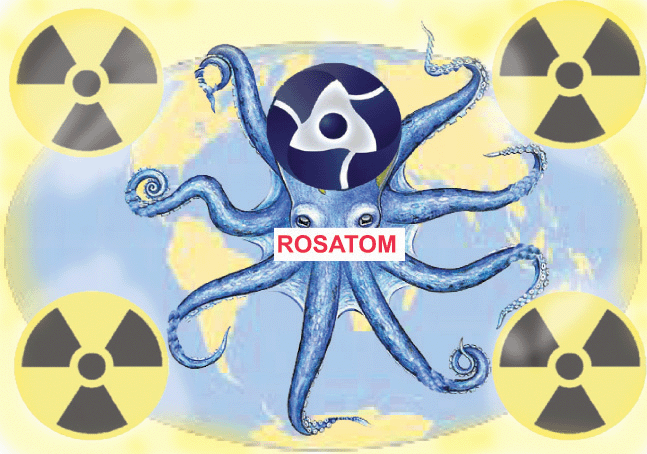 Russia’s Rosatom Sees Foreign Revenues, New Products Fuelling Rapid Growth, The state nuclear company aims to triple its revenues through new projects. Moscow Times, 24 June 19, Russian state nuclear company Rosatom aims to triple its revenues in U.S. dollar terms by 2030, driven by foreign projects from Belarus to Bangladesh and new product areas such as carbon fibre, its chief executive told Reuters.
Rosatom is the world’s only integrated nuclear firm, providing a one stop shop from uranium enrichment to handling nuclear waste, after its two biggest rivals Areva and Westinghouse hit financial troubles.
Alexey Likhachyov, 58, has led Rosatom since 2016, with goals to increase competitiveness, add new markets and products, and boost its share of global nuclear technology exports.
By 2030, he expects up to 70 percent of Rosatom’s revenue to come from outside Russia and up to 40 percent from new products, including non-nuclear ones.
“The first step is to implement our entire order book portfolio — this is around $190 billion overall, of which $133 billion is for this decade. Out of these, around $90 billion are (started) plants abroad. This is 12 countries,” he said.
Rosatom is the world’s biggest nuclear company by foreign orders, with a total of 36 nuclear blocks on order outside Russia, including in Belarus, Bangladesh, China, India, Turkey, Finland, Hungary and Egypt. …….. https://www.themoscowtimes.com/2019/06/24/russias-rosatom-sees-foreign-revenues-new-products-fuelling-rapid-growth-a66135
Concerns about the safety of Israel’s aging Dimona nuclear reactor
Israel’s Dimona nuclear reactor isn’t Chernobyl, but does have vulnerabilities A disaster at Israel’s reactor would be far less catastrophic than the 1986 meltdown, but the core is being kept in service far longer than intended, and experts warn that’s risky, Times of Israel, By JUDAH ARI GROSS 24 June 19, The hit television miniseries “Chernobyl” has reminded the world of the ever-present specter of a nuclear catastrophe made possible by the deadly combination of negligence, ignorance and incompetence…….
Rocket attacks aren’t the only threat
In addition to the overt threats posed to the Dimona nuclear reactor by terror groups and enemy nations, as well as by earthquakes and other natural disasters, one of the less-discussed concerns surrounding the core is its advancing age and Israel’s apparent resolve to keep it running regardless, the expert said.
The Dimona nuclear core, which was given to Israel by France and went active in the early 1960s, is one of the oldest still operating in the world.
Originally designed to operate for 40 years, the core is now being pushed to remain in service for twice that, according to the expert.
This is not from frugality or unwillingness on Israel’s part to purchase a new core, but a legal inability or disinclination by the countries that produce these cores to sell one to the Jewish state, as Jerusalem refuses to sign the Treaty on the Non-Proliferation of Nuclear Weapons, which is meant to prevent the spread of nuclear weapons.
As a result of Israel’s inability to replace the nuclear core, it is motivated to keep it in service for as long as possible, the atomic expert said, replacing and upgrading whatever parts it can and carefully monitoring the components it can’t for any possible “show-stopping” signs of trouble, notably in its aluminum reactor tank…….
Despite the government’s assurances, several Israeli nuclear experts — including some of the scientists who founded the Dimona reactor — as well as politicians have for years been calling for the aging core to be shut down over the risks it posed. ……
One of the central issues regarding Dimona’s safety is that it has no independent oversight. Since Israel is a non-signatory of the nuclear non-proliferation treaty, the International Atomic Energy Agency do not inspect the site, nor do American inspectors, who did monitor the reactor in its early days until they determined that their checks were effectively worthless as many aspects of the site were being kept hidden from them. Instead, the reactor is monitored by Israel’s Atomic Energy Commission — the same body that is responsible for running it.
The highly classified nature of the work there also limits the amount of public debate about the nuclear research center……..
This secrecy and lack of independent oversight means Israelis (and to a lesser extent Jordanians) can only hope that the government is doing its all to prevent a nuclear catastrophe — albeit one that would be far smaller than Chernobyl. https://www.timesofisrael.com/israels-dimona-nuclear-reactor-isnt-chernobyl-but-does-have-vulnerabilities/
France wants EDF to sell more nuclear power to rivals, price could increase,
“If we want power prices to be contained in 2020, we need to increase the ceiling and it is the wish of the government to move quickly on those two measure before the November auction window,” an official of the energy ministry told journalists.
“There would likely be a slight increase in the fixed price”, the official added.
The EU’s executive arm, which regulates market competition in the bloc would have to approve any change in the fixed wholesale nuclear price……..https://www.reuters.com/article/us-france-electricity/france-wants-edf-to-sell-more-nuclear-power-to-rivals-price-could-increase-idUSK
Insurer Looks at Ending Cover for Gambling, Arms, Nuclear Power
- ASR Nederland may refuse to sell insurance to 243 companies
- Allianz says engaging with ‘black sheep’ will do more good
Europe’s biggest insurers refuse to sell policies to coal miners and arms producers. A Dutch firm may go further by denying coverage to gambling companies and nuclear-power generators.
The asset-management arm of ASR Nederland NV already has a list of 243 companies that it won’t invest in for ethical reasons. Now the Utrecht, Netherlands-based firm is considering applying that list to the insurance side as well, according to Chief Executive Officer Jos Baeten.,,,, (subscribers only) https://www.bloomberg.com/news/articles/2019-06-24/insurer-looks-at-ending-cover-for-gambling-arms-nuclear-power
Sweden says two aging nuclear reactors safe to run till 2028
Donald Trump threatens Iran with ‘obliteration’
 Trump warns Iran of ’obliteration like you’ve never seen before’ https://www.politico.com/story/2019/06/23/trump-obliteration-iran-nuclear-weapons-pursuit-1376744, By MARTIN MATISHAK, 06/23/2019
President Donald Trump warned the United States may launch a devastating military attack on Iran unless it comes to the negotiating table and drops its bid to develop nuclear weapons.
“I’m not looking for war, and if there is, it’ll be obliteration like you’ve never seen before. But I’m not looking to do that. But you can’t have a nuclear weapon. You want to talk? Good. Otherwise you can have a bad economy for the next three years,” Trump said during an interview with NBC’s “Meet The Press” airing Sunday.
The president said he’d be willing to sit down with Iranian officials without preconditions.
The comments, made during an interview taped Friday, came the same day Trump confirmed on Twitter that he called off a retaliatory strike on Iran at the last minute Thursday night. He said he decided that the potential cost of human lives was “not proportionate to shooting down an unmanned drone.”
Iran’s Revolutionary Guard said Thursday it had shot down an American drone, claiming it had entered Iranian airspace, a claim disputed by the U.S., which has maintained the drone was over international waters. Both countries have since produced what they say is evidence supporting their respective positions.
Trump said the U.S. had a “modest but pretty, pretty heavy attack schedule,” but planes were not in the air when he called off the attack.
The commander in chief said the response now should be increased sanctions on Iran’s economy.
“We’re increasing the sanctions now,” adding the country’s economy has already been “shattered.”
Trump said he believes Iranian officials want to negotiate and that any deal would have to be about nuclear weapons. He also claimed that Iran had violated the nuclear agreement struck by the Obama administration and other world powers. International inspectors have repeatedly declared that Iran has complied with the 2015 deal.
“They cannot have a nuclear weapon,” he said. “They cannot have a nuclear weapon. They’d use it. And they’re not going to have a nuclear weapon.”
Trump also disputed that he sent a message to Iranian leaders through a third country, saying he did not want conflict, dubbing it “fake news.”
However, he also declined to send a message during the interview to Iranian Supreme Leader Ayatollah Ali Khamenei.
“Wouldn’t be much different than that message,” Trump said.
Hundreds of evacuees and their children continue to suffer from effects of Fukushima nuclear meltdown
‘Fukushima suffering continues’ https://www.churchtimes.co.uk/articles/2019/21-june/news/world/fukushima-suffering-continues 
by HATTIE WILLIAMS, 21 JUNE 2019 Eight years since the disaster, NSKK calls for nuclear-free world EIGHT years after the Fukushima nuclear disaster, hundreds of evacuees and their children continue to suffer from debilitating conditions, Anglican priests told an International Forum for a Nuclear-Free World held in Sendai, Japan, last week.
The Tohoku earthquake, in 2011, triggered a tsunami which caused explosions at the Fukushima Daiichi Nuclear Power Plant, in Okuma, leading to widespread radioactive contamination and serious health and environmental effects (News, 25 March 2011).
The disaster is estimated to have caused the deaths of about 1600 people out of the 300,000 who were evacuated from the area
The forum was organised by the Nippon Sei Ko Kai (NSKK) — the Anglican Communion in Japan — whose General Synod passed a resolution in 2012 calling for an end to nuclear-power plants. A joint statement from the forum, due next month, is expected to encourage churches to join the call for a worldwide ban on nuclear energy, the Anglican News Service reports.
The chair of the forum’s organising committee, Kiyosumi Hasegawa, said: “We have yet to see an end to the damage done to the people and natural environment by the meltdown of TEPCO’s Fukushima Daiichi Nuclear Power Plant.
“This man-made disaster will haunt countless people for years to come. We still see numerous people who wish to go back to their home towns, but are unable to. We also have people who have given up on ever going home.”
The week-long conference at Christ Church Cathedral, Sendai, was attended by bishops, clergy, and lay representatives from each NSKK diocese, as well as representatives from the US Episcopal Church, USPG, the Episcopal Church of the Philippines, the diocese of Taiwan, and the Anglican Church of Korea.
The general secretary of the Sendai Christian relief network Touhoku HELP, Dr Naoya Kawakami, whose church was affected by the tsunami, said: “I have been more than 700 times to meet with more than 180 mothers and about 20 fathers, all of whom have seen abnormalities in their children since 2011. . . Thyroid cancer has been found in more than 273 children, and many mothers are in deep anxiety.”
An NSKK priest, the Revd John Makito Aizawa, said: “Both religiously and ethically, we cannot allow nuclear-power plants to continue running. They produce deadly waste, which we have no way of processing into something safe. More than 100,000 years are necessary for the radiation of such deadly waste to diminish to the level that it was in the original uranium. This alone is a strong enough reason to prohibit nuclear-power plants.”
The partners-in-mission secretary for NSKK, Paul Tolhurst, said: “Driving past the power station and seeing the ghost town around us as the Geiger-counter reading kept going up is something I won’t forget. It was like the town time forgot: they still seem to be living the incident, while the rest of Japan has moved on.”
The forum’s statement is expected to call for a goal of conversion to renewable sources of energy, and set out ways in which a network can be built to take forward denuclearisation.
Russia’s nuclear weapons and the religious connection
 BLESSED BE THY NUCLEAR WEAPONS: THE RISE OF RUSSIAN NUCLEAR ORTHODOXY, War on the Rocks, MICHAEL KOFMAN June 21 2019 Dmitry Adamsky, Russian Nuclear Orthodoxy: Religion, Politics, and Strategy (Stanford University Press, 2019).
Russia’s Federal Nuclear Center, the All-Russian Institute of Experimental Physics (RFNC-VNIIEF), recently placed a somewhat unusual government tender: It is seeking a supplier of religious icons with the images of Saint Seraphim of Sarov and Saint Fedor Ushakov. Meanwhile, a private foundation, backed by President Vladimir Putin and Minister of Defense Sergei Shoigu, has been gathering funds to build a massive temple to the Russian Armed Forces at Patriot Park,. Artisans are crafting a new icon for the temple, while the steps are to be made from melted-down Nazi equipment captured by the Red Army in World War II.
Viewed in isolation, these may seem to be the occasional eccentric habits of a latter-day authoritarian state. However, Dima Adamsky’s new book, Russian Nuclear Orthodoxy: Religion, Politics, and Strategy, demonstrates convincingly that there are indeed important signs being missed all around us, pointing to a longstanding nexus between the Russian Orthodox Church and the country’s nuclear-military-industrial complex.
Adamsky’s groundbreaking book lays out the largely unstudied history of how a nuclear priesthood emerged in Russia, permeated the units and commands in charge of Russia’s nuclear forces, and became an integral part of the nuclear weapons industry. Continue reading
Nuclear power to solve climate change? Too many sound reasons against it.
 The 7 reasons why nuclear energy is not the answer to solve climate
 change, https://www.leonardodicaprio.org/the-7-reasons-why-nuclear-energy-is-not-the-answer-to-solve-climate-change/, Mark Z. Jacobson , Professor of Civil and Environmental Engineering, Director, Atmosphere/Energy Program, Stanford University, 21 June 19
One nuclear power plant takes on average about 14-1/2 years to build, from the planning phase all the way to operation. According to the World Health Organization, about 7.1 million people die from air pollution each year, with more than 90% of these deaths from energy-related combustion. So switching out our energy system to nuclear would result in about 93 million people dying, as we wait for all the new nuclear plants to be built in the all-nuclear scenario.
Utility-scale wind and solar farms, on the other hand, take on average only 2 to 5 years, from the planning phase to operation. Rooftop solar PV projects are down to only a 6-month timeline. So transitioning to 100% renewables as soon as possible would result in tens of millions fewer deaths.
This illustrates a major problem with nuclear power and why renewable energy — in particular Wind, Water, and Solar (WWS)– avoids this problem. Nuclear, though, doesn’t just have one problem. It has seven. Here are the seven major problems with nuclear energy:
The time lag between planning and operation of a nuclear reactor includes the times to identify a site, obtain a site permit, purchase or lease the land, obtain a construction permit, obtain financing and insurance for construction, install transmission, negotiate a power purchase agreement, obtain permits, build the plant, connect it to transmission, and obtain a final operating license.
The planning-to-operation (PTO) times of all nuclear plants ever built have been 10-19 years or more. For example, the Olkiluoto 3 reactor in Finland was proposed to the Finnish cabinet in December 2000 to be added to an existing nuclear power plant. Its latest estimated completion date is 2020, giving it a PTO time of 20 years.
The Hinkley Point nuclear plant was planned to start in 2008. It has an estimated completion year of 2025 to 2027, giving it a PTO time of 17 to 19 years. The Vogtle 3 and 4 reactors in Georgia were first proposed in August 2006 to be added to an existing site. The anticipated completion dates are November 2021 and November 2022, respectively, given them PTO times of 15 and 16 years, respectively.
The Haiyang 1 and 2 reactors in China were planned to start in 2005. Haiyang 1 began commercial operation on October 22, 2018. Haiyang 2 began operation on January 9, 2019, giving them PTO times of 13 and 14 years, respectively. The Taishan 1 and 2 reactors in China were bid in 2006. Taishan 1 began commercial operation on December 13, 2018. Taishan 2 is not expected to be connected until 2019, giving them PTO times of 12 and 13 years, respectively. Planning and procurement for four reactors in Ringhals, Sweden started in 1965. One took 10 years, the second took 11 years, the third took 16 years, and the fourth took 18 years to complete.
Many claim that France’s 1974 Messmer plan resulted in the building of its 58 reactors in 15 years. This is not true. The planning for several of these nuclear reactors began long before. For example, the Fessenheim reactor obtained its construction permit in 1967 and was planned starting years before. In addition, 10 of the reactors were completed between 1991-2000. As such, the whole planning-to-operation time for these reactors was at least 32 years, not 15. That of any individual reactor was 10 to 19 years.
2. Cost
The levelized cost of energy (LCOE) for a new nuclear plant in 2018, based on Lazard, is $151 (112 to 189)/MWh. This compares with $43 (29 to 56)/MWh for onshore wind and $41 (36 to 46)/MWh for utility-scale solar PV from the same source.
This nuclear LCOE is an underestimate for several reasons. First, Lazard assumes a construction time for nuclear of 5.75 years. However, the Vogtle 3 and 4 reactors, though will take at least 8.5 to 9 years to finish construction. This additional delay alone results in an estimated LCOE for nuclear of about $172 (128 to 215)/MWh, or a cost 2.3 to 7.4 times that of an onshore wind farm (or utility PV farm).
Next, the LCOE does not include the cost of the major nuclear meltdowns in history. For example, the estimated cost to clean up the damage from three Fukushima Dai-ichi nuclear reactor core meltdowns was $460 to $640 billion. This is $1.2 billion, or 10 to 18.5 percent of the capital cost, of every nuclear reactor worldwide.
In addition, the LCOE does not include the cost of storing nuclear waste for hundreds of thousands of years. In the U.S. alone, about $500 million is spent yearly to safeguard nuclear waste from about 100 civilian nuclear energy plants. This amount will only increase as waste continues to accumulate. After the plants retire, the spending must continue for hundreds of thousands of years with no revenue stream from electricity sales to pay for the storage.
3. Weapons Proliferation Risk
The growth of nuclear energy has historically increased the ability of nations to obtain or harvest plutonium or enrich uranium to manufacture nuclear weapons. The Intergovernmental Panel on Climate Change (IPCC) recognizes this fact. They concluded in the Executive Summary of their 2014 report on energy, with “robust evidence and high agreement” that nuclear weapons proliferation concern is a barrier and risk to the increasing development of nuclear energy:
Barriers to and risks associated with an increasing use of nuclear energy include operational risks and the associated safety concerns, uranium mining risks, financial and regulatory risks, unresolved waste management issues, nuclear weapons proliferation concerns, and adverse public opinion.The building of a nuclear reactor for energy in a country that does not currently have a reactor allows the country to import uranium for use in the nuclear energy facility. If the country so chooses, it can secretly enrich the uranium to create weapons grade uranium and harvest plutonium from uranium fuel rods for use in nuclear weapons. This does not mean any or every country will do this, but historically some have and the risk is high, as noted by IPCC. The building and spreading of Small Modular Reactors (SMRs) may increase this risk further.
4. Meltdown Risk
5. Mining Lung Cancer Risk
Uranium mining causes lung cancer in large numbers of miners because uranium mines contain natural radon gas, some of whose decay products are carcinogenic. A study https://www.cdc.gov/niosh/pgms/worknotify/uranium.html of 4,000 uranium miners between 1950 and 2000 found that 405 (10 percent) died of lung cancer, a rate six times that expected based on smoking rates alone. 61 others died of mining related lung diseases. Clean, renewable energy does not have this risk because (a) it does not require the continuous mining of any material, only one-time mining to produce the energy generators; and (b) the mining does not carry the same lung cancer risk that uranium mining does.
6. Carbon-Equivalent Emissions and Air Pollution
There is no such thing as a zero- or close-to-zero emission nuclear power plant. Even existing plants emit due to the continuous mining and refining of uranium needed for the plant. Emissions from new nuclear are 78 to 178 g-CO2/kWh, not close to 0. Of this, 64 to 102 g-CO2/kWh over 100 years are emissions from the background grid while consumers wait 10 to 19 years for nuclear to come online or be refurbished, relative to 2 to 5 years for wind or solar. In addition, all nuclear plants emit 4.4 g-CO2e/kWh from the water vapor and heat they release. This contrasts with solar panels and wind turbines, which reduce heat or water vapor fluxes to the air by about 2.2 g-CO2e/kWh for a net difference from this factor alone of 6.6 g-CO2e/kWh.
In fact, China’s investment in nuclear plants that take so long between planning and operation instead of wind or solar resulted in China’s CO2 emissions increasing 1.3 percent from 2016 to 2017 rather than declining by an estimated average of 3 percent. The resulting difference in air pollution emissions may have caused 69,000 additional air pollution deaths in China in 2016 alone, with additional deaths in years prior and since.
7. Waste Risk
Last but not least, consumed fuel rods from nuclear plants are radioactive waste. Most fuel rods are stored at the same site as the reactor that consumed them. This has given rise to hundreds of radioactive waste sites in many countries that must be maintained and funded for at least 200,000 years, far beyond the lifetimes of any nuclear power plant. The more nuclear waste that accumulates, the greater the risk of radioactive leaks, which can damage water supply, crops, animals, and humans.
Summary
To recap, new nuclear power costs about 5 times more than onshore wind power
per kWh (between 2.3 to 7.4 times depending upon location and integration issues). Nuclear takes 5 to 17 years longer between planning and operation and produces on average 23 times the emissions per unit electricity generated (between 9 to 37 times depending upon plant size and construction schedule). In addition, it creates risk and cost associated with weapons proliferation, meltdown, mining lung cancer, and waste risks. Clean, renewables avoid all such risks.
Nuclear advocates claim nuclear is still needed because renewables are intermittent and need natural gas for backup. However, nuclear itself never matches power demand so it needs backup. Even in France with one of the most advanced nuclear energy programs, the maximum ramp rate is 1 to 5 % per minute, which means they need natural gas, hydropower, or batteries, which ramp up 5 to 100 times faster, to meet peaks in demand. Today, in fact, batteries are beating natural gas for wind and solar backup needs throughout the world. A dozen independent scientific groups have further found that it is possible to match intermittent power demand with clean, renewable energy supply and storage, without nuclear, at low cost. Finally, many existing nuclear plants are so costly that their owners are demanding subsidies to stay open. For example, in 2016, three existing upstate New York nuclear plants requested and received subsidies to stay open using the argument that the plants were needed to keep emissions low. However, subsidizing such plants may increase carbon emissions and costs relative to replacing the plants with wind or solar as soon as possible. Thus, subsidizing nuclear would result in higher emissions and costs over the long term than replacing nuclear with renewables.
Derivations and sources of the numbers provided herein can be found here – https://web.stanford.edu/group/efmh/jacobson/Articles/I/NuclearVsWWS.pdf
Trump sent Kim Jong Un an ‘excellent’ letter
 North Korea says Trump sent Kim Jong Un an ‘excellent’ letter amid stalled nuclear diplomacy, abc news, June 23, 2019,
The White House confirmed that Trump had sent a letter to Kim.
“Correspondence between the two leaders has been ongoing,” Press Secretary Sarah Sanders said in a statement.
It comes after nuclear talks between the U.S. and North Korea broke down after the failed summit between Kim and Trump in February in Vietnam.
The U.S. is demanding that North Korea abandon its nuclear weapons entirely before international sanctions are lifted. North Korea is seeking a step-by-step approach in which moves toward denuclearization are matched by concessions from the U.S., notably a relaxation of the sanctions.
Kim “said with satisfaction that the letter is of excellent content,” Pyongyang’s Korean Central News Agency reported.
“Appreciating the political judging faculty and extraordinary courage of President Trump, Kim Jong Un said that he would seriously contemplate the interesting content,” the agency said, without elaborating.
South Korea’s presidential office said it sees the exchange of letters between Kim and Trump as a positive development for keeping the momentum for dialogue alive……….
Nuclear negotiations have been at a standstill, but Trump recently told reporters he received a “beautiful” letter from Kim, without revealing what was written. In an interview with TIME magazine last week, Trump said he also received a “birthday letter” from Kim that was delivered by hand a day before. ……..
Nuclear industry growth now thwarted in USA
Nuclear Power & Natural Gas Hit A Wall In US: Now What? https://cleantechnica.com/2019/06/22/nuclear-power-natural-gas-hit-a-wall-in-us-now-what/ June 22nd, 2019 by Tina Casey Two developments in the US energy landscape this week call into question the “clean energy” status of nuclear power and natural gas, too. In Rhode Island, state officials torpedoed a proposed natural gas power plant after a massive wave of public opposition. Meanwhile, federal officials greenlighted the sale of New Jersey’s Oyster Creek nuclear power plant in New Jersey to the company Holtec Decommissioning International, which will take it down atom by atom. So, now what?
The Oyster Creek Nuclear Power Plant
Decommissioning a nuclear power plant is a tricky business. It’s even trickier in the Oyster Creek case because Holtec intends to deep-six the facility in record time. The company credits its proprietary technology with enabling it to beat conventional timelines, though the Sierra Club is among those questioning Holtec’s ability to accomplish the task at a white-hot pace.
How fast? Well, According to our friends over at Energy Central News, by law the plant has a 60-year window for decommissioning. The NRC has already approved a 15-year schedule ending by 2035. Holtec anticipates completing most of the heavy lifting by 2025, with site remediation to follow.
Presumably New Jersey ratepayers have already chipped in for the cost of decommissioning by paying into an $848 million trust fund over the years of the nuclear power plant’s operation. Holtec expects to add another $46 million in investment income to the fund during decommissioning. We say presumably because anything can happen, but that’s the plan.
If all goes well, Holtec will get the job done within that budget. Still to be settled is where to stash the spent fuel. Holtec anticipates building a facility in New Mexico for that, though critics are already raising environmental justice issues.
Nuclear Power Out, Wind Power In
Oyster Creek’s fate was all but sealed years ago, when environmental groups and local stakeholders began drawing attention to its devastating impact on the ecosystem in Barnegat Bay. Fresh waves of residential and commercial development aren’t doing Barnegat Bay any favors either, but Oyster Creek took the #1 slot in the state’s 2010 list of action steps for restoring the 1,350 square mile estuary.
Critics of the closure plan (the plant pumped out its last kilowatts last fall) had been advocating for keeping the plant open while installing new cooling towers to help restore the bay. In past years they had a key ally: the absence of any handy alternative for the plant’s 636 megawatts.
Now they do. New Jersey is finally beginning to tap its massive offshore wind resources. In the latest development on that score, just last Friday the state tapped Denmark-based Ørsted to build a 1,100 offshore wind farm.
If that sounds big, it is. Ørsted’s so-named Ocean Wind project is the largest ever offshore wind procurement for a US state, according to Reuters.
Did you hear the sound of teeth gnashing? That’s probably former New Jersey Governor Chris Christie, known for his alliances with fossil industry stakeholders. New Jersey’s offshore wind industry hit the doldrums under the Christie administration, but his final term ended two years ago and now it’s a different ball of wax.
Natural Gas Hits An Offshore Wind Power Wall
Natural gas stakeholders have been hungrily eyeballing the New England market for growth opportunities, but like New Jersey, Rhode Island has set its sights on offshore wind.
Alex Kuffner of The Providence Journal has the scoop. Take it away, Alex:
In a long-awaited decision with far-reaching implications for the state’s energy regime and environment, Rhode Island regulators on Thursday rejected approval of a proposal to build a $1-billion fossil-fuel burning power plant in Burrillville that would be among New England’s largest.
Ouch! Invenergy, the company behind the 1,000 megawatt Clear River Energy Center, has the right to appeal through the courts. However, like nuclear power fans in New Jersey, fossil energy fans in New England are facing a double whammy: local opposition plus the availability of an alternative, that being offshore wind power.
Friday’s ruling came down on the basis of failure to show need, but — as with the Oyster Creek situation — opponents also had a strong environmental argument. Aside from its contribution to the global climate crisis, the project would take up 67 acres of forest in a “vital wildlife corridor.”
The Town of Burrillville also brought its legal guns to bear against the project. That’s interesting because in past times, a large new power plant would get a favorable reception from local stakeholders as a matter of economic development. According to Kuffner, labor unions did support the project but the locals joined a chorus of opposition from environmental organizations.
Speaking of offshore wind as an alternative, Rhode Island is already planning the next phase of its offshore ventures, and Ørsted’s New Jersey project is just part of that state’s 2030 offshore wind energy goal of 3,500 megawatts.
The nearby states of New York and Massachusetts are also working on ambitious renewable energy plans that include offshore wind.
Whither Nuclear & Natural Gas?
Nuclear stakeholders are working overtime to focus attention on the zero emissions aspect of nuclear power plants, but as the Oyster Creek closure demonstrates, other environmental considerations can thwart the growth of the nuclear industry here in the US.
Similarly, the Clear River rejection illustrates how natural gas stakeholders are losing their grip on the “clean” title as public awareness grows over both global warming and local environmental concerns.
Though small in size, New Jersey and Rhode Island are having an outsized impact on the US energy landscape. No wonder US natural gas and nuclear energy technology stakeholders are looking to the export market for relief.
Follow me on Twitter.
1 This Month
Tell Congress: Prevent Nuclear Catastrophe in Iran

Tell Congress: Prevent Nuclear Catastrophe in Iran

Read the Public Inquiry Report, the Commissioners’ report, Surrendering Australia: The AUKUS Deception is available to download for free at aukuspublicinquiry.com. Or just watch the replay of the National Press Club Luncheon.


Shut down the radiation-damaged Heysham nuclear reactors now
To see nuclear-related stories in greater depth and intensity – go to https://nuclearinformation.wordpress.com

Say No to NASA’s Reckless Nuclear Reactor on the Moon
Say No to NASA’s Reckless Nuclear Reactor on the Moon
-
Archives
- November 2026 (202)
- October 2026 (302)
- September 2026 (339)
- August 2026 (330)
- July 2026 (355)
- June 2026 (287)
- May 2026 (306)
- April 2026 (356)
- March 2026 (251)
- February 2026 (267)
- January 2026 (308)
- December 2025 (358)
-
Categories
- 1
- 1 NUCLEAR ISSUES
- business and costs
- climate change
- culture and arts
- ENERGY
- environment
- health
- history
- indigenous issues
- Legal
- marketing of nuclear
- media
- opposition to nuclear
- PERSONAL STORIES
- politics
- politics international
- Religion and ethics
- safety
- secrets,lies and civil liberties
- spinbuster
- technology
- Uranium
- wastes
- weapons and war
- Women
- 2 WORLD
- ACTION
- AFRICA
- Atrocities
- AUSTRALIA
- Christina's notes
- Christina's themes
- culture and arts
- Events
- Fuk 2022
- Fuk 2023
- Fukushima 2017
- Fukushima 2018
- fukushima 2019
- Fukushima 2020
- Fukushima 2021
- general
- global warming
- Humour (God we need it)
- Nuclear
- RARE EARTHS
- Reference
- resources – print
- Resources -audiovicual
- Weekly Newsletter
- World
- World Nuclear
- YouTube
-
RSS
Entries RSS
Comments RSS

