During the Cold War, Soviet citizens who kept to the straight path as the communist party veered sharply to the left or right were denounced as ‘deviationists’. For decades, US allies have been singing from the same hymn book, joining it in the insistence that the step-by-step, progressive approach was the only realistic path to nuclear disarmament. Instead of embracing the new orthodoxy from their fallible high priest, they should do a hard-nosed analysis of the merits of the changing risk–reward calculus of integrating more deeply with the nuclear alliance structure or joining the majority of countries in trying to rid the world of nuclear weapons.
Putin And Trump are ‘normalising’the increasing numbers, and the use, of nuclear weapons
 The more that Putin and Trump revalidate the role of nuclear weapons in strengthening national security, the more they normalise the discourse of nuclear weapons use and embolden calls for nuclear weapon acquisition in other countries.
A nuclear world in disarray https://www.aspistrategist.org.au/a-nuclear-world-in-disarray/ 7 Aug 2019, Ramesh Thakur We are in a uniquely dangerous period in the atomic age. Geopolitical tensions have spiked in Europe, in the Middle East, on the subcontinent and in East Asia. The nuclear arms control architecture is fraying and crumbling, but no negotiations are underway to reduce global nuclear stockpiles.
A hostile international security environment, the proliferation of nuclear weapons and the emergence of new space, cyber and AI technologies have increased the risk of accidental or deliberate use of nuclear weapons. The growing strategic risks and uncertainty in turn fuel the vicious cycle of renewed interest among US allies in a nuclear deterrent as a hedge against receding US primacy and reliability.
At the conclusion of a United Nations conference on 7 July 2017, 122 states parties of the Nuclear Nonproliferation Treaty adopted a new Treaty on the Prohibition of Nuclear Weapons. All nine countries that possess the bomb (China, France, India, Israel, North Korea, Pakistan, Russia, the UK and the US) boycotted the conference and rejected the treaty. They have done their very best since then to invalidate the concerns behind the drive to adopt it.
The 2018 US nuclear posture review will guide the Trump administration’s nuclear decision-making, modernisation, targeting and signalling. With an expansive vision of the role of nuclear weapons, its threefold effect is to enlarge the US nuclear arsenal, lower the threshold for the use of nuclear weapons, and broaden the contingencies in which the threat of nuclear weapons can be wielded as a tool of diplomatic coercion.
The 2015 Iran nuclear deal established a robust dismantlement, transparency, inspections and consequences regime. Last year, President Donald Trump pulled the US out of the agreement and reimposed sanctions on Iran, despite its still being in compliance with its obligations. That put Washington in breach of the multilaterally negotiated and UN-endorsed Joint Comprehensive Plan of Action. Trump’s decision will have reconfirmed North Korea’s belief that the one thing standing between its security and a US attack is the bomb. It has also caused the recent surge in tensions in the Persian Gulf.
On 1 February, Trump decided to suspend US participation in the Intermediate-Range Nuclear Forces Treaty—an arms control agreement with Russia that contributed to the end of the Cold War and underpinned European strategic stability for three decades. It lapsed on 2 August. Trump has also rebuffed Russian overtures to discuss a five-year extension of New START beyond 2021. His second summit with North Korea’s leader Kim Jong-un in Hanoi in Februarycollapsed without agreement and Pyongyang now seems to be expanding its nuclear arsenal. Still, at least the US and North Korea are engaged in high-level and working-level discussions and the fear of an imminent war has faded.
The altered US nuclear posture will have cascading effects on the arsenals, doctrines and deployments of other nuclear-armed states. On 1 March 2018, Russian President Vladimir Putin boasted of a new array of invincible nuclear weapons that can penetrate any defences anywhere in the world. He noted the US had not heeded Russian warnings when it pulled outof the 1972 anti-ballistic missile treaty in 2002. ‘You didn’t listen to our country then. Listen to us now’, he said. Putin’s language was reminiscent of the Cold War.
After the US–Russian suspensions of the INF Treaty, Putin warned that Russia could place hypersonic nuclear weapons on submarines deployed near US waters to match the time in which US missiles based in Europe could strike Russia. He also warned of a radioactive tsunami that could be triggered in densely populated coastal areas by a new nuclear-powered underwater drone dubbed ‘Poseidon’.
The more that Putin and Trump revalidate the role of nuclear weapons in strengthening national security, the more they normalise the discourse of nuclear weapons use and embolden calls for nuclear weapon acquisition in other countries. In Australia, this debate has been restarted most recently by Hugh White.
Meanwhile, the official newspaper of the People’s Liberation Army has called for China to strengthen its nuclear deterrence and counterstrike capabilities to match the US’s and Russia’s developing nuclear strategies. China is upgrading its relatively small nuclear arsenal. It rejected Germany’s request to save the INF Treaty by agreeing to trilateralise it, emphasising that its warheads in the low hundreds cannot be compared with US and Russian arsenals in the several thousands.
India and Pakistan are enlarging, modernising and upgrading stockpiles, while investing in battlefield tactical nuclear weapons and systems to counter them. The INF Treaty was the first disarmament agreement of the nuclear age. In an unwelcome symmetry, on 26 February we witnessed the first airstrikes by one nuclear-armed state against another, and the two engaged in a deadly dogfight above the skies of Kashmir the next day. Another India–Pakistan war is a question of when, not if.
The US, described by former Canadian disarmament ambassador Paul Meyer as ‘the high priest of nuclear orthodoxy’, has left its allies looking rather foolish. Washington had led them in dismissing the nuclear weapon ban treaty as impracticable virtue-signalling, instead extolling the decades-long efforts at step-by-step measures to advance the cause of nuclear disarmament that had seen global stockpiles plummet by over two-thirds from their Cold War peak.
When unkind critics noted that the only steps that were visible were leading backwards, Washington responded by launching a new initiative on ‘creating the conditions for nuclear disarmament’. Lest some conditions be specified and met, however, Washington suddenly embraced the more nebulous and inherently subjective language of ‘creating an environment for nuclear disarmament’.
Hiroshima Day – a time to review America’s “presidential first use” nuclear weapons policy

Hiroshima, Nagasaki, and no first use https://thebulletin.org/2019/08/hiroshima-nagasaki-and-no-first-use/ By Elaine Scarry, Zia Mian, August 5, 2019 On August 6 and August 9, we again take time to contemplate the US atomic bombing of Hiroshima and Nagasaki in 1945. The arrangements that permitted a US president to drop an atomic bomb on tens of thousands of civilians continue to be in place today.
The United States has a “presidential first use” policy which means that President Trump, acting alone, can issue the order for a nuclear strike, even if our own country is not under nuclear attack. This concern has been raised in the Democratic Party presidential primaries for the 2020 election, with some candidates arguing for a shift to a US policy of no first use of nuclear weapons. There is already legislation pending in Congress to this effect.
A conference held at Harvard in 2017, “Presidential First Use of Nuclear Weapons: Is it Legal? Is it Constitutional? Is it Just?” brought together a US congressman, a US Senator, a former missile launch officer, several constitutional law professors, a former secretary of defense, a physicist, and several philosophers to address this question as it applies to the United States, Russia, China, India, Pakistan, and North Korea.
Youtube videos of all their lectures can be found here. An edited transcript of some of the talks at the conference is available here.
Belarus’ forgotten children – victims of Chernobyl’s nuclear radiation
Kevin Barry in Chernobyl: ‘Misha is an example of what happens when a country is on its knees’ Irish Examiner, August 05, 2019
In 2000 the Irish Examiner sent Kevin Barry, now longlisted for the Booker Prize for his novel Night Boat to Tangier, to Chernobyl. Here we reproduce what he reported

Misha photographed by Eugene Kolzov at the No 1 orphanage in Minsk.Misha, aged seven, is the victim of not one but many sicknesses. His physical disorders, as can be plainly seen, are many and various.
But Misha is the victim of another ailment too, a kind of compassion deficiency.
Chernobyl isn’t fashionable these days, it’s been around so long now. April 26, 1986 seems a long time in the way-distant past. After the initial blurt of paranoia and charitable outreach, the fickle gaze of public interest quickly flicked from the incident at Reactor No 4 to fresher horrors.
Misha, then, has been shuffled way back in the compassion pack. He has fallen behind the other ravaged children who sombrely people the planet’s trouble spots, in places like Mozambique and Ethiopia.
He’s competing with Rwanda and Chechnya. And it’s beginning to tell Misha’s illness is a direct consequence of the Chernobyl explosion.
The radioactive danger in Belarus is not so much in the air now as in the food chain. Professor Yuri Bandashevsky, a dissident scientist, told the Irish Examiner this week that the mutations caused by radiation in children like Misha have by now entered the gene pool and thus the effects of the ‘86 explosion can stretch to infinity.
After criticising the state’s alleged misspending of research money for Chernobyl, Professor Bandashevsky recently found himself banged up in jail for five months, bound at the feet.
Which isn’t the sort of thing that bodes well for the likes of Misha. Some aid continues to filter through. This week, a convoy run by the Chernobyl Children’s Project has been on a drive through Belarus, dispensing almost £2 million in food and medicines.
One of the institutions the orphanage supports is Novinki, a children’s asylum on the outskirts of Minsk. Such is its Dickensian squalor, its actual existence was long denied by the state. This is where you’ll find little Misha.
Project leader Adi Roche says she has known the child since he was a baby, but has been stunned at his deterioration since she last visited in December.
After finding him emaciated and dying this week, the project has placed a Dublin nurse and a local Chernobyl nurse on 24-hour care alert with Misha, an attempt to make whatever is left of his life as painless as possible
“We don’t know how long Misha will live, or if he will live, but we are morally obliged to do everything in our power to attempt saving his life,” said Ms Roche last night.
“‘He is not the only child in Belarus suffering as horrifically as this. he’s just one of many.” she added. “‘These children are the victims of 14 years of neglect by the international community.”’
Many children in Belarus consigned to mental asylums have no mentaI handicap. “All orphaned children with any kind of disability are put into mental asylums if they live beyond the age of four,” she said.
Meanwhile, staffed by1,000 workers, the Chernobyl plant continues operate a couple of kilometres inside the Ukraine border.
The authorities say it will close this year. The concrete sarcophagus built to contain contamination from the reactor has 200 holes and counting.
Orphans of the nuclear age
Kevin Barry, in Chernobyl, finds a land and its people scarred by a disaster from which they may never recover.
Chernobyl at this time of year is beautiful, the borderlands of the Ukraine and Belarus a pastoral and idyllic place. Vast swardes of rich woodland are full of babbling brooks and twittering songbirds, every way you turn, there’s a postcard vista to please even the most jaded eyes.
The locals, however, are edgy. The President of Belarus, Alaksandr Lukashenko — aka ‘Batska’ (‘The Father’) — has decreed that the farmlands here–abouts are now safe to plant and he’s threatening to fly overhead and make sure the workers are toiling.
If not, he says, there will be trouble. Big trouble.
The notion of Batska in an airplane is enough to prompt sleepless nights for those who remain in the Purple Zone, the area most contaminated by the accident in 1986 at Smelter No 4 of the nuclear plant that lies inside the Ukranian border.
In a tragedy of happenstance, because there was a stiff northerly gusting that day, Belarus took the brunt of the damage and because radioactivity is most lethal when it attacks developing human systems, children have borne most of the pain.
But for these children, the most serious ailment is not the thyroid cancer or the leukaemia or the heart trouble or the kidney failure or the various disorders of colon and spleen prompted by Chernobyl.
The greatest danger is the compassion-fatigue. 1986 seems a long time ago now and the incident at Smelter No 4 is no longer swaddled in the necessary event-glamour or crisis-chatter.
When the evening news is an atrocity exhibition, when daily there are hellish dispatches from Mozambique, Ethiopia and Chechnya, the Belarussians fall ever further back in the line.
The foreign correspondents have long since moved on elsewhere. The story of a child developing thyroid cancer over a period of years doesn’t conform neatly with the sound-byte culture.
By this stage, the Belarussians have had enough. A condition of mass denial exists in the country and a native of the village Solchechy in the Purple Zone says that up to around 1993, everybody fretted and freaked out but then they decided, well, to hell with it.
“The mess got to be too much,” she says.
We don’t think about it now. Life is life and we try to get on with it.
This is easier said than done in Belarus. The country’s economy is shot — agriculture was its mainstay and since Chernobyl, the income from farming has been negligible. Almost 30% of the country’s annual turnover goes to the clean-up operation.
Belarus remains the most Soviet of states. There are thickly-piled layers bureaucracy and this tangle of demented protocol regulations and petty restrictions is amorphic, constantly shape-shifting.
The natives have had to develop a stoic acceptance of a hard frustrating life…….. https://www.irishexaminer.com/breakingnews/views/analysis/kevin-barry-in-chernobyl-misha-is-an-example-of-what-happens-when-a-country-is-on-its-knees-941735.html
Hiroshima and Nagasaki mayors calling for Japan to sign the UN Nuclear Weapons Ban Treaty
 Hiroshima mayor pushes Japan to join nuke ban treaty on A-bomb anniv. By Keita Nakamura, KYODO NEWS 5 Aug 19 Hiroshima marked the 74th anniversary of its atomic bombing by the United States on Tuesday, with the city’s Mayor Kazumi Matsui putting pressure on the Japanese government to join a U.N. treaty banning nuclear weapons in his peace declaration speech.Attended by representatives from about 90 countries including the United States, the annual memorial ceremony took place at the Peace Memorial Park near Ground Zero In the annual declaration, Matsui called on the central government to “accede” to the request from “hibakusha,” as atomic bomb survivors are known in Japan, that the U.N. Treaty on the Prohibition of Nuclear Weapons, which was passed in July 2017 with the support of 122 nations, be “signed and ratified.” Prime Minister Shinzo Abe gave a speech at the ceremony but avoided any reference to the treaty. Japan has refused to participate in the treaty, along with other countries under the U.S. nuclear umbrella, as have the world’s nuclear-weapon states……. This year, Matsui also demanded that the world leaders “respond to the yearning of civil society for entry into force” of the treaty, and Japanese leaders “manifest the pacifism of the Constitution” by showing leadership toward a nuclear-weapon-free world. “Around the world today, we see self-centered nationalism in ascendance, tensions heightened by international exclusivity and rivalry, with nuclear disarmament at a standstill,” Matsui warned. The power of individuals is weak, he said, but added there have been many examples of collective strength achieving desired goals….. Nagasaki Mayor Tomihisa Taue has said he will also urge the Japanese government to support the treaty at this year’s memorial ceremony to be held Friday in his city, as he has done in each of the past two years. The combined number of surviving hibakusha from either bombing stood at 145,844 as of March, with their average age at 82.65……… https://english.kyodonews.net/news/2019/08/b1311d988a26-hiroshima-marks-74th-a-bomb-anniv-with-mayor-to-call-for-nuke-ban.html |
|
Radiation research facility opens to public on anniversary of Hiroshima bombing to raise awareness of effects
 Radiation research facility opens to public on anniversary of Hiroshima bombing to raise awareness of effects, https://www.japantimes.co.jp/news/2019/08/05/national/radiation-research-facility-opens-public-anniversary-hiroshima-bombing/#.XUiq5m8zbIU
KYODOm HIROSHIMA – A Japan-U.S. joint research organization opened one of its radiation research facilities in Hiroshima to the public Monday to raise awareness of the effects of radiation on human health, ahead of the anniversary on Tuesday of the atomic bombing of the city.Although the Hiroshima facility will only be open to the public for two days, the Radiation Effects Research Foundation will open another research facility in the city of Nagasaki on Thursday and Friday to coincide with the city’s Aug. 9 A-bomb anniversary.
This marks the 25th annual public opening of the facility in Minami Ward, Hiroshima. It aims to share research content and help the public better understand the health effects of radiation. The research facility has been collecting data from hibakusha since the institute was established in 1975, when it succeeded the research efforts of its predecessor, the Atomic Bomb Casualty Commission.
Some of the exhibition booths explain the risks of radiation, as well as the role of blood. Visitors can also experiment with freezing cells in liquid nitrogen for preservation, which tends to be popular with children when the experiment is successful.
“The (facility was) full of things I didn’t know were there, like health research on second generation hibakusha. Even as a Hiroshima resident, I learned a lot,” said Sanae Yamamoto, a 41-year-old housewife from Asakita Ward in the city who visited the facility with her children.
To resuscitate the nuclear industry, USA Dept of Energy promotes yet another gimmick The Versatile Test Reactor

Energy Department wants to build nuclear test “fast” reactor, BOISE, Idaho (AP) — A new nuclear test reactor is needed as part of an effort to revamp the nation’s fading nuclear power industry by developing safer fuel and power plants, the U.S. Department of Energy said Monday.
The federal agency said it will prepare an environmental impact statement as part of the process to build the test reactor in Idaho or Tennessee by the end of 2025. Public comments on the environmental review are being taken through Sept. 4.
The Versatile Test Reactor would be the first new test reactor built in the U.S. in decades and give the nation a dedicated “fast-neutron-spectrum” testing capability. Such reactors are called fast reactors. ……
The Energy Department had a fast reactor, the Experimental Breeder Reactor II, operating in eastern Idaho until it was shut down in 1994 as the nation turned away from nuclear power.
Edwin Lyman, senior scientist and acting director of the Nuclear Safety Project at the Union of Concerned Scientists, a nonprofit, said fast reactors such as the proposed Versatile Test Reactor are less safe than current reactors.
Most nuclear reactors in use now are “light-water” reactors fueled by uranium and cooled with water. Lyman said the test reactor will be cooled with harder to control liquid sodium and likely fueled by plutonium, increasing potential nuclear terrorism risks because plutonium can be used to make nuclear weapons.
“There is nothing good about these reactors,” he said. “I think there is a love of plutonium in the (Energy) Department that is irrational.”…….
Reducing spent nuclear fuel, federal officials say, is also an objective of the new test reactor. The U.S. has no permanent repository for about 77,000 tons (70,000 metric tons) of radioactive spent fuel, stored mainly at the commercial nuclear power plants where they were used to produce electricity.
But Lyman said fast reactors would produce waste even more hazardous and difficult to dispose…….
The Energy Department is considering building the test reactor at the Idaho National Laboratory in eastern Idaho or the Oak Ridge National Laboratory in eastern Tennessee. …….. https://apnews.com/64194c2125ad4dc6add67d412e9024c5
Radiation Levels Higher in Marshall Islands Than in Chernobyl
Radiation Levels Higher in Marshall Islands Than in Chernobyl https://www.warhistoryonline.com/war-articles/veteran.html
This is where the United States tested atomic weapons in the 1940s and 1950s. Though it has been over sixty years since testing ended there, the islands are still more radioactive than Chernobyl and Fukushima, sites of two of the worst nuclear reactor disasters.
In a recent study, researchers tested the soil of these sites for plutonium-239 and plutonium-240. In some places, the islands had levels that were ten times higher than soil in the Chernobyl exclusion zone.
While the study was limited, the results indicate that a more thorough test is warranted. The surprising thing to the researchers was that they could not find any guidance from governments or from international organizations which indicated what a permissible level of plutonium would be.
The US tested radioactive weapons in the Marshall Islands even after dropping atomic bombs on Hiroshima and Nagasaki during World War II. At the time, the islands were a district of the Trus Territory of the Pacific Islands. The US ran this district on behalf of the United Nations.
The first tests were carried out on Bikini Atoll in 1946 and involved two bombs names Able and Baker. Over the next twelve years, the US tested 67 weapons on the Bikini and Enewetak atolls.
Those tests included one in 1951 code-named Ivy Mike – the first hydrogen bomb test. The largest hydrogen bomb test occurred in 1954 with the Castle Bravo test. Castle Bomb was over 1,000 times more powerful than Little Boy. Little Boy was the bomb that completely destroyed Hiroshima.
The radioactive damage from the tests was not contained to Bikini and Enewetak, though. Fallout from the test contaminated the Rongelap and Utirik atolls which are also part of the Marshall Islands. People on those islands became sick from the radiation levels.
In 2016, a study of background gamma radiation on the three northern atolls in the Marshall Islands, Bikini, Enewetak, and Rongelap, found elevated levels of the radiation. The study found that Bikini even had a higher level than had previously been reported.
That team returned to do more testing. They recently released the results of those studies in the PNAS journal. The studies focused on the Bikini, Enewetak, Rongelap, and Utirik Atolls in the northern part of the islands.
The studies found levels of gamma radiation that were significantly higher than the levels of a southern Marshall Island that the researchers used as a control.
Especially bad were the levels on Bikini and Naen islands. Those levels were found to be higher than the maximum exposure limit that the US and the Republic of the Marshall Islands had agreed to in the 1990s.
Along with Runi and Enjebi islands in the Enewetak Atoll, the islands were found to have radioactive plutonium levels in the soil that were higher than what has been found at Chernobyland Fukushima.
Ivana Nikolic-Hughes, director of the K1 Project at the Center for Nuclear Studies, stated that the researchers were surprised at the levels of external gamma radiation on Naen Island.
This island is on the outer edge of the Rongelap Atoll and was populated at the time of the Bravo test. The people were moved from the island, moved back and then moved away again, Nikolic-Hughes called it a “dreadful history” of treatment for the Rongelapese people.
A second study by the group used professional divers to collect 130 samples from the Castle Bravo Crater on the Bikini Atoll. Here, isotopes such as plutonium-239 and 240, americium-241 and bismuth-207 were much higher than they were on other Marshall Islands.
The researchers were interested in testing the crater because they feel it is a first step in determining how the testing of nuclear weapons has affected the ocean.
The third study tested over 200 fruits from the islands. They found many of the fruits contained higher levels of cesium-137 which would be deemed unsafe by several countries and international organizations.
The researchers hope the data gathered can be used to educate the residents of the Marshall Islands about the dangers there and inform them of whether it is safe to live on these islands or gather food from them.
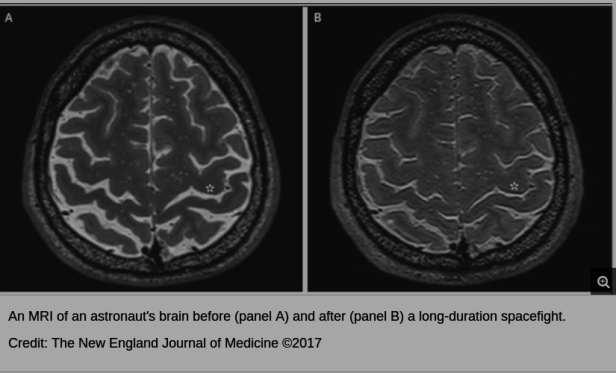
Major problem for astronauts – radiation damages mood and memory?
|
Long-Term Radiation Exposure From Space Travel Harms Memory, Mood, D-brief,
Researchers also know that short, powerful doses of radiation are deadly. But less is known about long-term, low-dose radiation — the kind that settlers on Mars or the moon would face. Now, a team of scientists led by Charles Limoli at the University of California, Irvine, has taken a step toward a better understanding of those long-term risks. The researchers exposed mice to chronic, low-dose radiation for six months. The results are troubling for the future of spaceflight. The radiation left the mice suffering from both memory and mood problems that the scientists say would likely show up in human subjects as well. The results were published Monday in the journal eNeuro. Radiation on the BrainIn the study, the mice showed “severe impairments in learning and memory,” according to the research paper. The mice were also generally more stressed out by their environments. That isn’t a good sign for space settlers, who will need their wits to face unforeseen struggles. Other studies have also already shown the potential ill effects of the long-term isolation and stress. In the past, scientists hit lab mice with radiation levels some 100,000 times higher than they’d actually experience on Mars’ surface. But the researchers say their test is the first that has used these lower, more realistic doses of radiation over long periods to study space travel. Their efforts were made possible by a new facility. The radiation included both neutrons – heavy particles from atomic nuclei – and pure energy in the form of gamma rays and other scattered photons…… Researchers found both physical and chemical changes in the brains they examined, in addition to the behavioral changes they observed in the living mice…….. more tests need to be done, and the radiation, while more realistic than past experiments, still doesn’t exactly mimic the space environment. But if their results hold up, they’re not a good sign for the future of human space settlement, at least not without a lot of bulky and expensive radiation shielding. http://blogs.discovermagazine.com/d-brief/2019/08/05/long-term-radiation-exposure-from-space-travel-harms-memory-mood/#.XUionm8zbIU |
|
Sunken Soviet Sub leaking high levels of radiation, Norwegian researchers say
|
Sunken Soviet Sub leaking high levels of radiation, Norwegian researchers sayNorwegian researchers have discovered that a Soviet nuclear submarine that sank in the Barents Sea 30 years ago, killing 41 sailors, is leaking radiation at nearly 1 million times normal levels. Bellona, August 5, 2019 by Charles Digges
Norwegian researchers have discovered that a Soviet nuclear submarine that sank in the Barents Sea 30 years ago, killing 41 sailors, is leaking radiation at nearly 1 million times normal levels. The submarine, called the Komsomolets, was at the time the most advanced in the Soviet Navy. When it went down on April 7,1989, it was carrying two plutonium warheads, which now lie at a depth of 1,680 meters with the rest of the sub’s wreckage, including its reactor. The wreck has caused concern about possible radioactive leakage ever since. Now those worries have been confirmed. Using a remote-controlled vehicle to probe the wreck, researchers from the Norwegian Radiation and Nuclear Safety Authority found extensive damage to the sub’s hull. Of particular disquiet, they say, are exceptionally high radiation levels in the area around one of the sub’s ventilation pipes. The highest measurement researchers recorded stood at 800 becquerel per liter. Radiation levels in that body of water typically remain around 0.001 Bq per liter, the authority said. “We found levels of radioactive cesium…that were close to 1 million times higher than the levels we find in [uncontaminated] seawater,” Hilde Elise Heldal, a researcher from Norway’s Institute of Marine Research who participated in the July 7 mission, told RFE/RL. In remarks to Reuters, she added that: “This is, of course, a higher level than we would usually measure out at sea, but the levels we have found now are not alarming.” Heldal said team members “weren’t surprised” to discover elevated radiation levels, the BBC reported. Radioactive cesium is easily diluted in the depths of the Barents Sea, and few fish live in the area surrounding the wreck. What we have found … has very little impact on Norwegian fish and seafood,” Heldal said, according to the Associated Press. “In general, cesium levels in the Norwegian Sea are very low, and as the wreck is so deep, the pollution from Komsomolets is quickly diluted.” Still, the confirmation that the submarine is actively leaking radiation comes weeks after a fire aboard a top-secret Russian nuclear submarine in the Barents Sea killed 14 sailors, making it the deadliest submarine incident to hit the Russian Navy since 2008. Norwegian scientists have been monitoring the wreck of the Komsomolets – which lies 180 kilometers southwest of Norway’s Bear Island and 350 kilometers northwest of the country’s mainland coast – since the 1990s…….. ven in its watery grave, the Komosomolets is the stuff of Cold War legend. Launched in May of 1983 from Severodvinsk on the Barents Sea, the sub could dive to deeper depths than any other vessel at the time. It was manned by a crew of 69 and could launch both nuclear and conventional weapons. The Komsomolets had been patrolling the waters for 39 days when a fire broke out in one compartment and quickly spread through the submarine on April 7, 1989, according to the CIA report. Forty-two crew died either in the fire or while awaiting rescue, and the sub sank to the bottom of the sea. The matter of the Komsomolets shook faith in an already ailing navy. Within two years of the accident, the Soviet Union would cease to be – leaving in its wake hundreds of derelict decommissioned nuclear submarines, and a host of other radioactive hazards dumped by the military. By 1994, the government in Moscow would reveal the scale of its irradiated legacy in the Arctic. The Soviet navy had scuttled hundreds of barrels of nuclear waste in the Kara Sea, along with old nuclear reactors, and, in one case, an entire nuclear submarine. https://bellona.org/news/nuclear-issues/2019-08-sunken-soviet-sub-leaking-high-levels-of-radiation-norwegian-researchers-say |
|
Kashmir, nexus of conflict between nuclear antagonists India and Pakistan, faces crackdown, plunges into fear,
Kashmir, nexus of conflict between nuclear antagonists India and Pakistan, faces crackdown, plunges into fear, By Douglas Perry | The Oregonian/OregonLive, 5 Aug 19, India and Pakistan have fought two wars and engaged in countless cross-border military skirmishes over Kashmir.
Now India has plunged the mountainous region into fear by revoking Kashmir’s constitutionally mandated “special privileges.” The federal government in Delhi sent in thousands of troops over the weekend, and Kashmiri political leaders have been put under house arrest. Internet service to the area has been cut off or restricted…..
The crackdown did not come as a surprise: The Delhi government ordered tourists out of the Himalayan region last week, warning of a possible terrorist attack.
Kashmir has been claimed by both Hindu-majority India and Muslim-majority Pakistan — and administered by India — since the two countries won their independence shortly after World War II. Great Britain partitioned its colony on the Indian subcontinent in 1947 before pulling out, sparking widespread violence. “Under the partition plan provided by the Indian Independence Act,” the BBC notes, “Kashmir was free to accede to India or Pakistan” — and the region’s maharaja at the time chose India, even though the population is predominantly Muslim. This led to a two-year war between India and Pakistan, with another one erupting in 1965.
In the 1990s, both India and Pakistan successfully tested nuclear weapons and began stockpiling warheads. Various armed separatist outfits have been operating in Kashmir for decades…….. https://www.oregonlive.com/news/2019/08/kashmir-nexus-of-conflict-between-nuclear-antagonists-india-and-pakistan-faces-crackdown-plunges-into-fear.html
Overwhelming arguments against nuclear power for Ireland
The arguments against nuclear as an energy solution are overwhelming, Irish Examiner, 5 Aug 19, “……….Tony Lowes, director of Friends of the Irish Environment, accepts that the nuclear question can provoke impassioned responses. “It hits some fundamental terror in people,” he says.
But he says the arguments against nuclear as an energy solution are overwhelming.
“It’s not a renewable fuel for a start — it’s a fossil fuel because you have to mine for uranium — and any efforts made to bring in nuclear energy would be at the expense of actually solving our problems which we have to do through wind and solar.”
Off-shore wind farms are the real answer, Lowes says, both because of the enormous amount of energy available to be harnessed off Ireland’s coasts and because of the growing opposition among local communities to the proliferation of onshore turbines and solar farms.
He is critical of the delays in overhauling the planning and licencing system needed to support offshore. Currently, developers face a mountain of bureaucracy with a multitude of national and local agencies to work through, with sometimes overlapping or duplicated processes.
In late July, the Government finally approved the general scheme of the Marine Planning and Development Management Bill 2019 which promises to clarify and streamline the procedures but, as the official announcement itself pointed out, this replaces the Maritime Area and Foreshore Amendment Bill of 2013.
Six years on and we still have only a general scheme of a bill with a long way to go before legislation is enacted and processes change accordingly.
Meanwhile investors have a number of large-scale project proposals on hold awaiting legislative clarity.
“We’ve known for a long time that off-shore wind is essential. It’s a no-brainer. The blockages to it are just so reprehensible,” Lowes says.
“We don’t have a very clear picture of how the rules for offshore will work and we haven’t addressed it with anything like the urgency we need to which is why we’re talking about nuclear energy. But I think it would be a really fatal mistake to make nuclear part of the energy mix in the long-term.”……
Off-shore wind and solar at times produce a surplus of energy. Battery storage facilities — often looking like a cluster of large office cabinets — can be installed in open spaces to store excess power but already plans for some in this country are facing local opposition.
The excess can also be processed to produce hydrogen that could be used for heating and fuelling vehicles which would take the pressure off the electricity supply at times when the sun is down and winds are light.
The idea works at the experimental level but the challenge is to get it working on a large scale and cheaply enough to make it worthwhile. A breakthrough on that front is imminent, so the energy industry says, but the proof is awaited……
Oisin Coghlan, director of the Friends of the Earth Ireland, however, doesn’t believe a debate on nuclear is necessary or justifiable.
“I think it’s a massive distraction,” he says. “You’d have to change the law and even if Friends of the Earth changed our position and said, you know what, we think nuclear is the solution and we’re going to drop everything and campaign for it for the next 10 years, I don’t think it would make the slightest bit of difference……
Coghlan believes nuclear has as much to do with psychology as technology. “Nuclear appeals to engineers and it appeals to politicians who want big solutions and macho solutions,” he says. ……
“Lagging every attic and double-glazing every window would be far more efficient and far quicker and have none of the hassle but engineers and politicians have been very resistant to this kind of approach.
“They don’t like starting small — putting solar panels on every school and house — because that’s lots of little people doing little things.
But that’s what makes this a societal journey where we all change together. When every school has solar power, while that won’t be enough on its own, it will mean that maybe the parents are less likely to oppose the solar farm planned for down the road because they start to feel like they’re part of the solution.
“I think nuclear is a red herring that appeals to a certain mindset and I think that mindset is outdated. We need to look at decentralised, renewable electricity that many of us are involved in owning, that many of us are involved in supplying and all of us are involved in supporting.”……
For Tony Lowes, here is no argument — nuclear is not an answer. “We were ahead of the game in wind energy 10-15 years ago and we got stuck but we can still transform the energy picture if we get moving again,” he says.
“Bringing nuclear into the conversation is just going to slow us down even more and we don’t have any more time to lose.”
Marshall Islands to survey leaking nuclear dome,
|
Marshall Islands to survey leaking nuclear dome, https://www.rnz.co.nz/international/pacific-news/395978/marshall-islands-to-survey-leaking-nuclear-dome , 5 Aug 19, The Marshall Islands government will survey a leaking nuclear-filled dome after growing international concern over the structure. The country’s Nuclear Commission said work is due to start by the end of the year studying the impact of the structure on Enewetak Atoll.It comes after the Pacific Islands Forum Secretary General, Dame Meg Taylor, called for an audit of the dome to determine if it was leaking.
Her UN counterpart, Antonio Guterres, has also raised concerns about the potential radioactive fallout. Nuclear Commission chairperson Rhea Moss-Christian says the survey will take around three years. “We just need to understand better what’s happening, what the status is. We already know that there’s the ground water beneath the dome is mixing with the lagoon water. All we know, based on DOE (US Department of Energy) studies is that the lagoon has more contamination than what is inside the dome.” Ms Moss-Christian said an ongoing US program monitoring the presence of nuclear waste in groundwater continued to be held up by a lack of funding being released by the Department of Interior. “We’ve been relying for years on the data provided by the US through the Department of Energy studies. And we haven’t had a clear enough picture for many years.” |
|
Nuclear power will ‘lumber into extinction,’ ex-regulator says
 STEVE SEBELIUS: Nuclear power will ‘lumber into extinction,’ ex-regulator says, By Steve Sebelius August 3, 2019 For Gregory Jaczko, the nuclear power question comes down to a basic quandary: For a nuclear reactor to be designed, built and operated safely, it has to be small, too small to make it useful as a commercial source of electricity.And given that other, less complicated and risky sources of renewable energy are available, spending time and money on solving the large-scale nuclear issue isn’t necessary, he argues.
Jaczko’s conclusions are controversial, especially in the energy industry, where he ruffled feathers as a former member and chairman of the Nuclear Regulatory Commission. But Jaczko, who holds a doctoral degree in theoretical particle physics from the University of Madison-Wisconsin, is convinced the equation is relatively simple.
“The longer you operate nuclear power plants, the more accidents are going to happen,” he said. “The more power plants you upgrade, the more accidents you’re going to have.”……
Jaczko, whose rocky tenure atop the NRC is discussed in his book, “Confessions of a Rogue Nuclear Regulator,” documents his opinions carefully, and suggests that even if nuclear plants could be designed more safely to avoid catastrophic accidents, the expense wouldn’t be worth it because of the availability of cheaper, renewable alternatives such as solar power, wind farms, geothermal plants and the like.
“Today, there’s not a debate anymore because you can solve the climate problem without nuclear,” he said. “So you don’t have to deal with any of these other issues anymore. And you can solve them with things that are cheaper. They do not create the same kinds of challenges.”
“In hindsight, the Fukushima incident revealed what has long been the sad truth about nuclear safety: the nuclear power industry has developed too much control over the (Nuclear Regulatory Commission) and Congress,” Jaczko writes in his book. “In the aftermath of the accident, I found myself moving from my role as a scientist impressed by nuclear power to a fierce nuclear safety advocate. I now believe that nuclear power is more hazardous than it is worth.”
Other countries are moving away from nuclear power: Countries such as Germany, Sweden, Switzerland and Italy have decided to phase out nuclear power, although it remains the largest source of power in France. After the Fukushima disaster, Japan shut down all of its nuclear power plants, although some have since been restarted.
Jaczko also makes the point that continued use of nuclear power puts pressure on regulators and the government to find a place to dispose of spent nuclear fuel. Currently, there’s only one target, the Yucca Mountain repository in Nevada, which has seen renewed interest from Republicans during the Trump administration.
But that site has long been opposed by most state officials out of concerns about safety, concerns that have been increased after recent California earthquakes. Not only that, but revelations that the government secretly shipped plutonium for temporary storage to the Nevada National Security Site, and may have mixed in reactive waste products with lower-level waste in other shipments, have stirred serious concerns among Nevada officials.
“As waste piles up, we leave behind dangerous materials that later generations will eventually have to confront,” Jaczko wrote in his book. “The short-term solution — leaving it where it is — can certainly be accomplished with minimal hazard to the public. But such solutions require active maintenance and monitoring by a less-than-willing industry.”
He adds: “There is only one logical answer: We must stop generating nuclear waste, and that means we must stop using nuclear power. I wish that as chairman (of the Nuclear Regulatory Commission) I’d had the courage to say this, but my courage had its limits. I knew the backlash that would come if the chairman of the NRC were to admit our country should stop producing nuclear power.”
But now, like many former elected officials or political appointees, he’s freed from the shackles that responsibility imposed upon his candor. He predicts that nuclear power will “lumber into extinction” in favor of cheaper, safer, cleaner and more readily viable technologies and that “we will likely begin to think of electricity much as we do hot water; as something we make in our homes on demand.”
Contact Steve Sebelius at SSebelius@reviewjournal.com or 702-383-0253. Follow @SteveSebelius on Twitter. https://www.reviewjournal.com/opinion/opinion-columns/steve-sebelius/steve-sebelius-nuclear-power-will-lumber-into-extinction-ex-regulator-says-1818297/
Japan’s govt urges Fukushima evacuees to return – in drive to promote 2020 Olympics
Expert says 2020 Tokyo Olympics unsafe due to Fukushima | 60 Minutes
Fukushima: Despite health threats, the Japanese government urges residents to return https://www.express.co.uk/news/world/1161500/fukushima-japanese-government-encourages-residents-returnFAMILIES who fled nuclear meltdown in Fukushima are being urged to return to their homes ahead of the Tokyo Olympics., By DAVID PILDITCH, Aug 4, 2019 Alarming levels of radiation up to 20 times higher than official safety targets have been recorded in areas where locals are being encouraged to go back. We found ghost towns eight years after three reactors went into meltdown at Daiichi power plant 140 miles north east of Tokyo in March 2011. Tokyo 2020 is being hailed as the “Reconstruction Olympics” signalling new hope following the earthquake and tsunami that triggered the disaster and left more than 18,000 people dead.
Now evacuees are being urged to return as the global spotlight focuses on the recovery of the region. The government has lifted most evacuation orders and all but a handful of hot spots have been declared safe.
But parents believe their children are in danger, saying officials are downplaying the dangers and safety is compromised in a cynical attempt to convince the world the crisis is over.
Families have accused the government of speeding up their return to showcase safety standards ahead of the Olympics.
We found once-vibrant communities now post apocalyptic wastelands like something from a Hollywood movie after the worst nuclear accident since Chernobyl.
Schools, shopping malls, supermarkets, libraries and petrol stations lie decaying along with thousands of homes. Many are set behind guarded barricades in exclusion areas known officially as “difficult to return to zones”.
Others lie in areas which the government says are safe to live in but whose few residents – wild boar and monkeys – demonstrate signs of mutation. Along roadsides sit giant black bags containing contaminated soil.
In Tomioka, five miles from the power plant, a school sports hall is scattered with footballs left when children fled.
It’s in stark contrast to arenas being built for the £20billion Games. Fukushima is hosting the first event, a softball match on July 22, two days before the opening ceremony.
The Japanese leg of the torch relay starts on March 26 at a soccer training centre 12 miles south of the crippled plant. The J Village, a base for emergency workers, only fully reopened last month.
In Okuma our Geiger counter sounded furiously, recording four microsieverts an hour. The government safety target is 0.23 microsieverts per hour.
It came days after evacuation orders were lifted for parts of the town which had 10,000 residents. The centre remains a no-go zone and just 367 former residents have registered to go back.
Ayako Oga, 46, who suffered a miscarriage, says: “The Olympics are putting lives in danger. The government is forcing people to leave the public homes they have been in. They are putting a heavy burden on people still suffering mentally and financially.”
In Namie, which had 21,000 residents, evacuation orders were lifted in 2017. It is said 800 people returned but we found desolation, only traffic lights working.
The Wild Boar bar last served a drink on disaster day. Owner Sumio Konno, in a group legal action against the government, says his son, who was five, still suffers nosebleeds. “He is sick all the time,” he says. “Every month he needs to go to the doctor.”
Ryohei Kataoka, of the Citizens Nuclear Information Centre, says: “The government’s insistence in lifting evacuation orders where heightened radiation-related health risks undeniably exist, is a campaign to show that Fukushima is ‘back to normal’ and to try to make Japan and the world forget the accident ever happened.”
Another French nuclear plant having difficulties due to hot weather, and poor river flow
 Reuters 3rd Aug 2019 French utility EDF may curb power generation at its 3,000 megawatt Chooz nuclear reactor in the north of France due to the low flow rate of the
Meuse river which it uses to cool the two reactors at the plant. “Due to
flow forecasts of Meuse river, production restrictions are likely to affect
EDF’s nuclear generating fleet on Chooz production units starting
Thursday August 8,” the company said. EDF’s use of water from rivers as
coolant is regulated by law to protect plant and animal life. It is obliged
to reduce output during hot weather when water temperatures rise, or when
river levels are low.
1 This Month
19 November – Webinar – The Reality of Reprocessing
Time: 11:00 AM Pacific Time (US & Canada) / 2:00 PM Eastern / 7:00 PM UK / 8:00 PM CET
Register for the Zoom Event Here

Tell Congress: Prevent Nuclear Catastrophe in Iran

Tell Congress: Prevent Nuclear Catastrophe in Iran

Read the Public Inquiry Report, the Commissioners’ report, Surrendering Australia: The AUKUS Deception is available to download for free at aukuspublicinquiry.com. Or just watch the replay of the National Press Club Luncheon.


Shut down the radiation-damaged Heysham nuclear reactors now
To see nuclear-related stories in greater depth and intensity – go to https://nuclearinformation.wordpress.com

Say No to NASA’s Reckless Nuclear Reactor on the Moon
Say No to NASA’s Reckless Nuclear Reactor on the Moon
-
Archives
- November 2026 (190)
- October 2026 (302)
- September 2026 (339)
- August 2026 (330)
- July 2026 (355)
- June 2026 (287)
- May 2026 (306)
- April 2026 (356)
- March 2026 (251)
- February 2026 (267)
- January 2026 (308)
- December 2025 (358)
-
Categories
- 1
- 1 NUCLEAR ISSUES
- business and costs
- climate change
- culture and arts
- ENERGY
- environment
- health
- history
- indigenous issues
- Legal
- marketing of nuclear
- media
- opposition to nuclear
- PERSONAL STORIES
- politics
- politics international
- Religion and ethics
- safety
- secrets,lies and civil liberties
- spinbuster
- technology
- Uranium
- wastes
- weapons and war
- Women
- 2 WORLD
- ACTION
- AFRICA
- Atrocities
- AUSTRALIA
- Christina's notes
- Christina's themes
- culture and arts
- Events
- Fuk 2022
- Fuk 2023
- Fukushima 2017
- Fukushima 2018
- fukushima 2019
- Fukushima 2020
- Fukushima 2021
- general
- global warming
- Humour (God we need it)
- Nuclear
- RARE EARTHS
- Reference
- resources – print
- Resources -audiovicual
- Weekly Newsletter
- World
- World Nuclear
- YouTube
-
RSS
Entries RSS
Comments RSS

