This Nuclear Renaissance Has a Waste Management Problem

12 Jan, 26, https://energyathaas.wordpress.com/2026/01/12/this-nuclear-renaissance-has-a-waste-management-problem/
Three sobering facts about nuclear waste in the United States.
Americans are getting re-excited about nuclear power. President Trump has signed four executive orders aiming to speed up nuclear reactor licensing and quadruple nuclear capacity by 2050. Big tech firms ( e.g. Google, Amazon, Microsoft, Meta) have signed big contracts with nuclear energy producers to fuel their power-hungry data centers. The federal government has signed a deal with Westinghouse to build at least $80 billion of new reactors across the country. Bill Gates has proclaimed that the “future of energy is sub-atomic”.
It’s easy to see the appeal of nuclear energy. Nuclear reactors generate reliable, 24/7 electricity while generating no greenhouse gas emissions or local air pollution. But these reactors also generate some of the most hazardous substances on earth. In the current excitement around an American nuclear renaissance, the formidable challenges around managing long-lived radioactive waste streams are often not mentioned or framed as a solved problem. This problem is not solved. If we are going to usher in a nuclear renaissance in this country, I hope we can keep three sobering facts top-of-mind.
Fact 1: Nuclear fission generates waste that is radioactive for a very long time.
After 4-6 years of hard work in a commercial fission reactor, nuclear fuel can no longer generate energy efficiently and needs to be replaced. When this “spent” fuel comes out of the reactor it is highly radioactive and intensely hot, so it must be carefully transferred into deep pools where it spends a few years cooling off…
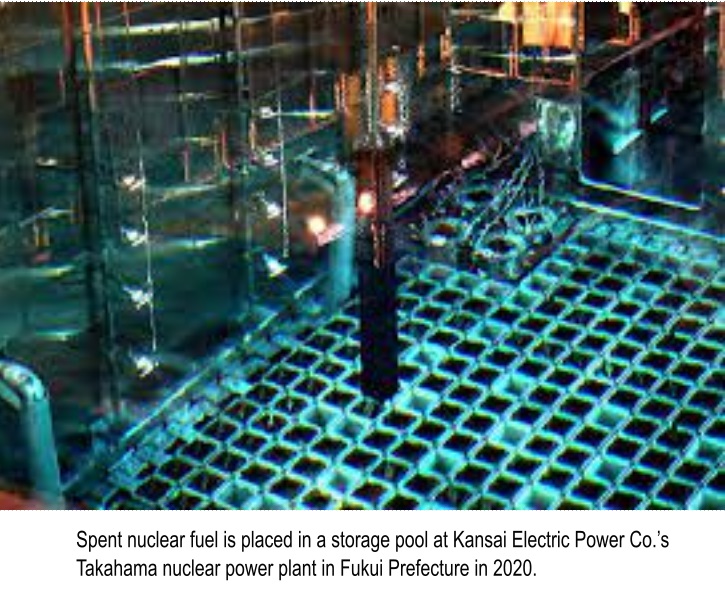
Once cooled, this spent fuel is still not something you want to spend time with because direct exposure is lethal. While most of the radioactivity decays after about 1000 years, some will persist for over a million years. U.S. efforts to site and build a permanent repository for nuclear waste have failed (more on this below). After spending time in the pool, spent fuel is stored on sites of operating or retired reactors in steel canisters or vaults.
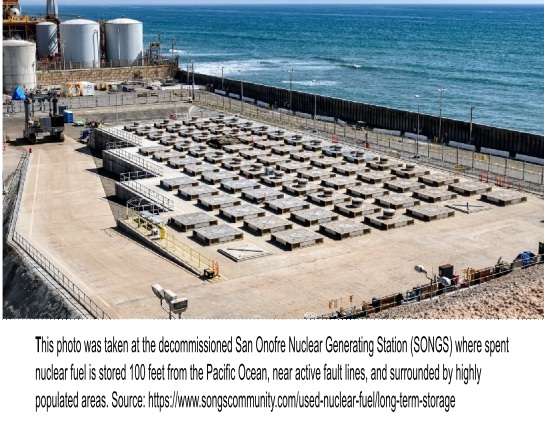
Across the country, more than 90,000 metric tons of radioactive fuel is sitting in pools or dry storage at over 100 sites in 39 states. These sites are licensed by the Nuclear Regulatory Commission (NRC) and regulated by the EPA. They are designed to be safe! But experts agree that this is an unacceptable long-term waste management situation (see, for example, here, here, and here).
Fact 2: The U.S. has no permanent nuclear waste disposal plan
For more than half a century, the United States has tried—and failed—to find a forever-home for its nuclear waste. Early efforts in the 1960s and 1970s went nowhere. In 1982, Congress passed the Nuclear Waste Policy Act which laid out a comparative siting process that was designed to be technically rigorous and politically fair. But this process was slow, expensive, and politically exhausting.
By 1987, Congress lost patience, scrapped its own framework, and tried to force the issue by designating Yucca Mountain in Nevada as the chosen one. Nevada’s resistance was relentless. After roughly $15 billion in spending on site development, the Yucca Mountain proposal was finally withdrawn in 2010. As I understand it, these siting efforts did not fail because the location was declared unsafe. They failed because nuclear waste storage siting was being forced on an unwilling community.
In the years since, Blue Ribbon panels, expert advisory groups, and national research councils have been convened. All have reached the same conclusion. The U.S. needs to break the impasse over a permanent solution for commercial spent nuclear fuel and this will require a fair, transparent, and consent-based process.
You might be thinking that spent fuel reprocessing, which is also enjoying an American renaissance right now, could eliminate the need for a geological repository. It’s true that reprocessing breaks spent fuel down to be used again. But in that process, new types of radioactive wastes are created that need to be managed in deep repositories or specialized landfills. This creates a potentially more (versus less) challenging mess to clean up (reprocessing leaders like France are pursuing costly geological repositories for these wastes).
Fact 3: We are actively undermining public trust in the nuclear waste management process
Convincing a community to host thousands of tons of radioactive waste for thousands of years is not easy. But it’s not impossible. Efforts in Sweden, Finland, France, Switzerland, and Canada are starting to find some success.
All of these international success stories share one important feature: a sustained commitment to building public trust in both nuclear industry regulation and the nuclear waste storage siting process. Alas, here in the United States, we seem to be moving in the opposite direction.
A series of recent developments make it hard to feel hakuna matata about our nuclear waste management protocols:
- In May, an executive order called for a “wholesale revision” of the NRC directing it to accelerate reactor licensing, reconsider radiation standards, and reduce staffing.
- In June, an NRC commissioner was abruptly fired, prompting a letter from concerned career staff .
- The Department of Energy has pledged to “use all available authorities to eliminate or expedite its environmental reviews for authorizations, permits, approvals, leases, and any other activity requested” by nuclear reactor projects under its supervision.
- The Supreme Court recently ruled that Texas lacks legal standing to challenge NRC approval of a privately operated interim nuclear waste facility, raising questions about state’s abilities to challenge nuclear waste siting decisions.
These developments may ultimately succeed in accelerating nuclear deployment across the United States. But they also undermine the public trust and independent governance that are essential inputs into the building of a long-term nuclear waste management strategy.
Weighing our nuclear options
Taking a step back, it is worth asking why nuclear energy is enjoying such a resurgence in this country right now. The growing availability of low-cost renewables and storage, together with an increasingly flexible demand-side, complicates the claim that nuclear power is some kind of moral climate necessity. There are cheaper ways to decarbonize the grid.
The renewed push for nuclear energy is not really about climate necessity. It seems to be driven by anxiety about reliability in a strained power system, industrial policy aimed at rebuilding domestic manufacturing capacity, and the commercial interests of firms chasing revenue streams tied to data centers and federal support. This nuclear revival trades off today’s politically urgent reliability concerns for a long-term obligation to manage radioactive waste (along with some low-probability risk of catastrophic failure). If that’s the trade off we want to make, we should understand that a nuclear renaissance without a viable long-term waste management plan saddles future generations with the messy consequences of our policy choices.
Spectral Threats: China, Russia and Trump’s Greenland Rationale

Were Russia or China to attempt an occupation of Greenland through military means, Article V of the North Atlantic Treaty would come into play, obliging NATO member states, including the United States, to collectively repel the effort.
“There are no Russian and Chinese ships all over the place around Greenland,”
“Russia and/or China has no capacity to occupy Greenland or to take control over Greenland.”
14 January 2026 Dr Binoy Kampmark, https://theaimn.net/spectral-threats-china-russia-and-trumps-greenland-rationale/
The Trump administration’s mania about Greenland, a self-governing territory of Denmark, is something to behold. Its untutored thuggery, its brash assertiveness, and the increasingly strident threats to either use force, bully Denmark into a sale of the island, or simply annex the territory, have officials and commentators scrambling for theories and precedents. The Europeans are terrified that the NATO alliance is under threat from another NATO member. The Greenlanders are anxious and confused. But the ground for further action by Washington is being readied by finding threats barely real and hardly plausible.
The concerns about China and Russia seizing Greenland retells the same nonsense President Donald Trump promoted in kidnapping the Venezuelan President Nicolás Maduro and his wife. Looking past the spurious narcoterrorism claims against the former leader, it fell to the issue of who would control the natural resources of the country. If we don’t get Venezuelan oil now and secure it for American companies, the Chinese or the Russians will. he gangster’s rationale is crudely reductionist, seeing all in a similar veinThe obsession with Beijing and Moscow runs like a forced thread through a dotty, insular rationale that repels evidence and cavorts with myth: “We need that [territory],” reasons the President, “because if you take a look outside Greenland right now, there are Russian destroyers, there are Chinese destroyers and, bigger, there are Russian submarines all over the place. We are not gonna have Russia or China occupy Greenland, and that’s what they’re going to do if we don’t.” On Denmark’s military capabilities in holding the island against any potential aggressor, Trump could only snort with macho dismissiveness. “You know what their defence is? Two dog sleds.”
This scratchy logic is unsustainable for one obvious point. Were Russia or China to attempt an occupation of Greenland through military means, Article V of the North Atlantic Treaty would come into play, obliging NATO member states, including the United States, to collectively repel the effort. With delicious perversity, any US effort to forcibly acquire the territory through use of force would be an attack on its own security, given its obligations under the Treaty. In such cases, it becomes sound to assume, as the Danish Prime Minister Mette Frederiksen does, that the alliance would cease to exist.
Such matters are utterly missed by the rabidly hawkish Deputy Chief of Staff Stephen Miller, who declared that, “Nobody’s going to fight the United States militarily over the future of Greenland.” It was up to the US “to secure the Arctic region, to protect and defend NATO and NATO interests” in incorporating Greenland. To take territory from a NATO ally was essentially doing it good.
Given that the United States already has a military presence on the island at the Pituffik Space Base, and rights under the 1951 agreement that would permit an increase in the number of bases should circumstances require it, along with the Defence Cooperation Agreement finalised with Copenhagen in June 2025, much of Miller’s airings are not merely farcical but redundant. Yet, Trump has made it clear that signatures and understandings reflected in documents are no substitute for physically taking something, the thrill of possession that, by its act, deprives someone else of it. “I think ownership gives you a thing that you can’t do, whether you’re talking about a lease or a treaty,” he told the New York Times. “Ownership gives you things and elements that you can’t get from just signing a document.”
What, then, of these phantom forces from Moscow and Beijing, supposedly lying in wait to seize the frozen prize? “There are no Russian and Chinese ships all over the place around Greenland,” states the very convinced research director of the Oslo-based Fridtjof Nansen Institute, Andreas Østhagen. “Russia and/or China has no capacity to occupy Greenland or to take control over Greenland.”
Danish Foreign Minister Lars Lokke Rasmussen is similarly inclined. “The image that’s being painted of Russian and Chinese ships right inside the Nuuk fjord and massive Chinese investments being made is not correct.” Senior “Nordic diplomats” quoted in the Financial Times add to that version, even if the paper is not decent enough to mention which Nordic country they come from. “It is simply not true that the Chinese and Russians are there,” said one. “I have seen the intelligence. There are no ships, no submarines.” Vessel tracking data from Marine Traffic and LSEG have so far failed to disclose the presence of Chinese and Russian ships near the island.
Heating engineer Lars Vintner, based in Greenland’s capital, Nuuk, wondered where these swarming, spectral Chinese were based. “The only Chinese I see,” he told Associated Press,“ is when I go to the fast food market.” This sparse presence extends to the broader security footprint of China in the Arctic, which remains modest despite a growing collaboration with Russia since the 2022 invasion of Ukraine. These have included Arctic and coast guard operations, while the Chinese military uses satellites and icebreakers equipped with deep-sea mini submarines, potentially for mapping the seabed.
However negligible and piffling the imaginary threat, analysts, ever ready with a larding quote or a research brief, are always on hand to show concern with such projects as Beijing’s Polar Silk Road, announced in 2018, which is intended as the Arctic extension of its transnational Belt and Road initiative. The subtext: Trump should not seize Greenland, but he might have a point. “China has clear ambitions to expand its footprint and influence in the region, which it considers… an emerging arena for geopolitical competition.” Or so says Helena Legarda of the Mercator Institute for China Studies in Berlin.
The ludicrous nature of Trump’s claims and acquisitive urges supply fertile material for sarcasm. A prominent political figure from one of the alleged conquerors-to-be made an effort almost verging on satire. “Trump needs to hurry up,” mocked the Deputy Chairman of the Russian Security Council and former President Dmitry Medvedev. “According to unverified information, within a few days, there could be a sudden referendum where all 55,000 residents of Greenland might vote to join Russia. And that’s it!” With Trump, “that’s it” never quite covers it.
Challenge to Latest Sellafield Discharges to the Rivers Calder, Ehen and the Irish Sea
By mariannewildart, on behalf of Lakes Against Nuclear Dump, https://lakesagainstnucleardump.com/2026/01/16/still-waiting-for-judge-to-make-decision-on-our-challenge-to-latest-sellafield-discharges/
The hearing on whether our Judicial Review into the challenge of Sellafield’s latest discharges to the rivers Calder and Ehen took place at the end of November. Incredibly we are still waiting for the decision on whether our Judicial Review can go forward. In the meantime here is a lovely photo [on original] of Rowbank Farm.
This is just one of the many farms and grand houses in the once fertile plain between the Lake District mountains and the Irish Sea to be obliterated by Sellafield’s nuclear waste sprawl along the once meandering and braided river Calder. This photo [on original] along with many more can be found on the Calderbridge and Ponsonby Parish Council website (no endorsement of our challenge by the Parish Council is implied – the photos are in the public domain)
Onwards and Upwards
TerraPower and Meta partner on Natrium nuclear plants

The agreement launches early work on two initial units and secures Meta rights to energy from six more, marking the tech giant’s largest investment in advanced nuclear energy to date.
erraPower and Meta have agreed to develop up to eight Natrium nuclear reactor and energy storage system plants in the United States, a move that could supply Meta with up to 2.8 gigawatts of carbon-free baseload energy. With the Natrium system’s built-in energy storage, total output could be increased to as much as 4 gigawatts.
The agreement supports early development of two initial Natrium units and gives Meta rights to energy from up to six additional units. Each reactor provides 345 MW of baseload power and can ramp up to 500 MW for more than five hours. A dual-unit site could deliver up to 690 MW of firm power and as much as 1 GW of dispatchable electricity.
The companies said delivery of the first units could begin as early as 2032. They also plan to identify a site for the initial dual-reactor project in the coming months.
‘Wall of money’ to invest in Scottish nuclear power if Labour win election
Prime Minister Keir Starmer said the SNP were saying Scotland was ‘shut for business’.
Danyel VanReenen, Politics Reporter, Jan 15th, 2026
The Prime Minister said the UK Labour Government is ready and willing to invest in nuclear power in Scotland if Anas Sarwar wins the Holyrood election in May.
The current SNP Government has consistently been against the creation of new nuclear power stations north of the border, with control of planning laws giving ministers an effective veto.
Keir Starmer said there is a “wall of money” Labour wants to invest in Scottish nuclear power, but he said the SNP are saying no “for ideological reasons”.
“If there’s a Labour Government in Scotland, we’ll be back the day after the election to make sure that money is translated into good, well-paying jobs in renewables and nuclear,” Starmer said.
“That can’t happen at the moment because the SNP is basically saying ‘we’re shut for business’.”…………………………………………………………………………………………. https://news.stv.tv/politics/wall-of-money-to-invest-in-scottish-nuclear-power-if-labour-win-election
Is a deep geological repository (DGR) for IGNACE a good idea?
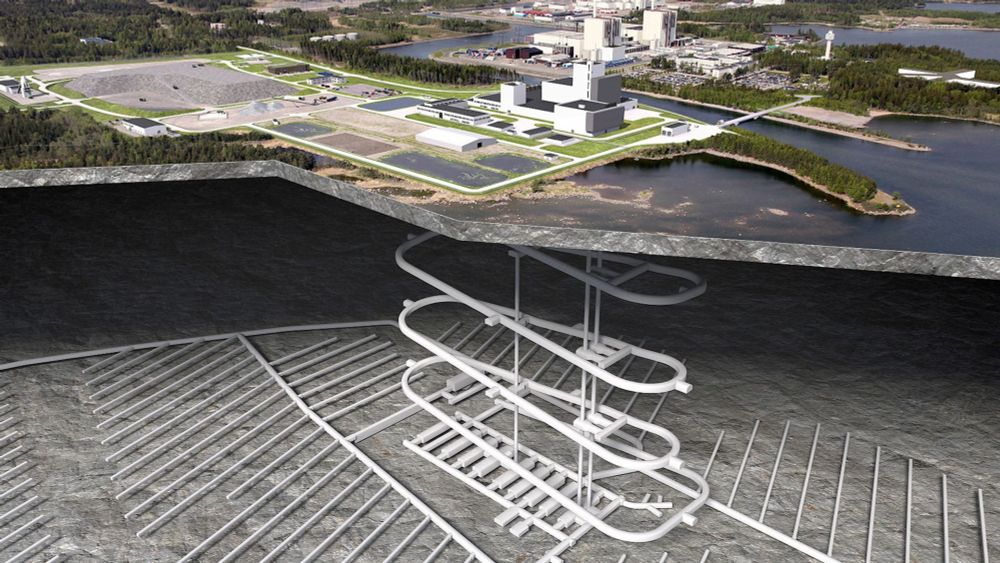
I would say that the most important issue – and one that is totally disregarded by NWMO – is the inordinate extra cost (of about $500 million) of shipping used fuel to Ignace rather than Teeswater or some more southerly location. The mass transfer of used fuel from locations such as Bruce, Pickering and Darlington to the township of Ignace will involve dozens of 50-ton trucks travelling up and down major roads, such as Highways 401, 400, 69 and 17, a total of 25,000 times between 2043 and 2068. This protracted activity adds up to a total highway travel time of over 200 years!
| Frank Greening, 13 Jan 26 |
Questioning the wisdom of NWMO’s plan for a used fuel DGR to be constructed near Ignace in Northern Ontario, in view of the issues presented below:
From the Project description document AMP-REP-05000-0211-R000
11. ESTIMATED MAXIMUM PRODUCTION CAPACITY OF THE PROJECT
An estimated 5.9 million bundles of used fuel will be processed in the UFPP over its operational lifetime of approximately 50 years (about 120,000 used fuel bundles per year). On average, per the current conceptual reference design, 10 used fuel containers (UFCs) are planned to be processed and placed in the repository each workday, or approximately 2,500 UFCs each year.
To achieve this throughput, the UFPP is likely to incorporate multiple processing lines. Based on annual shipping (receipt) assumptions, the maximum number of certified transportation packages received at the UFPP in any given year is estimated to be approximately 885, holding between 120 and 192 used fuel bundles in each certified transportation package. The UFPP is designed to receive and process up to five certified transportation packages each day.
I would say that the most important issue – and one that is totally disregarded by NWMO – is the inordinate extra cost (of about $500 million) of shipping used fuel to Ignace rather than Teeswater or some more southerly location. The mass transfer of used fuel from locations such as Bruce, Pickering and Darlington to the township of Ignace will involve dozens of 50-ton trucks travelling up and down major roads, such as Highways 401, 400, 69 and 17, a total of 25,000 times between 2043 and 2068. This protracted activity adds up to a total highway travel time of over 200 years!
Closely related to the issue of shipping costs, is the additional problem of the high probability of inclement weather along Highway 17 from November to March each year. It appears that NWMO’s approach to dealing with this issue is simply to limit used fuel shipments to Ignace to just 9 months per year. However, this is barely adequate, given the common occurrence of snow storms along Highway 17 from as early as October to as late as April each year. Indeed, the Ontario Ministry of the Environment states in reference to winter driving on Highway 17: “Expect snowfall amounts of 10 –15 cm; reduced visibility due to snow and blowing snow; icy and slippery surfaces, and quickly changing and deteriorating travel conditions”.
This clearly shows the severity of the winter weather for the township of Ignace, with heavy snowfall dominating the months from November to March. Interestingly, NWMO has stated – See NWMO Report APM-REP-00440-0209-R001, issued September 2021 – that moving used nuclear fuel by truck to Ignace would mean “two to three shipments a day for approximately nine months of the year”. It is not clear why NWMO stipulates shipments being made for only 9 months per year, but this is presumably to allow for three months of inclement weather.
However, as previously noted, meteorological data for Ignace indicate that heavy snow is possible for this region from November to March, which is five months, not three! In addition, one is left wondering what happens at the DGR site for the three months when there are no used fuel shipments. Indeed, this lack of shipments is inconsistent with NWMO’s assertion, previously noted in this email, that “10 used fuel containers (UFCs) are planned to be processed and placed in the repository each workday. I would like someone to explain how this will happen over winter, when NWMO admits there will be no used fuel shipments for at least three months each year, (December, January and February?). What will workers at the used fuel packaging plant do when there are no UFC’s to process?
Highway 17 in Northern Ontario has earned a reputation for frequent accidents, particularly involving heavy trucks. In 2022, the Ontario Provincial Police (OPP) reported over 9,100 collisions involving large trucks across the province, with 71 fatalities — many occurring on routes like Highway 17. Addressing the issues plaguing Highway 17 requires more than incremental fixes—it demands a transformative overhaul. Experts and residents alike stress the need for substantial investments to bring this critical corridor up to modern standards. Proposals extend far beyond doubling lanes or adding passing areas, emphasizing winter-specific design improvements, enhanced lane visibility, and the permanent operation of weigh stations with robust enforcement to eliminate unsafe vehicles. Rest stops must be expanded and maintained year-round to provide safe havens for drivers, particularly during extreme weather. Furthermore, the integration of advanced monitoring systems, including traffic cameras and real-time condition updates, is essential for proactive safety management of this Highway. Only through a comprehensive and bold approach can Highway 17 meet the safety, accessibility, and efficiency needs of the communities and industries it serves. Without such improvements to Highway 17, NWMO’s plan to build a DGR near Ignace is both reckless and potentially very dangerous!
NWMO’s nonchalant approach to the selection of a site for a used fuel DGR is deeply concerning. Just because the residents of a small northern Ontario town are willing to host a DGR does NOT make it the best possible option for Canada. And let’s remember that, once the site selection is made, it’s not just for a while, but in perpetuity!
Flamanville nuclear plant to remain offline to 1 Feb following storm
(Montel) Units 1 (1.3 GW) and 3 (1.6 GW) of French utility EDF’s Flamanville nuclear plant will remain offline until 1 February due to the damage caused by storm Goretti last week.
by: Elise Wu12 Jan 2026, https://montelnews.com/news/2d1b9548-51d9-41fa-932f-6d42f4c4d017/flamanville-nuclear-plant-to-remain-offline-to-1-feb-following-storm
Report: Military Tells Trump It Needs More Time to Prepare for War With Iran.

Military commanders in the Middle East want more time to prepare for Iranian counterattacks
by Kyle Anzalone | January 11, 2026 , https://news.antiwar.com/2026/01/11/report-military-tells-trump-it-needs-more-time-to-prepare-for-war-with-iran/
Senior Department of War officials have told President Donald Trump they need more time to consolidate American troops deployed to the Middle East before the US launches an attack on Iran.
According to The Telegraph, “Trump has been warned that the US military needs more time to prepare for strikes against Iran.” Military commanders in the Middle East stated they need to “consolidate US military positions and prepare defences” in anticipation of an Iranian retaliatory attack.
Parliament Speaker Mohammad Baqer Qalibaf said that if it attacks Iran, the Islamic Republic will strike Israel and US bases in the Middle East/
Trump has threatened Iran several times in recent weeks. “If Iran [shoots] and violently kills peaceful protesters, which is their custom, the United States of America will come to their rescue. We are locked and loaded and ready to go,” Trump said earlier this month.
Demonstrations began in Iran two weeks ago, and some protests have escalated into riots. Some groups report that 200 people have been killed during the demonstrations, including over 40 members of Iranian security forces.
Iranian authorities have reportedly used live ammunition to break up protests, and Tehran has cut off internet service in an attempt to quell the movement.
Israel Hayom spoke with American officials who said the White House is preparing a range of actions against Iran, including using Starlink to provide protesters with internet access, a cyber attack, new sanctions, and kinetic military action.
The Telegraph reports that potential targets of US strikes include non-military targets in Tehran and Iranian security forces.
At the end of last year, Israeli Prime Minister Benjamin Netanyahu traveled to the US to lobby Trump to restart the war with Iran. In June, Israel launched a surprise attack on Iran that ignited a 12-day war.
During the conflict, Trump ordered American bombers to strike three Iranian nuclear sites. The Islamic Republic responded by striking a US military base in Qatar. The Iranian response was viewed as symbolic, and a ceasefire between the US, Israel, and Iran was reached shortly after.
Navajo lands at risk

by beyondnuclearinternational, https://beyondnuclearinternational.org/2026/01/11/navajo-lands-at-risk/
New proposal is extraction not remediation, warns the Navajo group, Dooda Disa
More than 500 abandoned uranium mines (AUMs) contaminate the Navajo Nation, and genuine cleanup is urgently needed. But cleanup must be grounded in strict environmental oversight, transparency, and full community consultation. A proposal now being advanced by Navajo Nation EPA (NNEPA) Executive Director Stephen Etsitty, in partnership with DISA Technologies, is being marketed as AUM remediation when DISA’s High-Pressure Slurry Ablation (HPSA) system does not clean up Navajo land—it extracts uranium for commercial sale while leaving radioactive waste behind.
Etsitty told the Albuquerque Journal he was “really excited” that the process could “accelerate the cleanup” and said “the Navajo Nation is investing roughly $3 million” in a commercial-scale test —all of which is misleading. Even calling HPSA “remediation” is whitewashing, because the technology is strictly a uranium-extraction process.
On January 6, 2025, he introduced Resolution ENAC-12-2025-049 at the Eastern Navajo Agency Council (6) that asks the Navajo Nation to enter into a commercial partnership with DISA in order to apply for DOE critical-minerals grants—an extraction initiative, not a cleanup program. It provides no site information, no environmental safeguards, and no cost details, yet seeks approval for a commercial partnership structured around uranium extraction rather than cleanup.
The Truth About DISA and HPSA
In 2023, the EPA commissioned Tetra Tech to test HPSA on waste from three Navajo AUM sites: Old Church Rock Mine (OCRM), Quivira Church Rock-1, and the Cove Transfer Station (CTS-2). Over two weeks, small batches of contaminated waste were run through a pilot-scale HPSA unit. The system blasts rock with high-pressure water to create slurry, then separates it into a coarse fraction and a fines fraction. The fines—about 17% of the material—contain 80–95% of the uranium and radium that DISA intends to ship to the White Mesa Mill and sell to Energy Fuels. The coarse fraction is waste that remains radioactive and may be left onsite, buried, or sent to a disposal site that does not exist.
The results are unequivocal: HPSA did not meet Navajo Nation residential cleanup standards because the coarse waste rock left behind is still too radioactive. At each site, the process removed 80–95% of the uranium and concentrated it into the fines fraction (1), but the remaining coarse material still fails cleanup standards. At OCRM, rock that began at 940 mg/kg uranium—milligrams of uranium per kilogram of soil—was reduced only to 47 mg/kg, still far above the Navajo residential cleanup standard of 3.2 mg/kg. The report notes that meeting Navajo standards would require 99.7% uranium removal, which HPSA never achieved. The study shows that HPSA concentrates uranium for extraction but does not produce coarse waste rock clean enough to meet Navajo residential standards. It documents uranium extraction, not cleanup.
Environmental Review, Licensing, and the FONSI
After the field tests, DISA quickly sought federal licensing. On March 28, 2025, the company applied to the Nuclear Regulatory Commission (NRC) for a multi-site “service provider” license. NRC issued a Draft Environmental Assessment (EA) and Finding of No Significant Impact (FONSI) on August 5, 2025, opened a brief comment period, and finalized both documents by September 25, 2025.
This speed was possible only because Trump-era changes to the National Environmental Policy Act (NEPA) weakened requirements for thorough environmental review. NRC’s FONSI rests on assumptions—not Navajo-specific data—about water use, dust, trucking, and waste left onsite. HPSA has never been tested at commercial scale. NRC ultimately granted DISA a multi-state, non–site-specific generic license requiring only a pilot program and a Pre-Mobilization Notification (PMN) before work at any site. If the assumptions in the FONSI are not met, the PMN could trigger a full Environmental Impact Statement (EIS), but this is unlikely given the current administration’s broad weakening of environmental oversight.
Water Use, Energy, Waste, and Trucks
The Tetra Tech study relied on municipal water from Gallup because no Navajo source was available. A scaled-up 50-ton-per-hour HPSA system would use about 200,000 gallons of water per month; a 100-ton-per-hour system, roughly 384,000 gallons—requiring two to four water trucks per day. Each operating campaign ends with 32,000–54,000 gallons of contaminated process water that must be disposed of or transported to another AUM site.
For every 100 tons processed, HPSA generates about 17 tons of fines—the uranium-rich concentrate DISA intends to ship to White Mesa—and roughly 83 tons of coarse waste rock, which remains on the land or must be hauled to a disposal site that does not exist.
Energy demand is also heavy. A 100-TPH system requires two 500-kilowatt diesel generators running continuously, ensuring constant deliveries of diesel fuel and the need for onsite fuel storage—none of which were meaningfully evaluated in the EA, FONSI, or license.
In practice, the project would rely on three continuous streams of truck traffic: water trucks, diesel fuel trucks, and haul trucks carrying uranium-laden fines through Navajo lands to the White Mesa Mill in Utah—transport that is prohibited under the Diné Natural Resources Protection Act of 2005.
Who Profits—and Who Bears the Risk
Under federal law, all Navajo trust land is held by the United States, which controls the mineral rights. Once uranium is extracted from AUM waste, it becomes “source material” that DISA—not the Navajo Nation—may own, transport, and sell under its NRC license. Uranium recovered from high-grade AUM sites could be worth hundreds of millions of dollars—benefiting DISA and Energy Fuels, not the families who have lived with contamination for generations.
Whatever commercial partnership Etsitty envisions with DISA is not clear. DISA needs the partnership to obtain Navajo consent to access sites and conduct business, but what does the Navajo Nation receive in return? Why should the Nation take on the risk while giving up control over Navajo land? The reality is that DISA, a startup with limited funding, cannot even afford to conduct the required pilot itself. That is why Etsitty is asking the Navajo Nation to finance the pilot for $3 million—so DISA can prove its own extraction technology while keeping the uranium and the long-term profits.
What Happens Next—and What Navajo Nation Can Still Do
The question is not whether AUMs should be cleaned up—they must be. The real question is whether DISA should be entrusted with that work. Should the Navajo Nation pay to enter into a commercial partnership with a high-risk company using an unproven technology under the false banner of “cleanup”? All available evidence—the Tetra Tech study, DISA’s own descriptions of HPSA, and NRC’s licensing structure—shows the same thing: this is a mining project, not a cleanup program.
The bottom line is that the Diné Natural Resources Protection Act of 2005 bans uranium mining and processing on Navajo land. Extracting uranium from AUM waste for commercial sale is mining, whether the feedstock is called “ore” or “waste,” and is therefore prohibited.
Dooda Disa is a community-based grassroots group dedicated to providing accurate information, raising awareness, and protecting Navajo lands and communities from renewed uranium extraction disguised as cleanup.
Chubu Electric’s data fraud ‘undermines’ Japan’s nuclear energy policy

10 Jan 2026 https://www.japantimes.co.jp/news/2026/01/10/japan/chubu-electric-data-fraud/
Chubu Electric Power’s data fraud linked to earthquake risks at its Hamaoka nuclear power plant has splashed cold water on the Japanese government’s energy policy of maximizing nuclear power use.
Shinsuke Yamanaka, chief of the Nuclear Regulation Authority, has said that the NRA’s safety screening of the Nos. 3 and 4 reactors at the plant in Shizuoka Prefecture is expected to “go back to square one.”
A delay in the restart of Hamaoka reactors will deal a blow to Chubu Electric’s earnings and affect the government’s goal of raising the share of nuclear power in the country’s energy mix.
The new basic energy plan of the government, adopted in February 2025, marked a shift from its policy of reducing dependence on nuclear power as much as possible, which was introduced following the March 2011 triple meltdown at Tokyo Electric Power Company Holdings’ tsunami-stricken Fukushima No. 1 nuclear power plant.
The plan instead calls for fully utilizing nuclear energy to meet surging electricity demand in the country. It specifically seeks to raise the share of nuclear power in the energy mix to about 20% by fiscal 2040 from the current level of slightly less than 10%. For this to be achieved, the number of active nuclear power reactors should be increased from the current 14 to more than 30.
Late last year, the process to obtain local consent was completed for the restart of reactors at Tepco’s Kashiwazaki-Kariwa nuclear power station in Niigata Prefecture and Hokkaido Electric Power’s Tomari plant in Hokkaido.
On Jan. 20, the Kashiwazaki-Kariwa plant’s No. 6 reactor is expected to become the first Tepco reactor to be brought back online since the 2011 disaster.
Yamanaka said that the NRA does not plan to investigate nuclear power plants other than the Hamaoka power station for data fraud similar to the irregularities found at the Chubu Electric plant.
If public trust in safety is eroded, however, securing local consent for future reactor restarts would become increasingly difficult.
Chubu Electric’s data fraud case “will greatly undermine public trust in safety,” industry minister Ryosei Akazawa told a news conference Friday. “This should not have happened.” He vowed to “take strict measures” against Chubu Electric based on its upcoming report on preventive steps.
If the safety screening of the Hamaoka reactors restarts from scratch, the power supplier’s earnings will be affected significantly.
The company expects that its profitability will improve by about ¥250 billion a year if the Nos. 3 to 5 reactors at the Hamaoka plant are brought back online. The Nos. 1 and 2 reactors at the plant ended operations in January 2009 and are now being decommissioned.
At a news conference Monday, Chubu Electric President Kingo Hayashi said, “The company’s responsibility for the data fraud is serious.”
On whether he will step down from his post, Hayashi said only that he will consider the matter “comprehensively.”
Hayashi also serves as chairman of the Federation of Electric Power Companies of Japan.
Chubu Electric is also expected to struggle in its decarbonization efforts after the company decided last year to withdraw from a project to construct wind power plants at a total of three locations off the coasts of Akita and Chiba prefectures.
Bill Gates-backed ‘Cowboy Chernobyl’ nuclear reactor races toward approval in Wyoming

For longtime Wyoming resident Steve Helling, the risks outweigh the promises.
“Wyoming is being used as a guinea pig for this nuclear experiment,”
By Samantha Olander, Jan. 10, 2026
A Bill Gates-backed nuclear reactor dubbed “Cowboy Chernobyl” by critics is barreling toward approval in rural Wyoming, alarming residents and nuclear safety experts as regulators fast-track the project under a Trump-era order.
TerraPower, founded by the Microsoft guru, is seeking federal approval to build the western hemisphere’s first Natrium nuclear reactor in Kemmerer, a coal town of roughly 2,000 people near the Utah border and about two hours north of Salt Lake City.
The plant would use liquid sodium rather than water to cool the reactor, a design pitched as safer and more efficient.
Critics say it introduces new risks while cutting corners on containment.
The United States Nuclear Regulatory Commission completed its final safety evaluation in December, concluding there were no issues that would block issuance of a construction permit.
The five-member commission is expected to vote on the permit later this month. TerraPower still needs a separate operating license before the reactor can run.
Local residents say the fast pace has left them uneasy.
“We’re probably two hours away from that place when it comes to how long it takes the wind to get here,” Patrick Lawien of Casper told the Daily Mail. “Obviously, if anything goes wrong, it’s headed straight for us.”
TerraPower began building the non-nuclear portion of the 44-acre site in June 2024, near the retired Naughton coal plant, which shut down at the end of 2025.
The company says the reactor will generate 345 megawatts of power, with the ability to reach 500 megawatts during peak demand. It aims to have the plant operating by 2030………………………………………
uclear watchdogs say speed is the problem.
The Union of Concerned Scientists, a nonprofit science advocacy group, says TerraPower’s design omits the traditional concrete containment structure used at U.S. nuclear plants.
The company instead proposes “functional containment,” which relies on internal engineered systems to perform containment functions rather than a physical containment building.
“The potential for rapid power excursions and the lack of a real containment make the Kemmerer plant a true ‘Cowboy Chernobyl,’” said Edwin Lyman, the group’s director of nuclear power safety.
Lyman warned that if containment proves inadequate later, it would be nearly impossible to add a traditional containment structure once construction begins.
He also criticized the sodium cooling system.
“Its liquid sodium coolant can catch fire, and the reactor has inherent instabilities that could lead to a rapid and uncontrolled increase in power,” Lyman said….
Concerns intensified after the NRC wrapped up its review months ahead of its original schedule.
The accelerated timeline followed an executive order signed by Donald Trump in May directing federal agencies to fast-track advanced nuclear reactor approvals,
TerraPower applied for its construction permit in March 2024 and received preliminary approval in December, well ahead of its initial August 2026 target.
For longtime Wyoming resident Steve Helling, the risks outweigh the promises.
“Wyoming is being used as a guinea pig for this nuclear experiment,” Helling told the Daily Mail. “Wyoming has everything I could want, beauty, clean air, clean water, wildlife, abundant natural resources.”
He said he worries about the long-term cost of disposing of nuclear waste decades down the road, as the U.S. still lacks a permanent storage solution.
Some states, including California and Connecticut, prohibit new nuclear plant construction unless the federal government establishes a long-term solution for radioactive waste storage.
Zelensky makes another move to avoid election.

12 Jan 26, https://www.rt.com/russia/630856-zelensky-election-martial-law/
The Ukrainian leader has submitted a bill to extend martial law, which would allow him to remain in power.
Ukraine’s Vladimir Zelensky has submitted two draft bills to the parliament to extend martial law and general mobilization for another 90 days, effectively postponing elections once again. The move comes despite pressure from US President Donald Trump and the Ukrainian leader earlier saying he was open to holding an election.
One of the draft laws submitted to the Verhovna Rada on Monday would extend martial law from February 3 to early May, which would effectively bar national elections for this period. Martial law has been renewed repeatedly in three-month increments since 2022. The other bill would prolong the controversial forced mobilization campaign on the same timetable.
Zelensky’s presidential term expired in May 2024. The Ukrainian leader refused to hold a new election, citing the conflict with Russia. Moscow subsequently declared him “illegitimate,” arguing that authority now rests with the Ukrainian parliament. Russian officials also noted that Zelensky’s dubious status is a major legal obstacle to signing a peace agreement.
This comes despite pressure from Trump – who labeled Zelensky “a dictator without elections” last year – to hold an election. In December, Zelensky said he was ready to hold an election within months if the West could provide Kiev with robust security guarantees.
A poll in January by Ipsos suggested that former Ukrainian commander-in-chief Valery Zaluzhny – widely viewed as Zelensky’s main rival – is leading potential presidential candidates with around 23% support, while Zelensky trailed at 20%.
If the second bill passes, Ukraine will prolong its mobilization campaign, which has been marred by numerous violent incidents between draft officers and reluctant recruits. Officials in Kiev have acknowledged a decline in enthusiasm to serve, but insisted that drastic measures are required to replenish growing battlefield losses.
Ontario Power Generation seeks rate increase for electricity from nuclear plants
Matthew McClearn, 13 Jan, 26 https://www.theglobeandmail.com/business/article-ontario-power-generation-rate-increase-application-electricity-nuclear
The Pickering Nuclear Generation Station in January, 2020. In November the Ontario government approved the $26.8-billion refurbishment of four aging reactors at the station.
Ontario Power Generation is seeking a near-doubling of payments it receives for electricity produced by its nuclear power plants, a request that could lead to surging power bills.
In a rate application submitted to the Ontario Energy Board in December, OPG requested payments of nearly $207 dollars per megawatt hour produced by its nuclear power stations beginning Jan. 1, 2027, roughly double what it received as recently as last year. It seeks similar amounts for each year through 2031.
OPG spokesperson Neal Kelly said the sought rates would cause a typical residential customer’s payments to rise by roughly 2.4 per cent annually in each of the next five years.
Ontario has generated roughly half of its power in recent years from its Darlington, Pickering and Bruce nuclear stations. (The latter is operated by private power producer Bruce Power and is not part of OPG’s application.) Energy Minister Stephen Lecce is pursuing an aggressive expansion of the reactor fleet to meet an expected surge in demand for electricity between now and mid-century, which includes plans to build large new multi-reactor stations.
Chelsea McGee, a spokesperson for Mr. Lecce, referred an interview request from The Globe and Mail to the OEB and OPG.
The requested payment increases require the board’s approval. OEB spokesperson Tom Miller said it would be inappropriate to comment on OPG’s application because it is before a panel of commissioners. Mr. Miller said it will be adjudicated later this year.
Made in Canada: Inside an urban Toronto facility making uranium fuel for CANDU reactors
OPG is entering a period of intense capital spending. Last year, it began constructing the first of four new small modular reactors at its Darlington station, with an estimated cost of $20.9-billion. OPG said that project accounts for about one-quarter of the sought payment increases.
Far more consequential, at 60 per cent of the payment increase, is the $26.8-billion refurbishment of four aging reactors at Pickering station. The government approved that overhaul in November; it’s expected to wrap up in the mid-2030s.
OPG is also spending to refurbish many of its hydroelectric stations.
“Every investment in the application has been carefully evaluated, planned prudently and designed to provide long-term value to Ontarians,” Mr. Kelly wrote in a statement.
Mark Winfield, a professor at York University’s environmental faculty, said that because OPG’s projects have been approved by the government, the OEB has little room to disallow the payment increases sought by the utility.
“They can’t really say no to OPG,” he said.
“The system runs by political fiat, and all the agencies are basically mandated to fulfill the minister’s will.”
Ontario to spend $1.5-billion on underwater electricity cable from nuclear plant to Toronto
Ontario’s residential electricity rates previously increased 29 per cent on Nov. 1. The OEB attributed those hikes to “higher-than-expected generation costs” as well as increased spending on conservation programs, but it provided few additional details. Those rate hikes were largely offset by a 23.5-per-cent increase in the Ontario Electricity Rebate, a taxpayer-funded instrument the government uses to provide relief on residential power bills.
The Globe twice requested interviews with OEB officials in December to explore the role rising nuclear costs played in the Nov. 1 rate increases. Mr. Miller denied those requests but agreed to answer questions by e-mail. The Globe sent questions to the OEB on Jan. 5, but had not received responses by late Monday.
A report by Power Advisory LLC, a consultancy that performed work for the OEB related to the Nov. 1 rate increases, attributed them partly to “higher-than-expected nuclear generation.” That report noted payments for OPG’s nuclear generation rose to $123.76 per megawatt hour in 2026, as compared with $111.61 per megawatt hour last year.
The current trajectory for power rates has attracted concern from the Association of Major Power Consumers in Ontario, which represents industrial power users including automakers Ford Motor Co. and Toyota Motor Corp., and steel producers Stelco and ArcelorMittal Dofasco.
AMPCO president Brad Duguid said the province has no choice but to overhaul and expand its nuclear fleet – a decision he argued will preserve the provincial grid’s reliability. But he’s concerned that industrial power rates are already “skyrocketing” for AMPCO’s members – increases he mainly attributed to rising natural gas generation as reactors are taken offline for refurbishment.
“Over the next seven to 10 years, we’re seeing significant increases in the market energy rates to make up that difference,” he said.
“We’re talking about increases in the range of 165 per cent for the market rate over the next three years alone. That’s untenable. That’s an absolute threat to the competitiveness of our industrial sector and the hundreds of thousands of jobs it supports.”
Ottawa, Ontario pledge combined $3-billion for new nuclear reactors
Jack Gibbons, chair of the Ontario Clean Air Alliance, attributed the hikes directly to the government’s nuclear expansion and predicted the situation will only worsen.
“It’s just absurd to be investing in high-cost nuclear,” he said.
“It’s going to push up rates, make life less affordable for hard-working families and make Ontario’s businesses less competitive.”
York University’s Mr. Winfield said the government has four options to address the upward pressure on electricity rates. First, it can allow them to rise, but that would undermine affordability and could stall electrification of Ontario’s economy.
The government could also further increase subsidies such as the Ontario Energy Rebate. But at a total annual cost “of $8.5-billion per year, this has to be already at or near the limits of fiscal feasibility,” Mr. Winfield wrote in an e-mail.
Another option is to reconsider the province’s electricity plans to focus on lower-cost options. Finally, the government could conceal the additional costs as debt, a choice previous governments pursued.
Electricity rates are also rising sharply in many other jurisdictions across North America, including ones with little or no nuclear generation. According to the U.S. Energy Information Administration, average residential rates across the United States increased 5 per cent for the year ended Oct. 31, reaching nearly 18 US cents per kilowatt hour.
Wind is certainly not the only renewable power source in Scotland
The National 12th Jan 2026, Alexander Potts
I WOULD like to reply to Lyndsey Ward (Letters, Jan 6) to say that it isn’t the SNP that look silly for not wanting nuclear power plants in Scotland, but those who advocate that we build them.
Statistics published last month showed that Scotland produced 115% of electricity by renewables for the previous year (2024/2025). In other words, we produced 15% more than we needed by renewables alone. And yes, we do use other sources to produce electricity when needed. As we export 40% of electricity to England from the above 115% figure, we are certainly way above what our/Scotland’s demands are, so do we actually need more generating capacity?
I of course acknowledge that at times the wind turbines are switched off, but as I have stated, we do have other means to produce electricity. However, I do have to ask Lyndsey why she didn’t mention that we also generate renewable electricity by hydro power, and have been since the 1950s, as well as solar and tidal power? In that respect, Lyndsey has fallen into the same old trap as others in that she assumes we only generate renewables by the one source and that we don’t have back-up facilities.
Lyndsey also forgets to mention one very important fact in Scotland’s renewable project, in that we pump the water back up to the reservoirs at off-peak periods, so the one thing that we aren’t going to run short of is hydro power. In a similar fashion, people assume that solar panels only work in bright light. However, they work when there is a light source available and are producing power from early morning to evening more or less all the time, even in overcast conditions.
Although tidal power is still at the early stages of development, its only drawback is that its doesn’t produce power at slack water periods, which is about two hours per day (two one-hour periods per day). The interesting thing about that, though, is that slack water time is different all around the coast, so the more that potentially come online, the more that minor problem is overcome. As tidal energy production is submerged, then there won’t be visual evidence as with wind turbines………………………………………………………………………. https://www.thenational.scot/business/25756714.wind-certainly-not-renewable-power-source-scotland/
British Ministry of Defense developing ballistic missile for Ukraine to make “deep strikes into Russia”

Steven Starr , 13 Jan 26
The missile is only in the developmental stage. The delusional British imagine that Russia will not strike Britain if they pursue this folly.
The UK has formally launched Project Nightfall, a competition to develop a new ground-launched tactical ballistic missile intended primarily for use by Ukrainian forces, while also shaping future British long-range strike programmes.
The government has moved ahead with Project Nightfall, a competitive effort to rapidly develop a ground-launched ballistic missile designed to give Ukraine a long-range strike capability against Russian forces. The programme builds directly on work first disclosed by the UK Defence Journal in December, when the Ministry of Defence published an initial contract notice outlining the requirement.
While the project is being run by the UK, ministers have been clear that the missile is not intended as a near-term addition to Britain’s own arsenal. Instead, Nightfall is designed around Ukrainian operational use, with British industry acting as the developer and manufacturer and the UK Armed Forces positioned as a future beneficiary of lessons learned rather than the immediate end user.
The December notice, published on 9 December 2025, confirmed that the MOD was seeking industry partners to “procure a future tactical ballistic missile through a short-term development programme”. That followed parliamentary confirmation in November that officials were assessing industry feedback ahead of launching a formal competition.
According to the published requirement, Nightfall is one of the most ambitious missile programmes pursued by the UK in decades. The MOD specified a cost-effective, ground-launched ballistic missile with a range greater than 500 kilometres, capable of operating in high-threat and heavily contested environments, including under intense electronic warfare and degraded or denied satellite navigation.
Mobility and survivability are central to the concept. The system is required to support salvo firing from a single launcher, with multiple missiles launched in quick succession before the crew withdraws rapidly. The MOD specified that launch units must be able to leave the firing area “within 15 minutes of launching all effectors”, with each missile reaching its target within approximately 10 minutes of launch.
Scalability is another key requirement. Subject to future contracts, production must be capable of delivering at least 10 missiles per month, with scope to increase output. Designs are also expected to allow future upgrades to range, accuracy and manoeuvrability, while minimising reliance on foreign export controls.
This week’s announcement adds political weight and funding detail rather than altering the core technical requirement. Under the current plan, the government intends to award up to three competing development contracts, each worth £9 million. Each team would be expected to design, develop and deliver three missiles within 12 months for test firings. Proposals are due by 9 February, with development contracts targeted for award in March.
Defence Secretary John Healey framed the programme as a response to continued Russian attacks, saying the UK was determined to place advanced weapons “into the hands of Ukrainians as they fight back.” In ful, he said:
The missile must be “capable of being safely ground launched from a mobile platform in a high threat tactical environment, navigating to and accurately striking a user-programmed fixed target co-ordinate.” Each effector is expected to carry a conventional high-explosive payload of around 200 kilograms and follow a supersonic ballistic trajectory, with a stated accuracy requirement of striking within 10 metres of a target coordinate for 50 per cent of launches.
Mobility and survivability are central to the concept. The system is required to support salvo firing from a single launcher, with multiple missiles launched in quick succession before the crew withdraws rapidly. The MOD specified that launch units must be able to leave the firing area “within 15 minutes of launching all effectors”, with each missile reaching its target within approximately 10 minutes of launch.
Scalability is another key requirement. Subject to future contracts, production must be capable of delivering at least 10 missiles per month, with scope to increase output. Designs are also expected to allow future upgrades to range, accuracy and manoeuvrability, while minimising reliance on foreign export controls.
This week’s announcement adds political weight and funding detail rather than altering the core technical requirement. Under the current plan, the government intends to award up to three competing development contracts, each worth £9 million. Each team would be expected to design, develop and deliver three missiles within 12 months for test firings. Proposals are due by 9 February, with development contracts targeted for award in March
Defence Secretary John Healey framed the programme as a response to continued Russian attacks, saying the UK was determined to place advanced weapons “into the hands of Ukrainians as they fight back.” In ful, he said:
“The attacks overnight on Thursday just go to show how Putin thinks he can act with impunity, targeting civilian areas with advanced weaponry. Instead of seriously negotiating a peace, he’s seriously escalating his illegal war. We were close enough to hear the air raid sirens around Lviv on our journey to Kyiv, it was a serious moment and a stark reminder of the barrage of drones and missiles hitting Ukrainians in sub-zero conditions. We won’t stand for this, which is why we are determined to put leading edge weapons into the hands of Ukrainians as they fight back.”
Defence Minister Luke Pollard said the missiles would “keep Ukraine in the fight” while also strengthening longer-term European security.
“A secure Europe needs a strong Ukraine. These new long-range British missiles will keep Ukraine in the fight and give Putin another thing to worry about. In 2026, we will continue to stand shoulder to shoulder with Ukraine. Providing equipment to keep them in the fight today, whilst working to secure the peace tomorrow.”
While the formal launch underscores the government’s intent, the substance of Project Nightfall remains closely aligned with the requirement outlined in December. As that original notice made clear, the MOD still reserves the right to amend or cancel the programme at any stage, stating that “the Authority reserves the right not to award any Contract to any supplier at any stage during the procurement.”
For now, Nightfall represents a rare case of the UK pursuing a ground-launched ballistic missile explicitly for a partner nation’s use, while using the programme to accelerate domestic expertise in deep-strike systems that Britain itself currently lacks.
1 This Month
26 September – International Day for the Total Elimination of Nuclear Weapons





PLEASE OPPOSE HR 8255 AND S.3639 – bills would accelerate satellite deployment, with no environmental review or safeguards – https://ncstd5li.quorum.us/campaign/169331/
To see nuclear-related stories in greater depth and intensity – go to https://nuclearinformation.wordpress.com
-
Archives
- September 2026 (281)
- August 2026 (330)
- July 2026 (355)
- June 2026 (287)
- May 2026 (306)
- April 2026 (356)
- March 2026 (251)
- February 2026 (267)
- January 2026 (308)
- December 2025 (358)
- November 2025 (359)
- October 2025 (375)
-
Categories
- 1
- 1 NUCLEAR ISSUES
- business and costs
- climate change
- culture and arts
- ENERGY
- environment
- health
- history
- indigenous issues
- Legal
- marketing of nuclear
- media
- opposition to nuclear
- PERSONAL STORIES
- politics
- politics international
- Religion and ethics
- safety
- secrets,lies and civil liberties
- spinbuster
- technology
- Uranium
- wastes
- weapons and war
- Women
- 2 WORLD
- ACTION
- AFRICA
- Atrocities
- AUSTRALIA
- Christina's notes
- Christina's themes
- culture and arts
- Events
- Fuk 2022
- Fuk 2023
- Fukushima 2017
- Fukushima 2018
- fukushima 2019
- Fukushima 2020
- Fukushima 2021
- general
- global warming
- Humour (God we need it)
- Nuclear
- RARE EARTHS
- Reference
- resources – print
- Resources -audiovicual
- Weekly Newsletter
- World
- World Nuclear
- YouTube
-
RSS
Entries RSS
Comments RSS

