UN climate change talks in Madrid end with no agreement on carbon market rules or stronger pledges Marathon international climate talks have ended with major polluters resisting calls to ramp up efforts to keep global warming at bay and negotiators postponing the regulation of global carbon markets until next year. ABC 15 Dec 19 Key points:
UN secretary-general Antonio Guterres said he was “disappointed” by the meeting’s outcome
The final talks fell short of promising to enhance countries’ pledges to cut planet-heating greenhouse gases next year
There was no final agreement on regulation for international carbon markets, with the EU warning that weak rules sought by some countries would undermine the system
Those failures came even after organisers added two more days to the 12 days of scheduled talks in Madrid.
In the end, delegates from almost 200 nations endorsed a declaration to help poor countries that are suffering the effects of climate change, although they did not allocate any new funds to do so.
The final declaration called on the “urgent need” to cut planet-heating greenhouse gases in line with the goals of the landmark 2015 Paris climate change accord.
That fell far short of promising to enhance countries’ pledges to cut planet-heating greenhouse gases next year, which developing countries and environmentalists had lobbied the delegates to achieve.
The Paris accord established the common goal of avoiding a temperature increase of more than 1.5 degrees Celsius by the end of the century.
Negotiators in Madrid left some of the thorniest issues for the next climate summit in Glasgow in a year, including the liability for damages caused by rising temperatures that developing countries were insisting on.
That demand was resisted mainly by the United States……..
“Regressive governments put profit over the planetary crisis and the future of generations to come,” the conservation group WWF said in a statement.
Ms Mountford said the talks this year “reflect how disconnected country leaders are from the urgency of the science and the demands of their citizens in the streets.”
Business Green 13th Dec 2019, The Green Party saw its total number of votes grow by over 60 per cent in yesterday’s election, delivering the biggest percentage gains of any party following a campaign that saw environmental issues take centre stage.
Caroline Lucas retained her seat in Brighton Pavilion, increasing her share
of the vote by almost five per cent to 57 per cent.
Can Russia And The U.S. Agree To Keep A Lid On Their Nuclear Arsenals? Radio Free Europe, December 15, 2019 By Mike Eckel
One major Cold War-era weapons treaty has collapsed. Another, aimed at building trust among the United States, Russia, and other countries, is under severe strain. Washington and Moscow are modernizing their arsenals, building new, more advanced weapons.
By most accounts, the United States and Russia are on the verge of a new arms race, if not already in one.
But last month, something unusual happened: U.S. inspectors traveled to Russia to examine a new missile that Moscow says is super-fast. The demonstration was “aimed at facilitating efforts to ensure the viability and efficiency of New START,” the Russian Defense Ministry said.
The move has arms control observers wondering whether, despite poisoned relations, Moscow and Washington may in fact find a way to agree to extend the biggest — and last — major weapons treaty restraining the holders of the world’s two largest nuclear arsenals.
Dmitry Stefanovich, a researcher with the Russian International Affairs Council, said the inspection of the weapon — called Avangard by Russian military designers — was a demonstration that Moscow was eager to extend New START.
“It is more like an offer: See, we will [give] you transparency on some new weapons and probably some more in the future, but we have to extend the treaty for it to work,” he told RFE/RL. “And we expect the same from you, when your modernization of strategic weapons reaches fruition.”
Large Arsenals
Signed in 2010 by Presidents Barack Obama and Dmitry Medvedev, New START limited the U.S. and Russian nuclear arsenals by capping the numbers of delivery systems — long-range bombers, silo-based land missiles, and submarine-launched missiles — and deployed warheads.
As of September 1, Russia had 513 deployed strategic launchers with 1,426 warheads, according to State Department figures. The United States deploys 668 strategic launchers with 1,376 warheads, according to the data……
Nuclear War Simulator shows the devastation that nukes could cause , MIC, By AJ Dellinger, Dec 14, 2019
, The fallout of nuclear war is the premise for all sorts of films and video games. There is a sort of morbid curiosity to imagining what life would be like in a post-apocalyptic world caused by this type of warfare, but the threat of such an occurrence is anything but science fiction. To better understand exactly how devastating to the planet and the population that a global nuclear could cause, there’s Nuclear War Simulator.
One way to imagine Nuclear War Simulator is like a version of Google Earth with a nuclear option. With a couple clicks, you can find out what the fallout of a conflict between two nuclear superpowers would be, from casualties caused to the long-term effects that follow, including nuclear fallout and radiation levels.
The simulator puts you in full control of the experience, allowing you to design your own nuclear forces, establish attack plans and explore potential conflict scenarios and even push to see just how many weapons a nation could produce if they decided to put the full force of their military and economy behind it. Along the way of seeing how these scenarios play out, the Nuclear War Simulator also lets you determine what your chance of survival would be in a nuclear holocaust, based on your location and how the attacks would play out. …… https://www.mic.com/p/nuclear-war-simulator-shows-the-devastation-that-nukes-could-cause-19447517
Nuclear-powered container ship sailed 3,000 nm to change propellers in lack of floating dock up north
After the floating dock SD-50 sank at Roslyakovo yard north of Murmansk last fall “Sevmorput” now had to sail all around Scandinavia to St. Petersburg to find a dock large enough. Barents Observer, By Thomas Nilsen, December 15, 2019
“Sevmorput” left her homeport in Murmansk on December 5th and arrived in St. Petersburg on the 12th after sailing a distance of nearly 3,000 nautical miles, information from MarineTraffic tells.
The 260 meters long container ship is currently moored at the Admiralteyskiye yard in the Neva River, but will later be taken to the nearby dry dock at Kanonerskiy yard, SeaNews agency reports.
It was late October last year the floating dock sank at shipyard No. 82 in Roslyakovo between Murmansk and Severomorsk in the Kola Bay. The dock was then holding “Admiral Kuznetsov”, Russia’s only aircraft carrier.
The sunken dock was the only one on the Kola Peninsula large enough to accommodate “Sevmorput” and navy ships like the nuclear-powered battle cruiser “Pyotr Velikiy” and ballistic missile submarines of the Delta-IV-, Oscar, II- and Borei-classes.
RADIOACTIVE DUST ACCIDENTALLY RELEASED AT NUCLEAR SITE CONTRAVENED MULTIPLE REGULATIONS, INVESTIGATION FINDS, Newsweek
BY ARISTOS GEORGIOU ON 12/13/19 Environmental authorities in Scotland have said that an accidental release of radioactive dust from a nuclear site “contravened multiple” regulatory conditions, according to reports.
The contaminated dust vented out of a uranium recovery plant at Dounreay—a nuclear research center which is in the process of being decommissioned—earlier this year after a valve failed during a system test in February, the BBC reported.
Ethics of Nuclear Energy Abu-Dayyeh (P.hD) Amman – H.K. of Jordan Ayoub101@hotmail.com E_case Society (President) www.energyjo.com [Extract] November 30, 2019
“…..5- Nuclear energy in the South!
“If all the latter costs were reallocated to consumers, an increase in the price for electricity between €0.139 and €2.36 for each kilowatt-hour will have to be administered for a period of commitment of 100 years”(45).These estimates explicate the true cost of electricity produced from nuclear sources, similar to some predictions discussed earlier in the Japanese case, and thus urge few more reflections on the issue, such as:
Can developing countries in the South afford the actual prices of each KWh?
Is it ethical to overburden these developing nations with loans and radioactive waste management for millions of years?
To what extent can developing countries afford the risk of experiencing a major nuclear accident?
If small developing nations disintegrate due to a nuclear catastrophe, does this outcome open the way to asylum seekers flocking towards the North?
If a nuclear catastrophe strikes in the South, is the North ready to accommodate environmental refugees from the South?
If the answer is still yes, we suggest reminding the North that corruption risks are much higher in the South compared to the North, which thus dooms the investment in nuclear energy a failure! Furthermore, extra load management, upgrading the electricity grid, providing cooling water, constructing desalination plants for the cooling towers and facilitating the proper infra-structure are all factors to consider. Not to mention that a higher risk of a catastrophe would be predicted in the South due to shortages in skilled labor and because of the loose ends of cultural safety values typical of under developed countries.
As for non-proliferation, each nuclear power plant of around 1000 MW produces around 200 kg of plutonium every year, which is enough to arm 20 nuclear warheads. Wouldn’t that be an incentive for some countries to plunder the resources of others by force?
Enriching uranium U235 to 3.5%, for use in nuclear reactors, produces huge amounts of U238 (depleted Uranium), enough to encase tonnes of missiles annually. Who can guarantee these lethal weapons not to be used in the future for the destruction of humanity, as it has already been used in Yugoslavia, Iraq and Afghanistan?
Environmental degradation already accounts for 3-5% of GDP for some countries in the Middle East and North Africa, such as Jordan and Egypt. Uranium mining in these countries will worsen the environmental conditions which are already out of control, such as phosphate tailings in Rusaifa and Hasa in Jordan, which have bewailed the natural environment beyond recovery!
Creation of jobs is essential too when considering any investment in the South as unemployment is very high there. In a country like Namibia, were uranium mines had been utilized for a long time, the percentage of unemployment reached 51.2% in 2008(46). What about construction and operating nuclear facilities, are they labor intensive?
Energy source-jobs per tera watt hours are underlined in the following table:
Natural Gas
250 jobs / TWh
Coal
370 jobs / TWh
Nuclear
75 jobs / TWh
Wood
733 jobs / TWh
Hydro
250 jobs / TWh
Wind
918 – 2400 jobs / TWh
Photo-voltaic
29580 – 107000 jobs / TWh
Table 1: Jobs per tera watt hours of electricity production(47)
It looks quite obvious that the nuclear industry is the poorest concerning jobs per energy production. Hence, developing countries need to be motivated to resort to intensive labor energy sources, away from logging and deforestation, by promoting wind and solar energy which provide far more jobs than the nuclear industry. Renewable and clean energy jobs are both decentralized, require no high skilled labor and are safe and secure energy sources; decentralization and jobs are badly needed in the South as migration from rural areas to cities is intensifying and many skilled labor had already migrated to the North.
As for safety and security, we wonder! With the present reputation of safety and security in the South, can developing countries minimize the risks of a nuclear disaster?
Expert nuclear engineer David Lochbaum responds to our question:
“It is not if we are going to have nuclear accidents but when” (48)!
If developing countries can afford nuclear accidents and can recover from such catastrophes, like what happened in Japan at Fukushima, developing countries of the South cannot for the reasons discussed earlier……”
United Nations climate negotiations in Madrid were set to wrap up with even the best-case outcome likely to fall well short of what science says is needed to avert a future ravaged by global warming.
The COP25 summit comes on the heels of climate-related disasters across the planet, including unprecedented cyclones, deadly droughts and record-setting heatwaves.
Scientists have amassed a mountain of evidence pointing to even more dire impacts on the near horizon, while millions of youth activists are holding weekly strikes demanding government action.
As pressure inside and outside the talks mounts, old splits dividing rich polluters and developing nations – over who should slash greenhouse gas emissions by how much, and how to pay the trillions needed to live in a climate-addled world — have reemerged.
Newer fissures, meanwhile, between poor, climate vulnerable nations and emerging giants such as China and India – the world’s No.1 and No.4 emitters – may further stymie progress.
To not lose time, the 12-day meet was moved at the last minute from original host Chile due to social unrest.
But observers and delegates said negotiators had largely failed to live up to the conference’s motto: Time for Action.
Not even appearances from wunderkind campaigner Greta Thunberg – named Time Person of the Year Wednesday, much to the chagrin of Donald Trump — could spur countries to boost carbon-cutting pledges that are, taken together, woefully inadequate.
“We are appalled at the state of negotiations,” said Carlos Fuller, lead negotiator for the Association of Small Island States (AOSIS), many of whose members face an existential threat due to rising sea levels.
“At this stage we are being cornered. We fear having to concede on too many issues that would damage the very integrity of the Paris Agreement.”
Shifting alliances
The narrow aim of the Madrid negotiations is to finalise the rulebook for the 2015 climate accord, which enjoins nations to limit global temperature rises to “well below” two degrees Celsius.
Earth has already warmed 1C, and is on track to heat up another two or three degrees by 2100.
But “raising ambition” on emissions remains the overarching goal in Madrid.
Host nation Spain said Thursday that rich and developing nations alike were stalling.
There are two very clear visions,” Spain’s minister for energy and climate change Teresa Ribera told reporters.
“There are those that want to move quicker and those that want to hide behind things which aren’t working, so as not to advance.”
The deadline under the Paris treaty for revisiting carbon cutting commitments – known as NDCs, or nationally determined contributions – is 2020, ahead of the next climate summit in Glasgow.
But Madrid was seen as a crucial launch pad where countries could show their good intentions. Nearly 80 countries have said they intend to do more, but they only represent 10 percent of global emissions.
Conspicuously absent are China, India and Brazil, all of whom have indicated they will not follow suit, insisting that first-world emitters step up.
Fantasy land’
But some countries historically aligned with the emerging giants over the course of the 25-year talks broke rank Thursday.
“The failure of major emitters — including Australia, the United States, Canada, Russia, India, China, Brazil – ‘to commit to submitting revised NDCs suitable for achieving a 1.5C world shows a lack of ambition that also undermines ours,” AOSIS said in a statement.
The talks received a meagre shot in the arm Friday after the EU pledged to make the bloc carbon-neutral by 2050.
The much-heralded decision was immediately undermined however by the refusal of Poland – a major emitter – to sign on.
The UN said this month that in order for the world to limit warming to 1.5C, emissions would need to drop over seven percent annually to 2030, requiring nothing less than a restructuring of the global economy.
In fact, they are currently rising year-on-year, and have grown four percent since the Paris deal was signed.
“It’s basically like what’s happening in the real world and in the streets, the protesters, doesn’t exist,” Alden Meyer from the Union of Concerned Scientists, told AFP.
“We are in a fantasy land here.”
Without strong commitments from big emitters to up their own contributions to the climate fight, Meyer said the talks would have failed to fulfil their purpose.
“Countries need to be on a track to be 1.5C compatible, that’s the bottom line.”
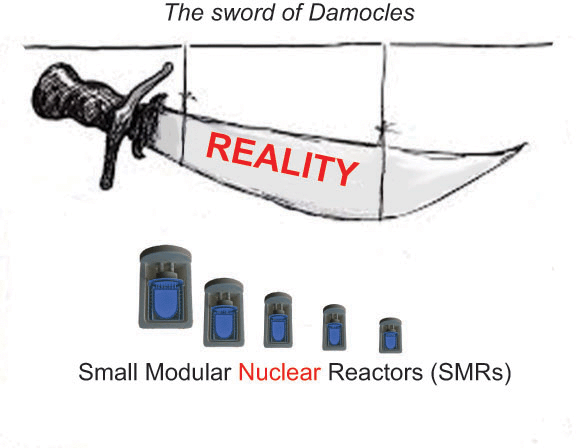
Renewables – Not Small Modular Nuclear Reactors – Are the Solution to Climate Change, https://cela.ca/renewables-not-small-modular-nuclear-reactors-are-the-solution-to-climate-change/December 4, 2019 By Theresa McClenaghan, Kerrie Blaise (CELA) and Guest Author Chris Rouse (New Clear Free Solutions)The idea of Small Modular Reactors (“SMRs”) was in the news this week with the federal government being urged to provide even more research money to develop this “new” nuclear power technology. The premise is that SMR’s are a needed, cost effective, safe and realistic solution to climate change.
However, SMRs are not the answer or even part of the answer to climate change given the problematic environmental, social and economic attributes of the proposed technology. Instead, in our view, investment is urgently needed in Canada’s vast and enviable renewable energy resources which are already scalable and provide safer, less costly, and more socially acceptable means of energy generation.
The UN has warned we have just 10 years to get climate change and our emissions under control – the promise of SMR technology provides too little, too late with too many risks. Socially acceptable, cost effective and scalable renewable options are available now.
SMRs are not yet commercially available. Indeed, Canada’s SMR Roadmap, produced by the Canadian Nuclear Association, only sets out a path for having a commercial demonstration unit in the 2030s. To contend that SMR technology can aid in combatting climate change is potentially damaging to climate action, as it misses the 10-year window we have to reverse emissions and decarbonize. It also distracts from the urgent work needed to respond to the climate emergency.
We already have many tools in our renewable energy toolbox. Canada’s electricity grid is 65% renewable, mainly from our vast hydro resources. These resources, used in combination with 30% to 35% wind and solar, makes a renewable grid achievable. Several jurisdictions have already achieved or surpassed this threshold, such as Prince Edward Island, where 43% of its power comes from wind alone. We also have access to other renewable energy resources such as biomass, geothermal, and tidal to assist in our transition to a low-carbon economy.
Studies also continue to demonstrate viable pathways to a renewable grid, which are both technically and economically feasible. One report from Nova Scotia provides a pathway to reach a 90% renewable grid by 2030 and a study from New Brunswick plots a cost effective solution to achieve a 95% renewable grid. While work is needed to achieve the remaining 5% over time, the immediate need – and the focus of governmental efforts – should be on prioritizing the first 90% to 95% shift to renewables.
Despite what appears as widespread interest in SMRs, very few countries have been willing to invest in their construction. Apart from technology’s risks, the problem is one of poor economics: nuclear energy is already known to be expensive and the cost-competitiveness of SMRs is contingent upon their mass fabrication. Hundreds if not thousands of SMRs would need to be deployed in order to be economically viable.
Past experience also dictates this new reactor technology may never become commercially available. For instance, after two decades and hundreds of millions of taxpayer dollars, the two prototype MAPLE reactors were abandoned in 2008 because they could not be safely operated. The Gentilly 1 prototype reactor in Quebec which received similar investment, also failed and after 180 days of operation was mothballed.
Despite public assurances of SMRs’ ‘passive’ and ‘inherent’ safety, SMR operators and suppliers would be protected from liability in the event of an accident under the current rules; the current nuclear liability rules are a concession by governments to the nuclear industry because of the inherent hazard that private nuclear investors do not want to underwrite.
Furthermore, after 50 years of nuclear energy production, we still do not have an approved plan for Canada’s high, intermediate and low-level radioactive waste stockpiles. Because of the diverse range of fuels which can be used by SMRs, new radioactive waste streams will be created, thus increasing the complexity of the used nuclear fuel waste problem, with new types of nuclear waste hazards being introduced.
The touted benefit of SMRs for use in remote and rural regions would also mean increased transport of radioactive substances on roads and railways across the country. This poses unique proliferation risks since the waste from enriched fuels can produce quantities of plutonium that could be attractive for diversion to malicious purposes.
The greater the number of sites and communities with SMRs, the greater the proliferation risks because of challenges in monitoring, keeping track and measuring plutonium in spent fuel, which must be kept secure.
Furthermore, Canada’s nuclear safety regulator advocated with the federal government to remove SMRs from public, more rigorous forms of decision-making under Canada’s new Impact Assessment Act (IAA). Despite requirements for wind and solar farms to undergo environmental assessments, either provincially or federally, SMRs would not trigger an environmental assessment under the current federal IAA Project List regulation. The coming into force of the Impact Assessment Act in June 2019 wholly exempts SMRs from environmental, or impact assessment review.
Investment in nuclear power at the 11th hour is a distraction from real climate action when scalable, cost-effective renewable solutions could and need to be employed. Already climate-burdened future generations should not have new risks imposed on them, due to SMR’s radioactive waste and accompanying proliferation risk. We need to invest in known renewable energy solutions, and not the promise of a hypothetical and risky technology.
It’s simply the most expensive way to reduce greenhouse gas pollution. Every nuclear project in Ontario’s history has run massively over budget. Remember the debt retirement charge on your hydro bill? You can thank bloated nuclear projects that left the old Ontario Hydro essentially bankrupt.
Ontario is one of the few places left that still sees nuclear as a viable way to keep the lights on. And that’s going to hit you where it hurts – in the wallet.
Ontario Power Generation has stated it needs to double the price it charges for nuclear energy to rebuild the Darlington nuclear station. Ontario has many better ways to simultaneously tackle climate change and lower electricity bills, something Premier Doug Ford has promised, but failed thus far to deliver.
Quebec has the lowest electricity prices on the continent thanks to its cost-efficient, water-power system. It also has a large and growing power surplus and is keen to make export deals.
Quebec has offered to sell Ontario power at half the cost of what we are paying for nuclear power today – one-third the cost of what we will be paying for nuclear power in five years.
Both the Kathleen Wynne and Doug Ford governments have turned up their noses at this offer to protect our high-cost nuclear industry.
Combine Quebec water power with energy efficiency programs in Ontario and you have the lowest-cost option for keeping the fridges humming.
Ontario pays, on average, two cents per kilowatt hour for efficiency measures that reduce the need to generate electricity in the first place. You may have doubts about solar and wind energy, but one thing is certain — prices for these sources are plummeting as costs for nuclear rise.
Quebec, by using its ability to store water, can act as a giant battery to smooth out the peaks and troughs of green energy in Ontario.
It can supply Ontario with plenty of power virtually every hour of the year. And it has that power right now – it doesn’t need to build new dams. In the few hours a year when Quebec’s own demand maxes out, Ontario has plenty of gas-fired power plants that can fill the brief gap.
For a fraction of the cost of rebuilding one nuclear reactor, we can upgrade our transmission links to get even more low-cost power from Quebec.
Instead of banking on phantom solutions like non-existent “small modular reactors” that, if they are ever built, will have all the waste, cost and security problems of conventional nuclear plants, Ontario should make a money-saving deal with Quebec.
As the people of Pickering are now discovering, Ontario has no long-term facility to store the huge pile of radioactive waste that has been built up over 50 years of nuclear operations.
Democrats Retreat on Nuclear PolicyDefense One, 13 Dec 19, The 2020 authorization bill fails to check Trump’s worst impulses.
Question: How do you go from a National Defense Authorization Act that in July was opposed by every House Republican to one that was approved by more GOP votes than Democratic ones and that President Donald Trump called a huge win that he cannot wait to sign?
Answer: Add Space Force and parental family leave and take out all of the progressive national security provisions.
The House passed the compromise NDAA last night; President Trump has said he will sign it. This final bill is a world apart from the version passed by House Democrats in July. The House version, ably led by Rep. Adam Smith, D-Washington, chair of the House Armed Services Committee, prohibited deployment of Trump’s new “low-yield” nuclear weapon for Trident submarines, which defense experts called “a gateway to nuclear catastrophe.” It prohibited unauthorized U.S. military action against Iran, which Trump came within 10 minutes of ordering in June, and prohibited U.S. military support for the Saudi-led intervention in Yemen. And it supported extension of the New START treaty, which Trump seems to have every intention of sacking even though Russia supports keeping the crucial pact. The list goes on.
In other words, the House bill would have constrained the most dangerous tendencies of an out-of-control White House. This is exactly what you would expect Democrats to do when faced with a President that they firmly believe is a danger to U.S. national security—and are now seeking to impeach on that basis.
Not surprisingly, Republicans do not share this impression of the President, and they deeply opposed the nuclear policy provisions in the House NDAA…….
The outcome was a disaster. The topline budget rose to $738 billion and the major constraints on Trump were ripped out. Others were watered down. The most we can say about the final NDAA is that it includes some useful language on arms control and missile defense, but nothing major. Such weak tea certainly does not justify supporting a bill that funds Trump’s excessive $2 trillion program to rebuild the nuclear arsenal, among other things.
Rep. Ro Khanna, D-California, a member of the House Armed Services Committee and a vice-chair of the progressive caucus issued a joint statement with Sen. Bernie Sanders, D-Vermont, a presidential candidate, calling the final agreement “a bill of astonishing moral cowardice.” Over 30 progressive national security organizations (including Ploughshares Fund) sent a letter to Congress opposing the final bill as doing “almost nothing to constrain the Trump administration’s erratic and reckless foreign policy.” Senator and presidential candidate Elizabeth Warren said she would oppose the bill, calling it a “$738 billion Christmas present to giant defense contractors.” …..
Democrats cannot seek to impeach Trump and yet sometimes act as if he is a normal president. They cannot attempt to remove him from office as a danger to national security and yet hand him $738 billion in military spending with no limits on his nuclear weapons development, ability to attack Iran, freedom to abandon arms control treaties, and so much more. Trump is nothing if not a disrupter. The Democrats must give the president a taste of his own medicine. https://www.defenseone.com/ideas/2019/12/democrats-retreat-nuclear-policy/161855/
Shikoku Electric to remove fuel from Ikata nuclear reactor, a first since MOX work began in 1997, HTTPS://WWW.JAPANTIMES.CO.JP/NEWS/2019/12/13/NATIONAL/SHIKOKU-ELECTRIC-REMOVE-MOX-FUEL-FROM-IKATA-REACTOR/#.XFPOTUGZBIU , EHIME PREF. – Shikoku Electric Power Co. said Thursday that it will suspend operations of the No. 3 reactor at its Ikata nuclear power plant on Dec. 26 for routine checkups and remove spent mixed-oxide (MOX) fuel from the reactor.This will mark the first removal of used MOX fuel, a blend of plutonium extracted from spent nuclear fuel and uranium, from any commercial nuclear power plant in Japan since an initiative on plu-thermal power generation using the mixed fuel was announced in 1997, according to the Shikoku utility.
The government and power firms are promoting plu-thermal power generation as part of the nuclear fuel cycle featuring the extraction of plutonium from spent nuclear fuel for reuse.
In 2010, Shikoku Electric started plu-thermal power generation using 16 MOX fuel assemblies at the No. 3 reactor at the Ikata plant in Ehime Prefecture.
The company plans to remove all of them during the reactor checkups through April 27 and will consider reusing the spent MOX fuel, which will likely be stored at the power plant for a while due to the lack of reprocessing facilities.
EU leaders include nuclear energy in green transition, By SAMUEL PETREQUIN, Associated Press Dec. 13, 2019 BRUSSELS (AP) — European Union leaders agreed Friday that nuclear energy will be part of the bloc’s solution to making its economy carbon neutral by 2050, allowing them to win the support of two coal-dependent countries.
EU heads of state and government agreed that nuclear energy will be recognized as a way to fight climate change as part of a deal that endorsed the climate target. While Poland did not immediately agree to the plan, the concessions on nuclear energy were enough for the Czech Republic and Hungary to give their approval…….. (subscribers only)https://www.sfchronicle.com/news/world/article/EU-leaders-include-nuclear-energy-in-green-14904378.php
EDF has drawn up a plan to “restore trust” in France’s nuclear power industry after a government-commissioned report lambasted failings at the energy group’s troubled flagship nuclear project. The state-backed company said it would spend €100m on measures including a skills programme, a scheme for selecting suppliers and initiatives to improve project management and industrial standards. This came after the French government, which owns 84 per cent of EDF, gave the utility a month to draw up a scheme to fix problems at Flamanville after the flagship project stumbled into delays and cost overruns.
A government-commissioned report into the failings at Flamanville, published in October, also pointed to a loss of skills in France’s nuclear sector. “We want to restore more trust in the ability of the French nuclear industry to deliver according to its objectives, in terms of cost, time and schedule,” said EDF’s chairman and chief executive Jean-Bernard Lévy. ……
Flamanville is considered a litmus test for next-generation European Pressurised Reactor technology, which supporters say will be a bigger, safer and more efficient type of nuclear plant. But the plant’s construction, which was supposed to last four-and-a-half years, is now expected to take 15 years to complete at about four times its originally projected cost of €3.3bn. This follows problems such as faulty weldings. Once a leader in atomic power, France will not decide whether to build more EPRs until Flamanville is up and running.
To address the sector-wide issues identified in October’s damning report, EDF will seek to change how risks are shared with suppliers and set up a college dedicated to “nuclear disciplines” where there are shortages, such as welding. ……
EDF’s plans come during a turbulent period for the group. Not only is it under fire for delays at another planned EPR site in the UK, but it is heading towards a corporate reorganisation.
This would create a government-owned mother company, EDF Bleu, containing its nuclear and hydroelectric assets. Bleu’s main subsidiary, EDF Vert, will house renewable energy, networks and services businesses, and will have a stock market listing. Under an energy planning law enacted this year, France must reduce its share of electricity produced by nuclear from 72 per cent to 50 per cent by 2035, with the rest coming from renewables. However, new atomic power stations may need to be built to replace ageing facilities, which will also need investment for retrofitting and maintenance. ….https://www.ft.com/content/9a33d12a-1da5-11ea-97df-cc63de1d73f4
Sound the alarm on deadly US-Russia nuclear threat, by Jill Dougherty December 12, 2019 CNN, As I looked around the large square conference table, I watched the faces settle into worried frowns. Russians and Americans, several of whom once had responsibility for their nations’ nuclear weapons, all members of the Dartmouth Conference, the oldest continual bi-lateral dialogue between Americans and Russians, founded almost 60 years ago during one of the darkest periods of the Cold War.
For a long minute, no one spoke. Then, one of them broke the silence: “Someone needs to sound the alarm.”
Now, profoundly concerned that the United States and Russia are on the verge of a new arms race, they are speaking out, issuing an urgent appeal to keep arms control alive:
“… for the first time in our history we are compelled by the urgency of the situation to issue this public appeal to our governments, founded on our view that the clear threat of an uncontrolled nuclear arms race has re-emerged with the collapse in recent years of key elements of the post-Cold War arms control architecture.”
Members of the Dartmouth Conference meet twice a year to discuss ways of improving — and, at this point, salvaging — the US/Russia relationship. Several are former top-level military and diplomatic officials. Some are religious leaders or physicians. All are concerned citizens.
They’ve watched as the arms control agreements, which helped prevent nuclear war between our countries, were dismantled — the Anti-Ballistic Missile Treaty signed by former President Richard Nixon and Soviet General Secretary Leonid Brezhnev, and the Intermediate Nuclear Forces agreement signed by former Presidents Ronald Reagan and Mikhail Gorbachev.
Now, the New START agreement — the last remaining arms control agreement between the US and Russia — hangs in the balance. …….
It could get worse, both I and other Dartmouth Conference members believe. Neither country wants to start a nuclear war, which would imperil the entire planet, but it could start by mistake, by misunderstanding, by escalation of tensions, as it almost did during the Cold War……..
In their appeal, Dartmouth members say the dialogue on strategic stability should be broadened to include other nuclear powers. But that doesn’t mean that, in the interim, New START can’t be extended for another five years, as the treaty provides. Extending it beyond 2021 would provide some breathing space to work on future global security agreements. We can do both.
New START not only led to steep reductions of nuclear arsenals on both sides but it strengthened confidence and trust between our countries and our militaries by providing for inspections and data exchanges that verify compliance. Transparency is key; Not knowing what weapons the other side might have can ignite suspicion.
At this very moment both countries are developing new, highly advanced conventional arms and delivery systems.
A cyberattack could knock out early warning systems. Both countries keep most of their nuclear weapons on hair-trigger alert, ready to be fired within minutes. Our presidents have only a few minutes to decide whether to respond. A missile launched in Russia can hit an American city in less than 30 minutes — and vice versa. A single warhead can kill millions of people.
……… together, we had just written: “The immediate imperative is extension of the New START Treaty … We see this as a paramount moral obligation of both our governments before our own peoples, and the world at large. We respectfully urge our governments to begin discussions immediately to this end.” https://edition.cnn.com/2019/12/12/opinions/new-start-treaty-dougherty/index.html
Tell Congress: Prevent Nuclear Catastrophe in Iran
Read the Public Inquiry Report, the Commissioners’ report, Surrendering Australia: The AUKUS Deception is available to download for free at aukuspublicinquiry.com. Or just watch the replay of the National Press Club Luncheon.