Low Oil Prices May Kill Off The Next Nuclear Boom Before It Begins
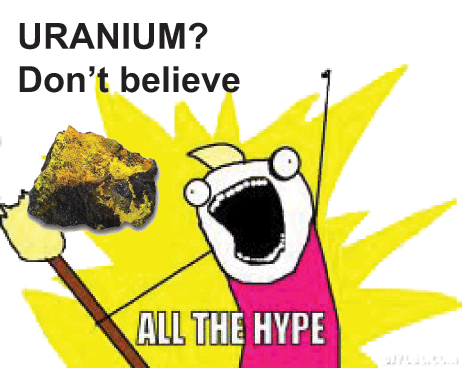 Low Oil Prices May Kill Off The Next Nuclear Boom Before It Begins, Oil Price, By Alex Kimani – Apr 27, 2020
Opening up the West
On Thursday, the Nuclear Fuel Working Group (NFWG) made recommendations to the U.S. Administration to open up ~1,500 acres outside the Grand Canyon for uranium production, arguing that the country needs to beef up domestic production to avoid an over-reliance on foreign sources.
The organization has recommended spending $1.5 billion over ten years buying uranium from American producers to create a uranium stockpile that would necessitate buying about 10 million pounds a year.
The working group’s report claims that the United States also needs more uranium for two other purposes:
– Low-enriched uranium for the production of tritium for nuclear weapons through the 2040s, and
– Highly enriched uranium to be used as fuel for Navy nuclear reactors through the 2050s
The slow and painful demise of the American uranium mining industry can be chalked up to the fact that the country is not endowed with the most abundant and most accessible uranium deposits, with resources in Canada and Australia boasting significantly higher uranium content and a lower production cost per unit.
American miners have had trouble making a profit from their operations even at the best of times. Consequently, the industry has historically had to rely heavily on government largesse.
During the golden age of American uranium that spanned from 1955-1980, the U.S. government offered fat uranium bonuses in a bid to shore up its stockpiles during the Cold War. These included 10-year price guarantees for certain kinds of ore as well as $10,000 discovery and production bonuses for new sources, which pencils out to nearly $100K in today’s dollars. The incentives set off a mad gold rush in the nation’s vast Western region as every man with a jeep and a Geiger counter set out to make the next significant discovery.
The program was a resounding success: U.S. uranium stockpiles skyrocketed so much that the government stopped paying out the bonuses sometime in the 1960s…….
By 1987, the tables had turned completely, with the country importing nearly 15 million pounds of uranium while domestic production clocked in at just 13 million.
Growing competition weighed heavily on domestic production while the country’s love affair with nuclear energy got its first dose of the harsh reality of nuclear technology thanks to the Three Mile Island nuclear disaster in 1979 as well as the Chernobyl reactor meltdown of 1986 that turned an entire Ukrainian city into a ghost town. Meanwhile, utilities began to grow weary of the time and cost of building reactors, which further depressed demand.
The result: U.S. uranium production had sunk to a 35-year low by the time the last wave of reactors came online in 1990…….
Brief Renaissance
The U.S. uranium industry enjoyed a renaissance in the early 2000s as falling global stockpiles, and booming economies in China and India drove new demand.
Unfortunately, this, too, was not to last as the financial crisis of 2008 destroyed demand, while the Fukushima nuclear disaster of 2011 led to another severe backlash that set off a new round of reactor closures while Germany set to phase out the technology by 2022.
The third nuclear gold rush is starting off on very shaky grounds, too.
First off, the world’s strategic uranium reserves are not in any immediate danger of running out. In 2016, the International Atomic Energy Agency said that the global nuclear fleet has enough stockpiles for 130 years, more than enough for the markets to respond to any shortfalls rapidly as they have done in the past. …..
But more importantly, trying to open up the west for uranium mining is bound to be met with stiff resistance and widespread public uproar.
For all its setbacks over the years, nuclear power has remained broadly popular in the United States. However, the turning point came in 2016 when the majority of people turned against the technology.
The latest poll last year revealed that American public opinion remains split over nuclear power, with 49 percent of U.S. adults either strongly favor (17 percent) or somewhat favor (32 percent) it in power generation while 49 percent either strongly oppose (21 percent) or somewhat oppose (28 percent) its use……
The funny thing is that Gallup has found that American opinion on nuclear power does not have much to do with radiation or safety concerns; rather, it is driven by prevailing fuel prices. …..
a 2020 Colorado College Conservation in the West Poll found that 71 percent of voters in the Mountain West and 77 percent of Arizona voters oppose the development of new uranium mines on public lands adjacent to the Grand Canyon. It’s the kind of backlash that no president wants to deal with, whether they are seeking re-election or not. https://oilprice.com/Energy/Energy-General/Low-Oil-Prices-May-Kill-Off-The-Next-Nuclear-Boom-Before-It-Begins.html
Solar and Wind Cheapest Sources of Power in Most of the World
 Solar and Wind Cheapest Sources of Power in Most of the World https://www.bloomberg.com/news/articles/2020-04-28/solar-and-wind-cheapest-sources-of-power-in-most-of-the-world By Brian Eckhouse, April 28, 2020,
- Batteries also gaining against traditional energy sources
- Most competitive new power is wind in U.S., solar in China
Solar and onshore wind power are now the cheapest new sources of electricity in at least two-thirds of the world’s population, further threatening the two fossil-fuel stalwarts — coal and natural gas.
The levelized cost of electricity for onshore wind projects has fallen 9% to $44 a megawatt-hour since the second half of last year. Solar declined 4% to $50 a megawatt-hour, according to a report Tuesday by BloombergNEF.
The prices are even lower in countries including the U.S., China and Brazil. Equipment costs have come down, technologies have improved and governments across the world have boosted clean-power targets as they seek to combat climate change. That could squeeze out coal and natural gas when utilities develop new power plants.
“Best-in-class solar and wind projects will be pushing below $20 per megawatt-hour this side of 2030,” Tifenn Brandily, an analyst at BNEF, said in a statement. “There are plenty of innovations in the pipeline that will drive down costs further.”
Yet it remains unclear whether the coronavirus’ impact on coal and gas prices will erode the competitiveness of wind and solar. “If sustained, this could help shield fossil fuel generation for a while from the cost onslaught from renewables,” Seb Henbest, chief economist at BNEF, said in the statement.
A decade ago, solar was more than $300 a megawatt-hour and onshore wind exceeded $100 per megawatt-hour. Today, onshore wind is $37 in the U.S. and $30 in Brazil, while solar is $38 in China, the cheapest sources of new electricity in those countries.
Battery storage is also getting more competitive. The levelized cost of electricity for batteries has fallen to $150 a megawatt-hour, about half of what it was two years ago. That’s made it the cheapest new peaking-power technology in places that import gas, including Europe, China and Japan.
BNEF’s levelized cost for electricity measures the entire cost of producing power, accounting for development, construction and equipment, financing, feedstock, operation and maintenance.
France’s unfairly heavy monitoring of anti-nuclear activists, treating them as violent criminals

 Justice has massively monitored Bure’s anti-nuclear activists Reporterre, April 27, 2020 / Marie Barbier (Reporterre) and Jade Lindgaard. Dozens of people tapped, a thousand retranscribed discussions, more than 85,000 conversations and intercepted messages, more than 16 years of cumulative telephone surveillance time: the judicial information opened in July 2017 is a disproportionate machine of intelligence on the movement antinuclear from this village of the Meuse, according to the documents consulted by Reporterre and Mediapart.
Faces caught in a web of arrows and diagrams. Under each photo: date and place of birth, nickname, organization. The individuals are grouped into “clans”, linked to places and ratings of the investigation file. Some faces are magnified, others reduced to the size of a pinhead. Some people are entitled to a photo, others appear in the form of a pictogram – blue for men, fuchsia pink for women.
This diagram [on original] was produced by the Anacrim criminal analysis cell of the national gendarmerie. Its software, Analyst’s notebook, makes it possible to visualize the links between people via their telephone numbers, places, events. This technique is usually used to solve particularly serious crimes: it recently emerged from the Gregory of legal darkness case, and is currently used in the investigation of the multi-repeat killer Nordahl Lelandais.
Examining magistrate Kévin le Fur used it to dissect the organization of the opposition movement at Cigeo, the radioactive waste landfill center planned next to the village of Bure, in the Meuse. Scheduled to come into operation in 2035, it is one of the largest industrial facilities in project today in France, and a very sensitive site for the nuclear industry.
The Anacrim diagram appears in the file of the judicial information for association of criminals, where ten antinuclear militants are under investigation for various reasons in connection with degradations committed in a hotel and the organization of an undeclared demonstration in August 2017. Subject to strict judicial control, those under investigation are prohibited from seeing each other, talking to each other and even being in the same room.
In the Bure case, Anacrim produced a total of fourteen diagrams on “the role and involvement” of the accused and the interactions between collectives and associations. This method leaves its mark on education. Seven people, among the ten indicted, are for criminal association, but 118 individuals are listed in the organization chart of the gendarmes placed in the investigation file.
Dozens of people tapped, more than a thousand transcribed discussions, tens of thousands of conversations and intercepted messages, more than fifteen years of cumulative telephone interception time: the judicial information opened in July 2017 looks like a real intelligence machine on the anti-nuclear movement of Bure, according to the investigation file consulted by Reporterre and Mediapart, and of which Liberation had unveiled part of the content in November 2018. An extraordinary investigation, extremely intrusive and focused on the surveillance of political activists whom the justice system seems to consider as enemies of democracy.
Molotov cocktails and stones fly. Gendarmes were injured and a protester mutilated by a grenade on the foot. Those charged are for different reasons from each other: participation in a gathering after summons, participation in a criminal association for the preparation of an offense punishable by five or ten years’ imprisonment, detention (or complicity) in an organized gang of incendiary product, damage to the property of others by dangerous means, concealment of property from an aggravated theft, voluntary violence in meetings.
From the first days of the investigation, the gendarmes were worried about “criminal designs” unrelated to the “legitimate challenge in a democratic state” of the militants implicated. “These actions can no longer be considered as a legitimate social and societal protest” or “as a form of democratic opposition”, they write in a report, July 27, 2017. According to them, “some of the opponents deliberately choose a violent path. They attack the property associated with the contested projects, but sometimes also the people working for the development of these industrial installations and at the same time against the police. ” In the eyes of the investigators, “opponents criminalize themselves”.
Part of the seals is sent to the Anti-Terrorism Office, a unit of the gendarmerie responsible for the prevention and suppression of acts of terrorism. To take the measure of the surveillance of the militants of Bure and their entourage, Reporterre and Mediapart evaluated the means deployed by the gendarmerie and the justice in their mission. Almost 765 telephone numbers have been the subject of identity verification requests from telephone operators. At least 200 other requests were made to find out the call histories, their places of emission, the bank details of the holders subscription, PUK codes to unlock a phone when you don’t know your PIN.
According to Me Raphaël Kempf, one of the lawyers for the indictments: Listening for so long is proof that we are not in a classic criminal judicial procedure intended to collect evidence of the commission of crimes, but that we are using the means of law and criminal procedure for the purpose of intelligence, which is political in nature. ”
If we add up all these sequences, we get a cumulative time spent listening to activists equivalent to more than sixteen years! According to the minutes, most of these people were listened to permanently by a team of gendarmes taking turns behind their screens. In total, more than 85,000 conversations and messages were intercepted, according to our estimates. And no less than 337 conversations were transcribed on trial- verbal, to which are added some 800 messages reproduced by the Technical Assistance Center (CTA). Are these means proportionate to the crimes being prosecuted? Joined by Reporterre and Mediapart, Olivier Glady, public prosecutor of Bar-le-Duc answers: “I cannot answer that. This is a dossier that makes fifteen volumes. You have files of other kinds (traffic in vehicles or narcotics) which are roughly equivalent, I am not sure that the proportionality of the investigations is simply to relate to a number as you give it to me. ”
During these innumerable hours spent listening to the militants, the gendarmes tracked the indications, sometimes tiny, of each other’s responsibilities in organizing the protest. These are two cultures which, behind closed doors of a judicial investigation, seem to confront each other from a distance. On the one hand, the gendarmes. On the other, anti-nuclear, libertarian culture, who refuse hierarchy and formal assignments to roles. Inevitably, the vision of gendarmes stumbles on the spontaneous and horizontal practices of regulars at the Maison de la Résistance. This old farm in Bure was bought in 2004 by anti-nuclear activists to create a place of struggle. It has become a place of collective life where people come to sleep during a gathering, get together, work, cook, party……. https://reporterre.net/1-3-La-justice-a-massivement-surveille-les-militants-antinucleaires-de-Bure
EDF’s planned Sizewell nuclear power station – vulnerable to sea level rise
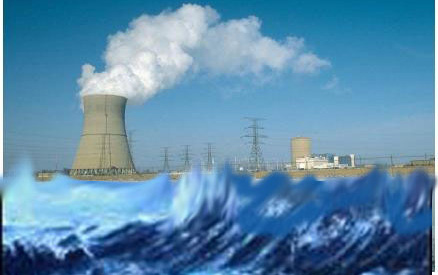 Climate News Network 28th April 2020, Controversial plans by the French nuclear giant EDF to build two of its massive new reactors on the low-lying east coast of England are causing
alarm: the shore is eroding and local people fear sea level rise could maroon the station on an island.
because they fear the proposed sea defences for the new station, Sizewell C, will be inadequate.
will be adequate.
of construction, 60 years of operation and then the time needed to decommission it.
https://climatenewsnetwork.net/sea-level-rise-threatens-uk-nuclear-reactor-plans/
With international finance help, Russia is dismantling its most radioactive ship
|
Russia’s most radioactive ship reaches dismantlement milestone The Lepse service ship, once the most glaring nuclear hazard in the Murmansk harbor, will now be emptied of nearly all of its radioactive cargo by the end of this year, Russian nuclear authorities have said. Bellona April 29, 2020 by Anna Kireeva, Charles DiggesThe Lepse service ship, once the most glaring nuclear hazard in the Murmansk harbor, will now be emptied of nearly all of its radioactive cargo by the end of this year, Russian nuclear authorities have said.
During its career as a refueling vessel for Soviet era nuclear icebreakers, the Lepse amassed 639 spent nuclear fuel assemblies, some of them damaged, creating an environmental danger that bobbed neglected at a Murmansk dock for decades. After it was taken out of service in 1988, the Lepse was left to languish at Atomflot, the headquarters of Russia’s nuclear icebreaker fleet, where it posed a severe radioactive hazard to Murmansk and its 300,000 residents. Over the course of more than two decades, Bellona worked with Russian officials ensure the vessel’s safe disposal. Now those plans are coming to fruition as officials say 97 percent of the nuclear fuel loaded into the Lepse’s holds will be emptied at the Nerpa Shipyard, to where the vessels was finally moved in 2012 for its painstaking dismantling…… All told, the Lepse participated in 14 refueling operations aboard the Lenin as well as the nuclear icebreakers the Sibir and the Arktika. In 1981, the vessel was again retrofitted, this time to so it could accommodate irradiated machine parts and other radioactive waste the nuclear icebreakers needed to offload. The Lepse’s history took a darker when it was used to help dump radioactive waste in the Kara and Barents Seas, contributing to Russia’s Cold War heritage of f nuclear and radiological hazards strewn across the Arctic sea floor, the extent of which is only beginning to be understood. It was in the early 1990s that the Lepse and the dangers it posed caught Bellona’s eye, and the organization mobilized the European Union to allocate funding toward removing it from Murmansk harbor and safely dismantling it. The boat was finally towed from Atomflot to the Nerpa naval shipyard in September 2012, after more than a decade of strenuous and often tedious negotiations among Bellona, the Russian government and European financial institutions – most notably the European Bank of Reconstruction and Development – to ensure the Lepse’s safe disposal. The EBRD-managed program is financed by the NDEP Nuclear Window, an international fund with contributions from Belgium, Canada, Denmark, the European Union, Finland, France, Germany, the Netherlands, Norway and the UK. The bank is also helping finance the safe removal of some 22,000 spent nuclear fuel assemblies from Andreyeva Bay, a former technical base used to service Soviet Northern Fleet Submarines. https://bellona.org/news/nuclear-issues/2020-04-russias-most-radioactive-ship-reaches-dismantlement-milestone |
|
|
Coronavirus spreads to Russia’s ‘secret’ nuclear cities
|
Now, coronavirus spreads to Russia’s ‘secret’ nuclear cities,
WION New Delhi, Delhi, India Apr 29, 2020, The coronavirus has rattled Russia. The number of cases in the country is nearing the 100,000 milestone, the country’s oil prices have collapsed and its economy is set to contract by 4 to 6 per cent.
In the latest, the coronavirus has begun spreading to Russia’s nuclear cities. The secret cities are at high risk and they stand exposed. ……
Also lying exposed are Russia’s secret cities. The Wuhan virus has sneaked its way past their fences and now Sarov, Elektrostal and Desnogorsk are infected. The situation is so bad that a top Russian executive was forced to mention these cities during his address. “The situation in Sarov, Elektrostal, Desnogorsk is today particularly alarming. In Sarov, the situation is being compounded by the outbreak in the nearest Diveyevo convent,” Rosatom chief, Alexei Likhachev, said. Sarov has at least 23 coronavirus cases. The numbers for Elektrostal and Desnogorsk are not clear. Also unknown are the number of hospitals in these cities and their pandemic preparedness. Not surprising, given everything around these cities is blurry. Sarov, Elektostal, and Desnogorsk are among Russia’s many secret cities.
They are highly restricted, so much so that they weren’t shown on the map until the breakup of the Soviet Union in the 1990s. These cities were excluded from train and bus routes. They were known only by their postal codes. Sarov, for example, was Arzamas-16. No one knew who lived there. The lives of its residents were as secretive as those of KGB agents. For years, the Russian government rewarded the residents of its secret cities with numerous perks – private apartments, well-paying jobs and good healthcare. These cities are closely linked to Russia’s nuclear industry. They are managed by Russia’s state atomic energy corporation – Rosatom.
Sarov became a closed city after World War-II. Once known for its monastery, the city was quickly turned into a rocket-making hub. It’s monastery buildings were converted into rocket factories. Today, Sarov is home to one of Russia’s top research institutes. The city is fenced, patrolled by the military and no one can enter without a pass. Last year, five scientists from the research institute died in a mysterious accident. No one knew what had happened. Russia said there was an accident during a rocket engine test.
The United States claimed it was a missile test gone wrong. Today, these secret cities are becoming coronavirus hotspots. Russia says it is sending emergency ventilators and medical aids to its nuclear cities but truth be told – we may never know what’s really going on there. https://www.wionews.com/world/now-coronavirus-spreads-to-russias-secret-nuclear-cities-295663
|
|
Beyond Nuclear opposes Holtec nuclear waste plan: the Nuclear Regulatory Commission is not above the law
 Group Plans To Fight Effort To Build Nuclear Waste Dump In New Mexico https://www.krwg.org/post/group-plans-fight-effort-build-nuclear-waste-dump-new-mexico
Beyond Nuclear has challenged the NRC’s authority to approve Holtec’s license application because it contemplates that the U.S. Department of Energy (DOE) may become the owner of the irradiated reactor fuel. The federal Nuclear Waste Policy Act (NWPA) prohibits federal ownership of spent fuel, however, unless and until a federal repository for permanent disposal is operating.
The NRC Commissioners acknowledged that Federal law prohibits federally-sponsored storage of irradiated reactor fuel unless and until a repository for permanent disposal is in operation. Nevertheless the NRC threw out Beyond Nuclear’s legal challenge to the project on the ground that Holtec could be depended on not to implement the unlawful provision if the license were granted.
The Commissioners’ decision affirms an earlier ruling by the NRC’s Atomic Safety and Licensing Board that the storage facility may be licensed despite the illegal license terms contemplating federal ownership of the irradiated fuel. The Licensing Board accepted arguments by Holtec and the NRC’s technical staff that the license containing illegal provisions could be approved as long as it also contained a provision that would allow private ownership of the spent fuel.
Mindy Goldstein, a lawyer for Beyond Nuclear, stated, “the NRC’s decision flagrantly violates the federal Administrative Procedure Act (APA), which prohibits an agency from acting contrary to the law as issued by Congress and signed by the President.” Goldstein also stated that “the Commission lacks a legal or logical basis for its rationale that the illegal provisions could be ignored in favor of other provisions that are legal, or that an illegal license could be issued in ‘hopes’ that the law might change in the future. The APA gives the NRC no excuse to ignore the mandates of federal law.”
Diane Curran, also a lawyer for Beyond Nuclear, said the group will pursue a federal court appeal of the NRC decision. “Our claim is simple,” she declared. “The NRC is not above the law.”
Kevin Kamps, radioactive waste specialist for Beyond Nuclear, called the federal Nuclear Waste Policy Act “the public’s best protection against an interim storage facility becoming a de facto permanent, national radioactive waste dump at the surface of the Earth.” According to Kamps, “Congress knew, in passing the NWPA, that the only safe long-term strategy for care of irradiated reactor fuel is to place it in a permanent repository for deep geologic isolation.
Congress acted wisely in refusing to allow nuclear reactor licensees to transfer ownership of their irradiated reactor fuel to the DOE until a repository was up and running. The carefully crafted Nuclear Waste Policy Act thus protects a state like New Mexico from being railroaded by the powerful nuclear industry, its friends in the federal government, and other states looking to off-load their mountain of forever deadly high-level radioactive waste.”
Kamps added: “A deep geologic repository for permanent disposal should meet a long list of stringent criteria. These include legality, environmental justice, consent-based siting, scientific suitability, mitigation of transport risks, regional equity, intergenerational equity, and non-proliferation, including a ban on reprocessing. This is why a coalition of more than a thousand environmental, environmental justice, and public interest organizations, representing all 50 states, have opposed the Yucca Mountain dump targeted at Western Shoshone Indian land in Nevada for 33 years.”
“On behalf of our members and supporters in New Mexico, and across the country along the road, rail, and waterway routes in most states, that would be used to haul the high risk, high-level radioactive waste out West, we will appeal the NRC Commissioners’ bad ruling to the federal court,” Kamps added.
Beyond Nuclear is a 501(c)(3) nonprofit membership organization. Beyond Nuclear aims to educate and activate the public about the connections between nuclear power and nuclear weapons and the need to abolish both to safeguard our future. Beyond Nuclear advocates for an energy future that is sustainable, benign and democratic. The Beyond Nuclear team works with diverse partners and allies to provide the public, government officials, and the media with the critical information necessary to move humanity toward a world beyond nuclear. Beyond Nuclear: 7304 Carroll Avenue, #182, Takoma Park, MD 20912. Info@beyondnuclear.org. www.beyondnuclear.org.
Indian Point nuclear power station’s first step to closure, as one reactor shuts down
 Nuclear power plant north of New York City to start shutdown, Daily Journal ,By MARY ESCH Associated Press, Apr 29, 2020
ALBANY, N.Y. (AP) — With the push of a red button, one of the two operating nuclear reactors at the Indian Point Energy Center along the Hudson River north of New York City will shut down Thursday night as federal regulators consider the plant owner’s proposal to sell it to a company that plans to demolish it by the end of 2033 at a projected cost of $2.3 billion.
The 1,020-megawatt Unit 2 reactor will close for good Thursday and 1,040-megawatt Unit 3 will close in April 2021 as part of a deal reached in January 2017 between Entergy Corp., the state of New York and the environmental group Riverkeeper. The Unit 1 reactor shut down in 1974, 12 years after the plant began operation in the Westchester County town of Buchanan……
Democratic Gov. Andrew Cuomo had long sought the shutdown, saying the plant 24 miles north of Manhattan posed too great a risk to millions of people who live and work nearby. Riverkeeper noted Hudson River fish kills, soil and water contamination, recurrent emergency shutdowns and vulnerability to terrorist attacks. Entergy cited low natural gas prices and increased operating costs as key factors in its decision to close Indian Point and exit the merchant power business.
A year ago, Entergy announced a deal to sell the 240-acre facility to the New Jersey-based decommissioning firm Holtec International, which has submitted a dismantling plan to the Nuclear Regulatory Commission. At a public information session held online last week, NRC representatives said the commission is reviewing Holtec’s financial and technical qualifications, as well as public comments, before approving the license transfer.
According to the NRC, Indian Point will join 13 other nuclear power plants across the United States that have begun the decades-long process of decommissioning, which dismantles a facility to the point that it no longer presents a radioactive danger.
Under the decommissioning process, spent fuel rod assemblies are initially placed in large pools of water where the hot fuel is cooled for at least two years. Then the spent fuel is transferred into giant steel and concrete cylinders that stay at the site unless or until a national nuclear waste storage facility is created……..
A 2017 analysis by the New York Independent System Operator, which runs the state’s electrical grid, concluded that Indian Point’s closure won’t impair the grid’s ability to keep New York City’s lights on. ……https://www.smdailyjournal.com/news/state/nuclear-power-plant-north-of-new-york-city-to-start-shutdown/article_62453a0b-19d7-5baf-9dfc-a7db2d15710f.html
Do-it-yourself radiation monitoring
By Dahyun Kang, April 28, 2020 Watching the HBO drama Chernobyl about the nuclear disaster that occurred in April 1986 gave me a whole new perspective on how destructive radioactive particles can be. One scene depicted local men and women fearfully looking toward the nuclear site, a dim red glow against the night sky. Highly radioactive cesium-137-contaminated dust fell like snow on children running in the streets. Plant workers and firefighters died gruesomely after exposure to acute radiation doses unleashed by the debris that exploded from the nuclear reactor. No one knew what to do because Soviet bureaucrats delayed accident announcements and evacuation orders.
The lack of information about radiation levels meant that people were exposed to radiation for a longer duration than if they had received timely warnings. The Chernobyl drama not only helped me realize the disastrous consequences and hazards of radiation, but also inspired me to create a radiation estimator that could provide estimations of environmental radiation levels in places where there are no stationed detectors.
A focus on Fukushima. To develop my estimator, I focused on the Fukushima region in Japan. I chose this area because of the nuclear disaster there in March 2011, when three nuclear power plant cores melted down and released radionuclides into the atmosphere. The Japanese government chose this region to hold a couple of events that are part of the 2020 Tokyo Summer Olympics and Paralympics, branded as the “Reconstruction Olympics.”
The environmental group Greenpeace has raised concerns about whether people attending these Olympic events—which have now been postponed until 2021—could be exposed to lingering radiation. In a report published last month, Greenpeace claimed measurements taken by a survey team detected radioactive hotspots at the Fukushima Azuma Baseball Stadium near Fukushima City, in the area around the city’s central station, and at the J-Village sports complex where the Olympic torch relay will start. According to Greenpeace, the highest measurement at J-Village on October 26, 2019, was 71 microsieverts per hour close to the ground, a reading more than 1,750 times higher than pre-2011 background levels. The forested mountains covering roughly 70 percent of the Fukushima prefecture cannot be decontaminated and therefore pose a recontamination risk to areas when heavy rainfall or typhoons mobilize radionuclides, which Greenpeace says happened during two intense typhoons in 2019.
Japan’s Shinzo Abe administration plans to host the Olympics baseball and softball games at the Azuma stadium, approximately 80 kilometers from the Fukushima Daiichi nuclear power plant site where the nuclear accident occurred. J-Village, where the torch relay will begin, is located about 20 kilometers south of Fukushima Daiichi.
How I built my radiation estimator. The nonprofit organization Safecast, which collects radiation readings taken by volunteers and makes them publicly available at no charge, provides data for a number of locations worldwide—particularly in Japan, where the monitoring network began as a response to the Fukushima disaster. Using the Safecast website, I collected data from the Fukushima prefecture. With the help of mathematical software called Mathematica, I then developed a mathematical equation that takes the Safecast Fukushima data and provides estimates of radiation values at any other location in Fukushima. With the help of a relative who works as a coding programmer, I also created a Radiation Estimation website that uses the mathematical equation to estimate radiation values, in microsieverts per hour, for any latitude and longitude entered by a user.
For example, if the user enters the latitude and longitude of the Azuma stadium, the equation gives an estimate of 0.103 microsieverts per hour. According to the International Commission on Radiological Protection, anything less than 0.23 microsieverts per hour is considered a safe dose, based on the recommended public dose limit of 1 millisievert per year (1 millisievert is equivalent to 1,000 microsieverts).
Future efforts. Currently, my radiation estimator inevitably contains some degree of uncertainty due to limited available data from the Fukushima prefecture, which covers about 13,700 square kilometers. The estimates would be more precise and could be applied beyond Fukushima if there were more disclosed data available to reference.
What about the radiation levels in my own city and others in the United States? Unfortunately, I was unable to find enough open radiation data available to make a good estimate. The US Environmental Protection Agency runs a nationwide environmental radiation monitoring system, RadNet, which has 140 radiation air monitors spread across 50 states, mostly in the heart of big cities. Although these monitors run 24/7, collecting near-real-time measurements of gamma radiation, the number and locations of the monitors are inadequate to cover all of the United States.
There are 96 US nuclear power reactors in operation. Who can assure the American public that no nuclear catastrophe on the scale of Chernobyl or Fukushima will occur in the United States? It is natural for the public to be worried and to insist that the US government install more radiation monitors near reactors and the surrounding populated areas to protect the public. Information collected by the monitors should also be disclosed to the public.
Once sufficient environmental radiation data are available, my radiation estimator would be applicable in my own city and others in America as well. I hope to raise awareness of environmental radiation and offer people information about what kind of environment they are living in. Since my radiation estimator is only a first step in that direction, I hope that someone with more expertise can build upon my idea to create a more precise tool that provides information about environmental radiation anywhere on the globe.
“Mrs America”- Phyllis Schlafly determined fan of nuclear weapons, like today’s pro nuclear women in public life
|
The truth about the dangerous nuclear policy pushed by Mrs. America’s Phyllis Schlafly In the show, the evening’s program features a beautiful Phyllis Schlafly (Cate Blanchett) as the fierce, iron-jawed opponent to communism and nuclear disarmament. Schlafly is no iron-jawed angel though, and the miniseries focuses on her efforts to halt the progress of women’s rights in 1960s America. I wondered: How does a woman with the convictions of Henry Kissinger and the features of Elizabeth Taylor figure into the history of the atomic era? Who is the real Mrs. America? Within the first few minutes of the series, Schlafly is already talking about national defense. On the topic of the Strategic Arms Limitation Treaty (SALT), the treaty that paved the way for its successors SALT II, the Strategic Arms Reduction Treaty (START) and the now endangered New START, Schlafly is blunt, “The only country who will comply with the pact is the United States!” This rhetoric is one we’ve heard repeated again, and again and again, through the decades. “Peace is wonderful. Try it. You’ll like it.” she mocks. Despite FX’s glamorization of Schlafly’s obvious wit and intelligence, the Ayn Rand-esque obliviousness to her own privilege is a clear parallel to the bootstrap mentality Republicans cling to fifty years later. The eerie correlations between episode one of “Mrs. America” and the talking points of today’s Phyllis Schlaflys — KellyAnne Conway, Candace Owens and Susan Collins, to name a few — make this romanticizing even more unsettling. In the same scene that she argued in favor of new nuclear weapons — once calling them “a marvelous gift given to our country by a wise God” — she argues against equal rights amendments. ……. Ending women’s liberation, and everything that comes with it, from abortions to homosexuality, was the second great passion of Schlafly’s life. The first was preaching a hawkish view of national defense that would put John Bolton to shame. Feminism, LGBTQ rights and abortion access might have triumphed over Mrs. America — Phyllis Schlafly — but what about nuclear weapons? “Mrs. America” touches on Schlafly’s involvement with the nuclear weapons industry and her ultimate slight by President Ronald Reagan, who refused to appoint her to a position in government. She was too “controversial,” he claimed and that decision may well have saved the United States — and the planet — from an entirely different scenario than we live in now……. While “Mrs. America” might put a syrup sweet lens on Phyllis Schlafly, viewers can’t help but question all of her views on feminism and they should be questioning her thoughts on national security as well. We don’t live in the arms race Schalfly longed for, but as the Trump administration jettisons treaties left and right, we’re getting dangerously close The legacy of denuclearization started by Reagan is already being undone by Trump, who is rebuilding the nuclear sponge and has green-lit another ‘low-yield’ nuclear weapon that could fit in even his hands. New START, the latest iteration of arms control between the U.S. and Russia, expires in February 2021. Despite offers from Russia to extend the treaty for five years, no strings attached, Trump can’t withstand the allure of potential new toys. Surely we can all agree, if Phyllis Schlafly thought something was a bad idea it’s probably actually in all of our best interest, and the extension of New START is in the best interest of the planet. Tristan Guyette is the national field manager of Beyond the Bomb, where they lead volunteers across the country to mobilize and advocate for sane nuclear policy through No First Use. https://thehill.com/opinion/national-security/495218-the-nuclear-threat-behind-mrs-america-because-ms-stands-for-misery |
|
Could President Trump launch a nuclear attack via Twitter?
|
The proverbial “big red button” is one of the most important responsibilities that a U.S. President has. But Americans know very little about it.
Last week, he said that is ordering the Navy to “shoot down and destroy” Iranian boats that get too close to U.S. ships, and then the Pentagon turned it into a reminder that “our ships retain the right of self-defense.” Do you see any situations where the President says something ambiguous, and then the military has to figure out whether he meant to use nuclear weapons, or some other similarly drastic measure?…….. The modern military has long adapted to the idea that nuclear weapons are a relatively clunky think to imagine using in practice. They might work as a strategic threat, but the United States benefits a lot more from not using them, and from using our many conventional options that are very diverse and capable, instead.
If we normalize the use of nuclear weapons, we are a very big target…….
I do worry about—it’s somewhat clear that the President and the military have a complicated communications relationship. There have a number of things that the President announced via Twitter, that he clearly did not get full consent from the military on or did not even inform them on……. Maybe your secure phone lines don’t work. Maybe your regular phone lines don’t work. You could imagine a situation in which Twitter is the only channel by which the President can communicate with the military, and he would tweet out an order on it, but it would have to be a very well-formed order. ……
if the President’s Twitter account suddenly started tweeting legitimate nuclear authentication codes and nuclear launch orders, I think that would raise a lot of questions for the military. Even in that situation, assuming they don’t see incoming missiles coming at them—which is to say, they’re not under any belief that this is a true, obviously unambiguous nuclear war situation—I think that would go through rather extreme efforts to contact the White House, or the Secretary of Defense, and/or anybody around there, just to find out if this was real or not.
That would definitely be a weird way for the world to end. |
|

Russia warns US against using low-yield nuclear weapons, threatening all-out retaliation
Russia warns US against using low-yield nuclear weapons, threatening all-out retaliation, SCMP, 29 Apr 20
US State Department had argued that deploying such warheads in submarines would help counter new threats from China and Russia
Moscow says any attack involving submarine-launched missiles will be perceived as nuclear aggression
, warning that an attempt to use such weapons against Russia would trigger an all-out nuclear retaliation.
The US State Department argued in a paper released last week that fitting the low-yield nuclear warheads to submarine-launched ballistic missiles would help counter potential new threats from Russia and China…… https://www.scmp.com/news/world/russia-central-asia/article/3082226/russia-warns-us-against-using-low-yield-nuclear
Federal appeals court dismisses case against GE over Fukushima nuclear disaster
The US Court of Appeals for the First Circuit affirmed the dismissal of a lawsuit by numerous Japanese individuals and business who hoped to sue General Electric (GE) over its role in building and maintaining the reactors that exploded in the 2011 disaster at the Fukushima nuclear power plant in Japan.
Compensation for the Fukushima disaster in Japan is covered by a 1961 law addressing nuclear damages—the Compensation Act. The Compensation Act creates a complex scheme with several ways for injured parties to recover, and it ultimately places all liability for Fukushima in the Tokyo Electric Power Company (TEPCO) that operated the plant. The plaintiffs in the lawsuit against GE, as well as millions of others, had recovered money from TEPCO in Japan through lawsuits, claims directly to the company, and mediated processes. But the plaintiffs in this case also wanted to recover money from GE, which had built, designed or maintained all the reactors at Fukushima, and, according to the plaintiffs, were responsible for some of what went wrong there during the tsunami in 2011. The plaintiffs sued in Massachusetts because GE is headquartered there.
USA Government prioritises nuclear industry over its duty to public health
 As Pandemic Rages, Federal Nuclear Regulators Put Keeping Reactors
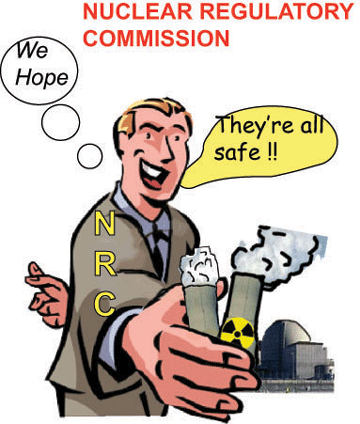 Running Ahead of Public Health and Safety https://www.ewg.org/energy/23141/pandemic-rages-federal-nuclear-regulators-put-keeping-reactors-running-ahead-public-27 Apr 20,
The federal government’s toothless nuclear “watchdog” has historically shown more concern for keeping dangerous aging reactors running than for Americans’ safety from a nuclear accident. So how is the Nuclear Regulatory Commission, or NRC, responding to the coronavirus pandemic?
-
-
- Letting nuclear power plants cut back their workforces to facilitate social distancing – but letting them make up for the reduced numbers by requiring the remaining control room operators and other key employees to work back-to-back 84-hour weeks, heightening the danger of worker exhaustion that could contribute to a reactor accident.Telling the agency’s on-site safety inspectors – two or more resident inspectors at each plant – to work from home, and allowing plants to defer required inspections of piping systems critical to cooling the reactors.
- Keeping reactor refueling crews of up to 1,500 technicians traveling from plant to plant, working in crowded conditions and staying in nearby communities, increasing the likelihood of crew members spreading the virus
The U.S. has 58 nuclear power plants housing 96 nuclear reactors in 29 states. Each plant employs 500 to 1,000 workers. Every 18 to 24 months, plants are powered down for four to six weeks for refueling, done in the spring or fall, when electric demand is low. According to the Nuclear Energy Institute, or NEI, the lobbying arm of the nuclear industry, refueling is scheduled at 56 plants this year.
On March 20, the NEI wrote the NRC to request that refueling crews have “unfettered access to travel across state lines” and unrestricted access to local hotels and food services, and to be prioritized for personal protective equipment. The NRC responded by allowing a reduction in the required number of plant personnel, and allowing an increased work week for remaining employees of 12-hour days for up to 14 days straight.
That worries Beyond Nuclear, a nonprofit that advocates “for an energy future that is sustainable, benign and democratic.”“Nuclear plant operators on extended 12-hour shifts, who can now be assigned to work two consecutive 84-hour weeks, will suffer excessive fatigue,” Beyond Nuclear’s director of plant oversight, Paul Gunter, said in a news release. “This not only compromises their immune systems, but makes catastrophic mistakes more likely.” The release cited the infamous Three Mile Island nuclear accident, in 1979, which it said was attributed to “mechanical failure worsened by operator fatigue and error.”
One week after the Nuclear Institute’s letter, the NRC directed resident inspectors to work from home, “only coming on site for risk-significant in-plant operations.” The agency has also allowed utilities operating the plants to request postponement of inspections and maintenance. “There are some ancillary activities during an outage that can be deferred,” an NRC spokesperson told Bloomberg.Among the “ancillary” activities that can be deferred is inspection of piping critical to cooling the reactors. Beyond Nuclear says three plants, in Illinois, Florida and Texas, have requested 18-month deferments of inspections of steam generator tubes that are subject to extreme heat, radiation and vibration. Failure of the piping, says the International Atomic Energy Agency, could lead to “core damage or large release events” of radiation.At least four nuclear plants – Fermi 2, near Detroit, Susquehanna, near Berwick, Pa., Limerick, near Pottstown, Pa., and Vogtle, near Waynesboro, Ga. – have seen cases of COVID-19
The Pottstown Mercury reports that local officials asked Exelon, the owner of Limerick, to postpone refueling because they found the company’s plans to address the pandemic inadequate. Regardless, the company went ahead with refueling and didn’t begin social distancing until workers told the press they were “terrified” that they’re working in a “breeding ground” for COVID-19.Nearly 30 Limerick workers have tested positive for the virus, according to The Philadelphia Inquirer. But Vogtle has by far the biggest outbreak, with 143 workers testing positive. It’s unknown how many nuclear plant workers nationwide have tested positive, because the NRC has not reported cases.“The key question,” Edwin Lyman, director of nuclear power safety for the Union of Concerned Scientists, told Utility Dive, “is how much additional risk will the NRC allow nuclear plants to accept in order to keep them running during the crisis?”Good question
-
South Korea’s government dismissed rumours about North Korean leader Kim Jong Un being gravely ill
 North Korean leader Kim Jong-un health rumours dismissed by South Korean intelligence, ABC News, 27 Apr 20, South Korea’s Government has dismissed rumours that North Korean leader Kim Jong-un is in a fragile condition, as speculation about his health intensifies amid the North’s silence on his whereabouts.
Unification Minister Kim Yeon-chul told a closed-door forum in Seoul that South Korea had “enough intelligence to confidently say that there are no unusual developments” in rival North Korea that would back up speculation about Mr Kim’s health, his ministry said.
The minister did not reveal what specific intelligence led to that conclusion, but stressed that it was reached after a thorough analysis.
His comments are a reiteration of earlier South Korean statements that Mr Kim appeared to be handling state affairs normally and that no unusual activities had been detected in North Korea.
Those comments, however, failed to dispel the rumours about Mr Kim, partly because past outside intelligence reports on developments in North Korea have sometimes turned out to be wrong. …..
As the absolute leader of a country with a nuclear weapons program, Mr Kim’s health is a matter of intense interest both regionally and globally.
If something were to happen to him, it could lead to instability in North Korea. Mr Kim hasn’t publicly anointed a successor, and that has prompted questions about who would take control of North Korea if he is gravely ill or dies…..
serious unrest could occur if a power struggle erupts between those supporting the Kim dynasty and those who want non-Kim rule…….. https://www.abc.net.au/news/2020-04-28/kim-jong-un-health-rumours-south-korea-intelligence/12191504
1 This Month

Tell Congress: Prevent Nuclear Catastrophe in Iran

Tell Congress: Prevent Nuclear Catastrophe in Iran

Read the Public Inquiry Report, the Commissioners’ report, Surrendering Australia: The AUKUS Deception is available to download for free at aukuspublicinquiry.com. Or just watch the replay of the National Press Club Luncheon.

19 November – Webinar – The Reality of Reprocessing
Time: 11:00 AM Pacific Time (US & Canada) / 2:00 PM Eastern / 7:00 PM UK / 8:00 PM CET
Register for the Zoom Event Here


Shut down the radiation-damaged Heysham nuclear reactors now
To see nuclear-related stories in greater depth and intensity – go to https://nuclearinformation.wordpress.com

Say No to NASA’s Reckless Nuclear Reactor on the Moon
Say No to NASA’s Reckless Nuclear Reactor on the Moon
-
Archives
- November 2026 (147)
- October 2026 (302)
- September 2026 (339)
- August 2026 (330)
- July 2026 (355)
- June 2026 (287)
- May 2026 (306)
- April 2026 (356)
- March 2026 (251)
- February 2026 (267)
- January 2026 (308)
- December 2025 (358)
-
Categories
- 1
- 1 NUCLEAR ISSUES
- business and costs
- climate change
- culture and arts
- ENERGY
- environment
- health
- history
- indigenous issues
- Legal
- marketing of nuclear
- media
- opposition to nuclear
- PERSONAL STORIES
- politics
- politics international
- Religion and ethics
- safety
- secrets,lies and civil liberties
- spinbuster
- technology
- Uranium
- wastes
- weapons and war
- Women
- 2 WORLD
- ACTION
- AFRICA
- Atrocities
- AUSTRALIA
- Christina's notes
- Christina's themes
- culture and arts
- Events
- Fuk 2022
- Fuk 2023
- Fukushima 2017
- Fukushima 2018
- fukushima 2019
- Fukushima 2020
- Fukushima 2021
- general
- global warming
- Humour (God we need it)
- Nuclear
- RARE EARTHS
- Reference
- resources – print
- Resources -audiovicual
- Weekly Newsletter
- World
- World Nuclear
- YouTube
-
RSS
Entries RSS
Comments RSS

