Europe feels the impact of weeks of wet weather and freezing cold.

Hundreds of thousands of people have been evacuated in Spain, Portugal and
Morocco after Storm Leonardo caused widespread flooding. Emergency services
and the military have been helping rescue people from their homes with
residents who remain warned to leave immediately. The Portuguese government
have extended a state of emergency due to what it describes as the
“devastating crisis” caused by a wave of storms. Saturday will see the
arrival of Storm Marta which will bring more rain to the region.
BBC 6th Feb 2026, https://www.bbc.co.uk/weather/articles/cwy8450qkwwo
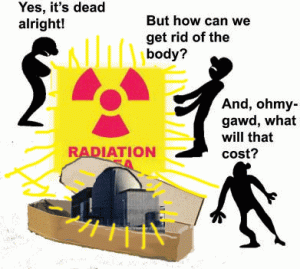
Decommissioning of Gentilly 1
Ken Collier, 7 Feb 26
As in many industrial projects, many of the hazards come to be known only after the project is well under way or, very often, completed and discontinued. Gentilly 1 is one of those projects. Like others, the Gentilly 1 detritus presents grave dangers to living things as the building, equipment and supplies are taken apart. Complete public review of the decommissioning of Gentilly 1 is required, in my view. It should not be skipped or sidestepped in any way.
Notice of the project was posted on the website of the federal impact assessment agency, but it bears scant resemblance to formal and complete impact assessments, and the public is instructed to send comments to the private consortium, rather than to the federal authorities responsible for making the decision.
To cite Dr. Gordon Edwards, president of the Canadian Coalition for Nuclear Responsibility (CCNR): “Heavily contaminated radioactive concrete and steel would be trucked over public roads and bridges, through many Quebec and Ontario communities, to the Chalk River site just across the Ottawa River from Quebec.”
How Flexibility, Not Nuclear, Can Secure Ontario’s Electricity Future
Michael Barnard, Clean Technica, 6 Feb 26
Ontario is moving forward with planning for an entirely new nuclear generation site in Port Hope, 100 km east of Toronto, at a moment when its electricity system is already one of the most nuclear-heavy in the world. Nuclear power today provides roughly 55% of Ontario’s electricity, with hydro adding another 25%. Wind, solar, batteries, and demand-side resources together account for a much smaller share, having been cut off at the knees in 2018 when the provincial conservative party took power and summarily cut 758 contracts for renewable generation. Advancing a new site signals how the province understands its future electricity challenge. It reflects an expectation that Ontario will require another large block of firm, always-available capacity to remain reliable as demand grows, particularly during the most constrained hours of the year.
Ontario’s electricity planners, primarily through the Independent Electricity System Operator, frame the case for new nuclear around long-term reliability rather than annual energy supply. Their planning outlook projects electricity demand rising by about 65–75% by 2050—a low energy value not aligned with actual climate or competitiveness goals—with a projected winter peak reaching roughly 36–37 GW. Summer peaks are also expected to rise, but they remain slightly lower, in the range of about 35–36 GW by mid-century. The winter peak, not the summer peak, is treated as the binding constraint, and it is that single cold, dark evening hour that underpins the justification for new nuclear capacity.
This framing matters because of how nuclear is treated in planning models. Nuclear plants supply energy year-round, but the decision to build new nuclear capacity is driven mainly by how much firm capacity planners believe is needed to meet future peak demand. Nuclear units are counted as fully available during peak hours, even though they operate continuously, do not follow demand and are not available when down for maintenance, refueling or refurbishment for months or years. From a reliability perspective, this approach is understandable. System operators are rewarded for avoiding shortages and penalized heavily for blackouts, while overbuilding capacity carries fewer immediate consequences………………………….
The distinction between energy growth and peak growth is critical here. Energy demand, measured in TWh, reflects how much electricity the system produces over a year. Peak demand, measured in GW, reflects the single hardest hour the system must meet. Nuclear plants are not built to follow peaks, but they are sized to peaks. If peaks remain sharp and high, nuclear looks attractive in planning models. If peaks flatten or decline due to significant system component flexiblity, the value of adding large, inflexible, always-on generation falls quickly, even if total energy demand continues to rise.
Electrification without flexibility is genuinely concerning, and planners are right to worry about it……………………………………………………………………………………………………………………………………………………………………………………………………………………………………………………..
Ontario does not lack clean electricity. It lacks a planning framework that fully reflects how electricity systems are changing, why winter peaks appear hard only under outdated assumptions, and how firm capacity is actually used in a flexible, digitized grid. The choice facing the province is not between reliability and decarbonization, but between building infrastructure sized for a winter peak that no longer needs to exist and building a system designed to avoid creating that peak in the first place. https://cleantechnica.com/2026/02/06/how-flexibility-not-nuclear-can-secure-ontarios-electricity-future/
Britain courts private cash to fund ‘golden age’ of nuclear-powered AI.

SMR trials are on the horizon, but commercial viability is not expected until the 2030s.
Things get a little hazy over the question of any financial support.
Framework aims to lure investors into powering the compute boom
Dan Robinson, Thu 5 Feb 2026,
https://www.theregister.com/2026/02/05/uk_private_finance_smr/
The British government today launched the Advanced Nuclear Framework to attract private investment in next-generation nuclear technology for factories and datacenters.
The framework aims to accelerate development of advanced modular reactors to power the AI infrastructure boom and provide [?]clean energy for economic growth.
The Department for Energy Security and Net Zero (DESNZ) will create a “pipeline” of projects meeting readiness criteria, offering a “concierge-style” service to help the developers navigate UK planning, regulations, and secure private investment.
DESNZ says emerging nuclear technologies like small modular reactors (SMRs) can be prefabricated in factories, enabling faster, cheaper assembly using skilled jobs across multiple regions. These reactors can provide [?] clean energy to the grid or directly to industrial users, it claims. SMRs, as Reg readers likely know, are newfangled designs with a power capacity of up to about 300 MW per unit, about a third of the generating capacity of traditional atomic reactors.
However, the novelty of these designs means they probably won’t be pumping out the megawatts any time soon. As Omdia principal analyst Alan Howard told us last year, SMR trials are on the horizon, but commercial viability is not expected until the 2030s.
Howard was commenting on the announcement of the UK’s first SMR plant last November, which being built at Wylfa on Anglesey, an island off the coast of Wales.
DESNZ also points to plans for X-Energy and Centrica to build 12 advanced modular reactors in Hartlepool, while Holtec, EDF, and Tritax aim to build SMRs at a former coal-fired power station site at Cottam in Nottinghamshire.
Lord Patrick Vallance, Minister for Science, Innovation, Research and Nuclear, claimed advanced nuclear technology could revolutionize the power and AI datacenter industries, delivering [?]clean energy and more jobs.
“We are seizing the opportunity to become a frontrunner in this space as part of our golden age of nuclear, creating the conditions for the industry to flourish,” he said.
The British government today launched the Advanced Nuclear Framework to attract private investment in next-generation nuclear technology for factories and datacenters.
The framework aims to accelerate development of advanced modular reactors to power the AI infrastructure boom and provide clean energy for economic growth.
The Department for Energy Security and Net Zero (DESNZ) will create a “pipeline” of projects meeting readiness criteria, offering a “concierge-style” service to help the developers navigate UK planning, regulations, and secure private investment.
DESNZ says emerging nuclear technologies like small modular reactors (SMRs) can be prefabricated in factories, enabling faster, cheaper assembly using skilled jobs across multiple regions. These reactors can provide clean energy to the grid or directly to industrial users, it claims.
SMRs, as Reg readers likely know, are newfangled designs with a power capacity of up to about 300 MW per unit, about a third of the generating capacity of traditional atomic reactors.
However, the novelty of these designs means they probably won’t be pumping out the megawatts any time soon. As Omdia principal analyst Alan Howard told us last year, SMR trials are on the horizon, but commercial viability is not expected until the 2030s.
Howard was commenting on the announcement of the UK’s first SMR plant last November, which being built at Wylfa on Anglesey, an island off the coast of Wales.
DESNZ also points to plans for X-Energy and Centrica to build 12 advanced modular reactors in Hartlepool, while Holtec, EDF, and Tritax aim to build SMRs at a former coal-fired power station site at Cottam in Nottinghamshire.
Lord Patrick Vallance, Minister for Science, Innovation, Research and Nuclear, claimed advanced nuclear technology could revolutionize the power and AI datacenter industries, delivering [?]clean energy and more jobs.
“We are seizing the opportunity to become a frontrunner in this space as part of our golden age of nuclear, creating the conditions for the industry to flourish,” he said.
The AI datacenter focus reflects the government’s ambitions for UK AI leadership. It is encouraging a rash of datacenter projects to house AI infrastructure, which is notoriously hot and hungry. One of many reports published last year estimated that global datacenter electricity use is set to more than double by 2030 thanks to AI.
Interested parties will be able to use the Advanced Nuclear Framework to submit proposals to join the pipeline from March. These will then be assessed by Great British Energy-Nuclear, the government-owned atomic energy company.
Things get a little hazy over the question of any financial support. Successful applicants get government endorsement “in principle,” and while they will be expected to secure private finance, the government says it is open to discussions on what may be needed to help get projects off the ground.
Developers will also be able to approach the National Wealth Fund, which can act as a “catalytic investor” for projects that meet their criteria.
The UK isn’t alone in looking to revitalize nuclear power. The US is also encouraging new builds and the development of advanced technologies, and it appears the Trump administration is prepared to overlook safety precautions to speed things along.
US and Russia negotiating New START deal – Axios.

The issue was reportedly discussed on the sidelines of the Ukraine peace talks in Abu Dhabi
5 Feb, 2026 , https://www.rt.com/news/632065-us-russia-negotiate-new-start/
Moscow and Washington are working on a deal to continue the New START nuclear reduction treaty, Axios reported on Thursday, citing three sources familiar with the issue. The strategic arms control agreement officially expired on February 5.
Signed in 2010, the treaty put caps on the number of strategic nuclear warheads and launchers that can be deployed and establishes monitoring mechanisms for both Russian and American arsenals. It was initially set to expire in 2021 but was extended for five years at the time.
According to Axios, President Donald Trump’s son-in-law Jared Kushner and special envoy Steve Witkoff discussed the issue with the Russian delegation on the sidelines of the Ukraine peace talks in Abu Dhabi. “We agreed with Russia to operate in good faith and to start a discussion about ways it could be updated,” a US official told the media outlet. Another source claimed that the sides had agreed to observe the treaty’s terms for at least six months as the talks on a potential new deal would be ongoing.
Earlier on Thursday, Kremlin spokesman Dmitry Peskov said that Moscow suggested sticking to the treaty’s provisions for another year but its initiative “remained unanswered.” Russia will “keep its responsible attentive approach in the field of strategic stability [and] nuclear weapons” but will be always “primarily guided by its national interests,” he said.
The UN also called the treaty expiration “a grave moment for international peace and security.” Secretary-General Antonio Guterres warned that “the risk of a nuclear weapon being used is the highest in decades” as he urged Moscow and Washington to negotiate a successor framework.
Russian President Vladimir Putin had earlier proposed to his US counterpart Donald Trump a one-year extension of the treaty but the American president said that he wanted a “better” agreement that includes China.
On Thursday, Peskov said that China considers joining the talks on a new treaty “pointless” since its nuclear arsenal is incompatible with that of Russia and the US. “We respect this position,” the Kremlin spokesman said.
Impact Assessment of the Planned Dismantling of the Core of the Gentilly-1 reactor.
To: The Honourable Julie Aviva Dabrusin, Minister of Environment and Climate Change
From: The Canadian Coalition for Nuclear Responsibility (CCNR)
Re: Impact assessment of the final dismantling of the Gentilly-1 nuclear reactor
Date: July 5 2026
Reference Number 90092
Cc Impact Assessment Agency of Canada
Atomic Energy of Canada Limited
Canadian Nuclear Laboratories \
Canadian Nuclear Safety Commission
The final dismantling of the most radioactive portions of the Gentilly-1 nuclear reactor, proposed by the licensee Canadian Nuclear Laboratories (CNL), will mark the first time that a CANDU power reactor has ever been fully decommissioned – that is, demolished.
This project is not designated for a full panel review under the Impact Assessment Act (IAA) but you, Minister Dabrusin, have the power to so designate it under the terms of the Act.
The Canadian Coalition for Nuclear Responsibility urges you to do so for the reasons stated below.
(1) When it comes to post-fission radioactivity (human made), the long-lived radioactive decommissioning waste from the core area of a nuclear reactor is second only in radiotoxicity and longevity to the high-level radioactive waste (irradiated nuclear fuel) that has already been designated for a full panel review under IAA at the initiative of NWMO, the Nuclear Waste Management Organization. The deadline for initial comments on the NWMO Deep Geological Repository project (DGR) for used nuclear fuel was yesterday, February 4, 2026. [Our comments: www.ccnr.org/GE_IAAC_NWMO_comments_2026.pdf ]
(2) Fully dismantling a nuclear reactor core is a demanding and hazardous undertaking, resulting in voluminous intermediate level radioactive wastes. The highly radioactive steel and concrete structures – fuel channels, calandria tubes, tube sheet, thermal shield, calandria vessel, biological shield, reactor vault, and more – need to be carefully disassembled, using robotic equipment and perhaps underwater cutting techniques with plasma torches. Such methods are described in a 1984 article published by the Canadian Nuclear Society and linked below, on the detailed advanced methods required for dismantling Gentilly-1.
Gentilly-1 Reactor Dismantling Proposal, by Hubert S. Vogt
Reactor and Fuel Handling Engineering Department
Atomic Energy of Canada Limited – CANDU Operation
Published by the Canadian Nuclear Society in the
Proceedings of the 5th Annual Congress
(3) Dismantling the reactor core will create large amounts of radioactive dust and debris some of which will almost certainly be disseminated into the atmosphere, or flushed into the nearby St. Lawrence River, or added to the existing contamination of the soil and subsoil (including groundwater) at the Gentilly site. It is worth noting that, during the Bruce refurbishment operations in 2009, over 500 workers – local tradesmen, mainly – suffered bodily contamination by inhaling radioactive airborne dust containing plutonium and other alpha emitters (i.e. americium) for a period of more than two weeks. The workers were told that respirators were not required. The radioactivity in the air went undetected for two and a half weeks because neither Bruce managers nor CNSC officers on site took the precaution to have the air sampled and tested.
(4) Once disassembled, the bulky and highly radioactive structural components of Gentilly-1 will have to be reduced in volume by cutting, grinding or blasting. Radioactive dust control and radioactive runoff prevention may be only partially effective. Then the multitudinous radioactive fragments must be packaged, and either (a) stored on site or (b) removed and transported over public roads and bridges, probably to Chalk River. The Chalk River site is already overburdened with high-level, intermediate-level, and low-level radioactive wastes of almost all imaginable varieties. Toxic waste dumping at Chalk River is contrary to the United Nations Declaration on the Rights of Indigenous Peoples (UNDRIP) and the federal government’s “duty to consult”, since Keboawek First Nation and other Indigenous rights-holders in the area have not given their free, prior, informed consent to either the storage or disposal of these toxic wastes on their unceded territory. A panel review could weigh the options of temporary on-site storage versus immediate relocation. Since there is as yet no final destination for intermediate level wastes, moving those wastes two or three times rather than once (when a final destination exists) will be costlier and riskier. Hence on-site storage is attractive.
(5) The decommissioning waste must be isolated from the environment of living things for thousands of years. The metallic fragments contain such long-lived radioactive species as nickel-59, with a 76,000 year half-life, and niobium-94, with a 20,000 year half-life. The concrete fragments also contain long-lived radioactive species like chlorine-36, with a 301,000 year half-life. Such radioactive waste materials are created during the fission process; they were never found in nature before 1940. NWMO has recommended that such intermediate-level decommissioning waste requires a Deep Underground Repository (DGR) not unlike that proposed for used nuclear fuel. CCNR believes that it is only logical and entirely responsible to call for a panel review of this, the first full decommissioning project for a nuclear power reactor in Canada. The lessons learned will have important ramifications for all of Canada’s power reactors as they will all have to be dismantled at some time. This is not “business as usual”.
Read more: Impact Assessment of the Planned Dismantling of the Core of the Gentilly-1 reactor.(6) Demolition of buildings is often a messy business, but demolition of a nuclear reactor core is further complicated by the fact that everything is so highly radioactive, therefore posing a long-term threat to the health and safety of humans and the environment. A panel review by the Assessment Agency is surely the least we can do in the pubic interest.
(7) To the best of our understanding, Canadian Nuclear Laboratories (CNL) is a private contractor managed by an American-led consortium of multinational corporations, whose work is paid for by Canadian taxpayers through the transfer of billions of dollars to CNL from Atomic Energy of Canada Limited, a crown corporation wholly owned by the Canadian government. As CNL is a contractor, paid to do a job by AECL, CCNR does not feel assured that the best interests of Quebec or of Canada will automatically be fully served by CNL, as it is not accountable to the electorate. When the job involves demolishing, segmenting, fragmenting, packaging and transporting dangerous radioactive materials, involving persistent radiological toxins, we feel that a thorough public review by means of a comprehensive impact assessment, coupled with the involvement and oversight of accountable federal and provincial public agencies is required to ensure that the radioactive inventory is verified and documented, that no corners are cut and no presumptions go unchallenged. The International Atomic Energy Agency strongly advises that before any reactor decommissioning work is done, there has to be a very precise and accurate characterisation of the radioactive inventory –
all radionuclides accounted for, all becquerel counts recorded, and all relevant physical/chemical/biological properties carefully noted. We have seen no such documentation, but we believe it is essential to make such documentation publicly available before final decommissioning work begins, and to preserve such records for future generations so that they can inform themselves about the radioactive legacy we are leaving them. A panel review could help to ensure that we do not bequeath a radioactive legacy that is devoid of useful information, a perfect recipe for amnesia.
(8) The Canadian Coalition for Nuclear Responsibility (CCNR) is federally incorporated as a not-for-profit organization, whose official name in French is le Regroupement pour la surveillance du nucléaire (RSN). CCNR/RSN is a member of le Regroupement des organismes environnementaux en énergie (ROEÉ). The ROEÈ has also filed comments on this dossier, linked below, with 10 recommendations. We endorse the ROEÉ submission and all of its recommendations. The ROEÉ submission is en français www.ccnr.org/IAAC_ROEE_G1_2026.pdf and here is a link to an English translation
www.ccnr.org/IAAC_ROEE_G1_e_2026.pdf .
Yours very truly,
Gordon Edwards, Ph.D., President,
Canadian Coalition for Nuclear Responsibility
‘Significant’ fire risks at nuclear plant site
Maisie Lillywhite, West of England, 4 Feb 26, https://www.bbc.com/news/articles/cgqexej138jo
‘Significant’ fire risks have been uncovered at the first nuclear plant to be built in Britain for 30 years, including flammable materials left on emergency exit stairs.
Inspectors from the Office for Nuclear Regulation (ONR) said they found significant fire safety shortfalls at Hinkley Point C, EDF’s twin-reactor nuclear power station in Somerset.
The ONR has served enforcement action notices on five organisations which are overseeing mechanical, electrical and heating (MEH) and ventilation and air conditioning work (HVAC) at the site.
Bosses of the five organisations will need to address the shortfalls ahead of the next inspection.
A spokesperson for Hinkley Point C said they are working closely with contract partners to ensure that the appropriate enhancements are made.
“Safety is our overriding priority, and we are already acting to oversee improvements,” they added.
Mahtab Khan, ONR’s head of regulation, said fire safety is not optional and it is a legal requirement that protects lives.
“We will not hesitate to take enforcement action where safety standards fall short, and we expect all dutyholders to treat fire safety with the urgency it demands.
“Working alongside the principal contractor and MEH alliance, we have made good progress in understanding the root causes of these shortfalls to ensure they are addressed,” Khan added.
The Hinkley Point C contractors given fire enforcement notices are Altrad Babcock, Altrad Services, Balfour Beatty Kilpatrick Ltd, Cavendish Nuclear, and NG Bailey.
The combustible material, found during an inspection in December, was discovered in the staircase and was waste typical of construction activities, the ONR said.
It added although the waste did not block the fire exit, it could have compromised access to the building in the event of a fire.
Inspectors found the construction site did not have an adequate fire risk assessment.
There were also insufficient means of escape exits for the number of people working in the building.
The ONR said the shortfalls had no direct impact on the likelihood of a fire, but that the enforcement means adequate routes should be available to workers in the event of a fire.
It comes after inspectors found there was a “risk of serious injury” due to “inadequate fire controls” being used by civil engineering firm Bylor JV, which is run by both Laing O’Rourke and Bouygues Travaux Publics.
In December, the company was served with a fire safety notice and was told it had until June to implement changes.
The estimated cost of Hinkley Point C has risen to £46bn from the £18bn predicted in 2017, and it is expected to open in 2031.
Growing stockpiles of radioactive waste beside the Ottawa River upstream of Parliament Hill causing widespread concern.

| The Ottawa River flows through an ancient rift valley that extends from near North Bay through Ottawa toward Montreal. The area is seismically active, and experiences dozens of minor earthquakes each year. Stronger earthquakes also occur such as the magnitude 5 quake in June 2010 that caused shaking, evacuations and damage in Ottawa including shattered windows in Ottawa City Hall and power outages in the downtown area. |
| February 3, 2026The Ottawa River flows through an ancient rift valley that extends from near North Bay through Ottawa toward Montreal. The area is seismically active, and experiences dozens of minor earthquakes each year. Stronger earthquakes also occur such as the magnitude 5 quake in June 2010 that caused shaking, evacuations and damage in Ottawa including shattered windows in Ottawa City Hall and power outages in the downtown area.Experts say Ottawa is at risk for a big earthquake.The Government of Canada is currently in the process of shoring up and earthquake-proofing the buildings on Parliament Hill. The project will take 13 years and cost billions of dollars.Incredibly, at the same time as billions are being spent to earthquake-proof Canada’s Parliament Buildings, the Government of Canada is paying billions of dollars to a US-based consortium that is importing large quantities of radioactive waste to the Ottawa Valley. |
| Soon after it took control of Canada’s nuclear laboratories and radioactive waste in 2015, the consortium, through its wholly-owned subsidiary, Canadian Nuclear Laboratories (CNL), announced its intention to consolidate all federally-owned radioactive waste at Chalk River Laboratories, alongside the Ottawa River, 180 km upstream of the Nation’s Capital. There was no consultation or approval from the Algonquin Nation in whose unceded territory the Chalk River Laboratories is located, nor any consultation with residents of the Ottawa Valley about the plan. |
| CNL is importing nuclear waste from federal nuclear facilities in Manitoba, southern Ontario and Quebec. The imports comprise thousands of shipments and thousands of tonnes of radioactive debris from reactor decommissioning, and dozens of tonnes of high level waste nuclear fuel, the most deadly kind of radioactive waste that can deliver a lethal dose of radiation to an unprotected bystander within seconds of exposure. |
| High level waste shipments from Becancour, Quebec have already been completed. They involved “dozens of trucks” and convoys operating secretly over several months, from December 2024 through July 2025, under police escort, to move 60 tons of used fuel bundles to Chalk River. Tons of high level waste from Manitoba will follow soon. |
| Since there is no long-term facility for high level waste at Chalk River, nor is there any such facility anywhere in Canada at present, CNL built silos (shown in the photo below) to hold the waste at a cost of 15 million dollars. This high level radioactive waste is ostensibly in storage at Chalk River, but there is no guarantee it will ever be moved. |
| CNL plans to put the less deadly waste into a giant, above-ground radioactive waste mound called the Near Surface Disposal Facility, a controversial project currently mired in legal challenges. The dump would hold one million tons of radioactive waste in a facility designed to last about 500 years. Many of the materials destined for disposal in the dump, such as plutonium, will remain radioactive for far longer than that. According to CNL’s own studies, the facility would leak during operation and disintegrate after a few hundred years, releasing its contents to the surrounding environment and Ottawa River less than a kilometer away. |
Shipping containers filled with radioactive waste are piling up at Waste Management Area H on the Chalk River Laboratories property, awaiting a time when they can be driven or emptied into the NSDF. At last count there were 1500 shipping containers there, shown in the photo below. [on original] Source photo is at https://concernedcitizens.net/2025/12/13/cnl-environmental-remediation-management-update-june-2025/
| It would be hard to choose a less suitable place to consolidate all federal radioactive waste than in a seismically-active zone beside the Ottawa River that provides drinking water for millions of Canadians in communities downstream including Ottawa, Gatineau and Montreal. |
| Concerns about imports of radioactive waste to the Ottawa Valley are widespread and growing. |
| In 2021, Ottawa City Council unanimously passed a resolution calling for radioactive waste imports to the Ottawa Valley to stop. Ottawa Riverkeeper recently called for transportation of radioactive waste to the Chalk River Laboratories to stop until a clear, long-term plan for the waste is available. A December 2025 letter to Prime Minister Mark Carney from Bloc Québécois and Green Party MPs along with First Nations and many civil society groups requested a moratorium on shipments of Canadian radioactive waste to Chalk River. |
| Action is urgently needed to halt the imports of radioactive waste to the earthquake-prone Ottawa Valley. |
Trump to Congress: “I don’t need your stinkin’ approval to fund Israeli genocide in Gaza”
4 February 2026 AIMN Editorial Walt Zlotow, West Suburban Peace Coalition Glen Ellyn IL https://theaimn.net/trump-to-congress-i-dont-need-your-stinkin-approval-to-fund-israeli-genocide-in-gaza/
Trump is so anxious to continue funding Israel’s genocide of Palestinians Gaza that he won’t wait for customary congressional approval.
He authorized a mammoth weapons tranche of $6.6 billion to Israel which includes:
- AH-64E Apache Helicopters and related equipment costing $3.8 billion
- Joint Light Tactical Vehicle and related equipment costing $1.98 billion
- Armored Personnel Carrier equipment and related logistics support costing $740 million
- AW119Kx Light Utility Helicopters and related equipment costing $150 million
Rep. Gregory Meeks (D-NY), the ranking member of the House oversight committee, blasted Trump’s action.
“Just one hour ago, the Trump administration informed me it would disregard congressional oversight and years of standing practice, and immediately notify over $6 billion in arms sales to Israel. Shamefully, this is now the second time the Trump administration has blatantly ignored long-standing Congressional prerogatives while also refusing to engage Congress on critical questions about the next steps in Gaza and broader US policy,”
Trump has no interest in using our tax dollars to fund decent health care, education, affordable housing, green energy, infrastructure; indeed everything needed to uplift the commons. But like predecessor Biden did when Israeli Prime Minister calls for more genocide weapons, Trump listens… then stands and delivers.
The new era of Israeli expansionism and the war economy that fuels it
By Ahmed Alqarout February 2, 2026, https://mondoweiss.net/2026/02/the-new-era-of-israeli-expansionism-and-the-war-economy-that-fuels-it/
While Israel’s current trajectory is being framed domestically as a triumph, its long-term outlook remains grim and costly. Permanent war locks Israel into permanent military mobilization, accelerates demographic and moral exhaustion, and increases long-term exposure to asymmetric retaliation from Palestinian resistance, Syria, Lebanon, and others.
How Israel’s war-driven economy, regional realignments, and Netanyahu’s push for military independence are ushering in a new period of Israeli expansionism in its quest for regional dominance.
Israel has entered a new era of territorial expansionism and military aggression beyond the borders of historic Palestine. Its belligerent actions have accelerated across Jordan, Lebanon, Syria, Yemen, Iran, Qatar, Libya, and most recently, Somaliland. These developments aren’t due to a change in Israeli strategic ambitions, but rather to the loosening of constraints that had kept it bounded before October 2023.
This expansionist turn reflects a structural recalibration of risk, leverage, and international tolerance rather than a sudden ideological shift. But it is also due to the way Israel’s economy is now structured: the military industry has been carrying the economy ever since Israel experienced a level of global isolation that decimated most other sectors over the past two years. The result? Israel now has an additional structural incentive to be in a perpetual state of war.
Prime Minister Benjamin Netanyahu gave voice to this reality when he announced that Israel would need to become a “super Sparta” — a highly militarized warrior state with a self-sufficient military industry, capable of defying international pressure and arms embargoes because it no longer has to rely on American military beneficence.
A crucial recent strategic declaration sharpens this trajectory. In January 2026, Prime Minister Benjamin Netanyahu announced his intention to end U.S. military aid to Israel within roughly a decade, framing this as a path toward military-industrial self-sufficiency and strategic autarky. This announcement signals that Israel is no longer content to remain subordinate to the U.S., instead seeking to operate as its strategic partner in the region at a time when the U.S.’s national security strategy is shifting attention from the Middle East to the Western Hemisphere.
Netanyahu’s declaration amplifies the urgency of the export-led growth model, which is largely based on arms and defense-linked industries. The problem is, if Israel is to replace $3.8 billion in annual U.S. military aid, it must dramatically scale up its domestic production and export capacity.
Also read: Israel moves to embrace its isolation.
The Israeli state is attempting to institutionalize this export surge through policy, committing roughly NIS 350 billion (equivalent to $100–108 billion) over the coming decade to expand an independent domestic arms industry. Economically, this means that military production will become central to Israel’s long-term industrial strategy, diverting capital, labor, and state support toward weapons manufacturing rather than civilian recovery, a strategy that is untenable during wartime. This also embeds Israeli firms deeper into global security supply chains, even as the state itself becomes diplomatically isolated.
The structural dimension: incentive for permanent war
Since 2023, Israeli military exports have become one of the few sectors compensating for its broader economic slowdown. In 2023, defense exports reached approximately $13 billion, and in 2024 they climbed further to around $14.7–15 billion, setting successive records. This expansion took place while civilian economic growth weakened, labor shortages and unemployment intensified due to the prolonged mobilization of the army, and large segments of the small and medium enterprise sector reported sustained losses and bankruptcies. Arms exports essentially functioned as a countercyclical stabilizer during wartime stress, but now they’re becoming a permanent part of how the Israeli economy aims to reproduce itself.
In 2025, this trajectory accelerated even further. Israel signed some of its largest defense agreements to date with the U.S., UAE, Germany, Greece, and Azerbaijan, covering air defense systems, missiles, drones, and advanced surveillance technologies. While full contract values are not always disclosed, these deals are expected to push total defense exports beyond the 2024 record, reinforcing the arms sector as Israel’s most dynamic export industry, even as other exports, such as agriculture, face an imminent “collapse,” according to Israeli farmers.
The war economy has become the organizing principle of political survival and regime insurance.
As civilian sectors stagnate, the war economy provides growth, foreign currency earnings, and political insulation. This creates a structural incentive for permanent mobilization: war sustains demand, shields the government from accountability, and reinforces a worldview in which force is treated as the primary currency of international relations.
In this configuration, military aggression and territorial expansionism are the mechanisms through which the Israeli economy now seeks to reproduce itself. As a result, Israel’s governing coalition rests on permanent securitization. The war economy has become the organizing principle of political survival and regime insurance.
The global dimension: the end of international law
The international dimension is equally decisive. Israel’s territorial expansionism and military aggression have been enabled by the hollowing out of global constraint mechanisms such as international law.
Western states have demonstrated that there is no meaningful red line when violence is framed as counterterrorism or civilizational defense. Legal norms remain rhetorically intact but operationally suspended. This has altered Israel’s strategic calculus, because if Gaza produces diplomatic noise but no material sanctions, then Lebanon, Syria, or Iraq carries even lower expected costs.
The collapse of normalization: no reason to play nice
Read more: The new era of Israeli expansionism and the war economy that fuels itNormalization politics also play a role. The collapse of Israeli-Saudi normalization talks — which had accelerated throughout 2023 under U.S. mediation but stalled after Israel launched its genocide in Gaza — did not discipline Israeli behavior, but liberated it.
Without Saudi recognition serving as a bargaining chip or incentive for restraint, Israel abandoned any pretense of using territorial compromises as a negotiating tool. It doubled down on the objective of establishing facts on the ground while seeking bilateral security ties with smaller or more vulnerable actors. Expansion now substitutes for Israel’s dying soft power, and recognition is increasingly extracted through leverage rather than negotiation.
What makes the post-2023 moment distinctive is Israel fighting across multiple theaters simultaneously, in the open, and with confidence that escalation will not trigger systemic pushback. Furthermore, Israel’s strategy has become structurally enabled by an ever-increasing reliance on new technologies developed during war. It is no longer a response to threats but a method of governance at home and influence abroad.
Since 2023, Israel has no longer pursued peace through containment, as it did during the Arab Spring period. Instead, it has shifted toward permanent occupation, land seizure, and the redrawing of political maps to sustain and expand its war machine.
How Israel is pursuing regional dominance
Domestically, Israeli territorial expansionism aims to permanently resolve the Palestinian question through a combination of expulsion, cantonization, co-optation, and ultimately displacement. The underlying logic is to eliminate what is perceived as Israel’s primary domestic security problem — the very presence of the Palestinian people on their land — once and for all, thereby restoring elite and societal confidence in the long-term survival of the state.
At the regional level, Israel pursues diverse objectives across the countries in which it intervenes, some involving territorial acquisition or semi-permanent occupation, others focused on subordination, fragmentation, and neutralization of perceived threats.
In Iran, aggression takes the form of seeking regime destabilization and military degradation through sustained airstrikes on nuclear and military facilities, alongside efforts to exacerbate social and political unrest. The June 2025 war between Israel and Iran marked the most direct military confrontation between the two states to date, yet it terminated in an informal pause rather than escalating into full-scale war, with neither side crossing recognized deterrence thresholds despite the intensity of exchanges.
Since then, large-scale protests inside Iran have introduced a new internal pressure point that external actors increasingly frame as a strategic vulnerability. This has coincided with explicit threats of war from Donald Trump and renewed U.S. military signalling, which together reinforce Israel’s long-standing view of Iran as an existential threat to be confronted through regime change. Yet the persistence of non-escalation reflects how aggression against Iran operates within implicit boundaries that territorial expansionism in Palestine or Syria does not face, even as the fusion of internal unrest and external coercive rhetoric makes this equilibrium more fragile.
In Lebanon, Israel seeks to dismantle Hezbollah not only as a military actor but as the backbone of a Shiite-led political order that obstructs Israeli regional dominance. The deeper objective is to fracture Lebanon into a minorities-based system in which Druze, Christians, and other groups are incentivized to seek external protection and economic linkage with Israel. A weak and segmented Lebanon provides strategic depth without the costs and liabilities of direct occupation. For now, the cross-border escalation in Lebanon functions less as a pathway to outright military victory and more as a tool for reshaping Lebanon’s internal political balance over time.
As of January 2026, despite the ceasefire nominally holding, Israel has maintained “temporary” positions in five “strategic” locations in southern Lebanon, refusing to complete its withdrawal. The result is a tense stalemate in which Israel maintains military leverage over Lebanon while withholding its commitment to a full withdrawal and leaving open the possibility of renewed major escalations.
Israel’s strikes across Syria are somewhat more complex, becoming a central theater of Israeli military intervention and engineered political fragmentation following the fall of the Assad regime in December 2024. The Israeli strategy in Syria involves both direct military action and efforts to prevent unified Syrian state consolidation by providing military support for and coordination with Syrian Kurdish forces (the SDF) aimed at fragmenting the new Syrian government’s authority.
In March 2025, Israeli Defense Minister Israel Katz publicly announced that Israel would permit Syrian Druze workers to enter the Golan Heights for agricultural and construction work, framing this as a humanitarian gesture while simultaneously cultivating labour dependencies and economic ties that bind border communities to Israel. In July 2025, Netanyahu adopted a formal policy of “demilitarization of southern Syria,” declaring that Israeli forces would remain in southern Syria indefinitely and that no Syrian military forces would be permitted south of Damascus, effectively partitioning Syrian territory. Netanyahu framed this policy as “protection of the Druze.”
Israel’s setbacks in Syria
By late 2025 and early 2026, the SDF’s position had collapsed. Arab tribal defections in Raqqa and Deir Ez-Zour, mounting pressure from Turkish forces to the north, and a lack of sustained external support led to a rapid SDF retreat from much of northern and eastern Syria by January 2026. This collapse of Israel’s primary Kurdish proxy, coupled with the failure of Israeli-backed Druze militia resistance to prevent Damascus’s consolidation of authority in southern Syria, has undermined Israel’s strategy of preventing unified Syrian state reconstruction through proxy warfare.
The Druze and Alawite populations represent potential economic and demographic assets at a time when Israel faces a structural shortage of both soldiers and workers. Since 2023, this shortage has become acute. The Syrian periphery offers a pool of labor that can be selectively incorporated under autonomy arrangements or informal annexation, which Israel has already done by allowing a number of Syrian Druze to work in the Golan Heights. What is emerging is a strategy of economic annexation without formal borders, integrating the southern Syrian periphery into the Israeli economy on subordinate terms.
As for Yemen, its alignment with Gaza and its demonstrated capacity to disrupt Red Sea shipping have elevated it from a peripheral conflict to a strategic threat for Israel, especially since Ansar Allah’s blockade undermines Israel’s global trade architecture and its security relationships with Western shipping insurers, logistics firms, and port operators.
Yemen’s growing ties with Russia and China have only compounded this threat. That’s why attacking Yemen isn’t about Yemen alone, but about preserving a Western-aligned maritime order in which Israel is embedded as its key security node.
This is where Israel’s recognition of Somaliland comes in, allowing Israel to bypass internationally recognized states and to work directly with sub-state entities. Somaliland has allegedly agreed to have an Israeli military base established in the territory and to accept displaced Palestinians from Gaza in exchange for this recognition.
Regarding direct Israeli involvement in North Africa more broadly, Israel has not pursued direct military operations in Egypt or sustained military intervention in Sudan or Libya, but it has pursued indirect strategies of influence and intelligence gathering, from maintaining contacts with both sides of the Sudanese civil war to secretly meeting with Libyan officials before October 2023.
The costs of expansionism and potential for resistance
While Israel’s current trajectory is being framed domestically as a triumph, its long-term outlook remains grim and costly. Permanent war locks Israel into permanent military mobilization, accelerates demographic and moral exhaustion, and increases long-term exposure to asymmetric retaliation from Palestinian resistance, Syria, Lebanon, and others.
Each absence of consequence recalibrates expectations on both sides. Within Israel, it reinforces the belief that force carries no meaningful cost. Among those targeted, it sharpens incentives to develop longer-horizon strategies of attrition and retaliation. Geographic overreach further compounds these vulnerabilities. Israel’s efforts to embed itself within overseas military infrastructures in places such as Somaliland and southern Yemen (and to establish bases through regional proxies like the UAE) expose Israel’s operational reach to extended supply lines that are distant, insecure, and vulnerable to interdiction.
Rather than Israeli-operated facilities, these arrangements rely on third-party bases (principally Emirati), whose stability depends on shifting regional power dynamics and state priorities beyond Israel’s direct control. Maintaining an effective presence at such a distance raises the likelihood of further military stumbling blocks, financial constraints, and unanticipated entanglements that may prove difficult to sustain over time, especially as Yemen’s Ansar Allah threatens to target any future military bases in Somaliland.
Lawmakers spark backlash with controversial fee imposed on residents: ‘Colossal financial risk’

There’s a political battle unfolding in Scotland over a new charge critics
are calling a “nuclear tax” — a levy that could leave Scottish households
paying for nuclear construction projects hundreds of miles away. At the
center of the dispute is England’s Sizewell C nuclear power station, a
project that has ballooned beyond its original budget and is raising
questions about who should foot the bill.
According to The National,
Scottish lawmakers are raising alarms over a levy introduced by Westminster
to help fund the plant in Suffolk, which is now projected to cost £38
billion ($51.9 billion) — nearly double its original estimate of £20
billion ($27.3 billion). Scottish bill payers could contribute around £300
million ($409.3 million) over the next decade even though the plant is
being built in England.
The Scottish National Party has criticized Labour
leadership for not opposing the tax, arguing that residents are paying for
a project they did not approve and may never directly benefit from. “Your
support for these projects in Scotland would see us exposed to colossal
financial risk and undermine our renewables future,” SNP lawmaker Graham
Leadbitter said.
However, Labour representatives argue that nuclear power
is an important part of the United Kingdom’s long-term energy mix. Gregor
Poynton has said Scotland risks missing out on jobs and investment by
turning away from new nuclear technologies such as small modular reactors.
TCD 2nd Feb 2026, https://www.thecooldown.com/green-business/nuclear-tax-scotland-household-energy-bills/
I spent decades in energy -Here are the problems with UK nuclear plans.
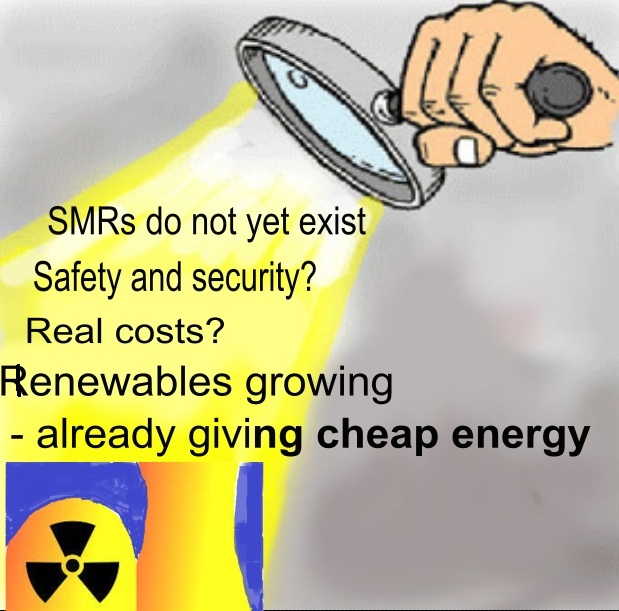
IT is clear that the issue of Scotland’s moratorium on new nuclear power
will be a key battle line in May’s Scottish Parliament election. Anas
Sarwar has joined the Labour energy minister Michael Shanks in the call for
building more nuclear power in Scotland – and the electricity cables to
take the generated electricity to energy-hungry England. MP Shanks
continues to declare that he would be relaxed about having a small
modularised reactor (SMR) erected in his constituency.
I am not sure how
the good people of Rutherglen feel about this. What I find mystifying is
the lack of proper scrutiny being applied to the claims made by those
members of the Nuclear Energy All-Party Parliamentary Group and its
well-funded nuclear lobbyists. It does not surprise me that they are unable
to set out what configuration they favour, as the reactors which they claim
will produce 400 MWs do not exist. They have not been manufactured, tested,
or installed – anywhere! As an engineer, I would be keen to ask the
politicians if they have thought about some of the basic elements of a
power plant. Do they have any ideas what the thermal capacity of the
proposed reactors are? Have they understood what the cooling requirements
might be? How about the status of the “core catcher”, the system
designed to prevent a Chernobyl-type event?
Be under no illusion, Shanks,
Sarwar and the nuclear lobby are building a Potemkin village, a deceptive,
impressive facade. They of course don’t want to talk about the European
Power Reactor (EPR) configuration being installed at astronomical cost at
Hinkley C. This project is forecast to cost around £45 billion when it
finally comes online sometime next decade. It is not easy to get a proper
sense of this sum but it might surprise people to realise that this is the
equivalent of paying £1 million every single day for 120 years – and this
is just the construction cost.
We have not even started talking about
operational costs, asset management and asset decommissioning. When Julia
Pyke, the managing director of Sizewell C, was asked by the BBC how the
project was going, she answered airily that it is “on schedule and within
budget”. I waited eagerly for the obvious follow-up question – what is
the budget and schedule? – but that never came. If the Sizewell C
construction consortium defies recent construction trends and achieve a 10%
saving relative to Hinkley C, that would still indicate a £40bn project
cost – which is enough to build 130 hospitals similar to, for example,
Forth Valley Royal Hospital.
The supporters of nuclear energy tell us that
we need these plants for baseload capacity. They fail to acknowledge that
in Scotland we already generate more capacity from renewables than we
consume – and this surplus is only going to grow as we continue to see more
investment in wind, solar, tidal and energy storage.
“What about
intermittency and the lack of system inertia?” is the nuclear advocates’
stock question when discussing the growth of renewables. This is a
legitimate question but the answer is beautifully simple – we will continue
to do what we do now, rely on combined-cycle gas turbines (CCGTs). Which is
reassuring as there will be no nuclear plant coming on stream anytime soon.
“But what about net zero?” might be the next question. Thankfully,
there are a raft of solutions to this currently available and more coming
on stream every week. For example, gas turbine manufacturers are building
on 50 years of experience of burning hydrogen and will be ready to burn
hydrogen or blended hydrogen/methane as quickly as the hydrogen market can
come on stream. My prediction is that the hydrogen market will come on
stream faster than any SMRs can be built – and if UK politicians had a
strategic bone in their bodies, they would be trying to beat our friends in
Europe to win the hydrogen race.
The National 31st Jan 2026, https://www.thenational.scot/news/25813385.spent-decades-energy-problems-uk-nuclear-plans/
The U.S. occupation of Gaza has begun

The plans for Donald Trump’s “Board of Peace” show that the goal is not just to make Gaza a playground for the wealthy, but to put it under permanent American occupation.
Mondoweiss, By Mitchell Plitnick January 30, 2026
This week, Drop Site News revealed a draft resolution from Trump’s newly christened “Board of Peace.” The resolution outlines what is, in essence, Phase Two of Trump’s unrealistic peace plan that ushered in a new phase of horror in Gaza under the guise of a ceasefire.
The actions outlined in the resolution ignore realities on the ground and paint a very grim picture of what the United States is planning for Gaza. Far from abandoning the ludicrous and offensive imagery Trump shared in that AI video from last year of himself and Elon Musk on a beach in an unrecognizable Gaza, this resolution is the battle plan to turn Gaza into the playground for the wealthy that Jared Kushner presented to the World Economic Forum at Davos last week. It’s a Gaza where the only Palestinians remaining are those chosen to be the servants in the new regime.
It’s a Gaza under permanent American occupation.
The “Executive Board” that would control Gaza
The Board of Peace (BoP) itself has drawn the most attention, but it is not the focal point for Gaza. The BoP is being set up as an international force to challenge the United Nations. It is currently populated entirely by far-right and autocratic figures, and will likely stay that way.
The BoP will be headed by Donald Trump and his role as Board Chair is personal, disconnected from his role as President of the United States. He has full power over the Board’s composition and full veto power over all of its actions. Trump will remain in control of the BoP until he decides to leave or he dies, and he has the sole authority to name his successor. You couldn’t build a clearer autocracy.
The BoP can delegate its authority as it wishes, and that is what it has done regarding Gaza. The “Executive Board” (EB) is the body that will govern Gaza. The EB itself will also have other areas within its portfolio, so it, too, has delegated its power to yet another group, dubbed the Gaza Executive Board (GEB). There is considerable overlap between the members of the EB and GEB.
The members of the GEB include some very familiar names like Steve Witkoff, Trump’s lead negotiator; Susan Wiles, his Chief of Staff; Jared Kushner, his son-in-law; and Tony Blair the former PM of the UK and a war criminal in the 2003 invasion of Iraq.
The rest of the names may be less familiar, but they are all important and, together, they draw a very worrisome picture of how this Board will behave ………………………………………………………………………………………………………………………………………………………………………………………………………………………………………………………..
Palestinians not included in planning Gaza’s future
While there are no Israelis on the Executive Board, it is stacked with extreme supporters of the Israeli right and of Netanyahu. This makes the vague mandate of the entire enterprise much more concerning.
The proposal published by Drop Site states that “the reconstruction and rehabilitation activities of the Board shall be dedicated solely to those who regard Gaza as their home and place of residence.”
But the proposal offers no opportunity for the people of Gaza to have any say at all in their present situation, let alone their future. The EB governs all of the laws. An American-led International Stabilization Force (ISF) controls all security.
The ISF is to be under the command of American Major General Jasper Jeffers. Trump, and Trump alone, has the power to remove the commander of the ISF and must personally approve any nominee to replace him.
The plan further states that “only those persons who support and act consistently [with Trump’s Comprehensive Plan for Gaza] will be eligible to participate in governance, reconstruction, economic development, or humanitarian assistance activities in Gaza.”
In other words, Palestinians who wish to be part of Gaza in any way must meet Trump’s litmus test of support for the external American control of the Gaza Strip. The same will be true for any business, NGO, or even individual who wants to participate in any way in rebuilding Gaza, physically, politically, or economically.

Ideally, for Trump and Jared Kushner, Gaza would be transformed into a giant “company town.” Most of the coastline would be dedicated to tourism. The bulk of Gaza’s eastern border with Israel would be dedicated to industrial zones and huge data centers, doubtless reflecting the massive investments Trump and his Emirati friends are making in AI.
In between would be residential areas separated by parks, agricultural, and sporting sites. In the West Bank, such parks and agricultural areas are frequently declared closed military zones and used for other purposes by the occupying force.
As has been apparent from the beginning, the only role currently envisioned for Palestinians is in the administration of the Executive Board’s decisions. In other words, Palestinian technocrats, laborers, and office workers would be “permitted” to carry out the decisions made for them by others.
The U.S. occupation of Gaza
This resolution provides only a bit more substance to the half-baked ideas Trump has been putting forward since October. And it continues to envision a near-future where Hamas has voluntarily disarmed, Israel has pulled out of Gaza, and the ISF has assumed security control that is welcomed by whatever Palestinians remain in Gaza.
All of that remains fully in the realm of fantasy.
Hamas has repeatedly made it clear that it is willing to discuss decommissioning its weapons, but would not disarm. Given that Israel is, once again, funding rogue Palestinian gangs in Gaza, complete disarmament is suicide for many members of Hamas, Islamic Jihad, and other factions.
The United States is discussing offering amnesty and even a buy-back program for the weapons, but these offers are hardly useful if the lives of Hamas members are put at grave risk by disarmament, even if we assume that the U.S. keeps to its word and that Israel does not itself hunt these fighters down.
Moreover, Israel is bristling at this entire plan. They prefer to bring the hammer down again on Gaza, especially now that there are no hostages, dead or alive, to be concerned with.
Netanyahu is openly stating that Israel will allow no rebuilding in Gaza—where it is killing people, including infants, not only with its weapons but by denying Palestinians the materials to shelter from the winter elements—until Hamas is “disarmed.”
…………………………Israel has already reportedly drawn up a plan for a major military operation, a return to the full-blown genocide of last year, which it plans to launch in March unless the U.S. refuses to allow it to do so.
…………………..What is taking shape in Gaza is a new kind of foreign occupation. This time, the U.S. would be the leading force on the ground unless it allows Israel to renew its aggression, something Trump doesn’t want.
………………………….An American occupation of Gaza on Israel’s behalf will be just as unwelcome by Palestinians as an Israeli one backed by the United States. It may take some time for the people of Gaza to regroup from the past two and a half years to organize impactful resistance, but it will come, as it always has.
The solution is simple: allow Palestinians their freedom and their rights. But that solution is beyond the imagination of Washington and Tel Aviv. So, meet the new occupation. It will be no more pleasant than the old one. https://mondoweiss.net/2026/01/the-u-s-occupation-of-gaza-has-begun/
Israel’s War on Iran: The Overkill No One Calls War
| urbanwronski on February 3, 2026, https://urbanwronski.com/2026/02/03/israels-war-on-iran-the-overkill-no-one-calls-war/ |
Tehran, June 13, 2025, 4:17 a.m. The first explosions light up the sky over Natanz. Israeli F-35s, invisible to radar, drop JDAMs on Iran’s largest uranium enrichment plant. Within minutes, no fewer than five car bombs detonate across Tehran, next to government buildings and the homes of nuclear scientists. The IDF, ever the courteous occupier, issues a warning to Iranian civilians: evacuate the areas around weapons factories and military bases in Shiraz. Or else.
By dawn, Israel has struck over 100 targets. Not just nuclear sites, but missile depots, air defences, and the homes of Iran’s top military brass. General Hossein Salami, commander of the Revolutionary Guards, is dead. So is Chief of Staff Mohammad Bagheri. So are nuclear scientists Fereydoon Abbasi and Mohammad Mehdi Tehranchi.
The Mossad, meanwhile, has spent years smuggling precision weapons into Iran, setting up covert drone bases near Tehran, and recruiting Iranian dissidents to sabotage air defences from within. This is not a flare-up. This is not a crisis. This is war, waged by Israel, enabled by the US, and dressed up as something else entirely.
The US Joins the Party On June 22, the Americans arrive. Twelve B-2 stealth bombers, escorted by 125 aircraft, drop 30,000 pound “bunker buster” bombs on Fordow, Natanz, and Isfahan. The GBU-57s, each capable of burrowing 200 feet underground before detonating, are the only weapons on Earth that can destroy Iran’s fortified nuclear sites. Trump calls it “Operation Midnight Hammer.” The Pentagon calls it “degrading Iran’s nuclear capabilities.” The rest of the world calls it what it is: the US and Israel bombing a country that, by all independent accounts, is not building a nuclear weapon. Nor intends to.
The Body Count By June 28, the numbers are in. Iranian health officials report 1,190 dead, including 435 military personnel and 436 civilians. Another 4,000 are wounded. Israel loses 28. The US? Zero. Iran fires back with missiles at Tel Aviv, drones at Haifa, a barrage at a US base in Qatar, but the Iron Dome and Patriot batteries swat most of them away. The Iranian air force, such as it is, never gets off the ground. Its fleet of MiG-29s and F-14s, some half a century old, are no match for Israel’s F-35s and the US’s B-2s. Iran has no air force to speak of. It has missiles, proxies, and little else.
The Mossad’s Shadow War This is not just a war of bombs. It’s a war of knives in the dark. The Mossad doesn’t just strike from the air, it strikes from within. In the months leading up to June 2025, Mossad operatives and recruited Iranian dissidents disable air defences, plant explosives, and assassinate scientists. They infiltrate government databases, steal passport data, and turn Iranian software against itself. When the war “ends,” the Mossad stays.
“We will be there,” Mossad Director David Barnea promises, “like we have always been there.”
The Next Round And there will be a next round. The US and Israel have already authorised fresh strikes. The CIA and Mossad are busy preparing the ground with cyberattacks, sabotage, the occasional hanging of an accused spy in Tehran’s Evin Prison. Iran, for its part, threatens to close the Strait of Hormuz, block oil shipments, and unleash its proxies across the region. But the pattern is set: Israel strikes, the US backs it up, and the world calls it anything but war.
The Language of Impunity Why does this matter? Because language is the first casualty. When Israel and the US bomb Iran, it’s a “campaign.” When Iran fires back, it’s “escalation.” When 1,190 Iranians die, it’s “collateral damage.” When the Mossad assassinates a scientist, it’s “targeted killing.” When the US drops bunker busters, it’s “degrading capabilities.” This is not neutral phrasing. It’s a lie by omission, a way to wage war without consequence, to turn atrocity into policy.
The Spectacle of Overkill Israel has 345 combat aircraft. Iran has 312, most of them museum pieces. Israel spends 5.6% of its GDP on defence. Iran spends 2.6%. Israel has the Iron Dome, David’s Sling, and the full backing of the US military. Iran has the S-300, a system so outdated that Israeli drones fly right through it. This is not a war. It’s a slaughter, dressed up as self defence.
What Comes Next The ceasefire is a pause, not an end. The Mossad is still in Tehran. The CIA is still running ops. The US with Donald Trump’s “beautiful Armada” is still offshore, waiting for the next excuse. And Iran? Iran is still standing, still defiant, still a target. Because for Israel and its American backer, the war never ends. It just gets rebadged.
Name it now. Or live with it forever.
Labour backbenchers revolt over Starmer’s nuclear plans

Ministers accused of scapegoating protected species for construction failures
Matt Oliver, 02 February 2026
Sir Keir Starmer’s plan for a nuclear renaissance faces a rearguard action
from Labour MPs and wildlife charities over claims it will be a
“catastrophe” for nature. As many as 40 backbenchers are rallying
against the Prime Minister’s proposal to overhaul environmental regulations
after an independent review said red tape was frustrating the construction
of new power stations.
The MPs and a coalition of environmental charities
including the Wildlife Trusts, the RSPB, the National Trust and the
Woodland Trust have accused ministers of scapegoating protected species
such as bats and newts for planning failures.
It comes ahead of a plan
expected to be published by ministers this month, setting out how they will
implement the review’s recommendations and whether they will adopt them in
full. Labour is also under pressure from an opposing group of pro-nuclear
campaigners, businesses and think tanks who argue reform is “essential if
we want to create jobs, tackle climate change, and cut energy bills”.
Britain is currently the most expensive place in the world to build nuclear
reactors, with critics blaming nature rules that have added hundreds of
millions of pounds of extra costs to construction. The review of nuclear
regulations, led by the economist John Fingleton, criticised regulators
such as the Office for Nuclear Regulation, the Environment Agency and
Natural England for presiding over a confusing and “duplicative” system
that prioritised “process over outcomes”.
A briefing circulated in
Parliament by the Wildlife Trusts claims that the review’s proposed changes
to habitat regulations “will do little to speed up planning decisions
but, instead, will turn the nature crisis into a catastrophe.” It argues
that the suggestion of a nature fund may be suitable in some cases but not
in the case of “irreplaceable habitats or species that cannot
re-establish elsewhere easily.”
The briefing adds: “The Government must
reject the nuclear regulatory review recommendations on environmental
regulations and end its confected war on nature as a barrier to
planning.” Chris Hinchcliffe, the Labour MP for North East Hertfordshire
who is coordinating the rebellion, said “a good number of colleagues”
shared the concerns. He said: “There is very clear polling on the
importance of nature to the British public and their desire to seek
stronger, not weaker, protections for nature. “Getting this wrong is a
real vote-loser, and is a misstep that the Government cannot afford.”
Responding to the findings in November, ministers vowed to present “a
full implementation plan” by late February and to push through the
changes within two years. On Monday, the campaign group Britain Remade
published a letter signed by businesses and think tanks urging ministers to
press ahead. The letter said: “If the Government is serious about growing
the economy, reducing bills, and delivering a new golden age of nuclear
energy, its implementation plan must back the Fingleton reforms in full.
“Nuclear energy is the most land-efficient zero-carbon technology we
possess. A single power station can power millions of homes. “If we are
serious about halting climate-driven nature loss, then nuclear energy must
expand in a safe, secure and sustainable way. “We cannot afford for the
Government to U-turn.”
Telegraph 2nd Feb 2026 https://www.telegraph.co.uk/business/2026/02/02/labour-backbenchers-revolt-over-starmer-nuclear-plans/
1 This Month



26 September – International Day for the Total Elimination of Nuclear Weapons


PLEASE OPPOSE HR 8255 AND S.3639 – bills would accelerate satellite deployment, with no environmental review or safeguards – https://ncstd5li.quorum.us/campaign/169331/
To see nuclear-related stories in greater depth and intensity – go to https://nuclearinformation.wordpress.com
-
Archives
- September 2026 (281)
- August 2026 (330)
- July 2026 (355)
- June 2026 (287)
- May 2026 (306)
- April 2026 (356)
- March 2026 (251)
- February 2026 (267)
- January 2026 (308)
- December 2025 (358)
- November 2025 (359)
- October 2025 (375)
-
Categories
- 1
- 1 NUCLEAR ISSUES
- business and costs
- climate change
- culture and arts
- ENERGY
- environment
- health
- history
- indigenous issues
- Legal
- marketing of nuclear
- media
- opposition to nuclear
- PERSONAL STORIES
- politics
- politics international
- Religion and ethics
- safety
- secrets,lies and civil liberties
- spinbuster
- technology
- Uranium
- wastes
- weapons and war
- Women
- 2 WORLD
- ACTION
- AFRICA
- Atrocities
- AUSTRALIA
- Christina's notes
- Christina's themes
- culture and arts
- Events
- Fuk 2022
- Fuk 2023
- Fukushima 2017
- Fukushima 2018
- fukushima 2019
- Fukushima 2020
- Fukushima 2021
- general
- global warming
- Humour (God we need it)
- Nuclear
- RARE EARTHS
- Reference
- resources – print
- Resources -audiovicual
- Weekly Newsletter
- World
- World Nuclear
- YouTube
-
RSS
Entries RSS
Comments RSS

