Fishing industry chief opposes releasing Fukushima No. 1 water into sea
Fishing industry chief opposes releasing Fukushima No. 1 water into sea, https://www.japantimes.co.jp/news/2020/10/09/national/zengyoren-fukushima-water-sea/ 9 Oct 20, The head of the National Federation of Fisheries Cooperative Associations, or Zengyoren, has voiced strong opposition against releasing treated water containing radioactive tritium from the disaster-stricken Fukushima No. 1 nuclear plant into the sea.
“We are absolutely against ocean release” as a way to dispose of tainted water at Tokyo Electric Power Company Holdings Inc.’s nuclear plant in Fukushima Prefecture, Hiroshi Kishi, head of Zengyoren, said Thursday at a government hearing in Tokyo.
Kishi said that fishermen who are operating along the coast of Fukushima have been suffering from problems caused by the radioactive fallout from the 2011 meltdowns at the plant, such as fishing restrictions, as well as malicious rumors about the safety of farm and marine products there.
If the government chooses to release radioactive water into the sea, a leading option to get rid of accumulating low-level radioactive water at the plant, it will trash all efforts fishermen have so far made to sweep away such rumors and consequently “will have a devastating impact on the future of Japan’s fishing industry,” Kishi stressed.
Toshihito Ono, head of the prefecture’s fishery product processors association, who joined the hearing via a video call, warned that Fukushima’s processed marine products, including products that use ingredients from other prefectures, will become targets of harmful rumors.
In a report released in February, a government panel pointed out that a realistic option would be releasing the tainted water into the ocean after dilution or into the air through evaporation.
Many people fear that both methods will add to the reputational damage suffered by Fukushima products. But treated water storage at the power plant is expected to reach full capacity as early as autumn 2022.
After the hearing, state industry minister Kiyoshi Ejima told reporters, “We find it unadvisable to put off a decision on how to dispose of the water because not much room is left at the plant for tanks containing the water.”
This was probably the last hearing on the water issue, people familiar with the matter said.
Utah congressman takes action to stop future nuclear weapons testing in U.S.
|
Utah congressman takes action to stop future nuclear weapons testing in U.S. The Daily Universe, By Kaela Cleary, October 9, 2020 With all of the chaos surrounding the U.S. presidential election, word of the Trump administration and Senate Republicans creating legislation to prepare to resume nuclear weapons testing at the Nevada Test Site hasn’t received much public attention.
|
|
China’s plan for dramatic switch to climate action and renewable energy
|
|
|
Ageing community in Hokkaido town – mayor agrees to survey for nuclear waste dump
|
Graying Hokkaido town applies for nuclear waste dump survey, Japan Times, 9 Oct 20, A small Hokkaido town struggling with depopulation signed up Friday for preliminary research into its land to gauge its suitability for hosting a disposal site deep underground for high-level radioactive nuclear waste, the first municipality to do so in Japan since 2007.Suttsu Mayor Haruo Kataoka submitted the documents for the survey at the quasi-governmental Nuclear Waste Management Organization (NUMO) in Tokyo. Municipalities that undergo the preliminary research, the first of a three-stage process requiring some 20 years in total to select a permanent disposal site, can receive up to ¥2 billion in state subsidies over two years. Prior to Suttsu, the only municipality to apply for a preliminary survey was Toyo in Kochi Prefecture, which submitted documents in 2007. However, the town later withdrew before the research was ever conducted following strong protests by local residents. ……… Meanwhile, government officials are expected later Friday to request Kamoenai village in Hokkaido, which is about 40 kilometers north of Suttsu, to accept research into its land a day after its assembly adopted a petition to host the survey. Suttsu and Kamoenai, with populations of about 2,900 and 820, respectively, have been struggling financially due to a decline in the fishing industry and the aging of their residents. It remains uncertain whether the process of becoming a final disposal site will go smoothly, as Hokkaido Gov. Naomichi Suzuki and members of the fishing industry in the area are opposed to the idea of hosting such a facility……. During its research, NUMO will examine the area to see if it is suited to the disposal of highly radioactive waste, paying attention to volcanoes and fault lines. High-level radioactive waste, produced as a result of extracting uranium and plutonium from spent fuel, must be stored in concrete structures at least 300 meters underground so as not to impact human lives or the environment. Locations near volcanoes and active faults are deemed unfavorable…….https://www.japantimes.co.jp/news/2020/10/09/national/hokkaido-nuclear-waste-dump-survey/ |
|
Conservative UK government is considering a carbon tax, in its commitment to reduce greenhouse gas emissions
 Times 9th Oct 2020, Rishi Sunak is examining proposals for a UK-wide carbon tax that could
raise billions of pounds while encouraging the drive towards net-zero emissions. The chancellor is seeking to replace existing EU carbon-reduction schemes with the new tax when the transition period finishes at the end of the year.
“The danger with relying solely on a carbon tax is that no one believes politicians will not scrap it when things get tough, so no one invests. A cap and trade scheme that guarantees an outcome, alongside regulation and innovation support, is much more likely to lead to cuts in emissions.”https://www.thetimes.co.uk/edition/news/sunak-plans-carbon-emissions-tax-to-help-rebuild-economy-jbl3gs993
European Commission, and France’s Hercules project, plan to break up the nuclear company EDF
Reporterre 8th Oct 2020, The European Commission, according to a document obtained by Reporterre,
intends to impose on the French State the disintegration of the EDF group
in the name of respect for competition rules. The “reform” of Brussels goes
even further than the government project Hercules, which wants to dismember
EDF .
https://reporterre.net/Exclusif-Le-projet-fou-de-Bruxelles-pour-demanteler-ED
Will the UK government sacrifice the beautiful Suffolk coast in its misguided, uneconomic, Sizewell nuclear power push?
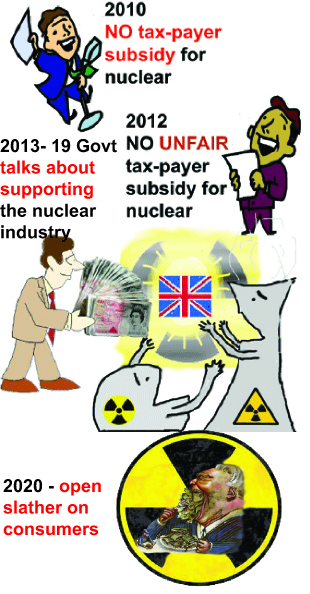 East Anglian Daily Times 8th Oct 2020, As councils lose patience with EDF, will Suffolk businesses follow suit?
Today East Suffolk lies at a crossroads – the future of the east of the county now seems certain to rest in the hands of London-based civil servants and ministers – and to be honest I don’t know which way they will jump when push comes to shove. The deadline has now passed for councils, businesses, and residents to have their say on whether a two new nuclear reactors should be built on the Suffolk coast at Eastbridge, north of the existing stations at Sizewell.
landscape. But I do worry that there are some in government who do not understand the value of this area to the country as a whole who will be prepared to look on Sizewell C as a shiny investment to try to kick-start the UK economy after the pandemic and in a world no longer governed by EU rules, will pour in government subsidies to make up for the loss of Chinese money.
https://www.eadt.co.uk/ea-life/last-chance-to-stop-sizewell-c-1-6871419?s=09
BBC 8th Oct 2020, Campaigners against a new nuclear power station say they are “resolute”
after their bid to protect woodland was thrown out by the High Court. EDF
Energy, which wants to build two new reactors next to Sizewell B in
Suffolk, was given approval in 2019 to fell Coronation Wood on the site.
Together Against Sizewell C (Tasc) sought a judicial review, claiming that
decision was unlawful.
Kim Jong Un Set to Show Off Nuclear Advances in Message to Trump
|
Kim Jong Un Set to Show Off Nuclear Advances in Message to Trump, By Jon Herskovitz and Jeong-Ho Lee
10 October 2020, North Korean leader Kim Jong Un is expected to hold his biggest military parade in at least two years and show off a nuclear arsenal that poses one of the most daunting security challenges for the winner of the U.S. presidential election.
The event — part of festivities Saturday to mark the 75th anniversary the Workers’ Party of Korea — could showcase the “new strategic weapon” Kim pledged to unveil at the start of the year. ….. https://www.bloomberg.com/news/articles/2020-10-09/kim-jong-un-set-to-show-off-nuclear-advances-in-message-to-trump |
|
USA trying to beat China, in marketing nuclear reactors to Romania
 Romania, U.S. to sign cooperation agreements over nuclear reactors, By Reuters Staff, 9 Oct 20, BUCHAREST (Reuters) – Romania’s economy ministry will sign cooperation and financing agreements with the United States
Russia’s nuclear giant Rosatom moving into renewable energy, energy storage, grid development
The state-owned company will manufacture module type lithium-ion traction batteries for electric vehicles, as well as energy storage systems for emergency power supplies, renewable energy resources, and the smoothing of load demand. PV Magazine , OCTOBER 9, 2020 EMILIANO BELLINI Rosatom State Nuclear Energy Corp. (Rosatom) is entering the energy storage business through its TVEL Fuel Company (TVEL) unit, which has set up a dedicated subsidiary, Renera.The new company will produce module type lithium-ion traction batteries for electric vehicles, as well as energy storage systems for emergency power supplies, renewable energy resources, and the smoothing of load demand, TVEL stated……
Rosatom is already operating in the renewable energy sector via its NovaWind unit, which mostly focuses on the wind power business.
“We have an R&D center which is capable to develop energy storage solutions as for grids and substations, as well as for renewable energy sources, including both wind and solar,” the spokesperson said.,,,,,,,,https://www.pv-magazine.com/2020/10/09/russian-nuclear-giant-rosatom-enters-storage-business/
3 Canadian provinces sucked in by propaganda from 3 Small Nuclear Reactor companies

|
The two big-name companies that won’t be designing Ontario’s next nuclear reactor The province has passed over two major players on its shortlist for a small-modular-reactor design. Will that mean a more competitive process? TVO By John Michael McGrath – Oct 09, 2020 The Ontario government — along with the governments of New Brunswick, Saskatchewan, and (probably) Alberta — wants to develop a new generation of nuclear reactors in Canada. This week, the provincially owned Ontario Power Generation announced it was taking the latest step toward that goal and would be working with three different companies to refine their engineering and design work so that eventually one can be selected for completion.
The three lucky companies are Terrestrial Energy (covered previously on TVO.org), GE Hitachi (with generations of nuclear experience in the United States), and X-energy. At least as notable, however, are two major omissions: NuScale and SNC-Lavalin, which makes the CANDU reactors that Ontario has relied on for decades……….. The problem for NuScale is that its design is meant to be packaged in clusters of up to 12, which is fine if you need 12 — but, right now, Ontario is looking to find one reactor that it could build reasonably quickly, to prove the design works and can be built economically, and then to reproduce it in other provinces, such as Saskatchewan……… In June of this year, however, SNC-Lavalin announced it was submitting a reactor design to the Canadian regulator in the 300-megawatt range — putting it on the larger end of the spectrum for something that’s still supposed to be “small” but is still smaller than traditional CANDU designs. Terrestrial Energy, by comparison, is offering a 195-megawatt design. Canada’s nuclear industry tried to market a 300-megawatt CANDU reactor in the 1980s (the CANDU 3) but never found a buyer. ……… handing the prize to SNC-Lavalin out of nostalgia for the CANDU design would have been a poor guarantee of value for electricity customers. https://www.tvo.org/article/the-two-big-name-companies-that-wont-be-designing-ontarios-next-nuclear-reactor |
|
Poland to build nuclear reactor starting in 2026, excludes Small Modular Reactors (SMRs)
Construction of Poland’s first nuclear power plant to start in 2026, The government has adopted a resolution to update the Polish Nuclear Power Programme (PPEJ), the Ministry of Climate announced on Friday.
The updated PPEJ provides for the construction of six nuclear reactors with a total capacity of 6-9 GW. The first reactor should be operational in 2033…….
The programme excludes the use of boiling water reactors (BWRs) and small modular reactors, referred to as SMRs……… https://www.thefirstnews.com/article/construction-of-polands-first-nuclear-power-plant-to-start-in-2026-16542
Trump’s COVID infection shows why it’s time to retire the nuclear football
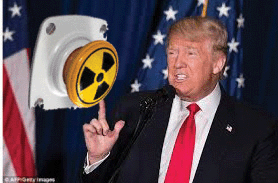 Trump’s COVID infection shows why it’s time to retire the nuclear football, Bulletin of the Atomic Scientists , By Tom Z. Collina, October 6, 2020 President John Kennedy took powerful pain medications. President Richard Nixon was a heavy drinker. President Ronald Reagan had dementia. And now President Donald Trump has the coronavirus. These conditions can significantly impair one’s ability to think clearly. And yet, as president, each had—or, in Trump’s case, still has–the unilateral authority to launch US nuclear weapons within minutes.
President Trump is followed 24/7 by a military aide that carries the “football,” the briefcase that holds all he would need to order the immediate launch of up to 1,000 nuclear weapons, more than enough megatonnage to blow the world back into the stone age. He does not need the approval of Congress or the secretary of defense. Shockingly, there are no checks and balances on this ultimate executive power.
President Trump took the nuclear football with him to Walter Reed Medical Center, where he received treatment for COVID-19. According to Trump’s doctor, the president’s blood oxygen levels had dipped. And this, according to independent health experts, can impair decision-making ability. He is taking dexamethasone, which can cause mood swings and “frank psychotic manifestations.” Yet as far as we know, at no point did the president transfer his powers to the vice president, as allowed under the 25th Amendment.
To state the obvious, we should not entrust nuclear launch authority to someone who is not fully lucid. (Reagan transferred authority temporarily before planned surgery, as did President George W. Bush before a medical procedure that required his sedation.) A nuclear crisis can happen at any time, including at the worst possible time. If such a crisis takes place when a president’s thinking is compromised for any reason, the results could be catastrophic. ……..
If the president or his advisors have reason to believe that Trump’s thinking may be compromised, nuclear launch authority should be transferred to the vice president, Mike Pence. If Pence also gets COVID, the football could then be passed to House Speaker Nancy Pelosi, President Pro Tempore of the Senate Chuck Grassley, and the secretaries of State, Treasury and Defense, in that order.
But kicking the football down the line does not solve the problem—and in fact shows why the system is broken. Does anyone really believe that the president pro tem of the Senate or the Treasury Secretary has spent much time preparing for nuclear war? And even if they had prepared, the central dilemma remains: All humans are imperfect, and we should not trust the fate of the world to any one person.
The whole concept of giving the president unilateral nuclear authority is built on the false assumption that Russia might launch a surprise first strike. In fact, Russia has never seriously considered a first strike against the United States for a simple reason: It would be national suicide. Both sides have to assume that an attack would provoke an unacceptable nuclear retaliation. Both nations, and much of the rest of the globe, would be obliterated. Starting such a war would be insanity………
It is time to retire the nuclear football. The only thing standing between us and nuclear holocaust is one man with COVID on heavy meds. That is the plan? Ending sole authority is better than entrusting it to any individual. In a vibrant democracy, no one person should have the unchecked power to destroy the world. https://thebulletin.org/2020/10/trumps-covid-infection-shows-why-its-time-to-retire-the-nuclear-football/
Countries that have included nuclear in their green stimulus plans may want to rethink their strategy
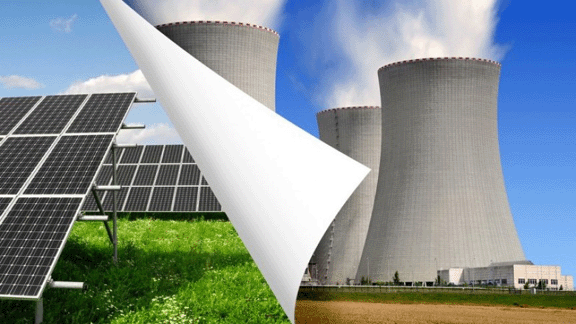
now, a new study spearheaded by the UK’s University of Sussex (UoS) for the scientific journal Nature Energy, shows that nuclear might not even be that great for lowering carbon emissions.
In fact, the study found that renewables are “up to seven times more effective at reducing carbon emissions than nuclear power.” As summarized by PV Magazine, the study “concluded nuclear could no longer be considered an effective low carbon energy technology, and suggests that countries aiming to rapidly and cost-effectively reduce their energy emissions should prioritize renewables.” …………
This study comes at an essential moment in which nations around the world are designing economic stimulus packages to overcome the recession being ushered in by the novel coronavirus pandemic. Countries that have included nuclear in their green stimulus plans may want to rethink their strategy–even if it’s in concert with investment in renewables. Another report by Science Daily this week shows that trying to adopt a hybrid approach that includes both nuclear and renewables is even less effective. At a time when the world is reckoning with and engineering a “new energy order” and a “great reset, such findings have never been so important, and governments around the world would do well to read the reports. https://oilprice.com/Alternative-Energy/Nuclear-Power/The-Biggest-Obstacle-For-Nuclear-Energy.html
The very costly effort of trying to resuscitate the dying nuclear industry

Nuclear Energy — The High Cost Of A Dying Industry, Clean Technica, October 6th, 2020 by Johnna Crider
Nuclear energy has had a seriously rough year. In an article by OilPrice.com, the author asked a question: “Why is nuclear energy so expensive?” One answer, besides the obvious 2020 curse that was activated when Egyptian authorities opened up 30 ancient wooden coffins in 2019, is that other sources have just gotten much cheaper while nuclear hasn’t……….
As we know, in 2020, the coronavirus pandemic shut down US energy demand, and this added nuclear energy to a long list of energy industries that are begging for taxpayer money — well, in the case of nuclear, even more taxpayer money. And the Trump administration came through for this dying and expensive industry. Back in June, the Department of Energy announced that it would award more than $65 million in nuclear energy research. This would cross-cut technology development, facility access, and infrastructure awards.
PowerTechnology reported that these awards would be for these departments’ nuclear energy programs:
- The Nuclear Energy University Programme
- Nuclear Energy Enabling Technologies
- Nuclear Science User Facilities.
That $65 million will also be poured into 93 advanced nuclear technology projects in 28 states. And the Office of Nuclear Energy, which is part of the US Department of Energy (DOE), has spent more than $800 million on research since 2009. OilPrice noted that the $65 million would probably be “too little, too late for domestic nuclear energy.” CleanTechnica‘s perspective is that nuclear has been long dead and we’re just waiting for the green leaves of the tree (existing power plans) to turn brown (close down). New nuclear is financially hopeless, many times more expensive than renewable energy options even with energy storage costs included.
Global State Of Nuclear Energy
Antony Froggat, who co-authored the report and is a Senior Research Fellow at Chatham House in London, said, “At the same time, COVID-19 puts additional stress on the sector. In economic terms, renewables continue to pull away from nuclear power, over the past decade the cost estimates for utility-scale solar dropped by 89 percent, wind by 70 percent, while nuclear increased by 26 percent.”
Also in the US, force-on-force exercises were suspended. These are simulated terrorist attacks on nuclear power plants that use a mock adversary force to replicate design basis threat characteristics during an attack. These are supposed to help assess and improve readiness in case of an actual terrorist attack on a nuclear reactor.
In Russia and Sweden, control room staff were made to isolate in housing that was located onsite. They lived at their jobs. In Russia, one national operation reported weekly on infections among the nuclear staff. In July, there were a total of 4,500 cases.
Technology Costs
The report compared the costs of solar, onshore wind, and nuclear. The report looked at analyses for the US conducted by Lazard at the end of 2019, which advises on financial matters while managing investment portfolios. This is what they found out in a nutshell:
- Solar PV (crystalline, utility-scale) averaged $40/MWh, compared to $65/MWh in 2015.
- Onshore wind was $41/MWh, compared to $55/MWh in 2015.
- Nuclear is $155/MWh, compared to $117/MWh in 2015.
The report points out that over the past 5 years, the annual Levelized Cost of Energy (LCOE) for nuclear has risen by over 50%. In stark contrast, renewables have become the most inexpensive of any type of power generation. “What is remarkable about these trends is that the costs of renewables continue to fall due to incremental manufacturing and installation improvements, while nuclear, despite over half a century of industrial experience, continue to see costs rising. Nuclear power is now the most expensive form of generation, except for gas peaking plants.”
The report also states that even though Trump’s White House supports nuclear power and coal, both have not thrived at all under his presidency. This is due, the report says, to renewables being cheaper and basic economics. Lazard also assessed that the costs of renewables continue to fall. You can learn more about the nuclear report here.
Whether it’s the curse of 2020 or humans are slowly evolving, we are phasing out of the old and phasing in the new. In the case of energy, it’s renewables, which will benefit not only our planet but the health and well-being of people all across the globe. For now, though, it seems that taxpayers will continue footing nuclear’s expensive high maintenance bills. https://cleantechnica.com/2020/10/06/nuclear-energy-the-high-cost-of-a-dying-industry/
1 This Month


Read the Public Inquiry Report, the Commissioners’ report, Surrendering Australia: The AUKUS Deception is available to download for free at aukuspublicinquiry.com. Or just watch the replay of the National Press Club Luncheon.



19 November – Webinar – The Reality of Reprocessing
Time: 11:00 AM Pacific Time (US & Canada) / 2:00 PM Eastern / 7:00 PM UK / 8:00 PM CET
Register for the Zoom Event Here



Shut down the radiation-damaged Heysham nuclear reactors now
To see nuclear-related stories in greater depth and intensity – go to https://nuclearinformation.wordpress.com

Say No to NASA’s Reckless Nuclear Reactor on the Moon
Say No to NASA’s Reckless Nuclear Reactor on the Moon
-
Archives
- November 2026 (119)
- October 2026 (302)
- September 2026 (339)
- August 2026 (330)
- July 2026 (355)
- June 2026 (287)
- May 2026 (306)
- April 2026 (356)
- March 2026 (251)
- February 2026 (267)
- January 2026 (308)
- December 2025 (358)
-
Categories
- 1
- 1 NUCLEAR ISSUES
- business and costs
- climate change
- culture and arts
- ENERGY
- environment
- health
- history
- indigenous issues
- Legal
- marketing of nuclear
- media
- opposition to nuclear
- PERSONAL STORIES
- politics
- politics international
- Religion and ethics
- safety
- secrets,lies and civil liberties
- spinbuster
- technology
- Uranium
- wastes
- weapons and war
- Women
- 2 WORLD
- ACTION
- AFRICA
- Atrocities
- AUSTRALIA
- Christina's notes
- Christina's themes
- culture and arts
- Events
- Fuk 2022
- Fuk 2023
- Fukushima 2017
- Fukushima 2018
- fukushima 2019
- Fukushima 2020
- Fukushima 2021
- general
- global warming
- Humour (God we need it)
- Nuclear
- RARE EARTHS
- Reference
- resources – print
- Resources -audiovicual
- Weekly Newsletter
- World
- World Nuclear
- YouTube
-
RSS
Entries RSS
Comments RSS

