The new way to hide the money splurged on nuclear weapons – via Small Nuclear Reactors

|
A military bromance: SMRs to support and cross-subsidize the UK nuclear weapons program, Industry and government in the UK openly promote SMRs on the grounds that an SMR industry would support the nuclear weapons program (in particular the submarine program) by providing a pool of trained nuclear experts, and that in so doing an SMR industry will cross-subsidize the weapons program. Such arguments are problematic for several reasons. Firstly, the weapons program is problematic and the UK’s compliance with its Nuclear Non-Proliferation Treaty obligations is questionable. Secondly, why subsidize an SMR industry to subsidize the weapons program ‒ why not simply invest more in the weapons program directly? Thirdly, there are strong reasons to firewall civil nuclear programs from military programs yet there is no longer any pretense of a firewall. The arguments are clearly stated in a 2017 report by Rolls-Royce.1 The company trumpets its role in powering and maintaining the UK Royal Navy submarine fleet. But its recent interest in civil SMRs isn’t a case of swords-to-ploughshares … it’s ploughshares-supporting-swords. The report states:1 “The indigenous UK supply chain that supports defence nuclear programmes requires significant ongoing support to retain talent and develop and maintain capability between major programmes. Opportunities for the supply chain to invest in new capability are restricted by the limited size and scope of the defence nuclear programme. A UK SMR programme would increase the security, size and scope of opportunities for the UK supply chain significantly, enabling long-term sustainable investment in people, technology and capability. “Expanding the talent pool from which defence nuclear programmes can draw from would bring a double benefit. First, additional talent means more competition for senior technical and managerial positions, driving excellence and performance. Second, the expansion of a nuclear-capable skilled workforce through a civil nuclear UK SMR programme would relieve the Ministry of Defence of the burden of developing and retaining skills and capability. This would free up valuable resources for other investments.” So SMRs will relieve the Ministry of Defence of the “burden” of paying for its own WMD programs! Andy Stirling and Phil Johnstone have carefully studied the links between the UK’s nuclear power program and the weapons program.2 They wrote in The Guardian in March 2018:
“Although unstated, by far the most likely source for such support is a continuing national civil nuclear programme. And this where the burgeoning hype around UK development of SMRs comes in. Leading designs for these reactors are derived directly from submarine propulsion. British nuclear submarine reactor manufacturer Rolls-Royce is their most enthusiastic champion. But, amid intense media choreography, links between SMRs and submarines remain (aside from reports of our own work) barely discussed in the UK press. “This neglect is odd, because the issues are very clear. Regretting that military programmes are no longer underwritten by civil nuclear research, a heavily redacted 2014 MoD report expresses serious concerns over the continued viability of the UK nuclear submarine industry. And Rolls-Royce itself is clear that success in securing government investment for SMRs would “relieve the Ministry of Defence of the burden of developing and retaining skills and capability” for the UK’s military nuclear sector. Other defence sources are also unambiguous that survival of the British nuclear submarine industry depends on continuation of UK civil nuclear power. Many new government initiatives focus intently on realising the military and civil synergies. “Some nuclear enthusiasts have called this analysis a conspiracy theory, but these links are now becoming visible. In response to our own recent evidence to the UK Public Accounts Committee, a senior civil servant briefly acknowledged the connections. And with US civil nuclear programmes collapsing, the submarine links are also strongly emphasised by a former US energy secretary. Nuclear submarines are evidently crucial to Britain’s cherished identity as a “global power”. It seems that Whitehall’s infatuation with civil nuclear energy is in fact a military romance.” |
|
|
With Small Nuclear Reactors (SMRs) Canada is back in the nuclear weapons business
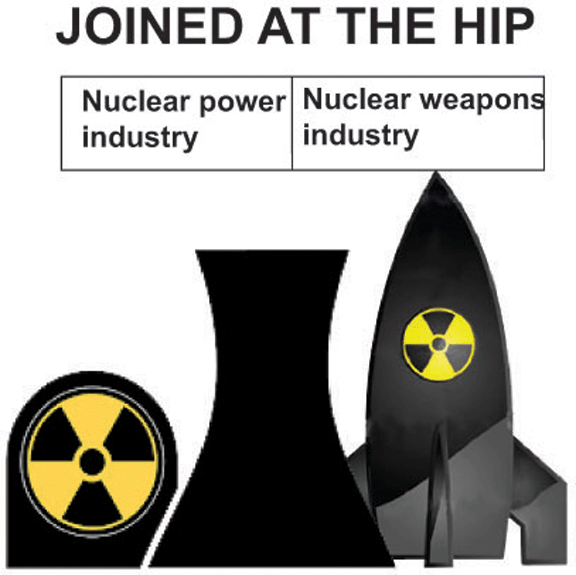 Canada re-engages in the Nuclear Weapons Business with SMRs, December 3, 2020, WWW.HILLTIMES.COM/2020/12/03/CANADA-RE-ENTERS-NUCLEAR-WEAPONS-BUSINESS-WITH-SMALL-MODULAR-REACTORS/274591
Natural Resources Minister Seamus O’Regan is expected to announce within weeks his government’s action plan for development of “small modular” nuclear reactors (SMRs).
SMR developers already control the federally-subsidized Chalk River Laboratories and other facilities owned by the crown corporation, Atomic Energy of Canada Limited (AECL). Canada is now poised to play a supporting role in the global nuclear weapons business, much as it did during World War II.
Canada was part of the Manhattan project with the U.S. and U.K. to produce atomic bombs. In 1943 the three countries agreed to build a facility in Canada to produce plutonium for nuclear weapons. Researchers who trained at the Chalk River Laboratories went on to launch weapons programs in the U.K. and France. Chalk River provided plutonium for U.S. weapons until the 1960s.
Canada’s Nuclear Schizophrenia describes a long tradition of nuclear cooperation with the United States: “For example, in the early 1950s, the U.S. Navy used Canadian technology to design a small reactor for powering its nuclear submarines.” C.D. Howe, after creating AECL in 1952 to develop nuclear reactors and sell weapons plutonium, remarked that “we in Canada are not engaged in military development, but the work that we are doing at Chalk River is of importance to military developments.”
The uranium used in the 1945 Hiroshima bomb may have been mined and refined in Canada. According to Jim Harding’s book Canada’s Deadly Secret: Saskatchewan Uranium and the Global Nuclear System, from 1953 to 1969, all the uranium mined in Saskatchewan went to make U.S. nuclear weapons. Canada remains the world’s second-largest producer of uranium. North America’s only currently operating uranium processing facility is owned by Cameco in Port Hope, Ontario.
Canada built India’s CIRUS reactor, which started up in 1960 and produced the plutonium for India’s first nuclear explosion in 1974. Canada also built Pakistan’s first nuclear reactor, which started up in 1972. Although this reactor was not used to make weapons plutonium, it helped train the engineers who eventually exploded Pakistan’s first nuclear weapons in 1998.
In 2015 the Harper Government contracted a multi-national consortium called Canadian National Energy Alliance – now comprised of two U.S. companies, Fluor and Jacobs, along with Canada’s SNC-Lavalin – to operate AECL’s nuclear sites, the main one being at Chalk River. Fluor operates the Savannah River Site, a South Carolina nuclear weapons facility, under contract to the U.S. Department of Energy (DOE). Jacobs also has contracts at DOE weapons facilities and is part of a consortium that operates the U.K. Atomic Weapons Establishment.
Joe McBrearty, the president of the consortium’s subsidiary that operates Chalk River and other federal nuclear sites, was a U.S. Navy nuclear submarine commander and then chief operating officer for the DOE’s nuclear laboratories between 2010 and 2019.
All three consortium partners have investments in SMRs and are ramping up research and development at AECL’s Chalk River facility. Some SMR designs would use uranium enriched to levels well beyond those in current reactors; others would use plutonium fuel; others would use fuel dissolved in molten salt. All of these pose new and problematic weapons proliferation risks.
Rolls Royce, an original consortium partner that makes reactors for the U.K.’s nuclear submarines, is lead partner in a U.K. consortium (including SNC-Lavalin) that was recently funded by the U.K. government to advance that country’s SMR program.
A military bromance: SMRs to support and cross-subsidize the UK nuclear weapons program, says “Industry and government in the UK openly promote SMRs on the grounds that an SMR industry would support the nuclear weapons program (in particular the submarine program) by providing a pool of trained nuclear experts, and that in so doing an SMR industry will cross-subsidize the weapons program.”
The article quotes a 2017 Rolls Royce study as follows: “expansion of a nuclear-capable skilled workforce through a civil nuclear UK SMR programme would relieve the Ministry of Defence of the burden of developing and retaining skills and capability.”
The SMR connection to weapons and submarines could hardly be clearer – without SMRs, the U.S. and U.K. will experience a shortage of trained engineers to maintain their nuclear weapons programs.
With the takeover of AECL’s Chalk River Laboratories by SMR developers, and growing federal government support for SMRs, Canada has become part of a global regime linking nuclear power and nuclear weapons.
Iran’s President Rouhani ready to restore the nuclear deal
Rouhani: ‘No negotiations’ needed to restore Iran nuclear deal https://www.aljazeera.com/news/2020/12/9/iran-rouhani-no-negotiations-on-nuclear-deal
President Rouhani says Iran will return to its commitments that were part of the deal if other signatories do the same. By
Maziar Motamedi, 9 Dec 2020, Tehran, Iran – Iran’s nuclear deal can be restored without negotiations despite recent escalations following the assassination of a top nuclear scientist, Iran’s President Hassan Rouhani has told world powers.
Rouhani said United States President Donald Trump “scribbled on a piece of paper” in May 2018, unilaterally withdrawing from the nuclear deal.
“The next person can put up a nice piece of paper and sign it and it just needs a signature, we’ll be back where we were. Ittakes no time and needs no negotiations,” Rouhani said in a televised cabinet speech on Wednesday.
“And it’s not just about the US. The P4+1 can return to all their commitments and we will do the same,” he said in reference to France, Germany, the United Kingdom, China, and Russia, the other signatories of the nuclear deal.
US President-elect Joe Biden and Europe have signalled that while they wish to restore the nuclear deal, they believe it needs to be renegotiated and extended.
Exactly a year after the US pulled out of the landmark deal and imposed harsh sanctions on Iran, Tehran gradually scaled back its commitments under the deal in five steps that it said are reversible.
Following the assassination of nuclear scientist Mohsen Fakhrizadeh outside Tehran last month, the Iranian parliament, dominated by conservatives and hardliners, quickly passed a bill that aims to increase uranium enrichment and expel inspectors of the International Atomic Energy Agency.
The Rouhani administration has explicitly said it opposes the legislation and was not consulted in its drafting.
Rouhani said all the new advanced centrifuges that are being installed at the Natanz underground nuclear facilities can be switched off once all the signatories of the nuclear deal start fully implementing their commitments.
Earlier this week, France, Germany and the UK – together known as the E3 – issued a joint statement saying Iran’s plans for a further reduction of nuclear commitments are “deeply worrying” and go against the spirit of the accord.
Opponents of the Ohio bailout of nuclear industry want more than just a freeze on this law
|
Opponents of HB6 Say Nuclear Bailout Freeze is not Enough https://www.wksu.org/government-politics/2020-12-08/opponents-of-hb6-say-nuclear-bailout-freeze-is-not-enough
The Statehouse News Bureau | By Andy Chow December 8, 2020, New charges are set to appear on everyone’s electric bills in Ohio to support a nuclear power plant bailout. While that bailout is linked to an alleged bribery scheme, House Republicans seem poised to freeze the law rather than repeal it. House leadership is signaling a freeze to the bailout, HB798, will be the vehicle used to address the energy laws created through HB6. The energy law allows for new charges of up to $2.35 a month on electric bills for nuclear, coal, and solar subsidies. Rachael Belz with Ohio Consumers Power Alliance says a freeze on the new charges doesn’t truly help the ratepayers. “It’s more like pushing something off that you never intend to get back to,” Belz said. Talk of an HB6 repeal began after House Speaker Larry Householder was arrested about five months ago accused of a bribery scheme that helped him rise to leadership and HB6 become law. It’s believed FirstEnergy funneled millions of dollars into the alleged scheme. HB6 accomplishes several things on the company’s legislative agenda. The nuclear and solar subsidies amount to a $0.85 monthly charge on electric bills. That new charge generates $150 million a year for two nuclear power plants in Ohio and $20 million for existing solar farms. HB798 would not repeal the provisions in HB6 that cuts renewable energy standards and eliminates energy efficiency standards. |
|
Thieves steal equipment from Russia’s nuclear war ‘doomsday’ plane.
|
Thieves target Russia’s nuclear war ‘doomsday’ plane. https://www.theguardian.com/world/2020/dec/08/thieves-target-russia-nuclear-war-doomsday-plane
Radio equipment stolen from Ilyushin-80 aircraft designed to protect Putin and top officials, Andrew Roth in Moscow, Thieves have targeted a Russian “doomsday” plane, the military aircraft that would be used by top officials, including Vladimir Putin, in case of a nuclear war.The robbery of the Ilyushin-80, a mobile command post specially designed to keep officials alive and in command of the military during a nuclear conflict, took place at an airfield in southern Russia, state media reported. The thieves managed to open the highly classified aircraft’s cargo hatch and make off with 39 pieces of radio equipment. They have not been caught. Interior ministry officials in the city of Taganrog confirmed that a plane at Taganrog Aviation Scientific and Technical Complex was robbed, although they did not specify which one. Ren-TV, a Russian television station, reported that police had found shoe and fingerprints aboard the aircraft. Russia has just four Ilyushin-80 planes, modified Il-86s that are specially equipped to protect those aboard in the event of a nuclear war. The plane does not have any passenger windows, to prevent passengers from being blinded by atomic explosions. The planes also carry specialised communications equipment to maintain contact with the country’s armed forces, including missile forces capable of launching nuclear strikes. A miles-long retractable antenna dragged from the rear of the aircraft can maintain communications with ballistic-missile submarines. In the event of a conflict, it is expected that Putin and other political and military officials would board the planes and command the country’s defences while remaining airborne, possibly for several days (with refuelling). Some of the details of the Ilyushin-80 are kept secret by Russia. It is not yet clear how sensitive the radio equipment that was stolen may be. The planes have been in service for 15 years and are due to be replaced by an aircraft with greater range – the Il-96-400M. The new planes, designed to withstand electromagnetic pulses released by nuclear explosions, and include better shielding have updated electronics and communications systems. The US maintains four Boeing E-4 Advanced Airborne Command Posts, modified Boeing 747-200s that would be carry the US president and other top officials in case of a nuclear war. |
|
|
Iran hastens nuclear legislation in response to the assassination of its nuclear scientist
Iran vows to build two new nuclear facilities, alarming observers https://www.sciencemag.org/news/2020/12/iran-vows-build-two-new-nuclear-facilities-alarming-observers By Richard StoneDec. 8, 2020,
|
Iran’s possible responses to the assassination of a prominent nuclear scientist go well beyond boosting uranium enrichment and expelling weapons inspectors, two provisions of a law passed by Iran’s parliament that alarmed nonproliferation experts last week. Equally worrisome are new facilities the law requires, which could enable Iran to make plutonium and fashion uranium into bomb components. The legislation had been in the works for months, but parliament fast-tracked it after the 27 November killing of Mohsen Fakhrizadeh, director of a Revolutionary Guard research unit who had previously led a secret nuclear weapons program shuttered in 2003, according to the International Atomic Energy Agency (IAEA). Iran’s powerful Guardian Council last week approved the law. The potential limits on IAEA monitoring are of particular concern, says a European diplomat involved in negotiations with Iran. “IAEA would go blind in many areas of Iran’s nuclear establishment.” Posing a fresh proliferation risk are the new facilities the bill mandates: a lab for working with uranium in metal form—a vital skill if Iran were to make nuclear weapons—and a heavy water reactor that could accumulate plutonium in its spent fuel. “If either was to proceed, that would stand out as a major proliferation concern,” says Richard Johnson, senior director for fuel cycle and verification at the nonprofit Nuclear Threat Initiative. Iranian President Hassan Rouhani’s administration opposed the legislation. However, Foreign Minister Mohammad Javad Zarif told an international forum last week, “We will implement it. We have no other choice.” But Zarif noted the law is reversible. “The remedy is very easy,” he said: Iran would shelve the law if the United States returns to the 2015 nuclear deal, formally called the Joint Comprehensive Plan of Action (JCPOA), which restrained Iran’s nuclear program in return for relief from economic sanctions. The Trump administration pulled out of the JCPOA in 2018; President-elect Joe Biden has pledged to rejoin it. The JCPOA, proponents say, lengthened the time Iran would need to accumulate enough fissile material for a bomb, from several weeks to at least 1 year. A key provision is a cap on uranium enrichment at 3.67% of the fissile isotope uranium-235 (U-235), which is a level sufficient for civilian nuclear reactors. One year after the U.S. withdrawal from the JCPOA, and after Europe’s failure to deliver promised economic relief, Iran began to breach the pact, including increasing enrichment to 4.5%. A hike to 20%—which last week’s law requires—is a big step toward weapons-grade uranium, which is generally defined as greater than 90% U-235. A heavy water reactor would pose another headache. Before the JCPOA, Iran was building a 40-megawatt heavy water reactor in Arak to produce radioisotopes for medicine. As originally designed, the reactor would have accumulated one or two bombs’ worth of plutonium each year in its spent fuel. The JCPOA required that the facility, not yet complete, be redesigned as a 20-megawatt reactor that largely eliminates plutonium production. But the redesign stalled after the U.S. Department of State in May canceled sanction waivers permitting import of necessary equipment and technology. The new law orders the Atomic Energy Organization of Iran (AEOI) to complete the 40-megawatt reactor—apparently the configuration originally planned at Arak—and design a second 40-megawatt heavy water reactor; a timetable for completion of both projects is due in early January 2021. The law also mandates that AEOI inaugurate a “metallic uranium factory” in Isfahan within 5 months. Iran had agreed under the JCPOA to a 15-year moratorium on uranium and plutonium metallurgy. Any provocation from the West could spur the Iranian government to implement the law even faster. “Many things could go wrong in the next several weeks,” the European diplomat says. And a U.S. return to the pact would not be instantaneous. “We can’t just snap our fingers and say, ‘We’re back in,’” Johnson says. The Biden administration would have to rescind sanctions that run contrary to the JCPOA, while Iran would have return to compliance by mothballing advanced centrifuges, for example, and steeply reducing a growing stockpile of enriched uranium. |
|
Greenhouse gas emissions transforming the Arctic into ‘an entirely different climate’
Guardian 8th Dec 2020. The Arctic’s rapid transformation into a less frozen, hotter and
biologically altered place has been further exacerbated by a year of
wildfires, soaring temperatures and loss of ice, US scientists have
reported. The planet’s northern polar region recorded its second hottest
12-month period to September 2020, with the warmest temperatures since 1900
all now occurring within the past seven years, according to an annual
Arctic report card issued by the National Ocean and Atmospheric
Administration (Noaa). The Arctic is heating up at a rate around double
that of the global average, due to the human-caused climate crisis.
—
Nuclear power industry stunned by Osaka District Court canceling central government approval for reactor restarts.
Japan Times 9th Dec 2020, A ruling Friday by the Osaka District Court canceling central government
approval for the operation of two reactors at the Oi nuclear plant run by
Kansai Electric Power Co. (Kepco), saying its calculations for standards
involving earthquake safety were flawed, has stunned the nuclear power
industry. The decision, which is the first of its kind, is likely to be
appealed and could still be overturned. But the result has resurrected
fundamental questions about nuclear power safety and the future role of the
energy source.
https://www.japantimes.co.jp/news/2020/12/09/national/oi-restart-ruling/
Significant problems for UK’s Trident nuclear deterrent ,if U.S. Congress refuses to fund a next-generation warhead.
   Guardian 8th Dec 2020, Britain’s most senior defence official admitted there would be “very significant implications” for the future of the Trident nuclear deterrent if Democrats in the US Congress refused to fund a next-generation warhead. Sir Stephen Lovegrove, permanent secretary at the Ministry of Defence, saidthat the UK was monitoring the US standoff closely but could not say what impact a refusal to start work on the new W93 warhead would have – or how many billions it would cost. British politicians and officials have, until now, had little to say about the long-running US row over the W93, crudely estimated to be twice as explosive as the ageing Trident warhead now usedby the UK. Prior to the US presidential election, Democrats in the House ofRepresentatives had refused to fund a $53m (£40m) development programme for the first year of the W93 despite lobbying from both the White House and the UK.
|
Four organisations join in legal action aimed at stopping the Flamanville nuclear power project
  EPR DE FLAMANVILLE: FOUR ORGANIZATIONS SEEK JUSTICE TO SUSPEND ITS PARTIAL START-UP, TRANSPORT OF FUEL AND RADIOACTIVE TESTS, http://crilan.fr/epr-de-flamanville-quatre-organisations-saisissent-la-justice-pour-suspendre-son-demarrage-partiel-le-transport-de-combustible-et-les-essais-radioactifs/ “Sortir du nuclear” Network, Greenpeace France, CRILAN, Stop EPR Ni at Penly Ni Ailleurs For the past two months, EDF has been authorized to deliver nuclear fuel to the Flamanville site and to conduct tests with radioactive gases on the facilities, although the state of the site absolutely does not justify it. On October 26, the first transport of enriched uranium was carried out from Romans-sur-Isère to Flamanville. Pending the judgment of the appeal, a summary suspension has also been introduced today to prevent any new deliveries and to minimize contamination of facilities that may never come into service.
The numerous anomalies and security flaws affecting the EPR site make partial commissioning unjustifiable. Greenpeace France and Mediapart revealed on Sunday December 6 that thousands of pages of confidential documents relating to the site’s security are in circulation outside EDF and its subcontractors. The partial commissioning of the EPR poses unnecessary risks to workers, the public and the environment. Moreover, EDF’s request for partial commissioning of the EPR dates from 2015. ASN had a maximum of two years to decide on this request, which it did not do. In this area, failure to reply from ASN equates to rejection and obliges EDF to submit a new request. This was not done: this is yet another demonstration of ASN’s lax attitude towards EDF. Finally, the environmental impact of this partial commissioning has not been examined. However, European Union law requires, when a project has been the subject of an impact study when a first authorization is issued, that the question of its updating be asked for each of the authorizations issued subsequently. . Taken together, the setbacks of the EPR demonstrate EDF’s industrial inability to carry out this project. At a time when the French government is considering the construction of new EPRs, the proof has been made that this option would be a dangerous and costly impasse. If Emmanuel Macron, who is scheduled to visit the Framatome plant in Le Creusot tomorrow, says he needs nuclear power, the planet does not need it. |
|
Botches and crisis in France’s nuclear energy system
|
Sueddeutsche Zeitung 7th Dec 2020, Group therapy with President. In the industrial forge in Le Creusot, components for nuclear power stations were tampered with. Now the French President wants to give the nuclear industry new impetus. Le Creusot, important components for France’s nuclear power plants and nuclear weapon systems are manufactured. In a country that gets 70 percent of its electricity from nuclear fission and believes in its status as a nuclear power, Le Creusot can see itself as a critical infrastructure. Emmanuel Macron is going there this Tuesday.
**************
The critical branch of the nuclear industry is itself in a critical condition after costly breakdowns and scandals. So the President wants to give encouragement to the industry that, after the Second World War, contributed more than any other to theFrench self-image.
**************
Macron will assure the top managers of the energy company EDF, the power plant builder Orano and the military shipyard Naval
Group, who have gathered in Le Creusot, that they are still “a trump card”, as it is called in Macron’s environment. And: the man who rules France’s nuclear button will announce the construction of a new nuclear submarine. **************
Nevertheless, French nuclear power is in crisis. A few days ago, the network operator RTE warned that electricity would be scarce in winter: Many of the 56 reactors in the country, which once knew an abundance of nuclear power, urgently need maintenance and are therefore shut down. The shutdown of the breakdown-prone power plant in Fessenheim, Alsace, in the summer, which was also carried out under pressure from Germany, is less significant. The shortage is exacerbated by the abandonment of coal-fired
electricity in recent years and the slow expansion of renewable energies. Macron wants to drive that forward. **************
At the same time, the life of the old nuclear power plant is to be extended – and up to six new, more powerful
reactors are likely to be built. Even if the prototype of these reactors, which is currently being built in Normandy, costs more than twelve billion euros instead of the originally estimated 3.5 billion euros. The botch in Le Creusot is also to blame for the rise in costs.https://www.sueddeutsche.de/wirtschaft/atomkraft-macron-frankreich-1.5140488 |
European Commission excludes nuclear power from the EU’s proposed green finance taxonomy,
  Energy Transition 8th Dec 2020, As we approach the end of a tumultuous 2020, with the UK finally to leave the European Union on 31 December after its transition period expires, the EU – primarily the Commission – itself has continued to refine the parameters of its sustainable energy strategy, which has been constructedvery much in the face of the pressures of the unprecedented global pandemic. David Lowry has the details. One big issue has been whether nuclear power should have any role, and if so, what? This debate has had a long gestation period. For example, the green taxonomy, which some see as the most sensitive part of a European Commission plan on sustainable finance – which aims at shifting financial flows towards the decarbonisation of the economy – were presented in May 2018 by then Commission Vice-President Valdis Dombrovskis, who underlined that financing the energy transition could not be financed with public money alone.
Then, on 28 March 2019, the European Parliament voted on the proposed classification for sustainable assets, which would have excluded nuclear power from receiving a green stamp of approval on financial markets. The text voted in Parliament also excludes fossil fuels and gas infrastructure from the EU’s proposed green finance taxonomy, which aims to divert investments away from polluting industries into clean technologies.
|
Federal funding for new nuclear reactors is a serious mistake that blocks swift ation on climate
|


Canada’s Coalition for Responsible Energy Development sceptical about Small Nuclear Reactors
Questions abound about New Brunswick’s embrace of small nuclear reactors
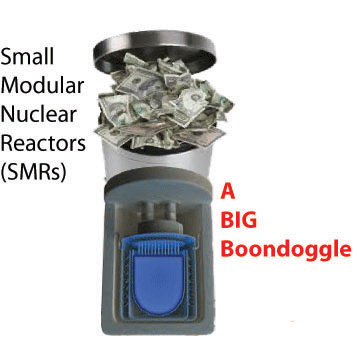 Critics question business case, but CEO says the market is ‘screaming’ for the units, Jacques Poitras · CBC News Dec 07, 2020
When Mike Holland talks about small modular nuclear reactors, he sees dollar signs.
When the Green Party hears about them, they see danger signs.
The loquacious Progressive Conservative minister of energy development recently quoted NB Power’s eye-popping estimates of the potential economic impact of the reactors: thousands of jobs and a $1 billion boost to the provincial economy.
“New Brunswick is positioned to not only participate in this opportunity, but to be a world leader in the SMR field,” Holland said in the legislature last month.
Green MLAs David Coon and Kevin Arseneau responded cheekily by ticking off the Financial and Consumer Services Commission’s checklist on how to spot a scam.
Is the sales pitch from a credible source? Is the windfall being promised by a reputable institution? Is the risk reasonable?
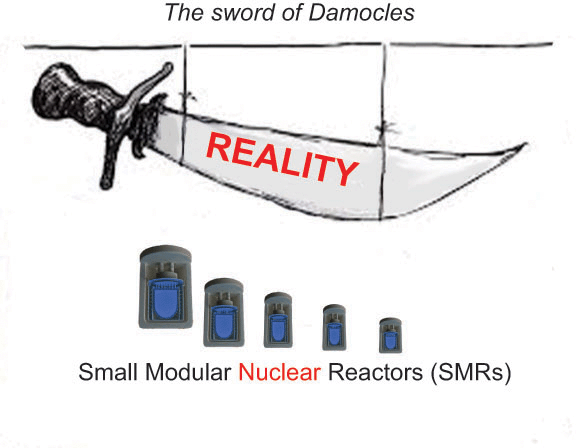 For small nuclear reactors, they said, the answer to all those questions is no.
“The last thing we need to do is pour more public money down the nuclear-power drain,” Coon said, reminding MLAs of the Point Lepreau refurbishment project that went $1 billion over budget. …….
Premier Blaine Higgs is a fervent supporter, but in the last provincial election the Liberals promised they’d do even more than Higgs to promote them.
Under Brian Gallant, the Liberals handed $10 million to two Saint John companies working on SMRs, ARC Nuclear and Moltex Energy.
Greens point to previous fiascoes
The Greens and other opponents of nuclear power fear SMRS are the latest in a long line of silver-bullet fiascoes, from the $23 million spent on the Bricklin in 1975 to $63.4 million in loans and loan guarantees to the Atcon Group a decade ago.
“It seems that [ARC and Moltex] have been targeting New Brunswick for another big handout … because it’s going to take billions of dollars to build these things, if they ever get off the drawing board,” said Susan O’Donnell, a University of New Brunswick researcher.
O’Donnell, who studies technology adoption in communities, is part of a small new group called the Coalition for Responsible Energy Development formed this year to oppose SMRs.

“What we really need here is a reasonable discussion about the pros and cons of it,” she said……..
What we didn’t see was a market analysis,” O’Donnell said. “How viable is the market? … They’re all based on a hypothetical market that probably doesn’t exist.”
O’Donnell said her group asked for the full report but was told it’s confidential because it contains sensitive commercial information………..
The market is screaming for this product,” Rory O’Sullivan, CEO of Moltex said, adding “all of the utilities” in Canada are interested in Moltex’s reactors ……
ARC’s CEO Norm Sawyer is more specific, guessing 30 per cent of his SMR sales will be in Atlantic Canada, 30 per cent in Ontario and 40 per cent in Alberta and Saskatchewan — all provincial power grids.
O’Donnell said it’s an important question because without a large number of guaranteed sales, the high cost of manufacturing SMRs would make the initiative a money-loser.
The cost of building the world’s only functioning SMR, in Russia, was four times what was expected.
An Australian government agency said initial cost estimates for such major projects “are often initially too low” and can “overrun.”
Up-front costs can be huge
University of British Columbia physicist M.V. Ramana, who has authored studies on the economics of nuclear power, said SMRs face the same financial reality as any large-scale manufacturing.
“You’re going to spend a huge amount of money on the basic fixed costs” at the outset, he said, with costs per unit becoming more viable only after more units are built and sold.
He estimates a company would have to build and sell more than 700 SMRs to break even, and said there are not enough buyers for that to happen. ….
O’Sullivan says: “In fact, just the first one alone looks like it will still be economical,” he said. “In reality, you probably need a few … but you’re talking about one or two, maximum three [to make a profit] because you don’t need these big factories.”
‘Paper designs’ prove nothing, says expert
Ramana doesn’t buy it.
“These are all companies that have been started by somebody who’s been in the nuclear industry for some years, has a bright idea, finds an angel investor who’s given them a few million dollars,” he said.
“They have a paper design, or a Power Point design. They have not built anything. They have not tested anything. To go from that point … to a design that can actually be constructed on the field is an enormous amount of work.
Both CEOs acknowledge the skepticism about SMRs.
“I understand New Brunswick has had its share of good investments and its share of what we consider questionable investments,” said ARC’s CEO Norm Sawyer….
But he said ARC’s SMR is based on a long-proven technology and is far past the on-paper design stage “so you reduce the risk.”
Moltex is now completing the first phase of the Canadian Nuclear Safety Commission’s review of its design, a major hurdle. ARC completed that phase last year.
But, Ramana said there are problems with both designs. Moltex’s molten salt model has had “huge technical challenges” elsewhere while ARC’s sodium-cooled system has encountered “operational difficulties.” …..
federal Natural Resources Minister Seamus O’Regan told CBC earlier this year that he’s “very excited” about SMRs…..
O’Donnell said while nuclear power doesn’t emit greenhouse gases, it’s hardly a clean technology because of the spent nuclear fuel waste.
Government support is key
She also wonders why, if SMRs make so much sense, ARC and Moltex are relying so much on government money rather than private capital.
…….. So far, Ottawa hasn’t put up any funding for ARC or Moltex. During the provincial election campaign, Higgs implied federal money was imminent, but there’s been no announcement in the almost three months since then.
Last month the federal government announced $20 million for Terrestrial Energy, an Ontario company working on SMRs.
…….O’Donnell said her group plans to continue asking questions about SMRs.
“I think what we really need is to have an honest conversation about what these are so that New Brunswickers can have all the facts on the table,” she said. https://www.cbc.ca/news/canada/new-brunswick/questions-small-nuclear-reactors-1.5828784
Nuclear powered electric vehicles? not existing, and not likely
|
One promising option, according to scientists at Argonne National Laboratory, is small nuclear reactors. Engineer Derek Kultgen is leading efforts at Argonne to develop a microreactor — about the size of two home water heaters — that is specifically designed to charge electric trucks at rest stops across the country lacking EV charging stations………… One promising, carbon-free charging option, according to scientists at Argonne National Laboratory, is small nuclear reactors………. Small nuclear reactors could be ideal for e-truck charging, he said……. In August, the Nuclear Regulatory Commission issued a final safety evaluation report endorsing NuScale Power’s small modular nuclear reactor design (Greenwire, Aug. 31). ……. Critics, however, say there’s insufficient evidence that small reactors are safer than nuclear power plants. It could also take years before they’re ready to be deployed, whereas new solar and wind resources could be built much more quickly. The microreactor being designed at Argonne, for example, is not being planned for construction at this point. NuScale’s design is the first to gain approval by the NRC, and even that project is still more than one year away from coming online, said Edwin Lyman, director of nuclear power safety at the Union of Concerned Scientists. Many proposed microreactor applications — including this one from Argonne — are inappropriate uses of nuclear energy, according to Lyman. “The Department of Energy is desperately trying to think of applications for all sorts of nuclear reactors, no matter how improbable or impractical they are, and I think this is a good example,” he said…….. Cost, security questionsWhile the concept is worth considering as a potential charging tool, some issues would need to be addressed before truck stop microreactors could become a reality, said Rick Mihelic, director of emerging technologies at the North American Council for Freight Efficiency. Opposition to nuclear power could delay the distribution of the microreactors, he said. A network of microreactors would also add to the country’s nuclear waste problem, for which there is no permanent disposal solution. It could be difficult to make the microreactors economical as well. To overcome that barrier, the researchers would need to find a way to mass-produce them, Buongiorno said. “If they are deployed each a little differently, each built at a different location with a different workforce, then achieving good economics may prove hopeless,” he said. Opposition to nuclear power could delay the distribution of the microreactors, he said. A network of microreactors would also add to the country’s nuclear waste problem, for which there is no permanent disposal solution. It could be difficult to make the microreactors economical as well. To overcome that barrier, the researchers would need to find a way to mass-produce them, Buongiorno said. “If they are deployed each a little differently, each built at a different location with a different workforce, then achieving good economics may prove hopeless,” he said……. https://www.eenews.net/stories/1063719531 |
|
1 This Month

Read the Public Inquiry Report, the Commissioners’ report, Surrendering Australia: The AUKUS Deception is available to download for free at aukuspublicinquiry.com. Or just watch the replay of the National Press Club Luncheon.



19 November – Webinar – The Reality of Reprocessing
Time: 11:00 AM Pacific Time (US & Canada) / 2:00 PM Eastern / 7:00 PM UK / 8:00 PM CET
Register for the Zoom Event Here



Shut down the radiation-damaged Heysham nuclear reactors now
To see nuclear-related stories in greater depth and intensity – go to https://nuclearinformation.wordpress.com

Say No to NASA’s Reckless Nuclear Reactor on the Moon
Say No to NASA’s Reckless Nuclear Reactor on the Moon
-
Archives
- November 2026 (109)
- October 2026 (302)
- September 2026 (339)
- August 2026 (330)
- July 2026 (355)
- June 2026 (287)
- May 2026 (306)
- April 2026 (356)
- March 2026 (251)
- February 2026 (267)
- January 2026 (308)
- December 2025 (358)
-
Categories
- 1
- 1 NUCLEAR ISSUES
- business and costs
- climate change
- culture and arts
- ENERGY
- environment
- health
- history
- indigenous issues
- Legal
- marketing of nuclear
- media
- opposition to nuclear
- PERSONAL STORIES
- politics
- politics international
- Religion and ethics
- safety
- secrets,lies and civil liberties
- spinbuster
- technology
- Uranium
- wastes
- weapons and war
- Women
- 2 WORLD
- ACTION
- AFRICA
- Atrocities
- AUSTRALIA
- Christina's notes
- Christina's themes
- culture and arts
- Events
- Fuk 2022
- Fuk 2023
- Fukushima 2017
- Fukushima 2018
- fukushima 2019
- Fukushima 2020
- Fukushima 2021
- general
- global warming
- Humour (God we need it)
- Nuclear
- RARE EARTHS
- Reference
- resources – print
- Resources -audiovicual
- Weekly Newsletter
- World
- World Nuclear
- YouTube
-
RSS
Entries RSS
Comments RSS

