Leeds and Brighton cities pass resolutions supportint the Treaty on Prohibition of Nuclear Weapons
NFLA 14th Jan 2021, With just 9 days to go before the entry into force of the Treaty on the Prohibition of Nuclear Weapons, Leeds and Brighton pass resolutions
supporting the Treaty.
A clean return to the Iran nuclear deal should be Biden’s first option
A clean return to the Iran nuclear deal should be Biden’s first option Bulletin of the Atomic Scientist By Eric Brewer | January 11, 2021 Of all the international agreements President-elect Joe Biden has pledged to rejoin upon taking office, perhaps none is more controversial than the Iran nuclear deal, also known as the Joint Comprehensive Plan of Action. Although the deal was containing Iran’s program until Trump withdrew in mid-2018—a move that led Iran to ramp up its nuclear activities—some are now arguing that returning to the deal isn’t a good idea or is too difficult given developments over the last four years.
This is unfortunate. Returning to the deal is not only viable but also presents the best chance of preventing an Iranian bomb. It is the best path toward building on the agreement and addressing some of the shortfalls that critics deride. Moreover, with a bit of planning, the Biden team could address several key concerns about the US return.
Arguments against rejoining the deal: Sorting the good from the bad. Some of the arguments and policy prescriptions offered by skeptics of returning to the deal are not realistic and should be dismissed. For example, some favor increasing pressure on Iran until that country’s leaders make more concessions on nuclear and non-nuclear activities. But no amount of pressure alone will cause Iran to abandon its ballistic missile program entirely or cease its support to terrorist groups, militias, and other malign non-state actors. Those policies are central to Iran’s concepts of national security and defense and ending them would require dramatic changes to the region and Iran’s threat perceptions, at a minimum.
The past four years has demonstrated that extreme pressure and unrealistic demands only cause Iran to increase its nuclear program and regional aggression.
But other critiques of returning to the deal have some merit and deserve consideration. A well-planned attempt at a “clean return”—in which the United States and Iran follow a series of agreed steps that bring them back into compliance to the deal’s original terms—would address many of them.
These objections can be broken down into three categories—strategy, process, and politics.
Objections to strategy. Some argue that it makes little sense to rejoin the deal because restrictions on Iran have already expired or would expire in the next few years, and that giving Iran significant sanctions relief would yield important leverage that could help secure a follow-on deal.
In fact, rejoining the agreement would put the United States in a stronger position to address both of these concerns. By returning, Washington would immediately cease to be the problematic actor—global attention would shift back toward Iran. This would make it easier for the United States to work with the international community to limit the fallout from the expired conventional arms embargo and to plan for the lifting of restrictions on Iran’s missile program, slated to occur in October 2023. A Biden team would then have the remainder of its first term to make progress toward a new deal (or deals) that addresses Iran’s nuclear and non-nuclear activities—long before the most important sunsets kick in. (The limits on enrichment levels and Iran’s stockpile of uranium, which are key to maintaining longer breakout timelines, don’t expire until 2031 and many of the monitoring provisions last even longer).
The United States still has ample incentives it can offer Iran in negotiations for a follow-on deal. These range from further assistance for Iran’s civil nuclear program, to relaxing the US trade embargo, to taking steps to help Iran actually reap the economic benefits of sanctions relief. (Recall that Iranian officials were quite dissatisfied that the removal of sanctions under the deal did not translate into the economic gains they expected or advertised.) And if and when talks expand to include missile and other regional issues, this will likely involve other players in the region that can put additional incentives on the table .
Concerns about process. Another set of concerns focuses on the process of returning to the agreement. Skeptics claim there simply just isn’t enough time. Biden will be inaugurated January 20, and Iranian President Hassan Rouhani will be out of office less than six months later, likely replaced by a more hardline successor. Potentially further complicating a swift return by both sides, Iran has hinted that it may insist on US compensation for its withdrawal from the deal; and it will expect Washington to remove sanctions first before dialing back its program.
True, the United States and Iran would have to act quickly to agree on the process by which both come back into compliance, but there are reasons to believe it might work. Both sides want to get it done. Iranian officials have been fairly consistent that they would be willing to return to compliance if the United States does the same………… https://thebulletin.org/2021/01/a-clean-return-to-the-iran-nuclear-deal-should-be-bidens-first-option/?utm_source=Newsletter&utm_medium=Email&utm_campaign=MondayNewsletter01112021&utm_content=NuclearRisk_IranReturn_01112021
Wall St is growing wary of Southern Co.’s promises to carry out Vogtle nuclear project economically

Wall Street braces for further delays, cost overruns at Vogtle nuke project, S and P Global, Darren Sweeney, 15 Jan 21,
| Wall Street is growing wary of Southern Co.’s promise to meet the regulatory approved in-service dates for the new Alvin W. Vogtle nuclear reactors in Georgia.
Southern subsidiary Georgia Power Co. has announced plans to “adjust key milestones” on the construction of Unit 3 at the nuclear plant expansion in response to an increase in COVID-19 cases. “Since October, the site has seen a significant increase in COVID-19 cases, consistent with the broader regional and national rise in cases,” Georgia Power said in a Jan. 11 news release. “This increase, combined with other productivity challenges, continues to impact construction production and the pace of testing activity completion.”……. Mizuho Securities USA LLC said it anticipates a seven-month delay from the Georgia Public Service Commission’s approved in-service dates for the units and a “$2.0 billion total project cost overrun.” “While the company continues to target a regulatory in-service date of November 2021 for Unit 3, they are running short of time in the calendar,” Mizuho analyst Paul Fremont wrote in a Jan. 13 research report. “For prior nuclear projects, it has taken roughly one year between the start of hot functional testing … to commercial operation of the plant. Based on these standards, Georgia Power’s previous schedule of beginning [hot functional testing] in January 2021 and commercial operation in November 2021 already looked aggressive.” Prior to Georgia Power’s update, Scotia Capital (USA) Inc. analyst Andrew Weisel noted that the Vogtle project “brings one-of-a-kind execution risks” for Southern. ….. “The company does not mention construction cost revisions in its press release, but we believe that the inability to meet production goals will likely result in an increase in the cost estimate to complete the project,” Fremont wrote. The analyst said he anticipates Southern will announce additional construction costs and update the schedule during a February earnings call. The independent Vogtle Monitoring Group said in a June 2020 filing with the Georgia PSC that Georgia Power and Southern Nuclear were “highly unlikely” to meet the regulatory approved in-service dates for Vogtle units 3 and 4………….. https://www.spglobal.com/marketintelligence/en/news-insights/blog/q3-us-solar-and-wind-power-by-the-numbers |
Property developer volunteers Allerdale, Cumbria for UK’s nuclear waste
anyone to volunteer anywhere, even an individual who doesn’t live in the area, or a company can volunteer it.
of the local population.
mirrored by the ease of withdrawing. There the government have chosen a highly prescriptive system.
Iran tests missiles under apparent watch of US nuclear sub
Iran tests missiles under apparent watch of US nuclear sub
State media says Iran has fired cruise missiles as part of a naval drill in the Gulf of Oman, abc news, ByThe Associated Press 15 January 2021 DUBAI, United Arab Emirates — Iran fired cruise missiles Thursday as part of a naval drill in the Gulf of Oman, state media reported, under surveillance of what appeared to be a U.S. nuclear submarine dispatched to the region amid heightened tensions between the countries.
Helicopter footage of the exercise released by Iran’s navy showed what resembled an Ohio-class guided-missile submarine, the USS Georgia, which the U.S. Navy last month said had been sent to the Persian Gulf — a rare announcement aimed at underscoring American military might in the region.
Iran’s navy did not identify the submarine, but warned the boat to steer clear of the area, where missiles were being launched from land units and ships in the gulf and the northern part of the Indian Ocean. When asked for comment on the reported submarine sighting, Cmdr. Rebecca Rebarich, a spokeswoman for the U.S. Navy’s Bahrain-based 5th Fleet, responded: “We don’t talk about submarine operations.”
Later Thursday, Iran‘s state-run media claimed that a “foreign” vessel had “intended to approach the naval drill” and departed soon after the Iranian Navy’s warning, without elaborating……..https://abcnews.go.com/International/wireStory/iran-tests-missiles-apparent-watch-us-nuclear-75251087
Small modular reactor plan bolsters nuclear industry’s future, but renewables could address energy issues now,
Small modular reactor plan bolsters nuclear industry’s future, but renewables could address energy issues now, https://www.cbc.ca/news/opinion/opinion-small-modular-reactor-strategy-1.5869623
While SMRs are hailed as start of a nuclear renaissance, there are big questions about costs and timeframe, Eva Schacherl · CBC News Jan 15 In late December, as many Canadians were easing into a low-key holiday break, Minister of Natural Resources Seamus O’Regan pulled out a bag of goodies for the nuclear industry. It was the much-hyped Small Modular Reactor Action Plan for Canada.
Small modular reactors (SMRs) are experimental nuclear technologies that are still on the drawing board. They are the nuclear power industry’s hope for overcoming the problems that have plagued it: high costs, radioactive waste, and risks of accidents.
Public interest groups across the country, however, argue that SMRs won’t solve these issues.
The dozen SMR vendors backing the technology include GE-Hitachi, Westinghouse, and SNC-Lavalin (which, along with two U.S. corporations, already holds a multibillion-dollar contract with the federal government to run Canadian Nuclear Laboratories at Chalk River, Ont.). O’Regan’s plan did nothing to clarify the price tag of a nuclear renaissance, but it says the federal government expects to share the cost and risks of SMR projects with the private sector.
Proponents say that SMRs will cost less than conventional nuclear and be flexible enough to serve remote communities reliant on costly and polluting diesel. O’Regan has also said that SMRs are necessary to fight climate change: in short, a utopia of “clean, affordable, safe and reliable power,” as he told a nuclear conference last year.
But is this any more than a dream? The enthusiasm for SMRs sometimes sounds like a New Age cult — let’s examine the claims.
First, must we have a new generation of nuclear reactors to get to the promised land of net-zero emissions?
Many studies show a path to net-zero without nuclear energy. Energy scientists who modelled a 100 per cent renewable energy system for North America, for example, concluded that nuclear energy “cannot play an important role in the future” because of its high cost and safety issues. Closer to home, it has been shown how Ontario can meet its electricity demand without nuclear, using renewables, hydro and storage.
Meanwhile, a new study in Nature Energy uses data from 123 nations to show that countries focused on renewables do much better at reducing emissions.
Can SMRs one day be cost-competitive with renewable energy?
Right now, the cost difference between nuclear power and other low-carbon alternatives is growing because renewables and energy storage keep getting cheaper.
Meanwhile, the estimated cost of the most advanced SMR project, in Idaho, has increased from $4.2 billion to $6.1 billion before shovels are even in the ground. That’s nearly $12,000 per kilowatt of generation capacity.
an small reactors wean off-grid communities and mines from diesel fuel?
Finally, nuclear energy is neither green nor clean. All reactors produce radioactive waste that will need to be kept out of the biosphere for hundreds of thousands of years.
The proposal that some SMR models would reuse highly radioactive CANDU fuel and plutonium will only create worse problems in the form of radioactive wastes that are even more dangerous to manage.
For a livable future, Canada has pledged to get to net-zero emissions by 2050. Will we get a bigger bang for our buck from reactors that are still just design concepts? Or by retrofitting buildings, improving energy efficiency, and building solar, wind, geothermal and tidal power with existing technology?
Clearly, the latter. And it needs to be done now.
Nuclear power, too inflexible, is in conflict with sustainable development goals.
|
Can nuclear power and renewables mix on electricity grids? By Nuclear Engineering International 06 Jan 2021 ”………..a new paper from the Science Policy Research Unit (SPRU), a research group at the UK’s Brighton University, argues that a nuclear power programme is in conflict with sustainable development goals.
Launching the paper, Differences in carbon emissions reduction between countries pursuing renewable electricity versus nuclear power, the SPRU group said that countries with large national nuclear programmes do not tend to show significantly lower carbon emissions. It claims the study shows that nuclear and renewable energy programmes do not tend to co-exist well in low-carbon energy systems because they crowd each other out. …… the researchers claim that an expanding nuclear programme is no guarantee of reduced carbon emissions – unlike increasing commitment to renewables. The authors found little support for the suggestion that countries with a large investment in nuclear invested less in renewables. But they said in a challenge to scenarios like that of the IEA, that “strong claims in favour of particular technologies” are “underevidenced”……… The International Energy Agency concluded in a report last year that global nuclear power development is moving too slowly to allow the world to meet its Sustainable Development Scenarios Over the COVID months, NGESO found that it had a power surplus to manage. It had to artificially increase demand, by paying neighbouring countries to accept power via interconnectors (against market prices). It also used innovative approaches, including inviting users to be paid to increase demand. Both were necessary, along with paying some renewable sources to switch off and ensuring pumped storage plants were working in “pump” mode, in order to bring demand up to exceed low-carbon supply enough to allow it to call up thermal generation (gas and biomas) to provide stability. What was nuclear’s role in this period? It too has large rotating machinery and it can provide inertia. But, although the system operator maintains frequency across the entire network, voltage support has to be localised. What is more, the amount of fast-acting reserves that the system operator is legally required to hold in readiness depends on the size of the largest system in-feed. Sizewell B, at 1200 megawatts (MW) the GB system’s largest infeed, all at one site, was simply too large for the best operation of the system with volumes down by some 20%. In the end, NGESO negotiated a one off, fixed term contract with EDF to reduce output from Sizewell B by half to 625MW. According to reports, the four-month deal would involve payment from NGESO (and eventually customers) to EDF of between £34m and £46m, depending on market power prices. That is a significant proportion of the additional balancing costs incurred between March and July 2020, which totalled £718m – 39% higher than NGESO would normally expect costs to be in this period, according to regulator Ofgem. The arrangement helped give NGESO what it called “footroom” to call on the thermal plant to meet system needs, but it was an inflexible option. In contrast other measures to provide footroom, inviting small generators to turn down, brought forward over 1 gigawatts (GW) of response across a wide area. Participants could be called upon with just a few hours notice from the system operator. That result should sound a warning for nuclear operators that argue they are flexible. The nuclear industry will have to do a lot of convincing if it wants to become the low-carbon companion to renewables. https://www.nsenergybusiness.com/news/nuclear-renewables-electricity-grids/?fbclid=IwAR1el0Rra5_ir2etNYpo_yz9MAqg2Fm-ekwy4Pjff3ACdiQtflTrN2oysks |
|
Nuclear Icebreakers Are Not An Option for U.S. Coast Guard
The call from the Trump administration to look at the potential for building nuclear-powered icebreakers coincided with the Pentagon’s ongoing shift to a National Defense Strategy that emphasizes high-end conflict with nations like Russia and China. ………… https://news.usni.org/2021/01/13/schultz-nuclear-icebreakers-are-not-an-option-for-coast-guard
What could Biden’s nuclear policy look like?
 What could Biden’s nuclear policy look like? King County sits only miles away from one-third of the deployed U.S. nuclear arsenal. Courier Herald By Aaron January 12, 2021 For Leonard Eiger, having the U.S. Navy’s entire Pacific fleet of nuclear-armed submarines only a short excursion away doesn’t sit well with him. The longtime anti-nuclear weapons activist and former North Bend resident has for decades worked to educate Puget Sound residents about Naval Base Kitsap Bangor, which houses around one-third of the nuclear weapons that are actively deployed. Eight of the 14 Ohio-class submarines, which carry powerful nuclear weapons, are stationed out of the base in Kitsap County. “For me there’s a real futility in thinking of, and preparing to fight, a nuclear war,” Eiger said. “Because any nuclear war, any nuclear exchange between the U.S. and Russia, is game over.” Eiger lived in North Bend for 26 years, before recently moving to the San Juan Islands. He’s been involved with the Ground Zero Center for Nonviolent Action, which stages demonstrations against — and education campaigns about — nuclear weapons. As the Donald Trump administration winds down, he’s hoping that a Joe Biden presidency will mark a turning point in the way the U.S. approaches nuclear weapons. The Trump administration didn’t make significant progress toward renewing the New START Treaty, which expires on Feb. 5 and began deploying “low-yield” nuclear weapons on submarines, he said. The administration also did not subscribe to a “no first use” policy. It also pulled out of the Iran nuclear deal. The Trump administration didn’t make significant progress toward renewing the New START Treaty, which expires on Feb. 5 and began deploying “low-yield” nuclear weapons on submarines, he said. The administration also did not subscribe to a “no first use” policy. It also pulled out of the Iran nuclear deal. And if a nuclear weapon was fired at one country, other nuclear powers wouldn’t know where it was destined, and could launch their own nukes, fearing an attack, he said. These missiles are something that Hans Kristensen, director of the Nuclear Information Project at the Federation of American Scientists, is thinking about. He said that this could make military leaders more comfortable using them from technical and humanitarian points of view because there could be less collateral damage and fallout …….. On the first use of nuclear weapons, Biden’s policy platform states that he believes the sole purpose of the U.S. nuclear arsenal is to deter other countries from attacking the U.S. with nuclear weapons. If he holds to this statement, then he would enact a no first use policy, according to Kristensen………. Treaties Biden is also hoping to resurrect two important nuclear treaties. The first is the Iran nuclear deal, which was negotiated by the Obama administration while he served as vice president. Trump withdrew from the treaty and put additional sanctions on Iran……. The second significant nuclear agreement is the New START Treaty between Russia and the U.S. The treaty limits the number of nuclear weapons that the countries can own, and have deployed, at any given time. It includes all three legs of the U.S. nuclear triad, including submarine, bomber and land-based missiles. Biden’s policy platform states he will try to renew and extend the New START Treaty. The treaty could be extended up to five years, but Kristensen said the administration could choose a shorter term. If Biden chose to go with a longer five year renewal, it would likely have a calming effect on nuclear competition between the U.S. and Russia. However, a shorter term would send signals that the two countries need to address the problems with the treaty and create something stronger, Kristensen said….. ………… For activist Leonard Eiger, the world of today is only here because of a series of fortunate events. He cited the Cuban Missile Crisis, where the U.S. and Russia came close to nuclear war in 1962. “We still live under the threat of either accidental or intentional nuclear war,” he said. “So long as nuclear weapons exist, that threat will continue to exist.”……… https://www.courierherald.com/news/what-could-bidens-nuclear-policy-look-like/ |
|
As pandemic cripples America, Donald Trump orders funding for military Small Nuclear Reactors in space

|
Trump orders DoD to explore use of nuclear power for space, Defense News,
By: Aaron Mehta 14 Jan 21, WASHINGTON — In the waning days of his administration, U.S. President Donald Trump has signed an executive order aimed at pushing the Department of Defense toward quickly developing and producing small nuclear reactors for military use — and to see if they could be used by military space vehicles.
The order, signed Jan. 5 and posted publicly Jan. 12, is not the first time the value of nuclear power for military operations has been studied. There is a long history of the Pentagon considering the issue, which proponents believe could alleviate the department’s massive logistics challenge of keeping fuel moving around the world……… In terms of terrestrial efforts, the executive order requires the defense secretary to, within 180 days, “establish and implement a plan to demonstrate” a micro-reactor at a domestic military installation — in other words, setting up an actual test of a nuclear reactor at a U.S. military location. However, that doesn’t mean the first test will be on a military base. One location to keep an eye on is the Nevada National Security Site, a Department of Energy location roughly 65 miles from Las Vegas……. Noted Hans Kristensen of the Federation of American Scientists, “the signing of this at the very last minute of the Trump administration suggests someone is concerned [President-elect Joe Biden] might not support the program.” Specific to space, the order calls for the defense secretary, in consultation with the secretaries of state, commerce and energy as well as the NASA administrator, to “determine whether advanced nuclear reactors can be made to benefit Department of Defense future space power needs” and to “pilot a transportable micro-reactor prototype.” In addition, the order directs an analysis of alternatives for “personnel, regulatory, and technical requirements to inform future decisions with respect to nuclear power usage” as well as “an analysis of United States military uses for space nuclear power and propulsion technologies and an analysis of foreign adversaries’ space power and propulsion programs.” ……… While the order speeds up the timetable for a test of a nuclear reactor at a military installation, the idea of using nuclear power is hardly a new one for the DoD. In fact, the Pentagon currently has two different development tracts for small nuclear reactors. The first is “Project Pele,” an effort to create a small mobile nuclear reactor in the 1-5 MWe power range, being run out of the Strategic Capabilities Office. In March 2020, the department awarded three companies a combined $39.7 million to start design work for Project Pele, with plans to select one firm in 2022 to build and demonstrate a prototype. The second effort is run through the office of the undersecretary of acquisition and sustainment. That effort, ordered in the 2019 National Defense Authorization Act, involves a pilot program aiming to demonstrate the efficacy of a small nuclear reactor, in the 2-10 MWe range, with initial testing at a Department of Energy site around 2023. If all goes well, the goal is to have a permanent small nuclear reactor on a military base around 2027. Even if all those timelines are hit, it is unlikely microreactors could proliferate quickly throughout the military………. https://www.defensenews.com/smr/nuclear-arsenal/2021/01/13/trump-orders-dod-to-explore-use-of-nuclear-power-for-space-systems/ |
|
USA will be bound by nuclear weapons ban treaty, and should join it.
 U.S. should join nuclear weapons ban treaty https://www.syracuse.com/opinion/2021/01/us-should-join-nuclear-weapons-ban-treaty-your-letters.html– Michaela Czerkies Jan 13, 2021
On Jan. 22, the United Nations Treaty on the Prohibition of Nuclear Weapons (TPNW) will enter into force. This treaty is a historic achievement in the global movement to abolish nuclear weapons, making it illegal under international law for participating nations to “develop, test, produce, manufacture, otherwise acquire, possess, or stockpile nuclear weapons or other nuclear explosive devices.” The treaty also acknowledges the suffering that nuclear weapons testing and use have inflicted around the world, and includes provisions for environmental remediation and assistance to people affected.
It is fitting that the TPNW enters into force just after Martin Luther King Jr. Day. King clearly stated that nuclear disarmament was deeply linked to racial justice and essential to our survival. He called for a ban on nuclear weapons, understanding that, “a full-scale nuclear war would be utterly catastrophic.”
Scientists must tell the truth on our consumerist, ecology-killing Ponzi culture

Scientists must not sugarcoat the overwhelming challenges ahead. Instead, they should tell it like it is. Anything else is at best misleading, and at worst potentially lethal for the human enterprise.
Worried about Earth’s future? Well, the outlook is worse than even scientists can grasp , The Conversation, Corey J. A. Bradshaw, Matthew Flinders Professor of Global Ecology and Models Theme Leader for the ARC Centre of Excellence for Australian Biodiversity and Heritage, Flinders University. Daniel T. Blumstein, Professor in the Department of Ecology and Evolutionary Biology and the Institute of the Environment and Sustainability, University of California, Los Angeles, Paul Ehrlich, President, Center for Conservation Biology, Bing Professor of Population Studies, January 13, 2021
Anyone with even a passing interest in the global environment knows all is not well. But just how bad is the situation? Our new paper shows the outlook for life on Earth is more dire than is generally understood.
The research published today reviews more than 150 studies to produce a stark summary of the state of the natural world. We outline the likely future trends in biodiversity decline, mass extinction, climate disruption and planetary toxification. We clarify the gravity of the human predicament and provide a timely snapshot of the crises that must be addressed now.
The problems, all tied to human consumption and population growth, will almost certainly worsen over coming decades. The damage will be felt for centuries and threatens the survival of all species, including our own………
academics tend to specialise in one discipline, which means they’re in many cases unfamiliar with the complex system in which planetary-scale problems — and their potential solutions — exist.
What’s more, positive change can be impeded by governments rejecting or ignoring scientific advice, and ignorance of human behaviour by both technical experts and policymakers.
More broadly, the human optimism bias – thinking bad things are more likely to befall others than yourself – means many people underestimate the environmental crisis.
Numbers don’t lie
A bad situation only getting worse
The human population has reached 7.8 billion – double what it was in 1970 – and is set to reach about 10 billion by 2050. More people equals more food insecurity, soil degradation, plastic pollution and biodiversity loss.
Essentially, humans have created an ecological Ponzi scheme. Consumption, as a percentage of Earth’s capacity to regenerate itself, has grown from 73% in 1960 to more than 170% today.
High-consuming countries like Australia, Canada and the US use multiple units of fossil-fuel energy to produce one energy unit of food. Energy consumption will therefore increase in the near future, especially as the global middle class grows.
The danger of political impotence
Our paper found global policymaking falls far short of addressing these existential threats. Securing Earth’s future requires prudent, long-term decisions. However this is impeded by short-term interests, and an economic system that concentrates wealth among a few individuals.
Right-wing populist leaders with anti-environment agendas are on the rise, and in many countries, environmental protest groups have been labelled “terrorists”. Environmentalism has become weaponised as a political ideology, rather than properly viewed as a universal mode of self-preservation.
Changing course
Fundamental change is required to avoid this ghastly future. Specifically, we and many others suggest:
- abolishing the goal of perpetual economic growth………..
Don’t look away………
Scientists must not sugarcoat the overwhelming challenges ahead. Instead, they should tell it like it is. Anything else is at best misleading, and at worst potentially lethal for the human enterprise. https://theconversation.com/worried-about-earths-future-well-the-outlook-is-worse-than-even-scientists-can-grasp-153091
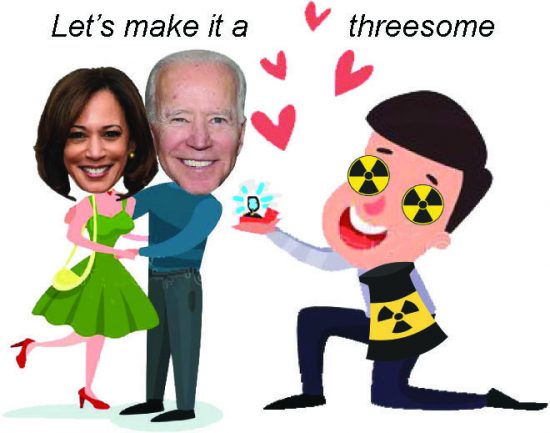
Joe Biden under pressure from nuclear lobby, despite the failing state of their industry
The United States has about 94 traditional reactors, out of the 440 worldwide, but rising costs have forced many plants to shut with five more expected to close this year in Illinois and New York.
Nuclear power faces competition from electricity stations that burn cheap, plentiful natural gas and from renewable power, including wind and solar.
As Britain’s plan for Wyfla nuclear project founders, it’s time to start a green revolution
PAWB 11th Jan 2021, On the last day of troubled 2020, the Westminster Government has deferred a decision on a Development Consent Order for a nuclear power station at Wylfa until the end of April 2021.
This is the fourth time this has happened, and the second time in a row for Duncan Hawthorne, chief executive Horizon, to ask for a deferral.
 On January 10 the Times revealed that Hitachi is winding Horizon up completely by March 31, 2021. This is the logical conclusion of the process that started exactly two years ago when Hitachi suspended Horizon’s operations at Wylfa. Then in September 2020, they announced that they were ditching their plans to build two huge reactors at Wylfa completely.
The attempt to build Wylfa B has been shambolic from the start. It’s high time to abandon the foolish dream that has paralyzed Anglesey’s development since 2006. As we approach the 10th
anniversary of the Fukushima disaster, the latest to be mentioned as ‘saviours’ of the radioactive poisoning project that would threaten the health of everyone on the island and beyond are three US companies.
Here they are: Bechtel Corporation, Westinghouse and Southern Company. Here are
some of the trio’s transgressions: Bechtel – recently fined nearly $58million for financial fraud with another company over a 10-year periodat Hanford Nuclear Reservation, the most radioactively contaminated site in the United States. This followed a fine of $125million for low quality work on the same site in 2016. Much more could be said about Bechtel. Westinghouse and Southern Company – Westinghouse went bankrupt while trying to build Vogtle Power Station in the state of Georgia.
The two AP1000 reactors of the type destined for Wylfa are five years behind Schedule, have doubled in cost to $25billion, and there is no guarantee that thepower station will ever be completed. Another of their projects was the V C Summer nuclear plant in South Carolina. It was abandoned unfinished in 2017, and is still being paid for by taxpayers.
However, with this latest information, it looks very unlikely that these three American companies are prepared to pay through their noses for two white elephant sites at Wylfa and Oldbury.
This is the end of Horizon’s journey. And the end once and for all of the nuclear industry’s plans to destroy an especially beautiful part of northern Ynys Môn. It is high time that politicians on Ynys Môn andGwynedd Councils, the Senedd in Cardiff, and at Westminster to recognise
this fact and to turn their attention towards cleaner, cheaper and more sustainable ways of producing electricity. The renewable technologies are available. This is the time to start a real green revolution.
Amid ongoing lawsuits about nuclear corruption, Ohio regulators will stall the nuclear bailout law
 Ohio regulators set to officially pause nuclear bailout fees created through tainted energy bill https://www.cleveland.com/open/2021/01/ohio-regulators-set-to-officially-pause-nuclear-bailout-fees-created-through-tainted-energy-bill.html Jan 11, 2021 By Andrew J. Tobias, cleveland.com COLUMBUS, Ohio — State regulators have ordered a pause on the $170 million in annual new fees created through the controversial House Bill 6, following a judge’s recent ruling in a lawsuit brought by Ohio Attorney General Dave Yost and officials in Cincinnati and Columbus. The Ohio Air Quality Development Authority will formally suspend the charges, $150 million of which would bail out two financially troubled Ohio nuclear plants owned by a former FirstEnergy subsidiary, during a scheduled meeting on Tuesday, the agency’s executive director wrote in a recent letter to officials with the Public Utilities Commission of Ohio. As part of the same official process, the PUCO on Dec. 30 acted to prevent the new fee from going into effect while the legal challenge continues. Both agencies cited a Dec. 21 ruling from a Franklin County judge who, ruling on the lawsuit from Yost and two Ohio cities, ordered the fees be blocked from going into effect. The fees, worth more than $1 billion to the nuclear plants, were to have appeared on Ohioans’ power bills starting on Jan. 1.
But the pause could remain in place at least until a March 5 hearing in the Franklin County case, according to a PUCO spokesman.
Yost and the local officials sued over the law after federal investigators said it was the product of an elaborate corruption scheme financed by FirstEnergy and its affiliates that led to the arrest of former House Speaker Larry Householder and others last July. Prosecutors have said in exchange for $61 million, spent to help Householder become speaker and on a political campaign supporting the law, Householder agreed to push the bill through the legislature. FirstEnergy, based in Akron, hasn’t been charged or officially accused of wrongdoing. Householder has pleaded not guilty to a federal corruption charge, but two associates who helped pass House Bill 6, Jeff Longstreth and Juan Cespedes, have pleaded guilty to participating in the scheme.
The fees will remain blocked even though the Ohio Supreme Court on Monday dismissed a different HB6 legal challenge filed by the Ohio Manufacturers Association, a business group. The Supreme Court previously ordered the fees paused while it considered OMA’s arguments. The OMA had asked permission to drop its challenge, saying the issue was moot since the PUCO had agreed to pause the nuclear subsidies in response to the Franklin County case.
DeWine and state legislative leaders have called for House Bill 6 to be repealed or at least, revisited. But state lawmakers failed to do so during their lame duck session in December, since House members were unable to agree on what specific action to take. The law’s future remains unclear, with legislators expected to reconvene in the coming weeks.
Numerous HB6-related state and federal investigations, including from the FBI and the U.S. Securities and Exchange Commission, are ongoing, as are numerous lawsuits.
|
|
1 This Month

Read the Public Inquiry Report, the Commissioners’ report, Surrendering Australia: The AUKUS Deception is available to download for free at aukuspublicinquiry.com. Or just watch the replay of the National Press Club Luncheon.


19 November – Webinar – The Reality of Reprocessing
Time: 11:00 AM Pacific Time (US & Canada) / 2:00 PM Eastern / 7:00 PM UK / 8:00 PM CET
Register for the Zoom Event Here



Shut down the radiation-damaged Heysham nuclear reactors now
To see nuclear-related stories in greater depth and intensity – go to https://nuclearinformation.wordpress.com

Say No to NASA’s Reckless Nuclear Reactor on the Moon
Say No to NASA’s Reckless Nuclear Reactor on the Moon
-
Archives
- November 2026 (109)
- October 2026 (302)
- September 2026 (339)
- August 2026 (330)
- July 2026 (355)
- June 2026 (287)
- May 2026 (306)
- April 2026 (356)
- March 2026 (251)
- February 2026 (267)
- January 2026 (308)
- December 2025 (358)
-
Categories
- 1
- 1 NUCLEAR ISSUES
- business and costs
- climate change
- culture and arts
- ENERGY
- environment
- health
- history
- indigenous issues
- Legal
- marketing of nuclear
- media
- opposition to nuclear
- PERSONAL STORIES
- politics
- politics international
- Religion and ethics
- safety
- secrets,lies and civil liberties
- spinbuster
- technology
- Uranium
- wastes
- weapons and war
- Women
- 2 WORLD
- ACTION
- AFRICA
- Atrocities
- AUSTRALIA
- Christina's notes
- Christina's themes
- culture and arts
- Events
- Fuk 2022
- Fuk 2023
- Fukushima 2017
- Fukushima 2018
- fukushima 2019
- Fukushima 2020
- Fukushima 2021
- general
- global warming
- Humour (God we need it)
- Nuclear
- RARE EARTHS
- Reference
- resources – print
- Resources -audiovicual
- Weekly Newsletter
- World
- World Nuclear
- YouTube
-
RSS
Entries RSS
Comments RSS

