Small island nations take high-emitting countries to court to protect the ocean
Countries threatened by rising sea levels are asking a tribunal to decide on responsibility for pollution of the marine environment
In a landmark hearing, small island nations disproportionately affected by
the climate crisis will take on high-emitting countries in a court in
Hamburg, Germany, on 11 September, in what is being seen as the first
climate justice case aimed at protecting the ocean.
During the two-day hearing, the nations – including the Bahamas, Tuvalu, Vanuatu, Antigua and Barbuda among others – will ask the International Tribunal for the Law of
the Sea (Itlos) to determine whether greenhouse gas emissions absorbed by
the marine environment should be considered pollution.
As one of the planet’s greatest carbon sinks, the ocean absorbs 25% of carbon dioxide
emissions, captures 90% of the heat caused by those emissions and produces
half the world’s oxygen.
Most countries have obligations under the legally
binding UN convention on the law of the sea to take measures to prevent,
reduce and control marine pollution. If the case, brought by the Commission
of Small Island States on Climate Change and International Law (Cosis), is
successful, these obligations would include carbon-emission reduction and
protection of marine environments already damaged by CO2 pollution.
Guardian 10th Sept 2023
Crew sailing ‘original peace boat’ reflect on mission to promote end of nuclear weapons

the issue boils down to the human heart.
The problem isn’t the nuclear weapons themselves or the countries that have them,” …… “The problem is the way of thinking that it’s okay to annihilate people to accomplish your goals. So, change that, and nuclear weapons can go away on their own.”
The Golden Rule has visited 92 cities across the world through the non-profit Veterans for Peace.
The visiting voyagers said they’re building on the legacy of sailors before them, who sailed the Golden Rule in 1958 from Hawaii towards a nuclear test zone in the Marshall Islands in protest.
By: Tahleel Mohieldin, Sep 05, 2023 https://www.tmj4.com/news/local-news/crew-sailing-original-peace-boat-reflect-on-mission-to-promote-end-of-nuclear-weapons
MILWAUKEE — Slicing through the windy waters of Lake Michigan, and taking up residence on the 65-year-old sailboat known as the Golden Rule, Captain Kiko Johnston-Kitazawa and his crew have plenty to keep them busy Labor Day weekend.
“It’s a very seaworthy vessel,” Johnston-Kitazawa said. “It’s not extremely fast but it can handle rough water and protect the crew.”
As they near the end of a 13-month 11,000-mile journey through the Great Loop, to raise awareness about the dangers of nuclear weapons, it’s more than a love of sailing that unites the crew.
“It’s nice to be able to sail on a boat that has a purpose,” said crew member Tamar Elias. “So much power, so much history.”
The visiting voyagers said they’re building on the legacy of sailors before them, who sailed the Golden Rule in 1958 from Hawaii towards a nuclear test zone in the Marshall Islands in protest.
Elias said though they never made it to the Marshall Islands, because they were arrested, their message got people’s attention and ultimately led to the end of atmospheric testing.
“Now in the last six or seven years there’s been a lot of going backward,” Johnston-Kitazawa said. “I won’t say all but the larger nuclear powers boasting about their capabilities and threatening directly or indirectly, subtly to use them so it’s time again.”
As he sails on what has come to be known as the original peace boat that started a movement Captain Johnston-Kitazawa said he’s come to realize the issue boils down to the human heart.
The problem isn’t the nuclear weapons themselves or the countries that have them,” he explained. “The problem is the way of thinking that it’s okay to annihilate people to accomplish your goals. So, change that, and nuclear weapons can go away on their own.”
The Golden Rule has visited 92 cities across the world through the non-profit Veterans for Peace.
Through Labor Day weekend people in Milwaukee were invited to view the sailboat which temporarily took up residence near Lakeshore State Park.
Guam nuclear energy ban focus of Tuesday hearing

By Joe Taitano II – For Variety, Sep 4, 2023 https://www.mvariety.com/news/regional_world/guam-nuclear-energy-ban-focus-of-tuesday-hearing/article_4a573368-4abf-11ee-aaa0-4335e65acd7f.html
HAGÅTÑA (The Guam Daily Post) — Residents can weigh in Tuesday morning on a proposal to ban nuclear energy from Guam’s shores.
Bill 151-37, sponsored by Sen. Sabina Perez, would ban nuclear reactors, from conventional reactors large enough to provide for the island’s entire energy consumption in one site to microreactors that can provide about as much power as the Dandan Solar Farm in a package that can fit on an airplane.
The hearing is scheduled for 9 a.m. Tuesday at the Guam Congress Building.
Perez said while nuclear power is becoming more popular in response to climate change, her bill intends to protect the community and environment from the inherent dangers of nuclear power.
“The main concerns are the likelihood of radiation exposure in a typhoon and an earthquake-prone region that could exacerbate recovery efforts. Additionally, our community is suffering from increasing rates of cancer compared to the continental U.S., which is experiencing declining rates,” Perez said.
She said adequate storage and disposal of nuclear waste could be a concern, given the limited space and growing population on island.
“As Pacific Islanders who are on the front lines of climate change, our future should not be built on risk but on responsible innovation for a sustainable future,” she said.
The text of the bill also weighs the strategic military importance of the island.
While federal officials planning a 360-degree missile defense system for the island have shot down ideas that nuclear microreactors could be used to power the new systems, both Andersen Air Force Base and Naval Base Guam were identified as candidates for portable nuclear power plants in a study commissioned by the Army in 2018.
The Pentagon last year announced plans to deploy portable nuclear reactors to remote forward operating bases, though Guam hasn’t been officially announced as a candidate site.
The hearing will be livestreamed on GTA Channel 21, Docomo Channel 117 and the Guam Legislature Media YouTube channel.
Marshall Islands sea turtle found to have nuclear contamination
Radio New Zealand, Christina Persico, RNZ Pacific Bulletin Editor 28 Aug 23
Scientists studying tortoise and turtle shells near the Marshall Islands have found they contain nuclear contamination.
An article in the journal PNAS Nexus considered ‘Anthropogenic uranium signatures in turtles, tortoises, and sea turtles from nuclear sites’.
The scientists studied a sea turtle collected at Enewetak Atoll in the Marshall Islands [RMI] in 1978.
“In May 1977, one year prior to the collection of this sea turtle in 1978, cleanup activities began at Enewetak Atoll resulting in the creation of the Runit Dome containment structure,” the report on the study said.
Green sea turtles are migratory, but live, forage, and nest at Enewetak Atoll, the researchers said.
“The presence of uranium contamination in this green turtle [approximately] 20 years after nuclear testing ended in the RMI – thus suggests the potential that cleanup activities disturbed contaminated sediments which (re)input small quantities of local fallout products into the surrounding environment.”
It also notes that eating contaminated algae or seagrass, or ingesting contaminated sediments during nesting, are all potential sources of uranium for this green turtle.
“It is also possible that legacy contamination present in the Enewetak Atoll lagoon occurred in substantive quantities to contaminate this turtle at some point during its lifetime, regardless of potential impacts during the cleanup for Runit Dome,” the report said…………………………………….
They said turtles inhabiting locations with significant nuclear deployment histories, such as Japanese pond turtles; nuclear test histories like the Kazakhstan steppe tortoise; or nuclear processing, production, and accident histories like Ukrainian pond turtles will undoubtedly clarify the extent to which these reptiles bioaccumulate and reflect anthropogenic contamination in the environment.
“We anticipate that our green sea turtle results may influence future sea turtle-based environmental monitoring and tracking of contaminates at Runit Dome in the RMI, and potentially long-term releases of radioactive water from the Fukushima Daiichi reactors, into the Pacific Ocean.” https://www.rnz.co.nz/international/pacific-news/496730/marshall-islands-sea-turtle-found-to-have-nuclear-contamination
Endless fallout: the Pacific idyll still facing nuclear blight 77 years on
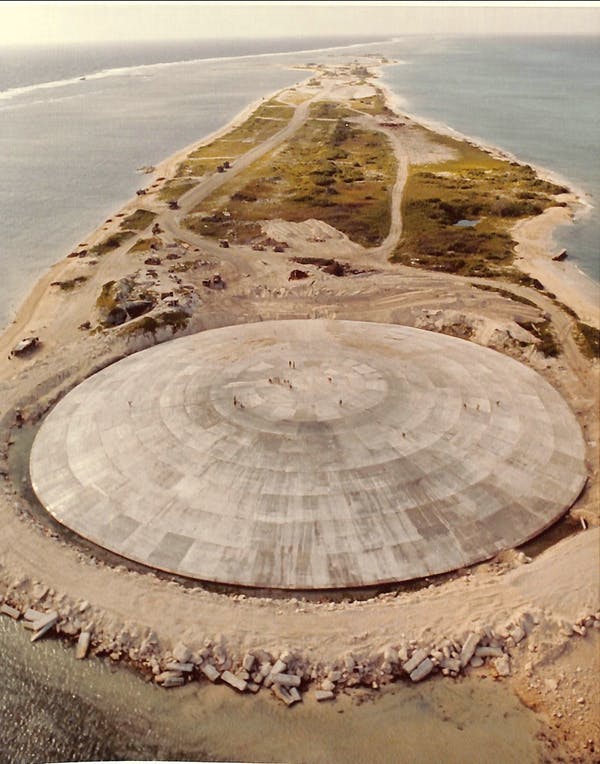
The film Oppenheimer has shone a global spotlight on the dawn of US nuclear weapons tests. In the Marshall Islands, where 23 of those earth-shattering blasts happened, people have never been able to forget
by Lucy Sherriff, 25 Aug 23, https://www.theguardian.com/environment/2023/aug/25/endless-fallout-marshall-islands-pacific-idyll-still-facing-nuclear-blight-77-years-on
t first glance, the aquamarine waters that surround the Marshall Islands seem like paradise. But this idyllic Pacific scene hides a dark secret: it was the location of 67 nuclear detonations as part of US military tests during the cold war between 1946 and 1958.
The bombs were exploded above ground and underwater on Bikini and Enewetak Atolls, including one device 1,100 times larger than the Hiroshima atom bomb. Chernobyl-like levels of radiation forced hundreds from their homes. Bikini Atoll remains deserted. At the US government’s urging, residents have begun returning slowly to Enewetak.
Today, there is little visible evidence of the tests on the islands except for a 115-metre (377ft)-wide cement dome that locals nickname the Tomb – for good reason.
Built in the late 1970s and now aged and cracking, the huge concrete lid on Runit Island covers more than 90,000 cubic metres (3.1m cubic ft) – or roughly 35 Olympic-sized swimming pools – of radioactive soil and nuclear waste. Unbeknown to the Marshallese people, the US shipped the waste from Nevada, where it was testing nuclear weapons on Native American land.
The legacy of America’s nuclear testing on Indigenous communities both on the US mainland and its territories has come under renewed scrutiny with the release of Oppenheimer, the blockbuster film about the physicist who led development of the atomic bomb.
Although his team tested the nuclear weapons on Native American land – there were 928 large-scale nuclear weapons tests in Nevada, Utah and Arizona during the cold war, dispersing huge clouds of radioactive material – the film never mentions the impact of the testing on the local Native Americans.
The legacy of America’s nuclear testing on Indigenous communities both on the US mainland and its territories has come under renewed scrutiny with the release of Oppenheimer, the blockbuster film about the physicist who led development of the atomic bomb.
Although his team tested the nuclear weapons on Native American land – there were 928 large-scale nuclear weapons tests in Nevada, Utah and Arizona during the cold war, dispersing huge clouds of radioactive material – the film never mentions the impact of the testing on the local Native Americans.
“The film completely ignores the experiences of our people,” says Ian Zabarte, principal man of the Western Bands of the Shoshone Nation – who have been described as “the most bombed nation on earth”
Zabarte is attempting to forge connections with those Pacific Islanders who were similarly affected by nuclear testing. Earlier this year, he met representatives from the Marshall Islands when they visited Nevada to discuss the effects on their health from nuclear weapons testing.
“The health impacts on our people have never been investigated,” Zabarte says. “We have never received an apology, let alone any kind of compensation.”
Separately, a band of Marshallese activists are now sailing around the country’s 29 atolls, along with artists and climate scientists, on a 12-day tour that aims to raise awareness of nuclear testing on the archipelago.
The 520-mile ocean voyage is being operated by Cape Farewell, a cultural programme founded by the British artist David Buckland and funded by the Waverley Street Foundation, Laurene Powell Jobs’s climate charity.
“Cancers continue from generation to generation,” says Alson Kelen, a master navigator and community elder who grew up on Bikini Atoll and is joining the expedition.
“If you ask anyone here if there’s a legacy of nuclear impact on their health, the answer would be yes. The Marshall Islands Nuclear Claim Tribunal has a list of cancers that are related to nuclear throughout our people. These cancers are hereditary.”
The US maintains that the Marshall Islands are safe. It seized them from Japan in 1944, and eventually granted the islands independence in 1979, but the fledgling nation remained in “free association” with the US. Under this system, along with Micronesia and Palau, the Marshall Islands are self-governing but economically remain largely dependent on Washington, which also retains a military presence. Today it continues to use the US dollar, and American aid still represents a large percentage of its GDP.
In 1988, an independent international tribunal was established to adjudicate between the two countries, and it later ordered the US to pay $2.3bn (£1.8bn) to the Marshall Islands in healthcare and resettlement costs.
The US government has refused, arguing that its liabilities ended when it paid $600m in the 1990s. In 1998, the US stopped providing medical care for cancer-stricken islanders, leaving many in financial hardship.
The agreement is up for renegotiation this year, and the Marshallese hope they will have stronger negotiating power with the US now that China is showing an interest in the islands due to their strategic location. The islanders are pushing for the $2.3bn they feel they are owed, and a cleanup of the Runit Dome, which is at risk of collapsing due to rising sea levels and the natural ageing of concrete structures.
“Of course it’s going to break,” says Stephen Palumbi, a Stanford University marine scientist who led a research trip to the islands in 2016. “What else can you expect? You can’t just build something like that and walk away from it and expect it to stay there. You wouldn’t do that with your patio.”
According to a 2019 investigation by the LA Times, many US military personnel present at the construction of Runit Dome realised that radioactive material was leaking from it, and would continue to do so – yet did not alert the Marshallese government.
The threat to the Tomb is particularly acute because the islands, which lie just 2 metres above sea level on average, are very vulnerable to rising sea levels. The country’s capital, Majuro, is highly likely to be at risk of frequent flooding, according to a World Bank study.
The US says it has discharged its responsibilities to the Marshall Islands, and because the dome is on Marshallese land, the onus is not on Washington to fix it.
It is not clear what will happen to the environment when the Tomb crumbles, and has also been hard to track how the ecosystem has behaved over time as “there’s just not many people” on Bikini Atoll to even casually monitor changes, Palumbi says.
But a 2012 United Nations report said the effects of radiation on the Marshall Islands are long-lasting and have caused “near-irreversible environmental contamination”.
On Palumbi’s visit, locals warned his team not to eat the coconuts – which are radioactive due to the contaminated groundwater – or the coconut crabs that feed on them. “You do not grow crops, you do not eat coconut, you do not drink the water,” Palumbi says.
In general, it has been shown that nuclear blasts represent an extreme threat to local biodiversity. A 1973 US government-funded study on nuclear testing in Alaska found both immediate harm and long-term damage to marine species: fish exploded when their gas-filled swim bladders reacted to the change in pressure underwater, and hundreds of sea otters were also killed instantly.
Researchers have recently found that sea turtle shells can be used to study nuclear contamination, with traces of uranium found in animals not born when testing in the Pacific Islands ended. The turtles are thought to accumulate human-made radionuclides in their bony outer shell, which is usually made of keratin, through the food chain by eating uranium-contaminated algae.
Japan recently announced it would start dumping waste from the Fukushima nuclear power plant, which had meltdowns in 2011, into the ocean. Although the UN’s nuclear watchdog says it is safe to do so, there are fears that there is still not enough understanding of how radioactive nuclear waste affects the ecosystem to be sure of this.
Palumbi notes that the resilience of the ocean is impressive, with corals regrowing on the Marshall Islands as soon as 10 years after the bombs were exploded. “This is the most destructive thing we have ever done to the ocean, dropping 23 atomic bombs on it, yet the ocean is really striving to come back to life.”
There are, however, eerie reminders of what happened decades ago, including a fine talcum powder-like sediment covering the reefs – and still-visible damage to the reef itself. “On the inside of the lagoon, where the actual bombs were, it’s still an amazing mess,” Palumbi says. “The reef has cracked in half, and you realise that it was the bomb.”
Kelen says he would not trust anyone who says releasing nuclear material into the water is safe. “Everybody who has talked to me about nuclear has been lying,” he says. This, he says, includes the US “who promised our islands were safe to live in. This continues. I do not trust politicians who say this will be OK.”
Zabarte, who has numerous family members who have died of cancer, is similarly concerned about the long-term impacts of radiation. “My people have nowhere to go,” he says. “We have to stay there, exposing ourselves on a daily basis. We have no choice.”
“We have to keep repeating this story,” says Kelen. “We have forever been moved around by people who make decisions over us, telling us our lives will be safe and how to live. But no matter what life has thrown at us, from nuclear testing to rising sea levels, our home and life are very much still here.
“We live this story, and it informs us culturally, but we do not let it define who we are.”
Concrete tomb filled with deadly nuclear waste is leaking as it’s starting to crack
Joe Harker, 12 August 2023 https://www.unilad.com/news/world-news/qin-xi-huang-tomb-china-emperor-terracotta-army-345786-20230809
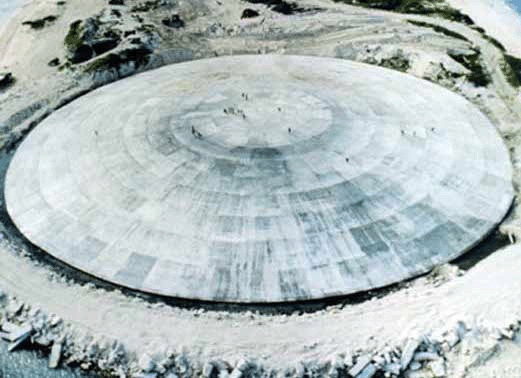
43 years ago a concrete container of nuclear waste was constructed on a tiny island in the Pacific Ocean, but there’s a big problem with that, it’s leaking.
During the Cold War, the US used islands in the Pacific to test nuclear weapons, and between 1946 and 1958 carried out a series of tests on Enewetak Atoll.
Of course, nuclear bombs poison the ground around them and the waste from these weapons is a dangerous commodity in and of itself. So between 1977 and 1980, a concrete dome was built to store the nuclear waste from the bomb tests.
That ended up being called the Runit Dome, because it was located on Runit Island, though it was also referred to as ‘the tomb’.
Housing radioactive debris, including poisonous plutonium, thousands of people scraped nuclear waste into a blast crater and covered it over with concrete to stop it from getting out.
Unfortunately that plan isn’t going quite so well as, according to IFL Science, a report from 2019 warns that changing conditions on the island are causing the concrete dome to crack.
Increasing temperatures are not helping the problem, while a rise in sea levels is also compounding the problem as the dome is not elevated off the ground, and the lapping waters of the sea are eroding it further.
This is all resulting in radioactive material bleeding out into the ground on the rest of the island and leaking out into the sea as well.
As long as the plutonium stays within the crater covered by the dome then it won’t be a major new source of contamination into the ocean.
That could all change if the cracking dome were to give way and seawater was able to flow in and out of the crater.
This concrete tomb could be a cracking nuclear coffin with a monster inside just waiting to be released, but for now things are still within acceptable levels.
According to the Woods Hole Oceanographic Institution, marine radioactivity expert Dr Ken Buesseler said they’d ‘known for years that the dome is leaking’, but for now only a ‘small amount of radioactivity’ was getting out.
For context, this isn’t putting the surrounding area beyond safety standards just yet, and the plutonium sealed beneath the Runit Dome is only a fraction of what was released during nuclear testing.
While he said things were alright at the moment, he warned that they ‘hadn’t considered sea level rise in the 1970s when they built this’, and said the dome would be ‘at least partially submerged by the end of this century’.
Bringing the Pacific people together in solidarity to address nuclear legacy issues in the Pacific – Lesuma
By Ema Ganivatu, Thursday 10/08/2023 https://www.fijivillage.com/news/Bringing-the-Pacific-people-together-in-solidarity-to-address-nuclear-legacy-issues-in-the-Pacific–Lesuma-r84xf5/
We try bringing together Pacific people and groups, in unity and solidarity so that we have one united way against nuclear waste dumping, nuclear testing and addressing nuclear legacy issues in the Pacific.
This was highlighted by Pacific Network on Globalisation (PANG) in Fiji Nuclear Justice campaigner Epeli Lesuma in an interview with fijivillage News about the environmental issues surrounding the Pacific.
Lesuma says they are trying to clean the nuclear waste that colonial powers have left behind.
He says this issue refers to the testing that was undertaken by the UK, USA, France, Christmas Island, and the Marshall Islands and the Nuclear Justice in the Pacific campaign for PANG and similarly for other regional NGOs is largely based around addressing this issue in the Pacific.
He adds this campaign is also around addressing justice for indigenous communities, and affected communities in those countries.
Lesuma says it is important for us to prioritize the Pacific Island Forums panel of experts because they were a panel appointed by Pacific leaders and provided by small Pacific countries with Pacific people and concerns at heart.
He says Fiji was the chair of the forum when this panel of experts was appointed so Fijians need to continue to support the PIFs panel of experts over the International Atomic Energy Agency (IAEA) because PIFs are not swayed by their interests or the interest of more developed countries like Japan or America or France.
Lesuma says there is power in numbers and the old saying ‘United we stand, divided we fall’ comes into place at this time, so part of PANG’s work is ensuring that the campaign has one voice and one message in advocating for Nuclear Free Pacific.
Philippines House panel OKs bill outlining nuclear damage compensation
By: Gabriel Pabico Lalu – Reporter / @GabrielLaluINQ INQUIRER.net August 07, 2023
MANILA, Philippines — A proposed measure that outlines civil liability and compensation in case of nuclear damage was approved by a House of Representatives panel on Monday.
During the hearing of the House Special Committee on nuclear energy, House Bill (HB) No. 8623, or the proposed Philippine Nuclear Liability Act, was approved, subject to discussions on the plenary.
A technical working group was also formed to reconcile differences between the original bill, authored by committee chairman and Pangasinan 2nd District Rep. Mark Cojuango, and the changes that would be made on the floor.
If enacted, the base version of the bill places that operators of nuclear installations would be liable for nuclear damage if there is proof that the incident was caused:
- in such nuclear installation or involving nuclear material coming from or originating in such nuclear installation
- involving nuclear material sent to such nuclear installation
It also specifies what conditions would require a joint liability — or when there is more than one operator handling the installation that caused the damage.
………………………………………………………………………………………………….. In a statement last May, the House of Representatives said IAEA informed lawmakers who hosted a forum on nuclear energy and international legal instruments that the law should contain the following provisions:
- regulatory control
- safe and secure uses
- offenses and penalties
- international cooperation
- peaceful uses
- compensation and liability
The IAEA said this after the House panel invited the Vienna-based organization to help Filipino lawmakers trying to come up with the necessary legal framework and policies for nuclear energy use.
https://newsinfo.inquirer.net/1813407/fwd-panel-oks-bill-outlining-compensation-in-case-of-nuclear-damage#ixzz89luKgXEL
Pacific anti-nuclear groups condemn Fiji’s Prime Minister Sitiveni Rabuka for backing Fukushima wastewater stance
Kelvin Anthony, RNZ 4 Aug 23
Pacific anti-nuclear advocacy groups and campaigners have condemned the Fijian Prime Minister Sitiveni Rabuka’s backing of Japan’s plans release over one million tonnes of treated nuclear wastewater into the Pacific Ocean.
On Thursday, Rabuka announced he was “satisfied” with Japan’s efforts to demonstrate that the release will be safe………………………………..
the Alliance for Future Generation Fiji [https://www.afgfiji.org/post/afg-condemns-fijipm-support-for-fukushima-wastewater said it was “deeply concerned” and “condemned” Rabuka’s stance.
The group is urging Rabuka to reconsider “and take a stronger position” on the issue.
AFG Fiji said releasing treated nuclear wastewater into the Pacific Ocean would have “far-reaching consequences for the entire Pacific region and beyond”.
“This action has the potential to inflict lasting damage to marine ecosystems, threatening the livelihoods of countless communities that depend on the ocean for sustenance and economic well-being. Our concerns regarding this matter are deeply rooted in the Pacific Ocean as a source of identity for all Pacific communities,” it said.
“We urge the Fiji Prime Minister and by extension, his government, to reconsider its stance and take a stronger position in advocating for the implementation of alternative, safe, and sustainable solutions for the Fukushima nuclear wastewater.
“We also urge Pacific leaders to trust the independent panel of scientific experts, appointed by the Pacific Islands Forum to review the data and information provided by Japan. As members of the global community, it is our collective responsibility to uphold principles of environmental stewardship and to prioritize the health and safety of our oceans and the lives they sustain,” the NGO said.
The campaigners are also calling on the international community to show solidarity and “demand that Japan seeks alternative solutions to handle its nuclear waste responsibly”. https://www.rnz.co.nz/international/pacific-news/495162/anti-nuclear-group-condemns-sitiveni-rabuka-s-fukushima-wastewater-stance
Opposition to Aukus – especially from New Zealand, but also from Australia and the Pacific, and across the political spectrum

Military Initiative by Australia, the United Kingdom and the United States (AUKUS) is Another Major Step in Prospective War on China
Covert Action Magazine, By Murray Horton, June 29, 2023
“………………………………………………“We Are Not at War, But Neither Are We at Peace”
New Zealanders may not have appreciated the degree of militarization in Australia, much more so than here. AUKUS should jolt us out of any complacency about what is going on with our nearest neighbor—it is preparing for war. Australian media commentary at the time of the AUKUS launch made that clear. “The monumental price tag of the AUKUS pact has made it clear. We are not at war, but neither are we at peace…”
“Almost $A400b, even over three decades, is not peacetime spending in anyone’s book—a fact Government ministers concede privately. Rather, we are navigating a dangerous and unpredictable new grey zone of superpower rivalry between China and the United States. It’s a contest in which we are poised to be a central player despite our geographical isolation and relatively small population.”
“Accepting such a role will require tough spending decisions the nation as a whole is not yet ready to confront. Already, Opposition Leader Peter Dutton is flagging his willingness to support reduced spending on the National Disability Insurance Scheme to pay for the submarine programme. Other unsettling trade-offs will need to be discussed. Even in the short term, before the big bills start arriving, difficult calls will have to be made….This is because…it will cut $A3b from existing defence programmes…This is likely to anger other branches of the military, such as the Army, while the Navy is lavished with money.”[2]
Albanese tried to put a positive spin on it,……………………………………..
Criticism from Inside the Political Elite
Pleasingly, AUKUS was not unopposed among Australia’s political elite (or, at least, former leading members of it). Paul Keating, who was Labor Prime Minister from 1991 to 1996, really put the boot into the good submarine AUKUS and all who sail in her. He did so in a March 2023 speech, the day after the AUKUS announcement. “Former prime minister Paul Keating has launched an extraordinary attack on the Albanese government over its adoption of the AUKUS pact, accusing it of making the worst foreign policy decision by a Labor government since the attempted introduction of conscription in World War I.”
“He said signing up to AUKUS had broken Labor’s long ‘winning streak’ on foreign policy over the past century and was a ‘deeply pathetic’ moment in the Party’s history. ‘Falling into a major mistake, Anthony Albanese, befuddled by his own small-target election strategy, emerges as prime minister with an American sword to rattle at the neighbourhood to impress upon it the United States’ esteemed view of its untrammelled destiny…’”
“‘Naturally, I should prefer to be singing the praises of the government in all matters, but these issues carry deadly consequences for Australia and I believe it is incumbent on any former prime minister, particularly now, a Labor one, to alert the country to the dangerous and unnecessary journey on which the Government is now embarking.’”
“‘This week, Anthony Albanese screwed into place the last shackle in the long chain the United States has laid out to contain China…I don’t think I suffer from relevance deprivation, but I do suffer concern for Australia as it most unwisely proceeds down this singular and dangerous path,’ he said.”
“Keating presented a largely benign view of China’s rise, saying it was ‘not the old Soviet Union’ and was ‘not seeking to propagate some competing international ideology’ to the United States. The fact is China is not an outrider,’ he said. ‘China is a world trading state—it is not about upending the international system,’”
“Keating said: ‘Every Labor Party branch member will wince when they realise that the party we all fight for is returning to our former colonial master, Britain, to find our security in Asia—236 years after Europeans first grabbed the continent from its Indigenous people. That of all things, a contemporary Labor government is shunning security in Asia for security in and within the Anglosphere’”[3]
Nor was Keating alone in his criticism from within the elite. “The Australian National University’s Hugh White, an emeritus professor of strategic studies, unleashed a quite extraordinary criticism of Australia’s nuclear submarine plan…Professor White, a former deputy secretary of the Defence Department, said Australia was not only going to ‘hand over some serious dollars’ to the US but also pay with ‘a promise’ to enter any future conflict with China.’”
“‘This is a very serious transformation of the nature of our alliance with the United States,’ White said in an interview recorded for the ANU’s politics podcast Democracy Sausage. ‘The US don’t really care about our submarine capability—they care deeply about tying Australia into their containment strategy against China.’”
“White said he couldn’t see why the US would sell its own submarines—of which they have fewer than they need—unless it was absolutely sure Australia’s submarines would be available to it in the event of a major conflict in Asia. He said a war between America and China over Taiwan would be ‘World War III’ and have a ‘very good chance’ of being a nuclear conflict.”
“‘Australia’s experience of war [is] shaped by the fact that we’ve tended to be on the winning side, but there is no reason to expect America to win in a war with China over Taiwan,’ he warned. He suggested there was also a high chance the AUKUS deal could fall over under [sic] a future American administration and a worsening strategic environment.”
“White said there were cheaper, quicker, less risky and less demanding ways for Australia to get the submarines it needed, labelling the AUKUS plan a waste of money that ‘doesn’t make sense. There’s going to be no actual net increase in the number of submarines available until well into the 2040s, even if it goes to plan—which it probably won’t,’ he said.”[4]……………………………………………………………………………………………………………………………………………………………………..
Former New Zealand Prime Ministers from Rival Parties Dissent
When AUKUS was first announced in 2021, New Zealand, which was not invited to join, simply confined itself to saying that nuclear-powered submarines would not be allowed into New Zealand territorial waters, or ports, because of our nuclear-free law dating back to the 1980s. So, the issue flew below the radar (or sailed under the water, to put it more appropriately). However, once AUKUS really kicked off in March 2023, debate and disquiet started in New Zealand.
Helen Clark was the Labour Prime Minister (1999-2008) who has dined out for 20 years on having refused to let New Zealand join the U.S., UK and Australia in the illegal and disastrous 2003 invasion of Iraq (in all other aspects Clark was a very loyal servant of the U.S.). She came out quickly and said that New Zealand is better off outside AUKUS (the word she used was “entanglement”).
She was not alone as the only former New Zealand Prime Minister to criticize it. “…[F]ormer National prime minister Jim Bolger [1990-97] participated in a forum about New Zealand’s foreign policy in Wellington, in which he is reported by the Herald’s Audrey Young to have criticised the Australian submarine buy up as ‘beyond comprehension’ because of the cost and the damage to peace in the Pacific region.”
“Bolger said that New Zealand certainly doesn’t want any such submarines, and challenged proponents of the AUKUS deal to defend it: ‘If you can find any Australian official who can explain why they need nuclear-powered submarines, come and tell me. I’d like to know.’ And Young reported Bolger asking rhetorically, ‘How mad are we getting?’ She says ‘he spoke with despair about the near-daily threats of nuclear war, which had the potential to destroy the planet.’”[7]
Opposition Across the Political Spectrum
“As part of the AUKUS deal Western Australia will play host to US and UK nuclear submarines from 2027. With nuclear-capable American B52 bombers and thousands of American marines rotating through the Northern Territory, Australia is lining up as a loyal lieutenant to the United States in the Pacific and would be expected to fight should war break out.”
“Would New Zealanders fight in a war between the nuclear superpowers? While we aren’t required by treaty obligations to act if America or Taiwan are attacked we are if Australia is. It is not an exaggeration to say Australia could be a target in a future war and already the country has been threatened with missile attacks in that scenario.”
“The risks of New Zealand being dragged in are real. Unlike in Australia, the conversation in New Zealand has been much more muted with limited discussion on the likelihood of war. Why aren’t we talking about it? New Zealand is in a difficult situation contemplating conflict between our largest trading partner and traditional security partner.”
“We weren’t invited to join AUKUS and Australian nuclear submarines won’t be allowed to berth here under our nuclear-free legislation. That same legislation sees New Zealand as only a friend and not an ally of the United States, but we are increasingly acting like we are an ally. In the years since New Zealand’s principled decision not to join the invasion of Iraq we have become more enmeshed with the United States defence apparatus.”
………………………………………………………………………………………………….. “New Zealanders need to talk more about the risks, our decision-makers need to explain why New Zealand is aligning more closely with the United States military and as a sovereign country we have to ask are we acting independently or as a cog in a machine? Our role could be focused on reducing tensions, finding solutions and building trust. War is never inevitable.”[8]
Former politicians across the spectrum have come out against AUKUS. For example, Richard Prebble, one-time Labour Cabinet Minister and later ACT Party founder and Leader.
He is currently a relentless right-wing critic of the current Labour government. His take on AUKUS is the classic mercantilist one. “China is New Zealand’s biggest trading partner. This country has joined China’s Belt and Road initiative. China has signed a free trade agreement with New Zealand, something the U.S. Senate refuses to consider.”
“Foreign Minister Nanaia Mahuta has warned that New Zealand’s exports to China could be caught up in a ‘storm,…………….. New Zealand’s exporters are only too aware of their dependency. There is no other obvious alternative to the New Zealand-China trade.”
“New Zealand has no territorial disputes with China. When we recognised the Government of China 50 years ago, we acknowledged Taiwan is part of China. Paul Keating and Helen Clark are correct. New Zealand’s strategic interest is in the peaceful resolution of conflicts with China rather than sleepwalking into anti-Chinese alliances.”[9]
Academic Skepticism
Leading academic Robert Patman spelled it out in an article entitled “Why New Zealand Should Remain Sceptical About AUKUS.” He wrote that “the basic problem facing AUKUS is that it is based on a binary assumption that the fate of the Indo-Pacific will be largely shaped by the outcome of U.S.-China rivalry and, in particular, by the capacity of America and its closest allies to counterbalance Chinese ambitions in the region.”[10]
“Such a perspective is problematic on a number of counts. First, it exaggerates the influence of great powers in the 21st century in a large, diverse region like the Indo-Pacific. The region contains 60% of the world’s population including significant economic players like Japan, South Korea and fast-growing economies such as Vietnam and India.”
“Second, AUKUS does not factor in the Indo-Pacific and European nations’ quite distinctive security and economic interests in countering China. While countries like Malaysia, Indonesia and Vietnam and EU states like Germany and France are deeply worried about China’s forceful diplomacy in the Indo-Pacific, they remain sceptical that a security arrangement involving three English-speaking states, two of whom have baggage in the region, is an adequate response.”
“Third, China’s global ambitions are very real, but they should not be over-hyped. AUKUS states depict China as a ‘systemic threat’ and, according to US Secretary of Defence Lloyd Austin, the ‘only competitor out there with both the intent to reshape the international order and, increasingly, a power to do so.’ Really?…”
“Fourth, the provision of nuclear-powered submarines to Australia has raised very real fears in the Indo-Pacific about nuclear proliferation. In 1995, ASEAN [Association of Southeast Asian Nations] member states signed the Treaty of Southeast Asia Nuclear Weapon-Free Zone (SEANWFZ). Furthermore, Singapore is now the only ASEAN state yet to sign or ratify the Treaty on the Prohibition of Nuclear Weapons (TPNW), a diplomatic initiative heavily promoted by New Zealand.”
………………………………………………………………………. New Zealand remains sceptical that China is a systemic threat to US dominance, sees a good fit between its non-nuclear security policy and the Indo-Pacific region, and views detachment from AUKUS as both consistent with the goal of diversifying New Zealand’s trade ties and building a diplomatic network of like-minded states to strengthen the international rules-based order through measures like UN Security Council reform.”
Madness to Support U.S. War Against China
Mike Treen, veteran union leader and left-wing activist, put it all very succinctly in an article in the Daily Blog on April 21, 2023. He wrote: “The US is going to war against China because it is losing the international economic competition that previously enabled its military and economic bullying to dominate the globe. The empire is in slow decline.”[11]
“China’s extraordinary rise as an economic powerhouse over the past few decades means that it is now the top international trading partner for 120 countries. This has given the world the freedom to act in ways they have never before—politically and economically.
………………………………………………………………………………. “New Zealand was wrong to join the war against Afghanistan. We were wrong to join the occupation of Iraq. We were wrong to become an ‘observer’ at NATO. And it would be foolish and dangerous to become a participant in any way with the AUKUS military provocation against China. New Zealand should be a neutral power that offers medical aid to the world not a tiny jumped-up militarised puppet of the US empire like Australia has become.”
Defence Minister Tempted by AUKUS
The AUKUS carrot that is being dangled in front of New Zealand and Defence Minister Andrew Little is keen to take a bite……………………………………………………..
But Not PM or Minister of Foreign Affairs
However, both the Prime Minister, Chris Hipkins, and the Minister of Foreign Affairs, Nanaia Mahuta, have since “dismissed suggestions the Government has shown interest in joining aspects of the pact.”
Mahuta made a May 2023 speech stressing that New Zealand’s nuclear-free position is a “cornerstone of our independent stance” ………………………
AUKUS Causing Alarm in the Pacific.
“[T]he Pacific Islands Forum warns ‘AUKUS will bring war much closer to home and goes against the Blue Pacific narrative on nuclear proliferation and the cost to climate change.’ Forum secretary-general Mark Brown said AUKUS would heighten geopolitical tensions and disturb the peace and security of the region.”…………………………………………………………………….
New Zealand Needs to Be Aware of War Drums Next Door
…………………………. New Zealand is actively supporting Ukraine in its war against Russia. There is an irony in our government being so invested in a war, and its attendant geopolitics, on the other side of the world while, right next door to home, our Aussie Big Brother is making a major push toward war via AUKUS and accompanying militarization.
………Make no mistake—AUKUS is a major lurch toward war with China and it is unfolding before our eyes.
The Australian peace movement is waging a vigorous and very active campaign against AUKUS. Independent and Peaceful Australia Network (IPAN) https://ipan.org.au/
References:………………………………………………………..
Will the small states of Oceania be able to maintain their independence in the face of a new Sino-American Cold War?
The ‘friends to all, enemies to none’ strategy is living its last days as the US and China press the island nations to take sides
By Timur Fomenko, a political analyst, https://www.rt.com/news/580174-friends-to-all-enemies-to-none/ 23 July 23
Papua New Guinea is a gateway between continents. The island, being effectively cut in half, demarcates an artificial boundary between Asia and Oceania. In the past several centuries, the broader island has been carved upon between almost every colonial power going, having been ruled at various points by the Dutch, Spanish, German, Japanese and British empires. Even after gaining its formal independence from Australia in 1975, these legacies continue to scar the island, with half of it still belonging to Indonesia, known as West Papua, which is now a source of unrest and insurgency.
The history of constantly fluctuating overlords only demonstrates the country’s perceived strategic and military importance. That’s because whoever dominates it has direct access to both Australia and the Pacific, and can project into Asia itself. It is of little surprise that Papua New Guinea (PNG) became one of the most gruesome fronts of the Pacific War in World War II, which subsequently brought it firmly into the hands of the Anglosphere, where it has remained ever since, making it an effective dependency of Australia in terms of aid and humanitarian assistance.
Despite this, the island has nothing to show for centuries of colonial dominion, or from being a subordinate of the English-speaking world as a black Melanesian country. It is one of the world’s poorer nations, and is in desperate need of infrastructure to develop itself. Because of this, it has developed a foreign policy it describes as ‘friends to all, enemies to none’, which seeks to attain and exploit as many development opportunities as possible and better sustain its own strategic autonomy. This of course, has drawn interest from China, who sees the islands as an important partner as a post-colonial, Global South country. Thanks to PNG being part of the Belt and Road Initiative, Beijing has built airports, highways, sea ports, and telecommunications infrastructure across the country.
Port Moresby, in turn, sees Beijing as a critical economic partner that can help bolster its own infrastructure and development, the two countries recently having negotiated a free trade agreement. But that doesn’t mean trouble is not afoot. While China seeks to bolster economic relations with the country, the US has other ideas; that is, to forcibly transform Papua New Guinea into a military outpost for the purpose, of course, of containing China. Recently, Washington was able to pry a Defense Cooperation Agreement out of the country, which will give the US access to its bases.
PNG, of course, denies that the is specifically opposing China, and does not rule out security cooperation with Beijing itself. However, it is also a reminder that the country’s weak and vulnerable position, along with its historical subservience to the West, means it does not have the power or political privilege to resist these kinds of overtures, and instead must seek a more delicate balance. In response to this, China is likely to increase its engagement with the country; for example, the Bank of China is working to establish a presence there.
Growing competition over Papua New Guinea also comes amid China’s successes in its relationship with the Solomon Islands, which switched allegiance from Taipei to Beijing in 2019. On July 11, the two countries finally signed a security cooperation pact, which has met with vitriol from Western media and politicians.
What this demonstrates is that the Pacific region has become a ‘cold war’ theater between China and the US, with the latter working through its ally, Australia. The US, after all, has long attempted to make the Pacific an ‘extended backyard’ or ‘ranch’, a large open space over which it seeks to be the exclusive military power. But now, China is expanding into it, and this has led to the emergence of strategic competition.
However, these Pacific countries do not really want to take sides – they are tired of being tossed from one master to the other. This means the fundamental challenge for countries such as Papua New Guinea is to gain benefits to strengthen itself, while nonetheless avoiding subservience. This means it has a fight to continue its ‘friends to all, enemies to none’ approach, while tensions rise and both powers start demanding it take sides on various issues. But if worst-case scenarios can be avoided, and the pace of investment in the country from all sides accelerates, the end product may be that competition could ultimately make PNG and the island countries a lot better off, and therefore a lot more capable of exerting their own will.
To the Pacific islands, the West’s support for Japan’s Fukushima nuclear waste ocean dumping is hypocrisy
Having been used for nuclear tests and dumping by the US and France, the Pacific islands deeply oppose Japan’s plan and see it as a ‘nuclear legacy’ issueThat the likes of Australia and the US support Japan’s plan just ups the region’s geopolitical stakes – and gives China a trump card
Kalinga Seneviratne, SCMP, 18 Jul 23
International Atomic Energy Agency (IAEA) director general Rafael Mariano Grossi, after travelling to Tokyo earlier this month to present a report endorsing Japan’s approach to discharging Fukushima’s treated nuclear waste water into the Pacific, has been trying to convince Japan’s sceptical Pacific neighbours of the authenticity of the report’s findings.
The IAEA, which has opened the door for Tokyo Electric Power Company (Tepco) to dump about 1.3 million tonnes of contaminated water into the Pacific Ocean, insists the controlled, gradual release would have a “negligible radiological impact on people and the environment”.
But the small island nations of the Pacific remain deeply concerned about Japan’s intention to dump nuclear waste into the ocean. They see this as not merely a nuclear safety issue but a “nuclear legacy issue” – the Pacific has been used as a nuclear weapon testing and dumping site since the end of the second world war………………….(Subscribers only) more https://www.scmp.com/comment/opinion/article/3228154/pacific-islands-wests-support-japans-fukushima-nuclear-waste-ocean-dumping-hypocrisy
France detonated nearly 200 nuclear ‘tests’ in French Polynesia — now this activist is calling for accountability
By Bobby Macumber, Dan Smith and Alice Matthews for Stories from the Pacific, 14 July 23 https://news.google.com/articles/CBMiVGh0dHBzOi8vd3d3LmFiYy5uZXQuYXUvcGFjaWZpYy9udWNsZWFyLXRlc3RpbmctZnJlbmNoLXBvbHluZXNpYS1oaW5hLWNyb3NzLzEwMjU4NTkzMNIBAA?hl=en-AU&gl=AU&ceid=AU%3Aen
Hinamoeura Cross was seven years old when France tested its last nuclear bomb in 1996 in French Polynesia.
It was detonated deep underground on the atoll of Fangataufa, in a deep shaft drilled into volcanic rock, and sent a white shockwave into the air, visible on grainy television cameras at the time.
“I don’t have any memory of it,” Hina told Stories from the Pacific.
“I was growing up. I never learned about the consequences of nuclear bombs at school. I didn’t even know there had been so many.”
Three to five was the figure Hina had in mind when she was younger.
But in fact, by the time France finished its testing program on the atolls of Fangataufa and Moruroa, around 190 nuclear “tests” had been conducted.
Nuclear explosions had been conducted in lagoons, dropped from planes and suspended from helium balloons. After international pressure, testing moved underground.
The largest was codenamed Canopus, which was a two-stage thermonuclear test that exploded in 1968 while suspended from a balloon.
It was around 200 times more powerful than the bombs dropped on Hiroshima and Nagasaki.
The combined effect of the testing was equivalent to a Hiroshima-sized nuclear bomb exploding in French Polynesia every week for 14 years, Hina said
“Today, our ocean is totally contaminated. It’s like a poison,” she said.
“I really feel that in my blood I have been poisoned because of those nuclear tests and we have so many thousands of Tahitian people who are sick … you can’t find a family without cancer.
“And it’s really hard because they don’t understand the consequences of the nuclear tests because they’re not aware today.”
Subjects in school touched on the nuclear bombs dropped in Japan, but Hina said nothing was taught about her country’s own more immediate history — and the health consequences.
France initially said only 10,000 people were at risk of radiation exposure as a result of the nuclear activity.
But a later investigation by a team of researchers from Princeton University, journalism group Disclose, and environmental group Interprt claimed 110,000 people were potentially exposed to toxic radiation.
Hina herself was diagnosed with Leukaemia at 24, while her grandmother, mother, aunt, and sister all had thyroid cancer.
And, she said, to add insult to injury, the compensation scheme in place was complex and “not at all impartial”.
There is one hospital and two clinics on the island of Tahiti, and many islanders are forced to fly to Paris for treatment.
“Today, it’s French Polynesia and all the population that pays for all this, the cost of the illness … and it costs a lot for us,” she said.
Calling a spade a spade — or a bomb a bomb
Hina’s diagnosis was a shock that jolted her into action.
Becoming an anti-nuclear activist, she started by posting articles and links online and eventually addressed the United Nations on the topic.
Now a newly elected member of Parliament in Tahiti, she’s pushing for better in-country medical treatment and to “educate and denuclearise Polynesian memories”.
It starts, she said, with “calling a spade a spade”. Nuclear tests were still nuclear bombs.
“The fact that there were no people that were being attacked … it was the same bomb,” she said.
“I really think that using the term test totally minimises the consequences.”
Another priority is getting France to acknowledge what happened and making her fellow Tahitians aware.
French Polynesia is of strategic importance to France, and Hina said the government was pushing to silence the fight.
“They don’t want to talk about the nuclear history. They don’t admit what happened.”
Hina also hopes to begin a foundation, allowing Polynesians to reclaim the nuclear narrative as well as advocate for anyone with radiation-related sickness to be treated in Polynesia.
Although chemotherapy has kept her leukaemia at bay thanks to an early diagnosis, not everyone is so lucky.
“I think it’s absolutely disgraceful that we don’t have a medical system that’s equal to the damage suffered by these 193 nuclear bombs,” she said.
“But I really thought that maybe if I have this courage, that will motivate other people to stand up and share their story, to speak about the cancers that we we have in our family, because … [many people] have cancer, but they don’t really realise the impact of the nuclear bombs.”
Safe or septic – Japan’s nuclear wastewater dumping
RNZ, From The Detail, Tom Kitchin, co-host of The Detail @inkitchnz tom.kitchin@rnz.co.nz 11 July 23
There are diplomatic headaches and heated scientific debates after Japan revealed plans to dump the wastewater it’s been using to cool the Fukushima nuclear power plant – in the Pacific.
…………………………… Sea and ground water has been used to cool the damaged reactors, and now there’s about 1.3 million tonnes of that sitting in tanks while the Japanese government and plant operator Tokyo Electric Power Company (TEPCO) figure out what to do with it.
They want to release the wastewater into the ocean – diluting all the cancer-causing nuclear fission products out of it – such as caesium, which can build up in muscles, strontium-90 which can build up in bones and iodine-129 which can build up in the thyroid.
…………………………………………. journalist Nic Maclellan, a Melbourne-based correspondent with Islands Business Magazine, tells The Detail.
“The Pacific Islands Forum has been especially critical, and appointed an independent scientific panel to investigate safety issues around the proposed dumping,” he says.
“The panel has raised a series of issues around the quality of the sampling, the cost of the sampling, the cost of the programme over decades, the maintenance of safety sampling and the fact that they really don’t know whether Japan can maintain the quality that will stop other radioactive isotopes being released into the ocean.”
There are also questions over whether the wastewater dump is a breach of the Treaty of Rarotonga, signed in 1985, which created a South Pacific nuclear-free zone.
It was largely about nuclear weapons, but article seven talks about preventing nuclear waste dumping.
“Japan has been acting as if these safety concerns are not serious and it’s taken a lot of pressure for Japan to be dragged kicking and screaming into addressing questions, many of which are still unresolved,” Maclellan says.
AUKUS is also a factor now – a security pact between Australia, the United Kingdom and United States. The main news out of that is the US and UK will help Australia get nuclear-powered submarines.
“The nuclear submarines are a breach of the spirit of the Rarotonga treaty. There’s going to be interesting debates about a technical definition of whether this is… a breach of the letter as well as the spirit,” Maclellan says. https://www.rnz.co.nz/programmes/the-detail/story/2018897817/safe-or-septic-japan-s-nuclear-wastewater-dumping
1 This Month

of the week – Shut Down Drone Warfare!


Tell the Ukrainian Government to Drop Prosecution of Peace Activist Yurii Sheliazhenko

Petition to revoke the licensing of the Near Surface Nuclear Disposal Facility (NSDF) at Chalk River. https://www.ourcommons.ca/petitions/en/Petition/Details?Petition=e-7247
To see nuclear-related stories in greater depth and intensity – go to https://nuclearinformation.wordpress.com
-
Archives
- March 2026 (237)
- February 2026 (268)
- January 2026 (308)
- December 2025 (358)
- November 2025 (359)
- October 2025 (376)
- September 2025 (257)
- August 2025 (319)
- July 2025 (230)
- June 2025 (348)
- May 2025 (261)
- April 2025 (305)
-
Categories
- 1
- 1 NUCLEAR ISSUES
- business and costs
- climate change
- culture and arts
- ENERGY
- environment
- health
- history
- indigenous issues
- Legal
- marketing of nuclear
- media
- opposition to nuclear
- PERSONAL STORIES
- politics
- politics international
- Religion and ethics
- safety
- secrets,lies and civil liberties
- spinbuster
- technology
- Uranium
- wastes
- weapons and war
- Women
- 2 WORLD
- ACTION
- AFRICA
- Atrocities
- AUSTRALIA
- Christina's notes
- Christina's themes
- culture and arts
- Events
- Fuk 2022
- Fuk 2023
- Fukushima 2017
- Fukushima 2018
- fukushima 2019
- Fukushima 2020
- Fukushima 2021
- general
- global warming
- Humour (God we need it)
- Nuclear
- RARE EARTHS
- Reference
- resources – print
- Resources -audiovicual
- Weekly Newsletter
- World
- World Nuclear
- YouTube
-
RSS
Entries RSS
Comments RSS
 nuclear-news