Low income households to get free solar power
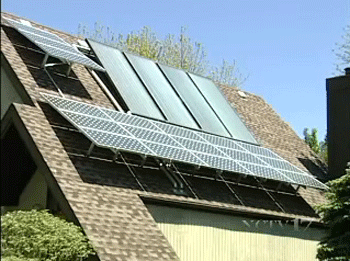
 Free Solar Power Systems For Cayman Islands Households, Energy Matters, 30 April 12, The Cayman Islands government is taking an interesting approach to helping low income families battle increasing electricity costs – by providing free solar panel systems.
Cayman Islands’ Premier, the Hon. McKeeva Bush, OBE, JP announced last week a free solar energy programme for 1500 households that will generate electricity bill savings of nearly 70% for beneficiaries and ensure these families will always have access to electricity for basic applications.
The $15 million programme will not only benefit the households, but also generate between 150 – 200 new job opportunities for Caymanians.
“We will be using reliable data from the Economic and Statistics Office, the Electricity Regulatory Authority and the Department of Social Services, in order to target those in most need of assistance. We will ensure that the myth is broken that renewable energy is only for the very wealthy and elite!” said Premier Bush. The Cayman Islands government has been pushing renewables uptake since revising its Electricity Regulatory Authority Law in 2010. A pilot feed in tariff program was launched in 2011, paying AUD 42c per kilowatt hour for all solar electricity produced by a system.
The Cayman Islands has a special interest in low emissions electricity generation. Like many small island nations around the world, the Caymans currently has a high dependence on electricity generated with expensive imported fossil fuels and is especially vulnerable to the projected impacts of climate change. The island of Grand Cayman was hit by Hurricane Ivan in 2004, flooding many areas and damaging an estimated 95% of the buildings on the island…. http://www.energymatters.com.au/index.php?main_page=news_article&article_id=3183
A solar energy business for two Tongan grandmothers
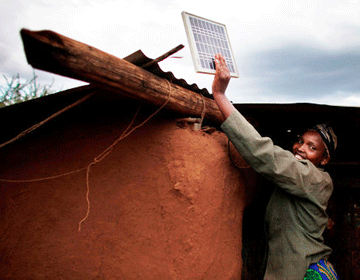 Tonga’s Solar Grandmothers, by Energy Matters, 27 April12, Two grandmothers from the island nation of Tonga have acquired the skills to install solar panel systems in the nation’s communities without access to mains grid electricity.
According to a report on Matangi Tonga Online , Siutiti Halatoa and Siale Leohau successfully completed a six months training course in solar power installation last year at Barefoot College, India, with the assistance of the Indian Government. The recently launched Kolomotu’a Women’s Solar Project in Nuku’alofa, the capital of the Kingdom of Tonga, will assist the women in their role of solar installers. The project is being supported under the Tonga Energy Roadmap.
The grandmothers are the first women to be trained in solar installation in Tonga and will begin their new careers by installing solar panels in over 30 homes, starting with households without electricity in ‘Isileli, Hala ‘o Vave and Sopu.
The solar panels and other equipment have been provided by an anonymous donor and each off-grid installation will generate enough electricity to power several light bulbs and a mobile phone ……. http://www.energymatters.com.au/index.php?main_page=news_article&article_id=3181
Trinidad’s scandal of over-radiated cancer patients
 The radiation incident at BLCTC has been shrouded in secrecy from the outset
Over-radiated cancer patients at Lara Centre… Trinidad Express, By Camini Marajh Head Investigative Desk Story Apr 14, 2012 Ninety-one or 40.8 per cent of the 223 cancer patients over-radiated by the Brian Lara Cancer Treatment Centre (BLCTC) are dead.
Continuing Sunday Express investigations into the radiation over-exposure incident at the private facility which is owned by powerful business interests reveal that the board and management of BLCTC failed internationally accepted guidelines on several critical
fronts, specifically: Continue reading
French Presidential candidate to support Pacific Islanders where atom bombs were tested
Hollande vows more transparency over nuclear tests in French Polynesia http://www.rnzi.com/pages/news.php?op=read&id=67463 Radio New Zealand, 12 April, 2012 The Socialist candidate for the French presidency, Francois Hollande, has promised French Polynesians that he would go to the bottom of the issue of the aftermath of the nuclear weapons tests.
In a video message to launch the formal campaign, he says what has been done in the past five years is not worthy, and not up to the expectations in terms of the impact the tests had.
Mr Hollande has promised greater transparency, and also endorses the initiative by French Polynesia’s member of the French Senate, Richard Tuheiava, for Paris to return the two test atolls.
Moruroa and Fangataufa were ceded to France at no cost in 1964 to allow its military to begin atmospheric and then underground nuclear tests. Although France recognised two years ago that its tests were not clean, the compensation law drawn up since has been widely criticise
Wellington set the trend for 105 local nuclear free zones
Wellington: 30 years proudly nuclear-free Capital was a benchmark for other cities The Dominion Post, MICHAEL FORBES 14/04/2012 Wellington became a benchmark for others. By the end of 1984, 40 local authorities had nuclear-free policies and by 1988, 72 per cent of the population was living in 105 locally declared nuclear-weapon-free zones.
“The declaration had repercussions way beyond anything I anticipated at the time,” Ms Ritchie says. “I’m pleased that it has stood the test of time. To have it stop at Wellington would have been insufficient.”
To even be able to put such a motion before council was a privilege, Ms Ritchie says; in today’s climate of local government being told to keep their nose out of non-essential matters, it probably would not have happened.
“It was in the days when we could actually do this sort of thing politically, which was great. We could move a motion that was not related to rubbish, rates or drains. Not even related to the agenda. Now, you can’t do that.”….. http://www.stuff.co.nz/dominion-post/news/6743621/Wellington-30-years-proudly-nuclear-free
New radiation monitoring dosimeter technology
The way in which radiation workers are monitored is set to change with the introduction of a new and very different type of dosimeter that has just been approved for legal use in New Zealand.
Instead of waiting months for information about a possible exposure, radiation workers can now plug their dosimeter directly into a USB port of an Internet-connected Windows or Maccomputer and get an instant readout of any dose received.
Exposure information now available for radiation workers http://www.voxy.co.nz/business/exposure-information-now-available-radiation-workers/5/120503, 13 April, 2012 – We tend to think of New Zealand as nuclear-free but the reality is quite different. Radioactive material produced in nuclear reactors in other parts of the world is imported into the country on a near daily basis and thousands of x-ray generations are at work up and down the country. X-rays, gamma rays and radiopharmaceuticals are used extensively in human and animal health and radioactive sources are deployed in a plethora of industrial and research applications.
Human senses cannot detect the presence of ionising radiation and over time the cumulative effects of undetected radiation exposure become a threat to health. This is of particular significance for the thousands of workers whose occupation brings them into close and frequent contact with sources of ionising radiation. Continue reading
U.N. to investigate effects on Marshall Islanders of USA’s atomic bomb tests
UN to assess Marshall Islands nuclear effects ABC Asia Pacific News, 22 Mar 2012 A United Nations expert will visit the Marshall Islands next week to assess adverse effects of the nuclear testing undertaken by the United States between 1946 and 1958.
”It will be an exceptional opportunity to assess how the Marshallese peoples’ basic rights including the right to food, adequate housing and health have been affected,” Calin Georgescu, special rapporteur on the human rights obligations related to environmental issues, said in a press release.
Mr Georgescu is to present the conclusions of his March 26-30 visit to the UN Human Rights Council in September, possibly including recommendations to the governments of the Marshall Islands and the United States. http://abcasiapacificnews.com/stories/201203/3461159.htm
Epidemic of cancer from nuclear bomb testing in Marshall Islands
 “Today we are witnessing an exploding epidemic of cancer cases,” … “Cancers, birth anomalies and other radiogenic diseases make a compelling argument for the United States to reopen the nuclear issue,”
RMI CRITICIZES U.S. OVER NUCLEAR COMPENSATION PACIFIC ISLANDS REPORT Pacific Islands Development Program/East-West CenterWith Support From Center for Pacific Islands Studies/University of Hawai‘i
‘Exploding epidemic of cancer cases,’ $2 billion in unpaid claims
By Giff Johnson SAIPAN, CNMI (Marianas Variety, March 6, 2012) – Marshall Islanders accused the United States government of refusing to provide adequate nuclear test compensation on the 58th anniversary of the largest American hydrogen bomb test that exposed thousands of islanders to radioactive fallout. Continue reading
25 renewable energy projects getting underway in New Zealand
Several New Zealand Renewable Power Projects Scheduled to Begin Construction in 2012-13, an Industrial Info News Alert Market Watch, PERTH, AUSTRALIA, Mar 06, 2012 — Researched by Industrial Info Resources Australia — Industrial Info is currently tracking 25 New Zealand renewable energy projects in the planning and engineering phase that are scheduled to begin construction from 2012 onward. The projects total more than US$4.87 billion in investment value and indicate that New Zealand is predominately investing in wind, geothermal and hydro generation projects…..http://www.marketwatch.com/story/several-new-zealand-renewable-power-projects-scheduled-to-begin-construction-in-2012-13-an-industrial-info-news-alert-2012-03-06?reflink=MW_news_stmp
Danger of uranium and plutonium use by terrorists
 Resolution on the use of uranium, plutonium to be tackled at summit, Business World, Philippines, 5 Mar 12, THE GOVERNMENT will be pushing for an international resolution that would tighten security measures and prevent nuclear resources such as uranium and plutonium from being used for terrorist activities, a high-ranking Executive official said late last week.
Mr. Binay remarked that with the pressing threat of nuclear terrorism, member states of the IAEA — a specialized United Nations body comprising 153 countries and aims to promote safe and peaceful nuclear technologies — “should not only focus on the possibility of terrorists being able to use nuclear bombs in the future, but should urgently improve their respective security and safety measures in the storing and keeping of their uranium and plutonium resources.”…. http://www.bworldonline.com/content.php?section=Nation&title=Resolution-on-the-use-of-uranium,-plutonium-to-be-tackled-at-summit&id=47788
Climate change tragedy of the Torres Strait islands
A SINKING FEELING IN THE TORRES STRAIT, ABC Radio National, Hagar Cohen.4 March 2012, There are six islands in the Torres Strait facing inundation from tidal flooding. The encroaching sea is slowly washing away everything from building foundations to ancestral graves, and mosquitoes are thriving. One island has had its worst malaria outbreak in 50 years. There is a temporary solution—building seawalls—but the federal and state governments are showing little interest in paying for that, and in the meantime these island communities have a sinking feeling that relocation may be the only option left for them.
http://www.abc.net.au/radionational/programs/backgroundbriefing/2012-03-04/3857272
Tonga aiming for 50% renewable energy by 2015
Tonga has set its renewable energy target at 50% by 2015, and already has a plan
(the Tonga Energy Roadmap) for how it will achieve this lofty figure.
Tonga is receiving financial support from New Zealand and technical support from the Renewable Energy & Efficiency Program (REEP) in the development of its renewable energy projects
Tonga Starts on its Plan to Achieve 50% Renewable Energy by 2015, Oil Price, By Charles Kennedy , 24 February 2012 As oil prices increase, steady oil supplies become more uncertain, and CO2 emissions continue to increase, many countries around the world are trying to invest in renewable energy sources. Continue reading
Asia and Pacific powering ahead with decentralised renewable eneergy
The Asian Development Bank (ADB), United Nations Economic and Social Commission for Asia and the Pacific (ESCAP) and the United Nations Environment Program (UNEP) released the report “Green Growth, Resources, and Resilience” this week.
 On the road to green economies, Malaya Business Insights, 24 Feb12, Net metering is empowering electric consumers in the Philippines. The scheme is embodied in the Philippines’ Renewable Energy Act of 2008 – considered to be the most comprehensive renewable energy law in Southeast Asia.
It allows electric consumers to sell power to the grid at an approved feed-in tariff and buy power as necessary at the normal retail tariff. The feed-in tariff will provide a guaranteed fixed price for at least 12 years for electricity produced from emerging renewable resources: wind, solar power, ocean, run-of-river hydropower, and biomass.
With net metering, the consumer generates electricity at the point of use, and is able to supply excess electricity generated into the grid, either earning revenue or reducing net payable consumption.
Net metering provides a regulatory basis for distributed and decentralized energy systems and at the same time provides a powerful incentive for end-use efficiency improvements. Net metering can be combined with feed-in-tariffs to promote renewable energy generation in decentralized applications. Continue reading
Polynesian nuclear victims distrust French government on compensation
PACIFIC ISLANDS REPORT Pacific Islands Development Program/East-West Center With Support From Center for Pacific Islands Studies/University of Hawai‘i
TAHITI NUCLEAR ATOLL COMPENSATION CHANGES DISMISSED
French president’s amendments ‘an election-related move’ WELLINGTON, New Zealand (Radio New Zealand International, Feb. 15, 2012) – The Moruroa e tatou veterans group in French Polynesia is dismissive of a French decree loosening the compensation criteria for victims of the nuclear weapons tests. Continue reading
Polynesia’s radioactive pollution from France’s nuclear bomb tests
 France’s upper chamber approved a motion that provides for Mururoa and Fangataufa, currently under the control of the defence ministry, to be restored to the Polynesian public domain, though the bill stands little chance of becoming law. “We realise that they are the two largest nuclear dumps in an ocean environment. But in Oceania you cannot separate human beings from their ecosystem,” says the author of the bill, Senator Richard Tuheiva. “Restitution [of the atolls] is a way of soothing the psychological wounds [caused by the nuclear era].”
 about 5kg of plutonium is trapped in the sediment at the bottom of the Mururoa and Fangataufa lagoons, ……. There is no question of them returning to “normal” use.
 France urged to clean up deadly waste from its nuclear tests in Polynesia, Guardian UK, 7 Feb 2012, 193 nuclear tests carried out on the Mururoa and Fangataufa atolls between 1966 and 1996 have left a dangerous legacy. Continue reading
1 This Month

22,000+ miles voyaging for nuclear disarmament
and a radiation-free environment https://vfpgoldenruleproject.org/



Cuba Is Not a Failed State – It Is a Besieged State
PETITION: “Global Appeal to Endorse Palestinian Right of Return of Refugees”
To see nuclear-related stories in greater depth and intensity – go to https://nuclearinformation.wordpress.com
-
Archives
- July 2026 (42)
- June 2026 (287)
- May 2026 (306)
- April 2026 (356)
- March 2026 (251)
- February 2026 (268)
- January 2026 (308)
- December 2025 (358)
- November 2025 (359)
- October 2025 (376)
- September 2025 (257)
- August 2025 (319)
-
Categories
- 1
- 1 NUCLEAR ISSUES
- business and costs
- climate change
- culture and arts
- ENERGY
- environment
- health
- history
- indigenous issues
- Legal
- marketing of nuclear
- media
- opposition to nuclear
- PERSONAL STORIES
- politics
- politics international
- Religion and ethics
- safety
- secrets,lies and civil liberties
- spinbuster
- technology
- Uranium
- wastes
- weapons and war
- Women
- 2 WORLD
- ACTION
- AFRICA
- Atrocities
- AUSTRALIA
- Christina's notes
- Christina's themes
- culture and arts
- Events
- Fuk 2022
- Fuk 2023
- Fukushima 2017
- Fukushima 2018
- fukushima 2019
- Fukushima 2020
- Fukushima 2021
- general
- global warming
- Humour (God we need it)
- Nuclear
- RARE EARTHS
- Reference
- resources – print
- Resources -audiovicual
- Weekly Newsletter
- World
- World Nuclear
- YouTube
-
RSS
Entries RSS
Comments RSS
 nuclear-news