Clean up Marshall Islands radioactive mess, Pacific leaders tell USA
Pacific leaders urge US on nuclear mess, Herald Sun, 31 Aug 12, PACIFIC leaders have used a joint communique to urge the US to clean up the mess left by nuclear tests in the Marshall Islands ….. A meeting of the 15-nation Pacific Island Forum (PIF) in the Cook Islands issued the communique after a leaders’ retreat, saying the United States, which tested 67 nuclear weapons in the Marshalls from 1946-1958, had a “special responsibility” on the issue.
The communique said radioactive contaminants were still present in the Marshalls and Washington should “live up to its full obligations” to remove them and compensate affected populations.
“(There is) a special responsibility by the United States of America towards the people of the Marshall Islands, who have been and continue to be, adversely affected as a direct result of nuclear weapons tests,” it said.
US Secretary of State Hillary Clinton arrives in the Cook Islands later on Thursday and PIF leaders will have a chance to voice their concerns to her first-hand on Friday, when she meets them in the capital Avarua….
The communique also called for action on climate change, which threatens many of the low-lying island states, and marine conservation…….
They agreed that next year’s forum will be held in the Marshall Islands, which is set to place more pressure on the United States over its nuclear legacy.
A UN fact-finding mission to the northern Pacific nation found in March that test-affected islanders “feel like nomads in their own country” and had suffered long-term health problems for the Cold War-era nuclear program. http://www.heraldsun.com.au/news/breaking-news/pacific-leaders-urge-us-on-nuclear-mess/story-e6frf7k6-1226462698540
New Zealand to host Pacific energy summit
AAP August 29, 2012 INTERNATIONAL energy superpowers could assist Pacific nations to establish renewable energy, with New Zealand set to host a summit bringing all sides together.
New Zealand Foreign Affairs Minister Murray McCully, who is in Rarotonga attending the Pacific Islands Forum, says the Pacific energy summit will take place in April 2013.
It would be co-sponsored by Australia, the World Bank and Asian Development Bank and co-hosted by the European Union.
Renewable energy was a main talking point when New Zealand hosted the forum last year, and Mr McCully says the summit would be its legacy in ensuring the talk turns into action….
http://www.theaustralian.com.au/news/breaking-news/new-zealand-to-host-pacific-energy-summit/story-fn3dxix6-1226460856384
Pacific islands Tonga and Tokelau moving to 100% solar energy
 Tonga joins Pacific solar drive to cheaper, safer, cleaner power REneweconomy By Sophie Vorrath 17 August 2012 Last week, New Zealand-based Powersmart Solar officially switched on the first of three solar power systems being installed on the South Pacific archipelago of Tokelau. As reported on RenewEconomy earlier this month, Tokelau is replacing the diesel electricity systems that have powered its three atolls with solar power systems and battery storage.
But Tokelau is not the the only South Pacific nation currently undergoing a solar transformation. The Kingdom of Tonga switched on its own maiden solar plant at the end of last month – another New Zealand-funded project that, along with the plant at Tokelau’s Fakaofo atoll, are set to be the first of many to come in the region, according to NZ Foreign Affairs Minister Murray McCully.
As is the case in Tokelau, the Tongan solar plant – Ma’ama Mai, which means “Let there be Light” – is part of a scheme to reduce the island nation’s dependence on fossil fuels and, in particular, diesel. According to reports, Tonga was consuming about 30 million litres of diesel a year; an average of about one litre every two seconds.
A collaborative effort between Tonga Power and NSW-based Meridian Energy, Ma’ama Mai’s nearly 6,000 solar panels will generate around 1MW a year, which equates to 4 per cent of electricity used on the main island of Tongatapu. For such a seemingly small amount, this will help Tonga save an estimated 470,000 litres of diesel – $NZ15 million-worth – over the 25-year-life of the plant.
According to an ABC News report, the plant was originally going to be funded by Tonga Power and the Tongan Government, but the World Bank would not loan Tonga any more funds, so New Zealand stepped in to cover the $7.9 million cost.
Already it is paying off, with the government announcing a reduction in the price Tongans pay for electricity from August 1. And this could just be the beginning – Tonga’s Minister for Public Enterprises, William Clive Edwards, says the aim is to have 50 per cent of the country’s energy to come from renewable sources by 2018; including solar, wind and biomass….. http://reneweconomy.com.au/2012/tonga-joins-pacific-solar-drive-to-cheaper-safer-cleaner-power-60042
Secrecy and injustice regarding nuclear tests in Marshall Islands
 Marshalls anger over nuclear reports and compensation http://www.radioaustralia.net.au/international/radio/program/pacific-beat/marshalls-anger-over-nuclear-reports-and-compensation/999420
15 August 2012, The announcement was made by US Assistant Secretary of State Kurt Campbell during his visit to the Marshall Islands.
Presenter: Geraldine Coutts
Speaker: Giff Johnson, editor, Marshall Islands Journal
JOHNSON: “….. more than 50 years after the last nuclear test was conducted in the Marshall Islands, that the US government has still not released fallout dose data for about 75% of those nuclear tests. So it’s extremely difficult for the Marshall Islands to have an understanding of what the actual exposure and impact of the test was and this relates to a lot of very big picture questions, such as the adequacy of US nuclear test compensation. Continue reading
Mururoa Atomic Bomb test site in danger of collapsing
French Nuclear Test Site Mururoa Atoll in Danger of Collapse Report kept secret for 2 years By Raiatea Tahana-Reese Epoch Times , 10 Aug 12, The French government, since 2010, has kept secret that Mururoa Atoll, the site of French nuclear testing in the Pacific, is in danger of collapsing, according to Mururoa e Tatou (MET), the Nuclear Association in French Polynesia.
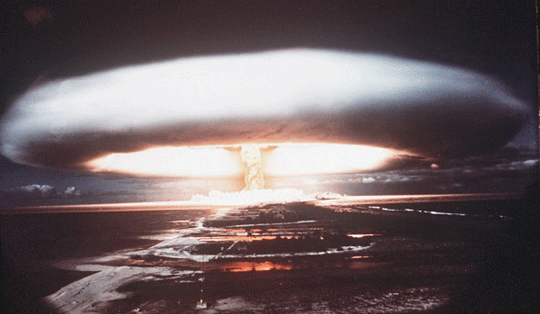
MET President Roland Oldham told ABC’s Radio Australia Pacific Beat program that the issue was detailed in a leaked report from the French Ministry of Defence and should have been made public long ago.
Mr Oldham said if the atoll were to collapse, radioactive material would be released into the Pacific Ocean, and could cause a 15-metre tsunami. “Just in that little area, there is over maybe 12 underground tests in that area, and we have to remember that France have done
altogether 193 nuclear test explosions in Mururoa,” he told Pacific Beat.
“In the soil of Mururoa, if something happens there are about 150 holes containing very dangerous radioactivity.” Continue reading
U.S. To Provide Access To Marshall Islands Nuclear Test Documents
Marshalls maintains demand for full disclosure of classified information By Giff Johnson SAIPAN, CNMI (Marianas Variety, Aug. 8, 2012) – In response to a strong statement of concern from the Marshall Islands government about the lack of access to classified information about United States nuclear testing in this western Pacific nation more than 50 years ago, a top State Department official has promised to initiate a review of data available for public release.
“Some documents provided in the past were so heavily redacted as to make them unreadable,” said Assistant Secretary of State for East Asian and Pacific Island Affairs Kurt Campbell at a media conference after meeting with President Christopher Loeak in Majuro Thursday evening. “It is fair to ask the United States to see if we’ve provided the Marshall Islands with the information it needs to understand more fully (the nuclear test legacy).”…. http://pidp.org/pireport/2012/August/08-08-09.htm
Solar power gives energy independence to Pacific Island Tokelau
Island nation of Tokelau gets ready to go solar Gizmag, By Antonio Pasolini, July 30, 2012 Adopting renewable energy sources such as solar and wind power is a great way to reduce emissions and produce energy locally.

In places like remote Pacific islands, however, those benefits are potentially a key to independence. For that reason Tokelau, a 10 sq. km. (3.86 sq. mi) island nation that lies around 500 km (311 mi) north of Samoa and which is a territory of New Zealand, is about to ditch diesel as a source of electricity and switch to solar power. Continue reading
Stolen vehicle contained radioactive material
Nuclear material on stolen ute TVNZ July 21, 2012 Police fear radioactive material could be released from a nuclear density metre on a utility stolen in Christchurch. Continue reading
New Zealand art show a reminder of that country’s proud anti nuclear history
Her first-hand experiences and those of her fellow protesters feature in an anti-nuclear exhibition called Blast! Pat Hanly – The Painter and His Protests, on now at the Voyager New Zealand Maritime Museum….. Blast! is a travelling exhibition featuring the paintings
of anti-nuclear artist Pat Hanly and his wife Gil Hanly’s photographs.
 Memories of anti-nuclear era Western Leader, Auckland NZ NICOLA MURPHY 19 July 12, PEACE PROTESTER: Jody Lusk doesn’t regret participating in New Zealand’s anti-nuclear protests, despite getting injured after attacks by French police. Continue reading
New Zealand to do limited testing of soldiers for depleted uranum poisoning
Kiwi soldiers tested for uranium poisoning, TVNZ June 25, 2012 Soldiers returning from Afghanistan are having urine tests to check if they have absorbed radioactivity from American depleted uranium munitions…. The issue will come before Parliament on Wednesday during the first reading of the Depleted Uranium (Prohibition) Bill, backed by Labour MP Phil Twyford. Continue reading
Renewable energy pledge of the small Pacific island nations
Pacific pledge to switch to renewable energy, June 15, 2012 http://www.abc.net.au/news/2012-06-15/pacific-ministers-commit-to-renewable-energy/4006638 Pacific Island nations have pledged to dump diesel and similar fuels they use to produce energy and replace them with renewable power sources.
Tuvalu, Tokelau and Cook Islands’ leaders outlined their renewable energy targets this week. The Deputy Prime Minister of Tuvalu, Kausa Natano has told Pacific Beat the implementation of renewable energy schemes in small island states is very important. ”I think everyone’s supported the idea of energy efficiency as it will save a lot of funds from their budgets and could be used for other social developments in respective countries,” he said.
“We had some donor partners – Denmark, Norway, the United Kingdom – that actually also made the commitment to support these small island states as they move forward to try and support the transformation of their societies.”
He says donor partners – Denmark, Norway and the United Kingdom – have committed to support the small island states in their transformation.
African and Islander nations going for small scale, off-grid, renewable technology
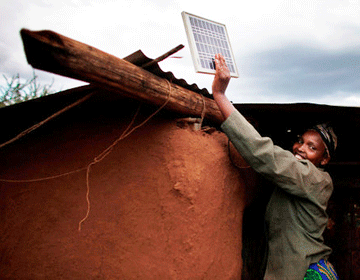 Africa: First African Renewable Energy Confab in Accra All Africa, BY AYUUREYISIYA KAPINI ATAFORI, 8 JUNE 2012 “….Off-grid technology is extremely important throughout Africa with many of the continent?s inhabitants without access to the grid.
…….A pioneering role in renewable energy development in Africa has been taken by Cape Verde. The West African islands have set a goal of 50 per cent renewable energy by 2020. Abrao Andrade Lopez, Director General of the Ministry of Industry and Energy, announced that the country was currently running a study to explore how to achieve 100 per cent renewable energy.
In a related development, decreasing dependency on oil imports encouraged 39 of the small island developing states (SIDS) in Africa, the Caribbean, the Indian Ocean and the Pacific to meet in Barbados to work out energy efficiency plans.
Islands like Tonga and Tokelau plan to become fully energy independent by 2013, and others are following suit. The small island developing states are writing the stories of their future, said Veerle Vandeweerd, Director of Environment and Energy at the United Nations Development Programme (UNDP). Continue reading
Distributed solar energy plan launched in the Philippines
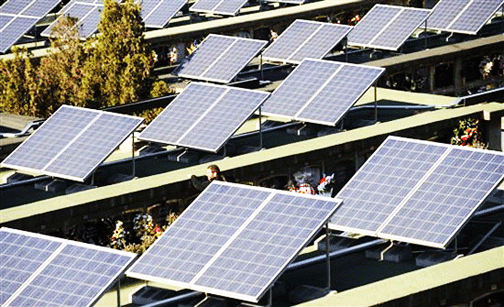 Such facilities in the Philippines should be installed mostly on rooftops because there is a lot of arable and productive land which should be used for food production rather than for solar power generation,
Rooftop solar power project launched to prove viability, Business World, 5 June 12, THE ASIAN Development Bank (ADB) said yesterday it expects solar power capacity in the Philippines to reach up to 115 megawatts (MW) by next year, as it launched yesterday its solar rooftop facility to prove the viability of this renewable energy thrust.
The multilateral lender said it estimates most of solar projects in the country will consist of small clusters that generate lower capacities of electricity rather than large facilities. ADB installed 2,040 solar panels on its rooftop which can generate around 500 kilowatts of energy or around 613 MW a year. Continue reading
Renewable energy chosen by island nations
 Climate Conversations – Island nations commit to renewable energy Alert Net By Veerle Vandeweerd, 11 May 12, Jamaica is a nation on a mission for sustainable energy for all. The government spent $2.2 billion – or 40 percent – of its foreign exchange earnings on
importing fossil fuels in 2011. So they decided to make a change.
They turned to the nature around them – the sunshine, waterfalls and rivers – investing in renewable energy. By 2030, 30 percent of Jamaica’s energy will come from renewables. Continue reading
Low income households to get free solar power
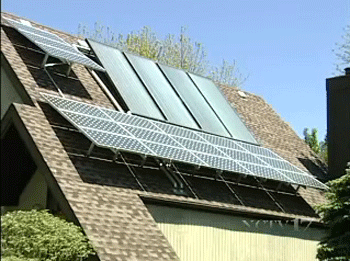
 Free Solar Power Systems For Cayman Islands Households, Energy Matters, 30 April 12, The Cayman Islands government is taking an interesting approach to helping low income families battle increasing electricity costs – by providing free solar panel systems.
Cayman Islands’ Premier, the Hon. McKeeva Bush, OBE, JP announced last week a free solar energy programme for 1500 households that will generate electricity bill savings of nearly 70% for beneficiaries and ensure these families will always have access to electricity for basic applications.
The $15 million programme will not only benefit the households, but also generate between 150 – 200 new job opportunities for Caymanians.
“We will be using reliable data from the Economic and Statistics Office, the Electricity Regulatory Authority and the Department of Social Services, in order to target those in most need of assistance. We will ensure that the myth is broken that renewable energy is only for the very wealthy and elite!” said Premier Bush. The Cayman Islands government has been pushing renewables uptake since revising its Electricity Regulatory Authority Law in 2010. A pilot feed in tariff program was launched in 2011, paying AUD 42c per kilowatt hour for all solar electricity produced by a system.
The Cayman Islands has a special interest in low emissions electricity generation. Like many small island nations around the world, the Caymans currently has a high dependence on electricity generated with expensive imported fossil fuels and is especially vulnerable to the projected impacts of climate change. The island of Grand Cayman was hit by Hurricane Ivan in 2004, flooding many areas and damaging an estimated 95% of the buildings on the island…. http://www.energymatters.com.au/index.php?main_page=news_article&article_id=3183
1 This Month

of the week – Shut Down Drone Warfare!


Tell the Ukrainian Government to Drop Prosecution of Peace Activist Yurii Sheliazhenko

Petition to revoke the licensing of the Near Surface Nuclear Disposal Facility (NSDF) at Chalk River. https://www.ourcommons.ca/petitions/en/Petition/Details?Petition=e-7247
To see nuclear-related stories in greater depth and intensity – go to https://nuclearinformation.wordpress.com
-
Archives
- April 2026 (19)
- March 2026 (251)
- February 2026 (268)
- January 2026 (308)
- December 2025 (358)
- November 2025 (359)
- October 2025 (376)
- September 2025 (257)
- August 2025 (319)
- July 2025 (230)
- June 2025 (348)
- May 2025 (261)
-
Categories
- 1
- 1 NUCLEAR ISSUES
- business and costs
- climate change
- culture and arts
- ENERGY
- environment
- health
- history
- indigenous issues
- Legal
- marketing of nuclear
- media
- opposition to nuclear
- PERSONAL STORIES
- politics
- politics international
- Religion and ethics
- safety
- secrets,lies and civil liberties
- spinbuster
- technology
- Uranium
- wastes
- weapons and war
- Women
- 2 WORLD
- ACTION
- AFRICA
- Atrocities
- AUSTRALIA
- Christina's notes
- Christina's themes
- culture and arts
- Events
- Fuk 2022
- Fuk 2023
- Fukushima 2017
- Fukushima 2018
- fukushima 2019
- Fukushima 2020
- Fukushima 2021
- general
- global warming
- Humour (God we need it)
- Nuclear
- RARE EARTHS
- Reference
- resources – print
- Resources -audiovicual
- Weekly Newsletter
- World
- World Nuclear
- YouTube
-
RSS
Entries RSS
Comments RSS
 nuclear-news