U.N. Decolonization Committee adopts French Polynesia Resolution
U.N. Decolonization Committee adopts French Polynesia Resolution, Overseas Territories Review , 3 July 16
 Recognized the significant health and environmental impacts of nuclear testing conducted by the administering Power in the Territory over a 30-year period.
New climate change strategy adopted by Small Pacific Island States
Small Island States adopt new climate change strategy http://www.radionz.co.nz/international/pacific-news/307877/small-island-states-adopt-new-climate-change-strategy The Forum Secretariat’s Alfred Schuster, 4 July 16 The Small Island States of the Pacific Islands Forum have adopted a new climate change strategy to ensure their vulnerabilities are addressed as part of the regional policy agenda.
The strategy was agreed to by leaders from the Cook Islands, Kiribati, Marshall Islands, Nauru, Palau and Tuvalu at a meeting last week in Palau.
The Forum Secretariat’s Development Co-operation Advisor, Alfred Schuster, says addressing climate change is one of the top priorities of the strategy.
He says the Small Island States want to band together when applying for climate change mitigation funding from the United Nations.
“It’ll be a new approach, from what we understand a joint proposal of countries and governments hasn’t yet been brought to the attention of the Green Climate Fund. But we’d like to think it’s a much more strategic way in light of the administrative burden and administrative requirements of the Green Climate Fund to generate the sort of revenue that’s required by the SIS.”
Pacific Island of Kiribati faces eventual inundation, as searises
A Remote Pacific Nation,Threatened by Rising Seas

Text by MIKE IVES Photographs and video by JOSH HANERJULY 2, 2016“…..For years, scientists have been predicting that much of Kiribati may become uninhabitable within decades because of an onslaught of environmental problems linked to climate change. And for just as long, many here have paid little heed. But while scientists are reluctant to attribute any specific weather or tidal event to rising sea levels, the tidal surge last winter, known as a king tide, was a chilling wake-up call.
Pacific island nations are among the world’s most physically and economically vulnerable to climate change and extreme weather events like floods, earthquakes and tropical cyclones, the World Bank said in a 2013 report. While world powers have summit meetings to negotiate treaties on how to reduce and mitigate carbon emissions, residents of tiny Kiribati, a former British colony with 110,000 people, are debating how to respond before it is too late.
Much of Kiribati, a collection of 33 coral atolls and reef islands scattered across a swath of the Pacific Ocean about twice the size of Alaska, lies no higher than six feet above sea level. The latest climate models predict that the world’s oceans could rise five to six feet by 2100. The prospects of rising seas and intensifying storms “threaten the very existence and livelihoods of large segments of the population,” the government told the United Nations in a report last year. Half of the 6,500-person village of Bikenibeu, for instance, could be inundated by 2050 by sea-level rises and storm surges,according to a World Bank study.
The study lays out Kiribati’s future in apocalyptic detail. ……
a 2011 government-commissioned report cast doubt on whether the World Bank project helped Kiribati prepare for climate change. And while the mangroves and water management plans have helped, a 2014 study said the first round of sea walls, made of sandbags, had proved counterproductive and caused more erosion.
“Adaptation is just this long, ugly, hard slog,” said the study’s lead author, Simon Donner, a professor of geography at the University of British Columbia in Vancouver. “The idea that an outside organization can just come in with money, expertise and ideas and implement something easily is naïve. What you need is consistent, long-term funding — the type of stuff that’s hard to pull off with development aid.”….
migration may become increasingly important. Mr. Tong said he hoped to prepare his people to move with job-training programs that would meet standards recognized in Australia and New Zealand. “The science of climate change is not 100 percent precise,” he said in the interview. “But we know without any argument that, in time, our people will have to relocate unless there are very, very significant resources committed to maintain the integrity of the land…..”http://www.nytimes.com/2016/07/03/world/asia/climate-NYT, change-kiribati.html?
Fiji making its mark in renewable energy
Solar energy: Innovative start-up puts Fiji ahead on renewable energy, ABC News, 1 July 16 By Pacific economic and business reporter Jemima Garrett Fiji is making its mark as a leader in renewable energy thanks to an innovative start-up company focusing on supplying energy to the corporate sector.
Sunergise is the brain-child of entrepreneurs from Africa and the Pacific and has attracted investment interest from the World Bank as well as from Australia, New Zealand, North America and China……..
The installation of the first 700 photovoltaic cells at the marina was completed in 2012, just two days before Cyclone Evan hit, with winds gusting up to 270 kph.
Only one panel was damaged.
Sunergise has since completed two more installations at the Port of Denarau, creating the biggest marina-based solar plant in the world.
Australia ‘well behind’
In Australia, corporate solar is lagging behind residential investment and Sunergise is something advocacy group Solar Citizens would like to see more of.
“Australia leads the world in terms of residential roof-top solar,” Solar Citizen consumer campaigner Reece Turner said.
“Mums and dads have invested $8 billion of their own money in solar panels in just the last six or seven years. But we are well behind in the commercial space; comparatively we are probably 20th or 30th in the world in terms of commercial solar.
“That is where we are seeing some of the growth now but we really need to incentivise that uptake of commercial solar.”
We sell energy’
Sunergise’s business model is to focus on blue chip corporate clients and to own and operate the infrastructure they put on their roof.
“We don’t sell solar panels, we sell energy,” Sunergise chairman Bob Lyon said.
“We install the panels, the clients get an instant discount on their power, they don’t pay anything [for the infrastructure].”
Sunergise sells contracts that run for 10 or more years, with the client enjoying an initial saving of about 10 per cent and certainty on their power costs for the full term of the contract.
One of Fiji’s top hotels, the Tokoriki Island resort, uses Sunergise’s solar power technology and has cut its power bill by 50 per cent and silenced its expensive diesel generators.
The World Bank’s International Finance Corporation, its private sector arm, made its decision to take a 20 per cent stake in Sunergise based on the skills of its people………http://www.abc.net.au/news/2016-06-30/innovative-start-up-puts-fiji-ahead-on-renewable-energy/7557594
French Polynesia at UN presses case for compensation for nuclear tests
French Polynesia goes to UN over nuclear compensation http://www.radionz.co.nz/international/pacific-news/307569/french-polynesia-goes-to-un-over-nuclear-compensation, 29 June 16, A legislator from French Polynesia has appeared at the United Nations pressing the territory’s case for compensation over nuclear testing.
Richard Tuheiava appeared before the UN Committee on Decolonisation, in an effort to bring the issue to international attention.
The French Government has compensated just a handful of French Polynesians who suffered from exposure to radiation after thirty years of tests in the territory’s vicinity.
Mr Tuheiava said France should compensate the territory as well as individuals.
“The fact is since the nuclear testing most of the diseases were cancer, leukaemia. Most of the diseases were as a result of the nuclear testing, so we collectively also put a request for the state of France, the colonial power to not only compensate directly the veterans, but also compensate this fund, this public health care fund.”
Richard Tuheiava said he has serious doubts about whether anything will come from the negotiations, but at least the truth is being exposed on a global stage.
Earlier this year during a visit to the territory, the French president Francois Hollande acknowledged that the weapons tests had an environmental impact with consequences for people’s health.
He promised to revisit the way compensation claims are being treated.
Island states most at risk of global warming impact – Maldives want action
 Maldives urges rich countries to rapidly ratify Paris climate agreement
Environment and energy minister of small island state, one of the countries most at risk of global warming impacts, says ‘no time to waste’ on Paris deal, Guardian, Fiona Harvey, 21 June 16 Rich countries must ratify the climate change agreement reached in Paris last December, one of the world’s most at-risk nations has warned.
Thoriq Ibrahim, environment and energy minister of the Maldives, told the Guardian that there was “no time to waste”, in ratifying the agreement that was reached more than six months ago, and that it should be a matter of urgency for industrialised countries.
So far, almost the only countries to have passed the accord into law are the small islands most at risk from rising sea levels, and other smaller developing nations.
France became the first large industrialised nation to ratify the Paris agreementonly earlier this month, although a ceremony was held in New York in April at which countries were supposed to affirm their commitment to the international agreement…….https://www.theguardian.com/environment/2016/jun/21/maldives-urges-rich-countries-to-rapidly-ratify-paris-climate-agreement
Parts of Philippines May Submerge Due to Global Warming
More than 167,000 hectares of coastland – about 0.6% of the country’s total area – are projected to go underwater in the Philippines, especially in low-lying island communities. …
The Philippines government has been forced to take this into consideration. The Department of Environment and National Resources has its own climate change office, which has set up various programs to educate communities in high-risk areas. …
But soon, adaptation on a local level won’t be enough. Policy makers need to convince governments to curb their emissions on a global level. https://www.sciencedaily.com/releases/2016/06/160606101406.htm
Alarmingly high levels of radiation remain at Bikini Atoll
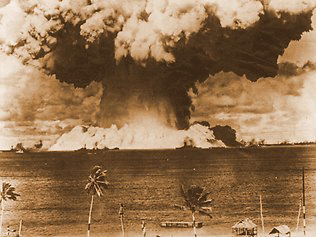 Bikini Atoll radiation levels remain alarmingly high https://www.sciencenews.org/article/bikini-atoll-radiation-levels-remain-alarmingly-high New measurements made decades after Pacific island used to test nuclear bombs BY THOMAS SUMNER , JUNE 6, 2016
Radioactive material such as cesium-137 currently produces, on average, 184 miLLIREMS OF RADIATION PER YEAR ON BIKINI ATOLL. AND SOME PARTS OF THE ISLAND HIT 639 MILLIREMS PER YEAR, RESEARCHERS REPORT ONLINE THE WEEK OF JUNE 6 IN THE PROCEEDINGS OF THE NATIONAL ACADEMY OF SCIENCES. THOSE MEASUREMENTS, MADE LAST YEAR, SURPASS THE 100 MILLIREMS PER YEAR SAFETY STANDARD SET BY THE UNITED STATES AND THE REPUBLIC OF THE MARSHALL ISLANDS, WHICH CONTROLS THE ISLAND.
Scientists had predicted that, by now, radiation levels would have dropped to 16 to 24 millirems per year. But those estimates came from extrapolating from measurements made in the 1970s. The mismatch probably stems from incorrect assumptions about how rapidly radioactive material washes off the island, proposes study coauthor Emlyn Hughes, a physicist at Columbia University.
Whether the higher radiation levels pose a serious health risk to caretakers who live on the island for part of the year depends on how long they stay on the island and whether the local fruit they eat is safe, Hughes says.
Wind power and solar replacing diesel on Galapagos
Wind turbines on Galapagos replace millions of liters of diesel since 2007, meet 30 percent of energy needs World’s top utilities hand over project keys, chart path for Ecuador’s famously biodiverse archipelago to meet 70 percent of fast-rising energy needs with renewables, Eureka Alert, 29 May 16.
GLOBAL SUSTAINABLE ELECTRICITY PARTNERSHIP A global renewable energy project on the Galapagos Islands — one of Earth’s most fragile and important ecological treasures — has helped avoid many tanker loads worth of risky diesel fuel imports since 2007, reduced the archipelago’s greenhouse gas emissions and preserved critically endangered species.
Now, after eight successful years, the project’s new operators are pursuing an ambitious expansion that would multiply the benefits of renewable energy for this remote, precious archipelago with a growing appetite for electricity.
A performance summary and recommendations for the expansion are contained in a new report by the Global Sustainable Electricity Partnership (GSEP), a not-for-profit association of 11 of the world’s foremost electricity firms, which led and financed the $10 million project.
The project’s three 51-metre-tall wind turbines and two sets of solar panels have supplied, on average, 30% of the electricity consumed on San Cristóbal, the archipelago’s second-largest island in size and population, since it went into operation in October 2007.
During that time, it has displaced 8.7 million litres (2.3 million gallons) of diesel fuel and avoided 21,000 tonnes of carbon dioxide emissions, the GSEP report states. The achievements have led to awards from Power Engineering Magazine, World Energy Forum, and Energy Globe.
The proposed expansion could boost the renewable energy share to 70 per cent, en route to a hoped-for elimination of fossil fuels, the report states. It could also be a template for energy development elsewhere in the Galapagos chain — where renewable sources now account for 20% of electricity production — and elsewhere around the world……..http://www.eurekalert.org/pub_releases/2016-05/tca-wto052016.php
Lawsuit on Bikini Atoll nuclear tests
Revisiting Bikini Atoll nuclear tests Japan Times, 15 May 16 A recent lawsuit filed by former crew members and relatives of deceased crew members of fishing boats operating near the area where the United States conducted a series of nuclear weapons tests in the Pacific in 1954 — seeking compensation from the Japanese government over its questionable behavior at the time and in subsequent years — carries historical significance. More than six decades after the hydrogen bomb tests at Bikini Atoll in the Marshall Islands, beginning with a test explosion code-named Castle Bravo on March 1, 1954, the lawsuit will help shed fresh light not only on the scope of radiation exposure for Japanese fishermen but also on whether the Japanese and U.S. governments acted properly to deal with the consequences of the fallout from the tests.
Even before the court proceedings begin, the omission on the part of the Japanese government seems clear — its failure to properly examine and keep track of the potential damage to the fishermen’s health and nondisclosure for decades of the records of their radiation exposure.
In connection with the 15-megaton Castle Bravo test, which was over 1,000 times more powerful than the atomic bomb dropped on Hiroshima on Aug. 6, 1945, the tragedy of the tuna trawler Fukuryu Maru No. 5, also known as the Lucky Dragon, is widely known. The fallout from the test fell onto the vessel for a few hours, causing its 23 crew members to suffer nausea. By the time they returned to their home port of Yaizu, Shizuoka Prefecture, two weeks later, they had developed serious symptoms of radiation sickness, and the radio operator, Aikichi Kuboyama, died six months later. The Fukuryu Maru incident sowed the seed for civic anti-nuclear movements in Japan.
The islanders suffered a great deal. The H-bomb tests contaminated many areas of the Marshall Islands so badly that they became unlivable. The tests destroyed the culture of the islands and irradiated thousands of people. In the years after the tests, the U.S. told evacuated islanders that it was safe to return. But many returning residents were exposed to contaminated water, air and food due to the false assurance.
The plaintiffs in the lawsuit, the first legal action seeking state compensation over the 1954 H-bomb tests, are former crew members of fishing boats other than the Fukuryu Maru that were operating in the area around the time of the tests and family members of fishermen who have since died. Most of the fishing boats were from Kochi Prefecture……
With the lawsuit, the plaintiffs will try to bring to light the government’s omission, including its failure to conduct follow-up health surveys on the crew members and to pay compensation to those who fell ill due to causes linked to the radiation exposure. Several of the former fishermen died of cancer — although it will be difficult to establish the causal relationship because so much time has passed. At least the court proceedings should shed light on how the government acted when it negotiated the settlement with the U.S. over the Fukuryu Maru incident — as well as on why the records of the radiation exposure suffered by other Japanese fishermen were kept undisclosed for so long and why no follow-up checks on the fishermen’s health were made. http://www.japantimes.co.jp/opinion/2016/05/15/editorials/revisiting-bikini-atoll-nuclear-tests/#.VzjsOTV97Gg
Nuclear shipwreck still highly radioactive over 60 years later
Details Emerge from Cold War-Era Nuclear Shipwreck, New Historian, David DeMar May 01, 2016 More details have emerged regarding the wreck of the USS Independence, a US Navy vessel deliberately sacrificed in 1946 at the Bikini Atoll nuclear weapons tests at the very inception of the Cold War…….
NOAA and Boeing used a combination of high-resolution sonar imaging and an unmanned submersible known as “Echo Ranger” to locate and safely survey the still-irradiated wreck of the Independence. The resultant case study, plus newly declassified files on the Navy ship straight from the US National Archives, concerning its time as a nuclear weapons testbed, have been published in theJournal of Maritime Archaeology (JNA)……
merging documentary evidence with a study of the physical remains of a maritime archaeological site is a goal that can and should be pursued…….
The infamous tests at Bikini Atoll, The Bikini tests, conceived and undertaken just one year after dropping not one but two nuclear weapons on Japan, at Hiroshima and Nagasaki, to end the Second World War, was one of the most visible and noteworthy events to signal a fundamental shift in postwar history.
 In one of the newly-declassified reports dating from the era, it was suggested that the awesome power of nuclear weaponry represented a new era where the utter destruction of man had become possible, scouring the Earth of nothing but vestigial traces of humanity. http://www.newhistorian.com/details-emerge-cold-war-era-nuclear-shipwreck/6397/
Climate Change threatens the already leaking Marshall Islands radioactive dome
This dome in the Pacific houses tons of radioactive waste – and it’s leaking
The Runit Dome in the Marshall Islands is a hulking legacy of years of US nuclear testing. Now locals and scientists are warning that rising sea levels caused by climate change could cause 111,000 cubic yards of debris to spill into the ocean , Guardian Coleen Jose, Kim Wall and Jan Hendrik Hinzel on Runit Island 3 July 2015
“……..Officially, this vast structure is known as the Runit Dome. Locals call it The Tomb.

Below the 18-inch concrete cap rests the United States’ cold war legacy to this remote corner of the Pacific Ocean: 111,000 cubic yards of radioactive debris left behind after 12 years of nuclear tests.
Brackish water pools around the edge of the dome, where sections of concrete have started to crack away. Underground, radioactive waste has already started to leach out of the crater: according to a 2013 report by the US Department of Energy, soil around the dome is already more contaminated than its contents.
Now locals, scientists and environmental activists fear that a storm surge, typhoon or other cataclysmic event brought on by climate change could tear the concrete mantel wide open, releasing its contents into the Pacific Ocean.
“Runit Dome represents a tragic confluence of nuclear testing and climate change,” said Michael Gerrard, director of the Sabin Center for Climate Change Law at Columbia University, who visited the dome in 2010.
“It resulted from US nuclear testing and the leaving behind of large quantities of plutonium,” he said. “Now it has been gradually submerged as result of sea level rise from greenhouse gas emissions by industrial countries led by the United States.”
Enewetak Atoll, and the much better-known Bikini Atoll, were the main sites of the United States Pacific Proving Grounds, the setting for dozens of atomic explosions during the early years of the cold war……..http://www.theguardian.com/world/2015/jul/03/runit-dome-pacific-radioactive-waste
Marshall Islands legal case puts nuclear weapons back on the world agenda
 Tiny Marshall Islands Taking On 3 World Nuclear Powers In Court http://www.npr.org/sections/thetwo-way/2016/03/07/469521887/tiny-marshall-islands-taking-on-3-world-nuclear-powers-in-court
March 8, 2016 MERRIT KENNEDY The Marshall Islands is on an unlikely mission — trying to press India, Pakistan and the United Kingdom to curb their nuclear programs.
The Pacific archipelago, which was the site of dozens of U.S. nuclear tests in the ’40s and ’50s, is suing the three countries in the U.N.’s International Court of Justice. The Marshall Islands says the three countries haven’t carried out in good faith their obligations to pursue negotiations leading to nuclear disarmament.
It says the U.K. is obligated to do so because it is a signatory to the Nuclear Non-Proliferation Treaty. India and Pakistan haven’t signed the NPT, but the Marshall Islands argues that this principle is sufficiently well-enshrined in international law to be considered customary law.”Nobody expects the Marshall Islands to force the three powers to disarm, but the archipelago’s dogged campaign highlights the growing scope for political minnows to get a hearing through global tribunals,” Reuters reports.
So why isn’t the Marshall Islands suing the U.S., the country that was actually testing its nukes on their territory? The short answer: It tried. As the Two-Way reported when the case was filed in 2014, the island chain attempted to file suit against all nine countries believed to possess a nuclear arsenal:
“Besides the U.S., the Marshall Islands is also suing Russia, China, France and the U.K., which have all signed the Non-Proliferation Treaty, or NPT, as well as four other countries that have never signed — India, Pakistan, North Korea and Israel, which has never acknowledged possessing nuclear weapons. …
“In court documents, the Marshall Islands argues that the 1968 NPT, which did not come into force until 1970, amounts to a compact between nuclear haves and have-nots. Non-weapons states essentially agreed not to try to acquire nuclear weapons in exchange for weapons states moving toward disarmament, the Marshalls says.”
However, only the cases against India, Pakistan and the U.K. are still proceeding. That’s because these are the only three countries that have “made a commitment to respond to suits brought at the ICJ,” Reuters reports. Preliminary hearings against India started on Monday in The Hague, with sessions on Pakistan and the U.K. scheduled in the coming weeks.
The Marshall Islands is pursuing global disarmament as a result of its “particular awareness of the dire consequences of nuclear weapons,” according to court documents.In 2014, the Two-Way reported on the lasting impact of those tests:
“Although islanders were relocated from Bikini and Eniwetok atolls — ground zero for the majority of the tests — three other Marshall atolls underwent emergency evacuations in 1954 after they were unexpectedly exposed to radioactive fallout. The Marshallese say they’ve suffered serious health issues ever since.
“The Marshall Islands were governed by the U.S. until 1979 and won full independence in 1986.”
The International Court of Justice hasn’t issued an opinion on nuclear weapons since 1996. As Dapo Akande, professor of international law at Oxford University, tells Reuters: “The success will be in putting the issue back on the agenda. … This is as much as the Marshall Islands can hope for.”
Pacific islands take on the world’s nuclear powers in court action
Tiny Marshall Islands take on world nuclear powers in court, SMH, March 5, 2016 Amsterdam: A small chain of Pacific islands will face off against Britain, India and Pakistan in court next week to try and get an international ruling ordering them to start work on dismantling their nuclear arsenals.
While nobody expects the Marshall Islands to force the three powers to disarm at Monday’s hearing, the archipelago’s dogged campaign at the International Court of Justice highlights the growing scope for political minnows to get a hearing through global tribunals.
All three are expected to argue that the Marshall Islands’ claims are beyond the Hague court’s jurisdiction and should be thrown out. But many activists and academics believe getting them into court is a victory in itself.
The island republic, a US protectorate until 1986 and home to just 50,000 people, was the site of 67 nuclear tests by 1958, the health impacts of which linger to this day……
In another David-and-Goliath case, the Pacific island state of Palau, that is threatened by rising sea levels, is pushing for the United Nations General Assembly to ask the ICJ for an advisory opinion on the obligation of the world’s nations to combat climate change. http://www.smh.com.au/world/tiny-marshall-islands-take-on-world-nuclear-powers-in-court-20160305-gnbacp.html#ixzz429kkshuW
France promises more compensation to Pacific nuclear test victims
France pledges more compensation for Polynesia nuclear tests http://www.reuters.com/article/us-france-nuclear-idUSKCN0VV1XW, 28 Feb 16 PAPEETE, FRENCH POLYNESIA Residents of French Polynesia who suffered due to 30 years of French nuclear tests in the Pacific archipelago have a legitimate right to compensation, President Francois Hollande said on his first visit to the region on Monday.
The sensitive issue of reparations for damage caused by the atomic testing between 1966 and 1996 at Mururoa Atoll is top of the agenda of Hollande’s tour of French Pacific territories. “If France is what it is today, with this deterrent capability, it is because there were nuclear tests for a very long period,” he said on arrival in Papeete.
“It’s quite legitimate that France should make good for a number of consequences, whether social, health-related or economic,” he said in a joint news conference with Polynesian president Edouard Fritch.
Regional authorities say compensation approved by a 2010 law has been slow to arrive. An anti-nuclear pressure group said only 19 people, of whom just five Polynesians, had received payments.
An annual 150 million euro ($165.2 million) subsidy fixed when President Jacques Chirac ended nuclear tests in 1996 is set to shrink to 84 million euros this year.
Employers and trade unions that manage the regional health fund are demanding 450 million euros in costs for treating people they say are suffering from cancer due to radiation.
(Reporting by Daniel Pardon; Writing by Paul Taylor)
1 This Month

of the week – Shut Down Drone Warfare!


Tell the Ukrainian Government to Drop Prosecution of Peace Activist Yurii Sheliazhenko

Petition to revoke the licensing of the Near Surface Nuclear Disposal Facility (NSDF) at Chalk River. https://www.ourcommons.ca/petitions/en/Petition/Details?Petition=e-7247
To see nuclear-related stories in greater depth and intensity – go to https://nuclearinformation.wordpress.com
-
Archives
- March 2026 (251)
- February 2026 (268)
- January 2026 (308)
- December 2025 (358)
- November 2025 (359)
- October 2025 (376)
- September 2025 (257)
- August 2025 (319)
- July 2025 (230)
- June 2025 (348)
- May 2025 (261)
- April 2025 (305)
-
Categories
- 1
- 1 NUCLEAR ISSUES
- business and costs
- climate change
- culture and arts
- ENERGY
- environment
- health
- history
- indigenous issues
- Legal
- marketing of nuclear
- media
- opposition to nuclear
- PERSONAL STORIES
- politics
- politics international
- Religion and ethics
- safety
- secrets,lies and civil liberties
- spinbuster
- technology
- Uranium
- wastes
- weapons and war
- Women
- 2 WORLD
- ACTION
- AFRICA
- Atrocities
- AUSTRALIA
- Christina's notes
- Christina's themes
- culture and arts
- Events
- Fuk 2022
- Fuk 2023
- Fukushima 2017
- Fukushima 2018
- fukushima 2019
- Fukushima 2020
- Fukushima 2021
- general
- global warming
- Humour (God we need it)
- Nuclear
- RARE EARTHS
- Reference
- resources – print
- Resources -audiovicual
- Weekly Newsletter
- World
- World Nuclear
- YouTube
-
RSS
Entries RSS
Comments RSS
 nuclear-news