Pearl Harbor update brings nuclear risk
Star Advertiser March 30, 2025, Lynda Williams
Kevin Knodell’s recent article highlights the significance of Dry Dock 5 at Pearl Harbor, but omits a critical detail: this facility is set to host the U.S. Navy’s most lethal nuclear-powered and nuclear-armed submarines (“‘An emphasis on lethality,’” Star-Advertiser, March 23).
This will likely transform Hawaii’s role in the U.S. nuclear arsenal by accommodating Ohio-class and, eventually, Columbia-class ballistic missile submarines, each capable of carrying Trident missiles with multiple nuclear warheads.
The detonation of even a single modern warhead could result in millions of deaths and potentially trigger a nuclear winter, devastating the global biosphere.
An accident on such a submarine near Pearl Harbor would be catastrophic and could cause widespread contamination across Hawaii. Hawaii’s residents were not consulted about housing nuclear-armed submarines in Honolulu. Please do not whitewash or sugarcoat the dangers associated with housing these submarines in our community……………………………………….. https://lyndalovon.blogspot.com/2025/03/my-op-ed-in-honolulu-star-advertiser.html?m=1&fbclid=IwY2xjawJYOxdleHRuA2FlbQIxMQABHXmnePII2HU6StRh1n7LgFionyc9TcmHIMLXETxISQeaZWtElxJvUl_axg_aem_RhuD_LZZLNNZDjuYWl-yGg
‘Never forget’: Pacific countries remember nuclear test legacy as weapons ban treaty debated.
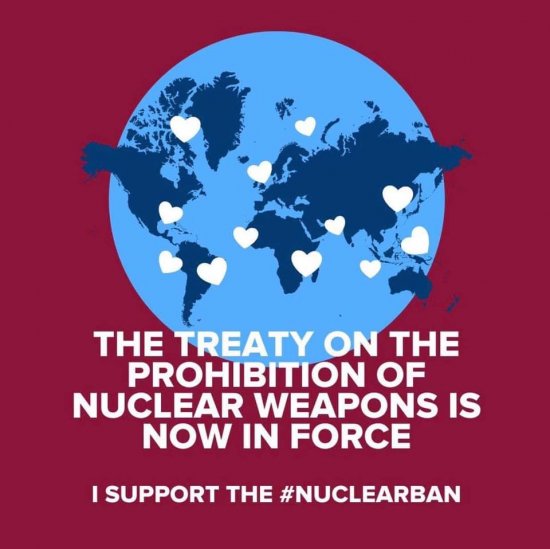
Supporters of the UN treaty prohibiting nuclear weapons gathered this month in New York to call for wider ratification
Jon Letman, Guardian, 21 Mar 25
Growing up in the Pacific nation of Kiribati, Oemwa Johnson heard her grandfather’s stories about nuclear explosions he witnessed in the 1950s. The blasts gave off ferocious heat and blinding light. He told her people were not consulted or given protective gear against bombs detonated by the US and UK at Kiritimati Island, now part of Kiribati, decades ago.
People in Kiribati suffered grave health consequences as a result of exposure to radiation from the tests in the late 1950s and early 1960s, a legacy they say continues to this day. Johnson says there’s a lack of accountability and awareness of how nuclear testing by foreign countries has harmed her people and homeland.
“It doesn’t matter if they’re very small island nations, their stories matter,” the 24-year-old says.
Between 1946 and 1996, the US, the UK and France conducted more than 300 underwater and atmospheric nuclear tests in the Pacific region, according to Pace University International Disarmament Institute. Kiribati, French Polynesia, and the Republic of the Marshall Islands were among the most affected.
For decades the countries have called for justice for the ongoing environmental and health impacts of nuclear weapons development. The push intensified this month as supporters of the UN treaty on the prohibition of nuclear weapons (TPNW) – including many from Pacific nations – met to discuss the treaty and call for wider ratification.
The treaty imposes a ban on developing, testing, stockpiling, using or threatening to use nuclear weapons – or helping other countries in such activities. It entered into force in 2021 and has 98 countries as parties or signatories. In the Pacific region 11 countries have backed the treaty. Treaty supporters want universal global support but many countries – including the US, the UK and France – oppose the treaty.
The nine nuclear armed countries argue that nuclear weapons are critical to their security. Likewise, Nato nations, Japan, South Korea and others are not yet party to the treaty. Australia, where the UK conducted nuclear tests in the 1950s, has not ratified the TPNW despite the prime minister, Anthony Albanese, saying in 2018 that Australia would do so the treaty when his party was in power…………………………..
‘Nuclear risks rising’
Against this backdrop, politicians, activists and other representatives gathered at UN headquarters in New York this month for week-long discussions on how to secure more support for the TPNW.
Hinamoeura Morgant-Cross, a representative of the French Polynesia assembly, was among the parliamentarians. She says her family was significantly affected by French nuclear detonations at Moruroa and Fangataufa atolls between 1966 and 1996. Morgant-Cross told the forum high rates of radiation-induced cancer in her family had motivated her to become an anti-nuclear activist and assembly member.
“It started with my grandma with thyroid cancer,” she said. “Then her first daughter – my auntie – with thyroid cancer. She also got breast cancer. My mom and my sister have thyroid disease. I got chronic leukemia when I was 24 years old. I’m still fighting against this leukemia.”
New Zealand’s UN representative in Geneva, Deborah Geels, stressed the treaty’s “special importance in the Pacific”, warning: “Tensions between nuclear-armed states and nuclear risk are rising, and no region is immune – even the South Pacific.”……………………………….. more https://www.theguardian.com/world/2025/mar/21/never-forget-pacific-countries-remember-nuclear-test-legacy-as-weapons-ban-treaty-debated
Air Force picks remote Pacific atoll as site for cargo rocket trials.

COMMENT. Dressed up as “humanitarian aid” blah blah. They never give up until they’ve wrecked every beautiful indigenous home.
By SETH ROBSON STARS AND STRIPES • March 4, 2025
The Department of the Air Force has tagged an isolated Pacific island as a test site for landing rockets capable of delivering tons of cargo anywhere on the planet at lightning speed. The department signaled its intent Monday to build two rocket landing pads on Johnston Island within Johnston Atoll, an unincorporated U.S. territory 717 nautical miles southwest of Honolulu, according to a notice in the Federal Register.
……………………………………………………………In October 2020, Army Gen. Stephen Lyons, at the time the head of the U.S. Transportation Command, told the National Defense Transportation Association that officials were working with Elon Musk’s Space X on rocket cargo deliveries. The Federal Register notice does not mention Space X participation in the trial.
………………..U.S. forces are preparing to disperse across the Indo-Pacific in the expectation of missile attacks on established bases in a conflict with China over Taiwan or in the South China Sea.
To sustain forces across a vast swathe of territory the Air Force has been renovating World War II-era airfields from Micronesia to the Philippines.
………………………..Officials also considered Kwajalein Atoll, Midway Island and Wake Island as rocket landing sites, according to the Federal Register notice states. March 4, 2025
More powerful than Hiroshima: how the largest ever nuclear weapons test built a nation of leaders in the Marshall Islands.
Shiva Gounden and Shaun Burnie , Greenpeace 28th Feb 2025, https://www.greenpeace.org/international/story/65565/nuclear-victims-remembrance-day-united-states-must-comply-with-marshall-islands-demands-for-recognition-and-nuclear-justice/
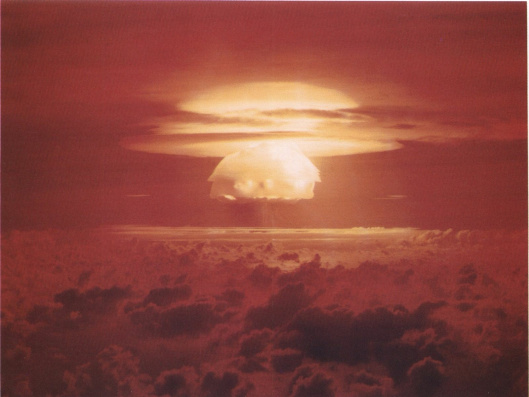
71 years ago, on Bikini Atoll in the Marshall Islands, a nuclear bomb with the codename “Castle Bravo”, exploded with an energy of 15 megatons. The mushroom cloud reached 40 kilometres into the atmosphere, resulting in thousands of square kilometres of the Pacific Ocean being contaminated by radioactivity. Its explosive yield was 1000 times more powerful than the Hiroshima bomb; and within four hours of the explosion, radioactive fallout made up of crushed coral, water, and radioactive particles, rained down over inhabited atolls, including Rongelap Atoll, which was 150 kilometres away. A fine white ash landed on the heads and bare arms of people standing in the open, dissolving into water supplies and drifting into houses. Witnesses of the Bravo nuclear fireball described seeing a second sun rising in the west, just before the terrifying shock waves hit them.
For the people of the Marshall Islands, that day on March 1 1954 will forever be known as Remembrance Day – the anniversary of Castle Bravo, the largest ever nuclear weapons ‘test’ conducted by the United States military.
In the 1950s, after the explosion, U.S. government scientists warned that the people of Marshall Islands were subjected to “high sub-lethal dose of gamma radiation, extensive beta burns of the skin, and significant internal absorption of fission products”. They were subjected to decades of medical experiments run by secretive U.S. laboratories, later to be discovered as “Project 4.1”.
71 years after the detonation, there remains no cancer clinic in the whole country. Many of the citizens still live in permanent exile, with some of the islands vaporised by nuclear weapons, while others remain too radioactive for safe return. The consequences of Castle Bravo have echoed through generations of the people in the Marshall Islands who have been denied the right to justice, proper medical care, and full reparation for loss and damage.
“After centuries of colonial rule, the people of the Marshall Islands and the wider Pacific, were made 20th century victims of a nuclear arms race which for them was never a ‘Cold War’,” said Shiva Gounden, Head of Pacific at Greenpeace Australia Pacific. “But all through this, their decades of resilience, resistance and refusal to be silenced in their quest for nuclear justice, has been an inspiration across generations. The proud people of the Marshall Islands have retained their profound and deep connection to their Pacific home, despite all efforts to destroy that connection through displacement and contamination. That same determination is now evident in their response to the devastating impacts of climate change. The refusal of the U.S. to meet in full their obligations, is matched today by the neo-colonial forces which deny the right of Pacific islanders to climate justice, funds for climate adaptation and mitigation, and financing for loss and damage. Today, we pay our deepest respects to the people of the Marshall Islands and their demands for nuclear and climate justice.”
The Marshall Islands government continues its strenuous efforts to secure compensation and justice from the U.S. government. It received US$150 million in nuclear compensation under its 1986 Compact of Free Association (COFA) with the U.S. The COFA established a tribunal to adjudicate compensation claims. The tribunal sought over US$3 billion in today’s dollars that the U.S. has never paid. In addition the US government has left the Marshallese with a “ticking time bomb” – the Runit Dome. After years of nuclear testing, a concrete dome measuring 114 meters in diameter and filled with radioactive waste has been left to the Marshallese. Climate change and rising sea levels have caused cracks to appear; and since the Marshall Islands independence in the late 70s, the US has absolved all responsibility of the maintenance of the Dome and have left it to the Marshall Islands government.
Like the resilient people of the Marshall Islands who refuse to give up, Greenpeace stands in genuine and deep solidarity by elevating the voices and stories of the communities impacted by the testing of nuclear weapons and the dangers it imposes. As their people are today pursuing those responsible for their suffering through the human rights institutions of the United Nations, Greenpeace will also continue to highlight this injustice. Jimwe im Maron
This article was originally published in 2024, to mark the 70 year anniversary of the Castle Bravo test. In 1957, just three years after the detonation, the people of Rongelap were told by the US government their island was deemed safe and asked to return. Decades later, after experiencing too many health complications and finding the island unsafe to live in, the people of Rongelap asked for assistance from Greenpeace; and in 1985, the Rainbow Warrior helped evacuate them from their home and move them to Mejatto Island.
In 2025, the Rainbow Warrior will be visiting again – this time to support and amplify the Marshall Islands’ courageous ongoing call for justice and fight for systemic change at a global level.
Shiva Gounden is the Head of Pacific at Greenpeace Australia Pacific
Shaun Burnie is International Climate & Nuclear Campaigner for Greenpeace International.
New Zealand’s Rocket Lab ‘ready to serve’ Pentagon

RNZ Phil Pennington, Reporter 19 Feb 25
Rocket Lab is poised to launch a satellite from Mahia Peninsula for a US company which is looking to bolster military and spying operations.
BlackSky’s plan is to add laser optic links later to its Gen-3 satellites to give “war-fighters real-time access to imagery during time-sensitive military operations worldwide”.
This comes shortly after Rocket Lab won a part in a mega-deal to help develop hypersonic weapons for the Pentagon, prompting the firm to state it was “ready to serve the US Department of Defense”.
The New York-listed, New Zealand-born company has also completed a design review for 18 military satellites in a contract worth more than $800 million, for the Proliferated Warfighter Space Architecture (PWSA), which is putting up a web of low-orbit satellites for missile tracking and battlefield comms.
That deal, which was signed last year, cemented Rocket Lab as a “prime” – or lead – defence contractor in the US.
The Mahia launch is set down for some time from Tuesday, and will be the first of several Gen-3s for BlackSky, which has used the site near Gisborne since 2019.
The government last year dismissed pro-Palestinian protesters complaints it breached rules on launches…………………………………..
Six months ago, BlackSky said it would make Gen-3s compatible with military networks. It won a $175m satellite contract with an unnamed international defence customer last month.
Its constellation of small satellites also has civilian uses, such as in mapping natural disasters.
Rocket Lab’s share price in the US has surged since it won big Pentagon contracts………………………………………………………….. more https://www.rnz.co.nz/news/national/542305/rocket-lab-ready-to-serve-pentagon
—
Leaders in the Pacific raise alarm over ‘direct impact’ of Trump’s climate retreat and aid freeze

Leaders and environmental advocates in the Pacific have expressed alarm
over Donald Trump’s decision to withdraw from the Paris climate agreement
and freeze foreign aid, warning the moves will accelerate the existential
threats they face as nations on the frontlines of the climate crisis.
Guardian 1st Feb 2025, https://www.theguardian.com/world/2025/feb/01/leaders-in-the-pacific-raise-alarm-over-direct-impact-of-trumps-climate-retreat-and-aid-freeze
New Zealand is under siege by the Atlas Network
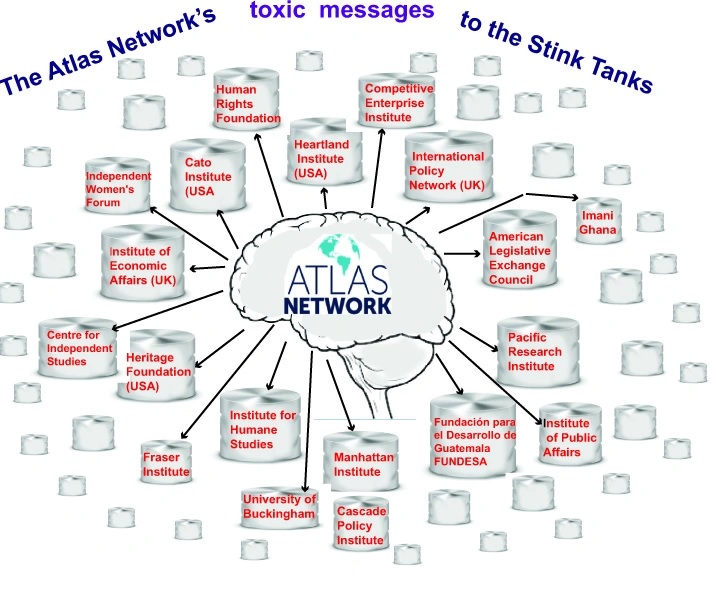
We have a handful of years to achieve a monumental shift from fossil fuel towards renewable energy: Atlas partners aim to ensure this does not take place.

March 3, 2024, by: Lucy Hamilton, https://theaimn.com/new-zealand-is-under-siege-by-the-atlas-network/—
Just as the Atlas Network-connected Advance body intervened in the Voice referendum in Australia and, in recent weeks, a by-election, similar organisations spawned from the American model are distorting New Zealand’s politics from within as well as from without.
One of the key researchers into the Atlas Network, Lee Fang, observed that it has “reshaped political power in country after country.” In America, every Republican president since Ronald Reagan has begun office with a Roadmap provided by the Heritage Foundation, primary Atlas Network partner. The “Mandate” for 2025 puts America on a hard path to fascism should a Republican win in November. Britain’s economy and standing have been savaged by Atlas partners’ impacts on the Tories. In New Zealand, the recently-elected rightwing coalition government is aping the new “Atlas president” of Argentina, aiming to privatise national assets, but is increasingly also imitating Atlas strategies recently seen in Australia, inflaming racial tensions and harming the wellbeing of Māori people.
Dr Jeremy Walker called Australia’s attention to the local Atlas partner organisations’ impact on the Voice to Parliament referendum and is now helping draw together the focus on the New Zealand partners’ very similar distortion of their national debate. There is a deep racism at the heart of this ultra-free market ideology that has licensed the international right to exploit resources and people around the globe untrammelled, largely in American corporate interest, but more broadly for any corporation or allied sector big enough to be a contender. (They do not, by contrast, fight for the renewable energy sector’s interests, as a competitor to their dominant fossil fuel donors; this shapes their climate crisis denial and delay, and colours their loathing of First People’s capacity to interfere with their profits by environment-driven protest. A sense of Western Civilisation as the apex of human existence and deep disdain for non-Western cultures also pervade the network.)
The Atlas model is to connect and foster talent in the neoliberal sphere. Young men (mostly) are funded or trained to replicate the talking points that Ultra High Net Worth Individuals (UHNWI) and lobbyists have built into a global network of over 500 bodies in 100 nations. The fact that neoliberal orthodoxies are more religious ideology that fact-based theories explains why their impact has been so utterly disastrous everywhere they have reshaped societies. The goal is to spawn replicating bodies with benign-sounding names that promote the UHNWI and corporate talking points – but with a veil hiding the self-interest that is obvious when those groups speak for themselves. Some of the bodies feign being thinktanks, which George Monbiot recently renamed junktanks to clarify their disingenuousness. Others are “astroturf” organisations that pretend to be grass roots bodies representing popular opinion. Another model is the beach-head in universities, an independent organisation within those institutions intended to dignify the neoliberal religion and the chosen strategies, including climate denial. All these produce material to fill civic debate and train more acolytes to enter politics, strategy companies and junktanks. Mainstream media elevates their standing by hosting their operatives as experts without explaining that the benign-sounding organisation to which they belong is a foreign-influence operation’s local outlet.
These groups damage local conditions to favour international corporations. They lobby for the removal of the “regulations” that are actually protections for the public – as workers, as consumers, as residents. They push for the privatisation of national treasures so that (often foreign) corporations can exploit the profits at the expense of the public. The greater the damage to the local democracy, the easier it is for them to act unimpeded. The stronger their infiltration of the media, the harder it is for the local electorate to understand the stakes. The politicians and strategists that emerge from the sphere (or are its allies) know that none of this wins votes, so they fill the space with culture war division to distract the voter from paying attention. Race and sexuality are their most obvious targets, as reactionary nostalgia for a mythical past of white picket fences pervades their ideology: a valorisation of “Christianity” and “family” and the “sacredness of marriage” (preached by adulterous politicians) is equally apparent in their propaganda.
The coalition that took power in NZ late in 2023, after a campaign centred on attacking the country’s founding Waitangi Treaty, has considerable Atlas infiltration. There is concern about Atlas fossil fuel and associated tobacco interests perverting policy in parliament, as well as senior ministerial aides who might be compromised. The government has promised to repeal Jacinda Ardern’s ban on offshore gas and fuel exploration, plans to sell water to private interests, not to mention planning to enable the selling off of “sensitive” NZ land and assets to foreign corporations, just as Argentinian Milei is intending.’
One of the government members, the Act Party, began its existence as an Atlas partner thinktank and continues that close connection. It was founded by former parliamentarian Denis Quigley with two members of the Mont Pelerin Society (MPS), the Atlas Network’s inner sanctum. One, Roger Douglas, was responsible for Rogernomics in NZ which has been described as a “right wing coup” that worked to “dismantle the welfare state.” The other, Alan Gibbs, who has been characterised as the godfather of the party, and a major funder, argued Act ought to campaign for government to privatise “all the schools, all the hospitals and all the roads.” This may not be surprising since he made much of his fortune out of the privatisation of NZ’s telecommunications.
The Act Party is currently led by David Seymour who functions as a co-deputy prime minister in the government. He has worked almost his entire adult life within Atlas partner bodies in Canada and boasts a (micro) MBA dispensed by the Network.
In Seymour’s 2021 Waitangi Day speech, he acknowledged his “old friends at the Atlas Network.” In light of that, his recent disdainful and absolute dismissal of the party’s connection to Atlas in an interview was telling: he clearly felt the association was damaging enough to lie outright.
Seymour is also deeply antagonistic to policies dedicated to repairing the disadvantage suffered by Māori people, disingenuously describing provisions that work cooperatively with Māori people as the “dismantling of democracy.” He appears antagonistic to Māori culture.
Another Atlas partner that has been key to distorting debate in NZ is the Taxpayer Union (TPU) which is emblematic of the production of metastasising bodies central to the Atlas strategy. Its co-founder and executive director is another graduate of the Atlas (micro) MBA program. Jordan Williams (currently “capo di tutti capi” of the Atlas global alliance of anti-tax junktanks) laughably depicts Atlas as a benign “club of like-minded think tanks.” He created, however, a body called the Campaign Company which helped radicalise the established farmer power base in NZ politics, planting sponsored material in the media. Williams claimed to grant the farmers “world-class campaign tools and digital strategies.” He also co-founded the Free Speech Union (FSU), which is unsurprisingly fighting regulation of the damaging impact of internet disinformation as well as fostering culture war battles.
A further spin-off of the bodies illustrates the increasing ugliness of the populist strategies. A former Act Party MP has founded the New Zealand Centre for Political Research which is fomenting civic division against Māori interests, including placing hate-mongering advertisements in the media.
The Act Party (alongside the populist New Zealand First party) is at the heart of the coalition government’s intention to destroy NZ’s admirable efforts to promote Māori interests for the betterment of the commonwealth, including the co-governance innovation. Efforts to undo disadvantage and programs that have promoted the distinctive NZ democratic experiment are set to be dismantled. A “massive unravelling” of Māori rights is at stake.
It is not only Māori people who will suffer. The NZ coalition government is also attempting a kind of “shock therapy” that did so much to tip first Chile and then other “developing” nations into brutal pain in pursuit of market “freedom.” The MPS was at the heart of Pinochet’s neoliberal brutality, resulting from Nixon’s injunction to make the Chilean economy scream.[1] New Zealand now faces cuts to a range of services, welfare and disability payments, even while the new PM, one of NZ’s wealthiest ever holders of the role, charged the taxpayer NZD 52,000 to live in his own property. It’s important to remember that this kind of entitlement is the sort that the neoliberals like, alongside subsidies to industry and corporations.
Lord Hannan (one of Boris Johnson’s elevations to the peerage, and a junktank creature) recently spoke in NZ, welcoming “all the coalition partners around this table” to hear his oration. There he celebrated the small percentage of GDP that NZ’s government spends on its people, cheering on the TPU’s power. He also disdained the “tribalism” that has dictated recognition of First Peoples’ suffering. There is grand (but unsurprising) irony in a graduate of three of Britain’s preeminent educational institutions dictating that humanity’s essential equality is all that can be considered when devising policy, particularly in settler-colonial nations.
Amusingly the weightier debunking of the Atlas connections has come from: Chris Trotter, formerly centre left, now a council member of Williams’ FSU; Eric Crampton, chief economist of the New Zealand Initiative, NZ’s leading Atlas partner and Sean Plunkett whose “anti-woke” vanity media platform, Platform, is plutocrat funded and regularly platforms the NZI talking heads.
While Atlas’s system largely functions to connect and train operatives, as well as acting as an extension of American foreign policy, this modest-seeming program must not be ignored. We have a handful of years to achieve a monumental shift from fossil fuel towards renewable energy: Atlas partners aim to ensure this does not take place.
And Atlas partners will push us at each other’s throats while we procrastinate.
[1] That MPS intervention resulted in massive unemployment, extraordinary inequality, and fire-sale prices of national assets to cronies. Much of Chile’s later success is as likely to be attributable to the trade requirements of (statist) China whose demand for copper has done so much to enrich Chile.
Grazing sheep among solar panels could produce higher quality wool, study finds

Sophie Vorrath, Nov 1, 2024,
https://reneweconomy.com.au/grazing-sheep-among-solar-panels-could-produce-higher-quality-wool-study-finds/
The co-location of solar farming with sheep grazing does not have a negative affect on wool production and could even improve the quality of the wool produced, a new study has found.
The study is based on the results of a second round of wool testing at the Wellington solar farm, south east of Dubbo in New South Wales, which has shared its site with 1,700 merino sheep for the past three years.
Legend has it that the decision to graze sheep at the solar farm came about when an employee of Lightsource bp, the owner of the Wellington project, complained to a local, sixth-generation wool farmer about the hassle and cost of mowing the solar farm six times a year.
According to Tony Inder, who heads up the Allendale Merino Stud, the effect on his sheep has been a lot better than he thought it would be – he says the wool quality they are producing has “increased significantly.”
But Lightsource bp – which is now wholly owned by the oil and gas giant BP, after completing the acquisition of the remaining 50.03% interest – has used the opportunity to gather some formal data.
The study, conducted by EMM Consulting with support from Elders Rural Services, compares two groups of merino sheep – one group grazed in a regular paddock and the other at the Wellington solar farm.
The latest findings show grazing sheep among solar panels does no harm to wool production, even in the case of pre-existing high-quality standards. And it says that some parameters even indicate an improvement in wool quality, although conclusive benefits require further long-term measurement.
Lightsource bp says that while the study at the Wellington solar farm is ongoing, it is another indication that solar farms can exist side-by-side with sheep farming, for the benefit of both enterprises.
“These results are very encouraging and highlight the potential for solar farms to complement agricultural practices,” says Emilien Simonot, Lightsource bp’s head of agrivoltaics.
“By integrating sheep farming with solar energy production, we can achieve dual benefits of sustainable energy together with agricultural output.” . By co-locating grazing with renewable energy, land can remain in agricultural use, offering farmers additional revenue while contributing to cleaner energy for the planet.
“Finding ways for agriculture and clean energy to work together is crucial for a more sustainable future,” says Brendan Clarke, interim head o environmental planning Australia and NZ at Lightsource bp.
“The promising results from this study indicate that we are on the right path, and working closely with farmers to grow our knowledge in this area is paramount.”
As for the sheep, Inder says they “just do really well” when grazing among the Wellington solar farm panels.
“I like to say that panel sheep are happy sheep.”
Sophie is editor of One Step Off The Grid and deputy editor of its sister site, Renew Economy. She is the co-host of the Solar Insiders Podcast. Sophie has been writing about clean energy for more than a decade.
Inside the radioactive island with mutant sharks that was used to test nuclear bombs

The water….remains undrinkable and sealife and plants cannot be eaten due to the radioactive water and soil.
The Defence Department concluded in the ’70s that the soil was so contained with cesium-137 and strontium-90 – both taking about three decades to decay, called a half-life – that the best course of action was to just let it rot.
Plutonium-239, however, takes a little longer; 24,000 years..…………………
Josh Milton, Oct 26, 2024,
https://metro.co.uk/2024/10/26/inside-radioactive-island-mutant-sharks-caused-nuclear-bombs-21376332/
Mutant sharks. White sand laced with plutonium. Water tainted with strontium. Hub cap-sized hermit crabs eating coconuts containing caesium. A dome ‘coffin’ crammed with radioactive material in plastic bags.
The Marshall Islands, a ring of coral reefs in the middle of the Pacific Ocean, looks like the perfect place to throw on a floppy sun hat and read a book below swaying palm trees.
But in the 1940s and ’50s, the US used two of the far-flung atolls, Bikini and Enewetak, to test out 67 nuclear bombs.
One was 1,000 times more powerful than the Hiroshima bomb, according to Hibakusha Worldwide, which tracks nuclear incidents.
This was part of Operation Crossroad, an atomic testing programme that came out of the anxiety of the Cold War.
With 52,000 Marshallese people calling the islands home at the time, the 20 islands are the remnants of ancient volcanoes halfway between Hawaii and Australia.
Yet entire islands were vaporized and craters gouged into its shallow lagoons, forcing hundreds of people out of their homes, never to return.
Bikini Atoll now has such a reputation for groovy wildlife it inspired the setting of Spongebob Squarepants.
While the islands are unlikely home to talking sponges, the radiation that lingers in its waters is impacting the wildlife.
Nurse sharks with just one dorsal fin swim around the Bikini Atoll and car-sized coral grows along the seafloor.
‘Popular belief is that radiation causes mutations, and you know what, it’s true,’ Steve Palumbi, a professor of marine sciences also at Stanford, told The Sun.
Even low levels of radiation can cause genetic mutations. Caesium, strontium and other radioactive isotopes break apart DNA, compressing thousands of years of evolution into a few decades in what one paper once described as ‘unnatural selection‘.
Marine life is on the rebound in Bikini. ‘The fact there is life there and the life there is trying to come back from the most violent thing we’ve ever done to it is pretty hopeful,’ said Steve Palumbi, a professor in marine sciences at Stanford University.
The water, though, remains undrinkable and sealife and plants cannot be eaten due to the radioactive water and soil.
People living on nearby islands, now part of the Republic of the Marshall Islands, during and after the testing show a higher risk of developing cancer – not one of the top two causes of death – and birth defects.
The list of woes for the Marshallese does not end there, with rising sea levels fuelled by climate change slowly swallowing up the habitable atolls.
The largest nuclear detonation was the hydrogen bomb Castle Bravo, fired on March 1, 1954, in Bikini. As the mushroom-shaped clast cast a shadow over the island, the radioactive fallout and debris spewed well beyond the shorelines.
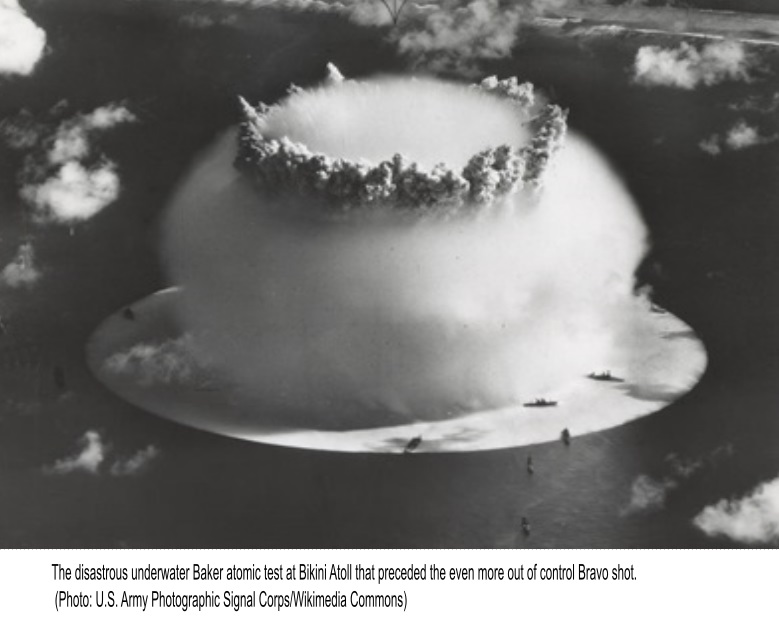
‘Traces of radioactive material were later found in parts of Japan, India, Australia, Europe, and the US,’ says the Atomic Heritage Foundation.
‘This was the worst radiological disaster in US history and caused worldwide backlash against atmospheric nuclear testing.’
Bikini, the colonial spelling of Pikinni, became so radioactive there’s little hope it’ll ever be habitable.
After the Limited Test Ban Treaty of 1963 put an end to atmospheric nuclear testing, this left American officials – and the islands’ displaced citizens – with one option: wait.
The Defence Department concluded in the ’70s that the soil was so contained with cesium-137 and strontium-90 – both taking about three decades to decay, called a half-life – that the best course of action was to just let it rot.
Plutonium-239, however, takes a little longer; 24,000 years. The US dumped 437 plastic bags filled with lumps of plutonium that had spewed after a bomb misfired into a 33-foot crater left behind in 1958 by a nuke on Runit Island.
That, and about 35 Olympic-sized swimming pools’ worth of radioactive soil and nuclear waste.
The crater was plugged up by a 350-foot-wide slab of concrete called the Runit Dome, which locals call ‘The Tomb’, in the ’70s. The dome almost looks like something from a science fiction movie, surrounded by a tropical paradise.
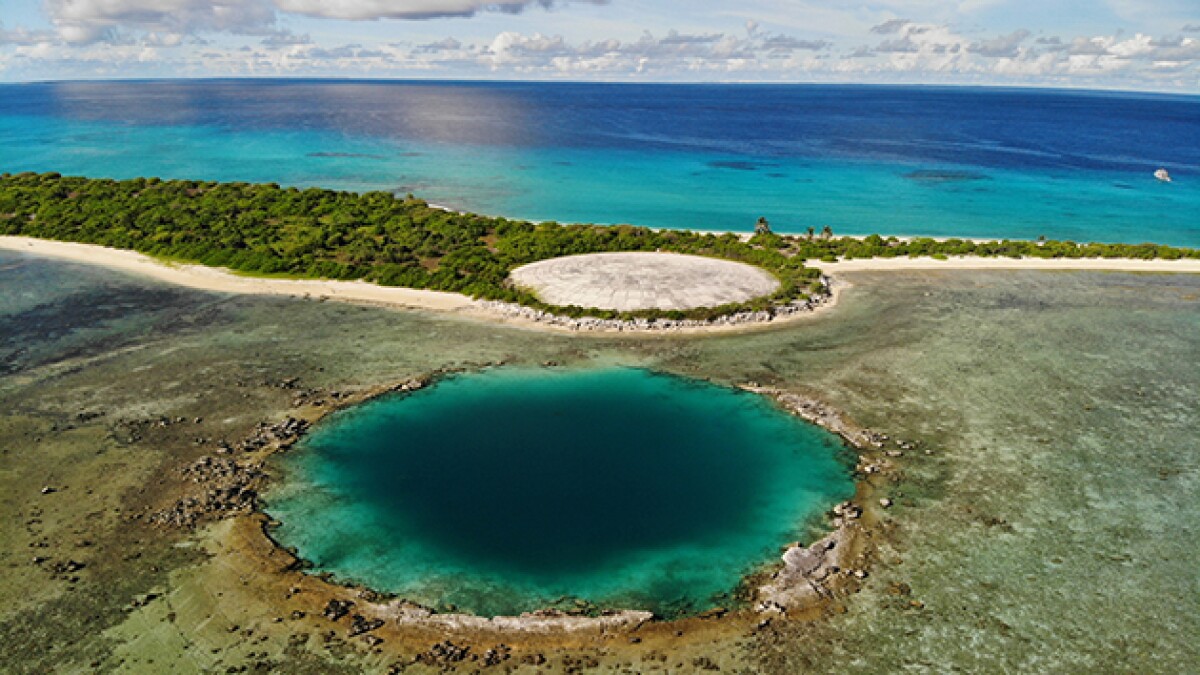
And the dome is leaking. ‘The dome is a significant visible scar on the landscape,’ Ken Buesseler, a marine radioactivity expert at the Woods Hole Oceanographic Institution (WHOI), told Oceans magazine in 2020.
But it’s a relatively small source of radioactivity.’
Overall, more than half of the 167 original inhabitants of Bikini Atoll have died. Some started showing cancers related to radiation exposure in the 1960s, while people living downwind of the explosions suffered burns and low blood counts.
Several generations later, about 5,400 Bikinians are still living in exile. Some live on a lone Pacific island called Kili, roughly 400 miles from Bikini, and others from Honolulu to the ‘Wheat Capital’ of Oklahoma, Enid.
Bikini Atoll largely remains uninhabited, with a tiny caretaker team taking care of the island infrastructure and divers pop in from time to time.
Bikinians continue to fight, however. Lobbying the US Congress for money to redevelop and clean up the place they once called home.
Scientists are hopeful. Remediation efforts include sprinkling affected areas with potassium fertilizer which reduces how much cesium-137 seeps into locally grown crops. How radioactive the soil is has also been decreasing.
The Marshall Islands Program advises that, once resettlement finally begins, a radiation monitoring programme be set up.
‘In this way, the Kili-Bikini-Ejit Local Government and the people of Bikini can be assured that radiological conditions on the islands remain at or below applicable safety standards, and the United States Government can avoid mistakes of the past,’ the programme says.
Waihopai is a Secret U.S. Spy Base in New Zealand Designed for War-fighting
Global Peace and Justice A0TEAROA) By Murray Horton, August 29, 2024
Murray Horton is organiser of the Campaign Against Foreign Control of Aotearoa (CAFCA) and an advocate of a range of progressive causes for the past five decades.
He can be reached at: cafca.
Reprinted from Covert Action Magazine
The news that the Waihopai spy base was going to be built led to the birth of the Anti-Bases Campaign (ABC) in 1987. ABC has campaigned for the closure of Waihopai ever since (our most recent protest there was in 2023).
We have consistently said that it is a U.S. spy base in all but name, i.e., that the New Zealand Government Communications Security Bureau (GCSB, NZ’s spy agency in the Five Eyes international spy alliance) works as directed by the U.S. National Security Agency (NSA). We have also consistently said that it is a war-fighting base, not just a spy base. The powers that be in New Zealand’s covert state, and their political mouthpieces, have always denied this and/or asked for evidence?
Soothing Reassurances from GCSB Bosses
For example, this from The New Zealand Herald, (April 9, 2010), with the eye-catching title “It’s ours and it’s not evil, say spy-base masters”:
“New Zealand’s secret spies emerged from the shadows yesterday to deny their Waihopai station is an American spy base contributing to torture and war. Present and past Directors of the Government Communications Security Bureau took the unusual step of commenting publicly on allegations made during and after last month’s trial in which a jury acquitted teacher Adrian Leason, 45, Dominican friar Peter Murnane, 69, and farmer Sam Land, 26, of charges of burglary and willful damage after they broke into the base in Marlborough.”
“Father Murnane said after the verdict: ‘We have shown New Zealanders there is a U.S. spy base in our midst.’ In court, he said the trio felt strongly about the evil caused by activities of spy bases, such as torture, war and use of weapons of mass destruction such as depleted uranium. Air Marshal Sir Bruce Ferguson, the Bureau’s Director, and his predecessor, Dr. Warren Tucker, said the allegations demanded a response because they brought into question the integrity of New Zealand’s security and intelligence apparatus. ‘The Waihopai station is not a U.S.-run spy base,’ they said. ‘It is totally operated and controlled by New Zealand, through the GCSB as an arm of the New Zealand Government.’”
Waihopai Hosted U.S. NSA Spying/War-Fighting System for Nearly a Decade
Case closed? Not so fast. The year 2024 has unearthed fresh revelations. According to RNZ News, “The operation—that the Government Communications Security Bureau (GCSB) did not tell government ministers about—ran from 2013-20, but was only exposed by an official watchdog last month [March 2024)]. Intelligence documents strongly suggest the bureau hosted—but exercised virtually no oversight over—a system run by the U.S. National Security Agency [NSA] to help acquire targets classified as terrorists for killer drones, bombs and raids using GCSB data.”
The article continued: “An important aspect of the deal document—called a memorandum of understanding (MOU)—was that it dealt with concerns that arose within the GCSB about the system’s military capabilities. The Inspector-General of Intelligence and Security (IGIS) said the system was ‘largely controlled by the partner agency,’ even though the bureau could have vetoed operations it did not like under the MOU. It chose instead not to keep track of them, the inspector-general’s report last month showed.”
“The public report did not identify the foreign agency, and the inspector-general later told RNZ he did not ask if the system was used for military operations. His report revealed the MOU was signed with the foreign agency in March 2012 by a GCSB deputy director. An internal GCSB document from 2012 showed it signed an MOU with the NSA that year to host the APPARITION system.”
“‘The decision to host the capability on the terms set out in the MOU was significant, particularly given the potential uses of the capability to support military operations,’ said the inspector-general report. The MOU was poorly implemented, it said. A subsequent policy requires the bureau to get ministerial approval for an international agreement that deals with new policy. The inspector-general said this should be triggered if the bureau looked at a hosting deal like this again.”
Nicky Hager Explains APPARITION
So, what was this all about? Fortunately, we could rely on Nicky Hager to flesh out the details. Here’s what he wrote: “The IGIS [Inspector-General of Intelligence and Security] report said the GCSB decision to host a foreign system from 2012-2020 was ‘improper’ and that the GCSB ‘could not be sure the tasking of the capability was always in accordance with…New Zealand law.’ The Inspector-General said: ‘I have found some of the GCSB’s explanations about how the capability operated and was tasked to be incongruous with information in GCSB records at the time.’”
Hager continued: “But the Inspector-General could not reveal details of the system to the public because they are ‘highly classified.’ The name and function of the foreign spy spying equipment, the identity of the ‘foreign partner agency’ and the location of the ‘GCSB facility’ where foreign equipment was hosted all remained secret.”
“The mystery spy equipment appears strongly to be a top-secret U.S. surveillance system that was installed at the GCSB’s Waihopai base at the same time as the equipment in the IGIS investigation was installed at a ‘GCSB facility.’ The top-secret NSA spy equipment had the ghostly codename ‘APPARITION’ and fits with all the details presented in the IGIS report.”
“APPARITION was owned by and controlled by the U.S. National Security Agency—the world’s largest intelligence gathering agency and head of the Five Eyes intelligence alliance that includes the GCSB. A[n] NSA internal report, written after the launch of the APPARITION system in 2008, said that it ‘builds on the success of the GHOSTHUNTER prototype…a tool that enabled a significant number of capture-kill operations against terrorists.’”
“Capture-kill operations involve lethal attacks on targeted people using drones, bombs and special forces raids. Human rights organisations have documented numerous deaths of civilians during capture-kill operations—many of them ‘algorithmically targeted’ by electronic surveillance systems such as APPARITION. They are also criticised as being ‘extra-judicial killings.’”……………………………………………………………………………………………………………………………………………….
Waihopai Domes Gone But It Continues Spying
RNZ News reported that “[t]he various NSA and GCSB reports quoted were part of the trove of top secret reports released by the U.S. whistleblower Edward Snowden in 2013. The APPARITION documents do not say what the NSA used the Waihopai-based APPARITION equipment to target. However GCSB used the equipment for its own targeting as well.”
“Another 2012 Snowden document suggests that the Waihopai base was intercepting VSAT communications in the Pacific by targeting the NSS-9 satellite, which was located at 183 degrees east. The 2012 report discusses technology changes affecting Waihopai’s ‘South Pacific mission’ including the ‘ViaSat Skylink VSAT links,’ the NSS-9 satellite. It’s unclear whether this VSAT surveillance involved APPARITION.”…………………………………………………..
In 2022 the GCSB announced ‘Removal of Waihōpai spy base surveillance domes begins’ and media reported that the ‘virtually obsolete’ Waihopai spy domes were being dismantled.” “Some people, including journalists, assumed that the Waihopai station was ceasing to be an intelligence base. However Waihopai continues to intercept a range of satellites with more modern antennas and processing equipment as part of the Five Eyes intelligence alliance.”
New Zealand Has Blood on Its Hands. Shut Waihopai and GCSB
So, there we have it. While the GCSB spy bosses have been making reassuring noises all along, the reality is that, for nearly a decade (and a very recent decade at that), the GCSB was hosting, at Waihopai, a U.S. NSA system over which the GCSB had no control—by choice—and which was not known to the various Ministers who were nominally “in charge” of the GCSB. This period spanned both the Key National government and the Ardern Labour government, so both major parties were equally ignorant and culpable.
Furthermore, this NSA system was not only for spying but for capturing and/or killing targets via drones, missiles, bombs or attacks by special forces in countries far removed from New Zealand. Such military strikes inevitably kill family members, neighbors, bystanders and innocent civilians in general. This means that New Zealand very much has blood on its hands.
As the ABC has said from the outset, Waihopai is a U.S. spy base and a war-fighting one. The GCSB is a willingly complicit junior partner of the NSA. This is the proof. And it makes even more urgent the case for shutting down both Waihopai and the GCSB. https://gpja.org.nz/2024/08/29/waihopai-is-a-secret-u-s-spy-base-in-new-zealand-designed-for-war-fighting/
Pacific leaders, Japan, agree on Fukushima nuclear wastewater discharge (not everyone is happy)
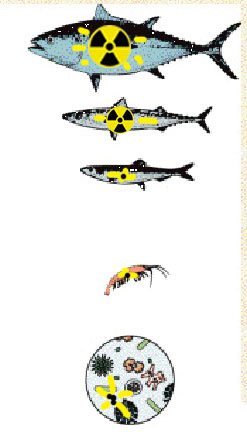
“The discharge, planned to continue for decades, is irreversible. Radionuclides bioaccumulate in marine organisms and can be passed up the food web, affecting marine life and humans who consume affected seafood,”
“The discharge, planned to continue for decades, is irreversible. Radionuclides bioaccumulate in marine organisms and can be passed up the food web, affecting marine life and humans who consume affected seafood,”
RNZ 19 July 2024 , By Pita Ligaiula in Tokyo
Consensus has been reached by Pacific leaders with Japan to address the controversial release of treated nuclear wastewater from the Fukushima nuclear power plant into the Pacific Ocean.
In August last year, Japan began discharging waste from about 1000 storage tanks holding 1.34 million metric tons of contaminated water collected after an earthquake and tsunami in 2011 that caused the meltdown of the Fukushima nuclear plant.
The agreement came at the Japanese hosted 10th Pacific Island Leaders Meeting (PALM10) on Thursday in the capital Tokyo attended by most of the Pacific Islands Forum (PIF) country leaders…………………………..
Pacific leaders emphasised the importance of a shared commitment to safeguarding the health, environment, and marine resources of the Pacific region and a need for transparency from Japan………………………………………….
TEPCO uses a process known as Advanced Liquid Processing System involving special filters which remove from the contaminated water most of the 62 types of radioactive materials, radionuclides such as cesium, strontium, iodine and cobalt but not tritium.
The leaders agreed to keep the ALPS treated water issue as a standing agenda item for future PALM meetings with Japan, supported by an ongoing review process. Their decision reflects concerns about addressing the long-term implications and ensuring continuous monitoring and evaluation.
While consensus was reached at the summit, the wastewater release continues to be questioned by some scientists.
Director of the Kewalo Marine Laboratory at the University of Hawaii, Research Professor Robert Richmond, said concerns remain regarding the efficacy of the ALPS treatment and the contents of the thousands of storage tanks of radioactive wastewater.
“The long-term effects of this discharge on Pacific marine ecosystems and those who depend on them are still unknown. Even small doses of radiation can cause cancer or genetic damage,” Richmond said in a statement to BenarNews after the agreement.
He criticised the current monitoring program as inadequate and poorly designed, failing to protect ocean and human health.
“The discharge, planned to continue for decades, is irreversible. Radionuclides bioaccumulate in marine organisms and can be passed up the food web, affecting marine life and humans who consume affected seafood,” Richmond said……………………………………………… https://www.rnz.co.nz/international/pacific-news/522582/pacific-leaders-japan-agree-on-fukushima-nuclear-wastewater-discharge—
Philippines Says US Will Pull Out Controversial Mid-Range Missile System
The US deployed the Typhon missile system for annual military drills
by Dave DeCamp July 4, 2024 ore https://news.antiwar.com/2024/07/04/philippines-says-us-will-pull-out-controversial-mid-range-missile-system/
On Thursday, the Philippines said the US was pulling out a new missile system it deployed to the Southeast Asian country for annual military exercises.
The US sent the Typhon missile system for the Balikatan exercises, which were held in April and May. The Typhon is a controversial launcher since it would have been banned by the Intermediate-Range Nuclear Forces (INF) Treaty, a treaty between the US and Russia that the Trump administration withdrew from in 2019.
The INF prohibited land-based missile systems with a range between 310 and 3,400 miles. The Typhon can launch nuclear-capable Tomahawk missiles, which have a range of about 1,000 miles. It can also fire SM-6 missiles, which can hit targets up to 290 miles away.
Philippine Col. Louie Dema-ala told AFP that the US planned to withdraw the Typhon from the Philippines following the military exercises. “As per plan… it will be shipped out of the country in September or even earlier,” he said. “The US Army is currently shipping out their equipment that we used during Balikatan and Salaknib (exercises).”
China strongly condemned the deployment of the Typhon system, which US officials have acknowledged was developed to prepare for a future conflict with Beijing over Taiwan or the South China Sea.
Russian President Vladimir Putin also recently mentioned the deployment. He made the comments when calling for Moscow to follow the US and develop missile systems previously banned by the INF.
“We need to start production of these strike systems and then, based on the actual situation, make decisions about where — if necessary to ensure our safety — to place them,” Putin said last week.
“Today it is known that the United States not only produces these missile systems, but has already brought them to Europe for exercises, to Denmark. Quite recently it was announced that they are in the Philippines,” the Russian leader added.
Guam’s fight for radiation exposure compensation ‘far from over’
RNZ, By Mar-Vic Cagurangan, Pacific Island Times, 17 June 24
Despite nearly two decades of relentless lobbying, Guam’s hopes to finally be included in the Radiation Exposure Compensation Act (RECA) crumbled anew when the US House Republican leadership let the program expire without extension or expansion.
While the RECA extension and expansion proposal received bipartisan support in the US Senate, House Speaker Mike Johnson shunned its inclusion in the 2025 National Defense Authorization Act.
Guam Delegate James Moylan said the House Rules Committee ruled his amendment to incorporate the RECA expansion language into the defense spending policy bill “out of order”. As a result, the language didn’t make it to the floor for the House vote.
“The primary reason was that offset costs were not provided, which were estimated at around US$50 billion,” Moylan said in a statement.
“This mirrors the message from House leadership when referencing the RECA measure passed by the Senate, and many in the House, including myself, have been requesting for a vote to take place on the floor.”
RECA, the 1990 legislation that provided financial compensation for atomic test downwinders in three states and pre-1971 uranium miners, expired on June 10.
The expanded version would have added Guam, Colorado, Idaho, Missouri, Montana and New Mexico to the list of areas currently included in RECA, namely Nevada, Arizona and Utah.
“The Republican leadership’s policy is that any new spending measure must have an offset provided, to prevent uncontrolled spending or an unfunded mandate,” Moylan said.
“There are others who believe the measure should be passed regardless, and thus allow the executive branch to identify the funds. We believe a combination of both is needed.”
The Pacific Association of Radiation Survivors led by Robert Celestial has been fighting for Guam’s inclusion in RECA, backed by the National Research Council’s 2005 report declaring the territory’s eligibility for compensation under the program.
“Guam did receive measurable fallout from atmospheric testing of nuclear weapons in the Pacific between 1946 and 1958,” read the council’s report, which recommended that people living on island during that period be compensated under RECA “in a way similar to that of persons considered to be downwinders.”
Despite the latest defeat, Moylan said the advocacy “is far from over” and “building more support along the way”.
He is banking on the Senate to include the language in its version of the NDAA in the coming weeks………………………………………… more https://www.rnz.co.nz/international/pacific-news/519741/guam-s-fight-for-radiation-exposure-compensation-far-from-over
In Nuclear Crosshairs, Guam Still Doesn’t Control Its Own Affairs
… because its inhabitants are not fully considered Americans when it matters.
WORDS: APRIL ARNOLD, PICTURES: JAZMIN SMITH, MAY 20, 2024, https://inkstickmedia.com/in-nuclear-crosshairs-guam-still-doesnt-control-its-own-affairs/
At the core of Guam’s indigenous CHamoru culture are the concepts of inafa’maolek – inafa meaning “to make together” and maolek meaning “good.” It is the idea that something was once bad or broken and is in need of repair, and that repair comes from doing good together and restoring harmony. If there is one thing the CHamoru have known for nearly 500 years, it is how to make the best of broken circumstances.
In recent years, Guam has found itself at the center of tensions between the United States and countries in the Pacific. As the tiny island sits on the frontlines of the competition for influence in the region, Guam has increasingly come under threat of being a prime target for nuclear attack by China or North Korea.
In 2022, North Korea confirmed a test launch of an intermediate-range ballistic missile that could reach Guam. In 2023, the country confirmed launching spy satellites that targeted military installations in Japan, on the US mainland and on Guam. Equally concerning was North Korea’s response that attempts to interfere with their satellites would be considered a declaration of war. In April 2024, North Korea conducted a test launch of another intermediate-range ballistic missile that could also reach Guam.
“Guam Killer”
As for China, during a military parade in September 2015, the Chinese government unveiled a new missile that quickly became known as the “Guam Killer.” Following the introduction of this new missile, the US-China Economic Security Commission published a 2016 report detailing China’s military expansion and its implications for Guam.
Yet, despite the threat to the island, it still does not have a full say over many aspects of its strategic role in international affairs. Its citizens are not allowed to vote in US presidential elections, with straw polls showing that voting trends of the territory do not guarantee one political party leverage over the other.
Nor does Guam have full representation in US Congress, limiting its ability to lobby for the island’s interests, despite being in harm’s way militarily and environmentally. As the US promotes democracy worldwide, it should start at home by affording Guam statehood. This, in turn, could help temper the aggression and rhetoric China and North Korea have directed at the island, giving the US an even stronger foothold in the region.
History of Foreign Rule
Guam has been under foreign rule since 1565 and foreign aggression since 1521 when Ferdinand Magellan landed on the island. As a strategic trade outpost for Spain for over 300 years, the CHamoru were forced to convert to Catholicism by the Jesuits and subservient to Spanish governance that ravaged the island’s natural resources and culture. In the book “Destiny’s Landfall,” author Robert F. Rogers detailed stories of the abuse the CHamoru people experienced at the hands of governors who had a recurring penchant for excessive greed and virile priests seeking to exact their purportedly divine authority.
Then, as a concession of the Spanish-American War, Spain transferred Guam to the US under the Treaty of Paris of 1898. This was a controversial transaction at the time as Congress was amid the throes of the debate over Manifest Destiny and expansion into the Pacific.
Much to the surprise of the citizens of Guam, the transfer did not result in its incorporation into the country as a state, despite establishing a local democratic government to aid this effort.
Military Oversight
Instead, the island was placed under the oversight of the Department of the Navy for 52 years, where military governance had absolute authority. As a result of the treaty, the US government faced a new hurdle of incorporating these newly-acquired territories.
Through a series of Supreme Court rulings known as the Insular Cases, the US decided that Guam among other islands such as Puerto Rico, Hawaii, and the Philippines, would be considered territories without full citizenship rights.
Language from one of the Insular Cases, Downes vs. Bidwell, states, in part, the following about foreign territories: “If those possessions are inhabited by alien races, differing from us in religion, customs, laws, methods of taxation, and modes of thought, the administration of government and justice, according to Anglo-Saxon principles, may for a time be impossible.”
Taking Advantage
In short, even though Guam had been under Catholic influence and rule for more than 300 years and had adopted many Catholic practices, it was not enough to be accepted into the US as more than an “alien race.”
Meanwhile, the US had begun taking full advantage of Guam’s position in the Pacific, constructing military bases starting in WWII. It wasn’t until 1950 that the Department of the Navy would transfer its oversight of Guam to the Department of the Interior, designating the island as an unincorporated territory through the Guam Organic Act.
With the steady military buildup of US forces on Guam over the decades, the US would gain more influence in the Pacific while pushing CHamoru off their lands and creating waste management nightmares that now include two Superfund sites used to dispose of hazardous chemicals.
Military Buildup
Even as tensions have grown, military officials have called for increased investment in a missile defense capability on the island to counter China’s capabilities development and aggression in the region. This includes relocating 5,000 US Marines to Camp Blaz on Guam later in 2024, with some concerned over impacts to the local ecosystem and historical sites.
Meanwhile, Guam continues to wrestle with the US government on waste management funding to clean up the Superfund site, Ordot Landfill. The landfill was formerly owned and used by the Department of the Navy during WWII, with some of its contents allegedly being toxic chemicals such as Agent Orange. Even upon returning the landfill to the island after Congress passed the Guam Organic Act in 1950, the Navy continued to use the dump until the 1970s.
After its closure in 2011, Guam’s local government began clean-up efforts and filed a lawsuit under the Superfund Act to seek financial help from the US government on the $160 million estimated cost. A lower court ruled that Guam’s lawsuit surpassed the statute of limitations under the Comprehensive Environmental Response, Compensation and Liability Act. As one article states, “Shouldering the cost alone would be unduly difficult for the small island, as the bill exceeds the combined annual budget of its health, social services, police, fire, public works, solid waste and environmental departments.”
In May 2021, the Supreme Court reversed the ruling, and in September 2023 the US government agreed to pay $48.9 million in cleanup costs that were incurred prior to Aug. 10, 2022. The remaining $110 million in costs will still have to be covered by Guam’s local government.
Self-Determination
The conversation of Guam’s self-determination starts at the local level. Guam’s Commission on Decolonization was formed in 1997 to promote domestic education and outreach on the island’s options for self-determination. These options include statehood, free association, or independence. The first step in this process is the self-determination vote, where voters decide which of the decolonization options to pursue. Yet, efforts for a referendum have already run into issues at the federal level.
Before conducting the vote, Guam’s government needs to decide who is included in the definition of self-determination, which it has already done. According to the commission’s website, the right of self-determination belongs to those who were colonized, with the definition of “native inhabitants of Guam,” referring to people who became US citizens through the 1950 Guam Organic Act, as well as their descendents.
In 2020, the Supreme Court declined to review Guam’s appeal of a previous lower court ruling on conducting a nonbinding plebiscite to determine whether native inhabitants preferred statehood, free association, or independence because the vote was discriminatory on the grounds of race.
In February 2024, Guam’s government began looking into better defining the term so that it meets expectations in local law and was not “considered again a ‘proxy for race’ and therefore unconstitutional.”
On May 13, 2024, Guam’s Attorney General published an opinion that there was “no room” for Guam’s definition of the phrase that would be deemed constitutional. Instead, the AG recommended Guam’s Governor take other legal routes, such as lobbying Congress to recognize Guam’s unique history and work with the island to develop a path towards self-determination as well as petition support from the United Nations.
Reluctance
Separately, politicians on Guam are also reluctant to pursue tribal classification for the CHamoru people, especially after the US federal government sued Guam over land trust issues.
In 2017, Madeleine Bordallo, then the Guam delegate to the US House of Representatives, expressed concerns over the implications of enrolling the CHamoru as a tribe when the island would have to transfer ownership of the tribal lands to the federal government.
Each of these issues has made it difficult for Guam to gain traction in pursuing any form of self-determination, let alone statehood.
While it is unlikely that the majority of US elected officials would support anything other than statehood for Guam, leaving the island in a position that forces them to either lobby Congress for any self-determination support or solicit help from the United Nations could strain the relationship at a delicate time internationally.
Path Forward
After a referendum favoring statehood, all that is required for Guam to become a state is a simple majority vote on a joint resolution in both houses of Congress and approval by the President. The biggest hurdle is often lobbying Congress for the votes. The CHamoru have had their land taken from them to support US military demands with little-to-no reconciliation efforts from the US government.
Yet, the tiny island finds itself in the crosshairs of growing tensions between multiple nuclear weapons states, with barely a voice to hold the US government accountable for its actions. Many arms control and nonproliferation experts lament the lack of US public interest in the threat of nuclear war. Perhaps, it is because those most at risk are not fully considered Americans when it matters. If the US truly cares about ensuring democracy around the world, it should start at home.
US, Philippines, Japan, and Australia Conduct First Joint Military Exercise in South China Sea
China launched patrols in the South China Sea in response
by Dave DeCamp April 7, 2024
https://news.antiwar.com/2024/04/07/us-philippines-japan-and-australia-conduct-first-joint-military-exercise-in-south-china-sea/
The US, Japan, the Philippines, and Australia conducted joint military exercises in the South China Sea on Sunday in a provocative show of force aimed at China.
According to Japan’s Kyodo News, the drills marked the first “full-scale exercise” between the four nations. The US has been looking to increase military cooperation between its treaty allies in the region as part of its military build-up to prepare for a future war with China.
The four countries released a joint statement that made clear the drills were meant to push back on China’s claims to the South China Sea. “We stand with all nations in safeguarding the international order based on the rule of law that is the foundation for a peaceful and stable Indo-Pacific region,” the statement said.
According to The South China Morning Post, the drills included two Philippine vessels, one American ship, one Australian ship, and a Japanese ship and focused on anti-submarine warfare training, tactical exercises, and photo exercises.
China launched patrols in the South China Sea on the same day in what appeared to be a response to the drill. “The Southern Theatre Command of the People’s Liberation Army will conduct a joint air and sea combat patrol in the South China Sea on April 7,” the Chinese military’s Southern Theater Command said.
The joint drills come as tensions are soaring between China and the Philippines over disputed rocks and reefs in the South China Sea. Chinese and Philippine vessels frequently have tense encounters in the waters, which often end in collision. In the most recent incident, a Chinese vessel fired a water cannon at a Philippine supply boat, injuring several crew members.
The incidents in the South China Sea could potentially spark a major war as the US has repeatedly affirmed that the US-Philippine Mutual Defense Treaty applies to attacks on Philippine vessels in the disputed waters.
President Biden is hosting Philippine President Ferdinand Marcos Jr. and Japanese Prime Minister Fumio Kishida in Washington this Thursday for the first-ever trilateral summit between the three nations. They’re expected to announce the launch of regular joint patrols in the South China Sea.
1 This Month

of the week – Shut Down Drone Warfare!


Tell the Ukrainian Government to Drop Prosecution of Peace Activist Yurii Sheliazhenko

Petition to revoke the licensing of the Near Surface Nuclear Disposal Facility (NSDF) at Chalk River. https://www.ourcommons.ca/petitions/en/Petition/Details?Petition=e-7247
To see nuclear-related stories in greater depth and intensity – go to https://nuclearinformation.wordpress.com
-
Archives
- March 2026 (237)
- February 2026 (268)
- January 2026 (308)
- December 2025 (358)
- November 2025 (359)
- October 2025 (376)
- September 2025 (257)
- August 2025 (319)
- July 2025 (230)
- June 2025 (348)
- May 2025 (261)
- April 2025 (305)
-
Categories
- 1
- 1 NUCLEAR ISSUES
- business and costs
- climate change
- culture and arts
- ENERGY
- environment
- health
- history
- indigenous issues
- Legal
- marketing of nuclear
- media
- opposition to nuclear
- PERSONAL STORIES
- politics
- politics international
- Religion and ethics
- safety
- secrets,lies and civil liberties
- spinbuster
- technology
- Uranium
- wastes
- weapons and war
- Women
- 2 WORLD
- ACTION
- AFRICA
- Atrocities
- AUSTRALIA
- Christina's notes
- Christina's themes
- culture and arts
- Events
- Fuk 2022
- Fuk 2023
- Fukushima 2017
- Fukushima 2018
- fukushima 2019
- Fukushima 2020
- Fukushima 2021
- general
- global warming
- Humour (God we need it)
- Nuclear
- RARE EARTHS
- Reference
- resources – print
- Resources -audiovicual
- Weekly Newsletter
- World
- World Nuclear
- YouTube
-
RSS
Entries RSS
Comments RSS
 nuclear-news