New bill introduced in Congress will benefit Guam victims of radiation exposure https://pacificnewscenter.com/bill-introduced-in-congress-to-benefit-guam-victims-of-radiation-exposure/
July 17, 2019 New legislation has been introduced in the U.S. House of Representatives that would expand compensation for those exposed to radiation from nuclear test weapon sites, including victims from Guam.Congressman Ben Ray Luján (D-N.M.), the U.S. House Assistant Speaker, introduced The Radiation Exposure Compensation Act Amendments of 2019, which provides health and monetary compensations for individuals who were exposed to high levels of radiation that caused sickness, cancer, and deaths in New Mexico and other parts of the country, including Guam.
RECA was first passed in 1990 to ensure the federal government met its responsibilities to Americans who made sacrifices for national security. The new legislation has more than 35 co-sponsors, including Guam Congressman Michael San Nicolas.
“This legacy issue for the people of Guam is more than about policy; it is about cancer, it is about the major impact these diseases have on our families, it is about the life and death of loved ones past, present, and future, and we are humbled to join Assistant Speaker Ben Ray Luján in making this right,” San Nicolas said.
Without this legislation, the current authorization for RECA will expire in two years – leaving thousands without the ability to pay for their medical care for illnesses directly linked to the exposure.
Senator Therese Terlaje, who coincidentally is having a hearing tomorrow, July 18, on Resolution 94-35 (COR), which is related to RECA, said she wants to thank the New Mexico congressman and Congressman San Nicolas for the introduction of the House RECA bill.
“That’s very good timing for us as we hold this hearing tomorrow,” Terlaje said during an interview with Andrea Pellacani on NewsTalk K-57.
The senator would also like to thank Robert Celestial, president of the Pacific Association of Radiation Survivors (PARS) for his work and for building relationships that have ensured Guam’s inclusion in the House bill and in Radiation Exposure Compensation Act (RECA) compensation.
For his part: Celestial said: “The people of Guam thank and applaud Congressman Ben Ray Luján and sponsors for their compassionate and just recognition of the cancer and other ailments suffered on Guam from downwind exposure to nuclear fallout, as determined in a report to Congress 2005: “Assessment of the Scientific Information for the radiation exposure Screening and Education program ” by the National Academy of Sciences.”
Senator Terlaje’s Resolution 94-35 (COR) expresses support for S. 947, “The Radiation Exposure Compensation Act Amendments of 2019,” which includes Guam residents exposed to radiation during nuclear testing in the Pacific from 1946 to 1962.
S. 947 was introduced in the U.S. Senate by Senator Mike Crapo (R- Idaho) and would expand eligibility requirements and increase compensation for persons suffering health problems related to cancer caused by radioactive fallout from nuclear bomb tests.
Idaho, Arizona, Colorado, Montana, New Mexico, Nevada, Utah and Guam would be added to existing areas where victims can apply for compensation under the federal Radiation Exposure Compensation Act program (RECA). Qualified claimants are entitled to free medical care, health screening, and $150,000 compensation for certain illnesses.
In 2004, The National Academies of Science confirmed Guam’s exposure to radiation as “downwinders” and recommended that Guam be included under RECA. Fifteen years later, Terlaje said Guam is still fighting an uphill battle for inclusion. S. 947 is the eighth version of the RECA Amendment bill introduced in the last 12 years.
Senator Terlaje’s hearing on Resolution 94-35 (COR) will be held tomorrow, July 18, at 10 a.m., at the Guam Congress Building.
July 18, 2019
Posted by Christina Macpherson |
health, OCEANIA, politics |
Leave a comment
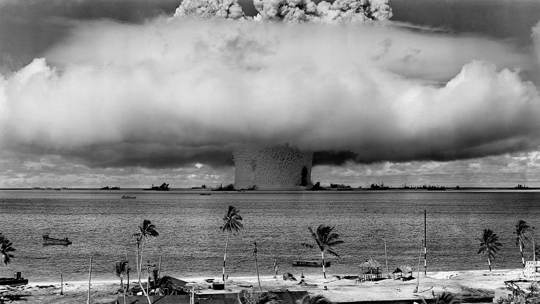
Radiation Levels at the Marshall Islands Remain Disturbingly High https://gizmodo.com/radiation-levels-at-the- marshall-islands-remain-disturb-1836382678?IR=T, George Dvorsky– 15 July 19
An analysis of soil samples, ocean sediment, and fruits from the Marshall Islands—the site of nearly 70 nuclear weapons tests during the 1940s and 1950s—has revealed alarmingly high levels of radiation, with some regions at levels exceeding areas affected by the Fukushima and Chernobyl disasters.
From 1946 to 1958, the United States conducted 67 nuclear tests in the Marshall Islands, a series of atolls located north of the equator between Hawaii and Australia. Twenty-three of these tests were conducted at Bikini Atoll and 44 near Enewetak Atoll, but fallout spread throughout the entire Marshall Islands, exposing the indigenous people there to dangerous levels of radiation.
Much of the Marshall Islands remains uninhabitable as a consequence of these nuclear tests, and it’s not immediately clear when Marshallese residents will be able to return to their ancestral homes. Three new studies published today in Proceedings of the National Academy of Sciences suggests their long-awaited return won’t happen anytime soon. A research team led by Emlyn Hughes and Malvin Ruderman from the Center for Nuclear Studies at Columbia University has detected unsafe levels of radiation in the soil, ocean sediment, and fruits in these contaminated areas.
Three years ago, the same team discovered alarming levels of gamma radiationin the Marshall Islands, and at levels that exceeded scientists’ expectations. The three new PNAS studies add to this prior work, which is being done to determine which, if any, of the Marshall Islands are safe for resettlement, and the specific risks that would be faced by returning indigenous peoples.
For the first study, the researchers measured background gamma radiation in soil samples taken from four atolls in 2017 and 2018: Bikini, Enewetak, Rongelap, and Utirik. Gamma radiation on Bikini and Naen islands were well beyond the maximum exposure limit as stipulated in agreements between the United States and the Republic of the Marshall Islands. On Bikini, the levels were as high as 648 millirems per year, and on Naen they were as high as 460 millirems per year. Safe exposure to radiation is 100 millirems per year, according to the U.S.-Republic of the Marshall Islands agreement.
These levels are “significantly higher” than “areas affected by the Chernobyl and Fukushima accidents,” wrote the study authors. The “radiation levels on Bikini Island, which served as the primary island for habitation on the atoll, before and in the aftermath of the testing, are too high for relocation to Bikini,” according to the new research. Some of the outer islands “may not [be] suitable for habitation on their own, but… islanders may visit in search of food, especially in times of harvest.”
For the second paper, the researchers explored the Castle Bravo crater—the site of the most powerful nuclear test ever conducted by the United States, which happened on March 1, 1954. This 15-megaton explosion vaporized the land beneath it, forming a crater 1.5 kilometers (0.9 miles) wide and 75 meters (246 feet) deep on Bikini Atoll. The ensuing fallout was comprised of pulverized coral, water, and radioactive particles. Traces of the radioactive debris were detected as far as Japan, India, Australia, Europe, and even the United States.
The Castle Bravo explosion also produced radioactive material that settled into the ocean sediment. From the research vessel Indies Surveyor, the researchers collected nearly 130 core samples from the Castle Bravo crater from 2017 to 2018. Analysis showed that, six decades later, the radiation levels are still “orders of magnitude” above normal levels within the top inch of sediment across the entire crater. The researchers conclude thusly:
In summary, there is still residual contamination of radionuclides throughout the Bravo bomb crater, from center to rim. We find that the radionuclide distribution is fairly uniform across the crater with some tapering off toward the crater rim….Although the lagoon is gradually filling in over time, contamination levels from residual long-lived radioactive isotopes, such as plutonium and americium, will likely last for centuries. The nuclear weapon tests caused a dramatic change in sediment composition. Additional studies to determine what the impact on life is in the lagoon craters, especially at the deeper depths, would be valuable.
The third paper is an analysis of fruits found in the Marshall Islands, namely coconuts and pandanus fruits. Cesium-137 features a half-life of around 30 years, and it’s easily absorbed by plants, presenting a potential health hazard. Sadly, 11 islands were found to have coconuts and pandanus fruits with radioactivity exceeding limits established by several countries and international organizations, including International Physicians for the Prevention of Nuclear War (IPPNW). Once again, some of the levels exceeded values found near Fukushima and Chernobyl.
“Based upon our results, we conclude that to ensure safe relocation to Bikini and Rongelap Atolls, further environmental remediation… appears to be necessary to avoid potentially harmful exposure to radiation,” wrote the authors in the study.
All-in-all, some very discouraging results, as much of the Marshall Islands remain unsafe for resettlement. It’s not immediately clear when these islands will be free of radiation, or if people will ever return to Bikini Atoll. Sadly, climate change is making a bad situation worse, as rising sea levels could render many of the safe Marshall Islands uninhabitable.
July 16, 2019
Posted by Christina Macpherson |
environment, OCEANIA, Reference, weapons and war |
Leave a comment

Marchers in Tahiti ‘mourn’ French nuclear weapons test legacy https://asiapacificreport.nz/2019/07/05/marches-in-tahiti-mourn-french-nuclear-weapons-test-legacy/, By PMC Editor -July 5, 2019 , By RNZ Pacific
An estimated 2000 people have joined a march in French Polynesia this week to mark the 53rd anniversary of France’s first atomic weapons test in the Pacific.
The first test was on July 2, 1966, after nuclear testing was moved from Algeria to the Tuamotus.
Organisers of the Association 193 described it as a “sad date that plunged the Polynesia people into mourning forever”. The test on Moruroa atoll was the first of 193 which were carried out over three decades until 1996.
The march was to the Place Pouvanaa a Oopa honouring a Tahitian leader.
The march and rally were called by test veterans’ groups and the Maohi Protestant church to also highlight the test victims’ difficulties in getting compensation for ill health.
After changes to the French compensation law, the nuclear-free organisation Moruroa e Tatou wants it to be scrapped as it now compensates no-one. The Association 193 said it was withdrawing from the project of the French state and the French Polynesian government to build a memorial site in Papeete, saying it will only serve as propaganda.
Apart from reparations for the victims, the organisation wants studies to be carried out into the genetic impact of radiation exposure.
July 15, 2019
Posted by Christina Macpherson |
France, Legal, OCEANIA, opposition to nuclear, weapons and war |
Leave a comment
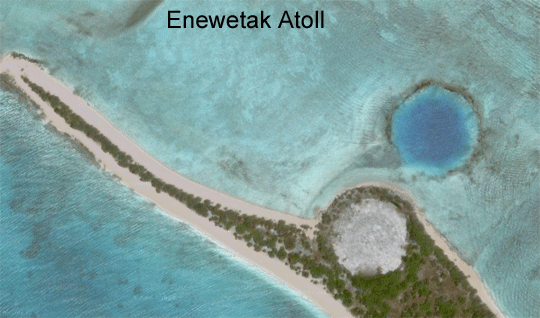
Nuclear waste, rising seas and Trump: Marshall Islands struggles to stay above water, Yahoo News, Marshall Islands President Heine speaks with Reuters in Geneva By Tom Miles, 21 June 19, GENEVA (Reuters) – The Marshall Islands is literally struggling to stay above water but its President Hilda Heine told Reuters she had saved her breath rather than try to persuade U.S. President Donald Trump to hear its climate change message.
Heine met Trump at the White House last month, along with the presidents of Palau and the Federated States of Micronesia, both of which are also under threat from rising sea levels.
But they did not talk about climate change.
“We made a conscious decision to discuss those things that we think we could accomplish, rather than spend time talking about something that we know is not going to happen,” she said.
“We know that we’re not going to be able to change his mind in 30 minutes about climate change.”
The Marshall Islands, comprising 31 tropical atolls between Australia and Hawaii, risks being underwater in 10-20 years.
“If that’s not scary enough, I don’t know what is. For us, it’s of course an existential issue,” said Heine, who was in Geneva to open a diplomatic mission, address the International Labour Organization and press her country’s case for a seat on the U.N. Human Rights Council.
The scene of massive U.S. nuclear tests in the 1950s, it is also at risk of disaster from radioactive debris the U.S. military left behind.
Her government has put a line item in its budget to cope with environmental costs, with about 5% of spending set aside to fund sea walls to save at least its two most populated areas.
On climate change, Heine said she had a simple message for the world: “Get real. Climate change is here. It’s not anything to just talk about and think, that is going to happen. It’s happening.”
The official statement from the White House meeting cited “the region’s most pressing issues, including responding to natural disasters”, but not climate change or rising sea levels.
The main topic was renewal of U.S. financial grants and the rollover of a Cold War-era defence and security agreement.
The Marshall Islands was occupied by Allied forces in 1944 and placed under U.S. administration in 1947. Between 1946 and 1958, the United States detonated 23 atomic and hydrogen bombs on Bikini and Enewetak atolls, debris from which was left buried under a shallow concrete dome on Enewetak.
“We’re told it’s seeping into the lagoon,” Heine said, adding that the government wanted help to assess the damage and impact on marine life and potential costs of making it safe.
Asked if it was potentially a nuclear disaster on top of a climate emergency, she said: “It could be.”
NUCLEAR JUSTICE
The Marshall Islands gained independence in 1986 and later tried in vain to sue nuclear powers in a David-and-Goliath case at the International Court of Justice.
It now has a “nuclear justice strategy” to cope with displacement and higher cancer rates, but cannot back a treaty banning nuclear weapons because of one provision that would force it to take care of its own clean-up, Heine said.
“The United States would be … off the hook.”…… https://news.yahoo.com/nuclear-waste-rising-seas-trump-120225579.html
June 22, 2019
Posted by Christina Macpherson |
climate change, OCEANIA, secrets,lies and civil liberties, wastes, weapons and war |
Leave a comment
 Giant clams are a delicacy of the Marshall Islands but illnesses fuel fears of nuclear contamination, ABC
Key points:
- The Marshallese bore the brunt of US nuclear bomb tests between 1946–58
- Tests released large amounts of radioactivity that the US was supposed to clean up
- Local leaders say that people remain fearful of eating contaminated local produce
“You see a nice-looking edible clam in the lagoon — it’s just like giving a kid a lovely lollipop,” nuclear commissioner Alson Kelen told the ABC, maintaining that eating clams will always be part of Marshall Islands life.
From 1946–1958, the US detonated 67 nuclear bombs in the Marshall Islands — some of the largest atomic weapons tests in history — and the area near the test site was evacuated, with locals receiving settlement payouts.
In the aftermath, with widespread radiation sickness being reported across the Marshall Islands, radioactive soil, debris, and wreckage was dumped into a nuclear crater on Enewetak Atoll.
The crater was capped with cement in 1980 and is officially called the Runit Dome — but locals have nicknamed it The Tomb.
The Enewatak people eventually began returning to the islands in the early 1980s following highly controversial talks between the United States and leaders of the Marshall Islands.
Amid reports of ongoing aftereffects and illness, a 2012 United Nations report found that the effects of the nuclear tests were long-lasting, which was followed by a 2013 US Department of Energy report which found radioactive materials were leeching out of the Dome, threatening the already tenuous existence of Enewetak locals. ………..https://www.abc.net.au/news/2019-06-08/illness-on-enewetak-atoll-reignites-nuclear-contamination-fears/11181940
June 8, 2019
Posted by Christina Macpherson |
environment, OCEANIA |
Leave a comment
High radiation levels found in giant clams near U.S. nuclear dump in Marshall Islands, By SUSANNE RUST and CAROLYN COLE, MAY 28, 2019, MAJURO, MARSHALL ISLANDS
May 30, 2019
Posted by Christina Macpherson |
environment, OCEANIA, wastes |
Leave a comment

|
Fears Grow That ‘Nuclear Coffin’ Is Leaking Waste Into The Pacific https://www.forbes.com/sites/trevornace/2019/05/27/fears-grow-that-nuclear-coffin-is-leaking-waste-into-the-pacific/#653322537073, Trevor Nace
The tropical blue skies over the southern Pacific Ocean were enveloped by towering mushroom clouds lingering over the Marshall Islands in 1954 as the United States continued its testing of nuclear weapons.
The United States conducted 67 nuclear weapon tests from 1946 to 1958 on the pristine Marshall Islands. The most powerful test was the “Bravo” hydrogen bomb in 1954, which was about 1,000 times more powerful than the bomb dropped on Hiroshima, Japan.
The extensive nuclear bomb testing blanketed the islands in radioactive ash, covering it in the fine, white, powder-like substance. Children, unaware of what the radioactive ash was, played in the “snow” and ate it according to the Atomic Heritage Foundation.
Today, there are growing concerns that the temporary containment of the nuclear waste resulting from those tests is leaking into the Pacific Ocean and could be cracked wide open from the next storm that rolls by. Specifically, the site is believed to be leaking one of the most toxic substances in the world, the radioactive isotope plutonium-239, a byproduct of nuclear bombs that decays with a half-life of 24,100 years.
In 1977 the United States worked to clean up the radioactive waste left strewn across the Marshall Islands. In total, an estimated 73,000 cubic meters of radioactive soil was collected across the Marshall Islands. The US used a crater from an especially large nuclear bomb test on Runit Island to stash away the radioactive soil. The 328-foot crater from a May 1958 test was designated the dumping ground.
As this was considered a temporary solution, the crater bottom was not lined with impervious material, which would have prevented radioactive waste from entering the below aquifers and Pacific Ocean. After the material was piled into the crater, an 18-inch thick concrete dome was positioned on top of it as a temporary containment. Plans for permanent radioactive waste storage were never finalized and thus the temporary solution has sat as-is for nearly 40 years.
Shortly afterward, in 1983 the Marshall Islands agreed on their severity from the United States and with it, the islands released the United States of any responsibility for past nuclear testing.
Rising sea level, soil shifting, and storms have all caused new concern over the integrity of the “nuclear coffin” and its ability to contain radioactive waste. The dome is reportedly cracking and the local government fears the next big storm may split the concrete dome apart. In addition, groundwater models suggest that seawater is almost certainly accessing the crater. However, it is unclear how much nuclear waste is seeping from the unlined crater bottom into the Pacific Ocean and groundwater aquifers.
Despite recent awareness around the issue, the Marshallese government does not have the money or expertise to properly clean up and isolate the nuclear waste. Thus, the Marshallese are left helpless as their tropical islands continue to leak deadly radioactive waste across its coral reefs.
Trevor Nace is a PhD geologist, founder of Science Trends, Forbes contributor, and explorer. Follow his journey @trevornace.
|
|
May 28, 2019
Posted by Christina Macpherson |
OCEANIA, Reference, wastes |
Leave a comment
|
Under the dome: Fears Pacific nuclear ‘coffin’ is leaking, https://phys.org/news/2019-05-dome-pacific-nuclear-coffin-leaking.html As nuclear explosions go, the US “Cactus” bomb test in May 1958 was relatively small—but it has left a lasting legacy for the Marshall Islands in a dome-shaped radioactive dump.
The dome—described by a UN chief Antonio Guterres as “a kind of coffin”—was built two decades after the blast in the Pacific ocean region.
The US military filled the bomb crater on Runit island with radioactive waste, capped it with concrete, and told displaced residents of the Pacific’s remote Enewetak atoll they could safely return home.
But Runit’s 45-centimetre (18-inch) thick concrete dome has now developed cracks.
And because the 115-metre wide crater was never lined, there are fears radioactive contaminants are leaching through the island’s porous coral rock into the ocean.
The concerns have intensified amid climate change. Rising seas, encroaching on the low-lying nation, are threatening to undermine the dome’s structural integrity.
Jack Ading, who represents the area in the Marshalls’ parliament, calls the dome a “monstrosity”.
“It is stuffed with radioactive contaminants that include plutonium-239, one of the most toxic substances known to man,” he told AFP.
“The coffin is leaking its poison into the surrounding environment. And to make matters even worse, we’re told not to worry about this leakage because the radioactivity outside of the dome is at least as bad as the radioactivity inside of it.”
Staggering’ challenges
The dome has become a symbol of the mess left by the US nuclear test programme in the Marshall islands when 67 bombs were detonated between 1947-58 at Enewetak and Bikini atolls.
Numerous islanders were forcibly evacuated from ancestral lands and resettled, including Enewetak’s residents. Thousands more islanders were exposed to radioactive fallout and suffered health problems.
The people of Enewetak were allowed home in 1980, and about 800 islanders now live in the southern part of the atoll, 20 kilometres (12 miles) from Runit.
After the US military withdrew, the Marshall Islands government officially accepted a “full and final” settlement to cover the impact of the nuclear tests.
But there have long been complaints that the compensation paid by Washington was inadequate, and the United Nations has described “a legacy of distrust” towards the United States.
UN Secretary General Guterres raised the issue earlier this month after meeting Marshall Islands President Hilda Heine in Fiji, when they discussed the nuclear legacy and the prospect of radioactive leakage from Runit dome.
“The Pacific was victimised in the past as we all know… the consequences of these have been quite dramatic, in relation to health, in relation to the poisoning of waters in some areas,” he said.
Marshalls Foreign Minister John Silk said he appreciated Guterres bringing the Runit dome to world attention with this comments.. “We are pleased that the Secretary General made these statements, since so often it seems that these ongoing legacy issues that continue to impact our people are forgotten by the international community,” he said.
Uncertain future
Rhea Moss-Christian, who chairs the Marshall Islands National Nuclear Commission, said the country “needs the support of the international community to address the staggering health and environmental challenges across the Pacific.”
The consequences of the dome failing are unclear.
A 2013 inspection commissioned by the US government suggested radioactive fallout in the Enewetak lagoon sediment was already so high a catastrophic failure would not necessarily result in locals receiving increased dosages of radiation. Silk, noting that the US government had committed to ongoing monitoring of the dome, said an independent assessment of the structure’s status “would be helpful”.
But Ading said the situation was “a constant source of anxiety for the people of Enewetak”.
“We pray that the Runit dome does not eventually become our coffin,” he said.
|
|
May 27, 2019
Posted by Christina Macpherson |
OCEANIA, USA, wastes |
Leave a comment
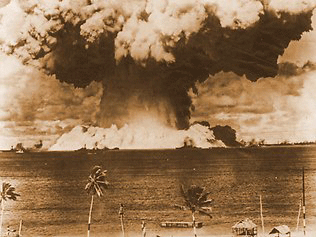
France acknowledges Polynesian islands ‘strong-armed’ into dangerous nuclear tests, Telegraph UK Henry Samuel, Paris, 24 MAY 2019 France has officially acknowledged for the first time that French Polynesians were effectively forced into accepting almost 200 nuclear tests conducted over a 30-year period, and that it is responsible for compensating them for the illnesses caused by the fallout.
The French parliament issued the much-awaited admission in a bill reforming the status of the collectivity of 118 islands in the South Pacific, with MPs saying the change should make it easier for the local population to request compensation for cancer and other illnesses linked to radioactivity.
From 1966 to 1996, France carried out 193 nuclear tests around the paradise islands, including Bora Bora and Tahiti, immortalised by Paul Gauguin. Images of a mushroom cloud over the Moruroa atoll, one of two used as test sites along with Fangataufa, provoked international protests.
Charles De Gaulle and subsequent presidents had thanked French Polynesians for their role in assuring the grandeur of France by allowing it to conduct the tests.
But in the parliamentary bill, France acknowledges that the islands were “called upon” – effectively strong-armed – into accepting the tests for the purposes of “building (its) nuclear deterrent and national defence”.
It also stipulates that the French state will “ensure the maintenance and surveillance of the sites concerned” and “support the economic and structural reconversion of French Polynesia following the cessation of nuclear tests”.
Patrice Bouveret of the Observatoire des armements (Armaments Observatory), an independent organisation that has been assessing the impacts of French nuclear testing in Polynesia since 1984, welcomed the reform.
“It recognises the fact that local people’s health could have been affected and thus the French state’s responsibility in compensating them for such damage. Until now, the entire French discourse was that the tests were ‘clean’ – that was the actual word used – and that they had taken all due precautions for staff and locals.”
However, he said it was a “scandal” that it had taken 23 years for France to officially recognise its responsibility, and said there was nothing in the law on the ill-effects on future generations……. https://www.telegraph.co.uk/news/2019/05/24/france-acknowledges-polynesian-islands-strong-armed-dangerous/
|
|
|
May 25, 2019
Posted by Christina Macpherson |
France, indigenous issues, OCEANIA, weapons and war |
1 Comment

Unusual secrecy around 1950s nuclear testing , The Saturday Paper, Martin McKenzie-Murray 18 May 19 Between 1952 and 1957, Britain tested 12 nuclear weapons in Australia – on the Montebello Islands off the Pilbara coast, and at Maralinga and Emu Fields in the South Australian outback. The tests were hurried, incautious and showed extraordinary disregard for Australian assistance and the local Indigenous people who had been forcibly but imperfectly evacuated from their land.
It was a clusterfuck,” says Elizabeth Tynan, an Australian historian, and the award-winning author of Atomic Thunder: The Maralinga Story. “The disregard was partly driven by the fact they were in a rush. They cut corners. They did it on the cheap – and it showed. They had very little regard for safety. Cavalier. They knew about the risks. There were international protocols. Many were disregarded. I met one man, he was a technician with the British effort in Australia, and he said of Indigenous Australians that they were ‘nothing to do with us – it was the Australian government’s responsibility’.”
For Susanne Roff growing up in Melbourne in the 1950s was uneventful. But later, living in Scotland with her husband, William Roff, an eminent historian, she developed a dogged, almost obsessive interest in this chapter of British history that remains cloaked in secrecy.
Once a month, Roff takes the train south from her home in a Scottish fishing village – to archives in London, Birmingham and Cambridge. She’s still looking for answers. “Why was the purportedly Australia-controlled Atomic Weapons Tests Safety Committee so ineffective?” she asks. “Why was the UK able to continue testing at Maralinga until barely six weeks before opening of the 1956 Olympics despite the known hazards to east coast populations? Why didn’t [Sir Mark] Oliphant ever speak out against the tests and contamination, including when he was governor of South Australia?”
Late last year, Roff had another question: Why, more than 60 years after the last nuclear test in Australia, had the British government suddenly vanished previously declassified documents about the tests from its national archives? Roff wasn’t alone in her surprise. The Campaign for Freedom of Information, a British not-for-profit organisation, described it as worrying.
All that was certain was that the files had been removed on the order of the Nuclear Decommissioning Authority.
“WE CAN BUT WONDER WHY THE WORLD’S THIRD ATOMIC AND THERMONUCLEAR POWER HAS SUDDENLY BECOME SO NERVOUS ABOUT EVENTS THAT HAPPENED DECADES AGO.”“The secrecy is arguably even worse today,” Tynan tells me. She is working on a second book about the British tests. “British service personnel have run into brick walls at every turn [in seeking compensation and acknowledgement]. One of the clues to the attitude of the British government is that it has not really ever properly acknowledged what they did. They were nuclear colonialists and they buggered up a part of our country. One former British personnel I met burst into tears when he thought about how Britain had never said sorry. The secrecy … seems incomprehensible. They continue to be secretive.”
But not all documents are closeted. Susanne Roff has some, which she shared with me – British intelligence files on Dr Eric Burhop, an Australian physicist who had worked on the Manhattan Project, which ran from 1939 to 1946. …….
Robert Menzies agreed to the testing immediately, without bothering to consult cabinet. For a time, only three people in the country knew of the agreement: the prime minister, treasurer and defence minister. He asked few questions of the British. “But it wasn’t pure patriotic sycophancy,” Tynan says of Menzies’ decision. “The pragmatic response was: vast reserves of uranium in Australia. It’s central to weaponry and power. It was completely valueless until the Manhattan Project. Then it became a valuable commodity. Australia had a lot of it. That was a very significant part of his reasoning. The other thing that would’ve informed Menzies’ thinking was that he was anxious to ensure Britain and America would protect Australia.”
They were also without the counsel of the Australians who had worked on the American tests – notably, Mark Oliphant and Eric Burhop. Both Susanne Roff and Elizabeth Tynan agree Oliphant would have been a strong head of the safety authority, which was otherwise feckless.
Both men were long suspected of being Communist spies, and may have been excluded to mollify US doubts about British security. The files on Burhop that I’ve seen are voluminous. The FBI, MI5 and ASIO all had records on him. In England and America, he was aggressively surveilled. His phone was tapped. Even Joseph Rotblat had his doubts about his former colleague. The British intelligence historian Andrew Brown has written: “Rotblat remained convinced that Burhop and other left-wing scientists … opposed the [proposed nuclear] moratorium not for their stated reasons but because it would perpetuate the USA’s monopoly and place the USSR at a dangerous disadvantage.”……
In 1984, Australia held a royal commission into the British tests. It found a litany of negligence and cover-ups. “Britain had to be dragged, kicking and screaming, to it,” Elizabeth Tynan says. Today, their attitude is much the same. In 2015, Fiji – frustrated by Britain’s refusal to compensate its people who suffered radiation poisoning during the Pacific tests – declared it would compensate citizens itself. “We are bringing justice to a brave and proud group of Fijians to whom a great injustice was done,” Fiji’s prime minister said. “Fiji is not prepared to wait for Britain to do the right thing.”
Meanwhile, in Britain’s national archives, the nuclear files are still gone. “The UK government has always [downplayed] risks to the servicemen who took part in the tests, the Aboriginal community in the immediate vicinity of them, and the general population downwind … as well as possible genetic effects on subsequent generations,” Susanne Roff says. “We see similar responses in relation to Fukushima in Japan. All the operational and scientific documents relating to the Australian tests that have been on open access in the National Archives have suddenly gone walkabout. We can but wonder why the world’s third atomic and thermonuclear power has suddenly become so nervous about events that happened decades ago.” https://www.thesaturdaypaper.com.au/news/law-crime/2019/05/18/unusual-secrecy-around-1950s-nuclear-testing/15581016008158
|
|
May 18, 2019
Posted by Christina Macpherson |
AUSTRALIA, history, OCEANIA, politics international, secrets,lies and civil liberties, UK, weapons and war |
Leave a comment
UN secretary-general meets Pacific leaders to discuss ‘global catastrophe’ of climate change ABC By foreign affairs reporter Stephen Dziedzic , 15 May 19
“…….. Key points:
- UN secretary-general Antonio Guterres said the Pacific is on the “front line of climate change”
- Pacific leaders have voiced frustration over Australia’s failure to curb its emissions
- Australian politicians say rapidly cutting emissions would be “ruinous” for Australia
Regional heavyweights had gathered at an historic climate change summit convened with the UN secretary-general Antonio Guterres.
Mr Guterres is intent on building global momentum for sharper cuts to emissions, arguing that drastic action is necessary to stave off ecological disaster.
The Pacific is on the “front line of climate change”, Mr Guterres told the meeting.
“It has a unique moral authority to speak out. It’s time for the world to listen.”
Senior Australian officials at the meeting could do little else; sent in the place of Prime Minister Scott Morrison only days before the federal election, they were bound to observer status by the caretaker conventions.
As a result, Australia did not sign up to the final statement by Pacific leaders, which declared climate change a “global catastrophe” and called for “transformative action” to stop it……
while Pacific leaders have praised New Zealand’s announcement that it wants to go carbon neutral by 2050, many are frustrated that Australia has failed to curb its emissions.
One Pacific official told the ABC the meeting’s call for radical action on climate change “really was aimed at the whole globe” but “for those in the room [it] was a message for one country”.
“Of course no-one said Australia. No-one needed to say Australia,” the official said. “What other country in the room could we be referring to?”
The outspoken Prime Minister of Samoa, Tuilaepa Sailele, went much further, wading straight into Australia’s election campaign during the post-summit press conference…….
decision makers in Canberra also know that the Pacific is increasingly impatient about Australia’s long and painful debate on climate policy.
The argument will flare up again in only months when regional leaders gather for the Pacific Islands Forum on tiny Tuvalu, which has long been a vocal champion for drastic climate action.
And this time, Australia will not be sitting on the sidelines. https://www.abc.net.au/news/2019-05-16/guterres-antonio-un-pacific-meeting-climate-change/11115816
May 16, 2019
Posted by Christina Macpherson |
AUSTRALIA, climate change, OCEANIA, politics international |
Leave a comment







 nuclear-news